BHARTIYEAYURVEDICPHARMACY
Products
08048126861
919711305254
Chat with us


Chat with us on WhatsApp
×
This is your website preview.
Currently it only shows your basic business info. Start adding relevant business details such as description, images and products or services to gain your customers attention by using Boost 360 android app / iOS App / web portal.
Home
 warm nature
 warm nature
Items tagged with 'warm nature'
{
"products": [
{
"_id": "6a0d871a8613ca78d7401948",
"fptag": "BHARTIYEAYURVEDICPHARMACY",
"merchantname": null,
"customwidgets": null,
"externalsourceid": null,
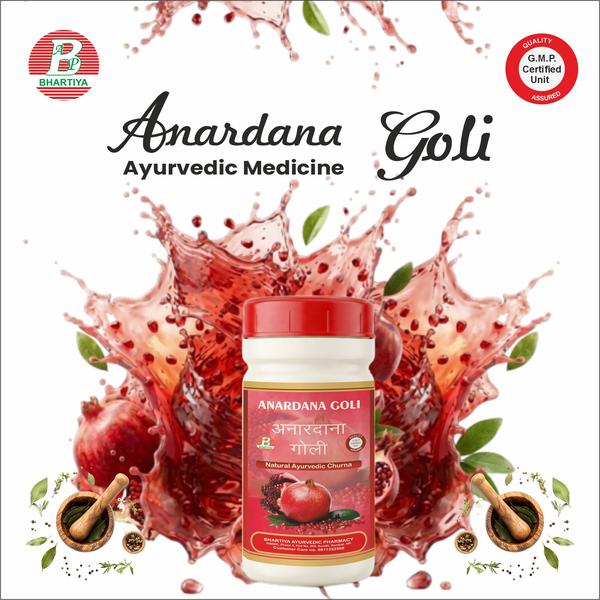
"name": "Anardana Goli",
"description": " ANARDANA GOLI \n\nProduct Identification\n•\tGeneric Name: Anardana Goli\n•\tType: Ayurvedic Patent Medicine\n•\tPrimary Indication Area: Improves digestion and stimulates appetite.\n•\tTherapeutic Indications: Helps improve digestion, increase appetite, boost vitality, and reduce weakness.\n\nKey benefits include:\n1. Digestive Support\n•\tAnardana Goli contains ingredients that are considered “Agnivardhaka” in Ayurveda, meaning they strengthen digestive fire (Agni).\n•\tStrong digestive fire ensures that food is properly broken down and nutrients are absorbed efficiently.\n•\tImproved digestion reduces issues like bloating, heaviness, or indigestion, which often suppress appetite.\n2. Appetite Stimulation\n•\tBy improving digestion, the body naturally signals hunger, leading to better appetite.\n•\tIt helps people who have poor appetite due to weakness, stress, or overexertion.\n•\tRegular use may lead to steady and healthy hunger cues, making it easier to eat balanced meals.\n3. Additional Benefits Linked to Digestion & Appetite\n•\tIncreased nutrient absorption → more energy and stamina\n•\tReduced digestive discomfort → enhanced overall well-being\n•\tSupports healthy metabolism, which can maintain proper body weight and vitality\n\nIngredients:\n Anardana \nBotanical Name: Punica granatum\nCommon Names: Anardana (India), Dried Pomegranate Seeds\n\nKey Nutrients / Phytochemicals\n•\tPolyphenols (punicalagins, ellagic acid) – potent antioxidants\n•\tVitamins: Vitamin C, some B-complex vitamins\n•\tMinerals: Potassium, iron, calcium, magnesium\n•\tFiber\n•\tStimulation of Digestive Enzymes\no\tOrganic acids in Anardana (like citric and malic acid) stimulate the secretion of saliva, gastric juices, and pancreatic enzymes.\no\tThis improves breakdown of food, especially proteins and fats.\n•\tEnhancement of Agni (Digestive Fire)\no\tIn Ayurvedic terms, Anardana strengthens Agni, helping proper digestion, nutrient absorption, and assimilation.\n•\tCarminative Effect\no\tReduces gas formation and bloating.\no\tThe mild aromatic compounds help relax intestinal muscles and aid smooth digestion.\n•\tMild Laxative & Stool Softening\no\tDietary fiber in Anardana adds bulk to stool.\no\tHelps in preventing constipation and promoting regular bowel movements.\n•\tReduction of Acidity & Indigestion\no\tOrganic acids balance stomach pH.\no\tHelps prevent fermentation of undigested food, reducing acidity, heartburn, and bloating.\n\n\n Kala Namak (Black Salt) \nBotanical/Source Name: Naturally occurring rock salt, mainly from the Himalayan region (mineral salt, not plant-based).\nCommon Names: Black Salt, Himalayan Black Salt, Kala Namak\n\nKey Constituents / Components\n•\tSodium chloride (NaCl) – main component\n•\tIron sulphide (gives the characteristic dark colour and sulphurous smell)\n•\tTrace minerals: potassium, magnesium, calcium, sulfur compounds\n\nDigestive Mechanism of Action\n1.\tStimulation of Digestive Enzymes & Saliva\no\tThe sulfur compounds and salts in Kala Namak stimulate salivary glands and gastric juices, improving breakdown of food.\no\tEnhances enzyme activity in the stomach, especially for protein digestion.\n2.\tEnhancement of Agni (Digestive Fire)\no\tIn Ayurveda, Kala Namak is considered Ushna (hot in potency) and Deepana (enhances Agni).\no\tPromotes proper digestion, assimilation of nutrients, and prevents Aama (undigested toxins) formation.\n3.\tCarminative & Gas-Relieving Effect\no\tHelps reduce flatulence, bloating, and heaviness in the stomach.\no\tMild action on intestinal muscles supports smooth movement of food.\n4.\tMild Laxative / Gut-Regulating Effect\no\tSupports bowel regularity in small doses.\no\tCan reduce constipation and improve stool consistency.\n5.\tAcidity & Heartburn Relief\no\tUnlike regular salt, Kala Namak neutralizes excess stomach acid due to its unique mineral composition.\no\tHelps maintain pH balance in the stomach, reducing acidity-related discomfort.\n\n Kali Mirch (Black Pepper) \nBotanical Name: Piper nigrum\nCommon Names: Black Pepper, Kali Mirch\n\nKey Phytochemicals\n•\tPiperine – main active compound, gives pungency\n•\tEssential oils (limonene, pinene) – contribute to digestive and carminative effects\n•\tAlkaloids and trace minerals\n\nDigestive Mechanism of Action\n1.\tStimulation of Digestive Enzymes\no\tPiperine in black pepper stimulates the secretion of saliva, gastric juices, bile, and pancreatic enzymes.\no\tEnhances breakdown and absorption of proteins, fats, and carbohydrates.\n2.\tEnhancement of Agni (Digestive Fire)\no\tIn Ayurveda, Kali Mirch is Ushna (hot) and Laghu (light), enhancing Agni.\no\tHelps in digestion of heavy or oily foods and prevents Aama (undigested toxins).\n3.\tCarminative Effect\no\tReduces gas formation, bloating, and flatulence.\no\tHelps relax intestinal muscles and improve bowel movement.\n4.\tImproved Nutrient Absorption\no\tPiperine enhances bioavailability of nutrients and other herbs.\no\tSupports efficient absorption of fat-soluble vitamins and minerals.\n5.\tGut Motility & Mild Laxative Action\no\tStimulates peristalsis, aiding smooth bowel movements.\no\tHelps prevent mild constipation.\n\n Amchur (Dried Mango Powder) \nBotanical Name: Mangifera indica (unripe mango)\nCommon Names: Amchur, Amchoor, Mango Powder\n\nKey Phytochemicals / Nutrients\n•\tOrganic acids: citric acid, malic acid, tartaric acid – provide sour taste\n•\tPolyphenols and flavonoids – antioxidant effect\n•\tVitamins: Vitamin C, small amounts of B-complex\n•\tMinerals: Potassium, magnesium\n\nDigestive Mechanism of Action\n1.\tStimulation of Digestive Enzymes\no\tOrganic acids in Amchur stimulate salivary and gastric secretions, enhancing breakdown of carbohydrates, proteins, and fats.\n2.\tEnhancement of Agni (Digestive Fire)\no\tIn Ayurveda, Amchur is Deepana (stimulates Agni) and Pachana (aids digestion).\no\tHelps digest heavy, oily, or kapha-aggravating foods.\n3.\tCarminative Effect\no\tReduces gas formation, bloating, and flatulence due to its sour and slightly astringent properties.\no\tSupports smooth movement of food in the intestines.\n4.\tAppetizer & Acid-Balancer\no\tImproves appetite by enhancing taste and stimulating digestive secretions.\no\tBalances mild acidity due to regulation of gastric pH.\n5.\tMild Laxative / Gut-Regulating Effect\no\tSlightly promotes bowel movements due to its fiber content and organic acids.\n Namak (Common Salt / Table Salt) \nChemical Composition: Mainly Sodium Chloride (NaCl)\nOther Components: Trace minerals (depending on source)\n\nDigestive Mechanism of Action\n1.\tStimulation of Digestive Secretions\no\tSalt stimulates salivary glands, promoting saliva production.\no\tIncreases secretion of gastric juices, which helps in breaking down food, especially proteins.\n2.\tEnhancement of Agni (Digestive Fire)\no\tIn Ayurveda, small amounts of salt are Deepana (stimulate Agni), aiding digestion and assimilation of nutrients.\n3.\tElectrolyte Balance\no\tMaintains osmotic balance in the gut, helping smooth movement of food through intestines.\n4.\tMild Appetite Stimulant\no\tImproves taste perception, which indirectly encourages better digestion by promoting chewing and salivation.\n5.\tGut Motility Support\no\tHelps maintain water balance in intestines, preventing constipation and aiding smooth bowel movements in normal amounts.\n\n Pippali (Long Pepper) \nBotanical Name: Piper longum\nCommon Names: Pippali, Long Pepper\n\nKey Phytochemicals\n•\tPiperine – main pungent compound\n•\tEssential oils – contribute to digestive and carminative effects\n•\tAlkaloids and volatile oils\n\nDigestive Mechanism of Action\n1.\tStimulation of Digestive Enzymes\no\tPiperine and essential oils stimulate secretion of saliva, gastric juices, and pancreatic enzymes.\no\tEnhances digestion of proteins, fats, and carbohydrates.\n2.\tEnhancement of Agni (Digestive Fire)\no\tIn Ayurveda, Pippali is Ushna (hot), Laghu (light), and Deepana (stimulates Agni).\no\tHelps digest heavy, kapha-aggravating foods and prevents formation of Aama (toxins from undigested food).\n3.\tCarminative Effect\no\tReduces bloating, gas formation, and flatulence.\no\tRelaxes intestinal muscles, aiding smooth movement of food.\n4.\tAppetite Stimulant\no\tImproves taste perception and digestive excitement, which indirectly enhances nutrient breakdown and assimilation.\n5.\tGut Motility & Mild Laxative Action\no\tStimulates peristalsis, supporting regular bowel movements.\no\tMildly laxative in nature, helps prevent constipation\n\n Gulkand (Rose Petal Preserve) \nBotanical Name: Rosa damascena (Damask Rose)\nCommon Names: Gulkand, Rose Petal Preserve\n\nKey Constituents / Phytochemicals\n•\tNatural sugars (from rose petals and sugar) – provide mild energy\n•\tFlavonoids and phenolic compounds – antioxidants\n•\tVolatile oils – aromatic and carminative properties\n•\tTrace minerals: iron, calcium\n\nDigestive Mechanism of Action\n1.\tEnhancement of Agni (Digestive Fire)\no\tGulkand is Deepana (stimulates digestion) and Pachana (aids digestion of heavy foods) in Ayurveda.\no\tHelps digest fatty or heavy meals and reduces formation of Aama (undigested toxins).\n2.\tCarminative Effect\no\tAromatic compounds and rose oils reduce gas, bloating, and flatulence.\no\tHelps smooth intestinal motility.\n3.\tCooling Digestive Tonic\no\tBalances Pitta and excess heat in the digestive tract while supporting digestion.\no\tMildly soothing for acidity and hyperacidity.\n4.\tAppetite Stimulant\no\tSweet taste and aroma improve appetite, increasing salivation and digestive enzyme secretion.\n5.\tGut-Regulating Effect\no\tSugar content provides mild bulk and energy for smooth bowel movement.\no\tMay prevent constipation in moderate use.\n\n Sugar (Sharkara / Saccharose / Table Sugar) \nChemical Composition: Mainly Sucrose (C12H22O11)\nSource: Sugarcane, sugar beet\n\nDigestive Mechanism of Action\n1.\tEnergy Source for Digestion\no\tSugar provides readily available glucose, which supplies quick energy for metabolic processes, including the digestive system.\n2.\tStimulation of Saliva & Taste\no\tSweet taste stimulates salivation, which begins pre-digestion of carbohydrates.\no\tEnhances the appetite indirectly by making food more palatable.\n3.\tMild Laxative / Gut-Regulating Effect (in moderate amounts)\no\tSugar can retain water in the intestines, softening stool slightly and supporting bowel movement.\n4.\tEnhancement of Digestive Enzyme Activity\no\tSimple sugars can activate carbohydrate-digesting enzymes (amylase) in saliva and pancreas.\n5.\tCooling Effect (in Ayurveda)\no\tSugar is considered Shita (cooling), which can soothe Pitta-related digestive irritation (like mild acidity).\n\n\n AMLA (Amalaki) \n1.\tDose:\no\t2–3 goli (tablets/lozenges) three times a day.\n2.\tTiming:\no\tTake after meals (breakfast, lunch, and dinner).\n3.\tMode of Intake:\no\tChew or slowly suck the goli for better digestive effect.\no\tCan be taken with lukewarm water if needed.\n4.\tPurpose:\no\tImproves digestion.\no\tReduces bloating, gas, and mild acidity.\n5.\tPrecautions:\no\tDo not take on an empty stomach.\no\tPeople with diabetes should monitor blood sugar.\no\tAvoid excessive intake to prevent loose stools or acidity.\n6.\tDuration:\no\tCan be used safely for 1–2 months or as advised by an Ayurvedic practitioner.\n\n\n\nanardana goli benefits, anardana goli benefits in hindi\nanardana goli khane ke fayde, anardana goli uses\nanardana goli ingredients, anardana goli recipe\nanardana goli amazon, anardana goli at home\nhow to make anardana goli at home, ayurvedic anardana goli\nwhat is anardana goli, is anardana goli good for health\nanardana goli buy online, anardana goli bottle\nanardana goli buy, anardana churan benefits\nanardana goli calories, anardana goli candy\nanardana goli contents, anardana chatpati goli\ncalories in anardana churan, anardana goli red colour\nanardana goli digestive, anardana goli dosage\nanardana goli in english, anardana goli for digestion\nanardana goli flipkart, anardana goli for kids\nanardana goli nutritional facts, anardana goli used for\nanardana goli gst rate, anardana churan goliyan\nanardana goli how to use, anardana goli health benefits\nanardana goli hindi, anardana churan hsn code\nis anardana goli healthy, anardana goli kya hota hai\nanardana goli in pregnancy, anardana goli india\nanardana goli indiamart, anardana goli in hindi\nanardana churan in pregnancy, anardana goli jiomart\nanardana goli jar, anardana goli kaise banti hai\nanardana goli kaise banate hain, anardana goli khatta meetha\nanardana ki goli, anardana churan ke fayde, anardana churan kaise banta hai\nanardana goli manufacturers, anardana goli making machine\nanardana goli manufacturers in india, anardana goli making\nanardana goli near me, anardana churan near me\nanardana goli shop near me, anardana churan online\nbuy anardana goli online, anardana goli pouch\nanardana goli powder, anardana goli price per kg\nanardana goli quantity, anardana goli qr code\nanardana goli q10, anardana goli qartulad\nanardana goli red, anardana churan recipe\njeera goli red, anardana churan recipe in hindi\nanardana churan goli recipe, anardana goli shadani\nanardana goli taste, anardana goli tablet\nanardana goli uses in hindi, anardana goli uses malayalam\nanardana churan uses, anardana goli kaise banaen\nanardana goli wholesale market, anardana goli wholesale\nanardana goli wholesale price, best anardana goli in india\nbenefits of eating anardana goli, why anardana goli healthy\nwhy anardana goli good for health, why anardana goli means\nwhy anardana goli good for digestion, who anardana goli price\nwho anardana goli in delhi, who anardana goli in a day\nwho anardana goli kaise banate hain, who anardana goli kaise banti hai\nwho anardana goli banane ka tarika, who anardana goli means\nwho anardana goli is made, who anardana goli good for health\nbest anardana goli brand, best anardana churan\nbest anardana brand",
"price": 108.0,
"discountamount": 54.0,
"currencycode": "INR",
"priority": 1000000,
"isfreeshipmentavailable": false,
"shipmentduration": 1,
"_keywords": null,
"isarchived": false,
"isavailable": true,
"applicationid": null,
"productindex": 125,
"imageuri": "https://productimages.withfloats.com/actual/6a0d871d881b69a5d83cfec8.jpg",
"tileimageuri": "https://productimages.withfloats.com/tile/6a0d871d881b69a5d83cfec8.jpg",
"images": null,
"totalqueries": 0,
"gpid": null,
"groupproductid": null,
"createdon": "2026-05-20T10:04:10.77Z",
"updatedon": "2026-05-20T10:04:10.77Z",
"buyonlinelink": null,
"producturl": "http://WWW.BHARTIYAAYURVEDICPHARMACY.COM/products/anardana-goli/125",
"availableunits": -1.0,
"iscodavailable": true,
"isprepaidonlineavailable": true,
"maxcodorders": -1,
"maxprepaidonlineorders": -1,
"uniquepaymenturl": null,
"brandname": "Bakula Fort",
"category": "Anardana Goli 100 GM X 40",
"tags": [],
"variants": false,
"keyspecification": null,
"otherspecifications": null,
"pickupaddressreferenceid": null,
"paymenttype": "AssuredPurchase",
"producttype": "products",
"hsncode": null,
"gstslab": 0.0,
"isnotforsale": false
},
{
"_id": "6a0d472f21349ee368625e5d",
"fptag": "BHARTIYEAYURVEDICPHARMACY",
"merchantname": null,
"customwidgets": null,
"externalsourceid": null,
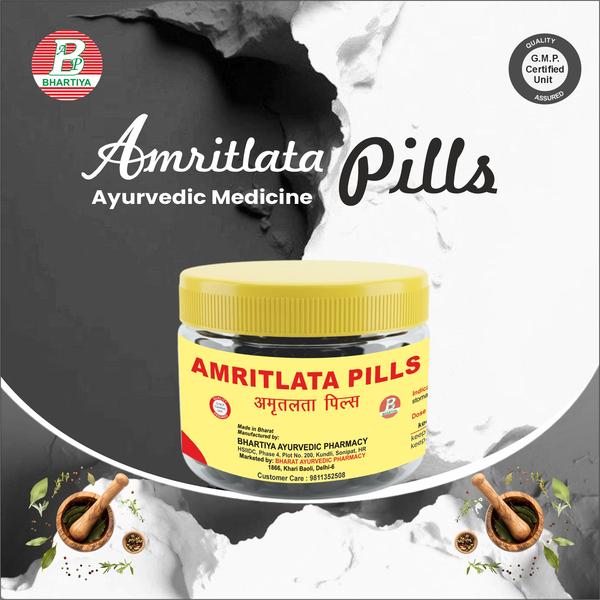
"name": "Amritlata Pill",
"description": " ANARDANA GOLI \n\nProduct Identification\n•\tGeneric Name: Anardana Goli\n•\tType: Ayurvedic Patent Medicine\n•\tPrimary Indication Area: Improves digestion and stimulates appetite.\n•\tTherapeutic Indications: Helps improve digestion, increase appetite, boost vitality, and reduce weakness.\n\nKey benefits include:\n1. Digestive Support\n•\tAnardana Goli contains ingredients that are considered “Agnivardhaka” in Ayurveda, meaning they strengthen digestive fire (Agni).\n•\tStrong digestive fire ensures that food is properly broken down and nutrients are absorbed efficiently.\n•\tImproved digestion reduces issues like bloating, heaviness, or indigestion, which often suppress appetite.\n2. Appetite Stimulation\n•\tBy improving digestion, the body naturally signals hunger, leading to better appetite.\n•\tIt helps people who have poor appetite due to weakness, stress, or overexertion.\n•\tRegular use may lead to steady and healthy hunger cues, making it easier to eat balanced meals.\n3. Additional Benefits Linked to Digestion & Appetite\n•\tIncreased nutrient absorption → more energy and stamina\n•\tReduced digestive discomfort → enhanced overall well-being\n•\tSupports healthy metabolism, which can maintain proper body weight and vitality\n\nIngredients:\n Anardana \nBotanical Name: Punica granatum\nCommon Names: Anardana (India), Dried Pomegranate Seeds\n\nKey Nutrients / Phytochemicals\n•\tPolyphenols (punicalagins, ellagic acid) – potent antioxidants\n•\tVitamins: Vitamin C, some B-complex vitamins\n•\tMinerals: Potassium, iron, calcium, magnesium\n•\tFiber\n•\tStimulation of Digestive Enzymes\no\tOrganic acids in Anardana (like citric and malic acid) stimulate the secretion of saliva, gastric juices, and pancreatic enzymes.\no\tThis improves breakdown of food, especially proteins and fats.\n•\tEnhancement of Agni (Digestive Fire)\no\tIn Ayurvedic terms, Anardana strengthens Agni, helping proper digestion, nutrient absorption, and assimilation.\n•\tCarminative Effect\no\tReduces gas formation and bloating.\no\tThe mild aromatic compounds help relax intestinal muscles and aid smooth digestion.\n•\tMild Laxative & Stool Softening\no\tDietary fiber in Anardana adds bulk to stool.\no\tHelps in preventing constipation and promoting regular bowel movements.\n•\tReduction of Acidity & Indigestion\no\tOrganic acids balance stomach pH.\no\tHelps prevent fermentation of undigested food, reducing acidity, heartburn, and bloating.\n\n\n Kala Namak (Black Salt) \nBotanical/Source Name: Naturally occurring rock salt, mainly from the Himalayan region (mineral salt, not plant-based).\nCommon Names: Black Salt, Himalayan Black Salt, Kala Namak\n\nKey Constituents / Components\n•\tSodium chloride (NaCl) – main component\n•\tIron sulphide (gives the characteristic dark colour and sulphurous smell)\n•\tTrace minerals: potassium, magnesium, calcium, sulfur compounds\n\nDigestive Mechanism of Action\n1.\tStimulation of Digestive Enzymes & Saliva\no\tThe sulfur compounds and salts in Kala Namak stimulate salivary glands and gastric juices, improving breakdown of food.\no\tEnhances enzyme activity in the stomach, especially for protein digestion.\n2.\tEnhancement of Agni (Digestive Fire)\no\tIn Ayurveda, Kala Namak is considered Ushna (hot in potency) and Deepana (enhances Agni).\no\tPromotes proper digestion, assimilation of nutrients, and prevents Aama (undigested toxins) formation.\n3.\tCarminative & Gas-Relieving Effect\no\tHelps reduce flatulence, bloating, and heaviness in the stomach.\no\tMild action on intestinal muscles supports smooth movement of food.\n4.\tMild Laxative / Gut-Regulating Effect\no\tSupports bowel regularity in small doses.\no\tCan reduce constipation and improve stool consistency.\n5.\tAcidity & Heartburn Relief\no\tUnlike regular salt, Kala Namak neutralizes excess stomach acid due to its unique mineral composition.\no\tHelps maintain pH balance in the stomach, reducing acidity-related discomfort.\n\n Kali Mirch (Black Pepper) \nBotanical Name: Piper nigrum\nCommon Names: Black Pepper, Kali Mirch\n\nKey Phytochemicals\n•\tPiperine – main active compound, gives pungency\n•\tEssential oils (limonene, pinene) – contribute to digestive and carminative effects\n•\tAlkaloids and trace minerals\n\nDigestive Mechanism of Action\n1.\tStimulation of Digestive Enzymes\no\tPiperine in black pepper stimulates the secretion of saliva, gastric juices, bile, and pancreatic enzymes.\no\tEnhances breakdown and absorption of proteins, fats, and carbohydrates.\n2.\tEnhancement of Agni (Digestive Fire)\no\tIn Ayurveda, Kali Mirch is Ushna (hot) and Laghu (light), enhancing Agni.\no\tHelps in digestion of heavy or oily foods and prevents Aama (undigested toxins).\n3.\tCarminative Effect\no\tReduces gas formation, bloating, and flatulence.\no\tHelps relax intestinal muscles and improve bowel movement.\n4.\tImproved Nutrient Absorption\no\tPiperine enhances bioavailability of nutrients and other herbs.\no\tSupports efficient absorption of fat-soluble vitamins and minerals.\n5.\tGut Motility & Mild Laxative Action\no\tStimulates peristalsis, aiding smooth bowel movements.\no\tHelps prevent mild constipation.\n\n Amchur (Dried Mango Powder) \nBotanical Name: Mangifera indica (unripe mango)\nCommon Names: Amchur, Amchoor, Mango Powder\n\nKey Phytochemicals / Nutrients\n•\tOrganic acids: citric acid, malic acid, tartaric acid – provide sour taste\n•\tPolyphenols and flavonoids – antioxidant effect\n•\tVitamins: Vitamin C, small amounts of B-complex\n•\tMinerals: Potassium, magnesium\n\nDigestive Mechanism of Action\n1.\tStimulation of Digestive Enzymes\no\tOrganic acids in Amchur stimulate salivary and gastric secretions, enhancing breakdown of carbohydrates, proteins, and fats.\n2.\tEnhancement of Agni (Digestive Fire)\no\tIn Ayurveda, Amchur is Deepana (stimulates Agni) and Pachana (aids digestion).\no\tHelps digest heavy, oily, or kapha-aggravating foods.\n3.\tCarminative Effect\no\tReduces gas formation, bloating, and flatulence due to its sour and slightly astringent properties.\no\tSupports smooth movement of food in the intestines.\n4.\tAppetizer & Acid-Balancer\no\tImproves appetite by enhancing taste and stimulating digestive secretions.\no\tBalances mild acidity due to regulation of gastric pH.\n5.\tMild Laxative / Gut-Regulating Effect\no\tSlightly promotes bowel movements due to its fiber content and organic acids.\n Namak (Common Salt / Table Salt) \nChemical Composition: Mainly Sodium Chloride (NaCl)\nOther Components: Trace minerals (depending on source)\n\nDigestive Mechanism of Action\n1.\tStimulation of Digestive Secretions\no\tSalt stimulates salivary glands, promoting saliva production.\no\tIncreases secretion of gastric juices, which helps in breaking down food, especially proteins.\n2.\tEnhancement of Agni (Digestive Fire)\no\tIn Ayurveda, small amounts of salt are Deepana (stimulate Agni), aiding digestion and assimilation of nutrients.\n3.\tElectrolyte Balance\no\tMaintains osmotic balance in the gut, helping smooth movement of food through intestines.\n4.\tMild Appetite Stimulant\no\tImproves taste perception, which indirectly encourages better digestion by promoting chewing and salivation.\n5.\tGut Motility Support\no\tHelps maintain water balance in intestines, preventing constipation and aiding smooth bowel movements in normal amounts.\n\n Pippali (Long Pepper) \nBotanical Name: Piper longum\nCommon Names: Pippali, Long Pepper\n\nKey Phytochemicals\n•\tPiperine – main pungent compound\n•\tEssential oils – contribute to digestive and carminative effects\n•\tAlkaloids and volatile oils\n\nDigestive Mechanism of Action\n1.\tStimulation of Digestive Enzymes\no\tPiperine and essential oils stimulate secretion of saliva, gastric juices, and pancreatic enzymes.\no\tEnhances digestion of proteins, fats, and carbohydrates.\n2.\tEnhancement of Agni (Digestive Fire)\no\tIn Ayurveda, Pippali is Ushna (hot), Laghu (light), and Deepana (stimulates Agni).\no\tHelps digest heavy, kapha-aggravating foods and prevents formation of Aama (toxins from undigested food).\n3.\tCarminative Effect\no\tReduces bloating, gas formation, and flatulence.\no\tRelaxes intestinal muscles, aiding smooth movement of food.\n4.\tAppetite Stimulant\no\tImproves taste perception and digestive excitement, which indirectly enhances nutrient breakdown and assimilation.\n5.\tGut Motility & Mild Laxative Action\no\tStimulates peristalsis, supporting regular bowel movements.\no\tMildly laxative in nature, helps prevent constipation\n\n Gulkand (Rose Petal Preserve) \nBotanical Name: Rosa damascena (Damask Rose)\nCommon Names: Gulkand, Rose Petal Preserve\n\nKey Constituents / Phytochemicals\n•\tNatural sugars (from rose petals and sugar) – provide mild energy\n•\tFlavonoids and phenolic compounds – antioxidants\n•\tVolatile oils – aromatic and carminative properties\n•\tTrace minerals: iron, calcium\n\nDigestive Mechanism of Action\n1.\tEnhancement of Agni (Digestive Fire)\no\tGulkand is Deepana (stimulates digestion) and Pachana (aids digestion of heavy foods) in Ayurveda.\no\tHelps digest fatty or heavy meals and reduces formation of Aama (undigested toxins).\n2.\tCarminative Effect\no\tAromatic compounds and rose oils reduce gas, bloating, and flatulence.\no\tHelps smooth intestinal motility.\n3.\tCooling Digestive Tonic\no\tBalances Pitta and excess heat in the digestive tract while supporting digestion.\no\tMildly soothing for acidity and hyperacidity.\n4.\tAppetite Stimulant\no\tSweet taste and aroma improve appetite, increasing salivation and digestive enzyme secretion.\n5.\tGut-Regulating Effect\no\tSugar content provides mild bulk and energy for smooth bowel movement.\no\tMay prevent constipation in moderate use.\n\n Sugar (Sharkara / Saccharose / Table Sugar) \nChemical Composition: Mainly Sucrose (C12H22O11)\nSource: Sugarcane, sugar beet\n\nDigestive Mechanism of Action\n1.\tEnergy Source for Digestion\no\tSugar provides readily available glucose, which supplies quick energy for metabolic processes, including the digestive system.\n2.\tStimulation of Saliva & Taste\no\tSweet taste stimulates salivation, which begins pre-digestion of carbohydrates.\no\tEnhances the appetite indirectly by making food more palatable.\n3.\tMild Laxative / Gut-Regulating Effect (in moderate amounts)\no\tSugar can retain water in the intestines, softening stool slightly and supporting bowel movement.\n4.\tEnhancement of Digestive Enzyme Activity\no\tSimple sugars can activate carbohydrate-digesting enzymes (amylase) in saliva and pancreas.\n5.\tCooling Effect (in Ayurveda)\no\tSugar is considered Shita (cooling), which can soothe Pitta-related digestive irritation (like mild acidity).\n\n\n AMLA (Amalaki) \n1.\tDose:\no\t2–3 goli (tablets/lozenges) three times a day.\n2.\tTiming:\no\tTake after meals (breakfast, lunch, and dinner).\n3.\tMode of Intake:\no\tChew or slowly suck the goli for better digestive effect.\no\tCan be taken with lukewarm water if needed.\n4.\tPurpose:\no\tImproves digestion.\no\tReduces bloating, gas, and mild acidity.\n5.\tPrecautions:\no\tDo not take on an empty stomach.\no\tPeople with diabetes should monitor blood sugar.\no\tAvoid excessive intake to prevent loose stools or acidity.\n6.\tDuration:\no\tCan be used safely for 1–2 months or as advised by an Ayurvedic practitioner.\n\n\n\namritlata pills price, amritlata pills price in india, amritlata pills amazon\namritlata pills amazon india, amritlata pills amazon price, amritlata pills buy online\namritlata pills buy, amritlata pills bottle, amritlata pills buy online india\namritlata pills company, amritlata pills cost, amritlata pills cost in india\namritlata pills cost price, amritlata pills company details\namritlata pills delhi, amritlata pills english name, amritlata pills english\namritlata pills flipkart, amritlata pills for sale, amritlata pills gst number\namritlata pills gst rate, amritlata pills gst, amritlata pills hindi, amritlata pills himachal pradesh\namritlata pills in hindi, amritlata pills image, amritlata pills indiamart\namritlata pills journal, amritlata pills ke fayde, amritlata pills ke fayde in hindi\namritlata pills kya hai in hindi, amritlata pills linkedin, amritlata pills list\namritlata pills life, amritlata pills manufacturer, amritlata pills manufacturers in india\namritlata pills narela, amritlata pills online shopping, amritlata pills online\namritlata pills online order, amritlata pills quantity, amritlata pills q10\namritlata pills review, amritlata pills rate, amritlata pills supplier\namritlata pills supplier in delhi, amritlata pills tablet, amritlata pills uses\namritlata pills vs, amritlata pills wholesale, amritlata pills wholesale price\namritlata pills zepto, top amritlata pills price in india",
"price": 330.0,
"discountamount": 165.0,
"currencycode": "INR",
"priority": 1000000,
"isfreeshipmentavailable": false,
"shipmentduration": 1,
"_keywords": null,
"isarchived": false,
"isavailable": true,
"applicationid": null,
"productindex": 124,
"imageuri": "https://productimages.withfloats.com/actual/6a0d47311c6b4360d8faaff4.jpg",
"tileimageuri": "https://productimages.withfloats.com/tile/6a0d47311c6b4360d8faaff4.jpg",
"images": null,
"totalqueries": 0,
"gpid": null,
"groupproductid": null,
"createdon": "2026-05-20T05:31:27.893Z",
"updatedon": "2026-05-20T05:31:27.893Z",
"buyonlinelink": null,
"producturl": "http://WWW.BHARTIYAAYURVEDICPHARMACY.COM//amritlata-pill/124",
"availableunits": -1.0,
"iscodavailable": true,
"isprepaidonlineavailable": true,
"maxcodorders": -1,
"maxprepaidonlineorders": -1,
"uniquepaymenturl": null,
"brandname": "Bakula Fort",
"category": "Amritlata Pill 100 GM X 40",
"tags": [],
"variants": false,
"keyspecification": null,
"otherspecifications": null,
"pickupaddressreferenceid": null,
"paymenttype": "AssuredPurchase",
"producttype": "products",
"hsncode": null,
"gstslab": 0.0,
"isnotforsale": false
},
{
"_id": "69e08903ef2bb462c498463f",
"fptag": "BHARTIYEAYURVEDICPHARMACY",
"merchantname": null,
"customwidgets": null,
"externalsourceid": null,
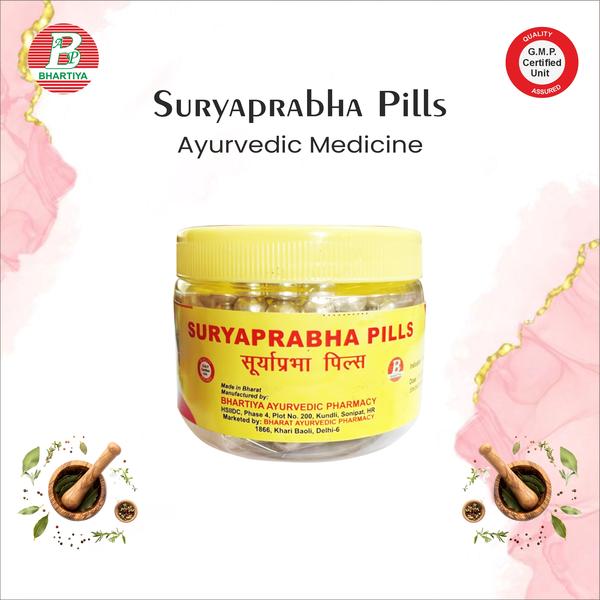
"name": "SURYAPRABHA PILLS",
"description": " SURYAPRABHA PILLS (SILVER COATED) \n\nProduct Identification\n•\tGeneric Name: Suryaprabha Pills\n•\tType: Ayurvedic Patent Medicine\n•\tPrimary Indication Area: Diabetes (Prameha / Blood Sugar Imbalance)\nTherapeutic Indications: The management of diabetes (Prameha / high blood sugar) and to support metabolic health, digestive strength, and overall vitality.\n\nKey benefits include:\n•\tBlood Sugar Support: Helps maintain healthy glucose levels.\n•\tDigestive & Metabolic Support: Enhances digestion, nutrient absorption, and metabolism.\n•\tPancreatic & Liver Health: Supports proper insulin function and detoxification.\n•\tStamina & Vitality: Helps combat fatigue and weakness associated with diabetes.\n•\tRasayana (Rejuvenation): Supports overall tissue nourishment and long-term health.\n\nIngredients:\n Giloy (Tinospora cordifolia) \nAyurvedic Name: Giloy / Guduchi\nPrimary Uses in Diabetes: Helps regulate blood glucose, improves insulin sensitivity, and protects organs from diabetic complications.\nKey Phytoconstituents\n•\tAlkaloids (e.g., berberine, magnoflorine)\n•\tDiterpenoid lactones (e.g., Tinosporide)\n•\tGlycosides\n•\tFlavonoids\n•\tSteroids\n•\tPolysaccharides\nThese compounds contribute to its antidiabetic, antioxidant, and immunomodulatory effects.\nMechanism of Action in Diabetes\n1. Insulin Sensitization & Secretion\n•\tGiloy stimulates pancreatic beta cells → increases insulin secretion.\n•\tImproves insulin receptor sensitivity on target tissues (muscle and adipose), enhancing glucose uptake.\n•\tAlkaloids like berberine mimic insulin action by activating AMPK pathway, which helps lower blood glucose.\n2. Carbohydrate Metabolism Regulation\n•\tModulates key enzymes:\no\tIncreases glucokinase activity → promotes glucose utilization in the liver.\no\tInhibits glucose-6-phosphatase & fructose-1,6-bisphosphatase → reduces hepatic gluconeogenesis.\n•\tThis leads to lower fasting and postprandial blood glucose.\n\nHaldi / Turmeric (Curcuma longa) \nAyurvedic Name: Haridra / Haldi\nPrimary Uses: Anti-inflammatory, antioxidant, digestive support, liver protection, and metabolic health (including blood sugar support).\nKey Phytoconstituents\n•\tCurcuminoids: Curcumin (major active compound), desmethoxycurcumin, bisdemethoxycurcumin\n•\tVolatile oils: Turmerone, zingiberene, atlantone\n•\tProteins & sugars\n•\tMinerals: Iron, calcium\nBiochemical & Pharmacological Actions\n1. Anti-inflammatory\n•\tCurcumin inhibits NF-κB pathway, reducing pro-inflammatory cytokines: TNF-α, IL-1β, IL-6.\n•\tSuppresses COX-2 and LOX enzymes, reducing prostaglandin and leukotriene production.\n•\tHelps in arthritis, inflammation, and chronic metabolic inflammation.\n2. Antioxidant\n•\tCurcumin neutralizes free radicals (ROS and RNS).\n•\tUpregulates endogenous antioxidant enzymes: SOD, catalase, glutathione peroxidase.\n•\tProtects tissues (liver, pancreas, kidneys, and heart) from oxidative stress.\n\nAtis (Aconitum heterophyllum) \nPrimary Role in Diabetes (Ayurvedic / Biochemical Basis):\nAtis is considered a mild hypoglycaemic and metabolism-supportive herb in traditional use, mainly through digestive and metabolic regulation. Modern research is limited, but biochemical mechanisms can be inferred.\nKey Phytochemicals Relevant to Diabetes\n•\tNon-toxic alkaloids (stimulatory to metabolism)\n•\tPhenolic compounds (antioxidant effects)\n•\tCarbohydrates and starch (support energy metabolism)\n•\tTannins (reduce oxidative gut stress)\nMechanisms of Action – Biochemical Basis\n1. Digestive & Metabolic Support\n•\tEnhances Agni (digestive fire) → indirectly supports carbohydrate digestion and absorption.\n•\tBetter digestion → improved glucose homeostasis because nutrients are metabolized efficiently.\n2. Antioxidant Action\n•\tPhenolic compounds neutralize free radicals generated by high blood sugar.\n•\tProtects pancreatic β-cells from oxidative damage → maintains insulin production.\n\nDaru Haldi (Berberis aristata) \nAyurvedic Name: Daruharidra / Daruhaldi\nPrimary Uses: Diabetes (Madhumeha), metabolic disorders, liver protection, antioxidant support\nKey Phytochemicals\n•\tAlkaloids: Berberine (major active compound), palmatine, jatrorrhizine\n•\tPolyphenols and flavonoids\n•\tTannins\n•\tOrganic acids\nBerberine is the primary active compound responsible for most antidiabetic effects.\nBiochemical Mechanisms in Diabetes\n1. Insulin Sensitization\n•\tBerberine activates AMPK (AMP-activated protein kinase) → acts like an “energy sensor” in cells.\n•\tIncreases glucose uptake in muscle and adipose tissue → lowers blood sugar.\n•\tImproves insulin receptor expression and sensitivity.\n2. Inhibition of Gluconeogenesis\n•\tReduces hepatic glucose production by inhibiting gluconeogenic enzymes:\no\tGlucose-6-phosphatase\no\tPhosphoenolpyruvate carboxykinase (PEPCK)\n•\tLeads to lower fasting blood glucose.\n\nPippali (Piper longum) \nAyurvedic Name: Pippali\nPrimary Uses: Diabetes (Madhumeha), digestive support, respiratory support, metabolism booster\nKey Phytochemicals\n•\tAlkaloids: Piperine (main active compound)\n•\tEssential oils: Caryophyllene, Pinene\n•\tFlavonoids, phenolic compounds\n•\tLignans\nPiperine is the primary bioactive compound responsible for most pharmacological effects.\nBiochemical Mechanisms in Diabetes\n1. Improves Insulin Sensitivity\n•\tPiperine enhances insulin receptor activity → increases glucose uptake in muscles and adipose tissue.\n•\tActs as a cellular sensitizer, making tissues respond better to insulin.\n2. Enhances Glucose Metabolism\n•\tStimulates glycolytic enzymes → promotes breakdown of glucose for energy.\n•\tReduces hepatic gluconeogenesis → less glucose is released into blood by the liver.\n\nChitrak (Plumbago zeylanica) \nAyurvedic Name: Chitraka\nPrimary Uses in Diabetes (Madhumeha): Digestive and metabolic support, improving glucose utilization, stimulating pancreatic function, and enhancing fat metabolism.\nKey Phytochemicals\n•\tPlumbagin (primary bioactive naphthoquinone)\n•\tAlkaloids\n•\tFlavonoids and phenolic compounds\n•\tEssential oils\nPlumbagin is the main compound responsible for antidiabetic effects.\nBiochemical Mechanisms in Diabetes\n1. Enhances Glucose Uptake\n•\tPlumbagin stimulates glucose transporter (GLUT4) translocation in muscle and adipose tissue.\n•\tImproves peripheral glucose utilization, lowering blood sugar.\n2. Stimulates Pancreatic Function\n•\tMildly supports pancreatic β-cell activity → helps maintain insulin secretion.\n•\tProtects β-cells from oxidative stress-induced damage.\n\nHarad (Terminalia chebula) \nAyurvedic Name: Haritaki / Harad\nPrimary Uses in Diabetes (Madhumeha): Blood sugar regulation, antioxidant support, lipid metabolism improvement, and digestive/metabolic balance.\nKey Phytochemicals\n•\tTannins: Chebulinic acid, chebulagic acid, gallic acid\n•\tFlavonoids and phenolic compounds\n•\tOrganic acids\n•\tPolysaccharides\nMost antidiabetic effects are attributed to tannins and polyphenols.\nBiochemical Mechanisms in Diabetes\n1. Improves Insulin Sensitivity\n•\tPolyphenols and tannins enhance insulin receptor activity on muscle and adipose tissues.\n•\tPromotes glucose uptake by cells → lowers blood sugar.\n2. Reduces Hepatic Glucose Production\n•\tInhibits gluconeogenic enzymes (glucose-6-phosphatase, PEPCK) → reduces fasting blood glucose.\n•\tHelps regulate hepatic glucose output.\n\nAmla (Phyllanthus emblica) \nAyurvedic Name: Amla / Amalaki\nPrimary Uses in Diabetes (Madhumeha): Blood sugar regulation, antioxidant protection, lipid metabolism improvement, and pancreatic β-cell protection.\nKey Phytochemicals\n•\tVitamin C (Ascorbic acid) – very high content\n•\tTannins: Emblicanin A & B, punigluconin, pedunculagin\n•\tFlavonoids and polyphenols\n•\tGallic acid and ellagic acid\nThe antioxidant compounds and tannins are responsible for most antidiabetic effects.\nBiochemical Mechanisms in Diabetes\n1. Enhances Insulin Secretion & β-Cell Protection\n•\tAntioxidants in Amla protect pancreatic β-cells from oxidative stress.\n•\tSupports insulin secretion in mild diabetes.\n2. Improves Insulin Sensitivity\n•\tPolyphenols improve insulin receptor activity on muscle and adipose tissues.\n•\tEnhances peripheral glucose uptake → lowers blood sugar.\n\nChavya (Piper chaba) \nAyurvedic Name: Chavya\nPrimary Uses in Diabetes (Madhumeha): Blood sugar regulation, digestive/metabolic support, and insulin sensitization.\nKey Phytochemicals\n•\tAlkaloids: Piperine (main active compound)\n•\tEssential oils: Caryophyllene, pinene\n•\tFlavonoids and polyphenols\n•\tLignans\nPiperine is the main bioactive compound responsible for most antidiabetic effects\nBiochemical Mechanisms in Diabetes\n1. Enhances Insulin Sensitivity\n•\tPiperine improves insulin receptor activity in muscle and adipose tissue.\n•\tIncreases glucose uptake → lowers blood sugar.\n2. Stimulates Glucose Metabolism\n•\tEnhances glycolytic enzyme activity → better glucose utilization by cells.\n•\tReduces hepatic gluconeogenesis → less glucose released into blood.\n\nVaividang (Embelia ribes) \nAyurvedic Name: Vaividang / Vidanga\nPrimary Uses in Diabetes (Madhumeha): Blood sugar regulation, antioxidant protection, lipid metabolism improvement, and digestive/metabolic support.\nKey Phytochemicals\n•\tAlkaloids: Embelin (main active compound)\n•\tFlavonoids and phenolic compounds\n•\tTannins and glycosides\n•\tEssential oils\nEmbelin is the major bioactive molecule responsible for antidiabetic effects.\nBiochemical Mechanisms in Diabetes\n1. Enhances Insulin Sensitivity\n•\tEmbelin improves insulin receptor activity in peripheral tissues (muscle and adipose).\n•\tIncreases glucose uptake, lowering blood sugar.\n2. Stimulates Glucose Metabolism\n•\tPromotes glycolytic enzyme activity → better glucose utilization in tissues.\n•\tReduces hepatic gluconeogenesis → decreases blood glucose release from liver.\n\nSaunth / Shunthi (Zingiber officinale, dry ginger) \nAyurvedic Name: Saunth / Shunthi\nPrimary Uses in Diabetes (Madhumeha): Blood sugar regulation, insulin sensitization, antioxidant protection, and metabolic support.\nKey Phytochemicals\n•\tGingerols and Shogaols (major bioactive compounds)\n•\tPolyphenols and flavonoids\n•\tEssential oils (zingiberene, bisabolene)\n•\tDiarylheptanoids\nGingerols and Shogaols are mainly responsible for antidiabetic effects.\nBiochemical Mechanisms in Diabetes\n1. Enhances Insulin Sensitivity\n•\tGingerol and shogaol improve insulin receptor signaling in muscle and adipose tissue.\n•\tEnhances glucose uptake by cells, reducing blood sugar.\n2. Reduces Hepatic Glucose Production\n•\tInhibits gluconeogenic enzymes like glucose-6-phosphatase and PEPCK.\n•\tLeads to lower fasting blood glucose.\n\nSajji kshar (Alkaline Salt / Kshara) \nAyurvedic Name: Sajji kshar / Kshara\nPrimary Uses in Diabetes (Madhumeha):\n•\tDigestive support and enhancing metabolism\n•\tBlood sugar balance\n•\tAcid-base regulation in the body\nKey Biochemical Properties\n•\tAlkaline nature (basic pH)\n•\tSodium ions and carbonate ions\n•\tNo direct organic phytochemicals (inorganic compound)\nSajji kshar is not a herb but an alkaline mineral-based therapeutic agent used in Ayurveda to correct metabolic imbalances.\nBiochemical Mechanisms Relevant to Diabetes\n1. Supports Digestive Enzymes & Metabolism\n•\tAlkaline environment improves digestive enzyme activity → better breakdown and absorption of nutrients.\n•\tHelps regulate glucose metabolism indirectly by improving digestion (Agni).\n2. Neutralizes Excess Acidity\n•\tIn diabetes, acid-base imbalance and metabolic acidosis may occur in uncontrolled cases.\n•\tSajji kshar helps maintain systemic pH balance, which supports enzymatic reactions for carbohydrate metabolism.\n\nSaindha Namak (Rock Salt / Himalayan Salt) \nAyurvedic Name: Saindha Namak / Lavana\nPrimary Uses in Diabetes (Madhumeha):\n•\tSupports digestion and metabolism\n•\tEnhances nutrient absorption\n•\tElectrolyte and mineral balance\nKey Biochemical Properties\n•\tSodium chloride – primary component\n•\tTrace minerals: potassium, magnesium, calcium, iron\n•\tAlkaline-forming salts (helps balance pH in tissues)\nSaindha Namak is not an organic herb, but a mineral salt used in Ayurveda to improve digestion and metabolic balance, which is important in diabetes management.\n\nBiochemical Mechanisms Relevant to Diabetes\n1. Digestive & Metabolic Support\n•\tEnhances Agni (digestive fire) → improves enzymatic breakdown of carbohydrates.\n•\tBetter digestion → improved glucose absorption and utilization.\n2. Electrolyte & Mineral Balance\n•\tProvides sodium, potassium, and trace minerals → helps maintain cellular osmolarity and enzyme function.\n•\tProper electrolyte balance supports insulin signaling and glucose transport in tissues.\n\nKala Namak (Black Salt) \nAyurvedic Name: Kala Namak / Black Salt\nPrimary Uses in Diabetes (Madhumeha):\n•\tDigestive and metabolic support\n•\tElectrolyte and mineral balance\n•\tMild alkalizing effect → helps in metabolic homeostasis\nKey Biochemical Properties\n•\tMain components: Sodium chloride, sodium sulphate, trace minerals (iron, magnesium, potassium)\n•\tContains sulfur compounds → gives characteristic taste and mild therapeutic action\n•\tMildly alkaline → supports acid-base balance\nKala Namak is a mineral-based adjunct in Ayurveda, not a direct herb, but plays an important role in metabolic regulation and diabetes support.\n\nBiochemical Mechanisms Relevant to Diabetes\n1. Digestive & Metabolic Support\n•\tImproves Agni (digestive fire) → enhances carbohydrate breakdown and absorption.\n•\tProper digestion → more stable blood glucose levels.\n2. Electrolyte & Mineral Balance\n•\tProvides sodium, potassium, and magnesium → supports cellular osmolarity, insulin signaling, and enzyme activity.\n\nDantimool (Baliospermum montanum) \nAyurvedic Name: Dantimool / Danti\nPrimary Uses in Diabetes (Madhumeha):\n•\tBlood sugar regulation\n•\tDigestive and metabolic support\n•\tLipid metabolism improvement\n•\tMild detoxification of blood\nKey Phytochemicals\n•\tAlkaloids: Baliospermin, solanifolamine\n•\tFlavonoids and phenolic compounds\n•\tGlycosides\n•\tFatty acids\nThe alkaloids and flavonoids are mainly responsible for metabolic and antidiabetic effects.\nBiochemical Mechanisms in Diabetes\n1. Digestive & Metabolic Support\n•\tImproves Agni (digestive fire) → enhances carbohydrate breakdown and nutrient absorption.\n•\tBetter digestion → improves glucose metabolism and stabilizes blood sugar levels.\n2. Enhances Glucose Utilization\n•\tStimulates glycolytic enzymes → promotes cellular glucose utilization.\n•\tReduces hepatic gluconeogenesis, lowering fasting blood sugar.\n\nTejpatra (Cinnamomum tamala) \nAyurvedic Name: Tejpatra / Indian Bay Leaf\nPrimary Uses in Diabetes (Madhumeha):\n•\tBlood sugar regulation\n•\tInsulin sensitization\n•\tAntioxidant protection\n•\tLipid metabolism support\nKey Phytochemicals\n•\tEssential oils: Eugenol, cinnamaldehyde, linalool\n•\tPolyphenols\n•\tFlavonoids\n•\tTannins\nThe cinnamaldehyde and polyphenols are mainly responsible for antidiabetic effects.\nBiochemical Mechanisms in Diabetes\n1. Enhances Insulin Sensitivity\n•\tPolyphenols and cinnamaldehyde improve insulin receptor activity in muscle and adipose tissue.\n•\tEnhances glucose uptake by cells, reducing postprandial blood sugar.\n2. Reduces Hepatic Glucose Production\n•\tInhibits gluconeogenic enzymes (glucose-6-phosphatase, PEPCK) → lowers fasting blood glucose.\n\nNagarmotha (Cyperus rotundus) \nAyurvedic Name: Nagarmotha / Musta-moola\nPrimary Uses in Diabetes (Madhumeha):\n•\tBlood sugar regulation\n•\tInsulin sensitization\n•\tDigestive and metabolic support\n•\tLipid metabolism improvement\nKey Phytochemicals\n•\tEssential oils: Cyperene, α-cyperone, β-selinene\n•\tFlavonoids and phenolic compounds\n•\tTannins\n•\tAlkaloids and glycosides\nThe α-cyperone, flavonoids, and phenolic compounds are mainly responsible for antidiabetic effects.\nBiochemical Mechanisms in Diabetes\n1. Enhances Insulin Sensitivity\n•\tFlavonoids and α-cyperone improve insulin receptor activity in muscle and adipose tissue.\n•\tEnhances glucose uptake by peripheral tissues, reducing postprandial blood sugar.\n2. Reduces Hepatic Glucose Production\n•\tInhibits gluconeogenic enzymes (glucose-6-phosphatase, PEPCK) → lowers fasting blood glucose.\n\nShudh Guggul (Commiphora mukul) \nAyurvedic Name: Guggul / Shudh Guggul\nPrimary Uses in Diabetes (Madhumeha):\n•\tBlood sugar regulation\n•\tLipid metabolism improvement\n•\tInsulin sensitization\n•\tAnti-inflammatory and antioxidant effects\n\nKey Phytochemicals\n•\tGuggulsterones (E & Z) – primary active compounds\n•\tFlavonoids and polyphenols\n•\tTerpenoids and volatile oils\n•\tResin compounds\nGuggulsterones are mainly responsible for antidiabetic and lipid-lowering effects.\nBiochemical Mechanisms in Diabetes\n1. Enhances Insulin Sensitivity\n•\tGuggulsterones improve insulin receptor signaling in peripheral tissues (muscle and adipose).\n•\tEnhances glucose uptake, lowering postprandial blood sugar.\n2. Regulates Hepatic Glucose Metabolism\n•\tModulates gluconeogenic enzymes in the liver → reduces fasting blood glucose.\n•\tSupports glycolysis, promoting cellular glucose utilization.\n\nShudh Shilajeet (Purified Shilajit) \nAyurvedic Name: Shilajeet / Shilajit\nPrimary Uses in Diabetes (Madhumeha):\n•\tBlood sugar regulation\n•\tInsulin sensitization\n•\tAntioxidant and anti-inflammatory support\n•\tEnergy metabolism enhancement\nKey Biochemical Constituents\n•\tFulvic acid – major bioactive compound\n•\tHumic acids\n•\tTrace minerals: zinc, iron, magnesium, copper\n•\tDibenzo-α-pyrones (antioxidant compounds)\n•\tAmino acids and phenolic compounds\nFulvic acid and dibenzo-α-pyrones are mainly responsible for antidiabetic effects.\nBiochemical Mechanisms in Diabetes\n1. Enhances Insulin Sensitivity\n•\tFulvic acid improves insulin receptor activity in muscle and adipose tissue.\n•\tEnhances glucose uptake, lowering blood sugar.\n2. Regulates Hepatic Glucose Metabolism\n•\tInhibits gluconeogenic enzymes (glucose-6-phosphatase, PEPCK) → reduces fasting blood glucose.\n•\tStimulates glycolysis → improves cellular glucose utilization.\n\nLoh Bhasma (Iron Ash) \nAyurvedic Name: Loh Bhasma\nPrimary Uses in Diabetes (Madhumeha):\n•\tSupports Hemoglobin and iron metabolism\n•\tEnhances energy and stamina\n•\tImproves glucose metabolism indirectly\n•\tAntioxidant and tissue-protective effects\n\nKey Biochemical Properties\n•\tInorganic Iron (Fe³⁺/Fe²⁺) – main active component\n•\tTrace minerals retained during preparation\n•\tHighly bioavailable form after Ayurvedic calcination (Bhasmikarana)\nLoh Bhasma is a mineral-based Ayurvedic preparation that primarily improves haematological and metabolic functions, indirectly supporting glucose homeostasis.\nBiochemical Mechanisms Relevant to Diabetes\n1. Supports Red Blood Cells & Oxygen Transport\n•\tIncreases Hemoglobin synthesis → better oxygen delivery to tissues.\n•\tEnhanced tissue oxygenation improves glucose utilization in muscles and organs.\n2. Energy & Metabolic Support\n•\tIron is a cofactor for enzymes in the electron transport chain and oxidative phosphorylation.\n•\tImproves ATP production, which enhances glucose metabolism and cellular energy.\n\nDosage & Administration\n•\tDose per intake: 1–2 pills\n•\tFrequency: 2–3 times daily\n•\tTotal daily dose: 2–6 pills (as per physician advice)\n•\tHow to take: With warm water, preferably after meals\n\nPrecautions\n•\tDo not exceed prescribed dose\n•\tConsult Ayurvedic practitioner before use in:\no\tChildren\no\tElderly\no\tChronic illness patients\n•\tMonitor for digestive discomfort\n•\tMaintain proper diet, hydration, and lifestyle for diabetes management\n\n\nsuryaprabha tablet, suryaprabha tablet uses, suryaprabha pills amazon\nsuryaprabha pills buy, suryaprabha pills buy online, suryaprabha pills benefits\nsuryaprabha pills brand, suryaprabha pills benefits in hindi\nsuryaprabha pills bibwewadi pune, suryaprabha pills company\nsuryaprabha pills contact number, suryaprabha pills content\nsuryaprabha pills chemist, suryaprabha pills contact details\nsuryaprabha pills contact no, suryaprabha pills channel\nsuryaprabha pills delhi, suryaprabha pills details\nsuryaprabha pills distributor, suryaprabha pills email id\nsuryaprabha pills energy, suryaprabha pills enterprises\nsuryaprabha pills education, suryaprabha pills energy private limited\nsuryaprabha pills effects, suryaprabha pills edit\nsuryaprabha pills for hair, suryaprabha pills for skin\nsuryaprabha pills for weight loss, suryaprabha pills group\nsuryaprabha pills gst number, suryaprabha pills granules\nsuryaprabha pills gulika uses, suryaprabha pills gulika\nsuryaprabha pills gulika benefits, suryaprabha pills gulika side effects\nsuryaprabha pills hyderabad, suryaprabha pills hindi\nsuryaprabha pills himachal pradesh, suryaprabha pills hospital\nsuryaprabha pills holidays, suryaprabha pills home\nsuryaprabha pills hospital pune, suryaprabha pills hot latest\nsuryaprabha pills in hindi, suryaprabha pills industries\nsuryaprabha pills indiamart, suryaprabha pills ingredients\nsuryaprabha pills in malayalam, suryaprabha pills instagram\nsuryaprabha pills in tamil, suryaprabha pills in perambalur\nsuryaprabha pills jee advanced, suryaprabha pills ke fayde\nsuryaprabha pills ke fayde in hindi, suryaprabha pills khanna\nsuryaprabha pills limited, suryaprabha pills linkedin\nsuryaprabha pills login, suryaprabha pills latest\nsuryaprabha pills manufacturer, suryaprabha pills manufacturing company\nsuryaprabha pills malayalam, suryaprabha pills matrimony\nsuryaprabha pills model, suryaprabha pills news\nsuryaprabha pills name, suryaprabha pills net worth\nsuryaprabha pills network, suryaprabha pills new delhi\nsuryaprabha pills nursing home, suryaprabha pills owner\nsuryaprabha pills online, suryaprabha pills online shopping\nsuryaprabha pills owner name, suryaprabha pills online order\nsuryaprabha pills oil, suryaprabha pills official\nsuryaprabha pills photography, suryaprabha pills photoshoot\nsuryaprabha pills pune, suryaprabha pills review\nsuryaprabha pills research, suryaprabha pills reels\nsuryaprabha pills supplier, suryaprabha pills share price\nsuryaprabha pills today, suryaprabha vati uses\nsuryaprabha pills veterinary, suryaprabha pills vs\nsuryaprabha pills vati uses, suryaprabha pills vati\nsuryaprabha pills vlogs, suryaprabha pills vahanam\nsuryaprabha pills vahanam images, suryaprabha pills website\nsuryaprabha pills wholesale, suryaprabha pills zepto\nayurvedic medicine suryaprabha, sooryaprabha tablet\ndoes suryaprabha pills work, does suryaprabha pills uses\nwas suryaprabha pills good, was suryaprabha pills uses\nwas suryaprabha pills uses in malayalam\nbest suryaprabha pills in india, best suryaprabha pills uses\nbest suryaprabha pills uses in malayalam",
"price": 450.0,
"discountamount": 225.0,
"currencycode": "INR",
"priority": 1000000,
"isfreeshipmentavailable": false,
"shipmentduration": 1,
"_keywords": null,
"isarchived": false,
"isavailable": true,
"applicationid": null,
"productindex": 87,
"imageuri": "https://productimages.withfloats.com/actual/69e08924c32735ec39db6c8e.jpg",
"tileimageuri": "https://productimages.withfloats.com/tile/69e08924c32735ec39db6c8e.jpg",
"images": null,
"totalqueries": 0,
"gpid": null,
"groupproductid": null,
"createdon": "2026-04-16T07:00:19.771Z",
"updatedon": "2026-04-16T07:00:19.771Z",
"buyonlinelink": null,
"producturl": "http://WWW.BHARTIYAAYURVEDICPHARMACY.COM//suryaprabha-pills/87",
"availableunits": -1.0,
"iscodavailable": true,
"isprepaidonlineavailable": true,
"maxcodorders": -1,
"maxprepaidonlineorders": -1,
"uniquepaymenturl": null,
"brandname": "Bakula Fort",
"category": "SURYAPRABHA PILLS 100gm X 30",
"tags": [],
"variants": false,
"keyspecification": null,
"otherspecifications": null,
"pickupaddressreferenceid": null,
"paymenttype": "AssuredPurchase",
"producttype": "products",
"hsncode": null,
"gstslab": 0.0,
"isnotforsale": false
},
{
"_id": "69afa519bf4e24909aec2e8e",
"fptag": "BHARTIYEAYURVEDICPHARMACY",
"merchantname": null,
"customwidgets": null,
"externalsourceid": null,
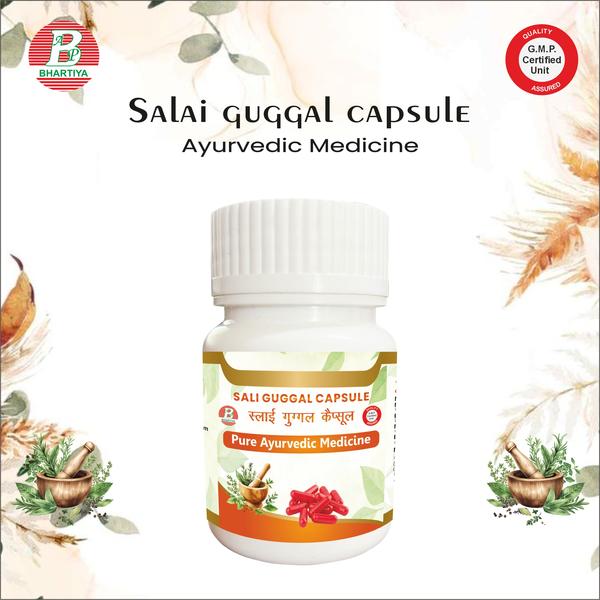
"name": "Salai guggal capsule",
"description": " SALAI GUGGUL \n\n SALAI GUGGUL (Boswellia serrata Roxb.) \nThe Natural Anti-Inflammatory & Joint Protector\n“Shallaki / Indian Frankincense”\nSalai Guggul is one of Ayurveda’s most powerful Shothahara (anti-inflammatory) and Vedanasthapana (pain-relieving) herbs. Revered for its exceptional ability to reduce joint inflammation, improve mobility, and protect cartilage, it is widely used in arthritis, joint degeneration, musculoskeletal pain, and inflammatory disorders.\n\n CLASSICAL AYURVEDIC REFERENCES\nCharaka Samhita\n• Mentioned among Shothahara Dravya’s for inflammatory conditions\n• Described as Vata-Kapha shamaka and Sandhishoolahara\nSushruta Samhita\n• Recommended in Sandhigata Vata, joint swelling, and pain disorders\n• Used in Vatavyadhi and traumatic inflammation\nBhavaprakasha Nighantu\n• Described as Shallaki – Shothahara, Vedanasthapana, Balya\n• Especially beneficial in joint and musculoskeletal disorders\n CLASSICAL STORY / ANECDOTE\nTraditional Ayurvedic physicians observed that the resin of the Salai tree exudes naturally to heal wounds and protect the tree from injury.\nThis self-protective and healing nature inspired its use in joint inflammation and tissue degeneration, where it “protects and restores” internal structures just as it does externally.\n\n BOTANICAL INFORMATION OF SALAI GUGGUL\nScientific Name: Boswellia serrata Roxb.\nFamily: Burseraceae\nOrder: Sapindales\nGenus: Boswellia\nSpecies: serrata\n\nCommon Names\nSanskrit: Shallaki\nHindi: Salai Guggul \nEnglish: Indian Frankincense\nTamil: Parangisambirani\nTelugu: Anduguggilam\nKannada: Chandra Dhoopa\nBengali: Salai Guggal\n\n SYNONYMS IN CLASSICAL AYURVEDIC NIGHANTUS\n Charaka Samhita: Shallaki – Shothahara\n Sushruta Samhita: Salai – Vatashamaka\n• Bhavaprakasha: Shallaki – Vedanasthapana, Balya\n MORPHOLOGY OF SALAI GUGGUL\n• Plant Type: Medium-sized deciduous tree\n• Bark: Thin, papery, exfoliating\n• Resin: Aromatic oleo-gum-resin (Salai Guggul)\n• Leaves: Pinnate, serrated\n• Flowers: Small, white\n• Taste: Bitter, astringent\n\n ECOLOGICAL PREFERENCES\n• Climate: Dry tropical\n• Soil: Rocky, well-drained soil\n• Habitat: Dry forests, hills\n• Sunlight: Full sun\n• Altitude: Up to 1200 m\n\n GEOGRAPHICAL DISTRIBUTION\n• India: Rajasthan, Madhya Pradesh, Gujarat, Maharashtra, Andhra Pradesh\n• Outside India: Africa, Middle East\n\n CLASSICAL AYURVEDIC PROPERTIES\n(RASA–GUNA–VIRYA–VIPAKA)\n• Rasa (Taste): Tikta (bitter), Kashaya (astringent)\n• Guna (Qualities): Laghu (light), Ruksha (dry)\n• Virya (Potency): Ushna (heating)\n• Vipaka: Katu (pungent)\nDosha Effect\n• Vata–Kapha hara\n• Excess use may aggravate Pitta\n\n THERAPEUTIC ACTIONS (KARMA)\n Shothahara – Reduces inflammation\n Vedanasthapana – Relieves pain\n Sandhishoolahara – Alleviates joint pain\n Balya – Strengthens joints and muscles\n Amapachana – Digests metabolic toxins\n Vranaropana – Supports healing\n INDICATIONS\n• Osteoarthritis\n• Rheumatoid arthritis\n• Joint pain and stiffness\n• Cervical & lumbar spondylosis\n• Sports injuries\n• Tendinitis and bursitis\n• Inflammatory musculoskeletal disorders\n\n MODERN PHARMACOLOGY & PHYTOCHEMISTRY\nMajor Constituents\n• Boswellic acids (AKBA)\n• Triterpenoids\n• Essential oils\n• Resin acids\nPharmacological Actions\n• Potent anti-inflammatory\n• Anti-arthritic\n• Analgesic\n• Cartilage protective\n• Anti-degenerative\n\n CULTIVATION DETAILS\n• Propagation: Seeds\n• Harvesting: Resin tapping after tree maturity\n• Collection Season: Summer\n• Processing: Purification and drying\n\n CLASSICAL DOSAGE (Ayurvedic Practice)\n• Powder (Churna): 1–3 g/day\n• Decoction (Kwatha): 30–60 ml/day\n• Capsules/Tablets: As prescribed\n• External Application: Oil or paste as required\n\n SALAI GUGGUL FORMULATIONS\nBhartiya Ayurvedic Pharmacy\nBhartiya Ayurvedic Pharmacy prepares authentic Salai Guggul formulations following classical Ayurvedic principles to support joint health, inflammation control, and musculoskeletal strength.\n\n SALAI GUGGUL CAPSULE \nPrepared using premium quality Boswellia serrata resin extract, standardized for optimal boswellic acid content.\nKey Benefits\n• Reduces joint inflammation\n• Relieves pain and stiffness\n• Improves mobility\n• Protects cartilage\n• Supports arthritis management\nDosage\n• Adults: 1–2 capsules twice daily with warm water\n• Or as directed by an Ayurvedic physician\nSafety & Precautions\n• Safe for long-term use under guidance\n• Use cautiously in high Pitta conditions\nFormulation Highlights\n• 100% pure Salai Guggul extract\n• No artificial additives or preservatives\n• Classical Ayurvedic processing\n\n SALAI GUGGUL POWDER \nPrepared from purified, shade-dried Salai Guggul resin, retaining its natural anti-inflammatory potency.\nKey Benefits\n• Reduces swelling and pain\n• Strengthens joints\n• Improves flexibility\n• Supports inflammatory balance\nDosage\n• Adults: 1–3 g daily\n• Take with warm water or honey\n• Or as advised by an Ayurvedic physician\nSafety & Precautions\n• Excess use may increase Pitta\n• Store in a cool, dry place\nFormulation Highlights\n• 100% pure Salai Guggul resin\n• No fillers or chemicals\n• Traditionally processed\n\n\n\nguggul capsules benefits, guggul how to use\nguggul is used for, guggul medicine uses\nguggul weight loss, guggul weight loss reviews\nguggulu capsules, salai guggal capsule amazon\nsalai guggal capsule ayurvedic, salai guggal capsule benefits\nsalai guggal capsule benefits in hindi, salai guggal capsule buy online\nsalai guggal capsule company, salai guggal capsule company name\nsalai guggal capsule composition, salai guggal capsule content\nsalai guggal capsule cost, salai guggal capsule details\nsalai guggal capsule details in hindi, salai guggal capsule dose\nsalai guggal capsule dose per day, salai guggal capsule download\nsalai guggal capsule easy ayurveda, salai guggal capsule english\nsalai guggal capsule english name, salai guggal capsule extract\nsalai guggal capsule for hair, salai guggal capsule for hair growth\nsalai guggal capsule for skin, salai guggal capsule for weight loss\nsalai guggal capsule goli, salai guggal capsule green world\nsalai guggal capsule gst number, salai guggal capsule gst rate\nsalai guggal capsule gujarati, salai guggal capsule hindi\nsalai guggal capsule hindi name, salai guggal capsule how to use\nsalai guggal capsule image, salai guggal capsule in english\nsalai guggal capsule in hindi, salai guggal capsule in india\nsalai guggal capsule indiamart, salai guggal capsule ke fayde\nsalai guggal capsule ke fayde in hindi, salai guggal capsule life\nsalai guggal capsule manufacturer, salai guggal capsule manufacturers in india\nsalai guggal capsule manufacturing company, salai guggal capsule name\nsalai guggal capsule name in hindi, salai guggal capsule near me\nsalai guggal capsule online, salai guggal capsule online order\nsalai guggal capsule online purchase, salai guggal capsule online shopping\nsalai guggal capsule original, salai guggal capsule price\nsalai guggal capsule price in india, salai guggal capsule rate\nsalai guggal capsule review, salai guggal capsule review in hindi\nsalai guggal capsule side effects, salai guggal capsule side effects in hindi\nsalai guggal capsule uses, salai guggal capsule uses in hindi",
"price": 450.0,
"discountamount": 225.0,
"currencycode": "INR",
"priority": 1000000,
"isfreeshipmentavailable": false,
"shipmentduration": 1,
"_keywords": null,
"isarchived": false,
"isavailable": true,
"applicationid": null,
"productindex": 77,
"imageuri": "https://productimages.withfloats.com/actual/69afa520f73acb380293150b.jpg",
"tileimageuri": "https://productimages.withfloats.com/tile/69afa520f73acb380293150b.jpg",
"images": null,
"totalqueries": 0,
"gpid": null,
"groupproductid": null,
"createdon": "2026-03-10T04:59:05.318Z",
"updatedon": "2026-03-10T04:59:05.318Z",
"buyonlinelink": null,
"producturl": "http://WWW.BHARTIYAAYURVEDICPHARMACY.COM//salai-guggal-capsule/77",
"availableunits": -1.0,
"iscodavailable": true,
"isprepaidonlineavailable": true,
"maxcodorders": -1,
"maxprepaidonlineorders": -1,
"uniquepaymenturl": null,
"brandname": "Bakula fort",
"category": "Salai guggal capsule 60-cap x 24",
"tags": [],
"variants": false,
"keyspecification": null,
"otherspecifications": null,
"pickupaddressreferenceid": null,
"paymenttype": "AssuredPurchase",
"producttype": "products",
"hsncode": null,
"gstslab": 0.0,
"isnotforsale": false
},
{
"_id": "69aabe02090539877161e8f0",
"fptag": "BHARTIYEAYURVEDICPHARMACY",
"merchantname": null,
"customwidgets": null,
"externalsourceid": null,
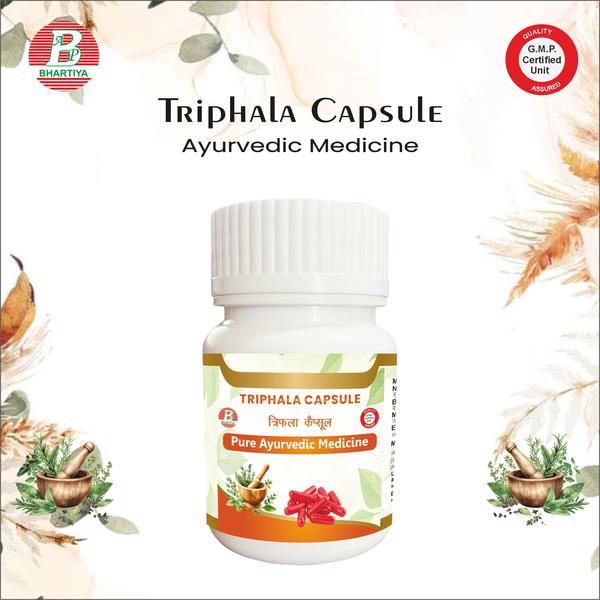
"name": "Triphala capsule",
"description": " TRIPHALA \n\n TRIPHALA \nThe Divine Rasayana of Ayurveda\nTriphala is one of the most revered classical formulations in Ayurveda, composed of three powerful fruits—Haritaki, Bibhitaki, and Amalaki. It is celebrated as a Rasayana (rejuvenator) that gently detoxifies the body while nourishing tissues, supporting digestion, immunity, eye health, and longevity. Unique among formulations, Triphala balances all three Doshas—Vata, Pitta, and Kapha.\n\n CLASSICAL AYURVEDIC REFERENCES\nCharaka Samhita\n•\tDescribed Triphala as a Tridoshahara Rasayana.\n•\tRegular use promotes longevity, strength, and digestive balance.\nSushruta Samhita\n•\tRecommends Triphala for eye health (Chakshushya) and internal cleansing.\n•\tUsed in wound healing, detoxification, and rejuvenation therapies.\nAshtanga Hridaya\n•\tMentions Triphala as a daily supportive Rasayana for maintaining Agni and Dhatu health.\nBhavaprakasha Nighantu\n•\tDescribes Triphala as Deepana, Pachana, Rasayana, and Chakshushya.\n\n CLASSICAL ANCIENT STORY / AACHARYA ANECDOTE\nAncient Ayurvedic tradition narrates that Acharya Charaka observed the declining vitality and digestive strength of people due to irregular lifestyle and improper food habits. The sages prayed for a formulation that could cleanse the body without weakening it.\nIt is said that Lord Dhanvantari, the divine physician, revealed Triphala—formed from three sacred fruits representing the three pillars of life:\n•\tHaritaki (Vata – movement & elimination)\n•\tBibhitaki (Kapha – stability & cleansing)\n•\tAmalaki (Pitta – nourishment & cooling)\nAcharyas proclaimed:\n“Nityaṃ Triphalā Sevanaṃ Jīvanaṃ Dīrgham Karoti”\n(Regular use of Triphala bestows long life.)\nThus, Triphala became known as the guardian Rasayana—safe for daily use, subtle yet profound in action.\n\n BOTANICAL COMPOSITION OF TRIPHALA\nIngredient\tBotanical Name\tPart Used\nHaritaki\tTerminalia chebula\tFruit\nBibhitaki\tTerminalia bellirica\tFruit\nAmalaki\tEmblica officinalis\tFruit\nFamily: Combretaceae & Phyllanthaceae\n\n SYNONYMS IN CLASSICAL TEXTS\n•\tTriphala – Three fruits\n•\tPhalatrikam\n•\tTridoshaghni\n•\tRasayana Yoga\n\n CLASSICAL AYURVEDIC PROPERTIES\n(RASA – GUNA – VIRYA – VIPAKA)\nRasa (Taste):\nPancharasa (All tastes except Lavana), predominantly Amla, Kashaya\nGuna (Qualities):\nLaghu (light), Ruksha (dry)\nVirya (Potency):\nUshna (Haritaki, Bibhitaki) & Sheeta (Amalaki) – balanced effect\nVipaka:\nMadhura\nDosha Effect:\n✔ Tridoshahara (Balances Vata, Pitta & Kapha)\n\n THERAPEUTIC ACTIONS (KARMA)\n• Rasayana – Rejuvenative\n• Anulomana – Regulates bowel movement\n• Deepana–Pachana – Improves digestion\n• Chakshushya – Promotes eye health\n• Raktashodhaka – Blood purifier\n• Medohara – Supports metabolism\n\n INDICATIONS\n• Chronic constipation & weak digestion\n• Detoxification and gut health\n• Eye disorders & vision support\n• Skin diseases & blood impurities\n• Metabolic imbalance & obesity\n• Immunity support & anti-aging care\n\n MODERN PHARMACOLOGY & PHYTOCHEMISTRY\nMajor Constituents:\n• Tannins\n• Gallic acid\n• Chebulinic acid\n• Vitamin C (from Amalaki)\nPharmacological Actions:\n• Mild laxative\n• Antioxidant\n• Anti-inflammatory\n• Gut microbiome supportive\n• Immunomodulatory\n\n\nTRIPHALA FORMULATIONS – Bhartiya Ayurvedic Pharmacy\nBhartiya Ayurvedic Pharmacy prepares authentic Triphala formulations—a classical blend of Haritaki (Terminalia chebula), Bibhitaki (Terminalia bellirica), and Amalaki (Emblica officinalis)—based on authoritative Ayurvedic texts, ensuring optimal digestive regulation, gentle detoxification, rejuvenation, and immune support.\n\n1. TRIPHALA CAPSULE \nDescription:\nTriphala Capsules are prepared using equal proportions of Haritaki, Bibhitaki, and Amalaki fruit powders, processed according to classical Ayurvedic principles to preserve Rasayana potency.\n\n KEY BENEFITS\n• Gently detoxifies without dependency\n• Improves digestion and bowel regularity\n• Enhances immunity and vitality\n• Supports eye and skin health\n• Promotes longevity and daily wellness\n\n DOSAGE\n• Adults: 1–2 capsules once or twice daily\n• Best taken at night with warm water\n• Or as directed by an Ayurvedic physician\n\n SAFETY & PRECAUTIONS\n• Safe for long-term use under guidance\n• Use cautiously in severe debility or dehydration\n• Adjust dose in high Vata conditions\n\n FORMULATION HIGHLIGHTS\n• Classical 1:1:1 Triphala formulation\n• 100% pure herbal ingredients\n• No chemicals, additives, or preservatives\n• Prepared as per authentic Ayurvedic texts\n\n Triphala is not merely a medicine—it is a daily companion for balanced living, as envisioned by the great Acharyas of Ayurveda.\n\n2. TRIPHALA CHURNA \n TRIPHALA \nThe Eternal Rasayana of the Great Acharyas\nTriphala Churna is one of the most time-honored classical formulations of Ayurveda, prepared from the powdered fruits of Haritaki, Bibhitaki, and Amalaki in equal proportion. Revered as a Rasayana (rejuvenator), Triphala Churna gently cleanses the body while nourishing all Dhatus, supporting digestion, vision, immunity, and longevity. It is uniquely praised for its ability to balance all three Doshas—Vata, Pitta, and Kapha.\n\n CLASSICAL AYURVEDIC REFERENCES\nCharaka Samhita\n•\tDescribes Triphala as Tridoshaghna and Rasayana.\n•\tRegular use promotes long life, strength, and clarity of senses.\nSushruta Samhita\n•\tRecommends Triphala Churna for Chakshushya (eye health) and internal purification.\n•\tWidely used in Vrana Shodhana (wound cleansing) and detoxifying therapies.\nAshtanga Hridaya\n•\tAdvises Triphala for daily use to maintain Agni, Koshtha, and Dhatu balance.\nBhavaprakasha Nighantu\n•\tDescribes Triphala as Deepana, Pachana, Rasayana, and Netrya.\n\n CLASSICAL ANCIENT STORY / AACHARYA ANECDOTE\nAyurvedic tradition narrates that the great sages observed how harsh purgatives weakened patients while untreated impurities shortened life. Seeking a remedy that could cleanse gently without depletion, they meditated upon nature’s wisdom.\nAcharya Charaka, guided by divine knowledge from Lord Dhanvantari, revealed Triphala—three sacred fruits representing harmony of the Tridosha:\n•\tHaritaki – Governs Vata, elimination, and vitality\n•\tBibhitaki – Regulates Kapha, cleansing and stability\n•\tAmalaki – Pacifies Pitta, nourishment and rejuvenation\nThe Acharyas proclaimed:\n“Triphala Nityasevanaṃ Sharīrasya Bala-Vardhanam”\n(Regular use of Triphala strengthens the body.)\n\n\n\nbenefits of triphala capsule, best brand of triphala capsules\nbest organic triphala capsules, best time to take triphala capsule\nbest triphala capsules, best triphala capsules brand in india\nbest triphala capsules in india, best triphala churna india\ncan i take triphala with other supplements\ncan triphala be taken daily, can triphala be taken everyday\ncan triphala cause weight gain, can triphala churna be taken daily\nhow to use triphala capsules, is it good to take triphala everyday\nis triphala capsules good, is triphala churna good for health\norganic triphala capsule, organic triphala capsules benefits\ntriphala 60 capsule organic india, triphala capsule ayurvedic\ntriphala capsule hsn code, triphala capsule in hindi\ntriphala capsule ke fayde, triphala capsule ke kya fayde hain\ntriphala capsule khane ke fayde, triphala capsule price\ntriphala capsule quantity, triphala capsule uses\ntriphala capsule uses in hindi, triphala capsules amazon\ntriphala capsules benefits, triphala capsules benefits in hindi\ntriphala capsules india, triphala capsules kottakkal\ntriphala capsules near me, triphala capsules nz\ntriphala capsules online, triphala capsules or powder\ntriphala capsules price, triphala capsules reviews\ntriphala capsules uk, triphala capsules uses, triphala capsules uses in hindi\ntriphala capsules when to take as, triphala churna capsule\ntriphala guggul capsule, triphala guggul tablets\ntriphala powder in capsule, triphala tablets india",
"price": 300.0,
"discountamount": 150.0,
"currencycode": "INR",
"priority": 1000000,
"isfreeshipmentavailable": false,
"shipmentduration": 1,
"_keywords": null,
"isarchived": false,
"isavailable": true,
"applicationid": null,
"productindex": 73,
"imageuri": "https://productimages.withfloats.com/actual/69aabe040d75f0106b3633a8.jpg",
"tileimageuri": "https://productimages.withfloats.com/tile/69aabe040d75f0106b3633a8.jpg",
"images": null,
"totalqueries": 0,
"gpid": null,
"groupproductid": null,
"createdon": "2026-03-06T11:44:02.388Z",
"updatedon": "2026-03-06T11:44:02.388Z",
"buyonlinelink": null,
"producturl": "http://WWW.BHARTIYAAYURVEDICPHARMACY.COM//triphala-capsule/73",
"availableunits": -1.0,
"iscodavailable": true,
"isprepaidonlineavailable": true,
"maxcodorders": -1,
"maxprepaidonlineorders": -1,
"uniquepaymenturl": null,
"brandname": "Bakula fort",
"category": "Triphala capsule 60-cap x 24",
"tags": [],
"variants": false,
"keyspecification": null,
"otherspecifications": null,
"pickupaddressreferenceid": null,
"paymenttype": "AssuredPurchase",
"producttype": "products",
"hsncode": null,
"gstslab": 0.0,
"isnotforsale": false
},
{
"_id": "69a27c1007634e1b29b4922c",
"fptag": "BHARTIYEAYURVEDICPHARMACY",
"merchantname": null,
"customwidgets": null,
"externalsourceid": null,
"name": "Punarnava Capsule",
"description": " Punarnava (Boerhavia diffusa) \n The Rejuvenating Herb with Healing Leaves\nPunarnava is one of the most important rejuvenating herbs in Ayurveda, widely valued for its unique ability to revive and renew the body.\nThe name Punarnava literally means “that which becomes new again”, indicating its powerful regenerative and restorative nature.\nIn Ayurveda, Punarnava is classified as a Mutrala (diuretic), Shothahara (anti-inflammatory), and Rasayana (rejuvenative) drug. It is highly beneficial in managing swelling (oedema), kidney disorders, liver weakness, urinary problems, digestive issues, anaemia, and general debility.\nBotanical Information of Punarnava\nScientific Name: Boerhavia diffusa Linn.\nFamily: Nyctaginaceae\nOrder: Caryophyllales\nGenus: Boerhavia\nSpecies: diffusa\nCommon Names:\n•\tSanskrit: Punarnavā, Shothaghanī, Raktapunarnavā, Śvetapunarnavā, Shreṇī, Shoṭikā\n•\tHindi: Punarnava\n•\tEnglish: Spreading Hogweed, Red Spiderling\n•\tTamil: Mookarattai\n•\tTelugu: Atika\n•\tMalayalam: Thazhuthama\n•\tKannada: Komme beru\n•\tBengali: Punarnava\nSynonyms of Punarnava (Boerhavia diffusa) in Ayurvedic Nighantus:\n Bhavaprakasha Nighantu – Shothaghni, Raktapunarnava, Shvetapunarnava, Shoṭikā\n Raja Nighantu & Kaiyadeva Nighantu – Panchanga, Jalapushpa, Mochana, Bhujanga\n Hrudaya Nighantu & Dhanvantari Nighantu – Utkalika, Shreni\n Morphology of Punarnava (Boerhavia diffusa)\nPlant Type: Perennial, creeping, and spreading herb\nStem:\n•\tProstrate or slightly ascending, creeping along the ground\n•\tPurplish-green, hairy, with swollen nodes\n•\tRoots develop at nodes where the stem touches the soil\nLeaves:\n•\tSimple, opposite arrangement\n•\tShape: Ovate, elliptic, or slightly rounded\n•\tTexture: Fleshy and soft\n•\tColor: Dark green on the upper surface, pale green below\n•\tPetiole: Short\nFlowers:\n•\tSmall, tubular, and bisexual\n•\tColor: Pink, reddish, or white\n•\tArranged in axillary clusters (cymes)\n•\tBloom mainly during summer and rainy seasons\nRoots:\n•\tThick, cylindrical, fleshy, and tapering\n•\tColor: White in Shveta Punarnava, reddish in Rakta Punarnava\n•\tMedicinal part, rich in active constituents\nFruits:\n•\tSmall, ovoid, glandular, and sticky when young\n•\tDark brown at maturity\n•\tOne-seeded\nHabit:\n•\tCreeping, spreading, fast-growing, regenerates easily\n•\tAdapted to drought and poor soil conditions\n Ecological Preferences of Punarnava\n•\tClimate: Thrives in tropical and subtropical climates; tolerates heat and moderate drought.\n•\tSoil: Prefers sandy, loamy, or well-drained soils; can grow in poor or degraded soils.\n•\tSunlight: Grows well in full sunlight to partial shade.\n•\tMoisture: Requires moderate moisture; can survive dry periods due to its hardy nature.\n•\tAltitude: Found at low to medium altitudes, commonly in plains and open areas.\n•\tHabitat: Common along roadsides, fields, gardens, wastelands, and riverbanks.\n•\tGrowth habit: Creeping, spreading, fast-growing, and regenerates easily after adverse conditions.\n Distribution of Punarnava\nGeographical Distribution:\nPunarnava is a widely distributed perennial herb found in tropical and subtropical regions across the world.\n•\tIndia: Found throughout the country in almost all states, particularly in plains, dry regions, roadsides, wastelands, and fields.\n•\tAsia: Occurs in Pakistan, Sri Lanka, Bangladesh, Nepal, and Myanmar.\n•\tAfrica: Common in tropical and subtropical Africa.\n•\tAmericas: Found in parts of South America and Central America.\n•\tOther Regions: Naturalized in various tropical areas worldwide due to its hardy and fast-growing nature\n Classical Ayurvedic Properties of Punarnava\n•\tRasa (Taste): Tikta (bitter), Kashaya (astringent)\n•\tGuna (Qualities): Laghu (light), Ruksha (dry)\n•\tVirya (Potency): Ushna (hot)\n•\tVipaka (post-digestive effect): Katu (pungent)\n•\tDosha Effect: Kapha-Vata shamaka (pacifies Kapha and Vata doshas)\n•\tKarma (Actions / Therapeutic Effects):\no\tMutrala: Promotes urination, useful in oedema and urinary disorders\no\tShothahara: Reduces swelling and inflammation\no\tYakrit-Pleeha Shodhaka: Supports liver and spleen health\no\tRasayana: Rejuvenative and revitalizing\no\tHridya: Supports heart function\nTherapeutic Actions of Punarnava According to Acharyas\n1.\tMutrala (Diuretic):\no\tPromotes urine formation, relieves Shotha (edema, ascites, anasarca)\no\tUseful in kidney and urinary disorders\n2.\tShothahara (Anti-inflammatory / Anti-edema):\no\tReduces Kapha and Vata-related swelling\no\tUseful in joint swelling, ascites, and edema\n3.\tYakrit-Pleeha Shodhaka (Hepato-splenic tonic / Detoxifier):\no\tSupports liver and spleen health\no\tClears stagnation in Rakta and Pitta\n4.\tRasayana (Rejuvenative / Revitalizing):\no\tImproves strength, vitality, and general health\no\tEnhances immunity and longevity\n5.\tHridya (Cardio-supportive):\no\tSupports heart function by reducing fluid overload\n6.\tMedohara / Vatashamaka:\no\tHelps in reducing excessive fat (Medo Dhatu) and pacifies Vata dosha in the body\n\nReferences from Acharyas:\n•\tCharaka Samhita: Punarnava is Shothaghni, Mutrala, Rasayana\n•\tSushruta Samhita: Shveta and Rakta Punarnava described for Shotha, Mutra, and Yakrit-Pleeha disorders\n•\tBhavaprakasha: Emphasizes anti-edema, diuretic, hepatoprotective, and rejuvenative actions\n Modern Phytochemistry of Punarnava\nPunarnava is rich in bioactive compounds responsible for its therapeutic properties. Key phytochemicals identified include:\n1. Alkaloids\n•\tPunarnavine – major alkaloid, responsible for diuretic and hepatoprotective activity\n•\tBoeravinones (A–F) – rotenoid compounds with antioxidant, hepatoprotective, and anti-inflammatory properties\n2. Flavonoids\n•\tQuercetin, Kaempferol – contribute to antioxidant and anti-inflammatory effects\n3. Glycosides\n•\tPunarnavoside – responsible for diuretic and anti-edema activity\nSpecies of Punarnava (Genus: Boerhavia)\nThe genus Boerhavia (family Nyctaginaceae) includes several species, but Boerhavia diffusa is the most commonly used in Ayurveda. Other species are also recognized botanically for various regional and medicinal uses:\n1. Boerhavia diffusa Linn.\n•\tMost widely used in Ayurveda\n•\tPerennial, creeping, and spreading herb\n•\tKnown for diuretic, anti-inflammatory, hepatoprotective, and rejuvenative properties\n2. Boerhavia erecta L.\n•\tErect or semi-erect habit, less creeping\n•\tFound in tropical regions\n•\tUsed in traditional medicine locally, but less common in classical Ayurveda\n3. Boerhavia repens L.\n•\tCreeping herb, often used as ground cover\n•\tOccasional medicinal use in folk medicine\n4. Boerhavia coccinea Mill.\n•\tRed-flowered species, creeping habit\n•\tSometimes used in ethnomedicine for fever and inflammation\n5. Boerhavia verticillata Willd.\n•\tFound in Africa and Asia\n•\tLimited medicinal use; occasionally cited in ethnobotanical surveys\nCultivation:\n•\tPropagation: Primarily by seeds; can also propagate via stem cuttings due to its creeping habit.\n•\tSowing Time: Best sown during the early monsoon or rainy season.\n•\tSpacing: Maintain 30–40 cm between plants to allow spreading.\n•\tWatering: Requires moderate moisture; drought-tolerant once established.\n•\tFertilization: Responds well to organic manure or compost, though hardy enough to grow in poor soils.\n•\tHarvesting: Roots, stems, and leaves are harvested after 3–4 months of growth, depending on medicinal use.\n•\tEcological Note: Acts as a pioneer plant, stabilizing soil and growing in degraded lands.\n Classical Dosage of Punarnava in Granthas\n1. Charaka Samhita\nForm: Root or whole plant powder (Churna), decoction (Kwatha)\nDose: 3–6 grams of powder; 40–60 ml of decoction, 2–3 times daily\nUses: Shotha (edema), Mutrakriccha (urinary disorders), Rasayana\n2. Sushruta Samhita\nForm: Root, whole plant, or paste\nDose: 3–6 grams powder; decoction 40–60 ml; external paste as required\nUses: Shotha, Mutra, Yakrit-Pleeha disorders\n3. Bhavaprakasha Nighantu\nForm: Churna, Kwatha, Swarasa (juice)\nDose: 3–6 grams Churna; 40–60 ml Kwatha; 20–30 ml Swarasa 1–2 times daily\nNotes: Shveta Punarnava for urinary issues; Rakta Punarnava for liver and blood disorders\n4. Raja Nighantu & Kaiyadeva Nighantu\nForm: Panchanga (whole plant), decoction, powder\nDose: Similar classical dose as above; 3–6 grams for powder, decoction 40–60 ml\nTherapeutic Use: Shothahara, Mutrala, Rasayana\n\n Safety and Precautions of Punarnava\n Safe in classical dosage.\n Avoid overdose -caution with strong diuretics.\n Pregnant Woman- use only under supervision.\n\n Classical Ayurvedic Formulations of Punarnava\nPunarnava is a key ingredient in many classical Ayurvedic preparations for edema, liver disorders, kidney ailments, and rejuvenation. Common formulations include:\n1. Punarnavadi Kwatha (Decoction)\n•\tIngredients: Punarnava, Trikatu (Pippali, Maricha, Shunthi), Musta, Haritaki, and other supporting herbs\n•\tAction: Diuretic, anti-edema, hepatoprotective, rejuvenative\n•\tIndication: Shotha (edema), Ascites, Mutrakriccha (urinary disorders)\n2. Punarnavadi Churna (Powder)\n•\tIngredients: Punarnava root, Haritaki, Musta, Chitrak, Shunthi\n•\tAction: Supports kidney and liver health, promotes detoxification, reduces swelling\n•\tDose: 3–6 g/day with water or honey\n3. Punarnava Swarasa (Juice)\n•\tForm: Fresh juice of Punarnava root or whole plant\n•\tAction: Diuretic, anti-inflammatory, mild laxative\n•\tDose: 20–30 ml, 1–2 times daily\n4. Punarnava Grita or Taila (Medicated Ghee/Oil)\n•\tUsage: External application for swelling, inflammation, and joint disorders\n•\tAction: Shothahara, soothing, and rejuvenative\n5. Compound Formulations\n•\tPunarnavadi Kashaya, Punarnavadi Gutika, Punarnavadi Avaleha – used in liver disorders, urinary diseases, edema, and general rejuvenation.\n Punarnava Formulations by Bhartiya Ayurvedic Pharmacy\nAt Bhartiya Ayurvedic Pharmacy, we prepare a range of Punarnava (Boerhavia diffusa) formulations following classical Ayurvedic methods as described in Charaka Samhita, Sushruta Samhita, Bhav Prakash Nighantu, and other Ayurvedic Granthas. Each product is crafted to retain the therapeutic potency, purity, and efficacy of the herb, ensuring benefits for fluid balance, kidney & liver support, detoxification, and rejuvenation.\n1. Punarnava Tablet\nDescription:\nPunarnava Tablets contain standardized powdered extract of Boerhavia diffusa, providing a convenient dosage form for daily use.\nKey Actions:\n•\tSupports normal urinary output and reduces mild water retention\n•\tPromotes liver and kidney health\n•\tReduces swelling (Edema)\n•\tBeneficial in cough or intestinal colic\n•\tIt can help lower the blood pressure\n•\tProvides general detox and rejuvenation\nDosage:\n•\t1–2 tablets twice daily after meals, or as advised by an Ayurvedic practitioner\nPrecautions:\n•\tUse under guidance in pregnancy, kidney disorders, or excessive fluid loss\n•\tMaintain recommended dosage\n2. Punarnava Capsule\nDescription:\nThese capsules offer a modern, easy-to-swallow format containing Punarnava extract, ideal for those who prefer capsules over tablets or decoctions.\nKey Actions:\n•\tSupports diuresis (mutrala) and reduces edema (shothahara)\n•\tHelps maintain healthy liver function\n•\tActs as a rejuvenative (rasayana)\nDosage:\n•\t1 capsule twice daily with warm water after meals\nPrecautions:\n•\tNot recommended for patients on strong diuretics without consulting a physician\n3. Punarnava Asava\nDescription:\nPunarnava Asava is a classical Ayurvedic fermented liquid formulation, prepared from fresh roots/whole plant to preserve bioactive constituents.\nKey Actions:\n•\tPromotes fluid balance and detoxification\n•\tSupports liver and kidney health\n•\tEasily digestible, suitable for patients with weak digestive fire\nDosage:\n•\t20–30 ml twice daily after meals, or as advised\n•\tCan be taken with warm water or honey as per taste and constitution\nPrecautions:\n•\tStore in a cool, dry place\n•\tUse under supervision during pregnancy or lactation\n4. Punarnavadi Mandura\nDescription:\nA classical Ayurvedic herbo-mineral formulation combining Punarnava with Mandura Bhasma (iron). Designed to support blood health, anemia, spleen function, along with Punarnava’s diuretic and rejuvenative actions.\nKey Actions:\n•\tHematinic: Replenishes iron and supports blood formation\n•\tDiuretic & Detox: Reduces edema and fluid retention\n•\tRejuvenative: Improves vitality and metabolic balance\nDosage:\n•\t1–2 tablets twice daily after meals with warm water or milk, as directed by an Ayurvedic practitioner\nPrecautions:\n•\tAvoid excessive intake; monitor iron levels if used long-term\n•\tNot recommended in cases of iron overload or severe gastric sensitivity\n\n\n\npunarnava capsule, punarnava capsule benefits, punarnava capsule company name\npunarnava capsule composition, punarnava capsule contains\npunarnava capsule cost, punarnava capsule gm\npunarnava capsule gst, punarnava capsule gst rate\npunarnava capsule ke fayde, punarnava capsule kis kaam aata hai\npunarnava capsule online, punarnava capsule online order\npunarnava capsule online shopping, punarnava capsule original\npunarnava capsule price, punarnava capsule quality\npunarnava capsule quantity, punarnava capsule review\npunarnava capsule root, punarnava capsule root powder\npunarnava capsule root powder benefits\npunarnava capsule side effects, punarnava capsule uses\npunarnava capsule uses in hindi, punarnava capsule video\npunarnava capsule video youtube, punarnava capsules benefits\npunarnava capsules benefits in hindi, punarnava capsules price in india\npunarnava capsules uses, punarnava capsules uses in hindi\npunarnava extract capsules, punarnava how to use\npunarnava ka juice, punarnava ke capsule\npunarnava nutritious capsule, punarnava tablet benefits\npunarnava tablet lene ke fayde, punarnava tablets benefits\nwhat is punarnava, when to take punarnava",
"price": 360.0,
"discountamount": 180.0,
"currencycode": "INR",
"priority": 1000000,
"isfreeshipmentavailable": false,
"shipmentduration": 1,
"_keywords": null,
"isarchived": false,
"isavailable": true,
"applicationid": null,
"productindex": 68,
"imageuri": "https://productimages.withfloats.com/actual/69a27c16871d453ad0f0d462.jpg",
"tileimageuri": "https://productimages.withfloats.com/tile/69a27c16871d453ad0f0d462.jpg",
"images": null,
"totalqueries": 0,
"gpid": null,
"groupproductid": null,
"createdon": "2026-02-28T05:24:32.91Z",
"updatedon": "2026-03-02T04:31:26.469Z",
"buyonlinelink": null,
"producturl": "http://WWW.BHARTIYAAYURVEDICPHARMACY.COM//punarnava-capsule/68",
"availableunits": -1.0,
"iscodavailable": true,
"isprepaidonlineavailable": true,
"maxcodorders": -1,
"maxprepaidonlineorders": -1,
"uniquepaymenturl": null,
"brandname": "Bakula Fort",
"category": "Punarnava Capsule 60 - cap X 24",
"tags": [],
"variants": false,
"keyspecification": null,
"otherspecifications": null,
"pickupaddressreferenceid": null,
"paymenttype": "AssuredPurchase",
"producttype": "products",
"hsncode": null,
"gstslab": 0.0,
"isnotforsale": false
},
{
"_id": "698f0f2661796b22a0856371",
"fptag": "BHARTIYEAYURVEDICPHARMACY",
"merchantname": null,
"customwidgets": null,
"externalsourceid": null,
"name": "Lassan Capsule",
"description": " LAHSUN \n\n LASSAN / LAHSUN (Allium sativum Linn.) \nThe Supreme Heart & Immunity Herb — “Lahsun / Garlic”\nLahsun is a highly esteemed herb in Ayurveda, celebrated for its Hrudya (heart-supporting), Balya (strength-promoting), Rasayana (rejuvenative), Jwaraghna (febrifuge), and Krimighna (antimicrobial) properties. It is traditionally used to enhance cardiovascular health, immunity, digestive strength, and overall vitality. Lahsun is particularly effective in Kapha–Vata disorders, hypertension, respiratory congestion, digestive weakness, and fatigue.\n \n BOTANICAL INFORMATION OF LASSAN\n•\tScientific Name: Allium sativum Linn.\n•\tFamily: Amaryllidaceae\n•\tOrder: Asparagales\n•\tGenus: Allium\n•\tSpecies: sativum\nCommon Names\n•\tSanskrit: Rasuna\n•\tHindi: Lahsun / Lassan\n•\tEnglish: Garlic\n•\tTamil: Vellulli\n•\tTelugu: Vellulli\n•\tKannada: Bellulli\n•\tMalayalam: Poondu\n•\tBengali: Rosun\n\n SYNONYMS IN CLASSICAL AYURVEDIC NIGHANTUS\nCharaka Samhita\n•\tRasuna – Cardio-protective, immune-boosting\nSushruta Samhita\n•\tLassan – Digestive stimulant, rejuvenative\nBhavaprakasha Nighantu\n•\tHrudya, Balya, Rasayana – Supports heart, strength, and rejuvenation\nDhanvantari Nighantu\n•\tKrimighna – Anti-parasitic, antimicrobial\n\n MORPHOLOGY OF LASSAN\n•\tPlant Type: Herbaceous perennial\n•\tHeight: 30–60 cm\n•\tLeaves: Strap-like, green\n•\tFlowers: Umbellate clusters, white or pink\n•\tBulb: Underground, composed of multiple cloves\n•\tRoots: Fibrous\n\n ECOLOGICAL PREFERENCES\n•\tClimate: Temperate to subtropical\n•\tSoil: Well-drained, fertile, loamy soil\n•\tSunlight: Full sun\n•\tWater Requirement: Moderate\n•\tAltitude: Up to 2,000 m\n\n GEOGRAPHICAL DISTRIBUTION\n•\tIndia: Punjab, Uttar Pradesh, Madhya Pradesh, Rajasthan\n•\tOutside India: China, Mediterranean, USA, Europe\n\n CLASSICAL AYURVEDIC PROPERTIES (RASA–GUNA–VIRYA–VIPAKA)\n•\tRasa (Taste): Katu (pungent), Tikta (bitter)\n•\tGuna (Qualities): Laghu (light), Ruksha (dry)\n•\tVirya (Potency): Ushna (hot)\n•\tVipaka (post-digestive effect): Katu (pungent)\n•\tDosha Effects: Kapha–Vata hara; increases Pitta\n\n THERAPEUTIC ACTIONS (KARMA)\n1.\tHrudya – Supports cardiovascular health\n2.\tBalya – Strengthens body and immunity\n3.\tRasayana – Rejuvenative, anti-aging, restores vitality\n4.\tPachana – Digestive stimulant\n5.\tKrimighna – Antimicrobial, antiparasitic\n6.\tShleshma-Kapha Hara – Reduces congestion and mucus\n7.\tVajikarana – Enhances sexual vitality\n\n INDICATIONS\n•\tHypertension, high cholesterol, heart disorders\n•\tWeak immunity and frequent infections\n•\tRespiratory congestion, cough, cold\n•\tDigestive weakness, bloating, and gas\n•\tMale sexual weakness or low libido\n•\tGeneral fatigue and low vitality\n\n MODERN PHYTOCHEMISTRY & PHARMACOLOGY\nMajor Constituents:\n•\tAllicin (sulphur compound)\n•\tSaponins\n•\tFlavonoids\n•\tVitamins (C, B6) and minerals (selenium, manganese)\nPharmacological Actions:\n•\tCardioprotective, antihypertensive, lipid-lowering\n•\tAnti-microbial, anti-inflammatory, antioxidant\n•\tImmune-modulatory\n•\tRejuvenative and anabolic\n•\tNeuroprotective\n\n CULTIVATION DETAILS\n•\tPropagation: Cloves / Bulbs\n•\tSowing Time: October–November\n•\tSpacing: 10–15 cm between plants\n•\tIrrigation: Moderate\n•\tHarvesting: 6–8 months after planting\n•\tFertilization: Organic manure preferred\n\n CLASSICAL DOSAGE (According to Ayurvedic Granthas)\n•\tFresh Cloves: 2–4 g daily\n•\tPowder (Churna): 1–2 g twice daily\n•\tJuice / Decoction: 5–10 ml with honey or warm water\n\n CLASSICAL AYURVEDIC FORMULATIONS CONTAINING LASSAN\n1.\tLahsun Churna – Digestive and immune support\n2.\tLahsun Kashaya (Decoction) – Respiratory congestion, cough, and cold\n3.\tMedicated Garlic Oil (Lahsun Taila) – For massage, nerve, and hair health\n4.\tRasayana with Lahsun – Rejuvenative and vitality-promoting\n\n SAFETY & PRECAUTIONS\n•\tSafe under classical doses\n•\tAvoid excessive intake in Pitta disorders (can cause acidity)\n•\tCaution in bleeding disorders or if on anticoagulants\n•\tMay irritate stomach in raw form\n\n “Lahsun, the pungent bulb, nurtures heart, immunity, digestion, and vitality — a humble yet potent gift of nature for rejuvenation and strength.” \n\n LASSAN / LAHSUN FORMULATIONS – BHARTIYA AYURVEDIC PHARMACY \nBhartiya Ayurvedic Pharmacy prepares a range of Lahsun (Allium sativum) formulations following classical Ayurvedic principles, retaining full Hrudya, Balya, Rasayana, Krimighna, and immune-supporting properties. Each product is designed to support cardiovascular health, immunity, digestive strength, vitality, and overall rejuvenation.\n\n 1. Lahsun Capsule\nDescription:\nLahsun Capsule is a convenient, modern dosage form containing standardized Lahsun extract. Ideal for those who prefer capsules over powders, it preserves all rejuvenative, immune-boosting, and cardio-protective properties of the bulb.\nKey Actions:\n•\tSupports heart and circulatory system health (Hrudya)\n•\tEnhances immunity and overall vitality (Rasayana)\n•\tPromotes digestive strength and energy (Balya Pachana)\n•\tAnti-aging and rejuvenative effects\nDosage:\n•\t1–2 capsules twice daily with warm water after meals\nPrecautions:\n•\tAvoid overdose\n•\tUse under supervision in bleeding disorders, hypertension, or pregnancy\n\n 2. Lahsun Powder (Churna)\nDescription:\nPure, finely powdered Lahsun for traditional use. Can be consumed with honey, ghee, warm water, or milk.\nKey Actions:\n•\tSupports cardiovascular health and lowers cholesterol\n•\tBoosts immunity and fights infections\n•\tEnhances digestive strength and metabolism\n•\tRejuvenative and anti-aging effects\nDosage:\n•\t1–2 g daily, mixed with honey, ghee, or warm water, or as advised by physician\nPrecautions:\n•\tAvoid excess intake in Pitta-prone individuals\n•\tUse with caution in bleeding disorders\n\n\nbest kashmiri lahsun, lahsun capsule ke fayde , lahsun capsule khane ke fayde, lahsun contains\nlahsun for skin, lahsun ka beej, lahsun ka capsule, lahsun ka doctor, lahsun ka upyog, lahsun ka use\nlahsun kaise hataye, lahsun kaise hoga, lahsun kaise rupaye, lahsun kaise wala, lahsun ke capsule\nlahsun ke capsule ke fayde, lahsun medicine, lahsun uses, lahsun vitamin, lahsun wala, lahsun wale capsule,\nlashun capsule amazon, lashun capsule ayurvedic, lashun capsule benefits, lashun capsule benefits in hindi,\n lashun capsule company, lashun capsule company name, lashun capsule composition, lashun capsule content,\nlashun capsule cost, lashun capsule english, lashun capsule english name, lashun capsule expiry date\nlashun capsule extract, lashun capsule gst rate, lashun capsule image, lashun capsule in english\nlashun capsule in hindi, lashun capsule indiamart, lashun capsule machine, lashun capsule manufacturer\nlashun capsule manufacturers in india, lashun capsule name, lashun capsule near me, lashun capsule online\nlashun capsule online order, lashun capsule online shopping, lashun capsule price, lashun capsule quality\nlashun capsule quantity per day, lashun capsule question, lashun capsule se kya hota hai, lashun capsule side effects\nlashun capsule side effects in hindi, lashun capsule supplier, lashun capsule time to consume\nlashun capsule today price, lashun capsule today rate, lashun capsule uses, lashun capsule uses in hindi\nlasun capsules, lasun side effects, side effects of lahsun, uses of lahsun",
"price": 270.0,
"discountamount": 135.0,
"currencycode": "INR",
"priority": 1000000,
"isfreeshipmentavailable": false,
"shipmentduration": 1,
"_keywords": null,
"isarchived": false,
"isavailable": true,
"applicationid": null,
"productindex": 63,
"imageuri": "https://productimages.withfloats.com/actual/698f0f28ce45eacfd2649794.jpg",
"tileimageuri": "https://productimages.withfloats.com/tile/698f0f28ce45eacfd2649794.jpg",
"images": null,
"totalqueries": 0,
"gpid": null,
"groupproductid": null,
"createdon": "2026-02-13T11:46:46.666Z",
"updatedon": "2026-02-17T09:27:13.421Z",
"buyonlinelink": null,
"producturl": "http://WWW.BHARTIYAAYURVEDICPHARMACY.COM//lassan-capsule/63",
"availableunits": -1.0,
"iscodavailable": true,
"isprepaidonlineavailable": true,
"maxcodorders": -1,
"maxprepaidonlineorders": -1,
"uniquepaymenturl": null,
"brandname": "Bakula Fort",
"category": "Lassan Capsule 60 Cap X 24",
"tags": [],
"variants": false,
"keyspecification": null,
"otherspecifications": null,
"pickupaddressreferenceid": null,
"paymenttype": "AssuredPurchase",
"producttype": "products",
"hsncode": null,
"gstslab": 0.0,
"isnotforsale": false
},
{
"_id": "698ee14cf76d02b22f47b077",
"fptag": "BHARTIYEAYURVEDICPHARMACY",
"merchantname": null,
"customwidgets": null,
"externalsourceid": null,
"name": "Kalonji Capsule",
"description": " KALONJI \n\n The Seed of Healing — “Kalonji / Nigella sativa”\n\nKalonji is a highly revered medicinal seed in Ayurveda, Unani, and traditional healing systems, renowned for its Deepana–Pachana (digestive stimulant), Krimighna (antiparasitic), Shothahara (anti-inflammatory), Rasayana (rejuvenative), and Balya (strength-promoting) properties.\nIts pungent–bitter nature is considered deeply therapeutic for correcting digestive, metabolic, respiratory, immune, and inflammatory disorders, purifying blood, removing Ama (toxins), and restoring systemic balance.\nTraditionally, Kalonji is regarded as a Sarva Roga Nashini (destroyer of many diseases), especially effective in Kapha–Vata disorders, metabolic sluggishness, skin diseases, respiratory ailments, and immune weakness.\n\n CLASSICAL AYURVEDIC REFERENCES\nCharaka Samhita\n• Described under Katu–Tikta Skandha and Deepaniya Dravyas\n• Indicated in Agnimandya, Krimi, Shwasa, Kasa, and Ama disorders\n• Enhances digestion, metabolism, and immune resistance\nSushruta Samhita\n• Recommended for Krimi, Shotha (inflammation), and Vata–Kapha disorders\n• Used in wound healing, respiratory ailments, and digestive cleansing\nBhavaprakasha Nighantu\n• Describes Kalonji as Deepana, Pachana, Krimighna, Shothahara, and Rasayana\n• Especially useful in skin diseases, respiratory disorders, and metabolic imbalance\nUnani & Folk Medicine\nHighly valued as Habbat-ul-Sauda, traditionally used for immunity strengthening, digestive correction, respiratory health, and chronic inflammatory conditions.\n\n CLASSICAL STORY / TRADITIONAL ANALOGY\nAncient wisdom narrates:\n“Kalonji is small in size but vast in power. As fire hidden in a spark ignites great transformation, so Kalonji ignites Agni and destroys disease from its root.”\nVaidyas prescribed Kalonji to:\n• Rekindle weakened digestive fire\n• Destroy worms and toxins\n• Purify blood and channels\n• Strengthen immunity and vitality\n• Restore balance in chronic diseases\n\n BOTANICAL INFORMATION OF KALONJI\nScientific Name: Nigella sativa Linn.\nFamily: Ranunculaceae\nOrder: Ranunculales\nGenus: Nigella\nSpecies: sativa\nCommon Names\nSanskrit: Upakunchika, Krishna Jiraka\nHindi: Kalonji\nEnglish: Black Seed, Black Cumin\nArabic: Habbat-ul-Sauda\nTamil: Karunjeeragam\nTelugu: నల్ల జీలకర్ర (Nalla Jeelakarra)\nUrdu: Kalonji\n\n SYNONYMS IN TRADITIONAL TEXTS\n• Krimighna – Destroyer of parasites\n• Deepaniya – Digestive stimulant\n• Shothahara – Anti-inflammatory\n• Rasayana – Rejuvenative\n• Balya – Strength promoter\n\n MORPHOLOGY OF KALONJI\nPlant Type: Annual herb\nStem: Erect, branched\nLeaves: Finely divided, linear\nFlowers: Pale blue or white\nFruit: Capsule with multiple compartments\nSeeds: Small, black, angular, aromatic\nRoots: Taproot system\n\n ECOLOGICAL PREFERENCES\nClimate: Temperate to subtropical\nSoil: Well-drained loamy soil\nSunlight: Full sun\nWater Requirement: Low to moderate\nAltitude: Up to 1,200 m\n\n GEOGRAPHICAL DISTRIBUTION\nIndia: Cultivated in Rajasthan, Uttar Pradesh, Madhya Pradesh, Punjab\nWorldwide: Middle East, Mediterranean region, Africa, Europe\n\n AYURVEDIC PROPERTIES (RASA–GUNA–VIRYA–VIPAKA)\n• Rasa: Katu (pungent), Tikta (bitter)\n• Guna: Laghu (light), Ruksha (dry), Tikshna (sharp)\n• Virya: Ushna (heating)\n• Vipaka: Katu (pungent)\nDosha Effect:\nKapha–Vata hara\nBalances Ama and Kleda\n\n THERAPEUTIC ACTIONS (KARMA)\n• Deepana–Pachana – Improves digestion\n• Krimighna – Antiparasitic\n• Shothahara – Reduces inflammation\n• Shwasahara – Supports respiratory health\n• Rasayana – Enhances immunity and vitality\n• Raktashodhaka – Blood purifier\n\n INDICATIONS\n• Digestive disorders (Agnimandya, Ama)\n• Worm infestations\n• Respiratory disorders (asthma, cough)\n• Skin diseases\n• Joint inflammation\n• Metabolic sluggishness\n• Immune weakness\n\n MODERN PHYTOCHEMISTRY & PHARMACOLOGY\nMajor Constituents:\n• Thymoquinone\n• Nigellone\n• Fixed oils\n• Volatile oils\n• Alkaloids\n• Flavonoids\nPharmacological Actions:\n• Anti-inflammatory\n• Immunomodulatory\n• Antioxidant\n• Antimicrobial\n• Hepatoprotective\n• Bronchodilatory\n\n CULTIVATION DETAILS\nPropagation: Seeds\nSowing Time: October–November\nHarvesting: When capsules dry\nIrrigation: Light irrigation\n\n CLASSICAL DOSAGE\nPowder (Churna): 1–3 g daily\nOil (Taila): 5–10 drops\nCapsule/Extract: As prescribed\n\n KALONJI CAPSULE \nBhartiya Ayurvedic Pharmacy Kalonji Capsules are prepared using standardized Nigella sativa seed extract, following classical Ayurvedic principles. These capsules preserve the Katu–Tikta Rasa essential for digestive activation, immune strengthening, and inflammatory balance.\n\n KEY BENEFITS\n• Supports digestion and metabolism\n• Enhances immunity\n• Reduces inflammation\n• Supports respiratory health\n• Purifies blood\n• Balances Kapha and Vata\n\n THERAPEUTIC ACTIONS (KARMA)\n• Deepana–Pachana – Digestive activation\n• Krimighna – Worm destruction\n• Shothahara – Anti-inflammatory\n• Rasayana – Rejuvenation\n\n INDICATIONS\n• Digestive weakness\n• Respiratory disorders\n• Chronic inflammation\n• Skin disorders\n• Immune deficiency\n• Kapha–Vata imbalance\n\n DOSAGE\n• Adults: 1–2 capsules twice daily\n• With lukewarm water\n• After meals or as directed\n\n SAFETY & PRECAUTIONS\n• Safe under medical supervision\n• Avoid excess in Pitta dominance\n• Use cautiously during pregnancy\n• Excess may cause gastric irritation\n\n FORMULATION HIGHLIGHTS\n• 100% pure Kalonji extract\n• Classical Ayurvedic processing\n• No preservatives or additives\n• Standardized potency\n\n\n CLASSICAL AYURVEDIC INSIGHT\n• Described in Charaka Samhita, Sushruta Samhita, and Bhavaprakasha Nighantu for:\n• Digestive correction\n• Immune strengthening\n• Inflammation control\n• Metabolic balance\n“Though small in form, Kalonji carries the strength to restore health from the root.”\n\n KALONJI POWDER \nBhartiya Ayurvedic Pharmacy Kalonji Powder is prepared from carefully cleaned, dried, and finely powdered Kalonji seeds, processed according to classical Ayurvedic methods to preserve its Katu–Tikta Rasa and full therapeutic potency.\n\n KEY BENEFITS\n• Improves digestion and appetite\n• Strengthens immunity\n• Acts as blood purifier\n• Reduces inflammation and Ama\n• Supports respiratory health\n\n THERAPEUTIC ACTIONS (KARMA)\n• Deepana–Pachana – Digestive stimulant\n• Krimighna – Antiparasitic\n• Shothahara – Anti-inflammatory\n• Rasayana – Rejuvenative\n\n INDICATIONS\n• Digestive disorders\n• Respiratory ailments\n• Skin diseases\n• Joint pain and inflammation\n• Kapha–Vata imbalance\n\n\n\n DOSAGE\n• 1–3 g once or twice daily\n• With lukewarm water or honey\n• Preferably after meals\n\n SAFETY & PRECAUTIONS\n• Safe in recommended dosage\n• Avoid excess use\n• Monitor in Pitta-prone individuals\n• Use under supervision during pregnancy\n\nbenefits of kalonji capsules, best kalonji seeds, best kalonji seeds in india\nblack kalonji benefits, can kalonji seeds be eaten, can we eat kalonji seeds at night\ncan we eat kalonji seeds daily, does kalonji cause constipation, does kalonji expire\ndoes kalonji help in weight loss, does kalonji reduce cholesterol, how much kalonji seeds per day\nhow much kalonji to take daily, kalonji capsule amazon, kalonji capsule amazon india\nkalonji capsule ayurveda, kalonji capsule ayurvedic, kalonji capsule effects, kalonji capsule expiry date\nkalonji capsule jiomart, kalonji capsule life, kalonji capsule life in hindi, kalonji capsule life pharmacy\nkalonji capsule list, kalonji capsule manufacturers, kalonji capsule manufacturers in india\nkalonji capsule meaning in hindi, kalonji capsule name in hindi, kalonji capsule near me\nkalonji capsule quality, kalonji capsule quantity in hindi, kalonji capsule ras, kalonji capsule rate\nkalonji capsule results, kalonji capsule review, kalonji capsule time period, kalonji capsule time to take\nkalonji capsule uses, kalonji capsule uses in hindi, kalonji capsules benefits, kalonji capsules benefits in hindi\nkalonji herbal, kalonji kaise use kare, kalonji ke capsule, kalonji ke capsule ke fayde, kalonji oil capsule\nkalonji oil capsules benefits, kalonji seeds buy, what is kalonji, when to eat kalonji",
"price": 330.0,
"discountamount": 165.0,
"currencycode": "INR",
"priority": 1000000,
"isfreeshipmentavailable": false,
"shipmentduration": 1,
"_keywords": null,
"isarchived": false,
"isavailable": true,
"applicationid": null,
"productindex": 62,
"imageuri": "https://productimages.withfloats.com/actual/698ee14e505ef7f8f5be988e.jpg",
"tileimageuri": "https://productimages.withfloats.com/tile/698ee14e505ef7f8f5be988e.jpg",
"images": null,
"totalqueries": 0,
"gpid": null,
"groupproductid": null,
"createdon": "2026-02-13T08:31:08.426Z",
"updatedon": "2026-02-17T09:54:01.929Z",
"buyonlinelink": null,
"producturl": "http://WWW.BHARTIYAAYURVEDICPHARMACY.COM//kalonji-capsule/62",
"availableunits": -1.0,
"iscodavailable": true,
"isprepaidonlineavailable": true,
"maxcodorders": -1,
"maxprepaidonlineorders": -1,
"uniquepaymenturl": null,
"brandname": "Bakula Fort",
"category": "Kalonji Capsule 60 cap X 24",
"tags": [],
"variants": false,
"keyspecification": null,
"otherspecifications": null,
"pickupaddressreferenceid": null,
"paymenttype": "AssuredPurchase",
"producttype": "products",
"hsncode": null,
"gstslab": 0.0,
"isnotforsale": false
},
{
"_id": "698c1ba5301c5faebac8e6fe",
"fptag": "BHARTIYEAYURVEDICPHARMACY",
"merchantname": null,
"customwidgets": null,
"externalsourceid": null,
"name": "Arjuna Capsule",
"description": " ARJUNA (Terminalia arjuna Wight & Arn.)\n The Supreme Hṛdya — “Kṣata-Śodhana,” the Divine Protector of the Heart\nArjuna, known as Arjuna, Arjunah, Dhanvi, Veeravruksha, is the most celebrated Hṛdya (cardiac protective) drug in Ayurveda. Revered for its ability to strengthen the heart, purify blood, heal wounds, and restore vitality, Arjuna is mentioned extensively by Charaka, Sushruta, Vagbhata, and Nighantukars.\nIts bark is rich in co-enzyme Q-like compounds, triterpenoids, flavonoids, and tannins, responsible for its cardioprotective and antioxidant effects. Traditionally used for Hṛdroga, Raktapitta, Urahshoola, Kshaya, Prameha, and Shotha, it remains one of Ayurveda’s most important rejuvenative herbs for cardiovascular wellness.\n BOTANICAL INFORMATION\nScientific Name: Terminalia arjuna (Roxb. ex-DC.) Wight & Arn.\nFamily: Combretaceae\nOrder: Myrtales\nGenus: Terminalia\nSpecies: arjuna\nCommon Names\n•\tSanskrit: Arjuna, Dhanvi, Indradruma, Ksheerashleshma, Partha\n•\tHindi: Arjun\n•\tTamil: Marudha Maram\n•\tTelugu: Tellamaddi\n•\tMalayalam: Neer Maruthu\n•\tKannada: Matti\n•\tBengali: Arjun\n•\tMarathi/Gujarati: Arjun\n SYNONYMS FROM CLASSICAL AYURVEDIC NIGHANTUS\nCharaka Saṃhitā\n•\tListed under Kashaya Skandha (astringent group)\n•\tActions indicated: Hṛdya, Kṛmighna, Vrana-ropana\nSushruta Saṃhitā\n•\tMentioned in Pittaghna and Kasaya Varga\n•\tDescribed as Rakta-stambhana, Vrana-shodhana, Vedanasthapana\nBhavaprakasha Nighantu\n•\tSynonyms: Arjuna, Kukubha, Dhavala, Veeravriksha, Nadisarjaka\n•\tActions: Hṛdya, Raktaprasadana, Sthambhana, Vrana-ropana\nDhanvantari Nighantu\n•\tSynonyms: Indradruma, Partha, Ksheerashleshma, Arjunah\n•\tAttributes: Kaphapittashamaka, Shoshahara, Hṛdya\nAll classical texts glorify Arjuna primarily for cardiac protection, blood purification, wound healing, and strength building.\n SHORT STORY OF ARJUNA — AS PER ĀCHĀRYA TRADITION\nIn the ancient riverbank forests where great sages lived, the Arjuna tree stood tall and white-barked like a vigilant warrior. The Āchāryas observed that wounded animals resting near the Arjuna tree would heal more quickly, and those who drank decoction from its bark recovered from blood loss and weakness with remarkable speed.\nSeeing this, the sages proclaimed:\n“Arijayati iti Arjunaḥ — that which conquers the enemies of the body is Arjuna.”\n(Bhavaprakāśa Nighaṇṭu, Arjuna Varga)\nRecognizing its Hṛdya (heart-protecting) power, they declared:\n“Arjuna strengthens the heart just as the warrior Arjuna protected the Pāṇḍavas.”\n(Traditional commentary based on Dhanvantari Nighaṇṭu)\nThus, inspired by both its healing nature and the valour of the Mahābhārata hero, the sages named the tree Arjuna —\nthe protector, the healer, the conqueror of disease.\n THE HISTORICAL & PURĀNIC STORY OF ARJUNA —\n“The Warrior Tree of Courage and the Heart” **\nAmong all the trees described in Ayurveda, Arjuna carries one of the most inspiring and sacred stories. The ancient Vaidyas say that Arjuna is not merely a medicinal tree; it is a symbol of courage, strength, and unshakeable heart power. Its origin is tied to the valor of Arjuna, the Pandava warrior, and to the compassion of divine beings.\n THE LEGEND OF ARJUNA:\nWhy the Tree Was Named After the Mahabharata Warrior\nAccording to Ayurvedic tradition and Pauranic lore, during the time of the Mahabharata:\n Arjuna, the mighty Pandava prince, was known for:\n•\tHis immovable courage,\n•\tHis unbreakable will,\n•\tHis sharp focus,\n•\tAnd his compassionate heart.\nBut during the exile, Arjuna once felt deep weakness and exhaustion of heart, both physically and mentally. Seeing his fatigue, Sage Chyavana and Sage Dhaumya took him to the banks of a sacred river.\nThere, stood a tall, shimmering white-barked tree.\nSage Dhaumya said:\n “Partha, this tree shall bear your name, for it holds the same virtues you do —\nCourage, strength, purity, and a heart that protects all.”\nHe instructed Arjuna:\n•\tTo rest under its shade,\n•\tTo consume a decoction from its reddish inner bark,\n•\tAnd to meditate facing the river.\nAfter days of consuming the bark decoction, Arjuna regained astounding strength, clarity, and vitality.\nAnd thus, the tree came to be known as “ARJUNA” —\nthe tree that strengthens the heart just as the warrior inspired hearts.\n THE STORY OF ARJUNA AND LORD INDRA\n(Said in some regional Ayurvedic oral traditions)\nAnother folklore says:\nArjuna performed severe penance to receive divine weapons. Pleased by his devotion, Lord Indra appeared before him. When Arjuna asked:\n“O Deva! Grant me something that will protect and strengthen the hearts of future generations.”\nIndra touched a nearby tree and said:\n “This tree shall become a guardian of hearts. Its bark will protect, its strength will heal.\nAs you guard dharma, this tree will guard life.”\nHence, the tree was blessed with:\n•\tUnmatched heart-protective power\n•\tStrength-giving qualities\n•\tWound-healing\n MORPHOLOGY OF ARJUNA\nTree\nLarge, deciduous, 20–30 m tall, with a wide crown.\nBark-Smooth, greyish-white to pinkish, Peels in thin, papery flakes, Medicinal bark is thick, reddish-brown inside\nLeaves-Simple, opposite, oblong, Shiny dark green above, pale beneath\nFlowers-Small, white to yellowish, In terminal panicles, Mild fragrance\nFruit-2.5–5 cm, fibrous, 5-winged drupe\nSeeds-Single seed in hard woody pericarp\n ECOLOGICAL REQUIREMENTS\n•\tClimate: Tropical, subtropical\n•\tSoil: Prefers moist alluvial soil; thrives along riverbanks\n•\tHabitat: Riverbanks, forests, moderately dry regions\n•\tAltitude: 200–1200 m\n•\tNative to: Indian subcontinent\n GEOGRAPHICAL DISTRIBUTION\nIndia:\nCentral and Southern India — UP, Bihar, Bengal, Odisha, MP, Maharashtra, Karnataka, Andhra Pradesh, Tamil Nadu, Kerala.\nOutside India:\nSri Lanka, Bangladesh, Myanmar, Nepal, Thailand, Malaysia.\n CLASSICAL AYURVEDIC PROPERTIES (RASA–GUNA–VIRYA–VIPAKA)\nRasa (Taste): Kashaya (astringent) dominant\nGuna (Qualities): Laghu (light), Ruksha (dry), Sara (flowing)\nVirya (Potency): Sheeta (cooling)\nVipaka (Post-digestive): Katu\nDoshic Action:\n•\tKaphapittashamaka\n•\tStrengthens Vata when combined with milk or ghee\n THERAPEUTIC ACTIONS ACCORDING TO AYURVEDA (KARMA)\n1.\tHṛdya – Strengthens heart muscles, improves cardiac tone\n2.\tRakta-stambhana – Stops internal bleeding\n3.\tVrana-ropana – Excellent wound healer\n4.\tKshaya-nashana – Useful in emaciation & debility\n5.\tKaphashamaka – Reduces Kapha accumulation\n6.\tShothahara – Anti-inflammatory\n7.\tPramehaghna – Supports urinary and metabolic disorders\n8.\tUrah-shoolahara – Relieves chest discomfort\n INDICATIONS\nCardiac System-Hṛdroga (cardiac weakness), Hṛdaya sthambhana (palpitation), Hypertension (traditionally interpreted as Raktapitta/Kapha vitiation), post-cardiac recovery tonic\nBlood & Circulatory System-Raktapitta, Excessive bleeding, Varicosities & weak vessels\nRespiratory-Kasa, Shwasa, Urahshoola (chest pain)\nSkin & Wounds-Non-healing wounds, Ulcers, Inflammatory conditions\nUrinary & Metabolic-Prameha, Kshaya, Excessive urination\n MODERN PHYTOCHEMISTRY & PHARMACOLOGY\nMajor Constituents\n•\tTriterpenoids: Arjunolic acid, Arjungenin, Arjunone\n•\tFlavonoids: Quercetin, Kaempferol\n•\tGlycosides: Arjunetin\n•\tMinerals: Calcium, magnesium\n•\tCoQ10-like compounds\n•\tTannins: Ellagic acid, Gallic acid\nPharmacological Actions: Cardioprotective, Antioxidant, Anti-ischemic, Antihypertensive, Anti-inflammatory, Lipid-lowering, Wound-healing, Antimicrobial.\n CULTIVATION DETAILS\n•\tPropagation: Seeds, stem cuttings\n•\tPlanting season: June–August\n•\tSpacing: 6–8 m\n•\tIrrigation: Needs moisture, but tolerates drought after maturity\n•\tHarvesting: Bark: Collected during winter, eaves/flowers: Seasonal\n CLASSICAL DOSAGE (as per Ayurvedic Granthas)\n(For educational/classical reference only)\n•\tChurna: 3–6 g/day\n•\tKwatha: 40–80 ml/day\n•\tSwarasa: 10–20 ml\n•\tArjuna Ksheer Paka: 50–100 ml\n•\tArishta: 15–25 ml\n•\tGhrita: 5–10 g\n CLASSICAL AYURVEDIC FORMULATIONS CONTAINING ARJUNA\n1.\tArjuna Ksheer Paka – Primary cardiac tonic\n2.\tArjunarishta – Cardiac strength, digestion, vitality\n3.\tArjuna Ghrita – Hṛdya, Rasayana\n4.\tKsheerabala Taila (variant) – Nervine & strengthening\n5.\tSarivadyasava – In Raktapitta & inflammation\n6.\tHridya Vati (classical)\n7.\tDashamoola Arjuna Kwatha – Respiratory & cardiac support\n Arjuna (Terminalia arjuna) Formulations – Bhartiya Ayurvedic Pharmacy\nBhartiya Ayurvedic Pharmacy prepares a range of Arjuna-based formulations following the classical Ayurvedic system described in Charaka Saṁhitā, Suśruta Saṁhitā, Aṣṭāṅga Hṛdaya, Bhavaprakāśa Nighaṇṭu and other authoritative granthas. Each preparation is designed to retain Arjuna’s full Hṛdya (cardio-protective), Raktaprasādaka, Shothahara, Vrana-ropana, and strength-promoting properties.\nThese formulations support heart health, stamina, circulation, wound healing, metabolism, and overall vitality.\n 1. ARJUNA CAPSULE\nDescription:\nA convenient, easy-to-absorb capsule containing standardized extract of Arjuna bark (Terminalia arjuna). Designed for daily cardiovascular strengthening.\nKey Benefits:\n•\tStrengthens cardiac muscles (Hṛdya Rasayana)\n•\tSupports healthy cholesterol & lipid profile\n•\tIncreases stamina and reduces fatigue\n•\tPromotes healthy blood circulation\n•\tAntioxidant and anti-inflammatory\nDosage:1–2 capsules twice daily after meals with warm water\n(or as directed by a physician)\nPrecautions: Use cautiously in low BP conditions\nMonitor dosage in pregnancy or chronic heart conditions\n 2. ARJUNARISHTA\nDescription:\nA classical fermented formulation prepared from Arjuna bark decoction, jaggery (guda), and Dhataki pushpa. Ideal for digestion, circulation, and heart health.\nKey Benefits:\n•\tNatural cardio-strengthening tonic\n•\tUseful in palpitations, mild chest discomfort, and weakness\n•\tImproves digestion, appetite, and metabolism\n•\tEnhances stamina and vitality\n•\tSupports post-illness recovery\nDosage:15–25 ml twice daily with equal water after meals\nPrecautions: Contains natural sugars — use carefully in diabetes\nStore away from sunlight\n 3. ARJUN CHHAL POWDER (Arjuna Bark Powder / Arjuna Churna)\nDescription:\nPure, finely powdered Arjuna bark, prepared through classical purification (Shodhana) for maximum potency and therapeutic effect.\nKey Benefits:\n•\tStrengthens heart and blood vessels\n•\tStops bleeding (Rakta-stambhana)\n•\tPromotes wound healing (Vrana-ropana)\n•\tReduces Pitta and inflammation\n•\tSupports urinary health and metabolism\nDosage: 2–4 g once or twice daily with warm water or milk\n•\tFor best Hṛdya Rasayana effect: Use with warm milk (Arjuna Ksheer Paka)\nPrecautions: May cause dryness in Vata prakriti — combine with ghee or milk\n•\tAvoid overdose in constipation\n Short Classical Reference (Āchāryas / Granthas)\nBhavaprakāśa Nighaṇṭu:\n“कषायो हृद्यः शीतवीर्यः पित्तकफापहः ।\nव्रणरोपणकृत् श्रेष्ठो रक्तपित्तनिवारकः ॥”\nMeaning:\nArjuna is cooling, astringent, heart-protecting, Pitta-Kapha balancing, excellent wound-healer, and stops bleeding.\n SAFETY & PRECAUTIONS\n•\tSafe in classical doses\n•\tAvoid excessive use in: Severe constipation, Dryness (Vata aggravation)\n•\tMonitor in: Low blood pressure\n•\tPregnancy/lactation: Use under guidance\n•\tLong-term bark consumption should be cycled to protect gut dryness\n\n\narjun capsule, arjun capsule awpl price, arjun capsule ayurvedic\narjun capsule benefits, arjun capsule jee, arjun capsule jind\narjun capsule ke fayde, arjun capsule khane ke fayde\narjun capsule medicine, arjun capsule medicine benefits\narjun capsule medicine for heart, arjun capsule medicine uses\narjun capsule price, arjun capsule qr code, arjun capsule qr code scanner\narjun capsule quality, arjun capsule quantity, arjun capsule rate\narjun capsule rate list, arjun capsule review, arjun capsule review in hindi\narjun capsule uses, arjun capsule uses in hindi, arjun capsules\narjun chaal capsule, arjun chaal capsule benefits, arjun chhal ke capsule\narjun extract capsule, arjun extract capsule awpl price\narjun extract capsule awpl uses, arjun extract capsule benefits\narjun extract capsule benefits in hindi, arjun extract capsule in hindi\narjun extract capsule ke fayde, arjun extract capsule price\narjun extract capsule uses, arjun extract capsule uses in hindi\narjun extract capsule uses in hindi awpl price, arjun ka capsule\narjun ki chhal ke capsule, arjun tree capsule, arjuna ayurvedic capsule\narjuna capsule benefits, arjuna capsule dosage, arjuna capsule ke fayde\narjuna capsules benefits, arjuna capsules benefits in hindi\narjuna capsules in hindi, arjuna capsules side effects\narjuna capsules uses, arjuna guggul capsules, benefits of arjun capsule\nbest arjuna capsules, l arjun capsule",
"price": 180.0,
"discountamount": 90.0,
"currencycode": "INR",
"priority": 1000000,
"isfreeshipmentavailable": false,
"shipmentduration": 1,
"_keywords": null,
"isarchived": false,
"isavailable": true,
"applicationid": null,
"productindex": 51,
"imageuri": "https://productimages.withfloats.com/actual/698c1ba891061ac934d15d3b.jpg",
"tileimageuri": "https://productimages.withfloats.com/tile/698c1ba891061ac934d15d3b.jpg",
"images": null,
"totalqueries": 0,
"gpid": null,
"groupproductid": null,
"createdon": "2026-02-11T06:03:17.39Z",
"updatedon": "2026-02-18T05:57:56.242Z",
"buyonlinelink": null,
"producturl": "http://WWW.BHARTIYAAYURVEDICPHARMACY.COM//arjuna-capsule/51",
"availableunits": -1.0,
"iscodavailable": true,
"isprepaidonlineavailable": true,
"maxcodorders": -1,
"maxprepaidonlineorders": -1,
"uniquepaymenturl": null,
"brandname": "Bakula Fort",
"category": "Arjuna Capsule 60 Cap X 60",
"tags": [],
"variants": false,
"keyspecification": null,
"otherspecifications": null,
"pickupaddressreferenceid": null,
"paymenttype": "AssuredPurchase",
"producttype": "products",
"hsncode": null,
"gstslab": 0.0,
"isnotforsale": false
}
],
"hasmoreitems": false,
"isapirequest": false,
"totalresults": 27,
"query": null,
"floatingpoint": null
}