BHARTIYEAYURVEDICPHARMACY
Products
08048126861
919711305254
Chat with us


Chat with us on WhatsApp
×
This is your website preview.
Currently it only shows your basic business info. Start adding relevant business details such as description, images and products or services to gain your customers attention by using Boost 360 android app / iOS App / web portal.
Home
 virya stambhan vati
 virya stambhan vati
Items tagged with 'virya stambhan vati'
{
"products": [
{
"_id": "6a5629222a274af7426fba35",
"fptag": "BHARTIYEAYURVEDICPHARMACY",
"merchantname": null,
"customwidgets": null,
"externalsourceid": null,
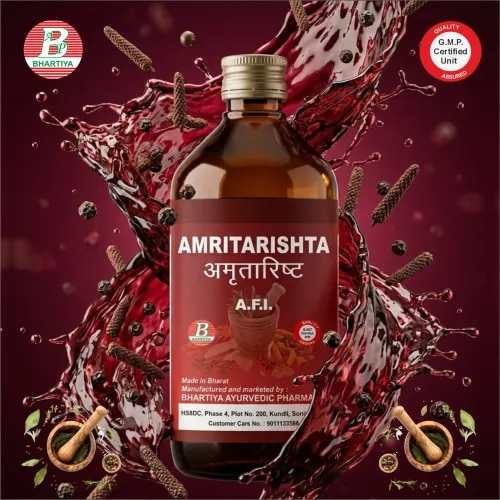
"name": "AMRITARISHTA",
"description": " \n AMRITARISHTA\n\n\nProduct Identification\nGeneric Name: Amritarishta\nType: Ayurvedic Polyherbal Fermented Formulation (Arishta)\nPrimary Indication Area:\nPrimarily used as a blood purifier, immunomodulator, and anti-inflammatory tonic, indicated in chronic fever, skin disorders, gout, and systemic inflammatory conditions.\n\nTherapeutic Indications:\n•\tChronic and recurrent fever (Jwara) \n•\tRheumatic disorders and inflammatory conditions \n•\tGout (Uric acid-related disorders) \n•\tSkin diseases (Kushta—eczema, itching, psoriasis-like conditions) \n•\tHepatomegaly and splenic disorders (supportive) \n•\tGeneral debility after chronic illness \n•\tLoss of immunity and recurrent infections \n•\tDetoxification and blood purification \n\nKey Benefits\n•\tImmunomodulatory action – strengthens body’s defense system \n•\tAnti-inflammatory support – reduces systemic inflammation and pain \n•\tBlood purification – helps eliminate metabolic toxins (Ama) \n•\tFever regulation – useful in chronic and recurrent fevers \n•\tSkin health improvement – reduces itching, eruptions, and inflammation \n•\tJoint health support – useful in gout and inflammatory joint pain \n•\tRestorative tonic action – improves strength after prolonged illness \n•\tBalances Pitta and Vata disorders\nFORMULA \nEach part contains:\nMain Decoction Drugs (Kwatha Dravyas):\n•\tGuduchi (Tinospora cordifolia) -4.800 kg\n•\tBilva (Aegle marmelos) -480 g\n•\tShyonaka (Oroxylum indicum) -480 g\n•\tGambhari (Gmelina arborea) -480 g\n•\tPatala (Stereospermum suaveolens) -480 g\n•\tAgnimantha (Clerodendrum phlomidis) -480 g\n•\tShalaparni (Desmodium gangeticum) -480 g\n•\tPrishniparni (Uraria picta) -480 g\n•\tBrihati (Solanum indicum) -480 g\n•\tKantakari (Solanum xanthocarpum) -480 g\n•\tGokshura (Tribulus terrestris) -480 g\n\nPrakshepa Dravyas (Added after decoction):\n•\tShweta Jeera (Cuminum cyminum) -48 g\n•\tParpata (Fumaria indica) -48 g\n•\tSaptaparna (Alstonia scholaris) -48 g\n•\tSunthi (Zingiber officinale) -48 g\n•\tMaricha (Piper nigrum) -48 g\n•\tPippali (Piper longum) -48 g\n•\tNagkesar (Mesua ferrea) -48 g\n•\tMusta (Cyperus rotundus) -48 g\n•\tKutaki (Picrorhiza kurroa) -48 g\n•\tAtivisha (Aconitum heterophyllum) -48 g\n•\tIndrayava (Holarrhena antidysenterica) -48 g \n\nFermentation Base:\n•\tGuda (Jaggery)-14.400 kg \n•\tWater (for decoction & fermentation)-49152 L reduced to 12.288 L\n1. Guduchi (Tinospora cordifolia)\n•\tRasa: Tikta, Kashaya \n•\tGuna: Laghu, Snigdha \n•\tVirya: Ushna \n•\tVipaka: Madhura \n•\tPrabhava: Rasayana, Jwaraghna \nMechanism of Action:\n•\tEnhances immune cell activity (macrophage stimulation) \n•\tReduces systemic inflammation and fever tendency \n•\tDetoxifies Ama from blood and tissues \n•\tSupports liver detoxification and metabolic clearance \n•\tImproves resistance against recurrent infections \n\n2. Bilva (Aegle marmelos)\n•\tRasa: Kashaya, Tikta \n•\tGuna: Laghu, Ruksha \n•\tVirya: Ushna \n•\tVipaka: Katu \n•\tPrabhava: Grahi, Deepana \nMechanism of Action:\n•\tImproves intestinal tone and controls abnormal bowel movements \n•\tReduces intestinal inflammation and abdominal discomfort \n•\tRegulates Vata in gastrointestinal tract \n•\tSupports digestion and absorption balance \n•\tPrevents toxin accumulation from improper digestion \n\n3. Shyonaka (Oroxylum indicum)\n•\tRasa: Tikta, Kashaya \n•\tGuna: Laghu, Ruksha \n•\tVirya: Ushna \n•\tVipaka: Katu \n•\tPrabhava: Shothahara \nMechanism of Action:\n•\tReduces systemic inflammation and tissue swelling \n•\tSupports joint and musculoskeletal health \n•\tImproves microcirculation and tissue repair \n•\tBalances Vata-Pitta inflammatory pathways \n•\tHelps in chronic pain and stiffness conditions \n\n4. Gambhari (Gmelina arborea)\n•\tRasa: Madhura, Tikta \n•\tGuna: Guru, Snigdha \n•\tVirya: Sheeta \n•\tVipaka: Madhura \n•\tPrabhava: Balya, Rasayana \nMechanism of Action:\n•\tProvides nourishment to depleted tissues \n•\tEnhances strength and recovery after illness \n•\tReduces fatigue and systemic weakness \n•\tSupports muscle and tissue regeneration \n•\tBalances Vata-induced debility \n\n5. Patala (Stereospermum suaveolens)\n•\tRasa: Tikta, Kashaya \n•\tGuna: Laghu \n•\tVirya: Ushna \n•\tVipaka: Katu \n•\tPrabhava: Vatahara \nMechanism of Action:\n•\tReduces Vata-related pain and stiffness \n•\tImproves circulation and tissue oxygenation \n•\tSupports anti-inflammatory activity in joints \n•\tHelps detoxify metabolic waste \n•\tRelieves systemic heaviness \n\n6. Agnimantha (Clerodendrum phlomidis)\n•\tRasa: Katu, Tikta \n•\tGuna: Laghu, Ruksha \n•\tVirya: Ushna \n•\tVipaka: Katu \n•\tPrabhava: Deepana, Pachana \nMechanism of Action:\n•\tStimulates digestive fire (Agni) \n•\tEnhances breakdown and metabolism of Ama \n•\tImproves nutrient assimilation \n•\tReduces bloating and sluggish digestion \n•\tBalances gut-related Vata disorders \n\n7. Shalaparni (Desmodium gangeticum)\n•\tRasa: Madhura \n•\tGuna: Guru, Snigdha \n•\tVirya: Sheeta \n•\tVipaka: Madhura \n•\tPrabhava: Balya, Vatahara \nMechanism of Action:\n•\tStrengthens neuromuscular system \n•\tReduces fatigue and physical weakness \n•\tImproves tissue repair and regeneration \n•\tSupports anti-inflammatory response \n•\tEnhances vitality in chronic illness \n\n8. Prishniparni (Uraria picta)\n•\tRasa: Madhura \n•\tGuna: Guru, Snigdha \n•\tVirya: Sheeta \n•\tVipaka: Madhura \n•\tPrabhava: Rasayana \nMechanism of Action:\n•\tImproves tissue nourishment and strength \n•\tEnhances recovery from systemic illness \n•\tReduces inflammatory fatigue \n•\tSupports immune modulation \n•\tStrengthens musculoskeletal system \n\n9. Brihati (Solanum indicum)\n•\tRasa: Tikta, Katu \n•\tGuna: Laghu, Ruksha \n•\tVirya: Ushna \n•\tVipaka: Katu \n•\tPrabhava: Vata-Kapha hara \nMechanism of Action:\n•\tReduces respiratory and systemic congestion \n•\tEnhances metabolic activity \n•\tImproves digestion and toxin clearance \n•\tRelieves inflammatory pain \n•\tSupports systemic detoxification \n\n10. Kantakari (Solanum xanthocarpum)\n•\tRasa: Tikta, Katu \n•\tGuna: Laghu, Ruksha \n•\tVirya: Ushna \n•\tVipaka: Katu \n•\tPrabhava: Shwasahara \nMechanism of Action:\n•\tClears respiratory and systemic mucus \n•\tReduces inflammatory congestion \n•\tEnhances metabolic detox pathways \n•\tSupports anti-inflammatory activity \n•\tImproves tissue clearance \n\n11. Gokshura (Tribulus terrestris)\n•\tRasa: Madhura, Tikta \n•\tGuna: Guru, Snigdha \n•\tVirya: Sheeta \n•\tVipaka: Madhura \n•\tPrabhava: Mutrala \nMechanism of Action:\n•\tSupports urinary detoxification system \n•\tReduces systemic toxin load \n•\tImproves tissue strength and nourishment \n•\tMaintains fluid-electrolyte balance \n•\tSupports recovery in chronic weakness \n\n12. Shweta Jeera (Cuminum cyminum)\n•\tRasa: Katu, Tikta \n•\tGuna: Laghu, Ruksha \n•\tVirya: Ushna \n•\tVipaka: Katu \n•\tPrabhava: Deepana, Pachana \nMechanism of Action:\n•\tStimulates digestive enzymes and Agni \n•\tReduces gas formation and bloating \n•\tEnhances gut motility \n•\tImproves nutrient absorption \n•\tSupports metabolic digestion \n\n13. Parpata (Fumaria indica)\n•\tRasa: Tikta \n•\tGuna: Laghu, Ruksha \n•\tVirya: Sheeta \n•\tVipaka: Katu \n•\tPrabhava: Raktashodhaka \nMechanism of Action:\n•\tPurifies blood and reduces toxins \n•\tSupports liver detoxification \n•\tReduces skin and inflammatory disorders \n•\tHelps clear metabolic waste \n•\tBalances Pitta-related conditions \n\n14. Saptaparna (Alstonia scholaris)\n•\tRasa: Tikta \n•\tGuna: Laghu, Ruksha \n•\tVirya: Ushna \n•\tVipaka: Katu \n•\tPrabhava: Jwaraghna \nMechanism of Action:\n•\tReduces chronic fever conditions \n•\tSupports immune regulation \n•\tActs against microbial imbalance \n•\tImproves systemic detoxification \n•\tStabilizes inflammatory response \n\n15. Sunthi (Zingiber officinale)\n•\tRasa: Katu \n•\tGuna: Laghu, Ruksha \n•\tVirya: Ushna \n•\tVipaka: Madhura \n•\tPrabhava: Ama Pachana \nMechanism of Action:\n•\tActivates digestive fire (Agni) \n•\tBreaks down Ama (metabolic toxins) \n•\tImproves circulation and metabolism \n•\tReduces gas and heaviness \n•\tEnhances nutrient absorption \n\n16. Maricha (Piper nigrum)\n•\tRasa: Katu \n•\tGuna: Laghu, Ruksha \n•\tVirya: Ushna \n•\tVipaka: Katu \n•\tPrabhava: Yogavahi \nMechanism of Action:\n•\tEnhances bioavailability of herbs \n•\tStimulates digestive enzymes \n•\tImproves metabolic rate \n•\tReduces Ama accumulation \n•\tSupports respiratory and digestive cleansing \n\n17. Pippali (Piper longum)\n•\tRasa: Katu \n•\tGuna: Laghu, Snigdha \n•\tVirya: Ushna \n•\tVipaka: Madhura \n•\tPrabhava: Rasayana \nMechanism of Action:\n•\tEnhances Agni and digestion \n•\tImproves respiratory and metabolic function \n•\tReduces chronic inflammation \n•\tSupports tissue rejuvenation \n•\tEnhances absorption of nutrients \n\n18. Nagkesar (Mesua ferrea)\n•\tRasa: Kashaya, Tikta \n•\tGuna: Laghu, Ruksha \n•\tVirya: Sheeta \n•\tVipaka: Katu \n•\tPrabhava: Raktastambhana \nMechanism of Action:\n•\tControls bleeding and inflammatory conditions \n•\tSupports blood purification \n•\tReduces tissue inflammation \n•\tImproves wound healing \n•\tBalances Pitta disorders \n\n19. Musta (Cyperus rotundus)\n•\tRasa: Tikta, Katu \n•\tGuna: Laghu, Ruksha \n•\tVirya: Sheeta \n•\tVipaka: Katu \n•\tPrabhava: Deepana, Pachana \nMechanism of Action:\n•\tImproves digestion and enzyme activity \n•\tReduces diarrhea and gut irritation \n•\tControls Ama formation \n•\tSupports metabolic balance \n•\tCalms gastrointestinal inflammation \n\n20. Kutaki (Picrorhiza kurroa)\n•\tRasa: Tikta \n•\tGuna: Laghu, Ruksha \n•\tVirya: Sheeta \n•\tVipaka: Katu \n•\tPrabhava: Hepatoprotective \nMechanism of Action:\n•\tSupports liver detoxification and regeneration \n•\tEnhances bile secretion and metabolism \n•\tRemoves accumulated toxins from blood \n•\tReduces inflammatory liver conditions \n•\tImproves digestion via hepatic support \n\n21. Ativisha (Aconitum heterophyllum)\n•\tRasa: Tikta, Katu \n•\tGuna: Laghu, Ruksha \n•\tVirya: Ushna \n•\tVipaka: Katu \n•\tPrabhava: Deepana, Jwaraghna \nMechanism of Action:\n•\tReduces fever and infectious conditions \n•\tEnhances digestive strength \n•\tControls diarrhea and gut infections \n•\tSupports immune response \n•\tReduces Ama-related disorders \n\n22. Indrayava (Holarrhena antidysenterica)\n•\tRasa: Tikta, Kashaya \n•\tGuna: Laghu, Ruksha \n•\tVirya: Sheeta \n•\tVipaka: Katu \n•\tPrabhava: Grahi, Krimighna \nMechanism of Action:\n•\tControls diarrhea and intestinal infections \n•\tEliminates intestinal parasites \n•\tImproves gut absorption and stability \n•\tReduces inflammation in GI tract \n•\tRestores intestinal microbial balance \n\n23. Guda (Jaggery)\n•\tRasa: Madhura \n•\tGuna: Guru \n•\tVirya: Ushna \n•\tVipaka: Madhura \n•\tPrabhava: Yogavahi \nMechanism of Action:\n•\tActs as fermentation medium in Arishta preparation \n•\tEnhances absorption of herbal constituents \n•\tImproves bioavailability of active compounds \n•\tSupports mild nutritive energy supply \n•\tFacilitates proper fermentation process \n\nDosage\n•\tAdults: 15–30 ml \n•\tTwice daily after meals \n•\tWith equal quantity of water (1:1 dilution) \n\nCommon Usage Guidance\n•\tUseful in fever, inflammation, and weakness \n•\tSupports digestion and detoxification simultaneously \n•\tTypically used for 4–8 weeks \n•\tBest taken after meals for better tolerance \n\nImportant Notes\n•\tUse cautiously in diabetes (contains jaggery) \n•\tAvoid overdose due to strong herbal potency \n•\tNot for acute severe dehydration or extreme weakness \n•\tShould be taken under Ayurvedic supervision in chronic disease \n\n\namritarishta syrup, amritarishta syrup uses in hindi, amritarishta ke fayde\namritarishta syrup uses, amritarishta use in hindi, amritarishta ayurvedic medicine uses in hindi\namritarishta uses, amritarishta syrup uses in hindi price, amritarishta ayurvedic medicine\namritarishta ayurvedic syrup uses in hindi, amritarishta ayurvedic, amritarishta ayurvedic medicine uses\namritarishta ayurvedic syrup uses, amritarishta ayurvedic dawai kis kaam aati hai\namritarishta ayurvedic syrup, amritarishta amazon, amritarishta benefits, amritarishta benefits in hindi\namritarishta banane ki vidhi, amritarishta composition, amritarishta contents, amritarishta dosage\namritarishta dawa ke fayde, amritarishta dawai kis kaam aati hai, amritarishta dawai\namritarishta dose, amritarishta easy ayurveda, amritarishta expiry date, amritarishta how to take\namritarishta hindi use, amritarishta use, hamdard amritarishta, amritarishta syrup hindi\namritarishta kya hai, amritarishta benefits hindi, amritarishta is used for, amritarishta indication\namritarishta image, amritarishta immune support, amritarishta in kannada, amritarishta uses hindi\namritarishta ke fayde in hindi, amritarishta kis kaam mein aati hai, amritarishta kis chij ki dawai hai\namritarishta kis kaam aata hai, amritarishta kaise lena chahiye\namritarishta kis liye hoti hai, amritarishta kiske liye hai, amritarishta medicine uses in hindi\namritarishta medicine uses, amritarishta mrp, amritarishta near me, amritarishta syrup near me\namritarishta online, amritarishta syrup online, amritarishta buy online, amritarishta before or after food\nuses of amritarishta, use of amritarishta in hindi, use of amritarishta syrup, benefits of amritarishta syrup\namritarishta peene ke kya fayde hain, amritarishta price in india, amritarishta planet ayurveda\namritarishta review, amritarishta syrup kis kaam aata hai, amritarishta syrup benefits\namritarishta syrup ingredients, amritarishta ayurvedic tonic, amritarishta vati, amritarishta when to take\namritarishta ayurveda, amritarishtam use, amritarishta syrup uses in english, amritarishta uses in english\nhow to take amritarishta syrup, how to take amritarishta, health benefits of amritarishta",
"price": 189.0,
"discountamount": 94.0,
"currencycode": "INR",
"priority": 1000000,
"isfreeshipmentavailable": false,
"shipmentduration": 1,
"_keywords": null,
"isarchived": false,
"isavailable": true,
"applicationid": null,
"productindex": 155,
"imageuri": "https://productimages.withfloats.com/actual/6a56292a5a4a17074bc2c96f.jpg",
"tileimageuri": "https://productimages.withfloats.com/tile/6a56292a5a4a17074bc2c96f.jpg",
"images": null,
"totalqueries": 0,
"gpid": null,
"groupproductid": null,
"createdon": "2026-07-14T12:18:42.683Z",
"updatedon": "2026-07-14T12:26:25.617Z",
"buyonlinelink": null,
"producturl": "http://WWW.BHARTIYAAYURVEDICPHARMACY.COM/products/amritarishta/155",
"availableunits": -1.0,
"iscodavailable": true,
"isprepaidonlineavailable": true,
"maxcodorders": -1,
"maxprepaidonlineorders": -1,
"uniquepaymenturl": null,
"brandname": "Bakula Fort",
"category": "AMRITARISHTA 450 ML X 40",
"tags": [],
"variants": false,
"keyspecification": null,
"otherspecifications": null,
"pickupaddressreferenceid": null,
"paymenttype": "AssuredPurchase",
"producttype": "products",
"hsncode": null,
"gstslab": 0.0,
"isnotforsale": false
},
{
"_id": "69e1c462654012fd93ca2eae",
"fptag": "BHARTIYEAYURVEDICPHARMACY",
"merchantname": null,
"customwidgets": null,
"externalsourceid": null,
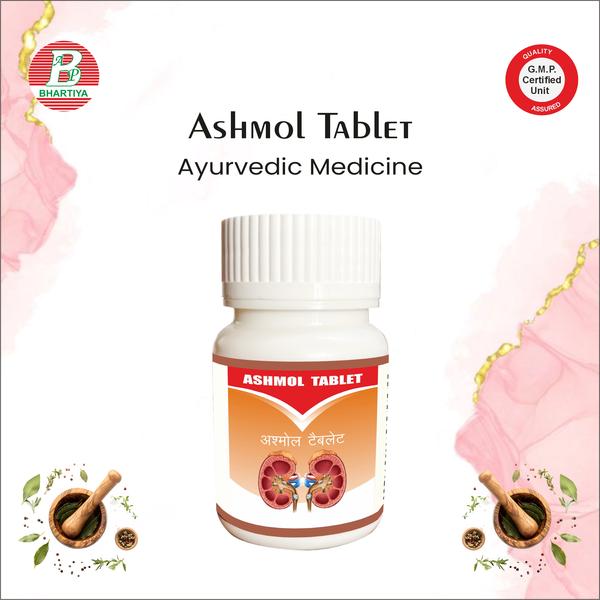
"name": "Ashmol Tablet",
"description": " ASHMOL TABLET \n\nProduct Identification\n•\tGeneric Name: Ashmol Tablet\n•\tType: Ayurvedic Patent Medicine\n•\tPrimary Indication Area: kidney stone treatment is to relieve pain and help pass or remove stones from the kidneys and urinary tract.\nTherapeutic Indications:\nPain relief, facilitation of stone passage, and prevention of stone recurrence. \nPrimary Benefit:\n•\tRelieves pain and helps pass or remove stones.\nOther Benefits:\n•\tPrevents recurrence of stones if proper medication or lifestyle changes are followed\n•\tReduces risk of urinary tract infections caused by stagnant stones\n•\tProtects kidney function by preventing obstruction and damage\n•\tMay improve urine flow and general urinary health\n HARAD \nBotanical / Common Name: Terminalia chebula\nKey Phytoconstituents:\n•\tTannins\n•\tFlavonoids\n•\tPolyphenols / Phenolic compounds\n•\tSugars / Mucilage\nMechanism of Action in Kidney Stones – Biochemistry / Pharmacology:\n1.\tInhibition of Stone Formation\no\tTannins and flavonoids bind calcium and oxalate ions, preventing calcium oxalate crystal aggregation.\no\tReduces formation of larger stones from small crystals.\n2.\tDiuretic Effect / Stone Flushing\no\tIncreases urine output, helping flush out small stones.\no\tReduces crystal retention in kidneys and ureters.\n3.\tAntioxidant / Renal Protective Effect\no\tPolyphenols and flavonoids scavenge reactive oxygen species (ROS).\no\tProtects renal tissue from oxidative damage that promotes stone formation.\n4.\tUrinary Alkalinization\no\tMildly increases urine pH, reducing uric acid stone formation.\n5.\tAnti-inflammatory Effect\no\tReduces inflammation in the urinary tract caused by stone irritation.\n\n BABOOL \nBotanical / Common Name: Acacia nilotica\nKey Phytoconstituents:\n•\tTannins\n•\tFlavonoids \n•\tSaponins\n•\tGlycosides\n•\tPolyphenolic compounds\nMechanism of Action – Biochemistry / Pharmacology:\n1.\tAntimicrobial / Oral Health Effect\no\tTannins and flavonoids exhibit antibacterial activity, reducing microbial growth in oral and gastrointestinal tract.\no\tHelps in prevention of infections and inflammation.\n2.\tAstringent Effect\no\tTannins precipitate proteins on mucosal surfaces, producing an astringent action.\no\tUseful in diarrhea, bleeding gums, and wound healing.\n3.\tAnti-inflammatory Effect\no\tPolyphenolic compounds reduce inflammation by inhibiting inflammatory mediators.\no\tProtects tissues from irritation and oxidative stress.\n4.\tAntioxidant Effect\no\tFlavonoids and polyphenols scavenge free radicals, protecting cells from oxidative damage.\n5.\tGastrointestinal Benefits\no\tSaponins and tannins strengthen gut mucosa, reduce diarrhea, and help maintain digestive health.\n\n\nSHUDH GUGGAL \nBotanical / Common Name: Commiphora mukul\nKey Phytoconstituents:\n•\tGuggulsterones (E- and Z- guggulsterone)\n•\tResinous compounds\n•\tEssential oils\n•\tSterols\nMechanism of Action – Biochemistry / Pharmacology:\n1.\tLipid-Lowering / Hypolipidemic Effect\no\tGuggulsterones modulate cholesterol metabolism by activating bile acid synthesis.\no\tReduces LDL cholesterol and triglycerides; increases HDL cholesterol.\n2.\tAnti-inflammatory Effect\no\tInhibits NF-κB pathway, reducing production of inflammatory mediators.\no\tUseful in arthritis, joint pain, and inflammatory conditions.\n3.\tAnti-oxidant Effect\no\tResin and phytosterols scavenge free radicals, protecting cells from oxidative stress.\n4.\tThyroid Stimulant / Metabolic Effect\no\tGuggulsterones may stimulate thyroid activity, enhancing metabolic rate and fat metabolism.\n5.\tCholagogue / Digestive Support\no\tPromotes bile secretion, aiding digestion and fat absorption.\n\n HAJRUL YAHOOD BHASMA \nBotanical / Common Name: mineral based Ayurvedic Bhasma (calcined stone)\nKey Phytoconstituents / Composition:\n•\tCalcium silicate / Lime silicate (from fossil stone)\n•\tMineral oxides (post calcination residues)\n(Hajrul Yahood is processed through purification and heating to form a fine, digestible powder) \nMechanism of Action in Kidney Stone / Urinary System – Biochemistry / Pharmacology:\n1.\tLithontriptic (Stone Dissolving) Action\no\tPromotes breakdown and dissolution of urinary calculi (stones), helping them reduce in size or pass through urine.\no\tUsed traditionally to manage kidney stones and assist expulsion along the urinary tract. \n2.\tDiuretic Effect / Urine Flow Promotion\no\tIncreases urine production and flow, facilitating the flushing out of small crystals or stones.\no\tHelps reduce urinary retention and complete bladder emptying. \n3.\tAnodyne / Pain Reducing Effect\no\tHas properties to alleviate renal colic (stone related pain) and discomfort during urination.\no\tMinimizes burning sensation and dysuria (painful urination). \n4.\tAntipruritic / Mucosal Protective Action\no\tTraditionally used externally for skin irritation (itching, ringworm) due to its calming effect on tissues.\no\tInternally, it supports mucosal health in the urinary tract. \n5.\tPitta & Kapha Pacification (Ayurvedic property)\no\tCooling (sheet) virya and astringent action help balance Pitta and Kapha doshas associated with excess heat and fluid imbalance in the GI and urinary systems. \n\n GHRIT KUMARI \nBotanical / Common Name: Aloe vera\nKey Phytoconstituents:\n•\tAnthraquinones (aloin, emodin)\n•\tPolysaccharides (acemannan)\n•\tSaponins\n•\tGlycoproteins\n•\tVitamins and minerals\nMechanism of Action – Biochemistry / Pharmacology:\n1.\tMild Laxative / Gastrointestinal Effect\no\tAnthraquinones stimulate intestinal peristalsis, easing bowel movements.\no\tPolysaccharides increase water content in stools, reducing constipation and straining.\n2.\tAnti-inflammatory Effect\no\tGlycoproteins and polysaccharides inhibit inflammatory mediators, soothing GI mucosa and reducing irritation.\n3.\tWound Healing / Tissue Regeneration\no\tPolysaccharides and glycoproteins promote cell proliferation, collagen synthesis, and tissue repair.\no\tHelps heal ulcers and minor GI lesions.\n4.\tAntioxidant Effect\no\tVitamins (A, C, E) and phenolic compounds scavenge free radicals, protecting tissues from oxidative damage.\n5.\tImmune Modulatory Effect\no\tPolysaccharides stimulate macrophages and cytokine activity, supporting immune defense in the GI tract.\nDosage\nDose: 2–3 tablets, twice a day (morning and evening)\n•\tAnupan: Water, preferably after food\n•\tPrecautions:\no\tOnly relieves pain, does not dissolve or remove stones\no\tMaintain hydration and follow dietary measures\no\tConsult a doctor if pain is severe, persistent, or with blood in urine/fever. \n\n\n\nashmol tablet amazon, ashmol tablet amazon india\nashmol tablet benefits, ashmol tablet buy online\nashmol tablet buy, ashmol tablet brand name\nashmol tablet composition, ashmol tablet company\nashmol tablet content, ashmol tablet composition pdf\nashmol tablet download, ashmol tablet dose\nashmol tablet dosage, ashmol tablet dose per day\nashmol tablet englis, ashmol tablet expiry date\nashmol tablet flipkart, ashmol tablet free download\nashmol tablet for hair, ashmol tablet for skin\nashmol tablet ghaziabad, ashmol tablet google\nashmol tablet ghaziabad uttar pradesh, ashmol tablet hindi\nashmol tablet holder, ashmol tablet how to use\nashmol tablet hsn code, ashmol tablet hd images\nashmol tablet indiamart, ashmol tablet india\nashmol tablet in hindi , ashmol tablet image\nashmol tablet jiomart, ashmol tablet jaipur\nashmol tablet ke fayde in hindi, ashmol tablet kya hai\nashmol tablet kis kaam aati hai, ashmol tablet ke fayde\nashmol tablet kya kam karta hai, ashmol tablet login\nashmol tablet list, ashmol tablet list pdf\nashmol tablet label, ashmolean museum tablets\nashmol tablet uses, ashmol tablet name\nashmol tablet new, ashmol tablet online shopping\nashmol tablet online, ashmol tablet order\nashmol tablet order online, ashmol tablet price\nashmol tablet price in india, ashmol tablet quality\nashmol tablet review, ashmol tablet rate\nashmol tablet review in hindi, ashmol tablet side effects\nashmol tablet supplier, ashmol tablet tablet\nasmol 500 uses in hindi, ashmol tablet video\nashmol tablet website, acimol+tablet+uses\nwhere ashmol tablet manufactured\nwhere ashmol tablet found, where ashmol tablet uses\nwhen ashmol tablet will start, when ashmol tablet launched\nwhen ashmol tablet uses, how ashmol tablet is used\nwhy ashmol tablet uses, who ashmol tablets\nwho ashmol tablet uses, is ashmol tablet good\ncan ashmol tablet uses, will ashmol tablet uses\ndo ashmol tablet uses, does ashmol tablets work\nwas ashmol tablet uses, best ashmol tablets\nbest ashmol tablet in india, top ashmol tablets\ntop ashmol tablet in india, top ashmol tablet uses",
"price": 105.0,
"discountamount": 50.0,
"currencycode": "INR",
"priority": 1000000,
"isfreeshipmentavailable": false,
"shipmentduration": 1,
"_keywords": null,
"isarchived": false,
"isavailable": true,
"applicationid": null,
"productindex": 91,
"imageuri": "https://productimages.withfloats.com/actual/69e1c46454763944d8952bf5.jpg",
"tileimageuri": "https://productimages.withfloats.com/tile/69e1c46454763944d8952bf5.jpg",
"images": null,
"totalqueries": 0,
"gpid": null,
"groupproductid": null,
"createdon": "2026-04-17T05:25:54.596Z",
"updatedon": "2026-04-17T05:25:54.596Z",
"buyonlinelink": null,
"producturl": "http://WWW.BHARTIYAAYURVEDICPHARMACY.COM//ashmol-tablet/91",
"availableunits": -1.0,
"iscodavailable": true,
"isprepaidonlineavailable": true,
"maxcodorders": -1,
"maxprepaidonlineorders": -1,
"uniquepaymenturl": null,
"brandname": "Bakula Fort",
"category": "Ashmol Tablet 100 Tab X 40",
"tags": [],
"variants": false,
"keyspecification": null,
"otherspecifications": null,
"pickupaddressreferenceid": null,
"paymenttype": "AssuredPurchase",
"producttype": "products",
"hsncode": null,
"gstslab": 0.0,
"isnotforsale": false
},
{
"_id": "69e0a9e5ba41faa29e085f5f",
"fptag": "BHARTIYEAYURVEDICPHARMACY",
"merchantname": null,
"customwidgets": null,
"externalsourceid": null,
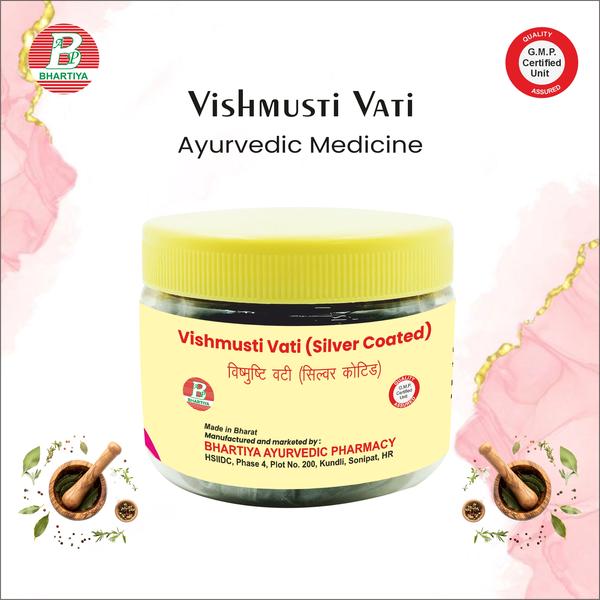
"name": "Vashmusti Vati",
"description": " VISHMUSHTI VATI (SILVER COATED) \n\nProduct Identification\n•\tGeneric Name: Vishmushti Vati\n•\tType: Ayurvedic Patent Medicine\n•\tPrimary Indication Area: All Types of Joint Pain (Gathiya / Vat Roga)\n•\tTherapeutic Indications Management of joint pain of all types, including Vata-related disorders (Gathiya / Vat Roga). \nKey benefits include:\n1.\tPain Relief\no\tHelps reduce joint pain, soreness, and discomfort caused by Vata imbalance.\n2.\tReduces Stiffness & Swelling\no\tImproves joint flexibility and eases swelling associated with arthritis or Gathiya.\n3.\tSupports Joint Mobility\no\tEnhances ease of movement and overall joint function.\n4.\tStrengthens Muscles & Bones\no\tHelps improve muscle tone around joints and supports bone health.\n5.\tAnti-fatigue & Vitality Support\no\tReduces weakness and tiredness caused by chronic joint pain.\no\tPromotes overall strength and rejuvenation.\no\t\n\nIngredients:\n SHUDH HINGUL \nAyurvedic Name: Shuddha Hingul / Hingula Bhasma\nMineral Source: Cinnabar (purified mercury sulphide)\nPrimary Use: Vata Roga & Joint Pain (Gathiya) support in classical Ayurvedic formulations\n\nKey Phytoconstituents\n•\tPurified Mercuric Sulphide (HgS) transformed into nano sized bio assimilable particles through classical Shodhana–Marana processes\n•\t Trace mineral complexes with elements like Zn, Cu, Fe formed during purification and incineration\n•\tSynergistic adjuvants (when processed with herbal decoctions such as Triphala, Guduchi, Nirgundi) to support detoxification and absorption\nMechanism of Action\n(Biochemistry / Pharmacological Basis for Joint Pain — Vata Roga / Gathiya)\n1.\tNano Particle Bio Assimilation & Immune Modulation\n\n•\tProperly purified mercuric sulphide (HgS) in Shuddha Hingul Bhasma forms extremely fine particles that cross intestinal mucosa more efficiently and interact with immune cells, stimulating macrophage activity and encouraging a balanced immune response in chronic inflammatory environments. \n2.\tAnti Inflammatory & Dosha Regulation\n•\tThrough traditional Ayurvedic mechanisms, the ushna (heating) potency and deep penetrating action of Hingul help pacify aggravated Vata dosha, which is a major contributor to stiffness, pain, and erratic neural signals in joint disorders. \n•\t Trace sulfur compounds and other mineral complexes may contribute mild anti inflammatory effects, reducing local discomfort \n3.\tDetoxification & Metabolic Balance (Ama Clearance)\n\n•\tHangul’s classical action includes enhancing agni (metabolic fire) and clearing ama (toxic metabolic by products) from tissues and srotas (channels), which in Ayurveda are thought to exacerbate joint pain and stiffness when accumulated. \n4.\tTissue Nourishment & Support\n\n•\tBy harmonizing metabolism and supporting reticuloendothelial system activity, fine bhasma particles may help improve nutrient delivery and tissue nourishment, indirectly supporting joint comfort and resilience. \n\nIngredients:\n JAYPHAL (Nutmeg) \nBotanical Name: Myristica fragrans\nAyurvedic Names: Jaiphal, Jatiphala, Jatisasya\nPrimary Use: Joint pain relief (Vata Roga), anti inflammatory and musculoskeletal support\n\nKey Phytoconstituents\nMyristicin – aromatic compound with anti inflammatory and mild analgesic properties\nElemicin – contributes to anti inflammatory and antioxidant effects\nTrimyristin & fatty acids – support metabolic functions\nEugenol, sabinene, α pinene & other volatile oils – anti inflammatory, analgesic and antioxidant constituents\n Phenolic compounds & lignans – support free radical neutralization and tissue protection\n\nMechanism of Action\n(Biochemistry / Pharmacological Basis for Joint Pain — Vata Roga / Gathiya)\n1.\tAnti Inflammatory & Analgesic Action\n•\tCompounds such as myristicin, eugenol, sabinene, β pinene and α pinene exhibit anti inflammatory and pain relieving effects, which help reduce joint swelling, soreness, and discomfort typical of Vata related joint disorders. \n2.\tAntioxidant & Tissue Protection\n•\tPhenolic compounds and lignans in Jaiphal neutralize free radicals, protecting joint tissues from oxidative stress that can worsen chronic inflammation and joint degeneration. \n3.\tVata Pacification & Nervine Modulation\n•\tIn Ayurvedic pharmacology, Jayphal’s hot (ushna) potency and pungent taste help balance aggravated Vata dosha, which contributes to pain, stiffness, and erratic neural signals in joint discomfort. \n4.\tMuscle Relaxation & Circulatory Support\n•\tNutmeg’s volatile oils may promote local blood flow and muscle relaxation, which can relieve stiffness and improve mobility around affected joints. \n\n JAVITRI (Mace) \nBotanical Name: Myristica fragrans (aril of nutmeg seed)\nAyurvedic Use: Traditionally used as a digestive, anti inflammatory and mild analgesic agent; balances Vata & Kapha doshas in classical systems and used for joint muscle discomfort support. \n\nKey Phytoconstituents\n Myristicin – an aromatic phenylpropene compound responsible for medicinal effects. \n Elemicin – contributes to anti inflammatory and antioxidant properties. \n Safrole and other volatile oils (terpenes) – support anti inflammatory and circulatory effects. \n Phenolic compounds & flavonoids (antioxidant activity). \n Minerals such as iron, magnesium and trace nutrients that support metabolic functions. \n\nMechanism of Action\n(Biochemistry / Pharmacological Basis for Joint Pain — Vata Roga / Gathiya)\n1.\tAnti Inflammatory & Pain Modulating Action\n\n•\tConstituents such as myristicin, elemicin and other volatile oils exert anti inflammatory and mild analgesic effects, reducing inflammatory mediators that contribute to joint pain and stiffness. \n2.\tAntioxidant & Tissue Protection\n\n•\tPhenolic compounds and flavonoids neutralize free radicals and oxidative stress, helping protect joint tissues from damage and degeneration. \n3.\tVata Pacifying & Nervine Support\n\n•\tIn Ayurveda, Javitri’s hot (ushna) potency and pungent taste help balance aggravated Vata dosha, which is often implicated in joint stiffness, erratic neural signals, and discomfort. \n4.\tCirculatory & Muscle Comfort Support\n\n•\tVolatile oils may enhance local circulation and support muscle relaxation, helping relieve stiffness and improve comfort around joints and connective tissues. \n\n LAVANG (Clove) \nBotanical Name: Syzygium aromaticum\nAyurvedic Name: Lavang / Laung\nPrimary Use: Analgesic & anti inflammatory support; soothing discomfort associated with joint pain and Vata imbalance\nKey Phytoconstituents\n• Eugenol – major active compound with analgesic and anti inflammatory effects\n• β Caryophyllene, chavibetol, eugenyl acetate – synergistic volatile compounds contributing to anti inflammatory and pain modulating actions\n• Other phenolic compounds and antioxidants that support tissue protection and oxidative balance \n\nMechanism of Action\n(Biochemistry / Pharmacological Basis for Joint Pain — Vata Roga / Gathiya)\n1.\tAnti Inflammatory & Pain Relieving Action\n\n•\tEugenol inhibits inflammatory mediators (such as prostaglandins via cyclooxygenase pathways) and reduces local inflammation, helping relieve discomfort in stiff or sore joints.\n• Its mildly anaesthetic action modulates nerve impulses, providing soothing relief in affected areas. \n2.\tAntioxidant & Tissue Protection\n\n•\tPhenolic compounds and flavonoid like constituents neutralize free radicals and oxidative stress, which can exacerbate chronic inflammatory conditions like joint pain.\n• This supports cellular protection and may slow degenerative changes in connective tissues. \n3.\tCirculation & Vata Balance Support\n\n•\tLavang’s warming effect (ushna virya) and pungent aroma help improve local circulation and penetrate tissues, which is believed in Ayurveda to help pacify aggravated Vata dosha, a key factor in joint stiffness and erratic neural signalling. \n4.\tMuscle Relaxation & Comfort\n•\tThe volatile oil components contribute to muscle relaxation and improved microcirculation around joints, aiding in reduced stiffness and enhanced comfort.\n\n•\tWhen used topically (e.g., in warm oil massage), these effects are particularly noticeable.\n\n KALI MIRCH (Black Pepper) \nBotanical Name: Piper nigrum\nAyurvedic Name: Kali Mirch / Marica\nPrimary Use: Support for joint discomfort, inflammation and Vata Roga (joint pain)\n\nKey Phytoconstituents\n• Piperine — the principal alkaloid responsible for most pharmacological activity\n• Essential oils: limonene, α pinene, β pinene, sabinene, caryophyllene\n• Phenolic compounds & flavonoids — contribute antioxidant activity\n• Trace nutrients and lignans that support biological actions \n\nMechanism of Action\n(Biochemistry / Pharmacological Basis for Joint Pain — Vata Roga / Gathiya)\n1.\tAnti Inflammatory & Pain Modulation\n\n•\tPiperine and related alkaloids inhibit pro inflammatory pathways (e.g., NF κB, COX, and inflammatory cytokines) that drive joint inflammation and pain in arthritis models.\n• In cell studies, piperine reduced production of inflammatory mediators such as NO, PGE₂ and cytokines (IL 6, TNF α) and inhibited enzymes that break down cartilage matrix. \n2.\tAnti Oxidant & Tissue Protection\n\n•\tPhenolic compounds and flavonoids in black pepper neutralize free radicals that can exacerbate chronic joint degeneration and inflammatory tissue damage.\n• This helps protect joint connective tissues and supports cellular resilience. \n3.\tVata Pacifying & Circulation Enhancement\n\n•\tIn Ayurvedic terms, the ushna (warming) and Tikshna (penetrating) qualities of Kali Mirch help pacify aggravated Vata dosha, improving comfort, reducing stiffness, and enhancing micro circulation around joints.\n• Topical preparations (oil or paste with carrier oil) are traditionally used to ease soreness and warmth in joint areas. \n4.\tBioavailability & Synergistic Support\n\n•\tPiperine enhances the bioavailability of other compounds (e.g., curcumin, phenolics) by inhibiting certain metabolic enzymes, which may increase effectiveness of joint support herbs\n\n SUDH KUCHLA \nAyurvedic Name: Shuddha Kuchla (Purified Strychnos nux vomica)\nBotanical Source: Seeds of Strychnos nux vomica (detoxified via classical Shodhana processes)\nPrimary Use: Supports Vata Roga & Joint Pain (Gathiya) through metabolic balance, neuromuscular stimulation, and Vata pacification\n\nKey Phytoconstituents\n• Alkaloids (notably strychnine and brucine) — the primary bioactive compounds remaining after purification that influence nervous and muscular responses. \n• Other trace constituents influenced by processing — contributing to digestion, metabolic fire (agni) enhancement, and detoxification support.\n\nMechanism of Action\n(Biochemistry / Pharmacological Basis for Joint Pain — Vata Roga / Gathiya /)\n1.\tNeuromuscular Stimulation & Pain Modulation\n\n•\tPurified alkaloids in Sudh Kuchla act on the central and peripheral nervous system, stimulating nerve activity in a controlled manner to improve nerve muscle coordination and reduce erratic Vata related neural signals that contribute to joint discomfort. \n•\t This neuromodulation can indirectly help reduce sensations of stiffness and weakness in chronic joint conditions.\n2.\tAnti Inflammatory & Vata Balance\n\n•\tThrough classical Ayurvedic properties (bitter, pungent taste with warming potency), Sudh Kuchla pacifies aggravated Vata dosha, a key driver of joint pain and stiffness in Vata dominant disorders like Gathiya.\n3.\tDigestive Fire (Agni) & Detoxification Support\n\n•\tWarming virya (ushna potency) of Sudh Kuchla supports metabolic fire (agni), which aids in digestion and clears metabolic by products (ama) that are believed in Ayurveda to worsen joint pain and tissue congestion. \n4.\tMuscle & Tissue Support\n\n•\tBy stimulating metabolic activity and nervous regulation, Sudh Kuchla may contribute to improved nutrient delivery and deep tissue nourishment, indirectly supporting resilience in musculoskeletal structures during joint stress. \n\n\nDosage:\n1.\tDose per intake: 1–2 pills\n2.\tFrequency: 2 times daily\n3.\tTotal daily dose: 2–4 pills (depending on physician advice)\n4.\tHow to take: With milk, preferably after meals\n\nPrecautions\n•\tDo not exceed the prescribed dose\n•\tConsult an Ayurvedic practitioner before use in:\no\tChildren\no\tElderly\no\tPatients with chronic illness\n•\tMonitor for any side effects (e.g., digestive discomfort)\n•\tMaintain proper diet and hydration to support bowel health\n\n\nvishamushti vati uses, vishamushti vati\nvishamushti vati ingredients, vishamushti vati benefits\nvishamushti vati price, vishamushti vati tablet\nvishamushti vati uses in hindi, vishamushti vati benefits in hindi\nvishamushti vati in hindi, vishamushti vati easy ayurveda\nvishamushti vati use, vishamushti vati composition\nvishmusti vati flipkart, vishmusti vati goli\nvishmusti vati jankari in hindi, vishmusti vati jankari\nvishmusti vati ke fayde, vishmusti vati ke fayde in hindi\nvishmusti vati khane ke fayde, vishmusti vati kya kam karta hai\nvishmusti vati manufacturer, vishmusti vati mrp\nvishmusti vati near me, use of vishamushti vati\nvishmusti vati quality, vishmusti vati quantity\nvishamushti vati side effects, vishmusti vati website\nvishmusti vati works, uses of vishamushti vati\nwhat vishmusti vati uses in hindi, what vishmusti vati uses\nwhere vishmusti vati manufactured, where vishmusti vati available\nwhen vishmusti vati uses in hindi, when vishmusti vati uses\nwho vishmusti vati uses in hindi, can vishmusti vati uses in hindi\nwill vishmusti vati uses in hindi, was vishmusti vati uses in hindi\nbest vishamushti vati in hindi, best vishamushti vati uses",
"price": 990.0,
"discountamount": 495.0,
"currencycode": "INR",
"priority": 1000000,
"isfreeshipmentavailable": false,
"shipmentduration": 1,
"_keywords": null,
"isarchived": false,
"isavailable": true,
"applicationid": null,
"productindex": 88,
"imageuri": "https://productimages.withfloats.com/actual/69e0a9f3c32735ec39db6df9.jpg",
"tileimageuri": "https://productimages.withfloats.com/tile/69e0a9f3c32735ec39db6df9.jpg",
"images": null,
"totalqueries": 0,
"gpid": null,
"groupproductid": null,
"createdon": "2026-04-16T09:20:37.839Z",
"updatedon": "2026-04-16T09:20:37.839Z",
"buyonlinelink": null,
"producturl": "http://WWW.BHARTIYAAYURVEDICPHARMACY.COM//vashmusti-vati/88",
"availableunits": -1.0,
"iscodavailable": true,
"isprepaidonlineavailable": true,
"maxcodorders": -1,
"maxprepaidonlineorders": -1,
"uniquepaymenturl": null,
"brandname": "Bakula Fort",
"category": "Vashmusti Vati 100gm X 20",
"tags": [],
"variants": false,
"keyspecification": null,
"otherspecifications": null,
"pickupaddressreferenceid": null,
"paymenttype": "AssuredPurchase",
"producttype": "products",
"hsncode": null,
"gstslab": 0.0,
"isnotforsale": false
},
{
"_id": "698c1ba5301c5faebac8e6fe",
"fptag": "BHARTIYEAYURVEDICPHARMACY",
"merchantname": null,
"customwidgets": null,
"externalsourceid": null,
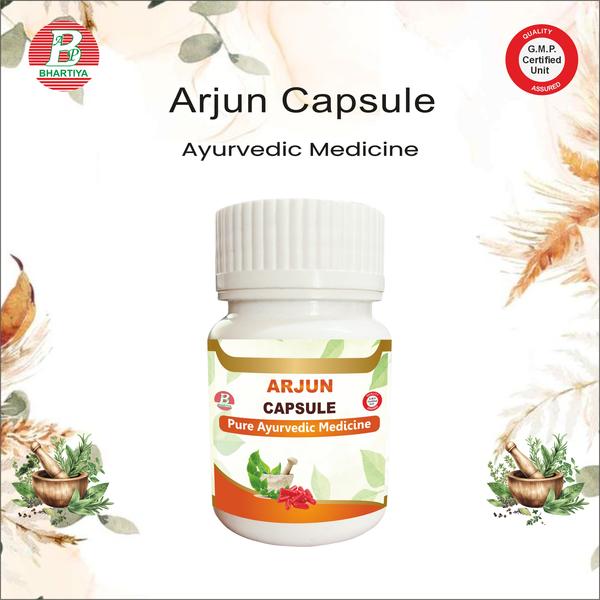
"name": "Arjuna Capsule",
"description": " ARJUNA (Terminalia arjuna Wight & Arn.)\n The Supreme Hṛdya — “Kṣata-Śodhana,” the Divine Protector of the Heart\nArjuna, known as Arjuna, Arjunah, Dhanvi, Veeravruksha, is the most celebrated Hṛdya (cardiac protective) drug in Ayurveda. Revered for its ability to strengthen the heart, purify blood, heal wounds, and restore vitality, Arjuna is mentioned extensively by Charaka, Sushruta, Vagbhata, and Nighantukars.\nIts bark is rich in co-enzyme Q-like compounds, triterpenoids, flavonoids, and tannins, responsible for its cardioprotective and antioxidant effects. Traditionally used for Hṛdroga, Raktapitta, Urahshoola, Kshaya, Prameha, and Shotha, it remains one of Ayurveda’s most important rejuvenative herbs for cardiovascular wellness.\n BOTANICAL INFORMATION\nScientific Name: Terminalia arjuna (Roxb. ex-DC.) Wight & Arn.\nFamily: Combretaceae\nOrder: Myrtales\nGenus: Terminalia\nSpecies: arjuna\nCommon Names\n•\tSanskrit: Arjuna, Dhanvi, Indradruma, Ksheerashleshma, Partha\n•\tHindi: Arjun\n•\tTamil: Marudha Maram\n•\tTelugu: Tellamaddi\n•\tMalayalam: Neer Maruthu\n•\tKannada: Matti\n•\tBengali: Arjun\n•\tMarathi/Gujarati: Arjun\n SYNONYMS FROM CLASSICAL AYURVEDIC NIGHANTUS\nCharaka Saṃhitā\n•\tListed under Kashaya Skandha (astringent group)\n•\tActions indicated: Hṛdya, Kṛmighna, Vrana-ropana\nSushruta Saṃhitā\n•\tMentioned in Pittaghna and Kasaya Varga\n•\tDescribed as Rakta-stambhana, Vrana-shodhana, Vedanasthapana\nBhavaprakasha Nighantu\n•\tSynonyms: Arjuna, Kukubha, Dhavala, Veeravriksha, Nadisarjaka\n•\tActions: Hṛdya, Raktaprasadana, Sthambhana, Vrana-ropana\nDhanvantari Nighantu\n•\tSynonyms: Indradruma, Partha, Ksheerashleshma, Arjunah\n•\tAttributes: Kaphapittashamaka, Shoshahara, Hṛdya\nAll classical texts glorify Arjuna primarily for cardiac protection, blood purification, wound healing, and strength building.\n SHORT STORY OF ARJUNA — AS PER ĀCHĀRYA TRADITION\nIn the ancient riverbank forests where great sages lived, the Arjuna tree stood tall and white-barked like a vigilant warrior. The Āchāryas observed that wounded animals resting near the Arjuna tree would heal more quickly, and those who drank decoction from its bark recovered from blood loss and weakness with remarkable speed.\nSeeing this, the sages proclaimed:\n“Arijayati iti Arjunaḥ — that which conquers the enemies of the body is Arjuna.”\n(Bhavaprakāśa Nighaṇṭu, Arjuna Varga)\nRecognizing its Hṛdya (heart-protecting) power, they declared:\n“Arjuna strengthens the heart just as the warrior Arjuna protected the Pāṇḍavas.”\n(Traditional commentary based on Dhanvantari Nighaṇṭu)\nThus, inspired by both its healing nature and the valour of the Mahābhārata hero, the sages named the tree Arjuna —\nthe protector, the healer, the conqueror of disease.\n THE HISTORICAL & PURĀNIC STORY OF ARJUNA —\n“The Warrior Tree of Courage and the Heart” **\nAmong all the trees described in Ayurveda, Arjuna carries one of the most inspiring and sacred stories. The ancient Vaidyas say that Arjuna is not merely a medicinal tree; it is a symbol of courage, strength, and unshakeable heart power. Its origin is tied to the valor of Arjuna, the Pandava warrior, and to the compassion of divine beings.\n THE LEGEND OF ARJUNA:\nWhy the Tree Was Named After the Mahabharata Warrior\nAccording to Ayurvedic tradition and Pauranic lore, during the time of the Mahabharata:\n Arjuna, the mighty Pandava prince, was known for:\n•\tHis immovable courage,\n•\tHis unbreakable will,\n•\tHis sharp focus,\n•\tAnd his compassionate heart.\nBut during the exile, Arjuna once felt deep weakness and exhaustion of heart, both physically and mentally. Seeing his fatigue, Sage Chyavana and Sage Dhaumya took him to the banks of a sacred river.\nThere, stood a tall, shimmering white-barked tree.\nSage Dhaumya said:\n “Partha, this tree shall bear your name, for it holds the same virtues you do —\nCourage, strength, purity, and a heart that protects all.”\nHe instructed Arjuna:\n•\tTo rest under its shade,\n•\tTo consume a decoction from its reddish inner bark,\n•\tAnd to meditate facing the river.\nAfter days of consuming the bark decoction, Arjuna regained astounding strength, clarity, and vitality.\nAnd thus, the tree came to be known as “ARJUNA” —\nthe tree that strengthens the heart just as the warrior inspired hearts.\n THE STORY OF ARJUNA AND LORD INDRA\n(Said in some regional Ayurvedic oral traditions)\nAnother folklore says:\nArjuna performed severe penance to receive divine weapons. Pleased by his devotion, Lord Indra appeared before him. When Arjuna asked:\n“O Deva! Grant me something that will protect and strengthen the hearts of future generations.”\nIndra touched a nearby tree and said:\n “This tree shall become a guardian of hearts. Its bark will protect, its strength will heal.\nAs you guard dharma, this tree will guard life.”\nHence, the tree was blessed with:\n•\tUnmatched heart-protective power\n•\tStrength-giving qualities\n•\tWound-healing\n MORPHOLOGY OF ARJUNA\nTree\nLarge, deciduous, 20–30 m tall, with a wide crown.\nBark-Smooth, greyish-white to pinkish, Peels in thin, papery flakes, Medicinal bark is thick, reddish-brown inside\nLeaves-Simple, opposite, oblong, Shiny dark green above, pale beneath\nFlowers-Small, white to yellowish, In terminal panicles, Mild fragrance\nFruit-2.5–5 cm, fibrous, 5-winged drupe\nSeeds-Single seed in hard woody pericarp\n ECOLOGICAL REQUIREMENTS\n•\tClimate: Tropical, subtropical\n•\tSoil: Prefers moist alluvial soil; thrives along riverbanks\n•\tHabitat: Riverbanks, forests, moderately dry regions\n•\tAltitude: 200–1200 m\n•\tNative to: Indian subcontinent\n GEOGRAPHICAL DISTRIBUTION\nIndia:\nCentral and Southern India — UP, Bihar, Bengal, Odisha, MP, Maharashtra, Karnataka, Andhra Pradesh, Tamil Nadu, Kerala.\nOutside India:\nSri Lanka, Bangladesh, Myanmar, Nepal, Thailand, Malaysia.\n CLASSICAL AYURVEDIC PROPERTIES (RASA–GUNA–VIRYA–VIPAKA)\nRasa (Taste): Kashaya (astringent) dominant\nGuna (Qualities): Laghu (light), Ruksha (dry), Sara (flowing)\nVirya (Potency): Sheeta (cooling)\nVipaka (Post-digestive): Katu\nDoshic Action:\n•\tKaphapittashamaka\n•\tStrengthens Vata when combined with milk or ghee\n THERAPEUTIC ACTIONS ACCORDING TO AYURVEDA (KARMA)\n1.\tHṛdya – Strengthens heart muscles, improves cardiac tone\n2.\tRakta-stambhana – Stops internal bleeding\n3.\tVrana-ropana – Excellent wound healer\n4.\tKshaya-nashana – Useful in emaciation & debility\n5.\tKaphashamaka – Reduces Kapha accumulation\n6.\tShothahara – Anti-inflammatory\n7.\tPramehaghna – Supports urinary and metabolic disorders\n8.\tUrah-shoolahara – Relieves chest discomfort\n INDICATIONS\nCardiac System-Hṛdroga (cardiac weakness), Hṛdaya sthambhana (palpitation), Hypertension (traditionally interpreted as Raktapitta/Kapha vitiation), post-cardiac recovery tonic\nBlood & Circulatory System-Raktapitta, Excessive bleeding, Varicosities & weak vessels\nRespiratory-Kasa, Shwasa, Urahshoola (chest pain)\nSkin & Wounds-Non-healing wounds, Ulcers, Inflammatory conditions\nUrinary & Metabolic-Prameha, Kshaya, Excessive urination\n MODERN PHYTOCHEMISTRY & PHARMACOLOGY\nMajor Constituents\n•\tTriterpenoids: Arjunolic acid, Arjungenin, Arjunone\n•\tFlavonoids: Quercetin, Kaempferol\n•\tGlycosides: Arjunetin\n•\tMinerals: Calcium, magnesium\n•\tCoQ10-like compounds\n•\tTannins: Ellagic acid, Gallic acid\nPharmacological Actions: Cardioprotective, Antioxidant, Anti-ischemic, Antihypertensive, Anti-inflammatory, Lipid-lowering, Wound-healing, Antimicrobial.\n CULTIVATION DETAILS\n•\tPropagation: Seeds, stem cuttings\n•\tPlanting season: June–August\n•\tSpacing: 6–8 m\n•\tIrrigation: Needs moisture, but tolerates drought after maturity\n•\tHarvesting: Bark: Collected during winter, eaves/flowers: Seasonal\n CLASSICAL DOSAGE (as per Ayurvedic Granthas)\n(For educational/classical reference only)\n•\tChurna: 3–6 g/day\n•\tKwatha: 40–80 ml/day\n•\tSwarasa: 10–20 ml\n•\tArjuna Ksheer Paka: 50–100 ml\n•\tArishta: 15–25 ml\n•\tGhrita: 5–10 g\n CLASSICAL AYURVEDIC FORMULATIONS CONTAINING ARJUNA\n1.\tArjuna Ksheer Paka – Primary cardiac tonic\n2.\tArjunarishta – Cardiac strength, digestion, vitality\n3.\tArjuna Ghrita – Hṛdya, Rasayana\n4.\tKsheerabala Taila (variant) – Nervine & strengthening\n5.\tSarivadyasava – In Raktapitta & inflammation\n6.\tHridya Vati (classical)\n7.\tDashamoola Arjuna Kwatha – Respiratory & cardiac support\n Arjuna (Terminalia arjuna) Formulations – Bhartiya Ayurvedic Pharmacy\nBhartiya Ayurvedic Pharmacy prepares a range of Arjuna-based formulations following the classical Ayurvedic system described in Charaka Saṁhitā, Suśruta Saṁhitā, Aṣṭāṅga Hṛdaya, Bhavaprakāśa Nighaṇṭu and other authoritative granthas. Each preparation is designed to retain Arjuna’s full Hṛdya (cardio-protective), Raktaprasādaka, Shothahara, Vrana-ropana, and strength-promoting properties.\nThese formulations support heart health, stamina, circulation, wound healing, metabolism, and overall vitality.\n 1. ARJUNA CAPSULE\nDescription:\nA convenient, easy-to-absorb capsule containing standardized extract of Arjuna bark (Terminalia arjuna). Designed for daily cardiovascular strengthening.\nKey Benefits:\n•\tStrengthens cardiac muscles (Hṛdya Rasayana)\n•\tSupports healthy cholesterol & lipid profile\n•\tIncreases stamina and reduces fatigue\n•\tPromotes healthy blood circulation\n•\tAntioxidant and anti-inflammatory\nDosage:1–2 capsules twice daily after meals with warm water\n(or as directed by a physician)\nPrecautions: Use cautiously in low BP conditions\nMonitor dosage in pregnancy or chronic heart conditions\n 2. ARJUNARISHTA\nDescription:\nA classical fermented formulation prepared from Arjuna bark decoction, jaggery (guda), and Dhataki pushpa. Ideal for digestion, circulation, and heart health.\nKey Benefits:\n•\tNatural cardio-strengthening tonic\n•\tUseful in palpitations, mild chest discomfort, and weakness\n•\tImproves digestion, appetite, and metabolism\n•\tEnhances stamina and vitality\n•\tSupports post-illness recovery\nDosage:15–25 ml twice daily with equal water after meals\nPrecautions: Contains natural sugars — use carefully in diabetes\nStore away from sunlight\n 3. ARJUN CHHAL POWDER (Arjuna Bark Powder / Arjuna Churna)\nDescription:\nPure, finely powdered Arjuna bark, prepared through classical purification (Shodhana) for maximum potency and therapeutic effect.\nKey Benefits:\n•\tStrengthens heart and blood vessels\n•\tStops bleeding (Rakta-stambhana)\n•\tPromotes wound healing (Vrana-ropana)\n•\tReduces Pitta and inflammation\n•\tSupports urinary health and metabolism\nDosage: 2–4 g once or twice daily with warm water or milk\n•\tFor best Hṛdya Rasayana effect: Use with warm milk (Arjuna Ksheer Paka)\nPrecautions: May cause dryness in Vata prakriti — combine with ghee or milk\n•\tAvoid overdose in constipation\n Short Classical Reference (Āchāryas / Granthas)\nBhavaprakāśa Nighaṇṭu:\n“कषायो हृद्यः शीतवीर्यः पित्तकफापहः ।\nव्रणरोपणकृत् श्रेष्ठो रक्तपित्तनिवारकः ॥”\nMeaning:\nArjuna is cooling, astringent, heart-protecting, Pitta-Kapha balancing, excellent wound-healer, and stops bleeding.\n SAFETY & PRECAUTIONS\n•\tSafe in classical doses\n•\tAvoid excessive use in: Severe constipation, Dryness (Vata aggravation)\n•\tMonitor in: Low blood pressure\n•\tPregnancy/lactation: Use under guidance\n•\tLong-term bark consumption should be cycled to protect gut dryness\n\n\narjun capsule, arjun capsule awpl price, arjun capsule ayurvedic\narjun capsule benefits, arjun capsule jee, arjun capsule jind\narjun capsule ke fayde, arjun capsule khane ke fayde\narjun capsule medicine, arjun capsule medicine benefits\narjun capsule medicine for heart, arjun capsule medicine uses\narjun capsule price, arjun capsule qr code, arjun capsule qr code scanner\narjun capsule quality, arjun capsule quantity, arjun capsule rate\narjun capsule rate list, arjun capsule review, arjun capsule review in hindi\narjun capsule uses, arjun capsule uses in hindi, arjun capsules\narjun chaal capsule, arjun chaal capsule benefits, arjun chhal ke capsule\narjun extract capsule, arjun extract capsule awpl price\narjun extract capsule awpl uses, arjun extract capsule benefits\narjun extract capsule benefits in hindi, arjun extract capsule in hindi\narjun extract capsule ke fayde, arjun extract capsule price\narjun extract capsule uses, arjun extract capsule uses in hindi\narjun extract capsule uses in hindi awpl price, arjun ka capsule\narjun ki chhal ke capsule, arjun tree capsule, arjuna ayurvedic capsule\narjuna capsule benefits, arjuna capsule dosage, arjuna capsule ke fayde\narjuna capsules benefits, arjuna capsules benefits in hindi\narjuna capsules in hindi, arjuna capsules side effects\narjuna capsules uses, arjuna guggul capsules, benefits of arjun capsule\nbest arjuna capsules, l arjun capsule",
"price": 180.0,
"discountamount": 90.0,
"currencycode": "INR",
"priority": 1000000,
"isfreeshipmentavailable": false,
"shipmentduration": 1,
"_keywords": null,
"isarchived": false,
"isavailable": true,
"applicationid": null,
"productindex": 51,
"imageuri": "https://productimages.withfloats.com/actual/698c1ba891061ac934d15d3b.jpg",
"tileimageuri": "https://productimages.withfloats.com/tile/698c1ba891061ac934d15d3b.jpg",
"images": null,
"totalqueries": 0,
"gpid": null,
"groupproductid": null,
"createdon": "2026-02-11T06:03:17.39Z",
"updatedon": "2026-02-18T05:57:56.242Z",
"buyonlinelink": null,
"producturl": "http://WWW.BHARTIYAAYURVEDICPHARMACY.COM//arjuna-capsule/51",
"availableunits": -1.0,
"iscodavailable": true,
"isprepaidonlineavailable": true,
"maxcodorders": -1,
"maxprepaidonlineorders": -1,
"uniquepaymenturl": null,
"brandname": "Bakula Fort",
"category": "Arjuna Capsule 60 Cap X 60",
"tags": [],
"variants": false,
"keyspecification": null,
"otherspecifications": null,
"pickupaddressreferenceid": null,
"paymenttype": "AssuredPurchase",
"producttype": "products",
"hsncode": null,
"gstslab": 0.0,
"isnotforsale": false
},
{
"_id": "69808eef911df6d4b0db3166",
"fptag": "BHARTIYEAYURVEDICPHARMACY",
"merchantname": null,
"customwidgets": null,
"externalsourceid": null,
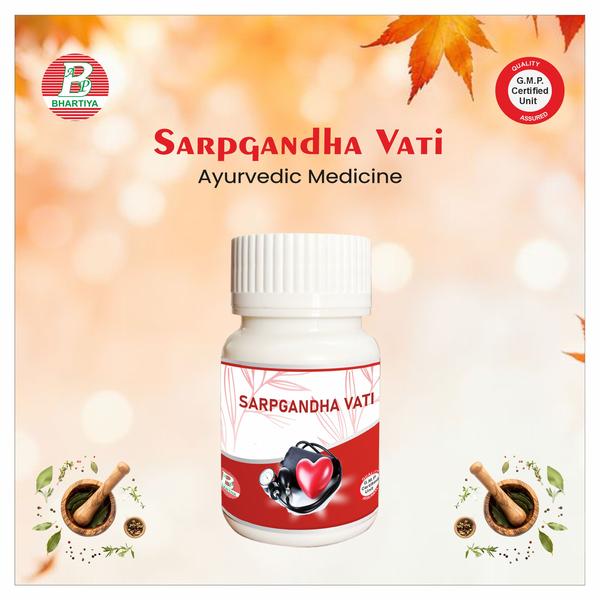
"name": "Sarpgandha vati / tablet",
"description": "Sarpagandha (Rauwolfia serpentina)\n The Serpent Root Herb with Profound Calming & Healing Power\nSarpagandha is one of the most potent and revered herbs in Ayurveda, known for its deep action on the nervous system, mind, blood pressure, and toxic conditions.\nThe name Sarpagandha literally means “the plant with a smell like a serpent” or “the herb that can subdue snake-like disorders”, symbolising its legendary power in calming, controlling, and neutralizing deep-rooted imbalances.\nAyurveda classifies Sarpagandha as:\n•\tStambhana (stabilizing, controlling)\n•\tNidrajanana (induces sleep)\n•\tVedanasthapana (analgesic)\n•\tSarpavisha hara (anti-venom / toxic disorders)\n•\tManas dosha hara (reduces mental disturbances)\n•\tHṛidya (supports the heart)\nIt is highly beneficial in managing high blood pressure, insomnia, anxiety, restlessness, mental agitation, certain psychotic disorders, and snake-bite toxic conditions (traditionally).\n Botanical Information of Sarpagandha\nScientific Name: Rauwolfia serpentina (Linn.) \nFamily: Apocynaceae\nOrder: Gentianales\nGenus: Rauwolfia\nSpecies: serpentina\nCommon Names\n•\tSanskrit: Sarpagandha, Chandrabhaga, Kundali, Sarpasandhi, Nakuli\n•\tHindi: Sarpagandha\n•\tEnglish: Indian Snakeroot, Serpent Root\n•\tTamil: Sivanar Vembu\n•\tTelugu: Patalagandhi\n•\tMalayalam: Paathalgaruda\n•\tKannada: Sarpagandhi\n•\tBengali: Sarpagandha\nSynonyms from Nighantus\n•\tBhavaprakasha: Sarpagandha, Chandrika, Kundali\n•\tDhanvantari Nighantu: Nakuli, Sarpasandhi\n•\tKaiyadeva Nighantu: Sarpagandha, Ganda Naga\n•\tRaja Nighantu: Sarpagandha, Patalagandhi\n Morphology of Sarpagandha (Rauwolfia serpentina)\nPlant Type\nPerennial, erect, smooth herb\nStem\n•\tSlender, erect, slightly woody at the base\n•\tDark green with smooth texture\nLeaves\n•\tSimple, opposite or whorled (3–4 in a circle)\n•\tLanceolate, smooth, shining\n•\tDark green above, light beneath\nFlowers\n•\tSmall, white or pinkish\n•\tArranged in terminal or axillary cymes\nRoots\n•\tLong, slender, cylindrical\n•\tDark brown externally, white inside\n•\tMedicinally most important part\n•\tCharacteristic serpentine smell (hence Sarpagandha)\nFruits\n•\tSmall, globose drupes\n•\tPurplish-black on ripening\nHabit\n•\tSlow-growing but hardy\n•\tDevelops best under semi-shade conditions\n Ecological Preferences\n•\tClimate: Tropical and subtropical\n•\tSoil: Moist, fertile, well-drained soil (prefers humus-rich loam)\n•\tSunlight: Partial shade preferred\n•\tMoisture: Requires consistent moisture\n•\tAltitude: Up to 1200 m\n•\tHabitat: Forest edges, moist slopes, shaded plantations\n Distribution\n•\tIndia: Common in the Himalayan foothills, Northeastern states, Bengal, Western Ghats, Odisha, and Central India\n•\tAsia: Nepal, Bhutan, Bangladesh, Myanmar, Sri Lanka, Thailand\n•\tOther Regions: Widely distributed in Southeast Asia\n Classical Ayurvedic Properties of Sarpagandha\n•\tRasa (Taste): Tikta (bitter), Kashaya (astringent), Madhura (slightly sweet)\n•\tGuna (Quality): Laghu (light), Ruksha (dry), Tikshna (penetrating)\n•\tVirya (Potency): Ushna (hot)\n•\tVipaka: Katu (pungent)\n•\tDosha Effect: Kapha-Vata hara, pacifies Raja & Tama (mental doshas)\nKarma (Therapeutic Actions)\n•\tNidrajanana – induces sleep\n•\tUnmadahara – reduces psychotic symptoms\n•\tSarpavisha hara – mitigates snake/poison effects (traditional use)\n•\tRaktachapa hara – reduces high blood pressure\n•\tStambhana – stabilizes nervous system\n•\tAnulomana – improves digestive and nervous coordination\n Historical & Grantha-Based Story/References of Sarpagandha\n 1. Mention in Ancient Texts\nSarpagandha is described in:\n•\tCharaka Samhita (Chikitsa Sthana) under Unmada (psychosis) treatment\n•\tSushruta Samhita under Sarpavisha Chikitsa (snake poisoning)\n•\tBhavaprakasha Nighantu elaborates its use for insomnia, hypertension-like symptoms, and mania\n•\tKaiyadeva Nighantu describes it as a herb that “calms the mind and controls the serpent-like movements of Vata in the nerves.”\n 2. Traditional Story: “The Serpent-Root Legend”\nAyurvedic folklore says:\n“A wandering sage noticed that snakes bitten by other snakes chewed the root of a certain plant and survived.”\nThis plant, believed to be Sarpagandha, was thus discovered in ancient times.\nThe sages concluded that if it could calm a deadly serpent’s venom, it could also calm the “inner serpent” — representing fear, agitation, and disordered nerves in humans.\nThis symbolic meaning led to its name Sarpagandha and its use for toxins, anxiety, agitation, hypertension, and insanity-like states.\n 3. Use by Ancient Physicians\n•\tAcharya Charaka used it in Unmada (psychiatric) conditions.\n•\tAcharya Sushruta prescribed it as a supportive herb for harmful bites and severe agitation.\n•\tVagbhata considered it “mind-stabilizing and nerve-controlling.”\n Modern Phytochemistry\nSarpagandha contains powerful alkaloids, especially:\n1. Alkaloids (main bioactive class)\n•\tReserpine – antihypertensive, sedative\n•\tAjmaline – antiarrhythmic\n•\tAjmalicine (raubasine) – circulatory and CNS modulator\n•\tSerpentine, Yohimbine (traces)\n2. Others\n•\tSterols\n•\tCarbohydrates\n•\tGlycosides\n•\tFlavonoids\n Species of Rauwolfia\n1.\tRauwolfia serpentina – true Sarpagandha, most potent\n2.\tRauwolfia tetraphylla – similar but less potent; used in some regions\n3.\tRauwolfia vomitoria – African species\n4.\tRauwolfia canescens – mild medicinal use\n Cultivation\n•\tPropagation: Seeds, root cuttings\n•\tPlanting Season: Monsoon (June–July)\n•\tSpacing: 30–45 cm\n•\tWatering: Regular moisture needed\n•\tManure: Best with organic compost\n•\tHarvesting: Roots collected after 2–3 years\n•\tNote: Overharvested in the wild → now commercially cultivated\n Classical Ayurvedic Dosage (from Granthas)\n(General, traditional; modern use must be supervised due to potency)\n•\tRoot Powder (Churna): 250–500 mg once or twice daily\n•\tRoot Decoction (Kwatha): 30–40 ml\n•\tSwarasa (Juice): 5–10 ml\nUsed in:\n•\tInsomnia\n•\tMental disorders\n•\tHypertension-like symptoms\n•\tAgitation\n•\tToxic disorders (traditional use)\n Safety & Precautions\nSarpagandha is highly potent.\n•\tAvoid overdose\n•\tNot suitable during pregnancy\n•\tNot to be combined with other sedatives or antihypertensive drugs without guidance\n•\tMust be used under qualified Ayurvedic supervision\n Sarpagandha Compound Formulations (Classical):\nSarpagandha with Arjuna, Ashwagandha, Brahmi, Shankhapushpi, or Jatamansi—used for hypertension, anxiety, insomnia, nervous disorders, and cardiovascular support, prepared according to classical Ayurvedic methods to retain Rasayana and Medhya properties.\n Sarpagandha Formulations by Bhartiya Ayurvedic Pharmacy\nAt Bhartiya Ayurvedic Pharmacy, we prepare a range of Sarpagandha formulations following classical Ayurvedic methods as described in Charaka Samhita, Sushruta Samhita, Bhavaprakasha Nighantu, and other Ayurvedic Granthas. Each product is crafted to retain the therapeutic potency, purity, and efficacy of the herb, ensuring benefits for stress relief, blood pressure management, nervous system support, and overall mental well-being.\n1.\tSarpagandha Vati/Tablet\nDose\n1 tablet (250–500 mg) twice daily\nOr 1 tablet at night for sleep disorders\nAdvanced cases: 1 tablet thrice daily (only under supervision)\n•\tFor hypertension-like symptoms, insomnia\n•\tSupports Calmness & Mental Stability\n•\tUseful in: Anxiety, Nervousness, Agitation, Irritability, Restlessness, Racing thoughts\n•\tHelps balance Rajas and Tamas (mental doshas) and calms Vata in the nervous system.\nSupports Brain & Nerve Health\nHelps in:\n•\tReducing excessive nerve excitability\n•\tSupporting healthy brain signaling\n•\tPromoting alert calmness\nUsed traditionally in unmada chikitsa (Ayurvedic mental health management)\n\n\nbenefits of sarpagandha tablet, benefits of sarpagandha tablets\nbest sarpagandha tablet, dosage of sarpagandha tablet\nhow to use sarpagandha, is sarpagandha effective for bp\nis sarpagandha safe, m sarpagandha mishran\nm sarpagandha mishran price, m sarpagandha mishran tablet\nm sarpagandha mishran tablet uses in hindi, m sarpagandha mishran uses\nm sarpagandha tablet, sarpagandha tablet benefits\nsarpagandha tablet benefits in hindi, sarpagandha tablet buy online\nsarpagandha tablet content, sarpagandha tablet dosage\nsarpagandha tablet dose, sarpagandha tablet fayde\nsarpagandha tablet flipkart, sarpagandha tablet for\nsarpagandha tablet hindi, sarpagandha tablet how to use\nsarpagandha tablet in hindim, sarpagandha tablet india\nsarpagandha tablet kaise khaye, msarpagandha tablet kaise le\nsarpagandha tablet ke fayde in hindi, sarpagandha tablet ke side effects\nsarpagandha tablet kis kaam aata hai, sarpagandha tablet kya kam karti hai\nsarpagandha tablet near me, sarpagandha tablet online\nsarpagandha tablet price, sarpagandha tablet price in india\nsarpagandha tablet review, sarpagandha tablet side effects\nsarpagandha tablet side effects in hindi, sarpagandha tablet use\nsarpagandha tablet used for, sarpagandha tablet uses\nsarpagandha tablet uses and side effects, sarpagandha tablet uses hindi\nsarpagandha tablet uses in english, sarpagandha tablet uses in hindi\nsarpagandha tablet when to take, sarpagandha tablets ayurvedic\nsarpagandha tablets benefits, sarpagandha tablets for blood pressure\nsarpagandha tablets for blood pressure in hindi, sarpagandha tablets uses\nsarpagandha use, sarpagandha vati tablet ke fayde\nsarpagandha vati tablet price, sarpagandha vati tablet side effects\nsarpagandha vati tablet uses, sarpagandha vati tablet uses in english\nsarpagandha vati tablet uses in hindi, sarpagandha vati tablet uses in tamil\nsarpagandha. tablet image, sarpagandhadi tablet uses\nsarpgandha tablet quality",
"price": 540.0,
"discountamount": 270.0,
"currencycode": "INR",
"priority": 1000000,
"isfreeshipmentavailable": false,
"shipmentduration": 1,
"_keywords": null,
"isarchived": false,
"isavailable": true,
"applicationid": null,
"productindex": 30,
"imageuri": "https://productimages.withfloats.com/actual/69808ef1cf660bbbdc554d46.jpg",
"tileimageuri": "https://productimages.withfloats.com/tile/69808ef1cf660bbbdc554d46.jpg",
"images": null,
"totalqueries": 0,
"gpid": null,
"groupproductid": null,
"createdon": "2026-02-02T11:47:59.198Z",
"updatedon": "2026-02-19T10:33:46.089Z",
"buyonlinelink": null,
"producturl": "http://WWW.BHARTIYAAYURVEDICPHARMACY.COM//sarpgandha-vati-tablet/30",
"availableunits": -1.0,
"iscodavailable": true,
"isprepaidonlineavailable": true,
"maxcodorders": 0,
"maxprepaidonlineorders": -1,
"uniquepaymenturl": null,
"brandname": "Bakula fort",
"category": "Sarpgandha vati / tablet 100 - GM X 24",
"tags": [],
"variants": false,
"keyspecification": null,
"otherspecifications": null,
"pickupaddressreferenceid": null,
"paymenttype": "AssuredPurchase",
"producttype": "products",
"hsncode": null,
"gstslab": 0.0,
"isnotforsale": false
},
{
"_id": "6a7b09867c3863faf5f35940",
"fptag": "BHARTIYEAYURVEDICPHARMACY",
"merchantname": null,
"customwidgets": null,
"externalsourceid": null,
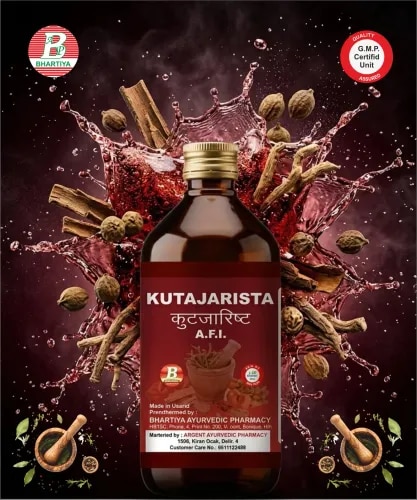
"name": "KUTJARISHTA",
"description": " KUTAJARISHTA\n\n\nProduct Identification \nGeneric Name: Kutajarishta (Kutajarishtam)\nType: Ayurvedic Polyherbal Fermented Formulation (Arishta)\nPrimary Indication Area: Diarrheal disorders, dysentery, irritable bowel conditions, digestive health, and intestinal detoxification.\n\nTherapeutic Indications\n• Atisara (diarrhea)\n• Pravahika (dysentery)\n• Chronic loose stools\n• irritable bowel syndrome with diarrhea (supportive management)\n• Grahani disorders (malabsorption syndrome)\n• Amoebic dysentery (supportive use)\n• Intestinal infections (supportive management)\n• Excess mucus in stools\n• post-infectious bowel weakness\n• Digestive debility associated with chronic diarrhea\n\nKey Benefits\n• Helps control diarrhea and dysentery\n• Supports restoration of normal bowel function\n• Reduces intestinal inflammation\n• Helps decrease mucus in stools\n• Supports healthy gut microbiota balance\n• Improves digestive strength (Agni)\n• Promotes intestinal healing and recovery\n• Acts as a restorative gastrointestinal tonic\n\nFORMULA\nMain Ingredients\n• Kutaja (Holarrhena antidysenterica)\n• Draksha (Vitis vinifera)\n• Madhuka (Madhuca longifolia)\n• Gambhari (Gmelina arborea)\nSweetening and Fermentation Base\n• Jala (Water)\n• Sarkara (Sugar)\n• Dhataki (Woodfordia fruticosa)\n\nKey Ingredient Actions\n1. Kutaja\nBotanical Name: Holarrhena antidysenterica \nRasa: Tikta, Kashaya\nGuna: Laghu, Ruksha\n Virya: Sheeta\nVipaka: Katu\nMechanism of Action:\n• Classical Atisaraghna (anti-diarrheal) herb\n• Helps control excessive bowel movements\n• Reduces intestinal inflammation\n• Supports management of dysentery and Grahani\n• Antimicrobial activity against intestinal pathogens\n• Promotes restoration of normal intestinal function\n\n2. Draksha\nBotanical Name: Vitis vinifera L.\nRasa: Madhura\n Guna: Guru, Snigdha\n Virya: Sheeta\n Vipaka: Madhura\nMechanism of Action:\n• Nourishing and restorative tonic\n• Helps replenish fluids and strength lost during diarrhea\n• Provides antioxidant support\n• Supports intestinal healing\n• Reduces dehydration-associated weakness\n• Promotes tissue nourishment and recovery\n\n3. Madhuka\nBotanical Name: Madhuca longifolia \nRasa: Madhura\nGuna: Guru, Snigdha\nVirya: Sheeta\nVipaka: Madhura\nMechanism of Action:\n• Provides nourishment and strength\n• Supports recovery from chronic gastrointestinal disorders\n• Helps soothe irritated intestinal mucosa\n• Promotes tissue healing and restoration\n• Supports overall digestive stability\n• Contributes to the fermentation process\n\n4. Gambhari\nBotanical Name: Gmelina arborea Roxb.\nRasa: Madhura, Kashaya\nGuna: Guru, Snigdha\n Virya: Sheeta\n Vipaka: Madhura\nMechanism of Action:\n• Supports intestinal healing and recovery\n• Helps reduce inflammatory conditions of the gut\n• Nourishes weakened tissues\n• Acts as a mild Rasayana (rejuvenative)\n• Supports recovery from chronic bowel disorders\n• Promotes gastrointestinal strength\n\n5. Dhataki\nBotanical Name: Woodfordia fruticosa (L.) Kurz\nRasa: Kashaya\n Guna: Laghu, Ruksha\n Virya: Ushna\nVipaka: Katu\n Prabhava: Sandhana Karaka\nMechanism of Action:\n• Natural fermentation catalyst\n• Enables alcohol formation in Arishta preparations\n• Enhances extraction of active phytochemicals\n• Improves bioavailability of herbal constituents\n• Supports preservation and shelf stability\n• Maintains quality of fermented formulation\n\n6. Sarkara (Sugar)\nRasa: Madhura\n Guna: Guru, Snigdha\n Virya: Sheeta\n Vipaka: Madhura\nMechanism of Action:\n• Provides substrate for fermentation\n• Improves palatability\n• Supports energy replenishment\n• Facilitates self-generated alcohol formation\n• Contributes to stability of the formulation\n\n7. Jala (Water)\nMechanism of Action:\n• Medium for herbal decoction preparation\n• Solvent for extraction of phytochemicals\n• Essential for fermentation process\n• Supports uniform distribution of active constituents\n• Facilitates preparation of the Arishta formulation\n\nDosage\nAdults\n• 15–30 mL\n• Twice daily after meals\n• Dilute with equal quantity of water\n\nkutjarishta use in hindi, kutjarishta use, kutjarishta price\nkutjarishta syrup, kutjarishta hindi, kutjarishta tablet\nkutajarishta ayurvedic medicine, kutajarishta ayurvedic syrup\nkutajarishta ayurvedic syrup in hindi, kutajarishta ayurvedic medicine uses\nkutajarishta ayurvedic, kutajarishtam amazon, kutajarishta ayurvedic aushadhi\nkutajarishta aushadhi, kutajarishta benefits in hindi, kutajarishta benefits\nkutajarishta before or after food, kutajarishta best company, kutajarishta composition\nkutajarishta contents, kutajarishta churna, kutajarishta cause constipation\nkutajarishta constipation, does kutajarishta cause constipation\ncan kutajarishta cure ibs, does kutajarishta contain alcohol, kutjarishta dosage\npatanjali divya kutjarishta, kutajarishta expiry date, kutajarishta in english\nbaidyanath kutajarishta ingredients, kutajarishta for ibs, kutajarishta for kids\nkutajarishta for constipation, kutajarishta for liver, kutajarishta for acidity\nkutajarishta for loose motion, kutajarishta for piles, kutajarishta for fatty liver\nkutajarishta for stomach infection, kutjarishta use hindi, kutajarishta syrup hindi\nkutjarishta use in hindi price, kutajarishta ingredients, kutajarishta in hindi\nkutajarishta ingredients in hindi, kutajarishta in constipation\nkutajarishta in pregnancy, kutjarishta ke nuksan, kutjarishta ke fayde in hindi\nkutajarishta ke, kutjarishta kadha, kutjarishta me kya hota hai, kutajarishta kya kam karta hai\nkutajarishta lene ke fayde, kutajarishta lene ka tarika, kutajarishta ke labh\nkutajarishta kab lena chahiye, kutajarishta kis liye hota hai, kutajarishta kis liye hai\nkutajarishta how long to take, kutajarishta me kya hota hai, kutajarishta medicine use in hindi\nkutajarishta multani, kutajarishta mrp, kutajarishta mode of action, kutajarishta near me\nkutajarishta online, benefits of kutjarishta, use of kutjarishta, dabur kutajarishta online\nuses of kutajarishta, ingredients of kutajarishta, benefits of kutajarishta syrup\nkutajarishta syrup price, kutajarishta reviews, kutajarishta research update\nkutajarishta research paper, kutajarishta reference, kutajarishta rate\nkutajarishta ramdev, kutajarishta syrup uses, kutajarishta syrup uses in hindi\nkutajarishta syrup benefits, kutajarishta uses, kutajarishta use hindi\nkutajarishta usage, kutajarishta when to take, how kutajarishta works\nkutajarishta used for, what does kutajarishta do, which kutajarishta is best\nkutajarishta for worms, how to use kutajarishta, how to take kutajarishta\ncan kutajarishta be given to kids, can kutajarishta cause constipation\ncan kutajarishta be taken daily",
"price": 165.0,
"discountamount": 82.0,
"currencycode": "INR",
"priority": 1000000,
"isfreeshipmentavailable": false,
"shipmentduration": 1,
"_keywords": null,
"isarchived": false,
"isavailable": true,
"applicationid": null,
"productindex": 168,
"imageuri": "https://productimages.withfloats.com/actual/6a7b0988a17759ddd0ad1917.jpg",
"tileimageuri": "https://productimages.withfloats.com/tile/6a7b0988a17759ddd0ad1917.jpg",
"images": null,
"totalqueries": 0,
"gpid": null,
"groupproductid": null,
"createdon": "2026-08-11T11:37:42.446Z",
"updatedon": "2026-08-11T12:11:44.451Z",
"buyonlinelink": null,
"producturl": "http://WWW.BHARTIYAAYURVEDICPHARMACY.COM//kutjarishta/168",
"availableunits": -1.0,
"iscodavailable": true,
"isprepaidonlineavailable": true,
"maxcodorders": -1,
"maxprepaidonlineorders": -1,
"uniquepaymenturl": null,
"brandname": "BAKULA FORT",
"category": "KUTJARISHTA 450 ML X 40",
"tags": [],
"variants": false,
"keyspecification": null,
"otherspecifications": null,
"pickupaddressreferenceid": null,
"paymenttype": "AssuredPurchase",
"producttype": "products",
"hsncode": null,
"gstslab": 0.0,
"isnotforsale": false
},
{
"_id": "6a7afd282a5df640d9fd3af9",
"fptag": "BHARTIYEAYURVEDICPHARMACY",
"merchantname": null,
"customwidgets": null,
"externalsourceid": null,
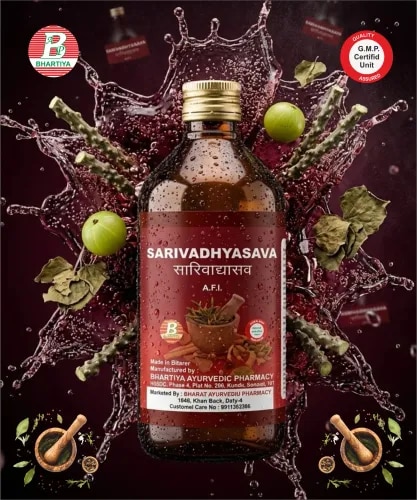
"name": "SARIVADYASAVA",
"description": " SARIVADYASAVA \n\n\nProduct Identification\nGeneric Name: Sarivadyasava\nType: Ayurvedic Polyherbal Fermented Formulation (Asava)\nPrimary Indication Area: Skin disorders, blood purification, urinary disorders, burning sensation, Pitta imbalance, and chronic inflammatory conditions.\n\nTherapeutic Indications\n• Kushta (skin disorders)\n• Twak vikara (chronic skin diseases)\n• Raktadushti (vitiated blood)\n• Daha (burning sensation)\n• Mutrakrichra (difficulty in urination)\n• Mutravaha disorders (urinary tract disorders)\n• Pittaja disorders\n• Chronic inflammatory conditions\n• Pruritus (itching)\n• Acne and recurrent skin eruptions\n• General weakness associated with chronic skin diseases\n\nKey Benefits\n• Supports healthy blood purification (Rakta Shodhana)\n• Helps maintain healthy skin and complexion\n• Reduces burning sensation and excess Pitta\n• Supports urinary tract health\n• Promotes natural detoxification\n• Helps reduce itching and inflammatory skin conditions\n• Supports immunity and tissue nourishment\n• Acts as a cooling rejuvenative tonic\n\nFORMULA\n1. Sariva\nBotanical Name: Hemidesmus indicus\nRasa: Madhura, Tikta\nGuna: Guru, Snigdha\n Virya: Sheeta\nVipaka: Madhura\n\nMechanism of Action:\n• Excellent blood purifier (Rakta Shodhaka)\n• Reduces Pitta and burning sensation\n• Supports healthy skin\n• Acts as a cooling rejuvenative\n\n2. Musta\nBotanical Name: Cyperus rotundus\nRasa: Tikta, Katu, Kashaya\nGuna: Laghu, Ruksha\nVirya: Sheeta\n Vipaka: Katu\n\nMechanism of Action:\n• Improves digestion and metabolism\n• Reduces Ama accumulation\n• Supports urinary health\n• Helps reduce inflammation\n\n3. Lodhra\nBotanical Name: Symplocos racemosa\nRasa: Kashaya\n Guna: Laghu, Ruksha\n Virya: Sheeta\n Vipaka: Katu\n\nMechanism of Action:\n• Supports healthy skin tissues\n• Reduces inflammation and discharge\n• Helps purify blood\n• Promotes wound healing\n\n4. Nyagrodha\nBotanical Name: Ficus benghalensis\nRasa: Kashaya\n Guna: Guru, Ruksha\nVirya: Sheeta\n Vipaka: Katu\n\nMechanism of Action:\n• Supports tissue healing\n• Helps reduce excessive Pitta\n• Promotes healthy skin\n• Supports blood purification\n\n5. Asvatha\nBotanical Name: Ficus religiosa\nRasa: Kashaya\nGuna: Guru, Ruksha\nVirya: Sheeta\nVipaka: Katu\n\nMechanism of Action:\n• Supports wound healing\n• Helps reduce inflammation\n• Promotes healthy blood circulation\n• Supports skin health\n\n6. Sati\nBotanical Name: Hedychium spicatum\nRasa: Katu, Tikta\n Guna: Laghu, Tikshna\nVirya: Ushna\nVipaka: Katu\n\nMechanism of Action:\n• Improves digestion\n• Reduces Ama formation\n• Supports respiratory and metabolic balance\n• Enhances bioavailability of herbs\n\n7. Sveta Sariva\nBotanical Name: Ichnocarpus frutescens\nRasa: Madhura, Tikta\n Guna: Guru, Snigdha\nVirya: Sheeta\n Vipaka: Madhura\n\nMechanism of Action:\n• Supports blood purification\n• Reduces burning sensation\n• Promotes healthy skin\n• Acts as a cooling tonic\n\n8. Padmaka\nBotanical Name: Prunus cerasoides\nRasa: Kashaya, Tikta\n Guna: Laghu, Ruksha\n Virya: Sheeta\n Vipaka: Katu\n\nMechanism of Action:\n• Supports healthy complexion\n• Helps reduce Pitta disorders\n• Promotes skin nourishment\n• Acts as an antioxidant\n\n9. Bala\nBotanical Name: Sida cordifolia\nRasa: Madhura\nGuna: Guru, Snigdha\nVirya: Sheeta\n Vipaka: Madhura\n\nMechanism of Action:\n• Strengthens body tissues\n• Supports recovery in chronic illness\n• Acts as a rejuvenative\n• Helps maintain vitality\n\n10. Patha\nBotanical Name: Cissampelos pareira\nRasa: Tikta, Kashaya\n Guna: Laghu, Ruksha\nVirya: Ushna\nVipaka: Katu\n\nMechanism of Action:\n• Supports urinary health\n• Reduces inflammation\n• Helps detoxification\n• Supports healthy digestion\n\n11. Amalaki\nBotanical Name: Phyllanthus emblica\nRasa: Pancha Rasa (predominantly Amla)\nGuna: Laghu, Ruksha\n Virya: Sheeta\n Vipaka: Madhura\n\nMechanism of Action:\n• Strong antioxidant and rejuvenative\n• Supports immunity\n• Helps purify blood\n• Supports healthy skin\n\n12. Guduchi\nBotanical Name: Tinospora cordifolia\nRasa: Tikta, Kashaya\n Guna: Laghu, Snigdha\n Virya: Ushna\nVipaka: Madhura\n\nMechanism of Action:\n• Supports immune function\n• Helps detoxification\n• Reduces inflammation\n• Promotes liver health\n\n13. Usira\nBotanical Name: Vetiveria zizanioides\nRasa: Tikta, Madhura\n Guna: Laghu, Ruksha\nVirya: Sheeta\nVipaka: Katu\n\nMechanism of Action:\n• Cooling and refreshing herb\n• Reduces burning sensation\n• Supports urinary health\n• Promotes blood purification\n\n14. Sveta Chandana\nBotanical Name: Santalum album\nRasa: Tikta, Madhura\nGuna: Laghu, Ruksha\nVirya: Sheeta\nVipaka: Katu\n\nMechanism of Action:\n• Reduces heat and burning sensation\n• Supports urinary comfort\n• Promotes healthy skin\n• Acts as a cooling tonic\n\n15. Rakta Chandana\nBotanical Name: Pterocarpus santalinus\nRasa: Tikta, Kashaya\nGuna: Laghu, Ruksha\nVirya: Sheeta\nVipaka: Katu\n\nMechanism of Action:\n• Supports blood purification\n• Helps reduce inflammation\n• Promotes skin health\n• Reduces excess Pitta\n\n16. Yavani\nBotanical Name: Trachyspermum ammi\nRasa: Katu\n Guna: Laghu, Ruksha, Tikshna\nVirya: Ushna\nVipaka: Katu\nMechanism of Action:\n• Improves digestion\n• Reduces gas and bloating\n• Supports metabolism\n• Helps digest Ama\n\n17. Kutaki\nBotanical Name: Picrorhiza kurroa\nRasa: Tikta\nGuna: Laghu, Ruksha\nVirya: Sheeta\n Vipaka: Katu\n\nMechanism of Action:\n• Supports liver function\n• Promotes detoxification\n• Improves digestion\n• Helps purify blood\n\n18. Tejpatra\nBotanical Name: Cinnamomum tamala\nRasa: Katu, Tikta\n Guna: Laghu, Ruksha\n Virya: Ushna\n Vipaka: Katu\n\nMechanism of Action:\n• Supports digestion and metabolism\n• Reduces gas and heaviness\n• Improves Agni\n• Helps digest Ama\n\n19. Sthuilaila\nBotanical Name: Amomum subulatum\nRasa: Tikta, Katu\nGuna: Laghu, Tikshna\nVirya: Ushna\nVipaka: Katu\n\nMechanism of Action:\n• Supports digestion\n• Reduces inflammation\n• Helps detoxification\n• Supports skin health\n\n20. Swernpatri\nBotanical Name: Cassia angustifolia\nRasa: Tikta, Kashaya\nGuna: Laghu, Ruksha\nVirya: Ushna\nVipaka: Katu\n\nMechanism of Action:\n• Mild natural laxative\n• Supports bowel cleansing\n• Helps eliminate toxins\n• Promotes detoxification\n\n21. Haritaki\nBotanical Name: Terminalia chebula\nRasa: Pancha Rasa (except Lavana)\nGuna: Laghu, Ruksha\nVirya: Ushna\nVipaka: Madhura\n\nMechanism of Action:\n• Mild laxative and detoxifier\n• Supports bowel cleansing\n• Improves digestion\n• Promotes elimination of toxins\n\n22. Guda\nBotanical Name: Jaggery\nRasa: Madhura\nGuna: Guru, Snigdha\n Virya: Ushna\n Vipaka: Madhura\n\nMechanism of Action:\n• Fermentation base\n• Provides energy substrate\n• Improves formulation stability\n• Enhances palatability\n\n23. Dhataki\nBotanical Name: Woodfordia fruticosa\nRasa: Kashaya\nGuna: Laghu, Ruksha\nVirya: Ushna\n Vipaka: Katu\n\nMechanism of Action:\n• Natural fermentation catalyst\n• Enhances extraction of phytochemicals\n• Improves bioavailability\n• Supports preservation of formulation\n\n24. Draksha\nBotanical Name: Vitis vinifera\nRasa: Madhura\n Guna: Guru, Snigdha\n Virya: Sheeta\n Vipaka: Madhura\nMechanism of Action:\n• Nourishes body tissues\n• Provides antioxidant support\n• Helps reduce burning sensation\n• Acts as a rejuvenative tonic\n\nDosage\nAdults:\n• 15–30 mL\n• Twice daily after meals\n• Dilute with equal quantity of water\n\nCommon Usage Guidance\n• Traditionally used in skin and blood disorders\n• Supports blood purification and healthy complexion\n• Helps reduce burning sensation and Pitta imbalance\n• Supports urinary health and detoxification\n• Usually prescribed for 4–8 weeks under Ayurvedic supervision\n• Best taken after food\n\nImportant Notes\n• Contains naturally fermented alcohol\n• Use cautiously in diabetes mellitus\n• Should be taken under Ayurvedic supervision\n• Avoid self-medication in severe systemic illness\n• Store in a cool, dry place\n• Keep tightly closed after use\n• Keep out of reach of children\n\n\nsarivadyasava uses in hindi, sarivadyasava uses, sarivadyasava syrup\nsarivadyasava benefits in hindi, sarivadyasava syrup side effects\nsarivadyasava syrup uses, sarivadyasava ingredients, sarivadyasava benefits\nsarivadyasava in hindi, sarivadyasava ayurvedic medicine, sarivadyasava ayurvedic\nsarivadyasava ayurvedic medicine uses in hindi, sarivadyasava amazon\nsarivadyasava easy ayurveda, sarivadyasava composition, sarivadyasava dosage\nsarivadyasava dabur uses, divya sarivadyasava, sarivadyasava uses in english\nsarivadyasava for skin in hindi, sarivadyasava for skin, sarivadyasava uses for skin\nsarivadyasava ke fayde, sarivadyasava used for, sarivadyasava hindi\nsarivadyasava how to take, sarivadyasava how to use, sarivadyasava uses hindi\nsarivadyasava syrup hindi, sarivadyasava syrup uses hindi, sarivadyasava ingredients in hindi\nsarivadyasava indication, sarivadyasava in pregnancy, sarivadyasava uses in ayurveda\nbaidyanath sarivadyasava ingredients, sarivadyasava jiva ayurveda\nsarivadyasava kaise use kare, sarivadyasava kadha uses, sarivadyasava kis kaam aati hai\nkerala ayurveda sarivadyasava, sarivadyasava kashayam, sarivadyasava medicine\nuse of sarivadyasava in hindi, ingredients of sarivadyasava, use of sarivadyasava syrup\nsarivadyasava price, sarivadyasava syrup price, sarivadyasava review\nsarivadyasava syrup benefits, sarivadyasava syrup benefits in hindi\nsarivadyasava tablet, sarivadyasava tablet uses in hindi\nsarivadyasava taste, how to take sarivadyasava, how to use sarivadyasava syrup\nhow to use sarivadyasava, sarivadyasava syrup uses in hindi, what is sarivadyasava used for",
"price": 165.0,
"discountamount": 82.0,
"currencycode": "INR",
"priority": 1000000,
"isfreeshipmentavailable": false,
"shipmentduration": 1,
"_keywords": null,
"isarchived": false,
"isavailable": true,
"applicationid": null,
"productindex": 167,
"imageuri": "https://productimages.withfloats.com/actual/6a7afd2abe4e6975bb0ae21f.jpg",
"tileimageuri": "https://productimages.withfloats.com/tile/6a7afd2abe4e6975bb0ae21f.jpg",
"images": null,
"totalqueries": 0,
"gpid": null,
"groupproductid": null,
"createdon": "2026-08-11T10:44:56.779Z",
"updatedon": "2026-08-11T10:44:56.779Z",
"buyonlinelink": null,
"producturl": "http://WWW.BHARTIYAAYURVEDICPHARMACY.COM//sarivadyasava/167",
"availableunits": -1.0,
"iscodavailable": true,
"isprepaidonlineavailable": true,
"maxcodorders": -1,
"maxprepaidonlineorders": -1,
"uniquepaymenturl": null,
"brandname": "BALULA FORT",
"category": "SARIVADYASAVA 450 ML X 40",
"tags": [],
"variants": false,
"keyspecification": null,
"otherspecifications": null,
"pickupaddressreferenceid": null,
"paymenttype": "AssuredPurchase",
"producttype": "products",
"hsncode": null,
"gstslab": 0.0,
"isnotforsale": false
},
{
"_id": "6a7ac6626f0de6a685d521bd",
"fptag": "BHARTIYEAYURVEDICPHARMACY",
"merchantname": null,
"customwidgets": null,
"externalsourceid": null,
"name": "USHIRASAVA",
"description": " USHIRASAVA \n\n\n\nGeneric Name: Ushirasava\nType: Ayurvedic Polyherbal Fermented Formulation (Asava)\nPrimary Indication Area: Bleeding disorders, burning sensation, Pitta disorders, skin diseases, urinary disorders, blood vitiation, and inflammatory conditions.\n\nTherapeutic Indications\n• Raktapitta (bleeding disorders)\n• Daha (burning sensation)\n• Pittaja disorders\n• Raktadushti (vitiated blood)\n• Twak vikara (skin disorders)\n• Mutrakrichra (difficulty in urination)\n• Mutravaha disorders (urinary tract disorders)\n• Excessive body heat\n• Chronic inflammatory conditions\n• Pruritus (itching)\n• General debility associated with Pitta disorders\n\nKey Benefits\n• Supports healthy blood purification (Rakta Shodhana)\n• Helps reduce excessive body heat and burning sensation\n• Supports urinary tract health\n• Promotes healthy skin and complexion\n• Helps maintain Pitta balance\n• Supports natural detoxification\n• Helps reduce inflammatory conditions\n• Acts as a cooling rejuvenative tonic\n\nFORMULA\n1. Ushira\nBotanical Name: Vetiveria zizanioides\nRasa: Tikta, Madhura\nGuna: Laghu, Ruksha\n Virya: Sheeta\n Vipaka: Katu\nMechanism of Action:\n• Strong cooling herb\n• Reduces burning sensation and excess Pitta\n• Supports urinary health\n• Purifies blood\n\n2. Harivera\nBotanical Name: Pavonia odorata\nRasa: Tikta, Madhura\nGuna: Laghu, Ruksha\nVirya: Sheeta\nVipaka: Katu\nMechanism of Action:\n• Cooling and refreshing herb\n• Supports blood purification\n• Reduces body heat\n• Promotes urinary comfort\n\n3. Padma\nBotanical Name: Nelumbo nucifera\nRasa: Madhura, Kashaya\nGuna: Laghu, Snigdha\n Virya: Sheeta\nVipaka: Madhura\nMechanism of Action:\n• Supports healthy blood circulation\n• Reduces burning sensation\n• Promotes skin health\n• Helps balance Pitta\n\n4. Gambhari\nBotanical Name: Gmelina arborea\nRasa: Madhura, Kashaya\n Guna: Guru, Snigdha\nVirya: Sheeta\n Vipaka: Madhura\nMechanism of Action:\n• Nourishes body tissues\n• Supports rejuvenation\n• Helps reduce inflammation\n• Promotes overall vitality\n\n5. Utpala\nBotanical Name: Nymphaea stellata\nRasa: Tikta, Kashaya, Madhura\n Guna: Laghu, Snigdha\n Virya: Sheeta\nVipaka: Madhura\nMechanism of Action:\n• Cooling and soothing herb\n• Helps reduce burning sensation\n• Supports blood purification\n• Promotes skin health\n\n6. Priyangu\nBotanical Name: Callicarpa macrophylla\nRasa: Kashaya, Madhura\nGuna: Laghu, Ruksha\nVirya: Sheeta\n Vipaka: Katu\nMechanism of Action:\n• Supports healthy skin\n• Reduces inflammation\n• Helps control excessive sweating\n• Supports blood purification\n\n7. Padmaka\nBotanical Name: Prunus cerasoides\nRasa: Kashaya, Tikta\n Guna: Laghu, Ruksha\nVirya: Sheeta\nVipaka: Katu\nMechanism of Action:\n• Supports healthy complexion\n• Helps reduce Pitta disorders\n• Promotes skin nourishment\n• Acts as an antioxidant\n\n8. Lodhra\nBotanical Name: Symplocos racemosa\nRasa: Kashaya\nGuna: Laghu, Ruksha\n Virya: Sheeta\nVipaka: Katu\nMechanism of Action:\n• Supports healthy skin tissues\n• Reduces inflammation and discharge\n• Helps purify blood\n• Promotes wound healing\n\n9. Manjistha\nBotanical Name: Rubia cordifolia\nRasa: Tikta, Kashaya, Madhura\n Guna: Guru, Ruksha\n Virya: Ushna\nVipaka: Katu\nMechanism of Action:\n• Powerful blood purifier\n• Supports healthy skin\n• Reduces inflammation\n• Promotes detoxification\n\n10. Dhanvayasaka\nBotanical Name: Fagonia cretica\nRasa: Tikta, Kashaya\n Guna: Laghu, Ruksha\nVirya: Sheeta\nVipaka: Katu\nMechanism of Action:\n• Supports blood purification\n• Helps reduce inflammation\n• Promotes skin health\n• Supports detoxification\n\n11. Patha\nBotanical Name: Cissampelos pareira\nRasa: Tikta, Kashaya\nGuna: Laghu, Ruksha\nVirya: Ushna\n Vipaka: Katu\nMechanism of Action:\n• Supports urinary health\n• Reduces inflammation\n• Helps detoxification\n• Supports healthy digestion\n\n12. Kiratatikta\nBotanical Name: Swertia chirata\nRasa: Tikta\n Guna: Laghu, Ruksha\nVirya: Sheeta\n Vipaka: Katu\nMechanism of Action:\n• Supports liver function\n• Purifies blood\n• Reduces fever and inflammation\n• Improves metabolism\n\n13. Nyagrodha\nBotanical Name: Ficus benghalensis\nRasa: Kashaya\n Guna: Guru, Ruksha\nVirya: Sheeta\n Vipaka: Katu\nMechanism of Action:\n• Supports tissue healing\n• Helps reduce excessive Pitta\n• Promotes healthy skin\n• Supports blood purification\n\n14. Udumbara\nBotanical Name: Ficus racemosa\nRasa: Kashaya, Madhura\n Guna: Guru, Ruksha\nVirya: Sheeta\nVipaka: Madhura\nMechanism of Action:\n• Helps control bleeding disorders\n• Supports wound healing\n• Promotes healthy skin\n• Reduces inflammation\n\n15. Sati\nBotanical Name: Hedychium spicatum\nRasa: Katu, Tikta\n Guna: Laghu, Tikshna\n Virya: Ushna\n Vipaka: Katu\nMechanism of Action:\n• Improves digestion\n• Reduces Ama formation\n• Supports respiratory and metabolic balance\n• Enhances bioavailability of herbs\n\n16. Parpata\nBotanical Name: Fumaria parviflora\nRasa: Tikta\n Guna: Laghu, Ruksha\n Virya: Sheeta\nVipaka: Katu\nMechanism of Action:\n• Supports liver function\n• Purifies blood\n• Reduces burning sensation\n• Promotes skin health\n\n17. Pundarika\nBotanical Name: Nelumbo nucifera (White Lotus)\nRasa: Madhura, Kashaya\nGuna: Laghu, Snigdha\n Virya: Sheeta\n Vipaka: Madhura\nMechanism of Action:\n• Cooling and soothing herb\n• Supports blood purification\n• Reduces Pitta disorders\n• Promotes healthy complexion\n\n18. Patola\nBotanical Name: Trichosanthes dioica\nRasa: Tikta\n Guna: Laghu, Ruksha\n Virya: Ushna\nVipaka: Katu\nMechanism of Action:\n• Supports healthy skin\n• Purifies blood\n• Helps detoxification\n• Improves digestion\n\n19. Kachnar\nBotanical Name: Bauhinia variegata\nRasa: Kashaya\n Guna: Laghu, Ruksha\nVirya: Sheeta\n Vipaka: Katu\nMechanism of Action:\n• Supports glandular health\n• Helps reduce inflammatory swelling\n• Promotes detoxification\n• Supports skin health\n\n20. Jambu\nBotanical Name: Syzygium cumini\nRasa: Kashaya, Madhura\n Guna: Laghu, Ruksha\n Virya: Sheeta\nVipaka: Katu\nMechanism of Action:\n• Supports blood purification\n• Helps regulate metabolism\n• Promotes urinary health\n• Supports healthy skin\n\n21. Salmali\nBotanical Name: Bombax ceiba\nRasa: Kashaya, Madhura\n Guna: Guru, Snigdha\nVirya: Sheeta\nVipaka: Madhura\nMechanism of Action:\n• Supports tissue healing\n• Helps reduce bleeding tendencies\n• Promotes skin health\n• Provides rejuvenative support\n\n22. Draksha\nBotanical Name: Vitis vinifera\nRasa: Madhura\n Guna: Guru, Snigdha\n Virya: Sheeta\nVipaka: Madhura\nMechanism of Action:\n• Nourishes body tissues\n• Provides antioxidant support\n• Helps reduce burning sensation\n• Acts as a rejuvenative tonic\n\n23. Dhataki\nBotanical Name: Woodfordia fruticosa\nRasa: Kashaya\n Guna: Laghu, Ruksha\n Virya: Ushna\n Vipaka: Katu\nMechanism of Action:\n• Natural fermentation catalyst\n• Enhances extraction of phytochemicals\n• Improves bioavailability\n• Supports preservation of formulation\n\n24. Sarkara\nBotanical Name: Sugar\nRasa: Madhura\n Guna: Guru, Snigdha\nVirya: Sheeta\nVipaka: Madhura\nMechanism of Action:\n• Fermentation substrate\n• Improves palatability\n• Provides formulation stability\n• Supports natural fermentation\n\n25. Madhu\nBotanical Name: Honey\nRasa: Madhura, Kashaya\nGuna: Laghu, Ruksha\n Virya: Sheeta\n Vipaka: Madhura\nMechanism of Action:\n• Supports natural fermentation\n• Enhances bioavailability\n• Acts as a Yogavahi (catalytic carrier)\n• Promotes tissue nourishment\n\n26. Maricha\nBotanical Name: Piper nigrum\nRasa: Katu\nGuna: Laghu, Tikshna\nVirya: Ushna\n Vipaka: Katu\nMechanism of Action:\n• Improves digestion and metabolism\n• Enhances bioavailability of herbal constituents\n• Reduces Ama accumulation\n• Supports detoxification\n\nDosage\nAdults:\n• 15–30 mL\n• Twice daily after meals\n• Dilute with equal quantity of water\n\nCommon Usage Guidance\n• Traditionally used in bleeding disorders and Pitta disorders\n• Supports blood purification and healthy skin\n• Helps reduce burning sensation and excessive body heat\n• Supports urinary health and natural detoxification\n• Usually prescribed for 4–8 weeks under Ayurvedic supervision\n• Best taken after food\n\nImportant Notes\n• Contains naturally fermented alcohol\n• Use cautiously in diabetes mellitus\n• Should be taken under Ayurvedic supervision\n• Avoid self-medication in severe bleeding disorders or systemic illness\n• Store in a cool, dry place\n• Keep tightly closed after use\n• Keep out of reach of children\n\nushirasava syrup, ushirasava syrup uses, ushirasava syrup uses in hindi\nushirasava uses, ushirasava uses in hindi, ushirasava syrup benefits\nushirasava ingredients, ushirasava ayurvedic medicine uses\nushirasava and chandanasava, ushirasava ayurvedic syrup\nushirasava ayurvedic, ushirasava ayurvedic medicine\nushirasava amazon, ushirasava ayur times, ushirasava ayurvedic medicine uses in kannada\nushirasava benefits in hindi, ushirasava benefits, ushirasava contents\nchandanasava ushirasava, benefits of ushirasava, ushirasava dhootapapeshwar\nushirasava dosage, ushirasava dose, ushirasava dawa ke fayde\ndivya ushirasava benefits, ushirasava uses in english, ushirasava for acidity\nushirasava for skin, ushirasava uses for skin, ushirasava uses for piles\nushirasava ke fayde, ushirasava ke fayde in hindi, ushirasava used for\nushirasava syrup ke fayde in hindi, ushirasava syrup ke fayde\nushirasava hindi, ushirasava how to use, ushirasava how to take\nushirasava uses hindi, ushirasava benefits hindi, ushirasava syrup hindi\nushirasava kya hai, ushirasava ingredients in hindi, ushirasava meaning in hindi\nushirasava in hindi, ushirasava indication, ushirasava in uti, ushirasava in ayurveda\nbaidyanath jhansi ushirasava, benefits of juani, ushirasava kadha, ushirasava kis kaam aati hai\nushirasava kadha uses, ushirasava near me, ushirasava online, uses of ushirasava\nuse of ushirasava syrup, use of ushirasava in hindi, ingredients of ushirasava\nbenefits of ushirasava in hindi, benefits of ushirasava syrup, ushirasava price\nushirasava planet ayurveda, ushirasava preparation, ushirasava syrup price\nushirasava reference, ushirasava research article, ushirasava unjha\nayurvedic medicine ushirasava, ayurvedic ushirasava, divya ushirasava uses\nsyp ushirasava uses in hindi, sandu ushirasava benefits, syrup ushirasava uses",
"price": 210.0,
"discountamount": 105.0,
"currencycode": "INR",
"priority": 1000000,
"isfreeshipmentavailable": false,
"shipmentduration": 1,
"_keywords": null,
"isarchived": false,
"isavailable": true,
"applicationid": null,
"productindex": 165,
"imageuri": "https://productimages.withfloats.com/actual/6a7ac667756b497df898fbeb.jpg",
"tileimageuri": "https://productimages.withfloats.com/tile/6a7ac667756b497df898fbeb.jpg",
"images": null,
"totalqueries": 0,
"gpid": null,
"groupproductid": null,
"createdon": "2026-08-11T06:51:14.369Z",
"updatedon": "2026-08-11T06:56:26.648Z",
"buyonlinelink": null,
"producturl": "http://WWW.BHARTIYAAYURVEDICPHARMACY.COM//ushirasava/165",
"availableunits": -1.0,
"iscodavailable": true,
"isprepaidonlineavailable": true,
"maxcodorders": -1,
"maxprepaidonlineorders": -1,
"uniquepaymenturl": null,
"brandname": "BAKULA FORT",
"category": "USHIRASAVA 450 ML X 40",
"tags": [],
"variants": false,
"keyspecification": null,
"otherspecifications": null,
"pickupaddressreferenceid": null,
"paymenttype": "AssuredPurchase",
"producttype": "products",
"hsncode": null,
"gstslab": 0.0,
"isnotforsale": false
},
{
"_id": "6a60670242007dcc7ee62d8d",
"fptag": "BHARTIYEAYURVEDICPHARMACY",
"merchantname": null,
"customwidgets": null,
"externalsourceid": null,
"name": "Bhringrajasava",
"description": " \n BHRINGRAJASAVA\n\n\n\nProduct Identification\nGeneric Name: Bhringrajasava \nType: Ayurvedic Polyherbal Fermented Formulation (Asava)\nPrimary Indication Area: Liver disorders, digestive weakness, anaemia, skin disorders, hair health, and general rejuvenation.\n\nTherapeutic Indications\n•\tYakrit Vikara (liver disorders) \n•\tKamala (jaundice) (supportive management) \n•\tPandu (anaemia) \n•\tHepatic dysfunction \n•\tLoss of appetite associated with liver disorders \n•\tDigestive weakness (Agnimandya) \n•\tSkin disorders associated with impaired liver function (supportive management) \n•\tPremature graying and hair fall (supportive use) \n•\tGeneral debility after chronic illness \n•\tConvalescence and tissue nourishment \n\nKey Benefits\n•\tSupports healthy liver function \n•\tHelps improve digestion and appetite \n•\tSupports detoxification of the liver \n•\tHelps maintain healthy hemoglobin levels \n•\tPromotes healthy hair growth and scalp nourishment \n•\tSupports skin health through improved metabolism \n•\tActs as a rejuvenative (Rasayana) \n•\tHelps restore strength during recovery from chronic illness \n\nFORMULA\nMain Ingredients\n•\tBhringraja (Eclipta alba / Eclipta prostrata) \n•\tHaritaki (Terminalia chebula) \n•\tBibhitaki (Terminalia bellirica) \n•\tAmalaki (Phyllanthus emblica) \n•\tGuduchi (Tinospora cordifolia) \n•\tPippali (Piper longum) \nSweetening and Fermentation Base\n•\tJala (Water) \n•\tSarkara (Sugar/Jaggery, depending on classical preparation) \n•\tDhataki (Woodfordia fruticosa) \n\nKey Ingredient Actions\n1. Bhringraja\nBotanical Name: Eclipta alba \n•\tRasa: Tikta, Kashaya \n•\tGuna: Laghu, Ruksha \n•\tVirya: Ushna \n•\tVipaka: Katu \nMechanism of Action\n•\tClassical Yakritottejaka (liver-supportive) herb \n•\tSupports healthy liver function \n•\tPromotes regeneration of liver tissue \n•\tEnhances bile secretion and metabolism \n•\tActs as a Rasayana (rejuvenative) \n•\tTraditionally supports healthy hair growth and pigmentation \n\n2. Haritaki\nBotanical Name: Terminalia chebula \n•\tRasa: Predominantly Kashaya (all tastes except Lavana) \n•\tGuna: Laghu, Ruksha \n•\tVirya: Ushna \n•\tVipaka: Madhura \nMechanism of Action\n•\tSupports healthy digestion \n•\tHelps improve bowel regularity \n•\tPromotes detoxification \n•\tSupports nutrient absorption \n•\tActs as a mild rejuvenative \n•\tHelps maintain gastrointestinal health \n\n3. Bibhitaki\nBotanical Name: Terminalia bellirica \n•\tRasa: Kashaya \n•\tGuna: Laghu, Ruksha \n•\tVirya: Ushna \n•\tVipaka: Madhura \nMechanism of Action\n•\tSupports liver and digestive function \n•\tHelps remove metabolic waste \n•\tProvides antioxidant activity \n•\tSupports healthy respiratory and gastrointestinal systems \n•\tPromotes tissue nourishment \n\n4. Amalaki\nBotanical Name: Phyllanthus emblica \n•\tRasa: Predominantly Amla (all tastes except Lavana) \n•\tGuna: Laghu, Ruksha \n•\tVirya: Sheeta \n•\tVipaka: Madhura \nMechanism of Action\n•\tRich source of natural antioxidants \n•\tSupports liver protection \n•\tPromotes healthy digestion \n•\tEnhances immune function \n•\tSupports healthy skin and hair \n•\tActs as a Rasayana \n\n5. Guduchi\nBotanical Name: Tinospora cordifolia \n•\tRasa: Tikta, Kashaya \n•\tGuna: Laghu, Snigdha \n•\tVirya: Ushna \n•\tVipaka: Madhura \nMechanism of Action\n•\tSupports liver health \n•\tEnhances immune function \n•\tHelps reduce inflammation \n•\tPromotes detoxification \n•\tSupports recovery from chronic illness \n•\tImproves overall vitality \n\n6. Pippali\nBotanical Name: Piper longum \n•\tRasa: Katu \n•\tGuna: Laghu, Snigdha \n•\tVirya: Anushna-Ushna \n•\tVipaka: Madhura \nMechanism of Action\n•\tImproves digestive fire (Agni) \n•\tEnhances bioavailability of herbal constituents \n•\tSupports healthy metabolism \n•\tImproves appetite \n•\tHelps relieve digestive sluggishness \n\n7. Dhataki\nBotanical Name: Woodfordia fruticosa \n•\tRasa: Kashaya \n•\tGuna: Laghu, Ruksha \n•\tVirya: Ushna \n•\tVipaka: Katu \n•\tPrabhava: Sandhana Karaka \nMechanism of Action\n•\tNatural fermentation catalyst \n•\tEnables self-generated alcohol formation \n•\tEnhances extraction of phytochemicals \n•\tImproves bioavailability of herbal constituents \n•\tSupports preservation and shelf stability \n•\tMaintains quality of the Asava formulation \n\n8. Sarkara (Sugar/Jaggery)\n•\tRasa: Madhura \n•\tGuna: Guru, Snigdha \n•\tVirya: Sheeta \n•\tVipaka: Madhura \nMechanism of Action\n•\tServes as the fermentation substrate \n•\tSupports formation of self-generated alcohol \n•\tImproves palatability \n•\tReplenishes energy \n•\tContributes to stability of the formulation \n\n9. Jala (Water)\nMechanism of Action\n•\tMedium for herbal extraction \n•\tSolvent for phytochemicals \n•\tEssential for fermentation \n•\tFacilitates uniform distribution of active constituents \n•\tSupports preparation of the Asava formulation \n \nDosage\nAdults:\n•\t15–30 mL \n•\tTwice daily after meals \n•\tDilute with an equal quantity of water \nCommon Usage Guidance\n•\tTraditionally used to support liver health and liver function \n•\tUsed in Ayurveda to promote healthy hair growth and help reduce premature graying and hair fall \n•\tSupports overall nourishment and vitality \n•\tMay be used as an adjunct in general weakness and during recovery, as advised by an Ayurvedic practitioner \n•\tUsually prescribed for 4–8 weeks or as directed by an Ayurvedic physician \n•\tBest taken after food \nImportant Notes\n•\tContains naturally fermented alcohol. \n•\tUse cautiously in people with diabetes mellitus, as it may contain residual sugars. \n•\tShould be taken under the supervision of a qualified Ayurvedic practitioner. \n•\tConsult a healthcare professional before use during pregnancy, breastfeeding, or in people with significant liver disease or other serious medical conditions. \n•\tStore in a cool, dry place. \n•\tKeep the bottle tightly closed after use. \n•\tKeep out of reach of children.\n\n\n",
"price": 192.0,
"discountamount": 96.0,
"currencycode": "INR",
"priority": 1000000,
"isfreeshipmentavailable": false,
"shipmentduration": 1,
"_keywords": null,
"isarchived": false,
"isavailable": true,
"applicationid": null,
"productindex": 162,
"imageuri": "https://productimages.withfloats.com/actual/6a606704bd7f0ad1085f7735.jpg",
"tileimageuri": "https://productimages.withfloats.com/tile/6a606704bd7f0ad1085f7735.jpg",
"images": null,
"totalqueries": 0,
"gpid": null,
"groupproductid": null,
"createdon": "2026-07-22T06:45:22.58Z",
"updatedon": "2026-07-22T06:45:22.58Z",
"buyonlinelink": null,
"producturl": "http://WWW.BHARTIYAAYURVEDICPHARMACY.COM//bhringrajasava/162",
"availableunits": -1.0,
"iscodavailable": true,
"isprepaidonlineavailable": true,
"maxcodorders": -1,
"maxprepaidonlineorders": -1,
"uniquepaymenturl": null,
"brandname": "Bakula Fort",
"category": "Bhringrajasava 450 ML X 40",
"tags": [],
"variants": false,
"keyspecification": null,
"otherspecifications": null,
"pickupaddressreferenceid": null,
"paymenttype": "AssuredPurchase",
"producttype": "products",
"hsncode": null,
"gstslab": 0.0,
"isnotforsale": false
}
],
"hasmoreitems": false,
"isapirequest": false,
"totalresults": 27,
"query": null,
"floatingpoint": null
}