BHARTIYEAYURVEDICPHARMACY
Products
08048126861
919711305254
Chat with us


Chat with us on WhatsApp
×
This is your website preview.
Currently it only shows your basic business info. Start adding relevant business details such as description, images and products or services to gain your customers attention by using Boost 360 android app / iOS App / web portal.
Home
 vidarikand delays aging
 vidarikand delays aging
Items tagged with 'vidarikand delays aging'
{
"products": [
{
"_id": "6a191e69e5534ec887cb6d36",
"fptag": "BHARTIYEAYURVEDICPHARMACY",
"merchantname": null,
"customwidgets": null,
"externalsourceid": null,
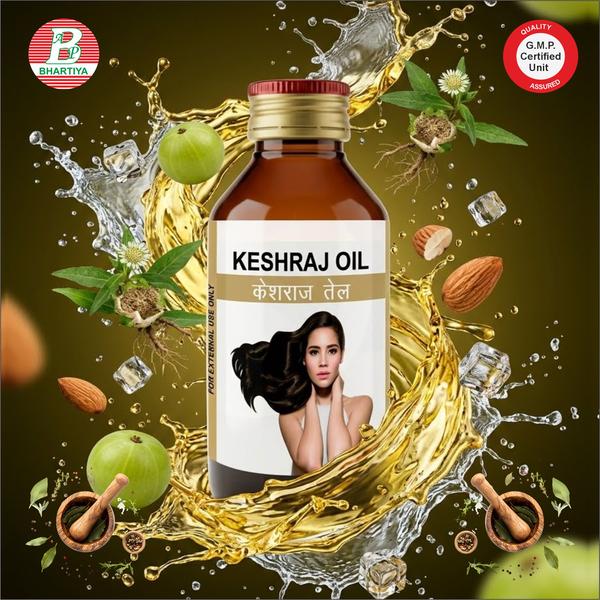
"name": "Keshraj Oil",
"description": " KESHRAJ OIL \n\nProduct Identification\n•\tGeneric Name: Keshraj Oil\n•\tType: Ayurvedic Patent Medicine\n•\tPrimary Indication Area: Promotes healthy scalp and hair, reduces hair fall, and prevents premature Graying.\n Therapeutic Indications\nUsed for strengthening hair roots, controlling hair fall, preventing premature graying, and nourishing the scalp to promote healthy hair growth.\nKey benefits:\n•\tStrengthens hair roots and prevents hair fall\n•\tReduces premature graying of hair\n•\tNourishes and moisturizes the scalp\n•\tPromotes healthy and long hair growth\n•\tImproves hair texture and shine\n\nIngredient: \n Bhringraj (Eclipta alba) \nBotanical Name: Eclipta alba\nKey Phytoconstituents:\n•\tWedelolactone\n•\tDemethylwedelolactone\n•\tCoumestans\n•\tFlavonoids\n•\tAlkaloids\n•\tTriterpenoids\nHair Health Benefits & Mechanism:\n1.\tPromotes Hair Growth: Stimulates hair follicles and improves scalp microcirculation, encouraging healthy hair growth.\n2.\tPrevents Hair Fall: Strengthens hair roots and reduces hair breakage.\n3.\tDelays Premature Graying: Nourishes hair follicles and helps maintain natural hair color.\n4.\tNourishes Scalp: Moisturizes dry scalp and reduces itchiness or dandruff.\n5.\tImproves Hair Texture & Shine: Enhances softness, smoothness, and natural luster of hair.\n6.\tCooling & Soothing: Reduces scalp inflammation and irritation.\n\n Amla (Indian Gooseberry) – Hair Health\nBotanical Name: Phyllanthus emblica\nKey Phytoconstituents:\n•\tVitamin C (Ascorbic acid)\n•\tTannins (e.g., Emblicanin A & B)\n•\tFlavonoids\n•\tPolyphenols\n•\tMinerals (Calcium, Iron, Phosphorus)\nHair Health Benefits & Mechanism:\n1.\tPromotes Hair Growth: Rich in antioxidants and nutrients that nourish hair follicles and stimulate growth.\n2.\tPrevents Hair Fall: Strengthens hair roots and reduces breakage.\n3.\tDelays Premature Graying: High vitamin C and tannin content help maintain natural hair colour.\n4.\tImproves Hair Texture & Shine: Conditions hair naturally, making it soft, smooth, and lustrous.\n5.\tScalp Health: Reduces dryness, dandruff, and scalp inflammation due to its cooling and rejuvenating properties.\n6.\tProtects Against Oxidative Damage: Antioxidants combat free radicals that weaken hair and follicles.\n\n\n Akarkara – Hair & Scalp Health\nBotanical Name: Anacyclus pyrethrum\nKey Phytoconstituents:\n•\tAlkylamides (e.g., Anacyclin)\n•\tPolyacetylenes\n•\tAlkaloids\n•\tEssential oils (volatile oils)\n•\tResin\nHair Health Benefits & Mechanism:\n1.\tStimulates Hair Growth: Improves blood circulation in the scalp, activating hair follicles.\n2.\tStrengthens Hair Roots: Alkaloids and essential oils nourish and fortify hair roots, reducing hair fall.\n3.\tScalp Rejuvenation: Antimicrobial and anti-inflammatory properties help soothe irritation and prevent scalp infections.\n4.\tImproves Hair Texture: Helps make hair stronger, thicker, and healthier in appearance.\n5.\tInvigorates Scalp: Traditionally considered “Vata-pacifying,” it provides warmth and promotes nourishment.\n\n Devdaru (Indian Cedar) \nBotanical Name: Cedrus deodara\nKey Phytoconstituents:\n•\tSesquiterpenes\n•\tFlavonoids\n•\tLignans\n•\tEssential oils (Cedrol, Cedrene)\n•\tResin acids\nHair Health Benefits & Mechanism:\n1.\tPromotes Hair Growth: Improves scalp circulation and stimulates hair follicles.\n2.\tReduces Hair Fall: Strengthens roots and prevents excessive shedding.\n3.\tNourishes Scalp: Provides moisture and soothes dry, itchy, or flaky scalp.\n4.\tImproves Hair Texture & Shine: Enhances hair strength, smoothness, and luster.\n5.\tAnti-inflammatory & Antimicrobial: Protects scalp from minor infections and irritation.\n\n Green Tea \nBotanical Name: Camellia sinensis\nKey Phytoconstituents:\n•\tPolyphenols (Epigallocatechin gallate – EGCG)\n•\tCatechins\n•\tFlavonoids\n•\tAmino acids (Theanine)\n•\tCaffeine\n•\tVitamins (B, C, E)\nHair Health Benefits & Mechanism:\n1.\tPromotes Hair Growth: EGCG and catechins stimulate hair follicle proliferation and prolong the anagen (growth) phase.\n2.\tReduces Hair Fall: Strengthens hair roots and prevents oxidative stress-induced shedding.\n3.\tDelays Premature Graying: Antioxidant activity protects hair follicle melanocytes from damage.\n4.\tImproves Scalp Health: Anti-inflammatory and antimicrobial properties soothe scalp irritation and reduce dandruff.\n5.\tEnhances Hair Strength & Shine: Nutrients nourish hair, improving texture, luster, and manageability.\n\n Jatamansi \nBotanical Name: Nardostachys jatamansi\nKey Phytoconstituents:\n•\tSesquiterpenes (Jatamansone / Nardostachone)\n•\tAlkaloids\n•\tLignans\n•\tEssential oils\n•\tCoumarins\nHair Health Benefits & Mechanism:\n1.\tPromotes Hair Growth: Stimulates hair follicles and improves scalp circulation.\n2.\tPrevents Hair Fall: Strengthens hair roots and reduces breakage.\n3.\tDelays Premature Graying: Nourishes hair follicles and maintains natural hair color.\n4.\tScalp Health: Anti-inflammatory and soothing effects reduce scalp irritation and dryness.\n5.\tImproves Hair Texture & Shine: Enhances softness, smoothness, and natural luster of hair.\n6.\tStress Relief (Ayurvedic Perspective): Helps calm Vata, which can indirectly reduce stress-related hair fall.\n\n Lemon Tea \nBotanical Name: Citrus limon (for lemon)\nKey Phytoconstituents:\n•\tVitamin C (Ascorbic acid)\n•\tFlavonoids (Hesperidin, Naringin)\n•\tCitric acid\n•\tEssential oils (Limonene, Linalool)\n•\tPolyphenols\nHair Health Benefits & Mechanism:\n1.\tPromotes Hair Growth: Improves scalp circulation and nourishes hair follicles.\n2.\tReduces Hair Fall: Strengthens hair roots and prevents breakage.\n3.\tPrevents Dandruff & Scalp Infections: Citric acid and flavonoids have mild antimicrobial and antifungal effects.\n4.\tImproves Hair Shine & Texture: Vitamin C and antioxidants protect hair from oxidative damage and enhance natural luster.\n5.\tBalances Scalp pH: Helps reduce oiliness and dryness, maintaining a healthy scalp environment.\n\n Brahmi – Hair Health\nBotanical Name: Bacopa monnieri\nKey Phytoconstituents:\n•\tBacosides (A & B)\n•\tAlkaloids (Brahmine, Nicotine)\n•\tFlavonoids\n•\tSaponins\n•\tSterols\nHair Health Benefits & Mechanism:\n1.\tPromotes Hair Growth: Nourishes hair follicles and improves scalp circulation.\n2.\tPrevents Hair Fall: Strengthens roots and reduces hair breakage.\n3.\tDelays Premature Graying: Rich in antioxidants that protect follicle melanocytes.\n4.\tScalp Health: Anti-inflammatory and soothing properties help reduce dryness, itching, and dandruff.\n5.\tImproves Hair Texture & Shine: Conditions hair naturally, enhancing softness, smoothness, and luster.\n6.\tCalms Nervous System (Ayurvedic Perspective): Reduces stress-related hair fall by pacifying Vata and supporting overall vitality.\n\n Til Taila (Sesame Oil) \nBotanical Name: Sesamum indicum\nKey Phytoconstituents:\n•\tUnsaturated fatty acids (Oleic acid, Linoleic acid)\n•\tVitamin E (Tocopherols)\n•\tSesamol & Sesamin (Lignans)\n•\tMinerals (Calcium, Magnesium, Phosphorus)\nHair Health Benefits & Mechanism:\n1.\tNourishes Hair & Scalp: Rich in essential fatty acids and vitamin E, it deeply moisturizes and strengthens hair.\n2.\tPrevents Hair Fall: Strengthens hair shafts and roots, reducing breakage and shedding.\n3.\tDelays Premature Graying: Antioxidants (sesamol, sesamin) protect hair follicles from oxidative damage.\n4.\tImproves Hair Texture & Shine: Conditions hair naturally, enhancing softness, smoothness, and luster.\n5.\tScalp Health: Anti-inflammatory properties soothe dry, itchy, or irritated scalp.\n6.\tEnhances Hair Growth: Improves blood circulation in the scalp, promoting healthy hair growth.\nHow to Use Keshraj Oil\n1.\tFor Hair Growth & Strengthening:\no\tTake 2–3 ml (about a teaspoon) of Keshraj Oil.\no\tGently massage it into the scalp using fingertips in circular motions for 5–10 minutes.\no\tEnsure even coverage of the scalp and hair roots.\n2.\tLeave-In Duration:\no\tLeave the oil on for at least 30 minutes.\no\tFor best results, leave it overnight and wash off in the morning.\n3.\tWashing:\no\tWash hair with a mild shampoo to remove excess oil.\no\tAvoid hot water; use lukewarm or cool water for washing.\n4.\tFrequency:\no\tUse 2–3 times a week or as advised by an Ayurvedic practitioner.\n5.\tAdditional Tip:\no\tRegular use improves hair strength, reduces hair fall, delays graying, and nourishes the scalp for healthier, shinier hair.\n\n\nkeshraj oil benefits, keshraj oil benefits in hindi, keshraj oil price\nkeshraj hair oil, keshraj hair oil review, keshraj hair oil benefits\nkeshraj hair oil price, keshraj bhringraj oil, keshraj oil agency\nkeshraj oil company, keshraj oil contact number, keshraj oil corporation\nkeshraj oil company contact number, keshraj oil creation, keshraj oil uses in hindi\nkeshraj oil in hindi, keshraj oil factory, keshraj oil filter price, keshraj oil gst number\nkeshraj oil gst rate, keshraj oil gst no, keshraj oil ke fayde, keshraj oil kg price\nkeshraj oil login, keshraj oil quantity, keshraj oil tonic, keshraj oil tree\nkeshraj oil uses, keshraj oil wash powder, what keshraj oil benefits\nwhat keshraj oil uses in hindi, what keshraj oil benefits in hindi\nwhat keshraj oil review, what keshraj oil price, where keshraj oil is manufactured\nwhere keshraj oil uses in hindi, where keshraj oil benefits, where keshraj oil price\nwhere keshraj oil in hindi, where keshraj oil benefits in hindi, where keshraj oil review\nwhen keshraj oil benefits, when keshraj oil uses in hindi, when keshraj oil benefits in hindi\nwhen keshraj oil price, when keshraj oil in hindi, when keshraj oil review\nhow keshraj oil is made, how keshraj oil works, how keshraj oil is used\nhow keshraj oil benefits, how keshraj oil uses in hindi, how keshraj oil benefits in hindi\nhow keshraj oil review, how keshraj oil price, why keshraj oil benefits\nwhy keshraj oil benefits in hindi, why keshraj oil uses in hindi, why keshraj oil review\nwhy keshraj oil price, who keshraj oil company, who keshraj oil benefits\nwho keshraj oil uses in hindi, who keshraj oil price, who keshraj oil in hindi\nis keshraj oil good, is keshraj oil benefits, is keshraj oil review\nis keshraj oil benefits in hindi, is keshraj oil uses in hindi, is keshraj oil price\ncan keshraj oil benefits, can keshraj oil uses in hindi, can keshraj oil review\ncan keshraj oil price, can keshraj oil in hindi, should keshraj oil benefits\nshould keshraj oil review, should keshraj oil benefits in hindi, should keshraj oil benefits in tamil\nshould keshraj oil uses in hindi, should keshraj oil price, will keshraj oil benefits\nwill keshraj oil review, will keshraj oil benefits in hindi, will keshraj oil price\nwill keshraj oil uses in hindi, will keshraj oil benefits in tamil, do keshraj oil uses in hindi\ndo keshraj oil price, do keshraj oil benefits, do keshraj oil benefits in hindi\ndo keshraj oil review, do keshraj oil in hindi, does keshraj oil benefits\ndoes keshraj oil benefits in hindi, does keshraj oil uses in hindi\ndoes keshraj oil review, was keshraj oil benefits, was keshraj oil uses in hindi\nwas keshraj oil benefits in hindi, was keshraj oil review, was keshraj oil price\nwas keshraj oil in hindi, was keshraj oil benefits in tamil, best keshraj oil in india\nbest keshraj oil benefits, best keshraj oil price, best keshraj oil uses in hindi\nbest keshraj oil review, best keshraj oil benefits in hindi, best keshraj oil in hindi\ntop keshraj oil company, top keshraj oil price, top keshraj oil pvt ltd\ntop keshraj oil uses in hindi, top keshraj oil review, top keshraj oil benefits\ntop keshraj oil in hindi, top keshraj oil benefits in hindi",
"price": 600.0,
"discountamount": 240.0,
"currencycode": "INR",
"priority": 1000000,
"isfreeshipmentavailable": false,
"shipmentduration": 1,
"_keywords": null,
"isarchived": false,
"isavailable": true,
"applicationid": null,
"productindex": 133,
"imageuri": "https://productimages.withfloats.com/actual/6a191e6d3b2a06da6b3bf919.jpg",
"tileimageuri": "https://productimages.withfloats.com/tile/6a191e6d3b2a06da6b3bf919.jpg",
"images": null,
"totalqueries": 0,
"gpid": null,
"groupproductid": null,
"createdon": "2026-05-29T05:04:41.942Z",
"updatedon": "2026-05-29T05:04:41.942Z",
"buyonlinelink": null,
"producturl": "http://WWW.BHARTIYAAYURVEDICPHARMACY.COM/products/keshraj-oil/133",
"availableunits": -1.0,
"iscodavailable": true,
"isprepaidonlineavailable": true,
"maxcodorders": -1,
"maxprepaidonlineorders": -1,
"uniquepaymenturl": null,
"brandname": "Bakula Fort",
"category": "Keshraj Oil 100 ML X 30",
"tags": [],
"variants": false,
"keyspecification": null,
"otherspecifications": null,
"pickupaddressreferenceid": null,
"paymenttype": "AssuredPurchase",
"producttype": "products",
"hsncode": null,
"gstslab": 0.0,
"isnotforsale": false
},
{
"_id": "698c4005e628254e7adcd257",
"fptag": "BHARTIYEAYURVEDICPHARMACY",
"merchantname": null,
"customwidgets": null,
"externalsourceid": null,
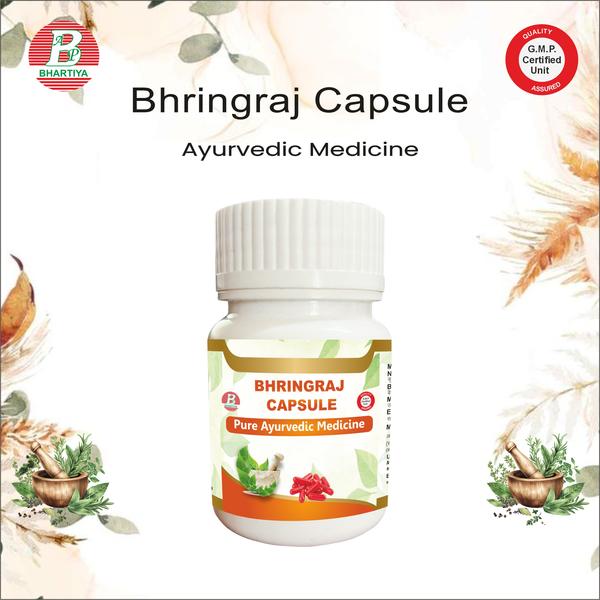
"name": "Bhringraj Capsule",
"description": " BHRINGRAJ \n\n BHRINGRAJ (Eclipta alba / Eclipta prostrata) \nThe King of Hair & Supreme Liver Rejuvenator\nBhringraj is one of the most important Rasayana herbs in Ayurveda, especially renowned for hair regeneration, liver rejuvenation, blood purification, and nervous system support.\nIt is called “Kesharaja” – King of Hair, and “Yakrit Uttama” – Best herb for liver health.\n\n Meaning of Bhringraj\nBhringa = Black bee\nRaja = King\n The herb that gives hair the black, glossy shine of a bee\n\nHistorical Story According to Acharyas\nAccording to Charaka Samhita and Bhavaprakasha, Bhringraj was first described as a divine herb gifted to humanity for promoting longevity and vitality. It is said that Lord Dhanvantari, during the churning of the ocean (Samudra Manthan), gave this herb to rejuvenate the sages and heal ailments, particularly those affecting hair, liver, and blood.\nBhavaprakasha Nighantu highlights:\n“Keshya, Rasayana, Hridya, Yakrit Pleeha Shodhaka” – Bhringraj nourishes hair, rejuvenates the body, supports heart health, and purifies liver and spleen.\nIt has been traditionally used as a Rasayana (rejuvenative), Keshya (hair tonic), and Yakrit-Pleeha Shodhaka (hepato-splenic tonic) in Ayurveda for centuries.\n\n Botanical Information of Bhringraj\n•\tScientific Name: Eclipta alba (L.) Hassk.\n•\tFamily: Asteraceae\n•\tOrder: Asterales\n•\tGenus: Eclipta\n•\tSpecies: alba\n\nCommon Names:\no\tSanskrit: Bhringraj, Kesharaja, Bhringraj\no\tHindi: Bhringraj\no\tEnglish: False Daisy\no\tTamil: Karisalankanni\no\tTelugu: Bhringrajam\no\tMalayalam: Bhringarajam\no\tKannada: Bhringaraja\no\tBengali: Bhringraj\nSynonyms in Ayurvedic Nighantus:\n•\tBhavaprakasha Nighantu: Keshya, Rasayana, Hridya\n•\tRaja Nighantu & Kaiyadeva Nighantu: Bhringraj, Karisalankanni\n•\tDhanvantari Nighantu: Keshya, Shreshtha Rasayana\n\n Morphology of Bhringraj (Eclipta alba)\n•\tPlant Type: Annual, erect or semi-prostrate herb\n•\tStem:\no\tErect, glabrous or slightly hairy\no\tGreen, branching, 30–100 cm height\n•\tLeaves:\no\tOpposite arrangement, simple, lanceolate or ovate\no\tSmooth, dark green, slightly hairy\no\tShort petiole\n•\tFlowers:\no\tSmall, white, tubular, bisexual\no\tBloom throughout monsoon\n•\tRoots:\no\tSlender, fibrous, white\no\tMedicinal part for Rasayana and Keshya use\n•\tFruits:\no\tSmall, one-seeded achenes\n•\tHabit:\no\tFast-growing, creeping or erect\no\tTolerates dry and degraded soils\n\n Ecological Preferences\n•\tClimate: Tropical and subtropical\n•\tSoil: Sandy, loamy, well-drained; grows in poor soils\n•\tSunlight: Full sun to partial shade\n•\tMoisture: Moderate, drought-tolerant\n•\tAltitude: Plains to medium elevation\n•\tHabitat: Roadsides, fields, gardens, wastelands\n\n Distribution\n•\tIndia: Widely throughout the country\n•\tAsia: Sri Lanka, Bangladesh, Myanmar, Nepal\n•\tAfrica: Tropical Africa\n•\tAmericas: Naturalized in South and Central America\n•\tOther regions: Common in tropical areas worldwide\n\n Classical Ayurvedic Properties of Bhringraj\n•\tRasa (Taste): Tikta (bitter), Kashaya (astringent)\n•\tGuna (Qualities): Laghu (light), Snigdha (slightly oily)\n•\tVirya (Potency): Ushna (hot)\n•\tVipaka (post-digestive effect): Katu (pungent)\n•\tDosha Effect: Kapha-Vata Shamaka\n\nKarma (Actions):\no\tKeshya: Promotes hair growth, delays greying\no\tRasayana: Rejuvenative, increases vitality\no\tYakrit-Pleeha Shodhaka: Supports liver and spleen\no\tHridya: Supports heart function\no\tMedohara: Reduces excess fat, balances metabolism\n\n Therapeutic Actions According to Acharyas\n1.\tKeshya (Hair tonic):\no\tPrevents hair fall, premature greying\no\tStrengthens hair roots\n2.\tRasayana (Rejuvenative):\no\tEnhances strength, vitality, longevity\no\tImproves immunity\n3.\tYakrit-Pleeha Shodhaka:\no\tSupports liver and spleen health\no\tDetoxifies blood\n4.\tHridya (Cardio-supportive):\no\tImproves circulation and heart health\n5.\tMedohara / Vata Shamak:\no\tReduces fat deposition\no\tBalances Vata dosha\nReferences:\n•\tCharaka Samhita: Bhringraj as Keshya and Rasayana\n•\tSushruta Samhita: Describes hair growth and liver-protective properties\n•\tBhavaprakasha Nighantu: Emphasizes rejuvenation, hair care, and liver support\n\n Modern Phytochemistry of Bhringraj\n•\tAlkaloids: Wedelolactone, Demethylwedelolactone – hepatoprotective\n•\tFlavonoids: Luteolin, Apigenin – antioxidant, anti-inflammatory\n•\tCoumestans: Antioxidant, anti-hepatotoxic\n•\tTriterpenoids: Support liver and kidney health\n•\tPhenolic compounds: Anti-aging and detoxifying effects\n\n Species of Bhringraj (Genus: Eclipta)\n1.\tEclipta alba (L.) Hassk. – Most widely used in Ayurveda\n2.\tEclipta prostrata (L.) L. – Similar properties, sometimes used interchangeably in folk medicine\n\n Cultivation\n•\tPropagation: Seeds or stem cuttings\n•\tSowing time: Early monsoon\n•\tSpacing: 25–30 cm between plants\n•\tWatering: Moderate; drought-tolerant\n•\tFertilization: Organic manure; hardy herb\n•\tHarvesting: Leaves and whole plant after 3–4 months\n•\tEcological note: Pioneer plant, stabilizes degraded soils\n\n Classical Dosage (According to Granthas)\n1.\tCharaka Samhita:\no\tPowder (Churna) 3–6 g/day\no\tDecoction (Kwatha) 40–60 ml, 2–3 times/day\n2.\tSushruta Samhita:\no\tFresh juice (Swarasa) 20–30 ml/day\no\tExternal paste for hair 2–3 times/week\n3.\tBhavaprakasha Nighantu:\no\tChurna 3–6 g\no\tKwatha 40–60 ml\no\tSwarasa 20–30 ml\n\n Bhringraj Formulations\n1.\tBhringraj Churna (Powder) – Hair growth, liver tonic, Rasayana\n2.\tBhringraj Swarasa (Juice) – Internal detox, Rasayana, hair health\n3.\tBhringraj Taila (Oil) – Hair tonic, prevents greying, strengthens scalp\n4.\tBhringraj Capsule / Tablet – Convenient, standardized for internal use\n5.\tBhringraj Asava – Fermented preparation for liver and general rejuvenation\n\n Bhringraj Formulations by Ayurvedic Pharmacy\n1.\tBhringraj Tablet – 1–2 tablets twice daily, supports hair, liver, and Rasayana effect\n2.\tBhringraj Capsule – 1 capsule twice daily, detoxifies and rejuvenates\n3.\tBhringraj Oil – Apply to scalp 2–3 times/week for hair fall, greying\n4.\tBhringraj Swarasa / Asava – 20–30 ml twice daily, improves liver, blood, and immunity\n\n Safety and Precautions\n•\tSafe in classical doses\n•\tAvoid overdose; may cause mild digestive upset if excessive\n•\tPregnant women: Use only under supervision\n•\tPatients with liver disease: Consult physician before long-term use\n\n BHRINGRAJ FORMULATIONS – BHARTIYA AYURVEDIC PHARMACY\nBhartiya Ayurvedic Pharmacy prepares Bhringraj (Eclipta alba) formulations using purified plant material, processed according to classical Ayurvedic principles, preserving its rejuvenating, hair-nourishing, liver-supporting, and Rasayana qualities.\nKey Uses\n• Promotes healthy hair growth and prevents premature greying\n• Supports liver and spleen function\n• Enhances vitality, stamina, and immunity\n• Blood purification and detoxification\n• Acts as a Rasayana for longevity and rejuvenation\n\n BHRINGRAJ CAPSULE\nBhartiya Ayurvedic Pharmacy Bhringraj Capsules are prepared using standardized Bhringraj extract/powder, following classical Ayurvedic processing methods.\nKey Benefits\n• Supports healthy hair growth and strengthens roots\n• Promotes liver and spleen health\n• Enhances energy, stamina, and general vitality\n• Acts as a rejuvenative (Rasayana) tonic\nDosage\n• Adults: 1 capsule twice daily with warm water after meals\n• Or as advised by an Ayurvedic physician\nSafety & Precautions\n• Safe for long-term use in recommended dose\n• Suitable for both men and women\n• Pregnant or lactating women: Use only under supervision\nFormulation Highlights\n• 100% pure Bhringraj extract/powder\n• No preservatives or additives\n• Classical Ayurvedic processing to retain therapeutic potency\n\n BHRINGRAJ POWDER (CHURNA)\nBhringraj Powder is prepared from dried and finely powdered Bhringraj whole plant/root.\nKey Benefits\n• Promotes hair growth and delays greying\n• Supports liver function and detoxification\n• Improves general vitality and immunity\n• Acts as a Rasayana for longevity\nDosage\n• 3–6 grams (1 tsp) once or twice daily with lukewarm water, honey, or milk\n• Or as advised by an Ayurvedic physician\nSafety & Precautions\n• Safe in classical doses\n• Avoid overdose\n• Pregnant women: Use only under guidance\nFormulation Highlights\n• Pure, dried Bhringraj powder\n• No artificial additives\n• Preserves natural bioactive compounds\n\n BHRINGRAJ ASAVA / SWARASA\nBhringraj Asava is a classical fermented liquid preparation from fresh roots/whole plant.\nKey Benefits\n• Supports liver and spleen health\n• Detoxifies blood and enhances vitality\n• Improves hair health from within\n• Acts as a mild Rasayana tonic\nDosage\n• 20–30 ml twice daily after meals with water or honey\n• Or as advised by an Ayurvedic physician\nSafety & Precautions\n• Contains naturally occurring alcohol (fermentation)\n• Use cautiously in children and pregnancy\nFormulation Highlights\n• Prepared from fresh plant material for maximum efficacy\n• Classical Ayurvedic fermentation process\n• Preserves bioactive constituents\n\n BHRINGRAJ OIL (TAILA)\nBhringraj Oil is a classical medicated oil prepared with Bhringraj Swarasa/Kwatha and carrier oils like sesame or coconut oil.\nKey Benefits\n• Strengthens scalp and hair roots\n• Promotes hair growth, prevents hair fall and premature greying\n• Nourishes hair and improves shine\n• Soothes scalp irritation and dryness\nMethod of Use\n• Apply to scalp 2–3 times weekly\n• Massage gently, leave 30–60 minutes or overnight\n• Wash with mild herbal shampoo\nFormulation Highlights\n• Made from Bhringraj Swarasa/Kwatha in herbal oils\n• Preserves hair-nourishing bioactive compounds\n• No artificial chemicals or additives\n\n\nbest bhringraj capsule, best bhringraj capsules\nbhringraj capsule company, bhringraj capsule company name\nbhringraj capsule composition, bhringraj capsule content\nbhringraj capsule cost, bhringraj capsule gharelu upay\nbhringraj capsule good or bad, bhringraj capsule jan aushadhi\nbhringraj capsule jan aushadhi kendra, bhringraj capsule jiomart\nbhringraj capsule ke fayde, bhringraj capsule life, bhringraj capsule list\nbhringraj capsule name, bhringraj capsule name in hindi\nbhringraj capsule natural, bhringraj capsule near me\nbhringraj capsule quantity, bhringraj capsule ras, bhringraj capsule recipe\nbhringraj capsule review, bhringraj capsule with benefits\nbhringraj capsule with price, bhringraj capsules, bhringraj capsules benefits\nbhringraj capsules benefits in hindi, bhringraj capsules organic india\nbhringraj capsules price, bhringraj capsules side effects\nbhringraj capsules uses, bhringraj ds capsule, bhringraj hair capsule\nbhringraj ka paudha kahan milega, bhringraj ka paudha kaise lagaen\nbhringraj ka paudha kaise pahchane, bhringraj ka upyog kaise karen\nbhringraj kaise lagaye, bhringraj ke capsule, bhringraj plus capsule uses in hindi\nbhringraj powder capsules, bhringraj tablets benefits, brahmi bhringraj capsule\nhimalaya bhringraj capsule, maha bhringraj capsule",
"price": 300.0,
"discountamount": 150.0,
"currencycode": "INR",
"priority": 1000000,
"isfreeshipmentavailable": false,
"shipmentduration": 1,
"_keywords": null,
"isarchived": false,
"isavailable": true,
"applicationid": null,
"productindex": 52,
"imageuri": "https://productimages.withfloats.com/actual/698c400712379120adacf0ef.jpg",
"tileimageuri": "https://productimages.withfloats.com/tile/698c400712379120adacf0ef.jpg",
"images": null,
"totalqueries": 0,
"gpid": null,
"groupproductid": null,
"createdon": "2026-02-11T08:38:29.295Z",
"updatedon": "2026-02-18T05:50:03.432Z",
"buyonlinelink": null,
"producturl": "http://WWW.BHARTIYAAYURVEDICPHARMACY.COM//bhringraj-capsule/52",
"availableunits": -1.0,
"iscodavailable": true,
"isprepaidonlineavailable": true,
"maxcodorders": -1,
"maxprepaidonlineorders": -1,
"uniquepaymenturl": null,
"brandname": "Bakula Fort",
"category": "Bhringraj Capsule 60 Cap X 24",
"tags": [],
"variants": false,
"keyspecification": null,
"otherspecifications": null,
"pickupaddressreferenceid": null,
"paymenttype": "AssuredPurchase",
"producttype": "products",
"hsncode": null,
"gstslab": 0.0,
"isnotforsale": false
},
{
"_id": "6a6069dca338caae77fcc9a0",
"fptag": "BHARTIYEAYURVEDICPHARMACY",
"merchantname": null,
"customwidgets": null,
"externalsourceid": null,
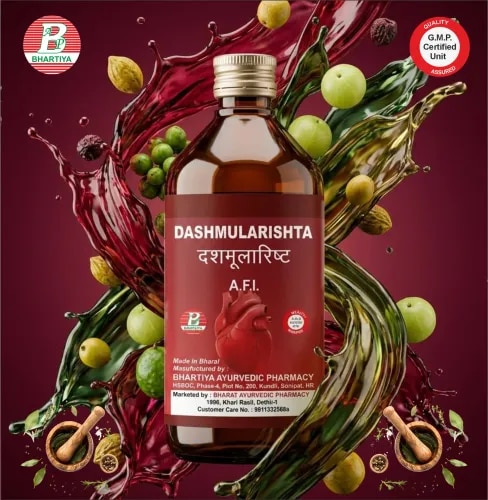
"name": "DASHMULARISHTA",
"description": " DASHMULARISHTA\n\n\nProduct Identification\nGeneric Name: Dashmularishta\nType: Ayurvedic Polyherbal Fermented Formulation (Arishta)\nPrimary Indication Area: Primarily used as a rejuvenative and restorative tonic for postpartum care, Vata disorders, inflammatory conditions, musculoskeletal weakness, nervous system disorders, and recovery following chronic illness. It is widely indicated for general debility, fever recovery, respiratory weakness, digestive impairment, and gynecological disorders associated with Vata imbalance.\n\nTherapeutic Indications\n•\tGeneral debility (Daurbalya) \n•\tPostpartum care (Sutika Paricharya) \n•\tVata disorders (Vatavyadhi) \n•\tChronic inflammatory conditions \n•\tMusculoskeletal weakness \n•\tJoint pain and stiffness \n•\tLow back pain \n•\tNeuralgia and neuropathic discomfort \n•\tConvalescence following prolonged illness \n•\tRespiratory weakness and chronic cough \n•\tFever recovery \n•\tDigestive weakness and poor appetite \n•\tGynecological disorders associated with Vata imbalance \n•\tFatigue and reduced stamina \n•\tAge-related decline in strength and vitality \n\nKey Benefits\n•\tSupports healthy musculoskeletal and nervous system function. \n•\tPromotes recovery following childbirth and prolonged illness. \n•\tHelps reduce inflammation and joint discomfort. \n•\tImproves physical strength and endurance. \n•\tSupports healthy respiratory function. \n•\tEnhances digestion and metabolism. \n•\tPromotes healthy immune function. \n•\tSupports uterine health during the postpartum period. \n•\tActs as a Rasayana for restoring vitality. \n•\tProvides antioxidant protection against oxidative stress. \n\nFORMULA\nEach part contains:\n•\tBilva (Aegle marmelos) \n•\tShyonaka (Oroxylum indicum) \n•\tGambhari (Gmelina arborea) \n•\tPatala (Stereospermum suaveolens) \n•\tAgnimantha (Clerodendrum phlomidis) \n•\tShalaparni (Desmodium gangeticum) \n•\tPrishniparni (Uraria picta) \n•\tBrihati (Solanum indicum) \n•\tKantakari (Solanum xanthocarpum)\n•\tGokshura (Tribulus terrestris) \n•\tChitraka (Plumbago zeylanica) \n•\tPushkara (Inula racemosa) \n•\tLodhra (Symplocos racemosa) \n•\tGuduchi (Tinospora cordifolia) \n•\tAmalaki (Phyllanthus emblica) \n•\tDhanvayasa (Fagonia cretica) \n•\tKhadira (Acacia catechu) \n•\tKustha (Saussurea lappa) \n•\tManjistha (Rubia cordifolia) \n•\tDevadaru (Cedrus deodara) \n•\tVidanga (Embelia ribes) \n•\tMadhuka (Glycyrrhiza glabra) \n•\tBharangi (Clerodendrum serratum) \n•\tKapitha (Limonia acidissima / Feronia limonia) \n•\tBibhitaki (Terminalia bellirica) \n•\tPunarnava (Boerhavia diffusa) \n•\tChavya (Piper retrofractum) \n•\tJatamansi (Nardostachys jatamansi) \n•\tPriyangu (Callicarpa macrophylla) \n•\tSariva (Hemidesmus indicus) \n•\tKala Jeera (Carum carvi / Nigella sativa (regional use)) \n•\tTrivrit (Operculina turpethum) \n•\tNirgundi (Vitex negundo) \n•\tRasna (Pluchea lanceolata) \n•\tHaridra (Curcuma longa) \n•\tSatpushpa (Anethum sowa / Anethum graveolens) \n•\tPadmaka (Prunus cerasoides) \n•\tNagakesara (Mesua ferrea) \n•\tMusta (Cyperus rotundus) \n•\tIndrayava (Holarrhena antidysenterica) \n•\tKarkatashringi (Pistacia integerrima) \n•\tJivaka (Microstylis wallichii) \n•\tRishabhaka (Microstylis muscifera) \n•\tMeda (Polygonatum cirrhifolium) \n•\tKakoli (Fritillaria roylei) \n•\tKshirakakoli (Roscoea purpurea) \n•\tRiddhi (Habenaria intermedia) \n•\tVriddhi (Habenaria edgeworthii) \n•\tDraksha (Vitis vinifera) \n•\tKatphala (Myrica nagi) \n•\tPuga (Areca catechu) \n•\tGuda (Jaggery) \n•\tMadhu (Honey) \n•\tDhataki (Woodfordia fruticosa) \n•\tLavanga (Syzygium aromaticum) \n•\tTvak (Cinnamomum verum) \n•\tEla (Elettaria cardamomum) \n•\tTejapatra (Cinnamomum tamala) \n•\tPippali (Piper longum) \n•\tHaridra (Curcuma longa) \n•\tSveta Chandana (Santalum album) \n•\tPippali root\n\n\n1. Bilva\nBotanical Name: Aegle marmelos\n•\tRasa: Kashaya, Tikta \n•\tGuna: Laghu, Ruksha \n•\tVirya: Ushna \n•\tVipaka: Katu \n•\tPrabhava: Vata-Kapha Shamaka \nMechanism of Action\n•\tReduces inflammatory mediators in gut and joints \n•\tRegulates Vata in neuromuscular system \n•\tSupports digestive motility and Agni \n•\tAnti-inflammatory and mild analgesic activity \n•\tHelps in post-illness weakness recovery \n\n2. Shyonaka\nBotanical Name: Oroxylum indicum\n•\tRasa: Tikta, Kashaya \n•\tGuna: Laghu, Ruksha \n•\tVirya: Ushna \n•\tVipaka: Katu \nMechanism of Action\n•\tReduces cytokine-mediated inflammation \n•\tSupports respiratory and musculoskeletal recovery \n•\tAntioxidant and tissue-protective action \n•\tHelps in Vata-induced pain conditions \n\n3. Gambhari\nBotanical Name: Gmelina arborea\n•\tRasa: Madhura, Kashaya \n•\tGuna: Guru, Snigdha \n•\tVirya: Sheeta \n•\tVipaka: Madhura \n•\tPrabhava: Rasayana \nMechanism of Action\n•\tPromotes tissue regeneration and strength \n•\tSupports post-partum recovery \n•\tImmunomodulatory and restorative effect \n•\tAnti-inflammatory and nutritive action \n\n4. Patala\nBotanical Name: Stereospermum suaveolens\n•\tRasa: Tikta, Kashaya \n•\tGuna: Laghu, Ruksha \n•\tVirya: Ushna \n•\tVipaka: Katu \nMechanism of Action\n•\tReduces neuromuscular inflammation \n•\tSupports respiratory function \n•\tAnalgesic activity in Vata disorders \n•\tImproves tissue repair mechanisms \n\n5. Agnimantha\nBotanical Name: Clerodendrum phlomidis\n•\tRasa: Katu, Tikta \n•\tGuna: Laghu, Ruksha \n•\tVirya: Ushna \n•\tVipaka: Katu \nMechanism of Action\n•\tStimulates digestive enzymes and Agni \n•\tReduces Ama accumulation \n•\tAnti-inflammatory in joints and muscles \n•\tEnhances metabolic clearance \n\n6. Shalaparni\nBotanical Name: Desmodium gangeticum\n•\tRasa: Madhura, Tikta \n•\tGuna: Snigdha, Laghu \n•\tVirya: Ushna \n•\tVipaka: Madhura \nMechanism of Action\n•\tNeuroprotective and muscle-strengthening \n•\tReduces fatigue and weakness \n•\tSupports immune modulation \n•\tEnhances recovery from chronic illness \n\n7. Prishniparni\nBotanical Name: Uraria picta\n•\tRasa: Madhura, Tikta \n•\tGuna: Snigdha, Laghu \n•\tVirya: Ushna \n•\tVipaka: Madhura \nMechanism of Action\n•\tImproves neuromuscular strength \n•\tSupports postpartum tissue repair \n•\tAnti-inflammatory and rejuvenative \n•\tEnhances stamina and vitality \n\n8. Brihati\nBotanical Name: Solanum indicum\n•\tRasa: Tikta, Katu \n•\tGuna: Laghu, Ruksha \n•\tVirya: Ushna \n•\tVipaka: Katu \nMechanism of Action\n•\tReduces inflammatory pain \n•\tSupports respiratory health \n•\tHelps in Vata-Kapha imbalance disorders \n•\tImproves metabolic function \n\n9. Kantakari\nBotanical Name: Solanum xanthocarpum\n•\tRasa: Tikta, Katu \n•\tGuna: Laghu, Ruksha \n•\tVirya: Ushna \n•\tVipaka: Katu \nMechanism of Action\n•\tBronchodilator and expectorant action \n•\tReduces respiratory inflammation \n•\tSupports Vata-Kapha balance \n•\tImproves oxygenation and vitality \n\n10. Gokshura\nBotanical Name: Tribulus terrestris\n•\tRasa: Madhura \n•\tGuna: Snigdha, Guru \n•\tVirya: Sheeta \n•\tVipaka: Madhura \nMechanism of Action\n•\tDiuretic and urinary system support \n•\tEnhances muscle strength and stamina \n•\tImproves reproductive function \n•\tAnti-fatigue and anabolic support \n\n11. Chitraka\nBotanical Name: Plumbago zeylanica\n•\tRasa: Katu \n•\tGuna: Laghu, Tikshna \n•\tVirya: Ushna \n•\tVipaka: Katu \nMechanism of Action\n•\tPotent digestive stimulant (Agni deepana) \n•\tReduces Ama accumulation \n•\tImproves nutrient absorption \n•\tEnhances metabolic rate \n\n12. Pushkara\nBotanical Name: Inula racemosa\n•\tRasa: Tikta, Katu \n•\tGuna: Laghu, Ruksha \n•\tVirya: Ushna \n•\tVipaka: Katu \nMechanism of Action\n•\tCardiorespiratory stimulant \n•\tImproves oxygen utilization \n•\tAnti-inflammatory and bronchodilator \n•\tSupports endurance \n\n13. Lodhra\nBotanical Name: Symplocos racemosa\n•\tRasa: Kashaya \n•\tGuna: Laghu, Ruksha \n•\tVirya: Sheeta \n•\tVipaka: Katu \nMechanism of Action\n•\tUterine tonic and anti-inflammatory \n•\tSupports tissue tightening and healing \n•\tReduces excessive secretions \n•\tImproves reproductive health \n\n14. Guduchi\nBotanical Name: Tinospora cordifolia\n•\tRasa: Tikta, Kashaya \n•\tGuna: Laghu, Snigdha \n•\tVirya: Ushna \n•\tVipaka: Madhura \nMechanism of Action\n•\tStrong immunomodulator \n•\tAnti-inflammatory and antipyretic \n•\tEnhances detoxification pathways \n•\tSupports chronic disease recovery \n\n15. Amalaki\nBotanical Name: Phyllanthus emblica\n•\tRasa: Amla Pradhana Pancharasa \n•\tGuna: Laghu, Ruksha \n•\tVirya: Sheeta \n•\tVipaka: Madhura \nMechanism of Action\n•\tPotent antioxidant (vitamin C rich) \n•\tAnti-aging and Rasayana effect \n•\tSupports immunity and tissue repair \n•\tEnhances digestion and metabolism\n16. Dhanvayasa\nBotanical Name: Fagonia cretica / Alhagi pseudalhagi\n•\tRasa: Tikta, Kashaya \n•\tGuna: Laghu, Ruksha \n•\tVirya: Sheeta \n•\tVipaka: Katu \nMechanism\n•\tAnti-inflammatory and blood-purifying activity \n•\tSupports detoxification and tissue repair \n•\tHelps reduce chronic inflammatory states \n\n17. Khadira\nBotanical Name: Acacia catechu\n•\tRasa: Kashaya \n•\tGuna: Ruksha, Laghu \n•\tVirya: Sheeta \n•\tVipaka: Katu \nMechanism\n•\tStrong antioxidant and antimicrobial action \n•\tSupports skin, blood and metabolic health \n•\tReduces chronic inflammation \n\n18. Kustha\nBotanical Name: Saussurea lappa\n•\tRasa: Tikta, Katu \n•\tGuna: Laghu, Tikshna \n•\tVirya: Ushna \n•\tVipaka: Katu \nMechanism\n•\tAnti-inflammatory and analgesic \n•\tSupports Vata disorders (pain, stiffness) \n•\tImproves neuromuscular function \n\n19. Manjistha\nBotanical Name: Rubia cordifolia\n•\tRasa: Tikta, Kashaya \n•\tGuna: Guru, Ruksha \n•\tVirya: Ushna \n•\tVipaka: Katu \nMechanism\n•\tBlood purification and lymphatic drainage \n•\tAnti-inflammatory and antioxidant \n•\tSupports skin and tissue repair \n\n20. Devadaru\nBotanical Name: Cedrus deodara\n•\tRasa: Tikta, Katu \n•\tGuna: Laghu, Ruksha \n•\tVirya: Ushna \n•\tVipaka: Katu \nMechanism\n•\tPotent anti-inflammatory action \n•\tRelieves joint and muscle pain \n•\tSupports respiratory clearance \n\n21. Vidanga\nBotanical Name: Embelia ribes\n•\tRasa: Katu \n•\tGuna: Laghu, Ruksha \n•\tVirya: Ushna \n•\tVipaka: Katu \nMechanism\n•\tAnthelmintic and antimicrobial \n•\tImproves gut health and metabolism \n•\tReduces Ama accumulation \n\n22. Madhuka\nBotanical Name: Glycyrrhiza glabra\n•\tRasa: Madhura \n•\tGuna: Guru, Snigdha \n•\tVirya: Sheeta \n•\tVipaka: Madhura \nMechanism\n•\tAnti-inflammatory and demulcent \n•\tSupports respiratory and gastric mucosa \n•\tImmunomodulatory and rejuvenative \n\n23. Bharangi\nBotanical Name: Clerodendrum serratum\n•\tRasa: Tikta, Katu \n•\tGuna: Laghu, Ruksha \n•\tVirya: Ushna \n•\tVipaka: Katu \nMechanism\n•\tRespiratory anti-inflammatory \n•\tBronchodilator effect \n•\tSupports cough and asthma conditions \n\n24. Kapitha\nBotanical Name: Limonia acidissima\n•\tRasa: Kashaya \n•\tGuna: Guru, Ruksha \n•\tVirya: Sheeta \n•\tVipaka: Katu \nMechanism\n•\tDigestive and gut stabilizing \n•\tAntimicrobial and anti-diarrheal \n•\tSupports intestinal health \n\n25. Bibhitaki\nBotanical Name: Terminalia bellirica\n•\tRasa: Kashaya \n•\tGuna: Ruksha, Laghu \n•\tVirya: Ushna \n•\tVipaka: Madhura \nMechanism\n•\tDetoxification and bowel regulation \n•\tAntioxidant and anti-inflammatory \n•\tSupports respiratory health \n\n26. Punarnava\nBotanical Name: Boerhavia diffusa\n•\tRasa: Tikta, Kashaya \n•\tGuna: Laghu, Ruksha \n•\tVirya: Ushna \n•\tVipaka: Katu \nMechanism\n•\tDiuretic and anti-edema action \n•\tKidney and fluid balance support \n•\tAnti-inflammatory activity \n\n27. Chavya\nBotanical Name: Piper retrofractum\n•\tRasa: Katu \n•\tGuna: Laghu, Tikshna \n•\tVirya: Ushna \n•\tVipaka: Katu \nMechanism\n•\tDigestive stimulant (Deepana) \n•\tImproves metabolism and Agni \n•\tReduces Ama formation \n\n28. Jatamansi\nBotanical Name: Nardostachys jatamansi\n•\tRasa: Tikta, Kashaya \n•\tGuna: Laghu, Snigdha \n•\tVirya: Sheeta \n•\tVipaka: Katu \nMechanism\n•\tNervine sedative and neuroprotective \n•\tReduces stress and anxiety \n•\tSupports sleep and mental balance \n\n29. Priyangu\nBotanical Name: Callicarpa macrophylla\n•\tRasa: Kashaya, Madhura \n•\tGuna: Laghu, Ruksha \n•\tVirya: Sheeta \n•\tVipaka: Katu \nMechanism\n•\tBlood purification and wound healing \n•\tAnti-inflammatory and cooling \n•\tSupports tissue repair \n\n30. Sariva\nBotanical Name: Hemidesmus indicus\n•\tRasa: Madhura, Tikta \n•\tGuna: Guru, Snigdha \n•\tVirya: Sheeta \n•\tVipaka: Madhura \nMechanism\n•\tBlood detoxification \n•\tCooling and anti-inflammatory \n•\tSupports skin and immune health \n\n31. Kala Jeera\nBotanical Name: Nigella sativa / Carum carvi (variant usage)\n•\tRasa: Katu, Tikta \n•\tGuna: Laghu, Ruksha \n•\tVirya: Ushna \n•\tVipaka: Katu \nMechanism\n•\tAnti-inflammatory and antioxidant \n•\tImproves digestion and immunity \n•\tSupports metabolic balance \n\n32. Trivrit\nBotanical Name: Operculina turpethum\n•\tRasa: Katu, Tikta \n•\tGuna: Ruksha, Laghu \n•\tVirya: Ushna \n•\tVipaka: Katu \nMechanism\n•\tStrong purgative (Rechana) \n•\tDetoxification and bowel cleansing \n•\tRemoves accumulated toxins \n\n33. Nirgundi\nBotanical Name: Vitex negundo\n•\tRasa: Katu, Tikta \n•\tGuna: Laghu, Ruksha \n•\tVirya: Ushna \n•\tVipaka: Katu \nMechanism\n•\tAnti-inflammatory and analgesic \n•\tUseful in joint pain and Vata disorders \n•\tMuscle relaxant activity \n\n34. Rasna\nBotanical Name: Pluchea lanceolata\n•\tRasa: Tikta, Katu \n•\tGuna: Snigdha, Laghu \n•\tVirya: Ushna \n•\tVipaka: Katu \nMechanism\n•\tStrong anti-arthritic action \n•\tReduces stiffness and pain \n•\tSupports neuromuscular health \n\n35. Haridra\nBotanical Name: Curcuma longa\n•\tRasa: Tikta, Katu \n•\tGuna: Laghu, Ruksha \n•\tVirya: Ushna \n•\tVipaka: Katu \nMechanism\n•\tAnti-inflammatory and antioxidant \n•\tImmunomodulatory activity \n•\tTissue healing and detox support \n\n36. Satpushpa\nBotanical Name: Anethum sowa / Anethum graveolens\n•\tRasa: Katu \n•\tGuna: Laghu \n•\tVirya: Ushna \n•\tVipaka: Katu \nMechanism\n•\tDigestive stimulant \n•\tReduces bloating and gas \n•\tSupports metabolism \n\n37. Padmaka\nBotanical Name: Prunus cerasoides\n•\tRasa: Kashaya \n•\tGuna: Laghu \n•\tVirya: Sheeta \n•\tVipaka: Katu \nMechanism\n•\tAnti-inflammatory and cooling \n•\tSupports blood purification \n•\tTissue soothing action \n\n38. Nagakesara\nBotanical Name: Mesua ferrea\n•\tRasa: Kashaya, Tikta \n•\tGuna: Laghu, Ruksha \n•\tVirya: Sheeta \n•\tVipaka: Katu \nMechanism\n•\tHemostatic and anti-inflammatory \n•\tSupports uterine and vascular health \n•\tAntioxidant activity \n\n39. Musta\nBotanical Name: Cyperus rotundus\n•\tRasa: Tikta, Katu \n•\tGuna: Laghu, Ruksha \n•\tVirya: Sheeta \n•\tVipaka: Katu \nMechanism\n•\tDigestive regulator \n•\tAnti-diarrheal and metabolic balance \n•\tReduces Ama \n\n40. Indrayava\nBotanical Name: Holarrhena antidysenterica\n•\tRasa: Tikta, Kashaya \n•\tGuna: Laghu, Ruksha \n•\tVirya: Sheeta \n•\tVipaka: Katu \nMechanism\n•\tStrong anti-diarrheal action \n•\tGut antimicrobial activity \n•\tRestores intestinal balance \n\n41. Karkatashringi\nBotanical Name: Pistacia integerrima\n•\tRasa: Kashaya \n•\tGuna: Laghu, Ruksha \n•\tVirya: Sheeta \n•\tVipaka: Katu \nMechanism\n•\tRespiratory anti-inflammatory \n•\tReduces cough and bronchial irritation \n•\tSupports lung function \n42. Jivaka\nBotanical Name: Microstylis wallichii\n•\tRasa: Madhura \n•\tGuna: Guru, Snigdha \n•\tVirya: Sheeta \n•\tVipaka: Madhura \nMechanism\n•\tRasayana and tissue-building action \n•\tImproves strength and vitality \n•\tSupports reproductive and neuromuscular health \n\n43. Rishabhaka\nBotanical Name: Microstylis muscifera\n•\tRasa: Madhura \n•\tGuna: Guru, Snigdha \n•\tVirya: Sheeta \n•\tVipaka: Madhura \nMechanism\n•\tRejuvenative and anabolic support \n•\tEnhances stamina and recovery \n•\tSupports muscle and nerve repair \n\n44. Meda\nBotanical Name: Polygonatum cirrhifolium\n•\tRasa: Madhura \n•\tGuna: Guru, Snigdha \n•\tVirya: Sheeta \n•\tVipaka: Madhura \nMechanism\n•\tNourishing and restorative \n•\tImproves tissue regeneration \n•\tSupports energy metabolism \n\n45. Kakoli\nBotanical Name: Fritillaria roylei\n•\tRasa: Madhura \n•\tGuna: Guru, Snigdha \n•\tVirya: Sheeta \n•\tVipaka: Madhura \nMechanism\n•\tPotent Rasayana herb \n•\tImproves strength and immunity \n•\tSupports nervous system recovery \n\n46. Kshirakakoli\nBotanical Name: Roscoea purpurea\n•\tRasa: Madhura \n•\tGuna: Guru, Snigdha \n•\tVirya: Sheeta \n•\tVipaka: Madhura \nMechanism\n•\tDeep tissue nourishment \n•\tEnhances vitality and stamina \n•\tSupports postpartum recovery \n\n47. Riddhi\nBotanical Name: Habenaria intermedia\n•\tRasa: Madhura \n•\tGuna: Guru, Snigdha \n•\tVirya: Sheeta \n•\tVipaka: Madhura \nMechanism\n•\tStrength promoter (Balya) \n•\tEnhances tissue growth and recovery \n•\tSupports immunity and endurance \n\n48. Vriddhi\nBotanical Name: Habenaria edgeworthii\n•\tRasa: Madhura \n•\tGuna: Guru, Snigdha \n•\tVirya: Sheeta \n•\tVipaka: Madhura \nMechanism\n•\tGrowth and regenerative support \n•\tImproves physical strength \n•\tRasayana for chronic weakness \n\n49. Draksha\nBotanical Name: Vitis vinifera\n•\tRasa: Madhura \n•\tGuna: Guru, Snigdha \n•\tVirya: Sheeta \n•\tVipaka: Madhura \nMechanism\n•\tAntioxidant and cardiotonic support \n•\tImproves energy and hydration \n•\tSupports liver and digestion \n\n50. Katphala\nBotanical Name: Myrica nagi\n•\tRasa: Kashaya \n•\tGuna: Laghu, Ruksha \n•\tVirya: Ushna \n•\tVipaka: Katu \nMechanism\n•\tAntimicrobial and digestive stimulant \n•\tSupports respiratory clearance \n•\tReduces Ama formation \n\n51. Puga\nBotanical Name: Areca catechu\n•\tRasa: Kashaya, Madhura \n•\tGuna: Laghu \n•\tVirya: Ushna \n•\tVipaka: Katu \nMechanism\n•\tAstringent and digestive support \n•\tImproves oral and gut health \n•\tMild stimulant action \n\n52. Guda\nBotanical Name: Saccharum officinarum (Jaggery)\n•\tRasa: Madhura \n•\tGuna: Guru, Snigdha \n•\tVirya: Ushna \n•\tVipaka: Madhura \nMechanism\n•\tFermentation substrate \n•\tEnergy provider \n•\tEnhances bioavailability of herbs \n\n53. Madhu\nBotanical Name: Honey (Apis mellifera product)\n•\tRasa: Madhura, Kashaya \n•\tGuna: Laghu, Ruksha \n•\tVirya: Sheeta \n•\tVipaka: Madhura \nMechanism\n•\tBioavailability enhancer (Yogavahi) \n•\tAntimicrobial and antioxidant \n•\tSupports fermentation stability \n\n54. Dhataki\nBotanical Name: Woodfordia fruticosa\n•\tRasa: Kashaya \n•\tGuna: Laghu, Ruksha \n•\tVirya: Sheeta \n•\tVipaka: Katu \nMechanism\n•\tNatural fermentation catalyst \n•\tEnhances alcohol formation \n•\tImproves extraction of phytochemicals \n\n55. Lavanga\nBotanical Name: Syzygium aromaticum\n•\tRasa: Katu, Tikta \n•\tGuna: Laghu, Tikshna \n•\tVirya: Ushna \n•\tVipaka: Katu \nMechanism\n•\tStrong antimicrobial action \n•\tDigestive stimulant \n•\tAnalgesic and carminative \n\n56. Tvak\nBotanical Name: Cinnamomum verum\n•\tRasa: Katu, Tikta \n•\tGuna: Laghu \n•\tVirya: Ushna \n•\tVipaka: Katu \nMechanism\n•\tImproves circulation and metabolism \n•\tAnti-inflammatory and antioxidant \n•\tSupports digestive fire \n\n57. Ela\nBotanical Name: Elettaria cardamomum\n•\tRasa: Madhura, Katu \n•\tGuna: Laghu \n•\tVirya: Sheeta \n•\tVipaka: Madhura \nMechanism\n•\tDigestive carminative \n•\tReduces bloating and gas \n•\tAromatic bioenhancer \n\n58. Tejapatra\nBotanical Name: Cinnamomum tamala\n•\tRasa: Katu, Tikta \n•\tGuna: Laghu \n•\tVirya: Ushna \n•\tVipaka: Katu \nMechanism\n•\tMetabolic stimulant \n•\tAnti-inflammatory activity \n•\tImproves digestion \n\n59. Pippali\nBotanical Name: Piper longum\n•\tRasa: Katu \n•\tGuna: Laghu, Tikshna \n•\tVirya: Ushna \n•\tVipaka: Madhura \nMechanism\n•\tBioavailability enhancer (Yogavahi) \n•\tRespiratory stimulant \n•\tImproves digestion and absorption\n42. Jivaka\nBotanical Name: Microstylis wallichii\n•\tRasa: Madhura \n•\tGuna: Guru, Snigdha \n•\tVirya: Sheeta \n•\tVipaka: Madhura \nMechanism\n•\tRasayana and tissue-building action \n•\tImproves strength and vitality \n•\tSupports reproductive and neuromuscular health \n\n43. Rishabhaka\nBotanical Name: Microstylis muscifera\n•\tRasa: Madhura \n•\tGuna: Guru, Snigdha \n•\tVirya: Sheeta \n•\tVipaka: Madhura \nMechanism\n•\tRejuvenative and anabolic support \n•\tEnhances stamina and recovery \n•\tSupports muscle and nerve repair \n\n44. Meda\nBotanical Name: Polygonatum cirrhifolium\n•\tRasa: Madhura \n•\tGuna: Guru, Snigdha \n•\tVirya: Sheeta \n•\tVipaka: Madhura \nMechanism\n•\tNourishing and restorative \n•\tImproves tissue regeneration \n•\tSupports energy metabolism \n\n45. Kakoli\nBotanical Name: Fritillaria roylei\n•\tRasa: Madhura \n•\tGuna: Guru, Snigdha \n•\tVirya: Sheeta \n•\tVipaka: Madhura \nMechanism\n•\tPotent Rasayana herb \n•\tImproves strength and immunity \n•\tSupports nervous system recovery \n\n46. Kshirakakoli\nBotanical Name: Roscoea purpurea\n•\tRasa: Madhura \n•\tGuna: Guru, Snigdha \n•\tVirya: Sheeta \n•\tVipaka: Madhura \nMechanism\n•\tDeep tissue nourishment \n•\tEnhances vitality and stamina \n•\tSupports postpartum recovery \n\n47. Riddhi\nBotanical Name: Habenaria intermedia\n•\tRasa: Madhura \n•\tGuna: Guru, Snigdha \n•\tVirya: Sheeta \n•\tVipaka: Madhura \nMechanism\n•\tStrength promoter (Balya) \n•\tEnhances tissue growth and recovery \n•\tSupports immunity and endurance \n\n48. Vriddhi\nBotanical Name: Habenaria edgeworthii\n•\tRasa: Madhura \n•\tGuna: Guru, Snigdha \n•\tVirya: Sheeta \n•\tVipaka: Madhura \nMechanism\n•\tGrowth and regenerative support \n•\tImproves physical strength \n•\tRasayana for chronic weakness \n\n49. Draksha\nBotanical Name: Vitis vinifera\n•\tRasa: Madhura \n•\tGuna: Guru, Snigdha \n•\tVirya: Sheeta \n•\tVipaka: Madhura \nMechanism\n•\tAntioxidant and cardiotonic support \n•\tImproves energy and hydration \n•\tSupports liver and digestion \n\n50. Katphala\nBotanical Name: Myrica nagi\n•\tRasa: Kashaya \n•\tGuna: Laghu, Ruksha \n•\tVirya: Ushna \n•\tVipaka: Katu \nMechanism\n•\tAntimicrobial and digestive stimulant \n•\tSupports respiratory clearance \n•\tReduces Ama formation \n\n51. Puga\nBotanical Name: Areca catechu\n•\tRasa: Kashaya, Madhura \n•\tGuna: Laghu \n•\tVirya: Ushna \n•\tVipaka: Katu \nMechanism\n•\tAstringent and digestive support \n•\tImproves oral and gut health \n•\tMild stimulant action \n\n52. Guda\nBotanical Name: Saccharum officinarum (Jaggery)\n•\tRasa: Madhura \n•\tGuna: Guru, Snigdha \n•\tVirya: Ushna \n•\tVipaka: Madhura \nMechanism\n•\tFermentation substrate \n•\tEnergy provider \n•\tEnhances bioavailability of herbs \n\n53. Madhu\nBotanical Name: Honey (Apis mellifera product)\n•\tRasa: Madhura, Kashaya \n•\tGuna: Laghu, Ruksha \n•\tVirya: Sheeta \n•\tVipaka: Madhura \nMechanism\n•\tBioavailability enhancer (Yogavahi) \n•\tAntimicrobial and antioxidant \n•\tSupports fermentation stability \n\n54. Dhataki\nBotanical Name: Woodfordia fruticosa\n•\tRasa: Kashaya \n•\tGuna: Laghu, Ruksha \n•\tVirya: Sheeta \n•\tVipaka: Katu \nMechanism\n•\tNatural fermentation catalyst \n•\tEnhances alcohol formation \n•\tImproves extraction of phytochemicals \n\n55. Lavanga\nBotanical Name: Syzygium aromaticum\n•\tRasa: Katu, Tikta \n•\tGuna: Laghu, Tikshna \n•\tVirya: Ushna \n•\tVipaka: Katu \nMechanism\n•\tStrong antimicrobial action \n•\tDigestive stimulant \n•\tAnalgesic and carminative \n\n56. Tvak\nBotanical Name: Cinnamomum verum\n•\tRasa: Katu, Tikta \n•\tGuna: Laghu \n•\tVirya: Ushna \n•\tVipaka: Katu \nMechanism\n•\tImproves circulation and metabolism \n•\tAnti-inflammatory and antioxidant \n•\tSupports digestive fire \n\n57. Ela\nBotanical Name: Elettaria cardamomum\n•\tRasa: Madhura, Katu \n•\tGuna: Laghu \n•\tVirya: Sheeta \n•\tVipaka: Madhura \nMechanism\n•\tDigestive carminative \n•\tReduces bloating and gas \n•\tAromatic bioenhancer \n\n58. Tejapatra\nBotanical Name: Cinnamomum tamala\n•\tRasa: Katu, Tikta \n•\tGuna: Laghu \n•\tVirya: Ushna \n•\tVipaka: Katu \nMechanism\n•\tMetabolic stimulant \n•\tAnti-inflammatory activity \n•\tImproves digestion \n\n59. Pippali\nBotanical Name: Piper longum\n•\tRasa: Katu \n•\tGuna: Laghu, Tikshna \n•\tVirya: Ushna \n•\tVipaka: Madhura \nMechanism\n•\tBioavailability enhancer (Yogavahi) \n•\tRespiratory stimulant \n•\tImproves digestion and absorption\n60. Karkatashringi\nBotanical Name: Pistacia integerrima\n•\tRasa: Kashaya \n•\tGuna: Laghu, Ruksha \n•\tVirya: Sheeta \n•\tVipaka: Katu \nMechanism\n•\tStrong respiratory anti-inflammatory action \n•\tReduces cough, bronchial irritation and asthma symptoms \n•\tSupports lung tissue healing \n\n61. Satpushpa\nBotanical Name: Anethum sowa\n•\tRasa: Katu \n•\tGuna: Laghu \n•\tVirya: Ushna \n•\tVipaka: Katu \nMechanism\n•\tCarminative and digestive stimulant \n•\tReduces gas, bloating and indigestion \n•\tSupports Agni and metabolism \n\n62. Padmaka\nBotanical Name: Prunus cerasoides\n•\tRasa: Kashaya \n•\tGuna: Laghu \n•\tVirya: Sheeta \n•\tVipaka: Katu \nMechanism\n•\tAnti-inflammatory and cooling effect \n•\tBlood purifier and tissue soothing action \n•\tSupports Pitta balance \n\n63. Nagakesara\nBotanical Name: Mesua ferrea\n•\tRasa: Kashaya, Tikta \n•\tGuna: Laghu, Ruksha \n•\tVirya: Sheeta \n•\tVipaka: Katu \nMechanism\n•\tHemostatic and anti-inflammatory \n•\tSupports uterine and vascular health \n•\tAntioxidant and wound healing activity \n\n64. Musta\nBotanical Name: Cyperus rotundus\n•\tRasa: Tikta, Katu \n•\tGuna: Laghu, Ruksha \n•\tVirya: Sheeta \n•\tVipaka: Katu \nMechanism\n•\tDigestive regulator and anti-diarrheal \n•\tReduces Ama formation \n•\tSupports gut microbial balance \n\n65. Indrayava\nBotanical Name: Holarrhena antidysenterica\n•\tRasa: Tikta, Kashaya \n•\tGuna: Laghu, Ruksha \n•\tVirya: Sheeta \n•\tVipaka: Katu \nMechanism\n•\tStrong anti-diarrheal and antimicrobial action \n•\tRestores intestinal mucosa integrity \n•\tSupports gut infection control \n\n66. Nirgundi\nBotanical Name: Vitex negundo\n•\tRasa: Katu, Tikta \n•\tGuna: Laghu, Ruksha \n•\tVirya: Ushna \n•\tVipaka: Katu \nMechanism\n•\tPowerful anti-inflammatory and analgesic \n•\tRelieves joint pain, swelling and stiffness \n•\tVata pacifying action \n\n67. Rasna\nBotanical Name: Pluchea lanceolata\n•\tRasa: Tikta, Katu \n•\tGuna: Snigdha, Laghu \n•\tVirya: Ushna \n•\tVipaka: Katu \nMechanism\n•\tAnti-arthritic and neuromuscular relaxant \n•\tReduces inflammation and stiffness \n•\tSupports Vata disorders \n\n68. Jivaka\nBotanical Name: Microstylis wallichii\n•\tRasa: Madhura \n•\tGuna: Guru, Snigdha \n•\tVirya: Sheeta \n•\tVipaka: Madhura \nMechanism\n•\tPotent Rasayana (rejuvenator) \n•\tImproves strength, stamina and tissue repair \n•\tSupports reproductive and nerve health \n\n69. Rishabhaka\nBotanical Name: Microstylis muscifera\n•\tRasa: Madhura \n•\tGuna: Guru, Snigdha \n•\tVirya: Sheeta \n•\tVipaka: Madhura \nMechanism\n•\tAnabolic and restorative action \n•\tEnhances muscle and nerve regeneration \n•\tImproves vitality and endurance \n\n70. Meda\nBotanical Name: Polygonatum cirrhifolium\n•\tRasa: Madhura \n•\tGuna: Guru, Snigdha \n•\tVirya: Sheeta \n•\tVipaka: Madhura \nMechanism\n•\tDeep nutritive and rejuvenative herb \n•\tImproves tissue building and energy metabolism \n•\tSupports chronic weakness recovery \n\n71. Kakoli / Kshirakakoli \nBotanical Name: Fritillaria roylei / Roscoea purpurea (group substitute in practice)\n•\tRasa: Madhura \n•\tGuna: Guru, Snigdha \n•\tVirya: Sheeta \n•\tVipaka: Madhura \nMechanism\n•\tStrong Rasayana and immunomodulator \n•\tEnhances strength, stamina and recovery \n•\tSupports neuromuscular and reproductive systems \n•\tDeep tissue nourishment and anti-aging effect\n\n1. Adult Dose\n•\t15–30 mL \n•\tTwice daily \n\n2. How to Take\n•\tDilute with equal quantity of water (1:1) \n•\tBest taken after meals \n•\tCommonly taken in morning and evening \n\n3. Therapeutic Duration\n•\tUsually 4–12 weeks \n•\tMay be extended in chronic conditions under physician supervision \n\n4. Special Situations\n•\tPostpartum care: 15–30 mL twice daily for 2–6 weeks (as advised) \n•\tGeneral debility: 15–20 mL twice daily \n•\tChronic Vata disorders: 20–30 mL twice daily \n\n5. Caution\n•\tUse under supervision in: \no\tPregnancy (generally avoided unless prescribed) \no\tDiabetes (contains jaggery fermentation) \no\tHypertension / cardiac patients on medication \n•\tAvoid self-medication in chronic diseases\n\n",
"price": 192.0,
"discountamount": 96.0,
"currencycode": "INR",
"priority": 1000000,
"isfreeshipmentavailable": false,
"shipmentduration": 1,
"_keywords": null,
"isarchived": false,
"isavailable": true,
"applicationid": null,
"productindex": 164,
"imageuri": "https://productimages.withfloats.com/actual/6a6069de406ff2e16e248d2f.jpg",
"tileimageuri": "https://productimages.withfloats.com/tile/6a6069de406ff2e16e248d2f.jpg",
"images": null,
"totalqueries": 0,
"gpid": null,
"groupproductid": null,
"createdon": "2026-07-22T06:57:32.507Z",
"updatedon": "2026-07-22T06:57:32.507Z",
"buyonlinelink": null,
"producturl": "http://WWW.BHARTIYAAYURVEDICPHARMACY.COM//dashmularishta/164",
"availableunits": -1.0,
"iscodavailable": true,
"isprepaidonlineavailable": true,
"maxcodorders": -1,
"maxprepaidonlineorders": -1,
"uniquepaymenturl": null,
"brandname": "Bakula Fort",
"category": "DASHMULARISHTA 450 ML X 40",
"tags": [],
"variants": false,
"keyspecification": null,
"otherspecifications": null,
"pickupaddressreferenceid": null,
"paymenttype": "AssuredPurchase",
"producttype": "products",
"hsncode": null,
"gstslab": 0.0,
"isnotforsale": false
},
{
"_id": "6a58b68f724d479a01604084",
"fptag": "BHARTIYEAYURVEDICPHARMACY",
"merchantname": null,
"customwidgets": null,
"externalsourceid": null,
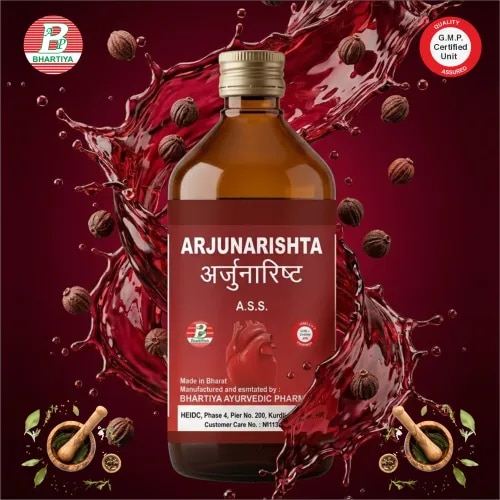
"name": "Arjunarishta",
"description": " \n ARJUNARISHTA\n\n\nProduct Identification\nGeneric Name: Arjunarishta\nType: Ayurvedic Polyherbal Fermented Formulation (Arishta)\nPrimary Indication Area: Primarily used as a cardiotonic for supporting heart health, improving cardiac function, strengthening blood vessels, and managing cardiovascular disorders. It is also indicated in hypertension, palpitations, angina-like symptoms, hyperlipidemia, fatigue associated with cardiac weakness, and as supportive therapy during recovery from cardiovascular illnesses.\n\nTherapeutic Indications\n•\tCardiac weakness (Hṛdroga)\n•\tPalpitations (Hridspandana)\n•\tHypertension (supportive management)\n•\tAngina-like chest discomfort (supportive therapy)\n•\tCongestive cardiac weakness (adjunctive support)\n•\tHyperlipidemia (elevated cholesterol and triglycerides)\n•\tPoor peripheral circulation\n•\tGeneral weakness associated with cardiovascular disorders\n•\tStress-induced cardiac symptoms\n•\tMild edema associated with circulatory insufficiency\n•\tPost-illness cardiac rehabilitation\n•\tAge-related decline in cardiovascular function\n\nKey Benefits\n•\tSupports healthy cardiac muscle function and improves myocardial strength\n•\tPromotes efficient blood circulation throughout the body\n•\tHelps maintain healthy blood pressure within normal physiological limits\n•\tSupports healthy cholesterol and lipid metabolism\n•\tProvides antioxidant protection against oxidative stress affecting cardiovascular tissues\n•\tHelps reduce palpitations and promotes normal cardiac rhythm\n•\tSupports vascular integrity and elasticity\n•\tImproves endurance and reduces fatigue associated with cardiac weakness\n•\tSupports recovery following prolonged illness affecting cardiovascular health\n•\tActs as a rejuvenative (Rasayana) for the cardiovascular system\n\nFORMULA\nEach part contains:\nArjuna (Terminalia arjuna) Bark – 4.800 kg\nMunnaka (Draksha / Vitis vinifera) – 2.400 kg\nMadhuka Pushpa (Madhuca longifolia) – 480 g\nWater – 49.152 L reduced to 12.288 L\nGuda (Jaggery) – 4.800 kg\nDhataki Pushpa (Woodfordia fruticosa) – 768 g\n\nIngredients\n1. Arjuna\nBotanical Name: Terminalia arjuna\n•\tRasa: Kashaya\n•\t Guna: Laghu, Ruksha\n•\t Virya: Sheeta\n•\tVipaka: Katu\n•\tPrabhava: Hridya, Rakta Stambhaka\nMechanism of Action\n• Strengthens cardiac muscle and supports efficient myocardial contraction\n• Supports healthy coronary circulation by improving blood flow to cardiac tissues\n• Helps maintain vascular integrity and elasticity through antioxidant activity\n• Supports healthy blood pressure by promoting normal vascular function\n• Protects cardiac cells from oxidative stress and age-related degeneration\n\n2. Draksha\nBotanical Name: Vitis vinifera\n•\tRasa: Madhura, Kashaya\n•\t Guna: Guru, Snigdha\n•\t Virya: Sheeta\n•\tVipaka: Madhura\n•\t Prabhava: Rasayana, Balya\nMechanism of Action\n• Provides antioxidant compounds that help protect cardiovascular tissues\n• Supports healthy blood circulation and vascular nourishment\n• Helps reduce oxidative damage associated with aging and metabolic stress\n• Provides natural nourishment for weakened tissues and improves vitality\n• Supports recovery from fatigue associated with cardiovascular weakness\n\n3. Madhuka Pushpa\nBotanical Name: Madhuca longifolia\n•\tRasa: Madhura\n•\t Guna: Guru, Snigdha\n•\t Virya: Sheeta\n•\t Vipaka: Madhura\n•\t Prabhava: Pittashamaka, Balya\nMechanism of Action\n• Helps nourish body tissues and supports overall strength\n• Provides cooling effects that help balance excess Pitta\n• Supports healthy metabolism during long-term cardiovascular therapy\n• Helps reduce systemic inflammation affecting cardiovascular tissues\n• Improves overall vitality and supports recovery from chronic weakness\n\n4. Dhataki Pushpa\nBotanical Name: Woodfordia fruticosa\n•\tRasa: Kashaya\n•\t Guna: Laghu, Ruksha\n•\tVirya: Sheeta\n•\tVipaka: Katu\n•\tPrabhava: Sandhaniya, Yogavahi\nMechanism of Action\n• Acts as the natural fermenting agent required for Arishta preparation\n• Facilitates formation of self-generated alcohol that enhances extraction of phytoconstituents\n• Improves bioavailability of herbal constituents\n• Supports preservation and stability of the formulation\n• Enhances overall therapeutic efficacy by promoting better absorption\n\nDosage\n•\tAdults: 15–30 ml\n•\t Twice daily after meals\n•\t With equal quantity of water (1:1 dilution is commonly recommended)\n\nCommon Usage Guidance\n•\tTake after meals to improve absorption and minimize gastric discomfort.\n•\t Can be used regularly as supportive therapy for cardiovascular health under medical supervision.\n•\t Duration of therapy generally varies from 4–12 weeks depending on the individual's condition and physician's advice.\n\nImportant Notes\n•\tNot recommended for self-use during pregnancy or lactation unless advised by a qualified healthcare professional.\n•\tUse cautiously in individuals taking antihypertensive, anticoagulant, or other cardiac medications.\n•\t Patients with significant cardiovascular disease should use this formulation under the supervision of a qualified Ayurvedic physician or healthcare professional.\n•\tDo not exceed the recommended dosage.\n\n",
"price": 195.0,
"discountamount": 95.0,
"currencycode": "INR",
"priority": 1000000,
"isfreeshipmentavailable": false,
"shipmentduration": 1,
"_keywords": null,
"isarchived": false,
"isavailable": true,
"applicationid": null,
"productindex": 157,
"imageuri": "https://productimages.withfloats.com/actual/6a58b691b0135121b1136bfc.jpg",
"tileimageuri": "https://productimages.withfloats.com/tile/6a58b691b0135121b1136bfc.jpg",
"images": null,
"totalqueries": 0,
"gpid": null,
"groupproductid": null,
"createdon": "2026-07-16T10:46:39.505Z",
"updatedon": "2026-07-16T10:46:39.505Z",
"buyonlinelink": null,
"producturl": "http://WWW.BHARTIYAAYURVEDICPHARMACY.COM//arjunarishta/157",
"availableunits": -1.0,
"iscodavailable": true,
"isprepaidonlineavailable": true,
"maxcodorders": -1,
"maxprepaidonlineorders": -1,
"uniquepaymenturl": null,
"brandname": "Bakula Fort",
"category": "Arjunarishta 450 ML X 40",
"tags": [],
"variants": false,
"keyspecification": null,
"otherspecifications": null,
"pickupaddressreferenceid": null,
"paymenttype": "AssuredPurchase",
"producttype": "products",
"hsncode": null,
"gstslab": 0.0,
"isnotforsale": false
},
{
"_id": "6a54780390386be4ae5e2b59",
"fptag": "BHARTIYEAYURVEDICPHARMACY",
"merchantname": null,
"customwidgets": null,
"externalsourceid": null,
"name": "SAPTVISH GUGGUL",
"description": "\n SAPTVISH GUGGUL\n\nProduct Identification \n•\tGeneric Name: Saptvish Guggul\n•\tType: Ayurvedic Polyherbal Formulation\n•\tPrimary Indication Area: Saptvish Guggul is primarily used as a supportive Ayurvedic medicine in Bhagandar (fistula-in-ano/nasoor) for reducing pain and inflammation.\n\nTherapeutic Indications: \nSaptvish Guggul is traditionally used as an adjuvant in Bhagandar (fistula-in-ano / nasoor) for:\n•\tRelief of pain (nasoor dard) in the anal region \n•\tReduction of local inflammation and swelling \n•\tSupport in managing Vata-related symptoms (throbbing, pricking, radiating pain) \n•\tHelp in reducing discomfort associated with pus discharge and chronic infection \n•\tSupportive role in wound healing and tissue recovery \n•\tAdjunct therapy along with primary treatments like Ksharasutra or surgical management \n\nKey Benefits:\n•\tHelps reduce pain (nasoor dard) in the affected area \n•\tSupports reduction of local inflammation and swelling \n•\tProvides relief in Vata-type symptoms like throbbing, pricking, and burning pain \n•\tAssists in improving comfort in chronic fistula conditions \n•\tMay support better local healing response as an adjuvant \n•\tUseful as a supportive therapy alongside Ksharasutra or surgical treatment \n\nEach Tablet contains: \nSunthi\t1part \nMaricha\t1part \nPippali\t1part \nHaritaki\t1part \nBibhitaki\t1part \nAmalaki\t1part \nMusta\t1part \nVidanga\t1part \nGuduchi \t1part \nChitrak \t1part \nSati \t1part \nEla \t1part \nPippalimula\t1part \nHapsua\t1part \nDevdaru \t1part \nTumburu\t1part \nPushkar \t1part \nChavya\t1part \nRakt Indera Varuni\t1part \nHaridra\t1part \nDaruharidra\t1part \nVida Lavana\t1part \nSauvarchala Lavana\t1part \nYava Kshar \t1part \nSajji Kshar\t1part \nSaindhava Lavana\t1part \nGajapippali\t1part \nShudh Guggul\t54 parts\n\n \nIngredients:\n\n1. Sunthi (Zingiber officinale)\n•\tBotanical/Scientific Name: Zingiber officinale \n•\tRasa–Guna–Vīrya–Vipāka: \no\tRasa: Kaṭu (Pungent) \no\tGuna: Laghu (Light), Rūkṣa (Dry) \no\tVīrya: Uṣṇa (Hot) \no\tVipāka: Madhura (Sweet) \n•\tPrabhāva:\nDeepana, Pachana, Shothahara \n•\tMechanism of Action (Karma): \no\tDeepana Karma: Improves Agni and reduces Ama (toxins) \no\tShothahara Karma: Reduces inflammation and tissue swelling in fistula area \no\tVedana Sthapana Karma: Helps reduce pain and discomfort in nasoor condition \n\n2. Maricha (Piper nigrum)\n•\tBotanical/Scientific Name: Piper nigrum \n•\tRasa–Guna–Vīrya–Vipāka: \no\tRasa: Kaṭu (Pungent) \no\tGuna: Laghu, Rūkṣa, Tikṣṇa \no\tVīrya: Uṣṇa \no\tVipāka: Kaṭu \n•\tPrabhāva:\nDeepana, Krimighna \n•\tMechanism of Action (Karma): \no\tDeepana-Pachana Karma: Enhances digestion and clears Ama \no\tKrimighna Karma: Helps reduce infection tendency in chronic wounds \no\tShothahara Karma: Reduces swelling in fistulous tract \n\n3. Pippali (Piper longum)\n•\tBotanical/Scientific Name: Piper longum \n•\tRasa–Guna–Vīrya–Vipāka: \no\tRasa: Kaṭu \no\tGuna: Laghu, Snigdha \no\tVīrya: Anuṣṇa-Uṣṇa (mild heating) \no\tVipāka: Madhura \n•\tPrabhāva:\nRasayana, Deepana \n•\tMechanism of Action (Karma): \no\tAgni Deepana: Improves metabolism and tissue repair \no\tRasayana Karma: Supports regeneration of damaged tissues in chronic fistula \no\tVata Shamana: Reduces pain and stiffness in nasoor region \n\n4. Haritaki (Terminalia chebula)\n•\tBotanical/Scientific Name: Terminalia chebula \n•\tRasa–Guna–Vīrya–Vipāka: \no\tRasa: Pancha Rasa (all except Lavana) \no\tGuna: Laghu, Rūkṣa \no\tVīrya: Uṣṇa \no\tVipāka: Madhura \n•\tPrabhāva:\nAnulomana, Virechana \n•\tMechanism of Action (Karma): \no\tAnulomana Karma: Improves bowel clearance, reduces pressure in anorectal region \no\tShothahara Karma: Reduces inflammatory swelling \no\tVrana Shodhana support: Helps detoxification in chronic infection conditions \n\n5. Bibhitaki (Terminalia bellirica)\n•\tBotanical/Scientific Name: Terminalia bellirica \n•\tRasa–Guna–Vīrya–Vipāka: \no\tRasa: Kaṣāya \no\tGuna: Laghu, Rūkṣa \no\tVīrya: Uṣṇa \no\tVipāka: Madhura \n•\tPrabhāva:\nKrimighna, Shothahara \n•\tMechanism of Action (Karma): \no\tKrimighna Karma: Helps reduce microbial load in chronic discharge \no\tShothahara Karma: Reduces swelling and induration \no\tVrana Shodhana support: Cleanses chronic infected tissue environment \n\n6. Amalaki (Emblica officinalis)\n•\tBotanical/Scientific Name: Emblica officinalis \n•\tRasa–Guna–Vīrya–Vipāka: \no\tRasa: Pancha Rasa (predominantly Amla) \no\tGuna: Guru, Ruksha \no\tVīrya: Sheeta \no\tVipāka: Madhura \n•\tPrabhāva:\nRasayana, Pittashamaka \n•\tMechanism of Action (Karma): \no\tRasayana Karma: Promotes tissue repair and healing \no\tPitta Shamana: Reduces burning and inflammation in fistula region \no\tVrana Ropana support: Enhances wound healing process \n\n7. Musta (Cyperus rotundus)\n•\tBotanical/Scientific Name: Cyperus rotundus \n•\tRasa–Guna–Vīrya–Vipāka: \no\tRasa: Tikta, Kaṭu \no\tGuna: Laghu, Rūkṣa \no\tVīrya: Sheeta \no\tVipāka: Kaṭu \n•\tPrabhāva:\nDeepana, Pachana \n•\tMechanism of Action (Karma): \no\tDeepana-Pachana: Reduces Ama and supports metabolism \no\tShothahara: Reduces inflammatory swelling \no\tKrimighna support: Helps control infection tendency \n\n8. Vidanga (Embelia ribes)\n•\tBotanical/Scientific Name: Embelia ribes \n•\tRasa–Guna–Vīrya–Vipāka: \no\tRasa: Kaṭu \no\tGuna: Laghu, Rūkṣa, Tikṣṇa \no\tVīrya: Uṣṇa \no\tVipāka: Kaṭu \n•\tPrabhāva:\nKrimighna (strong anti-parasitic/anti-infective) \n•\tMechanism of Action (Karma): \no\tKrimighna Karma: Controls microbial/infective tendency in chronic sinus \no\tShodhana Karma: Helps cleanse infected fistulous tract \no\tShothahara support: Reduces swelling and pus formation tendency \n\n9. Guduchi (Tinospora cordifolia)\n•\tBotanical/Scientific Name: Tinospora cordifolia \n•\tRasa–Guna–Vīrya–Vipāka: \no\tRasa: Tikta, Kaṣāya \no\tGuna: Laghu, Snigdha \no\tVīrya: Uṣṇa \no\tVipāka: Madhura \n•\tPrabhāva:\nRasayana, Immunomodulator \n•\tMechanism of Action (Karma): \no\tRasayana Karma: Enhances tissue regeneration and healing \no\tShothahara Karma: Reduces chronic inflammation in fistula tract \no\tOjas Vardhaka: Improves resistance to recurrent infection \n\n10. Chitrak (Plumbago zeylanica)\n•\tBotanical/Scientific Name: Plumbago zeylanica \n•\tRasa–Guna–Vīrya–Vipāka: \no\tRasa: Kaṭu \no\tGuna: Laghu, Rūkṣa, Tikṣṇa \no\tVīrya: Uṣṇa \no\tVipāka: Kaṭu \n•\tPrabhāva:\nAgni Deepana, Ama Pachana \n•\tMechanism of Action (Karma): \no\tDeepana Karma: Improves digestion and metabolic clearance \no\tShothahara Karma: Reduces inflammatory swelling \no\tShodhana Karma: Helps remove deep-seated toxins contributing to chronic disease \n\n11. Sati (Hedychium spicatum)\n•\tBotanical/Scientific Name: Hedychium spicatum \n•\tRasa–Guna–Vīrya–Vipāka: \no\tRasa: Tikta, Kaṭu \no\tGuna: Laghu, Rūkṣa, Tikṣṇa \no\tVīrya: Uṣṇa \no\tVipāka: Kaṭu \n•\tPrabhāva:\nShothahara, Vedana Sthapana \n•\tMechanism of Action (Karma): \no\tShothahara Karma: Reduces swelling and inflammatory induration \no\tVedana Sthapana Karma: Relieves pain in chronic fistulous tract \no\tKrimighna support: Helps reduce infective tendency in nasoor \n\n12. Ela (Elettaria cardamomum)\n•\tBotanical/Scientific Name: Elettaria cardamomum \n•\tRasa–Guna–Vīrya–Vipāka: \no\tRasa: Tikta, Madhura, Kaṭu \no\tGuna: Laghu, Snigdha \no\tVīrya: Sheeta \no\tVipāka: Madhura \n•\tPrabhāva:\nDeepana, Rochana \n•\tMechanism of Action (Karma): \no\tDeepana-Pachana Karma: Improves digestion and reduces Ama \no\tShothahara support: Helps reduce systemic inflammatory load \no\tSrotoshodhana: Clears subtle channel obstruction contributing to chronic disease \n\n13. Pippalimula (Root of Piper longum)\n•\tBotanical/Scientific Name: Piper longum (root) \n•\tRasa–Guna–Vīrya–Vipāka: \no\tRasa: Kaṭu \no\tGuna: Laghu, Rūkṣa \no\tVīrya: Uṣṇa \no\tVipāka: Madhura \n•\tPrabhāva:\nDeepana, Vata Shamana \n•\tMechanism of Action (Karma): \no\tAgni Deepana: Improves digestion and tissue metabolism \no\tVata Shamana: Reduces pain and nerve-related discomfort in nasoor \no\tShothahara: Helps reduce chronic inflammatory swelling \n\n14. Hapusha (Juniperus communis)\n•\tBotanical/Scientific Name: Juniperus communis \n•\tRasa–Guna–Vīrya–Vipāka: \no\tRasa: Tikta, Kaṭu \no\tGuna: Laghu, Rūkṣa \no\tVīrya: Uṣṇa \no\tVipāka: Kaṭu \n•\tPrabhāva:\nKrimighna, Shothahara \n•\tMechanism of Action (Karma): \no\tKrimighna Karma: Helps control microbial infection tendency \no\tShothahara Karma: Reduces swelling in chronic sinus tract \no\tShodhana support: Assists detoxification of chronic infected tissue \n\n15. Devdaru (Cedrus deodara)\n•\tBotanical/Scientific Name: Cedrus deodara \n•\tRasa–Guna–Vīrya–Vipāka: \no\tRasa: Tikta, Kaṭu \no\tGuna: Laghu, Rūkṣa, Tikṣṇa \no\tVīrya: Uṣṇa \no\tVipāka: Kaṭu \n•\tPrabhāva:\nShothahara, Vedana Sthapana \n•\tMechanism of Action (Karma): \no\tAnti-inflammatory action: Reduces swelling and induration \no\tPain-relieving action: Helps in chronic fistula pain \no\tVrana Shodhana support: Assists in cleansing unhealthy tissue \n\n16. Tumburu (Zanthoxylum armatum)\n•\tBotanical/Scientific Name: Zanthoxylum armatum \n•\tRasa–Guna–Vīrya–Vipāka: \no\tRasa: Kaṭu, Tikta \no\tGuna: Laghu, Rūkṣa, Tikṣṇa \no\tVīrya: Uṣṇa \no\tVipāka: Kaṭu \n•\tPrabhāva:\nKrimighna, Shothahara \n•\tMechanism of Action (Karma): \no\tKrimighna Karma: Helps reduce infective organisms in chronic wound \no\tShothahara Karma: Reduces swelling and pus formation \no\tVedana Sthapana: Relieves local pain and burning sensation \n\n17. Pushkar (Inula racemosa)\n•\tBotanical/Scientific Name: Inula racemosa \n•\tRasa–Guna–Vīrya–Vipāka: \no\tRasa: Tikta, Kaṭu \no\tGuna: Laghu, Rūkṣa \no\tVīrya: Uṣṇa \no\tVipāka: Kaṭu \n•\tPrabhāva:\nShothahara, Hridya (supportive circulation action) \n•\tMechanism of Action (Karma): \no\tShothahara Karma: Reduces chronic inflammatory swelling \no\tImproves microcirculation: Supports healing in damaged tissue \no\tVata Shamana: Helps reduce pain and stiffness \n\n18. Chavya (Piper retrofractum)\n•\tBotanical/Scientific Name: Piper retrofractum \n•\tRasa–Guna–Vīrya–Vipāka: \no\tRasa: Kaṭu \no\tGuna: Laghu, Rūkṣa, Tikṣṇa \no\tVīrya: Uṣṇa \no\tVipāka: Kaṭu \n•\tPrabhāva:\nDeepana, Krimighna \n•\tMechanism of Action (Karma): \no\tDeepana Karma: Enhances metabolism and reduces Ama \no\tKrimighna Karma: Helps control infection in chronic sinus tract \no\tShothahara support: Reduces swelling and discharge tendency \n\n19. Rakt Indra Varuni (classical identification varies)\n•\tBotanical/Scientific Name: Classical Ayurvedic herb (exact botanical varies by region) \n•\tRasa–Guna–Vīrya–Vipāka: \no\tRasa: Tikta, Kaṭu \no\tGuna: Laghu, Rūkṣa \no\tVīrya: Uṣṇa \no\tVipāka: Kaṭu \n•\tPrabhāva:\nShothahara, Vrana Shodhana \n•\tMechanism of Action (Karma): \no\tVrana Shodhana: Helps cleanse chronic infected tissue \no\tShothahara: Reduces swelling and inflammatory discharge \no\tSupport in nasoor: Assists in reducing chronic sinus activity \n\n20. Haridra (Curcuma longa)\n•\tBotanical/Scientific Name: Curcuma longa \n•\tRasa–Guna–Vīrya–Vipāka: \no\tRasa: Tikta, Kaṭu \no\tGuna: Laghu, Rūkṣa \no\tVīrya: Uṣṇa \no\tVipāka: Kaṭu \n•\tPrabhāva:\nKrimighna, Vrana Ropana \n•\tMechanism of Action (Karma): \no\tAnti-inflammatory action: Reduces swelling and pain \no\tAntimicrobial action: Controls infection in fistula tract \no\tVrana Ropana: Promotes healing of chronic wounds \n21. Daruharidra (Berberis aristata)\n•\tBotanical/Scientific Name: Berberis aristata \n•\tRasa–Guna–Vīrya–Vipāka: \no\tRasa: Tikta, Kaṣāya \no\tGuna: Laghu, Rūkṣa \no\tVīrya: Uṣṇa \no\tVipāka: Kaṭu \n•\tPrabhāva:\nKrimighna, Vrana Shodhana \n•\tMechanism of Action (Karma): \no\tAntimicrobial action: Helps control infection in fistula tract \no\tVrana Shodhana: Cleanses chronic discharging wound \no\tShothahara: Reduces swelling and induration \n\n22. Vida Lavana\n•\tRasa–Guna–Vīrya–Vipāka: \no\tRasa: Lavana (Salty), Tikta \no\tGuna: Laghu, Tikṣṇa \no\tVīrya: Uṣṇa \no\tVipāka: Madhura \n•\tPrabhāva:\nLekhana, Shothahara \n•\tMechanism of Action (Karma): \no\tLekhana Karma: Helps scraping and clearing blocked channels in chronic sinus \no\tShothahara: Reduces swelling and fluid accumulation \no\tSrotoshodhana: Improves drainage in fistulous tract \n\n23. Sauvarchala Lavana\n•\tRasa–Guna–Vīrya–Vipāka: \no\tRasa: Lavana, Tikta \no\tGuna: Laghu, Snigdha, Tikṣṇa \no\tVīrya: Uṣṇa \no\tVipāka: Madhura \n•\tPrabhāva:\nDeepana, Srotoshodhana \n•\tMechanism of Action (Karma): \no\tDeepana Karma: Improves digestion and reduces Ama \no\tSrotoshodhana: Clears obstructed channels in chronic disease \no\tShothahara: Reduces inflammatory swelling \n\n24. Yava Kshar\n•\tRasa–Guna–Vīrya–Vipāka: \no\tRasa: Tikta, Kaṭu \no\tGuna: Laghu, Tikṣṇa \no\tVīrya: Uṣṇa \no\tVipāka: Kaṭu \n•\tPrabhāva:\nLekhana, Ksharana (tissue debridement action) \n•\tMechanism of Action (Karma): \no\tKsharana Karma: Helps remove unhealthy tissue in chronic sinus tract \no\tLekhana Karma: Clears blockage and promotes drainage \no\tVrana Shodhana: Supports cleansing of fistulous tract \n\n25. Sajji Kshar\n•\tRasa–Guna–Vīrya–Vipāka: \no\tRasa: Tikta, Kaṭu \no\tGuna: Laghu, Rūkṣa, Tikṣṇa \no\tVīrya: Uṣṇa \no\tVipāka: Kaṭu \n•\tPrabhāva:\nKsharana, Shodhana \n•\tMechanism of Action (Karma): \no\tKsharana Karma: Helps chemical debridement of fistula tract \no\tShodhana Karma: Cleans infected tissue and discharge pathway \no\tShothahara: Reduces swelling \n\n26. Saindhava Lavana\n•\tRasa–Guna–Vīrya–Vipāka: \no\tRasa: Lavana (mild), Madhura \no\tGuna: Laghu, Snigdha \no\tVīrya: Sheeta \no\tVipāka: Madhura \n•\tPrabhāva:\nTridosha Shamana \n•\tMechanism of Action (Karma): \no\tSoftening action: Helps tissue relaxation and healing support \no\tVata Shamana: Reduces pain and stiffness \no\tImproves absorption: Enhances penetration of other herbs \n\n27. Gajapippali (Scindapsus officinalis)\n•\tBotanical/Scientific Name: Scindapsus officinalis \n•\tRasa–Guna–Vīrya–Vipāka: \no\tRasa: Kaṭu \no\tGuna: Laghu, Rūkṣa, Tikṣṇa \no\tVīrya: Uṣṇa \no\tVipāka: Kaṭu \n•\tPrabhāva:\nDeepana, Krimighna \n•\tMechanism of Action (Karma): \no\tDeepana-Pachana: Improves digestion and toxin clearance \no\tKrimighna: Reduces infective tendency in chronic wounds \no\tShothahara: Helps reduce swelling in fistula \n\n28. Shuddh Guggul (Commiphora wightii)\n•\tBotanical/Scientific Name: Commiphora wightii (Purified resin) \n•\tRasa–Guna–Vīrya–Vipāka: \no\tRasa: Tikta, Kaṭu, Kashaya \no\tGuna: Laghu, Rūkṣa, Sara \no\tVīrya: Uṣṇa \no\tVipāka: Kaṭu \n•\tPrabhāva:\nShothahara, Yogavahi (carrier action) \n•\tMechanism of Action (Karma): \no\tShothahara Karma: Strong anti-inflammatory action in chronic fistula \no\tVrana Ropana: Supports tissue healing and regeneration \no\tYogavahi Karma: Enhances delivery and action of all other herbs \no\tVata Shamana: Reduces pain, stiffness, and chronic inflammation in Bhagandar\n\nDosage of Triphala Guggul\n•\tForm: Tablet / Capsule \n•\tDose: 1–2 tablets (250–500 mg each) \n•\tFrequency: Twice daily (BID) \n•\tTiming: After food \n•\tAnupana: Lukewarm water.\n\nsaptvinshati guggul\nsaptvinshati guggul uses\nsaptavinshati guggulu in hindi\nsaptavinshati guggulu ingredients\nsaptavinshati guggulu ke fayde\nsaptvinshati guggul price\nsaptvinshati guggul content\nsaptvinshati guggul tablet\nsaptavishanti guggul ke fayde\nsaptvisanti guggul ke fayde\nsaptavishanti guggul uses\nsaptavishanti guggul\nsaptvish guggul benefits\nsaptvisanti guggul content\nsaptvisanti guggul uses in hindi\nsaptvinshati guggul uses in hindi\nsaptvish guggul extract\nsaptvinshati guggul ke fayde\nsaptvisanti guggul hindi mein\nsaptvinshati guggul hindi\nsaptvisanti guggul in hindi\nsaptvinshati guggul use in hindi\nsaptvinshati guggul uses hindi\nuse of saptvinshati guggul\nhow much guggul to take for weight loss\nsaptvinshati guggul reference\nsaptavinshati guggulu reference\nsaptvisanti guggul tablet\ndivya saptvinshati guggul uses\nsaptvish guggul weather\nsaptvish guggul waterfall\nsaptashati guggul ke fayde\nsaptashati guggulu uses in hindi\ntab saptavinshati guggulu\nsaptvinshati guggul ingredients\nsaptavinshati guggulu benefits in hindi\nuses of saptvinshati guggul\nuses of saptavinshati guggulu\n",
"price": 240.0,
"discountamount": 120.0,
"currencycode": "INR",
"priority": 1000000,
"isfreeshipmentavailable": false,
"shipmentduration": 1,
"_keywords": null,
"isarchived": false,
"isavailable": true,
"applicationid": null,
"productindex": 150,
"imageuri": "https://productimages.withfloats.com/actual/6a5478052f06e172057b708e.jpg",
"tileimageuri": "https://productimages.withfloats.com/tile/6a5478052f06e172057b708e.jpg",
"images": null,
"totalqueries": 0,
"gpid": null,
"groupproductid": null,
"createdon": "2026-07-13T05:30:43.473Z",
"updatedon": "2026-07-13T05:30:43.473Z",
"buyonlinelink": null,
"producturl": "http://WWW.BHARTIYAAYURVEDICPHARMACY.COM//saptvish-guggul/150",
"availableunits": -1.0,
"iscodavailable": true,
"isprepaidonlineavailable": true,
"maxcodorders": -1,
"maxprepaidonlineorders": -1,
"uniquepaymenturl": null,
"brandname": "Bakula Fort",
"category": "SAPTVISH GUGGUL 100 gm X 40",
"tags": [],
"variants": false,
"keyspecification": null,
"otherspecifications": null,
"pickupaddressreferenceid": null,
"paymenttype": "AssuredPurchase",
"producttype": "products",
"hsncode": null,
"gstslab": 0.0,
"isnotforsale": false
},
{
"_id": "6a4cb8280378aa7892f1e201",
"fptag": "BHARTIYEAYURVEDICPHARMACY",
"merchantname": null,
"customwidgets": null,
"externalsourceid": null,
"name": "Rasnadi Guggul",
"description": " RASNADI GUGGUL\n\nProduct Identification\nGeneric Name: Rasnadi Guggul\nType: Ayurvedic Polyherbal Formulation\nPrimary Indication Area: Management of Amvat, Gathiya, Sandhivat, and Vat vikar (Vata-related musculoskeletal disorders such as arthritis, joint pain, stiffness, and inflammation).\nTherapeutic Indications: Used in Amvat (rheumatoid-like conditions), Gathiya (osteoarthritis), Sandhivat (degenerative joint disorders), and Vatikar, helping relieve joint pain, inflammation, stiffness, swelling, and impaired mobility associated with Vata imbalance.\nKey Benefits\n•\tHelps reduce joint pain and discomfort \n•\tSupports reduction of joint inflammation and swelling \n•\tImproves joint mobility and flexibility \n•\tAids in managing stiffness in joints and muscles \n•\tSupports relief in Amvat, Gathiya, Sandhivat, and Vatikar (Vata disorders) \n•\tPromotes overall musculoskeletal comfort and function \nFORMULA \nEach Tablet contains: \nRasna\t1 part\nGiloy \t1 part\nErandmool\t1 part\nDevdaru \t1 part \nSaunth \t1 part\nShudh Guggul \t1 part\n\nIngredients:\n1. Rasna\nBotanical Name: Pluchea lanceolata\n Rasa: Tikta, Katu\n Guna: Laghu, Ruksha\n Virya: Ushna\n Vipaka: Katu\n Prabhava: Shothahara, Vata Shamak\nMechanism in Gathiya, Amvat & Sandhivat:\n\n•\tReduces joint inflammation and swelling\n•\tHelps in Vata pacification, relieving pain and stiffness\n•\tImproves joint mobility in Sandhivat and Gathiya\n•\tUseful in controlling inflammatory condition in Amvat\n\n2. Giloy (Guduchi)\nBotanical Name: Tinospora cordifolia\nRasa: Tikta, Kashaya\nGuna: Laghu, Snigdha\nVirya: Ushna\nVipaka: Madhura\nPrabhava: Rasayana, Jwaraghna\nMechanism in Gathiya, Amvat & Sandhivat:\n \n•\tHelps in Ama detoxification in Amvat\n•\t Reduces systemic and joint inflammation\n•\t Supports immune modulation in chronic arthritis\n•\t Aids in tissue repair and regeneration\n\n3. Erandmool (Castor Root)\nBotanical Name: Ricinus communis (Root)\nRasa: Madhura, Katu\nGuna: Snigdha, Tikshna\nVirya: Ushna\nVipaka: Madhura\nPrabhava: Vatahara, Shoolaghna\nMechanism in Gathiya, Amvat & Sandhivat:\n\n•\tStrongly pacifies Vata, main cause of joint pain\n•\tRelieves stiffness and pain in joints\n•\tImproves joint lubrication and flexibility\n•\t Useful in degenerative joint disorders\n\n4. Devdaru\nBotanical Name: Cedrus deodara\n Rasa: Tikta, Katu\n Guna: Laghu, Ruksha\nVirya: Ushna\nVipaka: Katu\nPrabhava: Shothahara, Vedanasthapana\nMechanism in Gathiya, Amvat & Sandhivat:\n\n•\tReduces joint inflammation and pain\n•\tImproves mobility in stiff joints\n•\tSupports circulation in affected areas\n•\tUseful in Vata-Kapha related joint disorders\n\n5. Saunth (Dry Ginger)\nBotanical Name: Zingiber officinale\nRasa: Katu\nGuna: Laghu, Snigdha\nVirya: Ushna\nVipaka: Madhura\nPrabhava: Deepana, Pachana, Shoolaghna\nMechanism in Gathiya, Amvat & Sandhivat:\n \n•\tHelps in Ama digestion in Amvat\n•\tReduces pain and inflammation in joints\n•\t Improves blood circulation and reduces stiffness\n•\t Useful in early and chronic arthritis conditions\n\n6. Shuddh Guggul\nBotanical Name: Commiphora mukul\nRasa: Tikta, Katu, Kashaya\nGuna: Laghu, Ruksha, Tikshna\nVirya: Ushna\nVipaka: Katu\nPrabhava: Lekhana, Vata-Kapha Shamak\nMechanism in Gathiya, Amvat & Sandhivat:\n\n•\tPotent anti-inflammatory and analgesic action\n•\tHelps in removal of Ama from joints in Amvat\n•\tImproves joint flexibility and mobility\n•\t Supports cartilage protection in Sandhivat\n\nGeneral Ayurvedic Dosage for Rasnadi Guggulu (Adults)\n•\tTablet: 1–2 tablets (250–500 mg each) \n•\t Frequency: 1–2 times daily (sometimes up to 2–3 times daily in stronger cases)\n•\tTiming: After meals (or as directed by an Ayurvedic physician)\n•\t Anupana (Vehicle): Lukewarm water (commonly), or herbal decoctions like Dashmool kwath / Rasnadi kwath as advised\nNote: Dosage may vary depending on the condition (joint pain, cervical spondylosis, headache, sinus issues), age, digestion strength, and physician’s recommendation.\n\n\n",
"price": 240.0,
"discountamount": 120.0,
"currencycode": "INR",
"priority": 1000000,
"isfreeshipmentavailable": false,
"shipmentduration": 1,
"_keywords": null,
"isarchived": false,
"isavailable": true,
"applicationid": null,
"productindex": 149,
"imageuri": "https://productimages.withfloats.com/actual/6a4cb82ac57aa227fd3526a4.jpg",
"tileimageuri": "https://productimages.withfloats.com/tile/6a4cb82ac57aa227fd3526a4.jpg",
"images": null,
"totalqueries": 0,
"gpid": null,
"groupproductid": null,
"createdon": "2026-07-07T08:26:16.666Z",
"updatedon": "2026-07-07T08:26:16.666Z",
"buyonlinelink": null,
"producturl": "http://WWW.BHARTIYAAYURVEDICPHARMACY.COM//rasnadi-guggul/149",
"availableunits": -1.0,
"iscodavailable": true,
"isprepaidonlineavailable": true,
"maxcodorders": -1,
"maxprepaidonlineorders": -1,
"uniquepaymenturl": null,
"brandname": "Bakula Fort",
"category": "Rasnadi Guggul 100 gm X 40",
"tags": [],
"variants": false,
"keyspecification": null,
"otherspecifications": null,
"pickupaddressreferenceid": null,
"paymenttype": "AssuredPurchase",
"producttype": "products",
"hsncode": null,
"gstslab": 0.0,
"isnotforsale": false
},
{
"_id": "6a475d9752249d9470d412b8",
"fptag": "BHARTIYEAYURVEDICPHARMACY",
"merchantname": null,
"customwidgets": null,
"externalsourceid": null,
"name": "Lakshadi Guggal",
"description": "\n LAKSHADI GUGGUL\n\nProduct Identification \n•\tGeneric Name: Laksha Guggulu (also known as Lakshadi Guggul)\n•\tType: Ayurvedic Polyherbal Formulation\n•\tPrimary Indication Area: Bone health, fracture healing, and bone mineral density support.\n•\tTherapeutic Indications: Traditionally used for managing bone fractures (Asthibhanga), joint dislocations (Sandhimukti), osteoporosis, osteopenia, bone sprains, and general bone weakness (Asthikshaya).\n\nKey Benefits:\n•\tAccelerates Fracture Healing: Speeds up the reunion of broken bones, stimulates callus formation, and hastens the overall calcification process.\n•\tEnhances Bone Density: Supplies natural organic calcium to strengthen weak bones, helping to manage and prevent osteoporosis and osteopenia.\n•\tHeals Dislocations & Trauma: Restores joint stability after dislocations, relieves severe sprains, and heals deep tissue strain.\n•\tReduces Pain & Swelling: Alleviates localized inflammation, joint stiffness, and musculoskeletal pain due to its strong Vata-balancing properties.\n•\tPrevents Bone Degeneration: Protects bone tissue matrix from premature wear and tear, reducing the risk of frequent fractures in old age.\nFORMULA\nEach Tablet contains: \nLaksha \t5 part\nShuddha Guggulu\t1 part\nHadjod / Asthisamharaka\t1 part\nArjuna\t1 part\nAshwagandha\t1 part\nNagabala \t1 part\n\t\n\nIngredients:\n1. Laksha (Lac Resin) \n•\tBotanical/Scientific Name: Laccifer lacca \n•\tRasa–Guna–Vīrya–Vipāka:\no\tRasa: Kaṣāya (Astringent)\no\tGuna: Laghu (Light), Snigdha (Unctuous/Oily)\no\tVīrya: Śīta (Cooling)\no\tVipāka: Kaṭu (Pungent) \n•\tPrabhāva: Sandhānīya (Promotes the rapid unification and binding of fractured bones or tissues) \nMechanism of Action (Karma):\n•\tAsthi-Sandhānaka Karma: Directly stimulates cell proliferation in bone tissue, fastening the calcification and bridging of broken bones.\n•\tRakta-Stambhana Karma: Acts as a natural hemostatic agent, helping arrest internal bleeding or bruising around trauma zones.\n•\tVrana-Ropaṇa Karma: Accelerates the healing of deeply situated internal wounds and soft tissue tears accompanying bone trauma.\n•\tKaphahara Karma: Liquefies and scraps out morbid accumulation of sticky Kapha from metabolic channels. \n\n2. Hadjod / Asthisamharaka (Bone Setter Stem)\n•\tBotanical/Scientific Name: Cissus quadrangularis Linn. \n•\tRasa–Guna–Vīrya–Vipāka:\no\tRasa: Madhura (Sweet), Kaṭu (Pungent)\no\tGuna: Laghu (Light), Rūkṣa (Dry), Tikṣṇa (Piercing)\no\tVīrya: Uṣṇa (Heating)\no\tVipāka: Kaṭu (Pungent) \n•\tPrabhāva: Asthi-Yojaka (The definitive natural bone patcher and alignment restorer) \nMechanism of Action (Karma):\n•\tAsthibhanga-Nāśaka Karma: Speeds up early cortical bone healing by promoting osteoblastic activity and early callus formation.\n•\tŚothahara & Śūlahara Karma: Relieves the local, intense throbbing pain and inflammatory edema following boe or joint fractures.\n•\tDāḍhya-Kara Karma: Enhances structural strength, mechanical resilience, and elasticity of the growing bone matrix.\n•\tVāta-Hara Karma: pacifies the aggravated Vata localized at bone structures (Asthigata Vata), minimizing deep bone aches. \n\n3. Arjuna (Arjun Bark) \n•\tBotanical/Scientific Name: Terminalia arjuna \n•\tRasa–Guna–Vīrya–Vipāka:\no\tRasa: Kaṣāya (Astringent)\no\tGuna: Laghu (Light), Rūkṣa (Dry)\no\tVīrya: Śīta (Cooling)\no\tVipāka: Kaṭu (Pungent) \n•\tPrabhāva: Hṛdaya & Sandhānākara (Cardioprotective and systematic structural binder) \nMechanism of Action (Karma):\n•\tAsthi-Draḍhyakara Karma: Infuses raw bio-available calcium and minerals directly into the bone matrix to counteract osteoporosis.\n•\tBhagna-Sandhāna Karma: Aids the structural matrix bonding process, solidifying the collagen foundations of broken bones.\n•\tRakta-Prasādana Karma: Optimizes local blood circulation and removes systemic toxins, providing nutrient-rich blood supply to damaged tissues.\n•\tKaphapitta-Hara Karma: Successfully neutralizes excess Kapha-induced swelling and reduces localized Pitta-induced burning sensations. \n\n4. Ashwagandha (Indian Ginseng Root) \n•\tBotanical/Scientific Name: Withania somnifera \n•\tRasa–Guna–Vīrya–Vipāka:\no\tRasa: Madhura (Sweet), Tikta (Bitter), Kaṭu (Pungent)\no\tGuna: Laghu (Light), Snigdha (Unctuous)\no\tVīrya: Uṣṇa (Heating)\no\tVipāka: Madhura (Sweet) \n•\tPrabhāva: Rasāyana & Balya (Deep tissue rejuvenator and skeletal muscle toner) \nMechanism of Action (Karma):\n•\tMāmsa-Asthi Balya Karma: Significantly reinforces skeletal muscles, ligaments, and tendons surrounding injured joints.\n•\tVāta-Śamana Karma: Calms hyperactive nervous systems and reduces neurological pain like sciatica or slip disc aches.\n•\tŚothahara Karma: Reduces joint space swelling, stiffness, and degenerative changes seen in chronic arthritis.\n•\tBṛmhaṇa Karma: Counters overall systemic weakness, fatigue, and prevents stress-mediated degradation of bone tissue. \n\n5. Nagabala (Snake Mallow Root) \n•\tBotanical/Scientific Name: Grewia hirsuta / Sida veronicaefolia \n•\tRasa–Guna–Vīrya–Vipāka:\no\tRasa: Madhura (Sweet), Kaṣāya (Astringent)\no\tGuna: Guru (Heavy), Snigdha (Unctuous), Picchila (Slimy)\no\tVīrya: Śīta (Cooling)\no\tVipāka: Madhura (Sweet) \n•\tPrabhāva: Rasāyana (Tissue anti-aging and long-term musculoskeletal revitalizer) \nMechanism of Action (Karma):\n•\tBalya & Bṛmhaṇa Karma: Restores deep physical stamina and stops progressive muscular or skeletal wasting (Asthikshaya).\n•\tVāta-Pitta Śamaka Karma: pacifies both structural Vata (pain) and tissue-burning Pitta (inflammation).\n•\tOjo-Vardhaka Karma: Elevates bodily immunity and structural endurance, allowing faster recovery from traumatic exhaustion.\n•\tKṣatachina-Ropaṇa Karma: Heals deep degenerative erosions inside the articular cartilage and synovial joint cavities.\n\n6. Shuddha Guggulu (Purified Oleo-Gum Resin)\n•\tBotanical/Scientific Name: Commiphora mukul \n•\tRasa–Guna–Vīrya–Vipāka:\no\tRasa: Tikta (Bitter), Kaṭu (Pungent)\no\tGuna: Laghu (Light), Rūkṣa (Dry), Tikṣṇa (Piercing), Sūkṣma (Minute/Subtle)\no\tVīrya: Uṣṇa (Heating)\no\tVipāka: Kaṭu (Pungent) \n•\tPrabhāva: Tridoṣa-Hara & Yogavāhī (Catalyst herb that carries and amplifies the properties of all other ingredients directly to deep bone layers)\nMechanism of Action (Karma):\n•\tŚothahara & Vedanā-Sthāpana Karma: Provides potent natural anti-inflammatory and pain-relieving effects on joints, mimicking analgesic compounds.\n& Lekhana Karma: Clears out congested metabolic channels and scrapes out morbid Ama (toxins) blocking structural tissues.\n•\tVāta-Vyādhi Nāśaka Karma: The ultimate Ayurvedic defense against chronic neural, joint, and bone degeneration disorders caused by Vata.\n•\tRasāyana Karma: Rejuvenates cellular longevity across all structural frames of the skeletal system. \n\nGeneral Ayurvedic dosage (adults):\nTablet/Capsule: 1–2 tablets (250–500 mg each)\n Frequency: 2 times a day\n Timing: After food (usually with lukewarm water)\n\nlakshadi guggul, lakshadi guggul uses in hindi, lakshadi guggul benefits in hindi\nlakshadi guggul uses, lakshadi guggul in hindi, lakshadi guggul ke fayde\nlakshadi guggul tablet uses in hindi, lakshadi guggul side effects\nlakshadi guggul ingredients, lakshadi guggul ayurvedic medicine\nlakshadi guggul amazon, ayurvedic lakshadi guggul, lakshadi guggul ayurvedic dawa\nlakshadi guggul easy ayurveda, what is lakshadi guggul, lakshadi guggul price\nlakshadi guggul benefits, lakshadi guggul buy online, lakshadi guggul benefits in telugu\nlakshadi guggul best brand, lakshadi guggul buy, lakshadi guggul benefits\nlakshadi guggul content, lakshadi guggul composition, lakshadi guggul contains\nlakshadi guggul dosage, lakshadi guggul divya, lakshadi guggul uses easy ayurveda\nlakshadi guggulu easy ayurveda, lakshadi guggul in english, lakshadi guggul for muscle pain\nlakshadi guggul fayde, lakshadi guggul for fracture, lakshadi guggul for knee pain\nlakshadi guggul ke fayde in hindi, lakshadi guggul goli, lakshadi guggul ke fayde nuksan\nlakshadi guggul hindi, lakshadi guggul how to take, lakshadi guggul how to use\nlakshadi guggul himalaya, benefits of lakshadi guggul in hindi, lakshadi guggul uses hindi \nlakshadi guggul vs hadjod, lakshadi guggul ingredients in hindi, lakshadi guggul image\nlakshadi guggul is used for, lakshadi guggul kis kaam aata hai, lakshadi guggul kaise khaye\nlakshadi guggul ka upyog, lakshadi guggul kya kam karta hai, lakshadi guggul khane ke fayde\nlakshadi guggul ke fayde aur nuksan, lakshadi guggul ke nuksan, lakshadi guggul kya hai\nlakshadi guggul reviews, lakshadi guggul latin name, lakshadi guggul medicine\nlakshadi guggul mrp, lakshadi guggul with milk, lakshadi guggul uses marathi\nlakshadi guggulu near me, multani lakshadi guggul price, lakshadi guggul online\nbenefits of lakshadi guggul, uses of lakshadi guggul, use of lakshadi guggul in hindi\ndose of lakshadi guggul, lakshadi guggul powder, lakshadi guggul indication\nlakshadi guggul research paper, lakshadi guggul reference, lakshadi guggul rate\nlakshadi guggul tablets benefits, lakshadi guggul tab, lakshadi guggulu uses in hindi\nlakshadi guggulu uses, lakshadi guggulu benefits in hindi, lakshadi guggulu ingredients\nlakshadi guggulu tablet uses, lakshadi guggulu tablet uses in hindi, vyas lakshadi guggul\nlakshadi guggul when to take, what is lakshadi guggul used for, lakshadi guggul flipkart\nayurvedic lakshadweep google, ayurvedic medicine lakshadi guggul, lakshadi guggul ayurvedic\ningredients in lakshadi guggul, function of lakshadi guggul, himalaya lakshadi guggul\nis guggul good for liver, tab lakshadi guggul, lakshadi guggul tablets, lakshadi guggul oil benefits\nwill lakshadi guggul, do lakshadi guggul, does lakshadi guggul, was lakshadi guggul, was lakshadi guggulu\nwas lakshadi guggul uses in hindi, best lakshadi guggul, which guggul is best for weight loss\nbest guggul for arthritis, best guggul in india, best guggulu, top lakshadi guggul",
"price": 330.0,
"discountamount": 165.0,
"currencycode": "INR",
"priority": 1000000,
"isfreeshipmentavailable": false,
"shipmentduration": 1,
"_keywords": null,
"isarchived": false,
"isavailable": true,
"applicationid": null,
"productindex": 143,
"imageuri": "https://productimages.withfloats.com/actual/6a475d99376427080a93197a.jpg",
"tileimageuri": "https://productimages.withfloats.com/tile/6a475d99376427080a93197a.jpg",
"images": null,
"totalqueries": 0,
"gpid": null,
"groupproductid": null,
"createdon": "2026-07-03T06:58:31.487Z",
"updatedon": "2026-07-03T06:58:31.487Z",
"buyonlinelink": null,
"producturl": "http://WWW.BHARTIYAAYURVEDICPHARMACY.COM//lakshadi-guggal/143",
"availableunits": -1.0,
"iscodavailable": true,
"isprepaidonlineavailable": true,
"maxcodorders": -1,
"maxprepaidonlineorders": -1,
"uniquepaymenturl": null,
"brandname": "Bakula Fort",
"category": "Lakshadi Guggal 100 gm X 330",
"tags": [],
"variants": false,
"keyspecification": null,
"otherspecifications": null,
"pickupaddressreferenceid": null,
"paymenttype": "AssuredPurchase",
"producttype": "products",
"hsncode": null,
"gstslab": 0.0,
"isnotforsale": false
},
{
"_id": "6a475083fe270580546a6ec8",
"fptag": "BHARTIYEAYURVEDICPHARMACY",
"merchantname": null,
"customwidgets": null,
"externalsourceid": null,
"name": "Kasiore Guggal",
"description": " KAISOR GUGGUL\n\nProduct Identification\nGeneric Name: Kaisora Guggul\nType: Ayurvedic Polyherbal Formulation\nPrimary Indication Area: Blood purification, skin disorders, inflammatory conditions, and metabolic toxin (Ama) management\nTherapeutic Indications: Traditionally used for managing gout (Vatarakta), skin diseases, chronic inflammation, ulcers, and metabolic toxin accumulation in the body.\nKey Benefits\n•\tBlood Purification: Helps purify blood and remove metabolic toxins (Ama).\n•\tSkin Health: Supports management of skin disorders like acne, eczema, and chronic eruptions.\n•\tAnti-inflammatory Action: Helps reduce inflammation, swelling, and joint discomfort.\n•\tMetabolic Detoxification: Aids in cleansing deep-seated toxins from the body.\n•\tJoint & Gout Support: Traditionally used in Vatarakta (gout-like conditions).\n•\tKapha–Pitta Balance: Helps balance aggravated Kapha and Pitta doshas.\n\nFORMULA \nEach Tablet contains: \nShudh Guggul \t768 g\nHaritaki \t256 g\nBibhitaki \t256 g\nAmalaki \t256 g\nGuduchi\t1.536 kg\nHaritaki \t48g\nBibhitaki \t48g\nAmalaki \t12g\nSunthi \t24 g\nMaricha\t24 g\nPippali \t24 g\nVidanga \t24 g\nTrivrt\t12 g\nDanti\t12 g\nGuduchi \t48 g\nGhrita\t384 g\nJala\t12.288 l reduced 6.144 l\n\nIngredients:\n1.\tGuggulu (Purified Oleo-Gum Resin) \nBotanical/Scientific Name: Commiphora mukul (also classified as Commiphora wightii)\n• Rasa–Guna–Vīrya–Vipāka:\n•\tRasa: Tikta (Bitter), Kaṭu (Pungent), Kaṣāya (Astringent)\n•\tGuna: Laghu (Light), Rūkṣa (Dry), Tīkṣṇa (Sharp), Sara (Mobile) (Note: Fresh resin is Snigdhā/Unctuous, while aged resin becomes Rūkṣa/Dry)\n•\tVīrya: Uṣṇa (Hot)\n•\tVipāka: Kaṭu (Pungent)\n•\tPrabhāva: Lekhana (Scraping action), Yogavāhī (Bio-enhancing vehicle)\nMechanism of Action (Karma)\n•\tLekhana Karma: Physically scrapes and liquefies dense cholesterol, lipids, and toxic metabolic plaque out of the cardiovascular system and cellular membranes. \n•\tŚothahara Karma: Suppresses system-wide inflammatory responses, dramatically reducing pain and fluid accumulation in the joints and deep tissues. \n•\tĀma Pācana Karma: Ignites localized cellular intelligence to digest sticky, stagnant, and un-metabolized toxic waste (Ama) circulating in the blood stream. \n•\tSrotoshodhana Karma: Dilates and deep-cleanses sluggish micro-circulatory networks (Srotas), maximizing targeted nutrient delivery to starved organ sites.\n•\tYogavāhī Karma: Acts as a specialized bio-carrier that chemically binds, transports, and amplifies the therapeutic values of all other ten ingredients (Amalaki, Haritaki, Vibhitaki, Guduchi, Sunthi, Maricha, Pippali, Vidanga, Trivrit, and Danti) directly into deep tissue levels without losing its own baseline properties. \n\n. \n2. Amalaki (Amla) \nBotanical/Scientific Name: Phyllanthus emblica (or Emblica officinalis) \n•\tRasa–Guna–Vīrya–Vipāka:\n•\tRasa: Amla (Sour) dominant; contains Pungent, Bitter, Astringent, and Sweet.\n•\tGuna: Guru (Heavy), Śīta (Cold), Ruksha (Dry).\n•\tVīrya: Śīta (Cold).\n•\tVipāka: Madhura (Sweet).\n•\tPrabhāva: Rasāyana (Anti-aging/Rejuvenative). \nMechanism of Action (Karma)\n•\tPitta-Shamana Karma: Directly cools down aggressive, toxic heat in the blood plasma.\n•\tRakta Prasadana Karma: Purifies, cools, and enhances the overall quality of red blood cells.\n•\tTvachya Karma: Acts as a natural skin tissue builder, reducing chronic acne scarring and redness.\n\n3.Haritaki (Harad)Botanical/Scientific Name: Terminalia chebula \n• Rasa–Guna–Vīrya–Vipāka:\n•\tRasa: Kaṣāya (Astringent) dominant; contains Pungent, Bitter, Sour, and Sweet.\n•\tGuna: Laghu (Light), Rūkṣa (Dry).\n•\tVīrya: Uṣṇa (Hot).\n•\tVipāka: Madhura (Sweet).\n•\tPrabhāva: Tridoṣahara (Balances all three internal bio-elements). \nMechanism of Action (Karma)\n•\tAnulomana Karma: Regulates the downward movement of Vata, eliminating dry intestinal gas and constipation.\n•\tSroto-Vidhama Karma: Scrapes out dense micro-stagnation from cellular delivery channels.\n•\tMalashodhana Karma: Dislodges deeply rooted intestinal toxins before they enter the bloodstream. \n\n4. Vibhitaki (Baheda) \nBotanical/Scientific Name: Terminalia bellirica \n• Rasa–Guna–Vīrya–Vipāka:\n•\tRasa: Kaṣāya (Astringent).\n•\tGuna: Rūkṣa (Dry), Laghu (Light).\n•\tVīrya: Uṣṇa (Hot).\n•\tVipāka: Kaṭu (Pungent).\n•\tPrabhāva: Bhedana (Accumulated mass breaker/purgative). \nMechanism of Action (Karma)\n•\tKapha-Hara Karma: Dries up abnormal, damp fluid accumulations and soft swellings in the body tissue.\n•\tRakta-Stambhana Karma: Prevents systemic internal bleeding and balances overall vessel permeability.\n•\tBhedana Karma: Liquefies sticky, solid toxic plaques stuck inside waste channels.\n\n 5.Guduchi (Giloy)\nBotanical/Scientific Name: Tinospora cordifolia \n• Rasa–Guna–Vīrya–Vipāka:\n•\tRasa: Tikta (Bitter), Kaṣāya (Astringent).\n•\tGuna: Guru (Heavy), Snigdhā (Unctuous).\n•\tVīrya: Uṣṇa (Hot).\n•\tVipāka: Madhura (Sweet).\n•\tPrabhāva: Rakta Shodhaka (Direct Blood Purifier). \nMechanism of Action (Karma)\n•\tVātarakta Nashaka Karma: Destroys conditions where toxic blood disrupts nervous and joint mechanisms (e.g., Gout).\n•\tJvaraghna Karma: Eliminates low-grade, deep-seated toxic fevers trapped inside internal organs.\n•\tYakrut-Uttejana Karma: Directly stimulates liver cells to enhance standard blood-filtering performance. \n6. Sunthi (Dry Ginger)\nBotanical/Scientific Name: Zingiber officinale \n• Rasa–Guna–Vīrya–Vipāka:\n•\tRasa: Kaṭu (Pungent).\n•\tGuna: Laghu (Light), Snigdhā (Unctuous).\n•\tVīrya: Uṣṇa (Hot).\n•\tVipāka: Madhura (Sweet).\n•\tPrabhāva: Deepana-Pachana (Digestive fire rekindler).\nMechanism of Action (Karma)\n•\tAmadosha-Hara Karma: Neutralizes the acidic, toxic fermentations building up in the digestive tract.\n•\tVata-Kapha Shamana Karma: Clears cold, damp pain patterns away from peripheral joint complexes.\n\n7. Maricha (Black Pepper)\nBotanical/Scientific Name: Piper nigrum \n• Rasa–Guna–Vīrya–Vipāka:\n•\tRasa: Kaṭu (Pungent).\n•\tGuna: Laghu (Light), Tīkṣṇa (Sharp), Rūkṣa (Dry).\n•\tVīrya: Uṣṇa (Hot).\n•\tVipāka: Kaṭu (Pungent).\n•\tPrabhāva: Pramāthi (Forcibly expels cellular waste obstructions).\nMechanism of Action (Karma)\n•\tSrotoshodhana Karma: Dilates narrow capillary networks to drive targeted blood cleansing.\n•\tChedana Karma: Mechanically breaks up physical cellular debris and internal sticky mucus. \n\n8. Pippali (Long Pepper) \nBotanical/Scientific Name: Piper longum \n• Rasa–Guna–Vīrya–Vipāka:\n•\tRasa: Kaṭu (Pungent).\n•\tGuna: Laghu (Light), Snigdhā (Unctuous), Tīkṣṇa (Sharp).\n•\tVīrya: Anushṇa-Sheeta (Mildly warm).\n•\tVipāka: Madhura (Sweet).\n•\tPrabhāva: Rasāyana (Tissue Rejuvenator).\nMechanism of Action (Karma)\n•\tPliha-Yakrut Shamana Karma: Cleanses, decongests, and tones the spleen and liver.\n•\tVatānulomana Karma: Keeps physical downward digestive pressures regular to prevent upward toxic gas movement.\n\n9. Vidanga (False Black Pepper) \nBotanical/Scientific Name: Embelia ribes\n• Rasa–Guna–Vīrya–Vipāka:\n•\tRasa: Kaṭu (Pungent), Tikta (Bitter).\n•\tGuna: Laghu (Light), Rūkṣa (Dry), Tīkṣṇa (Sharp).\n•\tVīrya: Uṣṇa (Hot).\n•\tVipāka: Kaṭu (Pungent).\n•\tPrabhāva: Kṛmighna (Antimicrobial / Anti-parasitic).\nMechanism of Action (Karma)\n•\tKṛmighna Karma: Kills harmful fungal and bacterial strains circulating in the gut and deep skin tissues.\n•\tKustha-Hara Karma: Directly counters severe chronic skin pathologies and stubborn itching.\n\n10. Trivrit (Nishoth)\nBotanical/Scientific Name: Operculina turpethum \n• Rasa–Guna–Vīrya–Vipāka:\n•\tRasa: Kaṭu (Pungent), Tikta (Bitter), Kashaya (Astringent).\n•\tGuna: Laghu (Light), Rūkṣa (Dry), Tīkṣṇa (Sharp).\n•\tVīrya: Uṣṇa (Hot).\n•\tVipāka: Kaṭu (Pungent).\n•\tPrabhāva: Sukha Virecana (Gentle, safe laxative purging).\nMechanism of Action (Karma)\n•\tPitta-Rechana Karma: Flushes residual acidic internal heat molecules directly out through the bowel.\n•\tRakta-Prasadana Karma: Cools over-reactive blood streams by draining excess localized metabolic fluids. \n\n11. Danti \nBotanical/Scientific Name: Baliospermum montanum \n• Rasa–Guna–Vīrya–Vipāka:\n•\tRasa: Kaṭu (Pungent).\n•\tGuna: Guru (Heavy), Tīkṣṇa (Sharp), Rūkṣa (Dry).\n•\tVīrya: Uṣṇa (Hot).\n•\tVipāka: Kaṭu (Pungent).\n•\tPrabhāva: Tikshna Virecana (Strong metabolic toxin flushing).\nMechanism of Action (Karma)\n•\tAsrh-Shodhaka Karma: Purifies stagnant, un-circulated pools of congested blood inside deep organ channels.\n•\tShothahara Karma: Rapidly resolves deep, internal cellular tissue swellings. \n. \n\nGeneral Ayurvedic dosage (adults):\nTablet/Capsule: 1–2 tablets (250–500 mg each)\n Frequency: 2 times a day\n Timing: After food (usually with lukewarm water\n\n\nkaishore guggul dose\nkaishore guggul benefits in hindi\nkaishore guggul ke fayde in hindi\nkaishore guggul ki taseer kaisi hoti hai\nkaishore guggul khane ke fayde\nkaishore guggul kis kaam aata hai\nkaishore guggul ke nuksan\nkaishore guggul ka upyog\nkaishore guggul tablet uses in hindi\nkaishore guggul medicine\nkaishore guggul planet ayurveda\nkaishore guggul price\nkaishore guggul is used for\nkaishore guggul content\nkaishore guggul benefits\nbenefits of kaishore guggul\ndivya kaishore guggul dosage\ndivya kaishore guggul benefits\ndivya kaishore guggul benefits in hindi\nwhat is kaishore guggul used for\nfunction of kaishore guggul\nwhat is kaishore guggul\nkaishore guggul ingredients\ntab kaishore guggul\ntablet kaishore guggul\nuses of kaishore guggul\nuses of kaishore guggulu tablets\nkaishore guggul vati\nkaishore guggul used for\nwhere kaishore guggul\nwhen kaishore guggul\nhow long does guggul take to work\nhow to take kaishore guggul\nwhy kaishore guggul\nwho kaishore guggul\nis guggul safe to take\nhow long can you take guggul\nshould kaishore guggul\nwill kaishore guggul\ndo kaishore guggul",
"price": 240.0,
"discountamount": 120.0,
"currencycode": "INR",
"priority": 1000000,
"isfreeshipmentavailable": false,
"shipmentduration": 1,
"_keywords": null,
"isarchived": false,
"isavailable": true,
"applicationid": null,
"productindex": 142,
"imageuri": "https://productimages.withfloats.com/actual/6a4750854965b955834a8a38.jpg",
"tileimageuri": "https://productimages.withfloats.com/tile/6a4750854965b955834a8a38.jpg",
"images": null,
"totalqueries": 0,
"gpid": null,
"groupproductid": null,
"createdon": "2026-07-03T06:02:43.787Z",
"updatedon": "2026-07-03T06:02:43.787Z",
"buyonlinelink": null,
"producturl": "http://WWW.BHARTIYAAYURVEDICPHARMACY.COM//kasiore-guggal/142",
"availableunits": -1.0,
"iscodavailable": true,
"isprepaidonlineavailable": true,
"maxcodorders": -1,
"maxprepaidonlineorders": -1,
"uniquepaymenturl": null,
"brandname": "Bakula FOrt",
"category": "Kasiore Guggal 100 gm X 30",
"tags": [],
"variants": false,
"keyspecification": null,
"otherspecifications": null,
"pickupaddressreferenceid": null,
"paymenttype": "AssuredPurchase",
"producttype": "products",
"hsncode": null,
"gstslab": 0.0,
"isnotforsale": false
},
{
"_id": "6a2a6438ca14d0e0bc75da96",
"fptag": "BHARTIYEAYURVEDICPHARMACY",
"merchantname": null,
"customwidgets": null,
"externalsourceid": null,
"name": "Kanchnar Guggal",
"description": " KACHNAR GUGGUL\n\nProduct Identification\n•\tGeneric Name: Kachnar Guggul \n•\t Type: Ayurvedic Polyherbal Formulation \n•\tPrimary Indication Area: Glandular disorders, thyroid support, lymphatic congestion, and abnormal growths. \n•\tTherapeutic Indications: Traditionally used for managing enlarged lymph nodes, thyroid enlargement (Galaganda), cysts, fibroids, lipomas, and other Kapha-related swellings.\n\nKey Benefits:\n•\tThyroid Support: Helps maintain healthy thyroid function and manage thyroid enlargement. \n•\tReduces Swelling: Supports the reduction of glandular and lymphatic swellings. \n•\tManages Cysts & Fibroids: Traditionally used for benign growths such as cysts, fibroids, and lipomas. \n•\tLymphatic Health: Promotes healthy lymphatic drainage and detoxification. \n•\tKapha Balance: Helps balance excess Kapha and supports metabolic health. \n•\tAnti-inflammatory Action: Helps relieve inflammation and discomfort associated with swellings. \n\nFORMULA\nEach Tablet contains: \nKachnar Tvak\t480\nGuggul \t996 g\nHaritaki \t96g\nBibhitaki \t96g\nAmalaki \t96g\nDry Ginger \t48g\nBlack Pepper \t48g\nLong Pepper \t48g\nVaruna \t12g\nCardamom \t48g\nCinnamon \t12g\nTejapatra \t12g\n\nIngredients:\n1. Kachnar Tvak (Bauhinia variegata) \nBotanical/Scientific Name: Bauhinia variegata Linn.\nRasa–Guna–Vīrya–Vipāka:\n• Rasa: Kaṣāya (Astringent), Tikta (Bitter)\n• Guna: Laghu (Light), Rūkṣa (Dry)\n• Vīrya: Śīta (Cooling)\n• Vipāka: Kaṭu (Pungent)\nPrabhāva: Granthi-Śothahara (Helps reduce glandular swellings and abnormal growths)\nMechanism of Action (Karma)\n1.\tGranthi-Nāśaka Karma\no Helps reduce glandular enlargements, nodules, cysts, and abnormal tissue growths. \n2.\tŚothahara Karma\no Assists in reducing inflammation and localized swellings. \n3.\tKapha-Medo Hara Karma\no Helps alleviate excess Kapha and unhealthy tissue accumulation. \n4.\tRakta Śodhaka Karma\no Supports blood purification and healthy tissue metabolism. \n5.\tLekhana Karma\no Helps in the reduction of excess tissue growth and metabolic congestion.\n\n2. Guggul (Commiphora mukul) \nBotanical/Scientific Name: Commiphora mukul\n•\tRasa–Guna–Vīrya–Vipāka:\n• Rasa: Tikta (Bitter), Kaṭu (Pungent), Kaṣāya (Astringent)\n• Guna: Laghu (Light), Rūkṣa (Dry), Tikṣṇa (Sharp), Sara (Mobile)\n• Vīrya: Uṣṇa (Hot)\n• Vipāka: Kaṭu (Pungent)\nPrabhāva: Lekhana, Yogavāhī (Scraping and bio-enhancing action)\nMechanism of Action (Karma)\n1.\tLekhana Karma\no Helps reduce excess fat, Kapha accumulation, and abnormal tissue growths. \n2.\tŚothahara Karma\no Reduces inflammation and swelling. \n3.\tĀma Pachana Karma\no Helps digest metabolic toxins (Ama). \n4.\tSrotoshodhana Karma\no Cleanses body channels and improves circulation. \n5.\tYogavāhī Karma\no Enhances the potency of other herbs in the formulation. \n\n3. Haritaki (Terminalia chebula) \nBotanical/Scientific Name: Terminalia chebula\nRasa–Guna–Vīrya–Vipāka:\n• Rasa: Pancharasa (except Lavana), predominance Kaṣāya\n• Guna: Laghu (Light), Rūkṣa (Dry)\n• Vīrya: Uṣṇa (Hot)\n• Vipāka: Madhura (Sweet)\nPrabhāva: Tridoṣa Śāmaka\nMechanism of Action (Karma)\n1.\tDeepana Karma\no Improves digestive fire. \n2.\tPachana Karma\no Helps digest and remove Ama (toxins). \n3.\tAnulomana Karma\no Supports proper bowel movement and detoxification. \n4.\tRasāyana Karma\no Rejuvenates tissues and supports longevity. \n\n4. Bibhitaki (Terminalia bellirica) \nBotanical/Scientific Name: Terminalia bellirica\nRasa–Guna–Vīrya–Vipāka:\n• Rasa: Kaṣāya (Astringent)\n• Guna: Laghu (Light), Rūkṣa (Dry)\n• Vīrya: Śīta (Cooling)\n• Vipāka: Madhura (Sweet)\nPrabhāva: Kapha-Pitta Śāmaka\nMechanism of Action (Karma)\n1.\tKapha Hara Karma\no Reduces mucus and congestion. \n2.\tShothahara Karma\no Reduces inflammation and swelling. \n3.\tShwasahara Karma\no Supports respiratory health. \n4.\tPachana Karma\no Aids digestion and detoxification. \n\n5. Amalaki (Emblica officinalis) \nBotanical/Scientific Name: Emblica officinalis\nRasa–Guna–Vīrya–Vipāka:\n• Rasa: Pancharasa (predominantly Amla)\n• Guna: Guru (Heavy), Rūkṣa (Dry)\n• Vīrya: Śīta (Cooling)\n• Vipāka: Madhura (Sweet)\nPrabhāva: Rasāyana (Rejuvenative)\nMechanism of Action (Karma)\n1.\tRasāyana Karma\no Rejuvenates body tissues and supports longevity. \n2.\tAntioxidant Karma\no Protects cells from oxidative stress. \n3.\tRakta Śodhaka Karma\no Purifies blood and supports skin/tissue health. \n4.\tImmunity Enhancer Karma\no Strengthens natural defense system. \n\n6. Shunthi (Zingiber officinale) \n\nBotanical/Scientific Name: Zingiber officinale (Dry Ginger)\nRasa–Guna–Vīrya–Vipāka:\n• Rasa: Kaṭu (Pungent)\n• Guna: Laghu (Light), Snigdha (Unctuous)\n• Vīrya: Uṣṇa (Hot)\n• Vipāka: Madhura (Sweet)\nPrabhāva: Deepana–Pachana\nMechanism of Action (Karma)\n1.\tAgni Deepana Karma\no Enhances digestive fire. \n2.\tAma Pachana Karma\no Helps remove toxins. \n3.\tŚothahara Karma\no Reduces inflammation. \n4.\tShwasahara Karma\no Supports respiratory health. \n\n7.Maricha (Black Pepper) \n\nBotanical/Scientific Name: Piper nigrum\nRasa–Guna–Vīrya–Vipāka:\n• Rasa: Kaṭu (Pungent)\n• Guna: Laghu (Light), Rūkṣa (Dry), Tikṣṇa (Sharp)\n• Vīrya: Uṣṇa (Hot)\n• Vipāka: Kaṭu (Pungent)\nPrabhāva: Yogavāhī (Bio-enhancer)\nMechanism of Action (Karma)\n1.\tDeepana Karma\no Improves digestion and metabolism. \n2.\tBioavailability Enhancer Karma\no Increases absorption of other herbs. \n3.\tKapha Hara Karma\no Reduces mucus and congestion. \n\n8. Pippali (Piper longum) \n\nBotanical/Scientific Name: Piper longum\nRasa–Guna–Vīrya–Vipāka:\n• Rasa: Kaṭu (Pungent)\n• Guna: Laghu (Light), Snigdha (Unctuous)\n• Vīrya: Uṣṇa (Hot)\n• Vipāka: Madhura (Sweet)\nPrabhāva: Rasāyana, Shwasahara\nMechanism of Action (Karma)\n1.\tShwasahara Karma\no Supports respiratory function and clears Kapha. \n2.\tAgni Deepana Karma\no Improves digestion. \n3.\tKapha Hara Karma\no Reduces congestion. \n4.\tRasāyana Karma\no Rejuvenates body tissues. \n\n9. Varuna (Crataeva nurvala) \n\nBotanical/Scientific Name: Crataeva nurvala\nRasa–Guna–Vīrya–Vipāka:\n• Rasa: Tikta (Bitter), Kaṣāya (Astringent)\n• Guna: Laghu (Light), Rūkṣa (Dry)\n• Vīrya: Śīta (Cooling)\n• Vipāka: Kaṭu (Pungent)\nPrabhāva: Granthi-Śothahara\nMechanism of Action (Karma)\n1.\tGranthi Hara Karma\no Helps reduce cysts and glandular swellings. \n2.\tMutrala Karma\no Supports urinary tract cleansing. \n3.\tŚothahara Karma\no Reduces inflammation and swelling. \n\n10. Ela (Cardamom) \n\nBotanical/Scientific Name: Elettaria cardamomum\nRasa–Guna–Vīrya–Vipāka:\n• Rasa: Madhura (Sweet), Kaṭu (Pungent), Tikta (Bitter)\n• Guna: Laghu (Light), Snigdha (Unctuous)\n• Vīrya: Śīta (Cooling)\n• Vipāka: Madhura (Sweet)\nPrabhāva: Hṛdya, Dīpana\nMechanism of Action (Karma)\n1.\tDeepana Karma\no Improves digestion. \n2.\tHṛdya Karma\no Supports heart health. \n3.\tShwasahara Karma\no Improves respiration. \n\n11. Tvak (Cinnamon) \n\nBotanical/Scientific Name: Cinnamomum zeylanicum\nRasa–Guna–Vīrya–Vipāka:\n• Rasa: Kaṭu (Pungent), Tikta (Bitter), Madhura (Sweet)\n• Guna: Laghu (Light), Rūkṣa (Dry), Tikṣṇa (Sharp)\n• Vīrya: Uṣṇa (Hot)\n• Vipāka: Kaṭu (Pungent)\nPrabhāva: Agni Deepana\nMechanism of Action (Karma)\n1.\tAgni Deepana Karma\no Enhances metabolism. \n2.\tKapha Hara Karma\no Reduces congestion. \n3.\tRakta Sancharana Karma\no Improves blood circulation. \n\n12. Tejapatra (Indian Bay Leaf) \n\nBotanical/Scientific Name: Cinnamomum tamala\nRasa–Guna–Vīrya–Vipāka:\n• Rasa: Kaṭu (Pungent), Tikta (Bitter)\n• Guna: Laghu (Light), Rūkṣa (Dry)\n• Vīrya: Uṣṇa (Hot)\n• Vipāka: Kaṭu (Pungent)\nPrabhāva: Kapha-Vāta Śāmaka\nMechanism of Action (Karma)\n1.\tDeepana Karma\no Improves digestion. \n2.\tKapha Hara Karma\no Reduces mucus and congestion. \n3.\tSrotoshodhana Karma\no Clears blocked channels and supports detoxification. \n\nGeneral Ayurvedic dosage (adults):\nTablet/Capsule: 1–2 tablets (250–500 mg each)\n Frequency: 2 times a day\n Timing: After food (usually with lukewarm water)\n\nkanchnar guggulu uses, kanchnar guggulu, kanchnar guggul\nkanchnar guggul benefits in hindi, kanchnar guggulu uses in hindi\nkanchnar guggul price, kanchnar guggul benefits, kanchnar guggulu tablet\nkanchnar guggul ke fayde, kanchnar guggulu amazon, kanchnar guggul ayurvedic medicine\nkanchnar guggul ayurvedic medicine uses in hindi, kanchnar guggul and guggul\nkanchnar guggul ayurvedic, kanchnar guggul ayurveda, kanchnar guggul ayurvedic tablet\nkanchnar guggul buy online, kanchnar guggul benefits for female, kanchnar guggul benefits for male\nkanchnar guggul before or after meal, kanchnar guggul composition, kanchnar guggul capsule\nkanchnar guggul content, kanchnar guggul dosage, kanchnar guggul dose, kanchnar guggul dose per day\nkanchnar guggul english name, kanchnar guggul effects, kanchnar guggul in english, what is kanchnar guggul\nkanchnar guggul for weight loss, kanchnar guggul for men, kanchnar guggul fayde in hindi, kanchnar guggul goli\nkanchnar guggul gutika, kanchnar guggul guti uses in hindi, kanchnar guggul goli ke fayde\nkanchnar guggul ganth ke fayde, kanchnar guggul good for liver, kanchnar guggul hindi, kanchnar guggulu himalaya\nkanchnar guggul how to take, kanchnar guggul herb, kanchnar guggul how to use, kanchnar guggul how many days to take\nkanchnar guggul hindi use, kanchnar guggul in hindi, kanchnar guggul ingredients, kanchnar guggul image\nkanchnar guggul is used for, kanchnar guggul in hindi benefits, kanchnar guggul jadi buti, kanchnar guggul for joint pain\ndoes kanchanar guggulu work, kanchnar guggul zandu, kanchnar juice, kanchnar guggul kaise khaye\nkanchnar guggul kis kam aata hai, kanchnar guggul khane ke fayde, kanchnar guggul kya hai\nkanchnar guggul ka kya kam hai, kanchnar guggul lene ka tarika, kanchnar guggul lene ke fayde\nkanchnar guggul medicine uses, kanchnar guggul me kya hota hai, kanchnar guggul made of\nkanchnar guggul mrp, kanchnar guggul medicine price, kanchnar guggul marathi\nkanchnar guggul near me, kanchnar guggul botanical name, kanchnar guggul scientific name\nkanchnar guggul online, kanchnar guggul order online, kanchnar guggul original\nkanchnar guggul on amazon, kanchnar guggul order, benefits of kanchnar guggul\nuses of kanchnar guggul",
"price": 240.0,
"discountamount": 120.0,
"currencycode": "INR",
"priority": 1000000,
"isfreeshipmentavailable": false,
"shipmentduration": 1,
"_keywords": null,
"isarchived": false,
"isavailable": true,
"applicationid": null,
"productindex": 140,
"imageuri": "https://productimages.withfloats.com/actual/6a2a643b0209063e1ab45dd6.jpg",
"tileimageuri": "https://productimages.withfloats.com/tile/6a2a643b0209063e1ab45dd6.jpg",
"images": null,
"totalqueries": 0,
"gpid": null,
"groupproductid": null,
"createdon": "2026-06-11T07:31:04.377Z",
"updatedon": "2026-06-11T07:31:04.377Z",
"buyonlinelink": null,
"producturl": "http://WWW.BHARTIYAAYURVEDICPHARMACY.COM//kanchnar-guggal/140",
"availableunits": -1.0,
"iscodavailable": true,
"isprepaidonlineavailable": true,
"maxcodorders": -1,
"maxprepaidonlineorders": -1,
"uniquepaymenturl": null,
"brandname": "Bakula Fort",
"category": "Kanchnar Guggal 100 gm X 40",
"tags": [],
"variants": false,
"keyspecification": null,
"otherspecifications": null,
"pickupaddressreferenceid": null,
"paymenttype": "AssuredPurchase",
"producttype": "products",
"hsncode": null,
"gstslab": 0.0,
"isnotforsale": false
}
],
"hasmoreitems": false,
"isapirequest": false,
"totalresults": 27,
"query": null,
"floatingpoint": null
}