BHARTIYEAYURVEDICPHARMACY
Products
08048126861
919711305254
Chat with us


Chat with us on WhatsApp
×
This is your website preview.
Currently it only shows your basic business info. Start adding relevant business details such as description, images and products or services to gain your customers attention by using Boost 360 android app / iOS App / web portal.
Home
 skin diseases
 skin diseases
Items tagged with 'skin diseases'
{
"products": [
{
"_id": "6a92cf441e2797f146a16baf",
"fptag": "BHARTIYEAYURVEDICPHARMACY",
"merchantname": null,
"customwidgets": null,
"externalsourceid": null,
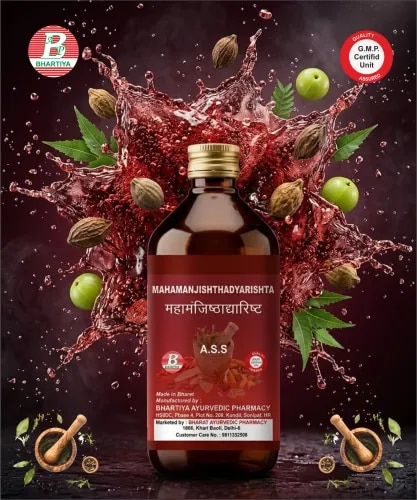
"name": "MAHAMANJISTHADYARISHTA",
"description": " MAHAMANJISTHADYARISHTA\n\n\n\nProduct Identification\nGeneric Name: Mahamanjisthadyarishta (Variant Formulation)\nType: Ayurvedic Polyherbal Fermented Preparation (Arishta/Kashayam-based fermentation tonic)\nPrimary Indication Area: Skin disorders, blood impurities, chronic inflammation, lymphatic congestion, liver–skin axis disorders, metabolic toxins (Ama), and Vata–Pitta imbalance conditions.\n\nTherapeutic Indications \n• Chronic skin diseases (eczema, psoriasis, acne, dermatitis)\n• Blood impurity disorders (Rakta dushti)\n• Vatarakta (gout, inflammatory arthritis)\n• Chronic itching and pigmentation disorders\n• Liver dysfunction-related skin problems\n• Edema and inflammatory swelling\n• Chronic non-healing skin eruptions\n• Detoxification and metabolic imbalance\n• Lymphatic congestion and toxin accumulation\n\nKey Benefits \nBlood purification (Rakta shodhana) \nSkin health improvement (Twak prasadana) \nReduces acne, eczema, psoriasis, itching \nAnti-inflammatory action (Shothahara) \nHelps in gout and joint pain (Vatarakta shamana) \nDetoxification of body (Ama pachana) \nImproves liver–skin connection \nLymphatic cleansing (Srotoshodhana) \nReduces chronic swelling and inflammation \nSupports healing of long-term skin disorders\n \nFormula \nMain Ingredients: \n\nManjistha \nNagarmotha \nKutaj chhal \nGiloy \nKuth \nSaunth \nBharangi \nChoti kateli \nVacha (Bach) \nNeem chhal \nHaldi \nDaruhaldi \nBaheda \nHarad \nAmla \nPatol patra \nKutaki \nMurva \nVidanga \nVijaysar \nShal chhal\nShatavari \nBanfsha \nGokshura \nIndrajav \nVasa ki jad \nBhangra (Bhringraj) \nDevdaru \nPatha \nKhadir kastha \nLal chandan \nNishoth \nVarun chhal \nKaranj chhal \nAtis \nIndrayana \nDhamasa \nAnantmool \nPitpapda \nDhataki \nGuda \nJala \n\n1. Manjistha\nBotanical Name: Rubia cordifolia\n\nRasa: Tikta, Kashaya\nGuna: Laghu, Ruksha\nVirya: Ushna\nVipaka: Katu\n\nMechanism of Action\n• Raktashodhaka (blood purifier)\n• Supports lymphatic drainage\n• Useful in chronic skin disorders\n• Anti-inflammatory action\n• Helps in detoxification of Ama\n\n2. Nagarmotha\nBotanical Name: Cyperus rotundus\n\nRasa: Tikta, Katu, Kashaya\n Guna: Laghu, Ruksha\n Virya: Sheeta\n Vipaka: Katu\n\nMechanism of Action\n• Deepana-Pachana (improves digestion)\n• Reduces Ama formation\n• Useful in diarrhea and gut disorders\n• Anti-inflammatory effect\n• Supports metabolic balance\n3. Kutaj Chhal\nBotanical Name: Holarrhena antidysenterica\n\nRasa: Tikta, Kashaya\nGuna: Laghu, Ruksha\n Virya: Sheeta\nVipaka: Katu\n\nMechanism of Action\n• Strong Grahi (anti-diarrheal) action\n• Intestinal detoxification\n• Controls dysentery and gut infections\n• Supports intestinal mucosa healing\n• Antimicrobial activity\n4. Giloy\nBotanical Name: Tinospora cordifolia\n \nRasa: Tikta, Kashaya\n Guna: Laghu, Snigdha\n Virya: Ushna\nVipaka: Madhura\n\nMechanism of Action\n• Rasayana (rejuvenator)\n• Immunomodulatory action\n• Anti-inflammatory effect\n• Reduces chronic fever and toxins\n• Supports liver and skin health\n5. Kuth\nBotanical Name: Saussurea costus\n\nRasa: Tikta, Katu\n Guna: Laghu, Tikshna\nVirya: Ushna\n Vipaka: Katu\n\nMechanism of Action\n• Anti-inflammatory and analgesic\n• Reduces Vata-Kapha disorders\n• Useful in joint pain and swelling\n• Improves circulation\n• Antimicrobial action\n6. Saunth\nBotanical Name: Zingiber officinale\n\nRasa: Katu\nGuna: Laghu, Ruksha, Tikshna\nVirya: Ushna\nVipaka: Madhura\n\nMechanism of Action\n• Deepana-Pachana (digestive stimulant)\n• Reduces Ama and inflammation\n• Improves circulation\n• Useful in Vata disorders\n• Analgesic and anti-inflammatory\n\n7. Bharangi\nBotanical Name: Clerodendrum serratum\n\nRasa: Tikta, Katu\nGuna: Laghu, Ruksha\n Virya: Ushna\n Vipaka: Katu\n\nMechanism of Action\n• Shwasahara (respiratory support)\n• Anti-inflammatory action\n• Useful in cough and asthma\n• Reduces Kapha accumulation\n• Immunomodulatory effect\n\n8. Choti Kateli (Gokshura)\nBotanical Name: Tribulus terrestris\n\n Rasa: Madhura, Tikta\n Guna: Guru, Snigdha\nVirya: Sheeta\n Vipaka: Madhura\n\nMechanism of Action\n• Mutrala (diuretic action)\n• Supports urinary tract health\n• Anti-inflammatory effect\n• Improves kidney function support\n• Rejuvenating (Rasayana) action\n\n9. Vacha (Bach)\nBotanical Name: Acorus calamus\n\nRasa: Katu, Tikta\nGuna: Laghu, Tikshna\nVirya: Ushna\nVipaka: Katu\n\nMechanism of Action\n• Medhya (brain tonic)\n• Clears Srotas (microchannels)\n• Improves digestion and appetite\n• Anti-inflammatory effect\n• Useful in neurological imbalance\n\n10. Neem Chhal\nBotanical Name: Azadirachta indica\n\nRasa: Tikta, Kashaya\n Guna: Laghu, Ruksha\n Virya: Sheeta\nVipaka: Katu\nMechanism of Action\n• Strong Raktashodhaka (blood purifier)\n• Antibacterial and antifungal\n• Useful in skin disorders\n• Reduces inflammation and itching\n• Detoxifying action\n\n11. Haldi\nBotanical Name: Curcuma longa\n\nRasa: Tikta, Katu\nGuna: Laghu, Ruksha\nVirya: Ushna\nVipaka: Katu\n\nMechanism of Action\n• Anti-inflammatory and wound healing\n• Raktashodhaka (blood purifier)\n• Antimicrobial action\n• Useful in skin disorders\n• Reduces swelling and pain\n\n12. Daruhaldi\nBotanical Name: Berberis aristata\n\nRasa: Tikta\nGuna: Laghu, Ruksha\nVirya: Ushna\n Vipaka: Katu\n\nMechanism of Action\n• Strong antimicrobial action\n• Useful in chronic skin diseases\n• Liver protective effect\n• Blood purification\n• Anti-inflammatory activity\n\n13. Baheda\nBotanical Name: Terminalia bellirica\n\nRasa: Kashaya, Madhura\nGuna: Laghu, Ruksha\n Virya: Sheeta\nVipaka: Madhura\n\nMechanism of Action\n• Rasayana (rejuvenator)\n• Digestive regulator\n• Detoxification support\n• Improves immunity\n• Anti-inflammatory action\n\n14. Harad\nBotanical Name: Terminalia chebula\n\nRasa: Pancharasa (except Lavana)\nGuna: Laghu, Ruksha\n Virya: Ushna\nVipaka: Madhura\n\nMechanism of Action\n• Strong detoxifier (Rechana)\n• Improves digestion\n• Removes Ama\n• Mild laxative effect\n• Tissue cleansing action\n\n15. Amla\nBotanical Name: Emblica officinalis\n\nRasa: Amla\n Guna: Laghu, Ruksha\n Virya: Sheeta\nVipaka: Madhura\n\nMechanism of Action\n• Powerful antioxidant\n• Rasayana (rejuvenation)\n• Supports immunity\n• Pitta balance\n• Skin and hair nourishment\n\n16. Patol Patra\nBotanical Name: Trichosanthes dioica\n\nRasa: Tikta\n Guna: Laghu, Ruksha\nVirya: Sheeta\nVipaka: Katu\n\nMechanism of Action\n• Liver detox support\n• Pitta shamak\n• Blood purification\n• Skin disease relief\n• Anti-inflammatory action\n\n17. Kutaki\nBotanical Name: Picrorhiza kurroa\n\nRasa: Tikta\n Guna: Laghu, Ruksha\n Virya: Sheeta\n Vipaka: Katu\n\nMechanism of Action\n• Hepatoprotective\n• Improves bile secretion\n• Detoxifies liver\n• Anti-inflammatory\n• Supports skin health\n\n18. Murva\nBotanical Name: Marsdenia tenacissima\n \nRasa: Tikta, Kashaya\n Guna: Laghu, Ruksha\n Virya: Ushna\n Vipaka: Katu\n\nMechanism of Action\n• Blood purifier\n• Skin disorder management\n• Anti-inflammatory action\n• Supports tissue healing\n• Detoxifying effect\n\n19. Vidanga\nBotanical Name: Embelia ribes\n• Rasa: Katu\n• Guna: Laghu, Ruksha\n• Virya: Ushna\n• Vipaka: Katu\nMechanism of Action\n• Krimighna (anti-parasitic)\n• Digestive stimulant\n• Detoxifies gut\n• Anti-microbial action\n• Reduces Ama\n\n20. Vijaysar\nBotanical Name: Pterocarpus marsupium\n• Rasa: Kashaya\n• Guna: Laghu, Ruksha\n• Virya: Sheeta\n• Vipaka: Katu\nMechanism of Action\n• Metabolic regulator\n• Supports blood sugar balance\n• Anti-inflammatory\n• Tissue strengthening\n• Detox support\n21. Shal Chhal\nBotanical Name: Shorea robusta\n• Rasa: Kashaya\n• Guna: Guru, Ruksha\n• Virya: Sheeta\n• Vipaka: Katu\nMechanism of Action\n• Grahi (absorptive, anti-diarrheal)\n• Anti-inflammatory action\n• Supports tissue healing\n• Useful in skin disorders\n• Detoxifying effect\n\n22. Shatavari\nBotanical Name: Asparagus racemosus\n• Rasa: Madhura\n• Guna: Guru, Snigdha\n• Virya: Sheeta\n• Vipaka: Madhura\nMechanism of Action\n• Rasayana (rejuvenator)\n• Hormonal balance support\n• Cooling and anti-ulcer action\n• Improves immunity\n• Tissue nourishment\n\n23. Banfsha\nBotanical Name: Viola odorata\n• Rasa: Tikta, Madhura\n• Guna: Laghu, Snigdha\n• Virya: Sheeta\n• Vipaka: Madhura\nMechanism of Action\n• Respiratory support (Shwasahara)\n• Cooling anti-inflammatory action\n• Blood purification\n• Skin disease support\n• Mild expectorant\n\n24. Gokshura\nBotanical Name: Tribulus terrestris\n• Rasa: Madhura, Tikta\n• Guna: Guru, Snigdha\n• Virya: Sheeta\n• Vipaka: Madhura\nMechanism of Action\n• Mutrala (diuretic)\n• Kidney and urinary support\n• Anti-inflammatory action\n• Rasayana effect\n• Supports reproductive health\n\n25. Indrajav\nBotanical Name: Holarrhena antidysenterica\n• Rasa: Tikta, Kashaya\n• Guna: Laghu, Ruksha\n• Virya: Sheeta\n• Vipaka: Katu\nMechanism of Action\n• Strong antidiarrheal action\n• Gut detoxification\n• Controls intestinal infections\n• Grahi effect\n• Anti-microbial activity\n\n26. Vasa Ki Jad\nBotanical Name: Adhatoda vasica\n• Rasa: Tikta, Katu\n• Guna: Laghu, Ruksha\n• Virya: Sheeta\n• Vipaka: Katu\nMechanism of Action\n• Shwasahara (respiratory relief)\n• Expectorant action\n• Anti-inflammatory\n• Bronchodilator support\n• Kapha reduction\n\n27. Bhangra (Bhringraj)\nBotanical Name: Eclipta alba\n• Rasa: Tikta, Katu\n• Guna: Laghu, Ruksha\n• Virya: Ushna\n• Vipaka: Katu\nMechanism of Action\n• Liver detox support\n• Hair and skin nourishment\n• Anti-inflammatory\n• Blood purification\n• Rasayana effect\n\n28. Devdaru\nBotanical Name: Cedrus deodara\n• Rasa: Tikta, Katu\n• Guna: Laghu, Ruksha\n• Virya: Ushna\n• Vipaka: Katu\nMechanism of Action\n• Anti-inflammatory action\n• Pain relief in joints\n• Reduces swelling\n• Improves circulation\n• Vata-Kapha pacification\n\n29. Patha\nBotanical Name: Cissampelos pareira\n• Rasa: Tikta, Kashaya\n• Guna: Laghu, Ruksha\n• Virya: Ushna\n• Vipaka: Katu\nMechanism of Action\n• Jwarahara (fever reducing)\n• Anti-inflammatory\n• Gut cleansing\n• Skin disorder support\n• Detoxification\n\n30. Khadir Kastha\nBotanical Name: Acacia catechu\n• Rasa: Kashaya\n• Guna: Laghu, Ruksha\n• Virya: Sheeta\n• Vipaka: Katu\nMechanism of Action\n• Strong Raktashodhaka\n• Skin disease management\n• Antimicrobial action\n• Wound healing\n• Reduces itching\n31. Lal Chandan\nBotanical Name: Pterocarpus santalinus\n• Rasa: Tikta, Kashaya\n• Guna: Laghu, Ruksha\n• Virya: Sheeta\n• Vipaka: Katu\nMechanism of Action\n• Cooling anti-inflammatory action\n• Blood purification\n• Skin healing support\n• Reduces burning sensation\n• Pitta pacifying effect\n\n32. Nishoth\nBotanical Name: Operculina turpethum\n• Rasa: Katu, Tikta\n• Guna: Laghu, Ruksha, Tikshna\n• Virya: Ushna\n• Vipaka: Katu\nMechanism of Action\n• Strong Rechana (purgative)\n• Deep detoxification\n• Removes Ama and toxins\n• Useful in constipation\n• Cleanses channels (Srotoshodhana)\n\n33. Varun Chhal\nBotanical Name: Crataeva nurvala\n• Rasa: Tikta, Kashaya\n• Guna: Laghu, Ruksha\n• Virya: Ushna\n• Vipaka: Katu\nMechanism of Action\n• Mutravirechaka (urinary detox)\n• Useful in kidney stones\n• Reduces urinary inflammation\n• Anti-inflammatory action\n• Cleans urinary channels\n\n34. Karanj Chhal\nBotanical Name: Pongamia pinnata\n• Rasa: Tikta, Katu\n• Guna: Laghu, Ruksha\n• Virya: Ushna\n• Vipaka: Katu\nMechanism of Action\n• Antimicrobial action\n• Skin disease management\n• Anti-inflammatory effect\n• Wound healing support\n• Raktashodhaka\n\n35. Atis\nBotanical Name: Aconitum heterophyllum\n• Rasa: Tikta, Kashaya\n• Guna: Laghu, Ruksha\n• Virya: Sheeta\n• Vipaka: Katu\nMechanism of Action\n• Jwarahara (fever reducing)\n• Digestive regulator\n• Anti-inflammatory\n• Antidiarrheal effect\n• Strengthens digestion\n\n36. Indrayana\nBotanical Name: Citrullus colocynthis\n• Rasa: Tikta\n• Guna: Laghu, Ruksha, Tikshna\n• Virya: Ushna\n• Vipaka: Katu\nMechanism of Action\n• Strong purgative action\n• Deep detoxification\n• Removes Ama\n• Cleans intestinal tract\n• Used in severe constipation\n\n37. Dhamasa\nBotanical Name: Fagonia cretica\n• Rasa: Tikta, Kashaya\n• Guna: Laghu, Ruksha\n• Virya: Sheeta\n• Vipaka: Katu\nMechanism of Action\n• Blood purification\n• Skin disease support\n• Anti-inflammatory action\n• Detoxifying effect\n• Wound healing support\n\n38. Anantmool\nBotanical Name: Hemidesmus indicus\n• Rasa: Madhura, Tikta\n• Guna: Guru, Snigdha\n• Virya: Sheeta\n• Vipaka: Madhura\nMechanism of Action\n• Cooling blood purifier\n• Skin disease management\n• Anti-inflammatory action\n• Detoxifies body\n• Supports urinary health\n\n39. Pitpapda\nBotanical Name: Fumaria indica\n• Rasa: Tikta\n• Guna: Laghu, Ruksha\n• Virya: Sheeta\n• Vipaka: Katu\nMechanism of Action\n• Liver detox support\n• Pitta balance\n• Blood purification\n• Skin disease relief\n• Improves bile flow\n\n40. Dhataki\nBotanical Name: Woodfordia fruticosa\n• Rasa: Kashaya\n• Guna: Laghu, Ruksha\n• Virya: Ushna\n• Vipaka: Katu\nMechanism of Action\n• Natural fermentation catalyst (Arishta)\n• Supports bioavailability of formulation\n• Mild antimicrobial action\n• Aids gut flora balance\n• Enhances potency of preparation\n\n41. Guda\nBotanical Name: Saccharum officinarum (processed jaggery)\n• Rasa: Madhura\n• Guna: Guru, Snigdha\n• Virya: Ushna\n• Vipaka: Madhura\nMechanism of Action\n• Fermentation base\n• Acts as Yogavahi (carrier)\n• Improves bioavailability\n• Mild detox effect\n• Energy support\n\n\n",
"price": 170.0,
"discountamount": 85.0,
"currencycode": "INR",
"priority": 1000000,
"isfreeshipmentavailable": false,
"shipmentduration": 1,
"_keywords": null,
"isarchived": false,
"isavailable": true,
"applicationid": null,
"productindex": 172,
"imageuri": "https://productimages.withfloats.com/actual/6a92cf45be0fefbc315368ad.jpg",
"tileimageuri": "https://productimages.withfloats.com/tile/6a92cf45be0fefbc315368ad.jpg",
"images": null,
"totalqueries": 0,
"gpid": null,
"groupproductid": null,
"createdon": "2026-08-29T12:23:32.23Z",
"updatedon": "2026-08-29T12:23:32.23Z",
"buyonlinelink": null,
"producturl": "http://WWW.BHARTIYAAYURVEDICPHARMACY.COM/products/mahamanjisthadyarishta/172",
"availableunits": -1.0,
"iscodavailable": true,
"isprepaidonlineavailable": true,
"maxcodorders": -1,
"maxprepaidonlineorders": -1,
"uniquepaymenturl": null,
"brandname": "Bakula Fort",
"category": "MAHAMANJISTHADYARISHTA 450 ML X 40",
"tags": [],
"variants": false,
"keyspecification": null,
"otherspecifications": null,
"pickupaddressreferenceid": null,
"paymenttype": "AssuredPurchase",
"producttype": "products",
"hsncode": null,
"gstslab": 0.0,
"isnotforsale": false
},
{
"_id": "6a7afd282a5df640d9fd3af9",
"fptag": "BHARTIYEAYURVEDICPHARMACY",
"merchantname": null,
"customwidgets": null,
"externalsourceid": null,
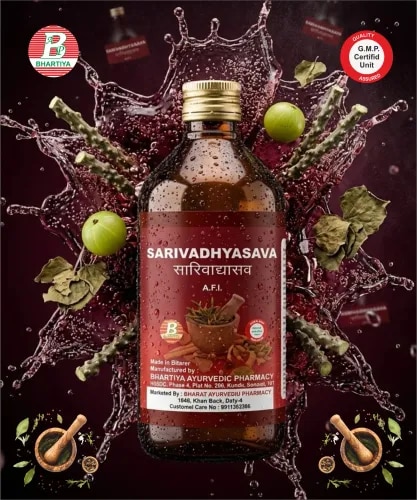
"name": "SARIVADYASAVA",
"description": " SARIVADYASAVA \n\n\nProduct Identification\nGeneric Name: Sarivadyasava\nType: Ayurvedic Polyherbal Fermented Formulation (Asava)\nPrimary Indication Area: Skin disorders, blood purification, urinary disorders, burning sensation, Pitta imbalance, and chronic inflammatory conditions.\n\nTherapeutic Indications\n• Kushta (skin disorders)\n• Twak vikara (chronic skin diseases)\n• Raktadushti (vitiated blood)\n• Daha (burning sensation)\n• Mutrakrichra (difficulty in urination)\n• Mutravaha disorders (urinary tract disorders)\n• Pittaja disorders\n• Chronic inflammatory conditions\n• Pruritus (itching)\n• Acne and recurrent skin eruptions\n• General weakness associated with chronic skin diseases\n\nKey Benefits\n• Supports healthy blood purification (Rakta Shodhana)\n• Helps maintain healthy skin and complexion\n• Reduces burning sensation and excess Pitta\n• Supports urinary tract health\n• Promotes natural detoxification\n• Helps reduce itching and inflammatory skin conditions\n• Supports immunity and tissue nourishment\n• Acts as a cooling rejuvenative tonic\n\nFORMULA\n1. Sariva\nBotanical Name: Hemidesmus indicus\nRasa: Madhura, Tikta\nGuna: Guru, Snigdha\n Virya: Sheeta\nVipaka: Madhura\n\nMechanism of Action:\n• Excellent blood purifier (Rakta Shodhaka)\n• Reduces Pitta and burning sensation\n• Supports healthy skin\n• Acts as a cooling rejuvenative\n\n2. Musta\nBotanical Name: Cyperus rotundus\nRasa: Tikta, Katu, Kashaya\nGuna: Laghu, Ruksha\nVirya: Sheeta\n Vipaka: Katu\n\nMechanism of Action:\n• Improves digestion and metabolism\n• Reduces Ama accumulation\n• Supports urinary health\n• Helps reduce inflammation\n\n3. Lodhra\nBotanical Name: Symplocos racemosa\nRasa: Kashaya\n Guna: Laghu, Ruksha\n Virya: Sheeta\n Vipaka: Katu\n\nMechanism of Action:\n• Supports healthy skin tissues\n• Reduces inflammation and discharge\n• Helps purify blood\n• Promotes wound healing\n\n4. Nyagrodha\nBotanical Name: Ficus benghalensis\nRasa: Kashaya\n Guna: Guru, Ruksha\nVirya: Sheeta\n Vipaka: Katu\n\nMechanism of Action:\n• Supports tissue healing\n• Helps reduce excessive Pitta\n• Promotes healthy skin\n• Supports blood purification\n\n5. Asvatha\nBotanical Name: Ficus religiosa\nRasa: Kashaya\nGuna: Guru, Ruksha\nVirya: Sheeta\nVipaka: Katu\n\nMechanism of Action:\n• Supports wound healing\n• Helps reduce inflammation\n• Promotes healthy blood circulation\n• Supports skin health\n\n6. Sati\nBotanical Name: Hedychium spicatum\nRasa: Katu, Tikta\n Guna: Laghu, Tikshna\nVirya: Ushna\nVipaka: Katu\n\nMechanism of Action:\n• Improves digestion\n• Reduces Ama formation\n• Supports respiratory and metabolic balance\n• Enhances bioavailability of herbs\n\n7. Sveta Sariva\nBotanical Name: Ichnocarpus frutescens\nRasa: Madhura, Tikta\n Guna: Guru, Snigdha\nVirya: Sheeta\n Vipaka: Madhura\n\nMechanism of Action:\n• Supports blood purification\n• Reduces burning sensation\n• Promotes healthy skin\n• Acts as a cooling tonic\n\n8. Padmaka\nBotanical Name: Prunus cerasoides\nRasa: Kashaya, Tikta\n Guna: Laghu, Ruksha\n Virya: Sheeta\n Vipaka: Katu\n\nMechanism of Action:\n• Supports healthy complexion\n• Helps reduce Pitta disorders\n• Promotes skin nourishment\n• Acts as an antioxidant\n\n9. Bala\nBotanical Name: Sida cordifolia\nRasa: Madhura\nGuna: Guru, Snigdha\nVirya: Sheeta\n Vipaka: Madhura\n\nMechanism of Action:\n• Strengthens body tissues\n• Supports recovery in chronic illness\n• Acts as a rejuvenative\n• Helps maintain vitality\n\n10. Patha\nBotanical Name: Cissampelos pareira\nRasa: Tikta, Kashaya\n Guna: Laghu, Ruksha\nVirya: Ushna\nVipaka: Katu\n\nMechanism of Action:\n• Supports urinary health\n• Reduces inflammation\n• Helps detoxification\n• Supports healthy digestion\n\n11. Amalaki\nBotanical Name: Phyllanthus emblica\nRasa: Pancha Rasa (predominantly Amla)\nGuna: Laghu, Ruksha\n Virya: Sheeta\n Vipaka: Madhura\n\nMechanism of Action:\n• Strong antioxidant and rejuvenative\n• Supports immunity\n• Helps purify blood\n• Supports healthy skin\n\n12. Guduchi\nBotanical Name: Tinospora cordifolia\nRasa: Tikta, Kashaya\n Guna: Laghu, Snigdha\n Virya: Ushna\nVipaka: Madhura\n\nMechanism of Action:\n• Supports immune function\n• Helps detoxification\n• Reduces inflammation\n• Promotes liver health\n\n13. Usira\nBotanical Name: Vetiveria zizanioides\nRasa: Tikta, Madhura\n Guna: Laghu, Ruksha\nVirya: Sheeta\nVipaka: Katu\n\nMechanism of Action:\n• Cooling and refreshing herb\n• Reduces burning sensation\n• Supports urinary health\n• Promotes blood purification\n\n14. Sveta Chandana\nBotanical Name: Santalum album\nRasa: Tikta, Madhura\nGuna: Laghu, Ruksha\nVirya: Sheeta\nVipaka: Katu\n\nMechanism of Action:\n• Reduces heat and burning sensation\n• Supports urinary comfort\n• Promotes healthy skin\n• Acts as a cooling tonic\n\n15. Rakta Chandana\nBotanical Name: Pterocarpus santalinus\nRasa: Tikta, Kashaya\nGuna: Laghu, Ruksha\nVirya: Sheeta\nVipaka: Katu\n\nMechanism of Action:\n• Supports blood purification\n• Helps reduce inflammation\n• Promotes skin health\n• Reduces excess Pitta\n\n16. Yavani\nBotanical Name: Trachyspermum ammi\nRasa: Katu\n Guna: Laghu, Ruksha, Tikshna\nVirya: Ushna\nVipaka: Katu\nMechanism of Action:\n• Improves digestion\n• Reduces gas and bloating\n• Supports metabolism\n• Helps digest Ama\n\n17. Kutaki\nBotanical Name: Picrorhiza kurroa\nRasa: Tikta\nGuna: Laghu, Ruksha\nVirya: Sheeta\n Vipaka: Katu\n\nMechanism of Action:\n• Supports liver function\n• Promotes detoxification\n• Improves digestion\n• Helps purify blood\n\n18. Tejpatra\nBotanical Name: Cinnamomum tamala\nRasa: Katu, Tikta\n Guna: Laghu, Ruksha\n Virya: Ushna\n Vipaka: Katu\n\nMechanism of Action:\n• Supports digestion and metabolism\n• Reduces gas and heaviness\n• Improves Agni\n• Helps digest Ama\n\n19. Sthuilaila\nBotanical Name: Amomum subulatum\nRasa: Tikta, Katu\nGuna: Laghu, Tikshna\nVirya: Ushna\nVipaka: Katu\n\nMechanism of Action:\n• Supports digestion\n• Reduces inflammation\n• Helps detoxification\n• Supports skin health\n\n20. Swernpatri\nBotanical Name: Cassia angustifolia\nRasa: Tikta, Kashaya\nGuna: Laghu, Ruksha\nVirya: Ushna\nVipaka: Katu\n\nMechanism of Action:\n• Mild natural laxative\n• Supports bowel cleansing\n• Helps eliminate toxins\n• Promotes detoxification\n\n21. Haritaki\nBotanical Name: Terminalia chebula\nRasa: Pancha Rasa (except Lavana)\nGuna: Laghu, Ruksha\nVirya: Ushna\nVipaka: Madhura\n\nMechanism of Action:\n• Mild laxative and detoxifier\n• Supports bowel cleansing\n• Improves digestion\n• Promotes elimination of toxins\n\n22. Guda\nBotanical Name: Jaggery\nRasa: Madhura\nGuna: Guru, Snigdha\n Virya: Ushna\n Vipaka: Madhura\n\nMechanism of Action:\n• Fermentation base\n• Provides energy substrate\n• Improves formulation stability\n• Enhances palatability\n\n23. Dhataki\nBotanical Name: Woodfordia fruticosa\nRasa: Kashaya\nGuna: Laghu, Ruksha\nVirya: Ushna\n Vipaka: Katu\n\nMechanism of Action:\n• Natural fermentation catalyst\n• Enhances extraction of phytochemicals\n• Improves bioavailability\n• Supports preservation of formulation\n\n24. Draksha\nBotanical Name: Vitis vinifera\nRasa: Madhura\n Guna: Guru, Snigdha\n Virya: Sheeta\n Vipaka: Madhura\nMechanism of Action:\n• Nourishes body tissues\n• Provides antioxidant support\n• Helps reduce burning sensation\n• Acts as a rejuvenative tonic\n\nDosage\nAdults:\n• 15–30 mL\n• Twice daily after meals\n• Dilute with equal quantity of water\n\nCommon Usage Guidance\n• Traditionally used in skin and blood disorders\n• Supports blood purification and healthy complexion\n• Helps reduce burning sensation and Pitta imbalance\n• Supports urinary health and detoxification\n• Usually prescribed for 4–8 weeks under Ayurvedic supervision\n• Best taken after food\n\nImportant Notes\n• Contains naturally fermented alcohol\n• Use cautiously in diabetes mellitus\n• Should be taken under Ayurvedic supervision\n• Avoid self-medication in severe systemic illness\n• Store in a cool, dry place\n• Keep tightly closed after use\n• Keep out of reach of children\n\n\nsarivadyasava uses in hindi, sarivadyasava uses, sarivadyasava syrup\nsarivadyasava benefits in hindi, sarivadyasava syrup side effects\nsarivadyasava syrup uses, sarivadyasava ingredients, sarivadyasava benefits\nsarivadyasava in hindi, sarivadyasava ayurvedic medicine, sarivadyasava ayurvedic\nsarivadyasava ayurvedic medicine uses in hindi, sarivadyasava amazon\nsarivadyasava easy ayurveda, sarivadyasava composition, sarivadyasava dosage\nsarivadyasava dabur uses, divya sarivadyasava, sarivadyasava uses in english\nsarivadyasava for skin in hindi, sarivadyasava for skin, sarivadyasava uses for skin\nsarivadyasava ke fayde, sarivadyasava used for, sarivadyasava hindi\nsarivadyasava how to take, sarivadyasava how to use, sarivadyasava uses hindi\nsarivadyasava syrup hindi, sarivadyasava syrup uses hindi, sarivadyasava ingredients in hindi\nsarivadyasava indication, sarivadyasava in pregnancy, sarivadyasava uses in ayurveda\nbaidyanath sarivadyasava ingredients, sarivadyasava jiva ayurveda\nsarivadyasava kaise use kare, sarivadyasava kadha uses, sarivadyasava kis kaam aati hai\nkerala ayurveda sarivadyasava, sarivadyasava kashayam, sarivadyasava medicine\nuse of sarivadyasava in hindi, ingredients of sarivadyasava, use of sarivadyasava syrup\nsarivadyasava price, sarivadyasava syrup price, sarivadyasava review\nsarivadyasava syrup benefits, sarivadyasava syrup benefits in hindi\nsarivadyasava tablet, sarivadyasava tablet uses in hindi\nsarivadyasava taste, how to take sarivadyasava, how to use sarivadyasava syrup\nhow to use sarivadyasava, sarivadyasava syrup uses in hindi, what is sarivadyasava used for",
"price": 165.0,
"discountamount": 82.0,
"currencycode": "INR",
"priority": 1000000,
"isfreeshipmentavailable": false,
"shipmentduration": 1,
"_keywords": null,
"isarchived": false,
"isavailable": true,
"applicationid": null,
"productindex": 167,
"imageuri": "https://productimages.withfloats.com/actual/6a7afd2abe4e6975bb0ae21f.jpg",
"tileimageuri": "https://productimages.withfloats.com/tile/6a7afd2abe4e6975bb0ae21f.jpg",
"images": null,
"totalqueries": 0,
"gpid": null,
"groupproductid": null,
"createdon": "2026-08-11T10:44:56.779Z",
"updatedon": "2026-08-11T10:44:56.779Z",
"buyonlinelink": null,
"producturl": "http://WWW.BHARTIYAAYURVEDICPHARMACY.COM//sarivadyasava/167",
"availableunits": -1.0,
"iscodavailable": true,
"isprepaidonlineavailable": true,
"maxcodorders": -1,
"maxprepaidonlineorders": -1,
"uniquepaymenturl": null,
"brandname": "BALULA FORT",
"category": "SARIVADYASAVA 450 ML X 40",
"tags": [],
"variants": false,
"keyspecification": null,
"otherspecifications": null,
"pickupaddressreferenceid": null,
"paymenttype": "AssuredPurchase",
"producttype": "products",
"hsncode": null,
"gstslab": 0.0,
"isnotforsale": false
},
{
"_id": "6a7ac6626f0de6a685d521bd",
"fptag": "BHARTIYEAYURVEDICPHARMACY",
"merchantname": null,
"customwidgets": null,
"externalsourceid": null,
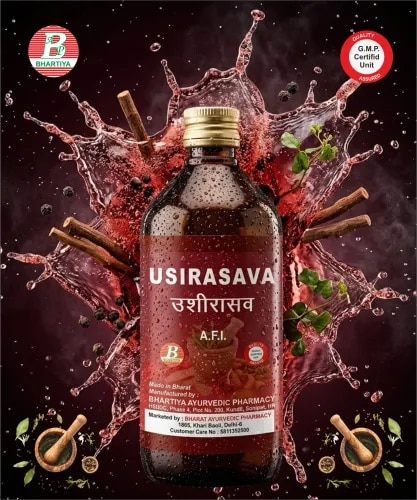
"name": "USHIRASAVA",
"description": " USHIRASAVA \n\n\n\nGeneric Name: Ushirasava\nType: Ayurvedic Polyherbal Fermented Formulation (Asava)\nPrimary Indication Area: Bleeding disorders, burning sensation, Pitta disorders, skin diseases, urinary disorders, blood vitiation, and inflammatory conditions.\n\nTherapeutic Indications\n• Raktapitta (bleeding disorders)\n• Daha (burning sensation)\n• Pittaja disorders\n• Raktadushti (vitiated blood)\n• Twak vikara (skin disorders)\n• Mutrakrichra (difficulty in urination)\n• Mutravaha disorders (urinary tract disorders)\n• Excessive body heat\n• Chronic inflammatory conditions\n• Pruritus (itching)\n• General debility associated with Pitta disorders\n\nKey Benefits\n• Supports healthy blood purification (Rakta Shodhana)\n• Helps reduce excessive body heat and burning sensation\n• Supports urinary tract health\n• Promotes healthy skin and complexion\n• Helps maintain Pitta balance\n• Supports natural detoxification\n• Helps reduce inflammatory conditions\n• Acts as a cooling rejuvenative tonic\n\nFORMULA\n1. Ushira\nBotanical Name: Vetiveria zizanioides\nRasa: Tikta, Madhura\nGuna: Laghu, Ruksha\n Virya: Sheeta\n Vipaka: Katu\nMechanism of Action:\n• Strong cooling herb\n• Reduces burning sensation and excess Pitta\n• Supports urinary health\n• Purifies blood\n\n2. Harivera\nBotanical Name: Pavonia odorata\nRasa: Tikta, Madhura\nGuna: Laghu, Ruksha\nVirya: Sheeta\nVipaka: Katu\nMechanism of Action:\n• Cooling and refreshing herb\n• Supports blood purification\n• Reduces body heat\n• Promotes urinary comfort\n\n3. Padma\nBotanical Name: Nelumbo nucifera\nRasa: Madhura, Kashaya\nGuna: Laghu, Snigdha\n Virya: Sheeta\nVipaka: Madhura\nMechanism of Action:\n• Supports healthy blood circulation\n• Reduces burning sensation\n• Promotes skin health\n• Helps balance Pitta\n\n4. Gambhari\nBotanical Name: Gmelina arborea\nRasa: Madhura, Kashaya\n Guna: Guru, Snigdha\nVirya: Sheeta\n Vipaka: Madhura\nMechanism of Action:\n• Nourishes body tissues\n• Supports rejuvenation\n• Helps reduce inflammation\n• Promotes overall vitality\n\n5. Utpala\nBotanical Name: Nymphaea stellata\nRasa: Tikta, Kashaya, Madhura\n Guna: Laghu, Snigdha\n Virya: Sheeta\nVipaka: Madhura\nMechanism of Action:\n• Cooling and soothing herb\n• Helps reduce burning sensation\n• Supports blood purification\n• Promotes skin health\n\n6. Priyangu\nBotanical Name: Callicarpa macrophylla\nRasa: Kashaya, Madhura\nGuna: Laghu, Ruksha\nVirya: Sheeta\n Vipaka: Katu\nMechanism of Action:\n• Supports healthy skin\n• Reduces inflammation\n• Helps control excessive sweating\n• Supports blood purification\n\n7. Padmaka\nBotanical Name: Prunus cerasoides\nRasa: Kashaya, Tikta\n Guna: Laghu, Ruksha\nVirya: Sheeta\nVipaka: Katu\nMechanism of Action:\n• Supports healthy complexion\n• Helps reduce Pitta disorders\n• Promotes skin nourishment\n• Acts as an antioxidant\n\n8. Lodhra\nBotanical Name: Symplocos racemosa\nRasa: Kashaya\nGuna: Laghu, Ruksha\n Virya: Sheeta\nVipaka: Katu\nMechanism of Action:\n• Supports healthy skin tissues\n• Reduces inflammation and discharge\n• Helps purify blood\n• Promotes wound healing\n\n9. Manjistha\nBotanical Name: Rubia cordifolia\nRasa: Tikta, Kashaya, Madhura\n Guna: Guru, Ruksha\n Virya: Ushna\nVipaka: Katu\nMechanism of Action:\n• Powerful blood purifier\n• Supports healthy skin\n• Reduces inflammation\n• Promotes detoxification\n\n10. Dhanvayasaka\nBotanical Name: Fagonia cretica\nRasa: Tikta, Kashaya\n Guna: Laghu, Ruksha\nVirya: Sheeta\nVipaka: Katu\nMechanism of Action:\n• Supports blood purification\n• Helps reduce inflammation\n• Promotes skin health\n• Supports detoxification\n\n11. Patha\nBotanical Name: Cissampelos pareira\nRasa: Tikta, Kashaya\nGuna: Laghu, Ruksha\nVirya: Ushna\n Vipaka: Katu\nMechanism of Action:\n• Supports urinary health\n• Reduces inflammation\n• Helps detoxification\n• Supports healthy digestion\n\n12. Kiratatikta\nBotanical Name: Swertia chirata\nRasa: Tikta\n Guna: Laghu, Ruksha\nVirya: Sheeta\n Vipaka: Katu\nMechanism of Action:\n• Supports liver function\n• Purifies blood\n• Reduces fever and inflammation\n• Improves metabolism\n\n13. Nyagrodha\nBotanical Name: Ficus benghalensis\nRasa: Kashaya\n Guna: Guru, Ruksha\nVirya: Sheeta\n Vipaka: Katu\nMechanism of Action:\n• Supports tissue healing\n• Helps reduce excessive Pitta\n• Promotes healthy skin\n• Supports blood purification\n\n14. Udumbara\nBotanical Name: Ficus racemosa\nRasa: Kashaya, Madhura\n Guna: Guru, Ruksha\nVirya: Sheeta\nVipaka: Madhura\nMechanism of Action:\n• Helps control bleeding disorders\n• Supports wound healing\n• Promotes healthy skin\n• Reduces inflammation\n\n15. Sati\nBotanical Name: Hedychium spicatum\nRasa: Katu, Tikta\n Guna: Laghu, Tikshna\n Virya: Ushna\n Vipaka: Katu\nMechanism of Action:\n• Improves digestion\n• Reduces Ama formation\n• Supports respiratory and metabolic balance\n• Enhances bioavailability of herbs\n\n16. Parpata\nBotanical Name: Fumaria parviflora\nRasa: Tikta\n Guna: Laghu, Ruksha\n Virya: Sheeta\nVipaka: Katu\nMechanism of Action:\n• Supports liver function\n• Purifies blood\n• Reduces burning sensation\n• Promotes skin health\n\n17. Pundarika\nBotanical Name: Nelumbo nucifera (White Lotus)\nRasa: Madhura, Kashaya\nGuna: Laghu, Snigdha\n Virya: Sheeta\n Vipaka: Madhura\nMechanism of Action:\n• Cooling and soothing herb\n• Supports blood purification\n• Reduces Pitta disorders\n• Promotes healthy complexion\n\n18. Patola\nBotanical Name: Trichosanthes dioica\nRasa: Tikta\n Guna: Laghu, Ruksha\n Virya: Ushna\nVipaka: Katu\nMechanism of Action:\n• Supports healthy skin\n• Purifies blood\n• Helps detoxification\n• Improves digestion\n\n19. Kachnar\nBotanical Name: Bauhinia variegata\nRasa: Kashaya\n Guna: Laghu, Ruksha\nVirya: Sheeta\n Vipaka: Katu\nMechanism of Action:\n• Supports glandular health\n• Helps reduce inflammatory swelling\n• Promotes detoxification\n• Supports skin health\n\n20. Jambu\nBotanical Name: Syzygium cumini\nRasa: Kashaya, Madhura\n Guna: Laghu, Ruksha\n Virya: Sheeta\nVipaka: Katu\nMechanism of Action:\n• Supports blood purification\n• Helps regulate metabolism\n• Promotes urinary health\n• Supports healthy skin\n\n21. Salmali\nBotanical Name: Bombax ceiba\nRasa: Kashaya, Madhura\n Guna: Guru, Snigdha\nVirya: Sheeta\nVipaka: Madhura\nMechanism of Action:\n• Supports tissue healing\n• Helps reduce bleeding tendencies\n• Promotes skin health\n• Provides rejuvenative support\n\n22. Draksha\nBotanical Name: Vitis vinifera\nRasa: Madhura\n Guna: Guru, Snigdha\n Virya: Sheeta\nVipaka: Madhura\nMechanism of Action:\n• Nourishes body tissues\n• Provides antioxidant support\n• Helps reduce burning sensation\n• Acts as a rejuvenative tonic\n\n23. Dhataki\nBotanical Name: Woodfordia fruticosa\nRasa: Kashaya\n Guna: Laghu, Ruksha\n Virya: Ushna\n Vipaka: Katu\nMechanism of Action:\n• Natural fermentation catalyst\n• Enhances extraction of phytochemicals\n• Improves bioavailability\n• Supports preservation of formulation\n\n24. Sarkara\nBotanical Name: Sugar\nRasa: Madhura\n Guna: Guru, Snigdha\nVirya: Sheeta\nVipaka: Madhura\nMechanism of Action:\n• Fermentation substrate\n• Improves palatability\n• Provides formulation stability\n• Supports natural fermentation\n\n25. Madhu\nBotanical Name: Honey\nRasa: Madhura, Kashaya\nGuna: Laghu, Ruksha\n Virya: Sheeta\n Vipaka: Madhura\nMechanism of Action:\n• Supports natural fermentation\n• Enhances bioavailability\n• Acts as a Yogavahi (catalytic carrier)\n• Promotes tissue nourishment\n\n26. Maricha\nBotanical Name: Piper nigrum\nRasa: Katu\nGuna: Laghu, Tikshna\nVirya: Ushna\n Vipaka: Katu\nMechanism of Action:\n• Improves digestion and metabolism\n• Enhances bioavailability of herbal constituents\n• Reduces Ama accumulation\n• Supports detoxification\n\nDosage\nAdults:\n• 15–30 mL\n• Twice daily after meals\n• Dilute with equal quantity of water\n\nCommon Usage Guidance\n• Traditionally used in bleeding disorders and Pitta disorders\n• Supports blood purification and healthy skin\n• Helps reduce burning sensation and excessive body heat\n• Supports urinary health and natural detoxification\n• Usually prescribed for 4–8 weeks under Ayurvedic supervision\n• Best taken after food\n\nImportant Notes\n• Contains naturally fermented alcohol\n• Use cautiously in diabetes mellitus\n• Should be taken under Ayurvedic supervision\n• Avoid self-medication in severe bleeding disorders or systemic illness\n• Store in a cool, dry place\n• Keep tightly closed after use\n• Keep out of reach of children\n\nushirasava syrup, ushirasava syrup uses, ushirasava syrup uses in hindi\nushirasava uses, ushirasava uses in hindi, ushirasava syrup benefits\nushirasava ingredients, ushirasava ayurvedic medicine uses\nushirasava and chandanasava, ushirasava ayurvedic syrup\nushirasava ayurvedic, ushirasava ayurvedic medicine\nushirasava amazon, ushirasava ayur times, ushirasava ayurvedic medicine uses in kannada\nushirasava benefits in hindi, ushirasava benefits, ushirasava contents\nchandanasava ushirasava, benefits of ushirasava, ushirasava dhootapapeshwar\nushirasava dosage, ushirasava dose, ushirasava dawa ke fayde\ndivya ushirasava benefits, ushirasava uses in english, ushirasava for acidity\nushirasava for skin, ushirasava uses for skin, ushirasava uses for piles\nushirasava ke fayde, ushirasava ke fayde in hindi, ushirasava used for\nushirasava syrup ke fayde in hindi, ushirasava syrup ke fayde\nushirasava hindi, ushirasava how to use, ushirasava how to take\nushirasava uses hindi, ushirasava benefits hindi, ushirasava syrup hindi\nushirasava kya hai, ushirasava ingredients in hindi, ushirasava meaning in hindi\nushirasava in hindi, ushirasava indication, ushirasava in uti, ushirasava in ayurveda\nbaidyanath jhansi ushirasava, benefits of juani, ushirasava kadha, ushirasava kis kaam aati hai\nushirasava kadha uses, ushirasava near me, ushirasava online, uses of ushirasava\nuse of ushirasava syrup, use of ushirasava in hindi, ingredients of ushirasava\nbenefits of ushirasava in hindi, benefits of ushirasava syrup, ushirasava price\nushirasava planet ayurveda, ushirasava preparation, ushirasava syrup price\nushirasava reference, ushirasava research article, ushirasava unjha\nayurvedic medicine ushirasava, ayurvedic ushirasava, divya ushirasava uses\nsyp ushirasava uses in hindi, sandu ushirasava benefits, syrup ushirasava uses",
"price": 210.0,
"discountamount": 105.0,
"currencycode": "INR",
"priority": 1000000,
"isfreeshipmentavailable": false,
"shipmentduration": 1,
"_keywords": null,
"isarchived": false,
"isavailable": true,
"applicationid": null,
"productindex": 165,
"imageuri": "https://productimages.withfloats.com/actual/6a7ac667756b497df898fbeb.jpg",
"tileimageuri": "https://productimages.withfloats.com/tile/6a7ac667756b497df898fbeb.jpg",
"images": null,
"totalqueries": 0,
"gpid": null,
"groupproductid": null,
"createdon": "2026-08-11T06:51:14.369Z",
"updatedon": "2026-08-11T06:56:26.648Z",
"buyonlinelink": null,
"producturl": "http://WWW.BHARTIYAAYURVEDICPHARMACY.COM//ushirasava/165",
"availableunits": -1.0,
"iscodavailable": true,
"isprepaidonlineavailable": true,
"maxcodorders": -1,
"maxprepaidonlineorders": -1,
"uniquepaymenturl": null,
"brandname": "BAKULA FORT",
"category": "USHIRASAVA 450 ML X 40",
"tags": [],
"variants": false,
"keyspecification": null,
"otherspecifications": null,
"pickupaddressreferenceid": null,
"paymenttype": "AssuredPurchase",
"producttype": "products",
"hsncode": null,
"gstslab": 0.0,
"isnotforsale": false
},
{
"_id": "6a6069dca338caae77fcc9a0",
"fptag": "BHARTIYEAYURVEDICPHARMACY",
"merchantname": null,
"customwidgets": null,
"externalsourceid": null,
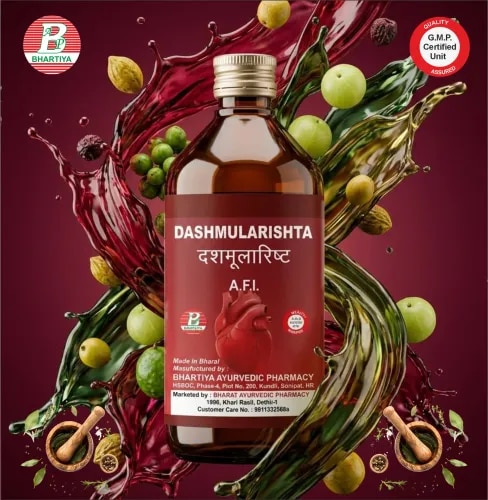
"name": "DASHMULARISHTA",
"description": " DASHMULARISHTA\n\n\nProduct Identification\nGeneric Name: Dashmularishta\nType: Ayurvedic Polyherbal Fermented Formulation (Arishta)\nPrimary Indication Area: Primarily used as a rejuvenative and restorative tonic for postpartum care, Vata disorders, inflammatory conditions, musculoskeletal weakness, nervous system disorders, and recovery following chronic illness. It is widely indicated for general debility, fever recovery, respiratory weakness, digestive impairment, and gynecological disorders associated with Vata imbalance.\n\nTherapeutic Indications\n•\tGeneral debility (Daurbalya) \n•\tPostpartum care (Sutika Paricharya) \n•\tVata disorders (Vatavyadhi) \n•\tChronic inflammatory conditions \n•\tMusculoskeletal weakness \n•\tJoint pain and stiffness \n•\tLow back pain \n•\tNeuralgia and neuropathic discomfort \n•\tConvalescence following prolonged illness \n•\tRespiratory weakness and chronic cough \n•\tFever recovery \n•\tDigestive weakness and poor appetite \n•\tGynecological disorders associated with Vata imbalance \n•\tFatigue and reduced stamina \n•\tAge-related decline in strength and vitality \n\nKey Benefits\n•\tSupports healthy musculoskeletal and nervous system function. \n•\tPromotes recovery following childbirth and prolonged illness. \n•\tHelps reduce inflammation and joint discomfort. \n•\tImproves physical strength and endurance. \n•\tSupports healthy respiratory function. \n•\tEnhances digestion and metabolism. \n•\tPromotes healthy immune function. \n•\tSupports uterine health during the postpartum period. \n•\tActs as a Rasayana for restoring vitality. \n•\tProvides antioxidant protection against oxidative stress. \n\nFORMULA\nEach part contains:\n•\tBilva (Aegle marmelos) \n•\tShyonaka (Oroxylum indicum) \n•\tGambhari (Gmelina arborea) \n•\tPatala (Stereospermum suaveolens) \n•\tAgnimantha (Clerodendrum phlomidis) \n•\tShalaparni (Desmodium gangeticum) \n•\tPrishniparni (Uraria picta) \n•\tBrihati (Solanum indicum) \n•\tKantakari (Solanum xanthocarpum)\n•\tGokshura (Tribulus terrestris) \n•\tChitraka (Plumbago zeylanica) \n•\tPushkara (Inula racemosa) \n•\tLodhra (Symplocos racemosa) \n•\tGuduchi (Tinospora cordifolia) \n•\tAmalaki (Phyllanthus emblica) \n•\tDhanvayasa (Fagonia cretica) \n•\tKhadira (Acacia catechu) \n•\tKustha (Saussurea lappa) \n•\tManjistha (Rubia cordifolia) \n•\tDevadaru (Cedrus deodara) \n•\tVidanga (Embelia ribes) \n•\tMadhuka (Glycyrrhiza glabra) \n•\tBharangi (Clerodendrum serratum) \n•\tKapitha (Limonia acidissima / Feronia limonia) \n•\tBibhitaki (Terminalia bellirica) \n•\tPunarnava (Boerhavia diffusa) \n•\tChavya (Piper retrofractum) \n•\tJatamansi (Nardostachys jatamansi) \n•\tPriyangu (Callicarpa macrophylla) \n•\tSariva (Hemidesmus indicus) \n•\tKala Jeera (Carum carvi / Nigella sativa (regional use)) \n•\tTrivrit (Operculina turpethum) \n•\tNirgundi (Vitex negundo) \n•\tRasna (Pluchea lanceolata) \n•\tHaridra (Curcuma longa) \n•\tSatpushpa (Anethum sowa / Anethum graveolens) \n•\tPadmaka (Prunus cerasoides) \n•\tNagakesara (Mesua ferrea) \n•\tMusta (Cyperus rotundus) \n•\tIndrayava (Holarrhena antidysenterica) \n•\tKarkatashringi (Pistacia integerrima) \n•\tJivaka (Microstylis wallichii) \n•\tRishabhaka (Microstylis muscifera) \n•\tMeda (Polygonatum cirrhifolium) \n•\tKakoli (Fritillaria roylei) \n•\tKshirakakoli (Roscoea purpurea) \n•\tRiddhi (Habenaria intermedia) \n•\tVriddhi (Habenaria edgeworthii) \n•\tDraksha (Vitis vinifera) \n•\tKatphala (Myrica nagi) \n•\tPuga (Areca catechu) \n•\tGuda (Jaggery) \n•\tMadhu (Honey) \n•\tDhataki (Woodfordia fruticosa) \n•\tLavanga (Syzygium aromaticum) \n•\tTvak (Cinnamomum verum) \n•\tEla (Elettaria cardamomum) \n•\tTejapatra (Cinnamomum tamala) \n•\tPippali (Piper longum) \n•\tHaridra (Curcuma longa) \n•\tSveta Chandana (Santalum album) \n•\tPippali root\n\n\n1. Bilva\nBotanical Name: Aegle marmelos\n•\tRasa: Kashaya, Tikta \n•\tGuna: Laghu, Ruksha \n•\tVirya: Ushna \n•\tVipaka: Katu \n•\tPrabhava: Vata-Kapha Shamaka \nMechanism of Action\n•\tReduces inflammatory mediators in gut and joints \n•\tRegulates Vata in neuromuscular system \n•\tSupports digestive motility and Agni \n•\tAnti-inflammatory and mild analgesic activity \n•\tHelps in post-illness weakness recovery \n\n2. Shyonaka\nBotanical Name: Oroxylum indicum\n•\tRasa: Tikta, Kashaya \n•\tGuna: Laghu, Ruksha \n•\tVirya: Ushna \n•\tVipaka: Katu \nMechanism of Action\n•\tReduces cytokine-mediated inflammation \n•\tSupports respiratory and musculoskeletal recovery \n•\tAntioxidant and tissue-protective action \n•\tHelps in Vata-induced pain conditions \n\n3. Gambhari\nBotanical Name: Gmelina arborea\n•\tRasa: Madhura, Kashaya \n•\tGuna: Guru, Snigdha \n•\tVirya: Sheeta \n•\tVipaka: Madhura \n•\tPrabhava: Rasayana \nMechanism of Action\n•\tPromotes tissue regeneration and strength \n•\tSupports post-partum recovery \n•\tImmunomodulatory and restorative effect \n•\tAnti-inflammatory and nutritive action \n\n4. Patala\nBotanical Name: Stereospermum suaveolens\n•\tRasa: Tikta, Kashaya \n•\tGuna: Laghu, Ruksha \n•\tVirya: Ushna \n•\tVipaka: Katu \nMechanism of Action\n•\tReduces neuromuscular inflammation \n•\tSupports respiratory function \n•\tAnalgesic activity in Vata disorders \n•\tImproves tissue repair mechanisms \n\n5. Agnimantha\nBotanical Name: Clerodendrum phlomidis\n•\tRasa: Katu, Tikta \n•\tGuna: Laghu, Ruksha \n•\tVirya: Ushna \n•\tVipaka: Katu \nMechanism of Action\n•\tStimulates digestive enzymes and Agni \n•\tReduces Ama accumulation \n•\tAnti-inflammatory in joints and muscles \n•\tEnhances metabolic clearance \n\n6. Shalaparni\nBotanical Name: Desmodium gangeticum\n•\tRasa: Madhura, Tikta \n•\tGuna: Snigdha, Laghu \n•\tVirya: Ushna \n•\tVipaka: Madhura \nMechanism of Action\n•\tNeuroprotective and muscle-strengthening \n•\tReduces fatigue and weakness \n•\tSupports immune modulation \n•\tEnhances recovery from chronic illness \n\n7. Prishniparni\nBotanical Name: Uraria picta\n•\tRasa: Madhura, Tikta \n•\tGuna: Snigdha, Laghu \n•\tVirya: Ushna \n•\tVipaka: Madhura \nMechanism of Action\n•\tImproves neuromuscular strength \n•\tSupports postpartum tissue repair \n•\tAnti-inflammatory and rejuvenative \n•\tEnhances stamina and vitality \n\n8. Brihati\nBotanical Name: Solanum indicum\n•\tRasa: Tikta, Katu \n•\tGuna: Laghu, Ruksha \n•\tVirya: Ushna \n•\tVipaka: Katu \nMechanism of Action\n•\tReduces inflammatory pain \n•\tSupports respiratory health \n•\tHelps in Vata-Kapha imbalance disorders \n•\tImproves metabolic function \n\n9. Kantakari\nBotanical Name: Solanum xanthocarpum\n•\tRasa: Tikta, Katu \n•\tGuna: Laghu, Ruksha \n•\tVirya: Ushna \n•\tVipaka: Katu \nMechanism of Action\n•\tBronchodilator and expectorant action \n•\tReduces respiratory inflammation \n•\tSupports Vata-Kapha balance \n•\tImproves oxygenation and vitality \n\n10. Gokshura\nBotanical Name: Tribulus terrestris\n•\tRasa: Madhura \n•\tGuna: Snigdha, Guru \n•\tVirya: Sheeta \n•\tVipaka: Madhura \nMechanism of Action\n•\tDiuretic and urinary system support \n•\tEnhances muscle strength and stamina \n•\tImproves reproductive function \n•\tAnti-fatigue and anabolic support \n\n11. Chitraka\nBotanical Name: Plumbago zeylanica\n•\tRasa: Katu \n•\tGuna: Laghu, Tikshna \n•\tVirya: Ushna \n•\tVipaka: Katu \nMechanism of Action\n•\tPotent digestive stimulant (Agni deepana) \n•\tReduces Ama accumulation \n•\tImproves nutrient absorption \n•\tEnhances metabolic rate \n\n12. Pushkara\nBotanical Name: Inula racemosa\n•\tRasa: Tikta, Katu \n•\tGuna: Laghu, Ruksha \n•\tVirya: Ushna \n•\tVipaka: Katu \nMechanism of Action\n•\tCardiorespiratory stimulant \n•\tImproves oxygen utilization \n•\tAnti-inflammatory and bronchodilator \n•\tSupports endurance \n\n13. Lodhra\nBotanical Name: Symplocos racemosa\n•\tRasa: Kashaya \n•\tGuna: Laghu, Ruksha \n•\tVirya: Sheeta \n•\tVipaka: Katu \nMechanism of Action\n•\tUterine tonic and anti-inflammatory \n•\tSupports tissue tightening and healing \n•\tReduces excessive secretions \n•\tImproves reproductive health \n\n14. Guduchi\nBotanical Name: Tinospora cordifolia\n•\tRasa: Tikta, Kashaya \n•\tGuna: Laghu, Snigdha \n•\tVirya: Ushna \n•\tVipaka: Madhura \nMechanism of Action\n•\tStrong immunomodulator \n•\tAnti-inflammatory and antipyretic \n•\tEnhances detoxification pathways \n•\tSupports chronic disease recovery \n\n15. Amalaki\nBotanical Name: Phyllanthus emblica\n•\tRasa: Amla Pradhana Pancharasa \n•\tGuna: Laghu, Ruksha \n•\tVirya: Sheeta \n•\tVipaka: Madhura \nMechanism of Action\n•\tPotent antioxidant (vitamin C rich) \n•\tAnti-aging and Rasayana effect \n•\tSupports immunity and tissue repair \n•\tEnhances digestion and metabolism\n16. Dhanvayasa\nBotanical Name: Fagonia cretica / Alhagi pseudalhagi\n•\tRasa: Tikta, Kashaya \n•\tGuna: Laghu, Ruksha \n•\tVirya: Sheeta \n•\tVipaka: Katu \nMechanism\n•\tAnti-inflammatory and blood-purifying activity \n•\tSupports detoxification and tissue repair \n•\tHelps reduce chronic inflammatory states \n\n17. Khadira\nBotanical Name: Acacia catechu\n•\tRasa: Kashaya \n•\tGuna: Ruksha, Laghu \n•\tVirya: Sheeta \n•\tVipaka: Katu \nMechanism\n•\tStrong antioxidant and antimicrobial action \n•\tSupports skin, blood and metabolic health \n•\tReduces chronic inflammation \n\n18. Kustha\nBotanical Name: Saussurea lappa\n•\tRasa: Tikta, Katu \n•\tGuna: Laghu, Tikshna \n•\tVirya: Ushna \n•\tVipaka: Katu \nMechanism\n•\tAnti-inflammatory and analgesic \n•\tSupports Vata disorders (pain, stiffness) \n•\tImproves neuromuscular function \n\n19. Manjistha\nBotanical Name: Rubia cordifolia\n•\tRasa: Tikta, Kashaya \n•\tGuna: Guru, Ruksha \n•\tVirya: Ushna \n•\tVipaka: Katu \nMechanism\n•\tBlood purification and lymphatic drainage \n•\tAnti-inflammatory and antioxidant \n•\tSupports skin and tissue repair \n\n20. Devadaru\nBotanical Name: Cedrus deodara\n•\tRasa: Tikta, Katu \n•\tGuna: Laghu, Ruksha \n•\tVirya: Ushna \n•\tVipaka: Katu \nMechanism\n•\tPotent anti-inflammatory action \n•\tRelieves joint and muscle pain \n•\tSupports respiratory clearance \n\n21. Vidanga\nBotanical Name: Embelia ribes\n•\tRasa: Katu \n•\tGuna: Laghu, Ruksha \n•\tVirya: Ushna \n•\tVipaka: Katu \nMechanism\n•\tAnthelmintic and antimicrobial \n•\tImproves gut health and metabolism \n•\tReduces Ama accumulation \n\n22. Madhuka\nBotanical Name: Glycyrrhiza glabra\n•\tRasa: Madhura \n•\tGuna: Guru, Snigdha \n•\tVirya: Sheeta \n•\tVipaka: Madhura \nMechanism\n•\tAnti-inflammatory and demulcent \n•\tSupports respiratory and gastric mucosa \n•\tImmunomodulatory and rejuvenative \n\n23. Bharangi\nBotanical Name: Clerodendrum serratum\n•\tRasa: Tikta, Katu \n•\tGuna: Laghu, Ruksha \n•\tVirya: Ushna \n•\tVipaka: Katu \nMechanism\n•\tRespiratory anti-inflammatory \n•\tBronchodilator effect \n•\tSupports cough and asthma conditions \n\n24. Kapitha\nBotanical Name: Limonia acidissima\n•\tRasa: Kashaya \n•\tGuna: Guru, Ruksha \n•\tVirya: Sheeta \n•\tVipaka: Katu \nMechanism\n•\tDigestive and gut stabilizing \n•\tAntimicrobial and anti-diarrheal \n•\tSupports intestinal health \n\n25. Bibhitaki\nBotanical Name: Terminalia bellirica\n•\tRasa: Kashaya \n•\tGuna: Ruksha, Laghu \n•\tVirya: Ushna \n•\tVipaka: Madhura \nMechanism\n•\tDetoxification and bowel regulation \n•\tAntioxidant and anti-inflammatory \n•\tSupports respiratory health \n\n26. Punarnava\nBotanical Name: Boerhavia diffusa\n•\tRasa: Tikta, Kashaya \n•\tGuna: Laghu, Ruksha \n•\tVirya: Ushna \n•\tVipaka: Katu \nMechanism\n•\tDiuretic and anti-edema action \n•\tKidney and fluid balance support \n•\tAnti-inflammatory activity \n\n27. Chavya\nBotanical Name: Piper retrofractum\n•\tRasa: Katu \n•\tGuna: Laghu, Tikshna \n•\tVirya: Ushna \n•\tVipaka: Katu \nMechanism\n•\tDigestive stimulant (Deepana) \n•\tImproves metabolism and Agni \n•\tReduces Ama formation \n\n28. Jatamansi\nBotanical Name: Nardostachys jatamansi\n•\tRasa: Tikta, Kashaya \n•\tGuna: Laghu, Snigdha \n•\tVirya: Sheeta \n•\tVipaka: Katu \nMechanism\n•\tNervine sedative and neuroprotective \n•\tReduces stress and anxiety \n•\tSupports sleep and mental balance \n\n29. Priyangu\nBotanical Name: Callicarpa macrophylla\n•\tRasa: Kashaya, Madhura \n•\tGuna: Laghu, Ruksha \n•\tVirya: Sheeta \n•\tVipaka: Katu \nMechanism\n•\tBlood purification and wound healing \n•\tAnti-inflammatory and cooling \n•\tSupports tissue repair \n\n30. Sariva\nBotanical Name: Hemidesmus indicus\n•\tRasa: Madhura, Tikta \n•\tGuna: Guru, Snigdha \n•\tVirya: Sheeta \n•\tVipaka: Madhura \nMechanism\n•\tBlood detoxification \n•\tCooling and anti-inflammatory \n•\tSupports skin and immune health \n\n31. Kala Jeera\nBotanical Name: Nigella sativa / Carum carvi (variant usage)\n•\tRasa: Katu, Tikta \n•\tGuna: Laghu, Ruksha \n•\tVirya: Ushna \n•\tVipaka: Katu \nMechanism\n•\tAnti-inflammatory and antioxidant \n•\tImproves digestion and immunity \n•\tSupports metabolic balance \n\n32. Trivrit\nBotanical Name: Operculina turpethum\n•\tRasa: Katu, Tikta \n•\tGuna: Ruksha, Laghu \n•\tVirya: Ushna \n•\tVipaka: Katu \nMechanism\n•\tStrong purgative (Rechana) \n•\tDetoxification and bowel cleansing \n•\tRemoves accumulated toxins \n\n33. Nirgundi\nBotanical Name: Vitex negundo\n•\tRasa: Katu, Tikta \n•\tGuna: Laghu, Ruksha \n•\tVirya: Ushna \n•\tVipaka: Katu \nMechanism\n•\tAnti-inflammatory and analgesic \n•\tUseful in joint pain and Vata disorders \n•\tMuscle relaxant activity \n\n34. Rasna\nBotanical Name: Pluchea lanceolata\n•\tRasa: Tikta, Katu \n•\tGuna: Snigdha, Laghu \n•\tVirya: Ushna \n•\tVipaka: Katu \nMechanism\n•\tStrong anti-arthritic action \n•\tReduces stiffness and pain \n•\tSupports neuromuscular health \n\n35. Haridra\nBotanical Name: Curcuma longa\n•\tRasa: Tikta, Katu \n•\tGuna: Laghu, Ruksha \n•\tVirya: Ushna \n•\tVipaka: Katu \nMechanism\n•\tAnti-inflammatory and antioxidant \n•\tImmunomodulatory activity \n•\tTissue healing and detox support \n\n36. Satpushpa\nBotanical Name: Anethum sowa / Anethum graveolens\n•\tRasa: Katu \n•\tGuna: Laghu \n•\tVirya: Ushna \n•\tVipaka: Katu \nMechanism\n•\tDigestive stimulant \n•\tReduces bloating and gas \n•\tSupports metabolism \n\n37. Padmaka\nBotanical Name: Prunus cerasoides\n•\tRasa: Kashaya \n•\tGuna: Laghu \n•\tVirya: Sheeta \n•\tVipaka: Katu \nMechanism\n•\tAnti-inflammatory and cooling \n•\tSupports blood purification \n•\tTissue soothing action \n\n38. Nagakesara\nBotanical Name: Mesua ferrea\n•\tRasa: Kashaya, Tikta \n•\tGuna: Laghu, Ruksha \n•\tVirya: Sheeta \n•\tVipaka: Katu \nMechanism\n•\tHemostatic and anti-inflammatory \n•\tSupports uterine and vascular health \n•\tAntioxidant activity \n\n39. Musta\nBotanical Name: Cyperus rotundus\n•\tRasa: Tikta, Katu \n•\tGuna: Laghu, Ruksha \n•\tVirya: Sheeta \n•\tVipaka: Katu \nMechanism\n•\tDigestive regulator \n•\tAnti-diarrheal and metabolic balance \n•\tReduces Ama \n\n40. Indrayava\nBotanical Name: Holarrhena antidysenterica\n•\tRasa: Tikta, Kashaya \n•\tGuna: Laghu, Ruksha \n•\tVirya: Sheeta \n•\tVipaka: Katu \nMechanism\n•\tStrong anti-diarrheal action \n•\tGut antimicrobial activity \n•\tRestores intestinal balance \n\n41. Karkatashringi\nBotanical Name: Pistacia integerrima\n•\tRasa: Kashaya \n•\tGuna: Laghu, Ruksha \n•\tVirya: Sheeta \n•\tVipaka: Katu \nMechanism\n•\tRespiratory anti-inflammatory \n•\tReduces cough and bronchial irritation \n•\tSupports lung function \n42. Jivaka\nBotanical Name: Microstylis wallichii\n•\tRasa: Madhura \n•\tGuna: Guru, Snigdha \n•\tVirya: Sheeta \n•\tVipaka: Madhura \nMechanism\n•\tRasayana and tissue-building action \n•\tImproves strength and vitality \n•\tSupports reproductive and neuromuscular health \n\n43. Rishabhaka\nBotanical Name: Microstylis muscifera\n•\tRasa: Madhura \n•\tGuna: Guru, Snigdha \n•\tVirya: Sheeta \n•\tVipaka: Madhura \nMechanism\n•\tRejuvenative and anabolic support \n•\tEnhances stamina and recovery \n•\tSupports muscle and nerve repair \n\n44. Meda\nBotanical Name: Polygonatum cirrhifolium\n•\tRasa: Madhura \n•\tGuna: Guru, Snigdha \n•\tVirya: Sheeta \n•\tVipaka: Madhura \nMechanism\n•\tNourishing and restorative \n•\tImproves tissue regeneration \n•\tSupports energy metabolism \n\n45. Kakoli\nBotanical Name: Fritillaria roylei\n•\tRasa: Madhura \n•\tGuna: Guru, Snigdha \n•\tVirya: Sheeta \n•\tVipaka: Madhura \nMechanism\n•\tPotent Rasayana herb \n•\tImproves strength and immunity \n•\tSupports nervous system recovery \n\n46. Kshirakakoli\nBotanical Name: Roscoea purpurea\n•\tRasa: Madhura \n•\tGuna: Guru, Snigdha \n•\tVirya: Sheeta \n•\tVipaka: Madhura \nMechanism\n•\tDeep tissue nourishment \n•\tEnhances vitality and stamina \n•\tSupports postpartum recovery \n\n47. Riddhi\nBotanical Name: Habenaria intermedia\n•\tRasa: Madhura \n•\tGuna: Guru, Snigdha \n•\tVirya: Sheeta \n•\tVipaka: Madhura \nMechanism\n•\tStrength promoter (Balya) \n•\tEnhances tissue growth and recovery \n•\tSupports immunity and endurance \n\n48. Vriddhi\nBotanical Name: Habenaria edgeworthii\n•\tRasa: Madhura \n•\tGuna: Guru, Snigdha \n•\tVirya: Sheeta \n•\tVipaka: Madhura \nMechanism\n•\tGrowth and regenerative support \n•\tImproves physical strength \n•\tRasayana for chronic weakness \n\n49. Draksha\nBotanical Name: Vitis vinifera\n•\tRasa: Madhura \n•\tGuna: Guru, Snigdha \n•\tVirya: Sheeta \n•\tVipaka: Madhura \nMechanism\n•\tAntioxidant and cardiotonic support \n•\tImproves energy and hydration \n•\tSupports liver and digestion \n\n50. Katphala\nBotanical Name: Myrica nagi\n•\tRasa: Kashaya \n•\tGuna: Laghu, Ruksha \n•\tVirya: Ushna \n•\tVipaka: Katu \nMechanism\n•\tAntimicrobial and digestive stimulant \n•\tSupports respiratory clearance \n•\tReduces Ama formation \n\n51. Puga\nBotanical Name: Areca catechu\n•\tRasa: Kashaya, Madhura \n•\tGuna: Laghu \n•\tVirya: Ushna \n•\tVipaka: Katu \nMechanism\n•\tAstringent and digestive support \n•\tImproves oral and gut health \n•\tMild stimulant action \n\n52. Guda\nBotanical Name: Saccharum officinarum (Jaggery)\n•\tRasa: Madhura \n•\tGuna: Guru, Snigdha \n•\tVirya: Ushna \n•\tVipaka: Madhura \nMechanism\n•\tFermentation substrate \n•\tEnergy provider \n•\tEnhances bioavailability of herbs \n\n53. Madhu\nBotanical Name: Honey (Apis mellifera product)\n•\tRasa: Madhura, Kashaya \n•\tGuna: Laghu, Ruksha \n•\tVirya: Sheeta \n•\tVipaka: Madhura \nMechanism\n•\tBioavailability enhancer (Yogavahi) \n•\tAntimicrobial and antioxidant \n•\tSupports fermentation stability \n\n54. Dhataki\nBotanical Name: Woodfordia fruticosa\n•\tRasa: Kashaya \n•\tGuna: Laghu, Ruksha \n•\tVirya: Sheeta \n•\tVipaka: Katu \nMechanism\n•\tNatural fermentation catalyst \n•\tEnhances alcohol formation \n•\tImproves extraction of phytochemicals \n\n55. Lavanga\nBotanical Name: Syzygium aromaticum\n•\tRasa: Katu, Tikta \n•\tGuna: Laghu, Tikshna \n•\tVirya: Ushna \n•\tVipaka: Katu \nMechanism\n•\tStrong antimicrobial action \n•\tDigestive stimulant \n•\tAnalgesic and carminative \n\n56. Tvak\nBotanical Name: Cinnamomum verum\n•\tRasa: Katu, Tikta \n•\tGuna: Laghu \n•\tVirya: Ushna \n•\tVipaka: Katu \nMechanism\n•\tImproves circulation and metabolism \n•\tAnti-inflammatory and antioxidant \n•\tSupports digestive fire \n\n57. Ela\nBotanical Name: Elettaria cardamomum\n•\tRasa: Madhura, Katu \n•\tGuna: Laghu \n•\tVirya: Sheeta \n•\tVipaka: Madhura \nMechanism\n•\tDigestive carminative \n•\tReduces bloating and gas \n•\tAromatic bioenhancer \n\n58. Tejapatra\nBotanical Name: Cinnamomum tamala\n•\tRasa: Katu, Tikta \n•\tGuna: Laghu \n•\tVirya: Ushna \n•\tVipaka: Katu \nMechanism\n•\tMetabolic stimulant \n•\tAnti-inflammatory activity \n•\tImproves digestion \n\n59. Pippali\nBotanical Name: Piper longum\n•\tRasa: Katu \n•\tGuna: Laghu, Tikshna \n•\tVirya: Ushna \n•\tVipaka: Madhura \nMechanism\n•\tBioavailability enhancer (Yogavahi) \n•\tRespiratory stimulant \n•\tImproves digestion and absorption\n42. Jivaka\nBotanical Name: Microstylis wallichii\n•\tRasa: Madhura \n•\tGuna: Guru, Snigdha \n•\tVirya: Sheeta \n•\tVipaka: Madhura \nMechanism\n•\tRasayana and tissue-building action \n•\tImproves strength and vitality \n•\tSupports reproductive and neuromuscular health \n\n43. Rishabhaka\nBotanical Name: Microstylis muscifera\n•\tRasa: Madhura \n•\tGuna: Guru, Snigdha \n•\tVirya: Sheeta \n•\tVipaka: Madhura \nMechanism\n•\tRejuvenative and anabolic support \n•\tEnhances stamina and recovery \n•\tSupports muscle and nerve repair \n\n44. Meda\nBotanical Name: Polygonatum cirrhifolium\n•\tRasa: Madhura \n•\tGuna: Guru, Snigdha \n•\tVirya: Sheeta \n•\tVipaka: Madhura \nMechanism\n•\tNourishing and restorative \n•\tImproves tissue regeneration \n•\tSupports energy metabolism \n\n45. Kakoli\nBotanical Name: Fritillaria roylei\n•\tRasa: Madhura \n•\tGuna: Guru, Snigdha \n•\tVirya: Sheeta \n•\tVipaka: Madhura \nMechanism\n•\tPotent Rasayana herb \n•\tImproves strength and immunity \n•\tSupports nervous system recovery \n\n46. Kshirakakoli\nBotanical Name: Roscoea purpurea\n•\tRasa: Madhura \n•\tGuna: Guru, Snigdha \n•\tVirya: Sheeta \n•\tVipaka: Madhura \nMechanism\n•\tDeep tissue nourishment \n•\tEnhances vitality and stamina \n•\tSupports postpartum recovery \n\n47. Riddhi\nBotanical Name: Habenaria intermedia\n•\tRasa: Madhura \n•\tGuna: Guru, Snigdha \n•\tVirya: Sheeta \n•\tVipaka: Madhura \nMechanism\n•\tStrength promoter (Balya) \n•\tEnhances tissue growth and recovery \n•\tSupports immunity and endurance \n\n48. Vriddhi\nBotanical Name: Habenaria edgeworthii\n•\tRasa: Madhura \n•\tGuna: Guru, Snigdha \n•\tVirya: Sheeta \n•\tVipaka: Madhura \nMechanism\n•\tGrowth and regenerative support \n•\tImproves physical strength \n•\tRasayana for chronic weakness \n\n49. Draksha\nBotanical Name: Vitis vinifera\n•\tRasa: Madhura \n•\tGuna: Guru, Snigdha \n•\tVirya: Sheeta \n•\tVipaka: Madhura \nMechanism\n•\tAntioxidant and cardiotonic support \n•\tImproves energy and hydration \n•\tSupports liver and digestion \n\n50. Katphala\nBotanical Name: Myrica nagi\n•\tRasa: Kashaya \n•\tGuna: Laghu, Ruksha \n•\tVirya: Ushna \n•\tVipaka: Katu \nMechanism\n•\tAntimicrobial and digestive stimulant \n•\tSupports respiratory clearance \n•\tReduces Ama formation \n\n51. Puga\nBotanical Name: Areca catechu\n•\tRasa: Kashaya, Madhura \n•\tGuna: Laghu \n•\tVirya: Ushna \n•\tVipaka: Katu \nMechanism\n•\tAstringent and digestive support \n•\tImproves oral and gut health \n•\tMild stimulant action \n\n52. Guda\nBotanical Name: Saccharum officinarum (Jaggery)\n•\tRasa: Madhura \n•\tGuna: Guru, Snigdha \n•\tVirya: Ushna \n•\tVipaka: Madhura \nMechanism\n•\tFermentation substrate \n•\tEnergy provider \n•\tEnhances bioavailability of herbs \n\n53. Madhu\nBotanical Name: Honey (Apis mellifera product)\n•\tRasa: Madhura, Kashaya \n•\tGuna: Laghu, Ruksha \n•\tVirya: Sheeta \n•\tVipaka: Madhura \nMechanism\n•\tBioavailability enhancer (Yogavahi) \n•\tAntimicrobial and antioxidant \n•\tSupports fermentation stability \n\n54. Dhataki\nBotanical Name: Woodfordia fruticosa\n•\tRasa: Kashaya \n•\tGuna: Laghu, Ruksha \n•\tVirya: Sheeta \n•\tVipaka: Katu \nMechanism\n•\tNatural fermentation catalyst \n•\tEnhances alcohol formation \n•\tImproves extraction of phytochemicals \n\n55. Lavanga\nBotanical Name: Syzygium aromaticum\n•\tRasa: Katu, Tikta \n•\tGuna: Laghu, Tikshna \n•\tVirya: Ushna \n•\tVipaka: Katu \nMechanism\n•\tStrong antimicrobial action \n•\tDigestive stimulant \n•\tAnalgesic and carminative \n\n56. Tvak\nBotanical Name: Cinnamomum verum\n•\tRasa: Katu, Tikta \n•\tGuna: Laghu \n•\tVirya: Ushna \n•\tVipaka: Katu \nMechanism\n•\tImproves circulation and metabolism \n•\tAnti-inflammatory and antioxidant \n•\tSupports digestive fire \n\n57. Ela\nBotanical Name: Elettaria cardamomum\n•\tRasa: Madhura, Katu \n•\tGuna: Laghu \n•\tVirya: Sheeta \n•\tVipaka: Madhura \nMechanism\n•\tDigestive carminative \n•\tReduces bloating and gas \n•\tAromatic bioenhancer \n\n58. Tejapatra\nBotanical Name: Cinnamomum tamala\n•\tRasa: Katu, Tikta \n•\tGuna: Laghu \n•\tVirya: Ushna \n•\tVipaka: Katu \nMechanism\n•\tMetabolic stimulant \n•\tAnti-inflammatory activity \n•\tImproves digestion \n\n59. Pippali\nBotanical Name: Piper longum\n•\tRasa: Katu \n•\tGuna: Laghu, Tikshna \n•\tVirya: Ushna \n•\tVipaka: Madhura \nMechanism\n•\tBioavailability enhancer (Yogavahi) \n•\tRespiratory stimulant \n•\tImproves digestion and absorption\n60. Karkatashringi\nBotanical Name: Pistacia integerrima\n•\tRasa: Kashaya \n•\tGuna: Laghu, Ruksha \n•\tVirya: Sheeta \n•\tVipaka: Katu \nMechanism\n•\tStrong respiratory anti-inflammatory action \n•\tReduces cough, bronchial irritation and asthma symptoms \n•\tSupports lung tissue healing \n\n61. Satpushpa\nBotanical Name: Anethum sowa\n•\tRasa: Katu \n•\tGuna: Laghu \n•\tVirya: Ushna \n•\tVipaka: Katu \nMechanism\n•\tCarminative and digestive stimulant \n•\tReduces gas, bloating and indigestion \n•\tSupports Agni and metabolism \n\n62. Padmaka\nBotanical Name: Prunus cerasoides\n•\tRasa: Kashaya \n•\tGuna: Laghu \n•\tVirya: Sheeta \n•\tVipaka: Katu \nMechanism\n•\tAnti-inflammatory and cooling effect \n•\tBlood purifier and tissue soothing action \n•\tSupports Pitta balance \n\n63. Nagakesara\nBotanical Name: Mesua ferrea\n•\tRasa: Kashaya, Tikta \n•\tGuna: Laghu, Ruksha \n•\tVirya: Sheeta \n•\tVipaka: Katu \nMechanism\n•\tHemostatic and anti-inflammatory \n•\tSupports uterine and vascular health \n•\tAntioxidant and wound healing activity \n\n64. Musta\nBotanical Name: Cyperus rotundus\n•\tRasa: Tikta, Katu \n•\tGuna: Laghu, Ruksha \n•\tVirya: Sheeta \n•\tVipaka: Katu \nMechanism\n•\tDigestive regulator and anti-diarrheal \n•\tReduces Ama formation \n•\tSupports gut microbial balance \n\n65. Indrayava\nBotanical Name: Holarrhena antidysenterica\n•\tRasa: Tikta, Kashaya \n•\tGuna: Laghu, Ruksha \n•\tVirya: Sheeta \n•\tVipaka: Katu \nMechanism\n•\tStrong anti-diarrheal and antimicrobial action \n•\tRestores intestinal mucosa integrity \n•\tSupports gut infection control \n\n66. Nirgundi\nBotanical Name: Vitex negundo\n•\tRasa: Katu, Tikta \n•\tGuna: Laghu, Ruksha \n•\tVirya: Ushna \n•\tVipaka: Katu \nMechanism\n•\tPowerful anti-inflammatory and analgesic \n•\tRelieves joint pain, swelling and stiffness \n•\tVata pacifying action \n\n67. Rasna\nBotanical Name: Pluchea lanceolata\n•\tRasa: Tikta, Katu \n•\tGuna: Snigdha, Laghu \n•\tVirya: Ushna \n•\tVipaka: Katu \nMechanism\n•\tAnti-arthritic and neuromuscular relaxant \n•\tReduces inflammation and stiffness \n•\tSupports Vata disorders \n\n68. Jivaka\nBotanical Name: Microstylis wallichii\n•\tRasa: Madhura \n•\tGuna: Guru, Snigdha \n•\tVirya: Sheeta \n•\tVipaka: Madhura \nMechanism\n•\tPotent Rasayana (rejuvenator) \n•\tImproves strength, stamina and tissue repair \n•\tSupports reproductive and nerve health \n\n69. Rishabhaka\nBotanical Name: Microstylis muscifera\n•\tRasa: Madhura \n•\tGuna: Guru, Snigdha \n•\tVirya: Sheeta \n•\tVipaka: Madhura \nMechanism\n•\tAnabolic and restorative action \n•\tEnhances muscle and nerve regeneration \n•\tImproves vitality and endurance \n\n70. Meda\nBotanical Name: Polygonatum cirrhifolium\n•\tRasa: Madhura \n•\tGuna: Guru, Snigdha \n•\tVirya: Sheeta \n•\tVipaka: Madhura \nMechanism\n•\tDeep nutritive and rejuvenative herb \n•\tImproves tissue building and energy metabolism \n•\tSupports chronic weakness recovery \n\n71. Kakoli / Kshirakakoli \nBotanical Name: Fritillaria roylei / Roscoea purpurea (group substitute in practice)\n•\tRasa: Madhura \n•\tGuna: Guru, Snigdha \n•\tVirya: Sheeta \n•\tVipaka: Madhura \nMechanism\n•\tStrong Rasayana and immunomodulator \n•\tEnhances strength, stamina and recovery \n•\tSupports neuromuscular and reproductive systems \n•\tDeep tissue nourishment and anti-aging effect\n\n1. Adult Dose\n•\t15–30 mL \n•\tTwice daily \n\n2. How to Take\n•\tDilute with equal quantity of water (1:1) \n•\tBest taken after meals \n•\tCommonly taken in morning and evening \n\n3. Therapeutic Duration\n•\tUsually 4–12 weeks \n•\tMay be extended in chronic conditions under physician supervision \n\n4. Special Situations\n•\tPostpartum care: 15–30 mL twice daily for 2–6 weeks (as advised) \n•\tGeneral debility: 15–20 mL twice daily \n•\tChronic Vata disorders: 20–30 mL twice daily \n\n5. Caution\n•\tUse under supervision in: \no\tPregnancy (generally avoided unless prescribed) \no\tDiabetes (contains jaggery fermentation) \no\tHypertension / cardiac patients on medication \n•\tAvoid self-medication in chronic diseases\n\n",
"price": 192.0,
"discountamount": 96.0,
"currencycode": "INR",
"priority": 1000000,
"isfreeshipmentavailable": false,
"shipmentduration": 1,
"_keywords": null,
"isarchived": false,
"isavailable": true,
"applicationid": null,
"productindex": 164,
"imageuri": "https://productimages.withfloats.com/actual/6a6069de406ff2e16e248d2f.jpg",
"tileimageuri": "https://productimages.withfloats.com/tile/6a6069de406ff2e16e248d2f.jpg",
"images": null,
"totalqueries": 0,
"gpid": null,
"groupproductid": null,
"createdon": "2026-07-22T06:57:32.507Z",
"updatedon": "2026-07-22T06:57:32.507Z",
"buyonlinelink": null,
"producturl": "http://WWW.BHARTIYAAYURVEDICPHARMACY.COM//dashmularishta/164",
"availableunits": -1.0,
"iscodavailable": true,
"isprepaidonlineavailable": true,
"maxcodorders": -1,
"maxprepaidonlineorders": -1,
"uniquepaymenturl": null,
"brandname": "Bakula Fort",
"category": "DASHMULARISHTA 450 ML X 40",
"tags": [],
"variants": false,
"keyspecification": null,
"otherspecifications": null,
"pickupaddressreferenceid": null,
"paymenttype": "AssuredPurchase",
"producttype": "products",
"hsncode": null,
"gstslab": 0.0,
"isnotforsale": false
},
{
"_id": "6a5629222a274af7426fba35",
"fptag": "BHARTIYEAYURVEDICPHARMACY",
"merchantname": null,
"customwidgets": null,
"externalsourceid": null,
"name": "AMRITARISHTA",
"description": " \n AMRITARISHTA\n\n\nProduct Identification\nGeneric Name: Amritarishta\nType: Ayurvedic Polyherbal Fermented Formulation (Arishta)\nPrimary Indication Area:\nPrimarily used as a blood purifier, immunomodulator, and anti-inflammatory tonic, indicated in chronic fever, skin disorders, gout, and systemic inflammatory conditions.\n\nTherapeutic Indications:\n•\tChronic and recurrent fever (Jwara) \n•\tRheumatic disorders and inflammatory conditions \n•\tGout (Uric acid-related disorders) \n•\tSkin diseases (Kushta—eczema, itching, psoriasis-like conditions) \n•\tHepatomegaly and splenic disorders (supportive) \n•\tGeneral debility after chronic illness \n•\tLoss of immunity and recurrent infections \n•\tDetoxification and blood purification \n\nKey Benefits\n•\tImmunomodulatory action – strengthens body’s defense system \n•\tAnti-inflammatory support – reduces systemic inflammation and pain \n•\tBlood purification – helps eliminate metabolic toxins (Ama) \n•\tFever regulation – useful in chronic and recurrent fevers \n•\tSkin health improvement – reduces itching, eruptions, and inflammation \n•\tJoint health support – useful in gout and inflammatory joint pain \n•\tRestorative tonic action – improves strength after prolonged illness \n•\tBalances Pitta and Vata disorders\nFORMULA \nEach part contains:\nMain Decoction Drugs (Kwatha Dravyas):\n•\tGuduchi (Tinospora cordifolia) -4.800 kg\n•\tBilva (Aegle marmelos) -480 g\n•\tShyonaka (Oroxylum indicum) -480 g\n•\tGambhari (Gmelina arborea) -480 g\n•\tPatala (Stereospermum suaveolens) -480 g\n•\tAgnimantha (Clerodendrum phlomidis) -480 g\n•\tShalaparni (Desmodium gangeticum) -480 g\n•\tPrishniparni (Uraria picta) -480 g\n•\tBrihati (Solanum indicum) -480 g\n•\tKantakari (Solanum xanthocarpum) -480 g\n•\tGokshura (Tribulus terrestris) -480 g\n\nPrakshepa Dravyas (Added after decoction):\n•\tShweta Jeera (Cuminum cyminum) -48 g\n•\tParpata (Fumaria indica) -48 g\n•\tSaptaparna (Alstonia scholaris) -48 g\n•\tSunthi (Zingiber officinale) -48 g\n•\tMaricha (Piper nigrum) -48 g\n•\tPippali (Piper longum) -48 g\n•\tNagkesar (Mesua ferrea) -48 g\n•\tMusta (Cyperus rotundus) -48 g\n•\tKutaki (Picrorhiza kurroa) -48 g\n•\tAtivisha (Aconitum heterophyllum) -48 g\n•\tIndrayava (Holarrhena antidysenterica) -48 g \n\nFermentation Base:\n•\tGuda (Jaggery)-14.400 kg \n•\tWater (for decoction & fermentation)-49152 L reduced to 12.288 L\n1. Guduchi (Tinospora cordifolia)\n•\tRasa: Tikta, Kashaya \n•\tGuna: Laghu, Snigdha \n•\tVirya: Ushna \n•\tVipaka: Madhura \n•\tPrabhava: Rasayana, Jwaraghna \nMechanism of Action:\n•\tEnhances immune cell activity (macrophage stimulation) \n•\tReduces systemic inflammation and fever tendency \n•\tDetoxifies Ama from blood and tissues \n•\tSupports liver detoxification and metabolic clearance \n•\tImproves resistance against recurrent infections \n\n2. Bilva (Aegle marmelos)\n•\tRasa: Kashaya, Tikta \n•\tGuna: Laghu, Ruksha \n•\tVirya: Ushna \n•\tVipaka: Katu \n•\tPrabhava: Grahi, Deepana \nMechanism of Action:\n•\tImproves intestinal tone and controls abnormal bowel movements \n•\tReduces intestinal inflammation and abdominal discomfort \n•\tRegulates Vata in gastrointestinal tract \n•\tSupports digestion and absorption balance \n•\tPrevents toxin accumulation from improper digestion \n\n3. Shyonaka (Oroxylum indicum)\n•\tRasa: Tikta, Kashaya \n•\tGuna: Laghu, Ruksha \n•\tVirya: Ushna \n•\tVipaka: Katu \n•\tPrabhava: Shothahara \nMechanism of Action:\n•\tReduces systemic inflammation and tissue swelling \n•\tSupports joint and musculoskeletal health \n•\tImproves microcirculation and tissue repair \n•\tBalances Vata-Pitta inflammatory pathways \n•\tHelps in chronic pain and stiffness conditions \n\n4. Gambhari (Gmelina arborea)\n•\tRasa: Madhura, Tikta \n•\tGuna: Guru, Snigdha \n•\tVirya: Sheeta \n•\tVipaka: Madhura \n•\tPrabhava: Balya, Rasayana \nMechanism of Action:\n•\tProvides nourishment to depleted tissues \n•\tEnhances strength and recovery after illness \n•\tReduces fatigue and systemic weakness \n•\tSupports muscle and tissue regeneration \n•\tBalances Vata-induced debility \n\n5. Patala (Stereospermum suaveolens)\n•\tRasa: Tikta, Kashaya \n•\tGuna: Laghu \n•\tVirya: Ushna \n•\tVipaka: Katu \n•\tPrabhava: Vatahara \nMechanism of Action:\n•\tReduces Vata-related pain and stiffness \n•\tImproves circulation and tissue oxygenation \n•\tSupports anti-inflammatory activity in joints \n•\tHelps detoxify metabolic waste \n•\tRelieves systemic heaviness \n\n6. Agnimantha (Clerodendrum phlomidis)\n•\tRasa: Katu, Tikta \n•\tGuna: Laghu, Ruksha \n•\tVirya: Ushna \n•\tVipaka: Katu \n•\tPrabhava: Deepana, Pachana \nMechanism of Action:\n•\tStimulates digestive fire (Agni) \n•\tEnhances breakdown and metabolism of Ama \n•\tImproves nutrient assimilation \n•\tReduces bloating and sluggish digestion \n•\tBalances gut-related Vata disorders \n\n7. Shalaparni (Desmodium gangeticum)\n•\tRasa: Madhura \n•\tGuna: Guru, Snigdha \n•\tVirya: Sheeta \n•\tVipaka: Madhura \n•\tPrabhava: Balya, Vatahara \nMechanism of Action:\n•\tStrengthens neuromuscular system \n•\tReduces fatigue and physical weakness \n•\tImproves tissue repair and regeneration \n•\tSupports anti-inflammatory response \n•\tEnhances vitality in chronic illness \n\n8. Prishniparni (Uraria picta)\n•\tRasa: Madhura \n•\tGuna: Guru, Snigdha \n•\tVirya: Sheeta \n•\tVipaka: Madhura \n•\tPrabhava: Rasayana \nMechanism of Action:\n•\tImproves tissue nourishment and strength \n•\tEnhances recovery from systemic illness \n•\tReduces inflammatory fatigue \n•\tSupports immune modulation \n•\tStrengthens musculoskeletal system \n\n9. Brihati (Solanum indicum)\n•\tRasa: Tikta, Katu \n•\tGuna: Laghu, Ruksha \n•\tVirya: Ushna \n•\tVipaka: Katu \n•\tPrabhava: Vata-Kapha hara \nMechanism of Action:\n•\tReduces respiratory and systemic congestion \n•\tEnhances metabolic activity \n•\tImproves digestion and toxin clearance \n•\tRelieves inflammatory pain \n•\tSupports systemic detoxification \n\n10. Kantakari (Solanum xanthocarpum)\n•\tRasa: Tikta, Katu \n•\tGuna: Laghu, Ruksha \n•\tVirya: Ushna \n•\tVipaka: Katu \n•\tPrabhava: Shwasahara \nMechanism of Action:\n•\tClears respiratory and systemic mucus \n•\tReduces inflammatory congestion \n•\tEnhances metabolic detox pathways \n•\tSupports anti-inflammatory activity \n•\tImproves tissue clearance \n\n11. Gokshura (Tribulus terrestris)\n•\tRasa: Madhura, Tikta \n•\tGuna: Guru, Snigdha \n•\tVirya: Sheeta \n•\tVipaka: Madhura \n•\tPrabhava: Mutrala \nMechanism of Action:\n•\tSupports urinary detoxification system \n•\tReduces systemic toxin load \n•\tImproves tissue strength and nourishment \n•\tMaintains fluid-electrolyte balance \n•\tSupports recovery in chronic weakness \n\n12. Shweta Jeera (Cuminum cyminum)\n•\tRasa: Katu, Tikta \n•\tGuna: Laghu, Ruksha \n•\tVirya: Ushna \n•\tVipaka: Katu \n•\tPrabhava: Deepana, Pachana \nMechanism of Action:\n•\tStimulates digestive enzymes and Agni \n•\tReduces gas formation and bloating \n•\tEnhances gut motility \n•\tImproves nutrient absorption \n•\tSupports metabolic digestion \n\n13. Parpata (Fumaria indica)\n•\tRasa: Tikta \n•\tGuna: Laghu, Ruksha \n•\tVirya: Sheeta \n•\tVipaka: Katu \n•\tPrabhava: Raktashodhaka \nMechanism of Action:\n•\tPurifies blood and reduces toxins \n•\tSupports liver detoxification \n•\tReduces skin and inflammatory disorders \n•\tHelps clear metabolic waste \n•\tBalances Pitta-related conditions \n\n14. Saptaparna (Alstonia scholaris)\n•\tRasa: Tikta \n•\tGuna: Laghu, Ruksha \n•\tVirya: Ushna \n•\tVipaka: Katu \n•\tPrabhava: Jwaraghna \nMechanism of Action:\n•\tReduces chronic fever conditions \n•\tSupports immune regulation \n•\tActs against microbial imbalance \n•\tImproves systemic detoxification \n•\tStabilizes inflammatory response \n\n15. Sunthi (Zingiber officinale)\n•\tRasa: Katu \n•\tGuna: Laghu, Ruksha \n•\tVirya: Ushna \n•\tVipaka: Madhura \n•\tPrabhava: Ama Pachana \nMechanism of Action:\n•\tActivates digestive fire (Agni) \n•\tBreaks down Ama (metabolic toxins) \n•\tImproves circulation and metabolism \n•\tReduces gas and heaviness \n•\tEnhances nutrient absorption \n\n16. Maricha (Piper nigrum)\n•\tRasa: Katu \n•\tGuna: Laghu, Ruksha \n•\tVirya: Ushna \n•\tVipaka: Katu \n•\tPrabhava: Yogavahi \nMechanism of Action:\n•\tEnhances bioavailability of herbs \n•\tStimulates digestive enzymes \n•\tImproves metabolic rate \n•\tReduces Ama accumulation \n•\tSupports respiratory and digestive cleansing \n\n17. Pippali (Piper longum)\n•\tRasa: Katu \n•\tGuna: Laghu, Snigdha \n•\tVirya: Ushna \n•\tVipaka: Madhura \n•\tPrabhava: Rasayana \nMechanism of Action:\n•\tEnhances Agni and digestion \n•\tImproves respiratory and metabolic function \n•\tReduces chronic inflammation \n•\tSupports tissue rejuvenation \n•\tEnhances absorption of nutrients \n\n18. Nagkesar (Mesua ferrea)\n•\tRasa: Kashaya, Tikta \n•\tGuna: Laghu, Ruksha \n•\tVirya: Sheeta \n•\tVipaka: Katu \n•\tPrabhava: Raktastambhana \nMechanism of Action:\n•\tControls bleeding and inflammatory conditions \n•\tSupports blood purification \n•\tReduces tissue inflammation \n•\tImproves wound healing \n•\tBalances Pitta disorders \n\n19. Musta (Cyperus rotundus)\n•\tRasa: Tikta, Katu \n•\tGuna: Laghu, Ruksha \n•\tVirya: Sheeta \n•\tVipaka: Katu \n•\tPrabhava: Deepana, Pachana \nMechanism of Action:\n•\tImproves digestion and enzyme activity \n•\tReduces diarrhea and gut irritation \n•\tControls Ama formation \n•\tSupports metabolic balance \n•\tCalms gastrointestinal inflammation \n\n20. Kutaki (Picrorhiza kurroa)\n•\tRasa: Tikta \n•\tGuna: Laghu, Ruksha \n•\tVirya: Sheeta \n•\tVipaka: Katu \n•\tPrabhava: Hepatoprotective \nMechanism of Action:\n•\tSupports liver detoxification and regeneration \n•\tEnhances bile secretion and metabolism \n•\tRemoves accumulated toxins from blood \n•\tReduces inflammatory liver conditions \n•\tImproves digestion via hepatic support \n\n21. Ativisha (Aconitum heterophyllum)\n•\tRasa: Tikta, Katu \n•\tGuna: Laghu, Ruksha \n•\tVirya: Ushna \n•\tVipaka: Katu \n•\tPrabhava: Deepana, Jwaraghna \nMechanism of Action:\n•\tReduces fever and infectious conditions \n•\tEnhances digestive strength \n•\tControls diarrhea and gut infections \n•\tSupports immune response \n•\tReduces Ama-related disorders \n\n22. Indrayava (Holarrhena antidysenterica)\n•\tRasa: Tikta, Kashaya \n•\tGuna: Laghu, Ruksha \n•\tVirya: Sheeta \n•\tVipaka: Katu \n•\tPrabhava: Grahi, Krimighna \nMechanism of Action:\n•\tControls diarrhea and intestinal infections \n•\tEliminates intestinal parasites \n•\tImproves gut absorption and stability \n•\tReduces inflammation in GI tract \n•\tRestores intestinal microbial balance \n\n23. Guda (Jaggery)\n•\tRasa: Madhura \n•\tGuna: Guru \n•\tVirya: Ushna \n•\tVipaka: Madhura \n•\tPrabhava: Yogavahi \nMechanism of Action:\n•\tActs as fermentation medium in Arishta preparation \n•\tEnhances absorption of herbal constituents \n•\tImproves bioavailability of active compounds \n•\tSupports mild nutritive energy supply \n•\tFacilitates proper fermentation process \n\nDosage\n•\tAdults: 15–30 ml \n•\tTwice daily after meals \n•\tWith equal quantity of water (1:1 dilution) \n\nCommon Usage Guidance\n•\tUseful in fever, inflammation, and weakness \n•\tSupports digestion and detoxification simultaneously \n•\tTypically used for 4–8 weeks \n•\tBest taken after meals for better tolerance \n\nImportant Notes\n•\tUse cautiously in diabetes (contains jaggery) \n•\tAvoid overdose due to strong herbal potency \n•\tNot for acute severe dehydration or extreme weakness \n•\tShould be taken under Ayurvedic supervision in chronic disease \n\n\namritarishta syrup, amritarishta syrup uses in hindi, amritarishta ke fayde\namritarishta syrup uses, amritarishta use in hindi, amritarishta ayurvedic medicine uses in hindi\namritarishta uses, amritarishta syrup uses in hindi price, amritarishta ayurvedic medicine\namritarishta ayurvedic syrup uses in hindi, amritarishta ayurvedic, amritarishta ayurvedic medicine uses\namritarishta ayurvedic syrup uses, amritarishta ayurvedic dawai kis kaam aati hai\namritarishta ayurvedic syrup, amritarishta amazon, amritarishta benefits, amritarishta benefits in hindi\namritarishta banane ki vidhi, amritarishta composition, amritarishta contents, amritarishta dosage\namritarishta dawa ke fayde, amritarishta dawai kis kaam aati hai, amritarishta dawai\namritarishta dose, amritarishta easy ayurveda, amritarishta expiry date, amritarishta how to take\namritarishta hindi use, amritarishta use, hamdard amritarishta, amritarishta syrup hindi\namritarishta kya hai, amritarishta benefits hindi, amritarishta is used for, amritarishta indication\namritarishta image, amritarishta immune support, amritarishta in kannada, amritarishta uses hindi\namritarishta ke fayde in hindi, amritarishta kis kaam mein aati hai, amritarishta kis chij ki dawai hai\namritarishta kis kaam aata hai, amritarishta kaise lena chahiye\namritarishta kis liye hoti hai, amritarishta kiske liye hai, amritarishta medicine uses in hindi\namritarishta medicine uses, amritarishta mrp, amritarishta near me, amritarishta syrup near me\namritarishta online, amritarishta syrup online, amritarishta buy online, amritarishta before or after food\nuses of amritarishta, use of amritarishta in hindi, use of amritarishta syrup, benefits of amritarishta syrup\namritarishta peene ke kya fayde hain, amritarishta price in india, amritarishta planet ayurveda\namritarishta review, amritarishta syrup kis kaam aata hai, amritarishta syrup benefits\namritarishta syrup ingredients, amritarishta ayurvedic tonic, amritarishta vati, amritarishta when to take\namritarishta ayurveda, amritarishtam use, amritarishta syrup uses in english, amritarishta uses in english\nhow to take amritarishta syrup, how to take amritarishta, health benefits of amritarishta",
"price": 189.0,
"discountamount": 94.0,
"currencycode": "INR",
"priority": 1000000,
"isfreeshipmentavailable": false,
"shipmentduration": 1,
"_keywords": null,
"isarchived": false,
"isavailable": true,
"applicationid": null,
"productindex": 155,
"imageuri": "https://productimages.withfloats.com/actual/6a56292a5a4a17074bc2c96f.jpg",
"tileimageuri": "https://productimages.withfloats.com/tile/6a56292a5a4a17074bc2c96f.jpg",
"images": null,
"totalqueries": 0,
"gpid": null,
"groupproductid": null,
"createdon": "2026-07-14T12:18:42.683Z",
"updatedon": "2026-07-14T12:26:25.617Z",
"buyonlinelink": null,
"producturl": "http://WWW.BHARTIYAAYURVEDICPHARMACY.COM//amritarishta/155",
"availableunits": -1.0,
"iscodavailable": true,
"isprepaidonlineavailable": true,
"maxcodorders": -1,
"maxprepaidonlineorders": -1,
"uniquepaymenturl": null,
"brandname": "Bakula Fort",
"category": "AMRITARISHTA 450 ML X 40",
"tags": [],
"variants": false,
"keyspecification": null,
"otherspecifications": null,
"pickupaddressreferenceid": null,
"paymenttype": "AssuredPurchase",
"producttype": "products",
"hsncode": null,
"gstslab": 0.0,
"isnotforsale": false
},
{
"_id": "6a48a645d538d47d741fbf2b",
"fptag": "BHARTIYEAYURVEDICPHARMACY",
"merchantname": null,
"customwidgets": null,
"externalsourceid": null,
"name": "Panchtika Ghrit Guggul",
"description": " PANCHATIKTA GHRIT GUGGUL\n\nProduct Identification\nGeneric Name: Panchatikta Ghrit Guggul\nType: Classical Ayurvedic herbo-mineral formulation\nPrimary Indication Area: Used for chronic skin disorders and inflammatory conditions, especially those involving vitiated Vata and Kapha doshas.\nTherapeutic Indications: Management of Vata-dominant disorders such as osteoarthritis (Sandhivata), rheumatoid arthritis (Amavata), gout (Vatarakta), chronic joint pain, stiffness, inflammation, musculoskeletal weakness, and associated anemia (Pandu). \nKey Benefits\n1. Supports skin health\n•\tHelps manage chronic skin conditions like eczema and psoriasis \n•\tReduces itching, redness, and inflammation \n•\tPromotes healing of long-standing skin lesions \n2. Anti-inflammatory action\n•\tHelps reduce swelling and pain in joints and tissues \n•\tUseful in inflammatory disorders affecting skin and bones \n3. Joint and bone support\n•\tTraditionally used in arthritis and degenerative joint conditions \n•\tMay help improve mobility and reduce stiffness \n4. Detoxification (Rakta & Twak Shodhana)\n•\tAids in purification of blood and skin tissues (as per Ayurvedic concept) \n•\tHelps remove accumulated toxins linked to chronic skin disorders \n5. Tissue healing and regeneration\n•\tSupports recovery of damaged skin and deeper tissues \n•\tHelps in chronic, slow-healing conditions \n6. Balancing doshas\n•\tPrimarily helps balance Vata and Kapha doshas, which are often linked with skin and joint disorders\n\nFORMULA \nEach Tablet contains: \nNeem Chhal \t40 tola\nVasa\t40 tola\nPatol Patra\t40 tola\nChoti Kateli\t40 tola\nShudh Guggul\t20 tola\nGoghrita\t128 tola\nPatha\t1 tola\nVaividang\t1 tola\nDevdaru\t1 tola\nGajapippali\t1 tola\nSajji kshar\t1 tola\nVajrakshar\t1 tola\nSaunth \t1 tola\nHaldi\t1 tola\nSaunf\t1 tola\nChavya\t1 tola\nKuth\t1 tola\nMalkangni\t1 tola\nKali Mirch \t1 tola\nInderjo\t1 tola\nJeera\t1 tola\nChitrak moola\t1 tola\nKutaki\t1 tola\nShudh Bhilava\t1 tola\nVach \t1 tola\nPippalimula\t1 tola\nManjeeth\t1 tola\nAtis\t1 tola\nHaritaki\t1 tola\nBibhitaki\t1 tola\nAmalaki \t1 tola\nAjwain \t1 tola\nWater\t\n\t\n\n\n\n\n\n\n\n\n\nIngredients:\n1. Neem Chhal\nBotanical name: Azadirachta indica\n•\tRasa: Tikta, Kashaya \n•\tGuna: Laghu, Ruksha, Tikshna \n•\tVirya: Shita \n•\tVipaka: Katu \n•\tPrabhava: Rakta shodhaka, Twak shodhaka \n Mechanism in Vata Vikara:\n•\tClears Vata–Rakta dushti in skin and blood \n•\tReduces chronic inflammation and itching \n•\tDetoxifies Twak and Rakta srotas \n•\tControls degenerative skin Vata disorders \n\n2. Vasa\nBotanical name: Adhatoda vasica\n•\tRasa: Tikta, Kashaya \n•\tGuna: Laghu, Ruksha \n•\tVirya: Shita \n•\tVipaka: Katu \n•\tPrabhava: Shwasahara, Rakta shodhaka \n Mechanism in Vata Vikara:\n•\tReduces inflammatory mediators in skin and mucosa \n•\tStabilizes Vata-driven irritation and burning \n•\tSupports tissue repair in chronic inflammation \n\n3. Patola Patra\nBotanical name: Trichosanthes dioica\n•\tRasa: Tikta, Kashaya \n•\tGuna: Laghu, Ruksha \n•\tVirya: Shita \n•\tVipaka: Katu \n•\tPrabhava: Kushthaghna, Twak shodhaka \n Mechanism in Vata Vikara:\n•\tRemoves Ama from liver–skin axis \n•\tClears obstructed skin microchannels (Srotas) \n•\tReduces chronic dermal inflammation \n\n4. Choti Kateli (Kantakari)\nBotanical name: Solanum surattense (also Solanum xanthocarpum)\n•\tRasa: Tikta, Katu \n•\tGuna: Laghu, Ruksha \n•\tVirya: Ushna \n•\tVipaka: Katu \n•\tPrabhava: Shothahara, Vata-Kapha shamaka \n Mechanism in Vata Vikara:\n•\tClears Kapha obstruction blocking Vata flow \n•\tImproves microcirculation in joints and skin \n•\tReduces stiffness and inflammatory pain \n\n5. Shudh Guggul\nBotanical name: Commiphora wightii\n•\tRasa: Tikta, Katu, Kashaya \n•\tGuna: Laghu, Ruksha, Tikshna \n•\tVirya: Ushna \n•\tVipaka: Katu \n•\tPrabhava: Yogavahi, Lekhana, Medohara \n Mechanism in Vata Vikara:\n•\tDeep tissue penetration (Yogavahi action) \n•\tRemoves Ama from Asthi–Majja–Sandhi system \n•\tImproves synovial lubrication and joint mobility \n•\tEnhances delivery of all co-actives \n\n6. Goghrita\nBotanical/Source: Cow (Bos indicus) clarified butter\n•\tRasa: Madhura \n•\tGuna: Snigdha, Sukshma \n•\tVirya: Shita \n•\tVipaka: Madhura \n•\tPrabhava: Rasayana, Medhya \n Mechanism in Vata Vikara:\n•\tLubricates dry Vata tissues \n•\tNourishes nerves and joints \n•\tActs as deep tissue carrier (Anupana) \n\n7. Patha\nBotanical name: Cissampelos pareira\n•\tRasa: Tikta, Kashaya \n•\tGuna: Laghu, Ruksha \n•\tVirya: Ushna \n•\tVipaka: Katu \n•\tPrabhava: Deepana \n Mechanism in Vata Vikara:\n•\tClears gut-origin Ama causing systemic Vata disorder \n•\tImproves metabolic detox pathways \n\n8. Vaividang\nBotanical name: Embelia ribes\n•\tRasa: Katu, Tikta \n•\tGuna: Laghu, Ruksha \n•\tVirya: Ushna \n•\tVipaka: Katu \n•\tPrabhava: Krimighna \n Mechanism in Vata Vikara:\n•\tEliminates microbial toxins aggravating Vata-Rakta \n•\tPurifies blood and skin channels \n\n9. Devdaru\nBotanical name: Cedrus deodara\n•\tRasa: Tikta, Katu \n•\tGuna: Laghu, Ruksha \n•\tVirya: Ushna \n•\tVipaka: Katu \n•\tPrabhava: Shothahara \n Mechanism in Vata Vikara:\n•\tReduces deep joint inflammation \n•\tImproves circulation in stiff tissues \n\n10. Gajapippali\nBotanical name: Scindapsus officinalis\n•\tRasa: Katu \n•\tGuna: Laghu, Snigdha \n•\tVirya: Ushna \n•\tVipaka: Madhura \n•\tPrabhava: Deepana \n Mechanism in Vata Vikara:\n•\tEnhances Agni, reduces Ama accumulation \n•\tImproves systemic metabolic balance \n11. Sajji Kshar\nBotanical/Source: Alkaline ash of plant salts (Kshara preparations)\n•\tRasa: Lavana, Kshariya \n•\tGuna: Tikshna, Ushna, Sukshma \n•\tVirya: Ushna \n•\tVipaka: Katu \n•\tPrabhava: Chedana, Lekhana (scraping) \n Mechanism in Vata Vikara:\n•\tBreaks deep srotorodha (channel obstruction) \n•\tRemoves Kapha-induced blockage aggravating Vata pain \n•\tEnhances penetration of herbal actives in deep tissues \n\n12. Vajra Kshar\nBotanical/Source: Strong alkaline mineral/ash preparation (Kshara)\n•\tRasa: Kshariya \n•\tGuna: Tikshna, Ushna \n•\tVirya: Ushna \n•\tVipaka: Katu \n•\tPrabhava: Chedana, Bhedana \n Mechanism in Vata Vikara:\n•\tDissolves hard, chronic tissue accumulations \n•\tClears obstructed microchannels (Srotas) \n•\tSupports deep detoxification in chronic Vata disorders \n\n13. Saunth (Dry Ginger)\nBotanical name: Zingiber officinale\n•\tRasa: Katu \n•\tGuna: Laghu, Snigdha \n•\tVirya: Ushna \n•\tVipaka: Madhura \n•\tPrabhava: Deepana, Pachana \n Mechanism in Vata Vikara:\n•\tImproves Agni, reduces Ama formation \n•\tPrevents systemic Vata aggravation from gut toxins \n•\tEnhances absorption of co-herbs \n\n14. Haldi\nBotanical name: Curcuma longa\n•\tRasa: Tikta, Katu \n•\tGuna: Ruksha, Laghu \n•\tVirya: Ushna \n•\tVipaka: Katu \n•\tPrabhava: Rakta shodhaka, Vranaropaka \n Mechanism in Vata Vikara:\n•\tReduces inflammatory cytokines in tissues \n•\tSupports healing in chronic degenerative Vata conditions \n•\tPurifies blood contributing to skin disorders \n\n15. Saunf\nBotanical name: Foeniculum vulgare\n•\tRasa: Madhura, Katu \n•\tGuna: Laghu, Snigdha \n•\tVirya: Shita \n•\tVipaka: Madhura \n•\tPrabhava: Deepana, Hridya \n Mechanism in Vata Vikara:\n•\tCalms gut-origin Vata imbalance \n•\tImproves digestion and reduces bloating-induced Vata disturbance \n\n16. Chavya\nBotanical name: Piper chaba\n•\tRasa: Katu \n•\tGuna: Laghu, Ruksha \n•\tVirya: Ushna \n•\tVipaka: Katu \n•\tPrabhava: Deepana, Pachana \n Mechanism in Vata Vikara:\n•\tBreaks Ama responsible for chronic Vata disorders \n•\tEnhances metabolic clearance in tissues \n\n17. Kuth\nBotanical name: Saussurea lappa\n•\tRasa: Tikta, Katu \n•\tGuna: Laghu, Ruksha \n•\tVirya: Ushna \n•\tVipaka: Katu \n•\tPrabhava: Vedanahara (pain relieving) \n Mechanism in Vata Vikara:\n•\tReduces deep-seated Vata pain in joints and nerves \n•\tImproves circulation in blocked channels \n\n18. Malkangni\nBotanical name: Celastrus paniculatus\n•\tRasa: Tikta, Katu \n•\tGuna: Snigdha, Tikshna \n•\tVirya: Ushna \n•\tVipaka: Katu \n•\tPrabhava: Medhya, Majja prasadana \n Mechanism in Vata Vikara:\n•\tNourishes nervous system (Majja dhatu) \n•\tImproves nerve conduction in degenerative Vata conditions \n\n19. Kali Mirch\nBotanical name: Piper nigrum\n•\tRasa: Katu \n•\tGuna: Laghu, Tikshna \n•\tVirya: Ushna \n•\tVipaka: Katu \n•\tPrabhava: Yogavahi \n Mechanism in Vata Vikara:\n•\tEnhances bioavailability of all herbs \n•\tImproves microcirculation and tissue penetration \n\n20. Inderjo\nBotanical name: Holarrhena antidysenterica\n•\tRasa: Tikta, Kashaya \n•\tGuna: Laghu, Ruksha \n•\tVirya: Shita \n•\tVipaka: Katu \n•\tPrabhava: Grahi, Krimighna \n Mechanism in Vata Vikara:\n•\tRemoves gut toxins causing systemic Vata aggravation \n•\tStabilizes bowel-related Vata disturbances \n\n21. Jeera\nBotanical name: Cuminum cyminum\n•\tRasa: Katu, Tikta \n•\tGuna: Laghu \n•\tVirya: Ushna \n•\tVipaka: Katu \n•\tPrabhava: Deepana \n Mechanism in Vata Vikara:\n•\tImproves digestion and prevents Ama formation \n•\tStabilizes gut-origin Vata imbalance \n\n22. Chitrak Moola\nBotanical name: Plumbago zeylanica\n•\tRasa: Katu \n•\tGuna: Laghu, Tikshna \n•\tVirya: Ushna \n•\tVipaka: Katu \n•\tPrabhava: Agni deepana, Lekhana \n Mechanism in Vata Vikara:\n•\tStrong metabolic stimulant removing deep Ama \n•\tClears obstructed channels in chronic diseases \n\n23. Kutaki\nBotanical name: Picrorhiza kurroa\n•\tRasa: Tikta \n•\tGuna: Laghu, Ruksha \n•\tVirya: Shita \n•\tVipaka: Katu \n•\tPrabhava: Rechana, Yakrit uttejaka \n Mechanism in Vata Vikara:\n•\tDetoxifies liver → reduces systemic inflammatory Vata disorders \n•\tClears metabolic toxins affecting skin and joints \n\n24. Vach\nBotanical name: Acorus calamus\n•\tRasa: Katu, Tikta \n•\tGuna: Laghu, Tikshna \n•\tVirya: Ushna \n•\tVipaka: Katu \n•\tPrabhava: Medhya, Srotoshodhana \n Mechanism in Vata Vikara:\n•\tClears nervous system stagnation \n•\tImproves neural conduction in Vata disorders \n\n25. Pippalimula\nBotanical name: Piper longum (root)\n•\tRasa: Katu \n•\tGuna: Laghu \n•\tVirya: Ushna \n•\tVipaka: Madhura \n•\tPrabhava: Deepana \n Mechanism in Vata Vikara:\n•\tEnhances digestion and systemic metabolism \n•\tReduces Ama-induced Vata blockage \n\n26. Manjistha\nBotanical name: Rubia cordifolia\n•\tRasa: Tikta, Kashaya \n•\tGuna: Laghu, Ruksha \n•\tVirya: Ushna \n•\tVipaka: Katu \n•\tPrabhava: Rakta shodhaka \n Mechanism in Vata Vikara:\n•\tPowerful blood purifier \n•\tClears Vata-Rakta disorders in skin and joints \n\n27. Atis\nBotanical name: Aconitum heterophyllum\n•\tRasa: Tikta \n•\tGuna: Laghu \n•\tVirya: Shita \n•\tVipaka: Katu \n•\tPrabhava: Jwaraghna \n Mechanism in Vata Vikara:\n•\tReduces inflammatory heat contributing to Vata imbalance \n•\tSupports systemic detoxification \n\n28. Haritaki\nBotanical name: Terminalia chebula\n•\tRasa: Pancharasa (except Lavana) \n•\tGuna: Laghu, Ruksha \n•\tVirya: Ushna \n•\tVipaka: Madhura \n•\tPrabhava: Anulomana \n Mechanism in Vata Vikara:\n•\tRegulates Vata movement in gut and system \n•\tRemoves systemic Ama contributing to Vata disorders \n\n29. Bibhitaki\nBotanical name: Terminalia bellirica\n•\tRasa: Kashaya \n•\tGuna: Laghu, Ruksha \n•\tVirya: Ushna \n•\tVipaka: Madhura \n•\tPrabhava: Kapha shodhaka \n Mechanism in Vata Vikara:\n•\tClears Kapha obstruction that worsens Vata pain \n•\tImproves respiratory and systemic detox pathways \n\n30. Amalaki\nBotanical name: Emblica officinalis\n•\tRasa: Amla Pradhan \n•\tGuna: Laghu, Ruksha \n•\tVirya: Shita \n•\tVipaka: Madhura \n•\tPrabhava: Rasayana \n Mechanism in Vata Vikara:\n•\tNourishes depleted Asthi–Majja system \n•\tReduces oxidative degeneration in chronic Vata disorders \n\n31. Ajwain\nBotanical name: Trachyspermum ammi\n•\tRasa: Katu \n•\tGuna: Laghu, Ruksha \n•\tVirya: Ushna \n•\tVipaka: Katu \n•\tPrabhava: Deepana, Krimighna \n Mechanism in Vata Vikara:\n•\tImproves digestion and prevents Ama formation \n•\tReduces gut-origin Vata disorders \n\nGeneral Ayurvedic Dosage for Panchtikta Ghrit Guggulu (Adults)\nPanchatikta Ghrit Guggul\n•\tTablet: 1–2 tablets (250–500 mg each) \n•\tFrequency: 2 times daily (BD) or 2–3 times daily as per condition \n•\tTiming: After meals (morning and evening preferred) \n\n Anupana (Vehicle)\n•\tLukewarm water: General use \n•\tMilk: Vata-dominant weakness, joint pain, degenerative conditions \n•\tHoney: Skin diseases, inflammation, Ama conditions \n \npanchatikta ghrit guggul youtube\npanchatikta ghrit guggul yojana\npanchatikta ghrit guggul youtube video\npanchatikta guggulu ghrita tablet\nguggulu panchatikta ghrita\nkottakkal panchatikta ghrita guggulu\nuses of panchatikta guggulu ghrita\nuses of panchatikta guggulu\nwhen to take guggul\nwhere panchatikta ghrit guggulu\nwhere panchatikta ghrit guggulu uses in hindi\nwhere panchatikta ghrit guggulu uses\nwhen panchatikta ghrit guggulu\nwhen panchatikta ghrit guggulu uses in hindi\nwhen panchatikta ghrit guggulu uses\nhow to take panchatikta ghrita guggulu\nhow long can you take guggul\nhow to take panchatikta ghrita guggulu tablets\npanchatikta guggulu benefits\nwhen should i take guggul\nwho panchatikta ghrit guggulu\nwho panchatikta ghrit guggulu uses in hindi\nwho panchatikta ghrit guggulu uses\nwho panchatikta ghrit guggulu benefits\ncan panchatikta ghrit guggulu\ncan panchatikta ghrit guggulu uses in hindi\ncan panchatikta ghrit guggulu uses\ncan panchatikta ghrit guggulu benefits",
"price": 240.0,
"discountamount": 120.0,
"currencycode": "INR",
"priority": 1000000,
"isfreeshipmentavailable": false,
"shipmentduration": 1,
"_keywords": null,
"isarchived": false,
"isavailable": true,
"applicationid": null,
"productindex": 147,
"imageuri": "https://productimages.withfloats.com/actual/6a48a647e01c4bbe746debe8.jpg",
"tileimageuri": "https://productimages.withfloats.com/tile/6a48a647e01c4bbe746debe8.jpg",
"images": null,
"totalqueries": 0,
"gpid": null,
"groupproductid": null,
"createdon": "2026-07-04T06:20:53.183Z",
"updatedon": "2026-07-04T06:20:53.183Z",
"buyonlinelink": null,
"producturl": "http://WWW.BHARTIYAAYURVEDICPHARMACY.COM//panchtika-ghrit-guggul/147",
"availableunits": -1.0,
"iscodavailable": true,
"isprepaidonlineavailable": true,
"maxcodorders": -1,
"maxprepaidonlineorders": -1,
"uniquepaymenturl": null,
"brandname": "Bakula Fort",
"category": "Panchtika Ghrit Guggul 100 gm X 30",
"tags": [],
"variants": false,
"keyspecification": null,
"otherspecifications": null,
"pickupaddressreferenceid": null,
"paymenttype": "AssuredPurchase",
"producttype": "products",
"hsncode": null,
"gstslab": 0.0,
"isnotforsale": false
},
{
"_id": "6a475083fe270580546a6ec8",
"fptag": "BHARTIYEAYURVEDICPHARMACY",
"merchantname": null,
"customwidgets": null,
"externalsourceid": null,
"name": "Kasiore Guggal",
"description": " KAISOR GUGGUL\n\nProduct Identification\nGeneric Name: Kaisora Guggul\nType: Ayurvedic Polyherbal Formulation\nPrimary Indication Area: Blood purification, skin disorders, inflammatory conditions, and metabolic toxin (Ama) management\nTherapeutic Indications: Traditionally used for managing gout (Vatarakta), skin diseases, chronic inflammation, ulcers, and metabolic toxin accumulation in the body.\nKey Benefits\n•\tBlood Purification: Helps purify blood and remove metabolic toxins (Ama).\n•\tSkin Health: Supports management of skin disorders like acne, eczema, and chronic eruptions.\n•\tAnti-inflammatory Action: Helps reduce inflammation, swelling, and joint discomfort.\n•\tMetabolic Detoxification: Aids in cleansing deep-seated toxins from the body.\n•\tJoint & Gout Support: Traditionally used in Vatarakta (gout-like conditions).\n•\tKapha–Pitta Balance: Helps balance aggravated Kapha and Pitta doshas.\n\nFORMULA \nEach Tablet contains: \nShudh Guggul \t768 g\nHaritaki \t256 g\nBibhitaki \t256 g\nAmalaki \t256 g\nGuduchi\t1.536 kg\nHaritaki \t48g\nBibhitaki \t48g\nAmalaki \t12g\nSunthi \t24 g\nMaricha\t24 g\nPippali \t24 g\nVidanga \t24 g\nTrivrt\t12 g\nDanti\t12 g\nGuduchi \t48 g\nGhrita\t384 g\nJala\t12.288 l reduced 6.144 l\n\nIngredients:\n1.\tGuggulu (Purified Oleo-Gum Resin) \nBotanical/Scientific Name: Commiphora mukul (also classified as Commiphora wightii)\n• Rasa–Guna–Vīrya–Vipāka:\n•\tRasa: Tikta (Bitter), Kaṭu (Pungent), Kaṣāya (Astringent)\n•\tGuna: Laghu (Light), Rūkṣa (Dry), Tīkṣṇa (Sharp), Sara (Mobile) (Note: Fresh resin is Snigdhā/Unctuous, while aged resin becomes Rūkṣa/Dry)\n•\tVīrya: Uṣṇa (Hot)\n•\tVipāka: Kaṭu (Pungent)\n•\tPrabhāva: Lekhana (Scraping action), Yogavāhī (Bio-enhancing vehicle)\nMechanism of Action (Karma)\n•\tLekhana Karma: Physically scrapes and liquefies dense cholesterol, lipids, and toxic metabolic plaque out of the cardiovascular system and cellular membranes. \n•\tŚothahara Karma: Suppresses system-wide inflammatory responses, dramatically reducing pain and fluid accumulation in the joints and deep tissues. \n•\tĀma Pācana Karma: Ignites localized cellular intelligence to digest sticky, stagnant, and un-metabolized toxic waste (Ama) circulating in the blood stream. \n•\tSrotoshodhana Karma: Dilates and deep-cleanses sluggish micro-circulatory networks (Srotas), maximizing targeted nutrient delivery to starved organ sites.\n•\tYogavāhī Karma: Acts as a specialized bio-carrier that chemically binds, transports, and amplifies the therapeutic values of all other ten ingredients (Amalaki, Haritaki, Vibhitaki, Guduchi, Sunthi, Maricha, Pippali, Vidanga, Trivrit, and Danti) directly into deep tissue levels without losing its own baseline properties. \n\n. \n2. Amalaki (Amla) \nBotanical/Scientific Name: Phyllanthus emblica (or Emblica officinalis) \n•\tRasa–Guna–Vīrya–Vipāka:\n•\tRasa: Amla (Sour) dominant; contains Pungent, Bitter, Astringent, and Sweet.\n•\tGuna: Guru (Heavy), Śīta (Cold), Ruksha (Dry).\n•\tVīrya: Śīta (Cold).\n•\tVipāka: Madhura (Sweet).\n•\tPrabhāva: Rasāyana (Anti-aging/Rejuvenative). \nMechanism of Action (Karma)\n•\tPitta-Shamana Karma: Directly cools down aggressive, toxic heat in the blood plasma.\n•\tRakta Prasadana Karma: Purifies, cools, and enhances the overall quality of red blood cells.\n•\tTvachya Karma: Acts as a natural skin tissue builder, reducing chronic acne scarring and redness.\n\n3.Haritaki (Harad)Botanical/Scientific Name: Terminalia chebula \n• Rasa–Guna–Vīrya–Vipāka:\n•\tRasa: Kaṣāya (Astringent) dominant; contains Pungent, Bitter, Sour, and Sweet.\n•\tGuna: Laghu (Light), Rūkṣa (Dry).\n•\tVīrya: Uṣṇa (Hot).\n•\tVipāka: Madhura (Sweet).\n•\tPrabhāva: Tridoṣahara (Balances all three internal bio-elements). \nMechanism of Action (Karma)\n•\tAnulomana Karma: Regulates the downward movement of Vata, eliminating dry intestinal gas and constipation.\n•\tSroto-Vidhama Karma: Scrapes out dense micro-stagnation from cellular delivery channels.\n•\tMalashodhana Karma: Dislodges deeply rooted intestinal toxins before they enter the bloodstream. \n\n4. Vibhitaki (Baheda) \nBotanical/Scientific Name: Terminalia bellirica \n• Rasa–Guna–Vīrya–Vipāka:\n•\tRasa: Kaṣāya (Astringent).\n•\tGuna: Rūkṣa (Dry), Laghu (Light).\n•\tVīrya: Uṣṇa (Hot).\n•\tVipāka: Kaṭu (Pungent).\n•\tPrabhāva: Bhedana (Accumulated mass breaker/purgative). \nMechanism of Action (Karma)\n•\tKapha-Hara Karma: Dries up abnormal, damp fluid accumulations and soft swellings in the body tissue.\n•\tRakta-Stambhana Karma: Prevents systemic internal bleeding and balances overall vessel permeability.\n•\tBhedana Karma: Liquefies sticky, solid toxic plaques stuck inside waste channels.\n\n 5.Guduchi (Giloy)\nBotanical/Scientific Name: Tinospora cordifolia \n• Rasa–Guna–Vīrya–Vipāka:\n•\tRasa: Tikta (Bitter), Kaṣāya (Astringent).\n•\tGuna: Guru (Heavy), Snigdhā (Unctuous).\n•\tVīrya: Uṣṇa (Hot).\n•\tVipāka: Madhura (Sweet).\n•\tPrabhāva: Rakta Shodhaka (Direct Blood Purifier). \nMechanism of Action (Karma)\n•\tVātarakta Nashaka Karma: Destroys conditions where toxic blood disrupts nervous and joint mechanisms (e.g., Gout).\n•\tJvaraghna Karma: Eliminates low-grade, deep-seated toxic fevers trapped inside internal organs.\n•\tYakrut-Uttejana Karma: Directly stimulates liver cells to enhance standard blood-filtering performance. \n6. Sunthi (Dry Ginger)\nBotanical/Scientific Name: Zingiber officinale \n• Rasa–Guna–Vīrya–Vipāka:\n•\tRasa: Kaṭu (Pungent).\n•\tGuna: Laghu (Light), Snigdhā (Unctuous).\n•\tVīrya: Uṣṇa (Hot).\n•\tVipāka: Madhura (Sweet).\n•\tPrabhāva: Deepana-Pachana (Digestive fire rekindler).\nMechanism of Action (Karma)\n•\tAmadosha-Hara Karma: Neutralizes the acidic, toxic fermentations building up in the digestive tract.\n•\tVata-Kapha Shamana Karma: Clears cold, damp pain patterns away from peripheral joint complexes.\n\n7. Maricha (Black Pepper)\nBotanical/Scientific Name: Piper nigrum \n• Rasa–Guna–Vīrya–Vipāka:\n•\tRasa: Kaṭu (Pungent).\n•\tGuna: Laghu (Light), Tīkṣṇa (Sharp), Rūkṣa (Dry).\n•\tVīrya: Uṣṇa (Hot).\n•\tVipāka: Kaṭu (Pungent).\n•\tPrabhāva: Pramāthi (Forcibly expels cellular waste obstructions).\nMechanism of Action (Karma)\n•\tSrotoshodhana Karma: Dilates narrow capillary networks to drive targeted blood cleansing.\n•\tChedana Karma: Mechanically breaks up physical cellular debris and internal sticky mucus. \n\n8. Pippali (Long Pepper) \nBotanical/Scientific Name: Piper longum \n• Rasa–Guna–Vīrya–Vipāka:\n•\tRasa: Kaṭu (Pungent).\n•\tGuna: Laghu (Light), Snigdhā (Unctuous), Tīkṣṇa (Sharp).\n•\tVīrya: Anushṇa-Sheeta (Mildly warm).\n•\tVipāka: Madhura (Sweet).\n•\tPrabhāva: Rasāyana (Tissue Rejuvenator).\nMechanism of Action (Karma)\n•\tPliha-Yakrut Shamana Karma: Cleanses, decongests, and tones the spleen and liver.\n•\tVatānulomana Karma: Keeps physical downward digestive pressures regular to prevent upward toxic gas movement.\n\n9. Vidanga (False Black Pepper) \nBotanical/Scientific Name: Embelia ribes\n• Rasa–Guna–Vīrya–Vipāka:\n•\tRasa: Kaṭu (Pungent), Tikta (Bitter).\n•\tGuna: Laghu (Light), Rūkṣa (Dry), Tīkṣṇa (Sharp).\n•\tVīrya: Uṣṇa (Hot).\n•\tVipāka: Kaṭu (Pungent).\n•\tPrabhāva: Kṛmighna (Antimicrobial / Anti-parasitic).\nMechanism of Action (Karma)\n•\tKṛmighna Karma: Kills harmful fungal and bacterial strains circulating in the gut and deep skin tissues.\n•\tKustha-Hara Karma: Directly counters severe chronic skin pathologies and stubborn itching.\n\n10. Trivrit (Nishoth)\nBotanical/Scientific Name: Operculina turpethum \n• Rasa–Guna–Vīrya–Vipāka:\n•\tRasa: Kaṭu (Pungent), Tikta (Bitter), Kashaya (Astringent).\n•\tGuna: Laghu (Light), Rūkṣa (Dry), Tīkṣṇa (Sharp).\n•\tVīrya: Uṣṇa (Hot).\n•\tVipāka: Kaṭu (Pungent).\n•\tPrabhāva: Sukha Virecana (Gentle, safe laxative purging).\nMechanism of Action (Karma)\n•\tPitta-Rechana Karma: Flushes residual acidic internal heat molecules directly out through the bowel.\n•\tRakta-Prasadana Karma: Cools over-reactive blood streams by draining excess localized metabolic fluids. \n\n11. Danti \nBotanical/Scientific Name: Baliospermum montanum \n• Rasa–Guna–Vīrya–Vipāka:\n•\tRasa: Kaṭu (Pungent).\n•\tGuna: Guru (Heavy), Tīkṣṇa (Sharp), Rūkṣa (Dry).\n•\tVīrya: Uṣṇa (Hot).\n•\tVipāka: Kaṭu (Pungent).\n•\tPrabhāva: Tikshna Virecana (Strong metabolic toxin flushing).\nMechanism of Action (Karma)\n•\tAsrh-Shodhaka Karma: Purifies stagnant, un-circulated pools of congested blood inside deep organ channels.\n•\tShothahara Karma: Rapidly resolves deep, internal cellular tissue swellings. \n. \n\nGeneral Ayurvedic dosage (adults):\nTablet/Capsule: 1–2 tablets (250–500 mg each)\n Frequency: 2 times a day\n Timing: After food (usually with lukewarm water\n\n\nkaishore guggul dose\nkaishore guggul benefits in hindi\nkaishore guggul ke fayde in hindi\nkaishore guggul ki taseer kaisi hoti hai\nkaishore guggul khane ke fayde\nkaishore guggul kis kaam aata hai\nkaishore guggul ke nuksan\nkaishore guggul ka upyog\nkaishore guggul tablet uses in hindi\nkaishore guggul medicine\nkaishore guggul planet ayurveda\nkaishore guggul price\nkaishore guggul is used for\nkaishore guggul content\nkaishore guggul benefits\nbenefits of kaishore guggul\ndivya kaishore guggul dosage\ndivya kaishore guggul benefits\ndivya kaishore guggul benefits in hindi\nwhat is kaishore guggul used for\nfunction of kaishore guggul\nwhat is kaishore guggul\nkaishore guggul ingredients\ntab kaishore guggul\ntablet kaishore guggul\nuses of kaishore guggul\nuses of kaishore guggulu tablets\nkaishore guggul vati\nkaishore guggul used for\nwhere kaishore guggul\nwhen kaishore guggul\nhow long does guggul take to work\nhow to take kaishore guggul\nwhy kaishore guggul\nwho kaishore guggul\nis guggul safe to take\nhow long can you take guggul\nshould kaishore guggul\nwill kaishore guggul\ndo kaishore guggul",
"price": 240.0,
"discountamount": 120.0,
"currencycode": "INR",
"priority": 1000000,
"isfreeshipmentavailable": false,
"shipmentduration": 1,
"_keywords": null,
"isarchived": false,
"isavailable": true,
"applicationid": null,
"productindex": 142,
"imageuri": "https://productimages.withfloats.com/actual/6a4750854965b955834a8a38.jpg",
"tileimageuri": "https://productimages.withfloats.com/tile/6a4750854965b955834a8a38.jpg",
"images": null,
"totalqueries": 0,
"gpid": null,
"groupproductid": null,
"createdon": "2026-07-03T06:02:43.787Z",
"updatedon": "2026-07-03T06:02:43.787Z",
"buyonlinelink": null,
"producturl": "http://WWW.BHARTIYAAYURVEDICPHARMACY.COM//kasiore-guggal/142",
"availableunits": -1.0,
"iscodavailable": true,
"isprepaidonlineavailable": true,
"maxcodorders": -1,
"maxprepaidonlineorders": -1,
"uniquepaymenturl": null,
"brandname": "Bakula FOrt",
"category": "Kasiore Guggal 100 gm X 30",
"tags": [],
"variants": false,
"keyspecification": null,
"otherspecifications": null,
"pickupaddressreferenceid": null,
"paymenttype": "AssuredPurchase",
"producttype": "products",
"hsncode": null,
"gstslab": 0.0,
"isnotforsale": false
},
{
"_id": "6a28ff79cc5f347db82c1ba4",
"fptag": "BHARTIYEAYURVEDICPHARMACY",
"merchantname": null,
"customwidgets": null,
"externalsourceid": null,
"name": "Amritadi Guggal",
"description": " AMRITADI GUGGUL\n\nProduct Identification\nGeneric Name: Amritadi Guggul\nType: Ayurvedic Polyherbal Formulation\nPrimary Indication Area: Gathiya (arthritis) – traditional Ayurvedic support for joint pain, stiffness, and inflammatory joint disorders.\nTherapeutic Indications: Traditionally used for managing gout (Vatarakta), skin diseases, chronic inflammation, ulcers, and metabolic toxin accumulation in the body.\nKey Benefits\n•\tHelps support joint health and mobility. \n•\tAssists in reducing joint pain and stiffness. \n•\tSupports management of arthritis-related symptoms. \n•\tHelps reduce Ama (metabolic toxins) according to Ayurvedic principles. \n•\tPromotes healthy digestion and metabolism. \n•\tSupports reduction of inflammation associated with joint disorders. \n•\tHelps maintain flexibility and comfort in joints. \n•\tSupports overall musculoskeletal health. Assists in maintaining healthy body weight and fat metabolism. \n•\tContributes to general wellness and physical comfort.\nFORMULA \nEach Tablet contains: \nGuduchi\t768 g\nShudha Guggul\t2.304 kg \nHaritaki\t768 g\nBibhitaki\t768 g\nAmalaki\t768 g\nVarsabhu\t768 g\nDanti\t24g \nChitraka mula\t24 g\nPippali\t24 g\nSunthi\t24 g\nHaritaki\t8 g\nBibhitaki\t8 g\nAmalaki \t8 g\nGuduchi\t24g\nDalchini\t24g\nVidanga\t24 g\nTrivrit \t12g\nWater\t12.288 l reduced 3.0721 L\n\nIngredients:\n1. Guduchi\nBotanical Name: Guduchi (Tinospora cordifolia)\n\n•\tRasa: Tikta, Kashaya \n•\tGuna: Laghu, Snigdha \n•\tVirya: Ushna \n•\tVipaka: Madhura \n•\tPrabhava: Rasayana, Tridosha Shamana \nMechanism in Arthritis (Gathiya):\n\n•\tReduces inflammatory mediators (Ayurvedic: Shothahara action) \n•\tHelps digest Ama (metabolic toxins linked to Amavata) \n•\tSupports immune modulation and joint tissue repair \n\n2. Shuddha Guggulu\nBotanical Name: Shuddha Guggulu (Commiphora mukul)\n\n•\tRasa: Tikta, Katu, Kashaya \n•\tGuna: Laghu, Ruksha, Tikshna \n•\tVirya: Ushna \n•\tVipaka: Katu \n•\tPrabhava: Lekhana, Yogavahi \nMechanism in Arthritis: \n\n•\tReduces joint swelling and stiffness (Shothahara) \n•\tHelps remove Ama from joints (Ama Pachana) \n•\tImproves mobility by clearing obstructed Srotas \n•\tSupports lipid and inflammatory balance in chronic arthritis \n\n3. Haritaki\nBotanical Name: Haritaki (Terminalia chebula)\n\n•\tRasa: Pancharasa (except Lavana) \n•\tGuna: Laghu, Ruksha \n•\tVirya: Ushna \n•\tVipaka: Madhura \n•\tPrabhava: Anulomana \nMechanism in Arthritis:\n\n•\tPromotes elimination of Ama via bowel cleansing \n•\tReduces systemic inflammatory load \n•\tSupports detoxification pathways linked to joint disease \n\n4. Bibhitaki\nBotanical Name: Bibhitaki (Terminalia bellirica)\n\n•\tRasa: Kashaya \n•\tGuna: Laghu, Ruksha \n•\tVirya: Ushna \n•\tVipaka: Madhura \n•\tPrabhava: Kapha-Pitta Shamaka \nMechanism in Arthritis:\n\n•\tReduces Kapha-related joint heaviness and stiffness \n•\tSupports reduction of inflammation and mucus-like accumulation in joints \n•\tHelps metabolic cleansing in chronic arthritis \n\n5. Amalaki\nBotanical Name: Amalaki (Emblica officinalis)\n\n•\tRasa: Pancharasa (dominant Amla) \n•\tGuna: Laghu, Ruksha \n•\tVirya: Shita \n•\tVipaka: Madhura \n•\tPrabhava: Rasayana \nMechanism in Arthritis:\n\n•\tAntioxidant support for joint tissues \n•\tReduces degenerative changes in joints \n•\tSupports tissue regeneration and immunity \n6.Varṣābhū\n Botanical Name: Trianthema portulacastrum\n\n• Rasa: Tikta, Kashaya\n• Guna: Laghu, Snigdha (sometimes described as Ruksha in some texts)\n• Virya: Ushna\n• Vipaka: Katu\n• Prabhava: Shothahara \nMechanism in Arthritis:\n\n•\tReduces swelling and fluid retention in joints\n•\tActs as anti-inflammatory and mild diuretic support\n•\tHelps in inflammatory and Kapha-Ama related joint stiffness\n•\t Improves joint comfort by reducing heaviness and edema\n\n7. Danti\n\nBotanical Name: Danti (Baliospermum montanum)\n\n•\tRasa: Tikta, Katu \n•\tGuna: Tikshna, Ruksha \n•\tVirya: Ushna \n•\tVipaka: Katu \n•\tPrabhava: Virechana (Purgative) \nMechanism in Arthritis:\n\n•\tEliminates deep-seated Ama through purgation \n•\tReduces chronic inflammatory load \n•\tUsed in cleansing therapy for Amavata \n\n8. Chitraka Mula\nBotanical Name: Chitraka Mula (Plumbago zeylanica)\n\n•\tRasa: Katu \n•\tGuna: Laghu, Ruksha, Tikshna \n•\tVirya: Ushna \n•\tVipaka: Katu \n•\tPrabhava: Deepana-Pachana \nMechanism in Arthritis:\n\n•\tImproves digestion of Ama (key in Amavata) \n•\tEnhances metabolic fire (Agni) \n•\tReduces stiffness by clearing metabolic toxins \n \n9. Pippali\nBotanical Name : Pippali (Piper longum)\n\n•\tRasa: Katu \n•\tGuna: Snigdha, Laghu \n•\tVirya: Ushna \n•\tVipaka: Madhura \n•\tPrabhava: Rasayana \nMechanism in Arthritis:\n\n•\tEnhances bioavailability of other herbs (Yogavahi support) \n•\tReduces inflammation and pain \n•\tSupports respiratory and systemic detox pathways \n\n10. Sunthi\nBotanical Name : Sunthi (Zingiber officinale)\n\n•\tRasa: Katu \n•\tGuna: Laghu, Ruksha \n•\tVirya: Ushna \n•\tVipaka: Madhura \n•\tPrabhava: Deepana, Shothahara \nMechanism in Arthritis :\n\n•\tStrong anti-inflammatory and analgesic support \n•\tImproves circulation in joints \n•\tReduces stiffness and Ama accumulation \n\n11. Dalchini\nBotanical Name : Dalchini (Cinnamomum verum)\n\n•\tRasa : Katu, Tikta, Madhura \n•\tGuna : Laghu, Tikshna \n•\tVirya : Ushna \n•\tVipaka : Katu \n•\tPrabhava : Shothahara \nMechanism in Arthritis :\n\n•\tReduces inflammation and oxidative stress \n•\tImproves blood circulation in joints \n•\tHelps reduce stiffness and pain \n\n12. Vidanga\nBotanical Name: Vidanga (Embelia ribes)\n\n•\tRasa: Katu, Kashaya \n•\tGuna: Ruksha, Tikshna \n•\tVirya: Ushna \n•\tVipaka: Katu \n•\tPrabhava: Krimighna \nMechanism in Arthritis:\n\n•\tRemoves Ama-related microbial/toxic burden \n•\tSupports detoxification in chronic joint disease \n•\tReduces inflammatory load indirectly \n\n13. Trivrit\nBotanical Name: Trivrit (Operculina turpethum)\n•\tRasa: Katu, Tikta \n•\tGuna: Laghu, Ruksha \n•\tVirya: Ushna \n•\tVipaka: Katu \n•\tPrabhava: Virechana \nMechanism in Arthritis:\n•\tEliminates deep Ama through purgation \n•\tUsed in classical Panchakarma support for Amavata \n•\tReduces chronic inflammatory accumulation \n \nStandard Adult Dosage\n•\t1–2 tablets (or 250–500 mg each) \n•\t2 times a day \n•\tBest taken after food \nAnupana (vehicle)\n\n•\tWarm water, or \n•\tDecoction like Nirgundi / Dashmool water (commonly used in joint disorders) \nDuration (general practice)\n\n•\tUsually 4–8 weeks, depending on condition severity \n•\tCan be continued longer under Ayurvedic supervision\n\namritadi guggulu, amritadi guggulu in hindi, amritadi guggulu uses\namritadi guggulu uses hindi, amritadi guggulu tablet uses in hindi\namritadi guggulu ingredients, amritadi guggulu ke fayde\namritadi guggulu benefits, amritadi guggulu price, amritadi guggulu tablet uses\namritadi guggulu ayurvedic medicine, amritadi guggulu benefits in hindi\namritadi guggulu contents, amritadi guggulu composition, amrita guggulu contents\namritadi guggulu dhootapapeshwar, amritadi guggulu dabur, amritadi guggulu dosage\namritadi guggulu dose, amrita guggulu easy ayurveda, amrutadi guggulu easy ayurveda\namritadi guggulu ke fayde in hindi, amritadi guggulu hindi, amritadi guggul hindi\namritadi guggulu indication, amritadi guggulu uses in hindi, amritadi guggulu kis kaam aati hai\namritadi guggal lucknow, amritadi guggal location, amritadi guggal lab, amritadi guggal last\namritadi guggulu medicine, uses of amritadi guggulu, use of amritadi guggulu in hindi\nbenefits of amritadi guggulu, ingredients of amritadi guggulu, amritadi guggulu preparation\namritadi guggal quality, amritadi guggal questions, amritadi guggulu reference\namritadi guggulu research paper, amritadi guggulu tablet, amrutadi guggul benefits\namrutadi guggul tablet, amrutadi guggul, tab amrita guggulu uses, tab amrutadi guggulu\ntab amrutadi guggulu uses, uses of amrutadi guggul, uses of amrutadi guggulu\namritadi guggulu use, uses of amrita guggulu, what is amrita in ayurveda\nwhat is the use of amritadi guggulu, amrita guggulu uses, amrita guggulu tablets\nwhere amritadi guggulu found, where amritadi guggulu, when amritadi guggulu\nwhen amritadi guggulu started, how amritadi guggulu works, how amritadi guggulu\nhow amritadi guggulu uses in hindi, how amritadi guggulu uses, why amritadi guggulu\nwhy amritadi guggulu is used, is amritadi guggulu, should amritadi guggulu increase, do amritadi guggulu",
"price": 240.0,
"discountamount": 120.0,
"currencycode": "INR",
"priority": 1000000,
"isfreeshipmentavailable": false,
"shipmentduration": 1,
"_keywords": null,
"isarchived": false,
"isavailable": true,
"applicationid": null,
"productindex": 137,
"imageuri": "https://productimages.withfloats.com/actual/6a28ff7b0966a060d35e4a26.jpg",
"tileimageuri": "https://productimages.withfloats.com/tile/6a28ff7b0966a060d35e4a26.jpg",
"images": null,
"totalqueries": 0,
"gpid": null,
"groupproductid": null,
"createdon": "2026-06-10T06:08:57.494Z",
"updatedon": "2026-06-10T12:22:21.21Z",
"buyonlinelink": null,
"producturl": "http://WWW.BHARTIYAAYURVEDICPHARMACY.COM//amritadi-guggal/137",
"availableunits": -1.0,
"iscodavailable": true,
"isprepaidonlineavailable": true,
"maxcodorders": -1,
"maxprepaidonlineorders": -1,
"uniquepaymenturl": null,
"brandname": "Bakula Fort",
"category": "Amritadi Guggal 100 GM X 40",
"tags": [],
"variants": false,
"keyspecification": null,
"otherspecifications": null,
"pickupaddressreferenceid": null,
"paymenttype": "AssuredPurchase",
"producttype": "products",
"hsncode": null,
"gstslab": 0.0,
"isnotforsale": false
},
{
"_id": "69abe347e762637e8ffc6f29",
"fptag": "BHARTIYEAYURVEDICPHARMACY",
"merchantname": null,
"customwidgets": null,
"externalsourceid": null,
"name": "Tulsi capsule",
"description": " TULSI (Ocimum sanctum / Ocimum tenuiflorum)\n The Sacred, Divine & Healing Herb of Ayurveda\nTulsi, also known as Holy Basil, is one of the most revered Ayurvedic herbs, worshipped for thousands of years for its spiritual purity, healing power, and protective energy. The name Tulsi means “the incomparable one,” signifying its unmatched medicinal and spiritual importance. In Ayurveda, Tulsi is described as Kaphahara, Vatahara, Hridya, Kasa-Shwasahara, Krimighna, Jwaraghna, and Rasayana. It is highly beneficial in respiratory infections, fever, cough, cold, asthma, immune weakness, digestive problems, skin disorders, stress, and mental imbalance.\n BOTANICAL INFORMATION\nScientific Name : Ocimum sanctum / Ocimum tenuiflorum\nFamily : Lamiaceae\nOrder : Lamiales\nGenus : Ocimum\nSpecies : sanctum / tenuiflorum\nCommon Names :\nSanskrit – Tulsi, Surasa, Parnasa, Gramya-jiraka\nHindi – Tulsi\nEnglish – Holy Basil, Sacred Basil\nTamil – Thulasi\nTelugu – Tulasi\nMalayalam – Tulasi\nKannada – Tulasi\nBengali – Tulshi\nTypes of Tulsi:\n1.\tShri (Green) Tulsi\n2.\tKrishna (Purple) Tulsi\n3.\tVan Tulsi (Wild)\n4.\tKapoor Tulsi (Aromatic)\n5.\tRama Tulsi\n SYNONYMS FROM AYURVEDIC NIGHANTUS\nBhavaprakasha – Tulasi, Surasa, Parnasa\nDhanvantari Nighantu – Tulasi, Mahoshadhi\nKaiyadeva Nighantu – Surasa, Vishaghni\nRaja Nighantu – Tulsi, Krishna Tulsi, Shyamala\n MORPHOLOGY\nPlant Type: Aromatic, erect, highly branched perennial herb\nStem: Quadrangular, purplish or green, soft and slightly hairy\nLeaves: Simple, opposite, ovate or elliptical, highly aromatic, serrated edges\nFlowers: Small, purplish or white, in elongated spikes\nRoots: Fibrous, branched, aromatic\nFruits: Tiny nutlets containing small seeds\n ECOLOGICAL PREFERENCES\nClimate – Tropical & subtropical\nSoil – Well-drained, loamy\nSunlight – Full sun exposure\nMoisture – Moderate watering\nAltitude – Up to 1800 m\nHabitat – Courtyards, temples, gardens, wild areas\n DISTRIBUTION\nWidely found throughout India; also present in Nepal, Sri Lanka, Bangladesh, Indonesia; naturalized worldwide due to religious and medicinal importance.\n CLASSICAL AYURVEDIC PROPERTIES\nRasa : Katu (pungent), Tikta (bitter)\nGuna : Laghu (light), Ruksha (dry), Tikshna (sharp)\nVirya : Ushna (hot)\nVipaka : Katu (pungent)\nDosha Effect : Kapha-Vata shamaka\nKarma (Therapeutic Actions):\nKasa-Shwasahara, Jwaraghna, Krimighna, Hridya, Vishaghna, Rasayana, Balya\n HISTORICAL REFERENCES & STORIES\nVedic Era: Mentioned in Rigveda and Atharva Veda as a herb of purity, protection, and healing.\nCharaka Samhita: Used for Kasa (cough), Shwasa (asthma), Jwara (fever), Krimi (infection), Hridroga (heart disorders).\nSushruta Samhita: Used for skin diseases, poisoning, Kapha disorders, and wound cleansing.\nAshtanga Hridaya: Praised for balancing Kapha, enhancing digestion, boosting intelligence and longevity.\nStory : In ancient texts, a kingdom was protected from epidemic by planting and worshipping Tulsi; it became known as “Vishnu Priya” – beloved of Lord Vishnu, symbolizing purification and protection.\nBhavaprakasha Nighantu: Describes Tulsi as Tikshna, Ushna, Vishaghni, Swasahara, Jwarahara, Rasayana.\n MODERN PHYTOCHEMISTRY\nContains Eugenol, Ursolic acid, Rosmarinic acid, Caryophyllene, Ocimarin, Flavonoids (apigenin, luteolin), essential oils (methyl chavicol, linalool).\n CULTIVATION\nPropagated by seeds, sown in spring or monsoon. Requires sunlight, organic manure; leaves harvested after 2–3 months.\n CLASSICAL DOSAGE (ACCORDING TO GRANATHAS)\n•\tTulsi Churna (Powder) : 1–3 g, twice daily\n•\tTulsi Swarasa (Juice) : 10–15 ml, 1–2 times daily\n•\tTulsi Kwatha (Decoction) : 30–50 ml, twice daily\n•\tTulsi Patra (Leaves) : 5–10 fresh leaves daily\n•\tTulsi Ark : 10–20 ml daily\n•\tTulsi Tablet : 1–2 tablets, twice daily after meals\n•\tTulsi Capsule : 1 capsule, twice daily with warm water after meals\n THERAPEUTIC INDICATIONS\nCough, cold, asthma, fever, viral/bacterial infections, respiratory congestion, stress, anxiety, digestion issues, skin diseases, heart support, immunity enhancement, insect bites, poisoning.\n SAFETY & PRECAUTIONS\nSafe in recommended doses. \nUse cautiously during pregnancy (high doses). \nAvoid with strong anticoagulant drugs. \nSuitable for long-term daily use in small doses.\nTulsi Compound Formulations (Classical): Tulsi with Sitopaladi, Trikatu, Chyawanprash, Ginger & Black Pepper, or Honey/Jaggery—used for cough, asthma, digestion, immunity, and rejuvenation, prepared as per classical Ayurvedic methods.\n Tulsi Formulations by Bhartiya Ayurvedic Pharmacy\nAt Bhartiya Ayurvedic Pharmacy, we prepare a range of Tulsi formulations following classical Ayurvedic methods as described in Charaka Samhita, Sushruta Samhita, Bhavaprakasha Nighantu, and other Ayurvedic Granthas. Each product is crafted to retain the therapeutic potency, purity, and efficacy of the herb, ensuring benefits for immunity, respiratory health, stress relief, and overall vitality\n TULSI TABLET\nDosage :\n1–2 tablets twice daily after meals.\nIndications:\nCough, cold, throat congestion, asthma, fever, low immunity, stress, digestive weakness, skin infections, Kapha disorders, seasonal allergies.\nKey Actions (According to Acharya) :\nKasa-Shwasahara, Jwaraghna, Krimighna, Vishaghna, Rasayana, Kapha-Vata Hara.\n TULSI CAPSULE\nDosage :\n1 capsule twice daily with warm water after meals.\nIndications :\nChronic cough, respiratory infections, viral fevers, allergic rhinitis, immunity booster, stress, indigestion, heart support, detoxification.\nKey Ayurvedic Benefits :\nStrengthens lungs, clears Kapha, improves digestion, supports heart, enhances natural immunity (Ojas).\n TULSI (PATRA) POWDER (CHURNA)\nDosage (Classical):\n1–3 grams twice daily with warm water or honey.\nIndications:\nCold, cough, asthma, fever, indigestion, parasites, skin disorders, stress, mental fatigue, oral infections.\nClassical References:\nCharaka – Kasa, Shwasa, Jwara, Hridroga\nSushruta – Krimighna, Vrana Shodhana\nBhavaprakasha – Vishaghna, Rasayana, Swasa-Kasa Hara\n\n\nbenefits of tulsi capsules, best tulsi capsules\nbest tulsi cough syrup, can tulsi cure dry cough\ncan tulsi cure fever, does tulsi cause constipation\ndoes tulsi contains caffeine, tulasi capsule\ntulsi capsule benefits, tulsi capsule jan aushadhi kendra\ntulsi capsule jind haryana, tulsi capsule jyoti\ntulsi capsule ke fayde, tulsi capsule manufacturer\ntulsi capsule manufacturers in india\ntulsi capsule organic india, tulsi capsule price\ntulsi capsule quality, tulsi capsule quantity\ntulsi capsule weight loss, tulsi capsule wholesale\ntulsi capsule with benefits, tulsi capsule with price\ntulsi capsule with warm water, tulsi capsule work\ntulsi capsules benefits, tulsi capsules benefits in hindi\ntulsi capsules organic india, tulsi capsules planet ayurveda\ntulsi extract capsules, tulsi forte capsule, tulsi ke capsule\ntulsi plus capsule ke fayde, tulsi plus capsule price\ntulsi plus capsule uses, tulsi plus capsule uses in hindi",
"price": 300.0,
"discountamount": 150.0,
"currencycode": "INR",
"priority": 1000000,
"isfreeshipmentavailable": false,
"shipmentduration": 1,
"_keywords": null,
"isarchived": false,
"isavailable": true,
"applicationid": null,
"productindex": 74,
"imageuri": "https://productimages.withfloats.com/actual/69abe349ce30eb0364cd92f8.jpg",
"tileimageuri": "https://productimages.withfloats.com/tile/69abe349ce30eb0364cd92f8.jpg",
"images": null,
"totalqueries": 0,
"gpid": null,
"groupproductid": null,
"createdon": "2026-03-07T08:35:19.132Z",
"updatedon": "2026-03-07T08:35:19.132Z",
"buyonlinelink": null,
"producturl": "http://WWW.BHARTIYAAYURVEDICPHARMACY.COM//tulsi-capsule/74",
"availableunits": -1.0,
"iscodavailable": true,
"isprepaidonlineavailable": true,
"maxcodorders": -1,
"maxprepaidonlineorders": -1,
"uniquepaymenturl": null,
"brandname": "Bakula Fort",
"category": "Tulsi capsule 60-cap x 24",
"tags": [],
"variants": false,
"keyspecification": null,
"otherspecifications": null,
"pickupaddressreferenceid": null,
"paymenttype": "AssuredPurchase",
"producttype": "products",
"hsncode": null,
"gstslab": 0.0,
"isnotforsale": false
}
],
"hasmoreitems": false,
"isapirequest": false,
"totalresults": 27,
"query": null,
"floatingpoint": null
}