BHARTIYEAYURVEDICPHARMACY
Products
08048038922
919711305254
Chat with us


Chat with us on WhatsApp
×
This is your website preview.
Currently it only shows your basic business info. Start adding relevant business details such as description, images and products or services to gain your customers attention by using Boost 360 android app / iOS App / web portal.
Home
 secrete insulin
 secrete insulin
Items tagged with 'secrete insulin'
{
"products": [
{
"_id": "6a293330031f91c411b6d96f",
"fptag": "BHARTIYEAYURVEDICPHARMACY",
"merchantname": null,
"customwidgets": null,
"externalsourceid": null,
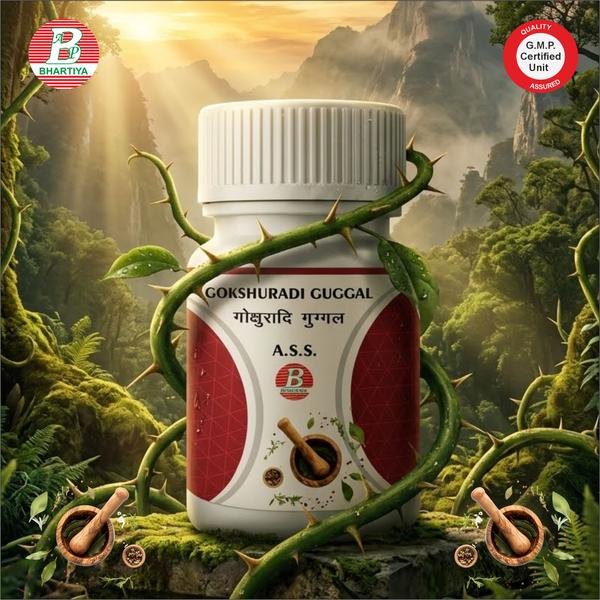
"name": "Gokshuradi Guggal",
"description": "\n GOKSHURADI GUGGUL\n\nProduct Identification \n•\tGeneric Name: Gokshuradi Guggul\n•\tType: Ayurvedic Polyherbal Formulation\n•\tPrimary Indication Area: Prameha (urinary disorders including diabetes mellitus support)\nTherapeutic Indications: Traditionally used for managing:\no\tPrameha (Madhumeha / diabetes-like conditions) – supports metabolic and urinary system balance \no\tMutravikara (urinary disorders) – helps in regulating urinary frequency and function \no\tMedo-dosha imbalance (lipid/metabolic disorders) – supports fat metabolism and weight-related metabolic issues \no\tKapha-vata disorders – helps in balancing doshas associated with metabolic syndrome \no\tGeneral metabolic weakness – used as a supportive formulation in chronic metabolic conditions\n\nKey Benefits:\n•\tSupports management of Prameha (diabetes-related metabolic imbalance)\nTraditionally used to help maintain balance in urinary and metabolic functions associated with Prameha.\nSrotas support)\nSupports healthy urinary frequency and flow, often affected in metabolic disorders.\n•\tPromotes healthy lipid and fat metabolism\nHelps manage “Medo-dosha” imbalance, which is linked with obesity and insulin resistance in Ayurveda.\n•\tSupports blood sugar balance (adjunct role)\nMay help in maintaining glucose metabolism as a supportive Ayurvedic formulation (not a standalone diabetes treatment).\n•\tReduces Kapha-related metabolic heaviness\nTraditionally used to address sluggish metabolism, heaviness, and water retention tendencies.\n•\tSupports detoxification and removal of metabolic wastes (Ama reduction)\nHelps improve digestion and metabolic processing, which is considered important in Prameha management.\n•\tSupports kidney and urinary tract health\nGokshura content traditionally supports renal and urinary system function\nFORMULA\nEach Tablet contains: \nGokshura \t1.344 kg\nShuddha Guggulu\t336g\nAmalaki \t48g\nHaritaki\t48g\nBibhitaki\t48g\nSunthi\t48g\nMarich\t48g\nPippali\t48g\nMusta\t48g\nWater\t8.0641 reduced to 4.0321\n\n 1. Gokshura (Tribulus terrestris)\n• Botanical/Scientific Name: Tribulus terrestris\n\nRasa–Guna–Vīrya–Vipāka:\n• Rasa: Madhura (Sweet), Kaṣāya (Astringent)\n• Guna: Guru (Heavy), Snigdha (Unctuous)\n• Vīrya: Śīta (Cooling)\n• Vipāka: Madhura (Sweet)\n\nPrabhāva:\n• Mutrala / Vrishya – Supports urinary system health and metabolic balance in Prameha\nMechanism of Action (Karma):\n• Mutravaha Srotas Shodhana Karma: Supports urinary tract function and regulates urinary frequency\n• Balya Karma: Improves strength and tissue nourishment\n• Kapha-Medo Hara Karma: Helps in reducing Kapha and fat-related metabolic imbalance\n\n2. Shuddha Guggulu (Commiphora mukul)\n• Botanical/Scientific Name: Commiphora mukul\n\nRasa–Guna–Vīrya–Vipāka:\n• Rasa: Tikta (Bitter), Kaṭu (Pungent)\n• Guna: Laghu (Light), Rūkṣa (Dry), Sara (Mobile)\n• Vīrya: Uṣṇa (Hot)\n• Vipāka: Kaṭu (Pungent)\n\nPrabhāva:\n• Yogavāhi / Lekhana – Enhances bioavailability and scrapes metabolic toxins (Medo-dosha)\n\nMechanism of Action (Karma):\n• Medo-Hara Karma: Reduces excess fat and supports lipid metabolism\n• Shothahara Karma: Reduces inflammation and swelling\n• Yogavāhi Karma: Enhances delivery and action of other herbs in the formulation\n\n3. Amalaki (Emblica officinalis)\n• Botanical/Scientific Name: Emblica officinalis\n\nRasa–Guna–Vīrya–Vipāka:\n• Rasa: Pancha Rasa (All tastes except Lavana), mainly Amla dominant\n• Guna: Laghu (Light), Ruksha (Dry)\n• Vīrya: Śīta (Cooling)\n• Vipāka: Madhura (Sweet)\n\nPrabhāva:\n• Rasayana – Potent rejuvenator and antioxidant support\n\nMechanism of Action (Karma):\n• Rasayana Karma: Supports tissue regeneration and immunity\n• Antioxidant Karma: Reduces oxidative stress in metabolic disorders\n• Pitta-Shamana Karma: Helps regulate heat and metabolic imbalance\n\n4. Haritaki (Terminalia chebula)\n• Botanical/Scientific Name: Terminalia chebula\n\nRasa–Guna–Vīrya–Vipāka:\n• Rasa: Pancha Rasa (all except Lavana)\n• Guna: Laghu (Light), Ruksha (Dry)\n• Vīrya: Uṣṇa (Hot)\n• Vipāka: Madhura (Sweet)\n\nPrabhāva:\n• Anulomana – Promotes proper bowel movement and detoxification\n\nMechanism of Action (Karma):\n• Deepana-Pachana Karma: Improves digestion and metabolic efficiency\n• Anulomana Karma: Supports proper elimination of waste\n• Ama-Pachana Karma: Reduces metabolic toxins linked with Prameha\n\n5. Bibhitaki (Terminalia bellirica)\n• Botanical/Scientific Name: Terminalia bellirica\n\nRasa–Guna–Vīrya–Vipāka:\n• Rasa: Kaṣāya (Astringent)\n• Guna: Laghu (Light), Ruksha (Dry)\n• Vīrya: Uṣṇa (Hot)\n• Vipāka: Madhura (Sweet)\n\nPrabhāva:\n• Kapha-Hara – Reduces excess mucus and metabolic congestion\n\nMechanism of Action (Karma):\n• Kapha-Medo Hara Karma: Helps in lipid and metabolic regulation\n• Detoxifying Karma: Supports removal of accumulated toxins\n• Metabolic Balancing Karma: Supports healthy digestion and metabolism\n\n6. Sunthi (Zingiber officinale)\n• Botanical/Scientific Name: Zingiber officinale\n\nRasa–Guna–Vīrya–Vipāka:\n• Rasa: Kaṭu (Pungent)\n• Guna: Laghu (Light), Snigdha (Slightly unctuous)\n• Vīrya: Uṣṇa (Hot)\n• Vipāka: Madhura (Sweet)\n\nPrabhāva:\n• Deepana-Pachana – Strong digestive and metabolic stimulant\n\nMechanism of Action (Karma):\n• Agni-Deepana Karma: Enhances digestive and metabolic fire\n• Shothahara Karma: Reduces inflammation\n• Bioavailability Enhancement Karma: Improves absorption of other herbs\n\n7. Marich (Piper nigrum)\n• Botanical/Scientific Name: Piper nigrum\n\nRasa–Guna–Vīrya–Vipāka:\n• Rasa: Kaṭu (Pungent)\n• Guna: Laghu (Light), Ruksha (Dry), Tikshna (Sharp)\n• Vīrya: Uṣṇa (Hot)\n• Vipāka: Kaṭu (Pungent)\n\nPrabhāva:\n• Yogavāhi – Enhances potency and absorption of other ingredients\n\nMechanism of Action (Karma):\n• Agni-Deepana Karma: Improves metabolism and digestion\n• Kapha-Hara Karma: Reduces excess Kapha and heaviness\n• Bioenhancer Karma: Increases bioavailability of active compounds\n\n8. Pippali (Piper longum)\n• Botanical/Scientific Name: Piper longum\n\nRasa–Guna–Vīrya–Vipāka:\n• Rasa: Kaṭu (Pungent)\n• Guna: Laghu (Light), Snigdha (Unctuous)\n• Vīrya: Uṣṇa (Hot)\n• Vipāka: Madhura (Sweet)\n\nPrabhāva:\n• Rasayana – Rejuvenative and bioenhancing herb\n\nMechanism of Action (Karma):\n• Agni-Deepana Karma: Enhances metabolic activity\n• Rasayana Karma: Supports tissue nourishment and strength\n• Vata-Kapha Shamana Karma: Balances doshas linked to metabolic disorders\n\n9. Musta (Cyperus rotundus)\n• Botanical/Scientific Name: Cyperus rotundus\n\nRasa–Guna–Vīrya–Vipāka:\n• Rasa: Tikta (Bitter), Kaṣāya (Astringent)\n• Guna: Laghu (Light), Ruksha (Dry)\n• Vīrya: Śīta (Cooling)\n• Vipāka: Kaṭu (Pungent)\n\nPrabhāva:\n• Tridosha Shamana – Balances all three doshas, especially Pitta and Kapha\n\nMechanism of Action (Karma):\n• Deepana-Pachana Karma: Improves digestion and metabolic regulation\n• Prameha Hara Karma: Supports management of urinary and metabolic disorders\n• Stambhana Karma: Helps regulate excessive secretions and fluid imbalance\n\nGeneral Ayurvedic dosage (adults):\nTablet/Capsule: 1–2 tablets (250–500 mg each)\n Frequency: 2 times a day\n Timing: After food (usually with lukewarm water)\n\n\n\ngokshuradi guggulu, gokshuradi guggulu benefits in hindi\ngokshuradi guggulu uses, gokshuradi guggulu uses in hindi\ngokshuradi guggulu ingredients, gokshuradi guggulu uses for male\ngokshuradi guggulu ingredients in hindi, gokshuradi guggulu benefits for male\ngokshuradi guggulu price, gokshuradi guggulu and chandraprabha vati\ngokshuradi guggulu ayurvedic medicine, gokshuradi guggulu amazon\ngokshuradi guggulu ayurvedic medicine uses, gokshuradi guggulu ayurvedic tablet\ngokshuradi guggulu benefits, gokshuradi guggulu benefits for female\ngokshuradi guggulu benefits for male in hindi, gokshuradi guggulu best brand\ngokshuradi guggulu before or after food, gokshuradi guggulu contents\ngokshuradi guggulu composition, gokshuradi guggulu dosage\ngokshuradi guggulu divya, gokshuradi guggulu ds tablet uses\ngokshuradi guggulu dose per day, gokshuradi guggulu easy ayurveda\ngokshuradi guggulu easy, gokshuradi guggulu uses easy ayurveda\ngokshuradi guggulu for weight loss, gokshuradi guggulu fayde in hindi\ngokshuradi guggulu goli, gokshuradi guggulu goli ke fayde\nwhat is gokshuradi guggulu good for, gokshuradi guggulu how to take\ngokshuradi guggulu hindi use, gokshuradi guggulu how long to take\ngokshuradi guggulu how to use, gokshuradi guggulu health benefits\ngokshuradi guggulu helps in weight loss, gokshuradi guggulu in hindi\ngokshuradi guggulu is used for, gokshuradi guggulu indication\nwhat is gokshuradi guggulu used for, what is gokshuradi guggulu\ngokshuradi guggulu ke fayde, gokshuradi guggulu ke fayde in hindi\ngokshuradi guggulu kis kaam aati hai, gokshuradi guggulu kaise khaye\ngokshuradi guggulu lene ka tarika, gokshuradi guggulu lene ke fayde\ngokshuradi guggulu kab lena chahiye, gokshuradi guggulu kis liye hota hai\ngokshuradi guggulu medicine, gokshuradi guggulu mrp, gokshuradi guggulu medicine uses\ngokshuradi guggulu near me, gokshuradi guggulu scientific name, gokshuradi guggulu botanical name\ngokshuradi guggulu online, benefits of gokshuradi guggulu, uses of gokshuradi guggulu\ningredients of gokshuradi guggulu, uses of gokshuradi guggulu in hindi, benefits of gokshuradi guggulu in hindi\ndosage of gokshuradi guggulu, gokshuradi guggulu plant, gokshuradi guggulu powder\ngokshuradi guggulu price in india, gokshuradi guggulu review, gokshuradi guggulu rate\ngokshuradi guggulu tablet, gokshuradi guggulu tablets benefits, gokshuradi guggulu tablet uses\ngokshuradi guggulu tablet uses in hindi, gokshuradi guggulu tablet ke fayde\ngokshuradi guggulu tablet price, gokshuradi guggulu tablets benefits in hindi\ngokshuradi guggulu tablet dosage, gokshuradi guggulu when to take\ngokshuradi guggul tablet, tablet gokshuradi guggulu, is gokshuradi guggulu good for kidney",
"price": 240.0,
"discountamount": 120.0,
"currencycode": "INR",
"priority": 1000000,
"isfreeshipmentavailable": false,
"shipmentduration": 1,
"_keywords": null,
"isarchived": false,
"isavailable": true,
"applicationid": null,
"productindex": 138,
"imageuri": "https://productimages.withfloats.com/actual/6a293335373107961f76938d.jpg",
"tileimageuri": "https://productimages.withfloats.com/tile/6a293335373107961f76938d.jpg",
"images": null,
"totalqueries": 0,
"gpid": null,
"groupproductid": null,
"createdon": "2026-06-10T09:49:36.351Z",
"updatedon": "2026-06-10T09:49:36.351Z",
"buyonlinelink": null,
"producturl": "http://WWW.BHARTIYAAYURVEDICPHARMACY.COM/products/gokshuradi-guggal/138",
"availableunits": -1.0,
"iscodavailable": true,
"isprepaidonlineavailable": true,
"maxcodorders": -1,
"maxprepaidonlineorders": -1,
"uniquepaymenturl": null,
"brandname": "Bakula Fort",
"category": "Gokshuradi Guggal 100 gm X 40",
"tags": [],
"variants": false,
"keyspecification": null,
"otherspecifications": null,
"pickupaddressreferenceid": null,
"paymenttype": "AssuredPurchase",
"producttype": "products",
"hsncode": null,
"gstslab": 0.0,
"isnotforsale": false
},
{
"_id": "69f58edb071b2b9418e4b8de",
"fptag": "BHARTIYEAYURVEDICPHARMACY",
"merchantname": null,
"customwidgets": null,
"externalsourceid": null,
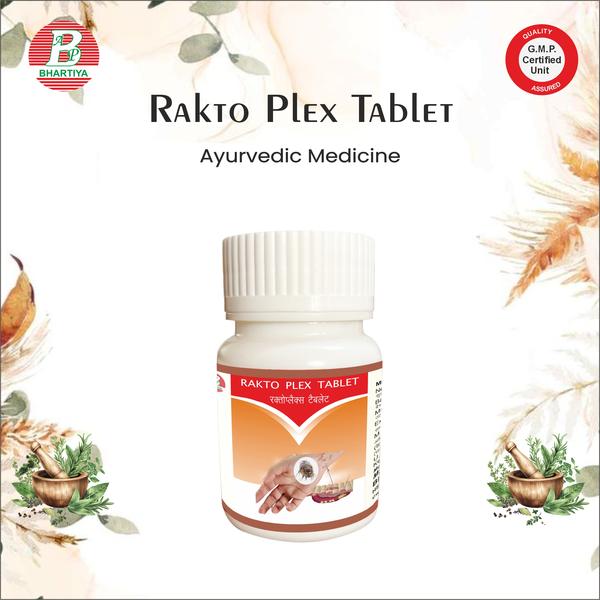
"name": "RAKTO PLEX TABLET",
"description": " RAKTO PLEX TABLET \n\nProduct Identification\n•\tGeneric Name: Rakto Plex Tablet\n•\tType: Ayurvedic Patent Medicine\n•\tPrimary Indication Area: Blood disorders (Rakt Vikar), Blood purification, Anaemia.\n\nTherapeutic Indications\nRakto Plex Tablet is used to support blood health by purifying blood, managing blood disorders (Rakt Vikar), and improving anaemia.\nKey benefits include:\nPrimary Benefit:\n•\tHelps in the management of blood disorders (Rakt Vikar) and anaemia by improving the quality and quantity of blood.\nOther Benefits:\no\tSupports overall energy and vitality\no\tMay help in skin health by improving blood quality\no\tSupports general well-being and immunity\nIngredients:\n CHOBCHINI \nBotanical / Common Name: Gymnema sylvestre\n•\tKey Phytoconstituents:\no\tGymnemic acids\no\tSaponins\no\tFlavonoids\no\tAlkaloids\nMechanism of Action in Rakt Vikar (Blood Disorders / Anaemia) – Biochemistry / Pharmacology:\n1.\tBlood Sugar Regulation & Metabolic Support\no\tGymnemic acids reduce glucose absorption in the intestine and enhance insulin secretion.\no\tImproved glycaemic control indirectly supports healthy blood composition.\n2.\tHematopoietic & Blood Purification Effects\no\tFlavonoids and saponins have antioxidant properties, reducing oxidative stress on red blood cells.\no\tSupports haemoglobin synthesis and improves RBC count, aiding in anaemia management.\n3.\tAnti-inflammatory & Immunomodulatory Activity\no\tReduces chronic inflammation in the blood and vascular tissues.\no\tEnhances immune regulation, contributing to overall blood health.\n4.\tLipid and Circulatory Support\no\tHelps normalize lipid levels, preventing blood thickening and improving circulation.\no\tProtects against free radical damage in blood vessels and plasma.\n\n KARANJUA \n•\tBotanical / Common Name: Pongamia pinnata\n•\tKey Phytoconstituents:\no\tFlavonoids (e.g., Pongamol, Karangin)\no\tAlkaloids\no\tTriterpenoids\no\tGlycosides\no\tFatty acids\nMechanism of Action in Rakt Vikar (Blood Disorders) – Biochemistry / Pharmacology:\n1.\tHematopoietic & Blood Purification Effects\no\tFlavonoids and triterpenoids act as antioxidants, protecting red blood cells from oxidative damage.\no\tPromotes purification of blood and supports normal haemoglobin levels.\n2.\tAnti-inflammatory & Detoxifying Action\no\tReduces chronic inflammation in blood vessels and tissues.\no\tDetoxifies the blood by neutralizing free radicals and harmful metabolites.\n3.\tCirculatory & Cardiovascular Support\no\tSupports healthy circulation by improving blood vessel function.\no\tMild vasodilatory effects help maintain normal blood flow.\n4.\tAntimicrobial Properties\no\tAlkaloids and flavonoids help protect blood from microbial infections, indirectly supporting blood health.\n REETHA \n•\tBotanical / Common Name: Sapindus mukorossi (Soapnut)\n•\tKey Phytoconstituents:\no\tSaponins\no\tFlavonoids\no\tTannins\no\tGlycosides\nMechanism of Action in Rakt Vikar (Blood Disorders) – Biochemistry / Pharmacology:\n1.\tBlood Purification & Detoxification\no\tSaponins and flavonoids have antioxidant properties that help detoxify the blood by neutralizing free radicals.\no\tSupports elimination of metabolic waste and toxins from the bloodstream.\n2.\tHematopoietic Support\no\tEnhances red blood cell health and may support haemoglobin levels, aiding in anaemia management.\n3.\tAnti-inflammatory & Immunomodulatory Effects\no\tReduces inflammation in blood and vascular tissues.\no\tModulates immune response, contributing to overall blood health.\n4.\tCirculatory & Cardiovascular Support\no\tImproves microcirculation and maintains healthy blood flow.\no\tProtects vascular endothelium from oxidative stress.\n\n SHUDH GANDHAK \n•\tBotanical / Common Name: Sulphur (Purified Form)\n•\tKey Phytoconstituents / Components:\no\tElemental Sulphur (S)\no\tTrace mineral impurities removed during purification\nMechanism of Action in Rakt Vikar (Blood Disorders) – Biochemistry / Pharmacology:\n1.\tBlood Purification & Detoxification\no\tActs as a natural detoxifier by removing toxins and impurities from the blood.\no\tEnhances metabolic processes that support purification of blood.\n2.\tAntimicrobial & Anti-inflammatory Effects\no\tExhibits mild antimicrobial activity, protecting blood from infections.\no\tReduces inflammation in tissues, indirectly supporting blood health.\n3.\tHematopoietic & Tissue Support\no\tSupports healthy red blood cell formation and tissue regeneration.\no\tPromotes skin and connective tissue health through sulphur-dependent enzymatic pathways.\n4.\tMetabolic & Enzymatic Role\no\tEssential for certain enzymes and amino acids (like cysteine and methionine) that are important for detoxification and maintaining blood health.\n\n RAS MANIKYA \n•\tBotanical / Common Name: Arsenic trisulfide (Purified Form)\n•\tType: Ayurvedic herbo-mineral preparation (Rasaushadhi)\nKey Components / Phytoconstituents:\n•\tArsenic trisulfide (As₂S₃) – purified\n•\tOther trace minerals from traditional purification (Shodhana) processes\nMechanism of Action in Rakt Vikar (Blood Disorders) – Biochemistry / Pharmacology:\n1.\tBlood Purification & Detoxification\no\tActs to detoxify and purify the blood, removing impurities and harmful metabolic by-products.\no\tEnhances liver and kidney function indirectly to support cleaner blood.\n2.\tHematopoietic & Tissue Support\no\tSupports formation and maintenance of healthy blood cells.\no\tAids in managing anaemia and improving overall vitality.\n3.\tAnti-inflammatory & Immunomodulatory Effects\no\tReduces inflammation in blood and tissue, supporting normal circulation.\no\tModulates immune response to protect blood and vascular health.\n4.\tMetabolic Activity\no\tInfluences enzymatic pathways involved in detoxification and tissue repair.\no\tSupports general metabolic balance, contributing to improved blood quality.\nDosage:\nDose per Intake: 1–2 tablets\nFrequency: Twice a day (morning and evening)\nTotal Daily Dose: 2–4 tablets per day\nAnupan (Vehicle / Medium):\n•\tPreferred: Take with water\n•\tOptional: Can be taken with milk for better absorption and nourishing effect\n•\tTiming: Preferably after meals to reduce gastric irritation\nPrecautions:\n•\tDo not exceed the prescribed dose\n•\tMonitor for any side effects\nConsult an Ayurvedic Practitioner Before Use in:\n•\tChildren\n•\tElderly\n•\tIndividuals with chronic illnesses\n\n\nraktoplex tablet price, raktoplex tablet uses in hindi\nraktoplex tablet uses, raktoplex tablet amazon\nraktoplex tablet amazon india, raktoplex tablet buy online\nraktoplex tablet buy, raktoplex tablet benefits\nraktoplex tablet box, raktoplex tablet benefits in hindi\nraktoplex tablet composition, raktoplex tablet company\nraktoplex tablet catalogue pdf, raktoplex tablet catalogue\nraktoplex tablet content, raktoplex tablet download\nraktoplex tablet english, raktoplex tablet export\nraktoplex tablet export data, raktoplex tablet flipkart\nraktoplex tablet faridabad, raktoplex tablet free download\nraktoplex tablet free, raktoplex tablet for\nraktoplex tablet gst rate, raktoplex tablet ghaziabad\nraktoplex tablet gst, raktoplex tablet ghaziabad uttar pradesh\nraktoplex tablet grade, raktoplex tablet hsn code\nraktoplex tablet hindi, raktoplex tablet holder\nraktoplex tablet indiamart, raktoplex tablet in hindi\nraktoplex tablet images, raktoplex tablet india\nraktoplex tablet joint, raktoplex tablet jalandhar\nraktoplex tablet kya kam karta hai, raktoplex tablet ke fayde in hindi\nraktoplex tablet login, raktoplex tablet list, raktoplex tablet manufacturer\nraktoplex tablet manufacturing company, raktoplex tablet manufacturers in india\nraktoplex tablet name, raktoplex tablet near me\nraktoplex tablet new, raktoplex tablet online shopping\nraktoplex tablet online, raktoplex tablet online order\nraktoplex tablet price in india, raktoplex tablet quality\nraktoplex tablet q10, raktoplex tablet review\nraktoplex tablet rate, raktoplex tablet review in hindi\nraktoplex tablet supplier, raktoplex tablet specification\nraktoplex tablet supplier in delhi, raktoplex tablet tds\nraktoplex tablet wholesale, raktoplex tablet weight in kg\nraktoplex tablet wholesale price, raktoplex tablet which company",
"price": 105.0,
"discountamount": 50.0,
"currencycode": "INR",
"priority": 1000000,
"isfreeshipmentavailable": false,
"shipmentduration": 1,
"_keywords": null,
"isarchived": false,
"isavailable": true,
"applicationid": null,
"productindex": 111,
"imageuri": "https://productimages.withfloats.com/actual/69f58edde35d63e511a95424.jpg",
"tileimageuri": "https://productimages.withfloats.com/tile/69f58edde35d63e511a95424.jpg",
"images": null,
"totalqueries": 0,
"gpid": null,
"groupproductid": null,
"createdon": "2026-05-02T05:42:51.125Z",
"updatedon": "2026-05-02T05:42:51.125Z",
"buyonlinelink": null,
"producturl": "http://WWW.BHARTIYAAYURVEDICPHARMACY.COM//rakto-plex-tablet/111",
"availableunits": -1.0,
"iscodavailable": true,
"isprepaidonlineavailable": true,
"maxcodorders": -1,
"maxprepaidonlineorders": -1,
"uniquepaymenturl": null,
"brandname": "Bakula Fort",
"category": "RAKTO PLEX TABLET 100 Tab X 50",
"tags": [],
"variants": false,
"keyspecification": null,
"otherspecifications": null,
"pickupaddressreferenceid": null,
"paymenttype": "AssuredPurchase",
"producttype": "products",
"hsncode": null,
"gstslab": 0.0,
"isnotforsale": false
},
{
"_id": "69e8891bfe3f5514f1dc5681",
"fptag": "BHARTIYEAYURVEDICPHARMACY",
"merchantname": null,
"customwidgets": null,
"externalsourceid": null,
"name": "Kasleen Tablet",
"description": " KASLEEN TABLET \n\nProduct Identification\n•\tGeneric Name: Kasleen Tablet\n•\tType: Ayurvedic Patent Medicine\n•\tPrimary Indication Area: Relief of cough and common cold symptoms — including runny nose, nasal congestion, and throat irritation\nTherapeutic Indications:\n•\tUsed for relief of cough and cold symptoms, including runny nose, nasal congestion (nazla/jukam), and throat irritation associated with upper respiratory infections\n Primary Benefit:\n•\tProvides relief from cough and common cold symptoms, including easing cough, throat irritation, nasal congestion, and runny or blocked nose associated with upper respiratory discomfort.\nOther Benefits:\n• Soothes throat irritation and soreness, making talking and swallowing more comfortable. \n• Helps reduce mucus and congestion, supporting clearer breathing. \n• May assist in easing respiratory discomfort, such as chest heaviness and irritation. \n• Supports overall respiratory comfort in both dry and productive cough conditions\n MULETHI \nBotanical / Scientific Name: Glycyrrhiza glabra L. (Licorice) \nKey Bioactive Constituents:\n• Glycyrrhizin & glycyrrhetinic acid\n• Liquiritin / flavonoids\n• Saponins / phenolic compounds\n• Mucilage / polysaccharides \nMechanism of Action – Cough, Cold & Congestion\n1.\tDemulcent / Soothing Action\no\tRoot mucilage and glycyrrhizin form a protective coating on irritated mucous membranes.\no\tHelps soothe sore throat and reduce cough reflex irritation. \n2.\tExpectorant & Mucus Clearing Effect\no\tLiquiritin and saponins stimulate secretion of thinner mucus in airways.\no\tEncourages loosening and expulsion of phlegm, improving congestion. \n\nPIPPALI \nBotanical / Scientific Name: Piper longum L. (Long Pepper) \nKey Bioactive Constituents:\n• Piperine (major alkaloid)\n• Volatile oils (pinene, limonene)\n• Alkaloids (pellitorine, piperlongumine)\n• Flavonoids & polyphenols \n\nMechanism of Action – Cough, Cold & Congestion\n1.\tAntitussive / Cough Suppression\no\tPippali exhibits a cough suppressing action, reducing irritation in the respiratory tract that triggers coughing.\no\tThis is attributed to its alkaloid and volatile oil actions on mucosal tissues. \n2.\tExpectorant / Mucus Clearing Effect\no\tThe volatile oils and piperine help loosen and expel mucus from the airways, aiding removal of phlegm and relieving chest congestion.\no\tThis facilitates easier breathing. \n\n SAUNF \nBotanical / Scientific Name: Foeniculum vulgare Mill. (Fennel) \nKey Phytoconstituents:\n• Essential oils (anethole, fenchone, pinene, limonene) \nMechanism of Action – Cough, Cold & Congestion\n1.\tExpectorant / Mucus Clearing Action\no\tVolatile oils (e.g., anethole) help loosen and thin mucus in the respiratory tract.\no\tMakes phlegm easier to expel, easing congestion and productive coughs. \n2.\tAnti Inflammatory Effect\no\tCompounds in Saunf exhibit anti inflammatory properties that help reduce airway and throat inflammation.\no\tSupports relief from sore throat and cough irritation. \n\n SOMLATA \nBotanical / Scientific Name: Ephedra gerardiana (also Ephedra vulgaris) — a medicinal herb traditionally used in Ayurveda and folk medicine for respiratory support. \nKey Bioactive Constituents:\n• Alkaloids (ephedrine, pseudoephedrine, nor ephedrine)\n• Flavonoids\n• Tannins\n• Phenolic compounds\n• Volatile constituents \nMechanism of Action – Cough, Cold & Congestion\n1.\tBronchodilator Action\no\tEphedrine and related alkaloids stimulate sympathetic receptors, leading to relaxation of bronchial smooth muscles.\no\tResults in easier airflow and relief from bronchospasm / tight chest associated with cough and cold. \n2.\tDecongestant Effect\no\tEphedrine type compounds cause mild vasoconstriction (shrinking of swollen mucous membranes), helping reduce nasal and airway congestion.\no\tThis improves nasal drainage and breathing comfort. \n\nBANFSA \nBotanical / Scientific Name: Viola odorata L. (Sweet Violet / Wood Violet) \nFamily: Violaceae \nKey Phytoconstituents:\n• Flavonoids\n• Glycosides (e.g., methyl salicylate glycoside)\n• Alkaloids\n• Saponins\n• Tannins\n• Volatile oils \nMechanism of Action – Cough, Cold & Congestion\n1.\tExpectorant / Phlegm Clearance\n• Promotes loosening and expulsion of mucus from the respiratory tract.\n• Aids in relieving congestion and productive cough. \n2.\tDemulcent / Soothing Effect\n• Soothes irritated mucous membranes of throat and chest.\n• Helps reduce cough reflex irritation. \n\nSUGAR \nBotanical / Scientific Reference: Sucrose (a common dietary sugar, carbohydrate source) \nKey Constituents:\n• Sucrose (disaccharide of glucose + fructose) \n• Glucose (monosaccharide) \n• Fructose (monosaccharide) \nMechanism of Action – Biochemistry / Physiological Effects\n1.\tRapid Energy Source\n• Broken down into glucose and fructose → absorbed into bloodstream; glucose fuels cells and is used in ATP production. \n2.\tBlood Sugar Regulation & Insulin Response\n• Glucose stimulates insulin release from pancreatic β cells to help transport sugar into cells for energy. \n\nSAUNF TAIL \nBotanical / Scientific Name: Foeniculum vulgare Mill. (Fennel) — oil extracted from seeds (“Saunf”) by steam distillation. \nKey Bioactive Constituents:\n• Volatile Oil: Anethole (major), Fenchone, Estragole, α pinenes, limonene, terpenes \n• Phenolic compounds and antioxidants (in fixed and volatile oil) \nMechanism of Action – Cough, Cold & Congestion\n1.\tExpectorant / Mucus Clearance\no\tThe volatile oil components (like anethole) exhibit expectorant action by thinning and mobilizing mucus in the respiratory tract.\no\tHelps reduce phlegm congestion and supports easier cough clearance. \n2.\tAnti inflammatory & Soothing Effect\no\tActive constituents reduce inflammation of the airway mucosa and soothe irritated throat and bronchial tissues.\no\tEases sore throat discomfort and cough irritation. \n\nNEELGIRI TAIL \nBotanical / Scientific Name: Eucalyptus globulus Labill. (Eucalyptus Oil) — essential oil obtained from leaves of the tree. \nKey Phytoconstituents:\n• 1,8 Cineole (Eucalyptol) – dominant volatile monoterpene. \n• α Pinene – anti inflammatory & bronchodilator. \n• Limonene, α terpineol & other minor terpenes – support respiratory effects. \nMechanism of Action – Cough, Cold & Congestion\n1.\tDecongestant / Mucus Clearing Action\no\tVolatile oil components like 1,8 cineole help loosen and mobilize mucus, making it easier to expel and reducing nasal and chest congestion.\no\tSupports clearer breathing when inhaled (steam) or diffused. \n2.\tExpectorant Effect\no\tEucalyptus oil promotes phlegm loosening and ejection from the respiratory passages — calming productive coughs.\no\tThis also helps clear sinus and bronchial congestion. \n\n SATPUDINA \nBotanical / Scientific Reference: Satpudina — a traditional herbal ingredient often identified with medicinal mint/fennel mixtures used in Ayurvedic cough remedies such as Multani Kuka syrup (exact botanical classification varies in traditional sources). \nKey Phytoconstituents (Reported / Traditional):\n• Volatile oils (menthol, menthone, limonene) — aromatic compounds\n• Other anti inflammatory and soothing components found in mint like herbs \nMechanism of Action – Cough, Cold & Congestion\n1.\tExpectorant / Mucus Mobilization\n• Helps loosen and facilitate expulsion of mucus from the respiratory tract.\n• Aids in phlegm clearance and congestion relief. \n2.\tAnti inflammatory Action\n• Compounds may reduce throat and airway inflammation, easing irritation and cough triggers.\n• Contributes to reduced sore throat discomfort. \n\nDALCHINI \nBotanical / Scientific Name: Cinnamomum zeylanicum (also Cinnamomum verum) — Cinnamon bark. \nKey Phytoconstituents:\n• Volatile oils (cinnamaldehyde, eugenol, pinene, phellandrene, cymene) \n• Tannins and mucilage \n\nMechanism of Action – Cough, Cold & Congestion\n1.\tAntimicrobial / Antiseptic Action\n• Cinnamaldehyde and eugenol exhibit antibacterial and mild antiviral action, helping reduce microbial irritation in the respiratory tract. \n2.\tAnti inflammatory Effect\n• Volatile oils and tannins help reduce inflammation of throat and bronchial mucosa, soothing sore throat and respiratory irritation. \n\nTULSI \nBotanical / Scientific Name: Ocimum sanctum L. (Holy Basil) \nKey Phytoconstituents:\n• Eugenol, camphor, linalool (volatile oils)\n• Rosmarinic acid, ursolic acid (anti inflammatory compounds)\n• Flavonoids & phenolic acids (antioxidants) \nMechanism of Action – Cough, Cold & Congestion\n1.\tAntitussive / Cough Soothing Effect\no\tTulsi helps suppress the cough reflex and soothe irritated throat tissues, reducing cough severity. \n2.\tExpectorant / Mucus Clearance\no\tPromotes loosening and mobilization of mucus from the airways, aiding expectoration and relieving chest congestion. \n\nDosage \n Dose: 2 tablets twice a day (usually morning and evening).\n Method: Swallow the tablets with warm water to help them dissolve and work better.\n Purpose: Helps relieve cold, cough, and congestion in the chest and nose.\n Timing Tips:\n•\tTake the tablets about 12 hours apart.\n•\tBest taken after meals to avoid stomach upset.\n Additional Advice:\n•\tDrink plenty of warm fluids like water, tea, or soup to help loosen mucus.\n•\tRest well to aid recovery.\n•\tDo not exceed the prescribed dose.\n•\tStop and consult a doctor if you notice side effects like rash, excessive drowsiness, or difficulty breathing.\n\nkasleen tablet download, kasleen tablet display\nkasleen tablet doctor, kasleen tablet delhi\nkasleen tablet delhi case, kasleen tablet free download\nkasleen tablet font free download, kasleen tablet free\nkasleen tablet font download, kasleen tablet facebook\nkasleen tablet fight, kasleen tablet facebook post\nkasleen tablet holder, kasleen tablet haryana\nkasleen tablet hindi, kasleen tablet happiness\nkasleen tablet images, kasleen tablet indiamart\nkasleen tablet in english, kasleen tablet in hindi\nkasleen tablet in india, kasleen tablet interview\nkasleen tablet keyboard, kasleen tablet ke fayde\nkasleen tablet ke fayde in hindi, kasleen tablet ka matlab\nkasleen tablet kaun hai, kasleen tablet khan ki video\nkasleen tablet login, kasleen tablet logo\nkasleen tablet list, kasleen tablet lab\nkasleen tablet latest new, kasleen tablet lifestyle\nkasleen tablet model, kasleen tablet manufacturer\nkasleen tablet meaning, kasleen tablet music\nkasleen tablet meaning in urdu, kasleen tablet mishra\nkasleen tablet name, kasleen tablet new\nkasleen tablet new delhi, kasleen tablet now\nkasleen tablet news, kasleen tablet name meaning\nkasleen tablet online shopping, kasleen tablet online\nkasleen tablet owner, kasleen tablet order\nkasleen tablet on instagram, kasleen tablet price\nkasleen tablet price in india, kasleen tablet prints\nkasleen tablet punjabi, kasleen tablet pic\nkasleen tablet quality, kasleen tablet review\nkasleen tablet rs, kasleen tablet store\nkasleen tablet shop, kasleen tablet stand price\nkasleen tablet store narela, kasleen tablet suri\nkasleen tablet tablet, kasleen tablet to\nkasleen tablet tablet uses in hindi\nkasleen tablet tablet uses\nkasleen tablet to english\nkasleen tablet times now\nkasleen tablet uses in hindi\nkasleen tablet uses\nkasleen tablet writing\nkasleen tablet word\n",
"price": 63.0,
"discountamount": 25.0,
"currencycode": "INR",
"priority": 1000000,
"isfreeshipmentavailable": false,
"shipmentduration": 1,
"_keywords": null,
"isarchived": false,
"isavailable": true,
"applicationid": null,
"productindex": 102,
"imageuri": "https://productimages.withfloats.com/actual/69e88920a7406eae06b4c2e8.jpg",
"tileimageuri": "https://productimages.withfloats.com/tile/69e88920a7406eae06b4c2e8.jpg",
"images": null,
"totalqueries": 0,
"gpid": null,
"groupproductid": null,
"createdon": "2026-04-22T08:38:51.48Z",
"updatedon": "2026-04-22T08:38:51.48Z",
"buyonlinelink": null,
"producturl": "http://WWW.BHARTIYAAYURVEDICPHARMACY.COM//kasleen-tablet/102",
"availableunits": -1.0,
"iscodavailable": true,
"isprepaidonlineavailable": true,
"maxcodorders": -1,
"maxprepaidonlineorders": -1,
"uniquepaymenturl": null,
"brandname": "Bakula Fort",
"category": "Kasleen Tablet 100 Tab X 50",
"tags": [],
"variants": false,
"keyspecification": null,
"otherspecifications": null,
"pickupaddressreferenceid": null,
"paymenttype": "AssuredPurchase",
"producttype": "products",
"hsncode": null,
"gstslab": 0.0,
"isnotforsale": false
},
{
"_id": "69e08903ef2bb462c498463f",
"fptag": "BHARTIYEAYURVEDICPHARMACY",
"merchantname": null,
"customwidgets": null,
"externalsourceid": null,
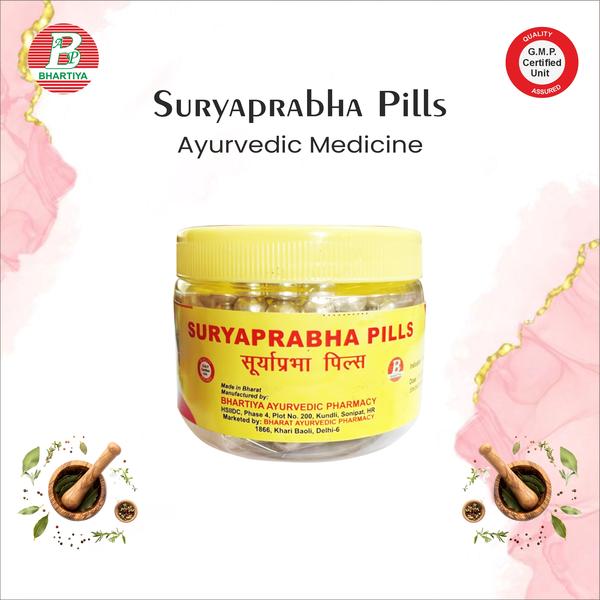
"name": "SURYAPRABHA PILLS",
"description": " SURYAPRABHA PILLS (SILVER COATED) \n\nProduct Identification\n•\tGeneric Name: Suryaprabha Pills\n•\tType: Ayurvedic Patent Medicine\n•\tPrimary Indication Area: Diabetes (Prameha / Blood Sugar Imbalance)\nTherapeutic Indications: The management of diabetes (Prameha / high blood sugar) and to support metabolic health, digestive strength, and overall vitality.\n\nKey benefits include:\n•\tBlood Sugar Support: Helps maintain healthy glucose levels.\n•\tDigestive & Metabolic Support: Enhances digestion, nutrient absorption, and metabolism.\n•\tPancreatic & Liver Health: Supports proper insulin function and detoxification.\n•\tStamina & Vitality: Helps combat fatigue and weakness associated with diabetes.\n•\tRasayana (Rejuvenation): Supports overall tissue nourishment and long-term health.\n\nIngredients:\n Giloy (Tinospora cordifolia) \nAyurvedic Name: Giloy / Guduchi\nPrimary Uses in Diabetes: Helps regulate blood glucose, improves insulin sensitivity, and protects organs from diabetic complications.\nKey Phytoconstituents\n•\tAlkaloids (e.g., berberine, magnoflorine)\n•\tDiterpenoid lactones (e.g., Tinosporide)\n•\tGlycosides\n•\tFlavonoids\n•\tSteroids\n•\tPolysaccharides\nThese compounds contribute to its antidiabetic, antioxidant, and immunomodulatory effects.\nMechanism of Action in Diabetes\n1. Insulin Sensitization & Secretion\n•\tGiloy stimulates pancreatic beta cells → increases insulin secretion.\n•\tImproves insulin receptor sensitivity on target tissues (muscle and adipose), enhancing glucose uptake.\n•\tAlkaloids like berberine mimic insulin action by activating AMPK pathway, which helps lower blood glucose.\n2. Carbohydrate Metabolism Regulation\n•\tModulates key enzymes:\no\tIncreases glucokinase activity → promotes glucose utilization in the liver.\no\tInhibits glucose-6-phosphatase & fructose-1,6-bisphosphatase → reduces hepatic gluconeogenesis.\n•\tThis leads to lower fasting and postprandial blood glucose.\n\nHaldi / Turmeric (Curcuma longa) \nAyurvedic Name: Haridra / Haldi\nPrimary Uses: Anti-inflammatory, antioxidant, digestive support, liver protection, and metabolic health (including blood sugar support).\nKey Phytoconstituents\n•\tCurcuminoids: Curcumin (major active compound), desmethoxycurcumin, bisdemethoxycurcumin\n•\tVolatile oils: Turmerone, zingiberene, atlantone\n•\tProteins & sugars\n•\tMinerals: Iron, calcium\nBiochemical & Pharmacological Actions\n1. Anti-inflammatory\n•\tCurcumin inhibits NF-κB pathway, reducing pro-inflammatory cytokines: TNF-α, IL-1β, IL-6.\n•\tSuppresses COX-2 and LOX enzymes, reducing prostaglandin and leukotriene production.\n•\tHelps in arthritis, inflammation, and chronic metabolic inflammation.\n2. Antioxidant\n•\tCurcumin neutralizes free radicals (ROS and RNS).\n•\tUpregulates endogenous antioxidant enzymes: SOD, catalase, glutathione peroxidase.\n•\tProtects tissues (liver, pancreas, kidneys, and heart) from oxidative stress.\n\nAtis (Aconitum heterophyllum) \nPrimary Role in Diabetes (Ayurvedic / Biochemical Basis):\nAtis is considered a mild hypoglycaemic and metabolism-supportive herb in traditional use, mainly through digestive and metabolic regulation. Modern research is limited, but biochemical mechanisms can be inferred.\nKey Phytochemicals Relevant to Diabetes\n•\tNon-toxic alkaloids (stimulatory to metabolism)\n•\tPhenolic compounds (antioxidant effects)\n•\tCarbohydrates and starch (support energy metabolism)\n•\tTannins (reduce oxidative gut stress)\nMechanisms of Action – Biochemical Basis\n1. Digestive & Metabolic Support\n•\tEnhances Agni (digestive fire) → indirectly supports carbohydrate digestion and absorption.\n•\tBetter digestion → improved glucose homeostasis because nutrients are metabolized efficiently.\n2. Antioxidant Action\n•\tPhenolic compounds neutralize free radicals generated by high blood sugar.\n•\tProtects pancreatic β-cells from oxidative damage → maintains insulin production.\n\nDaru Haldi (Berberis aristata) \nAyurvedic Name: Daruharidra / Daruhaldi\nPrimary Uses: Diabetes (Madhumeha), metabolic disorders, liver protection, antioxidant support\nKey Phytochemicals\n•\tAlkaloids: Berberine (major active compound), palmatine, jatrorrhizine\n•\tPolyphenols and flavonoids\n•\tTannins\n•\tOrganic acids\nBerberine is the primary active compound responsible for most antidiabetic effects.\nBiochemical Mechanisms in Diabetes\n1. Insulin Sensitization\n•\tBerberine activates AMPK (AMP-activated protein kinase) → acts like an “energy sensor” in cells.\n•\tIncreases glucose uptake in muscle and adipose tissue → lowers blood sugar.\n•\tImproves insulin receptor expression and sensitivity.\n2. Inhibition of Gluconeogenesis\n•\tReduces hepatic glucose production by inhibiting gluconeogenic enzymes:\no\tGlucose-6-phosphatase\no\tPhosphoenolpyruvate carboxykinase (PEPCK)\n•\tLeads to lower fasting blood glucose.\n\nPippali (Piper longum) \nAyurvedic Name: Pippali\nPrimary Uses: Diabetes (Madhumeha), digestive support, respiratory support, metabolism booster\nKey Phytochemicals\n•\tAlkaloids: Piperine (main active compound)\n•\tEssential oils: Caryophyllene, Pinene\n•\tFlavonoids, phenolic compounds\n•\tLignans\nPiperine is the primary bioactive compound responsible for most pharmacological effects.\nBiochemical Mechanisms in Diabetes\n1. Improves Insulin Sensitivity\n•\tPiperine enhances insulin receptor activity → increases glucose uptake in muscles and adipose tissue.\n•\tActs as a cellular sensitizer, making tissues respond better to insulin.\n2. Enhances Glucose Metabolism\n•\tStimulates glycolytic enzymes → promotes breakdown of glucose for energy.\n•\tReduces hepatic gluconeogenesis → less glucose is released into blood by the liver.\n\nChitrak (Plumbago zeylanica) \nAyurvedic Name: Chitraka\nPrimary Uses in Diabetes (Madhumeha): Digestive and metabolic support, improving glucose utilization, stimulating pancreatic function, and enhancing fat metabolism.\nKey Phytochemicals\n•\tPlumbagin (primary bioactive naphthoquinone)\n•\tAlkaloids\n•\tFlavonoids and phenolic compounds\n•\tEssential oils\nPlumbagin is the main compound responsible for antidiabetic effects.\nBiochemical Mechanisms in Diabetes\n1. Enhances Glucose Uptake\n•\tPlumbagin stimulates glucose transporter (GLUT4) translocation in muscle and adipose tissue.\n•\tImproves peripheral glucose utilization, lowering blood sugar.\n2. Stimulates Pancreatic Function\n•\tMildly supports pancreatic β-cell activity → helps maintain insulin secretion.\n•\tProtects β-cells from oxidative stress-induced damage.\n\nHarad (Terminalia chebula) \nAyurvedic Name: Haritaki / Harad\nPrimary Uses in Diabetes (Madhumeha): Blood sugar regulation, antioxidant support, lipid metabolism improvement, and digestive/metabolic balance.\nKey Phytochemicals\n•\tTannins: Chebulinic acid, chebulagic acid, gallic acid\n•\tFlavonoids and phenolic compounds\n•\tOrganic acids\n•\tPolysaccharides\nMost antidiabetic effects are attributed to tannins and polyphenols.\nBiochemical Mechanisms in Diabetes\n1. Improves Insulin Sensitivity\n•\tPolyphenols and tannins enhance insulin receptor activity on muscle and adipose tissues.\n•\tPromotes glucose uptake by cells → lowers blood sugar.\n2. Reduces Hepatic Glucose Production\n•\tInhibits gluconeogenic enzymes (glucose-6-phosphatase, PEPCK) → reduces fasting blood glucose.\n•\tHelps regulate hepatic glucose output.\n\nAmla (Phyllanthus emblica) \nAyurvedic Name: Amla / Amalaki\nPrimary Uses in Diabetes (Madhumeha): Blood sugar regulation, antioxidant protection, lipid metabolism improvement, and pancreatic β-cell protection.\nKey Phytochemicals\n•\tVitamin C (Ascorbic acid) – very high content\n•\tTannins: Emblicanin A & B, punigluconin, pedunculagin\n•\tFlavonoids and polyphenols\n•\tGallic acid and ellagic acid\nThe antioxidant compounds and tannins are responsible for most antidiabetic effects.\nBiochemical Mechanisms in Diabetes\n1. Enhances Insulin Secretion & β-Cell Protection\n•\tAntioxidants in Amla protect pancreatic β-cells from oxidative stress.\n•\tSupports insulin secretion in mild diabetes.\n2. Improves Insulin Sensitivity\n•\tPolyphenols improve insulin receptor activity on muscle and adipose tissues.\n•\tEnhances peripheral glucose uptake → lowers blood sugar.\n\nChavya (Piper chaba) \nAyurvedic Name: Chavya\nPrimary Uses in Diabetes (Madhumeha): Blood sugar regulation, digestive/metabolic support, and insulin sensitization.\nKey Phytochemicals\n•\tAlkaloids: Piperine (main active compound)\n•\tEssential oils: Caryophyllene, pinene\n•\tFlavonoids and polyphenols\n•\tLignans\nPiperine is the main bioactive compound responsible for most antidiabetic effects\nBiochemical Mechanisms in Diabetes\n1. Enhances Insulin Sensitivity\n•\tPiperine improves insulin receptor activity in muscle and adipose tissue.\n•\tIncreases glucose uptake → lowers blood sugar.\n2. Stimulates Glucose Metabolism\n•\tEnhances glycolytic enzyme activity → better glucose utilization by cells.\n•\tReduces hepatic gluconeogenesis → less glucose released into blood.\n\nVaividang (Embelia ribes) \nAyurvedic Name: Vaividang / Vidanga\nPrimary Uses in Diabetes (Madhumeha): Blood sugar regulation, antioxidant protection, lipid metabolism improvement, and digestive/metabolic support.\nKey Phytochemicals\n•\tAlkaloids: Embelin (main active compound)\n•\tFlavonoids and phenolic compounds\n•\tTannins and glycosides\n•\tEssential oils\nEmbelin is the major bioactive molecule responsible for antidiabetic effects.\nBiochemical Mechanisms in Diabetes\n1. Enhances Insulin Sensitivity\n•\tEmbelin improves insulin receptor activity in peripheral tissues (muscle and adipose).\n•\tIncreases glucose uptake, lowering blood sugar.\n2. Stimulates Glucose Metabolism\n•\tPromotes glycolytic enzyme activity → better glucose utilization in tissues.\n•\tReduces hepatic gluconeogenesis → decreases blood glucose release from liver.\n\nSaunth / Shunthi (Zingiber officinale, dry ginger) \nAyurvedic Name: Saunth / Shunthi\nPrimary Uses in Diabetes (Madhumeha): Blood sugar regulation, insulin sensitization, antioxidant protection, and metabolic support.\nKey Phytochemicals\n•\tGingerols and Shogaols (major bioactive compounds)\n•\tPolyphenols and flavonoids\n•\tEssential oils (zingiberene, bisabolene)\n•\tDiarylheptanoids\nGingerols and Shogaols are mainly responsible for antidiabetic effects.\nBiochemical Mechanisms in Diabetes\n1. Enhances Insulin Sensitivity\n•\tGingerol and shogaol improve insulin receptor signaling in muscle and adipose tissue.\n•\tEnhances glucose uptake by cells, reducing blood sugar.\n2. Reduces Hepatic Glucose Production\n•\tInhibits gluconeogenic enzymes like glucose-6-phosphatase and PEPCK.\n•\tLeads to lower fasting blood glucose.\n\nSajji kshar (Alkaline Salt / Kshara) \nAyurvedic Name: Sajji kshar / Kshara\nPrimary Uses in Diabetes (Madhumeha):\n•\tDigestive support and enhancing metabolism\n•\tBlood sugar balance\n•\tAcid-base regulation in the body\nKey Biochemical Properties\n•\tAlkaline nature (basic pH)\n•\tSodium ions and carbonate ions\n•\tNo direct organic phytochemicals (inorganic compound)\nSajji kshar is not a herb but an alkaline mineral-based therapeutic agent used in Ayurveda to correct metabolic imbalances.\nBiochemical Mechanisms Relevant to Diabetes\n1. Supports Digestive Enzymes & Metabolism\n•\tAlkaline environment improves digestive enzyme activity → better breakdown and absorption of nutrients.\n•\tHelps regulate glucose metabolism indirectly by improving digestion (Agni).\n2. Neutralizes Excess Acidity\n•\tIn diabetes, acid-base imbalance and metabolic acidosis may occur in uncontrolled cases.\n•\tSajji kshar helps maintain systemic pH balance, which supports enzymatic reactions for carbohydrate metabolism.\n\nSaindha Namak (Rock Salt / Himalayan Salt) \nAyurvedic Name: Saindha Namak / Lavana\nPrimary Uses in Diabetes (Madhumeha):\n•\tSupports digestion and metabolism\n•\tEnhances nutrient absorption\n•\tElectrolyte and mineral balance\nKey Biochemical Properties\n•\tSodium chloride – primary component\n•\tTrace minerals: potassium, magnesium, calcium, iron\n•\tAlkaline-forming salts (helps balance pH in tissues)\nSaindha Namak is not an organic herb, but a mineral salt used in Ayurveda to improve digestion and metabolic balance, which is important in diabetes management.\n\nBiochemical Mechanisms Relevant to Diabetes\n1. Digestive & Metabolic Support\n•\tEnhances Agni (digestive fire) → improves enzymatic breakdown of carbohydrates.\n•\tBetter digestion → improved glucose absorption and utilization.\n2. Electrolyte & Mineral Balance\n•\tProvides sodium, potassium, and trace minerals → helps maintain cellular osmolarity and enzyme function.\n•\tProper electrolyte balance supports insulin signaling and glucose transport in tissues.\n\nKala Namak (Black Salt) \nAyurvedic Name: Kala Namak / Black Salt\nPrimary Uses in Diabetes (Madhumeha):\n•\tDigestive and metabolic support\n•\tElectrolyte and mineral balance\n•\tMild alkalizing effect → helps in metabolic homeostasis\nKey Biochemical Properties\n•\tMain components: Sodium chloride, sodium sulphate, trace minerals (iron, magnesium, potassium)\n•\tContains sulfur compounds → gives characteristic taste and mild therapeutic action\n•\tMildly alkaline → supports acid-base balance\nKala Namak is a mineral-based adjunct in Ayurveda, not a direct herb, but plays an important role in metabolic regulation and diabetes support.\n\nBiochemical Mechanisms Relevant to Diabetes\n1. Digestive & Metabolic Support\n•\tImproves Agni (digestive fire) → enhances carbohydrate breakdown and absorption.\n•\tProper digestion → more stable blood glucose levels.\n2. Electrolyte & Mineral Balance\n•\tProvides sodium, potassium, and magnesium → supports cellular osmolarity, insulin signaling, and enzyme activity.\n\nDantimool (Baliospermum montanum) \nAyurvedic Name: Dantimool / Danti\nPrimary Uses in Diabetes (Madhumeha):\n•\tBlood sugar regulation\n•\tDigestive and metabolic support\n•\tLipid metabolism improvement\n•\tMild detoxification of blood\nKey Phytochemicals\n•\tAlkaloids: Baliospermin, solanifolamine\n•\tFlavonoids and phenolic compounds\n•\tGlycosides\n•\tFatty acids\nThe alkaloids and flavonoids are mainly responsible for metabolic and antidiabetic effects.\nBiochemical Mechanisms in Diabetes\n1. Digestive & Metabolic Support\n•\tImproves Agni (digestive fire) → enhances carbohydrate breakdown and nutrient absorption.\n•\tBetter digestion → improves glucose metabolism and stabilizes blood sugar levels.\n2. Enhances Glucose Utilization\n•\tStimulates glycolytic enzymes → promotes cellular glucose utilization.\n•\tReduces hepatic gluconeogenesis, lowering fasting blood sugar.\n\nTejpatra (Cinnamomum tamala) \nAyurvedic Name: Tejpatra / Indian Bay Leaf\nPrimary Uses in Diabetes (Madhumeha):\n•\tBlood sugar regulation\n•\tInsulin sensitization\n•\tAntioxidant protection\n•\tLipid metabolism support\nKey Phytochemicals\n•\tEssential oils: Eugenol, cinnamaldehyde, linalool\n•\tPolyphenols\n•\tFlavonoids\n•\tTannins\nThe cinnamaldehyde and polyphenols are mainly responsible for antidiabetic effects.\nBiochemical Mechanisms in Diabetes\n1. Enhances Insulin Sensitivity\n•\tPolyphenols and cinnamaldehyde improve insulin receptor activity in muscle and adipose tissue.\n•\tEnhances glucose uptake by cells, reducing postprandial blood sugar.\n2. Reduces Hepatic Glucose Production\n•\tInhibits gluconeogenic enzymes (glucose-6-phosphatase, PEPCK) → lowers fasting blood glucose.\n\nNagarmotha (Cyperus rotundus) \nAyurvedic Name: Nagarmotha / Musta-moola\nPrimary Uses in Diabetes (Madhumeha):\n•\tBlood sugar regulation\n•\tInsulin sensitization\n•\tDigestive and metabolic support\n•\tLipid metabolism improvement\nKey Phytochemicals\n•\tEssential oils: Cyperene, α-cyperone, β-selinene\n•\tFlavonoids and phenolic compounds\n•\tTannins\n•\tAlkaloids and glycosides\nThe α-cyperone, flavonoids, and phenolic compounds are mainly responsible for antidiabetic effects.\nBiochemical Mechanisms in Diabetes\n1. Enhances Insulin Sensitivity\n•\tFlavonoids and α-cyperone improve insulin receptor activity in muscle and adipose tissue.\n•\tEnhances glucose uptake by peripheral tissues, reducing postprandial blood sugar.\n2. Reduces Hepatic Glucose Production\n•\tInhibits gluconeogenic enzymes (glucose-6-phosphatase, PEPCK) → lowers fasting blood glucose.\n\nShudh Guggul (Commiphora mukul) \nAyurvedic Name: Guggul / Shudh Guggul\nPrimary Uses in Diabetes (Madhumeha):\n•\tBlood sugar regulation\n•\tLipid metabolism improvement\n•\tInsulin sensitization\n•\tAnti-inflammatory and antioxidant effects\n\nKey Phytochemicals\n•\tGuggulsterones (E & Z) – primary active compounds\n•\tFlavonoids and polyphenols\n•\tTerpenoids and volatile oils\n•\tResin compounds\nGuggulsterones are mainly responsible for antidiabetic and lipid-lowering effects.\nBiochemical Mechanisms in Diabetes\n1. Enhances Insulin Sensitivity\n•\tGuggulsterones improve insulin receptor signaling in peripheral tissues (muscle and adipose).\n•\tEnhances glucose uptake, lowering postprandial blood sugar.\n2. Regulates Hepatic Glucose Metabolism\n•\tModulates gluconeogenic enzymes in the liver → reduces fasting blood glucose.\n•\tSupports glycolysis, promoting cellular glucose utilization.\n\nShudh Shilajeet (Purified Shilajit) \nAyurvedic Name: Shilajeet / Shilajit\nPrimary Uses in Diabetes (Madhumeha):\n•\tBlood sugar regulation\n•\tInsulin sensitization\n•\tAntioxidant and anti-inflammatory support\n•\tEnergy metabolism enhancement\nKey Biochemical Constituents\n•\tFulvic acid – major bioactive compound\n•\tHumic acids\n•\tTrace minerals: zinc, iron, magnesium, copper\n•\tDibenzo-α-pyrones (antioxidant compounds)\n•\tAmino acids and phenolic compounds\nFulvic acid and dibenzo-α-pyrones are mainly responsible for antidiabetic effects.\nBiochemical Mechanisms in Diabetes\n1. Enhances Insulin Sensitivity\n•\tFulvic acid improves insulin receptor activity in muscle and adipose tissue.\n•\tEnhances glucose uptake, lowering blood sugar.\n2. Regulates Hepatic Glucose Metabolism\n•\tInhibits gluconeogenic enzymes (glucose-6-phosphatase, PEPCK) → reduces fasting blood glucose.\n•\tStimulates glycolysis → improves cellular glucose utilization.\n\nLoh Bhasma (Iron Ash) \nAyurvedic Name: Loh Bhasma\nPrimary Uses in Diabetes (Madhumeha):\n•\tSupports Hemoglobin and iron metabolism\n•\tEnhances energy and stamina\n•\tImproves glucose metabolism indirectly\n•\tAntioxidant and tissue-protective effects\n\nKey Biochemical Properties\n•\tInorganic Iron (Fe³⁺/Fe²⁺) – main active component\n•\tTrace minerals retained during preparation\n•\tHighly bioavailable form after Ayurvedic calcination (Bhasmikarana)\nLoh Bhasma is a mineral-based Ayurvedic preparation that primarily improves haematological and metabolic functions, indirectly supporting glucose homeostasis.\nBiochemical Mechanisms Relevant to Diabetes\n1. Supports Red Blood Cells & Oxygen Transport\n•\tIncreases Hemoglobin synthesis → better oxygen delivery to tissues.\n•\tEnhanced tissue oxygenation improves glucose utilization in muscles and organs.\n2. Energy & Metabolic Support\n•\tIron is a cofactor for enzymes in the electron transport chain and oxidative phosphorylation.\n•\tImproves ATP production, which enhances glucose metabolism and cellular energy.\n\nDosage & Administration\n•\tDose per intake: 1–2 pills\n•\tFrequency: 2–3 times daily\n•\tTotal daily dose: 2–6 pills (as per physician advice)\n•\tHow to take: With warm water, preferably after meals\n\nPrecautions\n•\tDo not exceed prescribed dose\n•\tConsult Ayurvedic practitioner before use in:\no\tChildren\no\tElderly\no\tChronic illness patients\n•\tMonitor for digestive discomfort\n•\tMaintain proper diet, hydration, and lifestyle for diabetes management\n\n\nsuryaprabha tablet, suryaprabha tablet uses, suryaprabha pills amazon\nsuryaprabha pills buy, suryaprabha pills buy online, suryaprabha pills benefits\nsuryaprabha pills brand, suryaprabha pills benefits in hindi\nsuryaprabha pills bibwewadi pune, suryaprabha pills company\nsuryaprabha pills contact number, suryaprabha pills content\nsuryaprabha pills chemist, suryaprabha pills contact details\nsuryaprabha pills contact no, suryaprabha pills channel\nsuryaprabha pills delhi, suryaprabha pills details\nsuryaprabha pills distributor, suryaprabha pills email id\nsuryaprabha pills energy, suryaprabha pills enterprises\nsuryaprabha pills education, suryaprabha pills energy private limited\nsuryaprabha pills effects, suryaprabha pills edit\nsuryaprabha pills for hair, suryaprabha pills for skin\nsuryaprabha pills for weight loss, suryaprabha pills group\nsuryaprabha pills gst number, suryaprabha pills granules\nsuryaprabha pills gulika uses, suryaprabha pills gulika\nsuryaprabha pills gulika benefits, suryaprabha pills gulika side effects\nsuryaprabha pills hyderabad, suryaprabha pills hindi\nsuryaprabha pills himachal pradesh, suryaprabha pills hospital\nsuryaprabha pills holidays, suryaprabha pills home\nsuryaprabha pills hospital pune, suryaprabha pills hot latest\nsuryaprabha pills in hindi, suryaprabha pills industries\nsuryaprabha pills indiamart, suryaprabha pills ingredients\nsuryaprabha pills in malayalam, suryaprabha pills instagram\nsuryaprabha pills in tamil, suryaprabha pills in perambalur\nsuryaprabha pills jee advanced, suryaprabha pills ke fayde\nsuryaprabha pills ke fayde in hindi, suryaprabha pills khanna\nsuryaprabha pills limited, suryaprabha pills linkedin\nsuryaprabha pills login, suryaprabha pills latest\nsuryaprabha pills manufacturer, suryaprabha pills manufacturing company\nsuryaprabha pills malayalam, suryaprabha pills matrimony\nsuryaprabha pills model, suryaprabha pills news\nsuryaprabha pills name, suryaprabha pills net worth\nsuryaprabha pills network, suryaprabha pills new delhi\nsuryaprabha pills nursing home, suryaprabha pills owner\nsuryaprabha pills online, suryaprabha pills online shopping\nsuryaprabha pills owner name, suryaprabha pills online order\nsuryaprabha pills oil, suryaprabha pills official\nsuryaprabha pills photography, suryaprabha pills photoshoot\nsuryaprabha pills pune, suryaprabha pills review\nsuryaprabha pills research, suryaprabha pills reels\nsuryaprabha pills supplier, suryaprabha pills share price\nsuryaprabha pills today, suryaprabha vati uses\nsuryaprabha pills veterinary, suryaprabha pills vs\nsuryaprabha pills vati uses, suryaprabha pills vati\nsuryaprabha pills vlogs, suryaprabha pills vahanam\nsuryaprabha pills vahanam images, suryaprabha pills website\nsuryaprabha pills wholesale, suryaprabha pills zepto\nayurvedic medicine suryaprabha, sooryaprabha tablet\ndoes suryaprabha pills work, does suryaprabha pills uses\nwas suryaprabha pills good, was suryaprabha pills uses\nwas suryaprabha pills uses in malayalam\nbest suryaprabha pills in india, best suryaprabha pills uses\nbest suryaprabha pills uses in malayalam",
"price": 450.0,
"discountamount": 225.0,
"currencycode": "INR",
"priority": 1000000,
"isfreeshipmentavailable": false,
"shipmentduration": 1,
"_keywords": null,
"isarchived": false,
"isavailable": true,
"applicationid": null,
"productindex": 87,
"imageuri": "https://productimages.withfloats.com/actual/69e08924c32735ec39db6c8e.jpg",
"tileimageuri": "https://productimages.withfloats.com/tile/69e08924c32735ec39db6c8e.jpg",
"images": null,
"totalqueries": 0,
"gpid": null,
"groupproductid": null,
"createdon": "2026-04-16T07:00:19.771Z",
"updatedon": "2026-04-16T07:00:19.771Z",
"buyonlinelink": null,
"producturl": "http://WWW.BHARTIYAAYURVEDICPHARMACY.COM//suryaprabha-pills/87",
"availableunits": -1.0,
"iscodavailable": true,
"isprepaidonlineavailable": true,
"maxcodorders": -1,
"maxprepaidonlineorders": -1,
"uniquepaymenturl": null,
"brandname": "Bakula Fort",
"category": "SURYAPRABHA PILLS 100gm X 30",
"tags": [],
"variants": false,
"keyspecification": null,
"otherspecifications": null,
"pickupaddressreferenceid": null,
"paymenttype": "AssuredPurchase",
"producttype": "products",
"hsncode": null,
"gstslab": 0.0,
"isnotforsale": false
},
{
"_id": "69e0790ab269050c64d3dd77",
"fptag": "BHARTIYEAYURVEDICPHARMACY",
"merchantname": null,
"customwidgets": null,
"externalsourceid": null,
"name": "R-Vita Pills",
"description": " R-VITA PILLS (GOLD COATED) \n\nProduct Identification\n•\tGeneric Name: R-Vita Pills\n•\tType: Ayurvedic Patent Medicine\n•\tPrimary Indication Area: Supportive management of blood sugar in diabetes\n•\tTherapeutic Indications: Helps in general wellness, vitality, and may support metabolic balance in individuals with diabetes\nKey benefits include:\n•\tSupports general health and vitality\n•\tMay help in metabolic balance and energy levels\n•\tProvides nutritional and herbal support (Ayurvedic formulation)\n•\tCan act as a supplementary aid in diabetes management (not a replacement for prescribed medication)\n\nIngredients:\n GILOY (Guduchi) \nBotanical Name: Tinospora cordifolia\nAyurvedic Name: Guduchi / Amrita\nPrimary Use: Blood Sugar (Diabetes) Support & Metabolic Health\nKey Phytoconstituents\n•\tAlkaloids (e.g., berberine, magnoflorine)\n•\tTannins & Glycosides\n•\tFlavonoids & Polyphenols\n•\tTerpenoids (e.g., diterpenoid lactones)\n•\tPolysaccharides\nMechanism of Action\n(Biochemistry / Pharmacological Basis for Blood Sugar Support)\n1. Blood Sugar Regulation\n•\tEnhances insulin secretion from pancreatic beta cells.\n•\tImproves insulin sensitivity, helping glucose enter cells efficiently.\n•\tReduces hepatic glucose production, preventing high blood sugar spikes.\n2.Antioxidant & Tissue Protection\n•\tProtects pancreatic cells from oxidative stress caused by high glucose.\n•\tReduces inflammation in tissues and blood vessels, lowering complications of diabetes.\n3.Metabolic & Vitality Support\n•\tSupports carbohydrate metabolism for steady energy release.\n•\tActs as a Rasayana, improving overall vitality and resilience under metabolic stress.\n\n HALDI (Turmeric) \nBotanical Name: Curcuma longa\nAyurvedic Name: Haridra\nPrimary Use: Blood Sugar (Diabetes) Support & Anti-Inflammatory Health\n\nKey Phytoconstituents\n• Curcuminoids (Curcumin, Desmethoxycurcumin, Bisdemethoxycurcumin)\n• Volatile oils (Turmerone, Zingiberene)\n• Polyphenols\n• Tannins\n• Minerals\nMechanism of Action\n(Biochemistry / Pharmacological Basis for Blood Sugar Support\n\n1. Blood Sugar Regulation\n•\tImproves insulin sensitivity, helping cells utilize glucose efficiently.\n•\tHelps reduce insulin resistance, a key factor in type-2 diabetes.\n•\tSupports balanced glucose metabolism, preventing sudden sugar spikes.\n2. Anti-Inflammatory Action\n•\tCurcumin reduces chronic inflammation, which contributes to insulin resistance.\n•\tInhibits inflammatory mediators, supporting metabolic health.\nATIS (Ativisha) \nBotanical Name: Aconitum heterophyllum\nAyurvedic Name: Ativisha\nPrimary Use: Blood Sugar (Diabetes) Support & Digestive Balance\n\nKey Phytoconstituents\n• Alkaloids (Atisine, Heterophylline)\n• Glycosides\n• Flavonoids\n• Bitter principles\n• Trace minerals\n\nMechanism of Action\n(Biochemistry / Pharmacological Basis for Blood Sugar Support)\n1. Blood Sugar Regulation\n•\tHelps improve glucose metabolism, supporting balanced blood sugar levels.\n•\tReduces post-meal glucose spikes by improving metabolic efficiency.\n2. Digestive & Agni Support\n•\tStimulates digestive fire (Agni), improving digestion and absorption.\n•\tHelps correct Ama (metabolic toxins), which Ayurveda links to diabetes (Prameha).\n\nDARUHALDI (Daruharidra) \nBotanical Name: Berberis aristata\nAyurvedic Name: Daruharidra\nPrimary Use: Blood Sugar (Diabetes) Support & Liver–Metabolic Health\nKey Phytoconstituents\n• Alkaloids (Berberine – major active compound)\n• Tannins\n• Flavonoids\n• Phenolic compounds\n• Bitter principles\nMechanism of Action\n(Biochemistry / Pharmacological Basis for Blood Sugar Support)\n1. Blood Sugar Regulation\n•\tBerberine helps improve insulin sensitivity, allowing better glucose uptake by cells.\n•\t Reduces hepatic glucose production, helping control fasting blood sugar levels.\n•\tSupports regulation of carbohydrate metabolism.\n2. Liver & Metabolic Support\n•\tImproves liver function, which plays a key role in glucose storage and release.\n•\t Helps correct metabolic imbalance associated with diabetes (Prameha).\n\n\nPIPPALI (Long Pepper) \nBotanical Name: Piper longum\nAyurvedic Name: Pippali\nPrimary Use: Blood Sugar (Diabetes) Support & Metabolic Enhancement\n\nKey Phytoconstituents\n• Alkaloids (Piperine – major active compound)\n• Volatile oils\n• Lignans\n• Flavonoids\n• Resinous compounds\n\nMechanism of Action\n(Biochemistry / Pharmacological Basis for Blood Sugar Support)\n1. Insulin Sensitivity & Glucose Utilization\n•\tEnhances insulin sensitivity, improving cellular glucose uptake.\n•\tHelps regulate glucose metabolism, supporting stable blood sugar levels.\n2. Digestive & Agni Enhancement\n•\tStrongly stimulates Agni (digestive fire), improving digestion and metabolism.\n•\tHelps reduce Ama (metabolic toxins), which Ayurveda associates with diabetes (Prameha).\n\n CHITRAK (Chitraka) \nBotanical Name: Plumbago zeylanica\nAyurvedic Name: Chitraka\nPrimary Use: Blood Sugar (Diabetes) Support & Digestive–Metabolic Balance\n\nKey Phytoconstituents\n• Naphthoquinones (Plumbagin – major active compound)\n• Alkaloids\n• Glycosides\n• Tannins\n• Bitter principles\n\nMechanism of Action\n(Biochemistry / Pharmacological Basis for Blood Sugar Support)\n1. Metabolic Activation & Glucose Regulation\n•\tEnhances glucose metabolism by improving metabolic efficiency.\n•\tHelps reduce insulin resistance through improved cellular energy utilization.\n2. Agni Deepana & Ama Pachana\n•\tStrongly stimulates digestive fire (Agni), correcting metabolic sluggishness.\n•\tHelps eliminate Ama (metabolic toxins), a key pathological factor in Prameha (diabetes).\n\nHARAD (Haritaki) \nBotanical Name: Terminalia chebula\nAyurvedic Name: Haritaki\nPrimary Use: Blood Sugar (Diabetes) Support & Digestive Detoxification\n\nKey Phytoconstituents\n• Tannins (Chebulinic acid, Chebulagic acid)\n• Gallic acid & Ellagic acid\n• Flavonoids\n• Polyphenols\n• Glycosides\n\nMechanism of Action\n(Biochemistry / Pharmacological Basis for Blood Sugar Support)\n1. Blood Sugar Regulation\n•\tHelps regulate glucose absorption from the intestine.\n•\t Supports balanced blood sugar levels by improving metabolic control.\n2. Digestive Cleansing & Ama Removal\n•\tPromotes elimination of Ama (metabolic toxins), a major factor in Prameha (diabetes).\n•\t Improves digestion and bowel regulation, supporting metabolic health.\n\n AMLA (Amalaki) \nBotanical Name: Emblica officinalis\nAyurvedic Name: Amalaki\nPrimary Use: Blood Sugar (Diabetes) Support, Antioxidant & Metabolic Balance\n\nKey Phytoconstituents\n• Ascorbic acid (Natural Vitamin C)\n• Tannins (Emblicanin A & B)\n• Flavonoids\n• Polyphenols\n• Gallic acid & Ellagic acid\n• Minerals & amino acids\n\nMechanism of Action\n(Biochemistry / Pharmacological Basis for Blood Sugar Support)\n1. Blood Sugar Regulation\n•\tImproves insulin sensitivity, helping better glucose utilization by cells.\n•\t Helps reduce post-meal blood sugar spikes.\n•\t Supports balanced carbohydrate metabolism.\n2. Antioxidant & Pancreatic Protection\n•\tStrong antioxidant activity protects pancreatic beta cells from oxidative stress.\n•\t Reduces cellular damage caused by chronic hyperglycaemia.\n\nCHAVYA \nBotanical Name: Piper chaba (syn. Piper retrofractum)\nAyurvedic Name: Chavya\nPrimary Use: Blood Sugar (Diabetes) Support & Digestive–Metabolic Activation\n\nKey Phytoconstituents\n• Alkaloids (Piperine and related compounds)\n• Volatile oils\n• Lignans\n• Resinous compounds\n• Bitter principles\n\nMechanism of Action\n(Biochemistry / Pharmacological Basis for Blood Sugar Support)\n1. Metabolic Activation & Glucose Utilization\n•\tImproves glucose metabolism by enhancing metabolic efficiency.\n•\t Helps reduce insulin resistance through better cellular energy use.\n2. Agni Deepana & Ama Pachana\n•\tStrongly stimulates digestive fire (Agni), correcting metabolic sluggishness.\n•\tHelps digest and eliminate Ama (metabolic toxins), a key factor in Prameha (diabetes).\n\nVAIVIDANG (Vidanga) \nBotanical Name: Embelia ribes\nAyurvedic Name: Vidanga / Vaividang\nPrimary Use: Blood Sugar (Diabetes) Support & Metabolic Detoxification\n\nKey Phytoconstituents\n• Quinones (Embelin – major active compound)\n• Alkaloids\n• Flavonoids\n• Tannins\n• Volatile oils\n\nMechanism of Action\n(Biochemistry / Pharmacological Basis for Blood Sugar Support)\n1. Blood Sugar Regulation\n•\tHelps improve glucose metabolism, supporting balanced blood sugar levels.\n•\t Assists in reducing insulin resistance through metabolic correction.\n2. Ama Pachana & Metabolic Cleansing\n•\tStrong Ama-pachana action helps remove metabolic toxins associated with Prameha (diabetes)\n•\t Supports proper digestion and nutrient assimilation.\n\nSAUNTH (Dry Ginger) \nBotanical Name: Zingiber officinale (Dried rhizome)\nAyurvedic Name: Shunthi / Saunth\nPrimary Use: Blood Sugar (Diabetes) Support & Digestive–Metabolic Health\n\nKey Phytoconstituents\n• Gingerols & Shogaols (major bioactive compounds)\n• Volatile oils (Zingiberene, Camphene)\n• Polyphenols\n• Flavonoids\n• Starch & carbohydrates\n\nMechanism of Action\n(Biochemistry / Pharmacological Basis for Blood Sugar Support)\n1. Blood Sugar Regulation\n•\tImproves insulin sensitivity, supporting better glucose uptake by cells.\n•\t Helps reduce postprandial blood sugar spikes.\n•\t Supports overall carbohydrate metabolism.\n2. Digestive & Agni Support\n•\tStrong Agni Deepana (digestive fire stimulant), improving digestion and nutrient absorption. \n•\tHelps reduce Ama (metabolic toxins), which are associated with Prameha (diabetes).\n\nSAJJIKSHAR (Sodium Kshara / Shuddha Kshar) \nAyurvedic Name: Sajji kshar / Kshara\nPrimary Use: Blood Sugar (Diabetes) Support & Digestive–Metabolic Balance\n\nKey Phytoconstituents / Composition\n• Alkali salts (mainly Sodium Bicarbonate)\n• Mineral base (from plant ash processing in Ayurveda)\n• Trace minerals (depending on source)\n\nMechanism of Action\n(Biochemistry / Pharmacological Basis for Blood Sugar Support)\n1. Digestive & Metabolic Support\n•\tActs as a mild alkaline agent, improving digestion and metabolic fire (Agni).\n•\t Helps reduce Ama (metabolic toxins) that accumulate due to weak digestion in Prameha (diabetes).\n2. Blood Sugar Modulation\n•\tBy improving digestion and reducing acidic overload, it supports better carbohydrate metabolism\n•\t Helps in maintaining steady glucose levels indirectly through digestive regulation.\n\nSAINDHAV NAMAK (Sendha Namak / Rock Salt) \nAyurvedic Name: Saindhav Namak\nPrimary Use: Blood Sugar (Diabetes) Support & Digestive–Metabolic Health\n\nKey Phytoconstituents / Composition\n• Sodium chloride (NaCl) – major component\n• Trace minerals (Potassium, Calcium, Magnesium, Iron, Zinc, etc.)\n• Electrolytes for metabolic balance\n\nMechanism of Action\n(Biochemistry / Pharmacological Basis for Blood Sugar Support)\n1. Digestive & Agni Support\n•\tStimulates digestive fire (Agni), improving nutrient absorption and metabolism.\n•\tHelps reduce Ama (metabolic toxins) that contribute to Prameha (diabetes).\n2. Electrolyte & Metabolic Balance\n•\tProvides essential trace minerals and electrolytes that support metabolic reactions.\n•\tHelps maintain acid-base balance, indirectly supporting carbohydrate metabolism.\n\nKALA NAMAK (Black Salt / Himalayan Black Salt) \nAyurvedic Name: Kala Namak / Saindhava Kala\nPrimary Use: Blood Sugar (Diabetes) Support & Digestive–Metabolic Health\n\nKey Phytoconstituents / Composition\n• Sodium chloride (NaCl) – major component\n• Iron sulfide & trace minerals (Iron, Potassium, Magnesium, Calcium, Sulfates)\n• Electrolytes for metabolic balance\n\nMechanism of Action\n(Biochemistry / Pharmacological Basis for Blood Sugar Support)\n1. Digestive & Agni Support\n•\tStimulates digestive fire (Agni), aiding digestion and nutrient absorption.\n•\tHelps reduce Ama (metabolic toxins), a key contributor in Prameha (diabetes).\n2. Electrolyte & Metabolic Balance\n•\tProvides essential trace minerals and electrolytes, supporting metabolic reactions and energy balance.\n•\t Improves acid-base balance, which indirectly helps carbohydrate metabolism.\n\nDANTIMOOL (Indian Toothroot) \nBotanical Name: Baliospermum montanum\nAyurvedic Name: Dantimool / Danti Mool\nPrimary Use: Blood Sugar (Diabetes) Support & Digestive–Metabolic Health\n\nKey Phytoconstituents\n• Alkaloids\n• Flavonoids\n• Glycosides\n• Starch & carbohydrates\n• Bitter principles\n\nMechanism of Action\n(Biochemistry / Pharmacological Basis for Blood Sugar Support)\n1. Blood Sugar Regulation\n•\tSupports glucose metabolism, helping maintain steady blood sugar levels.\n Improves insulin sensitivity and helps in better glucose utilization by cells.\n2. Digestive & Agni Support\n•\tStimulates digestive fire (Agni), improving nutrient assimilation.\n•\tHelps reduce Ama (metabolic toxins) associated with Prameha (diabetes).\n\nTEJPATRA (Indian Bay Leaf) \nBotanical Name: Cinnamomum tamala\nAyurvedic Name: Tejpatra\nPrimary Use: Blood Sugar (Diabetes) Support & Digestive–Metabolic Health\n\nKey Phytoconstituents\n• Essential oils (Cinnamaldehyde, Eugenol, Linalool)\n• Tannins\n• Flavonoids\n• Polyphenols\n• Trace minerals\n\nMechanism of Action\n(Biochemistry / Pharmacological Basis for Blood Sugar Support)\n1. Blood Sugar Regulation\n•\tEnhances insulin sensitivity, improving glucose uptake by cells.\n•\t Helps reduce postprandial blood sugar spikes.\n•\t Supports balanced carbohydrate metabolism.\n2. Digestive & Agni Support\n•\tStimulates digestive fire (Agni), improving digestion and nutrient absorption.\n•\tHelps reduce Ama (metabolic toxins) associated with Prameha (diabetes).\n\nNAGARMOTHA (Cyperus rotundus) \nBotanical Name: Cyperus rotundus\nAyurvedic Name: Nagarmotha / Musta\nPrimary Use: Blood Sugar (Diabetes) Support & Digestive–Metabolic Health\n\nKey Phytoconstituents\n• Essential oils (Cyperene, Rotundene)\n• Flavonoids\n• Alkaloids\n• Tannins\n• Starch & carbohydrates\n\nMechanism of Action\n(Biochemistry / Pharmacological Basis for Blood Sugar Support)\n1. Blood Sugar Regulation\n•\tEnhances glucose metabolism, supporting steady blood sugar levels.\n•\t Improves insulin sensitivity for better glucose uptake by cells.\n2. Digestive & Agni Support\n•\tStrong Agni Deepana (digestive fire stimulant), improving digestion and nutrient absorption.\n•\t Helps eliminate Ama (metabolic toxins) associated with Prameha (diabetes).\n\nKESAR (Saffron) \nBotanical Name: Crocus sativus\nAyurvedic Name: Kesar / Kumkuma\nPrimary Use: Blood Sugar (Diabetes) Support, Antioxidant & Metabolic Health\n\nKey Phytoconstituents\n• Crocin (major antioxidant compound)\n• Safranal (aromatic volatile oil)\n• Picrocrocin\n• Flavonoids & Polyphenols\n• Trace minerals\n\nMechanism of Action\n(Biochemistry / Pharmacological Basis for Blood Sugar Support)\n1. Blood Sugar Regulation\n•\tHelps improve insulin sensitivity, supporting better glucose uptake by cells.\n•\t Assists in reducing postprandial blood sugar spikes.\n•\t Supports balanced carbohydrate metabolism and energy release.\n2. Antioxidant & Tissue Protection\n•\tCrocin and safranal provide strong antioxidant protection to pancreatic and vascular tissues.\n•\tReduces oxidative stress, lowering the risk of diabetes-related tissue damage.\n\n JAIPHAL (Nutmeg) \nBotanical Name: Myristica fragrans\nAyurvedic Name: Jaiphal\nPrimary Use: Blood Sugar (Diabetes) Support & Digestive–Metabolic Health\n\nKey Phytoconstituents\n• Essential oils (Myristicin, Safrole, Eugenol)\n• Lignans\n• Flavonoids & Polyphenols\n• Starch & carbohydrates\n• Resinous compounds\n\nMechanism of Action\n(Biochemistry / Pharmacological Basis for Blood Sugar Support)\n1. Blood Sugar Regulation\n•\tSupports glucose metabolism, helping maintain steady blood sugar levels.\n•\tMay improve insulin sensitivity, aiding glucose uptake by cells.\n•\t Helps modulate carbohydrate digestion, reducing postprandial sugar spikes.\n2. Digestive & Agni Support\n•\tStimulates digestive fire (Agni), enhancing digestion and nutrient absorption.\n•\t Reduces accumulation of Ama (metabolic toxins) linked to Prameha (diabetes).\n\nJAVITRI (Mace) \nBotanical Name: Myristica fragrans\nAyurvedic Name: Javitri\nPrimary Use: Blood Sugar (Diabetes) Support & Digestive–Metabolic Health\n\nKey Phytoconstituents\n• Essential oils (Myristicin, Elemicin, Safrole)\n• Flavonoids & Polyphenols\n• Lignans\n• Starch & carbohydrates\n• Resinous compounds\n\nMechanism of Action\n(Biochemistry / Pharmacological Basis for Blood Sugar Support)\n1. Blood Sugar Regulation\n•\tSupports glucose metabolism, helping maintain stable blood sugar levels.\n•\t Improves insulin sensitivity, aiding cellular glucose uptake.\n•\t Helps regulate carbohydrate digestion, reducing postprandial sugar spikes.\n2. Digestive & Agni Support\n•\tStimulates digestive fire (Agni), improving digestion and nutrient assimilation.\n•\tHelps eliminate Ama (metabolic toxins) that contribute to Prameha (diabetes).\n\n LAVANG (Clove) \nBotanical Name: Syzygium aromaticum\nAyurvedic Name: Lavang\nPrimary Use: Blood Sugar (Diabetes) Support & Digestive–Metabolic Health\n\nKey Phytoconstituents\n• Essential oils (Eugenol – major bioactive compound)\n• Tannins\n• Flavonoids & Polyphenols\n• Glycosides\n• Volatile oils\n\nMechanism of Action\n(Biochemistry / Pharmacological Basis for Blood Sugar Support)\n1. Blood Sugar Regulation\n•\tImproves insulin sensitivity, supporting glucose uptake by cells.\n•\tHelps modulate carbohydrate metabolism, reducing postprandial sugar spikes.\n•\tSupports balanced glucose levels in the bloodstream.\n2. Digestive & Agni Support\n•\tStimulates digestive fire (Agni), improving digestion and nutrient absorption.\n•\tHelps reduce Ama (metabolic toxins) linked to Prameha (diabetes).\n\nAKARKARA \nBotanical Name: Anacyclus pyrethrum\nAyurvedic Name: Akarkara / Mushkaksha\nPrimary Use: Blood Sugar (Diabetes) Support & Digestive–Metabolic Health\n\nKey Phytoconstituents\n• Alkylamides (Pyrethrins)\n• Flavonoids\n• Tannins\n• Essential oils\n• Resinous compounds\n\nMechanism of Action\n(Biochemistry / Pharmacological Basis for Blood Sugar Support)\n1. Blood Sugar Regulation\n•\tSupports glucose metabolism, aiding steady blood sugar levels.\n•\tMay improve insulin sensitivity, promoting better cellular glucose uptake.\n•\t Helps regulate carbohydrate digestion, reducing post-meal sugar spikes.\n2. Digestive & Agni Support\n•\tStimulates digestive fire (Agni), improving nutrient absorption.\n•\tHelps eliminate Ama (metabolic toxins) associated with Prameha (diabetes).\n\nSHUDH GUGGUL (Purified Guggul) \nBotanical Name: Commiphora mukul\nAyurvedic Name: Shuddha Guggul\nPrimary Use: Blood Sugar (Diabetes) Support & Lipid–Metabolic Health\n\nKey Phytoconstituents\n• Guggulsterones (E & Z) – major bioactive compounds\n• Resins & Gum compounds\n• Flavonoids & Polyphenols\n• Tannins\n• Essential oils\n\nMechanism of Action\n(Biochemistry / Pharmacological Basis for Blood Sugar Support)\n1. Blood Sugar Regulation\n•\tImproves insulin sensitivity, aiding glucose uptake by cells.\n•\t Supports carbohydrate and lipid metabolism, reducing postprandial sugar spikes.\n Helps modulate hepatic glucose production.\n2. Metabolic & Lipid Support\n•\tReduces cholesterol and triglycerides, supporting metabolic health in diabetic conditions.\n•\t Enhances fat and carbohydrate metabolism, improving overall energy balance.\n\nSHUDH SHILAJIT (Purified Shilajit) \nAyurvedic Name: Shudh Shilajit / Asphaltum\nPrimary Use: Blood Sugar (Diabetes) Support, Energy & Metabolic Health\n\nKey Phytoconstituents\n• Fulvic acid & Humic acid – major bioactive compounds\n• Trace minerals (Iron, Magnesium, Zinc, Copper)\n• Dibenzo-alpha-pyrones\n• Amino acids & Vitamins\n• Polyphenols\n\nMechanism of Action\n(Biochemistry / Pharmacological Basis for Blood Sugar Support)\n1. Blood Sugar Regulation\n•\tEnhances insulin sensitivity, supporting better glucose uptake by cells.\n•\t Modulates hepatic glucose metabolism, helping maintain steady blood sugar levels.\n•\t Supports carbohydrate and energy metabolism.\n2. Antioxidant & Tissue Protection\n•\tFulvic acid and polyphenols provide strong antioxidant protection to pancreatic and vascular tissues.\n Reduces oxidative stress and inflammation linked to chronic hyperglycaemia.\n\nLOH BHASMA (Iron Bhasma) \nAyurvedic Name: Loh Bhasma / Lauha Bhasma\nPrimary Use: Blood Sugar (Diabetes) Support, Hematopoietic & Metabolic Health\n\nKey Phytoconstituents / Composition\n• Iron oxide (Fe₂O₃) – main active mineral\n• Trace minerals (depending on preparation method)\n• Ayurvedic processed constituents for enhanced bioavailability\n\nMechanism of Action\n(Biochemistry / Pharmacological Basis for Blood Sugar Support)\n1. Blood Sugar & Metabolic Support\n•\tSupports haemoglobin synthesis and overall blood quality, indirectly aiding glucose utilization\n•\tEnhances cellular energy metabolism, improving tissue function in diabetic conditions.\n•\t Helps maintain steady glucose levels through better oxygen delivery and nutrient utilization.\n2. Digestive & Agni Support\n•\tMildly stimulates digestive fire (Agni), improving nutrient absorption and metabolism.\n•\tHelps reduce Ama (metabolic toxins) that accumulate in Prameha (diabetes).\n\n SWARN BANG (Gold Bhasma) \nAyurvedic Name: Swarn Bhasma / Suvarna Bhasma\nPrimary Use: Blood Sugar (Diabetes) Support, Metabolic & Rasayana Health\n\nKey Phytoconstituents / Composition\n•\tPure gold particles (processed to Bhasma form)\n•\t Trace minerals depending on processing\n•\t Ayurvedic processed constituents to enhance bioavailability\n\nMechanism of Action\n(Biochemistry / Pharmacological Basis for Blood Sugar Support)\n1. Blood Sugar & Metabolic Support\n•\tSupports cellular energy metabolism and glucose utilization.\n•\t Helps maintain steady blood sugar levels by improving tissue nourishment.\n•\t Enhances overall metabolic efficiency.\n2. Digestive & Agni Support\n•\tMildly stimulates digestive fire (Agni), improving nutrient absorption.\n•\tHelps reduce Ama (metabolic toxins) linked to Prameha (diabetes).\n\nDosage:\n1.\tDose per intake: 2–3 tablets\n2.\tFrequency: 2–3 times daily\n3.\tTotal daily dose: 4–6 tablets (depending on physician advice)\n4.\tHow to take: With plain water, preferably after meals\n\nPrecautions\n•\tDo not exceed the prescribed dose\n•\tConsult an Ayurvedic practitioner before use in:\no\tChildren\no\tElderly\no\tPatients with chronic illness\n•\tMonitor for any side effects (e.g., digestive discomfort)\n•\tMaintain proper diet and hydration to support bowel health\n\n\n\nr vita pills, r vital tablet\nr-vit tablet, r-vita pills amazon\nr-vita pills benefits, r-vita pills benefits in hindi\nr-vita pills buy online, r-vita pills composition\nr-vita pills content, r-vita pills company\nr-vita pills details, r-vita pills dose\nr-vita pills dosage, r-vita pills dose per day\nr-vita pills dosage per day\nr-vita pills easy ayurveda\nr-vita pills generic name\nr-vita pills good or bad\nr-vita pills hindi\nr-vita pills how to use\nr-vita pills healthcare\nr-vita pills herbal\nr-vita pills how to use in hindi\nr-vita pills ingredients\nr-vita pills in hindi\nr-vita pills indiamart\nr-vita pills jan aushadhi\nr-vita pills kya kam karta hai\nr-vita pills ke fayde in hindi\nr-vita pills lab\nr-vita pills lab report\nr-vita pills manufacturer\nr-vita pills manufacturing company\nr-vita pills manufacturers in india\nr-vita pills mrp\nr-vita pills near me\nr-vita pills name\nr-vita pills nutrition\nr-vita pills nutrition facts\nr-vita pills online\nr-vita pills online shopping\nr-vita pills original\nr-vita pills online order\nr-vita pills price\nr-vita pills price in india\nr-vita pills quantity\nr-vita pills quality\nr-vita pills review\nr-vita pills review in hindi\nr-vita pills side effects\nr-vita pills substitute\nr-vita pills side effects in hindi\nr-vita pills tablet\nr-vita pills tab\nr-vita pills uses in hindi\nr-vita pills uses\nr-vita pills uk\nr-vita pills vs",
"price": 180.0,
"discountamount": 90.0,
"currencycode": "INR",
"priority": 1000000,
"isfreeshipmentavailable": false,
"shipmentduration": 1,
"_keywords": null,
"isarchived": false,
"isavailable": true,
"applicationid": null,
"productindex": 86,
"imageuri": "https://productimages.withfloats.com/actual/69e0790f2f1012ba8d1da4b6.jpg",
"tileimageuri": "https://productimages.withfloats.com/tile/69e0790f2f1012ba8d1da4b6.jpg",
"images": null,
"totalqueries": 0,
"gpid": null,
"groupproductid": null,
"createdon": "2026-04-16T05:52:10.702Z",
"updatedon": "2026-04-16T05:55:01.461Z",
"buyonlinelink": null,
"producturl": "http://WWW.BHARTIYAAYURVEDICPHARMACY.COM//r-vita-pills/86",
"availableunits": -1.0,
"iscodavailable": true,
"isprepaidonlineavailable": true,
"maxcodorders": -1,
"maxprepaidonlineorders": -1,
"uniquepaymenturl": null,
"brandname": "Bakula Fort",
"category": "R-Vita Pills 100gm X 30",
"tags": [],
"variants": false,
"keyspecification": null,
"otherspecifications": null,
"pickupaddressreferenceid": null,
"paymenttype": "AssuredPurchase",
"producttype": "products",
"hsncode": null,
"gstslab": 0.0,
"isnotforsale": false
},
{
"_id": "698d91b0ae21e6001288f1de",
"fptag": "BHARTIYEAYURVEDICPHARMACY",
"merchantname": null,
"customwidgets": null,
"externalsourceid": null,
"name": "Gurmar Capsule",
"description": " GUDMAR \n\n\n GUDMAR (Gymnema sylvestre R.Br.) \nThe Sugar-Destroyer & Blood Sugar Regulator — “Madhunashini”\nGudmar is a revered herb in Ayurveda known for its potent Madhumeha-hara (anti-diabetic) and Rasa-hara (sweetness-reducing) properties. It supports healthy blood sugar levels, improves pancreatic function, reduces sugar cravings, and aids in weight management. Traditionally used in diabetes, metabolic syndrome, obesity, and sweet cravings.\n\n CLASSICAL AYURVEDIC REFERENCES\n\nCharaka Samhita\n•\tMentioned under Madhumeha Chikitsa for managing diabetes.\n•\tDescribed as Raktaprasadaka, Madhumeha-hara, and Kapha-Pitta balancing.\n\nSushruta Samhita\n•\tRecommended in Madhumeha, obesity, and metabolic disorders.\n•\tSupports insulin regulation and pancreatic health.\n\nBhavaprakasha Nighantu\n•\tDescribed as Madhunashini, Sheetapittahara, and Medohara.\n•\tPromotes healthy digestion, metabolism, and sugar control.\n\n CLASSICAL STORY / ANECDOTE\n\nAyurvedic lore describes Gudmar as the herb that “destroys sugar.”\nTraditional Vaidyas observed that chewing its leaves temporarily removes the taste of sweetness from the tongue, inspiring its name Madhunashini— “the destroyer of sugar.”\n\n BOTANICAL INFORMATION OF GUDMAR\n\n• Scientific Name: Gymnema sylvestre R.Br.\n• Family: Apocynaceae\n• Order: Gentianales\n• Genus: Gymnema\n• Species: sylvestre\n\nCommon Names:\n• Sanskrit: Madhunashini\n• Hindi: Gudmar\n• English: Gymnema, Sugar Destroyer\n• Tamil: Periploca of India\n• Telugu: Chinna Chinta\n• Malayalam: Pullaari\n• Kannada: Meshasringi\n• Bengali: Gudmar\n\n SYNONYMS IN CLASSICAL AYURVEDIC NIGHANTUS\n\n• Charaka Samhita: Madhumeha-hara – Raktaprasadaka, Kapha-Pitta balancing\n• Sushruta Samhita: Gudmar – Madhumeha-hara, Medohara\n• Bhavaprakasha Nighantu: Madhunashini – Sheetapittahara, Rasa-hara\n\n MORPHOLOGY OF GUDMAR\n\n• Plant Type: Perennial climber\n• Stem: Woody, climbing\n• Leaves: Opposite, ovate, smooth\n• Flowers: Small, greenish-white\n• Fruit: Follicle containing seeds\n• Taste: Bitter, slightly astringent\n\n ECOLOGICAL PREFERENCES\n\n• Climate: Tropical and subtropical\n• Soil: Well-drained sandy or loamy soil\n• Habitat: Forests, dry hills, wastelands\n• Sunlight: Full sun to partial shade\n• Altitude: Up to 800 m\n\n GEOGRAPHICAL DISTRIBUTION\n\n• India: Madhya Pradesh, Maharashtra, Karnataka, Tamil Nadu, Kerala\n• Outside India: Sri Lanka, Southeast Asia, Africa\n\n CLASSICAL AYURVEDIC PROPERTIES (RASA–GUNA–VIRYA–VIPAKA)\n\n• Rasa (Taste): Tikta (bitter), Kashaya (astringent)\n• Guna (Qualities): Laghu (light), Ruksha (dry)\n• Virya (Potency): Ushna (heating)\n• Vipaka (post-digestive effect): Katu (pungent)\n\nDosha Effects:\n• Kapha–Pitta hara\n• May increase Vata if used excessively\n\n THERAPEUTIC ACTIONS (KARMA)\n\n• Madhumeha-hara – Manages blood sugar\n• Medohara – Reduces excess fat\n• Rasa-hara – Reduces sweetness perception\n• Sheetapittahara – Balances Pitta\n• Agnivardhana – Improves digestion and metabolism\n\n INDICATIONS\n\no\tDiabetes (Madhumeha)\no\tObesity and metabolic syndrome\no\tSweet cravings and sugar dependency\no\tHigh cholesterol and triglycerides\no\tDigestive weakness\n\n MODERN PHARMACOLOGY & PHYTOCHEMISTRY\n\nMajor Constituents:\n• Gymnemic acids\n• Saponins\n• Flavonoids\n• Tannins\n\nPharmacological Actions:\n• Anti-diabetic (reduces blood sugar)\n• Anti-obesity\n• Reduces sugar absorption in the intestine\n• Improves insulin function\n• Hypolipidemic\n\n CULTIVATION DETAILS\n\n• Propagation: Stem cuttings or seeds\n• Planting Season: Monsoon\n• Spacing: 1–1.5 m\n• Irrigation: Low to moderate\n• Harvesting: After 12–18 months\n\n CLASSICAL DOSAGE (According to Ayurvedic Practice)\n\n• Powder (Churna): 1–3 g/day\n• Decoction (Kwatha): 40–60 ml/day\n• Fresh Leaf Juice: 10–20 ml/day\n• Chewing Fresh Leaves: As required\n\n\nGudmar (Gymnema sylvestre) Formulations – Bhartiya Ayurvedic Pharmacy\nBhartiya Ayurvedic Pharmacy prepares authentic Gudmar (Gymnema sylvestre) formulations based on classical Ayurvedic texts, ensuring optimal blood sugar support, metabolic balance, and digestive wellness.\n\n GUDMAR CAPSULE \n\nGudmar Capsules are prepared using premium Gymnema sylvestre leaf powder or standardized extract following classical Ayurvedic methods.\n\nKey Benefits:\n• Supports healthy blood sugar levels\n• Reduces sugar cravings\n• Promotes weight management\n• Improves metabolism and insulin function\n\nDosage:\n• Adults: 1–2 capsules twice daily with warm water or milk\n• Or as directed by an Ayurvedic physician\n\nSafety & Precautions:\n• Safe for long-term use under guidance\n• Use cautiously in low blood sugar conditions\n• Suitable for metabolic support\n\nFormulation Highlights:\n• 100% pure Gudmar leaf extract\n• No artificial additives or preservatives\n• Prepared using classical Ayurvedic principles\n\n GUDMAR POWDER \n\nGudmar Powder is prepared from shade-dried, finely powdered leaves of Gymnema sylvestre, preserving its natural anti-diabetic potency.\n\nKey Benefits:\n• Supports blood sugar regulation\n• Reduces sugar cravings\n• Supports weight management\n• Improves digestive and metabolic health\n\nDosage:\n• Adults: 1–3 g daily\n• Take with warm water, milk, or honey\n• Or as advised by an Ayurvedic physician\n\nSafety & Precautions:\n• Avoid excess use to prevent hypoglycemia\n• Store in a cool, dry place\n\nFormulation Highlights:\n• 100% pure Gudmar leaf powder\n• No chemicals, fillers, or preservatives\n• Traditionally processed\n\nSuggested Use:\n• Ideal for diabetes management, sweet cravings, weight control, and metabolic support\n\n\nbenefits of gurmar, best curcumin capsules in india, best turmeric capsules\nghumar capsule, gudmar capsule, gurmar benefits, gurmar buti\ngurmar capsule advantages, gurmar capsule amazon, gurmar capsule ayurvedic\ngurmar capsule company name, gurmar capsule composition, gurmar capsule contains\ngurmar capsule content, gurmar capsule cost, gurmar capsule daily dose\ngurmar capsule dosage, gurmar capsule dose, gurmar capsule dose per day\ngurmar capsule download, gurmar capsule effect, gurmar capsule english\ngurmar capsule english name, gurmar capsule expiry date, gurmar capsule extract\ngurmar capsule flipkart, gurmar capsule generic name, gurmar capsule good or bad\ngurmar capsule hindi, gurmar capsule hindi name, gurmar capsule how to use\ngurmar capsule images, gurmar capsule in hindi, gurmar capsule in india\ngurmar capsule indiamart, gurmar capsule jan aushadhi\ngurmar capsule jiomart, gurmar capsule ke fayde\ngurmar capsule ke fayde in hindi, gurmar capsule manufacturer\ngurmar capsule manufacturers in india, gurmar capsule mrp\ngurmar capsule name, gurmar capsule name in hindi\ngurmar capsule near me, gurmar capsule nutrition facts\ngurmar capsule online, gurmar capsule online order\ngurmar capsule online shopping, gurmar capsule original\ngurmar capsule patanjali, gurmar capsule price\ngurmar capsule price in india, gurmar capsule qualification\ngurmar capsule quality, gurmar capsule quantity\ngurmar capsule rate, gurmar capsule research paper\ngurmar capsule review, gurmar capsule review in hindi\ngurmar capsule side effects, gurmar capsule side effects in hindi\ngurmar capsule uses, gurmar capsule uses in hindi\ngurmar capsule veterinary, gurmar capsules benefits\ngurmar capsules india, gurmar kaise banega, gurmar leaves\ngurmar powder uses",
"price": 360.0,
"discountamount": 180.0,
"currencycode": "INR",
"priority": 1000000,
"isfreeshipmentavailable": false,
"shipmentduration": 1,
"_keywords": null,
"isarchived": false,
"isavailable": true,
"applicationid": null,
"productindex": 56,
"imageuri": "https://productimages.withfloats.com/actual/698d91b2fa1c09f4b913a8f0.jpg",
"tileimageuri": "https://productimages.withfloats.com/tile/698d91b2fa1c09f4b913a8f0.jpg",
"images": null,
"totalqueries": 0,
"gpid": null,
"groupproductid": null,
"createdon": "2026-02-12T08:39:12.704Z",
"updatedon": "2026-02-17T12:15:03.843Z",
"buyonlinelink": null,
"producturl": "http://WWW.BHARTIYAAYURVEDICPHARMACY.COM//gurmar-capsule/56",
"availableunits": -1.0,
"iscodavailable": true,
"isprepaidonlineavailable": true,
"maxcodorders": -1,
"maxprepaidonlineorders": -1,
"uniquepaymenturl": null,
"brandname": "Bakula Fort",
"category": "Gurmar Capsule 60 cap X 16",
"tags": [],
"variants": false,
"keyspecification": null,
"otherspecifications": null,
"pickupaddressreferenceid": null,
"paymenttype": "AssuredPurchase",
"producttype": "products",
"hsncode": null,
"gstslab": 0.0,
"isnotforsale": false
},
{
"_id": "6789ecf25813dd70c674e30a",
"fptag": "BHARTIYEAYURVEDICPHARMACY",
"merchantname": null,
"customwidgets": null,
"externalsourceid": null,
"name": "Madhuhari capsule",
"description": "Madhuhari Capsule is a natural herbal supplement formulated to support healthy blood sugar levels and overall wellness. Enriched with potent Ayurvedic ingredients, it helps enhance insulin function, manage sugar cravings, and improve metabolism. Regular use promotes energy balance, reduces fatigue, and supports vital organs. Madhuhari Capsule is a trusted solution for maintaining optimal health in a holistic way.\n\n\nmadhuhari capsule amazon, madhuhari capsule ayurvedic\nmadhuhari capsule benefits, madhuhari capsule benefits in hindi\nmadhuhari capsule buy online, madhuhari capsule capsule\nmadhuhari capsule company, madhuhari capsule company name\nmadhuhari capsule composition, madhuhari capsule details\nmadhuhari capsule details in hindi, madhuhari capsule dose\nmadhuhari capsule download, madhuhari capsule education\nmadhuhari capsule effect, madhuhari capsule energy\nmadhuhari capsule english, madhuhari capsule flipkart\nmadhuhari capsule for hair, madhuhari capsule for skin\nmadhuhari capsule gmp, madhuhari capsule gst\nmadhuhari capsule hindi, madhuhari capsule hindi mein\nmadhuhari capsule how to use, madhuhari capsule in english\nmadhuhari capsule in hindi, madhuhari capsule in india\nmadhuhari capsule jee advanced, madhuhari capsule ji\nmadhuhari capsule ke fayde, madhuhari capsule ke fayde in hindi\nmadhuhari capsule khane ke fayde, madhuhari capsule kya hai\nmadhuhari capsule list, madhuhari capsule login\nmadhuhari capsule manufacturer, madhuhari capsule mrp\nmadhuhari capsule name, madhuhari capsule new\nmadhuhari capsule new delhi, madhuhari capsule new packaging\nmadhuhari capsule online, madhuhari capsule online order\nmadhuhari capsule online purchase, madhuhari capsule online shopping\nmadhuhari capsule original, madhuhari capsule pdf\nmadhuhari capsule price, madhuhari capsule price in india\nmadhuhari capsule qualification, madhuhari capsule quantity\nmadhuhari capsule review, madhuhari capsule review in hindi\nmadhuhari capsule site, madhuhari capsule test\nmadhuhari capsule trust, madhuhari capsule uses\nmadhuhari capsule uses in hindi, madhuhari capsule website",
"price": 300.0,
"discountamount": 150.0,
"currencycode": "INR",
"priority": 1000000,
"isfreeshipmentavailable": false,
"shipmentduration": 1,
"_keywords": [
"trusted solution",
"wellness enriched",
"maintaining optimal health",
"improve metabolism regular",
"potent ayurvedic ingredients",
"madhuhari capsulemadhuhari capsule"
],
"isarchived": false,
"isavailable": true,
"applicationid": null,
"productindex": 3,
"imageuri": "https://productimages.withfloats.com/actual/6789fd7aff115b37fc83011f.png",
"tileimageuri": "https://productimages.withfloats.com/tile/6789fd7aff115b37fc83011f.png",
"images": null,
"totalqueries": 0,
"gpid": null,
"groupproductid": null,
"createdon": "2025-01-17T05:38:58.383Z",
"updatedon": "2026-02-21T09:20:55.956Z",
"buyonlinelink": null,
"producturl": "http://WWW.BHARTIYAAYURVEDICPHARMACY.COM//madhuhari-capsule/3",
"availableunits": -1.0,
"iscodavailable": true,
"isprepaidonlineavailable": true,
"maxcodorders": 0,
"maxprepaidonlineorders": 0,
"uniquepaymenturl": null,
"brandname": "Bhartiya Ayurvedic Pharmacy",
"category": "Madhuhari capsule 50-cap X 24",
"tags": [],
"variants": false,
"keyspecification": null,
"otherspecifications": null,
"pickupaddressreferenceid": null,
"paymenttype": "AssuredPurchase",
"producttype": "products",
"hsncode": null,
"gstslab": 0.001,
"isnotforsale": false
},
{
"_id": "6a2ba3325b086ab862468a58",
"fptag": "BHARTIYEAYURVEDICPHARMACY",
"merchantname": null,
"customwidgets": null,
"externalsourceid": null,
"name": "Abha Guggal",
"description": " ABHA GUGGUL\n\nProduct Identification\nGeneric Name: Abha Guggul\nType: Ayurvedic Polyherbal Formulation\nPrimary Indication Area: Bhagna Sandhanakarak (Bhasma-Sandhanakarak) and Peeda Nashak – supports fracture healing, bone union, and relief from pain and inflammation.\nTherapeutic Indications: Management of fractures, delayed union of bones, sprains, musculoskeletal injuries, pain, and inflammation; promotes bone healing and provides analgesic support.\nKey Benefits\n•\tPromotes fracture healing and bone union. \n•\tHelps in the management of delayed bone healing. \n•\tProvides relief from pain and inflammation. \n•\tSupports recovery from sprains and musculoskeletal injuries. \n•\tAids in strengthening bones and supporting musculoskeletal health.\nFORMULA \nEach Tablet contains: \nBabool chhal\t1 part\nPippali\t1 part\nSunthi\t1 part\nMarich \t1 part \nHaritaki\t1 part\nBibhitaki 1 part\nAmalaki \t1 part\nShudh Guggul\t1 part\n\nIngredients:\n1. Babool Chhal\nBotanical Name: Vachellia nilotica (Syn. Acacia nilotica)\n•\tRasa: Kashaya \n•\tGuna: Guru, Ruksha \n•\tVirya: Sheeta \n•\tVipaka: Katu \n•\tPrabhava: Vrana Ropana, Sandhanakara \nMechanism in Fractures & Bone Disorders:\n•\tSupports tissue repair and healing. \n•\tHelps strengthen bones and connective tissues. \n•\tReduces inflammation at the injury site. \n•\tAids recovery from fractures and musculoskeletal injuries. \n\n2. Pippali\nBotanical Name: Piper longum\n•\tRasa: Katu \n•\tGuna: Laghu, Tikshna, Snigdha \n•\tVirya: Anushna-Ushna \n•\tVipaka: Madhura \n•\tPrabhava: Rasayana, Deepana \nMechanism in Fractures & Bone Disorders:\n•\tEnhances digestion and nutrient assimilation. \n•\tImproves bioavailability of other herbal ingredients. \n•\tSupports tissue nourishment and recovery. \n•\tHelps reduce Vata-related pain and stiffness. \n\n3. Sunthi\nBotanical Name: Zingiber officinale (Dry Ginger)\n•\tRasa: Katu \n•\tGuna: Laghu, Snigdha \n•\tVirya: Ushna \n•\tVipaka: Madhura \n•\tPrabhava: Ama Pachana, Shothahara \nMechanism in Fractures & Bone Disorders:\n•\tHelps reduce pain and inflammation. \n•\tImproves circulation to injured tissues. \n•\tSupports healing by reducing Ama and swelling. \n•\tEnhances mobility and comfort during recovery. \n\n4. Marich\nBotanical Name: Piper nigrum\n•\tRasa: Katu \n•\tGuna: Laghu, Tikshna \n•\tVirya: Ushna \n•\tVipaka: Katu \n•\tPrabhava: Deepana, Kapha-Vata Shamaka \nMechanism in Fractures & Bone Disorders:\n•\tEnhances absorption and efficacy of other herbs. \n•\tSupports healthy metabolism and tissue nourishment. \n•\tHelps alleviate pain and stiffness. \n•\tPromotes recovery from musculoskeletal injuries. \n\n5. Haritaki\nBotanical Name: Terminalia chebula\n•\tRasa: Pancharasa (predominantly Kashaya) \n•\tGuna: Laghu, Ruksha \n•\tVirya: Ushna \n•\tVipaka: Madhura \n•\tPrabhava: Tridosha Shamana, Rasayana \nMechanism in Fractures & Bone Disorders:\n•\tSupports detoxification and tissue regeneration. \n•\tPromotes healing and recovery. \n•\tHelps maintain healthy digestion for better nutrient utilization. \n•\tSupports overall musculoskeletal health. \n\n6. Bibhitaki\nBotanical Name: Terminalia bellirica\n•\tRasa: Kashaya \n•\tGuna: Laghu, Ruksha \n•\tVirya: Ushna \n•\tVipaka: Madhura \n•\tPrabhava: Tridosha Shamaka \nMechanism in Fractures & Bone Disorders:\n•\tSupports tissue repair and healing. \n•\tHelps reduce inflammation and oxidative stress. \n•\tAssists in maintaining healthy bone and joint function. \n•\tPromotes overall recovery. \n\n7. Amalaki\nBotanical Name: Phyllanthus emblica (Syn. Emblica officinalis)\n•\tRasa: Amla (predominant), with other Rasas except Lavana \n•\tGuna: Laghu, Ruksha \n•\tVirya: Sheeta \n•\tVipaka: Madhura \n•\tPrabhava: Rasayana, Vayasthapana \nMechanism in Fractures & Bone Disorders:\n•\tProvides antioxidant support for tissue repair. \n•\tPromotes collagen formation and healing. \n•\tSupports bone strength and regeneration. \n•\tEnhances overall recovery and vitality. \n\n8. Shuddha Guggul\nBotanical Name: Commiphora mukul\n•\tRasa: Tikta, Katu, Kashaya \n•\tGuna: Laghu, Ruksha, Tikshna \n•\tVirya: Ushna \n•\tVipaka: Katu \n•\tPrabhava: Shothahara, Vata-Kapha Shamaka, Sandhanakara \nMechanism in Fractures & Bone Disorders:\n•\tHelps reduce pain, swelling, and inflammation. \n•\tSupports bone healing and tissue regeneration. \n•\tEnhances circulation to injured areas. \n•\tPromotes faster recovery from fractures and musculoskeletal trauma.\n \nGeneral Ayurvedic Dosage for Abha Guggul (Adults)\n•\tTablet: 1–2 tablets (250–500 mg each) \n•\tFrequency: 2–3 times daily \n•\tTiming: After meals \n•\tAnupana (Vehicle): With lukewarm water, milk, or as directed by an Ayurvedic physician. \n Note: Dosage may vary depending on the condition, age, and physician's recommendation.\n\nabha guggul, abha guggulu benefits in hindi\nabha guggulu ds tablet uses, abha guggulu dosage\nabha guggal gold, abha guggulu uses in hindi\nabha guggulu uses in marathi, abha guggulu uses in telugu\nabha guggal journal, abha guggal noida, abha guggal near me\nabha guggal ncbi, abha guggal ncdex, benefits of abha guggulu\nabha guggulu use, abha guggul tablet, abha guggal website\nabha guggal wikipedia in hindi, abha guggal where to buy\nabha guggal zepto, abha guggal zandu, abha guggulu tablets\nabha guggul uses, natural guggal, uses of abha guggul\nabha guggulu unjha, what is abha guggulu, what abha guggulu uses in hindi\nwhat abha guggulu uses, what abha guggulu, where abha guggulu is made\nwhere abha guggulu, where abha guggulu found, where abha guggulu uses\nwhen abha guggulu, when abha guggulu uses in hindi\nhow abha guggulu works, how abha guggul works, who abha guggulu\nwho abha guggulu uses in hindi, who abha guggul, who abha guggulu uses\nis abha guggulu, will abha guggulu work, will abha guggulu\ndo abha guggulu uses in hindi, do abha guggulu, do abha guggulu uses\ndoes abha guggul work, does abha guggulu, was abha guggulu\nwas abha guggulu uses in hindi, was abha guggulu uses\nwas abha guggulu good, best abha guggulu, best abha guggul\ntop abha guggulu, top abha guggul, top abha guggulu uses in hindi",
"price": 294.0,
"discountamount": 147.0,
"currencycode": "INR",
"priority": 1000000,
"isfreeshipmentavailable": false,
"shipmentduration": 1,
"_keywords": null,
"isarchived": false,
"isavailable": true,
"applicationid": null,
"productindex": 141,
"imageuri": "https://productimages.withfloats.com/actual/6a2ba333b84833bbae5d8865.jpg",
"tileimageuri": "https://productimages.withfloats.com/tile/6a2ba333b84833bbae5d8865.jpg",
"images": null,
"totalqueries": 0,
"gpid": null,
"groupproductid": null,
"createdon": "2026-06-12T06:12:02.048Z",
"updatedon": "2026-06-12T06:12:02.048Z",
"buyonlinelink": null,
"producturl": "http://WWW.BHARTIYAAYURVEDICPHARMACY.COM//abha-guggal/141",
"availableunits": -1.0,
"iscodavailable": true,
"isprepaidonlineavailable": true,
"maxcodorders": -1,
"maxprepaidonlineorders": -1,
"uniquepaymenturl": null,
"brandname": "Bakula Fort",
"category": "Abha Guggal 100 gm X 40",
"tags": [],
"variants": false,
"keyspecification": null,
"otherspecifications": null,
"pickupaddressreferenceid": null,
"paymenttype": "AssuredPurchase",
"producttype": "products",
"hsncode": null,
"gstslab": 0.0,
"isnotforsale": false
},
{
"_id": "6a2a6438ca14d0e0bc75da96",
"fptag": "BHARTIYEAYURVEDICPHARMACY",
"merchantname": null,
"customwidgets": null,
"externalsourceid": null,
"name": "Kanchnar Guggal",
"description": " KACHNAR GUGGUL\n\nProduct Identification\n•\tGeneric Name: Kachnar Guggul \n•\t Type: Ayurvedic Polyherbal Formulation \n•\tPrimary Indication Area: Glandular disorders, thyroid support, lymphatic congestion, and abnormal growths. \n•\tTherapeutic Indications: Traditionally used for managing enlarged lymph nodes, thyroid enlargement (Galaganda), cysts, fibroids, lipomas, and other Kapha-related swellings.\n\nKey Benefits:\n•\tThyroid Support: Helps maintain healthy thyroid function and manage thyroid enlargement. \n•\tReduces Swelling: Supports the reduction of glandular and lymphatic swellings. \n•\tManages Cysts & Fibroids: Traditionally used for benign growths such as cysts, fibroids, and lipomas. \n•\tLymphatic Health: Promotes healthy lymphatic drainage and detoxification. \n•\tKapha Balance: Helps balance excess Kapha and supports metabolic health. \n•\tAnti-inflammatory Action: Helps relieve inflammation and discomfort associated with swellings. \n\nFORMULA\nEach Tablet contains: \nKachnar Tvak\t480\nGuggul \t996 g\nHaritaki \t96g\nBibhitaki \t96g\nAmalaki \t96g\nDry Ginger \t48g\nBlack Pepper \t48g\nLong Pepper \t48g\nVaruna \t12g\nCardamom \t48g\nCinnamon \t12g\nTejapatra \t12g\n\nIngredients:\n1. Kachnar Tvak (Bauhinia variegata) \nBotanical/Scientific Name: Bauhinia variegata Linn.\nRasa–Guna–Vīrya–Vipāka:\n• Rasa: Kaṣāya (Astringent), Tikta (Bitter)\n• Guna: Laghu (Light), Rūkṣa (Dry)\n• Vīrya: Śīta (Cooling)\n• Vipāka: Kaṭu (Pungent)\nPrabhāva: Granthi-Śothahara (Helps reduce glandular swellings and abnormal growths)\nMechanism of Action (Karma)\n1.\tGranthi-Nāśaka Karma\no Helps reduce glandular enlargements, nodules, cysts, and abnormal tissue growths. \n2.\tŚothahara Karma\no Assists in reducing inflammation and localized swellings. \n3.\tKapha-Medo Hara Karma\no Helps alleviate excess Kapha and unhealthy tissue accumulation. \n4.\tRakta Śodhaka Karma\no Supports blood purification and healthy tissue metabolism. \n5.\tLekhana Karma\no Helps in the reduction of excess tissue growth and metabolic congestion.\n\n2. Guggul (Commiphora mukul) \nBotanical/Scientific Name: Commiphora mukul\n•\tRasa–Guna–Vīrya–Vipāka:\n• Rasa: Tikta (Bitter), Kaṭu (Pungent), Kaṣāya (Astringent)\n• Guna: Laghu (Light), Rūkṣa (Dry), Tikṣṇa (Sharp), Sara (Mobile)\n• Vīrya: Uṣṇa (Hot)\n• Vipāka: Kaṭu (Pungent)\nPrabhāva: Lekhana, Yogavāhī (Scraping and bio-enhancing action)\nMechanism of Action (Karma)\n1.\tLekhana Karma\no Helps reduce excess fat, Kapha accumulation, and abnormal tissue growths. \n2.\tŚothahara Karma\no Reduces inflammation and swelling. \n3.\tĀma Pachana Karma\no Helps digest metabolic toxins (Ama). \n4.\tSrotoshodhana Karma\no Cleanses body channels and improves circulation. \n5.\tYogavāhī Karma\no Enhances the potency of other herbs in the formulation. \n\n3. Haritaki (Terminalia chebula) \nBotanical/Scientific Name: Terminalia chebula\nRasa–Guna–Vīrya–Vipāka:\n• Rasa: Pancharasa (except Lavana), predominance Kaṣāya\n• Guna: Laghu (Light), Rūkṣa (Dry)\n• Vīrya: Uṣṇa (Hot)\n• Vipāka: Madhura (Sweet)\nPrabhāva: Tridoṣa Śāmaka\nMechanism of Action (Karma)\n1.\tDeepana Karma\no Improves digestive fire. \n2.\tPachana Karma\no Helps digest and remove Ama (toxins). \n3.\tAnulomana Karma\no Supports proper bowel movement and detoxification. \n4.\tRasāyana Karma\no Rejuvenates tissues and supports longevity. \n\n4. Bibhitaki (Terminalia bellirica) \nBotanical/Scientific Name: Terminalia bellirica\nRasa–Guna–Vīrya–Vipāka:\n• Rasa: Kaṣāya (Astringent)\n• Guna: Laghu (Light), Rūkṣa (Dry)\n• Vīrya: Śīta (Cooling)\n• Vipāka: Madhura (Sweet)\nPrabhāva: Kapha-Pitta Śāmaka\nMechanism of Action (Karma)\n1.\tKapha Hara Karma\no Reduces mucus and congestion. \n2.\tShothahara Karma\no Reduces inflammation and swelling. \n3.\tShwasahara Karma\no Supports respiratory health. \n4.\tPachana Karma\no Aids digestion and detoxification. \n\n5. Amalaki (Emblica officinalis) \nBotanical/Scientific Name: Emblica officinalis\nRasa–Guna–Vīrya–Vipāka:\n• Rasa: Pancharasa (predominantly Amla)\n• Guna: Guru (Heavy), Rūkṣa (Dry)\n• Vīrya: Śīta (Cooling)\n• Vipāka: Madhura (Sweet)\nPrabhāva: Rasāyana (Rejuvenative)\nMechanism of Action (Karma)\n1.\tRasāyana Karma\no Rejuvenates body tissues and supports longevity. \n2.\tAntioxidant Karma\no Protects cells from oxidative stress. \n3.\tRakta Śodhaka Karma\no Purifies blood and supports skin/tissue health. \n4.\tImmunity Enhancer Karma\no Strengthens natural defense system. \n\n6. Shunthi (Zingiber officinale) \n\nBotanical/Scientific Name: Zingiber officinale (Dry Ginger)\nRasa–Guna–Vīrya–Vipāka:\n• Rasa: Kaṭu (Pungent)\n• Guna: Laghu (Light), Snigdha (Unctuous)\n• Vīrya: Uṣṇa (Hot)\n• Vipāka: Madhura (Sweet)\nPrabhāva: Deepana–Pachana\nMechanism of Action (Karma)\n1.\tAgni Deepana Karma\no Enhances digestive fire. \n2.\tAma Pachana Karma\no Helps remove toxins. \n3.\tŚothahara Karma\no Reduces inflammation. \n4.\tShwasahara Karma\no Supports respiratory health. \n\n7.Maricha (Black Pepper) \n\nBotanical/Scientific Name: Piper nigrum\nRasa–Guna–Vīrya–Vipāka:\n• Rasa: Kaṭu (Pungent)\n• Guna: Laghu (Light), Rūkṣa (Dry), Tikṣṇa (Sharp)\n• Vīrya: Uṣṇa (Hot)\n• Vipāka: Kaṭu (Pungent)\nPrabhāva: Yogavāhī (Bio-enhancer)\nMechanism of Action (Karma)\n1.\tDeepana Karma\no Improves digestion and metabolism. \n2.\tBioavailability Enhancer Karma\no Increases absorption of other herbs. \n3.\tKapha Hara Karma\no Reduces mucus and congestion. \n\n8. Pippali (Piper longum) \n\nBotanical/Scientific Name: Piper longum\nRasa–Guna–Vīrya–Vipāka:\n• Rasa: Kaṭu (Pungent)\n• Guna: Laghu (Light), Snigdha (Unctuous)\n• Vīrya: Uṣṇa (Hot)\n• Vipāka: Madhura (Sweet)\nPrabhāva: Rasāyana, Shwasahara\nMechanism of Action (Karma)\n1.\tShwasahara Karma\no Supports respiratory function and clears Kapha. \n2.\tAgni Deepana Karma\no Improves digestion. \n3.\tKapha Hara Karma\no Reduces congestion. \n4.\tRasāyana Karma\no Rejuvenates body tissues. \n\n9. Varuna (Crataeva nurvala) \n\nBotanical/Scientific Name: Crataeva nurvala\nRasa–Guna–Vīrya–Vipāka:\n• Rasa: Tikta (Bitter), Kaṣāya (Astringent)\n• Guna: Laghu (Light), Rūkṣa (Dry)\n• Vīrya: Śīta (Cooling)\n• Vipāka: Kaṭu (Pungent)\nPrabhāva: Granthi-Śothahara\nMechanism of Action (Karma)\n1.\tGranthi Hara Karma\no Helps reduce cysts and glandular swellings. \n2.\tMutrala Karma\no Supports urinary tract cleansing. \n3.\tŚothahara Karma\no Reduces inflammation and swelling. \n\n10. Ela (Cardamom) \n\nBotanical/Scientific Name: Elettaria cardamomum\nRasa–Guna–Vīrya–Vipāka:\n• Rasa: Madhura (Sweet), Kaṭu (Pungent), Tikta (Bitter)\n• Guna: Laghu (Light), Snigdha (Unctuous)\n• Vīrya: Śīta (Cooling)\n• Vipāka: Madhura (Sweet)\nPrabhāva: Hṛdya, Dīpana\nMechanism of Action (Karma)\n1.\tDeepana Karma\no Improves digestion. \n2.\tHṛdya Karma\no Supports heart health. \n3.\tShwasahara Karma\no Improves respiration. \n\n11. Tvak (Cinnamon) \n\nBotanical/Scientific Name: Cinnamomum zeylanicum\nRasa–Guna–Vīrya–Vipāka:\n• Rasa: Kaṭu (Pungent), Tikta (Bitter), Madhura (Sweet)\n• Guna: Laghu (Light), Rūkṣa (Dry), Tikṣṇa (Sharp)\n• Vīrya: Uṣṇa (Hot)\n• Vipāka: Kaṭu (Pungent)\nPrabhāva: Agni Deepana\nMechanism of Action (Karma)\n1.\tAgni Deepana Karma\no Enhances metabolism. \n2.\tKapha Hara Karma\no Reduces congestion. \n3.\tRakta Sancharana Karma\no Improves blood circulation. \n\n12. Tejapatra (Indian Bay Leaf) \n\nBotanical/Scientific Name: Cinnamomum tamala\nRasa–Guna–Vīrya–Vipāka:\n• Rasa: Kaṭu (Pungent), Tikta (Bitter)\n• Guna: Laghu (Light), Rūkṣa (Dry)\n• Vīrya: Uṣṇa (Hot)\n• Vipāka: Kaṭu (Pungent)\nPrabhāva: Kapha-Vāta Śāmaka\nMechanism of Action (Karma)\n1.\tDeepana Karma\no Improves digestion. \n2.\tKapha Hara Karma\no Reduces mucus and congestion. \n3.\tSrotoshodhana Karma\no Clears blocked channels and supports detoxification. \n\nGeneral Ayurvedic dosage (adults):\nTablet/Capsule: 1–2 tablets (250–500 mg each)\n Frequency: 2 times a day\n Timing: After food (usually with lukewarm water)\n\nkanchnar guggulu uses, kanchnar guggulu, kanchnar guggul\nkanchnar guggul benefits in hindi, kanchnar guggulu uses in hindi\nkanchnar guggul price, kanchnar guggul benefits, kanchnar guggulu tablet\nkanchnar guggul ke fayde, kanchnar guggulu amazon, kanchnar guggul ayurvedic medicine\nkanchnar guggul ayurvedic medicine uses in hindi, kanchnar guggul and guggul\nkanchnar guggul ayurvedic, kanchnar guggul ayurveda, kanchnar guggul ayurvedic tablet\nkanchnar guggul buy online, kanchnar guggul benefits for female, kanchnar guggul benefits for male\nkanchnar guggul before or after meal, kanchnar guggul composition, kanchnar guggul capsule\nkanchnar guggul content, kanchnar guggul dosage, kanchnar guggul dose, kanchnar guggul dose per day\nkanchnar guggul english name, kanchnar guggul effects, kanchnar guggul in english, what is kanchnar guggul\nkanchnar guggul for weight loss, kanchnar guggul for men, kanchnar guggul fayde in hindi, kanchnar guggul goli\nkanchnar guggul gutika, kanchnar guggul guti uses in hindi, kanchnar guggul goli ke fayde\nkanchnar guggul ganth ke fayde, kanchnar guggul good for liver, kanchnar guggul hindi, kanchnar guggulu himalaya\nkanchnar guggul how to take, kanchnar guggul herb, kanchnar guggul how to use, kanchnar guggul how many days to take\nkanchnar guggul hindi use, kanchnar guggul in hindi, kanchnar guggul ingredients, kanchnar guggul image\nkanchnar guggul is used for, kanchnar guggul in hindi benefits, kanchnar guggul jadi buti, kanchnar guggul for joint pain\ndoes kanchanar guggulu work, kanchnar guggul zandu, kanchnar juice, kanchnar guggul kaise khaye\nkanchnar guggul kis kam aata hai, kanchnar guggul khane ke fayde, kanchnar guggul kya hai\nkanchnar guggul ka kya kam hai, kanchnar guggul lene ka tarika, kanchnar guggul lene ke fayde\nkanchnar guggul medicine uses, kanchnar guggul me kya hota hai, kanchnar guggul made of\nkanchnar guggul mrp, kanchnar guggul medicine price, kanchnar guggul marathi\nkanchnar guggul near me, kanchnar guggul botanical name, kanchnar guggul scientific name\nkanchnar guggul online, kanchnar guggul order online, kanchnar guggul original\nkanchnar guggul on amazon, kanchnar guggul order, benefits of kanchnar guggul\nuses of kanchnar guggul",
"price": 240.0,
"discountamount": 120.0,
"currencycode": "INR",
"priority": 1000000,
"isfreeshipmentavailable": false,
"shipmentduration": 1,
"_keywords": null,
"isarchived": false,
"isavailable": true,
"applicationid": null,
"productindex": 140,
"imageuri": "https://productimages.withfloats.com/actual/6a2a643b0209063e1ab45dd6.jpg",
"tileimageuri": "https://productimages.withfloats.com/tile/6a2a643b0209063e1ab45dd6.jpg",
"images": null,
"totalqueries": 0,
"gpid": null,
"groupproductid": null,
"createdon": "2026-06-11T07:31:04.377Z",
"updatedon": "2026-06-11T07:31:04.377Z",
"buyonlinelink": null,
"producturl": "http://WWW.BHARTIYAAYURVEDICPHARMACY.COM//kanchnar-guggal/140",
"availableunits": -1.0,
"iscodavailable": true,
"isprepaidonlineavailable": true,
"maxcodorders": -1,
"maxprepaidonlineorders": -1,
"uniquepaymenturl": null,
"brandname": "Bakula Fort",
"category": "Kanchnar Guggal 100 gm X 40",
"tags": [],
"variants": false,
"keyspecification": null,
"otherspecifications": null,
"pickupaddressreferenceid": null,
"paymenttype": "AssuredPurchase",
"producttype": "products",
"hsncode": null,
"gstslab": 0.0,
"isnotforsale": false
}
],
"hasmoreitems": false,
"isapirequest": false,
"totalresults": 27,
"query": null,
"floatingpoint": null
}