BHARTIYEAYURVEDICPHARMACY
Products
08048126861
919711305254
Chat with us


Chat with us on WhatsApp
×
This is your website preview.
Currently it only shows your basic business info. Start adding relevant business details such as description, images and products or services to gain your customers attention by using Boost 360 android app / iOS App / web portal.
Home
 reproductive disorders
 reproductive disorders
Items tagged with 'reproductive disorders'
{
"products": [
{
"_id": "6a6069dca338caae77fcc9a0",
"fptag": "BHARTIYEAYURVEDICPHARMACY",
"merchantname": null,
"customwidgets": null,
"externalsourceid": null,
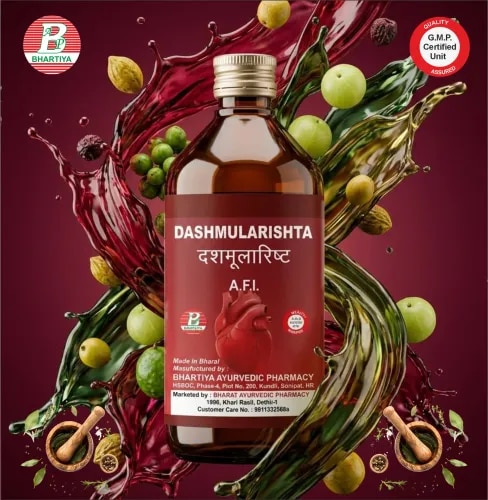
"name": "DASHMULARISHTA",
"description": " DASHMULARISHTA\n\n\nProduct Identification\nGeneric Name: Dashmularishta\nType: Ayurvedic Polyherbal Fermented Formulation (Arishta)\nPrimary Indication Area: Primarily used as a rejuvenative and restorative tonic for postpartum care, Vata disorders, inflammatory conditions, musculoskeletal weakness, nervous system disorders, and recovery following chronic illness. It is widely indicated for general debility, fever recovery, respiratory weakness, digestive impairment, and gynecological disorders associated with Vata imbalance.\n\nTherapeutic Indications\n•\tGeneral debility (Daurbalya) \n•\tPostpartum care (Sutika Paricharya) \n•\tVata disorders (Vatavyadhi) \n•\tChronic inflammatory conditions \n•\tMusculoskeletal weakness \n•\tJoint pain and stiffness \n•\tLow back pain \n•\tNeuralgia and neuropathic discomfort \n•\tConvalescence following prolonged illness \n•\tRespiratory weakness and chronic cough \n•\tFever recovery \n•\tDigestive weakness and poor appetite \n•\tGynecological disorders associated with Vata imbalance \n•\tFatigue and reduced stamina \n•\tAge-related decline in strength and vitality \n\nKey Benefits\n•\tSupports healthy musculoskeletal and nervous system function. \n•\tPromotes recovery following childbirth and prolonged illness. \n•\tHelps reduce inflammation and joint discomfort. \n•\tImproves physical strength and endurance. \n•\tSupports healthy respiratory function. \n•\tEnhances digestion and metabolism. \n•\tPromotes healthy immune function. \n•\tSupports uterine health during the postpartum period. \n•\tActs as a Rasayana for restoring vitality. \n•\tProvides antioxidant protection against oxidative stress. \n\nFORMULA\nEach part contains:\n•\tBilva (Aegle marmelos) \n•\tShyonaka (Oroxylum indicum) \n•\tGambhari (Gmelina arborea) \n•\tPatala (Stereospermum suaveolens) \n•\tAgnimantha (Clerodendrum phlomidis) \n•\tShalaparni (Desmodium gangeticum) \n•\tPrishniparni (Uraria picta) \n•\tBrihati (Solanum indicum) \n•\tKantakari (Solanum xanthocarpum)\n•\tGokshura (Tribulus terrestris) \n•\tChitraka (Plumbago zeylanica) \n•\tPushkara (Inula racemosa) \n•\tLodhra (Symplocos racemosa) \n•\tGuduchi (Tinospora cordifolia) \n•\tAmalaki (Phyllanthus emblica) \n•\tDhanvayasa (Fagonia cretica) \n•\tKhadira (Acacia catechu) \n•\tKustha (Saussurea lappa) \n•\tManjistha (Rubia cordifolia) \n•\tDevadaru (Cedrus deodara) \n•\tVidanga (Embelia ribes) \n•\tMadhuka (Glycyrrhiza glabra) \n•\tBharangi (Clerodendrum serratum) \n•\tKapitha (Limonia acidissima / Feronia limonia) \n•\tBibhitaki (Terminalia bellirica) \n•\tPunarnava (Boerhavia diffusa) \n•\tChavya (Piper retrofractum) \n•\tJatamansi (Nardostachys jatamansi) \n•\tPriyangu (Callicarpa macrophylla) \n•\tSariva (Hemidesmus indicus) \n•\tKala Jeera (Carum carvi / Nigella sativa (regional use)) \n•\tTrivrit (Operculina turpethum) \n•\tNirgundi (Vitex negundo) \n•\tRasna (Pluchea lanceolata) \n•\tHaridra (Curcuma longa) \n•\tSatpushpa (Anethum sowa / Anethum graveolens) \n•\tPadmaka (Prunus cerasoides) \n•\tNagakesara (Mesua ferrea) \n•\tMusta (Cyperus rotundus) \n•\tIndrayava (Holarrhena antidysenterica) \n•\tKarkatashringi (Pistacia integerrima) \n•\tJivaka (Microstylis wallichii) \n•\tRishabhaka (Microstylis muscifera) \n•\tMeda (Polygonatum cirrhifolium) \n•\tKakoli (Fritillaria roylei) \n•\tKshirakakoli (Roscoea purpurea) \n•\tRiddhi (Habenaria intermedia) \n•\tVriddhi (Habenaria edgeworthii) \n•\tDraksha (Vitis vinifera) \n•\tKatphala (Myrica nagi) \n•\tPuga (Areca catechu) \n•\tGuda (Jaggery) \n•\tMadhu (Honey) \n•\tDhataki (Woodfordia fruticosa) \n•\tLavanga (Syzygium aromaticum) \n•\tTvak (Cinnamomum verum) \n•\tEla (Elettaria cardamomum) \n•\tTejapatra (Cinnamomum tamala) \n•\tPippali (Piper longum) \n•\tHaridra (Curcuma longa) \n•\tSveta Chandana (Santalum album) \n•\tPippali root\n\n\n1. Bilva\nBotanical Name: Aegle marmelos\n•\tRasa: Kashaya, Tikta \n•\tGuna: Laghu, Ruksha \n•\tVirya: Ushna \n•\tVipaka: Katu \n•\tPrabhava: Vata-Kapha Shamaka \nMechanism of Action\n•\tReduces inflammatory mediators in gut and joints \n•\tRegulates Vata in neuromuscular system \n•\tSupports digestive motility and Agni \n•\tAnti-inflammatory and mild analgesic activity \n•\tHelps in post-illness weakness recovery \n\n2. Shyonaka\nBotanical Name: Oroxylum indicum\n•\tRasa: Tikta, Kashaya \n•\tGuna: Laghu, Ruksha \n•\tVirya: Ushna \n•\tVipaka: Katu \nMechanism of Action\n•\tReduces cytokine-mediated inflammation \n•\tSupports respiratory and musculoskeletal recovery \n•\tAntioxidant and tissue-protective action \n•\tHelps in Vata-induced pain conditions \n\n3. Gambhari\nBotanical Name: Gmelina arborea\n•\tRasa: Madhura, Kashaya \n•\tGuna: Guru, Snigdha \n•\tVirya: Sheeta \n•\tVipaka: Madhura \n•\tPrabhava: Rasayana \nMechanism of Action\n•\tPromotes tissue regeneration and strength \n•\tSupports post-partum recovery \n•\tImmunomodulatory and restorative effect \n•\tAnti-inflammatory and nutritive action \n\n4. Patala\nBotanical Name: Stereospermum suaveolens\n•\tRasa: Tikta, Kashaya \n•\tGuna: Laghu, Ruksha \n•\tVirya: Ushna \n•\tVipaka: Katu \nMechanism of Action\n•\tReduces neuromuscular inflammation \n•\tSupports respiratory function \n•\tAnalgesic activity in Vata disorders \n•\tImproves tissue repair mechanisms \n\n5. Agnimantha\nBotanical Name: Clerodendrum phlomidis\n•\tRasa: Katu, Tikta \n•\tGuna: Laghu, Ruksha \n•\tVirya: Ushna \n•\tVipaka: Katu \nMechanism of Action\n•\tStimulates digestive enzymes and Agni \n•\tReduces Ama accumulation \n•\tAnti-inflammatory in joints and muscles \n•\tEnhances metabolic clearance \n\n6. Shalaparni\nBotanical Name: Desmodium gangeticum\n•\tRasa: Madhura, Tikta \n•\tGuna: Snigdha, Laghu \n•\tVirya: Ushna \n•\tVipaka: Madhura \nMechanism of Action\n•\tNeuroprotective and muscle-strengthening \n•\tReduces fatigue and weakness \n•\tSupports immune modulation \n•\tEnhances recovery from chronic illness \n\n7. Prishniparni\nBotanical Name: Uraria picta\n•\tRasa: Madhura, Tikta \n•\tGuna: Snigdha, Laghu \n•\tVirya: Ushna \n•\tVipaka: Madhura \nMechanism of Action\n•\tImproves neuromuscular strength \n•\tSupports postpartum tissue repair \n•\tAnti-inflammatory and rejuvenative \n•\tEnhances stamina and vitality \n\n8. Brihati\nBotanical Name: Solanum indicum\n•\tRasa: Tikta, Katu \n•\tGuna: Laghu, Ruksha \n•\tVirya: Ushna \n•\tVipaka: Katu \nMechanism of Action\n•\tReduces inflammatory pain \n•\tSupports respiratory health \n•\tHelps in Vata-Kapha imbalance disorders \n•\tImproves metabolic function \n\n9. Kantakari\nBotanical Name: Solanum xanthocarpum\n•\tRasa: Tikta, Katu \n•\tGuna: Laghu, Ruksha \n•\tVirya: Ushna \n•\tVipaka: Katu \nMechanism of Action\n•\tBronchodilator and expectorant action \n•\tReduces respiratory inflammation \n•\tSupports Vata-Kapha balance \n•\tImproves oxygenation and vitality \n\n10. Gokshura\nBotanical Name: Tribulus terrestris\n•\tRasa: Madhura \n•\tGuna: Snigdha, Guru \n•\tVirya: Sheeta \n•\tVipaka: Madhura \nMechanism of Action\n•\tDiuretic and urinary system support \n•\tEnhances muscle strength and stamina \n•\tImproves reproductive function \n•\tAnti-fatigue and anabolic support \n\n11. Chitraka\nBotanical Name: Plumbago zeylanica\n•\tRasa: Katu \n•\tGuna: Laghu, Tikshna \n•\tVirya: Ushna \n•\tVipaka: Katu \nMechanism of Action\n•\tPotent digestive stimulant (Agni deepana) \n•\tReduces Ama accumulation \n•\tImproves nutrient absorption \n•\tEnhances metabolic rate \n\n12. Pushkara\nBotanical Name: Inula racemosa\n•\tRasa: Tikta, Katu \n•\tGuna: Laghu, Ruksha \n•\tVirya: Ushna \n•\tVipaka: Katu \nMechanism of Action\n•\tCardiorespiratory stimulant \n•\tImproves oxygen utilization \n•\tAnti-inflammatory and bronchodilator \n•\tSupports endurance \n\n13. Lodhra\nBotanical Name: Symplocos racemosa\n•\tRasa: Kashaya \n•\tGuna: Laghu, Ruksha \n•\tVirya: Sheeta \n•\tVipaka: Katu \nMechanism of Action\n•\tUterine tonic and anti-inflammatory \n•\tSupports tissue tightening and healing \n•\tReduces excessive secretions \n•\tImproves reproductive health \n\n14. Guduchi\nBotanical Name: Tinospora cordifolia\n•\tRasa: Tikta, Kashaya \n•\tGuna: Laghu, Snigdha \n•\tVirya: Ushna \n•\tVipaka: Madhura \nMechanism of Action\n•\tStrong immunomodulator \n•\tAnti-inflammatory and antipyretic \n•\tEnhances detoxification pathways \n•\tSupports chronic disease recovery \n\n15. Amalaki\nBotanical Name: Phyllanthus emblica\n•\tRasa: Amla Pradhana Pancharasa \n•\tGuna: Laghu, Ruksha \n•\tVirya: Sheeta \n•\tVipaka: Madhura \nMechanism of Action\n•\tPotent antioxidant (vitamin C rich) \n•\tAnti-aging and Rasayana effect \n•\tSupports immunity and tissue repair \n•\tEnhances digestion and metabolism\n16. Dhanvayasa\nBotanical Name: Fagonia cretica / Alhagi pseudalhagi\n•\tRasa: Tikta, Kashaya \n•\tGuna: Laghu, Ruksha \n•\tVirya: Sheeta \n•\tVipaka: Katu \nMechanism\n•\tAnti-inflammatory and blood-purifying activity \n•\tSupports detoxification and tissue repair \n•\tHelps reduce chronic inflammatory states \n\n17. Khadira\nBotanical Name: Acacia catechu\n•\tRasa: Kashaya \n•\tGuna: Ruksha, Laghu \n•\tVirya: Sheeta \n•\tVipaka: Katu \nMechanism\n•\tStrong antioxidant and antimicrobial action \n•\tSupports skin, blood and metabolic health \n•\tReduces chronic inflammation \n\n18. Kustha\nBotanical Name: Saussurea lappa\n•\tRasa: Tikta, Katu \n•\tGuna: Laghu, Tikshna \n•\tVirya: Ushna \n•\tVipaka: Katu \nMechanism\n•\tAnti-inflammatory and analgesic \n•\tSupports Vata disorders (pain, stiffness) \n•\tImproves neuromuscular function \n\n19. Manjistha\nBotanical Name: Rubia cordifolia\n•\tRasa: Tikta, Kashaya \n•\tGuna: Guru, Ruksha \n•\tVirya: Ushna \n•\tVipaka: Katu \nMechanism\n•\tBlood purification and lymphatic drainage \n•\tAnti-inflammatory and antioxidant \n•\tSupports skin and tissue repair \n\n20. Devadaru\nBotanical Name: Cedrus deodara\n•\tRasa: Tikta, Katu \n•\tGuna: Laghu, Ruksha \n•\tVirya: Ushna \n•\tVipaka: Katu \nMechanism\n•\tPotent anti-inflammatory action \n•\tRelieves joint and muscle pain \n•\tSupports respiratory clearance \n\n21. Vidanga\nBotanical Name: Embelia ribes\n•\tRasa: Katu \n•\tGuna: Laghu, Ruksha \n•\tVirya: Ushna \n•\tVipaka: Katu \nMechanism\n•\tAnthelmintic and antimicrobial \n•\tImproves gut health and metabolism \n•\tReduces Ama accumulation \n\n22. Madhuka\nBotanical Name: Glycyrrhiza glabra\n•\tRasa: Madhura \n•\tGuna: Guru, Snigdha \n•\tVirya: Sheeta \n•\tVipaka: Madhura \nMechanism\n•\tAnti-inflammatory and demulcent \n•\tSupports respiratory and gastric mucosa \n•\tImmunomodulatory and rejuvenative \n\n23. Bharangi\nBotanical Name: Clerodendrum serratum\n•\tRasa: Tikta, Katu \n•\tGuna: Laghu, Ruksha \n•\tVirya: Ushna \n•\tVipaka: Katu \nMechanism\n•\tRespiratory anti-inflammatory \n•\tBronchodilator effect \n•\tSupports cough and asthma conditions \n\n24. Kapitha\nBotanical Name: Limonia acidissima\n•\tRasa: Kashaya \n•\tGuna: Guru, Ruksha \n•\tVirya: Sheeta \n•\tVipaka: Katu \nMechanism\n•\tDigestive and gut stabilizing \n•\tAntimicrobial and anti-diarrheal \n•\tSupports intestinal health \n\n25. Bibhitaki\nBotanical Name: Terminalia bellirica\n•\tRasa: Kashaya \n•\tGuna: Ruksha, Laghu \n•\tVirya: Ushna \n•\tVipaka: Madhura \nMechanism\n•\tDetoxification and bowel regulation \n•\tAntioxidant and anti-inflammatory \n•\tSupports respiratory health \n\n26. Punarnava\nBotanical Name: Boerhavia diffusa\n•\tRasa: Tikta, Kashaya \n•\tGuna: Laghu, Ruksha \n•\tVirya: Ushna \n•\tVipaka: Katu \nMechanism\n•\tDiuretic and anti-edema action \n•\tKidney and fluid balance support \n•\tAnti-inflammatory activity \n\n27. Chavya\nBotanical Name: Piper retrofractum\n•\tRasa: Katu \n•\tGuna: Laghu, Tikshna \n•\tVirya: Ushna \n•\tVipaka: Katu \nMechanism\n•\tDigestive stimulant (Deepana) \n•\tImproves metabolism and Agni \n•\tReduces Ama formation \n\n28. Jatamansi\nBotanical Name: Nardostachys jatamansi\n•\tRasa: Tikta, Kashaya \n•\tGuna: Laghu, Snigdha \n•\tVirya: Sheeta \n•\tVipaka: Katu \nMechanism\n•\tNervine sedative and neuroprotective \n•\tReduces stress and anxiety \n•\tSupports sleep and mental balance \n\n29. Priyangu\nBotanical Name: Callicarpa macrophylla\n•\tRasa: Kashaya, Madhura \n•\tGuna: Laghu, Ruksha \n•\tVirya: Sheeta \n•\tVipaka: Katu \nMechanism\n•\tBlood purification and wound healing \n•\tAnti-inflammatory and cooling \n•\tSupports tissue repair \n\n30. Sariva\nBotanical Name: Hemidesmus indicus\n•\tRasa: Madhura, Tikta \n•\tGuna: Guru, Snigdha \n•\tVirya: Sheeta \n•\tVipaka: Madhura \nMechanism\n•\tBlood detoxification \n•\tCooling and anti-inflammatory \n•\tSupports skin and immune health \n\n31. Kala Jeera\nBotanical Name: Nigella sativa / Carum carvi (variant usage)\n•\tRasa: Katu, Tikta \n•\tGuna: Laghu, Ruksha \n•\tVirya: Ushna \n•\tVipaka: Katu \nMechanism\n•\tAnti-inflammatory and antioxidant \n•\tImproves digestion and immunity \n•\tSupports metabolic balance \n\n32. Trivrit\nBotanical Name: Operculina turpethum\n•\tRasa: Katu, Tikta \n•\tGuna: Ruksha, Laghu \n•\tVirya: Ushna \n•\tVipaka: Katu \nMechanism\n•\tStrong purgative (Rechana) \n•\tDetoxification and bowel cleansing \n•\tRemoves accumulated toxins \n\n33. Nirgundi\nBotanical Name: Vitex negundo\n•\tRasa: Katu, Tikta \n•\tGuna: Laghu, Ruksha \n•\tVirya: Ushna \n•\tVipaka: Katu \nMechanism\n•\tAnti-inflammatory and analgesic \n•\tUseful in joint pain and Vata disorders \n•\tMuscle relaxant activity \n\n34. Rasna\nBotanical Name: Pluchea lanceolata\n•\tRasa: Tikta, Katu \n•\tGuna: Snigdha, Laghu \n•\tVirya: Ushna \n•\tVipaka: Katu \nMechanism\n•\tStrong anti-arthritic action \n•\tReduces stiffness and pain \n•\tSupports neuromuscular health \n\n35. Haridra\nBotanical Name: Curcuma longa\n•\tRasa: Tikta, Katu \n•\tGuna: Laghu, Ruksha \n•\tVirya: Ushna \n•\tVipaka: Katu \nMechanism\n•\tAnti-inflammatory and antioxidant \n•\tImmunomodulatory activity \n•\tTissue healing and detox support \n\n36. Satpushpa\nBotanical Name: Anethum sowa / Anethum graveolens\n•\tRasa: Katu \n•\tGuna: Laghu \n•\tVirya: Ushna \n•\tVipaka: Katu \nMechanism\n•\tDigestive stimulant \n•\tReduces bloating and gas \n•\tSupports metabolism \n\n37. Padmaka\nBotanical Name: Prunus cerasoides\n•\tRasa: Kashaya \n•\tGuna: Laghu \n•\tVirya: Sheeta \n•\tVipaka: Katu \nMechanism\n•\tAnti-inflammatory and cooling \n•\tSupports blood purification \n•\tTissue soothing action \n\n38. Nagakesara\nBotanical Name: Mesua ferrea\n•\tRasa: Kashaya, Tikta \n•\tGuna: Laghu, Ruksha \n•\tVirya: Sheeta \n•\tVipaka: Katu \nMechanism\n•\tHemostatic and anti-inflammatory \n•\tSupports uterine and vascular health \n•\tAntioxidant activity \n\n39. Musta\nBotanical Name: Cyperus rotundus\n•\tRasa: Tikta, Katu \n•\tGuna: Laghu, Ruksha \n•\tVirya: Sheeta \n•\tVipaka: Katu \nMechanism\n•\tDigestive regulator \n•\tAnti-diarrheal and metabolic balance \n•\tReduces Ama \n\n40. Indrayava\nBotanical Name: Holarrhena antidysenterica\n•\tRasa: Tikta, Kashaya \n•\tGuna: Laghu, Ruksha \n•\tVirya: Sheeta \n•\tVipaka: Katu \nMechanism\n•\tStrong anti-diarrheal action \n•\tGut antimicrobial activity \n•\tRestores intestinal balance \n\n41. Karkatashringi\nBotanical Name: Pistacia integerrima\n•\tRasa: Kashaya \n•\tGuna: Laghu, Ruksha \n•\tVirya: Sheeta \n•\tVipaka: Katu \nMechanism\n•\tRespiratory anti-inflammatory \n•\tReduces cough and bronchial irritation \n•\tSupports lung function \n42. Jivaka\nBotanical Name: Microstylis wallichii\n•\tRasa: Madhura \n•\tGuna: Guru, Snigdha \n•\tVirya: Sheeta \n•\tVipaka: Madhura \nMechanism\n•\tRasayana and tissue-building action \n•\tImproves strength and vitality \n•\tSupports reproductive and neuromuscular health \n\n43. Rishabhaka\nBotanical Name: Microstylis muscifera\n•\tRasa: Madhura \n•\tGuna: Guru, Snigdha \n•\tVirya: Sheeta \n•\tVipaka: Madhura \nMechanism\n•\tRejuvenative and anabolic support \n•\tEnhances stamina and recovery \n•\tSupports muscle and nerve repair \n\n44. Meda\nBotanical Name: Polygonatum cirrhifolium\n•\tRasa: Madhura \n•\tGuna: Guru, Snigdha \n•\tVirya: Sheeta \n•\tVipaka: Madhura \nMechanism\n•\tNourishing and restorative \n•\tImproves tissue regeneration \n•\tSupports energy metabolism \n\n45. Kakoli\nBotanical Name: Fritillaria roylei\n•\tRasa: Madhura \n•\tGuna: Guru, Snigdha \n•\tVirya: Sheeta \n•\tVipaka: Madhura \nMechanism\n•\tPotent Rasayana herb \n•\tImproves strength and immunity \n•\tSupports nervous system recovery \n\n46. Kshirakakoli\nBotanical Name: Roscoea purpurea\n•\tRasa: Madhura \n•\tGuna: Guru, Snigdha \n•\tVirya: Sheeta \n•\tVipaka: Madhura \nMechanism\n•\tDeep tissue nourishment \n•\tEnhances vitality and stamina \n•\tSupports postpartum recovery \n\n47. Riddhi\nBotanical Name: Habenaria intermedia\n•\tRasa: Madhura \n•\tGuna: Guru, Snigdha \n•\tVirya: Sheeta \n•\tVipaka: Madhura \nMechanism\n•\tStrength promoter (Balya) \n•\tEnhances tissue growth and recovery \n•\tSupports immunity and endurance \n\n48. Vriddhi\nBotanical Name: Habenaria edgeworthii\n•\tRasa: Madhura \n•\tGuna: Guru, Snigdha \n•\tVirya: Sheeta \n•\tVipaka: Madhura \nMechanism\n•\tGrowth and regenerative support \n•\tImproves physical strength \n•\tRasayana for chronic weakness \n\n49. Draksha\nBotanical Name: Vitis vinifera\n•\tRasa: Madhura \n•\tGuna: Guru, Snigdha \n•\tVirya: Sheeta \n•\tVipaka: Madhura \nMechanism\n•\tAntioxidant and cardiotonic support \n•\tImproves energy and hydration \n•\tSupports liver and digestion \n\n50. Katphala\nBotanical Name: Myrica nagi\n•\tRasa: Kashaya \n•\tGuna: Laghu, Ruksha \n•\tVirya: Ushna \n•\tVipaka: Katu \nMechanism\n•\tAntimicrobial and digestive stimulant \n•\tSupports respiratory clearance \n•\tReduces Ama formation \n\n51. Puga\nBotanical Name: Areca catechu\n•\tRasa: Kashaya, Madhura \n•\tGuna: Laghu \n•\tVirya: Ushna \n•\tVipaka: Katu \nMechanism\n•\tAstringent and digestive support \n•\tImproves oral and gut health \n•\tMild stimulant action \n\n52. Guda\nBotanical Name: Saccharum officinarum (Jaggery)\n•\tRasa: Madhura \n•\tGuna: Guru, Snigdha \n•\tVirya: Ushna \n•\tVipaka: Madhura \nMechanism\n•\tFermentation substrate \n•\tEnergy provider \n•\tEnhances bioavailability of herbs \n\n53. Madhu\nBotanical Name: Honey (Apis mellifera product)\n•\tRasa: Madhura, Kashaya \n•\tGuna: Laghu, Ruksha \n•\tVirya: Sheeta \n•\tVipaka: Madhura \nMechanism\n•\tBioavailability enhancer (Yogavahi) \n•\tAntimicrobial and antioxidant \n•\tSupports fermentation stability \n\n54. Dhataki\nBotanical Name: Woodfordia fruticosa\n•\tRasa: Kashaya \n•\tGuna: Laghu, Ruksha \n•\tVirya: Sheeta \n•\tVipaka: Katu \nMechanism\n•\tNatural fermentation catalyst \n•\tEnhances alcohol formation \n•\tImproves extraction of phytochemicals \n\n55. Lavanga\nBotanical Name: Syzygium aromaticum\n•\tRasa: Katu, Tikta \n•\tGuna: Laghu, Tikshna \n•\tVirya: Ushna \n•\tVipaka: Katu \nMechanism\n•\tStrong antimicrobial action \n•\tDigestive stimulant \n•\tAnalgesic and carminative \n\n56. Tvak\nBotanical Name: Cinnamomum verum\n•\tRasa: Katu, Tikta \n•\tGuna: Laghu \n•\tVirya: Ushna \n•\tVipaka: Katu \nMechanism\n•\tImproves circulation and metabolism \n•\tAnti-inflammatory and antioxidant \n•\tSupports digestive fire \n\n57. Ela\nBotanical Name: Elettaria cardamomum\n•\tRasa: Madhura, Katu \n•\tGuna: Laghu \n•\tVirya: Sheeta \n•\tVipaka: Madhura \nMechanism\n•\tDigestive carminative \n•\tReduces bloating and gas \n•\tAromatic bioenhancer \n\n58. Tejapatra\nBotanical Name: Cinnamomum tamala\n•\tRasa: Katu, Tikta \n•\tGuna: Laghu \n•\tVirya: Ushna \n•\tVipaka: Katu \nMechanism\n•\tMetabolic stimulant \n•\tAnti-inflammatory activity \n•\tImproves digestion \n\n59. Pippali\nBotanical Name: Piper longum\n•\tRasa: Katu \n•\tGuna: Laghu, Tikshna \n•\tVirya: Ushna \n•\tVipaka: Madhura \nMechanism\n•\tBioavailability enhancer (Yogavahi) \n•\tRespiratory stimulant \n•\tImproves digestion and absorption\n42. Jivaka\nBotanical Name: Microstylis wallichii\n•\tRasa: Madhura \n•\tGuna: Guru, Snigdha \n•\tVirya: Sheeta \n•\tVipaka: Madhura \nMechanism\n•\tRasayana and tissue-building action \n•\tImproves strength and vitality \n•\tSupports reproductive and neuromuscular health \n\n43. Rishabhaka\nBotanical Name: Microstylis muscifera\n•\tRasa: Madhura \n•\tGuna: Guru, Snigdha \n•\tVirya: Sheeta \n•\tVipaka: Madhura \nMechanism\n•\tRejuvenative and anabolic support \n•\tEnhances stamina and recovery \n•\tSupports muscle and nerve repair \n\n44. Meda\nBotanical Name: Polygonatum cirrhifolium\n•\tRasa: Madhura \n•\tGuna: Guru, Snigdha \n•\tVirya: Sheeta \n•\tVipaka: Madhura \nMechanism\n•\tNourishing and restorative \n•\tImproves tissue regeneration \n•\tSupports energy metabolism \n\n45. Kakoli\nBotanical Name: Fritillaria roylei\n•\tRasa: Madhura \n•\tGuna: Guru, Snigdha \n•\tVirya: Sheeta \n•\tVipaka: Madhura \nMechanism\n•\tPotent Rasayana herb \n•\tImproves strength and immunity \n•\tSupports nervous system recovery \n\n46. Kshirakakoli\nBotanical Name: Roscoea purpurea\n•\tRasa: Madhura \n•\tGuna: Guru, Snigdha \n•\tVirya: Sheeta \n•\tVipaka: Madhura \nMechanism\n•\tDeep tissue nourishment \n•\tEnhances vitality and stamina \n•\tSupports postpartum recovery \n\n47. Riddhi\nBotanical Name: Habenaria intermedia\n•\tRasa: Madhura \n•\tGuna: Guru, Snigdha \n•\tVirya: Sheeta \n•\tVipaka: Madhura \nMechanism\n•\tStrength promoter (Balya) \n•\tEnhances tissue growth and recovery \n•\tSupports immunity and endurance \n\n48. Vriddhi\nBotanical Name: Habenaria edgeworthii\n•\tRasa: Madhura \n•\tGuna: Guru, Snigdha \n•\tVirya: Sheeta \n•\tVipaka: Madhura \nMechanism\n•\tGrowth and regenerative support \n•\tImproves physical strength \n•\tRasayana for chronic weakness \n\n49. Draksha\nBotanical Name: Vitis vinifera\n•\tRasa: Madhura \n•\tGuna: Guru, Snigdha \n•\tVirya: Sheeta \n•\tVipaka: Madhura \nMechanism\n•\tAntioxidant and cardiotonic support \n•\tImproves energy and hydration \n•\tSupports liver and digestion \n\n50. Katphala\nBotanical Name: Myrica nagi\n•\tRasa: Kashaya \n•\tGuna: Laghu, Ruksha \n•\tVirya: Ushna \n•\tVipaka: Katu \nMechanism\n•\tAntimicrobial and digestive stimulant \n•\tSupports respiratory clearance \n•\tReduces Ama formation \n\n51. Puga\nBotanical Name: Areca catechu\n•\tRasa: Kashaya, Madhura \n•\tGuna: Laghu \n•\tVirya: Ushna \n•\tVipaka: Katu \nMechanism\n•\tAstringent and digestive support \n•\tImproves oral and gut health \n•\tMild stimulant action \n\n52. Guda\nBotanical Name: Saccharum officinarum (Jaggery)\n•\tRasa: Madhura \n•\tGuna: Guru, Snigdha \n•\tVirya: Ushna \n•\tVipaka: Madhura \nMechanism\n•\tFermentation substrate \n•\tEnergy provider \n•\tEnhances bioavailability of herbs \n\n53. Madhu\nBotanical Name: Honey (Apis mellifera product)\n•\tRasa: Madhura, Kashaya \n•\tGuna: Laghu, Ruksha \n•\tVirya: Sheeta \n•\tVipaka: Madhura \nMechanism\n•\tBioavailability enhancer (Yogavahi) \n•\tAntimicrobial and antioxidant \n•\tSupports fermentation stability \n\n54. Dhataki\nBotanical Name: Woodfordia fruticosa\n•\tRasa: Kashaya \n•\tGuna: Laghu, Ruksha \n•\tVirya: Sheeta \n•\tVipaka: Katu \nMechanism\n•\tNatural fermentation catalyst \n•\tEnhances alcohol formation \n•\tImproves extraction of phytochemicals \n\n55. Lavanga\nBotanical Name: Syzygium aromaticum\n•\tRasa: Katu, Tikta \n•\tGuna: Laghu, Tikshna \n•\tVirya: Ushna \n•\tVipaka: Katu \nMechanism\n•\tStrong antimicrobial action \n•\tDigestive stimulant \n•\tAnalgesic and carminative \n\n56. Tvak\nBotanical Name: Cinnamomum verum\n•\tRasa: Katu, Tikta \n•\tGuna: Laghu \n•\tVirya: Ushna \n•\tVipaka: Katu \nMechanism\n•\tImproves circulation and metabolism \n•\tAnti-inflammatory and antioxidant \n•\tSupports digestive fire \n\n57. Ela\nBotanical Name: Elettaria cardamomum\n•\tRasa: Madhura, Katu \n•\tGuna: Laghu \n•\tVirya: Sheeta \n•\tVipaka: Madhura \nMechanism\n•\tDigestive carminative \n•\tReduces bloating and gas \n•\tAromatic bioenhancer \n\n58. Tejapatra\nBotanical Name: Cinnamomum tamala\n•\tRasa: Katu, Tikta \n•\tGuna: Laghu \n•\tVirya: Ushna \n•\tVipaka: Katu \nMechanism\n•\tMetabolic stimulant \n•\tAnti-inflammatory activity \n•\tImproves digestion \n\n59. Pippali\nBotanical Name: Piper longum\n•\tRasa: Katu \n•\tGuna: Laghu, Tikshna \n•\tVirya: Ushna \n•\tVipaka: Madhura \nMechanism\n•\tBioavailability enhancer (Yogavahi) \n•\tRespiratory stimulant \n•\tImproves digestion and absorption\n60. Karkatashringi\nBotanical Name: Pistacia integerrima\n•\tRasa: Kashaya \n•\tGuna: Laghu, Ruksha \n•\tVirya: Sheeta \n•\tVipaka: Katu \nMechanism\n•\tStrong respiratory anti-inflammatory action \n•\tReduces cough, bronchial irritation and asthma symptoms \n•\tSupports lung tissue healing \n\n61. Satpushpa\nBotanical Name: Anethum sowa\n•\tRasa: Katu \n•\tGuna: Laghu \n•\tVirya: Ushna \n•\tVipaka: Katu \nMechanism\n•\tCarminative and digestive stimulant \n•\tReduces gas, bloating and indigestion \n•\tSupports Agni and metabolism \n\n62. Padmaka\nBotanical Name: Prunus cerasoides\n•\tRasa: Kashaya \n•\tGuna: Laghu \n•\tVirya: Sheeta \n•\tVipaka: Katu \nMechanism\n•\tAnti-inflammatory and cooling effect \n•\tBlood purifier and tissue soothing action \n•\tSupports Pitta balance \n\n63. Nagakesara\nBotanical Name: Mesua ferrea\n•\tRasa: Kashaya, Tikta \n•\tGuna: Laghu, Ruksha \n•\tVirya: Sheeta \n•\tVipaka: Katu \nMechanism\n•\tHemostatic and anti-inflammatory \n•\tSupports uterine and vascular health \n•\tAntioxidant and wound healing activity \n\n64. Musta\nBotanical Name: Cyperus rotundus\n•\tRasa: Tikta, Katu \n•\tGuna: Laghu, Ruksha \n•\tVirya: Sheeta \n•\tVipaka: Katu \nMechanism\n•\tDigestive regulator and anti-diarrheal \n•\tReduces Ama formation \n•\tSupports gut microbial balance \n\n65. Indrayava\nBotanical Name: Holarrhena antidysenterica\n•\tRasa: Tikta, Kashaya \n•\tGuna: Laghu, Ruksha \n•\tVirya: Sheeta \n•\tVipaka: Katu \nMechanism\n•\tStrong anti-diarrheal and antimicrobial action \n•\tRestores intestinal mucosa integrity \n•\tSupports gut infection control \n\n66. Nirgundi\nBotanical Name: Vitex negundo\n•\tRasa: Katu, Tikta \n•\tGuna: Laghu, Ruksha \n•\tVirya: Ushna \n•\tVipaka: Katu \nMechanism\n•\tPowerful anti-inflammatory and analgesic \n•\tRelieves joint pain, swelling and stiffness \n•\tVata pacifying action \n\n67. Rasna\nBotanical Name: Pluchea lanceolata\n•\tRasa: Tikta, Katu \n•\tGuna: Snigdha, Laghu \n•\tVirya: Ushna \n•\tVipaka: Katu \nMechanism\n•\tAnti-arthritic and neuromuscular relaxant \n•\tReduces inflammation and stiffness \n•\tSupports Vata disorders \n\n68. Jivaka\nBotanical Name: Microstylis wallichii\n•\tRasa: Madhura \n•\tGuna: Guru, Snigdha \n•\tVirya: Sheeta \n•\tVipaka: Madhura \nMechanism\n•\tPotent Rasayana (rejuvenator) \n•\tImproves strength, stamina and tissue repair \n•\tSupports reproductive and nerve health \n\n69. Rishabhaka\nBotanical Name: Microstylis muscifera\n•\tRasa: Madhura \n•\tGuna: Guru, Snigdha \n•\tVirya: Sheeta \n•\tVipaka: Madhura \nMechanism\n•\tAnabolic and restorative action \n•\tEnhances muscle and nerve regeneration \n•\tImproves vitality and endurance \n\n70. Meda\nBotanical Name: Polygonatum cirrhifolium\n•\tRasa: Madhura \n•\tGuna: Guru, Snigdha \n•\tVirya: Sheeta \n•\tVipaka: Madhura \nMechanism\n•\tDeep nutritive and rejuvenative herb \n•\tImproves tissue building and energy metabolism \n•\tSupports chronic weakness recovery \n\n71. Kakoli / Kshirakakoli \nBotanical Name: Fritillaria roylei / Roscoea purpurea (group substitute in practice)\n•\tRasa: Madhura \n•\tGuna: Guru, Snigdha \n•\tVirya: Sheeta \n•\tVipaka: Madhura \nMechanism\n•\tStrong Rasayana and immunomodulator \n•\tEnhances strength, stamina and recovery \n•\tSupports neuromuscular and reproductive systems \n•\tDeep tissue nourishment and anti-aging effect\n\n1. Adult Dose\n•\t15–30 mL \n•\tTwice daily \n\n2. How to Take\n•\tDilute with equal quantity of water (1:1) \n•\tBest taken after meals \n•\tCommonly taken in morning and evening \n\n3. Therapeutic Duration\n•\tUsually 4–12 weeks \n•\tMay be extended in chronic conditions under physician supervision \n\n4. Special Situations\n•\tPostpartum care: 15–30 mL twice daily for 2–6 weeks (as advised) \n•\tGeneral debility: 15–20 mL twice daily \n•\tChronic Vata disorders: 20–30 mL twice daily \n\n5. Caution\n•\tUse under supervision in: \no\tPregnancy (generally avoided unless prescribed) \no\tDiabetes (contains jaggery fermentation) \no\tHypertension / cardiac patients on medication \n•\tAvoid self-medication in chronic diseases\n\n",
"price": 192.0,
"discountamount": 96.0,
"currencycode": "INR",
"priority": 1000000,
"isfreeshipmentavailable": false,
"shipmentduration": 1,
"_keywords": null,
"isarchived": false,
"isavailable": true,
"applicationid": null,
"productindex": 164,
"imageuri": "https://productimages.withfloats.com/actual/6a6069de406ff2e16e248d2f.jpg",
"tileimageuri": "https://productimages.withfloats.com/tile/6a6069de406ff2e16e248d2f.jpg",
"images": null,
"totalqueries": 0,
"gpid": null,
"groupproductid": null,
"createdon": "2026-07-22T06:57:32.507Z",
"updatedon": "2026-07-22T06:57:32.507Z",
"buyonlinelink": null,
"producturl": "http://WWW.BHARTIYAAYURVEDICPHARMACY.COM/products/dashmularishta/164",
"availableunits": -1.0,
"iscodavailable": true,
"isprepaidonlineavailable": true,
"maxcodorders": -1,
"maxprepaidonlineorders": -1,
"uniquepaymenturl": null,
"brandname": "Bakula Fort",
"category": "DASHMULARISHTA 450 ML X 40",
"tags": [],
"variants": false,
"keyspecification": null,
"otherspecifications": null,
"pickupaddressreferenceid": null,
"paymenttype": "AssuredPurchase",
"producttype": "products",
"hsncode": null,
"gstslab": 0.0,
"isnotforsale": false
},
{
"_id": "6a5a0a2eaf37c772c3f501dc",
"fptag": "BHARTIYEAYURVEDICPHARMACY",
"merchantname": null,
"customwidgets": null,
"externalsourceid": null,
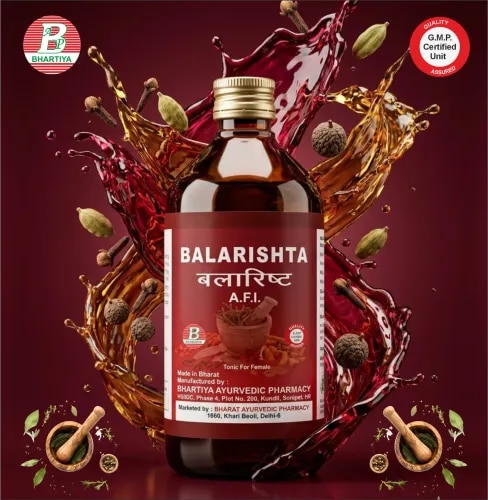
"name": "BALARISHTA",
"description": " BALARISHTA\n\n\n\nProduct Identification\nGeneric Name: Balarishta\nType: Ayurvedic Polyherbal Fermented Formulation (Arishta)\nPrimary Indication Area: Pediatric tonic, neuromuscular strength enhancer, general debility, and post-illness recovery support.\n\nTherapeutic Indications\n• General weakness in children and adults\n• Delayed growth and developmental support (pediatric use)\n• Neuromuscular debility\n• post-fever weakness and convalescence\n• Loss of appetite (Aruchi)\n• Low body weight and undernutrition\n• Anaemia-related fatigue (supportive)\n• Joint weakness and laxity\n• post-infectious recovery\n• Mild anxiety, irritability, and sleep disturbances (supportive)\n\nKey Benefits\n• Balya (strength-promoting) – improves muscle and tissue strength\n• Brimhana (nourishing) – supports healthy weight gain\n• Improves neuromuscular tone\n• Enhances appetite and digestion\n• Supports bone and joint development\n• Restores strength after illness\n• Mild calming effect on nervous system\n• Improves overall vitality and immunity\n\nFORMULA\nMain Decoction Drugs (Kwatha Dravyas):\n• Bala (Sida cordifolia) – 4.800 kg\n• Ashwagandha (Withania somnifera) – 4.8 kg\nPrakshepa Dravyas (Added after decoction):\n•\tVidari -96 g\n•\tEranda- 96 g\n•\tRasna -48 g\n•\tEla-48 g\n•\tPrishanparni-48 g\n•\tLavanga -48 g\n•\tUsira -48 g\n•\tGokharu -48 g\nFermentation Base:\n• Guda (Jaggery) – 14.400 kg\n• Water – sufficient quantity for decoction (reduced to ~12–13 L final arishta)\n• Fermentation starter: Dhataki flowers\n\n1. Bala (Sida cordifolia)\n\n•\tRasa: Madhura, Tikta\n•\t Guna: Guru, Snigdha\n•\t Virya: Sheeta\n•\t Vipaka: Madhura\n Prabhava: Balya\nMechanism of Action:\n\n•\tStrengthens muscles and neuromuscular tissue\n•\t Improves physical endurance\n•\t Supports growth and development\n•\t Reduces fatigue and Vata imbalance\n•\t Enhances tissue repair\n\n2. Ashwagandha (Withania somnifera)\n\n•\tRasa: Tikta, Kashaya\n•\tGuna: Laghu, Snigdha\n•\t Virya: Ushna\n•\t Vipaka: Madhura\n•\t Prabhava: Rasayana\nMechanism of Action:\n\n•\tEnhances stress resilience and recovery\n•\tPromotes muscle growth and strength\n•\t Supports nervous system stability\n•\t Improves sleep and reduces fatigue\n•\t Acts as adaptogen\n\n3. Vidari (Pueraria tuberosa)\n\n•\tRasa: Madhura\n•\tGuna: Guru, Snigdha\n•\t Virya: Sheeta\n•\tVipaka: Madhura\n•\tPrabhava: Brimhana\nMechanism of Action:\n\n•\tPromotes nourishment and weight gain\n•\tEnhances tissue regeneration\n•\tImproves strength and stamina\n•\t Supports endocrine balance\n•\t Useful in undernutrition\n\n4. Eranda (Ricinus communis – root)\n•\tRasa: Katu, Tikta\n•\t Guna: Snigdha, Tikshna\n•\tVirya: Ushna\n•\tVipaka: Katu\n•\t Prabhava: Vata shamak\nMechanism of Action:\n\n•\tStrong Vata pacifier\n•\t Reduces musculoskeletal pain\n•\tImproves joint mobility\n•\t Supports detoxification through laxative action\n•\t Useful in inflammatory joint conditions\n\n5. Rasna (Pluchea lanceolata)\n•\tRasa: Tikta, Kashaya\n•\tGuna: Laghu, Ruksha\n•\tVirya: Ushna\n•\tVipaka: Katu\n•\tPrabhava: Shothahara\nMechanism of Action:\n\n•\tReduces inflammation in joints and muscles\n•\tImproves mobility\n•\tActs on Vata disorders\n•\tSupports pain relief\n•\t Useful in arthritis-like conditions\n\n6. Ela (Elettaria cardamomum)\n\n•\tRasa: Madhura, Katu\n•\tGuna: Laghu, Snigdha\n•\tVirya: Sheeta\n•\tVipaka: Madhura\nMechanism of Action:\n\n•\tImproves digestion and appetite\n•\t Reduces nausea and bloating\n•\tEnhances bioavailability of herbs\n•\tSupports respiratory comfort\n•\t Mild calming effect\n\n7. Prishniparni (Uraria picta)\n•\tRasa: Tikta, Kashaya\n•\t Guna: Laghu, Snigdha\n•\t Virya: Ushna\n•\t Vipaka: Madhura\nMechanism of Action:\n\n•\tStrengthens muscles and tissues\n•\t Improves stamina\n•\tReduces fatigue\n•\t Supports respiratory and immune health\n•\tActs as restorative tonic\n\n8. Lavanga (Syzygium aromaticum)\n•\tRasa: Katu, Tikta\n•\tGuna: Laghu, Tikshna\n•\tVirya: Ushna\n•\t Vipaka: Katu\nMechanism of Action:\n\n•\tImproves circulation\n•\tEnhances digestion and absorption\n•\tProvides mild analgesic effect\n•\tSupports respiratory health\n•\tAnti-inflammatory action\n\n9. Ushira (Vetiveria zizanioides)\n\n•\tRasa: Tikta, Madhura\n•\tGuna: Laghu, Snigdha\n•\tVirya: Sheeta\n•\tVipaka: Madhura\nMechanism of Action:\n\n•\tCooling and calming effect on body\n•\t Reduces burning sensations\n•\tSupports Pitta balance\n•\t Improves skin and systemic detoxification\n•\t Mild sedative effect\n\n10. Gokshura (Tribulus terrestris)\n•\tRasa: Madhura, Tikta\n•\tGuna: Guru, Snigdha\n•\tVirya: Sheeta\n•\t Vipaka: Madhura\nMechanism of Action:\n•\tStrengthens muscles and urinary system\n•\t Improves stamina and vitality\n•\t Supports reproductive and renal health\n•\tEnhances tissue repair\n•\tUseful in Vata-Pitta disorders\n\nDosage\n•\tChildren: 5–10 ml\n•\tAdults: 15–30 ml\n•\t Twice daily after meals\n•\t With equal quantity of water\n\nDosage\n•\tAdults: 15–30 ml\n•\t Twice daily after meals\n•\t With equal quantity of water (1:1 dilution)\n\nCommon Usage Guidance\n•\tUsed in menstrual disorders and uterine weakness\n•\t Supports hormonal balance and reproductive health\n•\tTypically used for 4–8 weeks\n•\tBest taken after food\n\nImportant Notes\n•\tUse cautiously in pregnancy unless prescribed\n•\t Avoid in uncontrolled diabetes (contains jaggery)\n•\t Not suitable for acute heavy bleeding without supervision\n•\t Should be taken under Ayurvedic supervision in chronic cases\n\n\n\nbalarishta syrup uses in hindi, balarishta syrup uses, balarishta syrup kis kaam aata hai\nbalarishta uses in hindi, balarishta syrup, balarishta syrup price, balarishta syrup benefits\nbalarishta ayurvedic medicine, balarishta in english, balarishta uses in english\nbalarishta for weight gain, balarishta for kids, balarishta for liver, balarishta for vata dosha\nbalarishta for knee pain, balarishta ke fayde in hindi, balarishta ingredients\nbalarishta how to use, balarishta hindi, balarishta how to take, balarishta health benefits\nbalarishta hindi meaning, balarishta in hindi, balarishta ingredients in hindi\nbalarishta online, balarishta syrup online, benefits of balarishta\nuses of balarishta, uses of balarishta syrup, use of balarishta in hindi\nbenefits of balarishta syrup, balarishta price, balarishta peene ke fayde\nbalarishta syrup review, balarishta syrup ingredients, balarishta syrup benefits in hindi\nbalarishta tablet, balarishta tablet uses in hindi, balarishta uses, was balarishta age\nbest balarishta syrup, top balarishta syrup uses in hindi, top balarishta syrup\ntop balarishta uses in hindi, top balarishta in hindi, top balarishta tonic\ntop balarishta tablet, top balarishta medicine, top balarishta price, top balarishta tonic uses",
"price": 228.0,
"discountamount": 114.0,
"currencycode": "INR",
"priority": 1000000,
"isfreeshipmentavailable": false,
"shipmentduration": 1,
"_keywords": null,
"isarchived": false,
"isavailable": true,
"applicationid": null,
"productindex": 160,
"imageuri": "https://productimages.withfloats.com/actual/6a5a0a2fdd26b146ef511356.jpg",
"tileimageuri": "https://productimages.withfloats.com/tile/6a5a0a2fdd26b146ef511356.jpg",
"images": null,
"totalqueries": 0,
"gpid": null,
"groupproductid": null,
"createdon": "2026-07-17T10:55:42.069Z",
"updatedon": "2026-07-17T10:55:42.069Z",
"buyonlinelink": null,
"producturl": "http://WWW.BHARTIYAAYURVEDICPHARMACY.COM//balarishta/160",
"availableunits": -1.0,
"iscodavailable": true,
"isprepaidonlineavailable": true,
"maxcodorders": -1,
"maxprepaidonlineorders": -1,
"uniquepaymenturl": null,
"brandname": "Bakula Fort",
"category": "BALARISHTA 450 ML X 40",
"tags": [],
"variants": false,
"keyspecification": null,
"otherspecifications": null,
"pickupaddressreferenceid": null,
"paymenttype": "AssuredPurchase",
"producttype": "products",
"hsncode": null,
"gstslab": 0.0,
"isnotforsale": false
},
{
"_id": "6a58c88a6b70b63c19a36f6b",
"fptag": "BHARTIYEAYURVEDICPHARMACY",
"merchantname": null,
"customwidgets": null,
"externalsourceid": null,
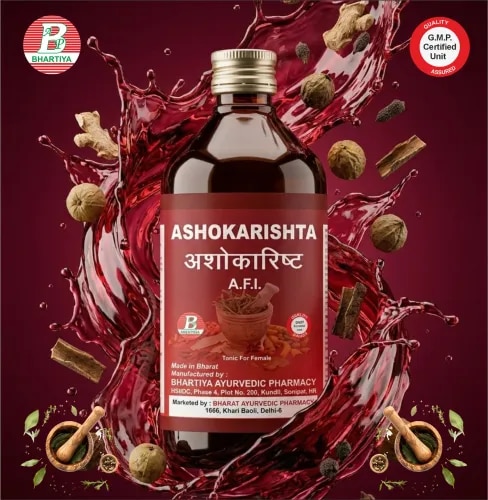
"name": "ASHOKARISHTA",
"description": " \n ASHOKARISHTA\n\n\nProduct Identification\nGeneric Name: Ashokarishta\nType: Ayurvedic Polyherbal Fermented Formulation (Arishta)\nPrimary Indication Area: Primarily used as a uterine tonic, hemostatic, and hormonal regulator, indicated in gynecological disorders and menstrual irregularities.\n\nTherapeutic Indications:\n• Heavy menstrual bleeding (Asrigdara)\n• Irregular menstruation (Anartava)\n• Dysmenorrhea (Painful menstruation)\n• Uterine weakness and reproductive system debility\n• Leucorrhea (white discharge)\n• Hormonal imbalance related menstrual disorders\n• Postpartum uterine recovery support\n• Pelvic inflammatory conditions (supportive)\n• Anaemia associated with heavy bleeding\n\nKey Benefits\n• Uterine tonic – strengthens uterine muscles and endometrium\n• Hormonal regulation – helps balance menstrual cycle\n• Anti-haemorrhagic support – reduces excessive bleeding\n• Anti-inflammatory action – supports pelvic health\n• Improves reproductive health and fertility support\n• Reduces menstrual pain and cramps\n• Restorative tonic – improves strength after blood loss\n• Balances Pitta and Vata in reproductive system\n \nFORMULA \nMain Decoction Drugs (Kwatha Dravyas):\n• Ashoka (Saraca asoca) - 4.800 kg\n• Amra (Mangifera indica – bark/seed as per classical usage) - 480 g\n• Daruharidra (Berberis aristata) - 480 g\n• Haritaki (Terminalia chebula) - 480 g\n• Bibhitaki (Terminalia bellirica) - 480 g\n• Amalaki (Emblica officinalis) - 480 g\n• Vasa (Adhatoda vasica) - 480 g\n• Utpala (Nymphaea alba / Nymphaea stellata) - 480 g\n• Shveta Jiraka (Cuminum cyminum) - 480 g\n• Musta (Cyperus rotundus) - 480 g\n\nPrakshepa Dravyas (Added after decoction):\n• Sunthi (Zingiber officinale) - 48 g\n• Shveta Jiraka (Cuminum cyminum) - 48 g\n• Musta (Cyperus rotundus) - 48 g\n• Dhataki pushpa (Woodfordia fruticosa) - 48 g\n• Daruharidra (Berberis aristata) - 48 g\n• Utpala (Nymphaea alba) - 48 g\n• Candan Shveta (Santalum album – white sandalwood) - 48 g\n\nFermentation Base:\n• Guda (Jaggery) - 14.400 kg\n• Water (for decoction & fermentation) - 49152 L reduced to 12.288 L\n\n1. Ashoka (Saraca asoca)\n•\tRasa: Kashaya, Tikta\n•\tGuna: Laghu, Ruksha\n•\tVirya: Sheeta\n•\tVipaka: Katu\n•\tPrabhava: Stambhana, Garbhashaya balya\nMechanism of Action:\n•\tStrengthens uterine musculature and endometrium\n•\t Controls excessive menstrual bleeding\n•\tRegulates hormonal fluctuations\n•\tReduces pelvic inflammation and pain\n•\tImproves uterine tone and stability\n\n2. Amra (Mangifera indica)\n•\tRasa: Kashaya, Madhura\n•\tGuna: Guru, Ruksha\n•\t Virya: Sheeta\n•\tVipaka: Madhura\n•\t Prabhava: Stambhana\nMechanism of Action:\n•\tHelps control excessive bleeding\n•\tSupports tissue healing in reproductive tract\n•\t Provides mild nutritive and cooling effect\n•\t Reduces Pitta-related inflammation\n•\tImproves mucosal stability\n\n3. Daruharidra (Berberis aristata)\n•\tRasa: Tikta, Kashaya\n•\t Guna: Laghu, Ruksha\n•\tVirya: Ushna\n•\tVipaka: Katu\n•\t Prabhava: Raktashodhaka\nMechanism of Action:\n•\tPurifies blood and reduces toxins\n•\t Anti-inflammatory effect on uterine tissues\n•\tSupports microbial balance in reproductive tract\n•\t Improves liver-hormonal metabolism\n•\tReduces abnormal discharge\n\n4. Haritaki (Terminalia chebula)\n•\tRasa: Pancharasa (except Lavana)\n•\tGuna: Laghu, Ruksha\n•\tVirya: Ushna\n•\t Vipaka: Madhura\n•\tPrabhava: Anulomana\nMechanism of Action:\n\n•\tImproves detoxification and bowel regulation\n•\tBalances Vata affecting menstruation\n•\t Enhances nutrient absorption\n•\t Supports metabolic cleansing\n•\t Reduces systemic toxin load\n\n5. Bibhitaki (Terminalia bellirica)\n•\tRasa: Kashaya\n•\tGuna: Ruksha\n•\t Virya: Ushna\n•\tVipaka: Madhura\n•\tPrabhava: Kapha shodhana\nMechanism of Action:\n•\tSupports metabolic detoxification\n•\tImproves liver function\n•\t Reduces inflammatory congestion\n•\t Helps in hormonal clearance\n•\t Purifies blood and tissues\n\n6. Amalaki (Emblica officinalis)\n•\tRasa: Amla pradhana pancharasa\n•\tGuna: Laghu, Ruksha\n•\t Virya: Sheeta\n•\t Vipaka: Madhura\n•\tPrabhava: Rasayana\nMechanism of Action:\n•\tImproves iron absorption and anaemia support\n•\tEnhances tissue regeneration\n•\t Reduces oxidative stress\n•\tSupports hormonal balance\n•\tStrengthens immunity\n\n7. Vasa (Adhatoda vasica)\n•\tRasa: Tikta, Kashaya\n•\t Guna: Laghu, Ruksha\n•\tVirya: Sheeta\n•\tVipaka: Katu\n•\tPrabhava: Raktastambhana\nMechanism of Action:\n•\tControls bleeding tendency\n•\tPurifies blood and reduces inflammation\n•\tSupports respiratory and systemic detox\n•\tStabilizes vascular fragility\n•\tHelps in Pitta-related disorders\n\n8. Utpala (Nymphaea alba / Nymphaea stellata)\n•\tRasa: Tikta, Kashaya\n•\tGuna: Laghu, Snigdha\n•\tVirya: Sheeta\n•\tVipaka: Katu\n•\tPrabhava: Pitta shamana\nMechanism of Action:\n•\tReduces uterine inflammation and burning\n•\tControls excessive bleeding\n•\tProvides cooling effect on reproductive system\n•\tSupports hormonal balance\n•\tCalms Pitta-related disorders\n\n9. Musta (Cyperus rotundus)\n•\tRasa: Tikta, Katu\n•\tGuna: Laghu, Ruksha\n•\tVirya: Sheeta\n•\t Vipaka: Katu\n•\tPrabhava: Deepana, Pachana\nMechanism of Action:\n•\tImproves digestion and metabolism\n•\tReduces abdominal discomfort\n•\tControls excess discharge\n•\tSupports detoxification\n•\tBalances gut-reproductive axis\n\n10. Sunthi (Zingiber officinale)\n•\tRasa: Katu\n•\tGuna: Laghu, Ruksha\n•\tVirya: Ushna\n•\tVipaka: Madhura\n•\tPrabhava: Ama pachana\nMechanism of Action:\n•\tImproves circulation and uterine blood flow\n•\t Reduces menstrual cramps\n•\tBreaks down metabolic toxins (Ama)\n•\tEnhances digestion\n•\tSupports pain relief\n\n11. Shveta Jiraka (Cuminum cyminum)\n•\tRasa: Katu, Tikta\n•\tGuna: Laghu, Ruksha\n•\tVirya: Ushna\n•\tVipaka: Katu\n•\t Prabhava: Deepana, Pachana\nMechanism of Action:\n•\tStimulates digestion and metabolism\n•\t Reduces bloating and abdominal pain\n•\tImproves nutrient absorption\n•\tSupports uterine and pelvic circulation\n•\t Enhances digestive fire (Agni)\n\n12. Dhataki (Woodfordia fruticosa)\n•\tRasa: Kashaya\n•\tGuna: Laghu, Ruksha\n•\tVirya: Ushna\n•\tVipaka: Katu\n•\tPrabhava: Sandhana karaka\nMechanism of Action:\n•\tActs as natural fermenting agent\n•\tEnhances bioavailability of herbal actives\n•\tStabilizes fermentation process\n•\t Improves absorption of constituents\n•\tSupports gut microbial activity\n\n13. Candan Shveta (Santalum album – White Sandalwood)\n•\tRasa: Tikta, Madhura\n•\tGuna: Laghu, Snigdha\n•\tVirya: Sheeta\n•\tVipaka: Katu\n•\t Prabhava: Pitta shamana\nMechanism of Action:\n•\tProvides cooling effect on uterus\n•\t Reduces inflammation and burning sensation\n•\t Supports hormonal balance\n•\t Calms excessive Pitta activity\n•\tImproves pelvic comfort\n\nDosage\n• Adults: 15–30 ml\n• Twice daily after meals\n• With equal quantity of water (1:1 dilution)\n\nCommon Usage Guidance\n• Used in menstrual disorders and uterine weakness\n• Supports hormonal balance and reproductive health\n• Typically used for 4–8 weeks\n• Best taken after food\n\nImportant Notes\n• Use cautiously in pregnancy unless prescribed\n• Avoid in uncontrolled diabetes (contains jaggery)\n• Not suitable for acute heavy bleeding without supervision\n• Should be taken under Ayurvedic supervision in chronic cases\n\nashokarishta syrup\nashokarishta syrup benefits\nashokarishta ke fayde\nashokarishta syrup uses\nashokarishta peene ke fayde\nashokarishta syrup price\nashokarishta dawai kis kaam aati hai\nashokarishta ayurvedic dawai\nashokarishta ayurvedic medicine\nashokarishta ayurvedic\nashokarishta ayurvedic syrup\nashokarishta ayurvedic medicine uses in hindi\nashokarishta amazon\nashokarishta ayurvedic medicine uses\nashokarishta benefits\nashokarishta benefits in hindi\nashokarishta benefits for female\nashokarishta benefits for periods\nashokarishta benefits for female in hindi\nashokarishta benefits for periods in hindi\nashokarishta dawai ke fayde\nashokarishta dose per day\nashokarishta dava kis kaam aati hai\nashokarishta dawa peene ke fayde\nashokarishta dawa\nashokarishta expiry date\nashokarishta expiry period\nashokarishta eating time\nashokarishta fayde\nashokarishta for pregnancy\nashokarishta flipkart\nashokarishta how to use\nashokarishta how to take\nashokarishta hamdard\nashokarishta hai\nashokarishta how to consume\nashokarishta in hindi\nashokarishta ingredients in hindi\nashokarishta is used for\nashokarishta ke kya-kya fayde hain\nashokarishta kaise le\nashokarishta lene ka tarika\nashokarishta lene ka sahi tarika\nashokarishta liquid medicine\nashokarishta liquid uses\nashokarishta medicine in hindi\nashokarishta medicine price\nashokarishta mahilaon ke liye\nashokarishta near me\nashokarishta uses for female in hindi\nashokarishta uses for female\nashokarishta uses and benefits\nashokarishta uses and benefits in hindi\nashokarishta upyog\n",
"price": 189.0,
"discountamount": 94.0,
"currencycode": "INR",
"priority": 1000000,
"isfreeshipmentavailable": false,
"shipmentduration": 1,
"_keywords": null,
"isarchived": false,
"isavailable": true,
"applicationid": null,
"productindex": 159,
"imageuri": "https://productimages.withfloats.com/actual/6a58c88d742a7643118b552d.jpg",
"tileimageuri": "https://productimages.withfloats.com/tile/6a58c88d742a7643118b552d.jpg",
"images": null,
"totalqueries": 0,
"gpid": null,
"groupproductid": null,
"createdon": "2026-07-16T12:03:22.659Z",
"updatedon": "2026-07-16T12:03:22.659Z",
"buyonlinelink": null,
"producturl": "http://WWW.BHARTIYAAYURVEDICPHARMACY.COM//ashokarishta/159",
"availableunits": -1.0,
"iscodavailable": true,
"isprepaidonlineavailable": true,
"maxcodorders": -1,
"maxprepaidonlineorders": -1,
"uniquepaymenturl": null,
"brandname": "Bakula Fort",
"category": "ASHOKARISHTA 450 ML X 40",
"tags": [],
"variants": false,
"keyspecification": null,
"otherspecifications": null,
"pickupaddressreferenceid": null,
"paymenttype": "AssuredPurchase",
"producttype": "products",
"hsncode": null,
"gstslab": 0.0,
"isnotforsale": false
},
{
"_id": "69e5c24a6a4eaecd8ae023b4",
"fptag": "BHARTIYEAYURVEDICPHARMACY",
"merchantname": null,
"customwidgets": null,
"externalsourceid": null,
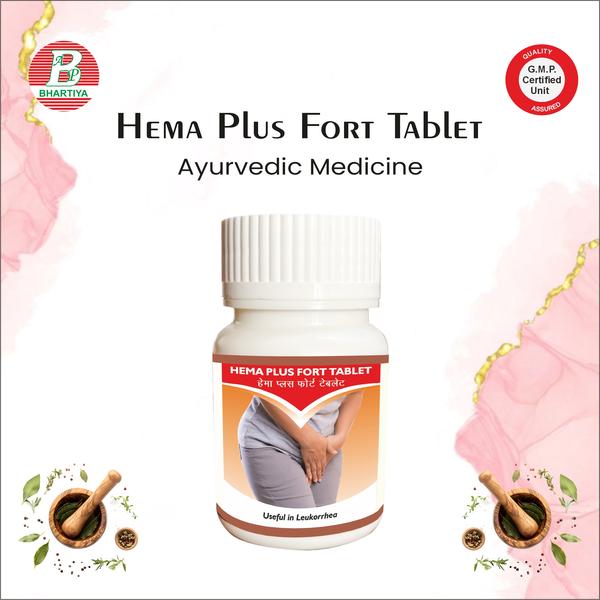
"name": "Hema Plus Fort Tablet",
"description": " HEMA PLUS FORT TABLET \n\nProduct Identification\n•\tGeneric Name: Hema Plus Fort Tablet\n•\tType: Ayurvedic Patent Medicine\n•\tPrimary Indication Area: To prevent or treat iron deficiency and anaemia, especially due to menstrual blood loss.\nTherapeutic Indications\nUsed for the prevention and treatment of iron-deficiency anaemia and to restore normal haemoglobin and iron levels in individuals with low iron stores, particularly due to menstrual blood loss, pregnancy, or dietary deficiency.\nKey benefits include:\n•\tHelps replenish iron lost during menstruation, reducing fatigue, weakness, and symptoms of iron-deficiency anaemia associated with heavy or prolonged periods.\n\nPrimary Benefit:\n•\tRestores iron levels and reduces fatigue caused by menstrual blood loss.\nAdditional Benefits:\n•\tSupports overall blood health by maintaining healthy haemoglobin and iron stores.\n•\tReduces fatigue and weakness associated with chronic blood or nutrient loss.\n•\tBoosts immunity and general wellbeing, which can be affected by prolonged or heavy menstrual bleeding.\n•\tHelps in recovery from nutritional deficiencies caused by excessive menstrual flow or prolonged discharge.\n\nIngredients:\n Kutaj Chaal \n•\tBotanical Name: Holarrhena antidysenterica\n•\tFamily: Apocynaceae\n•\tPart Used: Bark (Chaal)\n•\tTraditional Use: Ayurvedic remedy for diarrhea, dysentery, and digestive disorders\n Phytoconstituents\nThe bark contains several bioactive compounds that are responsible for its therapeutic actions:\n1.\tAlkaloids – e.g., holarrhenine, conessine, kurchine\no\tAntimicrobial, antispasmodic, anti-inflammatory\n2.\tTannins\no\tAstringent properties, reduce intestinal secretions and inflammation\n3.\tFlavonoids\no\tAntioxidant and anti-inflammatory effects\n4.\tGlycosides and Sterols\no\tContribute to digestive support and reduce smooth muscle spasms\n5.\tOther minor constituents – trace saponins, resins, and phenolic compounds\n\n Mechanism of Action in Menstrual Problems\nKutaj Chaal does not act directly on menstrual bleeding or hormones, but it supports menstrual health indirectly through the following mechanisms:\n1.\tReduces menstrual-associated diarrhea or loose stools\no\tAlkaloids and tannins normalize intestinal motility that may be elevated due to prostaglandins during menstruation\n2.\tEases abdominal and uterine cramps\no\tSpasmolytic (smooth muscle relaxant) action helps relieve uterine and gastrointestinal cramps\n3.\tSupports digestion and nutrient absorption\no\tBy improving gastrointestinal function, it ensures better nutrient availability, which is crucial during periods when appetite or digestion may be affected\n4.\tAnti-inflammatory effects\no\tFlavonoids and alkaloids reduce inflammatory mediators that contribute to pain and discomfort\n5.\tAstringent action\no\tTannins may slightly reduce excessive secretions and support overall gastrointestinal comfort\n Amla \n•\tBotanical Name: Phyllanthus emblica (syn. Emblica officinalis)\n•\tFamily: Phyllanthaceae\n•\tPart Used: Fruit\n•\tTraditional Use: Widely used in Ayurveda for rejuvenation, digestion, immunity, and blood health\n\n Phytoconstituents\nAmla is rich in bioactive compounds:\n1.\tVitamin C (Ascorbic acid) – very high concentration, antioxidant, immune support\n2.\tTannins – astringent, anti-inflammatory, help reduce secretions\n3.\tFlavonoids & Polyphenols – antioxidant and anti-inflammatory\n4.\tGallic acid & Ellagic acid – anti-inflammatory and hepatoprotective\n5.\tAmino acids, minerals (iron, calcium, phosphorous) – support overall metabolic and hematological health.\n\n Mechanism of Action in Menstrual Problems\nAmla supports menstrual health indirectly through multiple mechanisms:\n1.\tBlood and iron support\no\tRich in vitamin C and minerals like iron, it enhances haemoglobin formation and reduces anaemia, especially during heavy menstrual bleeding.\n2.\tAnti-inflammatory and antioxidant effects\no\tReduces oxidative stress and inflammation, which can help alleviate menstrual cramps and discomfort.\n3.\tDigestive support\no\tImproves digestion and nutrient absorption, ensuring better overall health during menstruation.\n4.\tImmune and hormonal balance support\no\tBy reducing oxidative stress and improving metabolic function, Amla may indirectly help maintain hormonal balance.\n Babul Chaal \n•\tBotanical Name: Acacia catechu\n•\tFamily: Fabaceae\n•\tPart Used: Bark (Chaal)\n•\tTraditional Use: Ayurvedic medicine for astringent, anti-inflammatory, digestive, and antimicrobial purposes\n Phytoconstituents\nBabul bark contains several bioactive compounds:\n1.\tCatechin and Epicatechin – flavonoids with antioxidant and anti-inflammatory effects\n2.\tTannins (up to 40–50%) – strong astringent properties, reduce secretions and inflammation\n3.\tGlycosides – may contribute to anti-inflammatory and tissue-healing effects\n4.\tPhenolic compounds – support antimicrobial and antioxidant activity\n Mechanism of Action in Menstrual Problems\nBabul Chaal does not directly regulate hormones or menstrual flow, but it can provide supportive benefits:\n1.\tAstringent effect\no\tTannins help reduce excessive secretions (e.g., leucorrhoea/white discharge)\no\tMay support uterine tonicity and reduce mild bleeding in traditional use\n2.\tAnti-inflammatory and antioxidant action\no\tReduces abdominal discomfort and cramps associated with menstruation\n3.\tDigestive support\no\tImproves digestion, reducing bloating or mild GI upset that can occur during menstruation\n4.\tHemostatic property (traditional use)\no\tTraditionally, it is believed to help control mild bleeding due to its astringent nature, though clinical evidence is limited\n Geru \n•\tBotanical Name / Mineral Identity: Geru is red ochre or red clay, mainly composed of ferric oxide (Fe₂O₃).\n•\tTraditional Use: In Ayurveda, it is used as a mineral remedy (Ras) for bleeding disorders, uterine health, and wound healing.\n Phytoconstituents / Composition\nGeru is primarily mineral-based, containing:\n1.\tIron Oxide (Fe₂O₃) – may contribute to mild iron supplementation\n2.\tAluminum and Silicates – support tissue healing and astringent properties\n3.\tTrace elements like calcium and magnesium\nNote: Unlike herbs, Geru is a mineral (Ras) preparation, so its effects are largely aesthetic, astringent, or supportive in traditional use rather than biochemical in the classic sense.\n\n Mechanism of Action in Menstrual Problems (Traditional / Ayurvedic View)\n1.\tAstringent and Hemostatic effect\no\tHelps control mild uterine bleeding or excessive menstrual flow in traditional formulations\no\tSupports uterine tonicity\n2.\tIron content\no\tMay provide minor support in preventing anaemia due to blood loss (though not as potent as iron supplements like Hema Plus)\n3.\tTissue healing and cooling effect\no\tUsed in some formulations for soothing inflammation or irritation in the reproductive tract\n\nDosage:\n1.\tDose per intake: 2–3 tablets\n2.\tFrequency: Twice a day (morning & evening)\n3.\tTotal daily dose: 2–6 tablets per day-(For 500 mg tablets, this equals 1–3 g/day)\n4.\tHow to take: With water, preferably after meals to reduce gastric irritation and improve absorption\n5.\tPrecautions\no\tDo not exceed the prescribed dose\no\tMonitor for side effects\nConsult an Ayurvedic practitioner for:\no\tChildren\no\tElderly\no\tChronic illnesses\n\n\nhema plus forte tablet uses in hindi, hema plus forte tablet\nhema plus tablet, hema plus capsule, hem plus tablet\nhema plus fort tablet amazon, hema plus fort tablet action\nhema plus fort tablet benefits, hema plus fort tablet benefits in hindi\nhema plus fort tablet brand name, hema plus fort tablet buy online\nhema plus fort tablet composition, hema plus fort tablet content\nhema plus fort tablet company, hema plus fort tablet company name\nhema plus fort tablet dosage, hema plus fort tablet dose\nhema plus fort tablet details, hema plus fort tablet dose per day\nhema plus fort tablet download, hema plus fort tablet english\nhema plus fort tablet expiry date, hema plus fort tablet flipkart\nhema plus fort tablet for hair growth, hema plus fort tablet generic name\nhema plus fort tablet gst rate, hema plus fort tablet gold\nhema plus fort tablet good or bad, hema plus fort tablet gst\nhema plus fort tablet jiomart, hema plus fort tablet junior\nhema plus fort tablet ke fayde in hindi, hema plus fort tablet kis kaam aati hai\nhema plus fort tablet ke fayde, hema plus fort tablet list\nhema plus fort tablet login, hema plus fort tablet lab\nhema plus fort tablet mrp, hema plus fort tablet manufacturer\nhema plus fort tablet name, hema plus fort tablet new\nhema plus fort tablet online shopping, hema plus fort tablet online\nhema plus fort tablet online order, hema plus fort tablet price\nhema plus fort tablet price in india, hema plus fort tablet quantity\nhema plus fort tablet quality, hema plus fort tablet q10\nhema plus fort tablet review, hema plus fort tablet rate\nhema plus fort tablet review in hindi, hema plus fort tablet side effects\nhema plus fort tablet side effects in hindi, hema plus fort tablet se kya hota hai\nhema plus fort tablet tablet, hema plus fort tablet tata 1mg\nhema plus fort tablet veterinary, hema plus fort tablet website\nhema plus fort tablet which company, hema plus fort tablet weight gainer\nhema plus fort tablet watch, hema plus fort tablet zinc\nwhy hema plus fort tablet uses in hindi, who hema plus fort tablet uses\nis hema plus fort tablet good, is hema plus fort tablet do\nwill hema plus fort tablets, will hema plus fort tablet uses\nwill hema plus fort tablet do, do hema plus fort tablet uses\ndo hema plus fort tablets, do hema plus fort tablet uses in hindi\ndoes hema plus fort tablet uses, does hema plus fort tablet work\ndoes hema plus fort tablet uses in hindi, does hema plus fort tablet do\nwas hema plus fort tablet good, was hema plus fort tablet in india\nbest hemo plus forte tablet uses in hindi, best hemo plus forte tablet uses\nbest hemo plus forte tablet price, top hema plus fort tablets\ntop hema plus fort tablet uses in hindi, top hema plus fort tablet uses\ntop hema plus fort tablet price",
"price": 84.0,
"discountamount": 42.0,
"currencycode": "INR",
"priority": 1000000,
"isfreeshipmentavailable": false,
"shipmentduration": 1,
"_keywords": null,
"isarchived": false,
"isavailable": true,
"applicationid": null,
"productindex": 98,
"imageuri": "https://productimages.withfloats.com/actual/69e5c24c25698ec472744d2a.jpg",
"tileimageuri": "https://productimages.withfloats.com/tile/69e5c24c25698ec472744d2a.jpg",
"images": null,
"totalqueries": 0,
"gpid": null,
"groupproductid": null,
"createdon": "2026-04-20T06:06:02.385Z",
"updatedon": "2026-04-20T06:06:02.385Z",
"buyonlinelink": null,
"producturl": "http://WWW.BHARTIYAAYURVEDICPHARMACY.COM//hema-plus-fort-tablet/98",
"availableunits": -1.0,
"iscodavailable": true,
"isprepaidonlineavailable": true,
"maxcodorders": -1,
"maxprepaidonlineorders": -1,
"uniquepaymenturl": null,
"brandname": "Bakul Fort",
"category": "Hema Plus Fort Tablet 100 Tab X 50",
"tags": [],
"variants": false,
"keyspecification": null,
"otherspecifications": null,
"pickupaddressreferenceid": null,
"paymenttype": "AssuredPurchase",
"producttype": "products",
"hsncode": null,
"gstslab": 0.0,
"isnotforsale": false
},
{
"_id": "69e30d18f95b5f945e3ebe58",
"fptag": "BHARTIYEAYURVEDICPHARMACY",
"merchantname": null,
"customwidgets": null,
"externalsourceid": null,
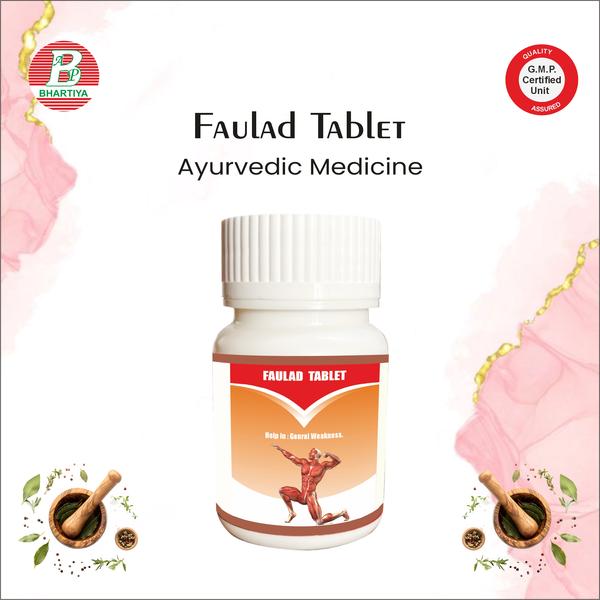
"name": "Faulad Tablet",
"description": " FAULAD TABLET \n\nProduct Identification\n•\tGeneric Name: Fauld Tablet\n•\tType: Ayurvedic Patent Medicine\n•\tPrimary Indication Area: Supports general weakness, debility, erectile dysfunction, and male fertility (sperm count & quality).\nTherapeutic Indications:\n•\tGeneral debility and weakness\n•\tErectile dysfunction and sexual health disorders\n•\tLow sperm count and poor sperm quality\n•\tStamina and vitality improvement\n Primary Benefit:\n•\tImproves strength, vitality, and sexual performance while supporting male reproductive health\nOther Benefits:\n1.Strength, Vitality & Sexual Health\n•\tEnhances overall physical strength and energy levels, helping combat general weakness.\n•\tSupports erectile function and sexual stamina in men.\n•\tImproves sexual performance, addressing mild to moderate sexual health issues.\n2. Male Reproductive Support\n•\tHelps increase sperm count and sperm quality, supporting male fertility.\n•\tImproves sperm motility and vitality, enhancing reproductive potential.\n\nSAFED MUSLI (Chlorophytum borivilianum) \nKey Phytoconstituents:\n•\tSteroidal saponins (e.g., borivilianosides)\n•\tPolysaccharides\n•\tAlkaloids\n•\tProteins and amino acids\n•\tFlavonoids\nMechanism of Action / Biochemistry & Pharmacology:\n1.\tAphrodisiac & Sexual Health Support\no\tSteroidal saponins stimulate testosterone synthesis in Leydig cells.\no\tEnhances spermatogenesis, improving sperm count, motility, and viability.\no\tModulates hypothalamic-pituitary-gonadal axis, supporting libido and sexual performance.\n2.\tStrength & Vitality Enhancement\no\tPolysaccharides and amino acids provide energy substrates for muscle tissue.\no\tImprove muscle strength and endurance by supporting protein synthesis and recovery.\n\nSHATAVARI (Asparagus racemosus) \nBotanical / Common Name: Asparagus racemosus / Shatavari\nKey Phytoconstituents:\n•\tSteroidal saponins (Shatavarins I–IV)\n•\tFlavonoids\n•\tAlkaloids\n•\tPolysaccharides\n•\tProteins and amino acids\nMechanism of Action / Biochemistry & Pharmacology:\n1.\tReproductive Health & Aphrodisiac Effects\no\tSteroidal saponins stimulate luteinizing hormone (LH) and follicle-stimulating hormone (FSH).\no\tSupports spermatogenesis in males and ovarian function in females.\no\tEnhances libido and sexual performance by modulating hypothalamic-pituitary-gonadal axis.\n2.\tStrength, Vitality & Energy Support\no\tPolysaccharides and amino acids provide energy substrates for muscle and tissue repair.\no\tImproves physical endurance and recovery from fatigue or debility.\n\nARJUNA CHHAL (Terminalia arjuna Bark) \nBotanical / Common Name: Terminalia arjuna / Arjuna Bark\nKey Phytoconstituents:\n•\tTriterpenoids (Arjunolic acid, Arjunic acid)\n•\tFlavonoids\n•\tGlycosides\n•\tTannins\n•\tMinerals (Calcium, Magnesium, Potassium)\nMechanism of Action / Biochemistry & Pharmacology:\n1.\tCardioprotective Effects\no\tTriterpenoids and flavonoids strengthen myocardial tissue and improve cardiac contractility.\no\tReduces oxidative stress in heart tissues, protecting against ischemic damage.\n2.\tAntioxidant & Anti-inflammatory Action\no\tFlavonoids and tannins scavenge reactive oxygen species (ROS).\no\tReduces inflammation in cardiovascular and gut tissues, supporting overall health.\n\n MULETHI (Glycyrrhiza glabra) \nBotanical / Common Name: Glycyrrhiza glabra / Licorice\nKey Phytoconstituents:\n•\tGlycyrrhizin (saponin glycoside)\n•\tFlavonoids\n•\tCoumarins\n•\tPolysaccharides\n•\tTannins\nMechanism of Action / Biochemistry & Pharmacology:\n1.\tGastroprotective & Anti-Ulcer Effects\no\tGlycyrrhizin and flavonoids stimulate mucus secretion in the stomach and intestines.\no\tProtects gut mucosa from acid or toxin-induced damage.\no\tSupports healing of minor intestinal lesions or irritation.\n2.\tAnti-inflammatory & Anti-Spasmodic Action\no\tFlavonoids and saponins reduce inflammation in the gastrointestinal and respiratory tract.\no\tRelieves abdominal cramps, bloating, and irritation.\n\nGOKHRU (Tribulus terrestris) \nBotanical / Common Name: Tribulus terrestris / Gokhru\nKey Phytoconstituents:\n•\tSteroidal saponins (Tribulosides)\n•\tFlavonoids\n•\tAlkaloids\n•\tTannins\n•\tGlycosides\nMechanism of Action / Biochemistry & Pharmacology:\n1.\tReproductive Health & Aphrodisiac Effect\no\tSteroidal saponins stimulate testosterone synthesis in Leydig cells.\no\tEnhances spermatogenesis, improving sperm count, motility, and quality.\no\tImproves libido, sexual performance, and erectile function by modulating the hypothalamic-pituitary-gonadal axis.\n2.\tStrength, Vitality & Physical Endurance\no\tProvides energy substrates and nutrients that support muscle strength and stamina.\no\tReduces fatigue and debility, enhancing overall physical performance.\n\nAMLAKI (Emblica officinalis) \nBotanical / Common Name: Emblica officinalis / Amla\nKey Phytoconstituents:\n•\tAscorbic acid (Vitamin C)\n•\tTannins\n•\tFlavonoids\n•\tSaponins\n•\tPhenolic compounds\nMechanism of Action / Biochemistry & Pharmacology:\n1.\tDigestive Support & Mild Laxative Effect\no\tSaponins stimulate bowel motility and soften stools.\no\tIncreases water content in stools, easing passage and reducing straining.\n2.\tDigestive Stimulant / Carminative Effect\no\tFlavonoids and phenolic compounds enhance secretion of digestive enzymes.\no\tImproves digestion and absorption, preventing accumulation of undigested food.\n\nHALDI (Curcuma longa) \nBotanical / Common Name: Curcuma longa / Turmeric\nKey Phytoconstituents:\n•\tCurcuminoids (Curcumin, Desmethoxycurcumin, Bisdemethoxycurcumin)\n•\tVolatile oils (Turmerone, Cineole)\n•\tProteins and starch\n•\tPhenolic compounds\nMechanism of Action / Biochemistry & Pharmacology:\n1.\tAnti-inflammatory Effects\no\tCurcumin inhibits NF-κB pathway and pro-inflammatory cytokines (TNF-α, IL-6).\no\tReduces inflammation in gut, joints, and other tissues.\n2.\tAntioxidant Protection\no\tCurcuminoids scavenge reactive oxygen species (ROS) and enhance antioxidant enzymes (SOD, catalase, glutathione).\no\tProtects cells and tissues from oxidative damage.\n\nKONCH BEEJ \nBotanical / Common Name: Shorea robusta seeds / Konch Beej\nKey Phytoconstituents:\n•\tTannins\n•\tFlavonoids\n•\tResins\n•\tSterols\n•\tPhenolic compounds\nMechanism of Action / Biochemistry & Pharmacology:\n1.\tAnti-Diarrhoeal / Astringent Effect\no\tTannins precipitate proteins in intestinal mucosa.\no\tReduces intestinal secretions, controlling watery stools.\no\tUseful in acute and chronic diarrhoea.\n2.\tAnti-inflammatory Action\no\tFlavonoids and phenolic compounds reduce gut inflammation.\no\tRelieves bloating, abdominal discomfort, and irritation.\n\nASHWAGANDHA (Withania somnifera) \nBotanical / Common Name: Withania somnifera / Ashwagandha\nKey Phytoconstituents:\n•\tWithanolides (steroidal lactones)\n•\tAlkaloids (Withanine, Somniferine)\n•\tSaponins\n•\tFlavonoids\n•\tGlycosides\nMechanism of Action / Biochemistry & Pharmacology:\n1.\tAdaptogenic / Stress-Modulating Effects\no\tWithanolides modulate the hypothalamic-pituitary-adrenal (HPA) axis.\no\tReduces cortisol levels, improving stress tolerance, energy, and vitality.\n2.\tStrength & Vitality Enhancement\no\tSupports muscle strength, endurance, and recovery.\no\tPolysaccharides and amino acids improve overall energy metabolism.\n\nKHARETI / ATIBALA (Abutilon indicum) \nBotanical / Common Name: Abutilon indicum / Khareti / Atibala\nKey Phytoconstituents:\n•\tFlavonoids\n•\tGlycosides\n•\tTannins\n•\tPhytosterols\n•\tAlkaloids\nMechanism of Action / Biochemistry & Pharmacology:\n1.\tStrength & Vitality Support\no\tGlycosides and flavonoids enhance energy metabolism.\no\tSupports muscle strength, endurance, and general physical vitality.\n2.\tReproductive Health Support\no\tTraditionally used to improve male reproductive function.\no\tSupports sperm quality, motility, and virility.\n\nCHOTI ELAICHI (Elettaria cardamomum) \nBotanical / Common Name: Elettaria cardamomum / Small Cardamom / Choti Elaichi\nKey Phytoconstituents:\n•\tEssential oils (Cineole, α-Terpinyl acetate, Linalool)\n•\tFlavonoids\n•\tTerpenes\n•\tPhenolic compounds\n•\tGlycosides\nMechanism of Action / Biochemistry & Pharmacology:\n1.\tDigestive Stimulant & Carminative\no\tEssential oils stimulate digestive enzyme secretion.\no\tReduces bloating, gas, and indigestion.\no\tImproves overall digestion and nutrient absorption.\n2.\tAnti-Flatulent & Mild Laxative Action\no\tTerpenes and flavonoids relieve intestinal gas.\no\tSupports regular bowel movements.\n\n LAUNG (Syzygium aromaticum) \nBotanical / Common Name: Syzygium aromaticum / Clove / Laung\nKey Phytoconstituents:\n•\tEugenol (major bioactive compound)\n•\tFlavonoids\n•\tTannins\n•\tVolatile oils (β-Caryophyllene, Eugenyl acetate)\n•\tPhenolic compounds\nMechanism of Action / Biochemistry & Pharmacology in Male Sexual Health:\n1.\tEnhancement of Testosterone Production\no\tEugenol and flavonoids may stimulate Leydig cells in the testes.\no\tIncreases testosterone synthesis, supporting libido, erectile function, and spermatogenesis.\n2.\tImprovement of Sperm Quality & Motility\no\tAntioxidant action of flavonoids and phenolics reduces oxidative stress in testes and seminal fluid.\no\tProtects sperm DNA and cell membrane integrity, improving sperm count, motility, and viability.\n\n AKARKARA (Anacyclus pyrethrum) \nBotanical / Common Name: Anacyclus pyrethrum / Akarkara / Pellitory root\nKey Phytoconstituents:\n•\tAlkylamides (Pyrethrins)\n•\tPolysaccharides\n•\tSterols\n•\tEssential oils\n•\tPolyphenols\nMechanism of Action / Biochemistry & Pharmacology in Male Sexual Health:\n1.\tAphrodisiac & Libido Enhancement\no\tAlkylamides stimulate central nervous system pathways, enhancing sexual desire.\no\tModulates dopamine and serotonin activity, supporting arousal and sexual behavior.\n2.\tTestosterone & Androgen Support\no\tPromotes Leydig cell activity in testes, enhancing testosterone synthesis.\no\tSupports erectile function, sperm production, and secondary sexual characteristics.\n\nJAYPHAL (Myristica fragrans) \nBotanical / Common Name: Myristica fragrans / Nutmeg / Jayphal\nKey Phytoconstituents:\n•\tEssential oils (Myristicin, Elemicin, Safrole)\n•\tLignans\n•\tAlkaloids\n•\tPhenolic compounds\n•\tFlavonoids\nMechanism of Action / Biochemistry & Pharmacology in Male Sexual Health:\n1.\tAphrodisiac & Libido Enhancement\no\tMyristicin and essential oils act on central nervous system pathways.\no\tModulate dopamine and serotonin, enhancing sexual desire and arousal.\n2.\tTestosterone & Androgen Support\no\tMay stimulate Leydig cells in testes, supporting testosterone synthesis.\no\tEnhances erectile function and secondary sexual characteristics.\n\nJAVITRI (Myristica fragrans – Mace) \nBotanical / Common Name: Myristica fragrans (aril) / Mace / Javitri\nKey Phytoconstituents:\n•\tEssential oils (Myristicin, Elemicin)\n•\tLignans\n•\tAlkaloids\n•\tFlavonoids\n•\tPhenolic compounds\nMechanism of Action / Biochemistry & Pharmacology in Male Sexual Health:\n1.\tAphrodisiac & Libido Enhancement\no\tMyristicin and essential oils stimulate central nervous system pathways.\no\tModulates dopamine and serotonin signaling, enhancing sexual desire and arousal.\n2.\tTestosterone & Androgen Support\no\tSupports Leydig cell activity, enhancing testosterone synthesis.\no\tPromotes erectile function and secondary sexual characteristics.\n\nSAUNTH (Zingiber officinale – Dry Ginger) \nBotanical / Common Name: Zingiber officinale Roscoe / Dry Ginger / Saunth\nKey Phytoconstituents:\n•\tGingerols\n•\tShogaols\n•\tVolatile oils (Zingiberene, Bisabolene)\n•\tFlavonoids\n•\tPhenolic compounds\nMechanism of Action / Biochemistry & Pharmacology in Male Sexual Health:\n1.\tLibido & Aphrodisiac Effect\no\tGingerols and shogaols stimulate central nervous system pathways, enhancing sexual desire and arousal.\no\tModulates dopamine and serotonin levels, supporting sexual performance.\n2.\tTestosterone & Androgen Support\no\tImproves Leydig cell function, supporting testosterone synthesis.\no\tPromotes erectile function and secondary sexual characteristics.\n\nMIRCH (Piper nigrum) \nBotanical / Common Name: Piper nigrum / Black Pepper / Mirch\nKey Phytoconstituents:\n•\tPiperine (alkaloid)\n•\tVolatile oils (Pinene, Limonene)\n•\tFlavonoids\n•\tPhenolic compounds\n•\tPiperidine derivatives\nMechanism of Action / Biochemistry & Pharmacology in Male Sexual Health:\n1.\tLibido & Aphrodisiac Effect\no\tPiperine stimulates central nervous system pathways, enhancing sexual desire and arousal.\no\tModulates dopamine and serotonin signaling, supporting libido.\n2.\tTestosterone & Androgen Support\no\tPiperine may enhance Leydig cell function, supporting testosterone synthesis.\no\tImproves erectile function and secondary sexual characteristics.\n\nDosage\n•\tAdults: 1–2 tablets, twice a day after meals\n•\tChildren: 1 tablet, twice a day (only if prescribed by a physician)\n•\tWith water: Swallow tablets with plain water\n•\tOptional: Can be taken with warm milk for better absorption and enhanced effect\n•\tTiming: After meals, preferably morning and evening, or as advised by a physician\n Precautions \n•\tFollow dosage; do not exceed recommended tablets.\n•\tConsult a doctor if child, elderly, or with chronic illnesses.\n•\tWatch for allergies: rash, nausea, abdominal discomfort.\n•\tCheck interactions with medications (BP, diabetes, anticoagulants).\n•\tMaintain healthy lifestyle: balanced diet, hydration, exercise, avoid smoking/alcohol.\n•\tUse under supervision for long-term or underlying conditions (hormonal, cardiovascular).\n\n\n\nfaulad tablet uses, faulad ki tablet, sharbat e faulad tablet\nfaulad ayurvedic medicine, faulad tonic, faulad tablet composition\nfaulad tablet company, faulad tablet content\nfaulad tablet company name, faulad tablet cartoon\nfaulad tablet download, faulad tablet dosage\nfaulad tablet dose, faulad tablet dose per day\nfaulad tablet dil, faulad e sharbat, faulad tablet flipkart\nfaulad tablet faulad, faulad tablet fayde, faulad tablet gst rate\nfaulad tablet generic name, faulad tablet gym\nfaulad tablet hindi, faulad tablet hota hai, faulad tablet hai\nfaulad tablet health, faulad tablet jiomart, faulad tablet jio\nfaulad tablet ji, faulad syrup ke fayde, faulad tablet list\nfaulad tablet list pdf, faulad tablet manufacturer\nfaulad tablet mrp, faulad tablet manufacturers in india\nfaulad tablet meaning, faulad tablet matlab\nfaulad tablet meaning in english, faulad tablet meaning in hindi\nfaulad tablet name, faulad tablet new, faulad tablet nutrition\nfaulad tablet no.1, faulad tablet online, faulad tablet online shopping\nfaulad tablet online order, faulad tablet price, faulad tablet picture\nfaulad tablet pharmacy, faulad tablet quality\nfaulad tablet quantity, faulad tablet qatar\nfaulad tablet review, faulad tablet rate\nfaulad tablet review in hindi, faulad tablet rs\nfaulad tablet tablet, faulad tablet technical\nfaulad tablet veterinary, faulad tablet weight gain\nfaulad tablet weight gainer",
"price": 96.0,
"discountamount": 48.0,
"currencycode": "INR",
"priority": 1000000,
"isfreeshipmentavailable": false,
"shipmentduration": 1,
"_keywords": null,
"isarchived": false,
"isavailable": true,
"applicationid": null,
"productindex": 94,
"imageuri": "https://productimages.withfloats.com/actual/69e30d1cf445311842ea3584.jpg",
"tileimageuri": "https://productimages.withfloats.com/tile/69e30d1cf445311842ea3584.jpg",
"images": null,
"totalqueries": 0,
"gpid": null,
"groupproductid": null,
"createdon": "2026-04-18T04:48:24.503Z",
"updatedon": "2026-04-18T04:56:11.614Z",
"buyonlinelink": null,
"producturl": "http://WWW.BHARTIYAAYURVEDICPHARMACY.COM//faulad-tablet/94",
"availableunits": -1.0,
"iscodavailable": true,
"isprepaidonlineavailable": true,
"maxcodorders": -1,
"maxprepaidonlineorders": -1,
"uniquepaymenturl": null,
"brandname": "Bakula Fort",
"category": "Faulad Tablet 100 Tab X 50",
"tags": [],
"variants": false,
"keyspecification": null,
"otherspecifications": null,
"pickupaddressreferenceid": null,
"paymenttype": "AssuredPurchase",
"producttype": "products",
"hsncode": null,
"gstslab": 0.0,
"isnotforsale": false
},
{
"_id": "69a55b8694180917ab8a5d30",
"fptag": "BHARTIYEAYURVEDICPHARMACY",
"merchantname": null,
"customwidgets": null,
"externalsourceid": null,
"name": "Sahjana capsule",
"description": " SAHJANA \n \n SAHJANA (Moringa oleifera Lam.) \nThe Nutrient-Rich “Drumstick Tree” — Leaves, Pods, Seeds, and Flowers\nSahjana, commonly known as Moringa, is a highly valued plant in Ayurveda and modern nutrition. Known for its nourishing, rejuvenating, and digestive-supporting properties, it is rich in vitamins, minerals, proteins, antioxidants, and phytochemicals. Sahjana is considered beneficial for immunity, metabolism, skin, hair, heart health, and overall vitality.\n CLASSICAL AYURVEDIC REFERENCES\n1.\tCharaka Samhita\no\tMentioned in Kalpa Sthana for strengthening Dhatus and improving Ojas.\no\tLeaves and pods are considered Medhya (brain nourishing) and Rasayana (rejuvenative).\n2.\tSushruta Samhita\no\tRecommended for Vata and Pitta disorders, digestive weakness, and anaemia.\no\tDescribed as Snigdha (unctuous), Ushna (warming), and Balya (strength-giving).\n3.\tBhavaprakasha Nighantu\no\tReferred to as Sahjana / Shobhanjana.\no\tPromotes longevity, immunity, and vitality.\no\tUsed in Vrishya (reproductive), Hridya (cardiac), and Medhya (intellectual) formulations.\n\n CLASSICAL STORY / ANECDOTE\nIn classical Ayurvedic texts, Sahjana is praised as a “miracle tree” because every part—leaves, pods, seeds, flowers, and bark—has medicinal or nutritional use. It is sometimes referred to as “Sanjeevani of common people”, symbolizing its life-supporting and rejuvenative qualities. Traditionally, Sahjana leaves and pods were included in the diet of warriors and laborers to enhance strength, stamina, and immunity during harsh seasons.\n\n BOTANICAL INFORMATION OF SAHJANA \n•\tScientific Name: Moringa oleifera Lam.\n•\tFamily: Moringaceae\n•\tOrder: Brassicales\n•\tGenus: Moringa\n•\tSpecies: oleifera\n\nCommon Names:\n\tSanskrit: Sahjana, Shobhanjana\n\tHindi: Sahjan, Munga\n\tEnglish: Drumstick Tree, Horseradish Tree\n\tTamil: Murungai\n\tTelugu: Munagaku\n\tMalayalam: Munagakaya\n\tKannada: Nuggekai\n\tBengali: Sajnana\n\n SYNONYMS IN CLASSICAL AYURVEDIC NIGHANTUS\n•\tCharaka Samhita: Sahjana – Rasayana, Balya\n•\tSushruta Samhita: Sahjana – Medhya, Hridya, Balya\n•\tBhavaprakasha Nighantu: Sahjana / Shobhanjana – Promotes longevity, immunity, and fertility\n\n MORPHOLOGY OF SAHJANA\n•\tPlant Type: Fast-growing perennial tree\n•\tHeight: 5–10 m\n•\tLeaves: Small, pinnate, feathery\n•\tFlowers: White to pale yellow, fragrant, 5-petaled\n•\tFruit / Pod: Long, slender drumstick-shaped pods containing seeds\n•\tSeeds: Round, brown, winged, nutrient-rich\n•\tRoots & Bark: Used in traditional medicines\n\n ECOLOGICAL PREFERENCES\n•\tClimate: Tropical to subtropical, tolerates dry conditions\n•\tSoil: Well-drained sandy or loamy soil, pH 6–7.5\n•\tHabitat: Cultivated in fields, gardens, roadsides; requires full sun\n•\tAltitude: Sea level to 1,000 m\n\n GEOGRAPHICAL DISTRIBUTION\n•\tIndia: Maharashtra, Tamil Nadu, Andhra Pradesh, West Bengal, Rajasthan\n•\tOutside India: Philippines, Africa, Caribbean, Southeast Asia, Middle East\n\n CLASSICAL AYURVEDIC PROPERTIES (RASA–GUNA–VIRYA–VIPAKA)\n•\tRasa (Taste): Madhura (sweet), Tikta (bitter), Katu (pungent)\n•\tGuna (Qualities): Laghu (light), Snigdha (unctuous)\n•\tVirya (Potency): Ushna (warming)\n•\tVipaka (post-digestive effect): Madhura (sweet)\n•\tDosha Effects: Vata-Pitta hara (reduces Vata & Pitta), Kapha samana in moderation\n THERAPEUTIC ACTIONS (KARMA)\n1.\tMedhya: Supports brain health, improves intellect and memory\n2.\tHridya: Supports cardiovascular system\n3.\tBalya: Enhances strength and immunity\n4.\tVatahara: Reduces Vata-related disorders like joint pain and weakness\n5.\tRasayana: Rejuvenates, promotes longevity, and overall vitality\n6.\tKeshya & Twachya: Nourishes hair and skin\n7.\tAnulomana: Supports digestion and regular bowel movements\n\n INDICATIONS\n•\tDigestive System: Constipation, poor digestion, loss of appetite\n•\tCardiovascular System: Hypertension, Hyperlipidemia\n•\tReproductive & Urinary System: Fertility support, reproductive wellness\n•\tSkin & Hair: Dry skin, hair loss, premature greying\n•\tMetabolism: Diabetes, obesity, metabolic imbalance\n•\tNervous System: Stress, fatigue, cognitive support\n\n MODERN PHARMACOLOGY & PHYTOCHEMISTRY\n•\tMajor Constituents:\no\tVitamins (A, C, E, B-complex), minerals (Ca, K, Fe, Mg)\no\tProteins, amino acids\no\tFlavonoids, phenolics, saponins, alkaloids\no\tOmega fatty acids (in seeds)\n•\tPharmacological Actions:\no\tAntioxidant\no\tAnti-inflammatory\no\tImmunomodulatory\no\tAnti-diabetic\no\tHepatoprotective\no\tCardioprotective\n\n CULTIVATION DETAILS\n•\tPropagation: Seeds or cuttings\n•\tSowing Time: February–May (summer) or monsoon planting\n•\tSpacing: 2–3 m between trees\n•\tIrrigation: Moderate; drought-tolerant\n•\tFertilization: Organic manure preferred\n•\tHarvesting: Leaves – year-round; Pods – 6–8 months after planting; Seeds – when pods mature\n\n CLASSICAL DOSAGE (According to Ayurvedic Granthas)\n•\tLeaves: 5–10 g/day (fresh or powdered)\n•\tPods / Drumsticks: 10–20 g/day cooked or in decoction\n•\tSeeds: 3–6 g/day powdered or soaked\n•\tOil (Sahjana Taila): 5–10 ml/day\n•\tDecoction / Paste: As per therapeutic requirement (skin, hair, or digestion)\n\n SAHJANA FORMULATIONS – BHARTIYA AYURVEDIC PHARMACY\nBhartiya Ayurvedic Pharmacy prepares a range of Sahjana formulations following classical Ayurvedic principles. Each product retains the full nutritive, rejuvenative, and digestive-supporting properties of Sahjana, promoting heart health, immunity, metabolism, and overall vitality.\nKey Uses of Sahjana Formulations:\n•\tDigestive Support: Improves digestion, relieves constipation, promotes gut health\n•\tCardiovascular Health: Supports healthy lipid levels and heart function\n•\tReproductive Health: Enhances fertility and nourishes reproductive tissues\n•\tSkin & Hair Care: Improves skin hydration, strengthens hair roots\n•\tRasayana: Rejuvenates, supports longevity, and overall vitality\n\n SAHJANA CAPSULE\nBhartiya Ayurvedic Pharmacy offers Sahjana Capsules prepared according to classical Ayurvedic methods. Each capsule contains premium quality Sahjana (Moringa) powder or extract, preserving its nutritive, rejuvenative, and balancing properties.\nKey Benefits:\n•\tSupports digestive health and regular bowel movements\n•\tPromotes cardiovascular health\n•\tEnhances reproductive health and immunity\n•\tNourishes skin and hair\n•\tActs as a Rasayana, promoting overall vitality and strength\n\nDosage:\n•\tAdults: 1–2 capsules twice daily with warm water or as directed by an Ayurvedic physician\n•\tCan be combined with milk or ghee for enhanced Rasayana effect\nSafety & Precautions:\n•\tSafe for long-term use when taken as per dosage\n•\tMild laxative effect may occur in sensitive individuals\n•\tMonitor blood pressure or blood sugar if taken with medications\nFormulation Highlights:\n•\t100% natural Sahjana (Moringa) powder\n•\tFree from artificial colours, preservatives, and additives\n•\tPrepared using classical Ayurvedic processing methods\nSuggested Use:\n•\tIdeal for adults looking to improve digestion, heart health, immunity, and vitality\n•\tSuitable for those seeking convenient Ayurvedic Rasayana support\n\n SAHJANA POWDER \nBhartiya Ayurvedic Pharmacy offers Sahjana (Moringa oleifera) Powder prepared according to classical Ayurvedic principles. Made from premium quality dried leaves, pods, and seeds, the powder retains full nutritive, rejuvenative, and balancing properties of Sahjana.\nKey Benefits:\n•\tSupports digestion and regular bowel movements\n•\tPromotes heart and cardiovascular health\n•\tEnhances immunity and overall vitality\n•\tNourishes skin and hair\n•\tActs as a Rasayana, promoting strength and stamina\nDosage:\n•\tAdults: 3–6 g/day (1–2 teaspoons) with warm water, milk, or ghee, or as directed by an Ayurvedic physician\n•\tCan be added to smoothies, soups, or food for daily nourishment\nSafety & Precautions:\n•\tSafe for long-term use when taken as per dosage\n•\tMild laxative effect may occur in sensitive individuals\n•\tMonitor blood sugar if taken with antidiabetic medications\nFormulation Highlights:\n•\t100% natural Sahjana (Moringa) powder\n•\tFree from artificial colours, preservatives, and additives\n•\tPrepared using classical Ayurvedic processing methods\nSuggested Use:\n•\tIdeal for adults looking to improve digestion, immunity, heart health, and overall vitality\n•\tSuitable for daily Rasayana and nutritional support\n\n\nsahjan capsule, sahjan capsule uses in hindi\nsahjan churna, sahjan ka churan, sahjan ka upyog\nsahjan ka upyog kaise karen, sahjan ke capsule\nsahjan ke capsule ke fayde, sahjan ke upyog\nsahjana capsule amazon, sahjana capsule ayurvedic\nsahjana capsule benefits, sahjana capsule benefits in hindi\nsahjana capsule buy online, sahjana capsule composition\nsahjana capsule contains, sahjana capsule content\nsahjana capsule cost, sahjana capsule dose\nsahjana capsule dose per day, sahjana capsule download\nsahjana capsule download pdf, sahjana capsule english\nsahjana capsule english name, sahjana capsule expiry date\nsahjana capsule extract, sahjana capsule gmp\nsahjana capsule green world, sahjana capsule hindi\nsahjana capsule how to use, sahjana capsule jan aushadhi\nsahjana capsule jiomart, sahjana capsule lagane ke fayde\nsahjana capsule life, sahjana capsule life care\nsahjana capsule login, sahjana capsule manufacturer\nsahjana capsule name, sahjana capsule near me\nsahjana capsule nutrition, sahjana capsule online\nsahjana capsule online order, sahjana capsule online purchase\nsahjana capsule online shopping, sahjana capsule price\nsahjana capsule quality, sahjana capsule quantity\nsahjana capsule question, sahjana capsule question paper\nsahjana capsule rate, sahjana capsule recipe\nsahjana capsule review, sahjana capsule review in hindi\nsahjana capsule side effects, sahjana capsule side effects in hindi",
"price": 360.0,
"discountamount": 180.0,
"currencycode": "INR",
"priority": 1000000,
"isfreeshipmentavailable": false,
"shipmentduration": 1,
"_keywords": null,
"isarchived": false,
"isavailable": true,
"applicationid": null,
"productindex": 70,
"imageuri": "https://productimages.withfloats.com/actual/69a55b888361c309c6520782.jpg",
"tileimageuri": "https://productimages.withfloats.com/tile/69a55b888361c309c6520782.jpg",
"images": null,
"totalqueries": 0,
"gpid": null,
"groupproductid": null,
"createdon": "2026-03-02T09:42:30.676Z",
"updatedon": "2026-03-02T09:42:30.676Z",
"buyonlinelink": null,
"producturl": "http://WWW.BHARTIYAAYURVEDICPHARMACY.COM//sahjana-capsule/70",
"availableunits": -1.0,
"iscodavailable": true,
"isprepaidonlineavailable": true,
"maxcodorders": -1,
"maxprepaidonlineorders": -1,
"uniquepaymenturl": null,
"brandname": "Bakula fort",
"category": "Sahjana capsule 60 - cap X 24",
"tags": [],
"variants": false,
"keyspecification": null,
"otherspecifications": null,
"pickupaddressreferenceid": null,
"paymenttype": "AssuredPurchase",
"producttype": "products",
"hsncode": null,
"gstslab": 0.0,
"isnotforsale": false
},
{
"_id": "69a528def45c3bf97dd093c7",
"fptag": "BHARTIYEAYURVEDICPHARMACY",
"merchantname": null,
"customwidgets": null,
"externalsourceid": null,
"name": "Safed musli capsule",
"description": " Safed Musali \n\nSafed Musali (Chlorophytum borivilianum)\nThe “King of Aphrodisiacs” – Root of Vitality\nSafed Musali, literally meaning “white musli,” is one of the most revered rejuvenative herbs in Ayurveda. Known for enhancing strength, vitality, and reproductive health, it is celebrated as a powerful Rasayana for both men and women. Traditionally, it is considered a Vata-Pitta pacifier, enhancing stamina, immunity, and overall well-being.\nIn Ayurveda, Safed Musali is valued as a Rasayana (rejuvenative), Vajikarana (aphrodisiac), and Balya (strength-promoting) herb, widely recommended for physical weakness, debility, infertility, and age-related decline.\n\n Botanical Information of Safed Musali\n•\tScientific Name: Chlorophytum borivilianum Sant. et Fernand.\n•\tFamily: Asparagaceae\n•\tOrder: Asparagales\n•\tGenus: Chlorophytum\n•\tSpecies: borivilianum\n\nCommon Names:\n•\tSanskrit: Musali, Safed Musali, Shweta Musali\n•\tHindi: Safed Musali\n•\tEnglish: White Musli\n•\tTamil: Shweta Musali\n•\tTelugu: Shweta Musali\n•\tKannada: Shweta Musali\n\nAyurvedic Synonyms in Nighantus:\n•\tBhavaprakasha Nighantu : Musali, Shweta Musali\n•\tRaja Nighantu: Musali\n•\tDhanvantari Nighantu: Shweta Musali\n\n Morphology of Safed Musali\n•\tPlant Type: Perennial, herbaceous, tuberous root\n•\tStem: Small, slender, sometimes underground rhizome\n•\tLeaves: Long, lanceolate, bright green\n•\tFlowers: Small, white or greenish-white, arranged in racemes\n•\tRoots: Thick, tuberous, white – medicinally used part\n•\tHabit: Low-growing, slow-growing, drought-tolerant\n\n Ecological Preferences\n•\tClimate: Tropical and subtropical\n•\tSoil: Well-drained sandy loam, rich in organic matter\n•\tSunlight: Full sun to partial shade\n•\tMoisture: Moderate; sensitive to waterlogging\n•\tAltitude: Up to 1200 m above sea level\n•\tHabitat: Plains, dry areas, scrublands, herbal gardens\n\n Distribution\n•\tIndia: Maharashtra, Madhya Pradesh, Rajasthan, Karnataka, Andhra Pradesh\n•\tAsia: Endemic to India; also cultivated in tropical regions\n\n\n Classical Ayurvedic Properties\nProperty\tDetails\nRasa (Taste)\tMadhura (sweet), Tikta (bitter)\nGuna (Qualities)\tGuru (heavy), Snigdha (unctuous)\nVirya (Potency)\tUshna (hot)\nVipaka\tMadhura (sweet)\nDosha Effect\tTridosha-hara, mainly Vata-Pitta pacifying\nKarma (Therapeutic Actions)\tRasayana, Vajikarana (aphrodisiac), Balya (strength-giving), Medhya (intellect-supportive), Varnya (skin-enhancing)\n\nTherapeutic Actions According to Acharyas:\n1.\tRejuvenation & Vitality: Enhances strength, stamina, and immunity\n2.\tReproductive Health: Aphrodisiac; improves sperm count, libido, menstrual health\n3.\tMetabolic Support: Reduces weakness, promotes digestion and nutrition absorption\n4.\tNervous System: Supports memory, intellect, and nervous system function\n\nStory from Acharya Charaka:\nCharaka Samhita mentions Musali as a “king among roots” for balya, Vrishya, and Vajikarana effects. It was advised by Acharyas to Raja Harishchandra’s warriors to regain strength after battles. The root was considered so potent that even a small dose was enough to restore vigor and stamina.\n\n Modern Phytochemistry\n•\tSaponins: Steroidal saponins – enhance strength, libido, immunity\n•\tAlkaloids: Bioactive compounds for nervous and reproductive health\n•\tPolysaccharides: Immunomodulatory and antioxidant effects\n•\tOther Constituents: Proteins, vitamins, minerals – supports general vitality\n\n Cultivation\n•\tPropagation: By seeds or root tubers\n•\tSowing Time: Early monsoon (June–July)\n•\tSpacing: 30–45 cm between plants\n•\tWatering: Moderate; avoid waterlogging\n•\tFertilization: Organic manure; compost preferred\n•\tHarvesting: Roots harvested after 18–24 months when tubers mature\n•\tEcological Note: Conserves soil fertility, drought-tolerant\n\n Classical Dosage\n•\tPowdered root: 3–6 g/day\n•\tDecoction (Kwatha): 40–60 ml/day\n•\tPaste with milk or ghee: As per Vajikarana preparations\nSafety:\n•\tGenerally safe; avoid excessive dose which may cause mild gastric upset\n•\tPregnant or lactating women should use only under supervision\n\n Classical Ayurvedic Formulations\n1.\tMusli Pak / Avaleha: Rejuvenative and aphrodisiac tonic\n2.\tChyawanprash Variant with Musali: Enhances strength and immunity\n3.\tVajikarna Rasayana: Root powder combined with milk, ghee, and honey\n4.\tMedhya Formulations: For memory and nervous system support\n\n Modern Preparations\n1.\tSafed Musali Capsule / Tablet: Standardized root extract for vitality\n2.\tSafed Musali Powder (Churna): For tonic, Vajikarana, and Rasayana use\n3.\tSafed Musali Milk Decoction: Strengthens muscles, stamina, and immunity\n4.\tCombination Tonics: With Ashwagandha, Shatavari, Gokshura for enhanced rejuvenation\n\n Dosage Examples\n•\tRoot powder: 3–6 g/day with milk or honey\n•\tCapsules: 1–2 capsules twice daily after meals\n•\tPaste / Avaleha: As per classical guidance for rejuvenation and aphrodisiac effect\n\n\n Safed Musali Formulations by Bhartiya Ayurvedic Pharmacy \nAt Bhartiya Ayurvedic Pharmacy, we prepare a range of Safed Musali (Chlorophytum borivilianum) formulations following classical Ayurvedic methods as described in Charaka Samhita, Sushruta Samhita, Bhavaprakasha Nighantu, and other Ayurvedic Granthas. Each product is crafted to retain the full therapeutic potency, purity, and efficacy of the herb, ensuring benefits for strength, vitality, reproductive health, immunity, and overall rejuvenation.\n\n1.Safed Musali Capsule \nDescription:\nStandardized capsule containing powdered extract of Safed Musali root. Convenient modern formulation for daily use.\nKey Actions:\n•\tSupports strength, stamina, and vitality\n•\tActs as a natural aphrodisiac and reproductive tonic\n•\tEnhances immunity and general health\n•\tTridosha-hara (balances Vata, Pitta, and Kapha)\nDosage:\n•\t1–2 capsules twice daily after meals with warm water or as advised by a practitioner\n\nPrecautions:\n•\tAvoid overdose – may cause mild digestive upset\n•\tUse under supervision during pregnancy or lactation\n\n\n\n\n2.Safed Musali Powder (Churna) \nDescription:\nPure dried root powder of Safed Musali for internal use or decoction preparation. Convenient for preparing traditional Ayurvedic tonics or mixing with milk, ghee, or honey.\nKey Actions:\n•\tEnhances physical strength and stamina\n•\tSupports reproductive and sexual health\n•\tActs as a general rejuvenative (Rasayana)\n•\tImproves digestion and metabolic functions\nDosage:\n•\t3–6 g once or twice daily with warm milk, ghee, or honey\n•\tCan also be used to prepare decoctions (Kwatha)\nPrecautions:\n•\tExcess may lead to mild gastric discomfort\n•\tAvoid in case of severe digestive disorders\n\n3. Musali Pak (Safed Musali Avaleha) \nDescription:\nA classical Ayurvedic tonic (Avaleha) made from Safed Musali root powder, ghee, honey, and other rejuvenative herbs. Highly valued for strength, vitality, and reproductive health.\nKey Actions:\n•\tRasayana (rejuvenative) – boosts immunity and longevity\n•\tBalya (strength-giving) – enhances muscle tone and stamina\n•\tVajikarana (aphrodisiac) – improves libido and reproductive health\n•\tMedhya (intellect-supportive) – enhances memory and nervous system function\nDosage:\n•\t5–10 g once or twice daily with warm milk or water\n•\tCan be taken after meals for best absorption\nPrecautions:\n•\tAvoid overdose – may cause mild gastric upset\n•\tPregnant and lactating women should consult an Ayurvedic practitioner\n\n\n\ncapsule of safed musli, is safed musli safe, musli capsule uses\nmusli power capsule review, musli power capsules uses\nmusli safed uses,. original safed musli capsule\noriginal safed musli powder, original safed musli price\nsafed capsule, safed musli capsule, safed musli capsule amazon\nsafed musli capsule ayurvedic, safed musli capsule benefits\nsafed musli capsule benefits in hindi, safed musli capsule best company\nsafed musli capsule dosage, safed musli capsule flipkart\nsafed musli capsule hindi, safed musli capsule in hindi\nsafed musli capsule kab khana chahiye, safed musli capsule ke fayde\nsafed musli capsule ke fayde in hindi, safed musli capsule khane ka tarika\nsafed musli capsule khane ke fayde, safed musli capsule khane se kya hota hai\nsafed musli capsule kis time khana chahiye, safed musli capsule near me\nsafed musli capsule price, safed musli capsule raw, safed musli capsule results\nsafed musli capsule review, safed musli capsule review in hindi\nsafed musli capsule root, safed musli capsule root benefits\nsafed musli capsule side effects, safed musli capsule tablet\nsafed musli capsule uses, safed musli capsule uses in hindi\nsafed musli capsules benefits, safed musli capsules uses\nsafed musli extract capsule, safed musli ka capsule aata hai\nsafed musli ka capsule aata hai kya, safed musli ke capsule\nsafed musli power capsule, what safed musli\nwhen to eat safed musli",
"price": 504.0,
"discountamount": 252.0,
"currencycode": "INR",
"priority": 1000000,
"isfreeshipmentavailable": false,
"shipmentduration": 1,
"_keywords": null,
"isarchived": false,
"isavailable": true,
"applicationid": null,
"productindex": 69,
"imageuri": "https://productimages.withfloats.com/actual/69a528df6d00dfe984d551ad.jpg",
"tileimageuri": "https://productimages.withfloats.com/tile/69a528df6d00dfe984d551ad.jpg",
"images": null,
"totalqueries": 0,
"gpid": null,
"groupproductid": null,
"createdon": "2026-03-02T06:06:22.019Z",
"updatedon": "2026-03-02T06:27:09.563Z",
"buyonlinelink": null,
"producturl": "http://WWW.BHARTIYAAYURVEDICPHARMACY.COM//safed-musli-capsule/69",
"availableunits": -1.0,
"iscodavailable": true,
"isprepaidonlineavailable": true,
"maxcodorders": -1,
"maxprepaidonlineorders": -1,
"uniquepaymenturl": null,
"brandname": "Bakula Fort",
"category": "Safed musli capsule 60 - cap X 24",
"tags": [],
"variants": false,
"keyspecification": null,
"otherspecifications": null,
"pickupaddressreferenceid": null,
"paymenttype": "AssuredPurchase",
"producttype": "products",
"hsncode": null,
"gstslab": 0.0,
"isnotforsale": false
},
{
"_id": "69a26b42696ba164ff83edc2",
"fptag": "BHARTIYEAYURVEDICPHARMACY",
"merchantname": null,
"customwidgets": null,
"externalsourceid": null,
"name": "Neem capsule",
"description": "\n NEEM (Azadirachta indica A. Juss.) \n The Divine Medicinal Tree — “Nimba” (The Bitter Guardian)\nNeem, known as Nimba in Sanskrit, is one of the most revered medicinal trees in Ayurveda. Celebrated for its antimicrobial, blood-purifying, and detoxifying properties, it has been used since Vedic times for health, hygiene, and longevity. Neem is considered a Pittashamaka and Rasayana, supporting immunity, skin, liver, and overall vitality. Classical texts praise Neem as the “Sarva Roga Nivarini” — capable of preventing or alleviating multiple diseases.\n\n BOTANICAL INFORMATION OF NEEM\n•\tScientific Name: Azadirachta indica A. Juss.\n•\tSynonyms: Melia azadirachta L., Nimba\n•\tFamily: Meliaceae\n•\tOrder: Sapindales\n•\tGenus: Azadirachta\n•\tSpecies: indica\n•\tCommon Names:\no\tSanskrit: Nimba, Nimbaka, Arishta, Sarva Roga Nivaraka\no\tHindi: Neem\no\tEnglish: Indian Lilac\no\tTamil: Veppam, Vembu\no\tTelugu: Vepa\no\tMalayalam: Veppu, Vempu\no\tKannada: Bevu\no\tMarathi/Gujarati: Neem\n SYNONYMS IN CLASSICAL AYURVEDIC TEXTS\n•\tCharaka Samhita: Nimba, Sarvoshadhi\n•\tSushruta Samhita: Nimb, Raktaprasadaka\n•\tBhavaprakasha Nighantu: Nimba, Arishta, Sarva Roga Nivaraka\n•\tDhanvantari Nighantu: Nimba, Raktashodhaka\nNeem is traditionally associated with blood purification, detoxification, longevity, and prevention of skin and systemic disorders.\n\n MORPHOLOGY OF NEEM\n•\tTree: Medium to large deciduous, height 15–20 m, spreading crown\n•\tBark: Grey-brown, rough, longitudinal fissures\n•\tLeaves: Pinnate, 20–40 cm long, leaflets 20–30 pairs, ovate-lanceolate, serrated margins\n•\tFlowers: Small, white, fragrant, axillary panicles\n•\tFruit: Drupe, ovoid, green turning yellow on ripening, 1–2 cm long, bitter-sweet\n•\tSeed: One hard seed per fruit\n ECOLOGICAL PREFERENCES\n•\tClimate: Tropical and subtropical, drought-resistant\n•\tSoil: Adaptable to a range of soils, grows well in poor, sandy, or rocky soil\n•\tHabitat: Open forests, village groves, roadsides\n•\tAltitude: Sea level to 1,500 m\n GEOGRAPHICAL DISTRIBUTION\n•\tIndia: Widely distributed, majorly in Rajasthan, Gujarat, Maharashtra, Tamil Nadu, Karnataka, Andhra Pradesh\n•\tOutside India: Myanmar, Bangladesh, Pakistan, Southeast Asia, tropical Africa\n CLASSICAL AYURVEDIC PROPERTIES (RASA–GUNA–VIRYA–VIPAKA)\n•\tRasa (Taste): Tikta (bitter), Kashaya (astringent)\n•\tGuna (Qualities): Laghu (light), Ruksha (dry)\n•\tVirya (Potency): Śīta (cooling)\n•\tVipaka (post-digestive effect): Katu (pungent)\n•\tDosha Effects: Tridoshaghna, especially Pittahara and Kapha-shamaka\n THERAPEUTIC ACTIONS ACCORDING TO AYURVEDA (KARMA)\n1.\tRaktashodhaka: Purifies blood, detoxifying\n2.\tKushthaghna: Treats skin disorders, eczema, acne, leprosy\n3.\tJwaraghna: Antipyretic, reduces fever\n4.\tKaphapittahara: Balances doshas, reduces inflammation\n5.\tKantya / Keshya: Promotes hair and skin health\n6.\tDantya: Oral hygiene, treats dental infections and gingivitis\n7.\tVrishya: Enhances reproductive health and vitality\n8.\tVishaghna: Anti-parasitic, kills microbes and intestinal worms\n INDICATIONS\n•\tSkin & Hair: Acne, eczema, psoriasis, dandruff, hair fall\n•\tDigestive System: Dyspepsia, constipation, intestinal worms\n•\tMetabolism & Immunity: Detoxification, immunity enhancement\n•\tOral Health: Gingivitis, dental caries, halitosis\n•\tBlood Disorders: Purifies blood, improves circulation\n•\tFever & Infections: Malaria, viral infections, minor fevers\n MODERN PHARMACOLOGY & PHYTOCHEMISTRY\n•\tMajor Constituents: Nimbin, Nimbidin, Azadirachtin, Quercetin, Nimbolide, Flavonoids, Tannins, Vitamins, Minerals\n•\tPharmacological Actions:\no\tAntibacterial, Antiviral, Antifungal\no\tAnti-inflammatory\no\tImmunomodulatory\no\tAntipyretic\no\tHepatoprotective\no\tAntidiabetic\no\tAntioxidant\n CULTIVATION DETAILS\n•\tPropagation: Seeds, stem cuttings\n•\tSowing Time: June–July (monsoon)\n•\tSpacing: 8–10 m between trees\n•\tIrrigation: Moderate, drought-tolerant once established\n•\tFertilization: Organic manure preferred\n•\tHarvesting: Leaves and fruits collected as required\n CLASSICAL DOSAGE (According to Ayurvedic Granthas)\n•\tChurna (Powder): 1–3 g\n•\tSwarasa (Juice): 10–20 ml\n•\tKwatha (Decoction): 40–60 ml\n•\tAvaleha (Paste/Lehyam): 5–10 g\n•\tOil (Thaila): Topical for skin and hair\n CLASSICAL AYURVEDIC FORMULATIONS CONTAINING NEEM\n1.\tNimbadi Churna – Skin disorders, immunity\n2.\tNimbadi Kwatha – Blood purification, fever\n3.\tNimbadi Thaila – Hair and scalp treatment\n4.\tNimbamrit Rasayana – Rejuvenative, detoxifying\n5.\tNimbadi Gutika – Digestive and metabolic support\n6.\tNimba Patra Swarasa – Oral health, dental car\n HISTORICAL & CLASSICAL SIGNIFICANCE\n•\tNeem is referred to as “Divine Tree” in Charaka, Sushruta, and Bhavaprakasha Nighantu.\n•\tKnown as Sarva Roga Nivarini — capable of preventing numerous diseases.\n•\tIn ancient Indian texts, neem twigs were used for dental hygiene, and leaves for blood purification.\n•\tUsed in Rasayana therapy, especially for skin, blood, and immunity-related disorders.\n•\tIn folklore, neem is regarded as sacred and protective, planted near homes for health and well-being.\n NEEM (Azadirachta indica A. Juss.) FORMULATIONS – BHARTIYA AYURVEDIC PHARMACY\n\nBhartiya Ayurvedic Pharmacy prepares a range of Neem formulations following classical Ayurvedic principles described in Charaka Samhita, Sushruta Samhita, Bhavaprakasha Nighantu, and other Ayurvedic texts. Each product is designed to retain the full blood-purifying, antimicrobial, skin-protective, and immunity-enhancing properties of Neem.\n\n 1. Neem Tablet\nDescription:\nNeem Tablet is a modern, convenient dosage form containing standardized Neem (Azadirachta indica) extract. Ideal for daily use, it supports detoxification, immunity, and skin health.\nKey Actions:\n•\tTridoshic Rasayana: Balances Vata, Pitta, Kapha\n•\tBlood purifier and detoxifier\n•\tSupports skin health and wound healing\n•\tDigestive and metabolic support\n•\tImmunity enhancer\nDosage:\n•\t1–2 tablets twice daily after meals with warm water, or as directed\nPrecautions:\n•\tAvoid excessive use in diarrhea or loose stools\n•\tPregnant and lactating women should use under supervision\n•\tMonitor blood sugar in diabetics\n 2. Neem Capsule\nDescription:\nNeem Capsule is a convenient, easy-to-swallow form containing concentrated Neem extract. Suitable for those who prefer capsules over tablets or powders.\nKey Actions:\n•\tAntimicrobial, antiviral, and antiparasitic\n•\tAnti-inflammatory and antioxidant\n•\tSupports liver function and metabolism\n•\tBoosts immunity and vitality\nDosage:\n•\t1–2 capsules twice daily with warm water after meals\nPrecautions:\n•\tAvoid overdose\n•\tUse under supervision if pregnant, lactating, or on anti-diabetic medications\n 3. Neem Oil (Taila)\nDescription:\nNeem Oil is a classical Ayurvedic topical preparation, cold-pressed from Neem seeds, used for skin and hair disorders.\nKey Actions:\n•\tAnti-inflammatory and antimicrobial\n•\tTreats acne, eczema, psoriasis, fungal infections\n•\tPromotes hair growth and prevents dandruff\n•\tSoothes itching and skin irritation\nDosage / Usage:\n•\tApply externally on affected areas 1–2 times daily\n•\tCan be mixed with coconut or sesame oil for massage\nPrecautions:\n•\tFor external use only\n•\tAvoid contact with eyes\n•\tTest patch for allergic reactions before extensive use\n 4. Nimbadi Churna\nDescription:\nNimbadi Churna is a classical powdered formulation containing Neem leaves and other synergistic herbs. Used traditionally for skin disorders, fever, blood purification, and digestive support.\nKey Actions:\n•\tMild laxative and digestive tonic\n•\tBlood purifier and detoxifying\n•\tAnti-inflammatory and antimicrobial\n•\tSupports immunity and metabolic health\nDosage:\n•\t1–3 g daily with warm water, honey, or ghee, preferably at bedtime or as advised\nPrecautions:\n•\tAvoid excessive use leading to loose stools\n•\tUse under practitioner supervision in elderly, children, or weak patients\n•\tMonitor blood sugar if diabetic\n SAFETY & PRECAUTIONS\n•\tSafe for long-term use when taken in classical doses\n•\tAvoid excessive consumption in dehydration or diarrhea\n•\tUse cautiously in pregnancy and lactation\n•\tMay reduce blood sugar: monitor if diabetic\n\n\n\nayurveda neem capsule, ayurvedic neem capsule\nbenefits of neem capsule, best neem capsule\nbest neem capsules in india, best neem supplement\nbest organic neem capsules, best time to take neem capsule\ncan i take neem capsules, can neem be consumed daily\ncan you take neem capsules everyday, do neem capsules expire\nhow long can i take neem capsules, how long to take neem capsules\nhow to make neem capsules at home, how to take neem capsules\nis neem capsules good for acne, is neem capsules good for diabetes\nis neem capsules good for skin, is neem capsules safe\nneem capsule amazon, neem capsule ayurvedic\nneem capsule benefits, neem capsule benefits in hindi\nneem capsule dosage, neem capsule dp price\nneem capsule empty stomach, neem capsule for acne\nneem capsule for men, neem capsule for skin\nneem capsule hindi, neem capsule hsn code\nneem capsule india, neem capsule kab khana chahiye\nneem capsule ke fayde, neem capsule khane ke fayde\nneem capsule kis kaam aata hai, neem capsule near me\nneem capsule online, neem capsule price\nneem capsule uses, neem capsule uses in hindi\nneem capsules acne, neem capsules benefits\nneem capsules benefits for men, neem capsules benefits for skin\nneem capsules benefits in hindi, neem capsules blood purifier\nneem capsules for acne reviews, neem capsules for hair growth\nneem capsules health benefits, neem capsules price online\nneem seed capsule",
"price": 270.0,
"discountamount": 135.0,
"currencycode": "INR",
"priority": 1000000,
"isfreeshipmentavailable": false,
"shipmentduration": 1,
"_keywords": null,
"isarchived": false,
"isavailable": true,
"applicationid": null,
"productindex": 67,
"imageuri": "https://productimages.withfloats.com/actual/69a26b4a1a54b14cdf0a25ce.jpg",
"tileimageuri": "https://productimages.withfloats.com/tile/69a26b4a1a54b14cdf0a25ce.jpg",
"images": null,
"totalqueries": 0,
"gpid": null,
"groupproductid": null,
"createdon": "2026-02-28T04:12:50.22Z",
"updatedon": "2026-02-28T04:12:50.22Z",
"buyonlinelink": null,
"producturl": "http://WWW.BHARTIYAAYURVEDICPHARMACY.COM//neem-capsule/67",
"availableunits": -1.0,
"iscodavailable": true,
"isprepaidonlineavailable": true,
"maxcodorders": -1,
"maxprepaidonlineorders": -1,
"uniquepaymenturl": null,
"brandname": "Bakula fort",
"category": "Neem capsule 60 - cap X 24",
"tags": [],
"variants": false,
"keyspecification": null,
"otherspecifications": null,
"pickupaddressreferenceid": null,
"paymenttype": "AssuredPurchase",
"producttype": "products",
"hsncode": null,
"gstslab": 0.0,
"isnotforsale": false
},
{
"_id": "698ea823ae21e6001288f3ef",
"fptag": "BHARTIYEAYURVEDICPHARMACY",
"merchantname": null,
"customwidgets": null,
"externalsourceid": null,
"name": "Imali Capsule",
"description": " IMLI \n\n\n IMLI (Tamarindus indica L.) \nThe Digestive & Metabolic Fruit — “Tamarind”\nImli, commonly known as Tamarind, is a widely used fruit in Ayurveda and traditional medicine. It is valued for its digestive, cooling, detoxifying, and rejuvenative properties. Rich in organic acids, polyphenols, and dietary fiber, Imli supports digestion, metabolism, liver function, cardiovascular health, and overall vitality.\n\n CLASSICAL AYURVEDIC REFERENCES\n1.\tCharaka Samhita\n•\tMentioned in Sutra Sthana and Kalpa Sthana as a digestive and metabolism-supporting fruit.\n•\tDescribed as Madhura-Amla-Kashaya in taste, pacifying Vata and Pitta.\n2.\tSushruta Samhita\n•\tEmphasized in Kalpa Sthana as a natural laxative and liver-supporting herb.\n•\tUsed in formulations for Vata-Pitta disorders, constipation, and digestive sluggishness.\n3.\tBhavaprakasha Nighantu\n•\tReferred to as Imli / Tamarind, supporting Agni (digestive fire), Medha (intellect), and Ojas (vitality).\n•\tRecommended in Rasayana and Hrudya formulations, often combined with honey or ghee.\n\n CLASSICAL STORY / ANECDOTE\nImli is often praised in Ayurvedic texts as the “King of Digestive Fruits” for its ability to restore Agni (digestive fire) and eliminate Ama (toxins).\nTraditionally, sages recommended Imli to strengthen digestion and metabolism, particularly during hot seasons, by consuming the pulp with water or in churna form to rejuvenate the body and maintain vitality.\n\n BOTANICAL INFORMATION OF IMLI\n•\tScientific Name: Tamarindus indica L.\n•\tFamily: Fabaceae\n•\tOrder: Fabales\n•\tGenus: Tamarindus\n•\tSpecies: indica\n•\tCommon Names:\no\tSanskrit: Imli, Amli, Chinta\no\tHindi: Imli\no\tEnglish: Tamarind\no\tTamil: Puli\no\tTelugu: Chintapandu\no\tMalayalam: Puliyam\no\tKannada: Hunase Hannu\no\tBengali: Tentul\n\n SYNONYMS IN CLASSICAL AYURVEDIC NIGHANTUS\n•\tCharaka Samhita: Imli – Digestive, Vata-Pitta pacifying\n•\tSushruta Samhita: Imli – Hrudya, Medhya, Vata-Pitta balancing\n•\tBhavaprakasha Nighantu: Imli, Chinta – Rasayana, Agni vardhaka, Detoxifier\n\n MORPHOLOGY OF IMLI\n•\tPlant Type: Large evergreen tree\n•\tHeight: 12–18 m\n•\tLeaves: Pinnate, 6–12 pairs of leaflets, small and oblong\n•\tFlowers: Small, yellowish-brown, clustered, fragrant\n•\tFruit: Leguminous pod, brown, elongated, pulpy, tangy-sweet\n•\tSeeds: Hard, shiny brown, 1–2 cm, embedded in pulp\n\n ECOLOGICAL PREFERENCES\n•\tClimate: Tropical and subtropical; tolerates heat and drought\n•\tSoil: Well-drained sandy, loamy, or red soils\n•\tHabitat: Fields, gardens, village premises; native to Indian subcontinent\n•\tAltitude: Sea level to 1,200 m\n\n GEOGRAPHICAL DISTRIBUTION\n•\tIndia: Tamil Nadu, Kerala, Karnataka, Maharashtra, Andhra Pradesh\n•\tOutside India: Sri Lanka, Africa, Southeast Asia, Caribbean, Latin America\n\n CLASSICAL AYURVEDIC PROPERTIES (RASA–GUNA–VIRYA–VIPAKA)\n•\tRasa (Taste): Madhura (sweet), Amla (sour), Kashaya (astringent)\n•\tGuna (Qualities): Snigdha (unctuous), Laghu (light)\n•\tVirya (Potency): Śīta (cooling)\n•\tVipaka (post-digestive effect): Madhura (sweet)\n•\tDosha Effects: Vata-Pitta hara, Kapha samana in moderation\n\n THERAPEUTIC ACTIONS (KARMA)\n1.\tDipana & Pachana: Enhances digestive fire, prevents constipation\n2.\tMedhya: Supports memory and intellect\n3.\tHrudya: Strengthens heart and circulation\n4.\tRasayana: Promotes overall vitality and rejuvenation\n5.\tVata-Pittahara: Balances Vata and Pitta disorders\n6.\tKeshya: Supports hair health\n7.\tLekhana & Raktaprasadana: Detoxifies blood, reduces toxins\n\n INDICATIONS\nWITH AACHARYA AND GRANTHS\nHere’s a detailed Imli (Tamarindus indica) monograph in the same format as Alsi, including classical Ayurvedic references and acharya/granth citations:\n IMLI (Tamarindus indica L.) \nThe Digestive and Metabolic Fruit — “Tamarind”\nImli, commonly known as Tamarind, is a widely used fruit in Ayurveda and traditional medicine. It is valued for its digestive, metabolism-supporting, cooling, and rejuvenative properties. Rich in organic acids, vitamins (A, C, B), minerals, and antioxidants, Imli supports digestion, liver function, heart health, metabolism, and overall vitality.\n\n CLASSICAL AYURVEDIC REFERENCES\n1.\tCharaka Samhita\no\tMentioned in Kalpa Sthana (Charaka Kalpa 6/28–30) as a sweet, sour, and nourishing fruit beneficial for digestive fire (Agni) and metabolism.\no\tUsed in formulations for Medhya (intellect) and Rasayana (rejuvenation).\n2.\tSushruta Samhita\no\tListed in Kalpa Sthana (Sushruta 52/18–20) for constipation, digestive sluggishness, and liver support.\no\tEmphasized as Snigdha (unctuous), Madhura (sweet), and Tikta (bitter) — suitable for Rasayana and mild laxative therapies.\n3.\tBhavaprakasha Nighantu\no\tReferred to as Imli / Amli, promoting Ojas, digestion, and rejuvenation.\no\tMentioned in Hrudya, Medhya, and Virechana formulations — often used with ghee, honey, or warm water.\n4.\tOther Classical Anecdotes\no\tAyurvedic texts describe Imli as a “pachana phala” — the fruit that digests and metabolizes food efficiently.\no\tTraditionally, sages recommended Imli to warriors and kings as a digestive and metabolism-supporting Rasayana, often combined with other herbs for enhanced rejuvenation.\n\n BOTANICAL INFORMATION OF IMLI\n•\tScientific Name: Tamarindus indica L.\n•\tFamily: Fabaceae (Leguminosae)\n•\tOrder: Fabales\n•\tGenus: Tamarindus\n•\tSpecies: indica\n•\tCommon Names:\no\tSanskrit: Imli, Amli, Chinta Phala\no\tHindi: Imli\no\tEnglish: Tamarind\no\tTamil: Puli\no\tTelugu: Chintapandu\no\tMalayalam: Puli\no\tKannada: Hunase Hannu\no\tBengali: Tentul\n\n SYNONYMS IN CLASSICAL AYURVEDIC NIGHANTUS\n•\tCharaka Samhita: Imli – Pachana, Medhya\n•\tSushruta Samhita: Imli – Virechana, Hrudya, Medhya\n•\tBhavaprakasha Nighantu: Amli, Imli – Rasayana, Pachana, Ojasvardhaka\n\n MORPHOLOGY OF IMLI\n•\tTree Type: Medium to large deciduous tree, 12–18 m height\n•\tBark: Brown, rough, fibrous\n•\tLeaves: Pinnate, alternate, leaflets small and oblong\n•\tFlowers: Yellowish, small, in clusters\n•\tFruit: Long, curved pods containing sticky, brown pulp\n•\tSeeds: Hard, glossy, dark brown\n\n ECOLOGICAL PREFERENCES\n•\tClimate: Tropical and subtropical, tolerates dry conditions\n•\tSoil: Well-drained loamy, clay, or sandy soils\n•\tHabitat: Fields, gardens, village premises; native to Indian subcontinent\n•\tAltitude: Sea level to 1,200 m\n\n GEOGRAPHICAL DISTRIBUTION\n•\tIndia: Maharashtra, Tamil Nadu, Karnataka, Andhra Pradesh, Gujarat\n•\tOutside India: Sri Lanka, Africa, Southeast Asia, Caribbean\n\n CLASSICAL AYURVEDIC PROPERTIES (RASA–GUNA–VIRYA–VIPAKA)\n•\tRasa (Taste): Madhura (sweet), Amla (sour), Tikta (bitter)\n•\tGuna (Qualities): Snigdha (unctuous), Laghu (light)\n•\tVirya (Potency): Śīta (cooling)\n•\tVipaka (post-digestive effect): Madhura (sweet)\n•\tDosha Effects: Tridoshaghna (balances all three); especially Vata-Pitta hara\n\n THERAPEUTIC ACTIONS (KARMA)\n1.\tPachana & Dipana: Enhances digestive fire, prevents acidity\n2.\tMedhya: Supports memory, intellect, and brain tissue\n3.\tHrudya: Supports heart and circulation\n4.\tRasayana: Promotes rejuvenation, Ojas, and vitality\n5.\tVatahara: Relieves constipation, joint stiffness\n6.\tLekhana: Mild lipid-lowering effect\n7.\tVrishya: Supports reproductive health and Shukra dhatu\n\n INDICATIONS\n•\tDigestive System: Constipation, sluggish digestion, hyperacidity\n•\tMetabolism: Obesity, mild dyslipidemia\n•\tNervous System: Fatigue, stress\n•\tReproductive & Urinary System: Supports fertility\n•\tSkin & Hair: Nourishes skin, mild detoxification\n MODERN PHARMACOLOGY & PHYTOCHEMISTRY\n•\tMajor Constituents:\no\tOrganic acids: tartaric, citric, malic\no\tPolyphenols: flavonoids, phenolic acids\no\tVitamins: A, C, B-complex\no\tMinerals: K, Mg, Ca, Fe\n•\tPharmacological Actions:\no\tDigestive tonic, mild laxative\no\tAntioxidant\no\tHepatoprotective\no\tAnti-inflammatory\no\tAnti-obesity and metabolic modulator\n\n CULTIVATION DETAILS\n•\tPropagation: Seeds (most common), grafting\n•\tSowing Time: May–June (monsoon)\n•\tSpacing: 10–12 m between plants\n•\tIrrigation: Moderate, drought-tolerant once mature\n•\tFertilization: Organic manure preferred\n•\tHarvesting: Fruits harvested November–March\n\n CLASSICAL DOSAGE (According to Ayurvedic Granthas)\n•\tPulp / Fresh Fruit: 10–20 g/day, chewed or in decoction\n•\tPowdered Fruit / Churna: 3–6 g/day\n•\tJuice / Paste: As per therapeutic need, especially for digestive support\n•\tSeed / Oil: 1–5 g/day, used in formulations for digestion and skin\n\n IMLI FORMULATIONS – BHARTIYA AYURVEDIC PHARMACY\nBhartiya Ayurvedic Pharmacy prepares Imli formulations following classical Ayurvedic principles described in Charaka Samhita, Sushruta Samhita, Bhavaprakasha Nighantu, and other texts. Each product retains digestive, metabolism-supporting, and rejuvenative properties, promoting overall vitality.\nKey Uses of Imli Formulations:\n•\tDigestive support: Relieves constipation, enhances Agni\n•\tMetabolic balance: Supports healthy weight and lipid profile\n•\tLiver support: Detoxification and mild hepatoprotection\n•\tRasayana: Promotes vitality and rejuvenation\n•\tSkin & Hair: Mild detoxification and nourishment\n\n IMLI CAPSULE\nBhartiya Ayurvedic Pharmacy offers Imli Capsules prepared according to classical Ayurvedic principles. Each capsule contains premium quality Tamarind pulp or extract, retaining full digestive, metabolism-supporting, and rejuvenative properties.\nKey Benefits:\n•\tSupports digestion and bowel regularity\n•\tPromotes metabolic balance and weight management\n•\tMild liver support and detoxification\n•\tActs as a Rasayana, enhancing vitality\n•\tSupports healthy skin and hair\nDosage:\n•\tAdults: 1–2 capsules twice daily with warm water\n•\tCan be combined with warm water or milk for enhanced effect\nSafety & Precautions:\n•\tSafe for long-term use when taken as per dosage\n•\tMay cause mild laxative effect in sensitive individuals\n•\tMonitor if taking antidiabetic or laxative medications\nFormulation Highlights:\n•\t100% natural Imli (Tamarindus indica) pulp/extract\n•\tFree from artificial colors, preservatives, and additives\n•\tPrepared using Ayurvedic-inspired processing methods\nSuggested Use:\n•\tIdeal for adults seeking digestive, metabolic, and Rasayana support\n•\tConvenient capsule form for daily use\n\n\nbest imli, best imli candy, best imli in india, capsule c care, capsule image\ndoes imli cause acidity, does imli cause gas, does imli expire, does imli have vitamin c\ndoes imli help in digestion, does imli help lose weight, does imli increase weight, e imli\nhow imli is made, i am capsule, i imli, imali capsule at home, imali capsule ayurvedic\nimali capsule company name, imali capsule contains, imali capsule daily use\nimali capsule daily use in hindi, imali capsule dainik bhaskar, imali capsule delhi\nimali capsule english name, imali capsule expiry date, imali capsule hindi\nimali capsule how to use, imali capsule in english, imali capsule in hindi\nimali capsule jiomart, imali capsule ke fayde, imali capsule ke fayde in hindi\nimali capsule khane ke fayde, imali capsule manufacturer, imali capsule manufacturers in india\nimali capsule meesho, imali capsule name, imali capsule near me, imali capsule online\nimali capsule online order, imali capsule online shopping, imali capsule online shopping india\nimali capsule price, imali capsule rate, imali capsule recipe, imali capsule se kya hota hai\nimali capsule side effects, imali capsule side effects in hindi, imali capsule uses\nimali capsule uses in hindi\nimli capsule\nimli capsules\nimli cause cough\nwhat is imli",
"price": 300.0,
"discountamount": 150.0,
"currencycode": "INR",
"priority": 1000000,
"isfreeshipmentavailable": false,
"shipmentduration": 1,
"_keywords": null,
"isarchived": false,
"isavailable": true,
"applicationid": null,
"productindex": 60,
"imageuri": "https://productimages.withfloats.com/actual/698ea825e8395ed6920a532a.jpg",
"tileimageuri": "https://productimages.withfloats.com/tile/698ea825e8395ed6920a532a.jpg",
"images": null,
"totalqueries": 0,
"gpid": null,
"groupproductid": null,
"createdon": "2026-02-13T04:27:15.232Z",
"updatedon": "2026-02-17T10:23:47.696Z",
"buyonlinelink": null,
"producturl": "http://WWW.BHARTIYAAYURVEDICPHARMACY.COM//imali-capsule/60",
"availableunits": -1.0,
"iscodavailable": true,
"isprepaidonlineavailable": true,
"maxcodorders": -1,
"maxprepaidonlineorders": -1,
"uniquepaymenturl": null,
"brandname": "Bakula Fort",
"category": "Imali Capsule 60 Cap X 24",
"tags": [],
"variants": false,
"keyspecification": null,
"otherspecifications": null,
"pickupaddressreferenceid": null,
"paymenttype": "AssuredPurchase",
"producttype": "products",
"hsncode": null,
"gstslab": 0.0,
"isnotforsale": false
}
],
"hasmoreitems": false,
"isapirequest": false,
"totalresults": 27,
"query": null,
"floatingpoint": null
}