BHARTIYEAYURVEDICPHARMACY
Products
08048126861
919711305254
Chat with us


Chat with us on WhatsApp
×
This is your website preview.
Currently it only shows your basic business info. Start adding relevant business details such as description, images and products or services to gain your customers attention by using Boost 360 android app / iOS App / web portal.
Home
 pain relief and joint formulations
 pain relief and joint formulations
Items tagged with 'pain relief and joint formulations'
{
"products": [
{
"_id": "69e20fb6243303f05834fd42",
"fptag": "BHARTIYEAYURVEDICPHARMACY",
"merchantname": null,
"customwidgets": null,
"externalsourceid": null,
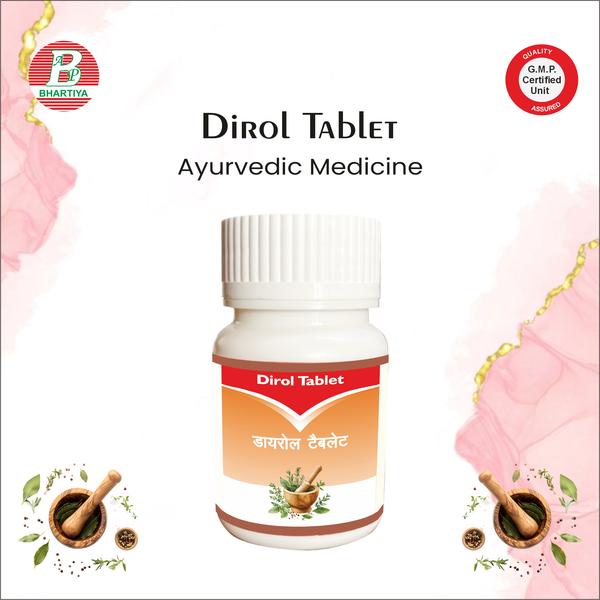
"name": "Dirol Tablet",
"description": " DIROL TABLET \n\nProduct Identification\n•\tGeneric Name: Dirol Tablet\n•\tType: Ayurvedic Patent Medicine\n•\tPrimary Indication Area: Treatment of diarrhoea and amoebic infections of the intestines.\nTherapeutic Indications:\n•\tAcute and chronic amoebiasis\n•\tAmoebic dysentery\n•\tAmoebic liver abscess\n•\tDiarrhoea of various causes\n.\n Primary Benefit:\n•\tThe primary benefit of Dirol Tablet is relief from diarrhoea and intestinal amoebic infections, helping restore normal bowel function and reduce abdominal discomfort.\nOther Benefits:\n1.\tReduces abdominal cramps and pain\no\tDiarrhoea and amoebic infections often cause cramping, bloating, and spasms in the gut. Diarrol helps relax the gut muscles and reduces irritation, easing pain.\n2.\tControls excessive bowel movements\no\tFrequent, watery stools can lead to fatigue and weakness. By improving stool consistency, Diarrol reduces the number of bowel movements, making daily activities easier.\n3.\tSupports recovery from dehydration\no\tDiarrhoea causes loss of fluids and electrolytes. By reducing stool frequency and severity, Diarrol indirectly helps the body maintain hydration and prevents complications like weakness or dizziness.\n4.\tPrevents complications of amoebic infections\no\tUntreated amoebiasis can spread to the liver, causing abscesses, or worsen intestinal inflammation. Early use of Diarrol can help manage the infection and reduce the risk of these complications.\n5.\tImproves overall digestive comfort\no\tBy controlling infection and reducing irritation in the gut, it helps improve appetite, digestion, and general well-being during recovery.\n\n SHOREA ROBUSTA (Sal Tree) \nBotanical / Common Name: Shorea robusta / Sal Tree\nKey Phytoconstituents:\n•\tTannins\n•\tResins\n•\tFlavonoids\n•\tPhenolic compounds\n•\tSterols\nMechanism of Action in GIT / Diarrhoea / Constipation – Biochemistry / Pharmacology:\n1.\tAstringent / Anti-Diarrhoeal Effect\no\tTannins precipitate proteins in the intestinal mucosa.\no\tReduces intestinal secretions and controls watery stools.\no\tHelps in acute and chronic diarrhoea.\n2.\tAnti-inflammatory Effects on Gut Mucosa\no\tFlavonoids and phenolic compounds reduce inflammation in intestinal lining.\no\tRelieves irritation, bloating, and abdominal discomfort associated with diarrhoea.\n3.\tAntimicrobial / Gut Protective Properties\no\tResins and phenolic compounds inhibit growth of pathogenic gut bacteria.\no\tHelps restore healthy gut flora and prevents secondary infections.\n4.\tDigestive Stimulant / Carminative Action\no\tSome phytochemicals enhance digestive enzyme secretion.\no\tImproves digestion and absorption, preventing accumulation of undigested food.\n5.\tAntioxidant Protection\no\tPhenolic compounds scavenge free radicals in gut tissues.\no\tMaintains gut mucosa integrity and supports healing of minor lesions.\n MOCHRAS \nBotanical / Common Name: Bombax malabaricum / Silk Cotton Tree\nKey Phytoconstituents:\n•\tFlavonoids\n•\tTannins\n•\tSaponins\n•\tPolysaccharides\n•\tSterols\nMechanism of Action in GIT / Constipation / Diarrhoea – Biochemistry / Pharmacology:\n1.\tMild Laxative Effect\no\tSaponins and polysaccharides stimulate intestinal motility.\no\tIncreases water retention in stools, easing passage and reducing straining.\n2.\tDigestive Stimulant / Carminative Action\no\tFlavonoids enhance secretion of digestive enzymes.\no\tImproves digestion and absorption, preventing accumulation of undigested food.\n3.\tAnti-inflammatory Effects on Gut Mucosa\no\tTannins and flavonoids reduce intestinal inflammation.\no\tRelieves abdominal discomfort, bloating, and irritation associated with constipation or mild diarrhoea.\n4.\tAntioxidant Protection\no\tPhenolic compounds scavenge free radicals in gut tissues.\no\tSupports gut mucosa integrity and healing of minor irritation or lesions.\n5.\tGut Microbiota Modulation\no\tPolyphenols may support growth of beneficial gut bacteria.\no\tHelps maintain regular bowel habits and overall gastrointestinal health.\n KUTAJ (Holarrhena antidysenterica) \nBotanical / Common Name: Holarrhena antidysenterica / Kutaja\nKey Phytoconstituents:\n•\tAlkaloids (Conessine, Conessimine)\n•\tTannins\n•\tFlavonoids\n•\tSterols\nMechanism of Action in GIT / Diarrhoea / Amoebiasis – Biochemistry / Pharmacology:\n1.\tAnti-Diarrhoeal / Astringent Effect\no\tAlkaloids and tannins reduce intestinal secretions.\no\tHelps control loose stools and acute diarrhoea.\n2.\tAnti-Amoebic / Antiprotozoal Action\no\tConessine exhibits activity against Entamoeba histolytica.\no\tInterferes with protozoal metabolism, reducing infection load.\n3.\tAnti-inflammatory Effects\no\tFlavonoids and tannins reduce inflammation in the intestinal mucosa.\no\tAlleviates abdominal pain, cramps, and irritation during diarrhoea.\n4.\tGut Protective / Mucosal Healing\no\tPhenolic compounds and sterols support intestinal mucosa integrity.\no\tHelps heal minor lesions caused by infection or inflammation.\n5.\tAntimicrobial / Gut Flora Modulation\no\tAlkaloids and phenolics inhibit growth of pathogenic gut bacteria.\no\tPromotes balance of beneficial gut microbiota\n.\n\n\n HARITAKI \nBotanical / Common Name: Terminalia chebula\nKey Phytoconstituents:\n•\tTannins\n•\tAnthraquinones\n•\tGlycosides\n•\tFlavonoids\nMechanism of Action in GIT / Constipation – Biochemistry / Pharmacology:\n1.\tNatural Laxative / Purgative Effect\no\tAnthraquinones stimulate peristalsis in the colon.\no\tPromotes regular bowel movements and eases passage of stools.\n2.\tStool Softening & Lubrication\no\tGlycosides and tannins increase water retention in stools.\no\tReduces straining and prevents constipation-related discomfort.\n3.\tDigestive Stimulant\no\tFlavonoids enhance secretion of digestive enzymes.\no\tImproves digestion and assimilation of nutrients.\n4.\tAnti-inflammatory & Gut Soothing Effects\no\tTannins and flavonoids reduce irritation in the intestinal mucosa.\no\tRelieves abdominal discomfort, bloating, and mild gut inflammation.\n5.\tAntimicrobial & Gut Protective Effects\no\tTannins inhibit growth of pathogenic gut bacteria.\no\tMaintains healthy gut microbiota, reducing risk of infections.\n6.\tAntioxidant Action\no\tPhenolic compounds and flavonoids scavenge free radicals.\no\tProtects gut lining from oxidative damage and supports tissue repair.\n\n\n CHINI (Saccharum officinarum) \nBotanical / Common Name: Saccharum officinarum / Sugarcane Sugar\nKey Phytoconstituents:\n•\tSucrose (main sugar)\n•\tGlucose and Fructose\n•\tMinor phenolic compounds\n•\tMinerals (Calcium, Potassium, Magnesium)\nMechanism of Action in GIT / Digestion – Biochemistry / Pharmacology:\n1.\tMild Digestive Stimulant\no\tSugar acts as an energy source for gut cells.\no\tSupports metabolic activity and may improve mild digestive sluggishness.\n2.\tSoothing / Protective Action\no\tCan provide a mild osmotic effect in the gut when used in herbal syrups.\no\tHelps coat mucosa and reduce minor irritation in the stomach/intestines.\n3.\tGut Microbiota Modulation\no\tSmall amounts may provide substrate for beneficial gut bacteria.\no\tSupports healthy gut flora balance (in moderation).\n4.\tMild Anti-inflammatory / Demulcent Effect\no\tUsed in combination with herbs in classical formulations to reduce gut irritation.\n5.\tSymptomatic Relief Support\no\tHelps improve taste, palatability, and acceptance of herbal preparations.\no\tIndirectly supports compliance and consistent use of anti-diarrhoeal or digestive herbs.\n\n SANKH BHASMA \nBotanical / Common Name: Prepared calcined conch shell / Calcium carbonate (Ayurvedic formulation)\nKey Phytoconstituents / Chemical Composition:\n•\tCalcium carbonate (CaCO₃) – main component\n•\tTrace minerals depending on preparation (Magnesium, Iron, etc.)\nMechanism of Action in GIT / Digestion / Constipation – Biochemistry / Pharmacology:\n1.\tAntacid / Acid Neutralizer\no\tCalcium carbonate reacts with gastric acid to form calcium chloride, carbon dioxide, and water.\no\tHelps neutralize excess stomach acid and relieve acidity or heartburn.\n2.\tMild Constipation Relief / Digestive Support\no\tProvides calcium ions that may mildly stimulate intestinal activity.\no\tHelps soften stools in certain formulations when combined with other herbs.\n3.\tGut Protective / Mucosal Support\no\tForms a protective coating over the gut lining.\no\tReduces irritation from acidity or mild inflammation.\n4.\tAlkalinizing Effect\no\tIncreases systemic and gut alkalinity, which can improve digestive enzyme activity.\no\tSupports overall digestive function.\n5.\tSymptomatic Relief in Dyspepsia / Gastric Disorders\no\tReduces bloating, acidity, and minor abdominal discomfort.\no\tOften combined with herbal formulations for enhanced gut healing and comfort.\n\n TAMARIX GALICA \nBotanical / Common Name: Tamarix gallica / French Tamarisk\nKey Phytoconstituents:\n•\tTannins\n•\tFlavonoids\n•\tGallic acid\n•\tSaponins\n•\tPhenolic compounds\nMechanism of Action in GIT / Diarrhoea / Constipation – Biochemistry / Pharmacology:\n1.\tAstringent / Anti-Diarrhoeal Effect\no\tTannins and gallic acid precipitate proteins in the intestinal mucosa.\no\tReduces intestinal secretions, controlling loose stools.\n2.\tAnti-inflammatory Effects on Gut Mucosa\no\tFlavonoids and phenolic compounds reduce inflammation in intestinal lining.\no\tRelieves abdominal discomfort, irritation, and bloating associated with diarrhoea.\n3.\tMild Laxative / Digestive Support (optional)\no\tSaponins may slightly stimulate intestinal motility, supporting regular bowel habits if constipation is present after infection.\n4.\tAntimicrobial / Gut Protective Properties\no\tTannins and phenolic compounds inhibit pathogenic gut bacteria.\no\tHelps maintain healthy gut microbiota and prevents secondary infections.\n5.\tAntioxidant Protection\no\tPhenolic compounds scavenge free radicals in gut tissues.\no\tSupports healing of intestinal mucosa and overall gut health.\n LODHRA (Symplocos racemosa) \nBotanical / Common Name: Symplocos racemosa / Lodhra\nKey Phytoconstituents:\n•\tTannins (Symplocin, Racemosol)\n•\tFlavonoids\n•\tGlycosides\n•\tSterols\nMechanism of Action in GIT / Diarrhoea / Dysentery – Biochemistry / Pharmacology:\n1.\tAnti-Diarrhoeal / Astringent Effect\no\tTannins precipitate proteins in the intestinal mucosa.\no\tReduces excess intestinal secretions, controlling loose stools.\n2.\tAnti-inflammatory Effects on Gut Mucosa\no\tFlavonoids and tannins reduce intestinal inflammation.\no\tRelieves abdominal cramps, irritation, and bloating associated with diarrhoea.\n3.\tAntimicrobial / Gut Protective Properties\no\tTannins and phenolic compounds inhibit growth of pathogenic gut bacteria.\no\tSupports healthy gut microbiota and prevents secondary infections.\n4.\tDigestive Stimulant / Carminative Effect\no\tGlycosides and flavonoids enhance digestive enzyme activity.\no\tImproves digestion, preventing accumulation of undigested food and gas formation.\n5.\tAntioxidant Protection\no\tPhenolic compounds scavenge free radicals in gut tissues.\no\tSupports mucosal healing and maintains overall gastrointestinal health.\n\n SHUDH GANDHAK \nBotanical / Common Name: Purified Sulfur / Shuddha Gandhak\nKey Phytoconstituents / Chemical Composition:\n•\tSulfur (S₈) – main component\n•\tTrace minerals depending on purification\nMechanism of Action in GIT / Digestion / Anti-Microbial – Biochemistry / Pharmacology:\n1.\tAnti-Microbial / Gut Protective Effect\no\tSulfur has bactericidal and fungicidal properties.\no\tHelps reduce pathogenic gut bacteria, supporting intestinal health.\n2.\tDetoxifying Action\no\tPromotes metabolic detoxification, aiding in the removal of toxins from the gut and body.\no\tSupports liver and gastrointestinal function indirectly.\n3.\tMild Anti-inflammatory Effects\no\tReduces gut inflammation caused by infection or irritation.\no\tHelps relieve abdominal discomfort and bloating.\n4.\tGut Motility and Digestive Support\no\tStimulates digestive enzyme activity mildly, aiding digestion and nutrient absorption.\no\tMay support regular bowel movements when combined with other herbs.\n5.\tSupport of Gut Mucosa Healing\no\tHelps maintain intestinal lining integrity.\no\tAssists in healing minor lesions or irritation in the digestive tract.\nDosage: \n•\tAdults: 2–3 tablets, thrice a day after meals\n•\tChildren: 1–2 tablets, thrice a day after meals\n•\tWith water: Swallow tablets with plain water.\n•\tOptional: Can be taken with warm milk if preferred or recommended by the physician.\n•\tTiming: After meals, preferably at night before bedtime for best effect on gut motility and digestion.\n Precautions\n•\tDo not exceed the prescribed dose.\n•\tConsult a doctor before use in:\no\tChildren\no\tElderly\no\tPatients with chronic illnesses (liver, kidney, or heart conditions)\n•\tMaintain adequate hydration and a fibre-rich diet for optimal results.\n•\tUse as part of a comprehensive management plan for piles, hemorrhoids, diarrhoea, or other gut-related issues.\n•\tReport any adverse reactions (e.g., nausea, abdominal discomfort, allergy) to a doctor immediately.\n\n\ndirol tablet uses, diarol tablet, dirol tablet amazon\ndirol tablet ad, dirol tablet amazon india\ndirol tablet all, dirol tablet benefits\ndirol tablet buy, dirol tablet buy online\ndirol tablet composition, dirol tablet company\ndirol tablet content, dirol tablet dose\ndirol tablet extra, dirol tablet full form\ndirol tablet for, dirol tablet for sale\ndirol tablet for skin, dirol tablet gst rate\ndirol tablet gold, dirol tablet gst number\ndirol tablet gst, dirol tablet gum\ndirol tablet hindi, dirol tablet hsn code\ndirol tablet hd, dirol tablet how to use\ndirol tablet hs code, dirol tablet indiamart\ndirol tablet image, dirol tablet india\ndirol tablet in hindi, dirol tablet japan\ndirol tablet jiomart, dirol tablet joint\ndirol tablet jio, dirol tablet kis kaam aati hai\ndirol tablet kya kam karta hai, dirol tablet kya hai\ndirol tablet list, dirol tablet login\ndirol tablet logo, dirol tablet label\ndirol tablet manufacturer, dirol tablet manufacturers in india\ndirol tablet mrp, dirol tablet name, dirol tablet number\ndirol tablet new, dirol tablet nutrition\ndirol tablet online shopping, dirol tablet online\ndirol tablet online order, dirol tablet price\ndirol tablet price in india, dirol tablet qatar\ndirol tablet quality, dirol tablet quantity\ndirol tablet q10, dirol tablet review\ndirol tablet rate, dirol tablet tab\ndiarol 500 tablet uses in hindi, dirol tablet vitamin\ndirol tablet wholesale, dirol tablet wholesale price\ndirol tablet xtra",
"price": 90.0,
"discountamount": 45.0,
"currencycode": "INR",
"priority": 1000000,
"isfreeshipmentavailable": false,
"shipmentduration": 1,
"_keywords": null,
"isarchived": false,
"isavailable": true,
"applicationid": null,
"productindex": 93,
"imageuri": "https://productimages.withfloats.com/actual/69e20fb8442027782e969442.jpg",
"tileimageuri": "https://productimages.withfloats.com/tile/69e20fb8442027782e969442.jpg",
"images": null,
"totalqueries": 0,
"gpid": null,
"groupproductid": null,
"createdon": "2026-04-17T10:47:18.224Z",
"updatedon": "2026-04-17T10:47:18.224Z",
"buyonlinelink": null,
"producturl": "http://WWW.BHARTIYAAYURVEDICPHARMACY.COM/products/dirol-tablet/93",
"availableunits": -1.0,
"iscodavailable": true,
"isprepaidonlineavailable": true,
"maxcodorders": -1,
"maxprepaidonlineorders": -1,
"uniquepaymenturl": null,
"brandname": "Bakula Fort",
"category": "Dirol Tablet 100 Tab X 50",
"tags": [],
"variants": false,
"keyspecification": null,
"otherspecifications": null,
"pickupaddressreferenceid": null,
"paymenttype": "AssuredPurchase",
"producttype": "products",
"hsncode": null,
"gstslab": 0.0,
"isnotforsale": false
},
{
"_id": "69e0a9e5ba41faa29e085f5f",
"fptag": "BHARTIYEAYURVEDICPHARMACY",
"merchantname": null,
"customwidgets": null,
"externalsourceid": null,
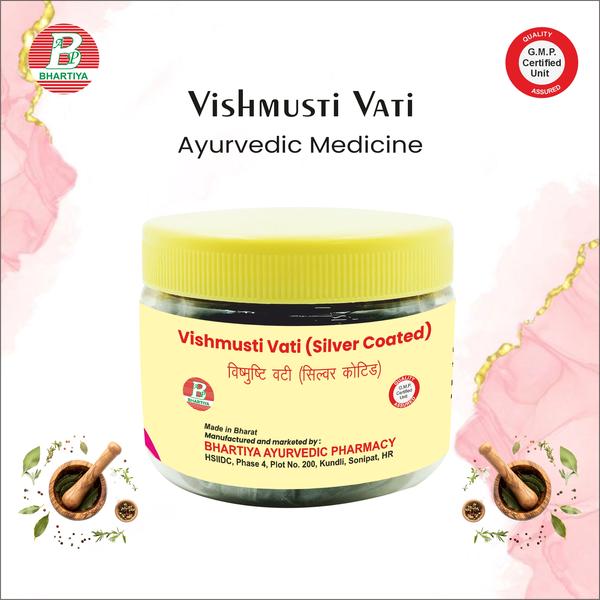
"name": "Vashmusti Vati",
"description": " VISHMUSHTI VATI (SILVER COATED) \n\nProduct Identification\n•\tGeneric Name: Vishmushti Vati\n•\tType: Ayurvedic Patent Medicine\n•\tPrimary Indication Area: All Types of Joint Pain (Gathiya / Vat Roga)\n•\tTherapeutic Indications Management of joint pain of all types, including Vata-related disorders (Gathiya / Vat Roga). \nKey benefits include:\n1.\tPain Relief\no\tHelps reduce joint pain, soreness, and discomfort caused by Vata imbalance.\n2.\tReduces Stiffness & Swelling\no\tImproves joint flexibility and eases swelling associated with arthritis or Gathiya.\n3.\tSupports Joint Mobility\no\tEnhances ease of movement and overall joint function.\n4.\tStrengthens Muscles & Bones\no\tHelps improve muscle tone around joints and supports bone health.\n5.\tAnti-fatigue & Vitality Support\no\tReduces weakness and tiredness caused by chronic joint pain.\no\tPromotes overall strength and rejuvenation.\no\t\n\nIngredients:\n SHUDH HINGUL \nAyurvedic Name: Shuddha Hingul / Hingula Bhasma\nMineral Source: Cinnabar (purified mercury sulphide)\nPrimary Use: Vata Roga & Joint Pain (Gathiya) support in classical Ayurvedic formulations\n\nKey Phytoconstituents\n•\tPurified Mercuric Sulphide (HgS) transformed into nano sized bio assimilable particles through classical Shodhana–Marana processes\n•\t Trace mineral complexes with elements like Zn, Cu, Fe formed during purification and incineration\n•\tSynergistic adjuvants (when processed with herbal decoctions such as Triphala, Guduchi, Nirgundi) to support detoxification and absorption\nMechanism of Action\n(Biochemistry / Pharmacological Basis for Joint Pain — Vata Roga / Gathiya)\n1.\tNano Particle Bio Assimilation & Immune Modulation\n\n•\tProperly purified mercuric sulphide (HgS) in Shuddha Hingul Bhasma forms extremely fine particles that cross intestinal mucosa more efficiently and interact with immune cells, stimulating macrophage activity and encouraging a balanced immune response in chronic inflammatory environments. \n2.\tAnti Inflammatory & Dosha Regulation\n•\tThrough traditional Ayurvedic mechanisms, the ushna (heating) potency and deep penetrating action of Hingul help pacify aggravated Vata dosha, which is a major contributor to stiffness, pain, and erratic neural signals in joint disorders. \n•\t Trace sulfur compounds and other mineral complexes may contribute mild anti inflammatory effects, reducing local discomfort \n3.\tDetoxification & Metabolic Balance (Ama Clearance)\n\n•\tHangul’s classical action includes enhancing agni (metabolic fire) and clearing ama (toxic metabolic by products) from tissues and srotas (channels), which in Ayurveda are thought to exacerbate joint pain and stiffness when accumulated. \n4.\tTissue Nourishment & Support\n\n•\tBy harmonizing metabolism and supporting reticuloendothelial system activity, fine bhasma particles may help improve nutrient delivery and tissue nourishment, indirectly supporting joint comfort and resilience. \n\nIngredients:\n JAYPHAL (Nutmeg) \nBotanical Name: Myristica fragrans\nAyurvedic Names: Jaiphal, Jatiphala, Jatisasya\nPrimary Use: Joint pain relief (Vata Roga), anti inflammatory and musculoskeletal support\n\nKey Phytoconstituents\nMyristicin – aromatic compound with anti inflammatory and mild analgesic properties\nElemicin – contributes to anti inflammatory and antioxidant effects\nTrimyristin & fatty acids – support metabolic functions\nEugenol, sabinene, α pinene & other volatile oils – anti inflammatory, analgesic and antioxidant constituents\n Phenolic compounds & lignans – support free radical neutralization and tissue protection\n\nMechanism of Action\n(Biochemistry / Pharmacological Basis for Joint Pain — Vata Roga / Gathiya)\n1.\tAnti Inflammatory & Analgesic Action\n•\tCompounds such as myristicin, eugenol, sabinene, β pinene and α pinene exhibit anti inflammatory and pain relieving effects, which help reduce joint swelling, soreness, and discomfort typical of Vata related joint disorders. \n2.\tAntioxidant & Tissue Protection\n•\tPhenolic compounds and lignans in Jaiphal neutralize free radicals, protecting joint tissues from oxidative stress that can worsen chronic inflammation and joint degeneration. \n3.\tVata Pacification & Nervine Modulation\n•\tIn Ayurvedic pharmacology, Jayphal’s hot (ushna) potency and pungent taste help balance aggravated Vata dosha, which contributes to pain, stiffness, and erratic neural signals in joint discomfort. \n4.\tMuscle Relaxation & Circulatory Support\n•\tNutmeg’s volatile oils may promote local blood flow and muscle relaxation, which can relieve stiffness and improve mobility around affected joints. \n\n JAVITRI (Mace) \nBotanical Name: Myristica fragrans (aril of nutmeg seed)\nAyurvedic Use: Traditionally used as a digestive, anti inflammatory and mild analgesic agent; balances Vata & Kapha doshas in classical systems and used for joint muscle discomfort support. \n\nKey Phytoconstituents\n Myristicin – an aromatic phenylpropene compound responsible for medicinal effects. \n Elemicin – contributes to anti inflammatory and antioxidant properties. \n Safrole and other volatile oils (terpenes) – support anti inflammatory and circulatory effects. \n Phenolic compounds & flavonoids (antioxidant activity). \n Minerals such as iron, magnesium and trace nutrients that support metabolic functions. \n\nMechanism of Action\n(Biochemistry / Pharmacological Basis for Joint Pain — Vata Roga / Gathiya)\n1.\tAnti Inflammatory & Pain Modulating Action\n\n•\tConstituents such as myristicin, elemicin and other volatile oils exert anti inflammatory and mild analgesic effects, reducing inflammatory mediators that contribute to joint pain and stiffness. \n2.\tAntioxidant & Tissue Protection\n\n•\tPhenolic compounds and flavonoids neutralize free radicals and oxidative stress, helping protect joint tissues from damage and degeneration. \n3.\tVata Pacifying & Nervine Support\n\n•\tIn Ayurveda, Javitri’s hot (ushna) potency and pungent taste help balance aggravated Vata dosha, which is often implicated in joint stiffness, erratic neural signals, and discomfort. \n4.\tCirculatory & Muscle Comfort Support\n\n•\tVolatile oils may enhance local circulation and support muscle relaxation, helping relieve stiffness and improve comfort around joints and connective tissues. \n\n LAVANG (Clove) \nBotanical Name: Syzygium aromaticum\nAyurvedic Name: Lavang / Laung\nPrimary Use: Analgesic & anti inflammatory support; soothing discomfort associated with joint pain and Vata imbalance\nKey Phytoconstituents\n• Eugenol – major active compound with analgesic and anti inflammatory effects\n• β Caryophyllene, chavibetol, eugenyl acetate – synergistic volatile compounds contributing to anti inflammatory and pain modulating actions\n• Other phenolic compounds and antioxidants that support tissue protection and oxidative balance \n\nMechanism of Action\n(Biochemistry / Pharmacological Basis for Joint Pain — Vata Roga / Gathiya)\n1.\tAnti Inflammatory & Pain Relieving Action\n\n•\tEugenol inhibits inflammatory mediators (such as prostaglandins via cyclooxygenase pathways) and reduces local inflammation, helping relieve discomfort in stiff or sore joints.\n• Its mildly anaesthetic action modulates nerve impulses, providing soothing relief in affected areas. \n2.\tAntioxidant & Tissue Protection\n\n•\tPhenolic compounds and flavonoid like constituents neutralize free radicals and oxidative stress, which can exacerbate chronic inflammatory conditions like joint pain.\n• This supports cellular protection and may slow degenerative changes in connective tissues. \n3.\tCirculation & Vata Balance Support\n\n•\tLavang’s warming effect (ushna virya) and pungent aroma help improve local circulation and penetrate tissues, which is believed in Ayurveda to help pacify aggravated Vata dosha, a key factor in joint stiffness and erratic neural signalling. \n4.\tMuscle Relaxation & Comfort\n•\tThe volatile oil components contribute to muscle relaxation and improved microcirculation around joints, aiding in reduced stiffness and enhanced comfort.\n\n•\tWhen used topically (e.g., in warm oil massage), these effects are particularly noticeable.\n\n KALI MIRCH (Black Pepper) \nBotanical Name: Piper nigrum\nAyurvedic Name: Kali Mirch / Marica\nPrimary Use: Support for joint discomfort, inflammation and Vata Roga (joint pain)\n\nKey Phytoconstituents\n• Piperine — the principal alkaloid responsible for most pharmacological activity\n• Essential oils: limonene, α pinene, β pinene, sabinene, caryophyllene\n• Phenolic compounds & flavonoids — contribute antioxidant activity\n• Trace nutrients and lignans that support biological actions \n\nMechanism of Action\n(Biochemistry / Pharmacological Basis for Joint Pain — Vata Roga / Gathiya)\n1.\tAnti Inflammatory & Pain Modulation\n\n•\tPiperine and related alkaloids inhibit pro inflammatory pathways (e.g., NF κB, COX, and inflammatory cytokines) that drive joint inflammation and pain in arthritis models.\n• In cell studies, piperine reduced production of inflammatory mediators such as NO, PGE₂ and cytokines (IL 6, TNF α) and inhibited enzymes that break down cartilage matrix. \n2.\tAnti Oxidant & Tissue Protection\n\n•\tPhenolic compounds and flavonoids in black pepper neutralize free radicals that can exacerbate chronic joint degeneration and inflammatory tissue damage.\n• This helps protect joint connective tissues and supports cellular resilience. \n3.\tVata Pacifying & Circulation Enhancement\n\n•\tIn Ayurvedic terms, the ushna (warming) and Tikshna (penetrating) qualities of Kali Mirch help pacify aggravated Vata dosha, improving comfort, reducing stiffness, and enhancing micro circulation around joints.\n• Topical preparations (oil or paste with carrier oil) are traditionally used to ease soreness and warmth in joint areas. \n4.\tBioavailability & Synergistic Support\n\n•\tPiperine enhances the bioavailability of other compounds (e.g., curcumin, phenolics) by inhibiting certain metabolic enzymes, which may increase effectiveness of joint support herbs\n\n SUDH KUCHLA \nAyurvedic Name: Shuddha Kuchla (Purified Strychnos nux vomica)\nBotanical Source: Seeds of Strychnos nux vomica (detoxified via classical Shodhana processes)\nPrimary Use: Supports Vata Roga & Joint Pain (Gathiya) through metabolic balance, neuromuscular stimulation, and Vata pacification\n\nKey Phytoconstituents\n• Alkaloids (notably strychnine and brucine) — the primary bioactive compounds remaining after purification that influence nervous and muscular responses. \n• Other trace constituents influenced by processing — contributing to digestion, metabolic fire (agni) enhancement, and detoxification support.\n\nMechanism of Action\n(Biochemistry / Pharmacological Basis for Joint Pain — Vata Roga / Gathiya /)\n1.\tNeuromuscular Stimulation & Pain Modulation\n\n•\tPurified alkaloids in Sudh Kuchla act on the central and peripheral nervous system, stimulating nerve activity in a controlled manner to improve nerve muscle coordination and reduce erratic Vata related neural signals that contribute to joint discomfort. \n•\t This neuromodulation can indirectly help reduce sensations of stiffness and weakness in chronic joint conditions.\n2.\tAnti Inflammatory & Vata Balance\n\n•\tThrough classical Ayurvedic properties (bitter, pungent taste with warming potency), Sudh Kuchla pacifies aggravated Vata dosha, a key driver of joint pain and stiffness in Vata dominant disorders like Gathiya.\n3.\tDigestive Fire (Agni) & Detoxification Support\n\n•\tWarming virya (ushna potency) of Sudh Kuchla supports metabolic fire (agni), which aids in digestion and clears metabolic by products (ama) that are believed in Ayurveda to worsen joint pain and tissue congestion. \n4.\tMuscle & Tissue Support\n\n•\tBy stimulating metabolic activity and nervous regulation, Sudh Kuchla may contribute to improved nutrient delivery and deep tissue nourishment, indirectly supporting resilience in musculoskeletal structures during joint stress. \n\n\nDosage:\n1.\tDose per intake: 1–2 pills\n2.\tFrequency: 2 times daily\n3.\tTotal daily dose: 2–4 pills (depending on physician advice)\n4.\tHow to take: With milk, preferably after meals\n\nPrecautions\n•\tDo not exceed the prescribed dose\n•\tConsult an Ayurvedic practitioner before use in:\no\tChildren\no\tElderly\no\tPatients with chronic illness\n•\tMonitor for any side effects (e.g., digestive discomfort)\n•\tMaintain proper diet and hydration to support bowel health\n\n\nvishamushti vati uses, vishamushti vati\nvishamushti vati ingredients, vishamushti vati benefits\nvishamushti vati price, vishamushti vati tablet\nvishamushti vati uses in hindi, vishamushti vati benefits in hindi\nvishamushti vati in hindi, vishamushti vati easy ayurveda\nvishamushti vati use, vishamushti vati composition\nvishmusti vati flipkart, vishmusti vati goli\nvishmusti vati jankari in hindi, vishmusti vati jankari\nvishmusti vati ke fayde, vishmusti vati ke fayde in hindi\nvishmusti vati khane ke fayde, vishmusti vati kya kam karta hai\nvishmusti vati manufacturer, vishmusti vati mrp\nvishmusti vati near me, use of vishamushti vati\nvishmusti vati quality, vishmusti vati quantity\nvishamushti vati side effects, vishmusti vati website\nvishmusti vati works, uses of vishamushti vati\nwhat vishmusti vati uses in hindi, what vishmusti vati uses\nwhere vishmusti vati manufactured, where vishmusti vati available\nwhen vishmusti vati uses in hindi, when vishmusti vati uses\nwho vishmusti vati uses in hindi, can vishmusti vati uses in hindi\nwill vishmusti vati uses in hindi, was vishmusti vati uses in hindi\nbest vishamushti vati in hindi, best vishamushti vati uses",
"price": 990.0,
"discountamount": 495.0,
"currencycode": "INR",
"priority": 1000000,
"isfreeshipmentavailable": false,
"shipmentduration": 1,
"_keywords": null,
"isarchived": false,
"isavailable": true,
"applicationid": null,
"productindex": 88,
"imageuri": "https://productimages.withfloats.com/actual/69e0a9f3c32735ec39db6df9.jpg",
"tileimageuri": "https://productimages.withfloats.com/tile/69e0a9f3c32735ec39db6df9.jpg",
"images": null,
"totalqueries": 0,
"gpid": null,
"groupproductid": null,
"createdon": "2026-04-16T09:20:37.839Z",
"updatedon": "2026-04-16T09:20:37.839Z",
"buyonlinelink": null,
"producturl": "http://WWW.BHARTIYAAYURVEDICPHARMACY.COM//vashmusti-vati/88",
"availableunits": -1.0,
"iscodavailable": true,
"isprepaidonlineavailable": true,
"maxcodorders": -1,
"maxprepaidonlineorders": -1,
"uniquepaymenturl": null,
"brandname": "Bakula Fort",
"category": "Vashmusti Vati 100gm X 20",
"tags": [],
"variants": false,
"keyspecification": null,
"otherspecifications": null,
"pickupaddressreferenceid": null,
"paymenttype": "AssuredPurchase",
"producttype": "products",
"hsncode": null,
"gstslab": 0.0,
"isnotforsale": false
},
{
"_id": "6985b8fb911df6d4b0db36c4",
"fptag": "BHARTIYEAYURVEDICPHARMACY",
"merchantname": null,
"customwidgets": null,
"externalsourceid": null,
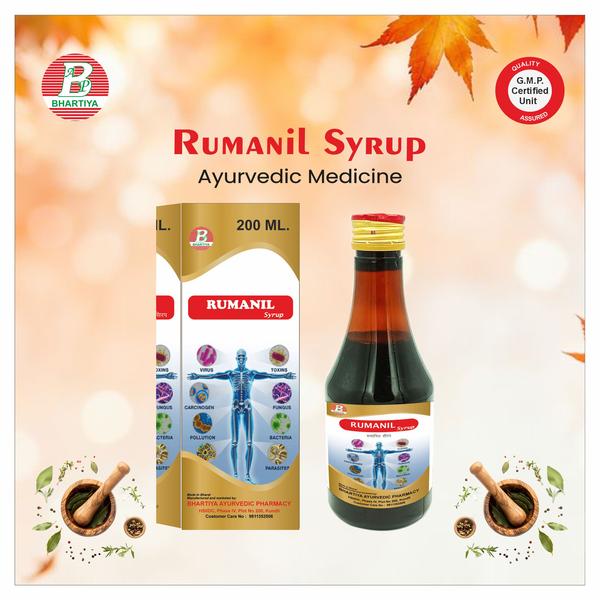
"name": "Rumanil Syrup",
"description": " RUMANIL SYRUP \n\nProduct Identification\n•\tGeneric Name: Rumanil Syrup\n•\tType: Ayurvedic Patent Medicine\n•\tPrimary Indication Area: Joint health, musculoskeletal support, and relief from pain and inflammation. \n Therapeutic Indications\n•\tProvides relief from joint pain and stiffness.\n•\tSupports mobility and flexibility of joints.\n•\tReduces inflammation and discomfort associated with arthritis or minor injuries.\n•\tHelps in strengthening bones and muscles.\n\nKey benefits:\n1.\tRelieves Joint Pain – Helps reduce discomfort in knees, elbows, shoulders, and other joints.\n2.\tReduces Inflammation – Herbal ingredients work to calm swelling and tenderness.\n3.\tImproves Flexibility & Mobility – Supports easier movement and reduces stiffness.\n4.\tStrengthens Muscles & Bones – Contributes to overall musculoskeletal health.\n5.\tSupports Arthritis Management – May help with symptoms of osteoarthritis or mild joint disorders.\n6.\tNatural & Ayurvedic – Use traditionally formulations long term use\n \nIngredient: \n Guggulu (Commiphora mukul)\nKey Phytoconstituents:\n1.\tGuggulsterones (E & Z isomers) – main active compounds\n2.\tSterols & Diterpenoids – anti-inflammatory activity\n3.\tResins – provide therapeutic effects\n4.\tEssential oils – minor anti-inflammatory and analgesic effects\n\nMechanism of Action in Joint Health\n1.\tAnti-inflammatory\no\tGuggulsterones inhibit pro-inflammatory mediators (like TNF-α, IL-1β, and COX enzymes).\no\tReduces swelling, stiffness, and tenderness in joints.\n2.\tAnalgesic (Pain Relief)\no\tReduces pain associated with osteoarthritis, rheumatoid arthritis, and minor joint injuries.\n\nSalai Guggul (Boswellia serrata)\nBotanical Name: Boswellia serrata\nCommon Name: Indian Frankincense\nKey Phytoconstituents:\n1.\tBoswellic Acids (α, β, acetyl-boswellic acids) – main active anti-inflammatory compounds\n2.\tTriterpenoids – support anti-inflammatory activity\n3.\tEssential Oils – minor analgesic and anti-inflammatory effects\n\nMechanism of Action in Joint Health\n1.\tAnti-inflammatory\no\tBoswellic acids inhibit 5-lipoxygenase (5-LOX), reducing leukotriene synthesis.\no\tHelps control inflammation in arthritis, tendinitis, and joint swelling.\n2.\tAnalgesic (Pain Relief)\no\tReduces pain associated with osteoarthritis and rheumatoid arthritis.\n\nChobchini (Smilax china)\nBotanical Name: Smilax china\nCommon Name: Chobchini\nKey Phytoconstituents:\n1.\tSaponins – main bioactive compounds, contribute to anti-inflammatory and detoxifying effects.\n2.\tFlavonoids – provide antioxidant and anti-inflammatory properties.\n3.\tSteroids & Triterpenoids – support anti-inflammatory and immune-modulatory activity.\n4.\tPolyphenols – help reduce oxidative stress and support joint health.\nMechanism of Action in Joint Health:\n1. Anti-inflammatory Effects\n•\tSaponins and flavonoids inhibit pro-inflammatory mediators, reducing joint inflammation and swelling.\n•\tHelpful in conditions like arthritis and gout.\n2. Analgesic (Pain Relief)\n•\tReduces pain and discomfort associated with inflamed joints\n\nAshwagandha (Withania somnifera)\nBotanical Name: Withania somnifera\nCommon Name: Ashwagandha, Indian Ginseng, Winter Cherry\nKey Phytoconstituents:\n1.\tWithanolides – steroidal lactones responsible for anti-inflammatory, adaptogenic, and immunomodulatory effects.\n2.\tAlkaloids – contribute to stress reduction and neuroprotective activity.\n3.\tSaponins – support anti-inflammatory and antioxidant actions.\n4.\tPolyphenols – provide antioxidant and tissue-protective effects.\nMechanism of Action in Joint Health:\n1. Anti-inflammatory Effects\n•\tWithanolides and saponins inhibit inflammatory cytokines (e.g., TNF-α, IL-1β) and oxidative stress in joints.\n•\tHelps in arthritis, tendinitis, and joint swelling.\n2. Analgesic (Pain Relief)\n•\tReduces pain and discomfort in osteoarthritis and rheumatoid arthritis.\n\nHaldi (Curcuma longa)\nBotanical Name: Curcuma longa\nCommon Name: Turmeric, Haldi\nKey Phytoconstituents:\n1.\tCurcuminoids (Curcumin, Desmethoxycurcumin, Bisdemethoxycurcumin) – primary anti-inflammatory and antioxidant compounds.\n2.\tVolatile Oils (Turmerone, Atlantone, Zingiberene) – provide minor analgesic and anti-inflammatory effects.\n3.\tPolysaccharides & Phenolics – support joint health through antioxidant and tissue-protective effects.\nMechanism of Action in Joint Health:\n1. Anti-inflammatory Effects\n•\tCurcumin inhibits NF-κB, COX-2, and 5-LOX pathways, reducing pro-inflammatory cytokines and mediators.\n•\tHelps manage arthritis, joint swelling, and tendinitis.\n2. Analgesic (Pain Relief)\n•\tReduces pain and stiffness associated with osteoarthritis and rheumatoid arthritis.\n\nNirgundi (Vitex negundo)\nBotanical Name: Vitex negundo\nCommon Name: Nirgundi, Five-leaved Chaste Tree\nKey Phytoconstituents:\n1.\tFlavonoids (Negundoside, Casticin, Vitexin) – contribute to anti-inflammatory and antioxidant effects.\n2.\tIridoid glycosides – provide analgesic and anti-inflammatory activity.\n3.\tEssential oils (α-pinene, β-caryophyllene, cineole) – minor analgesic and anti-inflammatory effects.\n4.\tTriterpenoids & Steroids – support joint health by modulating inflammation.\nMechanism of Action in Joint Health:\n1. Anti-inflammatory Effects\n•\tFlavonoids and iridoid glycosides inhibit inflammatory mediators like prostaglandins and leukotrienes.\n•\tHelps manage arthritis, joint swelling, and muscle inflammation.\n2. Analgesic (Pain Relief)\n•\tReduces pain associated with osteoarthritis, rheumatoid arthritis, and general joint discomfort.\n\nRasna (Pluchea lanceolata / Pluchea indica)\nBotanical Name: Pluchea lanceolata (commonly) / Pluchea indica\nCommon Name: Rasna\nKey Phytoconstituents:\n1.\tFlavonoids (Quercetin, Kaempferol derivatives) – provide anti-inflammatory and antioxidant effects.\n2.\tTerpenoids & Essential Oils – contribute analgesic and anti-inflammatory activity.\n3.\tAlkaloids & Phenolics – support anti-inflammatory and tissue-protective functions.\nMechanism of Action in Joint Health:\n1. Anti-inflammatory Effects\n•\tInhibits pro-inflammatory mediators like prostaglandins and leukotrienes.\n•\tEffective in arthritis, joint swelling, and musculoskeletal inflammation.\n2. Analgesic (Pain Relief)\n•\tReduces joint pain and discomfort associated with osteoarthritis and rheumatic conditions.\n\nSaunth (Zingiber officinale, dried ginger)\nBotanical Name: Zingiber officinale\nCommon Name: Saunth, Dried Ginger\nKey Phytoconstituents:\n1.\tGingerols & Shogaols – primary anti-inflammatory and analgesic compounds.\n2.\tVolatile Oils (Zingiberene, β-bisabolene, α-Curcumene) – support pain relief and anti-inflammatory effects.\n3.\tResins & Phenolic Compounds – provide antioxidant and tissue-protective activity.\nMechanism of Action in Joint Health:\n1. Anti-inflammatory Effects\n•\tGingerols and shogaols inhibit COX and 5-LOX pathways, reducing pro-inflammatory prostaglandins and leukotrienes.\n•\tHelps manage arthritis, joint swelling, and tendon inflammation.\n2. Analgesic (Pain Relief)\n•\tReduces joint pain and stiffness associated with osteoarthritis and rheumatoid arthritis.\n\nErandmool (Ricinus communis)\nBotanical Name: Ricinus communis\nCommon Name: Castor Root, Erandmool\nKey Phytoconstituents:\n1.\tRicinoleic Acid – primary anti-inflammatory and analgesic compound.\n2.\tFlavonoids & Phenolic Compounds – provide antioxidant and tissue-protective effects.\n3.\tTriterpenoids & Sterols – support anti-inflammatory activity and joint tissue protection.\nMechanism of Action in Joint Health:\n1. Anti-inflammatory Effects\n•\tRicinoleic acid and triterpenoids modulate inflammatory mediators like prostaglandins and cytokines.\n•\tReduces joint swelling and inflammation in arthritis and musculoskeletal conditions.\n2. Analgesic (Pain Relief)\n•\tProvides pain relief in osteoarthritis, rheumatoid arthritis, and general joint discomfort.\n\nMulethi (Glycyrrhiza glabra)\nBotanical Name: Glycyrrhiza glabra\nCommon Name: Mulethi, Licorice Root\nKey Phytoconstituents:\n1.\tGlycyrrhizin – primary anti-inflammatory and tissue-protective compound.\n2.\tFlavonoids (Liquiritin, Isoliquiritin, Glabridin) – antioxidant and anti-inflammatory effects.\n3.\tSaponins & Phenolics – support cartilage protection and analgesic activity’s\nMechanism of Action in Joint Health:\n1. Anti-inflammatory Effects\n•\tGlycyrrhizin and flavonoids modulate inflammatory cytokines and inhibit COX/LOX pathways.\n•\tHelps reduce arthritis-related inflammation, joint swelling, and musculoskeletal pain.\n2. Analgesic (Pain Relief)\n•\tReduces pain and discomfort in osteoarthritis and rheumatoid arthritis.\n\nSuranjan (Colchicum luteum / Colchicum autumnale)\nBotanical Name: Colchicum luteum (commonly in Ayurveda) / Colchicum autumnale\nCommon Name: Suranjan\nKey Phytoconstituents:\n1.\tColchicine – primary anti-inflammatory and anti-gout compound.\n2.\tAlkaloids & Phenolics – support anti-inflammatory and antioxidant effects.\n3.\tFlavonoids & Saponins – provide tissue-protective and mild analgesic effects.\nMechanism of Action in Joint Health:\n1. Anti-inflammatory Effects\n•\tColchicine inhibits microtubule polymerization, reducing neutrophil migration and inflammatory mediator release.\n•\tHighly effective in gouty arthritis, joint swelling, and acute inflammation.\n2. Analgesic (Pain Relief)\n•\tReduces pain in joints, especially in gout and acute inflammatory episodes.\n\n\nrumanil medicine, rumanil medicine in hindi\nrumanil syrup amazon, rumanil syrup amazon india\nrumanil syrup benefits, rumanil syrup benefits in hindi\nrumanil syrup buy online, rumanil syrup company name\nrumanil syrup composition, rumanil syrup content\nrumanil syrup dosage, rumanil syrup dose, rumanil syrup english\nrumanil syrup expiry date, rumanil syrup expiry date check\nrumanil syrup flipkart, rumanil syrup generic\nrumanil syrup generic name, rumanil syrup gst rate\nrumanil syrup gst rate and hsn code, rumanil syrup jan aushadhi\nrumanil syrup jiomart, rumanil syrup ke fayde\nrumanil syrup ke fayde in hindi, rumanil syrup manufacturer\nrumanil syrup manufacturers in india, rumanil syrup mrp\nrumanil syrup name, rumanil syrup news in hindi\nrumanil syrup online, rumanil syrup online order\nrumanil syrup online purchase, rumanil syrup online shopping\nrumanil syrup pric, rumanil syrup price in india\nrumanil syrup quality, rumanil syrup quantity\nrumanil syrup rate, rumanil syrup review\nrumanil syrup side effects, rumanil syrup side effects in hindi\nrumanil tablet hindi",
"price": 210.0,
"discountamount": 105.0,
"currencycode": "INR",
"priority": 1000000,
"isfreeshipmentavailable": false,
"shipmentduration": 1,
"_keywords": null,
"isarchived": false,
"isavailable": true,
"applicationid": null,
"productindex": 38,
"imageuri": "https://productimages.withfloats.com/actual/6985b8fee34c104b18ad342c.jpg",
"tileimageuri": "https://productimages.withfloats.com/tile/6985b8fee34c104b18ad342c.jpg",
"images": null,
"totalqueries": 0,
"gpid": null,
"groupproductid": null,
"createdon": "2026-02-06T09:48:43.96Z",
"updatedon": "2026-02-19T03:28:26.086Z",
"buyonlinelink": null,
"producturl": "http://WWW.BHARTIYAAYURVEDICPHARMACY.COM//rumanil-syrup/38",
"availableunits": -1.0,
"iscodavailable": true,
"isprepaidonlineavailable": true,
"maxcodorders": -1,
"maxprepaidonlineorders": -1,
"uniquepaymenturl": null,
"brandname": "Bakula Fort",
"category": "Rumanil Syrup 200 ML X 24",
"tags": [],
"variants": false,
"keyspecification": null,
"otherspecifications": null,
"pickupaddressreferenceid": null,
"paymenttype": "AssuredPurchase",
"producttype": "products",
"hsncode": null,
"gstslab": 0.0,
"isnotforsale": false
},
{
"_id": "6aa14233d555b883cd377ce6",
"fptag": "BHARTIYEAYURVEDICPHARMACY",
"merchantname": null,
"customwidgets": null,
"externalsourceid": null,
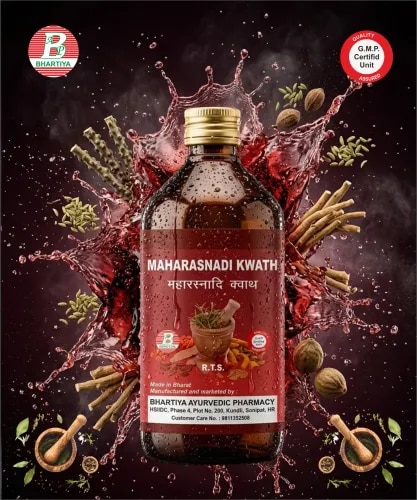
"name": "MAHA RASNADI KWATH",
"description": " MAHA RASNADI KWATH \n\nProduct Identification\nGeneric Name: Maha Rasnadi Kwath\nType: Ayurvedic Polyherbal Decoction (Kwath/Kashaya)\nPrimary Indication Area: Joint disorders, musculoskeletal health, inflammatory conditions, arthritis, neurological disorders associated with Vata imbalance, back pain, sciatica, and post-illness weakness.\n\nTherapeutic Indications (Traditional Ayurvedic Uses)\n• Amavata (Rheumatoid arthritis)\n• Sandhivata (Osteoarthritis)\n• Katigraha (Low back pain)\n• Gridhrasi (Sciatica)\n• Manyastambha (Cervical spondylosis/neck stiffness)\n• Pakshaghata (Hemiplegia/paralytic disorders)\n• Vatarakta (Gout)\n• Asthi-Sandhi Shoola (Bone and joint pain)\n• Musculoskeletal stiffness associated with Vata disorders\n• General weakness and restricted mobility\n\nKey Benefits\n• Supports healthy joint function\n• Helps maintain mobility and flexibility\n• Supports musculoskeletal health\n• Helps reduce joint stiffness\n• Supports healthy inflammatory balance according to Ayurvedic principles\n• Promotes comfort in muscles and joints\n• Supports nervous system function\n• Helps maintain healthy circulation in musculoskeletal tissues\n• Provides antioxidant and rejuvenative herbal support\n• Supports overall physical strength and mobility\n\nFormula\nFORMULA\nMain Ingredients\n• Rasna Patra (Pluchea lanceolata – leaves)\n• Dhamasa (Fagonia cretica)\n• Erandmool (Ricinus communis – root)\n• Devdaru (Cedrus deodara)\n• Kachur (Curcuma zedoaria)\n• Vacha (Acorus calamus)\n• Vasa (Justicia adhatoda)\n• Saunth (Zingiber officinale – dry ginger)\n• Harad (Terminalia chebula)\n• Nagarmotha (Cyperus rotundus)\n• Punarnava Mool (Boerhavia diffusa – root)\n• Giloy (Tinospora cordifolia)\n• Vidara (Pueraria tuberosa / Ipomoea digitata – regional variation)\n• Saunf (Foeniculum vulgare)\n• Gokshuru (Tribulus terrestris)\n• Ashwagandha (Withania somnifera)\n• Atis (Aconitum heterophyllum)\n• Amla (Emblica officinalis / Phyllanthus emblica)\n• Shatavari (Asparagus racemosus)\n• Pippali (Piper longum)\n• Piyavasa \n• Dhaniya (Coriandrum sativum)\n• Choti Kateri (Solanum surattense)\n• Badi Kateri (Solanum indicum)\n• Dhataki (Woodfordia fruticosa \n1. Rasna Patra\nBotanical Name: Pluchea lanceolata\n• Rasa: Tikta, Katu\n• Guna: Laghu, Ruksha\n• Virya: Ushna\n• Vipaka: Katu\nMechanism / Properties\n• Strong Vata-pacifying herb\n• Anti-inflammatory and analgesic action\n• Supports joint, nerve, and muscular pain relief\n• Reduces stiffness and swelling\n\n2. Dhamasa\nBotanical Name: Fagonia cretica\n• Rasa: Tikta, Kashaya\n• Guna: Laghu, Ruksha\n• Virya: Sheeta\n• Vipaka: Katu\nMechanism\n• Blood purifying (Rakta shodhana) action\n• Supports liver detoxification\n• Anti-inflammatory and antioxidant activity\n• Used in skin and metabolic disorders\n\n3. Erandmool\nBotanical Name: Ricinus communis (root)\n• Rasa: Madhura, Katu\n• Guna: Guru, Snigdha\n• Virya: Ushna\n• Vipaka: Madhura\nMechanism\n• Strong Vata shamak action\n• Analgesic and anti-inflammatory\n• Helps relieve constipation and urinary obstruction\n• Supports pain and swelling reduction\n\n4. Devdaru\nBotanical Name: Cedrus deodara\n• Rasa: Tikta, Kashaya\n• Guna: Laghu, Tikshna\n• Virya: Ushna\n• Vipaka: Katu\nMechanism\n• Potent anti-inflammatory and analgesic\n• Reduces obstruction in channels (Srotoshodhana)\n• Supports urinary and musculoskeletal health\n• Relieves swelling and pain\n\n5. Kachur\nBotanical Name: Curcuma zedoaria\n• Rasa: Tikta, Katu\n• Guna: Laghu, Ruksha\n• Virya: Ushna\n• Vipaka: Katu\nMechanism\n• Digestive stimulant (Agni deepana)\n• Anti-inflammatory and anti-microbial\n• Reduces Ama (toxins)\n• Supports metabolic cleansing\n\n6. Vacha\nBotanical Name: Acorus calamus\n• Rasa: Katu, Tikta\n• Guna: Laghu, Tikshna\n• Virya: Ushna\n• Vipaka: Katu\nMechanism\n• Srotoshodhana (channel cleansing)\n• Nervine stimulant\n• Anti-inflammatory and detoxifying\n• Supports neurological balance\n\n7. Vasa\nBotanical Name: Justicia adhatoda\n• Rasa: Tikta, Kashaya\n• Guna: Laghu, Ruksha\n• Virya: Sheeta\n• Vipaka: Katu\nMechanism\n• Hemostatic (controls bleeding)\n• Anti-inflammatory and bronchodilator\n• Supports blood purification\n• Tissue protective action\n\n8. Saunth\nBotanical Name: Zingiber officinale (dry ginger)\n• Rasa: Katu\n• Guna: Laghu, Snigdha\n• Virya: Ushna\n• Vipaka: Madhura\nMechanism\n• Enhances digestion and absorption\n• Anti-inflammatory and carminative\n• Reduces Ama formation\n• Improves circulation\n\n9. Harad\nBotanical Name: Terminalia chebula\n• Rasa: Pancharasa (except Lavana)\n• Guna: Laghu, Ruksha\n• Virya: Ushna\n• Vipaka: Madhura\nMechanism\n• Mild laxative and detoxifying\n• Rasayana (rejuvenator)\n• Supports digestion and gut health\n• Antioxidant action\n\n10. Nagarmotha\nBotanical Name: Cyperus rotundus\n• Rasa: Tikta, Katu, Kashaya\n• Guna: Laghu, Ruksha\n• Virya: Sheeta\n• Vipaka: Katu\nMechanism\n• Digestive and metabolic regulator\n• Anti-inflammatory\n• Supports urinary balance\n• Reduces Kapha and Ama\n\n11. Punarnava Mool\nBotanical Name: Boerhavia diffusa\n• Rasa: Tikta, Madhura, Kashaya\n• Guna: Laghu, Ruksha\n• Virya: Ushna\n• Vipaka: Katu\nMechanism\n• Natural diuretic (Mutrala)\n• Reduces edema and swelling\n• Supports kidney function\n• Anti-inflammatory\n\n12. Giloy\nBotanical Name: Tinospora cordifolia\n• Rasa: Tikta, Kashaya\n• Guna: Laghu, Snigdha\n• Virya: Ushna\n• Vipaka: Madhura\nMechanism\n• Immunomodulator\n• Detoxifying and anti-inflammatory\n• Supports fever and infection resistance\n• Rasayana herb\n\n13. Vidara\nBotanical Name: Pueraria tuberosa / Ipomoea digitata\n• Rasa: Madhura\n• Guna: Guru, Snigdha\n• Virya: Sheeta\n• Vipaka: Madhura\nMechanism\n• Rejuvenative tonic\n• Strengthens tissues and vitality\n• Supports Vata disorders\n• Nutritive and restorative\n\n14. Saunf\nBotanical Name: Foeniculum vulgare\n• Rasa: Madhura, Katu\n• Guna: Laghu, Snigdha\n• Virya: Sheeta\n• Vipaka: Madhura\nMechanism\n• Carminative and digestive\n• Mild diuretic\n• Reduces bloating and acidity\n• Soothes urinary tract\n\n15. Gokshura\nBotanical Name: Tribulus terrestris\n• Rasa: Madhura\n• Guna: Guru, Snigdha\n• Virya: Sheeta\n• Vipaka: Madhura\nMechanism\n• Strong urinary tonic\n• Supports kidney and bladder health\n• Promotes smooth urine flow\n• Aphrodisiac and rejuvenative\n\n16. Ashwagandha\nBotanical Name: Withania somnifera\n• Rasa: Tikta, Kashaya\n• Guna: Guru, Snigdha\n• Virya: Ushna\n• Vipaka: Madhura\nMechanism\n• Adaptogen (stress reducer)\n• Strengthens nervous system\n• Improves vitality and stamina\n• Vata balancing Rasayana\n\n17. Atis\nBotanical Name: Aconitum heterophyllum\n• Rasa: Tikta, Kashaya\n• Guna: Laghu, Ruksha\n• Virya: Ushna (mild)\n• Vipaka: Katu\nMechanism\n• Digestive stimulant\n• Antipyretic (fever reducing)\n• Anti-inflammatory\n• Helps toxin reduction\n\n18. Amla\nBotanical Name: Phyllanthus emblica\n• Rasa: Amla (sour dominant)\n• Guna: Laghu, Ruksha\n• Virya: Sheeta\n• Vipaka: Madhura\nMechanism\n• Strong antioxidant (Vitamin C rich)\n• Rasayana (rejuvenator)\n• Supports immunity\n• Tissue repair and regeneration\n\n19. Shatavari\nBotanical Name: Asparagus racemosus\n• Rasa: Madhura, Tikta\n• Guna: Guru, Snigdha\n• Virya: Sheeta\n• Vipaka: Madhura\nMechanism\n• Female reproductive tonic\n• Hormonal balancing support\n• Cooling and nutritive\n• Supports lactation and fertility health\n\n20. Pippali\nBotanical Name: Piper longum\n• Rasa: Katu\n• Guna: Laghu, Snigdha\n• Virya: Anushna-Ushna\n• Vipaka: Madhura\nMechanism\n• Bioavailability enhancer (Yogavahi)\n• Improves digestion and metabolism\n• Respiratory and urinary support\n• Detox enhancing herb\n\n21. Piyavasa\nBotanical Name: (Regionally variable; often hepatoprotective bitter herb)\n• Rasa: Tikta, Kashaya\n• Guna: Laghu, Ruksha\n• Virya: Sheeta/Ushna (varies)\n• Vipaka: Katu\nMechanism\n• Liver detox support\n• Bitter tonic action\n• Supports metabolic balance\n• Anti-inflammatory\n\n22. Dhaniya\nBotanical Name: Coriandrum sativum\n• Rasa: Madhura, Tikta\n• Guna: Laghu\n• Virya: Sheeta\n• Vipaka: Madhura\nMechanism\n• Cooling diuretic\n• Reduces burning urination\n• Digestive soothing\n• Anti-inflammatory\n\n23. Choti Kateri\nBotanical Name: Solanum surattense\n• Rasa: Tikta, Katu\n• Guna: Laghu, Ruksha\n• Virya: Ushna\n• Vipaka: Katu\nMechanism\n• Respiratory and urinary support\n• Anti-inflammatory\n• Vata-Kapha balancing\n• Pain relief support\n\n24. Badi Kateri\nBotanical Name: Solanum indicum\n• Rasa: Tikta, Katu\n• Guna: Laghu, Ruksha\n• Virya: Ushna\n• Vipaka: Katu\nMechanism\n• Anti-inflammatory and analgesic\n• Supports respiratory health\n• Reduces swelling and pain\n• Channel cleansing action\n\n25. Dhataki\nBotanical Name: Woodfordia fruticosa\n• Rasa: Kashaya\n• Guna: Laghu, Ruksha\n• Virya: Ushna\n• Vipaka: Katu\n• Prabhava: Sandhana Karaka\nMechanism\n• Natural fermentation catalyst\n• Enables Asava/Kwath preparation\n• Improves bioavailability\n• Preserves formulation stability\n\nDosage of Maharasnadi Kwath (Pravahi)\nAdults\n• Dose: 15–30 mL\n• Frequency: Twice daily (BID)\n• Administration: After meals\n• Anupana (vehicle): Equal quantity of lukewarm water\n\nGeneral Clinical Practice Range (Ayurvedic Use)\n• Mild conditions: 15 mL BD\n• Moderate conditions: 20–30 mL BD\n• Chronic Vata disorders / pain conditions: 25–30 mL BD (as advised)\n\nDuration\n• Usually 2–6 weeks\n• Can be extended up to 8 weeks under Ayurvedic supervision\n\nImportant Usage Notes\n• Shake well before use (as herbal sediment may settle)\n• Best taken after food to improve tolerance\n• Avoid self-medication in chronic kidney disease or severe urinary obstruction\n• Use cautiously in diabetes (may contain natural sugars from fermentation)\n• Not recommended during pregnancy without physician advice\n\n\n\n\n\nmaha rasnadi kwath uses in hindi\nmaha rasnadi kwath uses\nmaharasnadi kwatham\nmaha rasnadi kwath easy ayurveda\nrasnadi kashayam ingredients\nrasnadi kashayam benefits\nrasnadi ghritam uses\nmaharasnadi kwath amazon\nmaharasnadi kwath ayurvedic medicine\nmaharasnadi kwath ayurvedic\nmaharasnadi kwath ayurveda\nmaharasnadi kwath pravahi ayurvedic medicine\nmaharasnadi kwath benefits\nmaharasnadi kwath benefits in hindi\nmaharasnadi kwath botanical name\nmaharasnadi kwath buy online\nmaharasnadi kwath churna uses in hindi\nmaharasnadi kwath contents\nmaharasnadi kwath composition\nmaharasnadi kwath capsules\nmaharasnadi kwath kis chij ki dava hai\nmaharasnadi kwath dosage\ndivya maharasnadi kwath\ndabur maharasnadi kwath kadha\nmaharasnadi kwath easy ayurveda\nmaharasnadi kwath ke fayde\nmaharasnadi kwath ke fayde in hindi\nmaharasnadi kwath ghan\nmaharasnadi kwath how to use\nmaharasnadi kwath kya hai\nmaharasnadi kwath uses hindi\nmaharasnadi kwath benefits hindi\nmaharasnadi kwath ingredients\nmaharasnadi kwath in hindi\nmaharasnadi kwath ingredients in hindi\nmaharasnadi kwath indication\nmaharasnadi kwath is used for\nmaharasnadi kwath jiva ayurveda\nmaharasnadi kwath jiva\nmaharasnadi kwath kis kaam aata hai\nmaharasnadi kwath kaise use kare\nmaharasnadi kwath kya kam karta hai\nmaharasnadi kwath liquid\nmaharasnadi kwath ke labh\nmaharasnadi kwath medicine\nmaharasnadi kwath 200 ml\nmaharasnadi kwath hindi mein\nmaharasnadi kwath online\nuses of maharasnadi kwath\nbenefits of maharasnadi kwath\ningredients of maharasnadi kwath\nuses of maharasnadi kwath in hindi\nmaharasnadi kwath price\nmaharasnadi kwath peene ke fayde\nmaha rasnadi kwath q10\nmaharasnadi kwath reference\nmaharasnadi kwath review\nmaharasnadi kwath research paper\nmaharasnadi kwath syrup uses in hindi\nmaharasnadi kwath syrup uses\nmaharasnadi kwath syrup\nhow maha rasnadi kwath works\nhow maha rasnadi kwath is made\nhow maha rasnadi kwath use\nwhy maha rasnadi kwath useful",
"price": 210.0,
"discountamount": 105.0,
"currencycode": "INR",
"priority": 1000000,
"isfreeshipmentavailable": false,
"shipmentduration": 1,
"_keywords": null,
"isarchived": false,
"isavailable": true,
"applicationid": null,
"productindex": 175,
"imageuri": "https://productimages.withfloats.com/actual/6aa14237850fddb69be31772.jpg",
"tileimageuri": "https://productimages.withfloats.com/tile/6aa14237850fddb69be31772.jpg",
"images": null,
"totalqueries": 0,
"gpid": null,
"groupproductid": null,
"createdon": "2026-09-09T11:25:39.849Z",
"updatedon": "2026-09-09T11:25:39.849Z",
"buyonlinelink": null,
"producturl": "http://WWW.BHARTIYAAYURVEDICPHARMACY.COM//maha-rasnadi-kwath/175",
"availableunits": -1.0,
"iscodavailable": true,
"isprepaidonlineavailable": true,
"maxcodorders": -1,
"maxprepaidonlineorders": -1,
"uniquepaymenturl": null,
"brandname": "Bakula Fort",
"category": "MAHA RASNADI KWATH 450 ML X 40",
"tags": [],
"variants": false,
"keyspecification": null,
"otherspecifications": null,
"pickupaddressreferenceid": null,
"paymenttype": "AssuredPurchase",
"producttype": "products",
"hsncode": null,
"gstslab": 0.0,
"isnotforsale": false
},
{
"_id": "6a92cf441e2797f146a16baf",
"fptag": "BHARTIYEAYURVEDICPHARMACY",
"merchantname": null,
"customwidgets": null,
"externalsourceid": null,
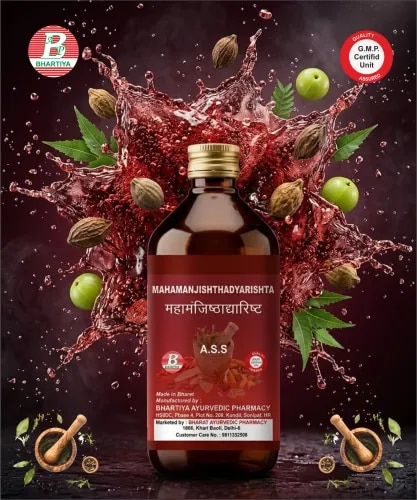
"name": "MAHAMANJISTHADYARISHTA",
"description": " MAHAMANJISTHADYARISHTA\n\n\n\nProduct Identification\nGeneric Name: Mahamanjisthadyarishta (Variant Formulation)\nType: Ayurvedic Polyherbal Fermented Preparation (Arishta/Kashayam-based fermentation tonic)\nPrimary Indication Area: Skin disorders, blood impurities, chronic inflammation, lymphatic congestion, liver–skin axis disorders, metabolic toxins (Ama), and Vata–Pitta imbalance conditions.\n\nTherapeutic Indications \n• Chronic skin diseases (eczema, psoriasis, acne, dermatitis)\n• Blood impurity disorders (Rakta dushti)\n• Vatarakta (gout, inflammatory arthritis)\n• Chronic itching and pigmentation disorders\n• Liver dysfunction-related skin problems\n• Edema and inflammatory swelling\n• Chronic non-healing skin eruptions\n• Detoxification and metabolic imbalance\n• Lymphatic congestion and toxin accumulation\n\nKey Benefits \nBlood purification (Rakta shodhana) \nSkin health improvement (Twak prasadana) \nReduces acne, eczema, psoriasis, itching \nAnti-inflammatory action (Shothahara) \nHelps in gout and joint pain (Vatarakta shamana) \nDetoxification of body (Ama pachana) \nImproves liver–skin connection \nLymphatic cleansing (Srotoshodhana) \nReduces chronic swelling and inflammation \nSupports healing of long-term skin disorders\n \nFormula \nMain Ingredients: \n\nManjistha \nNagarmotha \nKutaj chhal \nGiloy \nKuth \nSaunth \nBharangi \nChoti kateli \nVacha (Bach) \nNeem chhal \nHaldi \nDaruhaldi \nBaheda \nHarad \nAmla \nPatol patra \nKutaki \nMurva \nVidanga \nVijaysar \nShal chhal\nShatavari \nBanfsha \nGokshura \nIndrajav \nVasa ki jad \nBhangra (Bhringraj) \nDevdaru \nPatha \nKhadir kastha \nLal chandan \nNishoth \nVarun chhal \nKaranj chhal \nAtis \nIndrayana \nDhamasa \nAnantmool \nPitpapda \nDhataki \nGuda \nJala \n\n1. Manjistha\nBotanical Name: Rubia cordifolia\n\nRasa: Tikta, Kashaya\nGuna: Laghu, Ruksha\nVirya: Ushna\nVipaka: Katu\n\nMechanism of Action\n• Raktashodhaka (blood purifier)\n• Supports lymphatic drainage\n• Useful in chronic skin disorders\n• Anti-inflammatory action\n• Helps in detoxification of Ama\n\n2. Nagarmotha\nBotanical Name: Cyperus rotundus\n\nRasa: Tikta, Katu, Kashaya\n Guna: Laghu, Ruksha\n Virya: Sheeta\n Vipaka: Katu\n\nMechanism of Action\n• Deepana-Pachana (improves digestion)\n• Reduces Ama formation\n• Useful in diarrhea and gut disorders\n• Anti-inflammatory effect\n• Supports metabolic balance\n3. Kutaj Chhal\nBotanical Name: Holarrhena antidysenterica\n\nRasa: Tikta, Kashaya\nGuna: Laghu, Ruksha\n Virya: Sheeta\nVipaka: Katu\n\nMechanism of Action\n• Strong Grahi (anti-diarrheal) action\n• Intestinal detoxification\n• Controls dysentery and gut infections\n• Supports intestinal mucosa healing\n• Antimicrobial activity\n4. Giloy\nBotanical Name: Tinospora cordifolia\n \nRasa: Tikta, Kashaya\n Guna: Laghu, Snigdha\n Virya: Ushna\nVipaka: Madhura\n\nMechanism of Action\n• Rasayana (rejuvenator)\n• Immunomodulatory action\n• Anti-inflammatory effect\n• Reduces chronic fever and toxins\n• Supports liver and skin health\n5. Kuth\nBotanical Name: Saussurea costus\n\nRasa: Tikta, Katu\n Guna: Laghu, Tikshna\nVirya: Ushna\n Vipaka: Katu\n\nMechanism of Action\n• Anti-inflammatory and analgesic\n• Reduces Vata-Kapha disorders\n• Useful in joint pain and swelling\n• Improves circulation\n• Antimicrobial action\n6. Saunth\nBotanical Name: Zingiber officinale\n\nRasa: Katu\nGuna: Laghu, Ruksha, Tikshna\nVirya: Ushna\nVipaka: Madhura\n\nMechanism of Action\n• Deepana-Pachana (digestive stimulant)\n• Reduces Ama and inflammation\n• Improves circulation\n• Useful in Vata disorders\n• Analgesic and anti-inflammatory\n\n7. Bharangi\nBotanical Name: Clerodendrum serratum\n\nRasa: Tikta, Katu\nGuna: Laghu, Ruksha\n Virya: Ushna\n Vipaka: Katu\n\nMechanism of Action\n• Shwasahara (respiratory support)\n• Anti-inflammatory action\n• Useful in cough and asthma\n• Reduces Kapha accumulation\n• Immunomodulatory effect\n\n8. Choti Kateli (Gokshura)\nBotanical Name: Tribulus terrestris\n\n Rasa: Madhura, Tikta\n Guna: Guru, Snigdha\nVirya: Sheeta\n Vipaka: Madhura\n\nMechanism of Action\n• Mutrala (diuretic action)\n• Supports urinary tract health\n• Anti-inflammatory effect\n• Improves kidney function support\n• Rejuvenating (Rasayana) action\n\n9. Vacha (Bach)\nBotanical Name: Acorus calamus\n\nRasa: Katu, Tikta\nGuna: Laghu, Tikshna\nVirya: Ushna\nVipaka: Katu\n\nMechanism of Action\n• Medhya (brain tonic)\n• Clears Srotas (microchannels)\n• Improves digestion and appetite\n• Anti-inflammatory effect\n• Useful in neurological imbalance\n\n10. Neem Chhal\nBotanical Name: Azadirachta indica\n\nRasa: Tikta, Kashaya\n Guna: Laghu, Ruksha\n Virya: Sheeta\nVipaka: Katu\nMechanism of Action\n• Strong Raktashodhaka (blood purifier)\n• Antibacterial and antifungal\n• Useful in skin disorders\n• Reduces inflammation and itching\n• Detoxifying action\n\n11. Haldi\nBotanical Name: Curcuma longa\n\nRasa: Tikta, Katu\nGuna: Laghu, Ruksha\nVirya: Ushna\nVipaka: Katu\n\nMechanism of Action\n• Anti-inflammatory and wound healing\n• Raktashodhaka (blood purifier)\n• Antimicrobial action\n• Useful in skin disorders\n• Reduces swelling and pain\n\n12. Daruhaldi\nBotanical Name: Berberis aristata\n\nRasa: Tikta\nGuna: Laghu, Ruksha\nVirya: Ushna\n Vipaka: Katu\n\nMechanism of Action\n• Strong antimicrobial action\n• Useful in chronic skin diseases\n• Liver protective effect\n• Blood purification\n• Anti-inflammatory activity\n\n13. Baheda\nBotanical Name: Terminalia bellirica\n\nRasa: Kashaya, Madhura\nGuna: Laghu, Ruksha\n Virya: Sheeta\nVipaka: Madhura\n\nMechanism of Action\n• Rasayana (rejuvenator)\n• Digestive regulator\n• Detoxification support\n• Improves immunity\n• Anti-inflammatory action\n\n14. Harad\nBotanical Name: Terminalia chebula\n\nRasa: Pancharasa (except Lavana)\nGuna: Laghu, Ruksha\n Virya: Ushna\nVipaka: Madhura\n\nMechanism of Action\n• Strong detoxifier (Rechana)\n• Improves digestion\n• Removes Ama\n• Mild laxative effect\n• Tissue cleansing action\n\n15. Amla\nBotanical Name: Emblica officinalis\n\nRasa: Amla\n Guna: Laghu, Ruksha\n Virya: Sheeta\nVipaka: Madhura\n\nMechanism of Action\n• Powerful antioxidant\n• Rasayana (rejuvenation)\n• Supports immunity\n• Pitta balance\n• Skin and hair nourishment\n\n16. Patol Patra\nBotanical Name: Trichosanthes dioica\n\nRasa: Tikta\n Guna: Laghu, Ruksha\nVirya: Sheeta\nVipaka: Katu\n\nMechanism of Action\n• Liver detox support\n• Pitta shamak\n• Blood purification\n• Skin disease relief\n• Anti-inflammatory action\n\n17. Kutaki\nBotanical Name: Picrorhiza kurroa\n\nRasa: Tikta\n Guna: Laghu, Ruksha\n Virya: Sheeta\n Vipaka: Katu\n\nMechanism of Action\n• Hepatoprotective\n• Improves bile secretion\n• Detoxifies liver\n• Anti-inflammatory\n• Supports skin health\n\n18. Murva\nBotanical Name: Marsdenia tenacissima\n \nRasa: Tikta, Kashaya\n Guna: Laghu, Ruksha\n Virya: Ushna\n Vipaka: Katu\n\nMechanism of Action\n• Blood purifier\n• Skin disorder management\n• Anti-inflammatory action\n• Supports tissue healing\n• Detoxifying effect\n\n19. Vidanga\nBotanical Name: Embelia ribes\n• Rasa: Katu\n• Guna: Laghu, Ruksha\n• Virya: Ushna\n• Vipaka: Katu\nMechanism of Action\n• Krimighna (anti-parasitic)\n• Digestive stimulant\n• Detoxifies gut\n• Anti-microbial action\n• Reduces Ama\n\n20. Vijaysar\nBotanical Name: Pterocarpus marsupium\n• Rasa: Kashaya\n• Guna: Laghu, Ruksha\n• Virya: Sheeta\n• Vipaka: Katu\nMechanism of Action\n• Metabolic regulator\n• Supports blood sugar balance\n• Anti-inflammatory\n• Tissue strengthening\n• Detox support\n21. Shal Chhal\nBotanical Name: Shorea robusta\n• Rasa: Kashaya\n• Guna: Guru, Ruksha\n• Virya: Sheeta\n• Vipaka: Katu\nMechanism of Action\n• Grahi (absorptive, anti-diarrheal)\n• Anti-inflammatory action\n• Supports tissue healing\n• Useful in skin disorders\n• Detoxifying effect\n\n22. Shatavari\nBotanical Name: Asparagus racemosus\n• Rasa: Madhura\n• Guna: Guru, Snigdha\n• Virya: Sheeta\n• Vipaka: Madhura\nMechanism of Action\n• Rasayana (rejuvenator)\n• Hormonal balance support\n• Cooling and anti-ulcer action\n• Improves immunity\n• Tissue nourishment\n\n23. Banfsha\nBotanical Name: Viola odorata\n• Rasa: Tikta, Madhura\n• Guna: Laghu, Snigdha\n• Virya: Sheeta\n• Vipaka: Madhura\nMechanism of Action\n• Respiratory support (Shwasahara)\n• Cooling anti-inflammatory action\n• Blood purification\n• Skin disease support\n• Mild expectorant\n\n24. Gokshura\nBotanical Name: Tribulus terrestris\n• Rasa: Madhura, Tikta\n• Guna: Guru, Snigdha\n• Virya: Sheeta\n• Vipaka: Madhura\nMechanism of Action\n• Mutrala (diuretic)\n• Kidney and urinary support\n• Anti-inflammatory action\n• Rasayana effect\n• Supports reproductive health\n\n25. Indrajav\nBotanical Name: Holarrhena antidysenterica\n• Rasa: Tikta, Kashaya\n• Guna: Laghu, Ruksha\n• Virya: Sheeta\n• Vipaka: Katu\nMechanism of Action\n• Strong antidiarrheal action\n• Gut detoxification\n• Controls intestinal infections\n• Grahi effect\n• Anti-microbial activity\n\n26. Vasa Ki Jad\nBotanical Name: Adhatoda vasica\n• Rasa: Tikta, Katu\n• Guna: Laghu, Ruksha\n• Virya: Sheeta\n• Vipaka: Katu\nMechanism of Action\n• Shwasahara (respiratory relief)\n• Expectorant action\n• Anti-inflammatory\n• Bronchodilator support\n• Kapha reduction\n\n27. Bhangra (Bhringraj)\nBotanical Name: Eclipta alba\n• Rasa: Tikta, Katu\n• Guna: Laghu, Ruksha\n• Virya: Ushna\n• Vipaka: Katu\nMechanism of Action\n• Liver detox support\n• Hair and skin nourishment\n• Anti-inflammatory\n• Blood purification\n• Rasayana effect\n\n28. Devdaru\nBotanical Name: Cedrus deodara\n• Rasa: Tikta, Katu\n• Guna: Laghu, Ruksha\n• Virya: Ushna\n• Vipaka: Katu\nMechanism of Action\n• Anti-inflammatory action\n• Pain relief in joints\n• Reduces swelling\n• Improves circulation\n• Vata-Kapha pacification\n\n29. Patha\nBotanical Name: Cissampelos pareira\n• Rasa: Tikta, Kashaya\n• Guna: Laghu, Ruksha\n• Virya: Ushna\n• Vipaka: Katu\nMechanism of Action\n• Jwarahara (fever reducing)\n• Anti-inflammatory\n• Gut cleansing\n• Skin disorder support\n• Detoxification\n\n30. Khadir Kastha\nBotanical Name: Acacia catechu\n• Rasa: Kashaya\n• Guna: Laghu, Ruksha\n• Virya: Sheeta\n• Vipaka: Katu\nMechanism of Action\n• Strong Raktashodhaka\n• Skin disease management\n• Antimicrobial action\n• Wound healing\n• Reduces itching\n31. Lal Chandan\nBotanical Name: Pterocarpus santalinus\n• Rasa: Tikta, Kashaya\n• Guna: Laghu, Ruksha\n• Virya: Sheeta\n• Vipaka: Katu\nMechanism of Action\n• Cooling anti-inflammatory action\n• Blood purification\n• Skin healing support\n• Reduces burning sensation\n• Pitta pacifying effect\n\n32. Nishoth\nBotanical Name: Operculina turpethum\n• Rasa: Katu, Tikta\n• Guna: Laghu, Ruksha, Tikshna\n• Virya: Ushna\n• Vipaka: Katu\nMechanism of Action\n• Strong Rechana (purgative)\n• Deep detoxification\n• Removes Ama and toxins\n• Useful in constipation\n• Cleanses channels (Srotoshodhana)\n\n33. Varun Chhal\nBotanical Name: Crataeva nurvala\n• Rasa: Tikta, Kashaya\n• Guna: Laghu, Ruksha\n• Virya: Ushna\n• Vipaka: Katu\nMechanism of Action\n• Mutravirechaka (urinary detox)\n• Useful in kidney stones\n• Reduces urinary inflammation\n• Anti-inflammatory action\n• Cleans urinary channels\n\n34. Karanj Chhal\nBotanical Name: Pongamia pinnata\n• Rasa: Tikta, Katu\n• Guna: Laghu, Ruksha\n• Virya: Ushna\n• Vipaka: Katu\nMechanism of Action\n• Antimicrobial action\n• Skin disease management\n• Anti-inflammatory effect\n• Wound healing support\n• Raktashodhaka\n\n35. Atis\nBotanical Name: Aconitum heterophyllum\n• Rasa: Tikta, Kashaya\n• Guna: Laghu, Ruksha\n• Virya: Sheeta\n• Vipaka: Katu\nMechanism of Action\n• Jwarahara (fever reducing)\n• Digestive regulator\n• Anti-inflammatory\n• Antidiarrheal effect\n• Strengthens digestion\n\n36. Indrayana\nBotanical Name: Citrullus colocynthis\n• Rasa: Tikta\n• Guna: Laghu, Ruksha, Tikshna\n• Virya: Ushna\n• Vipaka: Katu\nMechanism of Action\n• Strong purgative action\n• Deep detoxification\n• Removes Ama\n• Cleans intestinal tract\n• Used in severe constipation\n\n37. Dhamasa\nBotanical Name: Fagonia cretica\n• Rasa: Tikta, Kashaya\n• Guna: Laghu, Ruksha\n• Virya: Sheeta\n• Vipaka: Katu\nMechanism of Action\n• Blood purification\n• Skin disease support\n• Anti-inflammatory action\n• Detoxifying effect\n• Wound healing support\n\n38. Anantmool\nBotanical Name: Hemidesmus indicus\n• Rasa: Madhura, Tikta\n• Guna: Guru, Snigdha\n• Virya: Sheeta\n• Vipaka: Madhura\nMechanism of Action\n• Cooling blood purifier\n• Skin disease management\n• Anti-inflammatory action\n• Detoxifies body\n• Supports urinary health\n\n39. Pitpapda\nBotanical Name: Fumaria indica\n• Rasa: Tikta\n• Guna: Laghu, Ruksha\n• Virya: Sheeta\n• Vipaka: Katu\nMechanism of Action\n• Liver detox support\n• Pitta balance\n• Blood purification\n• Skin disease relief\n• Improves bile flow\n\n40. Dhataki\nBotanical Name: Woodfordia fruticosa\n• Rasa: Kashaya\n• Guna: Laghu, Ruksha\n• Virya: Ushna\n• Vipaka: Katu\nMechanism of Action\n• Natural fermentation catalyst (Arishta)\n• Supports bioavailability of formulation\n• Mild antimicrobial action\n• Aids gut flora balance\n• Enhances potency of preparation\n\n41. Guda\nBotanical Name: Saccharum officinarum (processed jaggery)\n• Rasa: Madhura\n• Guna: Guru, Snigdha\n• Virya: Ushna\n• Vipaka: Madhura\nMechanism of Action\n• Fermentation base\n• Acts as Yogavahi (carrier)\n• Improves bioavailability\n• Mild detox effect\n• Energy support\n\n\n",
"price": 170.0,
"discountamount": 85.0,
"currencycode": "INR",
"priority": 1000000,
"isfreeshipmentavailable": false,
"shipmentduration": 1,
"_keywords": null,
"isarchived": false,
"isavailable": true,
"applicationid": null,
"productindex": 172,
"imageuri": "https://productimages.withfloats.com/actual/6a92cf45be0fefbc315368ad.jpg",
"tileimageuri": "https://productimages.withfloats.com/tile/6a92cf45be0fefbc315368ad.jpg",
"images": null,
"totalqueries": 0,
"gpid": null,
"groupproductid": null,
"createdon": "2026-08-29T12:23:32.23Z",
"updatedon": "2026-08-29T12:23:32.23Z",
"buyonlinelink": null,
"producturl": "http://WWW.BHARTIYAAYURVEDICPHARMACY.COM//mahamanjisthadyarishta/172",
"availableunits": -1.0,
"iscodavailable": true,
"isprepaidonlineavailable": true,
"maxcodorders": -1,
"maxprepaidonlineorders": -1,
"uniquepaymenturl": null,
"brandname": "Bakula Fort",
"category": "MAHAMANJISTHADYARISHTA 450 ML X 40",
"tags": [],
"variants": false,
"keyspecification": null,
"otherspecifications": null,
"pickupaddressreferenceid": null,
"paymenttype": "AssuredPurchase",
"producttype": "products",
"hsncode": null,
"gstslab": 0.0,
"isnotforsale": false
},
{
"_id": "6a5a0a2eaf37c772c3f501dc",
"fptag": "BHARTIYEAYURVEDICPHARMACY",
"merchantname": null,
"customwidgets": null,
"externalsourceid": null,
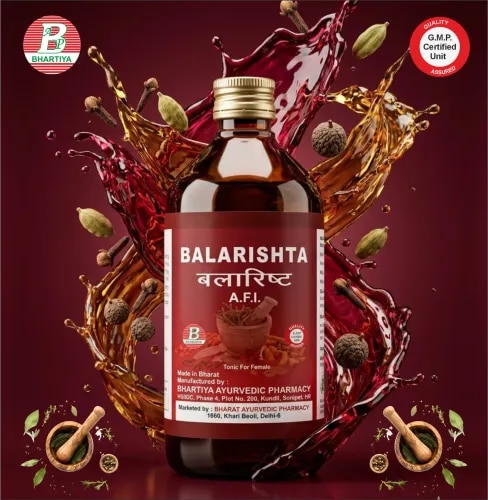
"name": "BALARISHTA",
"description": " BALARISHTA\n\n\n\nProduct Identification\nGeneric Name: Balarishta\nType: Ayurvedic Polyherbal Fermented Formulation (Arishta)\nPrimary Indication Area: Pediatric tonic, neuromuscular strength enhancer, general debility, and post-illness recovery support.\n\nTherapeutic Indications\n• General weakness in children and adults\n• Delayed growth and developmental support (pediatric use)\n• Neuromuscular debility\n• post-fever weakness and convalescence\n• Loss of appetite (Aruchi)\n• Low body weight and undernutrition\n• Anaemia-related fatigue (supportive)\n• Joint weakness and laxity\n• post-infectious recovery\n• Mild anxiety, irritability, and sleep disturbances (supportive)\n\nKey Benefits\n• Balya (strength-promoting) – improves muscle and tissue strength\n• Brimhana (nourishing) – supports healthy weight gain\n• Improves neuromuscular tone\n• Enhances appetite and digestion\n• Supports bone and joint development\n• Restores strength after illness\n• Mild calming effect on nervous system\n• Improves overall vitality and immunity\n\nFORMULA\nMain Decoction Drugs (Kwatha Dravyas):\n• Bala (Sida cordifolia) – 4.800 kg\n• Ashwagandha (Withania somnifera) – 4.8 kg\nPrakshepa Dravyas (Added after decoction):\n•\tVidari -96 g\n•\tEranda- 96 g\n•\tRasna -48 g\n•\tEla-48 g\n•\tPrishanparni-48 g\n•\tLavanga -48 g\n•\tUsira -48 g\n•\tGokharu -48 g\nFermentation Base:\n• Guda (Jaggery) – 14.400 kg\n• Water – sufficient quantity for decoction (reduced to ~12–13 L final arishta)\n• Fermentation starter: Dhataki flowers\n\n1. Bala (Sida cordifolia)\n\n•\tRasa: Madhura, Tikta\n•\t Guna: Guru, Snigdha\n•\t Virya: Sheeta\n•\t Vipaka: Madhura\n Prabhava: Balya\nMechanism of Action:\n\n•\tStrengthens muscles and neuromuscular tissue\n•\t Improves physical endurance\n•\t Supports growth and development\n•\t Reduces fatigue and Vata imbalance\n•\t Enhances tissue repair\n\n2. Ashwagandha (Withania somnifera)\n\n•\tRasa: Tikta, Kashaya\n•\tGuna: Laghu, Snigdha\n•\t Virya: Ushna\n•\t Vipaka: Madhura\n•\t Prabhava: Rasayana\nMechanism of Action:\n\n•\tEnhances stress resilience and recovery\n•\tPromotes muscle growth and strength\n•\t Supports nervous system stability\n•\t Improves sleep and reduces fatigue\n•\t Acts as adaptogen\n\n3. Vidari (Pueraria tuberosa)\n\n•\tRasa: Madhura\n•\tGuna: Guru, Snigdha\n•\t Virya: Sheeta\n•\tVipaka: Madhura\n•\tPrabhava: Brimhana\nMechanism of Action:\n\n•\tPromotes nourishment and weight gain\n•\tEnhances tissue regeneration\n•\tImproves strength and stamina\n•\t Supports endocrine balance\n•\t Useful in undernutrition\n\n4. Eranda (Ricinus communis – root)\n•\tRasa: Katu, Tikta\n•\t Guna: Snigdha, Tikshna\n•\tVirya: Ushna\n•\tVipaka: Katu\n•\t Prabhava: Vata shamak\nMechanism of Action:\n\n•\tStrong Vata pacifier\n•\t Reduces musculoskeletal pain\n•\tImproves joint mobility\n•\t Supports detoxification through laxative action\n•\t Useful in inflammatory joint conditions\n\n5. Rasna (Pluchea lanceolata)\n•\tRasa: Tikta, Kashaya\n•\tGuna: Laghu, Ruksha\n•\tVirya: Ushna\n•\tVipaka: Katu\n•\tPrabhava: Shothahara\nMechanism of Action:\n\n•\tReduces inflammation in joints and muscles\n•\tImproves mobility\n•\tActs on Vata disorders\n•\tSupports pain relief\n•\t Useful in arthritis-like conditions\n\n6. Ela (Elettaria cardamomum)\n\n•\tRasa: Madhura, Katu\n•\tGuna: Laghu, Snigdha\n•\tVirya: Sheeta\n•\tVipaka: Madhura\nMechanism of Action:\n\n•\tImproves digestion and appetite\n•\t Reduces nausea and bloating\n•\tEnhances bioavailability of herbs\n•\tSupports respiratory comfort\n•\t Mild calming effect\n\n7. Prishniparni (Uraria picta)\n•\tRasa: Tikta, Kashaya\n•\t Guna: Laghu, Snigdha\n•\t Virya: Ushna\n•\t Vipaka: Madhura\nMechanism of Action:\n\n•\tStrengthens muscles and tissues\n•\t Improves stamina\n•\tReduces fatigue\n•\t Supports respiratory and immune health\n•\tActs as restorative tonic\n\n8. Lavanga (Syzygium aromaticum)\n•\tRasa: Katu, Tikta\n•\tGuna: Laghu, Tikshna\n•\tVirya: Ushna\n•\t Vipaka: Katu\nMechanism of Action:\n\n•\tImproves circulation\n•\tEnhances digestion and absorption\n•\tProvides mild analgesic effect\n•\tSupports respiratory health\n•\tAnti-inflammatory action\n\n9. Ushira (Vetiveria zizanioides)\n\n•\tRasa: Tikta, Madhura\n•\tGuna: Laghu, Snigdha\n•\tVirya: Sheeta\n•\tVipaka: Madhura\nMechanism of Action:\n\n•\tCooling and calming effect on body\n•\t Reduces burning sensations\n•\tSupports Pitta balance\n•\t Improves skin and systemic detoxification\n•\t Mild sedative effect\n\n10. Gokshura (Tribulus terrestris)\n•\tRasa: Madhura, Tikta\n•\tGuna: Guru, Snigdha\n•\tVirya: Sheeta\n•\t Vipaka: Madhura\nMechanism of Action:\n•\tStrengthens muscles and urinary system\n•\t Improves stamina and vitality\n•\t Supports reproductive and renal health\n•\tEnhances tissue repair\n•\tUseful in Vata-Pitta disorders\n\nDosage\n•\tChildren: 5–10 ml\n•\tAdults: 15–30 ml\n•\t Twice daily after meals\n•\t With equal quantity of water\n\nDosage\n•\tAdults: 15–30 ml\n•\t Twice daily after meals\n•\t With equal quantity of water (1:1 dilution)\n\nCommon Usage Guidance\n•\tUsed in menstrual disorders and uterine weakness\n•\t Supports hormonal balance and reproductive health\n•\tTypically used for 4–8 weeks\n•\tBest taken after food\n\nImportant Notes\n•\tUse cautiously in pregnancy unless prescribed\n•\t Avoid in uncontrolled diabetes (contains jaggery)\n•\t Not suitable for acute heavy bleeding without supervision\n•\t Should be taken under Ayurvedic supervision in chronic cases\n\n\n\nbalarishta syrup uses in hindi, balarishta syrup uses, balarishta syrup kis kaam aata hai\nbalarishta uses in hindi, balarishta syrup, balarishta syrup price, balarishta syrup benefits\nbalarishta ayurvedic medicine, balarishta in english, balarishta uses in english\nbalarishta for weight gain, balarishta for kids, balarishta for liver, balarishta for vata dosha\nbalarishta for knee pain, balarishta ke fayde in hindi, balarishta ingredients\nbalarishta how to use, balarishta hindi, balarishta how to take, balarishta health benefits\nbalarishta hindi meaning, balarishta in hindi, balarishta ingredients in hindi\nbalarishta online, balarishta syrup online, benefits of balarishta\nuses of balarishta, uses of balarishta syrup, use of balarishta in hindi\nbenefits of balarishta syrup, balarishta price, balarishta peene ke fayde\nbalarishta syrup review, balarishta syrup ingredients, balarishta syrup benefits in hindi\nbalarishta tablet, balarishta tablet uses in hindi, balarishta uses, was balarishta age\nbest balarishta syrup, top balarishta syrup uses in hindi, top balarishta syrup\ntop balarishta uses in hindi, top balarishta in hindi, top balarishta tonic\ntop balarishta tablet, top balarishta medicine, top balarishta price, top balarishta tonic uses",
"price": 228.0,
"discountamount": 114.0,
"currencycode": "INR",
"priority": 1000000,
"isfreeshipmentavailable": false,
"shipmentduration": 1,
"_keywords": null,
"isarchived": false,
"isavailable": true,
"applicationid": null,
"productindex": 160,
"imageuri": "https://productimages.withfloats.com/actual/6a5a0a2fdd26b146ef511356.jpg",
"tileimageuri": "https://productimages.withfloats.com/tile/6a5a0a2fdd26b146ef511356.jpg",
"images": null,
"totalqueries": 0,
"gpid": null,
"groupproductid": null,
"createdon": "2026-07-17T10:55:42.069Z",
"updatedon": "2026-07-17T10:55:42.069Z",
"buyonlinelink": null,
"producturl": "http://WWW.BHARTIYAAYURVEDICPHARMACY.COM//balarishta/160",
"availableunits": -1.0,
"iscodavailable": true,
"isprepaidonlineavailable": true,
"maxcodorders": -1,
"maxprepaidonlineorders": -1,
"uniquepaymenturl": null,
"brandname": "Bakula Fort",
"category": "BALARISHTA 450 ML X 40",
"tags": [],
"variants": false,
"keyspecification": null,
"otherspecifications": null,
"pickupaddressreferenceid": null,
"paymenttype": "AssuredPurchase",
"producttype": "products",
"hsncode": null,
"gstslab": 0.0,
"isnotforsale": false
},
{
"_id": "6a54d89bb0195150594aa5d3",
"fptag": "BHARTIYEAYURVEDICPHARMACY",
"merchantname": null,
"customwidgets": null,
"externalsourceid": null,
"name": "YOGRAJ GUGGUL",
"description": "\n YOGRAJ GUGGUL\n\nProduct Identification \n•\tGeneric Name: Yograj Guggul\n•\tType: Ayurvedic Polyherbal Formulation\n•\tPrimary Indication Area: Chronic joint pain and stiffness (Sandhivata / osteoarthritis-type conditions) \n•\t Especially when pain is caused by Vata imbalance (dryness, cracking, stiffness, movement restriction)\nTherapeutic Indications: Traditionally used for:\n•\tOsteoarthritis (Sandhivata) – joint pain, stiffness, restricted movement \n•\tRheumatoid arthritis-like conditions (Amavata) – inflammatory joint pain and swelling \n•\tSciatica (Gridhrasi) – radiating nerve pain from back to legs \n•\tCervical and lumbar spondylosis – chronic spine pain and stiffness \n•\tGout (Vatarakta) – uric acid–related inflammatory joint disorders \n•\tChronic back and neck pain (Kati & Greeva Shoola) \n•\tGeneral musculoskeletal weakness – bones, joints, ligaments, and muscles\n\nKey Benefits:\n Relieves joint pain and stiffness \n•\tHelps reduce chronic pain in knees, hips, shoulders, and spine \nImproves joint mobility \n•\tSupports better movement in osteoarthritis and spondylosis \nReduces inflammation (traditional action) \n•\tUseful in inflammatory joint conditions like Amavata and gout \n Eases nerve pain \n•\tHelps in sciatica and radiating neuropathic pain \n Supports spine health \n•\tBeneficial in cervical and lumbar spondylosis-related discomfort \n Aids detoxification (Ama reduction in Ayurveda) \n•\tHelps improve digestion and reduce toxin accumulation linked with joint issues \nStrengthens musculoskeletal system (long-term use) \n•\tSupports bones, ligaments, and overall Vata balance\nFORMULA\nEach Tablet contains: \nChitraka \t1 part \nPippalimula\t1 part \nYavani\t1 part \nKrishna Jiraka \t1 part \nVidanga\t1 part \nAjmoda\t1 part \nSveta Jiraka\t1 part \nDevdaru \t1 part \nChavya \t1 part \nEla\t1 part \nSaindhava Lavana \t1 part \nKushta\t1 part \nRasna \t1 part \nGokshura\t1 part \nDhanyka \t1 part \nHaritaki\t1 part \nBibhitaki\t1 part \nAmalaki\t1 part \nMusta \t1 part \nSunthi \t1 part \nMaricha \t1 part \nPippali\t1 part \nTvak\t1 part \nUsira\t1 part \nYava Kshar \t1 part \nTalisa Patra \t1 part \nTejpatra\t1 part \nShudh Guggul\t1 part \nGoghrita \t1 part \n\n \nIngredients:\n1. Chitraka\n Botanical/Scientific Name: Plumbago zeylanica\n Rasa–Guna–Vīrya–Vipāka:\no Rasa: Kaṭu (Pungent)\no Guna: Laghu (Light), Rūkṣa (Dry), Tikṣṇa (Sharp)\no Vīrya: Uṣṇa (Hot)\no Vipāka: Kaṭu (Pungent)\n• Prabhāva: Deepana–Pachana (Strong digestive stimulant)\nMechanism of Action (Karma):\n• Strongly digests Ama (toxins)\n• Reduces inflammatory swelling in joints\n• Improves Agni and metabolism\n• Clears obstructed Srotas (channels) in arthritis\n\n2. Pippalimula\nBotanical/Scientific Name: Piper longum (root)\nRasa–Guna–Vīrya–Vipāka:\no Rasa: Kaṭu (Pungent)\no Guna: Laghu, Rūkṣa\no Vīrya: Uṣṇa (Hot)\no Vipāka: Kaṭu\n• Prabhāva: Deepana–Vata-Kapha Shamaka\nMechanism of Action (Karma):\n• Improves digestion of Ama\n• Reduces stiffness and heaviness in joints\n• Pacifies Vata-Kapha in musculoskeletal system\n• Supports pain reduction in chronic arthritis\n\n3. Yavani\nBotanical/Scientific Name: Trachyspermum ammi\nRasa–Guna–Vīrya–Vipāka:\no Rasa: Kaṭu, Tikta\no Guna: Laghu, Rūkṣa, Tikṣṇa\no Vīrya: Uṣṇa\no Vipāka: Kaṭu\n• Prabhāva: Vata-Kapha Shamaka\nMechanism of Action (Karma):\n• Reduces joint stiffness\n• Improves digestion and Ama clearance\n• Relieves inflammatory pain\n• Enhances joint mobility\n\n4. Krishna Jiraka\n Botanical/Scientific Name: Nigella sativa\nRasa–Guna–Vīrya–Vipāka:\no Rasa: Kaṭu, Tikta\no Guna: Laghu, Rūkṣa\no Vīrya: Uṣṇa\no Vipāka: Kaṭu\n• Prabhāva: Shothahara (Anti-inflammatory)\nMechanism of Action (Karma):\n• Reduces joint inflammation\n• Modulates immune response in arthritis\n• Decreases swelling and pain\n• Supports tissue protection\n\n5. Vidanga\n Botanical/Scientific Name: Embelia ribes\n Rasa–Guna–Vīrya–Vipāka:\no Rasa: Kaṭu, Tikta\no Guna: Laghu, Rūkṣa, Tikṣṇa\no Vīrya: Uṣṇa\no Vipāka: Kaṭu\n• Prabhāva: Krimighna (Detoxifying action)\nMechanism of Action (Karma):\n• Removes deep-seated toxins (Ama)\n• Reduces chronic inflammatory load\n• Improves Srotas cleansing\n• Supports joint healing process\n\n6. Ajmoda\n Botanical/Scientific Name: Apium leptophyllum\n Rasa–Guna–Vīrya–Vipāka:\no Rasa: Kaṭu, Tikta\no Guna: Laghu, Rūkṣa\no Vīrya: Uṣṇa\no Vipāka: Kaṭu\n• Prabhāva: Vatahara\nMechanism of Action (Karma):\n• Reduces Vata-induced pain\n• Relieves stiffness in joints\n• Improves neuromuscular function\n• Enhances circulation in affected joints\n\n7. Sveta Jiraka\n Botanical/Scientific Name: Cuminum cyminum\n Rasa–Guna–Vīrya–Vipāka:\no Rasa: Kaṭu, Tikta\no Guna: Laghu, Rūkṣa\no Vīrya: Uṣṇa\no Vipāka: Kaṭu\n• Prabhāva: Deepana\nMechanism of Action (Karma):\n• Improves digestion of Ama\n• Reduces joint heaviness\n• Supports metabolic clearance\n• Helps reduce stiffness\n\n8. Devdaru\nBotanical/Scientific Name: Cedrus deodara\nRasa–Guna–Vīrya–Vipāka:\no Rasa: Tikta, Kaṭu\no Guna: Laghu, Rūkṣa\no Vīrya: Uṣṇa\no Vipāka: Kaṭu\n• Prabhāva: Vata-Kapha Shamaka\nMechanism of Action (Karma):\n• Reduces joint pain and inflammation\n• Improves blood circulation in joints\n• Relieves stiffness in spine disorders\n• Useful in sciatica-like pain\n\n9. Chavya\nBotanical/Scientific Name: Piper chaba\nRasa–Guna–Vīrya–Vipāka:\no Rasa: Kaṭu\no Guna: Laghu, Rūkṣa\no Vīrya: Uṣṇa\no Vipāka: Kaṭu\n• Prabhāva: Deepana\nMechanism of Action (Karma):\n• Enhances digestion of Ama\n• Reduces Kapha-related heaviness\n• Improves joint mobility\n• Reduces chronic inflammatory pain\n\n10. Ela\nBotanical/Scientific Name: Elettaria cardamomum\nRasa–Guna–Vīrya–Vipāka:\no Rasa: Madhura, Tikta, Kaṭu\no Guna: Laghu, Snigdha\no Vīrya: Śīta\no Vipāka: Madhura\n• Prabhāva: Hridya (cardio-protective, soothing)\nMechanism of Action (Karma):\n• Improves circulation\n• Reduces inflammatory stress\n• Supports mild analgesic effect\n• Enhances drug absorption\n\n11. Saindhava Lavana\nBotanical/Scientific Name: Rock salt\nRasa–Guna–Vīrya–Vipāka:\no Rasa: Lavaṇa (Salty)\no Guna: Snigdha, Sukshma\no Vīrya: Anuṣṇa-Śīta\no Vipāka: Madhura\n• Prabhāva: Yogavahi\nMechanism of Action (Karma):\n• Enhances penetration of medicines\n• Improves Srotas opening\n• Reduces stiffness\n• Supports pain relief\n12. Kushta\nBotanical/Scientific Name: Saussurea lappa\nRasa–Guna–Vīrya–Vipāka:\no Rasa: Tikta, Kaṭu\no Guna: Laghu, Rūkṣa, Tikṣṇa\no Vīrya: Uṣṇa\no Vipāka: Kaṭu\n• Prabhāva: Vata-Kapha Shamaka\nMechanism of Action (Karma):\n• Reduces deep-seated joint pain\n• Improves nerve-related pain (sciatica-like)\n• Reduces stiffness and inflammation\n• Enhances circulation in affected joints\n\n13. Rasna\nBotanical/Scientific Name: Pluchea lanceolata\nRasa–Guna–Vīrya–Vipāka:\no Rasa: Tikta, Kaṭu\no Guna: Laghu, Rūkṣa\no Vīrya: Uṣṇa\no Vipāka: Kaṭu\n• Prabhāva: Vata-Shamaka\nMechanism of Action (Karma):\n• Strong anti-arthritic action\n• Reduces joint swelling and stiffness\n• Relieves chronic musculoskeletal pain\n• Improves mobility in spondylosis\n\n14. Gokshura\n Botanical/Scientific Name: Tribulus terrestris\nRasa–Guna–Vīrya–Vipāka:\no Rasa: Madhura, Tikta\no Guna: Guru (Heavy), Snigdha\no Vīrya: Śīta\no Vipāka: Madhura\n• Prabhāva: Balya (strengthening)\nMechanism of Action (Karma):\n• Strengthens bones and joints\n• Improves ligament and tendon health\n• Reduces degenerative weakness\n• Supports long-term joint stability\n\n15. Dhanyaka\nBotanical/Scientific Name: Coriandrum sativum\nRasa–Guna–Vīrya–Vipāka:\no Rasa: Madhura, Tikta\no Guna: Laghu, Snigdha\no Vīrya: Śīta\no Vipāka: Madhura\n• Prabhāva: Deepana-Pachana (mild)\nMechanism of Action (Karma):\n• Reduces Ama formation\n• Soothes inflammatory conditions\n• Improves digestion in chronic arthritis\n• Supports detoxification\n\n16. Haritaki\nBotanical/Scientific Name: Terminalia chebula\nRasa–Guna–Vīrya–Vipāka:\no Rasa: Kaṣāya, Amla, Madhura, Tikta, Kaṭu\no Guna: Laghu, Rūkṣa\no Vīrya: Uṣṇa\no Vipāka: Madhura\n• Prabhāva: Anulomana\nMechanism of Action (Karma):\n• Regulates Vata movement\n• Reduces Ama accumulation\n• Supports detoxification in chronic disease\n• Reduces inflammatory swelling\n\n17. Bibhitaki\nBotanical/Scientific Name: Terminalia bellirica\nRasa–Guna–Vīrya–Vipāka:\no Rasa: Kaṣāya\no Guna: Laghu, Rūkṣa\no Vīrya: Uṣṇa\no Vipāka: Madhura\n• Prabhāva: Kapha-Pitta Shamaka \nMechanism of Action (Karma):\n• Reduces joint inflammation\n• Clears toxins from tissues\n• Improves metabolic balance\n• Supports chronic arthritis recovery\n\n18. Amalaki\nBotanical/Scientific Name: Emblica officinalis\nRasa–Guna–Vīrya–Vipāka:\no Rasa: Amla, Madhura, Tikta, Kaṣāya\no Guna: Laghu, Rūkṣa\no Vīrya: Śīta\no Vipāka: Madhura\n• Prabhāva: Rasayana\nMechanism of Action (Karma):\n• Protects cartilage from degeneration\n• Reduces oxidative stress in joints\n• Strengthens bones and connective tissue\n• Supports long-term joint health\n\n19. Musta\nBotanical/Scientific Name: Cyperus rotundus\nRasa–Guna–Vīrya–Vipāka:\no Rasa: Tikta, Kaṭu\no Guna: Laghu, Rūkṣa\no Vīrya: Śīta\no Vipāka: Kaṭu\n• Prabhāva: Pachana\nMechanism of Action (Karma):\n• Reduces Ama formation\n• Improves digestion and metabolism\n• Reduces inflammatory swelling\n• Supports detoxification in arthritis\n\n20. Sunthi\nBotanical/Scientific Name: Zingiber officinale\nRasa–Guna–Vīrya–Vipāka:\no Rasa: Kaṭu\no Guna: Laghu, Snigdha\no Vīrya: Uṣṇa\no Vipāka: Madhura\n• Prabhāva: Ama-Pachana\nMechanism of Action (Karma):\n• Reduces stiffness and pain\n• Improves circulation in joints\n• Digests Ama and toxins\n• Anti-inflammatory action\n\n21. Maricha\nBotanical/Scientific Name: Piper nigrum\nRasa–Guna–Vīrya–Vipāka:\no Rasa: Kaṭu\no Guna: Laghu, Rūkṣa, Tikṣṇa\no Vīrya: Uṣṇa\no Vipāka: Kaṭu\n• Prabhāva: Yogavahi\nMechanism of Action (Karma):\n• Enhances bioavailability of herbs\n• Reduces Kapha and Ama\n• Improves joint circulation\n• Reduces chronic inflammation\n\n22. Pippali\nBotanical/Scientific Name: Piper longum\nRasa–Guna–Vīrya–Vipāka:\no Rasa: Kaṭu\no Guna: Laghu, Snigdha\no Vīrya: Uṣṇa\no Vipāka: Madhura\n• Prabhāva: Rasayana\nMechanism of Action (Karma):\n• Rejuvenates joint tissues\n• Reduces Vata-Kapha imbalance\n• Improves Agni and metabolism\n• Supports chronic pain relief\n\n23. Tvak\nBotanical/Scientific Name: Cinnamomum zeylanicum\nRasa–Guna–Vīrya–Vipāka:\no Rasa: Kaṭu, Tikta, Madhura\no Guna: Laghu, Rūkṣa\no Vīrya: Uṣṇa\no Vipāka: Kaṭu\n• Prabhāva: Shothahara\nMechanism of Action (Karma):\n• Reduces inflammation in joints\n• Improves blood circulation\n• Relieves pain and stiffness\n• Supports metabolic balance\n\n24. Usira\nBotanical/Scientific Name: Vetiveria zizanioides\nRasa–Guna–Vīrya–Vipāka:\no Rasa: Tikta, Madhura\no Guna: Laghu, Snigdha\no Vīrya: Śīta\no Vipāka: Madhura\n• Prabhāva: Pitta Shamaka\nMechanism of Action (Karma):\n• Reduces burning and inflammation\n• Soothes joint tissues\n• Detoxifies blood\n• Supports cooling anti-inflammatory action\n25. Yava Kshara\nBotanical/Scientific Name: Alkali preparation from Hordeum vulgare (barley)\nRasa–Guna–Vīrya–Vipāka:\no Rasa: Katu, Lavana\no Guna: Tikshna, Sukshma, Laghu\no Vīrya: Ushna\no Vipāka: Katu\n• Prabhāva: Lekhana (scraping action)\nMechanism of Action (Karma):\n• Removes obstruction in Srotas (channels)\n• Reduces stiffness due to Ama accumulation\n• Improves mobility in joints\n• Helps in metabolic clearance of toxins\n\n26. Talisa Patra\nBotanical/Scientific Name: Abies webbiana (or related species)\nRasa–Guna–Vīrya–Vipāka:\no Rasa: Katu, Tikta\no Guna: Laghu, Rūkṣa\no Vīrya: Ushna\no Vipāka: Katu\n• Prabhāva: Kapha-Vata Shamaka\nMechanism of Action (Karma):\n• Reduces chronic pain and stiffness\n• Improves respiratory and metabolic function\n• Helps in Ama digestion\n• Supports anti-inflammatory activity\n\n27. Tejpatra\nBotanical/Scientific Name: Cinnamomum tamala\nRasa–Guna–Vīrya–Vipāka:\no Rasa: Katu, Tikta\no Guna: Laghu, Rūkṣa\no Vīrya: Ushna\no Vipāka: Katu\n• Prabhāva: Deepana\nMechanism of Action (Karma):\n• Improves Agni and digestion\n• Reduces Ama-related joint stiffness\n• Enhances circulation\n• Helps in pain reduction\n\n28. Shuddha Guggul\n• Botanical/Scientific Name: Commiphora mukul (purified resin)\n• Rasa–Guna–Vīrya–Vipāka:\no Rasa: Tikta, Katu\no Guna: Laghu, Rūkṣa, Sara\no Vīrya: Ushna\no Vipāka: Katu\n• Prabhāva: Yogavahi, Lekhana\nMechanism of Action (Karma):\n• Major anti-inflammatory action on joints\n• Reduces swelling and synovial inflammation\n• Clears lipid and toxin deposits in tissues\n• Improves joint mobility and lubrication\n\n29. Goghrita\nBotanical/Scientific Name: Cow ghee (Clarified butter from cow milk)\nRasa–Guna–Vīrya–Vipāka:\no Rasa: Madhura\no Guna: Snigdha, Guru, Mridu\no Vīrya: Shita\no Vipāka: Madhura\n• Prabhāva: Yogavahi, Rasayana\nMechanism of Action (Karma):\n• Acts as carrier for deep tissue delivery of herbs\n• Nourishes Asthi (bone) and Majja (marrow)\n• Reduces dryness and Vata aggravation\n• Enhances long-term tissue healing\n\nDosage of Triphala Guggul\n•\tForm: Tablet / Capsule \n•\tDose: 1–2 tablets (250–500 mg each) \n•\tFrequency: Twice daily (BID) \n•\tTiming: After food \n•\tAnupana: Lukewarm water.\n\n\nyograj guggulu, yograj guggulu benefits in hindi, yograj guggulu tablet uses in hindi\nyograj guggulu uses, yograj guggulu uses in hindi, yograj guggulu ke fayde\nyograj guggulu kis kaam aata hai, yograj guggulu benefits, yograj guggulu ingredients\nyograj guggulu ayurvedic medicine uses, yograj guggulu ayurvedic medicine\nyograj guggulu amazon, yograj guggul botanical name, yograj guggulu composition\nyograj guggulu dose per day, yograj guggulu dose, yograj guggul easy ayurveda\nwhat is yograj guggul, what is yograj guggulu, yograj guggul use, how to take yograj guggulu\nyograj guggulu easy ayurveda, yograj guggulu uses easy ayurveda\nyograj guggulu for joint pain, yograj guggulu for piles, yograj guggulu flipkart\nyograj guggulu for constipation, yograj guggulu how to use\nyograj guggulu hamdard, yograj guggulu how to take\nyograj guggul ingredients, yograj guggul in hindi, yograj guggul is used for\nyograj guggul image, yograj guggulu indications, yograj guggulu is used for\nyograj guggul ke fayde in hindi\nyograj guggul ke fayde\nyograj guggul kis kam aati hai\nyograj guggul khane ke fayde\nyograj guggul ke fayde aur nuksan\nyograj guggulu lene ke fayde\nyograj guggulu maha uses in hindi\nyograj guggulu maha tablet uses in hindi\nyograj guggulu medicine\nyograj guggulu maha uses\nyograj guggulu main ingredients\nyograj guggul netmeds\nyograj guggulu nagarjuna\nyograj guggulu online\nyograj guggul powder\nyograj guggul patanjali uses\nyograj guggul uses\nyograj guggul use in hindi\nyograj guggulu uses in hindi price\nyograj guggulu uses hindi\nyograj guggulu uses in english\nhow to consume yograj guggulu",
"price": 240.0,
"discountamount": 120.0,
"currencycode": "INR",
"priority": 1000000,
"isfreeshipmentavailable": false,
"shipmentduration": 1,
"_keywords": null,
"isarchived": false,
"isavailable": true,
"applicationid": null,
"productindex": 153,
"imageuri": "https://productimages.withfloats.com/actual/6a54d89de9337cfefeb42897.jpg",
"tileimageuri": "https://productimages.withfloats.com/tile/6a54d89de9337cfefeb42897.jpg",
"images": null,
"totalqueries": 0,
"gpid": null,
"groupproductid": null,
"createdon": "2026-07-13T12:22:51.679Z",
"updatedon": "2026-07-13T12:22:51.679Z",
"buyonlinelink": null,
"producturl": "http://WWW.BHARTIYAAYURVEDICPHARMACY.COM//yograj-guggul/153",
"availableunits": -1.0,
"iscodavailable": true,
"isprepaidonlineavailable": true,
"maxcodorders": -1,
"maxprepaidonlineorders": -1,
"uniquepaymenturl": null,
"brandname": "Bakula Fort",
"category": "YOGRAJ GUGGUL 100 gm X 40",
"tags": [],
"variants": false,
"keyspecification": null,
"otherspecifications": null,
"pickupaddressreferenceid": null,
"paymenttype": "AssuredPurchase",
"producttype": "products",
"hsncode": null,
"gstslab": 0.0,
"isnotforsale": false
},
{
"_id": "6a4cb8280378aa7892f1e201",
"fptag": "BHARTIYEAYURVEDICPHARMACY",
"merchantname": null,
"customwidgets": null,
"externalsourceid": null,
"name": "Rasnadi Guggul",
"description": " RASNADI GUGGUL\n\nProduct Identification\nGeneric Name: Rasnadi Guggul\nType: Ayurvedic Polyherbal Formulation\nPrimary Indication Area: Management of Amvat, Gathiya, Sandhivat, and Vat vikar (Vata-related musculoskeletal disorders such as arthritis, joint pain, stiffness, and inflammation).\nTherapeutic Indications: Used in Amvat (rheumatoid-like conditions), Gathiya (osteoarthritis), Sandhivat (degenerative joint disorders), and Vatikar, helping relieve joint pain, inflammation, stiffness, swelling, and impaired mobility associated with Vata imbalance.\nKey Benefits\n•\tHelps reduce joint pain and discomfort \n•\tSupports reduction of joint inflammation and swelling \n•\tImproves joint mobility and flexibility \n•\tAids in managing stiffness in joints and muscles \n•\tSupports relief in Amvat, Gathiya, Sandhivat, and Vatikar (Vata disorders) \n•\tPromotes overall musculoskeletal comfort and function \nFORMULA \nEach Tablet contains: \nRasna\t1 part\nGiloy \t1 part\nErandmool\t1 part\nDevdaru \t1 part \nSaunth \t1 part\nShudh Guggul \t1 part\n\nIngredients:\n1. Rasna\nBotanical Name: Pluchea lanceolata\n Rasa: Tikta, Katu\n Guna: Laghu, Ruksha\n Virya: Ushna\n Vipaka: Katu\n Prabhava: Shothahara, Vata Shamak\nMechanism in Gathiya, Amvat & Sandhivat:\n\n•\tReduces joint inflammation and swelling\n•\tHelps in Vata pacification, relieving pain and stiffness\n•\tImproves joint mobility in Sandhivat and Gathiya\n•\tUseful in controlling inflammatory condition in Amvat\n\n2. Giloy (Guduchi)\nBotanical Name: Tinospora cordifolia\nRasa: Tikta, Kashaya\nGuna: Laghu, Snigdha\nVirya: Ushna\nVipaka: Madhura\nPrabhava: Rasayana, Jwaraghna\nMechanism in Gathiya, Amvat & Sandhivat:\n \n•\tHelps in Ama detoxification in Amvat\n•\t Reduces systemic and joint inflammation\n•\t Supports immune modulation in chronic arthritis\n•\t Aids in tissue repair and regeneration\n\n3. Erandmool (Castor Root)\nBotanical Name: Ricinus communis (Root)\nRasa: Madhura, Katu\nGuna: Snigdha, Tikshna\nVirya: Ushna\nVipaka: Madhura\nPrabhava: Vatahara, Shoolaghna\nMechanism in Gathiya, Amvat & Sandhivat:\n\n•\tStrongly pacifies Vata, main cause of joint pain\n•\tRelieves stiffness and pain in joints\n•\tImproves joint lubrication and flexibility\n•\t Useful in degenerative joint disorders\n\n4. Devdaru\nBotanical Name: Cedrus deodara\n Rasa: Tikta, Katu\n Guna: Laghu, Ruksha\nVirya: Ushna\nVipaka: Katu\nPrabhava: Shothahara, Vedanasthapana\nMechanism in Gathiya, Amvat & Sandhivat:\n\n•\tReduces joint inflammation and pain\n•\tImproves mobility in stiff joints\n•\tSupports circulation in affected areas\n•\tUseful in Vata-Kapha related joint disorders\n\n5. Saunth (Dry Ginger)\nBotanical Name: Zingiber officinale\nRasa: Katu\nGuna: Laghu, Snigdha\nVirya: Ushna\nVipaka: Madhura\nPrabhava: Deepana, Pachana, Shoolaghna\nMechanism in Gathiya, Amvat & Sandhivat:\n \n•\tHelps in Ama digestion in Amvat\n•\tReduces pain and inflammation in joints\n•\t Improves blood circulation and reduces stiffness\n•\t Useful in early and chronic arthritis conditions\n\n6. Shuddh Guggul\nBotanical Name: Commiphora mukul\nRasa: Tikta, Katu, Kashaya\nGuna: Laghu, Ruksha, Tikshna\nVirya: Ushna\nVipaka: Katu\nPrabhava: Lekhana, Vata-Kapha Shamak\nMechanism in Gathiya, Amvat & Sandhivat:\n\n•\tPotent anti-inflammatory and analgesic action\n•\tHelps in removal of Ama from joints in Amvat\n•\tImproves joint flexibility and mobility\n•\t Supports cartilage protection in Sandhivat\n\nGeneral Ayurvedic Dosage for Rasnadi Guggulu (Adults)\n•\tTablet: 1–2 tablets (250–500 mg each) \n•\t Frequency: 1–2 times daily (sometimes up to 2–3 times daily in stronger cases)\n•\tTiming: After meals (or as directed by an Ayurvedic physician)\n•\t Anupana (Vehicle): Lukewarm water (commonly), or herbal decoctions like Dashmool kwath / Rasnadi kwath as advised\nNote: Dosage may vary depending on the condition (joint pain, cervical spondylosis, headache, sinus issues), age, digestion strength, and physician’s recommendation.\n\n\n",
"price": 240.0,
"discountamount": 120.0,
"currencycode": "INR",
"priority": 1000000,
"isfreeshipmentavailable": false,
"shipmentduration": 1,
"_keywords": null,
"isarchived": false,
"isavailable": true,
"applicationid": null,
"productindex": 149,
"imageuri": "https://productimages.withfloats.com/actual/6a4cb82ac57aa227fd3526a4.jpg",
"tileimageuri": "https://productimages.withfloats.com/tile/6a4cb82ac57aa227fd3526a4.jpg",
"images": null,
"totalqueries": 0,
"gpid": null,
"groupproductid": null,
"createdon": "2026-07-07T08:26:16.666Z",
"updatedon": "2026-07-07T08:26:16.666Z",
"buyonlinelink": null,
"producturl": "http://WWW.BHARTIYAAYURVEDICPHARMACY.COM//rasnadi-guggul/149",
"availableunits": -1.0,
"iscodavailable": true,
"isprepaidonlineavailable": true,
"maxcodorders": -1,
"maxprepaidonlineorders": -1,
"uniquepaymenturl": null,
"brandname": "Bakula Fort",
"category": "Rasnadi Guggul 100 gm X 40",
"tags": [],
"variants": false,
"keyspecification": null,
"otherspecifications": null,
"pickupaddressreferenceid": null,
"paymenttype": "AssuredPurchase",
"producttype": "products",
"hsncode": null,
"gstslab": 0.0,
"isnotforsale": false
},
{
"_id": "6a476c3f52249d9470d412c3",
"fptag": "BHARTIYEAYURVEDICPHARMACY",
"merchantname": null,
"customwidgets": null,
"externalsourceid": null,
"name": "Mahayograj Guggal",
"description": "\n MHAYOGRAJ GUGGUL\n\nProduct Identification \n•\tGeneric Name: Mahayograj Guggul\n•\tType: Ayurvedic Polyherbal Formulation\n•\tPrimary Indication Area: Bones, Joints & Musculoskeletal Disorders\n•\t\nTherapeutic Indications: Traditionally used for:\nOsteoarthritis (joint pain, stiffness, swelling)\n• Rheumatoid arthritis-like conditions (Ama-Vata)\n• Back pain and cervical/lumbar spondylosis\n• Sciatica and nerve-related pain\n• Gout and inflammatory joint disorders\n• General weakness of bones, joints, and ligaments\nKey Benefits:\n•\tRelieves joint pain, stiffness, and swelling\n•\tHelps reduce inflammation in joints and muscles\n•\t Improves flexibility and mobility of joints\n•\t Supports nerve strength and reduces Vata imbalance\n•\tAids in improving chronic degenerative bone and joint conditions \nFORMULA\nEach Tablet contains: \nSunthi \t3 g\nPippali \t3 g\nChavya\t3 g\nPippali Mula\t3 g\nChitrak\t3 g\nHingu\t3 g\nAjmoda\t3 g\nSarsapa\t3 g\nSavet Jiraka\t3 g\nKrishan Jiraka\t3 g\nRenuka\t3 g\nKutaja\t3 g\nPatha\t3 g\nVidanga\t3 g\nGajpippali\t3 g\nKatuka\t3 g\nAtivisha\t3 g\nBharangi\t3 g\nVasa\t3 g\nMurva\t3 g\nHaritaki \t40g\nBibhitaki\t40g\nAmalaki\t40g\nShudh Guggul\t180g\nVang Bhasma\t48g\nRajat Bhasma\t48g\nNag Bhasma\t48g\nAbhrak Bhasma\t48g\nLoha Bhasma\t48g\nMandura Bhasma\t48g\nRas Sindura (Parada)\t48g\n\n \nIngredients:\n\n1. Haritaki (Terminalia chebula)\n• Botanical/Scientific Name: Terminalia chebula\n• Rasa–Guna–Vīrya–Vipāka:\no Rasa: Kaṣāya (Astringent), Amla (Sour), Madhura (Sweet), Tikta (Bitter), Kaṭu (Pungent)\no Guna: Laghu (Light), Rūkṣa (Dry)\no Vīrya: Uṣṇa (Hot)\no Vipāka: Madhura (Sweet)\n• Prabhāva: Virecana & Anulomana (Mild laxative and bowel regulator)\nMechanism of Action (Karma):\n• Anulomana Karma: Regulates Apana Vayu and improves bowel evacuation\n• Deepana-Pachana Karma: Enhances Agni and reduces Ama accumulation\n• Shothahara Karma: Reduces inflammatory swelling in tissues\n\n2. Bibhitaki (Terminalia bellirica)\n• Botanical/Scientific Name: Terminalia bellirica\n• Rasa–Guna–Vīrya–Vipāka:\no Rasa: Kaṣāya (Astringent)\no Guna: Laghu (Light), Rūkṣa (Dry)\no Vīrya: Uṣṇa (Hot)\no Vipāka: Madhura (Sweet)\n• Prabhāva: Kapha-Pitta Shamana\nMechanism of Action (Karma):\n• Detoxifies body and reduces Ama\n• Improves bowel regularity\n• Reduces inflammation in joints and tissues\n\n3. Amalaki (Emblica officinalis)\n• Botanical/Scientific Name: Emblica officinalis\n• Rasa–Guna–Vīrya–Vipāka:\no Rasa: Amla (Sour dominant, all Rasas except Lavana)\no Guna: Laghu (Light), Rūkṣa (Dry)\no Vīrya: Śīta (Cooling)\no Vipāka: Madhura (Sweet)\n• Prabhāva: Rasayana (Rejuvenator)\nMechanism of Action (Karma):\n• Strong antioxidant and tissue rejuvenation\n• Supports cartilage and bone health\n• Reduces oxidative inflammation in joints\n\n4. Sunthi (Zingiber officinale)\n• Botanical/Scientific Name: Zingiber officinale\n• Rasa–Guna–Vīrya–Vipāka:\no Rasa: Kaṭu (Pungent)\no Guna: Laghu (Light), Rūkṣa (Dry)\no Vīrya: Uṣṇa (Hot)\no Vipāka: Madhura (Sweet)\n• Prabhāva: Deepana & Shothahara\nMechanism of Action (Karma):\n• Improves digestion and removes Ama\n• Reduces joint inflammation and pain\n• Enhances circulation in Vata disorders\n\n5. Pippali (Piper longum)\n• Botanical/Scientific Name: Piper longum\n• Rasa–Guna–Vīrya–Vipāka:\no Rasa: Kaṭu\no Guna: Laghu, Snigdha\no Vīrya: Uṣṇa\no Vipāka: Madhura\n• Prabhāva: Yogavahi (bioenhancer)\nMechanism of Action (Karma):\n• Enhances absorption of other herbs\n• Reduces Ama and metabolic toxins\n• Strengthens joints and respiratory system\n\n6. Chavya (Piper chaba)\n• Botanical/Scientific Name: Piper chaba\n• Rasa–Guna–Vīrya–Vipāka:\no Rasa: Kaṭu\no Guna: Laghu, Rūkṣa\no Vīrya: Uṣṇa\no Vipāka: Kaṭu\n• Prabhāva: Deepana\nMechanism of Action (Karma):\n• Stimulates digestive fire\n• Reduces intestinal Ama\n• Helps Vata-Kapha imbalance in joints\n\n7. Pippali Mula (Piper longum root)\n• Botanical/Scientific Name: Piper longum (root)\n• Rasa–Guna–Vīrya–Vipāka:\no Rasa: Kaṭu\no Guna: Laghu, Rūkṣa\no Vīrya: Uṣṇa\no Vipāka: Kaṭu\n• Prabhāva: Vata-Kapha Shamana\nMechanism of Action (Karma):\n• Improves deep tissue metabolism\n• Reduces joint stiffness\n• Clears Ama from joints\n\n8. Chitrak (Plumbago zeylanica)\n• Botanical/Scientific Name: Plumbago zeylanica\n• Rasa–Guna–Vīrya–Vipāka:\no Rasa: Kaṭu\no Guna: Laghu, Rūkṣa, Tikṣṇa\no Vīrya: Uṣṇa\no Vipāka: Kaṭu\n• Prabhāva: Agni Deepana\nMechanism of Action (Karma):\n• Strong digestive stimulant\n• Breaks Ama in deep tissues\n• Reduces chronic inflammation in joints\n\n9. Hingu (Ferula foetida)\n• Botanical/Scientific Name: Ferula foetida\n• Rasa–Guna–Vīrya–Vipāka:\no Rasa: Kaṭu\no Guna: Laghu, Tikṣṇa, Snigdha\no Vīrya: Uṣṇa\no Vipāka: Kaṭu\n• Prabhāva: Vata Anulomana\nMechanism of Action (Karma):\n• Relieves gas and Vata obstruction\n• Reduces nerve and joint pain\n• Improves gut-joint connection balance\n\n10. Ajmoda (Apium leptophyllum)\n• Botanical/Scientific Name: Apium leptophyllum\n• Rasa–Guna–Vīrya–Vipāka:\no Rasa: Kaṭu, Tikta\no Guna: Laghu, Rūkṣa\no Vīrya: Uṣṇa\n• Prabhāva: Shoolahara\nMechanism of Action (Karma):\n• Reduces joint and muscular pain\n• Improves circulation\n• Relieves stiffness and cramps\n\n11. Sarsapa (Brassica juncea)\n• Botanical/Scientific Name: Brassica juncea\n• Rasa–Guna–Vīrya–Vipāka:\no Rasa: Kaṭu, Tikta\no Guna: Laghu, Rūkṣa, Tikṣṇa\no Vīrya: Uṣṇa\n• Prabhāva: Vedanasthapana\nMechanism of Action (Karma):\n• Improves blood flow in joints\n• Reduces cold-induced pain\n• Decreases stiffness\n\n12. Safed Jeeraka (Cuminum cyminum)\n• Botanical/Scientific Name: Cuminum cyminum\n• Rasa–Guna–Vīrya–Vipāka:\no Rasa: Kaṭu, Tikta\no Guna: Laghu, Rūkṣa\no Vīrya: Uṣṇa\n• Prabhāva: Deepana\nMechanism of Action (Karma):\n• Improves digestion and metabolism\n• Reduces Ama formation\n• Supports joint health indirectly\n\n13. Krishna Jeeraka (Carum carvi)\n• Botanical/Scientific Name: Carum carvi\n• Rasa–Guna–Vīrya–Vipāka:\no Rasa: Kaṭu, Tikta\no Guna: Laghu\no Vīrya: Uṣṇa\n• Prabhāva: Vata-Kapha Shamana\nMechanism of Action (Karma):\n• Relieves intestinal spasms\n• Reduces bloating and gas\n• Supports pain relief in Vata disorders\n\n14. Renuka\n• Botanical/Scientific Name: Vitex negundo (commonly associated)\n• Rasa–Guna–Vīrya–Vipāka:\no Rasa: Tikta, Kaṭu\no Guna: Laghu, Rūkṣa\no Vīrya: Uṣṇa\n• Prabhāva: Shothahara\nMechanism of Action (Karma):\n• Reduces inflammation in joints\n• Acts as mild analgesic\n• Helps in Vata-related swelling\n\n15. Kutaja (Holarrhena antidysenterica)\n• Botanical/Scientific Name: Holarrhena antidysenterica\n• Rasa–Guna–Vīrya–Vipāka:\no Rasa: Tikta, Kaṣāya\no Guna: Laghu, Rūkṣa\no Vīrya: Śīta\n• Prabhāva: Grahi (absorbent)\nMechanism of Action (Karma):\n• Controls excessive bowel discharge\n• Detoxifies gut\n• Supports chronic inflammatory conditions\n\n16. Patha (Cissampelos pareira)\n• Botanical/Scientific Name: Cissampelos pareira\n• Rasa–Guna–Vīrya–Vipāka:\no Rasa: Tikta, Kaṣāya\no Guna: Laghu, Rūkṣa\no Vīrya: Uṣṇa\n• Prabhāva: Shothahara\nMechanism of Action (Karma):\n• Reduces inflammation\n• Supports pain relief in joints\n• Helps Vata balance\n\n17. Vidanga (Embelia ribes)\n• Botanical/Scientific Name: Embelia ribes\n• Rasa–Guna–Vīrya–Vipāka:\no Rasa: Kaṭu, Tikta\no Guna: Laghu, Rūkṣa\no Vīrya: Uṣṇa\n• Prabhāva: Krimighna\nMechanism of Action (Karma):\n• Removes toxins and parasites\n• Improves gut health\n• Reduces Ama-related joint pain\n\n18. Gajpippali (Scindapsus officinalis)\n• Botanical/Scientific Name: Scindapsus officinalis\n• Rasa–Guna–Vīrya–Vipāka:\no Rasa: Kaṭu\no Guna: Laghu, Rūkṣa\no Vīrya: Uṣṇa\n• Prabhāva: Deepana\nMechanism of Action (Karma):\n• Improves digestion\n• Reduces Vata-Kapha imbalance\n• Supports joint metabolism\n\n19. Katuka (Picrorhiza kurroa)\n• Botanical/Scientific Name: Picrorhiza kurroa\n• Rasa–Guna–Vīrya–Vipāka:\no Rasa: Tikta\no Guna: Laghu, Rūkṣa\no Vīrya: Śīta\n• Prabhāva: Pitta Shamana\nMechanism of Action (Karma):\n• Detoxifies liver and blood\n• Reduces systemic inflammation\n• Supports chronic arthritis conditions\n\n20. Ativisha (Aconitum heterophyllum)\n• Botanical/Scientific Name: Aconitum heterophyllum\n• Rasa–Guna–Vīrya–Vipāka:\no Rasa: Tikta, Kaṭu\no Guna: Laghu, Rūkṣa\no Vīrya: Śīta\n• Prabhāva: Jwaraghna\nMechanism of Action (Karma):\n• Reduces systemic toxins\n• Supports immune regulation\n• Helps in chronic inflammatory disorders\n\n21. Bharangi (Clerodendrum serratum)\n• Botanical/Scientific Name: Clerodendrum serratum\n• Rasa–Guna–Vīrya–Vipāka:\no Rasa: Tikta, Kaṭu\no Guna: Laghu, Rūkṣa\no Vīrya: Uṣṇa\n• Prabhāva: Shothahara\nMechanism of Action (Karma):\n• Reduces swelling and inflammation\n• Supports respiratory and joint health\n• Helps in Vata-Kapha imbalance\n\n22. Vasa (Adhatoda vasica)\n• Botanical/Scientific Name: Adhatoda vasica\n• Rasa–Guna–Vīrya–Vipāka:\no Rasa: Tikta, Kaṣāya\no Guna: Laghu, Rūkṣa\no Vīrya: Śīta\n• Prabhāva: Kapha Shamana\nMechanism of Action (Karma):\n• Reduces Kapha and inflammation\n• Improves oxygenation and tissue repair\n• Supports chronic inflammatory conditions\n\n23. Murva (Marsdenia tenacissima)\n• Botanical/Scientific Name: Marsdenia tenacissima\n• Rasa–Guna–Vīrya–Vipāka:\no Rasa: Tikta\no Guna: Laghu, Rūkṣa\no Vīrya: Śīta\n• Prabhāva: Vata-Pitta Shamana\nMechanism of Action (Karma):\n• Reduces burning and inflammation\n• Supports joint and nerve health\n• Helps in chronic Vata disorders\n\n24. Shuddha Guggul (Commiphora mukul)\n• Botanical/Scientific Name: Commiphora mukul\n• Rasa–Guna–Vīrya–Vipāka:\no Rasa: Tikta, Kaṭu, Kaṣāya\no Guna: Laghu, Rūkṣa, Tikṣṇa\no Vīrya: Uṣṇa\n• Prabhāva: Yogavahi & Lekhana\nMechanism of Action (Karma):\n• Removes Ama and toxins from joints\n• Reduces inflammation and swelling\n• Restores joint mobility\n25. Vang Bhasma (Tin calx)\n• Botanical/Scientific Name: Tin processed calcined preparation (SnO₂ based Bhasma)\n• Rasa–Guna–Vīrya–Vipāka:\no Rasa: Kaṣāya, Tikta\no Guna: Laghu (Light), Rūkṣa (Dry)\no Vīrya: Śīta (Cooling)\no Vipāka: Kaṭu (Pungent)\n• Prabhāva: Balya & Shukra Dhatu Poshaka\nMechanism of Action (Karma):\n• Strengthens musculoskeletal tissues\n• Supports bone and joint mineral balance\n• Improves tissue regeneration in chronic degeneration\n\n26. Rajat Bhasma (Silver calx)\n• Botanical/Scientific Name: Purified calcined silver preparation\n• Rasa–Guna–Vīrya–Vipāka:\no Rasa: Madhura (Sweet), Kaṣāya\no Guna: Snigdha (Unctuous), Laghu\no Vīrya: Śīta (Cooling)\no Vipāka: Madhura (Sweet)\n• Prabhāva: Medhya & Rasayana\nMechanism of Action (Karma):\n• Supports nerve tissue regeneration\n• Reduces inflammation in chronic disorders\n• Enhances cellular repair and immunity\n\n27. Nag Bhasma (Lead calx – detoxified form in classical Ayurveda)\n• Botanical/Scientific Name: Purified calcined lead preparation\n• Rasa–Guna–Vīrya–Vipāka:\no Rasa: Kaṣāya, Tikta\no Guna: Laghu, Rūkṣa\no Vīrya: Uṣṇa\no Vipāka: Kaṭu\n• Prabhāva: Asthi-Sandhi Balya\nMechanism of Action (Karma):\n• Strengthens bone density and joints\n• Helps in chronic degenerative conditions\n• Supports Vata stabilization in musculoskeletal system\n\n28. Abhrak Bhasma (Mica calx)\n• Botanical/Scientific Name: Purified calcined mica (Silicate mineral complex)\n• Rasa–Guna–Vīrya–Vipāka:\no Rasa: Madhura, Tikta\no Guna: Laghu, Snigdha\no Vīrya: Śīta to Uṣṇa (balanced, Rasayana effect)\no Vipāka: Madhura\n• Prabhāva: Rasayana (Rejuvenator)\nMechanism of Action (Karma):\n• Promotes tissue regeneration and longevity\n• Strengthens nerves, bones, and muscles\n• Supports chronic degenerative disease recovery\n\n29. Loha Bhasma (Iron calx)\n• Botanical/Scientific Name: Purified calcined iron preparation\n• Rasa–Guna–Vīrya–Vipāka:\no Rasa: Kaṣāya, Tikta\no Guna: Laghu, Rūkṣa\no Vīrya: Uṣṇa\no Vipāka: Kaṭu\n• Prabhāva: Raktavardhaka & Balya\nMechanism of Action (Karma):\n• Improves blood formation and oxygen transport\n• Strengthens tissues and muscles\n• Supports recovery in chronic weakness\n\n30. Mandura Bhasma (Iron oxide calx)\nBotanical/Scientific Name: Ferric oxide-based calcined preparation\n Rasa–Guna–Vīrya–Vipāka:\no Rasa: Kaṣāya\no Guna: Laghu, Rūkṣa\no Vīrya: Uṣṇa\no Vipāka: Kaṭu\n• Prabhāva: Raktashodhaka\nMechanism of Action (Karma):\n• Purifies blood and removes metabolic toxins\n• Reduces inflammation in chronic disorders\n• Supports liver and tissue detox pathways\n\n31. Ras Sindura (Parada-based preparation)\n• Botanical/Scientific Name: Purified Mercury–Sulfur compound (HgS based Ayurvedic preparation)\n• Rasa–Guna–Vīrya–Vipāka:\no Rasa: Tikta, Kaṣāya\no Guna: Laghu, Tikṣṇa\no Vīrya: Uṣṇa\no Vipāka: Kaṭu\n• Prabhāva: Yogavahi & Rasayana (very potent catalyst)\nMechanism of Action (Karma):\n• Enhances potency of entire formulation\n• Supports deep tissue regeneration\n• Acts at microcellular level in chronic diseases\n• Helps in fast therapeutic action in Vata disorders\n\nDosage of Triphala Guggul\n•\tForm: Tablet / Capsule \n•\tDose: 1–2 tablets (250–500 mg each) \n•\tFrequency: Twice daily (BID) \n•\tTiming: After food \n•\tAnupana: Lukewarm water.\n\n\nmahayograj guggulu, mahayograj guggulu uses in hindi, mahayograj guggulu uses\nmahayograj guggulu benefits, mahayograj guggul, mahayograj guggulu ke fayde\nmahayograj guggulu price, mahayograj guggulu benefits in hindi, mahayograj guggulu ayurvedic medicine\nmahayograj guggulu amazon, mahayograj guggulu ayurveda, mahayograj guggulu ayurvedic\nmahayograj guggulu ayurvedic tablet, mahayograj guggul benefits in hindi\nmahayograj guggul benefits, mahayograj guggulu best brand, mahayograj guggulu buy online\nmahayograj guggul content, mahayograj guggul capsule, mahayograj guggul ingredients\nmahayograj guggul price, mahayograj guggul uses, mahayograj guggul dosage\nmahayograj guggulu fayde, mahayograj guggulu flipkart, mahayograj guggulu for arthritis\nmahayograj guggul ke fayde, mahayograj guggul ke fayde in hindi, mahayograj guggul gold\nmahayograj guggul ke ghatak, mahayograj guggul and yograj guggul, mahayograj guggul hindi\nmahayograj guggul uses hindi, swarna mahayograj guggul in hindi, mahayograj guggul kya hai\nmahayograj guggul benefits hindi, mahayograj guggul in hindi, mahayograj guggul ingredients in hindi\nmahayograj guggul in marathi, mahayograj guggul image, mahayograj guggulu ingredients\nmahayograj guggulu indicatio, mahayograj guggul khane ke fayde, mahayograj guggul ka kya kam hai\nmahayograj guggul ke bare mein bataiye, mahayograj guggul uses in hindi, mahayograj guggulu medicine\nmahayograj guggulu mrp, ayurvedic medicine mahayograj guggul, mahayograj guggul hindi mein\nmahayograj guggulu near me, mahayograj guggul botanical name, use of mahayograj guggul in hindi\nbenefits of mahayograj guggul, uses of mahayograj guggul, content of mahayograj guggul\ncomposition of mahayograj guggul, ingredients of mahayograj guggul, dose of mahayograj guggul\nmahayograj guggulu price in india, mahayograj guggul tablet, mahayograj guggulu tablet uses\nmahayograj guggul vati, mahayograj guggul vati uses in hindi, mahayograj guggulu vati\nmahayograj guggulu when to take, mahayograj guggul rate, mahayograj guggul fayde\nwhere mahayograj guggal tablets, where mahayograj guggal benefits, when mahayograj guggal how to use\nwhen mahayograj guggal tablets, when mahayograj guggal how to take, when mahayograj guggal benefits\nhow mahayograj guggal can be taken, how mahayograj guggal tablets, how mahayograj guggal mode of action\nhow mahayograj guggal benefits, how mahayograj guggal himalaya, why mahayograj guggal tablets\nwhy mahayograj guggal when to take, why mahayograj guggal mode of action, why mahayograj guggal in hindi\nwhy mahayograj guggal how to use, who mahayograj guggal tablets, who mahayograj gug, gal scientific name\nwho mahayograj guggal with gold, can mahayograj guggal how to use, can mahayograj guggal when to take\ncan mahayograj guggal side effects, can mahayograj guggal content, does mahayograj guggal dosage",
"price": 858.0,
"discountamount": 429.0,
"currencycode": "INR",
"priority": 1000000,
"isfreeshipmentavailable": false,
"shipmentduration": 1,
"_keywords": null,
"isarchived": false,
"isavailable": true,
"applicationid": null,
"productindex": 144,
"imageuri": "https://productimages.withfloats.com/actual/6a476c41ea2a7af079423105.jpg",
"tileimageuri": "https://productimages.withfloats.com/tile/6a476c41ea2a7af079423105.jpg",
"images": null,
"totalqueries": 0,
"gpid": null,
"groupproductid": null,
"createdon": "2026-07-03T08:01:03.912Z",
"updatedon": "2026-07-03T08:01:03.912Z",
"buyonlinelink": null,
"producturl": "http://WWW.BHARTIYAAYURVEDICPHARMACY.COM//mahayograj-guggal/144",
"availableunits": -1.0,
"iscodavailable": true,
"isprepaidonlineavailable": true,
"maxcodorders": -1,
"maxprepaidonlineorders": -1,
"uniquepaymenturl": null,
"brandname": "Bakula Fort",
"category": "Mahayograj Guggal 100 gm X 30",
"tags": [],
"variants": false,
"keyspecification": null,
"otherspecifications": null,
"pickupaddressreferenceid": null,
"paymenttype": "AssuredPurchase",
"producttype": "products",
"hsncode": null,
"gstslab": 0.0,
"isnotforsale": false
}
],
"hasmoreitems": false,
"isapirequest": false,
"totalresults": 27,
"query": null,
"floatingpoint": null
}