BHARTIYEAYURVEDICPHARMACY
Products
08048126861
919711305254
Chat with us


Chat with us on WhatsApp
×
This is your website preview.
Currently it only shows your basic business info. Start adding relevant business details such as description, images and products or services to gain your customers attention by using Boost 360 android app / iOS App / web portal.
Home
 pain relief and joint care formulations
 pain relief and joint care formulations
Items tagged with 'pain relief and joint care formulations'
{
"products": [
{
"_id": "69e20fb6243303f05834fd42",
"fptag": "BHARTIYEAYURVEDICPHARMACY",
"merchantname": null,
"customwidgets": null,
"externalsourceid": null,
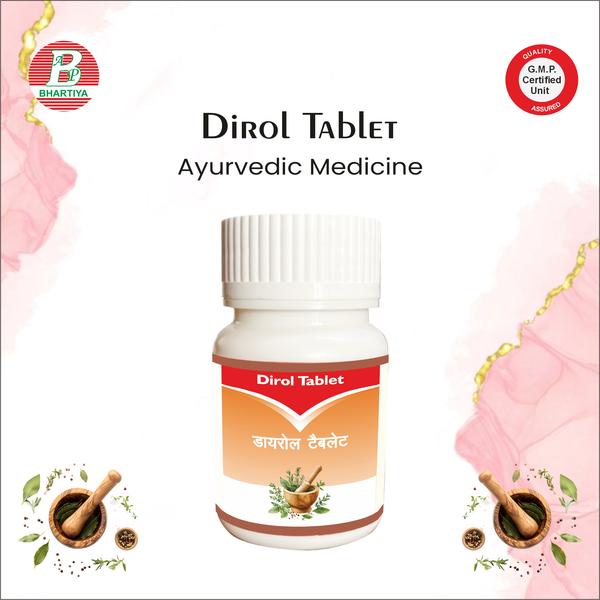
"name": "Dirol Tablet",
"description": " DIROL TABLET \n\nProduct Identification\n•\tGeneric Name: Dirol Tablet\n•\tType: Ayurvedic Patent Medicine\n•\tPrimary Indication Area: Treatment of diarrhoea and amoebic infections of the intestines.\nTherapeutic Indications:\n•\tAcute and chronic amoebiasis\n•\tAmoebic dysentery\n•\tAmoebic liver abscess\n•\tDiarrhoea of various causes\n.\n Primary Benefit:\n•\tThe primary benefit of Dirol Tablet is relief from diarrhoea and intestinal amoebic infections, helping restore normal bowel function and reduce abdominal discomfort.\nOther Benefits:\n1.\tReduces abdominal cramps and pain\no\tDiarrhoea and amoebic infections often cause cramping, bloating, and spasms in the gut. Diarrol helps relax the gut muscles and reduces irritation, easing pain.\n2.\tControls excessive bowel movements\no\tFrequent, watery stools can lead to fatigue and weakness. By improving stool consistency, Diarrol reduces the number of bowel movements, making daily activities easier.\n3.\tSupports recovery from dehydration\no\tDiarrhoea causes loss of fluids and electrolytes. By reducing stool frequency and severity, Diarrol indirectly helps the body maintain hydration and prevents complications like weakness or dizziness.\n4.\tPrevents complications of amoebic infections\no\tUntreated amoebiasis can spread to the liver, causing abscesses, or worsen intestinal inflammation. Early use of Diarrol can help manage the infection and reduce the risk of these complications.\n5.\tImproves overall digestive comfort\no\tBy controlling infection and reducing irritation in the gut, it helps improve appetite, digestion, and general well-being during recovery.\n\n SHOREA ROBUSTA (Sal Tree) \nBotanical / Common Name: Shorea robusta / Sal Tree\nKey Phytoconstituents:\n•\tTannins\n•\tResins\n•\tFlavonoids\n•\tPhenolic compounds\n•\tSterols\nMechanism of Action in GIT / Diarrhoea / Constipation – Biochemistry / Pharmacology:\n1.\tAstringent / Anti-Diarrhoeal Effect\no\tTannins precipitate proteins in the intestinal mucosa.\no\tReduces intestinal secretions and controls watery stools.\no\tHelps in acute and chronic diarrhoea.\n2.\tAnti-inflammatory Effects on Gut Mucosa\no\tFlavonoids and phenolic compounds reduce inflammation in intestinal lining.\no\tRelieves irritation, bloating, and abdominal discomfort associated with diarrhoea.\n3.\tAntimicrobial / Gut Protective Properties\no\tResins and phenolic compounds inhibit growth of pathogenic gut bacteria.\no\tHelps restore healthy gut flora and prevents secondary infections.\n4.\tDigestive Stimulant / Carminative Action\no\tSome phytochemicals enhance digestive enzyme secretion.\no\tImproves digestion and absorption, preventing accumulation of undigested food.\n5.\tAntioxidant Protection\no\tPhenolic compounds scavenge free radicals in gut tissues.\no\tMaintains gut mucosa integrity and supports healing of minor lesions.\n MOCHRAS \nBotanical / Common Name: Bombax malabaricum / Silk Cotton Tree\nKey Phytoconstituents:\n•\tFlavonoids\n•\tTannins\n•\tSaponins\n•\tPolysaccharides\n•\tSterols\nMechanism of Action in GIT / Constipation / Diarrhoea – Biochemistry / Pharmacology:\n1.\tMild Laxative Effect\no\tSaponins and polysaccharides stimulate intestinal motility.\no\tIncreases water retention in stools, easing passage and reducing straining.\n2.\tDigestive Stimulant / Carminative Action\no\tFlavonoids enhance secretion of digestive enzymes.\no\tImproves digestion and absorption, preventing accumulation of undigested food.\n3.\tAnti-inflammatory Effects on Gut Mucosa\no\tTannins and flavonoids reduce intestinal inflammation.\no\tRelieves abdominal discomfort, bloating, and irritation associated with constipation or mild diarrhoea.\n4.\tAntioxidant Protection\no\tPhenolic compounds scavenge free radicals in gut tissues.\no\tSupports gut mucosa integrity and healing of minor irritation or lesions.\n5.\tGut Microbiota Modulation\no\tPolyphenols may support growth of beneficial gut bacteria.\no\tHelps maintain regular bowel habits and overall gastrointestinal health.\n KUTAJ (Holarrhena antidysenterica) \nBotanical / Common Name: Holarrhena antidysenterica / Kutaja\nKey Phytoconstituents:\n•\tAlkaloids (Conessine, Conessimine)\n•\tTannins\n•\tFlavonoids\n•\tSterols\nMechanism of Action in GIT / Diarrhoea / Amoebiasis – Biochemistry / Pharmacology:\n1.\tAnti-Diarrhoeal / Astringent Effect\no\tAlkaloids and tannins reduce intestinal secretions.\no\tHelps control loose stools and acute diarrhoea.\n2.\tAnti-Amoebic / Antiprotozoal Action\no\tConessine exhibits activity against Entamoeba histolytica.\no\tInterferes with protozoal metabolism, reducing infection load.\n3.\tAnti-inflammatory Effects\no\tFlavonoids and tannins reduce inflammation in the intestinal mucosa.\no\tAlleviates abdominal pain, cramps, and irritation during diarrhoea.\n4.\tGut Protective / Mucosal Healing\no\tPhenolic compounds and sterols support intestinal mucosa integrity.\no\tHelps heal minor lesions caused by infection or inflammation.\n5.\tAntimicrobial / Gut Flora Modulation\no\tAlkaloids and phenolics inhibit growth of pathogenic gut bacteria.\no\tPromotes balance of beneficial gut microbiota\n.\n\n\n HARITAKI \nBotanical / Common Name: Terminalia chebula\nKey Phytoconstituents:\n•\tTannins\n•\tAnthraquinones\n•\tGlycosides\n•\tFlavonoids\nMechanism of Action in GIT / Constipation – Biochemistry / Pharmacology:\n1.\tNatural Laxative / Purgative Effect\no\tAnthraquinones stimulate peristalsis in the colon.\no\tPromotes regular bowel movements and eases passage of stools.\n2.\tStool Softening & Lubrication\no\tGlycosides and tannins increase water retention in stools.\no\tReduces straining and prevents constipation-related discomfort.\n3.\tDigestive Stimulant\no\tFlavonoids enhance secretion of digestive enzymes.\no\tImproves digestion and assimilation of nutrients.\n4.\tAnti-inflammatory & Gut Soothing Effects\no\tTannins and flavonoids reduce irritation in the intestinal mucosa.\no\tRelieves abdominal discomfort, bloating, and mild gut inflammation.\n5.\tAntimicrobial & Gut Protective Effects\no\tTannins inhibit growth of pathogenic gut bacteria.\no\tMaintains healthy gut microbiota, reducing risk of infections.\n6.\tAntioxidant Action\no\tPhenolic compounds and flavonoids scavenge free radicals.\no\tProtects gut lining from oxidative damage and supports tissue repair.\n\n\n CHINI (Saccharum officinarum) \nBotanical / Common Name: Saccharum officinarum / Sugarcane Sugar\nKey Phytoconstituents:\n•\tSucrose (main sugar)\n•\tGlucose and Fructose\n•\tMinor phenolic compounds\n•\tMinerals (Calcium, Potassium, Magnesium)\nMechanism of Action in GIT / Digestion – Biochemistry / Pharmacology:\n1.\tMild Digestive Stimulant\no\tSugar acts as an energy source for gut cells.\no\tSupports metabolic activity and may improve mild digestive sluggishness.\n2.\tSoothing / Protective Action\no\tCan provide a mild osmotic effect in the gut when used in herbal syrups.\no\tHelps coat mucosa and reduce minor irritation in the stomach/intestines.\n3.\tGut Microbiota Modulation\no\tSmall amounts may provide substrate for beneficial gut bacteria.\no\tSupports healthy gut flora balance (in moderation).\n4.\tMild Anti-inflammatory / Demulcent Effect\no\tUsed in combination with herbs in classical formulations to reduce gut irritation.\n5.\tSymptomatic Relief Support\no\tHelps improve taste, palatability, and acceptance of herbal preparations.\no\tIndirectly supports compliance and consistent use of anti-diarrhoeal or digestive herbs.\n\n SANKH BHASMA \nBotanical / Common Name: Prepared calcined conch shell / Calcium carbonate (Ayurvedic formulation)\nKey Phytoconstituents / Chemical Composition:\n•\tCalcium carbonate (CaCO₃) – main component\n•\tTrace minerals depending on preparation (Magnesium, Iron, etc.)\nMechanism of Action in GIT / Digestion / Constipation – Biochemistry / Pharmacology:\n1.\tAntacid / Acid Neutralizer\no\tCalcium carbonate reacts with gastric acid to form calcium chloride, carbon dioxide, and water.\no\tHelps neutralize excess stomach acid and relieve acidity or heartburn.\n2.\tMild Constipation Relief / Digestive Support\no\tProvides calcium ions that may mildly stimulate intestinal activity.\no\tHelps soften stools in certain formulations when combined with other herbs.\n3.\tGut Protective / Mucosal Support\no\tForms a protective coating over the gut lining.\no\tReduces irritation from acidity or mild inflammation.\n4.\tAlkalinizing Effect\no\tIncreases systemic and gut alkalinity, which can improve digestive enzyme activity.\no\tSupports overall digestive function.\n5.\tSymptomatic Relief in Dyspepsia / Gastric Disorders\no\tReduces bloating, acidity, and minor abdominal discomfort.\no\tOften combined with herbal formulations for enhanced gut healing and comfort.\n\n TAMARIX GALICA \nBotanical / Common Name: Tamarix gallica / French Tamarisk\nKey Phytoconstituents:\n•\tTannins\n•\tFlavonoids\n•\tGallic acid\n•\tSaponins\n•\tPhenolic compounds\nMechanism of Action in GIT / Diarrhoea / Constipation – Biochemistry / Pharmacology:\n1.\tAstringent / Anti-Diarrhoeal Effect\no\tTannins and gallic acid precipitate proteins in the intestinal mucosa.\no\tReduces intestinal secretions, controlling loose stools.\n2.\tAnti-inflammatory Effects on Gut Mucosa\no\tFlavonoids and phenolic compounds reduce inflammation in intestinal lining.\no\tRelieves abdominal discomfort, irritation, and bloating associated with diarrhoea.\n3.\tMild Laxative / Digestive Support (optional)\no\tSaponins may slightly stimulate intestinal motility, supporting regular bowel habits if constipation is present after infection.\n4.\tAntimicrobial / Gut Protective Properties\no\tTannins and phenolic compounds inhibit pathogenic gut bacteria.\no\tHelps maintain healthy gut microbiota and prevents secondary infections.\n5.\tAntioxidant Protection\no\tPhenolic compounds scavenge free radicals in gut tissues.\no\tSupports healing of intestinal mucosa and overall gut health.\n LODHRA (Symplocos racemosa) \nBotanical / Common Name: Symplocos racemosa / Lodhra\nKey Phytoconstituents:\n•\tTannins (Symplocin, Racemosol)\n•\tFlavonoids\n•\tGlycosides\n•\tSterols\nMechanism of Action in GIT / Diarrhoea / Dysentery – Biochemistry / Pharmacology:\n1.\tAnti-Diarrhoeal / Astringent Effect\no\tTannins precipitate proteins in the intestinal mucosa.\no\tReduces excess intestinal secretions, controlling loose stools.\n2.\tAnti-inflammatory Effects on Gut Mucosa\no\tFlavonoids and tannins reduce intestinal inflammation.\no\tRelieves abdominal cramps, irritation, and bloating associated with diarrhoea.\n3.\tAntimicrobial / Gut Protective Properties\no\tTannins and phenolic compounds inhibit growth of pathogenic gut bacteria.\no\tSupports healthy gut microbiota and prevents secondary infections.\n4.\tDigestive Stimulant / Carminative Effect\no\tGlycosides and flavonoids enhance digestive enzyme activity.\no\tImproves digestion, preventing accumulation of undigested food and gas formation.\n5.\tAntioxidant Protection\no\tPhenolic compounds scavenge free radicals in gut tissues.\no\tSupports mucosal healing and maintains overall gastrointestinal health.\n\n SHUDH GANDHAK \nBotanical / Common Name: Purified Sulfur / Shuddha Gandhak\nKey Phytoconstituents / Chemical Composition:\n•\tSulfur (S₈) – main component\n•\tTrace minerals depending on purification\nMechanism of Action in GIT / Digestion / Anti-Microbial – Biochemistry / Pharmacology:\n1.\tAnti-Microbial / Gut Protective Effect\no\tSulfur has bactericidal and fungicidal properties.\no\tHelps reduce pathogenic gut bacteria, supporting intestinal health.\n2.\tDetoxifying Action\no\tPromotes metabolic detoxification, aiding in the removal of toxins from the gut and body.\no\tSupports liver and gastrointestinal function indirectly.\n3.\tMild Anti-inflammatory Effects\no\tReduces gut inflammation caused by infection or irritation.\no\tHelps relieve abdominal discomfort and bloating.\n4.\tGut Motility and Digestive Support\no\tStimulates digestive enzyme activity mildly, aiding digestion and nutrient absorption.\no\tMay support regular bowel movements when combined with other herbs.\n5.\tSupport of Gut Mucosa Healing\no\tHelps maintain intestinal lining integrity.\no\tAssists in healing minor lesions or irritation in the digestive tract.\nDosage: \n•\tAdults: 2–3 tablets, thrice a day after meals\n•\tChildren: 1–2 tablets, thrice a day after meals\n•\tWith water: Swallow tablets with plain water.\n•\tOptional: Can be taken with warm milk if preferred or recommended by the physician.\n•\tTiming: After meals, preferably at night before bedtime for best effect on gut motility and digestion.\n Precautions\n•\tDo not exceed the prescribed dose.\n•\tConsult a doctor before use in:\no\tChildren\no\tElderly\no\tPatients with chronic illnesses (liver, kidney, or heart conditions)\n•\tMaintain adequate hydration and a fibre-rich diet for optimal results.\n•\tUse as part of a comprehensive management plan for piles, hemorrhoids, diarrhoea, or other gut-related issues.\n•\tReport any adverse reactions (e.g., nausea, abdominal discomfort, allergy) to a doctor immediately.\n\n\ndirol tablet uses, diarol tablet, dirol tablet amazon\ndirol tablet ad, dirol tablet amazon india\ndirol tablet all, dirol tablet benefits\ndirol tablet buy, dirol tablet buy online\ndirol tablet composition, dirol tablet company\ndirol tablet content, dirol tablet dose\ndirol tablet extra, dirol tablet full form\ndirol tablet for, dirol tablet for sale\ndirol tablet for skin, dirol tablet gst rate\ndirol tablet gold, dirol tablet gst number\ndirol tablet gst, dirol tablet gum\ndirol tablet hindi, dirol tablet hsn code\ndirol tablet hd, dirol tablet how to use\ndirol tablet hs code, dirol tablet indiamart\ndirol tablet image, dirol tablet india\ndirol tablet in hindi, dirol tablet japan\ndirol tablet jiomart, dirol tablet joint\ndirol tablet jio, dirol tablet kis kaam aati hai\ndirol tablet kya kam karta hai, dirol tablet kya hai\ndirol tablet list, dirol tablet login\ndirol tablet logo, dirol tablet label\ndirol tablet manufacturer, dirol tablet manufacturers in india\ndirol tablet mrp, dirol tablet name, dirol tablet number\ndirol tablet new, dirol tablet nutrition\ndirol tablet online shopping, dirol tablet online\ndirol tablet online order, dirol tablet price\ndirol tablet price in india, dirol tablet qatar\ndirol tablet quality, dirol tablet quantity\ndirol tablet q10, dirol tablet review\ndirol tablet rate, dirol tablet tab\ndiarol 500 tablet uses in hindi, dirol tablet vitamin\ndirol tablet wholesale, dirol tablet wholesale price\ndirol tablet xtra",
"price": 90.0,
"discountamount": 45.0,
"currencycode": "INR",
"priority": 1000000,
"isfreeshipmentavailable": false,
"shipmentduration": 1,
"_keywords": null,
"isarchived": false,
"isavailable": true,
"applicationid": null,
"productindex": 93,
"imageuri": "https://productimages.withfloats.com/actual/69e20fb8442027782e969442.jpg",
"tileimageuri": "https://productimages.withfloats.com/tile/69e20fb8442027782e969442.jpg",
"images": null,
"totalqueries": 0,
"gpid": null,
"groupproductid": null,
"createdon": "2026-04-17T10:47:18.224Z",
"updatedon": "2026-04-17T10:47:18.224Z",
"buyonlinelink": null,
"producturl": "http://WWW.BHARTIYAAYURVEDICPHARMACY.COM/products/dirol-tablet/93",
"availableunits": -1.0,
"iscodavailable": true,
"isprepaidonlineavailable": true,
"maxcodorders": -1,
"maxprepaidonlineorders": -1,
"uniquepaymenturl": null,
"brandname": "Bakula Fort",
"category": "Dirol Tablet 100 Tab X 50",
"tags": [],
"variants": false,
"keyspecification": null,
"otherspecifications": null,
"pickupaddressreferenceid": null,
"paymenttype": "AssuredPurchase",
"producttype": "products",
"hsncode": null,
"gstslab": 0.0,
"isnotforsale": false
},
{
"_id": "69e0a9e5ba41faa29e085f5f",
"fptag": "BHARTIYEAYURVEDICPHARMACY",
"merchantname": null,
"customwidgets": null,
"externalsourceid": null,
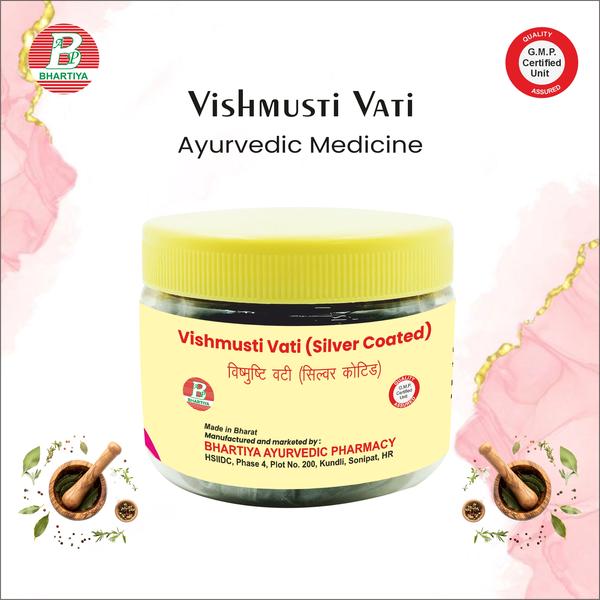
"name": "Vashmusti Vati",
"description": " VISHMUSHTI VATI (SILVER COATED) \n\nProduct Identification\n•\tGeneric Name: Vishmushti Vati\n•\tType: Ayurvedic Patent Medicine\n•\tPrimary Indication Area: All Types of Joint Pain (Gathiya / Vat Roga)\n•\tTherapeutic Indications Management of joint pain of all types, including Vata-related disorders (Gathiya / Vat Roga). \nKey benefits include:\n1.\tPain Relief\no\tHelps reduce joint pain, soreness, and discomfort caused by Vata imbalance.\n2.\tReduces Stiffness & Swelling\no\tImproves joint flexibility and eases swelling associated with arthritis or Gathiya.\n3.\tSupports Joint Mobility\no\tEnhances ease of movement and overall joint function.\n4.\tStrengthens Muscles & Bones\no\tHelps improve muscle tone around joints and supports bone health.\n5.\tAnti-fatigue & Vitality Support\no\tReduces weakness and tiredness caused by chronic joint pain.\no\tPromotes overall strength and rejuvenation.\no\t\n\nIngredients:\n SHUDH HINGUL \nAyurvedic Name: Shuddha Hingul / Hingula Bhasma\nMineral Source: Cinnabar (purified mercury sulphide)\nPrimary Use: Vata Roga & Joint Pain (Gathiya) support in classical Ayurvedic formulations\n\nKey Phytoconstituents\n•\tPurified Mercuric Sulphide (HgS) transformed into nano sized bio assimilable particles through classical Shodhana–Marana processes\n•\t Trace mineral complexes with elements like Zn, Cu, Fe formed during purification and incineration\n•\tSynergistic adjuvants (when processed with herbal decoctions such as Triphala, Guduchi, Nirgundi) to support detoxification and absorption\nMechanism of Action\n(Biochemistry / Pharmacological Basis for Joint Pain — Vata Roga / Gathiya)\n1.\tNano Particle Bio Assimilation & Immune Modulation\n\n•\tProperly purified mercuric sulphide (HgS) in Shuddha Hingul Bhasma forms extremely fine particles that cross intestinal mucosa more efficiently and interact with immune cells, stimulating macrophage activity and encouraging a balanced immune response in chronic inflammatory environments. \n2.\tAnti Inflammatory & Dosha Regulation\n•\tThrough traditional Ayurvedic mechanisms, the ushna (heating) potency and deep penetrating action of Hingul help pacify aggravated Vata dosha, which is a major contributor to stiffness, pain, and erratic neural signals in joint disorders. \n•\t Trace sulfur compounds and other mineral complexes may contribute mild anti inflammatory effects, reducing local discomfort \n3.\tDetoxification & Metabolic Balance (Ama Clearance)\n\n•\tHangul’s classical action includes enhancing agni (metabolic fire) and clearing ama (toxic metabolic by products) from tissues and srotas (channels), which in Ayurveda are thought to exacerbate joint pain and stiffness when accumulated. \n4.\tTissue Nourishment & Support\n\n•\tBy harmonizing metabolism and supporting reticuloendothelial system activity, fine bhasma particles may help improve nutrient delivery and tissue nourishment, indirectly supporting joint comfort and resilience. \n\nIngredients:\n JAYPHAL (Nutmeg) \nBotanical Name: Myristica fragrans\nAyurvedic Names: Jaiphal, Jatiphala, Jatisasya\nPrimary Use: Joint pain relief (Vata Roga), anti inflammatory and musculoskeletal support\n\nKey Phytoconstituents\nMyristicin – aromatic compound with anti inflammatory and mild analgesic properties\nElemicin – contributes to anti inflammatory and antioxidant effects\nTrimyristin & fatty acids – support metabolic functions\nEugenol, sabinene, α pinene & other volatile oils – anti inflammatory, analgesic and antioxidant constituents\n Phenolic compounds & lignans – support free radical neutralization and tissue protection\n\nMechanism of Action\n(Biochemistry / Pharmacological Basis for Joint Pain — Vata Roga / Gathiya)\n1.\tAnti Inflammatory & Analgesic Action\n•\tCompounds such as myristicin, eugenol, sabinene, β pinene and α pinene exhibit anti inflammatory and pain relieving effects, which help reduce joint swelling, soreness, and discomfort typical of Vata related joint disorders. \n2.\tAntioxidant & Tissue Protection\n•\tPhenolic compounds and lignans in Jaiphal neutralize free radicals, protecting joint tissues from oxidative stress that can worsen chronic inflammation and joint degeneration. \n3.\tVata Pacification & Nervine Modulation\n•\tIn Ayurvedic pharmacology, Jayphal’s hot (ushna) potency and pungent taste help balance aggravated Vata dosha, which contributes to pain, stiffness, and erratic neural signals in joint discomfort. \n4.\tMuscle Relaxation & Circulatory Support\n•\tNutmeg’s volatile oils may promote local blood flow and muscle relaxation, which can relieve stiffness and improve mobility around affected joints. \n\n JAVITRI (Mace) \nBotanical Name: Myristica fragrans (aril of nutmeg seed)\nAyurvedic Use: Traditionally used as a digestive, anti inflammatory and mild analgesic agent; balances Vata & Kapha doshas in classical systems and used for joint muscle discomfort support. \n\nKey Phytoconstituents\n Myristicin – an aromatic phenylpropene compound responsible for medicinal effects. \n Elemicin – contributes to anti inflammatory and antioxidant properties. \n Safrole and other volatile oils (terpenes) – support anti inflammatory and circulatory effects. \n Phenolic compounds & flavonoids (antioxidant activity). \n Minerals such as iron, magnesium and trace nutrients that support metabolic functions. \n\nMechanism of Action\n(Biochemistry / Pharmacological Basis for Joint Pain — Vata Roga / Gathiya)\n1.\tAnti Inflammatory & Pain Modulating Action\n\n•\tConstituents such as myristicin, elemicin and other volatile oils exert anti inflammatory and mild analgesic effects, reducing inflammatory mediators that contribute to joint pain and stiffness. \n2.\tAntioxidant & Tissue Protection\n\n•\tPhenolic compounds and flavonoids neutralize free radicals and oxidative stress, helping protect joint tissues from damage and degeneration. \n3.\tVata Pacifying & Nervine Support\n\n•\tIn Ayurveda, Javitri’s hot (ushna) potency and pungent taste help balance aggravated Vata dosha, which is often implicated in joint stiffness, erratic neural signals, and discomfort. \n4.\tCirculatory & Muscle Comfort Support\n\n•\tVolatile oils may enhance local circulation and support muscle relaxation, helping relieve stiffness and improve comfort around joints and connective tissues. \n\n LAVANG (Clove) \nBotanical Name: Syzygium aromaticum\nAyurvedic Name: Lavang / Laung\nPrimary Use: Analgesic & anti inflammatory support; soothing discomfort associated with joint pain and Vata imbalance\nKey Phytoconstituents\n• Eugenol – major active compound with analgesic and anti inflammatory effects\n• β Caryophyllene, chavibetol, eugenyl acetate – synergistic volatile compounds contributing to anti inflammatory and pain modulating actions\n• Other phenolic compounds and antioxidants that support tissue protection and oxidative balance \n\nMechanism of Action\n(Biochemistry / Pharmacological Basis for Joint Pain — Vata Roga / Gathiya)\n1.\tAnti Inflammatory & Pain Relieving Action\n\n•\tEugenol inhibits inflammatory mediators (such as prostaglandins via cyclooxygenase pathways) and reduces local inflammation, helping relieve discomfort in stiff or sore joints.\n• Its mildly anaesthetic action modulates nerve impulses, providing soothing relief in affected areas. \n2.\tAntioxidant & Tissue Protection\n\n•\tPhenolic compounds and flavonoid like constituents neutralize free radicals and oxidative stress, which can exacerbate chronic inflammatory conditions like joint pain.\n• This supports cellular protection and may slow degenerative changes in connective tissues. \n3.\tCirculation & Vata Balance Support\n\n•\tLavang’s warming effect (ushna virya) and pungent aroma help improve local circulation and penetrate tissues, which is believed in Ayurveda to help pacify aggravated Vata dosha, a key factor in joint stiffness and erratic neural signalling. \n4.\tMuscle Relaxation & Comfort\n•\tThe volatile oil components contribute to muscle relaxation and improved microcirculation around joints, aiding in reduced stiffness and enhanced comfort.\n\n•\tWhen used topically (e.g., in warm oil massage), these effects are particularly noticeable.\n\n KALI MIRCH (Black Pepper) \nBotanical Name: Piper nigrum\nAyurvedic Name: Kali Mirch / Marica\nPrimary Use: Support for joint discomfort, inflammation and Vata Roga (joint pain)\n\nKey Phytoconstituents\n• Piperine — the principal alkaloid responsible for most pharmacological activity\n• Essential oils: limonene, α pinene, β pinene, sabinene, caryophyllene\n• Phenolic compounds & flavonoids — contribute antioxidant activity\n• Trace nutrients and lignans that support biological actions \n\nMechanism of Action\n(Biochemistry / Pharmacological Basis for Joint Pain — Vata Roga / Gathiya)\n1.\tAnti Inflammatory & Pain Modulation\n\n•\tPiperine and related alkaloids inhibit pro inflammatory pathways (e.g., NF κB, COX, and inflammatory cytokines) that drive joint inflammation and pain in arthritis models.\n• In cell studies, piperine reduced production of inflammatory mediators such as NO, PGE₂ and cytokines (IL 6, TNF α) and inhibited enzymes that break down cartilage matrix. \n2.\tAnti Oxidant & Tissue Protection\n\n•\tPhenolic compounds and flavonoids in black pepper neutralize free radicals that can exacerbate chronic joint degeneration and inflammatory tissue damage.\n• This helps protect joint connective tissues and supports cellular resilience. \n3.\tVata Pacifying & Circulation Enhancement\n\n•\tIn Ayurvedic terms, the ushna (warming) and Tikshna (penetrating) qualities of Kali Mirch help pacify aggravated Vata dosha, improving comfort, reducing stiffness, and enhancing micro circulation around joints.\n• Topical preparations (oil or paste with carrier oil) are traditionally used to ease soreness and warmth in joint areas. \n4.\tBioavailability & Synergistic Support\n\n•\tPiperine enhances the bioavailability of other compounds (e.g., curcumin, phenolics) by inhibiting certain metabolic enzymes, which may increase effectiveness of joint support herbs\n\n SUDH KUCHLA \nAyurvedic Name: Shuddha Kuchla (Purified Strychnos nux vomica)\nBotanical Source: Seeds of Strychnos nux vomica (detoxified via classical Shodhana processes)\nPrimary Use: Supports Vata Roga & Joint Pain (Gathiya) through metabolic balance, neuromuscular stimulation, and Vata pacification\n\nKey Phytoconstituents\n• Alkaloids (notably strychnine and brucine) — the primary bioactive compounds remaining after purification that influence nervous and muscular responses. \n• Other trace constituents influenced by processing — contributing to digestion, metabolic fire (agni) enhancement, and detoxification support.\n\nMechanism of Action\n(Biochemistry / Pharmacological Basis for Joint Pain — Vata Roga / Gathiya /)\n1.\tNeuromuscular Stimulation & Pain Modulation\n\n•\tPurified alkaloids in Sudh Kuchla act on the central and peripheral nervous system, stimulating nerve activity in a controlled manner to improve nerve muscle coordination and reduce erratic Vata related neural signals that contribute to joint discomfort. \n•\t This neuromodulation can indirectly help reduce sensations of stiffness and weakness in chronic joint conditions.\n2.\tAnti Inflammatory & Vata Balance\n\n•\tThrough classical Ayurvedic properties (bitter, pungent taste with warming potency), Sudh Kuchla pacifies aggravated Vata dosha, a key driver of joint pain and stiffness in Vata dominant disorders like Gathiya.\n3.\tDigestive Fire (Agni) & Detoxification Support\n\n•\tWarming virya (ushna potency) of Sudh Kuchla supports metabolic fire (agni), which aids in digestion and clears metabolic by products (ama) that are believed in Ayurveda to worsen joint pain and tissue congestion. \n4.\tMuscle & Tissue Support\n\n•\tBy stimulating metabolic activity and nervous regulation, Sudh Kuchla may contribute to improved nutrient delivery and deep tissue nourishment, indirectly supporting resilience in musculoskeletal structures during joint stress. \n\n\nDosage:\n1.\tDose per intake: 1–2 pills\n2.\tFrequency: 2 times daily\n3.\tTotal daily dose: 2–4 pills (depending on physician advice)\n4.\tHow to take: With milk, preferably after meals\n\nPrecautions\n•\tDo not exceed the prescribed dose\n•\tConsult an Ayurvedic practitioner before use in:\no\tChildren\no\tElderly\no\tPatients with chronic illness\n•\tMonitor for any side effects (e.g., digestive discomfort)\n•\tMaintain proper diet and hydration to support bowel health\n\n\nvishamushti vati uses, vishamushti vati\nvishamushti vati ingredients, vishamushti vati benefits\nvishamushti vati price, vishamushti vati tablet\nvishamushti vati uses in hindi, vishamushti vati benefits in hindi\nvishamushti vati in hindi, vishamushti vati easy ayurveda\nvishamushti vati use, vishamushti vati composition\nvishmusti vati flipkart, vishmusti vati goli\nvishmusti vati jankari in hindi, vishmusti vati jankari\nvishmusti vati ke fayde, vishmusti vati ke fayde in hindi\nvishmusti vati khane ke fayde, vishmusti vati kya kam karta hai\nvishmusti vati manufacturer, vishmusti vati mrp\nvishmusti vati near me, use of vishamushti vati\nvishmusti vati quality, vishmusti vati quantity\nvishamushti vati side effects, vishmusti vati website\nvishmusti vati works, uses of vishamushti vati\nwhat vishmusti vati uses in hindi, what vishmusti vati uses\nwhere vishmusti vati manufactured, where vishmusti vati available\nwhen vishmusti vati uses in hindi, when vishmusti vati uses\nwho vishmusti vati uses in hindi, can vishmusti vati uses in hindi\nwill vishmusti vati uses in hindi, was vishmusti vati uses in hindi\nbest vishamushti vati in hindi, best vishamushti vati uses",
"price": 990.0,
"discountamount": 495.0,
"currencycode": "INR",
"priority": 1000000,
"isfreeshipmentavailable": false,
"shipmentduration": 1,
"_keywords": null,
"isarchived": false,
"isavailable": true,
"applicationid": null,
"productindex": 88,
"imageuri": "https://productimages.withfloats.com/actual/69e0a9f3c32735ec39db6df9.jpg",
"tileimageuri": "https://productimages.withfloats.com/tile/69e0a9f3c32735ec39db6df9.jpg",
"images": null,
"totalqueries": 0,
"gpid": null,
"groupproductid": null,
"createdon": "2026-04-16T09:20:37.839Z",
"updatedon": "2026-04-16T09:20:37.839Z",
"buyonlinelink": null,
"producturl": "http://WWW.BHARTIYAAYURVEDICPHARMACY.COM//vashmusti-vati/88",
"availableunits": -1.0,
"iscodavailable": true,
"isprepaidonlineavailable": true,
"maxcodorders": -1,
"maxprepaidonlineorders": -1,
"uniquepaymenturl": null,
"brandname": "Bakula Fort",
"category": "Vashmusti Vati 100gm X 20",
"tags": [],
"variants": false,
"keyspecification": null,
"otherspecifications": null,
"pickupaddressreferenceid": null,
"paymenttype": "AssuredPurchase",
"producttype": "products",
"hsncode": null,
"gstslab": 0.0,
"isnotforsale": false
},
{
"_id": "69a55b8694180917ab8a5d30",
"fptag": "BHARTIYEAYURVEDICPHARMACY",
"merchantname": null,
"customwidgets": null,
"externalsourceid": null,
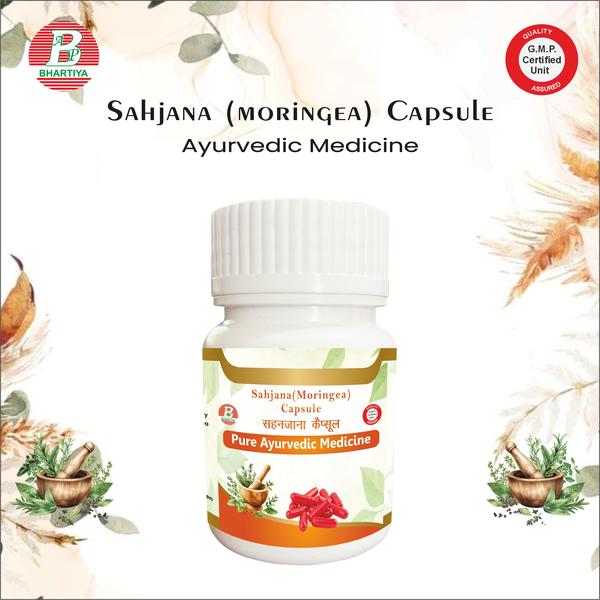
"name": "Sahjana capsule",
"description": " SAHJANA \n \n SAHJANA (Moringa oleifera Lam.) \nThe Nutrient-Rich “Drumstick Tree” — Leaves, Pods, Seeds, and Flowers\nSahjana, commonly known as Moringa, is a highly valued plant in Ayurveda and modern nutrition. Known for its nourishing, rejuvenating, and digestive-supporting properties, it is rich in vitamins, minerals, proteins, antioxidants, and phytochemicals. Sahjana is considered beneficial for immunity, metabolism, skin, hair, heart health, and overall vitality.\n CLASSICAL AYURVEDIC REFERENCES\n1.\tCharaka Samhita\no\tMentioned in Kalpa Sthana for strengthening Dhatus and improving Ojas.\no\tLeaves and pods are considered Medhya (brain nourishing) and Rasayana (rejuvenative).\n2.\tSushruta Samhita\no\tRecommended for Vata and Pitta disorders, digestive weakness, and anaemia.\no\tDescribed as Snigdha (unctuous), Ushna (warming), and Balya (strength-giving).\n3.\tBhavaprakasha Nighantu\no\tReferred to as Sahjana / Shobhanjana.\no\tPromotes longevity, immunity, and vitality.\no\tUsed in Vrishya (reproductive), Hridya (cardiac), and Medhya (intellectual) formulations.\n\n CLASSICAL STORY / ANECDOTE\nIn classical Ayurvedic texts, Sahjana is praised as a “miracle tree” because every part—leaves, pods, seeds, flowers, and bark—has medicinal or nutritional use. It is sometimes referred to as “Sanjeevani of common people”, symbolizing its life-supporting and rejuvenative qualities. Traditionally, Sahjana leaves and pods were included in the diet of warriors and laborers to enhance strength, stamina, and immunity during harsh seasons.\n\n BOTANICAL INFORMATION OF SAHJANA \n•\tScientific Name: Moringa oleifera Lam.\n•\tFamily: Moringaceae\n•\tOrder: Brassicales\n•\tGenus: Moringa\n•\tSpecies: oleifera\n\nCommon Names:\n\tSanskrit: Sahjana, Shobhanjana\n\tHindi: Sahjan, Munga\n\tEnglish: Drumstick Tree, Horseradish Tree\n\tTamil: Murungai\n\tTelugu: Munagaku\n\tMalayalam: Munagakaya\n\tKannada: Nuggekai\n\tBengali: Sajnana\n\n SYNONYMS IN CLASSICAL AYURVEDIC NIGHANTUS\n•\tCharaka Samhita: Sahjana – Rasayana, Balya\n•\tSushruta Samhita: Sahjana – Medhya, Hridya, Balya\n•\tBhavaprakasha Nighantu: Sahjana / Shobhanjana – Promotes longevity, immunity, and fertility\n\n MORPHOLOGY OF SAHJANA\n•\tPlant Type: Fast-growing perennial tree\n•\tHeight: 5–10 m\n•\tLeaves: Small, pinnate, feathery\n•\tFlowers: White to pale yellow, fragrant, 5-petaled\n•\tFruit / Pod: Long, slender drumstick-shaped pods containing seeds\n•\tSeeds: Round, brown, winged, nutrient-rich\n•\tRoots & Bark: Used in traditional medicines\n\n ECOLOGICAL PREFERENCES\n•\tClimate: Tropical to subtropical, tolerates dry conditions\n•\tSoil: Well-drained sandy or loamy soil, pH 6–7.5\n•\tHabitat: Cultivated in fields, gardens, roadsides; requires full sun\n•\tAltitude: Sea level to 1,000 m\n\n GEOGRAPHICAL DISTRIBUTION\n•\tIndia: Maharashtra, Tamil Nadu, Andhra Pradesh, West Bengal, Rajasthan\n•\tOutside India: Philippines, Africa, Caribbean, Southeast Asia, Middle East\n\n CLASSICAL AYURVEDIC PROPERTIES (RASA–GUNA–VIRYA–VIPAKA)\n•\tRasa (Taste): Madhura (sweet), Tikta (bitter), Katu (pungent)\n•\tGuna (Qualities): Laghu (light), Snigdha (unctuous)\n•\tVirya (Potency): Ushna (warming)\n•\tVipaka (post-digestive effect): Madhura (sweet)\n•\tDosha Effects: Vata-Pitta hara (reduces Vata & Pitta), Kapha samana in moderation\n THERAPEUTIC ACTIONS (KARMA)\n1.\tMedhya: Supports brain health, improves intellect and memory\n2.\tHridya: Supports cardiovascular system\n3.\tBalya: Enhances strength and immunity\n4.\tVatahara: Reduces Vata-related disorders like joint pain and weakness\n5.\tRasayana: Rejuvenates, promotes longevity, and overall vitality\n6.\tKeshya & Twachya: Nourishes hair and skin\n7.\tAnulomana: Supports digestion and regular bowel movements\n\n INDICATIONS\n•\tDigestive System: Constipation, poor digestion, loss of appetite\n•\tCardiovascular System: Hypertension, Hyperlipidemia\n•\tReproductive & Urinary System: Fertility support, reproductive wellness\n•\tSkin & Hair: Dry skin, hair loss, premature greying\n•\tMetabolism: Diabetes, obesity, metabolic imbalance\n•\tNervous System: Stress, fatigue, cognitive support\n\n MODERN PHARMACOLOGY & PHYTOCHEMISTRY\n•\tMajor Constituents:\no\tVitamins (A, C, E, B-complex), minerals (Ca, K, Fe, Mg)\no\tProteins, amino acids\no\tFlavonoids, phenolics, saponins, alkaloids\no\tOmega fatty acids (in seeds)\n•\tPharmacological Actions:\no\tAntioxidant\no\tAnti-inflammatory\no\tImmunomodulatory\no\tAnti-diabetic\no\tHepatoprotective\no\tCardioprotective\n\n CULTIVATION DETAILS\n•\tPropagation: Seeds or cuttings\n•\tSowing Time: February–May (summer) or monsoon planting\n•\tSpacing: 2–3 m between trees\n•\tIrrigation: Moderate; drought-tolerant\n•\tFertilization: Organic manure preferred\n•\tHarvesting: Leaves – year-round; Pods – 6–8 months after planting; Seeds – when pods mature\n\n CLASSICAL DOSAGE (According to Ayurvedic Granthas)\n•\tLeaves: 5–10 g/day (fresh or powdered)\n•\tPods / Drumsticks: 10–20 g/day cooked or in decoction\n•\tSeeds: 3–6 g/day powdered or soaked\n•\tOil (Sahjana Taila): 5–10 ml/day\n•\tDecoction / Paste: As per therapeutic requirement (skin, hair, or digestion)\n\n SAHJANA FORMULATIONS – BHARTIYA AYURVEDIC PHARMACY\nBhartiya Ayurvedic Pharmacy prepares a range of Sahjana formulations following classical Ayurvedic principles. Each product retains the full nutritive, rejuvenative, and digestive-supporting properties of Sahjana, promoting heart health, immunity, metabolism, and overall vitality.\nKey Uses of Sahjana Formulations:\n•\tDigestive Support: Improves digestion, relieves constipation, promotes gut health\n•\tCardiovascular Health: Supports healthy lipid levels and heart function\n•\tReproductive Health: Enhances fertility and nourishes reproductive tissues\n•\tSkin & Hair Care: Improves skin hydration, strengthens hair roots\n•\tRasayana: Rejuvenates, supports longevity, and overall vitality\n\n SAHJANA CAPSULE\nBhartiya Ayurvedic Pharmacy offers Sahjana Capsules prepared according to classical Ayurvedic methods. Each capsule contains premium quality Sahjana (Moringa) powder or extract, preserving its nutritive, rejuvenative, and balancing properties.\nKey Benefits:\n•\tSupports digestive health and regular bowel movements\n•\tPromotes cardiovascular health\n•\tEnhances reproductive health and immunity\n•\tNourishes skin and hair\n•\tActs as a Rasayana, promoting overall vitality and strength\n\nDosage:\n•\tAdults: 1–2 capsules twice daily with warm water or as directed by an Ayurvedic physician\n•\tCan be combined with milk or ghee for enhanced Rasayana effect\nSafety & Precautions:\n•\tSafe for long-term use when taken as per dosage\n•\tMild laxative effect may occur in sensitive individuals\n•\tMonitor blood pressure or blood sugar if taken with medications\nFormulation Highlights:\n•\t100% natural Sahjana (Moringa) powder\n•\tFree from artificial colours, preservatives, and additives\n•\tPrepared using classical Ayurvedic processing methods\nSuggested Use:\n•\tIdeal for adults looking to improve digestion, heart health, immunity, and vitality\n•\tSuitable for those seeking convenient Ayurvedic Rasayana support\n\n SAHJANA POWDER \nBhartiya Ayurvedic Pharmacy offers Sahjana (Moringa oleifera) Powder prepared according to classical Ayurvedic principles. Made from premium quality dried leaves, pods, and seeds, the powder retains full nutritive, rejuvenative, and balancing properties of Sahjana.\nKey Benefits:\n•\tSupports digestion and regular bowel movements\n•\tPromotes heart and cardiovascular health\n•\tEnhances immunity and overall vitality\n•\tNourishes skin and hair\n•\tActs as a Rasayana, promoting strength and stamina\nDosage:\n•\tAdults: 3–6 g/day (1–2 teaspoons) with warm water, milk, or ghee, or as directed by an Ayurvedic physician\n•\tCan be added to smoothies, soups, or food for daily nourishment\nSafety & Precautions:\n•\tSafe for long-term use when taken as per dosage\n•\tMild laxative effect may occur in sensitive individuals\n•\tMonitor blood sugar if taken with antidiabetic medications\nFormulation Highlights:\n•\t100% natural Sahjana (Moringa) powder\n•\tFree from artificial colours, preservatives, and additives\n•\tPrepared using classical Ayurvedic processing methods\nSuggested Use:\n•\tIdeal for adults looking to improve digestion, immunity, heart health, and overall vitality\n•\tSuitable for daily Rasayana and nutritional support\n\n\nsahjan capsule, sahjan capsule uses in hindi\nsahjan churna, sahjan ka churan, sahjan ka upyog\nsahjan ka upyog kaise karen, sahjan ke capsule\nsahjan ke capsule ke fayde, sahjan ke upyog\nsahjana capsule amazon, sahjana capsule ayurvedic\nsahjana capsule benefits, sahjana capsule benefits in hindi\nsahjana capsule buy online, sahjana capsule composition\nsahjana capsule contains, sahjana capsule content\nsahjana capsule cost, sahjana capsule dose\nsahjana capsule dose per day, sahjana capsule download\nsahjana capsule download pdf, sahjana capsule english\nsahjana capsule english name, sahjana capsule expiry date\nsahjana capsule extract, sahjana capsule gmp\nsahjana capsule green world, sahjana capsule hindi\nsahjana capsule how to use, sahjana capsule jan aushadhi\nsahjana capsule jiomart, sahjana capsule lagane ke fayde\nsahjana capsule life, sahjana capsule life care\nsahjana capsule login, sahjana capsule manufacturer\nsahjana capsule name, sahjana capsule near me\nsahjana capsule nutrition, sahjana capsule online\nsahjana capsule online order, sahjana capsule online purchase\nsahjana capsule online shopping, sahjana capsule price\nsahjana capsule quality, sahjana capsule quantity\nsahjana capsule question, sahjana capsule question paper\nsahjana capsule rate, sahjana capsule recipe\nsahjana capsule review, sahjana capsule review in hindi\nsahjana capsule side effects, sahjana capsule side effects in hindi",
"price": 360.0,
"discountamount": 180.0,
"currencycode": "INR",
"priority": 1000000,
"isfreeshipmentavailable": false,
"shipmentduration": 1,
"_keywords": null,
"isarchived": false,
"isavailable": true,
"applicationid": null,
"productindex": 70,
"imageuri": "https://productimages.withfloats.com/actual/69a55b888361c309c6520782.jpg",
"tileimageuri": "https://productimages.withfloats.com/tile/69a55b888361c309c6520782.jpg",
"images": null,
"totalqueries": 0,
"gpid": null,
"groupproductid": null,
"createdon": "2026-03-02T09:42:30.676Z",
"updatedon": "2026-03-02T09:42:30.676Z",
"buyonlinelink": null,
"producturl": "http://WWW.BHARTIYAAYURVEDICPHARMACY.COM//sahjana-capsule/70",
"availableunits": -1.0,
"iscodavailable": true,
"isprepaidonlineavailable": true,
"maxcodorders": -1,
"maxprepaidonlineorders": -1,
"uniquepaymenturl": null,
"brandname": "Bakula fort",
"category": "Sahjana capsule 60 - cap X 24",
"tags": [],
"variants": false,
"keyspecification": null,
"otherspecifications": null,
"pickupaddressreferenceid": null,
"paymenttype": "AssuredPurchase",
"producttype": "products",
"hsncode": null,
"gstslab": 0.0,
"isnotforsale": false
},
{
"_id": "6985b8fb911df6d4b0db36c4",
"fptag": "BHARTIYEAYURVEDICPHARMACY",
"merchantname": null,
"customwidgets": null,
"externalsourceid": null,
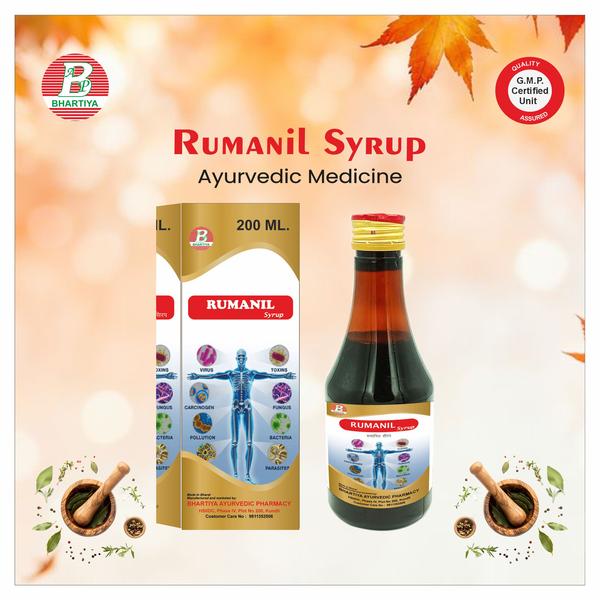
"name": "Rumanil Syrup",
"description": " RUMANIL SYRUP \n\nProduct Identification\n•\tGeneric Name: Rumanil Syrup\n•\tType: Ayurvedic Patent Medicine\n•\tPrimary Indication Area: Joint health, musculoskeletal support, and relief from pain and inflammation. \n Therapeutic Indications\n•\tProvides relief from joint pain and stiffness.\n•\tSupports mobility and flexibility of joints.\n•\tReduces inflammation and discomfort associated with arthritis or minor injuries.\n•\tHelps in strengthening bones and muscles.\n\nKey benefits:\n1.\tRelieves Joint Pain – Helps reduce discomfort in knees, elbows, shoulders, and other joints.\n2.\tReduces Inflammation – Herbal ingredients work to calm swelling and tenderness.\n3.\tImproves Flexibility & Mobility – Supports easier movement and reduces stiffness.\n4.\tStrengthens Muscles & Bones – Contributes to overall musculoskeletal health.\n5.\tSupports Arthritis Management – May help with symptoms of osteoarthritis or mild joint disorders.\n6.\tNatural & Ayurvedic – Use traditionally formulations long term use\n \nIngredient: \n Guggulu (Commiphora mukul)\nKey Phytoconstituents:\n1.\tGuggulsterones (E & Z isomers) – main active compounds\n2.\tSterols & Diterpenoids – anti-inflammatory activity\n3.\tResins – provide therapeutic effects\n4.\tEssential oils – minor anti-inflammatory and analgesic effects\n\nMechanism of Action in Joint Health\n1.\tAnti-inflammatory\no\tGuggulsterones inhibit pro-inflammatory mediators (like TNF-α, IL-1β, and COX enzymes).\no\tReduces swelling, stiffness, and tenderness in joints.\n2.\tAnalgesic (Pain Relief)\no\tReduces pain associated with osteoarthritis, rheumatoid arthritis, and minor joint injuries.\n\nSalai Guggul (Boswellia serrata)\nBotanical Name: Boswellia serrata\nCommon Name: Indian Frankincense\nKey Phytoconstituents:\n1.\tBoswellic Acids (α, β, acetyl-boswellic acids) – main active anti-inflammatory compounds\n2.\tTriterpenoids – support anti-inflammatory activity\n3.\tEssential Oils – minor analgesic and anti-inflammatory effects\n\nMechanism of Action in Joint Health\n1.\tAnti-inflammatory\no\tBoswellic acids inhibit 5-lipoxygenase (5-LOX), reducing leukotriene synthesis.\no\tHelps control inflammation in arthritis, tendinitis, and joint swelling.\n2.\tAnalgesic (Pain Relief)\no\tReduces pain associated with osteoarthritis and rheumatoid arthritis.\n\nChobchini (Smilax china)\nBotanical Name: Smilax china\nCommon Name: Chobchini\nKey Phytoconstituents:\n1.\tSaponins – main bioactive compounds, contribute to anti-inflammatory and detoxifying effects.\n2.\tFlavonoids – provide antioxidant and anti-inflammatory properties.\n3.\tSteroids & Triterpenoids – support anti-inflammatory and immune-modulatory activity.\n4.\tPolyphenols – help reduce oxidative stress and support joint health.\nMechanism of Action in Joint Health:\n1. Anti-inflammatory Effects\n•\tSaponins and flavonoids inhibit pro-inflammatory mediators, reducing joint inflammation and swelling.\n•\tHelpful in conditions like arthritis and gout.\n2. Analgesic (Pain Relief)\n•\tReduces pain and discomfort associated with inflamed joints\n\nAshwagandha (Withania somnifera)\nBotanical Name: Withania somnifera\nCommon Name: Ashwagandha, Indian Ginseng, Winter Cherry\nKey Phytoconstituents:\n1.\tWithanolides – steroidal lactones responsible for anti-inflammatory, adaptogenic, and immunomodulatory effects.\n2.\tAlkaloids – contribute to stress reduction and neuroprotective activity.\n3.\tSaponins – support anti-inflammatory and antioxidant actions.\n4.\tPolyphenols – provide antioxidant and tissue-protective effects.\nMechanism of Action in Joint Health:\n1. Anti-inflammatory Effects\n•\tWithanolides and saponins inhibit inflammatory cytokines (e.g., TNF-α, IL-1β) and oxidative stress in joints.\n•\tHelps in arthritis, tendinitis, and joint swelling.\n2. Analgesic (Pain Relief)\n•\tReduces pain and discomfort in osteoarthritis and rheumatoid arthritis.\n\nHaldi (Curcuma longa)\nBotanical Name: Curcuma longa\nCommon Name: Turmeric, Haldi\nKey Phytoconstituents:\n1.\tCurcuminoids (Curcumin, Desmethoxycurcumin, Bisdemethoxycurcumin) – primary anti-inflammatory and antioxidant compounds.\n2.\tVolatile Oils (Turmerone, Atlantone, Zingiberene) – provide minor analgesic and anti-inflammatory effects.\n3.\tPolysaccharides & Phenolics – support joint health through antioxidant and tissue-protective effects.\nMechanism of Action in Joint Health:\n1. Anti-inflammatory Effects\n•\tCurcumin inhibits NF-κB, COX-2, and 5-LOX pathways, reducing pro-inflammatory cytokines and mediators.\n•\tHelps manage arthritis, joint swelling, and tendinitis.\n2. Analgesic (Pain Relief)\n•\tReduces pain and stiffness associated with osteoarthritis and rheumatoid arthritis.\n\nNirgundi (Vitex negundo)\nBotanical Name: Vitex negundo\nCommon Name: Nirgundi, Five-leaved Chaste Tree\nKey Phytoconstituents:\n1.\tFlavonoids (Negundoside, Casticin, Vitexin) – contribute to anti-inflammatory and antioxidant effects.\n2.\tIridoid glycosides – provide analgesic and anti-inflammatory activity.\n3.\tEssential oils (α-pinene, β-caryophyllene, cineole) – minor analgesic and anti-inflammatory effects.\n4.\tTriterpenoids & Steroids – support joint health by modulating inflammation.\nMechanism of Action in Joint Health:\n1. Anti-inflammatory Effects\n•\tFlavonoids and iridoid glycosides inhibit inflammatory mediators like prostaglandins and leukotrienes.\n•\tHelps manage arthritis, joint swelling, and muscle inflammation.\n2. Analgesic (Pain Relief)\n•\tReduces pain associated with osteoarthritis, rheumatoid arthritis, and general joint discomfort.\n\nRasna (Pluchea lanceolata / Pluchea indica)\nBotanical Name: Pluchea lanceolata (commonly) / Pluchea indica\nCommon Name: Rasna\nKey Phytoconstituents:\n1.\tFlavonoids (Quercetin, Kaempferol derivatives) – provide anti-inflammatory and antioxidant effects.\n2.\tTerpenoids & Essential Oils – contribute analgesic and anti-inflammatory activity.\n3.\tAlkaloids & Phenolics – support anti-inflammatory and tissue-protective functions.\nMechanism of Action in Joint Health:\n1. Anti-inflammatory Effects\n•\tInhibits pro-inflammatory mediators like prostaglandins and leukotrienes.\n•\tEffective in arthritis, joint swelling, and musculoskeletal inflammation.\n2. Analgesic (Pain Relief)\n•\tReduces joint pain and discomfort associated with osteoarthritis and rheumatic conditions.\n\nSaunth (Zingiber officinale, dried ginger)\nBotanical Name: Zingiber officinale\nCommon Name: Saunth, Dried Ginger\nKey Phytoconstituents:\n1.\tGingerols & Shogaols – primary anti-inflammatory and analgesic compounds.\n2.\tVolatile Oils (Zingiberene, β-bisabolene, α-Curcumene) – support pain relief and anti-inflammatory effects.\n3.\tResins & Phenolic Compounds – provide antioxidant and tissue-protective activity.\nMechanism of Action in Joint Health:\n1. Anti-inflammatory Effects\n•\tGingerols and shogaols inhibit COX and 5-LOX pathways, reducing pro-inflammatory prostaglandins and leukotrienes.\n•\tHelps manage arthritis, joint swelling, and tendon inflammation.\n2. Analgesic (Pain Relief)\n•\tReduces joint pain and stiffness associated with osteoarthritis and rheumatoid arthritis.\n\nErandmool (Ricinus communis)\nBotanical Name: Ricinus communis\nCommon Name: Castor Root, Erandmool\nKey Phytoconstituents:\n1.\tRicinoleic Acid – primary anti-inflammatory and analgesic compound.\n2.\tFlavonoids & Phenolic Compounds – provide antioxidant and tissue-protective effects.\n3.\tTriterpenoids & Sterols – support anti-inflammatory activity and joint tissue protection.\nMechanism of Action in Joint Health:\n1. Anti-inflammatory Effects\n•\tRicinoleic acid and triterpenoids modulate inflammatory mediators like prostaglandins and cytokines.\n•\tReduces joint swelling and inflammation in arthritis and musculoskeletal conditions.\n2. Analgesic (Pain Relief)\n•\tProvides pain relief in osteoarthritis, rheumatoid arthritis, and general joint discomfort.\n\nMulethi (Glycyrrhiza glabra)\nBotanical Name: Glycyrrhiza glabra\nCommon Name: Mulethi, Licorice Root\nKey Phytoconstituents:\n1.\tGlycyrrhizin – primary anti-inflammatory and tissue-protective compound.\n2.\tFlavonoids (Liquiritin, Isoliquiritin, Glabridin) – antioxidant and anti-inflammatory effects.\n3.\tSaponins & Phenolics – support cartilage protection and analgesic activity’s\nMechanism of Action in Joint Health:\n1. Anti-inflammatory Effects\n•\tGlycyrrhizin and flavonoids modulate inflammatory cytokines and inhibit COX/LOX pathways.\n•\tHelps reduce arthritis-related inflammation, joint swelling, and musculoskeletal pain.\n2. Analgesic (Pain Relief)\n•\tReduces pain and discomfort in osteoarthritis and rheumatoid arthritis.\n\nSuranjan (Colchicum luteum / Colchicum autumnale)\nBotanical Name: Colchicum luteum (commonly in Ayurveda) / Colchicum autumnale\nCommon Name: Suranjan\nKey Phytoconstituents:\n1.\tColchicine – primary anti-inflammatory and anti-gout compound.\n2.\tAlkaloids & Phenolics – support anti-inflammatory and antioxidant effects.\n3.\tFlavonoids & Saponins – provide tissue-protective and mild analgesic effects.\nMechanism of Action in Joint Health:\n1. Anti-inflammatory Effects\n•\tColchicine inhibits microtubule polymerization, reducing neutrophil migration and inflammatory mediator release.\n•\tHighly effective in gouty arthritis, joint swelling, and acute inflammation.\n2. Analgesic (Pain Relief)\n•\tReduces pain in joints, especially in gout and acute inflammatory episodes.\n\n\nrumanil medicine, rumanil medicine in hindi\nrumanil syrup amazon, rumanil syrup amazon india\nrumanil syrup benefits, rumanil syrup benefits in hindi\nrumanil syrup buy online, rumanil syrup company name\nrumanil syrup composition, rumanil syrup content\nrumanil syrup dosage, rumanil syrup dose, rumanil syrup english\nrumanil syrup expiry date, rumanil syrup expiry date check\nrumanil syrup flipkart, rumanil syrup generic\nrumanil syrup generic name, rumanil syrup gst rate\nrumanil syrup gst rate and hsn code, rumanil syrup jan aushadhi\nrumanil syrup jiomart, rumanil syrup ke fayde\nrumanil syrup ke fayde in hindi, rumanil syrup manufacturer\nrumanil syrup manufacturers in india, rumanil syrup mrp\nrumanil syrup name, rumanil syrup news in hindi\nrumanil syrup online, rumanil syrup online order\nrumanil syrup online purchase, rumanil syrup online shopping\nrumanil syrup pric, rumanil syrup price in india\nrumanil syrup quality, rumanil syrup quantity\nrumanil syrup rate, rumanil syrup review\nrumanil syrup side effects, rumanil syrup side effects in hindi\nrumanil tablet hindi",
"price": 210.0,
"discountamount": 105.0,
"currencycode": "INR",
"priority": 1000000,
"isfreeshipmentavailable": false,
"shipmentduration": 1,
"_keywords": null,
"isarchived": false,
"isavailable": true,
"applicationid": null,
"productindex": 38,
"imageuri": "https://productimages.withfloats.com/actual/6985b8fee34c104b18ad342c.jpg",
"tileimageuri": "https://productimages.withfloats.com/tile/6985b8fee34c104b18ad342c.jpg",
"images": null,
"totalqueries": 0,
"gpid": null,
"groupproductid": null,
"createdon": "2026-02-06T09:48:43.96Z",
"updatedon": "2026-02-19T03:28:26.086Z",
"buyonlinelink": null,
"producturl": "http://WWW.BHARTIYAAYURVEDICPHARMACY.COM//rumanil-syrup/38",
"availableunits": -1.0,
"iscodavailable": true,
"isprepaidonlineavailable": true,
"maxcodorders": -1,
"maxprepaidonlineorders": -1,
"uniquepaymenturl": null,
"brandname": "Bakula Fort",
"category": "Rumanil Syrup 200 ML X 24",
"tags": [],
"variants": false,
"keyspecification": null,
"otherspecifications": null,
"pickupaddressreferenceid": null,
"paymenttype": "AssuredPurchase",
"producttype": "products",
"hsncode": null,
"gstslab": 0.0,
"isnotforsale": false
},
{
"_id": "6982fd57fa5708ebdc6e87eb",
"fptag": "BHARTIYEAYURVEDICPHARMACY",
"merchantname": null,
"customwidgets": null,
"externalsourceid": null,
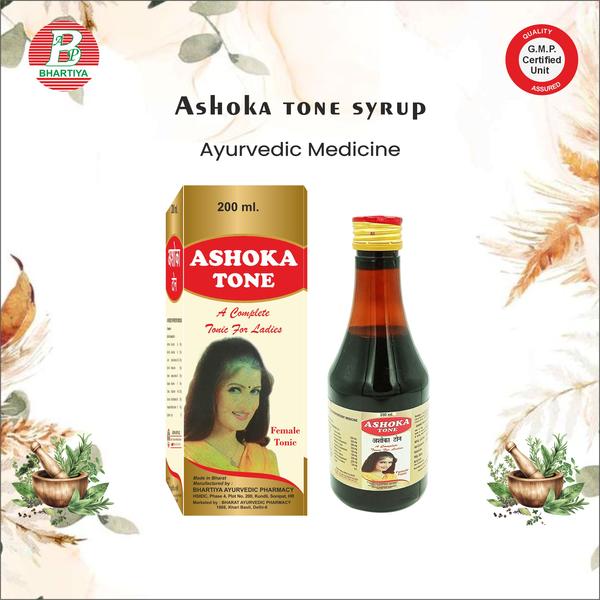
"name": "Ashoka Tone Syrup",
"description": " ASHOKATONE SYRUP \n\nProduct Identification\n•\tGeneric Name: Ashokatone Syrup\n•\tType: Ayurvedic Patent Medicine\n•\tPrimary Indication Area: Female reproductive health, menstrual disorders, uterine health\n Therapeutic Indications\nFor relief from menstrual disorders, uterine health support, and general female reproductive wellness.\nKey benefits:\n•\tRegulates menstrual cycle and reduces menstrual discomfort\n•\tControls excessive menstrual bleeding\n•\tSupports uterine health and reproductive wellness\n•\tHelps balance female hormones naturally\n•\tPromotes overall gynecological well-being\n \nIngredient: \n Ashok chhal \nBotanical Name: Terminalia arjuna \nKey Phytoconstituents: \n\n1.\tTriterpenoids / Triterpenoid Glycosides\no\tArjunolic acid\no\tArjunic acid\no\tArjunetin\n2.\tFlavonoids\no\tLuteolin\no\tQuercetin\no\tKaempferol\n3.\tTannins / Polyphenols\no\tPyrogallol-type tannins\no\tEllagic acid\n4.\tSaponins\n5.\tMinerals\no\tCalcium, magnesium, potassium\n\nMechanism of Action in Female Reproductive health\n•\tUterotonic / Menstrual Regulation\no\tHelps normalize menstrual cycles and reduce heavy menstrual bleeding (menorrhagia).\no\tMechanism: Tannins and flavonoids act on the uterine muscles, promoting tonicity and regulating contractions.\n•\tAnti-inflammatory / Antioxidant\no\tReduces inflammation in the endometrium, which helps with dysmenorrhea (painful menstruation).\no\tAntioxidants protect reproductive tissues from oxidative stress.\n•\tEndometrial Health\no\tPromotes healthy endometrial lining, supporting fertility and implantation.\n•\tHormonal Modulation (Indirect)\no\tHelps regulate estrogen and progesterone balance indirectly via uterine tissue support.\no\tMay support follicular maturation and ovarian function in traditional use.\n•\tManagement of Menorrhagia and Fibroids (Ayurvedic use)\no\tTraditionally used to control excessive bleeding due to its mild astringent (tannic) properties.\no\tHelps strengthen uterine walls and reduce bleeding.\n\n Babul Chhal\nBotanical Name: Acacia nilotica\n1. Key Phytoconstituents\n1.\tTannins / Polyphenols\no\tGallotannins\no\tCatechins\n2.\tFlavonoids\no\tKaempferol\no\tQuercetin\n3.\tAlkaloids\n4.\tSaponins\n5.\tVolatile oils\n6.\tMinerals\no\tCalcium, magnesium, potassium\n\nMechanism of Action in Female Reproductive Health\n•\tAstringent / Hemostatic\no\tReduces excessive uterine bleeding (menorrhagia) due to high tannin content.\no\tStrengthens uterine walls.\n•\tUterotonic / Menstrual Regulation\no\tSupports normalization of menstrual cycles by improving uterine tone.\n•\tAnti-inflammatory / Antioxidant\no\tReduces inflammation in reproductive tissues.\no\tProtects against oxidative stress.\n•\tManagement of Dysmenorrhea\no\tRelieves menstrual pain due to mild uterine muscle support and anti-inflammatory effects.\n•\tFertility Support (Traditional Use)\no\tPromotes reproductive tissue health and may support endometrial lining.\n\n Lodhra Chhal \nBotanical Name: Symplocos racemosa\n Key Phytoconstituents\n1.\tTannins / Polyphenols\no\tLodhretannin\no\tGallic acid\n2.\tFlavonoids\no\tQuercetin\no\tKaempferol\n3.\tAlkaloids\n4.\tSaponins\n5.\tGlycosides\n6.\tMinerals\no\tCalcium, magnesium, potassium\n\nMechanism of Action in Female Reproductive Health\n•\tAstringent / Hemostatic\no\tControls excessive uterine bleeding (menorrhagia) due to high tannin content.\no\tStrengthens uterine walls.\n•\tUterotonic / Menstrual Regulation\no\tHelps normalize menstrual cycles and regulate uterine contractions.\n•\tAnti-inflammatory / Antioxidant\no\tReduces inflammation in the endometrium.\no\tProtects reproductive tissues from oxidative stress.\n•\tManagement of Dysmenorrhea\no\tRelieves menstrual pain through uterine muscle support and anti-inflammatory effects.\n•\tEndometrial Health / Fertility Support\no\tPromotes healthy endometrial lining, supporting fertility and implantation.\n\n Marodphali Chhal \nBotanical Name: Helicteres isora\nKey Phytoconstituents\n•\tPolyphenols & Tannins: High levels of ellagitannins and condensed tannins (15–20% in fruit) provide astringent and antidiarrheal effects.\n•\tPhenolic Acids: Contains gallic acid, ellagic acid, caffeic acid, and p-coumaric acid, which act as powerful antioxidants.\n•\tFlavonoids: Primarily quercetin, kaempferol glycosides, and specialized compounds like isoscutellarein derivatives.\n•\tTriterpenoids & Sterols: Includes betulinic acid, oleanolic acid, and βbeta 𝛽-sitosterol, which support anti-inflammatory and liver health.\n•\tCucurbitacins: Notable compounds Cucurbitacin B and isocucurbitacin B are found in the roots, linked to potential anticancer activities.\n•\tGlycosides: Contains anthraquinone, cardiac, and rosmarinic acid glycosides.\n•\tNutrients: Rich in minerals (calcium, phosphorus, iron) and mucilage in seeds, which soothes the digestive tract. \nMechanism of Action in Female Reproductive Health\n•\tUterotonic / Menstrual Regulation\no\tSupports normalization of menstrual cycles and regulates uterine contractions.\n•\tAstringent / Hemostatic\no\tReduces excessive uterine bleeding (menorrhagia) due to tannins.\no\tStrengthens uterine walls.\n•\tAnti-inflammatory / Antioxidant\no\tProtects endometrial tissue and reduces inflammation in reproductive organs.\n•\tManagement of Dysmenorrhea\no\tRelieves menstrual pain through uterine muscle support and anti-inflammatory action.\n•\tEndometrial Health / Fertility Support\no\tPromotes healthy endometrial lining, supporting fertility and implantation.\n\n Shatavari Chhal \nBotanical Name: Asparagus racemosus\n Key Phytoconstituents\n1.\tSteroidal saponins (Shatavarins)\no\tShatavarin I, II, III\n2.\tFlavonoids\no\tQuercetin\no\tKaempferol\n3.\tAlkaloids\n4.\tTannins / Polyphenols\n5.\tGlycosides\n6.\tPolysaccharides\n7.\tMinerals\no\tCalcium, magnesium, potassium\n\nMechanism of Action in Female Reproductive Health\n•\tGalactagogue / Uterine Tonic\no\tSupports lactation and strengthens uterine tissues postpartum.\n•\tHormonal Modulation / Adaptogenic\no\tBalances estrogen and progesterone, supporting menstrual regularity and fertility.\n•\tUterotonic / Menstrual Regulation\no\tHelps normalize menstrual cycles and uterine contractions.\n•\tAnti-inflammatory / Antioxidant\no\tProtects reproductive tissues from oxidative stress and reduces endometrial inflammation.\n•\tEndometrial Health / Fertility Support\no\tPromotes healthy endometrial lining, follicular development, and implantation.\n•\tManagement of Dysmenorrhea & Menorrhagia\no\tReduces pain and controls excessive bleeding through saponins and uterine support.\n\n Nagkesar Chhal \nBotanical Name: Mesua ferrea\nKey Phytoconstituents\n1.\tXanthones\no\tMesuaxanthone\n2.\tCoumarins\no\tMesuol\no\tMesuagin\n3.\tFlavonoids\no\tQuercetin\no\tKaempferol\n4.\tTannins / Polyphenols\n5.\tEssential oils\n6.\tFatty acids\n7.\tMinerals\no\tCalcium, magnesium, potassium\n\nMechanism of Action in Female Reproductive Health\n•\tAstringent / Hemostatic\no\tControls excessive uterine bleeding (menorrhagia) due to tannins and polyphenols.\no\tStrengthens uterine walls.\n•\tUterotonic / Menstrual Regulation\no\tSupports normalization of menstrual cycles and regulates uterine contractions.\n•\tAnti-inflammatory / Antioxidant\no\tReduces endometrial inflammation and oxidative stress in reproductive tissues.\n•\tManagement of Dysmenorrhea\no\tRelieves menstrual pain via uterine support and anti-inflammatory action.\n•\tEndometrial Health / Fertility Support\no\tPromotes healthy endometrial lining, supporting implantation and fertility\n\n Chandan Chhal \nBotanical Name: Santalum album\n Key Phytoconstituents\n1.\tEssential oils / Volatile oils\no\tα-santalol\no\tβ-santalol\n2.\tFlavonoids\no\tQuercetin\no\tKaempferol\n3.\tTannins / Polyphenols\n4.\tSesquiterpenes\n5.\tResins\n6.\tMinerals\no\tCalcium, magnesium, potassium\n\nMechanism of Action in Female Reproductive Health\n•\tAnti-inflammatory / Cooling Effect\no\tReduces endometrial inflammation and soothes reproductive tissues.\n•\tAstringent / Mild Hemostatic\no\tHelps control mild excessive bleeding (menorrhagia).\n•\tUterine Tonic\no\tSupports uterine health and tonicity.\n•\tManagement of Dysmenorrhea\no\tRelieves menstrual pain through anti-inflammatory and smooth muscle calming effects.\n•\tEndometrial Health / Fertility Support\no\tPromotes healthy uterine lining, indirectly supporting fertility.\n\n Semal Chhal \nBotanical Name: Bombax ceiba\n1. Key Phytoconstituents\n1.\tFlavonoids\no\tQuercetin\no\tKaempferol\n2.\tTannins / Polyphenols\no\tGallic acid\no\tEllagic acid\n3.\tSaponins\n4.\tAlkaloids\n5.\tGum / Mucilage\n6.\tMinerals\no\tCalcium, magnesium, potassium\n\nMechanism of Action in Female Reproductive Health\n•\tAstringent / Hemostatic\no\tControls excessive uterine bleeding (menorrhagia) due to tannins.\no\tStrengthens uterine walls.\n•\tUterotonic / Menstrual Regulation\no\tHelps normalize menstrual cycles and regulates uterine contractions.\n•\tAnti-inflammatory / Antioxidant\no\tReduces inflammation in the endometrium and protects reproductive tissues from oxidative stress.\n•\tManagement of Dysmenorrhea\no\tRelieves menstrual pain through uterine support and anti-inflammatory action.\n•\tEndometrial Health / Fertility Support\no\tPromotes healthy endometrial lining, supporting implantation and fertility.\n\n Ashwagandha Chhal \nBotanical Name: Withania somnifera\n1. Key Phytoconstituents\n1.\tWithanolides (steroidal lactones)\no\tWithaferin A\no\tWithanolide D, E, and F\n2.\tAlkaloids\no\tSomniferine\no\tAnaferine\n3.\tSaponins\n4.\tFlavonoids\no\tQuercetin\no\tKaempferol\n5.\tTannins / Polyphenols\n6.\tIron, Calcium, Magnesium\n\nMechanism of Action in Female Reproductive Health\n•\tAdaptogenic / Hormonal Modulator\no\tHelps balance estrogen and progesterone, supporting menstrual regularity and ovarian function.\n•\tUterotonic / Reproductive Tonic\no\tSupports uterine health and promotes healthy uterine tone.\n•\tAnti-inflammatory / Antioxidant\no\tReduces endometrial inflammation and oxidative stress in reproductive tissues.\n•\tManagement of Dysmenorrhea\no\tAlleviates menstrual pain via anti-inflammatory and smooth muscle relaxant effects.\n•\tFertility Support\no\tPromotes healthy endometrial lining, supports follicular development, and improves reproductive tissue health.\n•\tStress & Ovulatory Support\no\tReduces stress-induced reproductive dysfunction due to adaptogenic effects.\n\n Sugar Base (Guda / Sugar Syrup)\n Key Phytoconstituents\n1.\tSucrose / Glucose / Fructose – main carbohydrate content\n2.\tMinerals\no\tCalcium, magnesium, potassium\no\tIron (in jaggery-based preparations)\n3.\tTrace Vitamins\no\tB-complex vitamins (in jaggery)\n4.\tPolyphenols\no\tAntioxidants (especially in unrefined jaggery)\nMechanism of Action in Female Reproductive Health\n•\tCarrier / Base for Herbal Formulations\no\tHelps deliver active phytoconstituents of herbal medicines effectively.\no\tImproves palatability and stability of formulations like Lehyas, Avalehas, and Churnas.\n•\tEnergy & Nutritional Support\no\tProvides immediate energy, important in postpartum care and anemia associated with menorrhagia.\n•\tMild Uterine Support (Indirect)\no\tWhen combined with herbs like Ashok, Shatavari, or Lodhra in Lehyas, it enhances absorption and supports reproductive tissue health.\n•\tHematopoietic Support\no\tJaggery-based sugar aids iron absorption, helpful in menstrual blood loss recovery.\nDose:\nDosage Instructions\n•\tAmount: 15–30 ml per dose\n•\tDilution: Mix with an equal amount of water (so if you take 15 ml of syrup, mix with 15 ml water)\n•\tFrequency: 3 times a day\n•\tTiming: After meals\nNotes / Precautions\n1.\tConsistency: Take it at the same times each day for best results.\n2.\tMonitor effects: If you experience any digestive discomfort, nausea, or allergic reactions, stop and consult a healthcare professional.\n3.\tMedical conditions: If you have chronic illnesses, are pregnant, or breastfeeding, check with a doctor before use.\n4.\tStorage: Keep in a cool, dry place and shake well before use.\n\n\nashoka cordial syrup uses, ashoka for tonic\nashoka rate syrup, ashoka syrup benefits\nashoka syrup in hindi, ashoka tone\nashoka tone syrup, ashoka tone syrup age limit\nashoka tone syrup amazon, ashoka tone syrup ayurvedic\nashoka tone syrup benefits, ashoka tone syrup benefits in hindi\nashoka tone syrup cold, ashoka tone syrup company name\nashoka tone syrup composition, ashoka tone syrup compound\nashoka tone syrup dosage, ashoka tone syrup dose\nashoka tone syrup expiry date, ashoka tone syrup flipkart\nashoka tone syrup generic name, ashoka tone syrup jpg\nashoka tone syrup ke fayde, ashoka tone syrup ke fayde in hindi\nashoka tone syrup kis kaam aata hai, ashoka tone syrup kis kaam aati hai\nashoka tone syrup login, ashoka tone syrup m\nashoka tone syrup meaning in hindi, ashoka tone syrup medicine\nashoka tone syrup mg, ashoka tone syrup mg road\nashoka tone syrup mrp, ashoka tone syrup name\nashoka tone syrup near me, ashoka tone syrup news\nashoka tone syrup news in hindi, ashoka tone syrup online\nashoka tone syrup online order, ashoka tone syrup online purchase\nashoka tone syrup online shopping, ashoka tone syrup plus tonic\nashoka tone syrup pm price, ashoka tone syrup price\nashoka tone syrup price in india, ashoka tone syrup qr code\nashoka tone syrup qr code scanner, ashoka tone syrup quantity\nashoka tone syrup rate, ashoka tone syrup recipe\nashoka tone syrup result, ashoka tone syrup review\nashoka tone syrup review in hindi, ashoka tone syrup right\nashoka tone syrup se kya hota hai, ashoka tone syrup side effects\nashoka tone syrup side effects in hindi, ashoka tone syrup sirup\nashoka tone syrup special, ashoka tone syrup sugar free\nashoka tone syrup super, ashoka tone syrup super tonic\nashoka tone syrup tonic uses, ashoka tone syrup tonlc\nashoka tone syrup uses in hindi, ashoka tone syrup zudio price\nashoka tonic in hindi, ashoka tonic syrup\nashoka tonic syrup uses in hindi, ashoka tonic uses",
"price": 180.0,
"discountamount": 90.0,
"currencycode": "INR",
"priority": 1000000,
"isfreeshipmentavailable": false,
"shipmentduration": 1,
"_keywords": null,
"isarchived": false,
"isavailable": true,
"applicationid": null,
"productindex": 33,
"imageuri": "https://productimages.withfloats.com/actual/6982fd59626b016e5e3a46a7.jpg",
"tileimageuri": "https://productimages.withfloats.com/tile/6982fd59626b016e5e3a46a7.jpg",
"images": null,
"totalqueries": 0,
"gpid": null,
"groupproductid": null,
"createdon": "2026-02-04T08:03:35.977Z",
"updatedon": "2026-02-19T06:38:12.323Z",
"buyonlinelink": null,
"producturl": "http://WWW.BHARTIYAAYURVEDICPHARMACY.COM//ashoka-tone-syrup/33",
"availableunits": -1.0,
"iscodavailable": true,
"isprepaidonlineavailable": true,
"maxcodorders": -1,
"maxprepaidonlineorders": -1,
"uniquepaymenturl": null,
"brandname": "Bakula Fort ",
"category": "Ashoka Tone Syrup 200 ML X 24",
"tags": [],
"variants": false,
"keyspecification": null,
"otherspecifications": null,
"pickupaddressreferenceid": null,
"paymenttype": "AssuredPurchase",
"producttype": "products",
"hsncode": null,
"gstslab": 0.0,
"isnotforsale": false
},
{
"_id": "6aa913756515661c912cbae4",
"fptag": "BHARTIYEAYURVEDICPHARMACY",
"merchantname": null,
"customwidgets": null,
"externalsourceid": null,
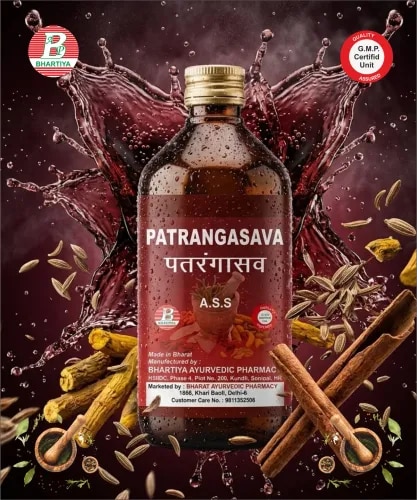
"name": "PATRANGASAVA",
"description": " PATRANGASAVA\n\n\n\nProduct Identification\nGeneric Name: Patrangasava (Patrang Asava)\nType: Ayurvedic Polyherbal Fermented Formulation (Asava)\nPrimary Indication Area: Gynecological disorders, excessive menstrual bleeding, leucorrhoea, anaemia, menstrual irregularities, and uterine health.\n\nTherapeutic Indications\nMenorrhagia (Asrigdara/Raktapradara) \nMetrorrhagia \nDysfunctional uterine bleeding (supportive) \nLeucorrhoea (Shweta Pradara) \nIrregular menstruation \nDysmenorrhea (painful menstruation) \nPostpartum weakness \nIron-deficiency anaemia (supportive) \nGeneral debility in women \nUterine weakness \n\nKey Benefits\nSupports healthy menstrual function \nHelps reduce excessive menstrual bleeding \nSupports uterine tone and endometrial health \nHelps manage leucorrhoea \nImproves hemoglobin and overall vitality (supportive) \nEnhances digestion and metabolism \nActs as a women's reproductive health tonic \nHelps restore strength after childbirth and chronic blood loss \n\nFORMULA\n1.Patang Kashtha (Caesalpinia sappan)\n2.Khair Saar (Acacia catechu)\n3.Vasa Moola (Justicia adhatoda)\n4.Somal Phool (Botanical identity to be confirmed as per formulation)\n5.Khareti (Sida cordifolia)\n6.Sariva (Hemidesmus indicus)\n7.Anantmool / Shyamlata (Ichnocarpus frutescens)\n8.Gudhal (Hibiscus rosa-sinensis)\n9.Aam Guthli (Mangifera indica)\n10.Daruhaldi (Berberis aristata)\n11.Chirayata (Swertia chirayita)\n12.Post Ke Dode (Papaver somniferum)\n13.Safed Jeera (Cuminum cyminum)\n14.Loh Churna (Purified Iron Powder)\n15.Rasont / Rasanjana (Extract of Berberis aristata)\n16.Bhringraj (Eclipta alba / Eclipta prostrata)\n17.Bael Giri (Aegle marmelos)\n18.Dalchini (Cinnamomum verum)\n19.Kesar (Crocus sativus)\n20.Lavang (Syzygium aromaticum)\n21.Munakka (Vitis vinifera)\n22.Dhataki (Woodfordia fruticosa)\n23.Khand (Cane Sugar)\n24.Shahad (Honey)\n\n\n1. Patang Kashtha\nBotanical Name: Caesalpinia sappan\nRasa: Kashaya, Tikta \nGuna: Laghu, Ruksha \nVirya: Ushna \nVipaka: Katu \nMechanism of Action:\nSupports healthy uterine function \nHelps reduce excessive menstrual bleeding \nPurifies blood and improves circulation \nTraditionally used in gynecological disorders \n\n2. Khair Saar\nBotanical Name: Acacia catechu\nRasa: Kashaya \nGuna: Laghu, Ruksha \nVirya: Sheeta \nVipaka: Katu \nMechanism of Action:\nStrong astringent action \nHelps control excessive uterine bleeding \nSupports healing of reproductive tissues \nImproves vaginal health \n\n3. Vasa Moola\nBotanical Name: Justicia adhatoda\nRasa: Tikta, Kashaya \nGuna: Laghu, Ruksha \nVirya: Sheeta \nVipaka: Katu \nMechanism of Action:\nHelps reduce excessive bleeding \nSupports healthy inflammatory response \nPromotes tissue healing \nMaintains reproductive tract health \n\n4. Semal Phool\nBotanical Name: Bombax ceiba\nRasa: Traditionally Kashaya, Tikta \nGuna: Laghu \nVirya: Sheeta \nVipaka: Katu \nMechanism of Action:\nTraditionally supports female reproductive health \nHelps regulate menstrual function \nSupports tissue healing \nAssists in maintaining uterine health \n\n5. Khareti\nBotanical Name: Sida cordifolia\nRasa: Madhura, Tikta \nGuna: Guru, Snigdha \nVirya: Sheeta \nVipaka: Madhura \nMechanism of Action:\nNourishes reproductive tissues \nSupports recovery from weakness \nImproves strength and vitality \nHelps reduce fatigue \n\n6. Sariva\nBotanical Name: Hemidesmus indicus\nRasa: Madhura, Tikta \nGuna: Guru, Snigdha \nVirya: Sheeta \nVipaka: Madhura \nMechanism of Action:\nPurifies blood \nSupports healthy skin and circulation \nHelps reduce burning sensation \nPromotes detoxification \n\n7. Anantmool (Shyamlata)\nBotanical Name: Ichnocarpus frutescens\nRasa: Madhura, Tikta \nGuna: Guru, Snigdha \nVirya: Sheeta \nVipaka: Madhura \nMechanism of Action:\nActs as a rejuvenative tonic \nSupports reproductive health \nImproves vitality \nHelps maintain hormonal balance \n\n8. Gudhal\nBotanical Name: Hibiscus rosa-sinensis\nRasa: Kashaya, Madhura \nGuna: Laghu, Snigdha \nVirya: Sheeta \nVipaka: Madhura \nMechanism of Action:\nSupports healthy menstrual flow \nHelps reduce excessive bleeding \nProvides antioxidant activity \nPromotes uterine health \n\n9. Aam Guthli\nBotanical Name: Mangifera indica\nRasa: Kashaya \nGuna: Laghu, Ruksha \nVirya: Sheeta \nVipaka: Katu \nMechanism of Action:\nHelps control excessive bleeding \nSupports intestinal health \nImproves digestion \nProvides astringent action \n\n10. Daruhaldi\nBotanical Name: Berberis aristata\nRasa: Tikta, Kashaya \nGuna: Laghu, Ruksha \nVirya: Ushna \nVipaka: Katu \nMechanism of Action:\nSupports healthy inflammatory response \nPromotes liver function \nPurifies blood \nSupports tissue healing \n\n11. Chirayata\nBotanical Name: Swertia chirayita\nRasa: Tikta \nGuna: Laghu, Ruksha \nVirya: Sheeta \nVipaka: Katu \nMechanism of Action:\nImproves digestion \nSupports liver function \nHelps reduce Ama \nPromotes metabolic balance \n\n12. Post Ke Dode\nBotanical Name: Papaver somniferum\nRasa: Madhura, Tikta \nGuna: Guru, Snigdha \nVirya: Sheeta \nVipaka: Madhura \nMechanism of Action:\nTraditionally supports pain relief \nHelps reduce pelvic discomfort \nPromotes relaxation \nSupports recovery in weakness \n\n13. Safed Jeera\nBotanical Name: Cuminum cyminum\nRasa: Katu, Tikta \nGuna: Laghu, Ruksha \nVirya: Ushna \nVipaka: Katu \nMechanism of Action:\nImproves digestion \nReduces bloating \nEnhances appetite \nSupports metabolism \n\n14. Loh Churna\nBotanical Name: Purified Iron Powder\nRasa: — \nGuna: Guru \nVirya: Ushna \nVipaka: Katu \nMechanism of Action:\nSupports hemoglobin formation \nHelps manage anemia \nImproves strength and vitality \nSupports healthy blood production \n\n15. Rasont\nBotanical Name: Extract of Berberis aristata\nRasa: Tikta, Kashaya \nGuna: Laghu \nVirya: Ushna \nVipaka: Katu \nMechanism of Action:\nSupports healthy inflammatory response \nPromotes tissue healing \nSupports liver function \nEnhances blood purification \n\n16. Bhringraj\nBotanical Name: Eclipta alba (Eclipta prostrata)\nRasa: Tikta, Kashaya \nGuna: Laghu, Ruksha \nVirya: Ushna \nVipaka: Katu \nMechanism of Action:\nSupports liver health \nPurifies blood \nImproves vitality \nPromotes tissue nourishment \n\n17. Bael Giri\nBotanical Name: Aegle marmelos\nRasa: Kashaya, Tikta \nGuna: Guru \nVirya: Ushna \nVipaka: Katu \nMechanism of Action:\nSupports digestive health \nHelps manage diarrhea \nImproves gut function \nReduces abdominal discomfort \n\n18. Dalchini\nBotanical Name: Cinnamomum verum\nRasa: Katu, Tikta \nGuna: Laghu, Ruksha, Tikshna \nVirya: Ushna \nVipaka: Katu \nMechanism of Action:\nImproves circulation \nEnhances digestion \nSupports metabolism \nReduces Ama formation \n\n19. Kesar\nBotanical Name: Crocus sativus\nRasa: Tikta, Katu \nGuna: Laghu, Snigdha \nVirya: Ushna \nVipaka: Katu \nMechanism of Action:\nSupports female reproductive health \nPromotes healthy circulation \nActs as an antioxidant \nImproves vitality \n\n20. Lavang\nBotanical Name: Syzygium aromaticum\nRasa: Katu, Tikta \nGuna: Laghu, Tikshna \nVirya: Ushna \nVipaka: Katu \nMechanism of Action:\nImproves digestion \nProvides antioxidant support \nReduces abdominal discomfort \nSupports circulation \n\n21. Munakka\nBotanical Name: Vitis vinifera\nRasa: Madhura \nGuna: Guru, Snigdha \nVirya: Sheeta \nVipaka: Madhura \nMechanism of Action:\nNourishes body tissues \nSupports blood formation \nImproves strength \nActs as a mild rejuvenative \n\n22. Dhataki\nBotanical Name: Woodfordia fruticosa\nRasa: Kashaya \nGuna: Laghu, Ruksha \nVirya: Ushna \nVipaka: Katu \nMechanism of Action:\nNatural fermentation catalyst \nEnhances extraction of phytochemicals \nImproves bioavailability \nSupports preservation of formulation \n\n23. Khand\nBotanical Name: Cane Sugar\nRasa: Madhura \nGuna: Guru, Snigdha \nVirya: Sheeta \nVipaka: Madhura \nMechanism of Action:\nFermentation substrate \nImproves formulation stability \nEnhances palatability \nProvides energy source for fermentation \n\n24. Shahad\nBotanical Name: Honey (Apis spp.)\nRasa: Madhura, Kashaya \nGuna: Laghu, Ruksha \nVirya: Sheeta \nVipaka: Madhura \nMechanism of Action:\nSupports natural preservation \nImproves palatability \nEnhances herbal delivery \nSupports wound healing and immunity\n\nDosage\nAdults:\n15–30 mL \nTwice daily after meals \nDilute with an equal quantity of water before administration. \nCommon Usage Guidance\nTraditionally administered for gynecological disorders such as excessive menstrual bleeding, leucorrhoea, and menstrual irregularities. \nSupports uterine health, blood nourishment, and female reproductive wellness. \nUsually prescribed for 4–8 weeks or as directed by an Ayurvedic physician, depending on the condition. \nBest taken after meals to enhance digestion and minimize gastric discomfort. \nImportant Notes\nContains naturally self-generated alcohol due to the fermentation process. \nUse with caution in individuals with diabetes mellitus, as the formulation contains sugar/honey. \nShould be taken under the supervision of a qualified Ayurvedic physician. \nNot recommended during pregnancy, unless specifically prescribed by a healthcare professional. \nPersistent or heavy abnormal uterine bleeding should be medically evaluated and not managed by self-medication alone. \nStore in a cool, dry place away from direct sunlight. \nKeep the bottle tightly closed after use. \nKeep out of reach of children.\n\n\n\npatrangasava syrup uses\npatrangasava uses in hindi\npatrangasava syrup\npatrangasava benefits\npatrangasava benefits in hindi\npatrangasava uses\npatrangasava syrup uses in hindi price\npatrangasava syrup uses in hindi\npatrangasava ayurvedic medicine\npatrangasava ayurvedic\npatrangasava ayurvedic syrup\npatrangasava amazon\nayurvedic patrangasava uses\npatrangasava easy ayurveda\npatrangasava syrup amazon\npatrangasava kis kaam aata hai\npatrangasava content\npatrangasava composition\nuse of patrangasava\npatrangasava dosage\npatrangasava divya\npatrangasava dose\npatrangasava syrup side effects\npatrangasava uses in english\npatrangasava fayde\npatrangasava ke fayde in hindi\npatrangasava used for\npatrangasava syrup ke fayde in hindi\npatrangasava syrup ke fayde\npatrangasava peene ke fayde\nregenwaterput kuisen\npatrangasava hindi\npatrangasava how to use\npatrangasava kya hai\npatrangasava uses hindi\npatrangasava syrup hindi\npatrangasava uses in hindi side effects\npatrangasava ingredients in hindi\npatrangasava syrup uses hindi\npatrangasava se kya hota hai\npatrangasava ingredients\npatrangasava in hindi\npatrangasava in pregnancy\npatrangasava is used for \npatrangasava ka upyog\npatrangasava kis kaam mein aata hai\npatrangasava liquid\npatrangasava ke labh\npatrangasava myupchar\npatrangasava medicine\npatrangasava online\nbenefits of patrangasava\nuses of patrangasava syrup\nuse of patrangasava in hindi\nbenefits of patrangasava in hindi\npatrangasava price\npatrangasava syrup price\npatrangasava reviews\npatrangasava syrup ingredients\npatrangasava tonic",
"price": 210.0,
"discountamount": 105.0,
"currencycode": "INR",
"priority": 1000000,
"isfreeshipmentavailable": false,
"shipmentduration": 1,
"_keywords": null,
"isarchived": false,
"isavailable": true,
"applicationid": null,
"productindex": 178,
"imageuri": "https://productimages.withfloats.com/actual/6aa91376f339c5e568d7c0fd.jpg",
"tileimageuri": "https://productimages.withfloats.com/tile/6aa91376f339c5e568d7c0fd.jpg",
"images": null,
"totalqueries": 0,
"gpid": null,
"groupproductid": null,
"createdon": "2026-09-15T09:44:21.155Z",
"updatedon": "2026-09-15T09:44:21.155Z",
"buyonlinelink": null,
"producturl": "http://WWW.BHARTIYAAYURVEDICPHARMACY.COM//patrangasava/178",
"availableunits": -1.0,
"iscodavailable": true,
"isprepaidonlineavailable": true,
"maxcodorders": -1,
"maxprepaidonlineorders": -1,
"uniquepaymenturl": null,
"brandname": "Bakula Fort",
"category": "PATRANGASAVA 450 ML X 40",
"tags": [],
"variants": false,
"keyspecification": null,
"otherspecifications": null,
"pickupaddressreferenceid": null,
"paymenttype": "AssuredPurchase",
"producttype": "products",
"hsncode": null,
"gstslab": 0.0,
"isnotforsale": false
},
{
"_id": "6aa14233d555b883cd377ce6",
"fptag": "BHARTIYEAYURVEDICPHARMACY",
"merchantname": null,
"customwidgets": null,
"externalsourceid": null,
"name": "MAHA RASNADI KWATH",
"description": " MAHA RASNADI KWATH \n\nProduct Identification\nGeneric Name: Maha Rasnadi Kwath\nType: Ayurvedic Polyherbal Decoction (Kwath/Kashaya)\nPrimary Indication Area: Joint disorders, musculoskeletal health, inflammatory conditions, arthritis, neurological disorders associated with Vata imbalance, back pain, sciatica, and post-illness weakness.\n\nTherapeutic Indications (Traditional Ayurvedic Uses)\n• Amavata (Rheumatoid arthritis)\n• Sandhivata (Osteoarthritis)\n• Katigraha (Low back pain)\n• Gridhrasi (Sciatica)\n• Manyastambha (Cervical spondylosis/neck stiffness)\n• Pakshaghata (Hemiplegia/paralytic disorders)\n• Vatarakta (Gout)\n• Asthi-Sandhi Shoola (Bone and joint pain)\n• Musculoskeletal stiffness associated with Vata disorders\n• General weakness and restricted mobility\n\nKey Benefits\n• Supports healthy joint function\n• Helps maintain mobility and flexibility\n• Supports musculoskeletal health\n• Helps reduce joint stiffness\n• Supports healthy inflammatory balance according to Ayurvedic principles\n• Promotes comfort in muscles and joints\n• Supports nervous system function\n• Helps maintain healthy circulation in musculoskeletal tissues\n• Provides antioxidant and rejuvenative herbal support\n• Supports overall physical strength and mobility\n\nFormula\nFORMULA\nMain Ingredients\n• Rasna Patra (Pluchea lanceolata – leaves)\n• Dhamasa (Fagonia cretica)\n• Erandmool (Ricinus communis – root)\n• Devdaru (Cedrus deodara)\n• Kachur (Curcuma zedoaria)\n• Vacha (Acorus calamus)\n• Vasa (Justicia adhatoda)\n• Saunth (Zingiber officinale – dry ginger)\n• Harad (Terminalia chebula)\n• Nagarmotha (Cyperus rotundus)\n• Punarnava Mool (Boerhavia diffusa – root)\n• Giloy (Tinospora cordifolia)\n• Vidara (Pueraria tuberosa / Ipomoea digitata – regional variation)\n• Saunf (Foeniculum vulgare)\n• Gokshuru (Tribulus terrestris)\n• Ashwagandha (Withania somnifera)\n• Atis (Aconitum heterophyllum)\n• Amla (Emblica officinalis / Phyllanthus emblica)\n• Shatavari (Asparagus racemosus)\n• Pippali (Piper longum)\n• Piyavasa \n• Dhaniya (Coriandrum sativum)\n• Choti Kateri (Solanum surattense)\n• Badi Kateri (Solanum indicum)\n• Dhataki (Woodfordia fruticosa \n1. Rasna Patra\nBotanical Name: Pluchea lanceolata\n• Rasa: Tikta, Katu\n• Guna: Laghu, Ruksha\n• Virya: Ushna\n• Vipaka: Katu\nMechanism / Properties\n• Strong Vata-pacifying herb\n• Anti-inflammatory and analgesic action\n• Supports joint, nerve, and muscular pain relief\n• Reduces stiffness and swelling\n\n2. Dhamasa\nBotanical Name: Fagonia cretica\n• Rasa: Tikta, Kashaya\n• Guna: Laghu, Ruksha\n• Virya: Sheeta\n• Vipaka: Katu\nMechanism\n• Blood purifying (Rakta shodhana) action\n• Supports liver detoxification\n• Anti-inflammatory and antioxidant activity\n• Used in skin and metabolic disorders\n\n3. Erandmool\nBotanical Name: Ricinus communis (root)\n• Rasa: Madhura, Katu\n• Guna: Guru, Snigdha\n• Virya: Ushna\n• Vipaka: Madhura\nMechanism\n• Strong Vata shamak action\n• Analgesic and anti-inflammatory\n• Helps relieve constipation and urinary obstruction\n• Supports pain and swelling reduction\n\n4. Devdaru\nBotanical Name: Cedrus deodara\n• Rasa: Tikta, Kashaya\n• Guna: Laghu, Tikshna\n• Virya: Ushna\n• Vipaka: Katu\nMechanism\n• Potent anti-inflammatory and analgesic\n• Reduces obstruction in channels (Srotoshodhana)\n• Supports urinary and musculoskeletal health\n• Relieves swelling and pain\n\n5. Kachur\nBotanical Name: Curcuma zedoaria\n• Rasa: Tikta, Katu\n• Guna: Laghu, Ruksha\n• Virya: Ushna\n• Vipaka: Katu\nMechanism\n• Digestive stimulant (Agni deepana)\n• Anti-inflammatory and anti-microbial\n• Reduces Ama (toxins)\n• Supports metabolic cleansing\n\n6. Vacha\nBotanical Name: Acorus calamus\n• Rasa: Katu, Tikta\n• Guna: Laghu, Tikshna\n• Virya: Ushna\n• Vipaka: Katu\nMechanism\n• Srotoshodhana (channel cleansing)\n• Nervine stimulant\n• Anti-inflammatory and detoxifying\n• Supports neurological balance\n\n7. Vasa\nBotanical Name: Justicia adhatoda\n• Rasa: Tikta, Kashaya\n• Guna: Laghu, Ruksha\n• Virya: Sheeta\n• Vipaka: Katu\nMechanism\n• Hemostatic (controls bleeding)\n• Anti-inflammatory and bronchodilator\n• Supports blood purification\n• Tissue protective action\n\n8. Saunth\nBotanical Name: Zingiber officinale (dry ginger)\n• Rasa: Katu\n• Guna: Laghu, Snigdha\n• Virya: Ushna\n• Vipaka: Madhura\nMechanism\n• Enhances digestion and absorption\n• Anti-inflammatory and carminative\n• Reduces Ama formation\n• Improves circulation\n\n9. Harad\nBotanical Name: Terminalia chebula\n• Rasa: Pancharasa (except Lavana)\n• Guna: Laghu, Ruksha\n• Virya: Ushna\n• Vipaka: Madhura\nMechanism\n• Mild laxative and detoxifying\n• Rasayana (rejuvenator)\n• Supports digestion and gut health\n• Antioxidant action\n\n10. Nagarmotha\nBotanical Name: Cyperus rotundus\n• Rasa: Tikta, Katu, Kashaya\n• Guna: Laghu, Ruksha\n• Virya: Sheeta\n• Vipaka: Katu\nMechanism\n• Digestive and metabolic regulator\n• Anti-inflammatory\n• Supports urinary balance\n• Reduces Kapha and Ama\n\n11. Punarnava Mool\nBotanical Name: Boerhavia diffusa\n• Rasa: Tikta, Madhura, Kashaya\n• Guna: Laghu, Ruksha\n• Virya: Ushna\n• Vipaka: Katu\nMechanism\n• Natural diuretic (Mutrala)\n• Reduces edema and swelling\n• Supports kidney function\n• Anti-inflammatory\n\n12. Giloy\nBotanical Name: Tinospora cordifolia\n• Rasa: Tikta, Kashaya\n• Guna: Laghu, Snigdha\n• Virya: Ushna\n• Vipaka: Madhura\nMechanism\n• Immunomodulator\n• Detoxifying and anti-inflammatory\n• Supports fever and infection resistance\n• Rasayana herb\n\n13. Vidara\nBotanical Name: Pueraria tuberosa / Ipomoea digitata\n• Rasa: Madhura\n• Guna: Guru, Snigdha\n• Virya: Sheeta\n• Vipaka: Madhura\nMechanism\n• Rejuvenative tonic\n• Strengthens tissues and vitality\n• Supports Vata disorders\n• Nutritive and restorative\n\n14. Saunf\nBotanical Name: Foeniculum vulgare\n• Rasa: Madhura, Katu\n• Guna: Laghu, Snigdha\n• Virya: Sheeta\n• Vipaka: Madhura\nMechanism\n• Carminative and digestive\n• Mild diuretic\n• Reduces bloating and acidity\n• Soothes urinary tract\n\n15. Gokshura\nBotanical Name: Tribulus terrestris\n• Rasa: Madhura\n• Guna: Guru, Snigdha\n• Virya: Sheeta\n• Vipaka: Madhura\nMechanism\n• Strong urinary tonic\n• Supports kidney and bladder health\n• Promotes smooth urine flow\n• Aphrodisiac and rejuvenative\n\n16. Ashwagandha\nBotanical Name: Withania somnifera\n• Rasa: Tikta, Kashaya\n• Guna: Guru, Snigdha\n• Virya: Ushna\n• Vipaka: Madhura\nMechanism\n• Adaptogen (stress reducer)\n• Strengthens nervous system\n• Improves vitality and stamina\n• Vata balancing Rasayana\n\n17. Atis\nBotanical Name: Aconitum heterophyllum\n• Rasa: Tikta, Kashaya\n• Guna: Laghu, Ruksha\n• Virya: Ushna (mild)\n• Vipaka: Katu\nMechanism\n• Digestive stimulant\n• Antipyretic (fever reducing)\n• Anti-inflammatory\n• Helps toxin reduction\n\n18. Amla\nBotanical Name: Phyllanthus emblica\n• Rasa: Amla (sour dominant)\n• Guna: Laghu, Ruksha\n• Virya: Sheeta\n• Vipaka: Madhura\nMechanism\n• Strong antioxidant (Vitamin C rich)\n• Rasayana (rejuvenator)\n• Supports immunity\n• Tissue repair and regeneration\n\n19. Shatavari\nBotanical Name: Asparagus racemosus\n• Rasa: Madhura, Tikta\n• Guna: Guru, Snigdha\n• Virya: Sheeta\n• Vipaka: Madhura\nMechanism\n• Female reproductive tonic\n• Hormonal balancing support\n• Cooling and nutritive\n• Supports lactation and fertility health\n\n20. Pippali\nBotanical Name: Piper longum\n• Rasa: Katu\n• Guna: Laghu, Snigdha\n• Virya: Anushna-Ushna\n• Vipaka: Madhura\nMechanism\n• Bioavailability enhancer (Yogavahi)\n• Improves digestion and metabolism\n• Respiratory and urinary support\n• Detox enhancing herb\n\n21. Piyavasa\nBotanical Name: (Regionally variable; often hepatoprotective bitter herb)\n• Rasa: Tikta, Kashaya\n• Guna: Laghu, Ruksha\n• Virya: Sheeta/Ushna (varies)\n• Vipaka: Katu\nMechanism\n• Liver detox support\n• Bitter tonic action\n• Supports metabolic balance\n• Anti-inflammatory\n\n22. Dhaniya\nBotanical Name: Coriandrum sativum\n• Rasa: Madhura, Tikta\n• Guna: Laghu\n• Virya: Sheeta\n• Vipaka: Madhura\nMechanism\n• Cooling diuretic\n• Reduces burning urination\n• Digestive soothing\n• Anti-inflammatory\n\n23. Choti Kateri\nBotanical Name: Solanum surattense\n• Rasa: Tikta, Katu\n• Guna: Laghu, Ruksha\n• Virya: Ushna\n• Vipaka: Katu\nMechanism\n• Respiratory and urinary support\n• Anti-inflammatory\n• Vata-Kapha balancing\n• Pain relief support\n\n24. Badi Kateri\nBotanical Name: Solanum indicum\n• Rasa: Tikta, Katu\n• Guna: Laghu, Ruksha\n• Virya: Ushna\n• Vipaka: Katu\nMechanism\n• Anti-inflammatory and analgesic\n• Supports respiratory health\n• Reduces swelling and pain\n• Channel cleansing action\n\n25. Dhataki\nBotanical Name: Woodfordia fruticosa\n• Rasa: Kashaya\n• Guna: Laghu, Ruksha\n• Virya: Ushna\n• Vipaka: Katu\n• Prabhava: Sandhana Karaka\nMechanism\n• Natural fermentation catalyst\n• Enables Asava/Kwath preparation\n• Improves bioavailability\n• Preserves formulation stability\n\nDosage of Maharasnadi Kwath (Pravahi)\nAdults\n• Dose: 15–30 mL\n• Frequency: Twice daily (BID)\n• Administration: After meals\n• Anupana (vehicle): Equal quantity of lukewarm water\n\nGeneral Clinical Practice Range (Ayurvedic Use)\n• Mild conditions: 15 mL BD\n• Moderate conditions: 20–30 mL BD\n• Chronic Vata disorders / pain conditions: 25–30 mL BD (as advised)\n\nDuration\n• Usually 2–6 weeks\n• Can be extended up to 8 weeks under Ayurvedic supervision\n\nImportant Usage Notes\n• Shake well before use (as herbal sediment may settle)\n• Best taken after food to improve tolerance\n• Avoid self-medication in chronic kidney disease or severe urinary obstruction\n• Use cautiously in diabetes (may contain natural sugars from fermentation)\n• Not recommended during pregnancy without physician advice\n\n\n\n\n\nmaha rasnadi kwath uses in hindi\nmaha rasnadi kwath uses\nmaharasnadi kwatham\nmaha rasnadi kwath easy ayurveda\nrasnadi kashayam ingredients\nrasnadi kashayam benefits\nrasnadi ghritam uses\nmaharasnadi kwath amazon\nmaharasnadi kwath ayurvedic medicine\nmaharasnadi kwath ayurvedic\nmaharasnadi kwath ayurveda\nmaharasnadi kwath pravahi ayurvedic medicine\nmaharasnadi kwath benefits\nmaharasnadi kwath benefits in hindi\nmaharasnadi kwath botanical name\nmaharasnadi kwath buy online\nmaharasnadi kwath churna uses in hindi\nmaharasnadi kwath contents\nmaharasnadi kwath composition\nmaharasnadi kwath capsules\nmaharasnadi kwath kis chij ki dava hai\nmaharasnadi kwath dosage\ndivya maharasnadi kwath\ndabur maharasnadi kwath kadha\nmaharasnadi kwath easy ayurveda\nmaharasnadi kwath ke fayde\nmaharasnadi kwath ke fayde in hindi\nmaharasnadi kwath ghan\nmaharasnadi kwath how to use\nmaharasnadi kwath kya hai\nmaharasnadi kwath uses hindi\nmaharasnadi kwath benefits hindi\nmaharasnadi kwath ingredients\nmaharasnadi kwath in hindi\nmaharasnadi kwath ingredients in hindi\nmaharasnadi kwath indication\nmaharasnadi kwath is used for\nmaharasnadi kwath jiva ayurveda\nmaharasnadi kwath jiva\nmaharasnadi kwath kis kaam aata hai\nmaharasnadi kwath kaise use kare\nmaharasnadi kwath kya kam karta hai\nmaharasnadi kwath liquid\nmaharasnadi kwath ke labh\nmaharasnadi kwath medicine\nmaharasnadi kwath 200 ml\nmaharasnadi kwath hindi mein\nmaharasnadi kwath online\nuses of maharasnadi kwath\nbenefits of maharasnadi kwath\ningredients of maharasnadi kwath\nuses of maharasnadi kwath in hindi\nmaharasnadi kwath price\nmaharasnadi kwath peene ke fayde\nmaha rasnadi kwath q10\nmaharasnadi kwath reference\nmaharasnadi kwath review\nmaharasnadi kwath research paper\nmaharasnadi kwath syrup uses in hindi\nmaharasnadi kwath syrup uses\nmaharasnadi kwath syrup\nhow maha rasnadi kwath works\nhow maha rasnadi kwath is made\nhow maha rasnadi kwath use\nwhy maha rasnadi kwath useful",
"price": 210.0,
"discountamount": 105.0,
"currencycode": "INR",
"priority": 1000000,
"isfreeshipmentavailable": false,
"shipmentduration": 1,
"_keywords": null,
"isarchived": false,
"isavailable": true,
"applicationid": null,
"productindex": 175,
"imageuri": "https://productimages.withfloats.com/actual/6aa14237850fddb69be31772.jpg",
"tileimageuri": "https://productimages.withfloats.com/tile/6aa14237850fddb69be31772.jpg",
"images": null,
"totalqueries": 0,
"gpid": null,
"groupproductid": null,
"createdon": "2026-09-09T11:25:39.849Z",
"updatedon": "2026-09-09T11:25:39.849Z",
"buyonlinelink": null,
"producturl": "http://WWW.BHARTIYAAYURVEDICPHARMACY.COM//maha-rasnadi-kwath/175",
"availableunits": -1.0,
"iscodavailable": true,
"isprepaidonlineavailable": true,
"maxcodorders": -1,
"maxprepaidonlineorders": -1,
"uniquepaymenturl": null,
"brandname": "Bakula Fort",
"category": "MAHA RASNADI KWATH 450 ML X 40",
"tags": [],
"variants": false,
"keyspecification": null,
"otherspecifications": null,
"pickupaddressreferenceid": null,
"paymenttype": "AssuredPurchase",
"producttype": "products",
"hsncode": null,
"gstslab": 0.0,
"isnotforsale": false
},
{
"_id": "6a92cf441e2797f146a16baf",
"fptag": "BHARTIYEAYURVEDICPHARMACY",
"merchantname": null,
"customwidgets": null,
"externalsourceid": null,
"name": "MAHAMANJISTHADYARISHTA",
"description": " MAHAMANJISTHADYARISHTA\n\n\n\nProduct Identification\nGeneric Name: Mahamanjisthadyarishta (Variant Formulation)\nType: Ayurvedic Polyherbal Fermented Preparation (Arishta/Kashayam-based fermentation tonic)\nPrimary Indication Area: Skin disorders, blood impurities, chronic inflammation, lymphatic congestion, liver–skin axis disorders, metabolic toxins (Ama), and Vata–Pitta imbalance conditions.\n\nTherapeutic Indications \n• Chronic skin diseases (eczema, psoriasis, acne, dermatitis)\n• Blood impurity disorders (Rakta dushti)\n• Vatarakta (gout, inflammatory arthritis)\n• Chronic itching and pigmentation disorders\n• Liver dysfunction-related skin problems\n• Edema and inflammatory swelling\n• Chronic non-healing skin eruptions\n• Detoxification and metabolic imbalance\n• Lymphatic congestion and toxin accumulation\n\nKey Benefits \nBlood purification (Rakta shodhana) \nSkin health improvement (Twak prasadana) \nReduces acne, eczema, psoriasis, itching \nAnti-inflammatory action (Shothahara) \nHelps in gout and joint pain (Vatarakta shamana) \nDetoxification of body (Ama pachana) \nImproves liver–skin connection \nLymphatic cleansing (Srotoshodhana) \nReduces chronic swelling and inflammation \nSupports healing of long-term skin disorders\n \nFormula \nMain Ingredients: \n\nManjistha \nNagarmotha \nKutaj chhal \nGiloy \nKuth \nSaunth \nBharangi \nChoti kateli \nVacha (Bach) \nNeem chhal \nHaldi \nDaruhaldi \nBaheda \nHarad \nAmla \nPatol patra \nKutaki \nMurva \nVidanga \nVijaysar \nShal chhal\nShatavari \nBanfsha \nGokshura \nIndrajav \nVasa ki jad \nBhangra (Bhringraj) \nDevdaru \nPatha \nKhadir kastha \nLal chandan \nNishoth \nVarun chhal \nKaranj chhal \nAtis \nIndrayana \nDhamasa \nAnantmool \nPitpapda \nDhataki \nGuda \nJala \n\n1. Manjistha\nBotanical Name: Rubia cordifolia\n\nRasa: Tikta, Kashaya\nGuna: Laghu, Ruksha\nVirya: Ushna\nVipaka: Katu\n\nMechanism of Action\n• Raktashodhaka (blood purifier)\n• Supports lymphatic drainage\n• Useful in chronic skin disorders\n• Anti-inflammatory action\n• Helps in detoxification of Ama\n\n2. Nagarmotha\nBotanical Name: Cyperus rotundus\n\nRasa: Tikta, Katu, Kashaya\n Guna: Laghu, Ruksha\n Virya: Sheeta\n Vipaka: Katu\n\nMechanism of Action\n• Deepana-Pachana (improves digestion)\n• Reduces Ama formation\n• Useful in diarrhea and gut disorders\n• Anti-inflammatory effect\n• Supports metabolic balance\n3. Kutaj Chhal\nBotanical Name: Holarrhena antidysenterica\n\nRasa: Tikta, Kashaya\nGuna: Laghu, Ruksha\n Virya: Sheeta\nVipaka: Katu\n\nMechanism of Action\n• Strong Grahi (anti-diarrheal) action\n• Intestinal detoxification\n• Controls dysentery and gut infections\n• Supports intestinal mucosa healing\n• Antimicrobial activity\n4. Giloy\nBotanical Name: Tinospora cordifolia\n \nRasa: Tikta, Kashaya\n Guna: Laghu, Snigdha\n Virya: Ushna\nVipaka: Madhura\n\nMechanism of Action\n• Rasayana (rejuvenator)\n• Immunomodulatory action\n• Anti-inflammatory effect\n• Reduces chronic fever and toxins\n• Supports liver and skin health\n5. Kuth\nBotanical Name: Saussurea costus\n\nRasa: Tikta, Katu\n Guna: Laghu, Tikshna\nVirya: Ushna\n Vipaka: Katu\n\nMechanism of Action\n• Anti-inflammatory and analgesic\n• Reduces Vata-Kapha disorders\n• Useful in joint pain and swelling\n• Improves circulation\n• Antimicrobial action\n6. Saunth\nBotanical Name: Zingiber officinale\n\nRasa: Katu\nGuna: Laghu, Ruksha, Tikshna\nVirya: Ushna\nVipaka: Madhura\n\nMechanism of Action\n• Deepana-Pachana (digestive stimulant)\n• Reduces Ama and inflammation\n• Improves circulation\n• Useful in Vata disorders\n• Analgesic and anti-inflammatory\n\n7. Bharangi\nBotanical Name: Clerodendrum serratum\n\nRasa: Tikta, Katu\nGuna: Laghu, Ruksha\n Virya: Ushna\n Vipaka: Katu\n\nMechanism of Action\n• Shwasahara (respiratory support)\n• Anti-inflammatory action\n• Useful in cough and asthma\n• Reduces Kapha accumulation\n• Immunomodulatory effect\n\n8. Choti Kateli (Gokshura)\nBotanical Name: Tribulus terrestris\n\n Rasa: Madhura, Tikta\n Guna: Guru, Snigdha\nVirya: Sheeta\n Vipaka: Madhura\n\nMechanism of Action\n• Mutrala (diuretic action)\n• Supports urinary tract health\n• Anti-inflammatory effect\n• Improves kidney function support\n• Rejuvenating (Rasayana) action\n\n9. Vacha (Bach)\nBotanical Name: Acorus calamus\n\nRasa: Katu, Tikta\nGuna: Laghu, Tikshna\nVirya: Ushna\nVipaka: Katu\n\nMechanism of Action\n• Medhya (brain tonic)\n• Clears Srotas (microchannels)\n• Improves digestion and appetite\n• Anti-inflammatory effect\n• Useful in neurological imbalance\n\n10. Neem Chhal\nBotanical Name: Azadirachta indica\n\nRasa: Tikta, Kashaya\n Guna: Laghu, Ruksha\n Virya: Sheeta\nVipaka: Katu\nMechanism of Action\n• Strong Raktashodhaka (blood purifier)\n• Antibacterial and antifungal\n• Useful in skin disorders\n• Reduces inflammation and itching\n• Detoxifying action\n\n11. Haldi\nBotanical Name: Curcuma longa\n\nRasa: Tikta, Katu\nGuna: Laghu, Ruksha\nVirya: Ushna\nVipaka: Katu\n\nMechanism of Action\n• Anti-inflammatory and wound healing\n• Raktashodhaka (blood purifier)\n• Antimicrobial action\n• Useful in skin disorders\n• Reduces swelling and pain\n\n12. Daruhaldi\nBotanical Name: Berberis aristata\n\nRasa: Tikta\nGuna: Laghu, Ruksha\nVirya: Ushna\n Vipaka: Katu\n\nMechanism of Action\n• Strong antimicrobial action\n• Useful in chronic skin diseases\n• Liver protective effect\n• Blood purification\n• Anti-inflammatory activity\n\n13. Baheda\nBotanical Name: Terminalia bellirica\n\nRasa: Kashaya, Madhura\nGuna: Laghu, Ruksha\n Virya: Sheeta\nVipaka: Madhura\n\nMechanism of Action\n• Rasayana (rejuvenator)\n• Digestive regulator\n• Detoxification support\n• Improves immunity\n• Anti-inflammatory action\n\n14. Harad\nBotanical Name: Terminalia chebula\n\nRasa: Pancharasa (except Lavana)\nGuna: Laghu, Ruksha\n Virya: Ushna\nVipaka: Madhura\n\nMechanism of Action\n• Strong detoxifier (Rechana)\n• Improves digestion\n• Removes Ama\n• Mild laxative effect\n• Tissue cleansing action\n\n15. Amla\nBotanical Name: Emblica officinalis\n\nRasa: Amla\n Guna: Laghu, Ruksha\n Virya: Sheeta\nVipaka: Madhura\n\nMechanism of Action\n• Powerful antioxidant\n• Rasayana (rejuvenation)\n• Supports immunity\n• Pitta balance\n• Skin and hair nourishment\n\n16. Patol Patra\nBotanical Name: Trichosanthes dioica\n\nRasa: Tikta\n Guna: Laghu, Ruksha\nVirya: Sheeta\nVipaka: Katu\n\nMechanism of Action\n• Liver detox support\n• Pitta shamak\n• Blood purification\n• Skin disease relief\n• Anti-inflammatory action\n\n17. Kutaki\nBotanical Name: Picrorhiza kurroa\n\nRasa: Tikta\n Guna: Laghu, Ruksha\n Virya: Sheeta\n Vipaka: Katu\n\nMechanism of Action\n• Hepatoprotective\n• Improves bile secretion\n• Detoxifies liver\n• Anti-inflammatory\n• Supports skin health\n\n18. Murva\nBotanical Name: Marsdenia tenacissima\n \nRasa: Tikta, Kashaya\n Guna: Laghu, Ruksha\n Virya: Ushna\n Vipaka: Katu\n\nMechanism of Action\n• Blood purifier\n• Skin disorder management\n• Anti-inflammatory action\n• Supports tissue healing\n• Detoxifying effect\n\n19. Vidanga\nBotanical Name: Embelia ribes\n• Rasa: Katu\n• Guna: Laghu, Ruksha\n• Virya: Ushna\n• Vipaka: Katu\nMechanism of Action\n• Krimighna (anti-parasitic)\n• Digestive stimulant\n• Detoxifies gut\n• Anti-microbial action\n• Reduces Ama\n\n20. Vijaysar\nBotanical Name: Pterocarpus marsupium\n• Rasa: Kashaya\n• Guna: Laghu, Ruksha\n• Virya: Sheeta\n• Vipaka: Katu\nMechanism of Action\n• Metabolic regulator\n• Supports blood sugar balance\n• Anti-inflammatory\n• Tissue strengthening\n• Detox support\n21. Shal Chhal\nBotanical Name: Shorea robusta\n• Rasa: Kashaya\n• Guna: Guru, Ruksha\n• Virya: Sheeta\n• Vipaka: Katu\nMechanism of Action\n• Grahi (absorptive, anti-diarrheal)\n• Anti-inflammatory action\n• Supports tissue healing\n• Useful in skin disorders\n• Detoxifying effect\n\n22. Shatavari\nBotanical Name: Asparagus racemosus\n• Rasa: Madhura\n• Guna: Guru, Snigdha\n• Virya: Sheeta\n• Vipaka: Madhura\nMechanism of Action\n• Rasayana (rejuvenator)\n• Hormonal balance support\n• Cooling and anti-ulcer action\n• Improves immunity\n• Tissue nourishment\n\n23. Banfsha\nBotanical Name: Viola odorata\n• Rasa: Tikta, Madhura\n• Guna: Laghu, Snigdha\n• Virya: Sheeta\n• Vipaka: Madhura\nMechanism of Action\n• Respiratory support (Shwasahara)\n• Cooling anti-inflammatory action\n• Blood purification\n• Skin disease support\n• Mild expectorant\n\n24. Gokshura\nBotanical Name: Tribulus terrestris\n• Rasa: Madhura, Tikta\n• Guna: Guru, Snigdha\n• Virya: Sheeta\n• Vipaka: Madhura\nMechanism of Action\n• Mutrala (diuretic)\n• Kidney and urinary support\n• Anti-inflammatory action\n• Rasayana effect\n• Supports reproductive health\n\n25. Indrajav\nBotanical Name: Holarrhena antidysenterica\n• Rasa: Tikta, Kashaya\n• Guna: Laghu, Ruksha\n• Virya: Sheeta\n• Vipaka: Katu\nMechanism of Action\n• Strong antidiarrheal action\n• Gut detoxification\n• Controls intestinal infections\n• Grahi effect\n• Anti-microbial activity\n\n26. Vasa Ki Jad\nBotanical Name: Adhatoda vasica\n• Rasa: Tikta, Katu\n• Guna: Laghu, Ruksha\n• Virya: Sheeta\n• Vipaka: Katu\nMechanism of Action\n• Shwasahara (respiratory relief)\n• Expectorant action\n• Anti-inflammatory\n• Bronchodilator support\n• Kapha reduction\n\n27. Bhangra (Bhringraj)\nBotanical Name: Eclipta alba\n• Rasa: Tikta, Katu\n• Guna: Laghu, Ruksha\n• Virya: Ushna\n• Vipaka: Katu\nMechanism of Action\n• Liver detox support\n• Hair and skin nourishment\n• Anti-inflammatory\n• Blood purification\n• Rasayana effect\n\n28. Devdaru\nBotanical Name: Cedrus deodara\n• Rasa: Tikta, Katu\n• Guna: Laghu, Ruksha\n• Virya: Ushna\n• Vipaka: Katu\nMechanism of Action\n• Anti-inflammatory action\n• Pain relief in joints\n• Reduces swelling\n• Improves circulation\n• Vata-Kapha pacification\n\n29. Patha\nBotanical Name: Cissampelos pareira\n• Rasa: Tikta, Kashaya\n• Guna: Laghu, Ruksha\n• Virya: Ushna\n• Vipaka: Katu\nMechanism of Action\n• Jwarahara (fever reducing)\n• Anti-inflammatory\n• Gut cleansing\n• Skin disorder support\n• Detoxification\n\n30. Khadir Kastha\nBotanical Name: Acacia catechu\n• Rasa: Kashaya\n• Guna: Laghu, Ruksha\n• Virya: Sheeta\n• Vipaka: Katu\nMechanism of Action\n• Strong Raktashodhaka\n• Skin disease management\n• Antimicrobial action\n• Wound healing\n• Reduces itching\n31. Lal Chandan\nBotanical Name: Pterocarpus santalinus\n• Rasa: Tikta, Kashaya\n• Guna: Laghu, Ruksha\n• Virya: Sheeta\n• Vipaka: Katu\nMechanism of Action\n• Cooling anti-inflammatory action\n• Blood purification\n• Skin healing support\n• Reduces burning sensation\n• Pitta pacifying effect\n\n32. Nishoth\nBotanical Name: Operculina turpethum\n• Rasa: Katu, Tikta\n• Guna: Laghu, Ruksha, Tikshna\n• Virya: Ushna\n• Vipaka: Katu\nMechanism of Action\n• Strong Rechana (purgative)\n• Deep detoxification\n• Removes Ama and toxins\n• Useful in constipation\n• Cleanses channels (Srotoshodhana)\n\n33. Varun Chhal\nBotanical Name: Crataeva nurvala\n• Rasa: Tikta, Kashaya\n• Guna: Laghu, Ruksha\n• Virya: Ushna\n• Vipaka: Katu\nMechanism of Action\n• Mutravirechaka (urinary detox)\n• Useful in kidney stones\n• Reduces urinary inflammation\n• Anti-inflammatory action\n• Cleans urinary channels\n\n34. Karanj Chhal\nBotanical Name: Pongamia pinnata\n• Rasa: Tikta, Katu\n• Guna: Laghu, Ruksha\n• Virya: Ushna\n• Vipaka: Katu\nMechanism of Action\n• Antimicrobial action\n• Skin disease management\n• Anti-inflammatory effect\n• Wound healing support\n• Raktashodhaka\n\n35. Atis\nBotanical Name: Aconitum heterophyllum\n• Rasa: Tikta, Kashaya\n• Guna: Laghu, Ruksha\n• Virya: Sheeta\n• Vipaka: Katu\nMechanism of Action\n• Jwarahara (fever reducing)\n• Digestive regulator\n• Anti-inflammatory\n• Antidiarrheal effect\n• Strengthens digestion\n\n36. Indrayana\nBotanical Name: Citrullus colocynthis\n• Rasa: Tikta\n• Guna: Laghu, Ruksha, Tikshna\n• Virya: Ushna\n• Vipaka: Katu\nMechanism of Action\n• Strong purgative action\n• Deep detoxification\n• Removes Ama\n• Cleans intestinal tract\n• Used in severe constipation\n\n37. Dhamasa\nBotanical Name: Fagonia cretica\n• Rasa: Tikta, Kashaya\n• Guna: Laghu, Ruksha\n• Virya: Sheeta\n• Vipaka: Katu\nMechanism of Action\n• Blood purification\n• Skin disease support\n• Anti-inflammatory action\n• Detoxifying effect\n• Wound healing support\n\n38. Anantmool\nBotanical Name: Hemidesmus indicus\n• Rasa: Madhura, Tikta\n• Guna: Guru, Snigdha\n• Virya: Sheeta\n• Vipaka: Madhura\nMechanism of Action\n• Cooling blood purifier\n• Skin disease management\n• Anti-inflammatory action\n• Detoxifies body\n• Supports urinary health\n\n39. Pitpapda\nBotanical Name: Fumaria indica\n• Rasa: Tikta\n• Guna: Laghu, Ruksha\n• Virya: Sheeta\n• Vipaka: Katu\nMechanism of Action\n• Liver detox support\n• Pitta balance\n• Blood purification\n• Skin disease relief\n• Improves bile flow\n\n40. Dhataki\nBotanical Name: Woodfordia fruticosa\n• Rasa: Kashaya\n• Guna: Laghu, Ruksha\n• Virya: Ushna\n• Vipaka: Katu\nMechanism of Action\n• Natural fermentation catalyst (Arishta)\n• Supports bioavailability of formulation\n• Mild antimicrobial action\n• Aids gut flora balance\n• Enhances potency of preparation\n\n41. Guda\nBotanical Name: Saccharum officinarum (processed jaggery)\n• Rasa: Madhura\n• Guna: Guru, Snigdha\n• Virya: Ushna\n• Vipaka: Madhura\nMechanism of Action\n• Fermentation base\n• Acts as Yogavahi (carrier)\n• Improves bioavailability\n• Mild detox effect\n• Energy support\n\n\n",
"price": 170.0,
"discountamount": 85.0,
"currencycode": "INR",
"priority": 1000000,
"isfreeshipmentavailable": false,
"shipmentduration": 1,
"_keywords": null,
"isarchived": false,
"isavailable": true,
"applicationid": null,
"productindex": 172,
"imageuri": "https://productimages.withfloats.com/actual/6a92cf45be0fefbc315368ad.jpg",
"tileimageuri": "https://productimages.withfloats.com/tile/6a92cf45be0fefbc315368ad.jpg",
"images": null,
"totalqueries": 0,
"gpid": null,
"groupproductid": null,
"createdon": "2026-08-29T12:23:32.23Z",
"updatedon": "2026-08-29T12:23:32.23Z",
"buyonlinelink": null,
"producturl": "http://WWW.BHARTIYAAYURVEDICPHARMACY.COM//mahamanjisthadyarishta/172",
"availableunits": -1.0,
"iscodavailable": true,
"isprepaidonlineavailable": true,
"maxcodorders": -1,
"maxprepaidonlineorders": -1,
"uniquepaymenturl": null,
"brandname": "Bakula Fort",
"category": "MAHAMANJISTHADYARISHTA 450 ML X 40",
"tags": [],
"variants": false,
"keyspecification": null,
"otherspecifications": null,
"pickupaddressreferenceid": null,
"paymenttype": "AssuredPurchase",
"producttype": "products",
"hsncode": null,
"gstslab": 0.0,
"isnotforsale": false
},
{
"_id": "6a6069dca338caae77fcc9a0",
"fptag": "BHARTIYEAYURVEDICPHARMACY",
"merchantname": null,
"customwidgets": null,
"externalsourceid": null,
"name": "DASHMULARISHTA",
"description": " DASHMULARISHTA\n\n\nProduct Identification\nGeneric Name: Dashmularishta\nType: Ayurvedic Polyherbal Fermented Formulation (Arishta)\nPrimary Indication Area: Primarily used as a rejuvenative and restorative tonic for postpartum care, Vata disorders, inflammatory conditions, musculoskeletal weakness, nervous system disorders, and recovery following chronic illness. It is widely indicated for general debility, fever recovery, respiratory weakness, digestive impairment, and gynecological disorders associated with Vata imbalance.\n\nTherapeutic Indications\n•\tGeneral debility (Daurbalya) \n•\tPostpartum care (Sutika Paricharya) \n•\tVata disorders (Vatavyadhi) \n•\tChronic inflammatory conditions \n•\tMusculoskeletal weakness \n•\tJoint pain and stiffness \n•\tLow back pain \n•\tNeuralgia and neuropathic discomfort \n•\tConvalescence following prolonged illness \n•\tRespiratory weakness and chronic cough \n•\tFever recovery \n•\tDigestive weakness and poor appetite \n•\tGynecological disorders associated with Vata imbalance \n•\tFatigue and reduced stamina \n•\tAge-related decline in strength and vitality \n\nKey Benefits\n•\tSupports healthy musculoskeletal and nervous system function. \n•\tPromotes recovery following childbirth and prolonged illness. \n•\tHelps reduce inflammation and joint discomfort. \n•\tImproves physical strength and endurance. \n•\tSupports healthy respiratory function. \n•\tEnhances digestion and metabolism. \n•\tPromotes healthy immune function. \n•\tSupports uterine health during the postpartum period. \n•\tActs as a Rasayana for restoring vitality. \n•\tProvides antioxidant protection against oxidative stress. \n\nFORMULA\nEach part contains:\n•\tBilva (Aegle marmelos) \n•\tShyonaka (Oroxylum indicum) \n•\tGambhari (Gmelina arborea) \n•\tPatala (Stereospermum suaveolens) \n•\tAgnimantha (Clerodendrum phlomidis) \n•\tShalaparni (Desmodium gangeticum) \n•\tPrishniparni (Uraria picta) \n•\tBrihati (Solanum indicum) \n•\tKantakari (Solanum xanthocarpum)\n•\tGokshura (Tribulus terrestris) \n•\tChitraka (Plumbago zeylanica) \n•\tPushkara (Inula racemosa) \n•\tLodhra (Symplocos racemosa) \n•\tGuduchi (Tinospora cordifolia) \n•\tAmalaki (Phyllanthus emblica) \n•\tDhanvayasa (Fagonia cretica) \n•\tKhadira (Acacia catechu) \n•\tKustha (Saussurea lappa) \n•\tManjistha (Rubia cordifolia) \n•\tDevadaru (Cedrus deodara) \n•\tVidanga (Embelia ribes) \n•\tMadhuka (Glycyrrhiza glabra) \n•\tBharangi (Clerodendrum serratum) \n•\tKapitha (Limonia acidissima / Feronia limonia) \n•\tBibhitaki (Terminalia bellirica) \n•\tPunarnava (Boerhavia diffusa) \n•\tChavya (Piper retrofractum) \n•\tJatamansi (Nardostachys jatamansi) \n•\tPriyangu (Callicarpa macrophylla) \n•\tSariva (Hemidesmus indicus) \n•\tKala Jeera (Carum carvi / Nigella sativa (regional use)) \n•\tTrivrit (Operculina turpethum) \n•\tNirgundi (Vitex negundo) \n•\tRasna (Pluchea lanceolata) \n•\tHaridra (Curcuma longa) \n•\tSatpushpa (Anethum sowa / Anethum graveolens) \n•\tPadmaka (Prunus cerasoides) \n•\tNagakesara (Mesua ferrea) \n•\tMusta (Cyperus rotundus) \n•\tIndrayava (Holarrhena antidysenterica) \n•\tKarkatashringi (Pistacia integerrima) \n•\tJivaka (Microstylis wallichii) \n•\tRishabhaka (Microstylis muscifera) \n•\tMeda (Polygonatum cirrhifolium) \n•\tKakoli (Fritillaria roylei) \n•\tKshirakakoli (Roscoea purpurea) \n•\tRiddhi (Habenaria intermedia) \n•\tVriddhi (Habenaria edgeworthii) \n•\tDraksha (Vitis vinifera) \n•\tKatphala (Myrica nagi) \n•\tPuga (Areca catechu) \n•\tGuda (Jaggery) \n•\tMadhu (Honey) \n•\tDhataki (Woodfordia fruticosa) \n•\tLavanga (Syzygium aromaticum) \n•\tTvak (Cinnamomum verum) \n•\tEla (Elettaria cardamomum) \n•\tTejapatra (Cinnamomum tamala) \n•\tPippali (Piper longum) \n•\tHaridra (Curcuma longa) \n•\tSveta Chandana (Santalum album) \n•\tPippali root\n\n\n1. Bilva\nBotanical Name: Aegle marmelos\n•\tRasa: Kashaya, Tikta \n•\tGuna: Laghu, Ruksha \n•\tVirya: Ushna \n•\tVipaka: Katu \n•\tPrabhava: Vata-Kapha Shamaka \nMechanism of Action\n•\tReduces inflammatory mediators in gut and joints \n•\tRegulates Vata in neuromuscular system \n•\tSupports digestive motility and Agni \n•\tAnti-inflammatory and mild analgesic activity \n•\tHelps in post-illness weakness recovery \n\n2. Shyonaka\nBotanical Name: Oroxylum indicum\n•\tRasa: Tikta, Kashaya \n•\tGuna: Laghu, Ruksha \n•\tVirya: Ushna \n•\tVipaka: Katu \nMechanism of Action\n•\tReduces cytokine-mediated inflammation \n•\tSupports respiratory and musculoskeletal recovery \n•\tAntioxidant and tissue-protective action \n•\tHelps in Vata-induced pain conditions \n\n3. Gambhari\nBotanical Name: Gmelina arborea\n•\tRasa: Madhura, Kashaya \n•\tGuna: Guru, Snigdha \n•\tVirya: Sheeta \n•\tVipaka: Madhura \n•\tPrabhava: Rasayana \nMechanism of Action\n•\tPromotes tissue regeneration and strength \n•\tSupports post-partum recovery \n•\tImmunomodulatory and restorative effect \n•\tAnti-inflammatory and nutritive action \n\n4. Patala\nBotanical Name: Stereospermum suaveolens\n•\tRasa: Tikta, Kashaya \n•\tGuna: Laghu, Ruksha \n•\tVirya: Ushna \n•\tVipaka: Katu \nMechanism of Action\n•\tReduces neuromuscular inflammation \n•\tSupports respiratory function \n•\tAnalgesic activity in Vata disorders \n•\tImproves tissue repair mechanisms \n\n5. Agnimantha\nBotanical Name: Clerodendrum phlomidis\n•\tRasa: Katu, Tikta \n•\tGuna: Laghu, Ruksha \n•\tVirya: Ushna \n•\tVipaka: Katu \nMechanism of Action\n•\tStimulates digestive enzymes and Agni \n•\tReduces Ama accumulation \n•\tAnti-inflammatory in joints and muscles \n•\tEnhances metabolic clearance \n\n6. Shalaparni\nBotanical Name: Desmodium gangeticum\n•\tRasa: Madhura, Tikta \n•\tGuna: Snigdha, Laghu \n•\tVirya: Ushna \n•\tVipaka: Madhura \nMechanism of Action\n•\tNeuroprotective and muscle-strengthening \n•\tReduces fatigue and weakness \n•\tSupports immune modulation \n•\tEnhances recovery from chronic illness \n\n7. Prishniparni\nBotanical Name: Uraria picta\n•\tRasa: Madhura, Tikta \n•\tGuna: Snigdha, Laghu \n•\tVirya: Ushna \n•\tVipaka: Madhura \nMechanism of Action\n•\tImproves neuromuscular strength \n•\tSupports postpartum tissue repair \n•\tAnti-inflammatory and rejuvenative \n•\tEnhances stamina and vitality \n\n8. Brihati\nBotanical Name: Solanum indicum\n•\tRasa: Tikta, Katu \n•\tGuna: Laghu, Ruksha \n•\tVirya: Ushna \n•\tVipaka: Katu \nMechanism of Action\n•\tReduces inflammatory pain \n•\tSupports respiratory health \n•\tHelps in Vata-Kapha imbalance disorders \n•\tImproves metabolic function \n\n9. Kantakari\nBotanical Name: Solanum xanthocarpum\n•\tRasa: Tikta, Katu \n•\tGuna: Laghu, Ruksha \n•\tVirya: Ushna \n•\tVipaka: Katu \nMechanism of Action\n•\tBronchodilator and expectorant action \n•\tReduces respiratory inflammation \n•\tSupports Vata-Kapha balance \n•\tImproves oxygenation and vitality \n\n10. Gokshura\nBotanical Name: Tribulus terrestris\n•\tRasa: Madhura \n•\tGuna: Snigdha, Guru \n•\tVirya: Sheeta \n•\tVipaka: Madhura \nMechanism of Action\n•\tDiuretic and urinary system support \n•\tEnhances muscle strength and stamina \n•\tImproves reproductive function \n•\tAnti-fatigue and anabolic support \n\n11. Chitraka\nBotanical Name: Plumbago zeylanica\n•\tRasa: Katu \n•\tGuna: Laghu, Tikshna \n•\tVirya: Ushna \n•\tVipaka: Katu \nMechanism of Action\n•\tPotent digestive stimulant (Agni deepana) \n•\tReduces Ama accumulation \n•\tImproves nutrient absorption \n•\tEnhances metabolic rate \n\n12. Pushkara\nBotanical Name: Inula racemosa\n•\tRasa: Tikta, Katu \n•\tGuna: Laghu, Ruksha \n•\tVirya: Ushna \n•\tVipaka: Katu \nMechanism of Action\n•\tCardiorespiratory stimulant \n•\tImproves oxygen utilization \n•\tAnti-inflammatory and bronchodilator \n•\tSupports endurance \n\n13. Lodhra\nBotanical Name: Symplocos racemosa\n•\tRasa: Kashaya \n•\tGuna: Laghu, Ruksha \n•\tVirya: Sheeta \n•\tVipaka: Katu \nMechanism of Action\n•\tUterine tonic and anti-inflammatory \n•\tSupports tissue tightening and healing \n•\tReduces excessive secretions \n•\tImproves reproductive health \n\n14. Guduchi\nBotanical Name: Tinospora cordifolia\n•\tRasa: Tikta, Kashaya \n•\tGuna: Laghu, Snigdha \n•\tVirya: Ushna \n•\tVipaka: Madhura \nMechanism of Action\n•\tStrong immunomodulator \n•\tAnti-inflammatory and antipyretic \n•\tEnhances detoxification pathways \n•\tSupports chronic disease recovery \n\n15. Amalaki\nBotanical Name: Phyllanthus emblica\n•\tRasa: Amla Pradhana Pancharasa \n•\tGuna: Laghu, Ruksha \n•\tVirya: Sheeta \n•\tVipaka: Madhura \nMechanism of Action\n•\tPotent antioxidant (vitamin C rich) \n•\tAnti-aging and Rasayana effect \n•\tSupports immunity and tissue repair \n•\tEnhances digestion and metabolism\n16. Dhanvayasa\nBotanical Name: Fagonia cretica / Alhagi pseudalhagi\n•\tRasa: Tikta, Kashaya \n•\tGuna: Laghu, Ruksha \n•\tVirya: Sheeta \n•\tVipaka: Katu \nMechanism\n•\tAnti-inflammatory and blood-purifying activity \n•\tSupports detoxification and tissue repair \n•\tHelps reduce chronic inflammatory states \n\n17. Khadira\nBotanical Name: Acacia catechu\n•\tRasa: Kashaya \n•\tGuna: Ruksha, Laghu \n•\tVirya: Sheeta \n•\tVipaka: Katu \nMechanism\n•\tStrong antioxidant and antimicrobial action \n•\tSupports skin, blood and metabolic health \n•\tReduces chronic inflammation \n\n18. Kustha\nBotanical Name: Saussurea lappa\n•\tRasa: Tikta, Katu \n•\tGuna: Laghu, Tikshna \n•\tVirya: Ushna \n•\tVipaka: Katu \nMechanism\n•\tAnti-inflammatory and analgesic \n•\tSupports Vata disorders (pain, stiffness) \n•\tImproves neuromuscular function \n\n19. Manjistha\nBotanical Name: Rubia cordifolia\n•\tRasa: Tikta, Kashaya \n•\tGuna: Guru, Ruksha \n•\tVirya: Ushna \n•\tVipaka: Katu \nMechanism\n•\tBlood purification and lymphatic drainage \n•\tAnti-inflammatory and antioxidant \n•\tSupports skin and tissue repair \n\n20. Devadaru\nBotanical Name: Cedrus deodara\n•\tRasa: Tikta, Katu \n•\tGuna: Laghu, Ruksha \n•\tVirya: Ushna \n•\tVipaka: Katu \nMechanism\n•\tPotent anti-inflammatory action \n•\tRelieves joint and muscle pain \n•\tSupports respiratory clearance \n\n21. Vidanga\nBotanical Name: Embelia ribes\n•\tRasa: Katu \n•\tGuna: Laghu, Ruksha \n•\tVirya: Ushna \n•\tVipaka: Katu \nMechanism\n•\tAnthelmintic and antimicrobial \n•\tImproves gut health and metabolism \n•\tReduces Ama accumulation \n\n22. Madhuka\nBotanical Name: Glycyrrhiza glabra\n•\tRasa: Madhura \n•\tGuna: Guru, Snigdha \n•\tVirya: Sheeta \n•\tVipaka: Madhura \nMechanism\n•\tAnti-inflammatory and demulcent \n•\tSupports respiratory and gastric mucosa \n•\tImmunomodulatory and rejuvenative \n\n23. Bharangi\nBotanical Name: Clerodendrum serratum\n•\tRasa: Tikta, Katu \n•\tGuna: Laghu, Ruksha \n•\tVirya: Ushna \n•\tVipaka: Katu \nMechanism\n•\tRespiratory anti-inflammatory \n•\tBronchodilator effect \n•\tSupports cough and asthma conditions \n\n24. Kapitha\nBotanical Name: Limonia acidissima\n•\tRasa: Kashaya \n•\tGuna: Guru, Ruksha \n•\tVirya: Sheeta \n•\tVipaka: Katu \nMechanism\n•\tDigestive and gut stabilizing \n•\tAntimicrobial and anti-diarrheal \n•\tSupports intestinal health \n\n25. Bibhitaki\nBotanical Name: Terminalia bellirica\n•\tRasa: Kashaya \n•\tGuna: Ruksha, Laghu \n•\tVirya: Ushna \n•\tVipaka: Madhura \nMechanism\n•\tDetoxification and bowel regulation \n•\tAntioxidant and anti-inflammatory \n•\tSupports respiratory health \n\n26. Punarnava\nBotanical Name: Boerhavia diffusa\n•\tRasa: Tikta, Kashaya \n•\tGuna: Laghu, Ruksha \n•\tVirya: Ushna \n•\tVipaka: Katu \nMechanism\n•\tDiuretic and anti-edema action \n•\tKidney and fluid balance support \n•\tAnti-inflammatory activity \n\n27. Chavya\nBotanical Name: Piper retrofractum\n•\tRasa: Katu \n•\tGuna: Laghu, Tikshna \n•\tVirya: Ushna \n•\tVipaka: Katu \nMechanism\n•\tDigestive stimulant (Deepana) \n•\tImproves metabolism and Agni \n•\tReduces Ama formation \n\n28. Jatamansi\nBotanical Name: Nardostachys jatamansi\n•\tRasa: Tikta, Kashaya \n•\tGuna: Laghu, Snigdha \n•\tVirya: Sheeta \n•\tVipaka: Katu \nMechanism\n•\tNervine sedative and neuroprotective \n•\tReduces stress and anxiety \n•\tSupports sleep and mental balance \n\n29. Priyangu\nBotanical Name: Callicarpa macrophylla\n•\tRasa: Kashaya, Madhura \n•\tGuna: Laghu, Ruksha \n•\tVirya: Sheeta \n•\tVipaka: Katu \nMechanism\n•\tBlood purification and wound healing \n•\tAnti-inflammatory and cooling \n•\tSupports tissue repair \n\n30. Sariva\nBotanical Name: Hemidesmus indicus\n•\tRasa: Madhura, Tikta \n•\tGuna: Guru, Snigdha \n•\tVirya: Sheeta \n•\tVipaka: Madhura \nMechanism\n•\tBlood detoxification \n•\tCooling and anti-inflammatory \n•\tSupports skin and immune health \n\n31. Kala Jeera\nBotanical Name: Nigella sativa / Carum carvi (variant usage)\n•\tRasa: Katu, Tikta \n•\tGuna: Laghu, Ruksha \n•\tVirya: Ushna \n•\tVipaka: Katu \nMechanism\n•\tAnti-inflammatory and antioxidant \n•\tImproves digestion and immunity \n•\tSupports metabolic balance \n\n32. Trivrit\nBotanical Name: Operculina turpethum\n•\tRasa: Katu, Tikta \n•\tGuna: Ruksha, Laghu \n•\tVirya: Ushna \n•\tVipaka: Katu \nMechanism\n•\tStrong purgative (Rechana) \n•\tDetoxification and bowel cleansing \n•\tRemoves accumulated toxins \n\n33. Nirgundi\nBotanical Name: Vitex negundo\n•\tRasa: Katu, Tikta \n•\tGuna: Laghu, Ruksha \n•\tVirya: Ushna \n•\tVipaka: Katu \nMechanism\n•\tAnti-inflammatory and analgesic \n•\tUseful in joint pain and Vata disorders \n•\tMuscle relaxant activity \n\n34. Rasna\nBotanical Name: Pluchea lanceolata\n•\tRasa: Tikta, Katu \n•\tGuna: Snigdha, Laghu \n•\tVirya: Ushna \n•\tVipaka: Katu \nMechanism\n•\tStrong anti-arthritic action \n•\tReduces stiffness and pain \n•\tSupports neuromuscular health \n\n35. Haridra\nBotanical Name: Curcuma longa\n•\tRasa: Tikta, Katu \n•\tGuna: Laghu, Ruksha \n•\tVirya: Ushna \n•\tVipaka: Katu \nMechanism\n•\tAnti-inflammatory and antioxidant \n•\tImmunomodulatory activity \n•\tTissue healing and detox support \n\n36. Satpushpa\nBotanical Name: Anethum sowa / Anethum graveolens\n•\tRasa: Katu \n•\tGuna: Laghu \n•\tVirya: Ushna \n•\tVipaka: Katu \nMechanism\n•\tDigestive stimulant \n•\tReduces bloating and gas \n•\tSupports metabolism \n\n37. Padmaka\nBotanical Name: Prunus cerasoides\n•\tRasa: Kashaya \n•\tGuna: Laghu \n•\tVirya: Sheeta \n•\tVipaka: Katu \nMechanism\n•\tAnti-inflammatory and cooling \n•\tSupports blood purification \n•\tTissue soothing action \n\n38. Nagakesara\nBotanical Name: Mesua ferrea\n•\tRasa: Kashaya, Tikta \n•\tGuna: Laghu, Ruksha \n•\tVirya: Sheeta \n•\tVipaka: Katu \nMechanism\n•\tHemostatic and anti-inflammatory \n•\tSupports uterine and vascular health \n•\tAntioxidant activity \n\n39. Musta\nBotanical Name: Cyperus rotundus\n•\tRasa: Tikta, Katu \n•\tGuna: Laghu, Ruksha \n•\tVirya: Sheeta \n•\tVipaka: Katu \nMechanism\n•\tDigestive regulator \n•\tAnti-diarrheal and metabolic balance \n•\tReduces Ama \n\n40. Indrayava\nBotanical Name: Holarrhena antidysenterica\n•\tRasa: Tikta, Kashaya \n•\tGuna: Laghu, Ruksha \n•\tVirya: Sheeta \n•\tVipaka: Katu \nMechanism\n•\tStrong anti-diarrheal action \n•\tGut antimicrobial activity \n•\tRestores intestinal balance \n\n41. Karkatashringi\nBotanical Name: Pistacia integerrima\n•\tRasa: Kashaya \n•\tGuna: Laghu, Ruksha \n•\tVirya: Sheeta \n•\tVipaka: Katu \nMechanism\n•\tRespiratory anti-inflammatory \n•\tReduces cough and bronchial irritation \n•\tSupports lung function \n42. Jivaka\nBotanical Name: Microstylis wallichii\n•\tRasa: Madhura \n•\tGuna: Guru, Snigdha \n•\tVirya: Sheeta \n•\tVipaka: Madhura \nMechanism\n•\tRasayana and tissue-building action \n•\tImproves strength and vitality \n•\tSupports reproductive and neuromuscular health \n\n43. Rishabhaka\nBotanical Name: Microstylis muscifera\n•\tRasa: Madhura \n•\tGuna: Guru, Snigdha \n•\tVirya: Sheeta \n•\tVipaka: Madhura \nMechanism\n•\tRejuvenative and anabolic support \n•\tEnhances stamina and recovery \n•\tSupports muscle and nerve repair \n\n44. Meda\nBotanical Name: Polygonatum cirrhifolium\n•\tRasa: Madhura \n•\tGuna: Guru, Snigdha \n•\tVirya: Sheeta \n•\tVipaka: Madhura \nMechanism\n•\tNourishing and restorative \n•\tImproves tissue regeneration \n•\tSupports energy metabolism \n\n45. Kakoli\nBotanical Name: Fritillaria roylei\n•\tRasa: Madhura \n•\tGuna: Guru, Snigdha \n•\tVirya: Sheeta \n•\tVipaka: Madhura \nMechanism\n•\tPotent Rasayana herb \n•\tImproves strength and immunity \n•\tSupports nervous system recovery \n\n46. Kshirakakoli\nBotanical Name: Roscoea purpurea\n•\tRasa: Madhura \n•\tGuna: Guru, Snigdha \n•\tVirya: Sheeta \n•\tVipaka: Madhura \nMechanism\n•\tDeep tissue nourishment \n•\tEnhances vitality and stamina \n•\tSupports postpartum recovery \n\n47. Riddhi\nBotanical Name: Habenaria intermedia\n•\tRasa: Madhura \n•\tGuna: Guru, Snigdha \n•\tVirya: Sheeta \n•\tVipaka: Madhura \nMechanism\n•\tStrength promoter (Balya) \n•\tEnhances tissue growth and recovery \n•\tSupports immunity and endurance \n\n48. Vriddhi\nBotanical Name: Habenaria edgeworthii\n•\tRasa: Madhura \n•\tGuna: Guru, Snigdha \n•\tVirya: Sheeta \n•\tVipaka: Madhura \nMechanism\n•\tGrowth and regenerative support \n•\tImproves physical strength \n•\tRasayana for chronic weakness \n\n49. Draksha\nBotanical Name: Vitis vinifera\n•\tRasa: Madhura \n•\tGuna: Guru, Snigdha \n•\tVirya: Sheeta \n•\tVipaka: Madhura \nMechanism\n•\tAntioxidant and cardiotonic support \n•\tImproves energy and hydration \n•\tSupports liver and digestion \n\n50. Katphala\nBotanical Name: Myrica nagi\n•\tRasa: Kashaya \n•\tGuna: Laghu, Ruksha \n•\tVirya: Ushna \n•\tVipaka: Katu \nMechanism\n•\tAntimicrobial and digestive stimulant \n•\tSupports respiratory clearance \n•\tReduces Ama formation \n\n51. Puga\nBotanical Name: Areca catechu\n•\tRasa: Kashaya, Madhura \n•\tGuna: Laghu \n•\tVirya: Ushna \n•\tVipaka: Katu \nMechanism\n•\tAstringent and digestive support \n•\tImproves oral and gut health \n•\tMild stimulant action \n\n52. Guda\nBotanical Name: Saccharum officinarum (Jaggery)\n•\tRasa: Madhura \n•\tGuna: Guru, Snigdha \n•\tVirya: Ushna \n•\tVipaka: Madhura \nMechanism\n•\tFermentation substrate \n•\tEnergy provider \n•\tEnhances bioavailability of herbs \n\n53. Madhu\nBotanical Name: Honey (Apis mellifera product)\n•\tRasa: Madhura, Kashaya \n•\tGuna: Laghu, Ruksha \n•\tVirya: Sheeta \n•\tVipaka: Madhura \nMechanism\n•\tBioavailability enhancer (Yogavahi) \n•\tAntimicrobial and antioxidant \n•\tSupports fermentation stability \n\n54. Dhataki\nBotanical Name: Woodfordia fruticosa\n•\tRasa: Kashaya \n•\tGuna: Laghu, Ruksha \n•\tVirya: Sheeta \n•\tVipaka: Katu \nMechanism\n•\tNatural fermentation catalyst \n•\tEnhances alcohol formation \n•\tImproves extraction of phytochemicals \n\n55. Lavanga\nBotanical Name: Syzygium aromaticum\n•\tRasa: Katu, Tikta \n•\tGuna: Laghu, Tikshna \n•\tVirya: Ushna \n•\tVipaka: Katu \nMechanism\n•\tStrong antimicrobial action \n•\tDigestive stimulant \n•\tAnalgesic and carminative \n\n56. Tvak\nBotanical Name: Cinnamomum verum\n•\tRasa: Katu, Tikta \n•\tGuna: Laghu \n•\tVirya: Ushna \n•\tVipaka: Katu \nMechanism\n•\tImproves circulation and metabolism \n•\tAnti-inflammatory and antioxidant \n•\tSupports digestive fire \n\n57. Ela\nBotanical Name: Elettaria cardamomum\n•\tRasa: Madhura, Katu \n•\tGuna: Laghu \n•\tVirya: Sheeta \n•\tVipaka: Madhura \nMechanism\n•\tDigestive carminative \n•\tReduces bloating and gas \n•\tAromatic bioenhancer \n\n58. Tejapatra\nBotanical Name: Cinnamomum tamala\n•\tRasa: Katu, Tikta \n•\tGuna: Laghu \n•\tVirya: Ushna \n•\tVipaka: Katu \nMechanism\n•\tMetabolic stimulant \n•\tAnti-inflammatory activity \n•\tImproves digestion \n\n59. Pippali\nBotanical Name: Piper longum\n•\tRasa: Katu \n•\tGuna: Laghu, Tikshna \n•\tVirya: Ushna \n•\tVipaka: Madhura \nMechanism\n•\tBioavailability enhancer (Yogavahi) \n•\tRespiratory stimulant \n•\tImproves digestion and absorption\n42. Jivaka\nBotanical Name: Microstylis wallichii\n•\tRasa: Madhura \n•\tGuna: Guru, Snigdha \n•\tVirya: Sheeta \n•\tVipaka: Madhura \nMechanism\n•\tRasayana and tissue-building action \n•\tImproves strength and vitality \n•\tSupports reproductive and neuromuscular health \n\n43. Rishabhaka\nBotanical Name: Microstylis muscifera\n•\tRasa: Madhura \n•\tGuna: Guru, Snigdha \n•\tVirya: Sheeta \n•\tVipaka: Madhura \nMechanism\n•\tRejuvenative and anabolic support \n•\tEnhances stamina and recovery \n•\tSupports muscle and nerve repair \n\n44. Meda\nBotanical Name: Polygonatum cirrhifolium\n•\tRasa: Madhura \n•\tGuna: Guru, Snigdha \n•\tVirya: Sheeta \n•\tVipaka: Madhura \nMechanism\n•\tNourishing and restorative \n•\tImproves tissue regeneration \n•\tSupports energy metabolism \n\n45. Kakoli\nBotanical Name: Fritillaria roylei\n•\tRasa: Madhura \n•\tGuna: Guru, Snigdha \n•\tVirya: Sheeta \n•\tVipaka: Madhura \nMechanism\n•\tPotent Rasayana herb \n•\tImproves strength and immunity \n•\tSupports nervous system recovery \n\n46. Kshirakakoli\nBotanical Name: Roscoea purpurea\n•\tRasa: Madhura \n•\tGuna: Guru, Snigdha \n•\tVirya: Sheeta \n•\tVipaka: Madhura \nMechanism\n•\tDeep tissue nourishment \n•\tEnhances vitality and stamina \n•\tSupports postpartum recovery \n\n47. Riddhi\nBotanical Name: Habenaria intermedia\n•\tRasa: Madhura \n•\tGuna: Guru, Snigdha \n•\tVirya: Sheeta \n•\tVipaka: Madhura \nMechanism\n•\tStrength promoter (Balya) \n•\tEnhances tissue growth and recovery \n•\tSupports immunity and endurance \n\n48. Vriddhi\nBotanical Name: Habenaria edgeworthii\n•\tRasa: Madhura \n•\tGuna: Guru, Snigdha \n•\tVirya: Sheeta \n•\tVipaka: Madhura \nMechanism\n•\tGrowth and regenerative support \n•\tImproves physical strength \n•\tRasayana for chronic weakness \n\n49. Draksha\nBotanical Name: Vitis vinifera\n•\tRasa: Madhura \n•\tGuna: Guru, Snigdha \n•\tVirya: Sheeta \n•\tVipaka: Madhura \nMechanism\n•\tAntioxidant and cardiotonic support \n•\tImproves energy and hydration \n•\tSupports liver and digestion \n\n50. Katphala\nBotanical Name: Myrica nagi\n•\tRasa: Kashaya \n•\tGuna: Laghu, Ruksha \n•\tVirya: Ushna \n•\tVipaka: Katu \nMechanism\n•\tAntimicrobial and digestive stimulant \n•\tSupports respiratory clearance \n•\tReduces Ama formation \n\n51. Puga\nBotanical Name: Areca catechu\n•\tRasa: Kashaya, Madhura \n•\tGuna: Laghu \n•\tVirya: Ushna \n•\tVipaka: Katu \nMechanism\n•\tAstringent and digestive support \n•\tImproves oral and gut health \n•\tMild stimulant action \n\n52. Guda\nBotanical Name: Saccharum officinarum (Jaggery)\n•\tRasa: Madhura \n•\tGuna: Guru, Snigdha \n•\tVirya: Ushna \n•\tVipaka: Madhura \nMechanism\n•\tFermentation substrate \n•\tEnergy provider \n•\tEnhances bioavailability of herbs \n\n53. Madhu\nBotanical Name: Honey (Apis mellifera product)\n•\tRasa: Madhura, Kashaya \n•\tGuna: Laghu, Ruksha \n•\tVirya: Sheeta \n•\tVipaka: Madhura \nMechanism\n•\tBioavailability enhancer (Yogavahi) \n•\tAntimicrobial and antioxidant \n•\tSupports fermentation stability \n\n54. Dhataki\nBotanical Name: Woodfordia fruticosa\n•\tRasa: Kashaya \n•\tGuna: Laghu, Ruksha \n•\tVirya: Sheeta \n•\tVipaka: Katu \nMechanism\n•\tNatural fermentation catalyst \n•\tEnhances alcohol formation \n•\tImproves extraction of phytochemicals \n\n55. Lavanga\nBotanical Name: Syzygium aromaticum\n•\tRasa: Katu, Tikta \n•\tGuna: Laghu, Tikshna \n•\tVirya: Ushna \n•\tVipaka: Katu \nMechanism\n•\tStrong antimicrobial action \n•\tDigestive stimulant \n•\tAnalgesic and carminative \n\n56. Tvak\nBotanical Name: Cinnamomum verum\n•\tRasa: Katu, Tikta \n•\tGuna: Laghu \n•\tVirya: Ushna \n•\tVipaka: Katu \nMechanism\n•\tImproves circulation and metabolism \n•\tAnti-inflammatory and antioxidant \n•\tSupports digestive fire \n\n57. Ela\nBotanical Name: Elettaria cardamomum\n•\tRasa: Madhura, Katu \n•\tGuna: Laghu \n•\tVirya: Sheeta \n•\tVipaka: Madhura \nMechanism\n•\tDigestive carminative \n•\tReduces bloating and gas \n•\tAromatic bioenhancer \n\n58. Tejapatra\nBotanical Name: Cinnamomum tamala\n•\tRasa: Katu, Tikta \n•\tGuna: Laghu \n•\tVirya: Ushna \n•\tVipaka: Katu \nMechanism\n•\tMetabolic stimulant \n•\tAnti-inflammatory activity \n•\tImproves digestion \n\n59. Pippali\nBotanical Name: Piper longum\n•\tRasa: Katu \n•\tGuna: Laghu, Tikshna \n•\tVirya: Ushna \n•\tVipaka: Madhura \nMechanism\n•\tBioavailability enhancer (Yogavahi) \n•\tRespiratory stimulant \n•\tImproves digestion and absorption\n60. Karkatashringi\nBotanical Name: Pistacia integerrima\n•\tRasa: Kashaya \n•\tGuna: Laghu, Ruksha \n•\tVirya: Sheeta \n•\tVipaka: Katu \nMechanism\n•\tStrong respiratory anti-inflammatory action \n•\tReduces cough, bronchial irritation and asthma symptoms \n•\tSupports lung tissue healing \n\n61. Satpushpa\nBotanical Name: Anethum sowa\n•\tRasa: Katu \n•\tGuna: Laghu \n•\tVirya: Ushna \n•\tVipaka: Katu \nMechanism\n•\tCarminative and digestive stimulant \n•\tReduces gas, bloating and indigestion \n•\tSupports Agni and metabolism \n\n62. Padmaka\nBotanical Name: Prunus cerasoides\n•\tRasa: Kashaya \n•\tGuna: Laghu \n•\tVirya: Sheeta \n•\tVipaka: Katu \nMechanism\n•\tAnti-inflammatory and cooling effect \n•\tBlood purifier and tissue soothing action \n•\tSupports Pitta balance \n\n63. Nagakesara\nBotanical Name: Mesua ferrea\n•\tRasa: Kashaya, Tikta \n•\tGuna: Laghu, Ruksha \n•\tVirya: Sheeta \n•\tVipaka: Katu \nMechanism\n•\tHemostatic and anti-inflammatory \n•\tSupports uterine and vascular health \n•\tAntioxidant and wound healing activity \n\n64. Musta\nBotanical Name: Cyperus rotundus\n•\tRasa: Tikta, Katu \n•\tGuna: Laghu, Ruksha \n•\tVirya: Sheeta \n•\tVipaka: Katu \nMechanism\n•\tDigestive regulator and anti-diarrheal \n•\tReduces Ama formation \n•\tSupports gut microbial balance \n\n65. Indrayava\nBotanical Name: Holarrhena antidysenterica\n•\tRasa: Tikta, Kashaya \n•\tGuna: Laghu, Ruksha \n•\tVirya: Sheeta \n•\tVipaka: Katu \nMechanism\n•\tStrong anti-diarrheal and antimicrobial action \n•\tRestores intestinal mucosa integrity \n•\tSupports gut infection control \n\n66. Nirgundi\nBotanical Name: Vitex negundo\n•\tRasa: Katu, Tikta \n•\tGuna: Laghu, Ruksha \n•\tVirya: Ushna \n•\tVipaka: Katu \nMechanism\n•\tPowerful anti-inflammatory and analgesic \n•\tRelieves joint pain, swelling and stiffness \n•\tVata pacifying action \n\n67. Rasna\nBotanical Name: Pluchea lanceolata\n•\tRasa: Tikta, Katu \n•\tGuna: Snigdha, Laghu \n•\tVirya: Ushna \n•\tVipaka: Katu \nMechanism\n•\tAnti-arthritic and neuromuscular relaxant \n•\tReduces inflammation and stiffness \n•\tSupports Vata disorders \n\n68. Jivaka\nBotanical Name: Microstylis wallichii\n•\tRasa: Madhura \n•\tGuna: Guru, Snigdha \n•\tVirya: Sheeta \n•\tVipaka: Madhura \nMechanism\n•\tPotent Rasayana (rejuvenator) \n•\tImproves strength, stamina and tissue repair \n•\tSupports reproductive and nerve health \n\n69. Rishabhaka\nBotanical Name: Microstylis muscifera\n•\tRasa: Madhura \n•\tGuna: Guru, Snigdha \n•\tVirya: Sheeta \n•\tVipaka: Madhura \nMechanism\n•\tAnabolic and restorative action \n•\tEnhances muscle and nerve regeneration \n•\tImproves vitality and endurance \n\n70. Meda\nBotanical Name: Polygonatum cirrhifolium\n•\tRasa: Madhura \n•\tGuna: Guru, Snigdha \n•\tVirya: Sheeta \n•\tVipaka: Madhura \nMechanism\n•\tDeep nutritive and rejuvenative herb \n•\tImproves tissue building and energy metabolism \n•\tSupports chronic weakness recovery \n\n71. Kakoli / Kshirakakoli \nBotanical Name: Fritillaria roylei / Roscoea purpurea (group substitute in practice)\n•\tRasa: Madhura \n•\tGuna: Guru, Snigdha \n•\tVirya: Sheeta \n•\tVipaka: Madhura \nMechanism\n•\tStrong Rasayana and immunomodulator \n•\tEnhances strength, stamina and recovery \n•\tSupports neuromuscular and reproductive systems \n•\tDeep tissue nourishment and anti-aging effect\n\n1. Adult Dose\n•\t15–30 mL \n•\tTwice daily \n\n2. How to Take\n•\tDilute with equal quantity of water (1:1) \n•\tBest taken after meals \n•\tCommonly taken in morning and evening \n\n3. Therapeutic Duration\n•\tUsually 4–12 weeks \n•\tMay be extended in chronic conditions under physician supervision \n\n4. Special Situations\n•\tPostpartum care: 15–30 mL twice daily for 2–6 weeks (as advised) \n•\tGeneral debility: 15–20 mL twice daily \n•\tChronic Vata disorders: 20–30 mL twice daily \n\n5. Caution\n•\tUse under supervision in: \no\tPregnancy (generally avoided unless prescribed) \no\tDiabetes (contains jaggery fermentation) \no\tHypertension / cardiac patients on medication \n•\tAvoid self-medication in chronic diseases\n\n",
"price": 192.0,
"discountamount": 96.0,
"currencycode": "INR",
"priority": 1000000,
"isfreeshipmentavailable": false,
"shipmentduration": 1,
"_keywords": null,
"isarchived": false,
"isavailable": true,
"applicationid": null,
"productindex": 164,
"imageuri": "https://productimages.withfloats.com/actual/6a6069de406ff2e16e248d2f.jpg",
"tileimageuri": "https://productimages.withfloats.com/tile/6a6069de406ff2e16e248d2f.jpg",
"images": null,
"totalqueries": 0,
"gpid": null,
"groupproductid": null,
"createdon": "2026-07-22T06:57:32.507Z",
"updatedon": "2026-07-22T06:57:32.507Z",
"buyonlinelink": null,
"producturl": "http://WWW.BHARTIYAAYURVEDICPHARMACY.COM//dashmularishta/164",
"availableunits": -1.0,
"iscodavailable": true,
"isprepaidonlineavailable": true,
"maxcodorders": -1,
"maxprepaidonlineorders": -1,
"uniquepaymenturl": null,
"brandname": "Bakula Fort",
"category": "DASHMULARISHTA 450 ML X 40",
"tags": [],
"variants": false,
"keyspecification": null,
"otherspecifications": null,
"pickupaddressreferenceid": null,
"paymenttype": "AssuredPurchase",
"producttype": "products",
"hsncode": null,
"gstslab": 0.0,
"isnotforsale": false
}
],
"hasmoreitems": false,
"isapirequest": false,
"totalresults": 27,
"query": null,
"floatingpoint": null
}