BHARTIYEAYURVEDICPHARMACY
Products
08048126861
919711305254
Chat with us


Chat with us on WhatsApp
×
This is your website preview.
Currently it only shows your basic business info. Start adding relevant business details such as description, images and products or services to gain your customers attention by using Boost 360 android app / iOS App / web portal.
Home
 organic moringa leaves for health
 organic moringa leaves for health
Items tagged with 'organic moringa leaves for health'
{
"products": [
{
"_id": "69abe347e762637e8ffc6f29",
"fptag": "BHARTIYEAYURVEDICPHARMACY",
"merchantname": null,
"customwidgets": null,
"externalsourceid": null,
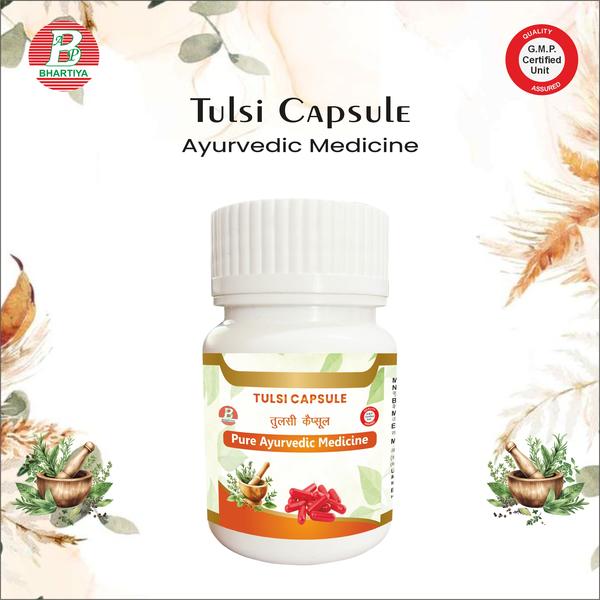
"name": "Tulsi capsule",
"description": " TULSI (Ocimum sanctum / Ocimum tenuiflorum)\n The Sacred, Divine & Healing Herb of Ayurveda\nTulsi, also known as Holy Basil, is one of the most revered Ayurvedic herbs, worshipped for thousands of years for its spiritual purity, healing power, and protective energy. The name Tulsi means “the incomparable one,” signifying its unmatched medicinal and spiritual importance. In Ayurveda, Tulsi is described as Kaphahara, Vatahara, Hridya, Kasa-Shwasahara, Krimighna, Jwaraghna, and Rasayana. It is highly beneficial in respiratory infections, fever, cough, cold, asthma, immune weakness, digestive problems, skin disorders, stress, and mental imbalance.\n BOTANICAL INFORMATION\nScientific Name : Ocimum sanctum / Ocimum tenuiflorum\nFamily : Lamiaceae\nOrder : Lamiales\nGenus : Ocimum\nSpecies : sanctum / tenuiflorum\nCommon Names :\nSanskrit – Tulsi, Surasa, Parnasa, Gramya-jiraka\nHindi – Tulsi\nEnglish – Holy Basil, Sacred Basil\nTamil – Thulasi\nTelugu – Tulasi\nMalayalam – Tulasi\nKannada – Tulasi\nBengali – Tulshi\nTypes of Tulsi:\n1.\tShri (Green) Tulsi\n2.\tKrishna (Purple) Tulsi\n3.\tVan Tulsi (Wild)\n4.\tKapoor Tulsi (Aromatic)\n5.\tRama Tulsi\n SYNONYMS FROM AYURVEDIC NIGHANTUS\nBhavaprakasha – Tulasi, Surasa, Parnasa\nDhanvantari Nighantu – Tulasi, Mahoshadhi\nKaiyadeva Nighantu – Surasa, Vishaghni\nRaja Nighantu – Tulsi, Krishna Tulsi, Shyamala\n MORPHOLOGY\nPlant Type: Aromatic, erect, highly branched perennial herb\nStem: Quadrangular, purplish or green, soft and slightly hairy\nLeaves: Simple, opposite, ovate or elliptical, highly aromatic, serrated edges\nFlowers: Small, purplish or white, in elongated spikes\nRoots: Fibrous, branched, aromatic\nFruits: Tiny nutlets containing small seeds\n ECOLOGICAL PREFERENCES\nClimate – Tropical & subtropical\nSoil – Well-drained, loamy\nSunlight – Full sun exposure\nMoisture – Moderate watering\nAltitude – Up to 1800 m\nHabitat – Courtyards, temples, gardens, wild areas\n DISTRIBUTION\nWidely found throughout India; also present in Nepal, Sri Lanka, Bangladesh, Indonesia; naturalized worldwide due to religious and medicinal importance.\n CLASSICAL AYURVEDIC PROPERTIES\nRasa : Katu (pungent), Tikta (bitter)\nGuna : Laghu (light), Ruksha (dry), Tikshna (sharp)\nVirya : Ushna (hot)\nVipaka : Katu (pungent)\nDosha Effect : Kapha-Vata shamaka\nKarma (Therapeutic Actions):\nKasa-Shwasahara, Jwaraghna, Krimighna, Hridya, Vishaghna, Rasayana, Balya\n HISTORICAL REFERENCES & STORIES\nVedic Era: Mentioned in Rigveda and Atharva Veda as a herb of purity, protection, and healing.\nCharaka Samhita: Used for Kasa (cough), Shwasa (asthma), Jwara (fever), Krimi (infection), Hridroga (heart disorders).\nSushruta Samhita: Used for skin diseases, poisoning, Kapha disorders, and wound cleansing.\nAshtanga Hridaya: Praised for balancing Kapha, enhancing digestion, boosting intelligence and longevity.\nStory : In ancient texts, a kingdom was protected from epidemic by planting and worshipping Tulsi; it became known as “Vishnu Priya” – beloved of Lord Vishnu, symbolizing purification and protection.\nBhavaprakasha Nighantu: Describes Tulsi as Tikshna, Ushna, Vishaghni, Swasahara, Jwarahara, Rasayana.\n MODERN PHYTOCHEMISTRY\nContains Eugenol, Ursolic acid, Rosmarinic acid, Caryophyllene, Ocimarin, Flavonoids (apigenin, luteolin), essential oils (methyl chavicol, linalool).\n CULTIVATION\nPropagated by seeds, sown in spring or monsoon. Requires sunlight, organic manure; leaves harvested after 2–3 months.\n CLASSICAL DOSAGE (ACCORDING TO GRANATHAS)\n•\tTulsi Churna (Powder) : 1–3 g, twice daily\n•\tTulsi Swarasa (Juice) : 10–15 ml, 1–2 times daily\n•\tTulsi Kwatha (Decoction) : 30–50 ml, twice daily\n•\tTulsi Patra (Leaves) : 5–10 fresh leaves daily\n•\tTulsi Ark : 10–20 ml daily\n•\tTulsi Tablet : 1–2 tablets, twice daily after meals\n•\tTulsi Capsule : 1 capsule, twice daily with warm water after meals\n THERAPEUTIC INDICATIONS\nCough, cold, asthma, fever, viral/bacterial infections, respiratory congestion, stress, anxiety, digestion issues, skin diseases, heart support, immunity enhancement, insect bites, poisoning.\n SAFETY & PRECAUTIONS\nSafe in recommended doses. \nUse cautiously during pregnancy (high doses). \nAvoid with strong anticoagulant drugs. \nSuitable for long-term daily use in small doses.\nTulsi Compound Formulations (Classical): Tulsi with Sitopaladi, Trikatu, Chyawanprash, Ginger & Black Pepper, or Honey/Jaggery—used for cough, asthma, digestion, immunity, and rejuvenation, prepared as per classical Ayurvedic methods.\n Tulsi Formulations by Bhartiya Ayurvedic Pharmacy\nAt Bhartiya Ayurvedic Pharmacy, we prepare a range of Tulsi formulations following classical Ayurvedic methods as described in Charaka Samhita, Sushruta Samhita, Bhavaprakasha Nighantu, and other Ayurvedic Granthas. Each product is crafted to retain the therapeutic potency, purity, and efficacy of the herb, ensuring benefits for immunity, respiratory health, stress relief, and overall vitality\n TULSI TABLET\nDosage :\n1–2 tablets twice daily after meals.\nIndications:\nCough, cold, throat congestion, asthma, fever, low immunity, stress, digestive weakness, skin infections, Kapha disorders, seasonal allergies.\nKey Actions (According to Acharya) :\nKasa-Shwasahara, Jwaraghna, Krimighna, Vishaghna, Rasayana, Kapha-Vata Hara.\n TULSI CAPSULE\nDosage :\n1 capsule twice daily with warm water after meals.\nIndications :\nChronic cough, respiratory infections, viral fevers, allergic rhinitis, immunity booster, stress, indigestion, heart support, detoxification.\nKey Ayurvedic Benefits :\nStrengthens lungs, clears Kapha, improves digestion, supports heart, enhances natural immunity (Ojas).\n TULSI (PATRA) POWDER (CHURNA)\nDosage (Classical):\n1–3 grams twice daily with warm water or honey.\nIndications:\nCold, cough, asthma, fever, indigestion, parasites, skin disorders, stress, mental fatigue, oral infections.\nClassical References:\nCharaka – Kasa, Shwasa, Jwara, Hridroga\nSushruta – Krimighna, Vrana Shodhana\nBhavaprakasha – Vishaghna, Rasayana, Swasa-Kasa Hara\n\n\nbenefits of tulsi capsules, best tulsi capsules\nbest tulsi cough syrup, can tulsi cure dry cough\ncan tulsi cure fever, does tulsi cause constipation\ndoes tulsi contains caffeine, tulasi capsule\ntulsi capsule benefits, tulsi capsule jan aushadhi kendra\ntulsi capsule jind haryana, tulsi capsule jyoti\ntulsi capsule ke fayde, tulsi capsule manufacturer\ntulsi capsule manufacturers in india\ntulsi capsule organic india, tulsi capsule price\ntulsi capsule quality, tulsi capsule quantity\ntulsi capsule weight loss, tulsi capsule wholesale\ntulsi capsule with benefits, tulsi capsule with price\ntulsi capsule with warm water, tulsi capsule work\ntulsi capsules benefits, tulsi capsules benefits in hindi\ntulsi capsules organic india, tulsi capsules planet ayurveda\ntulsi extract capsules, tulsi forte capsule, tulsi ke capsule\ntulsi plus capsule ke fayde, tulsi plus capsule price\ntulsi plus capsule uses, tulsi plus capsule uses in hindi",
"price": 300.0,
"discountamount": 150.0,
"currencycode": "INR",
"priority": 1000000,
"isfreeshipmentavailable": false,
"shipmentduration": 1,
"_keywords": null,
"isarchived": false,
"isavailable": true,
"applicationid": null,
"productindex": 74,
"imageuri": "https://productimages.withfloats.com/actual/69abe349ce30eb0364cd92f8.jpg",
"tileimageuri": "https://productimages.withfloats.com/tile/69abe349ce30eb0364cd92f8.jpg",
"images": null,
"totalqueries": 0,
"gpid": null,
"groupproductid": null,
"createdon": "2026-03-07T08:35:19.132Z",
"updatedon": "2026-03-07T08:35:19.132Z",
"buyonlinelink": null,
"producturl": "http://WWW.BHARTIYAAYURVEDICPHARMACY.COM/products/tulsi-capsule/74",
"availableunits": -1.0,
"iscodavailable": true,
"isprepaidonlineavailable": true,
"maxcodorders": -1,
"maxprepaidonlineorders": -1,
"uniquepaymenturl": null,
"brandname": "Bakula Fort",
"category": "Tulsi capsule 60-cap x 24",
"tags": [],
"variants": false,
"keyspecification": null,
"otherspecifications": null,
"pickupaddressreferenceid": null,
"paymenttype": "AssuredPurchase",
"producttype": "products",
"hsncode": null,
"gstslab": 0.0,
"isnotforsale": false
},
{
"_id": "69a27c1007634e1b29b4922c",
"fptag": "BHARTIYEAYURVEDICPHARMACY",
"merchantname": null,
"customwidgets": null,
"externalsourceid": null,
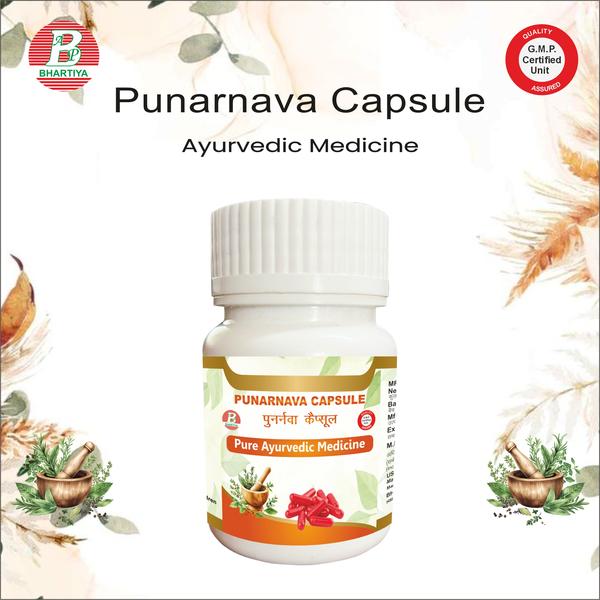
"name": "Punarnava Capsule",
"description": " Punarnava (Boerhavia diffusa) \n The Rejuvenating Herb with Healing Leaves\nPunarnava is one of the most important rejuvenating herbs in Ayurveda, widely valued for its unique ability to revive and renew the body.\nThe name Punarnava literally means “that which becomes new again”, indicating its powerful regenerative and restorative nature.\nIn Ayurveda, Punarnava is classified as a Mutrala (diuretic), Shothahara (anti-inflammatory), and Rasayana (rejuvenative) drug. It is highly beneficial in managing swelling (oedema), kidney disorders, liver weakness, urinary problems, digestive issues, anaemia, and general debility.\nBotanical Information of Punarnava\nScientific Name: Boerhavia diffusa Linn.\nFamily: Nyctaginaceae\nOrder: Caryophyllales\nGenus: Boerhavia\nSpecies: diffusa\nCommon Names:\n•\tSanskrit: Punarnavā, Shothaghanī, Raktapunarnavā, Śvetapunarnavā, Shreṇī, Shoṭikā\n•\tHindi: Punarnava\n•\tEnglish: Spreading Hogweed, Red Spiderling\n•\tTamil: Mookarattai\n•\tTelugu: Atika\n•\tMalayalam: Thazhuthama\n•\tKannada: Komme beru\n•\tBengali: Punarnava\nSynonyms of Punarnava (Boerhavia diffusa) in Ayurvedic Nighantus:\n Bhavaprakasha Nighantu – Shothaghni, Raktapunarnava, Shvetapunarnava, Shoṭikā\n Raja Nighantu & Kaiyadeva Nighantu – Panchanga, Jalapushpa, Mochana, Bhujanga\n Hrudaya Nighantu & Dhanvantari Nighantu – Utkalika, Shreni\n Morphology of Punarnava (Boerhavia diffusa)\nPlant Type: Perennial, creeping, and spreading herb\nStem:\n•\tProstrate or slightly ascending, creeping along the ground\n•\tPurplish-green, hairy, with swollen nodes\n•\tRoots develop at nodes where the stem touches the soil\nLeaves:\n•\tSimple, opposite arrangement\n•\tShape: Ovate, elliptic, or slightly rounded\n•\tTexture: Fleshy and soft\n•\tColor: Dark green on the upper surface, pale green below\n•\tPetiole: Short\nFlowers:\n•\tSmall, tubular, and bisexual\n•\tColor: Pink, reddish, or white\n•\tArranged in axillary clusters (cymes)\n•\tBloom mainly during summer and rainy seasons\nRoots:\n•\tThick, cylindrical, fleshy, and tapering\n•\tColor: White in Shveta Punarnava, reddish in Rakta Punarnava\n•\tMedicinal part, rich in active constituents\nFruits:\n•\tSmall, ovoid, glandular, and sticky when young\n•\tDark brown at maturity\n•\tOne-seeded\nHabit:\n•\tCreeping, spreading, fast-growing, regenerates easily\n•\tAdapted to drought and poor soil conditions\n Ecological Preferences of Punarnava\n•\tClimate: Thrives in tropical and subtropical climates; tolerates heat and moderate drought.\n•\tSoil: Prefers sandy, loamy, or well-drained soils; can grow in poor or degraded soils.\n•\tSunlight: Grows well in full sunlight to partial shade.\n•\tMoisture: Requires moderate moisture; can survive dry periods due to its hardy nature.\n•\tAltitude: Found at low to medium altitudes, commonly in plains and open areas.\n•\tHabitat: Common along roadsides, fields, gardens, wastelands, and riverbanks.\n•\tGrowth habit: Creeping, spreading, fast-growing, and regenerates easily after adverse conditions.\n Distribution of Punarnava\nGeographical Distribution:\nPunarnava is a widely distributed perennial herb found in tropical and subtropical regions across the world.\n•\tIndia: Found throughout the country in almost all states, particularly in plains, dry regions, roadsides, wastelands, and fields.\n•\tAsia: Occurs in Pakistan, Sri Lanka, Bangladesh, Nepal, and Myanmar.\n•\tAfrica: Common in tropical and subtropical Africa.\n•\tAmericas: Found in parts of South America and Central America.\n•\tOther Regions: Naturalized in various tropical areas worldwide due to its hardy and fast-growing nature\n Classical Ayurvedic Properties of Punarnava\n•\tRasa (Taste): Tikta (bitter), Kashaya (astringent)\n•\tGuna (Qualities): Laghu (light), Ruksha (dry)\n•\tVirya (Potency): Ushna (hot)\n•\tVipaka (post-digestive effect): Katu (pungent)\n•\tDosha Effect: Kapha-Vata shamaka (pacifies Kapha and Vata doshas)\n•\tKarma (Actions / Therapeutic Effects):\no\tMutrala: Promotes urination, useful in oedema and urinary disorders\no\tShothahara: Reduces swelling and inflammation\no\tYakrit-Pleeha Shodhaka: Supports liver and spleen health\no\tRasayana: Rejuvenative and revitalizing\no\tHridya: Supports heart function\nTherapeutic Actions of Punarnava According to Acharyas\n1.\tMutrala (Diuretic):\no\tPromotes urine formation, relieves Shotha (edema, ascites, anasarca)\no\tUseful in kidney and urinary disorders\n2.\tShothahara (Anti-inflammatory / Anti-edema):\no\tReduces Kapha and Vata-related swelling\no\tUseful in joint swelling, ascites, and edema\n3.\tYakrit-Pleeha Shodhaka (Hepato-splenic tonic / Detoxifier):\no\tSupports liver and spleen health\no\tClears stagnation in Rakta and Pitta\n4.\tRasayana (Rejuvenative / Revitalizing):\no\tImproves strength, vitality, and general health\no\tEnhances immunity and longevity\n5.\tHridya (Cardio-supportive):\no\tSupports heart function by reducing fluid overload\n6.\tMedohara / Vatashamaka:\no\tHelps in reducing excessive fat (Medo Dhatu) and pacifies Vata dosha in the body\n\nReferences from Acharyas:\n•\tCharaka Samhita: Punarnava is Shothaghni, Mutrala, Rasayana\n•\tSushruta Samhita: Shveta and Rakta Punarnava described for Shotha, Mutra, and Yakrit-Pleeha disorders\n•\tBhavaprakasha: Emphasizes anti-edema, diuretic, hepatoprotective, and rejuvenative actions\n Modern Phytochemistry of Punarnava\nPunarnava is rich in bioactive compounds responsible for its therapeutic properties. Key phytochemicals identified include:\n1. Alkaloids\n•\tPunarnavine – major alkaloid, responsible for diuretic and hepatoprotective activity\n•\tBoeravinones (A–F) – rotenoid compounds with antioxidant, hepatoprotective, and anti-inflammatory properties\n2. Flavonoids\n•\tQuercetin, Kaempferol – contribute to antioxidant and anti-inflammatory effects\n3. Glycosides\n•\tPunarnavoside – responsible for diuretic and anti-edema activity\nSpecies of Punarnava (Genus: Boerhavia)\nThe genus Boerhavia (family Nyctaginaceae) includes several species, but Boerhavia diffusa is the most commonly used in Ayurveda. Other species are also recognized botanically for various regional and medicinal uses:\n1. Boerhavia diffusa Linn.\n•\tMost widely used in Ayurveda\n•\tPerennial, creeping, and spreading herb\n•\tKnown for diuretic, anti-inflammatory, hepatoprotective, and rejuvenative properties\n2. Boerhavia erecta L.\n•\tErect or semi-erect habit, less creeping\n•\tFound in tropical regions\n•\tUsed in traditional medicine locally, but less common in classical Ayurveda\n3. Boerhavia repens L.\n•\tCreeping herb, often used as ground cover\n•\tOccasional medicinal use in folk medicine\n4. Boerhavia coccinea Mill.\n•\tRed-flowered species, creeping habit\n•\tSometimes used in ethnomedicine for fever and inflammation\n5. Boerhavia verticillata Willd.\n•\tFound in Africa and Asia\n•\tLimited medicinal use; occasionally cited in ethnobotanical surveys\nCultivation:\n•\tPropagation: Primarily by seeds; can also propagate via stem cuttings due to its creeping habit.\n•\tSowing Time: Best sown during the early monsoon or rainy season.\n•\tSpacing: Maintain 30–40 cm between plants to allow spreading.\n•\tWatering: Requires moderate moisture; drought-tolerant once established.\n•\tFertilization: Responds well to organic manure or compost, though hardy enough to grow in poor soils.\n•\tHarvesting: Roots, stems, and leaves are harvested after 3–4 months of growth, depending on medicinal use.\n•\tEcological Note: Acts as a pioneer plant, stabilizing soil and growing in degraded lands.\n Classical Dosage of Punarnava in Granthas\n1. Charaka Samhita\nForm: Root or whole plant powder (Churna), decoction (Kwatha)\nDose: 3–6 grams of powder; 40–60 ml of decoction, 2–3 times daily\nUses: Shotha (edema), Mutrakriccha (urinary disorders), Rasayana\n2. Sushruta Samhita\nForm: Root, whole plant, or paste\nDose: 3–6 grams powder; decoction 40–60 ml; external paste as required\nUses: Shotha, Mutra, Yakrit-Pleeha disorders\n3. Bhavaprakasha Nighantu\nForm: Churna, Kwatha, Swarasa (juice)\nDose: 3–6 grams Churna; 40–60 ml Kwatha; 20–30 ml Swarasa 1–2 times daily\nNotes: Shveta Punarnava for urinary issues; Rakta Punarnava for liver and blood disorders\n4. Raja Nighantu & Kaiyadeva Nighantu\nForm: Panchanga (whole plant), decoction, powder\nDose: Similar classical dose as above; 3–6 grams for powder, decoction 40–60 ml\nTherapeutic Use: Shothahara, Mutrala, Rasayana\n\n Safety and Precautions of Punarnava\n Safe in classical dosage.\n Avoid overdose -caution with strong diuretics.\n Pregnant Woman- use only under supervision.\n\n Classical Ayurvedic Formulations of Punarnava\nPunarnava is a key ingredient in many classical Ayurvedic preparations for edema, liver disorders, kidney ailments, and rejuvenation. Common formulations include:\n1. Punarnavadi Kwatha (Decoction)\n•\tIngredients: Punarnava, Trikatu (Pippali, Maricha, Shunthi), Musta, Haritaki, and other supporting herbs\n•\tAction: Diuretic, anti-edema, hepatoprotective, rejuvenative\n•\tIndication: Shotha (edema), Ascites, Mutrakriccha (urinary disorders)\n2. Punarnavadi Churna (Powder)\n•\tIngredients: Punarnava root, Haritaki, Musta, Chitrak, Shunthi\n•\tAction: Supports kidney and liver health, promotes detoxification, reduces swelling\n•\tDose: 3–6 g/day with water or honey\n3. Punarnava Swarasa (Juice)\n•\tForm: Fresh juice of Punarnava root or whole plant\n•\tAction: Diuretic, anti-inflammatory, mild laxative\n•\tDose: 20–30 ml, 1–2 times daily\n4. Punarnava Grita or Taila (Medicated Ghee/Oil)\n•\tUsage: External application for swelling, inflammation, and joint disorders\n•\tAction: Shothahara, soothing, and rejuvenative\n5. Compound Formulations\n•\tPunarnavadi Kashaya, Punarnavadi Gutika, Punarnavadi Avaleha – used in liver disorders, urinary diseases, edema, and general rejuvenation.\n Punarnava Formulations by Bhartiya Ayurvedic Pharmacy\nAt Bhartiya Ayurvedic Pharmacy, we prepare a range of Punarnava (Boerhavia diffusa) formulations following classical Ayurvedic methods as described in Charaka Samhita, Sushruta Samhita, Bhav Prakash Nighantu, and other Ayurvedic Granthas. Each product is crafted to retain the therapeutic potency, purity, and efficacy of the herb, ensuring benefits for fluid balance, kidney & liver support, detoxification, and rejuvenation.\n1. Punarnava Tablet\nDescription:\nPunarnava Tablets contain standardized powdered extract of Boerhavia diffusa, providing a convenient dosage form for daily use.\nKey Actions:\n•\tSupports normal urinary output and reduces mild water retention\n•\tPromotes liver and kidney health\n•\tReduces swelling (Edema)\n•\tBeneficial in cough or intestinal colic\n•\tIt can help lower the blood pressure\n•\tProvides general detox and rejuvenation\nDosage:\n•\t1–2 tablets twice daily after meals, or as advised by an Ayurvedic practitioner\nPrecautions:\n•\tUse under guidance in pregnancy, kidney disorders, or excessive fluid loss\n•\tMaintain recommended dosage\n2. Punarnava Capsule\nDescription:\nThese capsules offer a modern, easy-to-swallow format containing Punarnava extract, ideal for those who prefer capsules over tablets or decoctions.\nKey Actions:\n•\tSupports diuresis (mutrala) and reduces edema (shothahara)\n•\tHelps maintain healthy liver function\n•\tActs as a rejuvenative (rasayana)\nDosage:\n•\t1 capsule twice daily with warm water after meals\nPrecautions:\n•\tNot recommended for patients on strong diuretics without consulting a physician\n3. Punarnava Asava\nDescription:\nPunarnava Asava is a classical Ayurvedic fermented liquid formulation, prepared from fresh roots/whole plant to preserve bioactive constituents.\nKey Actions:\n•\tPromotes fluid balance and detoxification\n•\tSupports liver and kidney health\n•\tEasily digestible, suitable for patients with weak digestive fire\nDosage:\n•\t20–30 ml twice daily after meals, or as advised\n•\tCan be taken with warm water or honey as per taste and constitution\nPrecautions:\n•\tStore in a cool, dry place\n•\tUse under supervision during pregnancy or lactation\n4. Punarnavadi Mandura\nDescription:\nA classical Ayurvedic herbo-mineral formulation combining Punarnava with Mandura Bhasma (iron). Designed to support blood health, anemia, spleen function, along with Punarnava’s diuretic and rejuvenative actions.\nKey Actions:\n•\tHematinic: Replenishes iron and supports blood formation\n•\tDiuretic & Detox: Reduces edema and fluid retention\n•\tRejuvenative: Improves vitality and metabolic balance\nDosage:\n•\t1–2 tablets twice daily after meals with warm water or milk, as directed by an Ayurvedic practitioner\nPrecautions:\n•\tAvoid excessive intake; monitor iron levels if used long-term\n•\tNot recommended in cases of iron overload or severe gastric sensitivity\n\n\n\npunarnava capsule, punarnava capsule benefits, punarnava capsule company name\npunarnava capsule composition, punarnava capsule contains\npunarnava capsule cost, punarnava capsule gm\npunarnava capsule gst, punarnava capsule gst rate\npunarnava capsule ke fayde, punarnava capsule kis kaam aata hai\npunarnava capsule online, punarnava capsule online order\npunarnava capsule online shopping, punarnava capsule original\npunarnava capsule price, punarnava capsule quality\npunarnava capsule quantity, punarnava capsule review\npunarnava capsule root, punarnava capsule root powder\npunarnava capsule root powder benefits\npunarnava capsule side effects, punarnava capsule uses\npunarnava capsule uses in hindi, punarnava capsule video\npunarnava capsule video youtube, punarnava capsules benefits\npunarnava capsules benefits in hindi, punarnava capsules price in india\npunarnava capsules uses, punarnava capsules uses in hindi\npunarnava extract capsules, punarnava how to use\npunarnava ka juice, punarnava ke capsule\npunarnava nutritious capsule, punarnava tablet benefits\npunarnava tablet lene ke fayde, punarnava tablets benefits\nwhat is punarnava, when to take punarnava",
"price": 360.0,
"discountamount": 180.0,
"currencycode": "INR",
"priority": 1000000,
"isfreeshipmentavailable": false,
"shipmentduration": 1,
"_keywords": null,
"isarchived": false,
"isavailable": true,
"applicationid": null,
"productindex": 68,
"imageuri": "https://productimages.withfloats.com/actual/69a27c16871d453ad0f0d462.jpg",
"tileimageuri": "https://productimages.withfloats.com/tile/69a27c16871d453ad0f0d462.jpg",
"images": null,
"totalqueries": 0,
"gpid": null,
"groupproductid": null,
"createdon": "2026-02-28T05:24:32.91Z",
"updatedon": "2026-03-02T04:31:26.469Z",
"buyonlinelink": null,
"producturl": "http://WWW.BHARTIYAAYURVEDICPHARMACY.COM//punarnava-capsule/68",
"availableunits": -1.0,
"iscodavailable": true,
"isprepaidonlineavailable": true,
"maxcodorders": -1,
"maxprepaidonlineorders": -1,
"uniquepaymenturl": null,
"brandname": "Bakula Fort",
"category": "Punarnava Capsule 60 - cap X 24",
"tags": [],
"variants": false,
"keyspecification": null,
"otherspecifications": null,
"pickupaddressreferenceid": null,
"paymenttype": "AssuredPurchase",
"producttype": "products",
"hsncode": null,
"gstslab": 0.0,
"isnotforsale": false
},
{
"_id": "69a26b42696ba164ff83edc2",
"fptag": "BHARTIYEAYURVEDICPHARMACY",
"merchantname": null,
"customwidgets": null,
"externalsourceid": null,
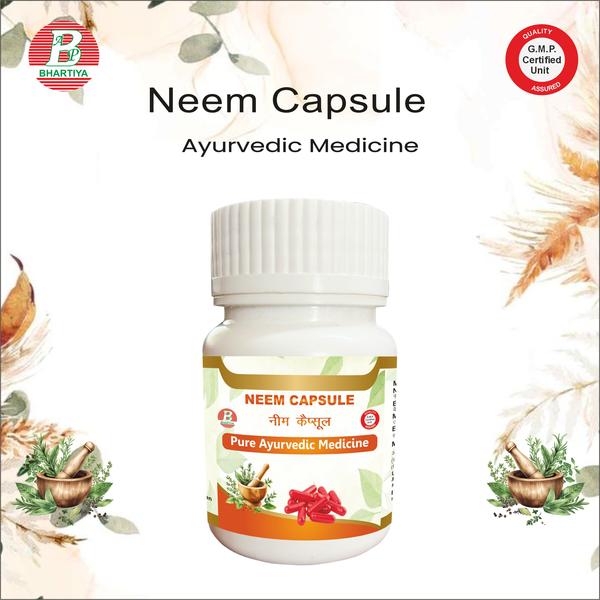
"name": "Neem capsule",
"description": "\n NEEM (Azadirachta indica A. Juss.) \n The Divine Medicinal Tree — “Nimba” (The Bitter Guardian)\nNeem, known as Nimba in Sanskrit, is one of the most revered medicinal trees in Ayurveda. Celebrated for its antimicrobial, blood-purifying, and detoxifying properties, it has been used since Vedic times for health, hygiene, and longevity. Neem is considered a Pittashamaka and Rasayana, supporting immunity, skin, liver, and overall vitality. Classical texts praise Neem as the “Sarva Roga Nivarini” — capable of preventing or alleviating multiple diseases.\n\n BOTANICAL INFORMATION OF NEEM\n•\tScientific Name: Azadirachta indica A. Juss.\n•\tSynonyms: Melia azadirachta L., Nimba\n•\tFamily: Meliaceae\n•\tOrder: Sapindales\n•\tGenus: Azadirachta\n•\tSpecies: indica\n•\tCommon Names:\no\tSanskrit: Nimba, Nimbaka, Arishta, Sarva Roga Nivaraka\no\tHindi: Neem\no\tEnglish: Indian Lilac\no\tTamil: Veppam, Vembu\no\tTelugu: Vepa\no\tMalayalam: Veppu, Vempu\no\tKannada: Bevu\no\tMarathi/Gujarati: Neem\n SYNONYMS IN CLASSICAL AYURVEDIC TEXTS\n•\tCharaka Samhita: Nimba, Sarvoshadhi\n•\tSushruta Samhita: Nimb, Raktaprasadaka\n•\tBhavaprakasha Nighantu: Nimba, Arishta, Sarva Roga Nivaraka\n•\tDhanvantari Nighantu: Nimba, Raktashodhaka\nNeem is traditionally associated with blood purification, detoxification, longevity, and prevention of skin and systemic disorders.\n\n MORPHOLOGY OF NEEM\n•\tTree: Medium to large deciduous, height 15–20 m, spreading crown\n•\tBark: Grey-brown, rough, longitudinal fissures\n•\tLeaves: Pinnate, 20–40 cm long, leaflets 20–30 pairs, ovate-lanceolate, serrated margins\n•\tFlowers: Small, white, fragrant, axillary panicles\n•\tFruit: Drupe, ovoid, green turning yellow on ripening, 1–2 cm long, bitter-sweet\n•\tSeed: One hard seed per fruit\n ECOLOGICAL PREFERENCES\n•\tClimate: Tropical and subtropical, drought-resistant\n•\tSoil: Adaptable to a range of soils, grows well in poor, sandy, or rocky soil\n•\tHabitat: Open forests, village groves, roadsides\n•\tAltitude: Sea level to 1,500 m\n GEOGRAPHICAL DISTRIBUTION\n•\tIndia: Widely distributed, majorly in Rajasthan, Gujarat, Maharashtra, Tamil Nadu, Karnataka, Andhra Pradesh\n•\tOutside India: Myanmar, Bangladesh, Pakistan, Southeast Asia, tropical Africa\n CLASSICAL AYURVEDIC PROPERTIES (RASA–GUNA–VIRYA–VIPAKA)\n•\tRasa (Taste): Tikta (bitter), Kashaya (astringent)\n•\tGuna (Qualities): Laghu (light), Ruksha (dry)\n•\tVirya (Potency): Śīta (cooling)\n•\tVipaka (post-digestive effect): Katu (pungent)\n•\tDosha Effects: Tridoshaghna, especially Pittahara and Kapha-shamaka\n THERAPEUTIC ACTIONS ACCORDING TO AYURVEDA (KARMA)\n1.\tRaktashodhaka: Purifies blood, detoxifying\n2.\tKushthaghna: Treats skin disorders, eczema, acne, leprosy\n3.\tJwaraghna: Antipyretic, reduces fever\n4.\tKaphapittahara: Balances doshas, reduces inflammation\n5.\tKantya / Keshya: Promotes hair and skin health\n6.\tDantya: Oral hygiene, treats dental infections and gingivitis\n7.\tVrishya: Enhances reproductive health and vitality\n8.\tVishaghna: Anti-parasitic, kills microbes and intestinal worms\n INDICATIONS\n•\tSkin & Hair: Acne, eczema, psoriasis, dandruff, hair fall\n•\tDigestive System: Dyspepsia, constipation, intestinal worms\n•\tMetabolism & Immunity: Detoxification, immunity enhancement\n•\tOral Health: Gingivitis, dental caries, halitosis\n•\tBlood Disorders: Purifies blood, improves circulation\n•\tFever & Infections: Malaria, viral infections, minor fevers\n MODERN PHARMACOLOGY & PHYTOCHEMISTRY\n•\tMajor Constituents: Nimbin, Nimbidin, Azadirachtin, Quercetin, Nimbolide, Flavonoids, Tannins, Vitamins, Minerals\n•\tPharmacological Actions:\no\tAntibacterial, Antiviral, Antifungal\no\tAnti-inflammatory\no\tImmunomodulatory\no\tAntipyretic\no\tHepatoprotective\no\tAntidiabetic\no\tAntioxidant\n CULTIVATION DETAILS\n•\tPropagation: Seeds, stem cuttings\n•\tSowing Time: June–July (monsoon)\n•\tSpacing: 8–10 m between trees\n•\tIrrigation: Moderate, drought-tolerant once established\n•\tFertilization: Organic manure preferred\n•\tHarvesting: Leaves and fruits collected as required\n CLASSICAL DOSAGE (According to Ayurvedic Granthas)\n•\tChurna (Powder): 1–3 g\n•\tSwarasa (Juice): 10–20 ml\n•\tKwatha (Decoction): 40–60 ml\n•\tAvaleha (Paste/Lehyam): 5–10 g\n•\tOil (Thaila): Topical for skin and hair\n CLASSICAL AYURVEDIC FORMULATIONS CONTAINING NEEM\n1.\tNimbadi Churna – Skin disorders, immunity\n2.\tNimbadi Kwatha – Blood purification, fever\n3.\tNimbadi Thaila – Hair and scalp treatment\n4.\tNimbamrit Rasayana – Rejuvenative, detoxifying\n5.\tNimbadi Gutika – Digestive and metabolic support\n6.\tNimba Patra Swarasa – Oral health, dental car\n HISTORICAL & CLASSICAL SIGNIFICANCE\n•\tNeem is referred to as “Divine Tree” in Charaka, Sushruta, and Bhavaprakasha Nighantu.\n•\tKnown as Sarva Roga Nivarini — capable of preventing numerous diseases.\n•\tIn ancient Indian texts, neem twigs were used for dental hygiene, and leaves for blood purification.\n•\tUsed in Rasayana therapy, especially for skin, blood, and immunity-related disorders.\n•\tIn folklore, neem is regarded as sacred and protective, planted near homes for health and well-being.\n NEEM (Azadirachta indica A. Juss.) FORMULATIONS – BHARTIYA AYURVEDIC PHARMACY\n\nBhartiya Ayurvedic Pharmacy prepares a range of Neem formulations following classical Ayurvedic principles described in Charaka Samhita, Sushruta Samhita, Bhavaprakasha Nighantu, and other Ayurvedic texts. Each product is designed to retain the full blood-purifying, antimicrobial, skin-protective, and immunity-enhancing properties of Neem.\n\n 1. Neem Tablet\nDescription:\nNeem Tablet is a modern, convenient dosage form containing standardized Neem (Azadirachta indica) extract. Ideal for daily use, it supports detoxification, immunity, and skin health.\nKey Actions:\n•\tTridoshic Rasayana: Balances Vata, Pitta, Kapha\n•\tBlood purifier and detoxifier\n•\tSupports skin health and wound healing\n•\tDigestive and metabolic support\n•\tImmunity enhancer\nDosage:\n•\t1–2 tablets twice daily after meals with warm water, or as directed\nPrecautions:\n•\tAvoid excessive use in diarrhea or loose stools\n•\tPregnant and lactating women should use under supervision\n•\tMonitor blood sugar in diabetics\n 2. Neem Capsule\nDescription:\nNeem Capsule is a convenient, easy-to-swallow form containing concentrated Neem extract. Suitable for those who prefer capsules over tablets or powders.\nKey Actions:\n•\tAntimicrobial, antiviral, and antiparasitic\n•\tAnti-inflammatory and antioxidant\n•\tSupports liver function and metabolism\n•\tBoosts immunity and vitality\nDosage:\n•\t1–2 capsules twice daily with warm water after meals\nPrecautions:\n•\tAvoid overdose\n•\tUse under supervision if pregnant, lactating, or on anti-diabetic medications\n 3. Neem Oil (Taila)\nDescription:\nNeem Oil is a classical Ayurvedic topical preparation, cold-pressed from Neem seeds, used for skin and hair disorders.\nKey Actions:\n•\tAnti-inflammatory and antimicrobial\n•\tTreats acne, eczema, psoriasis, fungal infections\n•\tPromotes hair growth and prevents dandruff\n•\tSoothes itching and skin irritation\nDosage / Usage:\n•\tApply externally on affected areas 1–2 times daily\n•\tCan be mixed with coconut or sesame oil for massage\nPrecautions:\n•\tFor external use only\n•\tAvoid contact with eyes\n•\tTest patch for allergic reactions before extensive use\n 4. Nimbadi Churna\nDescription:\nNimbadi Churna is a classical powdered formulation containing Neem leaves and other synergistic herbs. Used traditionally for skin disorders, fever, blood purification, and digestive support.\nKey Actions:\n•\tMild laxative and digestive tonic\n•\tBlood purifier and detoxifying\n•\tAnti-inflammatory and antimicrobial\n•\tSupports immunity and metabolic health\nDosage:\n•\t1–3 g daily with warm water, honey, or ghee, preferably at bedtime or as advised\nPrecautions:\n•\tAvoid excessive use leading to loose stools\n•\tUse under practitioner supervision in elderly, children, or weak patients\n•\tMonitor blood sugar if diabetic\n SAFETY & PRECAUTIONS\n•\tSafe for long-term use when taken in classical doses\n•\tAvoid excessive consumption in dehydration or diarrhea\n•\tUse cautiously in pregnancy and lactation\n•\tMay reduce blood sugar: monitor if diabetic\n\n\n\nayurveda neem capsule, ayurvedic neem capsule\nbenefits of neem capsule, best neem capsule\nbest neem capsules in india, best neem supplement\nbest organic neem capsules, best time to take neem capsule\ncan i take neem capsules, can neem be consumed daily\ncan you take neem capsules everyday, do neem capsules expire\nhow long can i take neem capsules, how long to take neem capsules\nhow to make neem capsules at home, how to take neem capsules\nis neem capsules good for acne, is neem capsules good for diabetes\nis neem capsules good for skin, is neem capsules safe\nneem capsule amazon, neem capsule ayurvedic\nneem capsule benefits, neem capsule benefits in hindi\nneem capsule dosage, neem capsule dp price\nneem capsule empty stomach, neem capsule for acne\nneem capsule for men, neem capsule for skin\nneem capsule hindi, neem capsule hsn code\nneem capsule india, neem capsule kab khana chahiye\nneem capsule ke fayde, neem capsule khane ke fayde\nneem capsule kis kaam aata hai, neem capsule near me\nneem capsule online, neem capsule price\nneem capsule uses, neem capsule uses in hindi\nneem capsules acne, neem capsules benefits\nneem capsules benefits for men, neem capsules benefits for skin\nneem capsules benefits in hindi, neem capsules blood purifier\nneem capsules for acne reviews, neem capsules for hair growth\nneem capsules health benefits, neem capsules price online\nneem seed capsule",
"price": 270.0,
"discountamount": 135.0,
"currencycode": "INR",
"priority": 1000000,
"isfreeshipmentavailable": false,
"shipmentduration": 1,
"_keywords": null,
"isarchived": false,
"isavailable": true,
"applicationid": null,
"productindex": 67,
"imageuri": "https://productimages.withfloats.com/actual/69a26b4a1a54b14cdf0a25ce.jpg",
"tileimageuri": "https://productimages.withfloats.com/tile/69a26b4a1a54b14cdf0a25ce.jpg",
"images": null,
"totalqueries": 0,
"gpid": null,
"groupproductid": null,
"createdon": "2026-02-28T04:12:50.22Z",
"updatedon": "2026-02-28T04:12:50.22Z",
"buyonlinelink": null,
"producturl": "http://WWW.BHARTIYAAYURVEDICPHARMACY.COM//neem-capsule/67",
"availableunits": -1.0,
"iscodavailable": true,
"isprepaidonlineavailable": true,
"maxcodorders": -1,
"maxprepaidonlineorders": -1,
"uniquepaymenturl": null,
"brandname": "Bakula fort",
"category": "Neem capsule 60 - cap X 24",
"tags": [],
"variants": false,
"keyspecification": null,
"otherspecifications": null,
"pickupaddressreferenceid": null,
"paymenttype": "AssuredPurchase",
"producttype": "products",
"hsncode": null,
"gstslab": 0.0,
"isnotforsale": false
},
{
"_id": "6993fdc30e3bcc31e5947ffe",
"fptag": "BHARTIYEAYURVEDICPHARMACY",
"merchantname": null,
"customwidgets": null,
"externalsourceid": null,
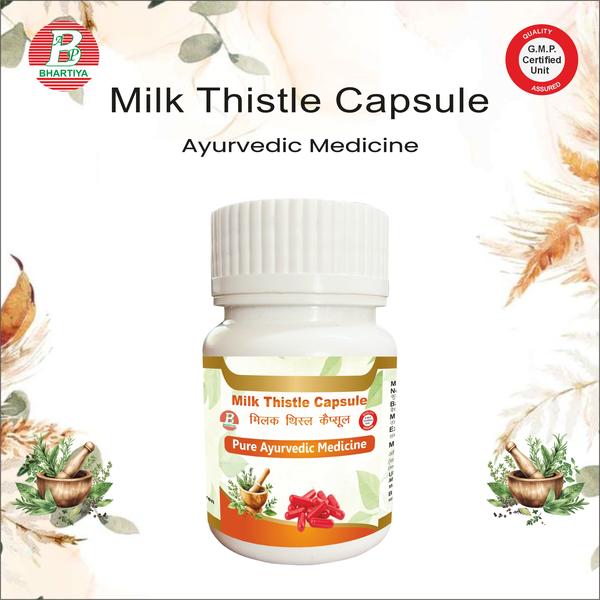
"name": "Milk Thistel Capsule",
"description": " MILK THISTLE \n\n MILK THISTLE (Silybum marianum L.) \nThe Liver-Protective Herb — “Marian Thistle”\nMilk Thistle, known scientifically as Silybum marianum, is a medicinal herb traditionally used for liver protection, detoxification, and rejuvenation. Rich in flavonolignans (silymarin), antioxidants, and phytonutrients, it is considered beneficial for liver health, digestion, metabolism, and overall vitality.\n\n CLASSICAL AYURVEDIC REFERENCES\nWhile Milk Thistle is not mentioned in classical Indian Ayurvedic granthas directly, modern Ayurvedic scholars equate its properties with “Yogavahi, Hridya, Yakrutya” (liver-protective, circulatory supportive, and rejuvenative herbs). Its actions are aligned with Rasayana therapy and digestive tonics described in:\n1.\tCharaka Samhita (Kalpa Sthana) – Herbs with Hepatoprotective and Pitta-hara properties are recommended for liver disorders, digestion, and detoxification.\n2.\tSushruta Samhita (Chikitsa Sthana) – Herbs with Tikta-Rasa (bitter taste) and Sheeta Virya (cooling potency) are advised to purify the blood and support liver function.\n3.\tBhavaprakasha Nighantu – Mentions Tikta-Medhya-Virechana herbs, comparable in modern research to Milk Thistle for detoxification, antioxidant, and rejuvenative effects.\nClassical Story / Analogy:\nAyurvedic scholars often compare Milk Thistle to a “guardian herb of the liver”, like a protector of vital channels. Its scientific name “marianum” comes from the legend of the Virgin Mary: the white veins on the leaves were said to represent milk spilled from her breast, symbolizing nourishment and protection. In Ayurveda, it is considered a Rasayana for the Yakrut (liver), Medhya (intellect), and Ojas (vitality).\n\n BOTANICAL INFORMATION OF MILK THISTLE\n•\tScientific Name: Silybum marianum (L.) Gaertn.\n•\tFamily: Asteraceae\n•\tOrder: Asterales\n•\tGenus: Silybum\n•\tSpecies: marianum\n•\tCommon Names:\no\tSanskrit: Kshirakakoli (in modern Ayurvedic texts)\no\tEnglish: Milk Thistle, Marian Thistle\no\tHindi: Kshirakakoli\no\tTamil: Pappal Thistle\no\tTelugu: Kshirakakoli\no\tMalayalam: Ksheerakakoli\no\tKannada: Ksheera Thistle\no\tBengali: Kshirakakoli\n\n SYNONYMS IN MODERN AYURVEDIC NIGHANTUS\n•\tBhavaprakasha Nighantu (modern Ayurvedic adaptations): Silybum marianum – Yakrutya, Rasayana, Medhya\n•\tCharaka & Sushruta adaptations: Herbs with Tikta Rasa, Sheeta Virya, and Yakrutya karma\n\n MORPHOLOGY OF MILK THISTLE\n•\tPlant Type: Biennial or annual herb\n•\tHeight: 1–2 m\n•\tLeaves: Large, spiny, green with white veins\n•\tFlowers: Purple, thistle-like, solitary or clustered\n•\tFruit / Seeds: Oval, brown to black, contain oil-rich seeds\n•\tSeeds: Rich in silymarin flavonolignans, hepatoprotective compounds\n\n ECOLOGICAL PREFERENCES\n•\tClimate: Temperate to Mediterranean\n•\tSoil: Well-drained, fertile, loamy soil\n•\tHabitat: Dry, sunny areas, wastelands, grasslands\n•\tAltitude: Sea level to 1,800 m\n\n GEOGRAPHICAL DISTRIBUTION\n•\tIndia: Himachal Pradesh, Uttarakhand, Jammu & Kashmir\n•\tOutside India: Mediterranean region, Europe, North America\n\n CLASSICAL AYURVEDIC PROPERTIES (RASA–GUNA–VIRYA–VIPAKA)\n•\tRasa (Taste): Tikta (bitter), Katu (pungent)\n•\tGuna (Qualities): Laghu (light), Ruksha (dry)\n•\tVirya (Potency): Sheeta (cooling)\n•\tVipaka (post-digestive effect): Katu (pungent)\n•\tDosha Effects: Pitta-Vata hara, supports Kapha balance in moderation\n\n THERAPEUTIC ACTIONS (KARMA)\n1.\tYakrutya / Hepatoprotective: Protects liver cells, supports detoxification\n2.\tRasayana / Rejuvenative: Supports vitality, Ojas, and metabolic health\n3.\tMedhya: Enhances memory and cognitive function\n4.\tHridya: Mild circulatory and heart support\n5.\tVirechana / Detoxifying: Promotes gentle bowel movement and purification\n6.\tKapha-Vata Samana: Reduces digestive sluggishness, supports metabolism\n\n INDICATIONS\n•\tLiver disorders, hepatitis, fatty liver, detoxification\n•\tDigestive sluggishness, mild constipation\n•\tMetabolic syndrome, obesity\n•\tCardiovascular support\n•\tFatigue, cognitive support\n\n MODERN PHARMACOLOGY & PHYTOCHEMISTRY\n•\tMajor Constituents: Silymarin (silybin, silychristin, silydianin), flavonoids, polyphenols, fatty acids, vitamins E & C\n•\tPharmacological Actions: Hepatoprotective, antioxidant, anti-inflammatory, mild hypoglycemic, lipid-lowering, neuroprotective\n\n CULTIVATION DETAILS\n•\tPropagation: Seeds\n•\tSowing Time: Spring (Feb–April)\n•\tSpacing: 30–50 cm between plants\n•\tIrrigation: Moderate; drought-tolerant once mature\n•\tFertilization: Organic manure preferred\n•\tHarvesting: Seeds harvested when brown and dry\n\n CLASSICAL DOSAGE (According to Ayurvedic Adaptation & Modern Herbal Use)\n•\tPowdered Seeds (Churna): 2–5 g/day\n•\tCapsule / Extract: 150–300 mg twice daily\n•\tDecoction / Tea: 1–2 cups/day for liver support\n\n MILK THISTLE FORMULATIONS – BHARTIYA AYURVEDIC PHARMACY\nBhartiya Ayurvedic Pharmacy prepares Milk Thistle Capsules and extracts following Ayurvedic principles adapted for modern use. Each product retains hepatoprotective, antioxidant, and rejuvenative properties, promoting liver health, metabolic balance, and overall vitality.\nKey Uses of Milk Thistle Formulations:\n•\tLiver support and detoxification\n•\tDigestive health and mild bowel regulation\n•\tMetabolic and cardiovascular support\n•\tRasayana for vitality, endurance, and rejuvenation\n\n MILK THISTLE CAPSULE\nBhartiya Ayurvedic Pharmacy offers Milk Thistle Capsules prepared from premium quality Silybum marianum seeds or extract, preserving full therapeutic properties.\nKey Benefits:\n•\tSupports liver detoxification and hepatoprotection\n•\tEnhances metabolism and digestive health\n•\tProvides antioxidant and rejuvenative effects\n•\tSupports cardiovascular and metabolic function\n•\tActs as a Rasayana for overall vitality\nDosage:\n•\tAdults: 1–2 capsules twice daily with warm water\n•\tCan be combined with warm water or milk for enhanced effect\nSafety & Precautions:\n•\tSafe for long-term use when taken as per dosage\n•\tMild laxative effect may occur in sensitive individuals\n•\tAvoid in cases of severe bile duct obstruction without consulting a physician\nFormulation Highlights:\n•\t100% natural Milk Thistle seed powder/extract\n•\tFree from artificial colours, preservatives, and additives\n•\tPrepared using modern Ayurvedic processing methods to preserve therapeutic qualities\nSuggested Use:\n•\tIdeal for adults seeking liver support, detoxification, and Rasayana effects\n•\tConvenient capsule form for daily Ayurvedic supplementation\n\nare milk thistle capsules good for you, are milk thistle capsules safe\nasthalin capsule\nasthalin capsule dose\nbest milk thistle capsule\nbest milk thistle capsules\nbest milk thistle capsules in india\nbest milk thistle supplement in india\nbest organic milk thistle capsules\ncan i open milk thistle capsules\ncan i take milk thistle with milk\ncan i take milk thistle with other supplements\ncan milk thistle capsules be opened\ncan we take milk thistle every day\ncan you open milk thistle capsules\ndo milk thistle capsules go bad\ndo milk thistle tablets go out of date\ndoes milk thistle capsules expire\ndoes milk thistle capsules work\ndoes milk thistle come in capsules\ndoes milk thistle help in weight loss\nhow long do milk thistle capsules last\nhow many milk thistle capsules per day\nhow much milk thistle capsules per day\nhow to take milk thistle capsules\nhow to take milk thistle seed powder\nhow to take milk thistle seeds\nhow to use milk thistle seeds for liver\nis milk thistle capsule good\nis milk thistle capsules good for you\nis milk thistle capsules good for your liver\nis milk thistle found in india\nkapiva milk thistle capsule review\nmilk thistle 500 mg capsule\nmilk thistle capsule\nmilk thistle capsule amazon\nmilk thistle capsule benefits\nmilk thistle capsule benefits for men\nmilk thistle capsule benefits in hindi\nmilk thistle capsule dosage\nmilk thistle capsule for liver\nmilk thistle capsule high strength\nmilk thistle capsule image\nmilk thistle capsule jan aushadhi kendra\nmilk thistle capsule jiomart\nmilk thistle capsule kab khana chahiye\nmilk thistle capsule ke fayde\nmilk thistle capsule or liquid\nmilk thistle capsule price\nmilk thistle capsule review\nmilk thistle capsule side effects\nmilk thistle capsule uses\nmilk thistle capsule uses in hindi\nmilk thistle capsule youtube\nmilk thistle capsule youtube video\nmilk thistle capsules\nmilk thistle capsules australia\nmilk thistle capsules benefits\nmilk thistle capsules best brand\nmilk thistle capsules boots\nmilk thistle capsules for sale\nmilk thistle capsules good for\nmilk thistle capsules how to use\nmilk thistle capsules in india\nmilk thistle capsules near me\nmilk thistle capsules now\nmilk thistle capsules organic\nmilk thistle capsules side effects\nmilk thistle capsules uk\nmilk thistle capsules usa\nmilk thistle capsules uses\nmilk thistle extract capsules benefits\nmilk thistle powder vs capsule\nmilk thistle tablets benefits for skin\nmilk thistle tablets benefits in hindi",
"price": 480.0,
"discountamount": 240.0,
"currencycode": "INR",
"priority": 1000000,
"isfreeshipmentavailable": false,
"shipmentduration": 1,
"_keywords": null,
"isarchived": false,
"isavailable": true,
"applicationid": null,
"productindex": 65,
"imageuri": "https://productimages.withfloats.com/actual/6993fdc6334724dfd78e0fbc.jpg",
"tileimageuri": "https://productimages.withfloats.com/tile/6993fdc6334724dfd78e0fbc.jpg",
"images": null,
"totalqueries": 0,
"gpid": null,
"groupproductid": null,
"createdon": "2026-02-17T05:33:55.94Z",
"updatedon": "2026-02-17T08:35:08.865Z",
"buyonlinelink": null,
"producturl": "http://WWW.BHARTIYAAYURVEDICPHARMACY.COM//milk-thistel-capsule/65",
"availableunits": -1.0,
"iscodavailable": true,
"isprepaidonlineavailable": true,
"maxcodorders": -1,
"maxprepaidonlineorders": -1,
"uniquepaymenturl": null,
"brandname": "Bakula Fort",
"category": "Milk Thistel Capsule 60 Cap X 12",
"tags": [],
"variants": false,
"keyspecification": null,
"otherspecifications": null,
"pickupaddressreferenceid": null,
"paymenttype": "AssuredPurchase",
"producttype": "products",
"hsncode": null,
"gstslab": 0.0,
"isnotforsale": false
},
{
"_id": "698b1826061c704326857527",
"fptag": "BHARTIYEAYURVEDICPHARMACY",
"merchantname": null,
"customwidgets": null,
"externalsourceid": null,
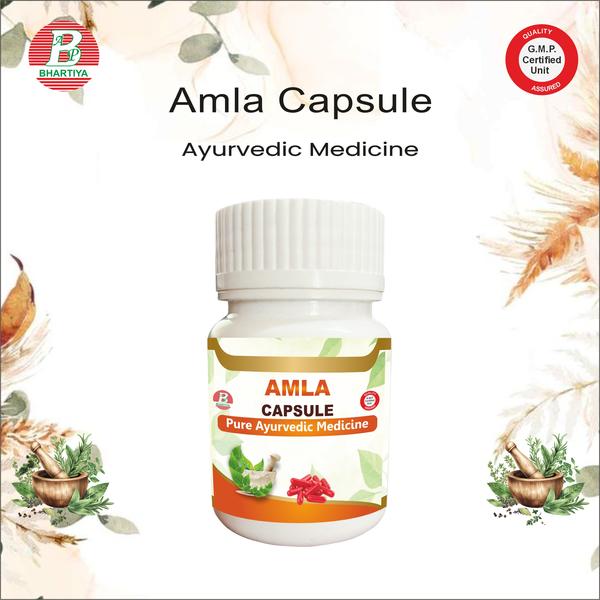
"name": "Amla Capsule",
"description": " (AMLA (Emblica officinalis Gaertn.) \n The Supreme Rasayana — “Dhatri Phala” (The Nourishing Mother Fruit)\nĀmla, also known as Āmalakī, is one of the most celebrated herbs in Ayurveda, recognized as a prime Rasayana (rejuvenative) and Pittashamaka. Considered sacred and synonymous with longevity, it is used for rejuvenation, metabolism, immunity, skin, hair, digestion, eyesight, and vitality.\nIt is among the richest natural sources of Vitamin C, in a unique heat-stable and bioavailable form preserved by tannins such as Emblicanin A & B.\nAyurvedic texts describe Amla as a divine herb, equal to nectar, and capable of restoring youth, strength, and Ojas.\n\n BOTANICAL INFORMATION OF AMLA\nScientific Name: Emblica officinalis Gaertn.\nSynonyms: Phyllanthus emblica Linn.\nFamily: Phyllanthaceae (formerly Euphorbiaceae)\nOrder: Malpighiales\nGenus: Phyllanthus\nSpecies: emblica\nCommon Names\n•\tSanskrit: Āmalakī, Dhatri, Shiva, Amrutaphala, Vayasya\n•\tHindi: Amla\n•\tEnglish: Indian Gooseberry\n•\tTamil: Nellikai\n•\tTelugu: Usirikaya\n•\tMalayalam: Nellikka\n•\tKannada: Nellikayi\n•\tGujarati/Marathi: Amla\n•\tBengali: Amloki\n\n SYNONYMS IN CLASSICAL AYURVEDIC NIGHANTUS\nCharaka Samhita\n•\tDhatri, Amalaki – Supreme Rasayana for long life\nSushruta Samhita\n•\tVayasya, Shreyasi, Kshaya Apaha\nBhavaprakasha Nighantu\n•\tAmruta, Shiva, Shreyasi, Amalaki\nDhanvantari Nighantu\n•\tTishya, Vayasya, Dhatri Phala\n•\tThese synonyms emphasize longevity, nourishment, rejuvenation, and divine purity.\n\n MORPHOLOGY OF AMLA\nTree-Medium-sized deciduous tree, Height: 8–20 crooked trunk, spreading crown\nBark-Thin, greyish or reddish-brown, Exfoliating in irregular flakes\nLeaves-Simple, subsessile, linear-oblong, closely arranged along branchlets, resembling compound leaves\nFlowers-Greenish-yellow, Unisexual, axillary clusters\nFruit-Nearly spherical, smooth, light green,6 vertical stripes, extremely sour and astringent, highly nutritious and medicinal.\nSeed -Hard, six-triangular\n ECOLOGICAL PREFERENCES\nClimate: Tropical and subtropical, highly drought-resistant, Tolerates high temperatures\nSoil: Grows in poor, alkaline, calcareous, or sandy soils, Thrives in well-drained loamy soil\nHabitat: Dry deciduous forests, Fields, gardens, village premises, Native to Indian subcontinent\nAltitude-Sea level to 1,500 m\n\n GEOGRAPHICAL DISTRIBUTION\n India\n•\tWidely distributed throughout\n•\tMajor states: UP, MP, Rajasthan, Gujarat, Maharashtra, Tamil Nadu, Kerala\nOutside India\n•\tSri Lanka, Nepal, Bangladesh, Pakistan\n•\tChina, Myanmar, Thailand\n•\tNaturalized in Southeast Asia and tropical regions worldwide\n\n CLASSICAL AYURVEDIC PROPERTIES (RASA–GUNA–VIRYA–VIPAKA)\nRasa (Taste): Pancharasa (five tastes): Amla (sour) predominates Madhura (sweet), Kashaya (astringent), Tikta (bitter), Katu (pungent)No Lavana (salty)\nGuna (Qualities): Laghu (light), Ruksha (dry)\nVirya (Potency): Śīta (cooling)\nVipaka (post-digestive effect): Madhura (sweet)\nDosha Effects: Tridoshaghna (balances all three) Especially Pittashamaka Balances Vata & Kapha too\n THERAPEUTIC ACTIONS ACCORDING TO AYURVEDA (KARMA)\n1. Rasayana (Rejuvenative)-Restores youth, vitality, Ojas, Promotes longevity\n2. ChakshushyaImproves eyesight, Used in Tripahala for eye therapies\n3. Dipana & Pachana-Enhances digestive fire gently, Prevents acidity despite sour taste\n4. Medhya-Enhances memory, intellect, Nourishes brain tissues\n5. Hridya-Strengthens heart, Improves circulation\n6. Vrishya / Reproductive Health-Promotes fertility, Nourishes Shukra dhatu\n7. Keshya-Strengthens hair roots, Prevents greying & hair fall\n8. Raktaprasadana-Purifies blood, Detoxifying\n9. Lekhana & Kapha-pittahara-Reduces excessive Pitta, Clears Kapha from channels\n INDICATIONS\nDigestive System-Acidity, Indigestion, Constipation, Hyperacidity, IBS, Loss of appetite\nRespiratory System-Cough, Cold, Allergies, Asthma (as part of formulations)\nReproductive & Urinary System-Semen quality improvement, Strengthens bladder\nSkin & Hair-Brightens complexion, Anti-aging, reduces pigmentation, Promotes hair growth\nMetabolism-Diabetes, Obesity, High cholesterol\nNervous System-Memory loss, Fatigue, Stress\n MODERN PHARMACOLOGY & PHYTOCHEMISTRY\nMajor Constituents\n•\tVitamin C (highly stable)\n•\tTannins: Emblicanin A &, Gallotannins, Ellagitannins\n•\tPhenolics: Gallic acid, Ellagic acid, Chebulinic acid\n•\tFlavonoids: Quercetin, Kaempferol, Amino acids, minerals\nPharmacological Actions\n•\tAdaptogenic\n•\tAntioxidant\n•\tAnti-inflammatory\n•\tImmunomodulatory\n•\tHepatoprotective\n•\tAnti-ulcer\n•\tAntidiabetic\n•\tAnti-aging\n\n CULTIVATION DETAILS\nPropagation-Seeds (most common), Vegetative cuttings\nSowing Time-June–July (monsoon)\nSpacing-8–10 m between plants\nIrrigation-Moderate, tolerates drought once mature\nFertilization-Organic manure preferred\nHarvesting-Fruits harvested November–March, Leaves and bark collected as required\n CLASSICAL DOSAGE (According to Ayurvedic Granthas)\nChurna (Powder): 2–5 g twice daily\nSwarasa (Fresh juice): 10–20 ml\nKwatha (Decoction): 40–60 ml\nAvaleha (paste/lehyam): 10–15 g\nCapsules / Tablets: As per preparation\nOil (Thaila): External use\nGhrita: Internal rejuvenation\n CLASSICAL AYURVEDIC FORMULATIONS CONTAINING AMLA\n1. Chyawanprash-Primary Rasayana formulation, Rejuvenation, immunity\n2. Tripahala Churna-Digestive, detoxifying, eye tonic\n3. Amalaki Rasayana-Anti-aging, brain tonic, immunity\n4. Dhatri Rasayana-Pitta balance, digestion\n5. Brahma Rasayana-Brain and nerve rejuvenative\n6. Dhatryarishta-Digestive and hepatoprotective\n7. Amla Oil (Thaila)\n•\tUsed for hair growth, cooling\n Amla (Phyllanthus emblica/Emblica officinalis) Formulations – Bhartiya Ayurvedic Pharmacy\nBhartiya Ayurvedic Pharmacy prepares a range of Amla formulations following classical Ayurvedic principles described in Charaka Samhita, Sushruta Samhita, Bhav Prakash Nighantu, and other Ayurvedic texts. Each product is designed to retain the full rejuvenative, antioxidant, and digestive properties of Amla, supporting immunity, digestion, liver health, and overall vitality.\n 1. Amla Tablet\nDescription:\nAmla Tablet is a modern, convenient dosage form containing standardized Amla (Phyllanthus emblica) extract. Ideal for daily use, it retains Amla’s rejuvenative, antioxidant, and digestive properties.\nKey Actions:\n•\tTridoshic Rasayana: Balances Vata, Pitta, Kapha\n•\tSupports immunity and vitality\n•\tEnhances digestion and bowel regularity\n•\tImproves liver and kidney health\n•\tPromotes skin and hair health\nDosage:\n•\t1–2 tablets twice daily after meals with warm water, or as directed\nPrecautions:\n•\tAvoid excessive use in diarrhea or loose stools\n•\tDiabetics should monitor blood sugar\n 2. Amla Capsule\nDescription:\nAmla Capsule is a convenient, easy-to-swallow form containing Amla extract. Suitable for those who prefer capsules over tablets or powders.\nKey Actions:\n•\tRejuvenative and immunity-boosting\n•\tAntioxidant properties reduce oxidative stress\n•\tSupports digestive health\n•\tPromotes liver and kidney function\nDosage:\n•\t1–2 capsules twice daily with warm water after meals\nPrecautions:\n•\tAvoid overdose\n•\tUse under supervision if pregnant or lactating\n 3. Amlakyadi Loh (Amlakyadi Loh Bhasma)\nDescription:\nA herbo-mineral Ayurvedic formulation combining Amla and metallic/mineral preparations (Loh Bhasma – iron ash). Traditionally used for blood disorders, anaemia, and general debility.\nKey Actions:\n•\tHematinic: Supports red blood cell formation\n•\tRejuvenative: Enhances strength, vitality, and metabolism\n•\tImproves immunity\n•\tSupports liver function\nDosage:\n•\t1–2 tablets once or twice daily after meals with warm water or milk, as directed by an Ayurvedic practitioner\nPrecautions:\n•\tMonitor iron levels during prolonged use\n•\tAvoid in cases of iron overload or gastric sensitivity\n 4. Amla Powder (Amla Churna)\nDescription:\nPure, finely powdered Amla for traditional use. Can be consumed with honey, ghee, or water.\nKey Actions:\n•\tRasayana and rejuvenative\n•\tSupports digestion and bowel movements\n•\tEnhances liver and kidney detoxification\n•\tImproves immunity, skin, and hair health\nDosage:\n•\t1–3 g daily with water, honey, or as advised\nPrecautions:\n•\tAvoid excess intake in diarrhea\n•\tDiabetics should consult before use\n Amlaki Rasayana (Semi-Solid / Avaleha Form)\nDescription:\nClassical semi-solid Rasayana prepared from Amla (Phyllanthus emblica), sometimes with other rejuvenative herbs, preserving full potency and bioactive constituents.\nKey Actions:\n•\tRejuvenative (Rasayana) and immunity booster\n•\tEnhances digestion and nutrient absorption\n•\tDetoxifies liver and kidneys\n•\tPromotes healthy skin and hair\n•\tSupports respiratory health and longevity\nDosage:\n•\t5–10 g (1 teaspoon) twice daily with warm milk, water, or honey\nPrecautions:\n•\tAvoid in diarrhea or loose stools\n•\tDiabetics should monitor sugar if sweetened\n•\tUse under supervision during pregnancy or chronic illness\nBenefits:\n•\tVitality and strength\n•\tDigestive, liver, and kidney support\n•\tAntioxidant and anti-aging effects\n•\tOverall rejuvenation and longevity\n 6. Tripahala Churna\nDescription:\nA classical Ayurvedic powder containing Haritaki, Bibhitaki, and Amla, used for digestion, detoxification, and bowel regulation.\nKey Actions:\n•\tMild laxative: Supports regular bowel movements\n•\tRejuvenative: Improves immunity and vitality\n•\tDetoxifying: Cleanses liver, kidneys, and digestive tract\n•\tBalances Vata and Pitta doshas\nDosage:\n•\t1–3 g daily with warm water, honey, or ghee, preferably at bedtime or as advised\nPrecautions:\n•\tAvoid excessive use leading to loose stools\n•\tConsult practitioner for prolonged use in elderly or weak patients\n SAFETY & PRECAUTIONS\nSafe for long-term use when taken in classical doses\nHighly safe fruit for children, elderly, and pregnant women (dietary form)\nPrecautions:\n•\tExcess consumption may increase dryness (Vata)\n•\tUse cautiously in:\n• Severe hypoglycemia\n• Chronic diarrhea\n•\tAvoid cold Amla juice in Kapha prakriti people during heavy winter\n\namla ayurvedic capsule, amla bhringraj capsule, amla c capsules\namla capsule, amla capsule benefits, amla capsule ke fayde\namla capsule khane ke fayde, amla capsule kis kaam aata hai\namla capsule price, amla capsule quality, amla capsule quantity\namla capsule uses, amla capsule vestige, amla capsules amazon\namla capsules benefits, amla capsules benefits in hindi\namla capsules benefits in tamil, amla capsules chemist warehouse\namla capsules dosage per day, amla capsules for hair\namla capsules for hair growth, amla capsules how to use\namla capsules in hindi, amla capsules india, amla capsules near me\namla capsules organic, amla capsules organic india, amla capsules review\namla capsules side effects, amla capsules uk\namla capsules used for, amla capsules uses\namla capsules uses in hindi, amla capsules vestige in hindi\namla capsules vestige price, amla capsules vestige uses\namla capsules vestige uses in hindi, amla extract capsule\namla fruit capsule, amla hair capsules, amla in capsule\namla ke capsule, amla powder capsule, amla powder capsules benefits\namla powder or capsules, amla powder vs capsule\nbest amla capsule, best amla capsules in india, best amla supplement\nbest organic amla capsules, does amla delay period, does amla have any side effects\ni am capsule, is amla candy healthy, is amla capsules good, is amla cause cold\nwhat is amla capsules, where does amla grow in india, where is amla",
"price": 210.0,
"discountamount": 105.0,
"currencycode": "INR",
"priority": 1000000,
"isfreeshipmentavailable": false,
"shipmentduration": 1,
"_keywords": null,
"isarchived": false,
"isavailable": true,
"applicationid": null,
"productindex": 50,
"imageuri": "https://productimages.withfloats.com/actual/698b18283d7b82b108fcb293.jpg",
"tileimageuri": "https://productimages.withfloats.com/tile/698b18283d7b82b108fcb293.jpg",
"images": null,
"totalqueries": 0,
"gpid": null,
"groupproductid": null,
"createdon": "2026-02-10T11:36:06.219Z",
"updatedon": "2026-02-18T06:08:59.904Z",
"buyonlinelink": null,
"producturl": "http://WWW.BHARTIYAAYURVEDICPHARMACY.COM//amla-capsule/50",
"availableunits": -1.0,
"iscodavailable": true,
"isprepaidonlineavailable": true,
"maxcodorders": -1,
"maxprepaidonlineorders": -1,
"uniquepaymenturl": null,
"brandname": "",
"category": "Amla Capsule 60 Cap X 24",
"tags": [],
"variants": false,
"keyspecification": null,
"otherspecifications": null,
"pickupaddressreferenceid": null,
"paymenttype": "AssuredPurchase",
"producttype": "products",
"hsncode": null,
"gstslab": 0.0,
"isnotforsale": false
},
{
"_id": "6981b2530337a60dee80f223",
"fptag": "BHARTIYEAYURVEDICPHARMACY",
"merchantname": null,
"customwidgets": null,
"externalsourceid": null,
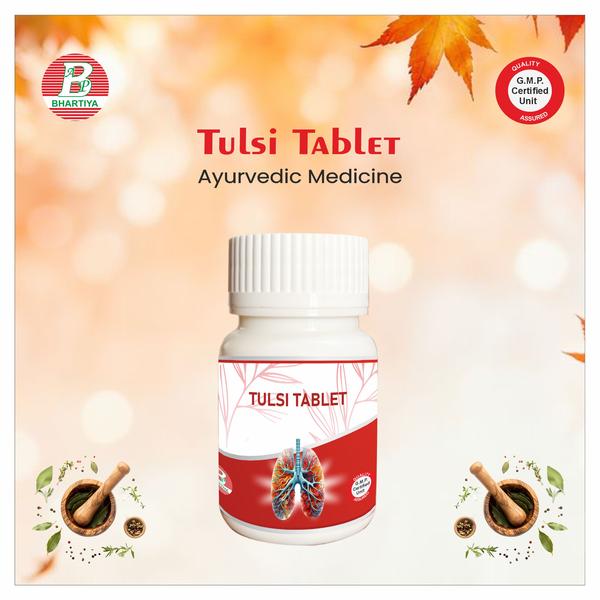
"name": "Tulsi Tablet",
"description": "TULSI (Ocimum sanctum / Ocimum tenuiflorum) \n The Sacred, Divine & Healing Herb of Ayurveda\nTulsi, also known as Holy Basil, is one of the most revered Ayurvedic herbs, worshipped for thousands of years for its spiritual purity, healing power, and protective energy. The name Tulsi means “the incomparable one,” signifying its unmatched medicinal and spiritual importance. In Ayurveda, Tulsi is described as Kaphahara, Vatahara, Hridya, Kasa-Shwasahara, Krimighna, Jwaraghna, and Rasayana. It is highly beneficial in respiratory infections, fever, cough, cold, asthma, immune weakness, digestive problems, skin disorders, stress, and mental imbalance.\n BOTANICAL INFORMATION\nScientific Name: Ocimum sanctum / Ocimum tenuiflorum\nFamily: Lamiaceae\nOrder: Lamiales\nGenus: Ocimum\nSpecies: sanctum / tenuiflorum\nCommon Names:\nSanskrit – Tulsi, Surasa, Parnasa, Gramya-jiraka\nHindi – Tulsi\nEnglish – Holy Basil, Sacred Basil\nTamil – Thulasi\nTelugu – Tulasi\nMalayalam – Tulasi\nKannada – Tulasi\nBengali – Tulshi\nTypes of Tulsi:\n1.\tShri (Green) Tulsi\n2.\tKrishna (Purple) Tulsi\n3.\tVan Tulsi (Wild)\n4.\tKapoor Tulsi (Aromatic)\n5.\tRama Tulsi\n SYNONYMS FROM AYURVEDIC NIGHANTUS\nBhavaprakasha – Tulasi, Surasa, Parnasa\nDhanvantari Nighantu – Tulasi, Mahoshadhi\nKaiyadeva Nighantu – Surasa, Vishaghni\nRaja Nighantu – Tulsi, Krishna Tulsi, Shyamala\n MORPHOLOGY\nPlant Type: Aromatic, erect, highly branched perennial herb\nStem: Quadrangular, purplish or green, soft and slightly hairy\nLeaves: Simple, opposite, ovate or elliptical, highly aromatic, serrated edges\nFlowers: Small, purplish or white, in elongated spikes\nRoots: Fibrous, branched, aromatic\nFruits: Tiny nutlets containing small seeds\n ECOLOGICAL PREFERENCES\nClimate – Tropical & subtropical\nSoil – Well-drained, loamy\nSunlight – Full sun exposure\nMoisture – Moderate watering\nAltitude – Up to 1800 m\nHabitat – Courtyards, temples, gardens, wild areas\n DISTRIBUTION\nWidely found throughout India; also present in Nepal, Sri Lanka, Bangladesh, Indonesia; naturalized worldwide due to religious and medicinal importance.\n CLASSICAL AYURVEDIC PROPERTIES\nRasa: Katu (pungent), Tikta (bitter)\nGuna: Laghu (light), Ruksha (dry), Tikshna (sharp)\nVirya: Ushna (hot)\nVipaka: Katu (pungent)\nDosha Effect: Kapha-Vata shamaka\nKarma (Therapeutic Actions):\nKasa-Shwasahara, Jwaraghna, Krimighna, Hridya, Vishaghna, Rasayana, Balya\n HISTORICAL REFERENCES & STORIES\nVedic Era: Mentioned in Rigveda and Atharva Veda as a herb of purity, protection, and healing.\nCharaka Samhita: Used for Kasa (cough), Shwasa (asthma), Jwara (fever), Krimi (infection), Hridroga (heart disorders).\nSushruta Samhita: Used for skin diseases, poisoning, Kapha disorders, and wound cleansing.\nAshtanga Hridaya: Praised for balancing Kapha, enhancing digestion, boosting intelligence and longevity.\nStory: In ancient texts, a kingdom was protected from epidemic by planting and worshipping Tulsi; it became known as “Vishnu Priya” – beloved of Lord Vishnu, symbolizing purification and protection.\nBhavaprakasha Nighantu: Describes Tulsi as Tikshna, Ushna, Vishaghni, Swasahara, Jwarahara, Rasayana.\n MODERN PHYTOCHEMISTRY\nContains Eugenol, Ursolic acid, Rosmarinic acid, Caryophyllene, Ocimarin, Flavonoids (apigenin, luteolin), essential oils (methyl chavicol, linalool).\n CULTIVATION\nPropagated by seeds, sown in spring or monsoon. Requires sunlight, organic manure; leaves harvested after 2–3 months.\n CLASSICAL DOSAGE (ACCORDING TO GRANATHAS)\n•\tTulsi Churna (Powder): 1–3 g, twice daily\n•\tTulsi Swarasa (Juice): 10–15 ml, 1–2 times daily\n•\tTulsi Kwatha (Decoction): 30–50 ml, twice daily\n•\tTulsi Patra (Leaves): 5–10 fresh leaves daily\n•\tTulsi Ark: 10–20 ml daily\n•\tTulsi Tablet: 1–2 tablets, twice daily after meals\n•\tTulsi Capsule: 1 capsule, twice daily with warm water after meals\nTHERAPEUTIC INDICATIONS\nCough, cold, asthma, fever, viral/bacterial infections, respiratory congestion, stress, anxiety, digestion issues, skin diseases, heart support, immunity enhancement, insect bites, poisoning.\n SAFETY & PRECAUTIONS\nSafe in recommended doses. \nUse cautiously during pregnancy (high doses). \nAvoid with strong anticoagulant drugs. \nSuitable for long-term daily use in small doses.\nTulsi Compound Formulations (Classical): Tulsi with Sitopaladi, Trikatu, Chyawanprash, Ginger & Black Pepper, or Honey/Jaggery—used for cough, asthma, digestion, immunity, and rejuvenation, prepared as per classical Ayurvedic methods.\n Tulsi Formulations by Bhartiya Ayurvedic Pharmacy\nAt Bhartiya Ayurvedic Pharmacy, we prepare a range of Tulsi formulations following classical Ayurvedic methods as described in Charaka Samhita, Sushruta Samhita, Bhavaprakasha Nighantu, and other Ayurvedic Granthas. Each product is crafted to retain the therapeutic potency, purity, and efficacy of the herb, ensuring benefits for immunity, respiratory health, stress relief, and overall vitality\n TULSI TABLET\nDosage:\n1–2 tablets twice daily after meals.\nIndications:\nCough, cold, throat congestion, asthma, fever, low immunity, stress, digestive weakness, skin infections, Kapha disorders, seasonal allergies.\n\nKey Actions (According to Acharya):\nKasa-Shwasahara, Jwaraghna, Krimighna, Vishaghna, Rasayana, Kapha-Vata Hara.\n\n\narogya tulsi tablet, ayurvedic tulsi tablet\nbenefits of tulsi tablet, best time to take tulsi tablets\nbest tulsi, best tulsi in the world, best tulsi powder\nbest tulsi tablet, best tulsi tablets in india\ncan tulsi be taken daily, can tulsi cure cough\ncan tulsi cure fever, did tulsi kumar, how to take tulsi\nhow to take tulsi tablets, how tulsi is good for health\nhow tulsi is used for medicine, how tulsi is useful\ntulasi tablet uses, tulasi tablets uses, tulsi ghan extract tablet\ntulsi mint tablet, tulsi tablet, tulsi tablet amazon\ntulsi tablet amway, tulsi tablet ayurvedic\ntulsi tablet benefits, tulsi tablet benefits in hindi\ntulsi tablet dosage, tulsi tablet for cough, tulsi tablet in hindi\ntulsi tablet ke fayde, tulsi tablet ke fayde in hindi\ntulsi tablet khane ke fayde, tulsi tablet kis kaam aati hai\ntulsi tablet near me, tulsi tablet price, tulsi tablet side effects\ntulsi tablet uses, tulsi tablet uses in hindi\ntulsi tablets benefits, tulsi tablets online\nuses of tulsi tablet",
"price": 180.0,
"discountamount": 90.0,
"currencycode": "INR",
"priority": 1000000,
"isfreeshipmentavailable": false,
"shipmentduration": 1,
"_keywords": null,
"isarchived": false,
"isavailable": true,
"applicationid": null,
"productindex": 31,
"imageuri": "https://productimages.withfloats.com/actual/6981b25567208ae6db48c640.jpg",
"tileimageuri": "https://productimages.withfloats.com/tile/6981b25567208ae6db48c640.jpg",
"images": null,
"totalqueries": 0,
"gpid": null,
"groupproductid": null,
"createdon": "2026-02-03T08:31:15.524Z",
"updatedon": "2026-02-19T09:27:32.358Z",
"buyonlinelink": null,
"producturl": "http://WWW.BHARTIYAAYURVEDICPHARMACY.COM//tulsi-tablet/31",
"availableunits": -1.0,
"iscodavailable": true,
"isprepaidonlineavailable": true,
"maxcodorders": -1,
"maxprepaidonlineorders": -1,
"uniquepaymenturl": null,
"brandname": "",
"category": "Tulsi Tablet 100 - Tab X 24",
"tags": [],
"variants": false,
"keyspecification": null,
"otherspecifications": null,
"pickupaddressreferenceid": null,
"paymenttype": "AssuredPurchase",
"producttype": "products",
"hsncode": null,
"gstslab": 0.0,
"isnotforsale": false
},
{
"_id": "698084369b2383ec7eecaa68",
"fptag": "BHARTIYEAYURVEDICPHARMACY",
"merchantname": null,
"customwidgets": null,
"externalsourceid": null,
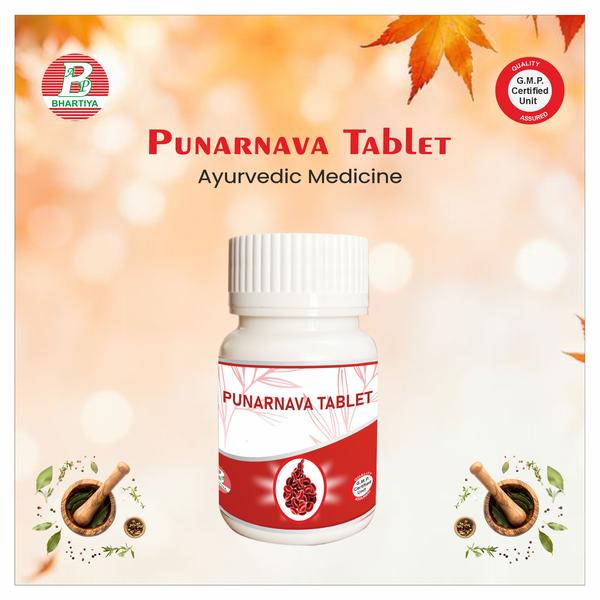
"name": "Punarnava Tablet",
"description": "Punarnava (Boerhavia diffusa) \n The Rejuvenating Herb with Healing Leaves\nPunarnava is one of the most important rejuvenating herbs in Ayurveda, widely valued for its unique ability to revive and renew the body.\nThe name Punarnava literally means “that which becomes new again”, indicating its powerful regenerative and restorative nature.\nIn Ayurveda, Punarnava is classified as a Mutrala (diuretic), Shothahara (anti-inflammatory), and Rasayana (rejuvenative) drug. It is highly beneficial in managing swelling (oedema), kidney disorders, liver weakness, urinary problems, digestive issues, anaemia, and general debility.\nBotanical Information of Punarnava\nScientific Name: Boerhavia diffusa Linn.\nFamily: Nyctaginaceae\nOrder: Caryophyllales\nGenus: Boerhavia\nSpecies: diffusa\nCommon Names:\n•\tSanskrit: Punarnavā, Shothaghanī, Raktapunarnavā, Śvetapunarnavā, Shreṇī, Shoṭikā\n•\tHindi: Punarnava\n•\tEnglish: Spreading Hogweed, Red Spiderling\n•\tTamil: Mookarattai\n•\tTelugu: Atika\n•\tMalayalam: Thazhuthama\n•\tKannada: Komme beru\n•\tBengali: Punarnava\nSynonyms of Punarnava (Boerhavia diffusa) in Ayurvedic Nighantus:\n Bhavaprakasha Nighantu – Shothaghni, Raktapunarnava, Shvetapunarnava, Shoṭikā\n Raja Nighantu & Kaiyadeva Nighantu – Panchanga, Jalapushpa, Mochana, Bhujanga\n Hrudaya Nighantu & Dhanvantari Nighantu – Utkalika, Shreni\n Morphology of Punarnava (Boerhavia diffusa)\nPlant Type: Perennial, creeping, and spreading herb\nStem:\n•\tProstrate or slightly ascending, creeping along the ground\n•\tPurplish-green, hairy, with swollen nodes\n•\tRoots develop at nodes where the stem touches the soil\nLeaves:\n•\tSimple, opposite arrangement\n•\tShape: Ovate, elliptic, or slightly rounded\n•\tTexture: Fleshy and soft\n•\tColor: Dark green on the upper surface, pale green below\n•\tPetiole: Short\nFlowers:\n•\tSmall, tubular, and bisexual\n•\tColor: Pink, reddish, or white\n•\tArranged in axillary clusters (cymes)\n•\tBloom mainly during summer and rainy seasons\nRoots:\n•\tThick, cylindrical, fleshy, and tapering\n•\tColor: White in Shveta Punarnava, reddish in Rakta Punarnava\n•\tMedicinal part, rich in active constituents\nFruits:\n•\tSmall, ovoid, glandular, and sticky when young\n•\tDark brown at maturity\n•\tOne-seeded\nHabit:\n•\tCreeping, spreading, fast-growing, regenerates easily\n•\tAdapted to drought and poor soil conditions\n Ecological Preferences of Punarnava\n•\tClimate: Thrives in tropical and subtropical climates; tolerates heat and moderate drought.\n•\tSoil: Prefers sandy, loamy, or well-drained soils; can grow in poor or degraded soils.\n•\tSunlight: Grows well in full sunlight to partial shade.\n•\tMoisture: Requires moderate moisture; can survive dry periods due to its hardy nature.\n•\tAltitude: Found at low to medium altitudes, commonly in plains and open areas.\n•\tHabitat: Common along roadsides, fields, gardens, wastelands, and riverbanks.\n•\tGrowth habit: Creeping, spreading, fast-growing, and regenerates easily after adverse conditions.\n Distribution of Punarnava\nGeographical Distribution:\nPunarnava is a widely distributed perennial herb found in tropical and subtropical regions across the world.\n•\tIndia: Found throughout the country in almost all states, particularly in plains, dry regions, roadsides, wastelands, and fields.\n•\tAsia: Occurs in Pakistan, Sri Lanka, Bangladesh, Nepal, and Myanmar.\n•\tAfrica: Common in tropical and subtropical Africa.\n•\tAmericas: Found in parts of South America and Central America.\n•\tOther Regions: Naturalized in various tropical areas worldwide due to its hardy and fast-growing nature\n Classical Ayurvedic Properties of Punarnava\n•\tRasa (Taste): Tikta (bitter), Kashaya (astringent)\n•\tGuna (Qualities): Laghu (light), Ruksha (dry)\n•\tVirya (Potency): Ushna (hot)\n•\tVipaka (post-digestive effect): Katu (pungent)\n•\tDosha Effect: Kapha-Vata shamaka (pacifies Kapha and Vata doshas)\n•\tKarma (Actions / Therapeutic Effects):\no\tMutrala: Promotes urination, useful in oedema and urinary disorders\no\tShothahara: Reduces swelling and inflammation\no\tYakrit-Pleeha Shodhaka: Supports liver and spleen health\no\tRasayana: Rejuvenative and revitalizing\no\tHridya: Supports heart function\nTherapeutic Actions of Punarnava According to Acharyas\n1.\tMutrala (Diuretic):\no\tPromotes urine formation, relieves Shotha (edema, ascites, anasarca)\no\tUseful in kidney and urinary disorders\n2.\tShothahara (Anti-inflammatory / Anti-edema):\no\tReduces Kapha and Vata-related swelling\no\tUseful in joint swelling, ascites, and edema\n3.\tYakrit-Pleeha Shodhaka (Hepato-splenic tonic / Detoxifier):\no\tSupports liver and spleen health\no\tClears stagnation in Rakta and Pitta\n4.\tRasayana (Rejuvenative / Revitalizing):\no\tImproves strength, vitality, and general health\no\tEnhances immunity and longevity\n5.\tHridya (Cardio-supportive):\no\tSupports heart function by reducing fluid overload\n6.\tMedohara / Vatashamaka:\no\tHelps in reducing excessive fat (Medo Dhatu) and pacifies Vata dosha in the body\n\nReferences from Acharyas:\n•\tCharaka Samhita: Punarnava is Shothaghni, Mutrala, Rasayana\n•\tSushruta Samhita: Shveta and Rakta Punarnava described for Shotha, Mutra, and Yakrit-Pleeha disorders\n•\tBhavaprakasha: Emphasizes anti-edema, diuretic, hepatoprotective, and rejuvenative actions\n Modern Phytochemistry of Punarnava\nPunarnava is rich in bioactive compounds responsible for its therapeutic properties. Key phytochemicals identified include:\n1. Alkaloids\n•\tPunarnavine – major alkaloid, responsible for diuretic and hepatoprotective activity\n•\tBoeravinones (A–F) – rotenoid compounds with antioxidant, hepatoprotective, and anti-inflammatory properties\n2. Flavonoids\n•\tQuercetin, Kaempferol – contribute to antioxidant and anti-inflammatory effects\n3. Glycosides\n•\tPunarnavoside – responsible for diuretic and anti-edema activity\nSpecies of Punarnava (Genus: Boerhavia)\nThe genus Boerhavia (family Nyctaginaceae) includes several species, but Boerhavia diffusa is the most commonly used in Ayurveda. Other species are also recognized botanically for various regional and medicinal uses:\n1. Boerhavia diffusa Linn.\n•\tMost widely used in Ayurveda\n•\tPerennial, creeping, and spreading herb\n•\tKnown for diuretic, anti-inflammatory, hepatoprotective, and rejuvenative properties\n2. Boerhavia erecta L.\n•\tErect or semi-erect habit, less creeping\n•\tFound in tropical regions\n•\tUsed in traditional medicine locally, but less common in classical Ayurveda\n3. Boerhavia repens L.\n•\tCreeping herb, often used as ground cover\n•\tOccasional medicinal use in folk medicine\n4. Boerhavia coccinea Mill.\n•\tRed-flowered species, creeping habit\n•\tSometimes used in ethnomedicine for fever and inflammation\n5. Boerhavia verticillata Willd.\n•\tFound in Africa and Asia\n•\tLimited medicinal use; occasionally cited in ethnobotanical surveys\nCultivation:\n•\tPropagation: Primarily by seeds; can also propagate via stem cuttings due to its creeping habit.\n•\tSowing Time: Best sown during the early monsoon or rainy season.\n•\tSpacing: Maintain 30–40 cm between plants to allow spreading.\n•\tWatering: Requires moderate moisture; drought-tolerant once established.\n•\tFertilization: Responds well to organic manure or compost, though hardy enough to grow in poor soils.\n•\tHarvesting: Roots, stems, and leaves are harvested after 3–4 months of growth, depending on medicinal use.\n•\tEcological Note: Acts as a pioneer plant, stabilizing soil and growing in degraded lands.\n Classical Dosage of Punarnava in Granthas\n1. Charaka Samhita\nForm: Root or whole plant powder (Churna), decoction (Kwatha)\nDose: 3–6 grams of powder; 40–60 ml of decoction, 2–3 times daily\nUses: Shotha (edema), Mutrakriccha (urinary disorders), Rasayana\n2. Sushruta Samhita\nForm: Root, whole plant, or paste\nDose: 3–6 grams powder; decoction 40–60 ml; external paste as required\nUses: Shotha, Mutra, Yakrit-Pleeha disorders\n3. Bhavaprakasha Nighantu\nForm: Churna, Kwatha, Swarasa (juice)\nDose: 3–6 grams Churna; 40–60 ml Kwatha; 20–30 ml Swarasa 1–2 times daily\nNotes: Shveta Punarnava for urinary issues; Rakta Punarnava for liver and blood disorders\n4. Raja Nighantu & Kaiyadeva Nighantu\nForm: Panchanga (whole plant), decoction, powder\nDose: Similar classical dose as above; 3–6 grams for powder, decoction 40–60 ml\nTherapeutic Use: Shothahara, Mutrala, Rasayana\n\n Safety and Precautions of Punarnava\n Safe in classical dosage.\n Avoid overdose -caution with strong diuretics.\n Pregnant Woman- use only under supervision.\n\n Classical Ayurvedic Formulations of Punarnava\nPunarnava is a key ingredient in many classical Ayurvedic preparations for edema, liver disorders, kidney ailments, and rejuvenation. Common formulations include:\n1. Punarnavadi Kwatha (Decoction)\n•\tIngredients: Punarnava, Trikatu (Pippali, Maricha, Shunthi), Musta, Haritaki, and other supporting herbs\n•\tAction: Diuretic, anti-edema, hepatoprotective, rejuvenative\n•\tIndication: Shotha (edema), Ascites, Mutrakriccha (urinary disorders)\n2. Punarnavadi Churna (Powder)\n•\tIngredients: Punarnava root, Haritaki, Musta, Chitrak, Shunthi\n•\tAction: Supports kidney and liver health, promotes detoxification, reduces swelling\n•\tDose: 3–6 g/day with water or honey\n3. Punarnava Swarasa (Juice)\n•\tForm: Fresh juice of Punarnava root or whole plant\n•\tAction: Diuretic, anti-inflammatory, mild laxative\n•\tDose: 20–30 ml, 1–2 times daily\n4. Punarnava Grita or Taila (Medicated Ghee/Oil)\n•\tUsage: External application for swelling, inflammation, and joint disorders\n•\tAction: Shothahara, soothing, and rejuvenative\n5. Compound Formulations\n•\tPunarnavadi Kashaya, Punarnavadi Gutika, Punarnavadi Avaleha – used in liver disorders, urinary diseases, edema, and general rejuvenation.\n Punarnava Formulations by Bhartiya Ayurvedic Pharmacy\nAt Bhartiya Ayurvedic Pharmacy, we prepare a range of Punarnava (Boerhavia diffusa) formulations following classical Ayurvedic methods as described in Charaka Samhita, Sushruta Samhita, Bhav Prakash Nighantu, and other Ayurvedic Granthas. Each product is crafted to retain the therapeutic potency, purity, and efficacy of the herb, ensuring benefits for fluid balance, kidney & liver support, detoxification, and rejuvenation.\n1. Punarnava Tablet\nDescription:\nPunarnava Tablets contain standardized powdered extract of Boerhavia diffusa, providing a convenient dosage form for daily use.\nKey Actions:\n•\tSupports normal urinary output and reduces mild water retention\n•\tPromotes liver and kidney health\n•\tReduces swelling (Edema)\n•\tBeneficial in cough or intestinal colic\n•\tIt can help lower the blood pressure\n•\tProvides general detox and rejuvenation\nDosage:\n•\t1–2 tablets twice daily after meals, or as advised by an Ayurvedic practitioner\nPrecautions:\n•\tUse under guidance in pregnancy, kidney disorders, or excessive fluid loss\n•\tMaintain recommended dosage\n\n\n\nbest punarnava tablet, best punarnava tablets, best time to take punarnava tablets\ncan anyone take punarnava, can i take punarnava daily, how to drink punarnava\nhow to take punarnava tablet, how to take punarnava tablets, \nhow to use punarnava for weight loss, how to use punarnava tablet\npunarnava plant tablet, punarnava tablet, punarnava tablet ayurvedic\npunarnava tablet benefits, punarnava tablet benefits in hindi\npunarnava tablet composition, punarnava tablet dosage\npunarnava tablet flipkart, punarnava tablet hindi\npunarnava tablet how to use, punarnava tablet in hindi\npunarnava tablet ingredients, punarnava tablet kab lena chahiye\npunarnava tablet kaise khaye, punarnava tablet ke fayde\npunarnava tablet ke fayde in hindi, punarnava tablet ke labh\npunarnava tablet kya hai, punarnava tablet lene ke fayde\npunarnava tablet online, punarnava tablet price\npunarnava tablet quality, punarnava tablet quantity\npunarnava tablet uses, punarnava tablet uses hindi\npunarnava tablet uses in hindi, punarnava tablets amazon\npunarnava tablets benefits, punarnava tablets benefits in hindi\npunarnava tablets near me, punarnava tablets price in india\npunarnava tablets reviews, punarnava tablets uses\npunarnava tablets when to take, what is punarnava tablet",
"price": 180.0,
"discountamount": 90.0,
"currencycode": "INR",
"priority": 1000000,
"isfreeshipmentavailable": false,
"shipmentduration": 1,
"_keywords": null,
"isarchived": false,
"isavailable": true,
"applicationid": null,
"productindex": 29,
"imageuri": "https://productimages.withfloats.com/actual/69808437fc3cf1d183418882.jpg",
"tileimageuri": "https://productimages.withfloats.com/tile/69808437fc3cf1d183418882.jpg",
"images": null,
"totalqueries": 0,
"gpid": null,
"groupproductid": null,
"createdon": "2026-02-02T11:02:14.772Z",
"updatedon": "2026-02-19T11:12:54.092Z",
"buyonlinelink": null,
"producturl": "http://WWW.BHARTIYAAYURVEDICPHARMACY.COM//punarnava-tablet/29",
"availableunits": -1.0,
"iscodavailable": true,
"isprepaidonlineavailable": true,
"maxcodorders": 0,
"maxprepaidonlineorders": -1,
"uniquepaymenturl": null,
"brandname": "Bakula Fort",
"category": "Punarnava Tablet 100 - Tab X 24",
"tags": [],
"variants": false,
"keyspecification": null,
"otherspecifications": null,
"pickupaddressreferenceid": null,
"paymenttype": "AssuredPurchase",
"producttype": "products",
"hsncode": null,
"gstslab": 0.0,
"isnotforsale": false
},
{
"_id": "6aa14233d555b883cd377ce6",
"fptag": "BHARTIYEAYURVEDICPHARMACY",
"merchantname": null,
"customwidgets": null,
"externalsourceid": null,
"name": "MAHA RASNADI KWATH",
"description": " MAHA RASNADI KWATH \n\nProduct Identification\nGeneric Name: Maha Rasnadi Kwath\nType: Ayurvedic Polyherbal Decoction (Kwath/Kashaya)\nPrimary Indication Area: Joint disorders, musculoskeletal health, inflammatory conditions, arthritis, neurological disorders associated with Vata imbalance, back pain, sciatica, and post-illness weakness.\n\nTherapeutic Indications (Traditional Ayurvedic Uses)\n• Amavata (Rheumatoid arthritis)\n• Sandhivata (Osteoarthritis)\n• Katigraha (Low back pain)\n• Gridhrasi (Sciatica)\n• Manyastambha (Cervical spondylosis/neck stiffness)\n• Pakshaghata (Hemiplegia/paralytic disorders)\n• Vatarakta (Gout)\n• Asthi-Sandhi Shoola (Bone and joint pain)\n• Musculoskeletal stiffness associated with Vata disorders\n• General weakness and restricted mobility\n\nKey Benefits\n• Supports healthy joint function\n• Helps maintain mobility and flexibility\n• Supports musculoskeletal health\n• Helps reduce joint stiffness\n• Supports healthy inflammatory balance according to Ayurvedic principles\n• Promotes comfort in muscles and joints\n• Supports nervous system function\n• Helps maintain healthy circulation in musculoskeletal tissues\n• Provides antioxidant and rejuvenative herbal support\n• Supports overall physical strength and mobility\n\nFormula\nFORMULA\nMain Ingredients\n• Rasna Patra (Pluchea lanceolata – leaves)\n• Dhamasa (Fagonia cretica)\n• Erandmool (Ricinus communis – root)\n• Devdaru (Cedrus deodara)\n• Kachur (Curcuma zedoaria)\n• Vacha (Acorus calamus)\n• Vasa (Justicia adhatoda)\n• Saunth (Zingiber officinale – dry ginger)\n• Harad (Terminalia chebula)\n• Nagarmotha (Cyperus rotundus)\n• Punarnava Mool (Boerhavia diffusa – root)\n• Giloy (Tinospora cordifolia)\n• Vidara (Pueraria tuberosa / Ipomoea digitata – regional variation)\n• Saunf (Foeniculum vulgare)\n• Gokshuru (Tribulus terrestris)\n• Ashwagandha (Withania somnifera)\n• Atis (Aconitum heterophyllum)\n• Amla (Emblica officinalis / Phyllanthus emblica)\n• Shatavari (Asparagus racemosus)\n• Pippali (Piper longum)\n• Piyavasa \n• Dhaniya (Coriandrum sativum)\n• Choti Kateri (Solanum surattense)\n• Badi Kateri (Solanum indicum)\n• Dhataki (Woodfordia fruticosa \n1. Rasna Patra\nBotanical Name: Pluchea lanceolata\n• Rasa: Tikta, Katu\n• Guna: Laghu, Ruksha\n• Virya: Ushna\n• Vipaka: Katu\nMechanism / Properties\n• Strong Vata-pacifying herb\n• Anti-inflammatory and analgesic action\n• Supports joint, nerve, and muscular pain relief\n• Reduces stiffness and swelling\n\n2. Dhamasa\nBotanical Name: Fagonia cretica\n• Rasa: Tikta, Kashaya\n• Guna: Laghu, Ruksha\n• Virya: Sheeta\n• Vipaka: Katu\nMechanism\n• Blood purifying (Rakta shodhana) action\n• Supports liver detoxification\n• Anti-inflammatory and antioxidant activity\n• Used in skin and metabolic disorders\n\n3. Erandmool\nBotanical Name: Ricinus communis (root)\n• Rasa: Madhura, Katu\n• Guna: Guru, Snigdha\n• Virya: Ushna\n• Vipaka: Madhura\nMechanism\n• Strong Vata shamak action\n• Analgesic and anti-inflammatory\n• Helps relieve constipation and urinary obstruction\n• Supports pain and swelling reduction\n\n4. Devdaru\nBotanical Name: Cedrus deodara\n• Rasa: Tikta, Kashaya\n• Guna: Laghu, Tikshna\n• Virya: Ushna\n• Vipaka: Katu\nMechanism\n• Potent anti-inflammatory and analgesic\n• Reduces obstruction in channels (Srotoshodhana)\n• Supports urinary and musculoskeletal health\n• Relieves swelling and pain\n\n5. Kachur\nBotanical Name: Curcuma zedoaria\n• Rasa: Tikta, Katu\n• Guna: Laghu, Ruksha\n• Virya: Ushna\n• Vipaka: Katu\nMechanism\n• Digestive stimulant (Agni deepana)\n• Anti-inflammatory and anti-microbial\n• Reduces Ama (toxins)\n• Supports metabolic cleansing\n\n6. Vacha\nBotanical Name: Acorus calamus\n• Rasa: Katu, Tikta\n• Guna: Laghu, Tikshna\n• Virya: Ushna\n• Vipaka: Katu\nMechanism\n• Srotoshodhana (channel cleansing)\n• Nervine stimulant\n• Anti-inflammatory and detoxifying\n• Supports neurological balance\n\n7. Vasa\nBotanical Name: Justicia adhatoda\n• Rasa: Tikta, Kashaya\n• Guna: Laghu, Ruksha\n• Virya: Sheeta\n• Vipaka: Katu\nMechanism\n• Hemostatic (controls bleeding)\n• Anti-inflammatory and bronchodilator\n• Supports blood purification\n• Tissue protective action\n\n8. Saunth\nBotanical Name: Zingiber officinale (dry ginger)\n• Rasa: Katu\n• Guna: Laghu, Snigdha\n• Virya: Ushna\n• Vipaka: Madhura\nMechanism\n• Enhances digestion and absorption\n• Anti-inflammatory and carminative\n• Reduces Ama formation\n• Improves circulation\n\n9. Harad\nBotanical Name: Terminalia chebula\n• Rasa: Pancharasa (except Lavana)\n• Guna: Laghu, Ruksha\n• Virya: Ushna\n• Vipaka: Madhura\nMechanism\n• Mild laxative and detoxifying\n• Rasayana (rejuvenator)\n• Supports digestion and gut health\n• Antioxidant action\n\n10. Nagarmotha\nBotanical Name: Cyperus rotundus\n• Rasa: Tikta, Katu, Kashaya\n• Guna: Laghu, Ruksha\n• Virya: Sheeta\n• Vipaka: Katu\nMechanism\n• Digestive and metabolic regulator\n• Anti-inflammatory\n• Supports urinary balance\n• Reduces Kapha and Ama\n\n11. Punarnava Mool\nBotanical Name: Boerhavia diffusa\n• Rasa: Tikta, Madhura, Kashaya\n• Guna: Laghu, Ruksha\n• Virya: Ushna\n• Vipaka: Katu\nMechanism\n• Natural diuretic (Mutrala)\n• Reduces edema and swelling\n• Supports kidney function\n• Anti-inflammatory\n\n12. Giloy\nBotanical Name: Tinospora cordifolia\n• Rasa: Tikta, Kashaya\n• Guna: Laghu, Snigdha\n• Virya: Ushna\n• Vipaka: Madhura\nMechanism\n• Immunomodulator\n• Detoxifying and anti-inflammatory\n• Supports fever and infection resistance\n• Rasayana herb\n\n13. Vidara\nBotanical Name: Pueraria tuberosa / Ipomoea digitata\n• Rasa: Madhura\n• Guna: Guru, Snigdha\n• Virya: Sheeta\n• Vipaka: Madhura\nMechanism\n• Rejuvenative tonic\n• Strengthens tissues and vitality\n• Supports Vata disorders\n• Nutritive and restorative\n\n14. Saunf\nBotanical Name: Foeniculum vulgare\n• Rasa: Madhura, Katu\n• Guna: Laghu, Snigdha\n• Virya: Sheeta\n• Vipaka: Madhura\nMechanism\n• Carminative and digestive\n• Mild diuretic\n• Reduces bloating and acidity\n• Soothes urinary tract\n\n15. Gokshura\nBotanical Name: Tribulus terrestris\n• Rasa: Madhura\n• Guna: Guru, Snigdha\n• Virya: Sheeta\n• Vipaka: Madhura\nMechanism\n• Strong urinary tonic\n• Supports kidney and bladder health\n• Promotes smooth urine flow\n• Aphrodisiac and rejuvenative\n\n16. Ashwagandha\nBotanical Name: Withania somnifera\n• Rasa: Tikta, Kashaya\n• Guna: Guru, Snigdha\n• Virya: Ushna\n• Vipaka: Madhura\nMechanism\n• Adaptogen (stress reducer)\n• Strengthens nervous system\n• Improves vitality and stamina\n• Vata balancing Rasayana\n\n17. Atis\nBotanical Name: Aconitum heterophyllum\n• Rasa: Tikta, Kashaya\n• Guna: Laghu, Ruksha\n• Virya: Ushna (mild)\n• Vipaka: Katu\nMechanism\n• Digestive stimulant\n• Antipyretic (fever reducing)\n• Anti-inflammatory\n• Helps toxin reduction\n\n18. Amla\nBotanical Name: Phyllanthus emblica\n• Rasa: Amla (sour dominant)\n• Guna: Laghu, Ruksha\n• Virya: Sheeta\n• Vipaka: Madhura\nMechanism\n• Strong antioxidant (Vitamin C rich)\n• Rasayana (rejuvenator)\n• Supports immunity\n• Tissue repair and regeneration\n\n19. Shatavari\nBotanical Name: Asparagus racemosus\n• Rasa: Madhura, Tikta\n• Guna: Guru, Snigdha\n• Virya: Sheeta\n• Vipaka: Madhura\nMechanism\n• Female reproductive tonic\n• Hormonal balancing support\n• Cooling and nutritive\n• Supports lactation and fertility health\n\n20. Pippali\nBotanical Name: Piper longum\n• Rasa: Katu\n• Guna: Laghu, Snigdha\n• Virya: Anushna-Ushna\n• Vipaka: Madhura\nMechanism\n• Bioavailability enhancer (Yogavahi)\n• Improves digestion and metabolism\n• Respiratory and urinary support\n• Detox enhancing herb\n\n21. Piyavasa\nBotanical Name: (Regionally variable; often hepatoprotective bitter herb)\n• Rasa: Tikta, Kashaya\n• Guna: Laghu, Ruksha\n• Virya: Sheeta/Ushna (varies)\n• Vipaka: Katu\nMechanism\n• Liver detox support\n• Bitter tonic action\n• Supports metabolic balance\n• Anti-inflammatory\n\n22. Dhaniya\nBotanical Name: Coriandrum sativum\n• Rasa: Madhura, Tikta\n• Guna: Laghu\n• Virya: Sheeta\n• Vipaka: Madhura\nMechanism\n• Cooling diuretic\n• Reduces burning urination\n• Digestive soothing\n• Anti-inflammatory\n\n23. Choti Kateri\nBotanical Name: Solanum surattense\n• Rasa: Tikta, Katu\n• Guna: Laghu, Ruksha\n• Virya: Ushna\n• Vipaka: Katu\nMechanism\n• Respiratory and urinary support\n• Anti-inflammatory\n• Vata-Kapha balancing\n• Pain relief support\n\n24. Badi Kateri\nBotanical Name: Solanum indicum\n• Rasa: Tikta, Katu\n• Guna: Laghu, Ruksha\n• Virya: Ushna\n• Vipaka: Katu\nMechanism\n• Anti-inflammatory and analgesic\n• Supports respiratory health\n• Reduces swelling and pain\n• Channel cleansing action\n\n25. Dhataki\nBotanical Name: Woodfordia fruticosa\n• Rasa: Kashaya\n• Guna: Laghu, Ruksha\n• Virya: Ushna\n• Vipaka: Katu\n• Prabhava: Sandhana Karaka\nMechanism\n• Natural fermentation catalyst\n• Enables Asava/Kwath preparation\n• Improves bioavailability\n• Preserves formulation stability\n\nDosage of Maharasnadi Kwath (Pravahi)\nAdults\n• Dose: 15–30 mL\n• Frequency: Twice daily (BID)\n• Administration: After meals\n• Anupana (vehicle): Equal quantity of lukewarm water\n\nGeneral Clinical Practice Range (Ayurvedic Use)\n• Mild conditions: 15 mL BD\n• Moderate conditions: 20–30 mL BD\n• Chronic Vata disorders / pain conditions: 25–30 mL BD (as advised)\n\nDuration\n• Usually 2–6 weeks\n• Can be extended up to 8 weeks under Ayurvedic supervision\n\nImportant Usage Notes\n• Shake well before use (as herbal sediment may settle)\n• Best taken after food to improve tolerance\n• Avoid self-medication in chronic kidney disease or severe urinary obstruction\n• Use cautiously in diabetes (may contain natural sugars from fermentation)\n• Not recommended during pregnancy without physician advice\n\n\n\n\n\nmaha rasnadi kwath uses in hindi\nmaha rasnadi kwath uses\nmaharasnadi kwatham\nmaha rasnadi kwath easy ayurveda\nrasnadi kashayam ingredients\nrasnadi kashayam benefits\nrasnadi ghritam uses\nmaharasnadi kwath amazon\nmaharasnadi kwath ayurvedic medicine\nmaharasnadi kwath ayurvedic\nmaharasnadi kwath ayurveda\nmaharasnadi kwath pravahi ayurvedic medicine\nmaharasnadi kwath benefits\nmaharasnadi kwath benefits in hindi\nmaharasnadi kwath botanical name\nmaharasnadi kwath buy online\nmaharasnadi kwath churna uses in hindi\nmaharasnadi kwath contents\nmaharasnadi kwath composition\nmaharasnadi kwath capsules\nmaharasnadi kwath kis chij ki dava hai\nmaharasnadi kwath dosage\ndivya maharasnadi kwath\ndabur maharasnadi kwath kadha\nmaharasnadi kwath easy ayurveda\nmaharasnadi kwath ke fayde\nmaharasnadi kwath ke fayde in hindi\nmaharasnadi kwath ghan\nmaharasnadi kwath how to use\nmaharasnadi kwath kya hai\nmaharasnadi kwath uses hindi\nmaharasnadi kwath benefits hindi\nmaharasnadi kwath ingredients\nmaharasnadi kwath in hindi\nmaharasnadi kwath ingredients in hindi\nmaharasnadi kwath indication\nmaharasnadi kwath is used for\nmaharasnadi kwath jiva ayurveda\nmaharasnadi kwath jiva\nmaharasnadi kwath kis kaam aata hai\nmaharasnadi kwath kaise use kare\nmaharasnadi kwath kya kam karta hai\nmaharasnadi kwath liquid\nmaharasnadi kwath ke labh\nmaharasnadi kwath medicine\nmaharasnadi kwath 200 ml\nmaharasnadi kwath hindi mein\nmaharasnadi kwath online\nuses of maharasnadi kwath\nbenefits of maharasnadi kwath\ningredients of maharasnadi kwath\nuses of maharasnadi kwath in hindi\nmaharasnadi kwath price\nmaharasnadi kwath peene ke fayde\nmaha rasnadi kwath q10\nmaharasnadi kwath reference\nmaharasnadi kwath review\nmaharasnadi kwath research paper\nmaharasnadi kwath syrup uses in hindi\nmaharasnadi kwath syrup uses\nmaharasnadi kwath syrup\nhow maha rasnadi kwath works\nhow maha rasnadi kwath is made\nhow maha rasnadi kwath use\nwhy maha rasnadi kwath useful",
"price": 210.0,
"discountamount": 105.0,
"currencycode": "INR",
"priority": 1000000,
"isfreeshipmentavailable": false,
"shipmentduration": 1,
"_keywords": null,
"isarchived": false,
"isavailable": true,
"applicationid": null,
"productindex": 175,
"imageuri": "https://productimages.withfloats.com/actual/6aa14237850fddb69be31772.jpg",
"tileimageuri": "https://productimages.withfloats.com/tile/6aa14237850fddb69be31772.jpg",
"images": null,
"totalqueries": 0,
"gpid": null,
"groupproductid": null,
"createdon": "2026-09-09T11:25:39.849Z",
"updatedon": "2026-09-09T11:25:39.849Z",
"buyonlinelink": null,
"producturl": "http://WWW.BHARTIYAAYURVEDICPHARMACY.COM//maha-rasnadi-kwath/175",
"availableunits": -1.0,
"iscodavailable": true,
"isprepaidonlineavailable": true,
"maxcodorders": -1,
"maxprepaidonlineorders": -1,
"uniquepaymenturl": null,
"brandname": "Bakula Fort",
"category": "MAHA RASNADI KWATH 450 ML X 40",
"tags": [],
"variants": false,
"keyspecification": null,
"otherspecifications": null,
"pickupaddressreferenceid": null,
"paymenttype": "AssuredPurchase",
"producttype": "products",
"hsncode": null,
"gstslab": 0.0,
"isnotforsale": false
},
{
"_id": "6a475d9752249d9470d412b8",
"fptag": "BHARTIYEAYURVEDICPHARMACY",
"merchantname": null,
"customwidgets": null,
"externalsourceid": null,
"name": "Lakshadi Guggal",
"description": "\n LAKSHADI GUGGUL\n\nProduct Identification \n•\tGeneric Name: Laksha Guggulu (also known as Lakshadi Guggul)\n•\tType: Ayurvedic Polyherbal Formulation\n•\tPrimary Indication Area: Bone health, fracture healing, and bone mineral density support.\n•\tTherapeutic Indications: Traditionally used for managing bone fractures (Asthibhanga), joint dislocations (Sandhimukti), osteoporosis, osteopenia, bone sprains, and general bone weakness (Asthikshaya).\n\nKey Benefits:\n•\tAccelerates Fracture Healing: Speeds up the reunion of broken bones, stimulates callus formation, and hastens the overall calcification process.\n•\tEnhances Bone Density: Supplies natural organic calcium to strengthen weak bones, helping to manage and prevent osteoporosis and osteopenia.\n•\tHeals Dislocations & Trauma: Restores joint stability after dislocations, relieves severe sprains, and heals deep tissue strain.\n•\tReduces Pain & Swelling: Alleviates localized inflammation, joint stiffness, and musculoskeletal pain due to its strong Vata-balancing properties.\n•\tPrevents Bone Degeneration: Protects bone tissue matrix from premature wear and tear, reducing the risk of frequent fractures in old age.\nFORMULA\nEach Tablet contains: \nLaksha \t5 part\nShuddha Guggulu\t1 part\nHadjod / Asthisamharaka\t1 part\nArjuna\t1 part\nAshwagandha\t1 part\nNagabala \t1 part\n\t\n\nIngredients:\n1. Laksha (Lac Resin) \n•\tBotanical/Scientific Name: Laccifer lacca \n•\tRasa–Guna–Vīrya–Vipāka:\no\tRasa: Kaṣāya (Astringent)\no\tGuna: Laghu (Light), Snigdha (Unctuous/Oily)\no\tVīrya: Śīta (Cooling)\no\tVipāka: Kaṭu (Pungent) \n•\tPrabhāva: Sandhānīya (Promotes the rapid unification and binding of fractured bones or tissues) \nMechanism of Action (Karma):\n•\tAsthi-Sandhānaka Karma: Directly stimulates cell proliferation in bone tissue, fastening the calcification and bridging of broken bones.\n•\tRakta-Stambhana Karma: Acts as a natural hemostatic agent, helping arrest internal bleeding or bruising around trauma zones.\n•\tVrana-Ropaṇa Karma: Accelerates the healing of deeply situated internal wounds and soft tissue tears accompanying bone trauma.\n•\tKaphahara Karma: Liquefies and scraps out morbid accumulation of sticky Kapha from metabolic channels. \n\n2. Hadjod / Asthisamharaka (Bone Setter Stem)\n•\tBotanical/Scientific Name: Cissus quadrangularis Linn. \n•\tRasa–Guna–Vīrya–Vipāka:\no\tRasa: Madhura (Sweet), Kaṭu (Pungent)\no\tGuna: Laghu (Light), Rūkṣa (Dry), Tikṣṇa (Piercing)\no\tVīrya: Uṣṇa (Heating)\no\tVipāka: Kaṭu (Pungent) \n•\tPrabhāva: Asthi-Yojaka (The definitive natural bone patcher and alignment restorer) \nMechanism of Action (Karma):\n•\tAsthibhanga-Nāśaka Karma: Speeds up early cortical bone healing by promoting osteoblastic activity and early callus formation.\n•\tŚothahara & Śūlahara Karma: Relieves the local, intense throbbing pain and inflammatory edema following boe or joint fractures.\n•\tDāḍhya-Kara Karma: Enhances structural strength, mechanical resilience, and elasticity of the growing bone matrix.\n•\tVāta-Hara Karma: pacifies the aggravated Vata localized at bone structures (Asthigata Vata), minimizing deep bone aches. \n\n3. Arjuna (Arjun Bark) \n•\tBotanical/Scientific Name: Terminalia arjuna \n•\tRasa–Guna–Vīrya–Vipāka:\no\tRasa: Kaṣāya (Astringent)\no\tGuna: Laghu (Light), Rūkṣa (Dry)\no\tVīrya: Śīta (Cooling)\no\tVipāka: Kaṭu (Pungent) \n•\tPrabhāva: Hṛdaya & Sandhānākara (Cardioprotective and systematic structural binder) \nMechanism of Action (Karma):\n•\tAsthi-Draḍhyakara Karma: Infuses raw bio-available calcium and minerals directly into the bone matrix to counteract osteoporosis.\n•\tBhagna-Sandhāna Karma: Aids the structural matrix bonding process, solidifying the collagen foundations of broken bones.\n•\tRakta-Prasādana Karma: Optimizes local blood circulation and removes systemic toxins, providing nutrient-rich blood supply to damaged tissues.\n•\tKaphapitta-Hara Karma: Successfully neutralizes excess Kapha-induced swelling and reduces localized Pitta-induced burning sensations. \n\n4. Ashwagandha (Indian Ginseng Root) \n•\tBotanical/Scientific Name: Withania somnifera \n•\tRasa–Guna–Vīrya–Vipāka:\no\tRasa: Madhura (Sweet), Tikta (Bitter), Kaṭu (Pungent)\no\tGuna: Laghu (Light), Snigdha (Unctuous)\no\tVīrya: Uṣṇa (Heating)\no\tVipāka: Madhura (Sweet) \n•\tPrabhāva: Rasāyana & Balya (Deep tissue rejuvenator and skeletal muscle toner) \nMechanism of Action (Karma):\n•\tMāmsa-Asthi Balya Karma: Significantly reinforces skeletal muscles, ligaments, and tendons surrounding injured joints.\n•\tVāta-Śamana Karma: Calms hyperactive nervous systems and reduces neurological pain like sciatica or slip disc aches.\n•\tŚothahara Karma: Reduces joint space swelling, stiffness, and degenerative changes seen in chronic arthritis.\n•\tBṛmhaṇa Karma: Counters overall systemic weakness, fatigue, and prevents stress-mediated degradation of bone tissue. \n\n5. Nagabala (Snake Mallow Root) \n•\tBotanical/Scientific Name: Grewia hirsuta / Sida veronicaefolia \n•\tRasa–Guna–Vīrya–Vipāka:\no\tRasa: Madhura (Sweet), Kaṣāya (Astringent)\no\tGuna: Guru (Heavy), Snigdha (Unctuous), Picchila (Slimy)\no\tVīrya: Śīta (Cooling)\no\tVipāka: Madhura (Sweet) \n•\tPrabhāva: Rasāyana (Tissue anti-aging and long-term musculoskeletal revitalizer) \nMechanism of Action (Karma):\n•\tBalya & Bṛmhaṇa Karma: Restores deep physical stamina and stops progressive muscular or skeletal wasting (Asthikshaya).\n•\tVāta-Pitta Śamaka Karma: pacifies both structural Vata (pain) and tissue-burning Pitta (inflammation).\n•\tOjo-Vardhaka Karma: Elevates bodily immunity and structural endurance, allowing faster recovery from traumatic exhaustion.\n•\tKṣatachina-Ropaṇa Karma: Heals deep degenerative erosions inside the articular cartilage and synovial joint cavities.\n\n6. Shuddha Guggulu (Purified Oleo-Gum Resin)\n•\tBotanical/Scientific Name: Commiphora mukul \n•\tRasa–Guna–Vīrya–Vipāka:\no\tRasa: Tikta (Bitter), Kaṭu (Pungent)\no\tGuna: Laghu (Light), Rūkṣa (Dry), Tikṣṇa (Piercing), Sūkṣma (Minute/Subtle)\no\tVīrya: Uṣṇa (Heating)\no\tVipāka: Kaṭu (Pungent) \n•\tPrabhāva: Tridoṣa-Hara & Yogavāhī (Catalyst herb that carries and amplifies the properties of all other ingredients directly to deep bone layers)\nMechanism of Action (Karma):\n•\tŚothahara & Vedanā-Sthāpana Karma: Provides potent natural anti-inflammatory and pain-relieving effects on joints, mimicking analgesic compounds.\n& Lekhana Karma: Clears out congested metabolic channels and scrapes out morbid Ama (toxins) blocking structural tissues.\n•\tVāta-Vyādhi Nāśaka Karma: The ultimate Ayurvedic defense against chronic neural, joint, and bone degeneration disorders caused by Vata.\n•\tRasāyana Karma: Rejuvenates cellular longevity across all structural frames of the skeletal system. \n\nGeneral Ayurvedic dosage (adults):\nTablet/Capsule: 1–2 tablets (250–500 mg each)\n Frequency: 2 times a day\n Timing: After food (usually with lukewarm water)\n\nlakshadi guggul, lakshadi guggul uses in hindi, lakshadi guggul benefits in hindi\nlakshadi guggul uses, lakshadi guggul in hindi, lakshadi guggul ke fayde\nlakshadi guggul tablet uses in hindi, lakshadi guggul side effects\nlakshadi guggul ingredients, lakshadi guggul ayurvedic medicine\nlakshadi guggul amazon, ayurvedic lakshadi guggul, lakshadi guggul ayurvedic dawa\nlakshadi guggul easy ayurveda, what is lakshadi guggul, lakshadi guggul price\nlakshadi guggul benefits, lakshadi guggul buy online, lakshadi guggul benefits in telugu\nlakshadi guggul best brand, lakshadi guggul buy, lakshadi guggul benefits\nlakshadi guggul content, lakshadi guggul composition, lakshadi guggul contains\nlakshadi guggul dosage, lakshadi guggul divya, lakshadi guggul uses easy ayurveda\nlakshadi guggulu easy ayurveda, lakshadi guggul in english, lakshadi guggul for muscle pain\nlakshadi guggul fayde, lakshadi guggul for fracture, lakshadi guggul for knee pain\nlakshadi guggul ke fayde in hindi, lakshadi guggul goli, lakshadi guggul ke fayde nuksan\nlakshadi guggul hindi, lakshadi guggul how to take, lakshadi guggul how to use\nlakshadi guggul himalaya, benefits of lakshadi guggul in hindi, lakshadi guggul uses hindi \nlakshadi guggul vs hadjod, lakshadi guggul ingredients in hindi, lakshadi guggul image\nlakshadi guggul is used for, lakshadi guggul kis kaam aata hai, lakshadi guggul kaise khaye\nlakshadi guggul ka upyog, lakshadi guggul kya kam karta hai, lakshadi guggul khane ke fayde\nlakshadi guggul ke fayde aur nuksan, lakshadi guggul ke nuksan, lakshadi guggul kya hai\nlakshadi guggul reviews, lakshadi guggul latin name, lakshadi guggul medicine\nlakshadi guggul mrp, lakshadi guggul with milk, lakshadi guggul uses marathi\nlakshadi guggulu near me, multani lakshadi guggul price, lakshadi guggul online\nbenefits of lakshadi guggul, uses of lakshadi guggul, use of lakshadi guggul in hindi\ndose of lakshadi guggul, lakshadi guggul powder, lakshadi guggul indication\nlakshadi guggul research paper, lakshadi guggul reference, lakshadi guggul rate\nlakshadi guggul tablets benefits, lakshadi guggul tab, lakshadi guggulu uses in hindi\nlakshadi guggulu uses, lakshadi guggulu benefits in hindi, lakshadi guggulu ingredients\nlakshadi guggulu tablet uses, lakshadi guggulu tablet uses in hindi, vyas lakshadi guggul\nlakshadi guggul when to take, what is lakshadi guggul used for, lakshadi guggul flipkart\nayurvedic lakshadweep google, ayurvedic medicine lakshadi guggul, lakshadi guggul ayurvedic\ningredients in lakshadi guggul, function of lakshadi guggul, himalaya lakshadi guggul\nis guggul good for liver, tab lakshadi guggul, lakshadi guggul tablets, lakshadi guggul oil benefits\nwill lakshadi guggul, do lakshadi guggul, does lakshadi guggul, was lakshadi guggul, was lakshadi guggulu\nwas lakshadi guggul uses in hindi, best lakshadi guggul, which guggul is best for weight loss\nbest guggul for arthritis, best guggul in india, best guggulu, top lakshadi guggul",
"price": 330.0,
"discountamount": 165.0,
"currencycode": "INR",
"priority": 1000000,
"isfreeshipmentavailable": false,
"shipmentduration": 1,
"_keywords": null,
"isarchived": false,
"isavailable": true,
"applicationid": null,
"productindex": 143,
"imageuri": "https://productimages.withfloats.com/actual/6a475d99376427080a93197a.jpg",
"tileimageuri": "https://productimages.withfloats.com/tile/6a475d99376427080a93197a.jpg",
"images": null,
"totalqueries": 0,
"gpid": null,
"groupproductid": null,
"createdon": "2026-07-03T06:58:31.487Z",
"updatedon": "2026-07-03T06:58:31.487Z",
"buyonlinelink": null,
"producturl": "http://WWW.BHARTIYAAYURVEDICPHARMACY.COM//lakshadi-guggal/143",
"availableunits": -1.0,
"iscodavailable": true,
"isprepaidonlineavailable": true,
"maxcodorders": -1,
"maxprepaidonlineorders": -1,
"uniquepaymenturl": null,
"brandname": "Bakula Fort",
"category": "Lakshadi Guggal 100 gm X 330",
"tags": [],
"variants": false,
"keyspecification": null,
"otherspecifications": null,
"pickupaddressreferenceid": null,
"paymenttype": "AssuredPurchase",
"producttype": "products",
"hsncode": null,
"gstslab": 0.0,
"isnotforsale": false
}
],
"hasmoreitems": false,
"isapirequest": false,
"totalresults": 27,
"query": null,
"floatingpoint": null
}