BHARTIYEAYURVEDICPHARMACY
Products
08048126861
919711305254
Chat with us


Chat with us on WhatsApp
×
This is your website preview.
Currently it only shows your basic business info. Start adding relevant business details such as description, images and products or services to gain your customers attention by using Boost 360 android app / iOS App / web portal.
Home
 nerves stabilizing
 nerves stabilizing
Items tagged with 'nerves stabilizing'
{
"products": [
{
"_id": "69808eef911df6d4b0db3166",
"fptag": "BHARTIYEAYURVEDICPHARMACY",
"merchantname": null,
"customwidgets": null,
"externalsourceid": null,
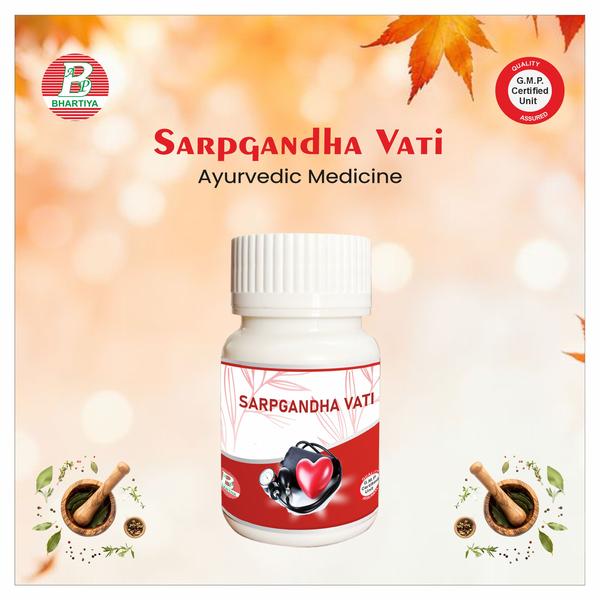
"name": "Sarpgandha vati / tablet",
"description": "Sarpagandha (Rauwolfia serpentina)\n The Serpent Root Herb with Profound Calming & Healing Power\nSarpagandha is one of the most potent and revered herbs in Ayurveda, known for its deep action on the nervous system, mind, blood pressure, and toxic conditions.\nThe name Sarpagandha literally means “the plant with a smell like a serpent” or “the herb that can subdue snake-like disorders”, symbolising its legendary power in calming, controlling, and neutralizing deep-rooted imbalances.\nAyurveda classifies Sarpagandha as:\n•\tStambhana (stabilizing, controlling)\n•\tNidrajanana (induces sleep)\n•\tVedanasthapana (analgesic)\n•\tSarpavisha hara (anti-venom / toxic disorders)\n•\tManas dosha hara (reduces mental disturbances)\n•\tHṛidya (supports the heart)\nIt is highly beneficial in managing high blood pressure, insomnia, anxiety, restlessness, mental agitation, certain psychotic disorders, and snake-bite toxic conditions (traditionally).\n Botanical Information of Sarpagandha\nScientific Name: Rauwolfia serpentina (Linn.) \nFamily: Apocynaceae\nOrder: Gentianales\nGenus: Rauwolfia\nSpecies: serpentina\nCommon Names\n•\tSanskrit: Sarpagandha, Chandrabhaga, Kundali, Sarpasandhi, Nakuli\n•\tHindi: Sarpagandha\n•\tEnglish: Indian Snakeroot, Serpent Root\n•\tTamil: Sivanar Vembu\n•\tTelugu: Patalagandhi\n•\tMalayalam: Paathalgaruda\n•\tKannada: Sarpagandhi\n•\tBengali: Sarpagandha\nSynonyms from Nighantus\n•\tBhavaprakasha: Sarpagandha, Chandrika, Kundali\n•\tDhanvantari Nighantu: Nakuli, Sarpasandhi\n•\tKaiyadeva Nighantu: Sarpagandha, Ganda Naga\n•\tRaja Nighantu: Sarpagandha, Patalagandhi\n Morphology of Sarpagandha (Rauwolfia serpentina)\nPlant Type\nPerennial, erect, smooth herb\nStem\n•\tSlender, erect, slightly woody at the base\n•\tDark green with smooth texture\nLeaves\n•\tSimple, opposite or whorled (3–4 in a circle)\n•\tLanceolate, smooth, shining\n•\tDark green above, light beneath\nFlowers\n•\tSmall, white or pinkish\n•\tArranged in terminal or axillary cymes\nRoots\n•\tLong, slender, cylindrical\n•\tDark brown externally, white inside\n•\tMedicinally most important part\n•\tCharacteristic serpentine smell (hence Sarpagandha)\nFruits\n•\tSmall, globose drupes\n•\tPurplish-black on ripening\nHabit\n•\tSlow-growing but hardy\n•\tDevelops best under semi-shade conditions\n Ecological Preferences\n•\tClimate: Tropical and subtropical\n•\tSoil: Moist, fertile, well-drained soil (prefers humus-rich loam)\n•\tSunlight: Partial shade preferred\n•\tMoisture: Requires consistent moisture\n•\tAltitude: Up to 1200 m\n•\tHabitat: Forest edges, moist slopes, shaded plantations\n Distribution\n•\tIndia: Common in the Himalayan foothills, Northeastern states, Bengal, Western Ghats, Odisha, and Central India\n•\tAsia: Nepal, Bhutan, Bangladesh, Myanmar, Sri Lanka, Thailand\n•\tOther Regions: Widely distributed in Southeast Asia\n Classical Ayurvedic Properties of Sarpagandha\n•\tRasa (Taste): Tikta (bitter), Kashaya (astringent), Madhura (slightly sweet)\n•\tGuna (Quality): Laghu (light), Ruksha (dry), Tikshna (penetrating)\n•\tVirya (Potency): Ushna (hot)\n•\tVipaka: Katu (pungent)\n•\tDosha Effect: Kapha-Vata hara, pacifies Raja & Tama (mental doshas)\nKarma (Therapeutic Actions)\n•\tNidrajanana – induces sleep\n•\tUnmadahara – reduces psychotic symptoms\n•\tSarpavisha hara – mitigates snake/poison effects (traditional use)\n•\tRaktachapa hara – reduces high blood pressure\n•\tStambhana – stabilizes nervous system\n•\tAnulomana – improves digestive and nervous coordination\n Historical & Grantha-Based Story/References of Sarpagandha\n 1. Mention in Ancient Texts\nSarpagandha is described in:\n•\tCharaka Samhita (Chikitsa Sthana) under Unmada (psychosis) treatment\n•\tSushruta Samhita under Sarpavisha Chikitsa (snake poisoning)\n•\tBhavaprakasha Nighantu elaborates its use for insomnia, hypertension-like symptoms, and mania\n•\tKaiyadeva Nighantu describes it as a herb that “calms the mind and controls the serpent-like movements of Vata in the nerves.”\n 2. Traditional Story: “The Serpent-Root Legend”\nAyurvedic folklore says:\n“A wandering sage noticed that snakes bitten by other snakes chewed the root of a certain plant and survived.”\nThis plant, believed to be Sarpagandha, was thus discovered in ancient times.\nThe sages concluded that if it could calm a deadly serpent’s venom, it could also calm the “inner serpent” — representing fear, agitation, and disordered nerves in humans.\nThis symbolic meaning led to its name Sarpagandha and its use for toxins, anxiety, agitation, hypertension, and insanity-like states.\n 3. Use by Ancient Physicians\n•\tAcharya Charaka used it in Unmada (psychiatric) conditions.\n•\tAcharya Sushruta prescribed it as a supportive herb for harmful bites and severe agitation.\n•\tVagbhata considered it “mind-stabilizing and nerve-controlling.”\n Modern Phytochemistry\nSarpagandha contains powerful alkaloids, especially:\n1. Alkaloids (main bioactive class)\n•\tReserpine – antihypertensive, sedative\n•\tAjmaline – antiarrhythmic\n•\tAjmalicine (raubasine) – circulatory and CNS modulator\n•\tSerpentine, Yohimbine (traces)\n2. Others\n•\tSterols\n•\tCarbohydrates\n•\tGlycosides\n•\tFlavonoids\n Species of Rauwolfia\n1.\tRauwolfia serpentina – true Sarpagandha, most potent\n2.\tRauwolfia tetraphylla – similar but less potent; used in some regions\n3.\tRauwolfia vomitoria – African species\n4.\tRauwolfia canescens – mild medicinal use\n Cultivation\n•\tPropagation: Seeds, root cuttings\n•\tPlanting Season: Monsoon (June–July)\n•\tSpacing: 30–45 cm\n•\tWatering: Regular moisture needed\n•\tManure: Best with organic compost\n•\tHarvesting: Roots collected after 2–3 years\n•\tNote: Overharvested in the wild → now commercially cultivated\n Classical Ayurvedic Dosage (from Granthas)\n(General, traditional; modern use must be supervised due to potency)\n•\tRoot Powder (Churna): 250–500 mg once or twice daily\n•\tRoot Decoction (Kwatha): 30–40 ml\n•\tSwarasa (Juice): 5–10 ml\nUsed in:\n•\tInsomnia\n•\tMental disorders\n•\tHypertension-like symptoms\n•\tAgitation\n•\tToxic disorders (traditional use)\n Safety & Precautions\nSarpagandha is highly potent.\n•\tAvoid overdose\n•\tNot suitable during pregnancy\n•\tNot to be combined with other sedatives or antihypertensive drugs without guidance\n•\tMust be used under qualified Ayurvedic supervision\n Sarpagandha Compound Formulations (Classical):\nSarpagandha with Arjuna, Ashwagandha, Brahmi, Shankhapushpi, or Jatamansi—used for hypertension, anxiety, insomnia, nervous disorders, and cardiovascular support, prepared according to classical Ayurvedic methods to retain Rasayana and Medhya properties.\n Sarpagandha Formulations by Bhartiya Ayurvedic Pharmacy\nAt Bhartiya Ayurvedic Pharmacy, we prepare a range of Sarpagandha formulations following classical Ayurvedic methods as described in Charaka Samhita, Sushruta Samhita, Bhavaprakasha Nighantu, and other Ayurvedic Granthas. Each product is crafted to retain the therapeutic potency, purity, and efficacy of the herb, ensuring benefits for stress relief, blood pressure management, nervous system support, and overall mental well-being.\n1.\tSarpagandha Vati/Tablet\nDose\n1 tablet (250–500 mg) twice daily\nOr 1 tablet at night for sleep disorders\nAdvanced cases: 1 tablet thrice daily (only under supervision)\n•\tFor hypertension-like symptoms, insomnia\n•\tSupports Calmness & Mental Stability\n•\tUseful in: Anxiety, Nervousness, Agitation, Irritability, Restlessness, Racing thoughts\n•\tHelps balance Rajas and Tamas (mental doshas) and calms Vata in the nervous system.\nSupports Brain & Nerve Health\nHelps in:\n•\tReducing excessive nerve excitability\n•\tSupporting healthy brain signaling\n•\tPromoting alert calmness\nUsed traditionally in unmada chikitsa (Ayurvedic mental health management)\n\n\nbenefits of sarpagandha tablet, benefits of sarpagandha tablets\nbest sarpagandha tablet, dosage of sarpagandha tablet\nhow to use sarpagandha, is sarpagandha effective for bp\nis sarpagandha safe, m sarpagandha mishran\nm sarpagandha mishran price, m sarpagandha mishran tablet\nm sarpagandha mishran tablet uses in hindi, m sarpagandha mishran uses\nm sarpagandha tablet, sarpagandha tablet benefits\nsarpagandha tablet benefits in hindi, sarpagandha tablet buy online\nsarpagandha tablet content, sarpagandha tablet dosage\nsarpagandha tablet dose, sarpagandha tablet fayde\nsarpagandha tablet flipkart, sarpagandha tablet for\nsarpagandha tablet hindi, sarpagandha tablet how to use\nsarpagandha tablet in hindim, sarpagandha tablet india\nsarpagandha tablet kaise khaye, msarpagandha tablet kaise le\nsarpagandha tablet ke fayde in hindi, sarpagandha tablet ke side effects\nsarpagandha tablet kis kaam aata hai, sarpagandha tablet kya kam karti hai\nsarpagandha tablet near me, sarpagandha tablet online\nsarpagandha tablet price, sarpagandha tablet price in india\nsarpagandha tablet review, sarpagandha tablet side effects\nsarpagandha tablet side effects in hindi, sarpagandha tablet use\nsarpagandha tablet used for, sarpagandha tablet uses\nsarpagandha tablet uses and side effects, sarpagandha tablet uses hindi\nsarpagandha tablet uses in english, sarpagandha tablet uses in hindi\nsarpagandha tablet when to take, sarpagandha tablets ayurvedic\nsarpagandha tablets benefits, sarpagandha tablets for blood pressure\nsarpagandha tablets for blood pressure in hindi, sarpagandha tablets uses\nsarpagandha use, sarpagandha vati tablet ke fayde\nsarpagandha vati tablet price, sarpagandha vati tablet side effects\nsarpagandha vati tablet uses, sarpagandha vati tablet uses in english\nsarpagandha vati tablet uses in hindi, sarpagandha vati tablet uses in tamil\nsarpagandha. tablet image, sarpagandhadi tablet uses\nsarpgandha tablet quality",
"price": 540.0,
"discountamount": 270.0,
"currencycode": "INR",
"priority": 1000000,
"isfreeshipmentavailable": false,
"shipmentduration": 1,
"_keywords": null,
"isarchived": false,
"isavailable": true,
"applicationid": null,
"productindex": 30,
"imageuri": "https://productimages.withfloats.com/actual/69808ef1cf660bbbdc554d46.jpg",
"tileimageuri": "https://productimages.withfloats.com/tile/69808ef1cf660bbbdc554d46.jpg",
"images": null,
"totalqueries": 0,
"gpid": null,
"groupproductid": null,
"createdon": "2026-02-02T11:47:59.198Z",
"updatedon": "2026-02-19T10:33:46.089Z",
"buyonlinelink": null,
"producturl": "http://WWW.BHARTIYAAYURVEDICPHARMACY.COM/products/sarpgandha-vati-tablet/30",
"availableunits": -1.0,
"iscodavailable": true,
"isprepaidonlineavailable": true,
"maxcodorders": 0,
"maxprepaidonlineorders": -1,
"uniquepaymenturl": null,
"brandname": "Bakula fort",
"category": "Sarpgandha vati / tablet 100 - GM X 24",
"tags": [],
"variants": false,
"keyspecification": null,
"otherspecifications": null,
"pickupaddressreferenceid": null,
"paymenttype": "AssuredPurchase",
"producttype": "products",
"hsncode": null,
"gstslab": 0.0,
"isnotforsale": false
},
{
"_id": "6a6069dca338caae77fcc9a0",
"fptag": "BHARTIYEAYURVEDICPHARMACY",
"merchantname": null,
"customwidgets": null,
"externalsourceid": null,
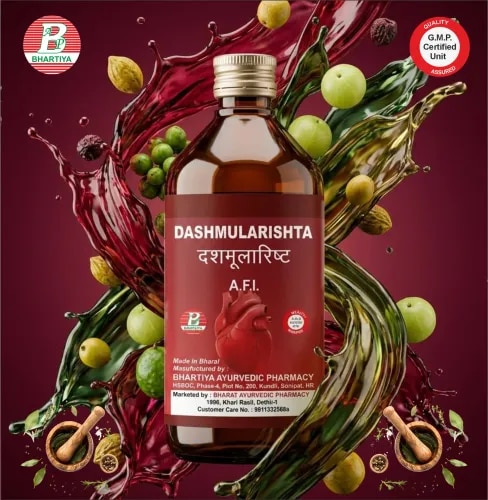
"name": "DASHMULARISHTA",
"description": " DASHMULARISHTA\n\n\nProduct Identification\nGeneric Name: Dashmularishta\nType: Ayurvedic Polyherbal Fermented Formulation (Arishta)\nPrimary Indication Area: Primarily used as a rejuvenative and restorative tonic for postpartum care, Vata disorders, inflammatory conditions, musculoskeletal weakness, nervous system disorders, and recovery following chronic illness. It is widely indicated for general debility, fever recovery, respiratory weakness, digestive impairment, and gynecological disorders associated with Vata imbalance.\n\nTherapeutic Indications\n•\tGeneral debility (Daurbalya) \n•\tPostpartum care (Sutika Paricharya) \n•\tVata disorders (Vatavyadhi) \n•\tChronic inflammatory conditions \n•\tMusculoskeletal weakness \n•\tJoint pain and stiffness \n•\tLow back pain \n•\tNeuralgia and neuropathic discomfort \n•\tConvalescence following prolonged illness \n•\tRespiratory weakness and chronic cough \n•\tFever recovery \n•\tDigestive weakness and poor appetite \n•\tGynecological disorders associated with Vata imbalance \n•\tFatigue and reduced stamina \n•\tAge-related decline in strength and vitality \n\nKey Benefits\n•\tSupports healthy musculoskeletal and nervous system function. \n•\tPromotes recovery following childbirth and prolonged illness. \n•\tHelps reduce inflammation and joint discomfort. \n•\tImproves physical strength and endurance. \n•\tSupports healthy respiratory function. \n•\tEnhances digestion and metabolism. \n•\tPromotes healthy immune function. \n•\tSupports uterine health during the postpartum period. \n•\tActs as a Rasayana for restoring vitality. \n•\tProvides antioxidant protection against oxidative stress. \n\nFORMULA\nEach part contains:\n•\tBilva (Aegle marmelos) \n•\tShyonaka (Oroxylum indicum) \n•\tGambhari (Gmelina arborea) \n•\tPatala (Stereospermum suaveolens) \n•\tAgnimantha (Clerodendrum phlomidis) \n•\tShalaparni (Desmodium gangeticum) \n•\tPrishniparni (Uraria picta) \n•\tBrihati (Solanum indicum) \n•\tKantakari (Solanum xanthocarpum)\n•\tGokshura (Tribulus terrestris) \n•\tChitraka (Plumbago zeylanica) \n•\tPushkara (Inula racemosa) \n•\tLodhra (Symplocos racemosa) \n•\tGuduchi (Tinospora cordifolia) \n•\tAmalaki (Phyllanthus emblica) \n•\tDhanvayasa (Fagonia cretica) \n•\tKhadira (Acacia catechu) \n•\tKustha (Saussurea lappa) \n•\tManjistha (Rubia cordifolia) \n•\tDevadaru (Cedrus deodara) \n•\tVidanga (Embelia ribes) \n•\tMadhuka (Glycyrrhiza glabra) \n•\tBharangi (Clerodendrum serratum) \n•\tKapitha (Limonia acidissima / Feronia limonia) \n•\tBibhitaki (Terminalia bellirica) \n•\tPunarnava (Boerhavia diffusa) \n•\tChavya (Piper retrofractum) \n•\tJatamansi (Nardostachys jatamansi) \n•\tPriyangu (Callicarpa macrophylla) \n•\tSariva (Hemidesmus indicus) \n•\tKala Jeera (Carum carvi / Nigella sativa (regional use)) \n•\tTrivrit (Operculina turpethum) \n•\tNirgundi (Vitex negundo) \n•\tRasna (Pluchea lanceolata) \n•\tHaridra (Curcuma longa) \n•\tSatpushpa (Anethum sowa / Anethum graveolens) \n•\tPadmaka (Prunus cerasoides) \n•\tNagakesara (Mesua ferrea) \n•\tMusta (Cyperus rotundus) \n•\tIndrayava (Holarrhena antidysenterica) \n•\tKarkatashringi (Pistacia integerrima) \n•\tJivaka (Microstylis wallichii) \n•\tRishabhaka (Microstylis muscifera) \n•\tMeda (Polygonatum cirrhifolium) \n•\tKakoli (Fritillaria roylei) \n•\tKshirakakoli (Roscoea purpurea) \n•\tRiddhi (Habenaria intermedia) \n•\tVriddhi (Habenaria edgeworthii) \n•\tDraksha (Vitis vinifera) \n•\tKatphala (Myrica nagi) \n•\tPuga (Areca catechu) \n•\tGuda (Jaggery) \n•\tMadhu (Honey) \n•\tDhataki (Woodfordia fruticosa) \n•\tLavanga (Syzygium aromaticum) \n•\tTvak (Cinnamomum verum) \n•\tEla (Elettaria cardamomum) \n•\tTejapatra (Cinnamomum tamala) \n•\tPippali (Piper longum) \n•\tHaridra (Curcuma longa) \n•\tSveta Chandana (Santalum album) \n•\tPippali root\n\n\n1. Bilva\nBotanical Name: Aegle marmelos\n•\tRasa: Kashaya, Tikta \n•\tGuna: Laghu, Ruksha \n•\tVirya: Ushna \n•\tVipaka: Katu \n•\tPrabhava: Vata-Kapha Shamaka \nMechanism of Action\n•\tReduces inflammatory mediators in gut and joints \n•\tRegulates Vata in neuromuscular system \n•\tSupports digestive motility and Agni \n•\tAnti-inflammatory and mild analgesic activity \n•\tHelps in post-illness weakness recovery \n\n2. Shyonaka\nBotanical Name: Oroxylum indicum\n•\tRasa: Tikta, Kashaya \n•\tGuna: Laghu, Ruksha \n•\tVirya: Ushna \n•\tVipaka: Katu \nMechanism of Action\n•\tReduces cytokine-mediated inflammation \n•\tSupports respiratory and musculoskeletal recovery \n•\tAntioxidant and tissue-protective action \n•\tHelps in Vata-induced pain conditions \n\n3. Gambhari\nBotanical Name: Gmelina arborea\n•\tRasa: Madhura, Kashaya \n•\tGuna: Guru, Snigdha \n•\tVirya: Sheeta \n•\tVipaka: Madhura \n•\tPrabhava: Rasayana \nMechanism of Action\n•\tPromotes tissue regeneration and strength \n•\tSupports post-partum recovery \n•\tImmunomodulatory and restorative effect \n•\tAnti-inflammatory and nutritive action \n\n4. Patala\nBotanical Name: Stereospermum suaveolens\n•\tRasa: Tikta, Kashaya \n•\tGuna: Laghu, Ruksha \n•\tVirya: Ushna \n•\tVipaka: Katu \nMechanism of Action\n•\tReduces neuromuscular inflammation \n•\tSupports respiratory function \n•\tAnalgesic activity in Vata disorders \n•\tImproves tissue repair mechanisms \n\n5. Agnimantha\nBotanical Name: Clerodendrum phlomidis\n•\tRasa: Katu, Tikta \n•\tGuna: Laghu, Ruksha \n•\tVirya: Ushna \n•\tVipaka: Katu \nMechanism of Action\n•\tStimulates digestive enzymes and Agni \n•\tReduces Ama accumulation \n•\tAnti-inflammatory in joints and muscles \n•\tEnhances metabolic clearance \n\n6. Shalaparni\nBotanical Name: Desmodium gangeticum\n•\tRasa: Madhura, Tikta \n•\tGuna: Snigdha, Laghu \n•\tVirya: Ushna \n•\tVipaka: Madhura \nMechanism of Action\n•\tNeuroprotective and muscle-strengthening \n•\tReduces fatigue and weakness \n•\tSupports immune modulation \n•\tEnhances recovery from chronic illness \n\n7. Prishniparni\nBotanical Name: Uraria picta\n•\tRasa: Madhura, Tikta \n•\tGuna: Snigdha, Laghu \n•\tVirya: Ushna \n•\tVipaka: Madhura \nMechanism of Action\n•\tImproves neuromuscular strength \n•\tSupports postpartum tissue repair \n•\tAnti-inflammatory and rejuvenative \n•\tEnhances stamina and vitality \n\n8. Brihati\nBotanical Name: Solanum indicum\n•\tRasa: Tikta, Katu \n•\tGuna: Laghu, Ruksha \n•\tVirya: Ushna \n•\tVipaka: Katu \nMechanism of Action\n•\tReduces inflammatory pain \n•\tSupports respiratory health \n•\tHelps in Vata-Kapha imbalance disorders \n•\tImproves metabolic function \n\n9. Kantakari\nBotanical Name: Solanum xanthocarpum\n•\tRasa: Tikta, Katu \n•\tGuna: Laghu, Ruksha \n•\tVirya: Ushna \n•\tVipaka: Katu \nMechanism of Action\n•\tBronchodilator and expectorant action \n•\tReduces respiratory inflammation \n•\tSupports Vata-Kapha balance \n•\tImproves oxygenation and vitality \n\n10. Gokshura\nBotanical Name: Tribulus terrestris\n•\tRasa: Madhura \n•\tGuna: Snigdha, Guru \n•\tVirya: Sheeta \n•\tVipaka: Madhura \nMechanism of Action\n•\tDiuretic and urinary system support \n•\tEnhances muscle strength and stamina \n•\tImproves reproductive function \n•\tAnti-fatigue and anabolic support \n\n11. Chitraka\nBotanical Name: Plumbago zeylanica\n•\tRasa: Katu \n•\tGuna: Laghu, Tikshna \n•\tVirya: Ushna \n•\tVipaka: Katu \nMechanism of Action\n•\tPotent digestive stimulant (Agni deepana) \n•\tReduces Ama accumulation \n•\tImproves nutrient absorption \n•\tEnhances metabolic rate \n\n12. Pushkara\nBotanical Name: Inula racemosa\n•\tRasa: Tikta, Katu \n•\tGuna: Laghu, Ruksha \n•\tVirya: Ushna \n•\tVipaka: Katu \nMechanism of Action\n•\tCardiorespiratory stimulant \n•\tImproves oxygen utilization \n•\tAnti-inflammatory and bronchodilator \n•\tSupports endurance \n\n13. Lodhra\nBotanical Name: Symplocos racemosa\n•\tRasa: Kashaya \n•\tGuna: Laghu, Ruksha \n•\tVirya: Sheeta \n•\tVipaka: Katu \nMechanism of Action\n•\tUterine tonic and anti-inflammatory \n•\tSupports tissue tightening and healing \n•\tReduces excessive secretions \n•\tImproves reproductive health \n\n14. Guduchi\nBotanical Name: Tinospora cordifolia\n•\tRasa: Tikta, Kashaya \n•\tGuna: Laghu, Snigdha \n•\tVirya: Ushna \n•\tVipaka: Madhura \nMechanism of Action\n•\tStrong immunomodulator \n•\tAnti-inflammatory and antipyretic \n•\tEnhances detoxification pathways \n•\tSupports chronic disease recovery \n\n15. Amalaki\nBotanical Name: Phyllanthus emblica\n•\tRasa: Amla Pradhana Pancharasa \n•\tGuna: Laghu, Ruksha \n•\tVirya: Sheeta \n•\tVipaka: Madhura \nMechanism of Action\n•\tPotent antioxidant (vitamin C rich) \n•\tAnti-aging and Rasayana effect \n•\tSupports immunity and tissue repair \n•\tEnhances digestion and metabolism\n16. Dhanvayasa\nBotanical Name: Fagonia cretica / Alhagi pseudalhagi\n•\tRasa: Tikta, Kashaya \n•\tGuna: Laghu, Ruksha \n•\tVirya: Sheeta \n•\tVipaka: Katu \nMechanism\n•\tAnti-inflammatory and blood-purifying activity \n•\tSupports detoxification and tissue repair \n•\tHelps reduce chronic inflammatory states \n\n17. Khadira\nBotanical Name: Acacia catechu\n•\tRasa: Kashaya \n•\tGuna: Ruksha, Laghu \n•\tVirya: Sheeta \n•\tVipaka: Katu \nMechanism\n•\tStrong antioxidant and antimicrobial action \n•\tSupports skin, blood and metabolic health \n•\tReduces chronic inflammation \n\n18. Kustha\nBotanical Name: Saussurea lappa\n•\tRasa: Tikta, Katu \n•\tGuna: Laghu, Tikshna \n•\tVirya: Ushna \n•\tVipaka: Katu \nMechanism\n•\tAnti-inflammatory and analgesic \n•\tSupports Vata disorders (pain, stiffness) \n•\tImproves neuromuscular function \n\n19. Manjistha\nBotanical Name: Rubia cordifolia\n•\tRasa: Tikta, Kashaya \n•\tGuna: Guru, Ruksha \n•\tVirya: Ushna \n•\tVipaka: Katu \nMechanism\n•\tBlood purification and lymphatic drainage \n•\tAnti-inflammatory and antioxidant \n•\tSupports skin and tissue repair \n\n20. Devadaru\nBotanical Name: Cedrus deodara\n•\tRasa: Tikta, Katu \n•\tGuna: Laghu, Ruksha \n•\tVirya: Ushna \n•\tVipaka: Katu \nMechanism\n•\tPotent anti-inflammatory action \n•\tRelieves joint and muscle pain \n•\tSupports respiratory clearance \n\n21. Vidanga\nBotanical Name: Embelia ribes\n•\tRasa: Katu \n•\tGuna: Laghu, Ruksha \n•\tVirya: Ushna \n•\tVipaka: Katu \nMechanism\n•\tAnthelmintic and antimicrobial \n•\tImproves gut health and metabolism \n•\tReduces Ama accumulation \n\n22. Madhuka\nBotanical Name: Glycyrrhiza glabra\n•\tRasa: Madhura \n•\tGuna: Guru, Snigdha \n•\tVirya: Sheeta \n•\tVipaka: Madhura \nMechanism\n•\tAnti-inflammatory and demulcent \n•\tSupports respiratory and gastric mucosa \n•\tImmunomodulatory and rejuvenative \n\n23. Bharangi\nBotanical Name: Clerodendrum serratum\n•\tRasa: Tikta, Katu \n•\tGuna: Laghu, Ruksha \n•\tVirya: Ushna \n•\tVipaka: Katu \nMechanism\n•\tRespiratory anti-inflammatory \n•\tBronchodilator effect \n•\tSupports cough and asthma conditions \n\n24. Kapitha\nBotanical Name: Limonia acidissima\n•\tRasa: Kashaya \n•\tGuna: Guru, Ruksha \n•\tVirya: Sheeta \n•\tVipaka: Katu \nMechanism\n•\tDigestive and gut stabilizing \n•\tAntimicrobial and anti-diarrheal \n•\tSupports intestinal health \n\n25. Bibhitaki\nBotanical Name: Terminalia bellirica\n•\tRasa: Kashaya \n•\tGuna: Ruksha, Laghu \n•\tVirya: Ushna \n•\tVipaka: Madhura \nMechanism\n•\tDetoxification and bowel regulation \n•\tAntioxidant and anti-inflammatory \n•\tSupports respiratory health \n\n26. Punarnava\nBotanical Name: Boerhavia diffusa\n•\tRasa: Tikta, Kashaya \n•\tGuna: Laghu, Ruksha \n•\tVirya: Ushna \n•\tVipaka: Katu \nMechanism\n•\tDiuretic and anti-edema action \n•\tKidney and fluid balance support \n•\tAnti-inflammatory activity \n\n27. Chavya\nBotanical Name: Piper retrofractum\n•\tRasa: Katu \n•\tGuna: Laghu, Tikshna \n•\tVirya: Ushna \n•\tVipaka: Katu \nMechanism\n•\tDigestive stimulant (Deepana) \n•\tImproves metabolism and Agni \n•\tReduces Ama formation \n\n28. Jatamansi\nBotanical Name: Nardostachys jatamansi\n•\tRasa: Tikta, Kashaya \n•\tGuna: Laghu, Snigdha \n•\tVirya: Sheeta \n•\tVipaka: Katu \nMechanism\n•\tNervine sedative and neuroprotective \n•\tReduces stress and anxiety \n•\tSupports sleep and mental balance \n\n29. Priyangu\nBotanical Name: Callicarpa macrophylla\n•\tRasa: Kashaya, Madhura \n•\tGuna: Laghu, Ruksha \n•\tVirya: Sheeta \n•\tVipaka: Katu \nMechanism\n•\tBlood purification and wound healing \n•\tAnti-inflammatory and cooling \n•\tSupports tissue repair \n\n30. Sariva\nBotanical Name: Hemidesmus indicus\n•\tRasa: Madhura, Tikta \n•\tGuna: Guru, Snigdha \n•\tVirya: Sheeta \n•\tVipaka: Madhura \nMechanism\n•\tBlood detoxification \n•\tCooling and anti-inflammatory \n•\tSupports skin and immune health \n\n31. Kala Jeera\nBotanical Name: Nigella sativa / Carum carvi (variant usage)\n•\tRasa: Katu, Tikta \n•\tGuna: Laghu, Ruksha \n•\tVirya: Ushna \n•\tVipaka: Katu \nMechanism\n•\tAnti-inflammatory and antioxidant \n•\tImproves digestion and immunity \n•\tSupports metabolic balance \n\n32. Trivrit\nBotanical Name: Operculina turpethum\n•\tRasa: Katu, Tikta \n•\tGuna: Ruksha, Laghu \n•\tVirya: Ushna \n•\tVipaka: Katu \nMechanism\n•\tStrong purgative (Rechana) \n•\tDetoxification and bowel cleansing \n•\tRemoves accumulated toxins \n\n33. Nirgundi\nBotanical Name: Vitex negundo\n•\tRasa: Katu, Tikta \n•\tGuna: Laghu, Ruksha \n•\tVirya: Ushna \n•\tVipaka: Katu \nMechanism\n•\tAnti-inflammatory and analgesic \n•\tUseful in joint pain and Vata disorders \n•\tMuscle relaxant activity \n\n34. Rasna\nBotanical Name: Pluchea lanceolata\n•\tRasa: Tikta, Katu \n•\tGuna: Snigdha, Laghu \n•\tVirya: Ushna \n•\tVipaka: Katu \nMechanism\n•\tStrong anti-arthritic action \n•\tReduces stiffness and pain \n•\tSupports neuromuscular health \n\n35. Haridra\nBotanical Name: Curcuma longa\n•\tRasa: Tikta, Katu \n•\tGuna: Laghu, Ruksha \n•\tVirya: Ushna \n•\tVipaka: Katu \nMechanism\n•\tAnti-inflammatory and antioxidant \n•\tImmunomodulatory activity \n•\tTissue healing and detox support \n\n36. Satpushpa\nBotanical Name: Anethum sowa / Anethum graveolens\n•\tRasa: Katu \n•\tGuna: Laghu \n•\tVirya: Ushna \n•\tVipaka: Katu \nMechanism\n•\tDigestive stimulant \n•\tReduces bloating and gas \n•\tSupports metabolism \n\n37. Padmaka\nBotanical Name: Prunus cerasoides\n•\tRasa: Kashaya \n•\tGuna: Laghu \n•\tVirya: Sheeta \n•\tVipaka: Katu \nMechanism\n•\tAnti-inflammatory and cooling \n•\tSupports blood purification \n•\tTissue soothing action \n\n38. Nagakesara\nBotanical Name: Mesua ferrea\n•\tRasa: Kashaya, Tikta \n•\tGuna: Laghu, Ruksha \n•\tVirya: Sheeta \n•\tVipaka: Katu \nMechanism\n•\tHemostatic and anti-inflammatory \n•\tSupports uterine and vascular health \n•\tAntioxidant activity \n\n39. Musta\nBotanical Name: Cyperus rotundus\n•\tRasa: Tikta, Katu \n•\tGuna: Laghu, Ruksha \n•\tVirya: Sheeta \n•\tVipaka: Katu \nMechanism\n•\tDigestive regulator \n•\tAnti-diarrheal and metabolic balance \n•\tReduces Ama \n\n40. Indrayava\nBotanical Name: Holarrhena antidysenterica\n•\tRasa: Tikta, Kashaya \n•\tGuna: Laghu, Ruksha \n•\tVirya: Sheeta \n•\tVipaka: Katu \nMechanism\n•\tStrong anti-diarrheal action \n•\tGut antimicrobial activity \n•\tRestores intestinal balance \n\n41. Karkatashringi\nBotanical Name: Pistacia integerrima\n•\tRasa: Kashaya \n•\tGuna: Laghu, Ruksha \n•\tVirya: Sheeta \n•\tVipaka: Katu \nMechanism\n•\tRespiratory anti-inflammatory \n•\tReduces cough and bronchial irritation \n•\tSupports lung function \n42. Jivaka\nBotanical Name: Microstylis wallichii\n•\tRasa: Madhura \n•\tGuna: Guru, Snigdha \n•\tVirya: Sheeta \n•\tVipaka: Madhura \nMechanism\n•\tRasayana and tissue-building action \n•\tImproves strength and vitality \n•\tSupports reproductive and neuromuscular health \n\n43. Rishabhaka\nBotanical Name: Microstylis muscifera\n•\tRasa: Madhura \n•\tGuna: Guru, Snigdha \n•\tVirya: Sheeta \n•\tVipaka: Madhura \nMechanism\n•\tRejuvenative and anabolic support \n•\tEnhances stamina and recovery \n•\tSupports muscle and nerve repair \n\n44. Meda\nBotanical Name: Polygonatum cirrhifolium\n•\tRasa: Madhura \n•\tGuna: Guru, Snigdha \n•\tVirya: Sheeta \n•\tVipaka: Madhura \nMechanism\n•\tNourishing and restorative \n•\tImproves tissue regeneration \n•\tSupports energy metabolism \n\n45. Kakoli\nBotanical Name: Fritillaria roylei\n•\tRasa: Madhura \n•\tGuna: Guru, Snigdha \n•\tVirya: Sheeta \n•\tVipaka: Madhura \nMechanism\n•\tPotent Rasayana herb \n•\tImproves strength and immunity \n•\tSupports nervous system recovery \n\n46. Kshirakakoli\nBotanical Name: Roscoea purpurea\n•\tRasa: Madhura \n•\tGuna: Guru, Snigdha \n•\tVirya: Sheeta \n•\tVipaka: Madhura \nMechanism\n•\tDeep tissue nourishment \n•\tEnhances vitality and stamina \n•\tSupports postpartum recovery \n\n47. Riddhi\nBotanical Name: Habenaria intermedia\n•\tRasa: Madhura \n•\tGuna: Guru, Snigdha \n•\tVirya: Sheeta \n•\tVipaka: Madhura \nMechanism\n•\tStrength promoter (Balya) \n•\tEnhances tissue growth and recovery \n•\tSupports immunity and endurance \n\n48. Vriddhi\nBotanical Name: Habenaria edgeworthii\n•\tRasa: Madhura \n•\tGuna: Guru, Snigdha \n•\tVirya: Sheeta \n•\tVipaka: Madhura \nMechanism\n•\tGrowth and regenerative support \n•\tImproves physical strength \n•\tRasayana for chronic weakness \n\n49. Draksha\nBotanical Name: Vitis vinifera\n•\tRasa: Madhura \n•\tGuna: Guru, Snigdha \n•\tVirya: Sheeta \n•\tVipaka: Madhura \nMechanism\n•\tAntioxidant and cardiotonic support \n•\tImproves energy and hydration \n•\tSupports liver and digestion \n\n50. Katphala\nBotanical Name: Myrica nagi\n•\tRasa: Kashaya \n•\tGuna: Laghu, Ruksha \n•\tVirya: Ushna \n•\tVipaka: Katu \nMechanism\n•\tAntimicrobial and digestive stimulant \n•\tSupports respiratory clearance \n•\tReduces Ama formation \n\n51. Puga\nBotanical Name: Areca catechu\n•\tRasa: Kashaya, Madhura \n•\tGuna: Laghu \n•\tVirya: Ushna \n•\tVipaka: Katu \nMechanism\n•\tAstringent and digestive support \n•\tImproves oral and gut health \n•\tMild stimulant action \n\n52. Guda\nBotanical Name: Saccharum officinarum (Jaggery)\n•\tRasa: Madhura \n•\tGuna: Guru, Snigdha \n•\tVirya: Ushna \n•\tVipaka: Madhura \nMechanism\n•\tFermentation substrate \n•\tEnergy provider \n•\tEnhances bioavailability of herbs \n\n53. Madhu\nBotanical Name: Honey (Apis mellifera product)\n•\tRasa: Madhura, Kashaya \n•\tGuna: Laghu, Ruksha \n•\tVirya: Sheeta \n•\tVipaka: Madhura \nMechanism\n•\tBioavailability enhancer (Yogavahi) \n•\tAntimicrobial and antioxidant \n•\tSupports fermentation stability \n\n54. Dhataki\nBotanical Name: Woodfordia fruticosa\n•\tRasa: Kashaya \n•\tGuna: Laghu, Ruksha \n•\tVirya: Sheeta \n•\tVipaka: Katu \nMechanism\n•\tNatural fermentation catalyst \n•\tEnhances alcohol formation \n•\tImproves extraction of phytochemicals \n\n55. Lavanga\nBotanical Name: Syzygium aromaticum\n•\tRasa: Katu, Tikta \n•\tGuna: Laghu, Tikshna \n•\tVirya: Ushna \n•\tVipaka: Katu \nMechanism\n•\tStrong antimicrobial action \n•\tDigestive stimulant \n•\tAnalgesic and carminative \n\n56. Tvak\nBotanical Name: Cinnamomum verum\n•\tRasa: Katu, Tikta \n•\tGuna: Laghu \n•\tVirya: Ushna \n•\tVipaka: Katu \nMechanism\n•\tImproves circulation and metabolism \n•\tAnti-inflammatory and antioxidant \n•\tSupports digestive fire \n\n57. Ela\nBotanical Name: Elettaria cardamomum\n•\tRasa: Madhura, Katu \n•\tGuna: Laghu \n•\tVirya: Sheeta \n•\tVipaka: Madhura \nMechanism\n•\tDigestive carminative \n•\tReduces bloating and gas \n•\tAromatic bioenhancer \n\n58. Tejapatra\nBotanical Name: Cinnamomum tamala\n•\tRasa: Katu, Tikta \n•\tGuna: Laghu \n•\tVirya: Ushna \n•\tVipaka: Katu \nMechanism\n•\tMetabolic stimulant \n•\tAnti-inflammatory activity \n•\tImproves digestion \n\n59. Pippali\nBotanical Name: Piper longum\n•\tRasa: Katu \n•\tGuna: Laghu, Tikshna \n•\tVirya: Ushna \n•\tVipaka: Madhura \nMechanism\n•\tBioavailability enhancer (Yogavahi) \n•\tRespiratory stimulant \n•\tImproves digestion and absorption\n42. Jivaka\nBotanical Name: Microstylis wallichii\n•\tRasa: Madhura \n•\tGuna: Guru, Snigdha \n•\tVirya: Sheeta \n•\tVipaka: Madhura \nMechanism\n•\tRasayana and tissue-building action \n•\tImproves strength and vitality \n•\tSupports reproductive and neuromuscular health \n\n43. Rishabhaka\nBotanical Name: Microstylis muscifera\n•\tRasa: Madhura \n•\tGuna: Guru, Snigdha \n•\tVirya: Sheeta \n•\tVipaka: Madhura \nMechanism\n•\tRejuvenative and anabolic support \n•\tEnhances stamina and recovery \n•\tSupports muscle and nerve repair \n\n44. Meda\nBotanical Name: Polygonatum cirrhifolium\n•\tRasa: Madhura \n•\tGuna: Guru, Snigdha \n•\tVirya: Sheeta \n•\tVipaka: Madhura \nMechanism\n•\tNourishing and restorative \n•\tImproves tissue regeneration \n•\tSupports energy metabolism \n\n45. Kakoli\nBotanical Name: Fritillaria roylei\n•\tRasa: Madhura \n•\tGuna: Guru, Snigdha \n•\tVirya: Sheeta \n•\tVipaka: Madhura \nMechanism\n•\tPotent Rasayana herb \n•\tImproves strength and immunity \n•\tSupports nervous system recovery \n\n46. Kshirakakoli\nBotanical Name: Roscoea purpurea\n•\tRasa: Madhura \n•\tGuna: Guru, Snigdha \n•\tVirya: Sheeta \n•\tVipaka: Madhura \nMechanism\n•\tDeep tissue nourishment \n•\tEnhances vitality and stamina \n•\tSupports postpartum recovery \n\n47. Riddhi\nBotanical Name: Habenaria intermedia\n•\tRasa: Madhura \n•\tGuna: Guru, Snigdha \n•\tVirya: Sheeta \n•\tVipaka: Madhura \nMechanism\n•\tStrength promoter (Balya) \n•\tEnhances tissue growth and recovery \n•\tSupports immunity and endurance \n\n48. Vriddhi\nBotanical Name: Habenaria edgeworthii\n•\tRasa: Madhura \n•\tGuna: Guru, Snigdha \n•\tVirya: Sheeta \n•\tVipaka: Madhura \nMechanism\n•\tGrowth and regenerative support \n•\tImproves physical strength \n•\tRasayana for chronic weakness \n\n49. Draksha\nBotanical Name: Vitis vinifera\n•\tRasa: Madhura \n•\tGuna: Guru, Snigdha \n•\tVirya: Sheeta \n•\tVipaka: Madhura \nMechanism\n•\tAntioxidant and cardiotonic support \n•\tImproves energy and hydration \n•\tSupports liver and digestion \n\n50. Katphala\nBotanical Name: Myrica nagi\n•\tRasa: Kashaya \n•\tGuna: Laghu, Ruksha \n•\tVirya: Ushna \n•\tVipaka: Katu \nMechanism\n•\tAntimicrobial and digestive stimulant \n•\tSupports respiratory clearance \n•\tReduces Ama formation \n\n51. Puga\nBotanical Name: Areca catechu\n•\tRasa: Kashaya, Madhura \n•\tGuna: Laghu \n•\tVirya: Ushna \n•\tVipaka: Katu \nMechanism\n•\tAstringent and digestive support \n•\tImproves oral and gut health \n•\tMild stimulant action \n\n52. Guda\nBotanical Name: Saccharum officinarum (Jaggery)\n•\tRasa: Madhura \n•\tGuna: Guru, Snigdha \n•\tVirya: Ushna \n•\tVipaka: Madhura \nMechanism\n•\tFermentation substrate \n•\tEnergy provider \n•\tEnhances bioavailability of herbs \n\n53. Madhu\nBotanical Name: Honey (Apis mellifera product)\n•\tRasa: Madhura, Kashaya \n•\tGuna: Laghu, Ruksha \n•\tVirya: Sheeta \n•\tVipaka: Madhura \nMechanism\n•\tBioavailability enhancer (Yogavahi) \n•\tAntimicrobial and antioxidant \n•\tSupports fermentation stability \n\n54. Dhataki\nBotanical Name: Woodfordia fruticosa\n•\tRasa: Kashaya \n•\tGuna: Laghu, Ruksha \n•\tVirya: Sheeta \n•\tVipaka: Katu \nMechanism\n•\tNatural fermentation catalyst \n•\tEnhances alcohol formation \n•\tImproves extraction of phytochemicals \n\n55. Lavanga\nBotanical Name: Syzygium aromaticum\n•\tRasa: Katu, Tikta \n•\tGuna: Laghu, Tikshna \n•\tVirya: Ushna \n•\tVipaka: Katu \nMechanism\n•\tStrong antimicrobial action \n•\tDigestive stimulant \n•\tAnalgesic and carminative \n\n56. Tvak\nBotanical Name: Cinnamomum verum\n•\tRasa: Katu, Tikta \n•\tGuna: Laghu \n•\tVirya: Ushna \n•\tVipaka: Katu \nMechanism\n•\tImproves circulation and metabolism \n•\tAnti-inflammatory and antioxidant \n•\tSupports digestive fire \n\n57. Ela\nBotanical Name: Elettaria cardamomum\n•\tRasa: Madhura, Katu \n•\tGuna: Laghu \n•\tVirya: Sheeta \n•\tVipaka: Madhura \nMechanism\n•\tDigestive carminative \n•\tReduces bloating and gas \n•\tAromatic bioenhancer \n\n58. Tejapatra\nBotanical Name: Cinnamomum tamala\n•\tRasa: Katu, Tikta \n•\tGuna: Laghu \n•\tVirya: Ushna \n•\tVipaka: Katu \nMechanism\n•\tMetabolic stimulant \n•\tAnti-inflammatory activity \n•\tImproves digestion \n\n59. Pippali\nBotanical Name: Piper longum\n•\tRasa: Katu \n•\tGuna: Laghu, Tikshna \n•\tVirya: Ushna \n•\tVipaka: Madhura \nMechanism\n•\tBioavailability enhancer (Yogavahi) \n•\tRespiratory stimulant \n•\tImproves digestion and absorption\n60. Karkatashringi\nBotanical Name: Pistacia integerrima\n•\tRasa: Kashaya \n•\tGuna: Laghu, Ruksha \n•\tVirya: Sheeta \n•\tVipaka: Katu \nMechanism\n•\tStrong respiratory anti-inflammatory action \n•\tReduces cough, bronchial irritation and asthma symptoms \n•\tSupports lung tissue healing \n\n61. Satpushpa\nBotanical Name: Anethum sowa\n•\tRasa: Katu \n•\tGuna: Laghu \n•\tVirya: Ushna \n•\tVipaka: Katu \nMechanism\n•\tCarminative and digestive stimulant \n•\tReduces gas, bloating and indigestion \n•\tSupports Agni and metabolism \n\n62. Padmaka\nBotanical Name: Prunus cerasoides\n•\tRasa: Kashaya \n•\tGuna: Laghu \n•\tVirya: Sheeta \n•\tVipaka: Katu \nMechanism\n•\tAnti-inflammatory and cooling effect \n•\tBlood purifier and tissue soothing action \n•\tSupports Pitta balance \n\n63. Nagakesara\nBotanical Name: Mesua ferrea\n•\tRasa: Kashaya, Tikta \n•\tGuna: Laghu, Ruksha \n•\tVirya: Sheeta \n•\tVipaka: Katu \nMechanism\n•\tHemostatic and anti-inflammatory \n•\tSupports uterine and vascular health \n•\tAntioxidant and wound healing activity \n\n64. Musta\nBotanical Name: Cyperus rotundus\n•\tRasa: Tikta, Katu \n•\tGuna: Laghu, Ruksha \n•\tVirya: Sheeta \n•\tVipaka: Katu \nMechanism\n•\tDigestive regulator and anti-diarrheal \n•\tReduces Ama formation \n•\tSupports gut microbial balance \n\n65. Indrayava\nBotanical Name: Holarrhena antidysenterica\n•\tRasa: Tikta, Kashaya \n•\tGuna: Laghu, Ruksha \n•\tVirya: Sheeta \n•\tVipaka: Katu \nMechanism\n•\tStrong anti-diarrheal and antimicrobial action \n•\tRestores intestinal mucosa integrity \n•\tSupports gut infection control \n\n66. Nirgundi\nBotanical Name: Vitex negundo\n•\tRasa: Katu, Tikta \n•\tGuna: Laghu, Ruksha \n•\tVirya: Ushna \n•\tVipaka: Katu \nMechanism\n•\tPowerful anti-inflammatory and analgesic \n•\tRelieves joint pain, swelling and stiffness \n•\tVata pacifying action \n\n67. Rasna\nBotanical Name: Pluchea lanceolata\n•\tRasa: Tikta, Katu \n•\tGuna: Snigdha, Laghu \n•\tVirya: Ushna \n•\tVipaka: Katu \nMechanism\n•\tAnti-arthritic and neuromuscular relaxant \n•\tReduces inflammation and stiffness \n•\tSupports Vata disorders \n\n68. Jivaka\nBotanical Name: Microstylis wallichii\n•\tRasa: Madhura \n•\tGuna: Guru, Snigdha \n•\tVirya: Sheeta \n•\tVipaka: Madhura \nMechanism\n•\tPotent Rasayana (rejuvenator) \n•\tImproves strength, stamina and tissue repair \n•\tSupports reproductive and nerve health \n\n69. Rishabhaka\nBotanical Name: Microstylis muscifera\n•\tRasa: Madhura \n•\tGuna: Guru, Snigdha \n•\tVirya: Sheeta \n•\tVipaka: Madhura \nMechanism\n•\tAnabolic and restorative action \n•\tEnhances muscle and nerve regeneration \n•\tImproves vitality and endurance \n\n70. Meda\nBotanical Name: Polygonatum cirrhifolium\n•\tRasa: Madhura \n•\tGuna: Guru, Snigdha \n•\tVirya: Sheeta \n•\tVipaka: Madhura \nMechanism\n•\tDeep nutritive and rejuvenative herb \n•\tImproves tissue building and energy metabolism \n•\tSupports chronic weakness recovery \n\n71. Kakoli / Kshirakakoli \nBotanical Name: Fritillaria roylei / Roscoea purpurea (group substitute in practice)\n•\tRasa: Madhura \n•\tGuna: Guru, Snigdha \n•\tVirya: Sheeta \n•\tVipaka: Madhura \nMechanism\n•\tStrong Rasayana and immunomodulator \n•\tEnhances strength, stamina and recovery \n•\tSupports neuromuscular and reproductive systems \n•\tDeep tissue nourishment and anti-aging effect\n\n1. Adult Dose\n•\t15–30 mL \n•\tTwice daily \n\n2. How to Take\n•\tDilute with equal quantity of water (1:1) \n•\tBest taken after meals \n•\tCommonly taken in morning and evening \n\n3. Therapeutic Duration\n•\tUsually 4–12 weeks \n•\tMay be extended in chronic conditions under physician supervision \n\n4. Special Situations\n•\tPostpartum care: 15–30 mL twice daily for 2–6 weeks (as advised) \n•\tGeneral debility: 15–20 mL twice daily \n•\tChronic Vata disorders: 20–30 mL twice daily \n\n5. Caution\n•\tUse under supervision in: \no\tPregnancy (generally avoided unless prescribed) \no\tDiabetes (contains jaggery fermentation) \no\tHypertension / cardiac patients on medication \n•\tAvoid self-medication in chronic diseases\n\n",
"price": 192.0,
"discountamount": 96.0,
"currencycode": "INR",
"priority": 1000000,
"isfreeshipmentavailable": false,
"shipmentduration": 1,
"_keywords": null,
"isarchived": false,
"isavailable": true,
"applicationid": null,
"productindex": 164,
"imageuri": "https://productimages.withfloats.com/actual/6a6069de406ff2e16e248d2f.jpg",
"tileimageuri": "https://productimages.withfloats.com/tile/6a6069de406ff2e16e248d2f.jpg",
"images": null,
"totalqueries": 0,
"gpid": null,
"groupproductid": null,
"createdon": "2026-07-22T06:57:32.507Z",
"updatedon": "2026-07-22T06:57:32.507Z",
"buyonlinelink": null,
"producturl": "http://WWW.BHARTIYAAYURVEDICPHARMACY.COM//dashmularishta/164",
"availableunits": -1.0,
"iscodavailable": true,
"isprepaidonlineavailable": true,
"maxcodorders": -1,
"maxprepaidonlineorders": -1,
"uniquepaymenturl": null,
"brandname": "Bakula Fort",
"category": "DASHMULARISHTA 450 ML X 40",
"tags": [],
"variants": false,
"keyspecification": null,
"otherspecifications": null,
"pickupaddressreferenceid": null,
"paymenttype": "AssuredPurchase",
"producttype": "products",
"hsncode": null,
"gstslab": 0.0,
"isnotforsale": false
},
{
"_id": "6a547e7778188a142c486bcf",
"fptag": "BHARTIYEAYURVEDICPHARMACY",
"merchantname": null,
"customwidgets": null,
"externalsourceid": null,
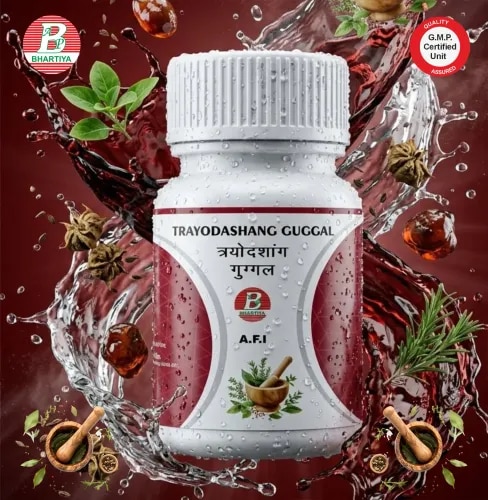
"name": "TRAYODASANG GUGGUL",
"description": "\n TRAYODASANG GUGGUL\n\nProduct Identification \n•\tGeneric Name: Trayodasang Guggulu \n•\tType: Ayurvedic Polyherbal Formulation\n•\tPrimary Indication Area: Musculoskeletal and joint health support\n•\tTherapeutic Indications: Used in Ayurveda for conditions associated with Vāta imbalance, including:\n•\tJoint pain and stiffness \n•\tNeuromuscular weakness \n•\tDegenerative joint conditions \n•\tInflammatory musculoskeletal disorders \n•\tSupport in recovery from musculoskeletal injury and nerve-related discomfort\nKey Benefits:\n•\tJoint Pain Relief: Helps reduce discomfort associated with Vāta imbalance in joints and muscles\n•\tReduces Stiffness: Supports improved flexibility and mobility in stiff joints\n•\tNerve & Musculoskeletal Support: Traditionally used to support neuromuscular function and strength Anti-Inflammatory Action (Traditional): Helps manage swelling and inflammatory conditions in joints and tissues\n•\tSupports Degenerative Conditions: Used in Ayurveda for age-related joint wear and musculoskeletal weakness\n•\tImproves Movement Comfort: Aids in smoother movement by balancing Vāta in the body\n•\tRecovery Support: Traditionally used as supportive therapy in musculoskeletal injury and weakness\n•\tStrengthens Body Tissues: Supports overall bone, joint, and connective tissue health\n•\tVāta Balancing Effect: Helps restore functional balance in Vāta-dominant disorders\n•\tGeneral Mobility Support: Promotes ease of movement and physical stability\nFORMULA\nEach Tablet contains: \nBaboola\t1 part\nAshvagandha\t1 part\nHapsua\t1 part\nGuduchi\t1 part\nShatavari\t1 part\nGokshura\t1 part\nVrddhadarka\t1 part\nRasna\t1 part\nSatahva\t1 part\nSati\t1 part\nYavani\t1 part\nSunthi \t1 part\nShudh Guggul\t1 part\nGoghrita\t1 part\n\n\n\n\n\n\n\nIngredients:\n1. Babool\n•Botanical/Scientific Name: Vachellia nilotica\n• Rasa–Guna–Vīrya–Vipāka:\n•\tRasa: Kaṣāya (Astringent) \n•\tGuna: Rūkṣa (Dry), Laghu (Light) \n•\tVīrya: Śīta (Cooling) \n•\tVipāka: Kaṭu (Pungent) \n• Prabhāva: Sandhāna (Supports tissue binding and healing)\nMechanism of Action (Karma):\n•\tŚotha-Hara Karma: Helps reduce inflammation and swelling in musculoskeletal tissues\n•\tSandhāna Karma: Promotes tissue repair and supports structural healing\n•\tRakta-Stambhana Karma: Helps control minor bleeding and supports vascular stability\n•\tKapha-Pitta Śāmaka Karma: Balances Kapha and Pitta involved in inflammatory conditions\n\n2. Ashwagandha\n• Botanical/Scientific Name: Withania somnifera\n• Rasa–Guna–Vīrya–Vipāka:\n•\tRasa: Tikta (Bitter), Kaṣāya (Astringent) \n•\tGuna: Laghu (Light), Snigdha (Oily) \n•\tVīrya: Uṣṇa (Hot) \n•\tVipāka: Madhura (Sweet) \n• Prabhāva: Balya–Rasāyana (Strength-promoting and rejuvenating herb)\nMechanism of Action (Karma):\n•\tBṛṃhaṇa Karma: Promotes tissue nourishment, muscle strength, and recovery from weakness.\n• Vāta-Hara Karma: Reduces Vāta-related pain, stiffness, and neuromuscular discomfort\n• Rasāyana Karma: Supports long-term rejuvenation of bones, muscles, and nerves\n• Balya Karma: Improves physical strength, stamina, and functional recovery\n\n3. Hapusa\n• Botanical/Scientific Name: Juniperus communis\n• Rasa–Guna–Vīrya–Vipāka:\n•\tRasa: Tikta (Bitter), Kaṭu (Pungent) \n•\tGuna: Laghu (Light), Rūkṣa (Dry), Tīkṣṇa (Sharp) \n•\tVīrya: Uṣṇa (Hot) \n•\tVipāka: Kaṭu (Pungent) \n• Prabhāva: Śothaghna (Anti-inflammatory action)\nMechanism of Action (Karma):\n•\tŚotha-Hara Karma: Reduces swelling and inflammatory conditions in joints and tissues\n• Vedana-Hara Karma: Helps relieve pain and discomfort in musculoskeletal disorders\n• Āma-Pācana Karma: Assists in digestion of metabolic toxins contributing to inflammation\n• Srotoshodhana Karma: Clears obstructed channels, improving circulation and healing\n4. Guduchi\n• Botanical/Scientific Name: Tinospora cordifolia\n• Rasa–Guna–Vīrya–Vipāka:\n•\tRasa: Tikta (Bitter), Kaṣāya (Astringent) \n•\tGuna: Laghu (Light), Snigdha (Unctuous) \n•\tVīrya: Uṣṇa (Hot) \n•\tVipāka: Madhura (Sweet) \n• Prabhāva: Rasāyana (Deep rejuvenative and immunomodulatory herb)\nMechanism of Action (Karma):\n•\tRasāyana Karma: Promotes tissue regeneration, vitality, and long-term musculoskeletal health\n• Vāta-Pitta-Kapha Śāmaka Karma: Balances all three Doṣas, especially in inflammatory and degenerative conditions\n• Śotha-Hara Karma: Reduces inflammation, swelling, and tissue irritation\n• Āma-Pācana Karma: Helps detoxify and metabolize accumulated Āma contributing to joint disorders\n\n5. Shatavari\n• Botanical/Scientific Name: Asparagus racemosus\n• Rasa–Guna–Vīrya–Vipāka:\n•\tRasa: Madhura (Sweet), Tikta (Bitter) \n•\tGuna: Guru (Heavy), Snigdha (Unctuous) \n•\tVīrya: Śīta (Cooling) \n•\tVipāka: Madhura (Sweet) \n• Prabhāva: Stanyajanana–Rasāyana (Nourishing and rejuvenating tonic herb)\nMechanism of Action (Karma):\n•\tBṛṃhaṇa Karma: Supports tissue building, nourishment, and strength\n• Rasāyana Karma: Promotes regeneration and rejuvenation of bones and connective tissues\n• Pitta-Śāmaka Karma: Reduces heat, inflammation, and burning sensations in tissues\n• Balya Karma: Improves strength, stamina, and recovery capacity\n8. Rasna\n• Botanical/Scientific Name: Pluchea lanceolata\n• Rasa–Guna–Vīrya–Vipāka:\n•\tRasa: Tikta (Bitter), Kaṭu (Pungent) \n•\tGuna: Laghu (Light), Rūkṣa (Dry), Tīkṣṇa (Sharp) \n•\tVīrya: Uṣṇa (Hot) \n•\tVipāka: Kaṭu (Pungent) \n• Prabhāva: Vāta-Kapha Hara (Special action on musculoskeletal and joint disorders)\nMechanism of Action (Karma):\n•\tVāta-Śāmaka Karma: Reduces pain, stiffness, and nerve-related discomfort\n• Śotha-Hara Karma: Helps reduce inflammation and swelling in joints and tissues\n• Vedana-Hara Karma: Relieves musculoskeletal pain and tenderness\n• Srotoshodhana Karma: Clears obstructed channels, improving circulation and mobility\n\n9. Satahva (Shatapushpa)\n• Botanical/Scientific Name: Anethum sowa\n• Rasa–Guna–Vīrya–Vipāka:\n•\tRasa: Kaṭu (Pungent), Tikta (Bitter) \n•\tGuna: Laghu (Light), Snigdha (Oily) \n•\tVīrya: Uṣṇa (Hot) \n•\tVipāka: Madhura (Sweet) \n• Prabhāva: Deepana–Pācana (Improves digestion and metabolism)\nMechanism of Action (Karma):\n•\tĀma-Pācana Karma: Helps digest metabolic toxins that contribute to joint stiffness and inflammation\n• Vāta-Anulomana Karma: Supports proper movement of Vāta, reducing pain and obstruction\n• Śotha-Hara Karma: Reduces mild swelling and tissue congestion\n• Srotoshodhana Karma: Improves channel clearance and nutrient flow to tissues\n10. Sati\n• Botanical/Scientific Name: Hedychium spicatum\n• Rasa–Guna–Vīrya–Vipāka:\n•\tRasa: Tikta (Bitter), Kaṭu (Pungent) \n•\tGuna: Laghu (Light), Rūkṣa (Dry), Tīkṣṇa (Sharp) \n•\tVīrya: Uṣṇa (Hot) \n•\tVipāka: Kaṭu (Pungent) \n• Prabhāva: Vāta-Kapha Hara (Special action in pain and inflammatory conditions)\nMechanism of Action (Karma):\n•\tVāta-Śāmaka Karma: Reduces nerve pain, stiffness, and muscular tightness\n• Śotha-Hara Karma: Helps reduce swelling and inflammatory responses\n• Vedana-Hara Karma: Alleviates musculoskeletal pain and discomfort\n• Srotoshodhana Karma: Clears obstructed channels and improves tissue flow\n\n11. Yavani\n• Botanical/Scientific Name: Trachyspermum ammi\n• Rasa–Guna–Vīrya–Vipāka:\n•\tRasa: Kaṭu (Pungent), Tikta (Bitter) \n•\tGuna: Laghu (Light), Rūkṣa (Dry), Tīkṣṇa (Sharp) \n•\tVīrya: Uṣṇa (Hot) \n•\tVipāka: Kaṭu (Pungent) \n• Prabhāva: Deepana–Pācana (Strong digestive and metabolic stimulant)\nMechanism of Action (Karma):\n•\tĀma-Pācana Karma: Helps eliminate metabolic toxins contributing to joint stiffness and inflammation\n• Vāta-Anulomana Karma: Regulates Vāta movement, reducing pain and obstruction\n• Śotha-Hara Karma: Assists in reducing mild swelling and tissue inflammation\n• Srotoshodhana Karma: Improves microchannel clearance and nutrient circulation\n12. Sunthi (Dry Ginger)\n• Botanical/Scientific Name: Zingiber officinale\n• Rasa–Guna–Vīrya–Vipāka:\n•\tRasa: Kaṭu (Pungent) \n•\tGuna: Laghu (Light), Snigdha (Slightly unctuous), Tīkṣṇa (Sharp) \n•\tVīrya: Uṣṇa (Hot) \n•\tVipāka: Madhura (Sweet) \n• Prabhāva: Āma-Pācana (Strong toxin-digesting and bio-clearing action)\nMechanism of Action (Karma):\n•\tĀma-Pācana Karma: Digests metabolic toxins responsible for joint pain, stiffness, and inflammation\n• Vāta-Kapha Hara Karma: Balances Vāta and Kapha, reducing pain, heaviness, and swelling\n• Śotha-Hara Karma: Helps reduce inflammatory swelling in muscles and joints\n• Vedana-Hara Karma: Alleviates musculoskeletal pain and discomfort\n\n13. Shuddha Guggul\n• Botanical/Scientific Name: Commiphora mukul\n• Rasa–Guna–Vīrya–Vipāka:\n•\tRasa: Tikta (Bitter), Kaṭu (Pungent), Kaṣāya (Astringent) \n•\tGuna: Laghu (Light), Rūkṣa (Dry), Tīkṣṇa (Sharp) \n•\tVīrya: Uṣṇa (Hot) \n•\tVipāka: Kaṭu (Pungent) \n• Prabhāva: Lekhana (Scraping action on pathological accumulations)\nMechanism of Action (Karma):\n•\tVāta-Kapha Hara Karma: Reduces pain, stiffness, and swelling in joints and muscles\n• Śotha-Hara Karma: Helps control inflammation in musculoskeletal conditions\n• Lekhana Karma: Removes deep-seated toxins and pathological deposits from tissues\n• Asthi-Sandhi Bala Karma: Supports strength and stability of bones and joints\n• Srotoshodhana Karma: Clears blocked channels and improves tissue nutrition\n14. Goghrita\n• Botanical/Scientific Name: ghee\n• Rasa–Guna–Vīrya–Vipāka:\n•\tRasa: Madhura (Sweet) \n•\tGuna: Snigdha (Unctuous), Guru (Heavy), Mridu (Soft) \n•\tVīrya: Śīta (Cooling) \n•\tVipāka: Madhura (Sweet) \n• Prabhāva: Yogavāhī & Rasāyana (Enhances action of herbs and promotes tissue nourishment)\nMechanism of Action (Karma):\n•\tYogavāhī Karma: Enhances absorption, potency, and delivery of co-administered herbal ingredients\n• Rasāyana Karma: Promotes rejuvenation and nourishment of bones, nerves, and connective tissues\n• Vāta-Pitta Śāmaka Karma: Balances Vāta and Pitta, reducing pain, inflammation, and burning sensations\n• Bṛṃhaṇa Karma: Supports tissue building, strength, and recovery in degenerative conditions\n• Smṛti & Medhya Support: Traditionally supports nervous system function and mental clarity\n\nDosage of Trayodasang Guggulu\n• Adult Dose: 250 mg – 1 g per dose\n• Frequency: 2–3 times daily\n• Common Use: 1–2 tablets (500 mg each) twice daily\n• Anupāna (Vehicle):\n•\tWarm water \n•\tWarm milk \n•\tAs directed by physician \n• Timing: After meals\n• Duration: As per condition and physician advice\n• Precaution: Use under medical supervision in pregnancy, lactation, and sensitive digestion cases\n\ntrayodashang guggulu uses in hindi, trayodashang guggulu, trayodashang guggulu benefits in hindi\ntrayodashang guggulu uses, trayodashang guggulu benefits, trayodashang guggulu uses in hindi ingredients\ntrayodashang guggulu tablet uses in hindi, trayodashang guggulu in hindi, trayodashang guggulu ingredients\ntrayodashang guggulu uses in hindi price, trayodashang guggulu amazon, trayodashang guggulu ayurvedic medicine\ntrayodashang guggulu ayurvedic, trayodashang guggulu ayur times, trayodashang guggulu before or after food\ntrayodashang guggulu best company, trayodashang guggulu benefits in english, trayodashang guggulu buy\ntrayodashang guggulu content, trayodashang guggulu composition, trayodashang guggulu contains\ntrayodashang guggulu cost, trayodashang guggulu dosage, trayodashang guggulu dawai\ntrayodashang guggulu uses in english, trayodashang guggulu fayde, trayodashang guggulu for what\ntrayodashang guggulu hindi, trayodashang guggulu how to take, trayodashang guggulu himalaya\ntrayodashang guggulu ingredients in hindi, trayodashang guggulu indication, trayodashang guggulu is used for\ntrayodashang guggulu images, trayodashang guggulu kis kaam aata hai, trayodashang guggulu ka use,\ntrayodashang guggulu khane ke fayde, trayodashang guggulu mrp, trayodashang guggulu main ingredients\ntrayodashang guggulu medicine use, trayodashang guggulu multani, trayodashang guggulu near me\ntrayodashang guggulu online, trayodashang guggulu online shopping, benefits of trayodashang guggulu\ntrayodashang guggulu price, trayodashang guggulu preparation, trayodashang guggulu price in india\ntrayodashang guggulu when to take, trayodashang guggulu syrup, trayodashang guggulu tablet\ntrayodashang guggulu tablet uses, trayodashang guggulu tablet price,trayodashang guggulu tab\ntriphala guggulu tablet uses, triphala guggulu tablet uses in hindi, trayodashang guggulu kaise use kare\nbenefits of trayodashang guggul, what is trayodashang guggulu, does trayodasang guggulu when to take\ndoes trayodasang guggulu benefits, does trayodasang guggulu dosage, does trayodasang guggulu how to use\ndoes trayodasang guggulu in hindi, was trayodasang guggulu benefits, top trayodasang guggulu uses\ntop trayodasang guggulu uses in hindi, top trayodasang guggulu flipkart",
"price": 294.0,
"discountamount": 147.0,
"currencycode": "INR",
"priority": 1000000,
"isfreeshipmentavailable": false,
"shipmentduration": 1,
"_keywords": null,
"isarchived": false,
"isavailable": true,
"applicationid": null,
"productindex": 151,
"imageuri": "https://productimages.withfloats.com/actual/6a547e78bd72d329583f799c.jpg",
"tileimageuri": "https://productimages.withfloats.com/tile/6a547e78bd72d329583f799c.jpg",
"images": null,
"totalqueries": 0,
"gpid": null,
"groupproductid": null,
"createdon": "2026-07-13T05:58:15.196Z",
"updatedon": "2026-07-13T05:58:15.196Z",
"buyonlinelink": null,
"producturl": "http://WWW.BHARTIYAAYURVEDICPHARMACY.COM//trayodasang-guggul/151",
"availableunits": -1.0,
"iscodavailable": true,
"isprepaidonlineavailable": true,
"maxcodorders": -1,
"maxprepaidonlineorders": -1,
"uniquepaymenturl": null,
"brandname": "Bakula Fort",
"category": "TRAYODASANG GUGGUL 100gm X 40",
"tags": [],
"variants": false,
"keyspecification": null,
"otherspecifications": null,
"pickupaddressreferenceid": null,
"paymenttype": "AssuredPurchase",
"producttype": "products",
"hsncode": null,
"gstslab": 0.0,
"isnotforsale": false
},
{
"_id": "6a48a645d538d47d741fbf2b",
"fptag": "BHARTIYEAYURVEDICPHARMACY",
"merchantname": null,
"customwidgets": null,
"externalsourceid": null,
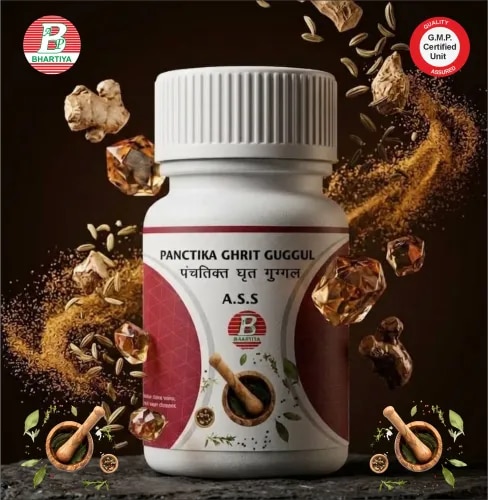
"name": "Panchtika Ghrit Guggul",
"description": " PANCHATIKTA GHRIT GUGGUL\n\nProduct Identification\nGeneric Name: Panchatikta Ghrit Guggul\nType: Classical Ayurvedic herbo-mineral formulation\nPrimary Indication Area: Used for chronic skin disorders and inflammatory conditions, especially those involving vitiated Vata and Kapha doshas.\nTherapeutic Indications: Management of Vata-dominant disorders such as osteoarthritis (Sandhivata), rheumatoid arthritis (Amavata), gout (Vatarakta), chronic joint pain, stiffness, inflammation, musculoskeletal weakness, and associated anemia (Pandu). \nKey Benefits\n1. Supports skin health\n•\tHelps manage chronic skin conditions like eczema and psoriasis \n•\tReduces itching, redness, and inflammation \n•\tPromotes healing of long-standing skin lesions \n2. Anti-inflammatory action\n•\tHelps reduce swelling and pain in joints and tissues \n•\tUseful in inflammatory disorders affecting skin and bones \n3. Joint and bone support\n•\tTraditionally used in arthritis and degenerative joint conditions \n•\tMay help improve mobility and reduce stiffness \n4. Detoxification (Rakta & Twak Shodhana)\n•\tAids in purification of blood and skin tissues (as per Ayurvedic concept) \n•\tHelps remove accumulated toxins linked to chronic skin disorders \n5. Tissue healing and regeneration\n•\tSupports recovery of damaged skin and deeper tissues \n•\tHelps in chronic, slow-healing conditions \n6. Balancing doshas\n•\tPrimarily helps balance Vata and Kapha doshas, which are often linked with skin and joint disorders\n\nFORMULA \nEach Tablet contains: \nNeem Chhal \t40 tola\nVasa\t40 tola\nPatol Patra\t40 tola\nChoti Kateli\t40 tola\nShudh Guggul\t20 tola\nGoghrita\t128 tola\nPatha\t1 tola\nVaividang\t1 tola\nDevdaru\t1 tola\nGajapippali\t1 tola\nSajji kshar\t1 tola\nVajrakshar\t1 tola\nSaunth \t1 tola\nHaldi\t1 tola\nSaunf\t1 tola\nChavya\t1 tola\nKuth\t1 tola\nMalkangni\t1 tola\nKali Mirch \t1 tola\nInderjo\t1 tola\nJeera\t1 tola\nChitrak moola\t1 tola\nKutaki\t1 tola\nShudh Bhilava\t1 tola\nVach \t1 tola\nPippalimula\t1 tola\nManjeeth\t1 tola\nAtis\t1 tola\nHaritaki\t1 tola\nBibhitaki\t1 tola\nAmalaki \t1 tola\nAjwain \t1 tola\nWater\t\n\t\n\n\n\n\n\n\n\n\n\nIngredients:\n1. Neem Chhal\nBotanical name: Azadirachta indica\n•\tRasa: Tikta, Kashaya \n•\tGuna: Laghu, Ruksha, Tikshna \n•\tVirya: Shita \n•\tVipaka: Katu \n•\tPrabhava: Rakta shodhaka, Twak shodhaka \n Mechanism in Vata Vikara:\n•\tClears Vata–Rakta dushti in skin and blood \n•\tReduces chronic inflammation and itching \n•\tDetoxifies Twak and Rakta srotas \n•\tControls degenerative skin Vata disorders \n\n2. Vasa\nBotanical name: Adhatoda vasica\n•\tRasa: Tikta, Kashaya \n•\tGuna: Laghu, Ruksha \n•\tVirya: Shita \n•\tVipaka: Katu \n•\tPrabhava: Shwasahara, Rakta shodhaka \n Mechanism in Vata Vikara:\n•\tReduces inflammatory mediators in skin and mucosa \n•\tStabilizes Vata-driven irritation and burning \n•\tSupports tissue repair in chronic inflammation \n\n3. Patola Patra\nBotanical name: Trichosanthes dioica\n•\tRasa: Tikta, Kashaya \n•\tGuna: Laghu, Ruksha \n•\tVirya: Shita \n•\tVipaka: Katu \n•\tPrabhava: Kushthaghna, Twak shodhaka \n Mechanism in Vata Vikara:\n•\tRemoves Ama from liver–skin axis \n•\tClears obstructed skin microchannels (Srotas) \n•\tReduces chronic dermal inflammation \n\n4. Choti Kateli (Kantakari)\nBotanical name: Solanum surattense (also Solanum xanthocarpum)\n•\tRasa: Tikta, Katu \n•\tGuna: Laghu, Ruksha \n•\tVirya: Ushna \n•\tVipaka: Katu \n•\tPrabhava: Shothahara, Vata-Kapha shamaka \n Mechanism in Vata Vikara:\n•\tClears Kapha obstruction blocking Vata flow \n•\tImproves microcirculation in joints and skin \n•\tReduces stiffness and inflammatory pain \n\n5. Shudh Guggul\nBotanical name: Commiphora wightii\n•\tRasa: Tikta, Katu, Kashaya \n•\tGuna: Laghu, Ruksha, Tikshna \n•\tVirya: Ushna \n•\tVipaka: Katu \n•\tPrabhava: Yogavahi, Lekhana, Medohara \n Mechanism in Vata Vikara:\n•\tDeep tissue penetration (Yogavahi action) \n•\tRemoves Ama from Asthi–Majja–Sandhi system \n•\tImproves synovial lubrication and joint mobility \n•\tEnhances delivery of all co-actives \n\n6. Goghrita\nBotanical/Source: Cow (Bos indicus) clarified butter\n•\tRasa: Madhura \n•\tGuna: Snigdha, Sukshma \n•\tVirya: Shita \n•\tVipaka: Madhura \n•\tPrabhava: Rasayana, Medhya \n Mechanism in Vata Vikara:\n•\tLubricates dry Vata tissues \n•\tNourishes nerves and joints \n•\tActs as deep tissue carrier (Anupana) \n\n7. Patha\nBotanical name: Cissampelos pareira\n•\tRasa: Tikta, Kashaya \n•\tGuna: Laghu, Ruksha \n•\tVirya: Ushna \n•\tVipaka: Katu \n•\tPrabhava: Deepana \n Mechanism in Vata Vikara:\n•\tClears gut-origin Ama causing systemic Vata disorder \n•\tImproves metabolic detox pathways \n\n8. Vaividang\nBotanical name: Embelia ribes\n•\tRasa: Katu, Tikta \n•\tGuna: Laghu, Ruksha \n•\tVirya: Ushna \n•\tVipaka: Katu \n•\tPrabhava: Krimighna \n Mechanism in Vata Vikara:\n•\tEliminates microbial toxins aggravating Vata-Rakta \n•\tPurifies blood and skin channels \n\n9. Devdaru\nBotanical name: Cedrus deodara\n•\tRasa: Tikta, Katu \n•\tGuna: Laghu, Ruksha \n•\tVirya: Ushna \n•\tVipaka: Katu \n•\tPrabhava: Shothahara \n Mechanism in Vata Vikara:\n•\tReduces deep joint inflammation \n•\tImproves circulation in stiff tissues \n\n10. Gajapippali\nBotanical name: Scindapsus officinalis\n•\tRasa: Katu \n•\tGuna: Laghu, Snigdha \n•\tVirya: Ushna \n•\tVipaka: Madhura \n•\tPrabhava: Deepana \n Mechanism in Vata Vikara:\n•\tEnhances Agni, reduces Ama accumulation \n•\tImproves systemic metabolic balance \n11. Sajji Kshar\nBotanical/Source: Alkaline ash of plant salts (Kshara preparations)\n•\tRasa: Lavana, Kshariya \n•\tGuna: Tikshna, Ushna, Sukshma \n•\tVirya: Ushna \n•\tVipaka: Katu \n•\tPrabhava: Chedana, Lekhana (scraping) \n Mechanism in Vata Vikara:\n•\tBreaks deep srotorodha (channel obstruction) \n•\tRemoves Kapha-induced blockage aggravating Vata pain \n•\tEnhances penetration of herbal actives in deep tissues \n\n12. Vajra Kshar\nBotanical/Source: Strong alkaline mineral/ash preparation (Kshara)\n•\tRasa: Kshariya \n•\tGuna: Tikshna, Ushna \n•\tVirya: Ushna \n•\tVipaka: Katu \n•\tPrabhava: Chedana, Bhedana \n Mechanism in Vata Vikara:\n•\tDissolves hard, chronic tissue accumulations \n•\tClears obstructed microchannels (Srotas) \n•\tSupports deep detoxification in chronic Vata disorders \n\n13. Saunth (Dry Ginger)\nBotanical name: Zingiber officinale\n•\tRasa: Katu \n•\tGuna: Laghu, Snigdha \n•\tVirya: Ushna \n•\tVipaka: Madhura \n•\tPrabhava: Deepana, Pachana \n Mechanism in Vata Vikara:\n•\tImproves Agni, reduces Ama formation \n•\tPrevents systemic Vata aggravation from gut toxins \n•\tEnhances absorption of co-herbs \n\n14. Haldi\nBotanical name: Curcuma longa\n•\tRasa: Tikta, Katu \n•\tGuna: Ruksha, Laghu \n•\tVirya: Ushna \n•\tVipaka: Katu \n•\tPrabhava: Rakta shodhaka, Vranaropaka \n Mechanism in Vata Vikara:\n•\tReduces inflammatory cytokines in tissues \n•\tSupports healing in chronic degenerative Vata conditions \n•\tPurifies blood contributing to skin disorders \n\n15. Saunf\nBotanical name: Foeniculum vulgare\n•\tRasa: Madhura, Katu \n•\tGuna: Laghu, Snigdha \n•\tVirya: Shita \n•\tVipaka: Madhura \n•\tPrabhava: Deepana, Hridya \n Mechanism in Vata Vikara:\n•\tCalms gut-origin Vata imbalance \n•\tImproves digestion and reduces bloating-induced Vata disturbance \n\n16. Chavya\nBotanical name: Piper chaba\n•\tRasa: Katu \n•\tGuna: Laghu, Ruksha \n•\tVirya: Ushna \n•\tVipaka: Katu \n•\tPrabhava: Deepana, Pachana \n Mechanism in Vata Vikara:\n•\tBreaks Ama responsible for chronic Vata disorders \n•\tEnhances metabolic clearance in tissues \n\n17. Kuth\nBotanical name: Saussurea lappa\n•\tRasa: Tikta, Katu \n•\tGuna: Laghu, Ruksha \n•\tVirya: Ushna \n•\tVipaka: Katu \n•\tPrabhava: Vedanahara (pain relieving) \n Mechanism in Vata Vikara:\n•\tReduces deep-seated Vata pain in joints and nerves \n•\tImproves circulation in blocked channels \n\n18. Malkangni\nBotanical name: Celastrus paniculatus\n•\tRasa: Tikta, Katu \n•\tGuna: Snigdha, Tikshna \n•\tVirya: Ushna \n•\tVipaka: Katu \n•\tPrabhava: Medhya, Majja prasadana \n Mechanism in Vata Vikara:\n•\tNourishes nervous system (Majja dhatu) \n•\tImproves nerve conduction in degenerative Vata conditions \n\n19. Kali Mirch\nBotanical name: Piper nigrum\n•\tRasa: Katu \n•\tGuna: Laghu, Tikshna \n•\tVirya: Ushna \n•\tVipaka: Katu \n•\tPrabhava: Yogavahi \n Mechanism in Vata Vikara:\n•\tEnhances bioavailability of all herbs \n•\tImproves microcirculation and tissue penetration \n\n20. Inderjo\nBotanical name: Holarrhena antidysenterica\n•\tRasa: Tikta, Kashaya \n•\tGuna: Laghu, Ruksha \n•\tVirya: Shita \n•\tVipaka: Katu \n•\tPrabhava: Grahi, Krimighna \n Mechanism in Vata Vikara:\n•\tRemoves gut toxins causing systemic Vata aggravation \n•\tStabilizes bowel-related Vata disturbances \n\n21. Jeera\nBotanical name: Cuminum cyminum\n•\tRasa: Katu, Tikta \n•\tGuna: Laghu \n•\tVirya: Ushna \n•\tVipaka: Katu \n•\tPrabhava: Deepana \n Mechanism in Vata Vikara:\n•\tImproves digestion and prevents Ama formation \n•\tStabilizes gut-origin Vata imbalance \n\n22. Chitrak Moola\nBotanical name: Plumbago zeylanica\n•\tRasa: Katu \n•\tGuna: Laghu, Tikshna \n•\tVirya: Ushna \n•\tVipaka: Katu \n•\tPrabhava: Agni deepana, Lekhana \n Mechanism in Vata Vikara:\n•\tStrong metabolic stimulant removing deep Ama \n•\tClears obstructed channels in chronic diseases \n\n23. Kutaki\nBotanical name: Picrorhiza kurroa\n•\tRasa: Tikta \n•\tGuna: Laghu, Ruksha \n•\tVirya: Shita \n•\tVipaka: Katu \n•\tPrabhava: Rechana, Yakrit uttejaka \n Mechanism in Vata Vikara:\n•\tDetoxifies liver → reduces systemic inflammatory Vata disorders \n•\tClears metabolic toxins affecting skin and joints \n\n24. Vach\nBotanical name: Acorus calamus\n•\tRasa: Katu, Tikta \n•\tGuna: Laghu, Tikshna \n•\tVirya: Ushna \n•\tVipaka: Katu \n•\tPrabhava: Medhya, Srotoshodhana \n Mechanism in Vata Vikara:\n•\tClears nervous system stagnation \n•\tImproves neural conduction in Vata disorders \n\n25. Pippalimula\nBotanical name: Piper longum (root)\n•\tRasa: Katu \n•\tGuna: Laghu \n•\tVirya: Ushna \n•\tVipaka: Madhura \n•\tPrabhava: Deepana \n Mechanism in Vata Vikara:\n•\tEnhances digestion and systemic metabolism \n•\tReduces Ama-induced Vata blockage \n\n26. Manjistha\nBotanical name: Rubia cordifolia\n•\tRasa: Tikta, Kashaya \n•\tGuna: Laghu, Ruksha \n•\tVirya: Ushna \n•\tVipaka: Katu \n•\tPrabhava: Rakta shodhaka \n Mechanism in Vata Vikara:\n•\tPowerful blood purifier \n•\tClears Vata-Rakta disorders in skin and joints \n\n27. Atis\nBotanical name: Aconitum heterophyllum\n•\tRasa: Tikta \n•\tGuna: Laghu \n•\tVirya: Shita \n•\tVipaka: Katu \n•\tPrabhava: Jwaraghna \n Mechanism in Vata Vikara:\n•\tReduces inflammatory heat contributing to Vata imbalance \n•\tSupports systemic detoxification \n\n28. Haritaki\nBotanical name: Terminalia chebula\n•\tRasa: Pancharasa (except Lavana) \n•\tGuna: Laghu, Ruksha \n•\tVirya: Ushna \n•\tVipaka: Madhura \n•\tPrabhava: Anulomana \n Mechanism in Vata Vikara:\n•\tRegulates Vata movement in gut and system \n•\tRemoves systemic Ama contributing to Vata disorders \n\n29. Bibhitaki\nBotanical name: Terminalia bellirica\n•\tRasa: Kashaya \n•\tGuna: Laghu, Ruksha \n•\tVirya: Ushna \n•\tVipaka: Madhura \n•\tPrabhava: Kapha shodhaka \n Mechanism in Vata Vikara:\n•\tClears Kapha obstruction that worsens Vata pain \n•\tImproves respiratory and systemic detox pathways \n\n30. Amalaki\nBotanical name: Emblica officinalis\n•\tRasa: Amla Pradhan \n•\tGuna: Laghu, Ruksha \n•\tVirya: Shita \n•\tVipaka: Madhura \n•\tPrabhava: Rasayana \n Mechanism in Vata Vikara:\n•\tNourishes depleted Asthi–Majja system \n•\tReduces oxidative degeneration in chronic Vata disorders \n\n31. Ajwain\nBotanical name: Trachyspermum ammi\n•\tRasa: Katu \n•\tGuna: Laghu, Ruksha \n•\tVirya: Ushna \n•\tVipaka: Katu \n•\tPrabhava: Deepana, Krimighna \n Mechanism in Vata Vikara:\n•\tImproves digestion and prevents Ama formation \n•\tReduces gut-origin Vata disorders \n\nGeneral Ayurvedic Dosage for Panchtikta Ghrit Guggulu (Adults)\nPanchatikta Ghrit Guggul\n•\tTablet: 1–2 tablets (250–500 mg each) \n•\tFrequency: 2 times daily (BD) or 2–3 times daily as per condition \n•\tTiming: After meals (morning and evening preferred) \n\n Anupana (Vehicle)\n•\tLukewarm water: General use \n•\tMilk: Vata-dominant weakness, joint pain, degenerative conditions \n•\tHoney: Skin diseases, inflammation, Ama conditions \n \npanchatikta ghrit guggul youtube\npanchatikta ghrit guggul yojana\npanchatikta ghrit guggul youtube video\npanchatikta guggulu ghrita tablet\nguggulu panchatikta ghrita\nkottakkal panchatikta ghrita guggulu\nuses of panchatikta guggulu ghrita\nuses of panchatikta guggulu\nwhen to take guggul\nwhere panchatikta ghrit guggulu\nwhere panchatikta ghrit guggulu uses in hindi\nwhere panchatikta ghrit guggulu uses\nwhen panchatikta ghrit guggulu\nwhen panchatikta ghrit guggulu uses in hindi\nwhen panchatikta ghrit guggulu uses\nhow to take panchatikta ghrita guggulu\nhow long can you take guggul\nhow to take panchatikta ghrita guggulu tablets\npanchatikta guggulu benefits\nwhen should i take guggul\nwho panchatikta ghrit guggulu\nwho panchatikta ghrit guggulu uses in hindi\nwho panchatikta ghrit guggulu uses\nwho panchatikta ghrit guggulu benefits\ncan panchatikta ghrit guggulu\ncan panchatikta ghrit guggulu uses in hindi\ncan panchatikta ghrit guggulu uses\ncan panchatikta ghrit guggulu benefits",
"price": 240.0,
"discountamount": 120.0,
"currencycode": "INR",
"priority": 1000000,
"isfreeshipmentavailable": false,
"shipmentduration": 1,
"_keywords": null,
"isarchived": false,
"isavailable": true,
"applicationid": null,
"productindex": 147,
"imageuri": "https://productimages.withfloats.com/actual/6a48a647e01c4bbe746debe8.jpg",
"tileimageuri": "https://productimages.withfloats.com/tile/6a48a647e01c4bbe746debe8.jpg",
"images": null,
"totalqueries": 0,
"gpid": null,
"groupproductid": null,
"createdon": "2026-07-04T06:20:53.183Z",
"updatedon": "2026-07-04T06:20:53.183Z",
"buyonlinelink": null,
"producturl": "http://WWW.BHARTIYAAYURVEDICPHARMACY.COM//panchtika-ghrit-guggul/147",
"availableunits": -1.0,
"iscodavailable": true,
"isprepaidonlineavailable": true,
"maxcodorders": -1,
"maxprepaidonlineorders": -1,
"uniquepaymenturl": null,
"brandname": "Bakula Fort",
"category": "Panchtika Ghrit Guggul 100 gm X 30",
"tags": [],
"variants": false,
"keyspecification": null,
"otherspecifications": null,
"pickupaddressreferenceid": null,
"paymenttype": "AssuredPurchase",
"producttype": "products",
"hsncode": null,
"gstslab": 0.0,
"isnotforsale": false
},
{
"_id": "6a476c3f52249d9470d412c3",
"fptag": "BHARTIYEAYURVEDICPHARMACY",
"merchantname": null,
"customwidgets": null,
"externalsourceid": null,
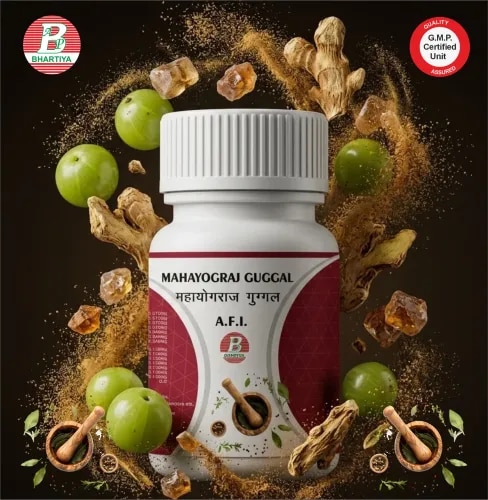
"name": "Mahayograj Guggal",
"description": "\n MHAYOGRAJ GUGGUL\n\nProduct Identification \n•\tGeneric Name: Mahayograj Guggul\n•\tType: Ayurvedic Polyherbal Formulation\n•\tPrimary Indication Area: Bones, Joints & Musculoskeletal Disorders\n•\t\nTherapeutic Indications: Traditionally used for:\nOsteoarthritis (joint pain, stiffness, swelling)\n• Rheumatoid arthritis-like conditions (Ama-Vata)\n• Back pain and cervical/lumbar spondylosis\n• Sciatica and nerve-related pain\n• Gout and inflammatory joint disorders\n• General weakness of bones, joints, and ligaments\nKey Benefits:\n•\tRelieves joint pain, stiffness, and swelling\n•\tHelps reduce inflammation in joints and muscles\n•\t Improves flexibility and mobility of joints\n•\t Supports nerve strength and reduces Vata imbalance\n•\tAids in improving chronic degenerative bone and joint conditions \nFORMULA\nEach Tablet contains: \nSunthi \t3 g\nPippali \t3 g\nChavya\t3 g\nPippali Mula\t3 g\nChitrak\t3 g\nHingu\t3 g\nAjmoda\t3 g\nSarsapa\t3 g\nSavet Jiraka\t3 g\nKrishan Jiraka\t3 g\nRenuka\t3 g\nKutaja\t3 g\nPatha\t3 g\nVidanga\t3 g\nGajpippali\t3 g\nKatuka\t3 g\nAtivisha\t3 g\nBharangi\t3 g\nVasa\t3 g\nMurva\t3 g\nHaritaki \t40g\nBibhitaki\t40g\nAmalaki\t40g\nShudh Guggul\t180g\nVang Bhasma\t48g\nRajat Bhasma\t48g\nNag Bhasma\t48g\nAbhrak Bhasma\t48g\nLoha Bhasma\t48g\nMandura Bhasma\t48g\nRas Sindura (Parada)\t48g\n\n \nIngredients:\n\n1. Haritaki (Terminalia chebula)\n• Botanical/Scientific Name: Terminalia chebula\n• Rasa–Guna–Vīrya–Vipāka:\no Rasa: Kaṣāya (Astringent), Amla (Sour), Madhura (Sweet), Tikta (Bitter), Kaṭu (Pungent)\no Guna: Laghu (Light), Rūkṣa (Dry)\no Vīrya: Uṣṇa (Hot)\no Vipāka: Madhura (Sweet)\n• Prabhāva: Virecana & Anulomana (Mild laxative and bowel regulator)\nMechanism of Action (Karma):\n• Anulomana Karma: Regulates Apana Vayu and improves bowel evacuation\n• Deepana-Pachana Karma: Enhances Agni and reduces Ama accumulation\n• Shothahara Karma: Reduces inflammatory swelling in tissues\n\n2. Bibhitaki (Terminalia bellirica)\n• Botanical/Scientific Name: Terminalia bellirica\n• Rasa–Guna–Vīrya–Vipāka:\no Rasa: Kaṣāya (Astringent)\no Guna: Laghu (Light), Rūkṣa (Dry)\no Vīrya: Uṣṇa (Hot)\no Vipāka: Madhura (Sweet)\n• Prabhāva: Kapha-Pitta Shamana\nMechanism of Action (Karma):\n• Detoxifies body and reduces Ama\n• Improves bowel regularity\n• Reduces inflammation in joints and tissues\n\n3. Amalaki (Emblica officinalis)\n• Botanical/Scientific Name: Emblica officinalis\n• Rasa–Guna–Vīrya–Vipāka:\no Rasa: Amla (Sour dominant, all Rasas except Lavana)\no Guna: Laghu (Light), Rūkṣa (Dry)\no Vīrya: Śīta (Cooling)\no Vipāka: Madhura (Sweet)\n• Prabhāva: Rasayana (Rejuvenator)\nMechanism of Action (Karma):\n• Strong antioxidant and tissue rejuvenation\n• Supports cartilage and bone health\n• Reduces oxidative inflammation in joints\n\n4. Sunthi (Zingiber officinale)\n• Botanical/Scientific Name: Zingiber officinale\n• Rasa–Guna–Vīrya–Vipāka:\no Rasa: Kaṭu (Pungent)\no Guna: Laghu (Light), Rūkṣa (Dry)\no Vīrya: Uṣṇa (Hot)\no Vipāka: Madhura (Sweet)\n• Prabhāva: Deepana & Shothahara\nMechanism of Action (Karma):\n• Improves digestion and removes Ama\n• Reduces joint inflammation and pain\n• Enhances circulation in Vata disorders\n\n5. Pippali (Piper longum)\n• Botanical/Scientific Name: Piper longum\n• Rasa–Guna–Vīrya–Vipāka:\no Rasa: Kaṭu\no Guna: Laghu, Snigdha\no Vīrya: Uṣṇa\no Vipāka: Madhura\n• Prabhāva: Yogavahi (bioenhancer)\nMechanism of Action (Karma):\n• Enhances absorption of other herbs\n• Reduces Ama and metabolic toxins\n• Strengthens joints and respiratory system\n\n6. Chavya (Piper chaba)\n• Botanical/Scientific Name: Piper chaba\n• Rasa–Guna–Vīrya–Vipāka:\no Rasa: Kaṭu\no Guna: Laghu, Rūkṣa\no Vīrya: Uṣṇa\no Vipāka: Kaṭu\n• Prabhāva: Deepana\nMechanism of Action (Karma):\n• Stimulates digestive fire\n• Reduces intestinal Ama\n• Helps Vata-Kapha imbalance in joints\n\n7. Pippali Mula (Piper longum root)\n• Botanical/Scientific Name: Piper longum (root)\n• Rasa–Guna–Vīrya–Vipāka:\no Rasa: Kaṭu\no Guna: Laghu, Rūkṣa\no Vīrya: Uṣṇa\no Vipāka: Kaṭu\n• Prabhāva: Vata-Kapha Shamana\nMechanism of Action (Karma):\n• Improves deep tissue metabolism\n• Reduces joint stiffness\n• Clears Ama from joints\n\n8. Chitrak (Plumbago zeylanica)\n• Botanical/Scientific Name: Plumbago zeylanica\n• Rasa–Guna–Vīrya–Vipāka:\no Rasa: Kaṭu\no Guna: Laghu, Rūkṣa, Tikṣṇa\no Vīrya: Uṣṇa\no Vipāka: Kaṭu\n• Prabhāva: Agni Deepana\nMechanism of Action (Karma):\n• Strong digestive stimulant\n• Breaks Ama in deep tissues\n• Reduces chronic inflammation in joints\n\n9. Hingu (Ferula foetida)\n• Botanical/Scientific Name: Ferula foetida\n• Rasa–Guna–Vīrya–Vipāka:\no Rasa: Kaṭu\no Guna: Laghu, Tikṣṇa, Snigdha\no Vīrya: Uṣṇa\no Vipāka: Kaṭu\n• Prabhāva: Vata Anulomana\nMechanism of Action (Karma):\n• Relieves gas and Vata obstruction\n• Reduces nerve and joint pain\n• Improves gut-joint connection balance\n\n10. Ajmoda (Apium leptophyllum)\n• Botanical/Scientific Name: Apium leptophyllum\n• Rasa–Guna–Vīrya–Vipāka:\no Rasa: Kaṭu, Tikta\no Guna: Laghu, Rūkṣa\no Vīrya: Uṣṇa\n• Prabhāva: Shoolahara\nMechanism of Action (Karma):\n• Reduces joint and muscular pain\n• Improves circulation\n• Relieves stiffness and cramps\n\n11. Sarsapa (Brassica juncea)\n• Botanical/Scientific Name: Brassica juncea\n• Rasa–Guna–Vīrya–Vipāka:\no Rasa: Kaṭu, Tikta\no Guna: Laghu, Rūkṣa, Tikṣṇa\no Vīrya: Uṣṇa\n• Prabhāva: Vedanasthapana\nMechanism of Action (Karma):\n• Improves blood flow in joints\n• Reduces cold-induced pain\n• Decreases stiffness\n\n12. Safed Jeeraka (Cuminum cyminum)\n• Botanical/Scientific Name: Cuminum cyminum\n• Rasa–Guna–Vīrya–Vipāka:\no Rasa: Kaṭu, Tikta\no Guna: Laghu, Rūkṣa\no Vīrya: Uṣṇa\n• Prabhāva: Deepana\nMechanism of Action (Karma):\n• Improves digestion and metabolism\n• Reduces Ama formation\n• Supports joint health indirectly\n\n13. Krishna Jeeraka (Carum carvi)\n• Botanical/Scientific Name: Carum carvi\n• Rasa–Guna–Vīrya–Vipāka:\no Rasa: Kaṭu, Tikta\no Guna: Laghu\no Vīrya: Uṣṇa\n• Prabhāva: Vata-Kapha Shamana\nMechanism of Action (Karma):\n• Relieves intestinal spasms\n• Reduces bloating and gas\n• Supports pain relief in Vata disorders\n\n14. Renuka\n• Botanical/Scientific Name: Vitex negundo (commonly associated)\n• Rasa–Guna–Vīrya–Vipāka:\no Rasa: Tikta, Kaṭu\no Guna: Laghu, Rūkṣa\no Vīrya: Uṣṇa\n• Prabhāva: Shothahara\nMechanism of Action (Karma):\n• Reduces inflammation in joints\n• Acts as mild analgesic\n• Helps in Vata-related swelling\n\n15. Kutaja (Holarrhena antidysenterica)\n• Botanical/Scientific Name: Holarrhena antidysenterica\n• Rasa–Guna–Vīrya–Vipāka:\no Rasa: Tikta, Kaṣāya\no Guna: Laghu, Rūkṣa\no Vīrya: Śīta\n• Prabhāva: Grahi (absorbent)\nMechanism of Action (Karma):\n• Controls excessive bowel discharge\n• Detoxifies gut\n• Supports chronic inflammatory conditions\n\n16. Patha (Cissampelos pareira)\n• Botanical/Scientific Name: Cissampelos pareira\n• Rasa–Guna–Vīrya–Vipāka:\no Rasa: Tikta, Kaṣāya\no Guna: Laghu, Rūkṣa\no Vīrya: Uṣṇa\n• Prabhāva: Shothahara\nMechanism of Action (Karma):\n• Reduces inflammation\n• Supports pain relief in joints\n• Helps Vata balance\n\n17. Vidanga (Embelia ribes)\n• Botanical/Scientific Name: Embelia ribes\n• Rasa–Guna–Vīrya–Vipāka:\no Rasa: Kaṭu, Tikta\no Guna: Laghu, Rūkṣa\no Vīrya: Uṣṇa\n• Prabhāva: Krimighna\nMechanism of Action (Karma):\n• Removes toxins and parasites\n• Improves gut health\n• Reduces Ama-related joint pain\n\n18. Gajpippali (Scindapsus officinalis)\n• Botanical/Scientific Name: Scindapsus officinalis\n• Rasa–Guna–Vīrya–Vipāka:\no Rasa: Kaṭu\no Guna: Laghu, Rūkṣa\no Vīrya: Uṣṇa\n• Prabhāva: Deepana\nMechanism of Action (Karma):\n• Improves digestion\n• Reduces Vata-Kapha imbalance\n• Supports joint metabolism\n\n19. Katuka (Picrorhiza kurroa)\n• Botanical/Scientific Name: Picrorhiza kurroa\n• Rasa–Guna–Vīrya–Vipāka:\no Rasa: Tikta\no Guna: Laghu, Rūkṣa\no Vīrya: Śīta\n• Prabhāva: Pitta Shamana\nMechanism of Action (Karma):\n• Detoxifies liver and blood\n• Reduces systemic inflammation\n• Supports chronic arthritis conditions\n\n20. Ativisha (Aconitum heterophyllum)\n• Botanical/Scientific Name: Aconitum heterophyllum\n• Rasa–Guna–Vīrya–Vipāka:\no Rasa: Tikta, Kaṭu\no Guna: Laghu, Rūkṣa\no Vīrya: Śīta\n• Prabhāva: Jwaraghna\nMechanism of Action (Karma):\n• Reduces systemic toxins\n• Supports immune regulation\n• Helps in chronic inflammatory disorders\n\n21. Bharangi (Clerodendrum serratum)\n• Botanical/Scientific Name: Clerodendrum serratum\n• Rasa–Guna–Vīrya–Vipāka:\no Rasa: Tikta, Kaṭu\no Guna: Laghu, Rūkṣa\no Vīrya: Uṣṇa\n• Prabhāva: Shothahara\nMechanism of Action (Karma):\n• Reduces swelling and inflammation\n• Supports respiratory and joint health\n• Helps in Vata-Kapha imbalance\n\n22. Vasa (Adhatoda vasica)\n• Botanical/Scientific Name: Adhatoda vasica\n• Rasa–Guna–Vīrya–Vipāka:\no Rasa: Tikta, Kaṣāya\no Guna: Laghu, Rūkṣa\no Vīrya: Śīta\n• Prabhāva: Kapha Shamana\nMechanism of Action (Karma):\n• Reduces Kapha and inflammation\n• Improves oxygenation and tissue repair\n• Supports chronic inflammatory conditions\n\n23. Murva (Marsdenia tenacissima)\n• Botanical/Scientific Name: Marsdenia tenacissima\n• Rasa–Guna–Vīrya–Vipāka:\no Rasa: Tikta\no Guna: Laghu, Rūkṣa\no Vīrya: Śīta\n• Prabhāva: Vata-Pitta Shamana\nMechanism of Action (Karma):\n• Reduces burning and inflammation\n• Supports joint and nerve health\n• Helps in chronic Vata disorders\n\n24. Shuddha Guggul (Commiphora mukul)\n• Botanical/Scientific Name: Commiphora mukul\n• Rasa–Guna–Vīrya–Vipāka:\no Rasa: Tikta, Kaṭu, Kaṣāya\no Guna: Laghu, Rūkṣa, Tikṣṇa\no Vīrya: Uṣṇa\n• Prabhāva: Yogavahi & Lekhana\nMechanism of Action (Karma):\n• Removes Ama and toxins from joints\n• Reduces inflammation and swelling\n• Restores joint mobility\n25. Vang Bhasma (Tin calx)\n• Botanical/Scientific Name: Tin processed calcined preparation (SnO₂ based Bhasma)\n• Rasa–Guna–Vīrya–Vipāka:\no Rasa: Kaṣāya, Tikta\no Guna: Laghu (Light), Rūkṣa (Dry)\no Vīrya: Śīta (Cooling)\no Vipāka: Kaṭu (Pungent)\n• Prabhāva: Balya & Shukra Dhatu Poshaka\nMechanism of Action (Karma):\n• Strengthens musculoskeletal tissues\n• Supports bone and joint mineral balance\n• Improves tissue regeneration in chronic degeneration\n\n26. Rajat Bhasma (Silver calx)\n• Botanical/Scientific Name: Purified calcined silver preparation\n• Rasa–Guna–Vīrya–Vipāka:\no Rasa: Madhura (Sweet), Kaṣāya\no Guna: Snigdha (Unctuous), Laghu\no Vīrya: Śīta (Cooling)\no Vipāka: Madhura (Sweet)\n• Prabhāva: Medhya & Rasayana\nMechanism of Action (Karma):\n• Supports nerve tissue regeneration\n• Reduces inflammation in chronic disorders\n• Enhances cellular repair and immunity\n\n27. Nag Bhasma (Lead calx – detoxified form in classical Ayurveda)\n• Botanical/Scientific Name: Purified calcined lead preparation\n• Rasa–Guna–Vīrya–Vipāka:\no Rasa: Kaṣāya, Tikta\no Guna: Laghu, Rūkṣa\no Vīrya: Uṣṇa\no Vipāka: Kaṭu\n• Prabhāva: Asthi-Sandhi Balya\nMechanism of Action (Karma):\n• Strengthens bone density and joints\n• Helps in chronic degenerative conditions\n• Supports Vata stabilization in musculoskeletal system\n\n28. Abhrak Bhasma (Mica calx)\n• Botanical/Scientific Name: Purified calcined mica (Silicate mineral complex)\n• Rasa–Guna–Vīrya–Vipāka:\no Rasa: Madhura, Tikta\no Guna: Laghu, Snigdha\no Vīrya: Śīta to Uṣṇa (balanced, Rasayana effect)\no Vipāka: Madhura\n• Prabhāva: Rasayana (Rejuvenator)\nMechanism of Action (Karma):\n• Promotes tissue regeneration and longevity\n• Strengthens nerves, bones, and muscles\n• Supports chronic degenerative disease recovery\n\n29. Loha Bhasma (Iron calx)\n• Botanical/Scientific Name: Purified calcined iron preparation\n• Rasa–Guna–Vīrya–Vipāka:\no Rasa: Kaṣāya, Tikta\no Guna: Laghu, Rūkṣa\no Vīrya: Uṣṇa\no Vipāka: Kaṭu\n• Prabhāva: Raktavardhaka & Balya\nMechanism of Action (Karma):\n• Improves blood formation and oxygen transport\n• Strengthens tissues and muscles\n• Supports recovery in chronic weakness\n\n30. Mandura Bhasma (Iron oxide calx)\nBotanical/Scientific Name: Ferric oxide-based calcined preparation\n Rasa–Guna–Vīrya–Vipāka:\no Rasa: Kaṣāya\no Guna: Laghu, Rūkṣa\no Vīrya: Uṣṇa\no Vipāka: Kaṭu\n• Prabhāva: Raktashodhaka\nMechanism of Action (Karma):\n• Purifies blood and removes metabolic toxins\n• Reduces inflammation in chronic disorders\n• Supports liver and tissue detox pathways\n\n31. Ras Sindura (Parada-based preparation)\n• Botanical/Scientific Name: Purified Mercury–Sulfur compound (HgS based Ayurvedic preparation)\n• Rasa–Guna–Vīrya–Vipāka:\no Rasa: Tikta, Kaṣāya\no Guna: Laghu, Tikṣṇa\no Vīrya: Uṣṇa\no Vipāka: Kaṭu\n• Prabhāva: Yogavahi & Rasayana (very potent catalyst)\nMechanism of Action (Karma):\n• Enhances potency of entire formulation\n• Supports deep tissue regeneration\n• Acts at microcellular level in chronic diseases\n• Helps in fast therapeutic action in Vata disorders\n\nDosage of Triphala Guggul\n•\tForm: Tablet / Capsule \n•\tDose: 1–2 tablets (250–500 mg each) \n•\tFrequency: Twice daily (BID) \n•\tTiming: After food \n•\tAnupana: Lukewarm water.\n\n\nmahayograj guggulu, mahayograj guggulu uses in hindi, mahayograj guggulu uses\nmahayograj guggulu benefits, mahayograj guggul, mahayograj guggulu ke fayde\nmahayograj guggulu price, mahayograj guggulu benefits in hindi, mahayograj guggulu ayurvedic medicine\nmahayograj guggulu amazon, mahayograj guggulu ayurveda, mahayograj guggulu ayurvedic\nmahayograj guggulu ayurvedic tablet, mahayograj guggul benefits in hindi\nmahayograj guggul benefits, mahayograj guggulu best brand, mahayograj guggulu buy online\nmahayograj guggul content, mahayograj guggul capsule, mahayograj guggul ingredients\nmahayograj guggul price, mahayograj guggul uses, mahayograj guggul dosage\nmahayograj guggulu fayde, mahayograj guggulu flipkart, mahayograj guggulu for arthritis\nmahayograj guggul ke fayde, mahayograj guggul ke fayde in hindi, mahayograj guggul gold\nmahayograj guggul ke ghatak, mahayograj guggul and yograj guggul, mahayograj guggul hindi\nmahayograj guggul uses hindi, swarna mahayograj guggul in hindi, mahayograj guggul kya hai\nmahayograj guggul benefits hindi, mahayograj guggul in hindi, mahayograj guggul ingredients in hindi\nmahayograj guggul in marathi, mahayograj guggul image, mahayograj guggulu ingredients\nmahayograj guggulu indicatio, mahayograj guggul khane ke fayde, mahayograj guggul ka kya kam hai\nmahayograj guggul ke bare mein bataiye, mahayograj guggul uses in hindi, mahayograj guggulu medicine\nmahayograj guggulu mrp, ayurvedic medicine mahayograj guggul, mahayograj guggul hindi mein\nmahayograj guggulu near me, mahayograj guggul botanical name, use of mahayograj guggul in hindi\nbenefits of mahayograj guggul, uses of mahayograj guggul, content of mahayograj guggul\ncomposition of mahayograj guggul, ingredients of mahayograj guggul, dose of mahayograj guggul\nmahayograj guggulu price in india, mahayograj guggul tablet, mahayograj guggulu tablet uses\nmahayograj guggul vati, mahayograj guggul vati uses in hindi, mahayograj guggulu vati\nmahayograj guggulu when to take, mahayograj guggul rate, mahayograj guggul fayde\nwhere mahayograj guggal tablets, where mahayograj guggal benefits, when mahayograj guggal how to use\nwhen mahayograj guggal tablets, when mahayograj guggal how to take, when mahayograj guggal benefits\nhow mahayograj guggal can be taken, how mahayograj guggal tablets, how mahayograj guggal mode of action\nhow mahayograj guggal benefits, how mahayograj guggal himalaya, why mahayograj guggal tablets\nwhy mahayograj guggal when to take, why mahayograj guggal mode of action, why mahayograj guggal in hindi\nwhy mahayograj guggal how to use, who mahayograj guggal tablets, who mahayograj gug, gal scientific name\nwho mahayograj guggal with gold, can mahayograj guggal how to use, can mahayograj guggal when to take\ncan mahayograj guggal side effects, can mahayograj guggal content, does mahayograj guggal dosage",
"price": 858.0,
"discountamount": 429.0,
"currencycode": "INR",
"priority": 1000000,
"isfreeshipmentavailable": false,
"shipmentduration": 1,
"_keywords": null,
"isarchived": false,
"isavailable": true,
"applicationid": null,
"productindex": 144,
"imageuri": "https://productimages.withfloats.com/actual/6a476c41ea2a7af079423105.jpg",
"tileimageuri": "https://productimages.withfloats.com/tile/6a476c41ea2a7af079423105.jpg",
"images": null,
"totalqueries": 0,
"gpid": null,
"groupproductid": null,
"createdon": "2026-07-03T08:01:03.912Z",
"updatedon": "2026-07-03T08:01:03.912Z",
"buyonlinelink": null,
"producturl": "http://WWW.BHARTIYAAYURVEDICPHARMACY.COM//mahayograj-guggal/144",
"availableunits": -1.0,
"iscodavailable": true,
"isprepaidonlineavailable": true,
"maxcodorders": -1,
"maxprepaidonlineorders": -1,
"uniquepaymenturl": null,
"brandname": "Bakula Fort",
"category": "Mahayograj Guggal 100 gm X 30",
"tags": [],
"variants": false,
"keyspecification": null,
"otherspecifications": null,
"pickupaddressreferenceid": null,
"paymenttype": "AssuredPurchase",
"producttype": "products",
"hsncode": null,
"gstslab": 0.0,
"isnotforsale": false
},
{
"_id": "6a1936c2b229e486c3e86712",
"fptag": "BHARTIYEAYURVEDICPHARMACY",
"merchantname": null,
"customwidgets": null,
"externalsourceid": null,
"name": "Santushti Tail",
"description": " SANTUSHTI OIL \n\nProduct Identification\n•\tGeneric Name: Santushti Oil\n•\tType: Ayurvedic Patent Medicine\n•\tPrimary Indication Area: Sexual health and vitality; may help improve stamina, libido, and overall reproductive wellness\n\n Therapeutic Indications\nSantushti Oil is indicated for the promotion of sexual health, enhancement of libido, improvement of stamina and vitality, and support for overall reproductive wellness. It may also help in reducing sexual fatigue and improving performance.\n\nKey benefits:\n•\tEnhances Sexual Vitality: Supports libido and overall sexual health.\n•\tImproves Stamina & Endurance: Helps reduce fatigue and boost energy levels.\n•\tSupports Reproductive Wellness: Promotes healthy reproductive function.\n•\tRelieves Stress & Fatigue: Provides rejuvenating effects on body and mind.\n•\tAyurvedic Formulation: Made from natural herbs to safely support male and female vitality.\n\n\nIngredient: \n Javitri (Nutmeg) \nBotanical Name: Myristica fragrans\nKey Constituents: Myristicin, elemicin, eugenol, essential oils, tannins\nTherapeutic Role in Sexual Health:\n1.\tAphrodisiac Effect:\no\tEnhances libido and sexual desire by stimulating the nervous system.\n2.\tImproves Stamina & Vitality:\no\tHelps reduce fatigue and promotes physical and sexual endurance.\n3.\tSupports Reproductive Health:\no\tTraditionally used to strengthen reproductive organs and improve overall sexual performance.\n4.\tMood & Stress Support:\no\tMild nervine and calming properties help relieve anxiety or stress that can impact sexual health.\n5.\tAyurvedic Perspective:\no\tUshna (hot) and Snigdha (unctuous) qualities help balance Vata and Kapha, enhancing vitality and energy.\nJaiphal (Nutmeg) \nBotanical Name: Myristica fragrans\nKey Constituents: Myristicin, elemicin, eugenol, essential oils, tannins\nTherapeutic Role in Sexual Health:\n1.\tAphrodisiac Activity:\no\tEnhances libido and sexual desire by stimulating the nervous system.\n2.\tImproves Stamina & Endurance:\no\tReduces fatigue and promotes physical and sexual energy.\n3.\tSupports Reproductive Wellness:\no\tStrengthens reproductive organs and improves overall sexual performance.\n4.\tMood & Stress Support:\no\tCalms the nervous system and helps relieve stress or anxiety affecting sexual health.\n5.\tAyurvedic Properties:\no\tRasa (taste): Sweet, pungent\no\tGuna (qualities): Ushna (hot), Snigdha (unctuous)\no\tDosha effect: Balances Vata and Kapha, supporting vitality and vigor\n\n Lavang (Clove) \nBotanical Name: Syzygium aromaticum\nKey Constituents: Eugenol, caryophyllene, tannins, flavonoids, essential oils\nTherapeutic Role in Sexual Health:\n1.\tAphrodisiac & Libido Support:\no\tStimulates circulation and nervous system activity to enhance sexual desire and performance.\n2.\tBoosts Stamina & Vitality:\no\tHelps reduce fatigue and improve energy, supporting endurance in sexual activity.\n3.\tSupports Reproductive Health:\no\tTraditionally used to strengthen reproductive organs and enhance overall sexual wellness.\n4.\tAntioxidant & Anti-inflammatory Effects:\no\tEugenol and flavonoids help protect tissues from oxidative stress, supporting general vitality.\n5.\tAyurvedic Perspective:\no\tRasa (taste): Pungent, sweet\no\tGuna (qualities): Ushna (hot), Tikshna (sharp)\no\tDosha effect: Balances Vata and Kapha; enhances circulation and warmth, promoting vigor\n Kesar (Saffron) \nBotanical Name: Crocus sativus\nKey Constituents: Crocin, crocetin, picrocrocin, Safranal\nTherapeutic Role in Sexual Health:\n1.\tAphrodisiac Effect:\no\tEnhances libido and sexual desire by stimulating nervous and reproductive systems.\n2.\tImproves Stamina & Vitality:\no\tReduces fatigue and boosts energy, supporting endurance in sexual activity.\n3.\tSupports Reproductive Wellness:\no\tPromotes healthy reproductive function and overall sexual performance.\n4.\tMood & Stress Support:\no\tCrocin and Safranal help improve mood, reduce stress, and relieve anxiety, which can positively influence sexual health.\n5.\tAyurvedic Perspective:\no\tRasa (taste): Sweet, slightly bitter\no\tGuna (qualities): Ushna (hot), Laghu (light), Snigdha (unctuous)\no\tDosha effect: Balances Vata and Kapha; enhances energy, vitality, and overall vigor\n\n Malkangni\nBotanical Name: Celestrus paniculatus\nCommon Names: Jyotishmati, Malkagni\nKey Constituents: Alkaloids (paniculatine), fatty acids, flavonoids, sterols, saponins\nTherapeutic Role in Sexual Health:\n1.\tAphrodisiac & Libido Support:\no\tTraditionally used to enhance sexual desire and performance.\n2.\tSupports Reproductive Health & Vitality:\no\tStrengthens reproductive organs and improves overall vigor.\n3.\tNervine & Cognitive Support:\no\tHelps improve memory, mental clarity, and reduces stress, indirectly supporting sexual health.\n4.\tStamina & Endurance:\no\tReduces fatigue and promotes physical and sexual energy.\n5.\tAyurvedic Perspective:\no\tRasa (taste): Bitter, pungent\no\tGuna (qualities): Ushna (hot), Laghu (light), Tikshna (sharp)\no\tDosha effect: Balances Vata and Kapha; enhances vitality, vigor, and nervous system strength\n\nBirbuti\n Botanical Name: Spilanthes acmella \nKey Constituents: Alkylamides (spilanthol), flavonoids, coumarins, essential oils\nTherapeutic Role in Sexual Health:\n1.\tAphrodisiac & Libido Support:\no\tTraditionally used to enhance sexual desire and performance.\n2.\tReproductive Health Support:\no\tStrengthens reproductive organs and improves vitality.\n3.\tStamina & Energy Enhancement:\no\tImproves physical and sexual endurance; reduces fatigue.\n4.\tCirculatory & Muscle Support:\no\tEnhances blood flow and improves tissue nourishment, supporting overall vitality.\n5.\tAyurvedic Perspective:\no\tRasa (taste): Pungent, slightly bitter\no\tGuna (qualities): Ushna (hot), Laghu (light), Tikshna (sharp)\no\tDosha effect: Balances Vata and Kapha; enhances energy, vitality, and sexual vigor\n\n\n Salam panja \nBotanical Name: Dactylorhiza hatagirea\nCommon Names: Himalayan Orchid, Rasna Bheda\nKey Constituents: Polysaccharides, glycosides, starches, phenolics, mucilage\nTherapeutic Role in Sexual Health:\n1.\tAphrodisiac & Libido Enhancement:\no\tTraditionally used to improve sexual desire and performance in both men and women.\n2.\tSupports Reproductive Health:\no\tStrengthens reproductive organs and enhances fertility and vigor.\n3.\tBoosts Stamina & Vitality:\no\tRejuvenates the body, reduces fatigue, and promotes endurance.\n4.\tMuscle & Tissue Rejuvenation:\no\tSupports recovery from weakness, improves circulation, and nourishes tissues.\n5.\tAyurvedic Perspective:\no\tRasa (taste): Sweet, slightly bitter\no\tGuna (qualities): Ushna (hot), Snigdha (unctuous), Laghu (light)\no\tDosha effect: Balances Vata and Kapha; promotes vitality, vigor, and sexual health\n\n Akarkara\nBotanical Name: Anacyclus pyrethrum \nCommon Names: Akar Pahal, Akarkara, Pellitory Root\nKey Constituents: Alkylamides (Anacyclin), pyrethrins, alkaloids, essential oils, saponins\nTherapeutic Role in Sexual Health:\n1.\tAphrodisiac & Libido Support:\no\tEnhances sexual desire, performance, and vitality.\n2.\tSupports Reproductive Health:\no\tStrengthens reproductive organs and improves fertility.\n3.\tStamina & Energy Booster:\no\tReduces fatigue and promotes physical and sexual endurance.\n4.\tNervine & Circulatory Support:\no\tStimulates nerve and blood circulation, supporting vitality and muscular health.\n5.\tAyurvedic Perspective:\no\tRasa (taste): Pungent, bitter\no\tGuna (qualities): Ushna (hot), Tikshna (sharp), Laghu (light)\no\tDosha effect: Balances Vata and Kapha; enhances vigor, stamina, and sexual health\n\n Nagkesar \nBotanical Name: Mesua ferrea\nCommon Names: Ironwood Tree, Nagkesar\nKey Constituents: Coumarins (mesuol, mesuagin), tannins, flavonoids, essential oils, resin\nTherapeutic Role in Sexual Health:\n1.\tAphrodisiac & Libido Support:\no\tEnhances sexual desire and performance.\n2.\tSupports Reproductive Health:\no\tStrengthens male reproductive organs and improves fertility and sexual vigor.\n3.\tStamina & Vitality Enhancement:\no\tReduces fatigue, boosts endurance, and promotes physical and sexual energy.\n4.\tAnti-inflammatory & Circulatory Support:\no\tImproves blood flow to reproductive tissues and supports muscular comfort.\n5.\tAyurvedic Perspective:\no\tRasa (taste): Bitter, astringent\no\tGuna (qualities): Ushna (hot), Tikshna (sharp)\no\tDosha effect: Balances Vata and Kapha; enhances vigor, vitality, and reproductive health\n\n Khursani Ajwain \nBotanical Name: Trachyspermum ammi\nCommon Names: Carom Seeds, Ajwain, Omam\nKey Constituents: Thymol, carvacrol, flavonoids, saponins, essential oils\nTherapeutic Role in Sexual Health:\n1.\tDigestive & Metabolic Support:\no\tImproves digestion and nutrient absorption, which supports overall vitality and energy.\n2.\tSupports Sexual Vitality Indirectly:\no\tBy enhancing digestive fire (Agni) and metabolism, it helps maintain stamina and vigor.\n3.\tStamina & Energy Booster:\no\tReduces lethargy and fatigue by improving overall metabolism.\n4.\tCirculatory & Muscle Support:\no\tThymol and essential oils enhance local circulation and tissue nourishment.\n5.\tAyurvedic Perspective:\no\tRasa (taste): Pungent, bitter\no\tGuna (qualities): Ushna (hot), Tikshna (sharp)\no\tDosha effect: Balances Kapha and Vata; enhances energy, vitality, and digestive health\n\n Choti Elaichi\nBotanical Name: Elettaria cardamomum\nCommon Names: Green Cardamom, Elaichi\nKey Constituents: Essential oils (cineole, terpinene, limonene), flavonoids, phenolic compounds, tannins\nTherapeutic Role in Sexual Health:\n1.\tAphrodisiac & Libido Support:\no\tEnhances sexual desire, performance, and vitality.\n2.\tSupports Reproductive Health:\no\tStrengthens reproductive organs and supports overall sexual wellness.\n3.\tStamina & Energy Booster:\no\tReduces fatigue, promotes endurance, and improves physical and sexual energy.\n4.\tDigestive & Metabolic Support:\no\tImproves digestion, nutrient absorption, and metabolism, which indirectly supports vitality.\n5.\tAyurvedic Perspective:\no\tRasa (taste): Sweet, pungent\no\tGuna (qualities): Ushna (hot), Snigdha (unctuous), Laghu (light)\no\tDosha effect: Balances Vata and Kapha; enhances vigor, stamina, and vitality\n\n Castoreum\nSource: Secretion from castor sacs of mature beavers (Castor fiber / Castor canadensis)\nKey Constituents: Phenols, esters, fatty acids, volatile oils, ketones\nTherapeutic Role in Sexual Health:\n1.\tAphrodisiac & Libido Enhancement:\no\tTraditionally used to stimulate sexual desire and enhance performance.\n2.\tReproductive Health Support:\no\tBelieved to strengthen reproductive organs and improve fertility.\n3.\tStamina & Vitality:\no\tEnhances physical endurance, reduces fatigue, and boosts overall energy.\n4.\tCirculatory & Nervine Support:\no\tPromotes circulation and tissue nourishment, supporting vitality.\n5.\tAyurvedic / Traditional Perspective:\no\tClassified as a rejuvenator and aphrodisiac in Rasayana formulations.\no\tOften used in small quantities due to potency.\n\n Pista\nBotanical Name: Pistacia vera\nCommon Names: Pistachio, Pista\nKey Constituents: Proteins, healthy fats (oleic, linoleic acids), vitamins (E, B6), minerals (magnesium, potassium), antioxidants\nTherapeutic Role in Sexual Health:\n1.\tAphrodisiac & Libido Support:\no\tTraditionally used to enhance sexual desire and performance.\n2.\tReproductive Health Support:\no\tStrengthens reproductive organs, enhances fertility, and supports overall sexual vigor.\n3.\tStamina & Energy Booster:\no\tProvides sustained energy, reduces fatigue, and improves physical and sexual endurance.\n4.\tNervine & Tissue Rejuvenation:\no\tNourishes tissues, supports nervous system health, and promotes overall vitality.\n5.\tAyurvedic Perspective:\no\tRasa (taste): Sweet, slightly astringent\no\tGuna (qualities): Snigdha (unctuous), Guru (heavy), Madhura (sweet)\no\tDosha effect: Balances Vata and Pitta; enhances strength, stamina, and reproductive health\n\n Til Tail\nBotanical Name: Sesamum indicum\nCommon Names: Sesame Oil, Til Oil\nKey Constituents: Unsaturated fatty acids (oleic, linoleic), sesamol, sesamin, vitamin E, minerals\nTherapeutic Role in Sexual Health:\n1.\tAphrodisiac & Libido Support:\no\tSupports sexual vigor and vitality by nourishing reproductive tissues.\n2.\tReproductive Health Support:\no\tStrengthens reproductive organs, enhances fertility, and improves sexual stamina.\n3.\tStamina & Energy Booster:\no\tProvides sustained energy, reduces fatigue, and supports physical and sexual endurance.\n4.\tNervine & Tissue Nourishment:\no\tDeeply penetrates tissues to rejuvenate muscles, joints, and nerves.\n5.\tAyurvedic Perspective:\no\tRasa (taste): Sweet, oily\no\tGuna (qualities): Snigdha (unctuous), Guru (heavy), Ushna (hot)\no\tDosha effect: Balances Vata and Pitta; enhances strength, stamina, and reproductive health\n\n Lauh Bhasma \n Scientific Name: Iron Ash\nSource: Calcined and purified iron prepared according to classical Ayurvedic methods\nKey Constituents: Elemental iron, trace minerals\nTherapeutic Role in Sexual Health:\n1.\tReproductive & Sexual Health Support:\no\tEnhances sexual vigor, libido, and performance.\no\tStrengthens male reproductive organs and supports fertility.\n2.\tStamina & Vitality Booster:\no\tImproves energy levels, reduces fatigue, and promotes physical and sexual endurance.\n3.\tHemopoietic & Tissue Rejuvenation:\no\tSupports red blood cell formation, improves circulation, and nourishes tissues.\n4.\tAyurvedic Perspective:\no\tRasa (taste): Kashaya (astringent), Tikta (bitter)\no\tGuna (qualities): Guru (heavy), Ruksha (dry), Ushna (hot)\no\tDosha effect: Balances Vata and Pitta; enhances strength, vitality, and reproductive health\n\n Shudh Shilajit \n Scientific Name: Purified Shilajit / Asphaltum\nSource: Exudate from Himalayan rocks, purified according to classical Ayurvedic methods\nKey Constituents: Fulvic acid, humic acid, dibenzo-alpha-pyrones, trace minerals\nTherapeutic Role in Sexual Health:\n1.\tAphrodisiac & Libido Enhancement:\no\tBoosts sexual desire, performance, and reproductive vitality.\n2.\tReproductive Health Support:\no\tStrengthens reproductive organs, supports fertility, and improves sperm quality in men.\n3.\tStamina & Energy Booster:\no\tReduces fatigue, enhances physical and sexual endurance, and improves overall vitality.\n4.\tNervine & Tissue Rejuvenation:\no\tSupports nervous system health, nourishes tissues, and promotes rejuvenation.\n5.\tAyurvedic Perspective:\no\tRasa (taste): Bitter, astringent\no\tGuna (qualities): Guru (heavy), Snigdha (unctuous), Ushna (hot)\no\tDosha effect: Balances Vata and Kapha; enhances strength, stamina, and reproductive health\n\nTrivang Bhasma – Ayurvedic Herbo-Mineral Preparation\nSource: Classical bhasma prepared from three purified metals/minerals according to Ayurvedic pharmacopeia\nKey Constituents: Trace elements of Tin, Lead, Zinc, along with minor mineral ash components\nTherapeutic Role in Sexual Health:\n1.\tAphrodisiac & Libido Enhancement:\no\tTraditionally used to boost sexual desire, performance, and reproductive vitality.\n2.\tReproductive Health Support:\no\tStrengthens reproductive organs, improves fertility, and enhances sexual stamina.\n3.\tStamina & Vitality Booster:\no\tImproves energy, reduces fatigue, and enhances physical and sexual endurance.\n4.\tTissue & Nervine Rejuvenation:\no\tSupports nervous system and tissue health, aiding rejuvenation and vitality.\n5.\tAyurvedic Perspective:\no\tRasa (taste): Astringent, metallic\no\tGuna (qualities): Guru (heavy), Ruksha (dry), Ushna (hot)\no\tDosha effect: Balances Vata and Kapha; enhances vigor, reproductive health, and overall strength\n\n Shudh Hingul \nScientific Name: Purified Cinnabar / Red Sulfur\nSource: Mercury-sulfur compound (Cinnabar / HgS) purified according to classical Ayurvedic methods\nKey Constituents: Mercuric sulphide (HgS) and trace minerals after purification\nTherapeutic Role in Sexual Health:\n1.\tAphrodisiac & Libido Support:\no\tEnhances sexual desire, performance, and vigor.\n2.\tReproductive Health Support:\no\tStrengthens reproductive organs and supports fertility.\n3.\tStamina & Vitality Booster:\no\tIncreases physical endurance, reduces fatigue, and promotes overall vitality.\n4.\tTissue & Nervine Rejuvenation:\no\tSupports nervous system health, tissue strength, and rejuvenation.\n5.\tAyurvedic Perspective:\no\tRasa (taste): Kashaya (astringent), Lavana (salty)\no\tGuna (qualities): Guru (heavy), Ushna (hot), Snigdha (unctuous)\no\tDosha effect: Balances Vata and Kapha; enhances strength, stamina, and reproductive health\n\n Abhrak Bhasma \nScientific Name: Purified Mica Ash\nSource: Calcined and purified natural mica (Abhrak) prepared according to classical Ayurvedic methods\nKey Constituents: Silicates of aluminum and magnesium, trace minerals, microelements\nTherapeutic Role in Sexual Health:\n1.\tAphrodisiac & Libido Enhancement:\no\tBoosts sexual desire, vigor, and performance.\n2.\tReproductive Health Support:\no\tStrengthens reproductive organs, enhances fertility, and improves sexual stamina.\n3.\tStamina & Energy Booster:\no\tImproves physical endurance, reduces fatigue, and promotes vitality.\n4.\tTissue & Nervine Rejuvenation:\no\tSupports nervous system health, tissue strength, and overall rejuvenation.\n5.\tAyurvedic Perspective:\no\tRasa (taste): Kashaya (astringent), Madhura (sweet)\no\tGuna (qualities): Guru (heavy), Snigdha (unctuous), Ushna (hot)\no\tDosha effect: Balances Vata and Kapha; enhances vigor, strength, and reproductive health\n\n Shudh Hartal \nScientific Name: Purified Cinnabar / Mercury Sulphide\nSource: Mercury-sulfur compound (Cinnabar / HgS) purified according to classical Ayurvedic procedures\nKey Constituents: Mercuric sulphide (HgS) with trace minerals after purification\nTherapeutic Role in Sexual Health:\n1.\tAphrodisiac & Libido Enhancement:\no\tBoosts sexual desire, performance, and vigor.\n2.\tReproductive Health Support:\no\tStrengthens reproductive organs and enhances fertility.\n3.\tStamina & Vitality Booster:\no\tReduces fatigue, improves endurance, and promotes overall vitality.\n4.\tTissue & Nervine Rejuvenation:\no\tSupports nervous system health, tissue strength, and rejuvenation.\n5.\tAyurvedic Perspective:\no\tRasa (taste): Kashaya (astringent), Lavana (salty)\no\tGuna (qualities): Guru (heavy), Ushna (hot), Snigdha (unctuous)\no\tDosha effect: Balances Vata and Kapha; enhances strength, stamina, and reproductive health\n\nShudh Bhilawa \nScientific Name: Purified Aconitum / Indian Monkshood\nSource: Root or tuber of Aconitum ferox purified according to classical Ayurvedic methods\nKey Constituents: Alkaloids (aconitine, mesaconitine), polysaccharides, trace minerals after purification\nTherapeutic Role in Sexual Health:\n1.\tAphrodisiac & Libido Enhancement:\no\tEnhances sexual desire, performance, and vigor.\n2.\tReproductive Health Support:\no\tStrengthens reproductive organs, improves fertility, and sexual stamina.\n3.\tStamina & Vitality Booster:\no\tImproves physical endurance, reduces fatigue, and boosts overall energy.\n4.\tTissue & Nervine Rejuvenation:\no\tSupports nervous system health, tissue strength, and overall rejuvenation.\n5.\tAyurvedic Perspective:\no\tRasa (taste): Tikta (bitter), Katu (pungent)\no\tGuna (qualities): Guru (heavy), Ushna (hot), Tikshna (sharp)\no\tDosha effect: Balances Vata and Kapha; enhances vigor, strength, and sexual health\n\n\n How to use:\nExternal Application (Topical Massage / Abhyanga)\n•\tMethod: Apply a few drops of the oil on the lower abdomen, lower back, thighs, or reproductive organs.\n•\tMassage: Gently massage in circular motions for 5–10 minutes.\n•\tFrequency: 1–2 times daily, preferably before bedtime.\n•\tBenefit: Improves local circulation, muscle relaxation, and sexual vitality; nourishes tissues and reproductive organs.\n\nsantushti tail taila, santushti tail bala, santushti tail bilaspur\nsantushti tail brand, santushti tail branches, santushti tail cooler\nsantushti tail cooler price, santushti tail company, santushti tail deoria uttar pradesh\nsantushti tail deoghar jharkhand, santushti tail export, santushti tail english\nsantushti tail equipment, santushti tail english translation, santushti tail enterprises\nsantushti tail english meaning, santushti tail english name, santushti tail english spelling\nsantushti tail feed, santushti tail fashion point, santushti tail franchise, santushti tail franchise price\nsantushti tail grinder, santushti tail gate, santushti tail gold, santushti tail ghaziabad\nsantushti tail gujarat, santushti tail gurugram, santushti tail gujarati, santushti tail hospital\nsantushti tail hindi, santushti tail house, santushti tail hospital sonipat, santushti tail hoti hai\nsantushti tail in english, santushti tail in hindi, santushti tail in delhi, santushti tail in marathi\nsantushti tail in malayalam, santushti tail in tamil, santushti tail in punjabi, santushti tail in telugu\nsantushti tail in bengali, santushti tail kundali, santushti tail kaise kare, santushti tail ka meaning in hindi\nsantushti tail ka hindi, santushti tail light, santushti tail limited, santushti tail light price, santushti tail machine\nsantushti tail machine price, santushti tail name, santushti tail name style, santushti tail najafgarh\nsantushti tail nagar, santushti tail online, santushti tail online shopping, santushti tail office address\nsantushti tail origin, santushti tail online order, santushti tail owner, santushti tail of hindi\nsantushti tail price, santushti tail product, santushti tail question, santushti tail question answer\nsantushti tail quotes in hindi, santushti tail uses in hindi, santushti tail uses",
"price": 270.0,
"discountamount": 135.0,
"currencycode": "INR",
"priority": 1000000,
"isfreeshipmentavailable": false,
"shipmentduration": 1,
"_keywords": null,
"isarchived": false,
"isavailable": true,
"applicationid": null,
"productindex": 134,
"imageuri": "https://productimages.withfloats.com/actual/6a1936c6b129782af24ef5c9.jpg",
"tileimageuri": "https://productimages.withfloats.com/tile/6a1936c6b129782af24ef5c9.jpg",
"images": null,
"totalqueries": 0,
"gpid": null,
"groupproductid": null,
"createdon": "2026-05-29T06:48:34.259Z",
"updatedon": "2026-05-29T06:48:34.259Z",
"buyonlinelink": null,
"producturl": "http://WWW.BHARTIYAAYURVEDICPHARMACY.COM//santushti-tail/134",
"availableunits": -1.0,
"iscodavailable": true,
"isprepaidonlineavailable": true,
"maxcodorders": -1,
"maxprepaidonlineorders": -1,
"uniquepaymenturl": null,
"brandname": "Bakula Fort",
"category": "Santushti Tail 15 ML X 30",
"tags": [],
"variants": false,
"keyspecification": null,
"otherspecifications": null,
"pickupaddressreferenceid": null,
"paymenttype": "AssuredPurchase",
"producttype": "products",
"hsncode": null,
"gstslab": 0.0,
"isnotforsale": false
},
{
"_id": "6a0aeed71c45b26e830de355",
"fptag": "BHARTIYEAYURVEDICPHARMACY",
"merchantname": null,
"customwidgets": null,
"externalsourceid": null,
"name": "Amrit Vita Pill",
"description": " AMRIT VITA PILLS \n\nProduct Identification\n•\tGeneric Name: Amrit Vita Pills\n•\tType: Ayurvedic Patent Medicine\n•\tPrimary Indication Area: Supports respiratory health, particularly useful in bronchitis, cough, and asthma\n•\tTherapeutic Indications: support respiratory function, help in relieving cough, reducing congestion, and promoting lung health naturally\nKey benefits include:\n•\tRespiratory Support: Helps maintain healthy lung function and eases breathing.\n•\tBronchitis & Asthma Relief: Reduces symptoms like cough, congestion, and respiratory discomfort.\n•\tCough Management: Soothes the throat and reduces persistent coughing.\n•\tImmune Support: Strengthens the body’s natural defenses against infections.\n•\tAnti-inflammatory Action: Helps reduce mild inflammation in the respiratory tract.\n•\tOverall Vitality: Supports energy levels and general wellness.\n.\nIngredients:\nArjun Chhal (Terminalia arjuna Bark) \nBotanical Name: Terminalia arjuna\nAyurvedic Name: Arjuna Chhal / Arjuna Bark\nKey Phytoconstituents:\n•\tTriterpenoid saponins (Arjunic acid, Arjunolic acid) – strengthen heart muscles\n•\tFlavonoids & Polyphenols – antioxidant, anti-inflammatory\n•\tTannins – astringent, protect cardiac tissue\n•\tMinerals (Calcium, Magnesium) – support myocardial function\n•\tGlycosides – improve circulation and cardiac output\n\n1. Triggers & Immune Response\n•\tDust, pollen, infection → body’s immune cells (mast cells, eosinophils, neutrophils) get activated\n•\tThey release cytokines like IL-4, IL-5, IL-13 → cause inflammation and allergy reactions\n2. Mast Cell Reaction\n•\tMast cells release histamine, leukotrienes, prostaglandins\n•\tEffect: Smooth muscles around airways tighten → bronchoconstriction (wheeze)\n3. Mucus Overproduction\n•\tAirways make too much mucus (from goblet cells)\n•\tTriggered by IL-13, IL-9\n•\tEffect: Airway gets blocked → cough and difficulty breathing\n4. Oxidative Stress\n•\tImmune cells make free radicals (ROS)\n•\tEffect: Damage lung cells → worsen inflammation\n5. Chronic Changes (Airway Remodeling)\n•\tLong-term inflammation → airway thickens and stiffens\n•\tMediated by TGF-β → fibrosis and permanent narrowing\n6. Cough Reflex\n•\tIrritation of airway nerves → release Substance P\n•\tEffect: Triggers cough\n Bhringraj (Eclipta alba) \nPrimary Action: Supports respiratory mucosa, reduces inflammation, and protects against oxidative damage.\nKey Phytoconstituents:\n•\tCoumestans (Wedelolactone)\n•\tFlavonoids & Polyphenols\n•\tTriterpenoids & Glycosides\nMechanism / Biochemistry:\n1.\tAnti-inflammatory: Wedelolactone inhibits pro-inflammatory cytokines (IL-6, TNF-α) → reduces airway inflammation.\n2.\tAntioxidant: Polyphenols scavenge ROS, protecting bronchial epithelial cells.\n3.\tMucosal protection: Glycosides and triterpenoids soothe irritated respiratory lining.\n4.\tMild immunomodulatory: Helps regulate immune response to allergens and infections.\n\n Myristica malabarica \nBotanical Name: Myristica malabarica\nAyurvedic Name: Jaiphal / Myristica\nPrimary Indication Area:\n•\tSupports respiratory system, especially cough, bronchitis, and congestion\n•\tActs as expectorant, bronchodilator, and anti-inflammatory\n•\tRelieves cold, chest congestion, and mild asthma symptoms\nKey Phytoconstituents:\n•\tEssential oils: Myristicin, Elemicin, Safrole – volatile oils with bronchodilator and antimicrobial properties\n•\tFlavonoids & Polyphenols – antioxidant and anti-inflammatory\n•\tTannins – astringent, protective for mucosa\n•\tFatty oils / fixed oils – mild soothing effect on respiratory lining\n\nMechanism of Action / Biochemistry:\n1.\tBronchodilator Action:\no\tMyristicin and elemicin relax smooth muscles of bronchi → improves airflow\no\tUseful in wheeze and mild bronchospasm\n2.\tExpectorant / Mucus Clearance:\no\tVolatile oils thin mucus and stimulate productive cough\no\tHelps clear thick phlegm from airways\n3.\tAnti-inflammatory Action:\no\tFlavonoids and polyphenols inhibit pro-inflammatory mediators (TNF-α, IL-6)\no\tReduces airway swelling and irritation\n4.\tAntimicrobial Effect:\no\tEssential oils inhibit bacteria and viruses that cause respiratory infections\n5.\tAntioxidant & Protective:\no\tTannins and polyphenols scavenge ROS → protect airway epithelial cells from oxidative damage\n\n Vasa (Adhatoda vasica) \nBotanical Name: Adhatoda vasica\nAyurvedic Name: Vasa / Vasaka\nPrimary Indication Area:\n•\tSupports respiratory system\n•\tActs as bronchodilator, expectorant, and anti-inflammatory\n•\tUsed in cough, bronchitis, asthma, and congestion\nKey Phytoconstituents:\n•\tAlkaloids: Vasicine, Vasicinone – bronchodilator and expectorant\n•\tFlavonoids & Phenolics – antioxidant, anti-inflammatory\n•\tEssential oils – mild antimicrobial and soothing effect\n\nMechanism of Action / Biochemistry:\n1.\tBronchodilator Action:\no\tVasicine and Vasicinone relax bronchial smooth muscles → eases airflow\no\tHelps relieve wheeze and mild bronchospasm\n2.\tExpectorant / Mucus Clearance:\no\tStimulates respiratory glands → thins mucus\no\tPromotes productive cough, clearing phlegm\n3.\tAnti-inflammatory Action:\no\tFlavonoids and phenolics inhibit pro-inflammatory cytokines (IL-6, TNF-α)\no\tReduces airway swelling and irritation\n4.\tAntioxidant & Protective:\no\tScavenges ROS, protecting bronchial epithelium from oxidative stress\n5.\tMild Antimicrobial Action:\no\tEssential oils and alkaloids inhibit bacteria and viruses in the respiratory tract\n\n Apamarg (Achyranthes aspera) \nBotanical Name: Achyranthes aspera\nAyurvedic Name: Apamarg\nPrimary Indication Area:\n•\tSupports respiratory health\n•\tActs as expectorant, anti-inflammatory, and bronchodilator\n•\tHelps in cough, asthma, bronchitis, and phlegm clearance\nKey Phytoconstituents:\n•\tAlkaloids – stimulate respiratory tract, bronchodilator effect\n•\tSaponins – reduce airway inflammation and mucus viscosity\n•\tFlavonoids & Phenolics – antioxidant, anti-inflammatory\n•\tTannins – astringent, protective for mucosa\n•\tEssential oils – mild antimicrobial\n\nMechanism of Action / Biochemistry:\n1.\tBronchodilator Action:\no\tAlkaloids relax bronchial smooth muscles, improving airflow\no\tReduces wheeze and shortness of breath\n2.\tExpectorant / Mucus Clearance:\no\tSaponins and essential oils thin mucus and stimulate productive cough\no\tHelps clear thick phlegm from airways\n3.\tAnti-inflammatory Action:\no\tFlavonoids and phenolics inhibit pro-inflammatory cytokines (IL-6, TNF-α)\no\tReduces airway swelling and irritation\n4.\tAntioxidant & Protective:\no\tPolyphenols and flavonoids scavenge ROS, protecting respiratory epithelial cells\n5.\tAntimicrobial Effect:\no\tEssential oils and tannins inhibit bacteria and viruses in respiratory tract\n\n Baheda (Terminalia bellerica) \nBotanical Name: Terminalia bellerica\nAyurvedic Name: Baheda / Bibhitaki\nPrimary Indication Area:\n•\tSupports respiratory health\n•\tActs as expectorant, anti-inflammatory, and antioxidant\n•\tHelps in cough, asthma, bronchitis, and throat irritation\nKey Phytoconstituents:\n•\tTannins: Belleric acid, Ellagic acid – anti-inflammatory, antioxidant\n•\tPolyphenols & Flavonoids – reduce oxidative stress\n•\tMucilage & Polysaccharides – soothe irritated airways\n•\tFatty oils – mild protective effect on mucosa\n\nMechanism of Action / Biochemistry:\n1.\tAnti-inflammatory:\no\tPolyphenols and tannins inhibit pro-inflammatory cytokines (IL-6, TNF-α) → reduces airway swelling and irritation\n2.\tExpectorant / Mucus Clearance:\no\tMucilage and polysaccharides soothe respiratory lining\no\tHelps thin and clear mucus → productive cough\n3.\tAntioxidant / Protective:\no\tEllagic acid and tannins scavenge ROS → protect bronchial epithelial cells from oxidative damage\n4.\tMild Antimicrobial Effect:\no\tTannins may inhibit bacteria or viruses in the respiratory tract\n\n Somlata (Cynanchum viminale) \nBotanical Name: Cynanchum viminale (also called Sarcostemma viminale)\nAyurvedic Name: Somlata\nPrimary Indication Area:\n•\tSupports respiratory system\n•\tActs as expectorant, bronchodilator, and anti-inflammatory\n•\tHelps in cough, bronchitis, asthma, and phlegm-related respiratory issues\nKey Phytoconstituents:\n•\tAlkaloids – bronchodilator and expectorant action\n•\tSaponins – reduce mucus viscosity, anti-inflammatory\n•\tFlavonoids & Phenolics – antioxidant and anti-inflammatory\n•\tGlycosides – protect respiratory mucosa\n•\tTannins – astringent and protective\n\nMechanism of Action / Biochemistry:\n1.\tBronchodilator Action:\no\tAlkaloids relax bronchial smooth muscles, improving airflow\no\tHelps relieve wheeze and mild bronchospasm\n2.\tExpectorant / Mucus Clearance:\no\tSaponins and glycosides thin mucus → facilitate productive cough\no\tClears thick phlegm from airways\n3.\tAnti-inflammatory Action:\no\tFlavonoids and phenolics inhibit pro-inflammatory cytokines (IL-6, TNF-α)\no\tReduces airway edema and irritation\n4.\tAntioxidant & Protective:\no\tScavenges ROS, protecting airway epithelial cells from oxidative damage\n5.\tAntimicrobial / Mucosal Protection:\no\tTannins and glycosides help prevent infections and protect mucosa\n\n Harad (Terminalia chebula) \nBotanical Name: Terminalia chebula\nAyurvedic Name: Harad / Haritaki\nPrimary Indication Area:\n•\tSupports respiratory health\n•\tActs as expectorant, anti-inflammatory, and antioxidant\n•\tHelps in cough, asthma, bronchitis, and throat irritation\nKey Phytoconstituents:\n•\tTannins: Chebulinic acid, Chebulagic acid – anti-inflammatory, antioxidant\n•\tPolyphenols & Flavonoids – reduce oxidative stress\n•\tMucilage & Polysaccharides – soothe irritated airways\n•\tAnthraquinones – mild mucus-thinning effect\nMechanism of Action / Biochemistry:\n1.\tAnti-inflammatory:\no\tPolyphenols and tannins inhibit pro-inflammatory cytokines (IL-6, TNF-α) → reduces airway swelling and irritation\n2.\tExpectorant / Mucus Clearance:\no\tMucilage soothes airway lining\no\tAnthraquinones thin mucus, making cough productive\n3.\tAntioxidant / Protective:\no\tChebulinic and chebulagic acids scavenge ROS → protect bronchial epithelial cells from oxidative damage\n4.\tMild Antimicrobial Effect:\no\tTannins may reduce bacterial or viral infections in the respiratory tract\n\n Shudh Hingul (Ferula narthex) \nBotanical Name: Ferula narthex\nAyurvedic Name: Shudh Hingul\nPrimary Indication Area:\n•\tSupports respiratory system\n•\tActs as expectorant, bronchodilator, and anti-inflammatory\n•\tHelps in cough, asthma, bronchitis, and congestion\nKey Phytoconstituents:\n•\tResin / Essential oils: Ferulic acid, Umbelliferone – bronchodilator, anti-inflammatory\n•\tSesquiterpenes & Coumarins – antioxidant, antimicrobial\n•\tGum & Resin – soothes irritated mucosa\n•\tTannins – astringent and protective\nMechanism of Action / Biochemistry:\n1.\tBronchodilator Action:\no\tResin and essential oils relax bronchial smooth muscles, improving airflow\no\tHelps relieve wheeze and bronchospasm\n2.\tExpectorant / Mucus Clearance:\no\tGum and resin thin mucus, making cough productive\no\tClears thick phlegm from airways\n3.\tAnti-inflammatory Action:\no\tCoumarins and ferulic acid inhibit pro-inflammatory cytokines (IL-6, TNF-α)\no\tReduces airway swelling and irritation\n4.\tAntioxidant & Protective:\no\tSesquiterpenes and phenolics scavenge ROS, protecting bronchial epithelial cells\n5.\tAntimicrobial Effect:\no\tEssential oils inhibit bacteria and viruses in the respiratory tract\nDosage:\n1.\tDose per intake: 1-2 pills \n2.\tFrequency: 2 times daily\n3.\tTotal daily dose: 2-4 pills (depending on physician advice)\n4.\tHow to take: With plain water, preferably after meals\nPrecautions\n•\tDo not exceed the prescribed dose\n•\tConsult an Ayurvedic practitioner before use in:\no\tChildren\no\tElderly\no\tPatients with chronic illness\n•\tMonitor for any side effects (e.g., digestive discomfort)\n•\tMaintain proper diet and hydration to support bowel health\n\n\namritvita pills, amritvita pill aid, amritvita pill box\namritvita pill benefits, amritvita pill benefits in hindi\namritvita pill dehradun, amritvita pill extract\namritvita pill forte, amritvita pill gurugram\namritvita pill gummies, amritvita pill hospital\namritvita pill house, amritvita pill herbal\namritvita pill in hindi , amritvita pill in english\namritvita pill kit, amritvita pill khanna, amritvita pill machine\namritvita pill maker, amritvita pill machine price\namritvita pill normal, amritvita pill powder\namritvita pill pvt ltd, amritvita pill price\namritvita pill plus, amritvita pill power house\namritvita pill quetta contact number, amritvita pill recipe\namritvita pill recipe in hindi, amritvita pill pills\namritvita pill pills price, amritvita pill pills uses in hindi\namritvita pill pills review, amritvita pill tablet\namritvita pill tablet price, amritvita pill tree\namritvita pill tablet uses in hindi, amritvita pill tablet uses\namritvita pill vitamin, amritvita pill vihar, amritvita pill wellness\namritvita pill web series, amritvita pill zumba, amritvita pill zone\nwhat amritvita pills used for, best amritvita pills\nbest amritvita pillai, top amritvita pills, top amritvita pillai",
"price": 330.0,
"discountamount": 165.0,
"currencycode": "INR",
"priority": 1000000,
"isfreeshipmentavailable": false,
"shipmentduration": 1,
"_keywords": null,
"isarchived": false,
"isavailable": true,
"applicationid": null,
"productindex": 123,
"imageuri": "https://productimages.withfloats.com/actual/6a0aeedaa338f9b17482e0f1.jpg",
"tileimageuri": "https://productimages.withfloats.com/tile/6a0aeedaa338f9b17482e0f1.jpg",
"images": null,
"totalqueries": 0,
"gpid": null,
"groupproductid": null,
"createdon": "2026-05-18T10:49:59.771Z",
"updatedon": "2026-05-18T10:49:59.771Z",
"buyonlinelink": null,
"producturl": "http://WWW.BHARTIYAAYURVEDICPHARMACY.COM//amrit-vita-pill/123",
"availableunits": -1.0,
"iscodavailable": true,
"isprepaidonlineavailable": true,
"maxcodorders": -1,
"maxprepaidonlineorders": -1,
"uniquepaymenturl": null,
"brandname": "Bakula Fort",
"category": "Amrit Vita Pill 100 GM X 30",
"tags": [],
"variants": false,
"keyspecification": null,
"otherspecifications": null,
"pickupaddressreferenceid": null,
"paymenttype": "AssuredPurchase",
"producttype": "products",
"hsncode": null,
"gstslab": 0.0,
"isnotforsale": false
},
{
"_id": "6a05b4d42065b659ccfb8e50",
"fptag": "BHARTIYEAYURVEDICPHARMACY",
"merchantname": null,
"customwidgets": null,
"externalsourceid": null,
"name": "Vigozyme Fort Tablet",
"description": " VIGOZYME FORT TABLET \n\nProduct Identification\n•\tGeneric Name: Vigozyme Fort Tablet\n•\tType: Ayurvedic Patent Medicine\n•\tPrimary Indication Area: Male sexual health, specifically nightfall and dysfunctional ejaculation.\nTherapeutic Indications: \n•\tTo manage nightfall, premature or dysfunctional ejaculation, and improve male reproductive health.\nPrimary Benefit:\n•\tReduces involuntary ejaculation (nightfall) and supports normal sexual function in men.\nOther Benefits:\n Improves Sexual Stamina and Endurance\n•\tHelps delay ejaculation and sustain sexual activity for longer periods.\n•\tStrengthens the physiological mechanisms controlling ejaculation.\n•\tEnhances Overall Reproductive Health\n•\tSupports healthy sperm production and seminal quality.\n•\tPromotes balance in the reproductive tissues (Shukra Dhatu in Ayurvedic terms).\n•\tSupports Vitality and Energy Levels\n•\tReduces fatigue and improves overall physical and mental energy, which contributes to better sexual performance.\n•\tReduces Stress-Related Sexual Dysfunction\n•\tHelps manage anxiety or psychological factors that may trigger nightfall or premature ejaculation.\n•\tActs as a mild adaptogen to support nervous system stability.\n•\tGeneral Health Support (Optional, depending on formulation)\n•\tSome herbs may provide antioxidant benefits, improving tissue health and circulation, indirectly supporting reproductive function.\n\n HARAD CHILKA (Terminalia chebula – Seed Coat) \nBotanical / Common Name: Harad Chilka / Chebula Seed Coat\nPart Used: Seed coat\nKey Phytoconstituents:\n•\tTannins (chebulinic acid, chebulagic acid)\n•\tGallic acid\n•\tFlavonoids\n•\tPhenolic compounds\n•\tMinor alkaloids\nMechanism of Action in Male Sexual Health — Nightfall & Premature Ejaculation\n1. Nervine & Adaptogenic Support\n•\tFlavonoids and tannins exert mild adaptogenic effects, supporting the autonomic nervous system.\n•\tHelps regulate involuntary ejaculation by stabilizing nerve function.\n2. Strengthening Reproductive Tissues\n•\tTannins and phenolic compounds nourish Shukra Dhatu (reproductive tissue in Ayurvedic terms).\n•\tSupports sperm quality and seminal retention, reducing nightfall frequency.\n\nSHUDH KUCHLA (Nux vomica – Detoxified Seeds) \nBotanical / Common Name: Nux vomica / Kuchla\nPart Used: Seeds (Shuddh / Detoxified)\nKey Phytoconstituents:\n•\tAlkaloids (strychnine, brucine – in detoxified form, safe in small doses)\n•\tTannins\n•\tFlavonoids\n•\tGlycosides\nMechanism of Action in Male Sexual Health — Nightfall & Premature Ejaculation\n1. Nervine Stimulant & CNS Modulation\n•\tDetoxified alkaloids in Shudh Kuchla act as mild nervous system stimulants, improving neuromuscular coordination.\n•\tEnhances control over ejaculatory reflex, reducing premature ejaculation and involuntary nightfall.\n2. Strengthening Reproductive Tissue (Shukra Dhatu)\n•\tSupports seminal tissue health and sperm quality, helping maintain normal ejaculation patterns.\n\nSHUDH DHATURBEEJ (Datura stramonium – Detoxified Seeds) \nBotanical / Common Name: Dhatri Beej / Datura Seeds\nPart Used: Seeds (Shuddh / Detoxified)\nKey Phytoconstituents:\n•\tAlkaloids (atropine, scopolamine – in detoxified form, safe in small doses)\n•\tFlavonoids\n•\tTannins\n•\tGlycosides\nMechanism of Action in Male Sexual Health — Nightfall & Premature Ejaculation\n1. Nervine and Autonomic Modulation\n•\tDetoxified alkaloids modulate the autonomic nervous system, helping regulate ejaculatory reflex.\n•\tReduces involuntary ejaculation (nightfall) and improves ejaculatory control.\n2. Strengthening Reproductive Tissue (Shukra Dhatu)\n•\tSupports seminal health, improving sperm quality and reducing frequency of nightfall.\n\n ASHWAGANDHA (Withania somnifera) \nBotanical / Common Name: Ashwagandha / Indian Ginseng / Winter Cherry\nPart Used: Root\nKey Phytoconstituents:\n•\tWithanolides\n•\tAlkaloids (withanine, somniferine)\n•\tSaponins\n•\tFlavonoids\n•\tIron and other micronutrients\nMechanism of Action in Male Sexual Health — Nightfall & Premature Ejaculation\n1. Nervine and Adaptogenic Support\n•\tWithanolides act as adaptogens, reducing stress and anxiety.\n•\tSupports autonomic nervous system balance, improving control over ejaculation and reducing involuntary nightfall.\n2. Strengthening Reproductive Tissue (Shukra Dhatu)\n•\tEnhances seminal production and sperm quality.\n•\tNourishes reproductive tissues, helping maintain normal ejaculatory function.\n\nSAFED MUSALI (Chlorophytum borivilianum) \nBotanical / Common Name: Safed Musali / White Musli\nPart Used: Root\nKey Phytoconstituents:\n•\tSteroidal saponins (sarsasapogenin derivatives)\n•\tPolysaccharides\n•\tAlkaloids\n•\tProteins and amino acids\n•\tFlavonoids\nMechanism of Action in Male Sexual Health — Nightfall & Premature Ejaculation\n1. Aphrodisiac & Sexual Stamina Enhancement\n•\tSteroidal saponins improve sexual desire, vigor, and endurance.\n•\tEnhances ejaculatory control, reducing premature ejaculation.\n2. Strengthening Reproductive Tissue (Shukra Dhatu)\n•\tNourishes and revitalizes seminal tissue, improving sperm count and quality.\n•\tSupports overall reproductive health and reduces nightfall frequency.\n\n SHATAVARI (Asparagus racemosus) \nBotanical / Common Name: Shatavari / Wild Asparagus\nPart Used: Root\nKey Phytoconstituents:\n•\tSteroidal saponins (shatavarins I–IV)\n•\tFlavonoids\n•\tAlkaloids\n•\tPolysaccharides\n•\tVitamins and minerals\nMechanism of Action in Male Sexual Health — Nightfall & Premature Ejaculation\n1. Reproductive Tissue Nourishment (Shukra Dhatu)\n•\tSteroidal saponins nourish and strengthen seminal tissue, improving sperm quality and reducing involuntary nightfall.\n2. Nervine & Adaptogenic Support\n•\tActs as a mild adaptogen, reducing stress and anxiety that contribute to premature ejaculation.\n•\tSupports autonomic nervous system regulation, improving ejaculatory control.\n\nTALMAKHANA (Hygrophila auriculata / Hygrophila spinosa) \nBotanical / Common Name: Talmakhana / Marsh Hygrophila\nPart Used: Root and seeds\nKey Phytoconstituents:\n•\tAlkaloids\n•\tFlavonoids\n•\tSteroidal saponins\n•\tTannins\n•\tProteins and essential amino acids\nMechanism of Action in Male Sexual Health — Nightfall & Premature Ejaculation\n1. Reproductive Tissue Nourishment (Shukra Dhatu)\n•\tSteroidal saponins and proteins nourish seminal tissue, improving sperm quality, volume, and vitality.\n•\tHelps reduce frequency of nightfall.\n2. Aphrodisiac & Sexual Stamina Enhancement\n•\tIncreases sexual vigor, endurance, and control over ejaculation, supporting men with premature ejaculation.\n\n SALAM PANJA (Tribulus terrestris) \nBotanical / Common Name: Salam Panja / Gokshura\nPart Used: Whole plant / Fruit\nKey Phytoconstituents:\n•\tSteroidal saponins (protodioscin)\n•\tFlavonoids\n•\tAlkaloids\n•\tGlycosides\n•\tTannins\n\nMechanism of Action in Male Sexual Health — Nightfall & Premature Ejaculation\n1. Reproductive Tissue Nourishment (Shukra Dhatu)\n•\tSteroidal saponins (protodioscin) support seminal tissue health, improving sperm quality, count, and motility.\n•\tHelps reduce involuntary nightfall.\n2. Aphrodisiac & Sexual Stamina Enhancement\n•\tEnhances libido, sexual vigor, and endurance, improving control over ejaculation and supporting premature ejaculation management.\n\nKAUNCH BEEJ (Mucuna pruriens – Velvet Bean Seeds) \nBotanical / Common Name: Kaunch Beej / Cowhage Seeds\nPart Used: Seeds\nKey Phytoconstituents:\n•\tL-DOPA (Levodopa)\n•\tAlkaloids\n•\tFlavonoids\n•\tSaponins\n•\tProteins and amino acids\nMechanism of Action in Male Sexual Health — Nightfall & Premature Ejaculation\n1. Reproductive Tissue Nourishment (Shukra Dhatu)\n•\tProteins, amino acids, and saponins support seminal tissue health, improving sperm quality, count, and motility.\n•\tHelps reduce involuntary nightfall.\n2. Aphrodisiac & Sexual Stamina Enhancement\n•\tEnhances libido, sexual vigor, and ejaculatory control, helping manage premature ejaculation.\n\nAmla (Phyllanthus emblica – Indian Gooseberry) \nBotanical / Common Name: Amla / Indian Gooseberry\nPart Used: Fruit\nKey Phytoconstituents:\n•\tVitamin C (Ascorbic Acid) – powerful antioxidant\n•\tTannins – astringent, protective\n•\tFlavonoids – antioxidant and anti-inflammatory\n•\tPhenolic compounds – tissue protection and rejuvenation\n•\tMinerals – iron, calcium, and phosphorus\nMechanism of Action in Male Sexual Health\n1. Reproductive Tissue Nourishment\n•\tRich in vitamin C and antioxidants, supports healthy sperm production and seminal quality.\n•\tHelps maintain Shukra Dhatu (seminal tissue) strength in Ayurvedic terms.\n2. Hormonal Balance\n•\tEnhances testosterone levels naturally through antioxidative and adaptogenic effects.\n•\tSupports endocrine health, indirectly aiding sexual performance.\n\nVidarikand (Pueraria tuberosa – Indian Kudzu) \nBotanical / Common Name: Vidarikand / Indian Kudzu\nPart Used: Tuber / Root\nKey Phytoconstituents:\n•\tIsoflavones – phytoestrogens, antioxidant\n•\tSaponins – tissue nourishment\n•\tProteins & Amino acids – support reproductive tissue health\n•\tStarch & Carbohydrates – energy source\n•\tSteroidal compounds – support hormonal balance\n\nMechanism of Action in Male Sexual Health\n1. Reproductive Tissue Nourishment (Shukra Dhatu)\n•\tSaponins and amino acids nourish seminal tissue, improving sperm quality, count, and motility.\n•\tHelps maintain vitality of reproductive organs, reducing nightfall.\n2. Aphrodisiac & Sexual Stamina Enhancement\n•\tActs as a natural aphrodisiac, boosting libido and sexual vigor.\n•\tSupports ejaculatory control, helping with premature ejaculation.\n\n Shital Chini (Stevia, Stevia rebaudiana) \nBotanical / Common Name: Shital Chini / Stevia\nPart Used: Leaves (dried or extract)\nKey Phytoconstituents:\n•\tSteviosides & Rebaudiosides – natural sweetening compounds\n•\tFlavonoids – antioxidant\n•\tPhenolic compounds – tissue protection\n•\tVitamins & Minerals – trace amounts supporting overall health\nMechanism of Action in Male Sexual Health\n1. Blood Sugar Regulation\n•\tHelps maintain healthy blood sugar levels, important because high blood sugar can affect sexual performance and libido.\n•\tSupports endothelial health, improving blood flow to reproductive organs.\n2. Antioxidant & Tissue Protection\n•\tFlavonoids and phenolics protect tissues from oxidative stress, including reproductive tissues.\n•\tHelps maintain sperm health and ejaculatory function.\n\nShudh Shilajit (Purified Shilajit) \nBotanical / Common Name: Shilajit / Mineral Pitch\nPart Used: Resin (exudate from rocks in Himalayas)\nKey Phytoconstituents:\n•\tFulvic acid & Humic acid – enhance nutrient absorption and antioxidant defense\n•\tDibenzopyrones & Minerals – support cellular energy and tissue repair\n•\tTrace minerals – iron, zinc, magnesium, selenium\n•\tOther bioactive compounds – support hormonal and metabolic health\nMechanism of Action in Male Sexual Health\n1. Reproductive Tissue Nourishment (Shukra Dhatu)\n•\tRich in minerals and bioactive compounds that strengthen seminal tissues.\n•\tImproves sperm count, motility, and quality, supporting fertility.\n2. Aphrodisiac & Sexual Stamina Enhancement\n•\tActs as a potent natural aphrodisiac, enhancing libido, sexual vigor, and ejaculatory control.\n•\tHelps manage premature ejaculation and sexual weakness.\n\nNausadar (Sodium Bicarbonate / Natron) \nBotanical / Common Name: Nausadar / Sodium Bicarbonate / Natron\nPart Used: Mineral salt\nKey Phytoconstituents / Composition:\n•\tSodium bicarbonate (NaHCO₃) – alkalizing agent\n•\tTrace minerals – depending on natural source\nMechanism of Action in Male Sexual Health\n1. Alkalizing & Digestive Support\n•\tHelps neutralize excess acidity in the stomach and body.\n•\tMay improve metabolic efficiency, indirectly supporting energy levels and stamina.\n2. Urinary & Prostate Health\n•\tAlkaline environment may help maintain urinary tract and prostate health.\n•\tCan reduce discomfort from mild urinary irritation, indirectly supporting sexual function.\n\nHingul Shudh (Purified Red Sulfur) \nBotanical / Common Name: Hingul Shudh / Shuddha Hingula / Cinnabar (Mercuric Sulfide, purified)\nPart Used: Mineral (purified form of cinnabar)\nKey Phytoconstituents / Composition:\n•\tMercuric sulfide (HgS, purified) – primary active mineral\n•\tTrace minerals – depending on source and purification\nMechanism of Action in Male Sexual Health\n1. Reproductive Tissue Nourishment (Shukra Dhatu)\n•\tTraditionally used in Ayurvedic formulations to strengthen seminal tissues.\n•\tHelps enhance sperm quality, count, and motility, supporting reproductive vitality.\n2. Aphrodisiac & Sexual Stamina\n•\tConsidered a rejuvenator and aphrodisiac in classical texts.\n•\tSupports libido, sexual vigor, and ejaculatory control, useful for premature ejaculation.\n\nPraval Pishti (Coral Calcium / Red Coral) \nBotanical / Common Name: Praval Pishti / Coral Calcium / Red Coral\nPart Used: Fossilized coral, powdered and processed\nKey Phytoconstituents / Composition:\n•\tCalcium carbonate (CaCO₃) – primary constituent\n•\tTrace minerals – magnesium, iron, zinc, and other microelements\n•\tAlkaline compounds – help balance body pH\nMechanism of Action in Male Sexual Health\n1. Reproductive Tissue Nourishment (Shukra Dhatu)\n•\tCalcium and trace minerals strengthen reproductive tissues, supporting healthy sperm production and seminal quality.\n•\tHelps reduce nightfall by nourishing Shukra Dhatu.\n2. Hormonal Support\n•\tCalcium and trace minerals support endocrine function, indirectly enhancing testosterone production and sexual vigor.\n\nTribang Bhasma\nBotanical / Common Name: Tribang Bhasma / Ayurvedic Herbal-Mineral Ash\nPart Used: Calcined minerals and herbal components (typically includes Loha / Iron, Vanga / Tin, and Naga / Lead in purified forms)\nKey Phytoconstituents / Composition:\n•\tPurified metals/minerals: Iron, Tin, Lead (processed for safety)\n•\tTrace minerals supporting reproductive and metabolic health\n•\tBioactive compounds from the Bhasma preparation process\nMechanism of Action in Male Sexual Health\n1. Reproductive Tissue Nourishment (Shukra Dhatu)\n•\tProvides essential minerals that nourish seminal tissues.\n•\tHelps improve sperm quality, count, and motility, supporting fertility.\n2. Aphrodisiac & Sexual Stamina Enhancement\n•\tTraditionally used as a sexual tonic to enhance libido, vigor, and endurance.\n•\tSupports ejaculatory control, helpful in premature ejaculation.\n\nLoh Bhasma (Iron Bhasma) \nBotanical / Common Name: Loh Bhasma / Ayurvedic Iron Ash\nPart Used: Purified and calcined iron\nKey Phytoconstituents / Composition:\n•\tElemental Iron (Fe) – primary active mineral\n•\tTrace minerals – depending on preparation method\n•\tBioactive compounds generated during bhasma processing (marana)\nMechanism of Action in Male Sexual Health\n1. Reproductive Tissue Nourishment (Shukra Dhatu)\n•\tProvides iron and trace minerals that strengthen seminal tissues.\n•\tSupports sperm production, motility, and overall reproductive vitality.\n2. Aphrodisiac & Sexual Stamina Enhancement\n•\tTraditionally used as a rejuvenator and sexual tonic.\n•\tImproves libido, vigor, and endurance, aiding ejaculatory control.\n\nDosage\n•\tAdults: 1–2 tablets twice a day.\n•\tTotal daily dose: 2–4 tablets.\nAdministration\n•\tTake with warm milk or water, preferably before meals.\n•\tFollow a physician’s advice if recommended.\nPrecautions\n•\tDo not exceed the prescribed dose.\n•\tSpecial populations: Consult a doctor before use in children, elderly, or patients with chronic illnesses.\n•\tHydration & diet: Maintain adequate hydration and a fiber-rich diet for optimal effect.\n•\tIntegrated care: Use as part of a comprehensive management plan for sexual health or any related condition.\n\n\n\nvigozyme fort tablet amazon, vigozyme fort tablet action\nvigozyme fort tablet benefits, vigozyme fort tablet buy online\nvigozyme fort tablet benefits in hindi, vigozyme fort tablet buy\nvitazyme tablet composition, vigozyme fort tablet dosage\nvigozyme fort tablet dose, vigozyme fort tablet details\nvigozyme fort tablet description, vigozyme fort tablet expiry date\nvigozyme fort tablet english, vigozyme fort tablet equivalent\nvigozyme fort tablet expiry, vigozyme fort tablet generic name\nvigozyme fort tablet gst rate, vigozyme fort tablet grade\nvigozyme fort tablet gst, vigozyme fort tablet how to use\nvigozyme fort tablet hindi, vigozyme fort tablet hsn code\nvigozyme fort tablet image, vigozyme fort tablet ingredients\nvigozyme fort tablet in hindi, vigozyme fort tablet ke fayde in hindi\nvigozyme fort tablet literature review, vigozyme fort tablet label\nvigozyme fort tablet manufacturer, vigozyme fort tablet manufacturers in india\nvigozyme fort tablet mrp, vigozyme fort tablet nutrition\nvigozyme fort tablet near me, vigozyme fort tablet online shopping\nvigozyme fort tablet online, vigozyme fort tablet price\nvigozyme fort tablet price in india, vigozyme fort tablet prospektüs\nvigozyme fort tablet quantity, vigozyme fort tablet quality\nvigozyme fort tablet rate, vigozyme fort tablet review\nvigozyme fort tablet reaction, vigozyme fort tablet rate in india\nvigozyme fort tablet substitute, vigozyme fort tablet supplier\nvigozyme fort tablet tata 1mg, vigozyme fort tablet time period\nvigozyme fort tablet uses in hindi, vigozyme fort tablet wise\nvigozyme fort tablet zepto",
"price": 120.0,
"discountamount": 60.0,
"currencycode": "INR",
"priority": 1000000,
"isfreeshipmentavailable": false,
"shipmentduration": 1,
"_keywords": null,
"isarchived": false,
"isavailable": true,
"applicationid": null,
"productindex": 117,
"imageuri": "https://productimages.withfloats.com/actual/6a05b4d7a41ecebe5b270138.jpg",
"tileimageuri": "https://productimages.withfloats.com/tile/6a05b4d7a41ecebe5b270138.jpg",
"images": null,
"totalqueries": 0,
"gpid": null,
"groupproductid": null,
"createdon": "2026-05-14T11:41:08.802Z",
"updatedon": "2026-05-14T11:41:08.802Z",
"buyonlinelink": null,
"producturl": "http://WWW.BHARTIYAAYURVEDICPHARMACY.COM//vigozyme-fort-tablet/117",
"availableunits": -1.0,
"iscodavailable": true,
"isprepaidonlineavailable": true,
"maxcodorders": -1,
"maxprepaidonlineorders": -1,
"uniquepaymenturl": null,
"brandname": "Bakula Fort",
"category": "Vigozyme Fort Tablet 100 GM X 40",
"tags": [],
"variants": false,
"keyspecification": null,
"otherspecifications": null,
"pickupaddressreferenceid": null,
"paymenttype": "AssuredPurchase",
"producttype": "products",
"hsncode": null,
"gstslab": 0.0,
"isnotforsale": false
},
{
"_id": "69f3238a7360b3ebd4a14204",
"fptag": "BHARTIYEAYURVEDICPHARMACY",
"merchantname": null,
"customwidgets": null,
"externalsourceid": null,
"name": "Prabhakar Mishran Tablet",
"description": " PRABHAKAR MISHRAN TABLET \n\nProduct Identification\n•\tGeneric Name: Prabhakar Mishran Tablet\n•\tType: Ayurvedic Patent Medicine\n•\tPrimary Indication Area: It is considered a cardiac tonic (Hridya Rasayana) aimed at supporting the heart’s function, circulation, and overall cardiac strength.\n\nTherapeutic Indications:\nSupportive treatment of heart disorders, including mild hypertension, palpitations, and general cardiac weakness.\n Primary Benefit:\n•\tStrengthens and supports heart function.\n.\nOther Benefits:\n1.\tStrengthens the heart (Hridya Rasayana):\no\tSupports overall cardiac muscle function and helps maintain a healthy heartbeat.\n2.\tHelps manage mild hypertension:\no\tCan assist in regulating blood pressure naturally, reducing strain on the heart.\n3.\tReduces palpitations and irregular heartbeat:\no\tHelps stabilize cardiac rhythm in mild cases, improving cardiovascular efficiency.\n4.\tImproves circulation:\no\tEnhances blood flow, ensuring oxygen and nutrients reach tissues efficiently, supporting heart and systemic health.\n5.\tBoosts stamina and reduces fatigue:\no\tBy strengthening the heart and circulation, it improves physical endurance and resilience to stress.\n\n\n PRABHAKAR VATI \nClassical Ayurvedic Name: Prabhakar Vati (Bhaishajya Ratnavali formulation)\nType: Polyherbal–mineral Rasashastra formulation\nPrimary Indication Area: Cardiac tonic, antihypertensive support, rejuvenator (Rasayana)\n\nKey Components / Phytoconstituents\n1. Abhrak Bhasma (Purified mica ash)\n•\tRich in Fe, Mg, Ca, K, Si, trace minerals\n•\tEnhances mitochondrial efficiency\n•\tBoosts oxygen transport & cellular respiration\n•\tYogavahi: improves bioavailability of all accompanying herbs\n2. Muktā Bhasma (Purified Pearl Calcium)\n•\tRich in bioavailable calcium carbonate & trace minerals\n•\tCalms the cardiac conduction system\n•\tProvides cooling, stabilizing effect on heart rhythm\n3. Arjuna (Terminalia arjuna)\n•\tContains flavonoids, saponins, tannins\n•\tPowerful cardiotonic herb\n•\tImproves coronary circulation & reduces oxidative load\n4. Other Herbal/ Mineral Ingredients (depending on classical variant)\n•\tLoh Bhasma – iron-based tonic for improved haemoglobin\n•\tPushkaramoola – bronchodilator & anti-anginal\n•\tNagabala, Vanshlochan – support cardiac & respiratory tissue strength\n\nBiochemistry / Pharmacology in Heart & Lung Health\n1. Myocardial Strengthening (Cardiac Muscle Support)\n•\tAbhrak + Arjuna improves mitochondrial ATP production\n•\tStrengthens myocardial contractility\n•\tHelps regulate cardiac ion channels (Ca²⁺, K⁺)\nEffect: Better pumping efficiency & improved cardiac endurance.\n\n2. Coronary Circulation & Oxygen Utilization\n•\tArjuna causes vasodilation via nitric-oxide–mediated endothelial relaxation\n•\tImproves coronary blood flow\n•\tMineral bhasmas increase oxygen delivery & tissue perfusion\nEffect: Less ischemic strain on heart muscles.\n3. Anti-arrhythmic & Rhythm Stabilization\n•\tMukta Bhasma stabilizes electrolyte balance (Ca²⁺ homeostasis)\n•\tReduces sympathetic overdrive → calming effect on heart rhythm\n•\tSmoothes conduction through SA & AV nodes\nEffect: Reduced palpitations & more regular heartbeat.\n4. Antioxidant & Anti-inflammatory Cardiac Protection\n•\tArjuna’s polyphenols neutralize free radicals\n•\tMinimizes cardiac lipid peroxidation\n•\tProtects mitochondria from oxidative damage\nEffect: Long-term structural protection of heart tissue.\n5. Lipid Metabolism & Liver Support\n•\tArjuna helps regulate LDL, triglycerides, and hepatic fat processing\n•\tDetoxifying herbs reduce metabolic overload\nEffect: Eases cardiac workload & promotes healthier lipid profile.\n\nRespiratory (Pulmonary) Mechanisms\n6. Bronchodilation & Respiratory Support\n•\tPushkaramoola relaxes bronchial smooth muscles\n•\tImproves lung capacity, oxygen exchange, and airflow\n•\tUseful in dyspnoea, chest congestion & chronic cough tendencies\nEffect: Better oxygen availability → indirectly supports heart health.\nRasayana (Rejuvenating) Action\n7. Tissue Regeneration & Vitality Enhancement\n•\tEncourages cellular renewal and metabolic efficiency\n•\tImproves stamina, vitality, and immunity\n•\tSupports recovery from chronic cardiac or respiratory strain\nEffect: Overall rejuvenation & systemic strengthening.\n\n NAGARJUN ABHRAK RAS \nClassical Ayurvedic Name: Abhrak Ras (Nagarjuna formulation)\nType: Polyherbal–mineral Rasashastra formulation\nPrimary Indication Area: Cardiac tonic, respiratory enhancer, rejuvenator (Rasayana)\n\nKey Components / Phytoconstituents\n1. Abhrak Bhasma (Purified & processed mica ash)\n•\tContains trace minerals: Fe, Mg, Ca, K, Si, bioavailable compounds\n•\tEnhances mitochondrial function, improves tissue oxygenation\n•\tKnown for Yogavahi property → enhances absorption of other herbs\n2. Herbal Ingredients (depending on classical variant):\n•\tSwarnamakshik Bhasma, Loha Bhasma – iron/copper-based mineral tonics\n•\tCardiotonic herbs (e.g., Arjuna, Pushkaramoola)\n•\tRich in flavonoids, saponins, glycosides, and antioxidant compounds\n\nBiochemistry / Pharmacology in Heart & Lung Health\n1. Myocardial Strengthening (Cardiac Muscle Support)\n•\tAbhrak Bhasma enhances mitochondrial ATP generation in heart cells\n•\tSupports stronger myocardial contraction\n•\tTrace minerals help regulate ion channels (Ca²⁺, K⁺) important for heartbeat regularity\nEffect: Improved pumping efficiency and cardiac stamina.\n2. Cardiac Circulation & Oxygen Utilization\n•\tActs as a vasodilator via flavonoid-mediated endothelial relaxation\n•\tIncreases coronary blood flow\n•\tAbhrak enhances oxygen uptake and haemoglobin function\nEffect: Better perfusion of cardiac tissue and reduced ischemic stress.\n3. Anti-arrhythmic & Rhythm Stabilizing Activity\n•\tCalcium and potassium modulation stabilizes action potentials in cardiac cells\n•\tReduces sympathetic overactivity → helps minimize palpitations\n•\tImproves SA–AV node conduction stability\nEffect: More stable and regular heartbeat.\n4. Antioxidant & Anti-inflammatory Cardiac Protection\n•\tPolyphenols + minerals decrease oxidative stress in the myocardium\n•\tReduces lipid peroxidation in cardiac membranes\n•\tPrevents damage to mitochondria, which are abundant in heart cells\nEffect: Protects the heart from long-term structural and functional damage.\n\n5. Lipid Metabolism & Detoxification\n•\tSupports liver-mediated lipid processing\n•\tHelps maintain healthy cholesterol and triglyceride levels\n•\tDetoxifies metabolic waste that burdens the heart\nEffect: Reduces cardiac metabolic load and improves overall cardiovascular health.\n\nRespiratory (Pulmonary) Mechanisms\n6. Bronchodilation & Respiratory Support\n•\tRelaxes bronchial smooth muscles → supports easier breathing\n•\tEnhances lung capacity and oxygen exchange\n•\tUseful in dyspnea (breathlessness), chronic cough, and asthmatic tendencies\nEffect: Better oxygen supply → indirectly strengthens the heart.\n\n7. Rasayana (Rejuvenating) Action\n•\tEnhances vitality, immunity, stamina\n•\tPromotes tissue regeneration and recovery\n•\tImproves overall metabolic efficiency\n\n\n ARJUN GHAN SATVA \nClassical Ayurvedic Name: Arjuna Ghana / Arjuna Satva\nType: Single-herb concentrated extract (Ghan Satva)\nPrimary Indication Area: Cardiac tonic, anti-anginal, antihypertensive, antioxidant\n\nKey Components / Phytoconstituents\n1. Arjuna Bark Extract (Terminalia arjuna) – Ghan Satva\nA potent, concentrated form of Arjuna containing:\n•\tFlavonoids: quercetin, kaempferol\n•\tTannins: arjunetin, arjunic acid, arjunolic acid\n•\tSaponins: arjunosides\n•\tMinerals: Ca, Mg, Zn\n•\tPhytosterols & polyphenols\nThese confer cardio-protective, anti-inflammatory, and antioxidant activities.\n\nBiochemistry / Pharmacology in Heart & Vascular Health\n1. Myocardial Strengthening (Cardiotonic Action)\n•\tEnhances contractility of cardiac muscle fibers\n•\tImproves mitochondrial ATP generation in cardiac cells\n•\tSupports structural integrity of myocardium\nEffect: Stronger, more efficient heart contractions.\n\n2. Coronary Circulation & Anti-Anginal Activity\n•\tNatural vasodilator through nitric oxide pathway\n•\tRelaxes coronary vessels and improves oxygen delivery to heart tissue\n•\tReduces anginal episodes by decreasing ischemia\nEffect: Enhanced perfusion & reduced chest pain.\n\n3. Blood Pressure Regulation\n•\tMild beta-blocker–like effect reducing heart workload\n•\tImproves endothelial elasticity and arterial compliance\n•\tReduces peripheral resistance through antioxidant-mediated vessel relaxation\nEffect: Normalization of systolic and diastolic pressure.\n\n4. Anti-arrhythmic & Rhythm Stabilizing Activity\n•\tRegulates ion channels (Ca²⁺, Na⁺, K⁺)\n•\tReduces sympathetic over-excitation\n•\tStabilizes SA & AV node electrical conduction\nEffect: More steady heart rhythm, reduced palpitations.\n\n5. Antioxidant & Anti-inflammatory Cardiac Protection\n•\tRich in polyphenols → powerful free-radical scavenging\n•\tPrevents lipid peroxidation in cardiac membranes\n•\tArjunolic acid protects mitochondria & cardiac proteins\nEffect: Long-term structural & functional protection of heart.\n\n6. Lipid Metabolism & Cholesterol Regulation\n•\tReduces LDL, triglycerides & ApoB\n•\tIncreases HDL levels\n•\tProtects liver from oxidative stress, enhancing lipid metabolism\nEffect: Healthier lipid profile & reduced atherosclerotic risk.\n\nRespiratory (Pulmonary) Mechanisms\n7. Bronchodilatory & Respiratory Support\n•\tMild relaxation of bronchial smooth muscle\n•\tReduces chest congestion and improves oxygen uptake\n•\tHelpful in dyspnoea associated with cardiac insufficiency\nEffect: Better oxygenation → indirect heart support.\n\nRasayana (Rejuvenating) Action\n8. Tissue Strengthening & Recovery\n•\tSupports collagen formation in vascular tissues\n•\tEnhances overall stamina and resilience\n•\tAccelerates recovery in chronic cardiac stress\nEffect: Rejuvenation of cardiac & vascular systems.\n.\n\nDosage\n•\t• 1–2 tablets, twice daily\n•\tWith lukewarm water or milk\nPrecautions\n•\tUse Under Professional Supervision\n• Take only as advised by a qualified Ayurvedic practitioner, especially for heart or blood pressure conditions. \n•\tMonitor Blood Pressure if on BP Medications\n• Herbs like Terminalia arjuna may influence blood pressure; use caution if also taking antihypertensives. \n•\tPregnancy & Breastfeeding\n• Avoid or consult a doctor before use in pregnancy — heating herbs (e.g., Ashwagandha, Pippali) may not be ideal without supervision. \n•\tDigestive Sensitivity (Pitta)\n• May cause mild gastric discomfort or acidity in some individuals; if this occurs, reduce dose / take with food. \n•\tPre Existing Conditions\n• Be cautious in peptic ulcer, acute inflammatory states, or severe liver/kidney issues — consult physician first. \n•\tPossible Drug Interactions\n• May interact with blood thinners or sedatives; always inform all healthcare providers about your full regimen. \n•\tChildren & Elderly\n• For children (above 12) and elderly, start with a lower dose and adjust only under medical guidance. \n•\tDo Not Exceed Recommended Dose\n• Stick to the prescribed dose on the label or by your clinician — more is not necessarily better. \n•\tStop if Serious Side Effects Occur\n• Unusual symptoms (persistent nausea, dizziness, rash, palpitations) → discontinue and consult a doctor. \n•\tStorage & Handling\n• Store in a cool, dry place away from sunlight and keep out of reach of children. \n\n\n\nprabhakar mishran tablet in hindi, prabhakar mishra tablet\nprabhakar mishran tablet uses, prabhakar mishran tablet uses in hindi\nprabhakar mishran uses, prabhakar mishran\nprabhakar mishran tablet kis kaam aati hai, prabhakar mishran tablet buy\nprabhakar mishran tablet buy online, prabhakar mishran tablet brand name\nprabhakar mishran tablet benefits, prabhakar mishran tablet bihar sharif\nprabhakar mishran tablet company, prabhakar mishran tablet composition\nprabhakar mishran tablet contact number, prabhakar mishran tablet company name\nprabhakar mishran tablet download, prabhakar mishran tablet dose\nprabhakar mishran tablet download pdf, prabhakar mishran tablet dose per day\nprabhakar mishran tablet flipkart, prabhakar mishran tablet factory\nprabhakar mishran tablet free download, prabhakar mishran tablet free\nprabhakar mishran tablet ghaziabad, prabhakar mishran tablet ghaziabad uttar pradesh\nbaidyanath sunidra tablet benefits. prabhakar mishran uses in hindi\nprabhakar mishran in hindi, prabhakar mishran tablet ji, prabhakar vati ingredients\nprabhakar vati benefits, prabhakar mishran tablet login, prabhakar mishran tablet list\nprabhakar mishran tablet lab, prabhakar mishran tablet manufacturer\nprabhakar mishran tablet manufacturers in india, prabhakar mishran tablet medicine\nprabhakar mishran tablet name, prabhakar mishran tablet online\nprabhakar mishran tablet online shopping, prabhakar mishran tablet owner\nprabhakar mishran tablet online purchase, prabhakar mishran tablet price\nprabhakar mishran tablet pharmacy, prabhakar mishran tablet purchase\nprabhakar mishran tablet quality, prabhakar mishran tablet qualification\nprabhakar mishran tablet q10, prabhakar mishran tablet review\nprabhakar mishran tablet tablet, prabhakar mishran tablet vitamin\nprabhakar mishran tablet vati, prabhakar mishran tablet website\nprabhakar mishran tablet which company, prabhakar mishran tablet use in hindi, \nponnam prabhakar contact number, prabhakar vati price\nwhere prabhakar mishran tablet manufacturer\nwhere prabhakar mishran tablet uses\nwhere prabhakar mishran tablet uses in hindi\nhow prabhakar mishran tablets\nhow prabhakar mishran tablet uses\nhow prabhakar mishran tablet uses in hindi\ncan prabhakar mishran tablet uses in hindi\ncan prabhakar mishran tab\nbest prabhakar mishran tablets\nbest prabhakar mishran tablet price\nbest prabhakar mishran tablet uses\nbest prabhakar mishran tablet uses in hindi\nbest prabhakar mishran tab\nbest prabhakar mishran tablets for motions\ntop prabhakar mishran tablets\ntop prabhakar mishran tablet price\ntop prabhakar mishran tablet uses in hindi\ntop prabhakar mishran tablet uses\ntop prabhakar mishran tab",
"price": 90.0,
"discountamount": 45.0,
"currencycode": "INR",
"priority": 1000000,
"isfreeshipmentavailable": false,
"shipmentduration": 1,
"_keywords": null,
"isarchived": false,
"isavailable": true,
"applicationid": null,
"productindex": 110,
"imageuri": "https://productimages.withfloats.com/actual/69f3238c7c5c9d7a6a9426fd.jpg",
"tileimageuri": "https://productimages.withfloats.com/tile/69f3238c7c5c9d7a6a9426fd.jpg",
"images": null,
"totalqueries": 0,
"gpid": null,
"groupproductid": null,
"createdon": "2026-04-30T09:40:26.957Z",
"updatedon": "2026-04-30T09:40:26.957Z",
"buyonlinelink": null,
"producturl": "http://WWW.BHARTIYAAYURVEDICPHARMACY.COM//prabhakar-mishran-tablet/110",
"availableunits": -1.0,
"iscodavailable": true,
"isprepaidonlineavailable": true,
"maxcodorders": -1,
"maxprepaidonlineorders": -1,
"uniquepaymenturl": null,
"brandname": "Bakula Fort",
"category": "Prabhakar Mishran Tablet 100 Tab X 50",
"tags": [],
"variants": false,
"keyspecification": null,
"otherspecifications": null,
"pickupaddressreferenceid": null,
"paymenttype": "AssuredPurchase",
"producttype": "products",
"hsncode": null,
"gstslab": 0.0,
"isnotforsale": false
}
],
"hasmoreitems": false,
"isapirequest": false,
"totalresults": 27,
"query": null,
"floatingpoint": null
}