BHARTIYEAYURVEDICPHARMACY
Products
08048126861
919711305254
Chat with us


Chat with us on WhatsApp
×
This is your website preview.
Currently it only shows your basic business info. Start adding relevant business details such as description, images and products or services to gain your customers attention by using Boost 360 android app / iOS App / web portal.
Home
 jatiphaladi vati india
 jatiphaladi vati india
Items tagged with 'jatiphaladi vati india'
{
"products": [
{
"_id": "69808eef911df6d4b0db3166",
"fptag": "BHARTIYEAYURVEDICPHARMACY",
"merchantname": null,
"customwidgets": null,
"externalsourceid": null,
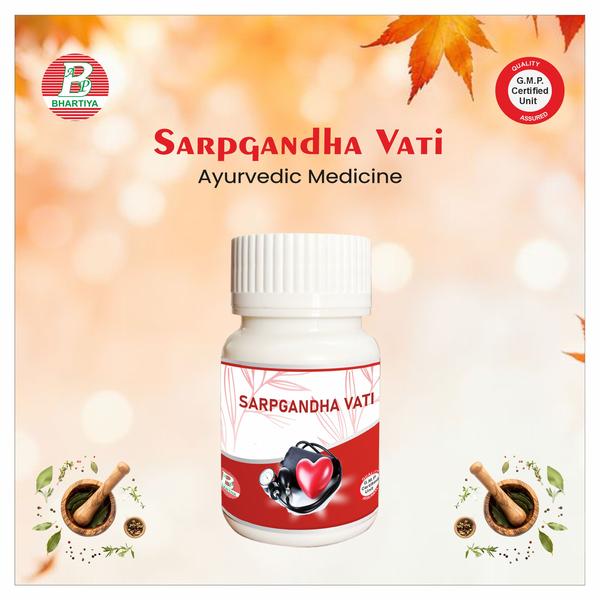
"name": "Sarpgandha vati / tablet",
"description": "Sarpagandha (Rauwolfia serpentina)\n The Serpent Root Herb with Profound Calming & Healing Power\nSarpagandha is one of the most potent and revered herbs in Ayurveda, known for its deep action on the nervous system, mind, blood pressure, and toxic conditions.\nThe name Sarpagandha literally means “the plant with a smell like a serpent” or “the herb that can subdue snake-like disorders”, symbolising its legendary power in calming, controlling, and neutralizing deep-rooted imbalances.\nAyurveda classifies Sarpagandha as:\n•\tStambhana (stabilizing, controlling)\n•\tNidrajanana (induces sleep)\n•\tVedanasthapana (analgesic)\n•\tSarpavisha hara (anti-venom / toxic disorders)\n•\tManas dosha hara (reduces mental disturbances)\n•\tHṛidya (supports the heart)\nIt is highly beneficial in managing high blood pressure, insomnia, anxiety, restlessness, mental agitation, certain psychotic disorders, and snake-bite toxic conditions (traditionally).\n Botanical Information of Sarpagandha\nScientific Name: Rauwolfia serpentina (Linn.) \nFamily: Apocynaceae\nOrder: Gentianales\nGenus: Rauwolfia\nSpecies: serpentina\nCommon Names\n•\tSanskrit: Sarpagandha, Chandrabhaga, Kundali, Sarpasandhi, Nakuli\n•\tHindi: Sarpagandha\n•\tEnglish: Indian Snakeroot, Serpent Root\n•\tTamil: Sivanar Vembu\n•\tTelugu: Patalagandhi\n•\tMalayalam: Paathalgaruda\n•\tKannada: Sarpagandhi\n•\tBengali: Sarpagandha\nSynonyms from Nighantus\n•\tBhavaprakasha: Sarpagandha, Chandrika, Kundali\n•\tDhanvantari Nighantu: Nakuli, Sarpasandhi\n•\tKaiyadeva Nighantu: Sarpagandha, Ganda Naga\n•\tRaja Nighantu: Sarpagandha, Patalagandhi\n Morphology of Sarpagandha (Rauwolfia serpentina)\nPlant Type\nPerennial, erect, smooth herb\nStem\n•\tSlender, erect, slightly woody at the base\n•\tDark green with smooth texture\nLeaves\n•\tSimple, opposite or whorled (3–4 in a circle)\n•\tLanceolate, smooth, shining\n•\tDark green above, light beneath\nFlowers\n•\tSmall, white or pinkish\n•\tArranged in terminal or axillary cymes\nRoots\n•\tLong, slender, cylindrical\n•\tDark brown externally, white inside\n•\tMedicinally most important part\n•\tCharacteristic serpentine smell (hence Sarpagandha)\nFruits\n•\tSmall, globose drupes\n•\tPurplish-black on ripening\nHabit\n•\tSlow-growing but hardy\n•\tDevelops best under semi-shade conditions\n Ecological Preferences\n•\tClimate: Tropical and subtropical\n•\tSoil: Moist, fertile, well-drained soil (prefers humus-rich loam)\n•\tSunlight: Partial shade preferred\n•\tMoisture: Requires consistent moisture\n•\tAltitude: Up to 1200 m\n•\tHabitat: Forest edges, moist slopes, shaded plantations\n Distribution\n•\tIndia: Common in the Himalayan foothills, Northeastern states, Bengal, Western Ghats, Odisha, and Central India\n•\tAsia: Nepal, Bhutan, Bangladesh, Myanmar, Sri Lanka, Thailand\n•\tOther Regions: Widely distributed in Southeast Asia\n Classical Ayurvedic Properties of Sarpagandha\n•\tRasa (Taste): Tikta (bitter), Kashaya (astringent), Madhura (slightly sweet)\n•\tGuna (Quality): Laghu (light), Ruksha (dry), Tikshna (penetrating)\n•\tVirya (Potency): Ushna (hot)\n•\tVipaka: Katu (pungent)\n•\tDosha Effect: Kapha-Vata hara, pacifies Raja & Tama (mental doshas)\nKarma (Therapeutic Actions)\n•\tNidrajanana – induces sleep\n•\tUnmadahara – reduces psychotic symptoms\n•\tSarpavisha hara – mitigates snake/poison effects (traditional use)\n•\tRaktachapa hara – reduces high blood pressure\n•\tStambhana – stabilizes nervous system\n•\tAnulomana – improves digestive and nervous coordination\n Historical & Grantha-Based Story/References of Sarpagandha\n 1. Mention in Ancient Texts\nSarpagandha is described in:\n•\tCharaka Samhita (Chikitsa Sthana) under Unmada (psychosis) treatment\n•\tSushruta Samhita under Sarpavisha Chikitsa (snake poisoning)\n•\tBhavaprakasha Nighantu elaborates its use for insomnia, hypertension-like symptoms, and mania\n•\tKaiyadeva Nighantu describes it as a herb that “calms the mind and controls the serpent-like movements of Vata in the nerves.”\n 2. Traditional Story: “The Serpent-Root Legend”\nAyurvedic folklore says:\n“A wandering sage noticed that snakes bitten by other snakes chewed the root of a certain plant and survived.”\nThis plant, believed to be Sarpagandha, was thus discovered in ancient times.\nThe sages concluded that if it could calm a deadly serpent’s venom, it could also calm the “inner serpent” — representing fear, agitation, and disordered nerves in humans.\nThis symbolic meaning led to its name Sarpagandha and its use for toxins, anxiety, agitation, hypertension, and insanity-like states.\n 3. Use by Ancient Physicians\n•\tAcharya Charaka used it in Unmada (psychiatric) conditions.\n•\tAcharya Sushruta prescribed it as a supportive herb for harmful bites and severe agitation.\n•\tVagbhata considered it “mind-stabilizing and nerve-controlling.”\n Modern Phytochemistry\nSarpagandha contains powerful alkaloids, especially:\n1. Alkaloids (main bioactive class)\n•\tReserpine – antihypertensive, sedative\n•\tAjmaline – antiarrhythmic\n•\tAjmalicine (raubasine) – circulatory and CNS modulator\n•\tSerpentine, Yohimbine (traces)\n2. Others\n•\tSterols\n•\tCarbohydrates\n•\tGlycosides\n•\tFlavonoids\n Species of Rauwolfia\n1.\tRauwolfia serpentina – true Sarpagandha, most potent\n2.\tRauwolfia tetraphylla – similar but less potent; used in some regions\n3.\tRauwolfia vomitoria – African species\n4.\tRauwolfia canescens – mild medicinal use\n Cultivation\n•\tPropagation: Seeds, root cuttings\n•\tPlanting Season: Monsoon (June–July)\n•\tSpacing: 30–45 cm\n•\tWatering: Regular moisture needed\n•\tManure: Best with organic compost\n•\tHarvesting: Roots collected after 2–3 years\n•\tNote: Overharvested in the wild → now commercially cultivated\n Classical Ayurvedic Dosage (from Granthas)\n(General, traditional; modern use must be supervised due to potency)\n•\tRoot Powder (Churna): 250–500 mg once or twice daily\n•\tRoot Decoction (Kwatha): 30–40 ml\n•\tSwarasa (Juice): 5–10 ml\nUsed in:\n•\tInsomnia\n•\tMental disorders\n•\tHypertension-like symptoms\n•\tAgitation\n•\tToxic disorders (traditional use)\n Safety & Precautions\nSarpagandha is highly potent.\n•\tAvoid overdose\n•\tNot suitable during pregnancy\n•\tNot to be combined with other sedatives or antihypertensive drugs without guidance\n•\tMust be used under qualified Ayurvedic supervision\n Sarpagandha Compound Formulations (Classical):\nSarpagandha with Arjuna, Ashwagandha, Brahmi, Shankhapushpi, or Jatamansi—used for hypertension, anxiety, insomnia, nervous disorders, and cardiovascular support, prepared according to classical Ayurvedic methods to retain Rasayana and Medhya properties.\n Sarpagandha Formulations by Bhartiya Ayurvedic Pharmacy\nAt Bhartiya Ayurvedic Pharmacy, we prepare a range of Sarpagandha formulations following classical Ayurvedic methods as described in Charaka Samhita, Sushruta Samhita, Bhavaprakasha Nighantu, and other Ayurvedic Granthas. Each product is crafted to retain the therapeutic potency, purity, and efficacy of the herb, ensuring benefits for stress relief, blood pressure management, nervous system support, and overall mental well-being.\n1.\tSarpagandha Vati/Tablet\nDose\n1 tablet (250–500 mg) twice daily\nOr 1 tablet at night for sleep disorders\nAdvanced cases: 1 tablet thrice daily (only under supervision)\n•\tFor hypertension-like symptoms, insomnia\n•\tSupports Calmness & Mental Stability\n•\tUseful in: Anxiety, Nervousness, Agitation, Irritability, Restlessness, Racing thoughts\n•\tHelps balance Rajas and Tamas (mental doshas) and calms Vata in the nervous system.\nSupports Brain & Nerve Health\nHelps in:\n•\tReducing excessive nerve excitability\n•\tSupporting healthy brain signaling\n•\tPromoting alert calmness\nUsed traditionally in unmada chikitsa (Ayurvedic mental health management)\n\n\nbenefits of sarpagandha tablet, benefits of sarpagandha tablets\nbest sarpagandha tablet, dosage of sarpagandha tablet\nhow to use sarpagandha, is sarpagandha effective for bp\nis sarpagandha safe, m sarpagandha mishran\nm sarpagandha mishran price, m sarpagandha mishran tablet\nm sarpagandha mishran tablet uses in hindi, m sarpagandha mishran uses\nm sarpagandha tablet, sarpagandha tablet benefits\nsarpagandha tablet benefits in hindi, sarpagandha tablet buy online\nsarpagandha tablet content, sarpagandha tablet dosage\nsarpagandha tablet dose, sarpagandha tablet fayde\nsarpagandha tablet flipkart, sarpagandha tablet for\nsarpagandha tablet hindi, sarpagandha tablet how to use\nsarpagandha tablet in hindim, sarpagandha tablet india\nsarpagandha tablet kaise khaye, msarpagandha tablet kaise le\nsarpagandha tablet ke fayde in hindi, sarpagandha tablet ke side effects\nsarpagandha tablet kis kaam aata hai, sarpagandha tablet kya kam karti hai\nsarpagandha tablet near me, sarpagandha tablet online\nsarpagandha tablet price, sarpagandha tablet price in india\nsarpagandha tablet review, sarpagandha tablet side effects\nsarpagandha tablet side effects in hindi, sarpagandha tablet use\nsarpagandha tablet used for, sarpagandha tablet uses\nsarpagandha tablet uses and side effects, sarpagandha tablet uses hindi\nsarpagandha tablet uses in english, sarpagandha tablet uses in hindi\nsarpagandha tablet when to take, sarpagandha tablets ayurvedic\nsarpagandha tablets benefits, sarpagandha tablets for blood pressure\nsarpagandha tablets for blood pressure in hindi, sarpagandha tablets uses\nsarpagandha use, sarpagandha vati tablet ke fayde\nsarpagandha vati tablet price, sarpagandha vati tablet side effects\nsarpagandha vati tablet uses, sarpagandha vati tablet uses in english\nsarpagandha vati tablet uses in hindi, sarpagandha vati tablet uses in tamil\nsarpagandha. tablet image, sarpagandhadi tablet uses\nsarpgandha tablet quality",
"price": 540.0,
"discountamount": 270.0,
"currencycode": "INR",
"priority": 1000000,
"isfreeshipmentavailable": false,
"shipmentduration": 1,
"_keywords": null,
"isarchived": false,
"isavailable": true,
"applicationid": null,
"productindex": 30,
"imageuri": "https://productimages.withfloats.com/actual/69808ef1cf660bbbdc554d46.jpg",
"tileimageuri": "https://productimages.withfloats.com/tile/69808ef1cf660bbbdc554d46.jpg",
"images": null,
"totalqueries": 0,
"gpid": null,
"groupproductid": null,
"createdon": "2026-02-02T11:47:59.198Z",
"updatedon": "2026-02-19T10:33:46.089Z",
"buyonlinelink": null,
"producturl": "http://WWW.BHARTIYAAYURVEDICPHARMACY.COM/products/sarpgandha-vati-tablet/30",
"availableunits": -1.0,
"iscodavailable": true,
"isprepaidonlineavailable": true,
"maxcodorders": 0,
"maxprepaidonlineorders": -1,
"uniquepaymenturl": null,
"brandname": "Bakula fort",
"category": "Sarpgandha vati / tablet 100 - GM X 24",
"tags": [],
"variants": false,
"keyspecification": null,
"otherspecifications": null,
"pickupaddressreferenceid": null,
"paymenttype": "AssuredPurchase",
"producttype": "products",
"hsncode": null,
"gstslab": 0.0,
"isnotforsale": false
},
{
"_id": "6a58bbe06552478ea1d9eb13",
"fptag": "BHARTIYEAYURVEDICPHARMACY",
"merchantname": null,
"customwidgets": null,
"externalsourceid": null,
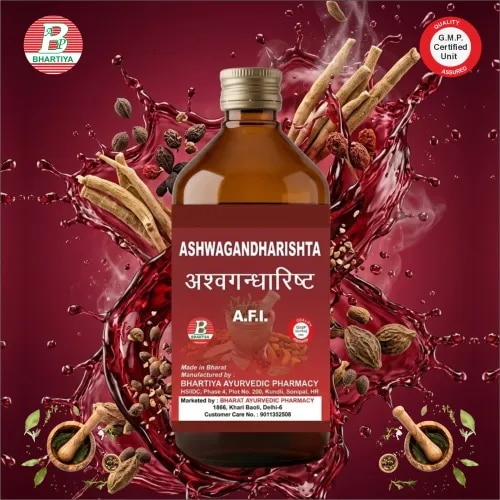
"name": "ASHWAGANDHARISHTA",
"description": " ASHWAGANDHARISHTA\n\n\nProduct Identification\nGeneric Name: Ashwagandharishta\nType: Ayurvedic Polyherbal Fermented Formulation (Arishta)\nPrimary Indication Area: Primarily used as a rejuvenative (Rasayana) and adaptogenic tonic for improving physical strength, mental well-being, nervous system health, vitality, and recovery from chronic weakness. It is commonly indicated in fatigue, stress, anxiety, debility, insomnia, convalescence, reduced immunity, sexual weakness, and age-related decline in strength and stamina.\n\nTherapeutic Indications\n•\tGeneral debility (Daurbalya) \n•\tChronic fatigue and physical exhaustion \n•\tStress and anxiety (Chittodvega) \n•\tNervous exhaustion \n•\tInsomnia and disturbed sleep \n•\tMuscle weakness and reduced stamina \n•\tAge-related decline in vitality \n•\tConvalescence following prolonged illness \n•\tReduced immunity \n•\tSexual weakness and reproductive debility (supportive therapy) \n•\tMild cognitive impairment associated with stress \n•\tLoss of appetite associated with chronic weakness \n\nKey Benefits\n•\tSupports healthy nervous system function and stress adaptation \n•\tPromotes physical strength, stamina, and endurance \n•\tHelps reduce fatigue and improves energy levels \n•\tSupports restful sleep and relaxation \n•\tEnhances mental clarity, memory, and concentration \n•\tSupports healthy immune function \n•\tActs as a rejuvenative (Rasayana) for overall vitality and longevity \n•\tSupports healthy reproductive function and vitality \n•\tHelps improve recovery following chronic illness and prolonged weakness \n•\tProvides antioxidant protection against oxidative stress \n\nFORMULA\nEach part contains:\n•\tAshwagandha (Withania somnifera) Root – 2.400 kg \n•\tMusali (Chlorophytum borivilianum) – 960 g \n•\tManjistha (Rubia cordifolia) – 480 g \n•\tHaritaki (Terminalia chebula) – 480 g \n•\tHaridra (Curcuma longa) – 480 g \n•\tDaruharidra (Berberis aristata) – 480 g \n•\tRasna (Pluchea lanceolata) – 480 g \n•\tVidari (Pueraria tuberosa) – 480 g \n•\tArjuna (Terminalia arjuna) – 480 g \n•\tMusta (Cyperus rotundus) – 480 g \n•\tChitraka (Plumbago zeylanica) – 384 g \n•\tTrivrit (Operculina turpethum) – 480 g \n•\tSveta Sariva (Hemidesmus indicus)-384 g\n•\tKrsna Sariva (Cyrptolepis buchanani)-384 g \n•\tShweta Chandana (Santalum album) – 384 g \n•\tRakta Chandana (Pterocarpus santalinus) – 384 g \n•\tVacha (Acorus calamus) – 384 g \n•\tWater – 98.304 L, reduced to 12.288 L \nPrakshepa Dravyas\n•\tMadhu (Honey) – 14.400 K g \n•\tDhataki Pushpa (Woodfordia fruticosa) – 768 g \n•\tShunthi (Zingiber officinale) – 96 g \n•\tMaricha (Piper nigrum) – 96 g\n•\tPippali (Piper longum) – 96 g\n•\tTvak (Cinnamomum verum) – 96 g\n•\tEla (Elettaria cardamomum) – 96 g\n•\tTejapatra (Cinnamomum tamala) – 96 g\n•\tPriyangu (Callicarpa macrophylla) – 96 g\n•\tNagakesara (Mesua ferrea) – 96 g\n\nIngredients\n1. Ashwagandha\nBotanical Name: Withania somnifera\n•\tRasa: Tikta, Kashaya, Madhura \n•\tGuna: Laghu, Snigdha \n•\tVirya: Ushna \n•\tVipaka: Madhura \n•\tPrabhava: Balya, Rasayana \nMechanism of Action\n•\tSupports adaptation to physical and mental stress. \n•\tEnhances muscle strength and endurance. \n•\tSupports healthy nervous system function. \n•\tPromotes restful sleep and relaxation. \n•\tProvides antioxidant and immunomodulatory activity. \n\n2. Musali\nBotanical Name: Chlorophytum borivilianum\n•\tRasa: Madhura \n•\tGuna: Guru, Snigdha \n•\tVirya: Sheeta \n•\tVipaka: Madhura \n•\tPrabhava: Vrishya, Balya \nMechanism of Action\n•\tImproves physical strength and stamina. \n•\tSupports reproductive health. \n•\tNourishes body tissues (Dhatus). \n•\tHelps reduce fatigue and debility. \n•\tActs as a rejuvenative tonic. \n\n3. Manjistha\nBotanical Name: Rubia cordifolia\n•\tRasa: Tikta, Kashaya, Madhura \n•\tGuna: Guru, Ruksha \n•\tVirya: Ushna \n•\tVipaka: Katu \n•\tPrabhava: Raktashodhaka \nMechanism of Action\n•\tSupports healthy blood purification. \n•\tPromotes healthy circulation. \n•\tProvides antioxidant protection. \n•\tHelps maintain normal inflammatory responses. \n•\tSupports skin and tissue health. \n\n4. Haritaki\nBotanical Name: Terminalia chebula\n•\tRasa: Pancharasa (except Lavana), predominantly Kashaya \n•\tGuna: Laghu, Ruksha \n•\tVirya: Ushna \n•\tVipaka: Madhura \n•\tPrabhava: Rasayana \nMechanism of Action\n•\tSupports digestion and metabolism. \n•\tPromotes bowel regularity. \n•\tEnhances nutrient absorption. \n•\tHelps eliminate metabolic waste. \n•\tActs as a rejuvenative. \n\n5. Haridra\nBotanical Name: Curcuma longa\n•\tRasa: Tikta, Katu \n•\tGuna: Laghu, Ruksha \n•\tVirya: Ushna \n•\tVipaka: Katu \n•\tPrabhava: Vishaghna \nMechanism of Action\n•\tSupports healthy inflammatory balance. \n•\tProvides antioxidant activity. \n•\tSupports liver function. \n•\tEnhances immune response. \n•\tProtects tissues from oxidative stress. \n\n6. Daruharidra\nBotanical Name: Berberis aristata\n•\tRasa: Tikta, Kashaya \n•\tGuna: Laghu, Ruksha \n•\tVirya: Ushna \n•\tVipaka: Katu \n•\tPrabhava: Krimighna \nMechanism of Action\n•\tSupports liver and metabolic health. \n•\tHelps maintain healthy blood glucose metabolism. \n•\tProvides antimicrobial activity. \n•\tSupports immune function. \n•\tPromotes healthy inflammatory balance. \n\n7. Rasna\nBotanical Name: Pluchea lanceolata\n•\tRasa: Tikta, Katu \n•\tGuna: Laghu, Snigdha \n•\tVirya: Ushna \n•\tVipaka: Katu \n•\tPrabhava: Vatahara \nMechanism of Action\n•\tSupports joint and muscle health. \n•\tHelps reduce stiffness. \n•\tPromotes mobility. \n•\tSupports recovery from muscular fatigue. \n•\tHelps maintain healthy inflammatory response. \n\n8. Vidari\nBotanical Name: Pueraria tuberosa\n•\tRasa: Madhura \n•\tGuna: Guru, Snigdha \n•\tVirya: Sheeta \n•\tVipaka: Madhura \n•\tPrabhava: Balya, Rasayana \nMechanism of Action\n•\tNourishes body tissues. \n•\tImproves stamina and vitality. \n•\tSupports reproductive health. \n•\tHelps recovery from chronic weakness. \n•\tPromotes overall rejuvenation. \n\n9. Arjuna\nBotanical Name: Terminalia arjuna\n•\tRasa: Kashaya \n•\tGuna: Laghu, Ruksha \n•\tVirya: Sheeta \n•\tVipaka: Katu \n•\tPrabhava: Hridya \nMechanism of Action\n•\tSupports healthy cardiac muscle function. \n•\tPromotes efficient circulation. \n•\tMaintains vascular integrity. \n•\tProvides antioxidant protection. \n•\tSupports cardiovascular wellness. \n\n10. Musta\nBotanical Name: Cyperus rotundus\n•\tRasa: Tikta, Katu, Kashaya \n•\tGuna: Laghu, Ruksha \n•\tVirya: Sheeta \n•\tVipaka: Katu \n•\tPrabhava: Deepana, Pachana \nMechanism of Action\n•\tSupports digestion and appetite. \n•\tPromotes healthy metabolism. \n•\tHelps relieve digestive discomfort. \n•\tMaintains gastrointestinal balance. \n•\tSupports nutrient assimilation. \n\n11. Chitraka\nBotanical Name: Plumbago zeylanica\n•\tRasa: Katu \n•\tGuna: Laghu, Tikshna, Ruksha \n•\tVirya: Ushna \n•\tVipaka: Katu \n•\tPrabhava: Deepana, Pachana \nMechanism of Action\n•\tStimulates digestive fire (Agni). \n•\tImproves digestion and nutrient absorption. \n•\tReduces Ama (metabolic toxins). \n•\tSupports healthy metabolism. \n•\tEnhances bioavailability of herbal constituents. \n\n12. Trivrit\nBotanical Name: Operculina turpethum\n•\tRasa: Tikta, Katu \n•\tGuna: Laghu, Snigdha, Tikshna \n•\tVirya: Ushna \n•\tVipaka: Katu \n•\tPrabhava: Rechana \nMechanism of Action\n•\tSupports natural detoxification. \n•\tPromotes bowel regularity. \n•\tHelps eliminate metabolic waste. \n•\tSupports digestive health. \n•\tMaintains healthy metabolism. \n\n13. Sveta Sariva\nBotanical Name: Hemidesmus indicus\n•\tRasa: Madhura, Tikta \n•\tGuna: Guru, Snigdha \n•\tVirya: Sheeta \n•\tVipaka: Madhura \n•\tPrabhava: Raktaprasadana \nMechanism of Action\n•\tSupports blood purification. \n•\tProvides cooling and rejuvenating effects. \n•\tHelps maintain healthy skin. \n•\tSupports immune function. \n•\tPromotes overall vitality. \n\n14. Krishna Sariva\nBotanical Name: Cryptolepis buchanani\n•\tRasa: Tikta, Kashaya \n•\tGuna: Guru, Snigdha \n•\tVirya: Sheeta \n•\tVipaka: Madhura \n•\tPrabhava: Balya \nMechanism of Action\n•\tSupports healthy joints and muscles. \n•\tHelps maintain normal inflammatory responses. \n•\tPromotes tissue nourishment. \n•\tSupports musculoskeletal health. \n•\tProvides antioxidant protection. \n\n15. Shweta Chandana\nBotanical Name: Santalum album\n•\tRasa: Tikta, Madhura \n•\tGuna: Laghu, Ruksha \n•\tVirya: Sheeta \n•\tVipaka: Katu \n•\tPrabhava: Pittashamaka \nMechanism of Action\n•\tProvides cooling effects. \n•\tSupports urinary health. \n•\tPromotes mental calmness. \n•\tHelps balance Pitta. \n•\tProvides antioxidant activity. \n\n16. Rakta Chandana\nBotanical Name: Pterocarpus santalinus\n•\tRasa: Tikta, Kashaya \n•\tGuna: Laghu, Ruksha \n•\tVirya: Sheeta \n•\tVipaka: Katu \n•\tPrabhava: Raktaprasadana \nMechanism of Action\n•\tSupports healthy circulation. \n•\tProvides antioxidant protection. \n•\tHelps maintain skin health. \n•\tSupports tissue healing. \n•\tHelps maintain normal inflammatory balance. \n\n17. Vacha\nBotanical Name: Acorus calamus\n•\tRasa: Katu, Tikta \n•\tGuna: Laghu, Tikshna \n•\tVirya: Ushna \n•\tVipaka: Katu \n•\tPrabhava: Medhya \nMechanism of Action\n•\tSupports cognitive function. \n•\tEnhances memory and concentration. \n•\tSupports nervous system health. \n•\tHelps reduce mental fatigue. \n•\tPromotes mental clarity. \n Prakshepa Dravyas\n1. Madhu (Honey)\nSource: Honey \n•\tRasa: Madhura, Kashaya Anurasa \n•\tGuna: Laghu, Ruksha \n•\tVirya: Sheeta \n•\tVipaka: Madhura \n•\tPrabhava: Yogavahi \nMechanism of Action\n•\tActs as a Yogavahi, enhancing the delivery and absorption of herbal constituents. \n•\tSupports tissue nourishment and rejuvenation. \n•\tProvides antioxidant and antimicrobial properties. \n•\tImproves the palatability of the formulation. \n•\tHelps preserve the fermented preparation. \n\n2. Dhataki Pushpa\nBotanical Name: Woodfordia fruticosa\n•\tRasa: Kashaya \n•\tGuna: Laghu, Ruksha \n•\tVirya: Sheeta \n•\tVipaka: Katu \n•\tPrabhava: Sandhaniya, Yogavahi \nMechanism of Action\n•\tActs as the natural fermenting agent in Arishta preparation. \n•\tFacilitates the formation of self-generated alcohol for efficient extraction of phytoconstituents. \n•\tImproves bioavailability of herbal constituents. \n•\tSupports preservation and stability of the formulation. \n•\tEnhances overall therapeutic efficacy through improved absorption. \n\n3. Shunthi\nBotanical Name: Zingiber officinale (Dry Rhizome)\n•\tRasa: Katu \n•\tGuna: Laghu, Snigdha \n•\tVirya: Ushna \n•\tVipaka: Madhura \n•\tPrabhava: Deepana, Pachana \nMechanism of Action\n•\tStimulates digestive fire (Agni). \n•\tImproves digestion and nutrient absorption. \n•\tHelps reduce Ama (metabolic toxins). \n•\tSupports healthy circulation and metabolism. \n•\tEnhances bioavailability of herbal constituents. \n\n4. Maricha\nBotanical Name: Piper nigrum\n•\tRasa: Katu \n•\tGuna: Laghu, Tikshna \n•\tVirya: Ushna \n•\tVipaka: Katu \n•\tPrabhava: Deepana, Lekhana \nMechanism of Action\n•\tStimulates digestion and metabolism. \n•\tEnhances intestinal absorption of phytoconstituents. \n•\tSupports respiratory health. \n•\tPromotes healthy circulation. \n•\tProvides antioxidant activity. \n\n5. Pippali\nBotanical Name: Piper longum\n•\tRasa: Katu \n•\tGuna: Laghu, Snigdha, Tikshna \n•\tVirya: Anushna (Mildly Ushna) \n•\tVipaka: Madhura \n•\tPrabhava: Rasayana \nMechanism of Action\n•\tSupports respiratory and digestive health. \n•\tEnhances absorption and bioavailability of herbal compounds. \n•\tPromotes rejuvenation and vitality. \n•\tSupports immune function. \n•\tHelps improve endurance and recovery. \n\n6. Tvak\nBotanical Name: Cinnamomum verum (Syn. Cinnamomum zeylanicum)\n•\tRasa: Katu, Tikta, Madhura \n•\tGuna: Laghu, Ruksha, Tikshna \n•\tVirya: Ushna \n•\tVipaka: Katu \n•\tPrabhava: Hridya \nMechanism of Action\n•\tSupports healthy digestion and metabolism. \n•\tPromotes healthy blood circulation. \n•\tProvides antioxidant activity. \n•\tHelps maintain healthy blood glucose metabolism. \n•\tImproves aroma and taste of the formulation. \n\n7. Ela\nBotanical Name: Elettaria cardamomum\n•\tRasa: Katu, Madhura \n•\tGuna: Laghu, Ruksha \n•\tVirya: Sheeta \n•\tVipaka: Madhura \n•\tPrabhava: Hridya \nMechanism of Action\n•\tSupports healthy digestion. \n•\tHelps reduce bloating and indigestion. \n•\tSupports respiratory health. \n•\tProvides antioxidant activity. \n•\tImproves aroma and palatability. \n\n8. Tejapatra\nBotanical Name: Cinnamomum tamala\n•\tRasa: Katu, Tikta, Kashaya \n•\tGuna: Laghu, Ruksha \n•\tVirya: Ushna \n•\tVipaka: Katu \n•\tPrabhava: Deepana \nMechanism of Action\n•\tStimulates appetite and digestion. \n•\tSupports healthy metabolism. \n•\tPromotes circulation. \n•\tProvides antioxidant protection. \n•\tEnhances the aromatic quality of the formulation. \n\n9. Priyangu\nBotanical Name: Callicarpa macrophylla\n•\tRasa: Kashaya, Madhura \n•\tGuna: Laghu, Ruksha \n•\tVirya: Sheeta \n•\tVipaka: Katu \n•\tPrabhava: Pittashamaka \nMechanism of Action\n•\tSupports healthy skin and blood. \n•\tHelps maintain normal inflammatory responses. \n•\tProvides antioxidant activity. \n•\tPromotes tissue healing. \n•\tContributes to the rejuvenative effects of the formulation. \n\n10. Nagakesara\nBotanical Name: Mesua ferrea\n•\tRasa: Kashaya, Tikta \n•\tGuna: Laghu, Ruksha \n•\tVirya: Sheeta \n•\tVipaka: Katu \n•\tPrabhava: Grahi, Raktastambhaka \nMechanism of Action\n•\tSupports healthy circulation and vascular integrity. \n•\tHelps maintain normal inflammatory responses. \n•\tProvides antioxidant protection. \n•\tSupports digestive health. \n•\tContributes to tissue repair and rejuvenation.\n Dosage\n•\tAdults: 15–30 ml \n•\tTwice daily after meals \n•\tDilute with an equal quantity of water (1:1 dilution is commonly recommended) \nCommon Usage Guidance\n•\tTake after meals to improve digestion and absorption. \n•\tShake well before use. \n•\tCan be used regularly as a Rasayana (rejuvenative) and adaptogenic tonic under the supervision of a qualified Ayurvedic physician. \n•\tThe duration of therapy generally ranges from 4–12 weeks, depending on the individual's condition and the physician's advice. \nImportant Notes\n•\tNot recommended during pregnancy or lactation unless advised by a qualified healthcare professional. \n•\tUse cautiously in individuals taking sedatives, antidiabetic medications, antihypertensive drugs, thyroid medications, or immunosuppressants, as Ashwagandha may influence their effects. \n•\tPatients with chronic medical conditions should use this formulation under the supervision of a qualified Ayurvedic physician or healthcare professional. \n•\tThis is a naturally fermented preparation and contains a small amount of self-generated alcohol, which enhances the extraction and absorption of herbal constituents. \n•\tDo not exceed the recommended dosage. \n•\tStore in a cool, dry place away from direct sunlight and keep the container tightly closed after use.\n\n\nashwagandharishta ke fayde\nashwagandharishta syrup benefits in hindi\nashwagandharishta syrup\nashwagandharishta kis kaam aati hai\nashwagandharishta benefits in hindi\nashwagandharishta uses in hindi\nashwagandharishta ayurvedic medicine uses\nashwagandharishta ayurveda\nashwagandharishta ayurvedic medicine uses in hindi\nashwagandharishta ayurvedic syrup uses in hindi\nashwagandharishta composition\nashwagandharishta expiry date\nashwagandharishta empty stomach\nashwagandharishta uses easy ayurveda\nashwagandharishta syrup expiry date\nashwagandharishta for women\nashwagandharishta fayde\nashwagandharishta flipkart\nashwagandharishta for weight gain\nashwagandharishta for heart\nashwagandharishta fayde in hindi\nashwagandharishta ke gun\nashwagandharishta hindi use\nashwagandharishta hindi mein\nashwagandharishta how to take\nashwagandharishta hai\nashwagandharishta how long to take\nashwagandharishta how to use\nashwagandharishta hamdard\nashwagandharishta in hindi\nashwagandharishta ingredients\nashwagandharishta ingredients in hindi\nashwagandharishta image\nashwagandharishta india\nashwagandharishta kaise piya jata hai\nashwagandharishta ke fayde hindi mein\nashwagandharishta kis kaam mein aata hai\nashwagandharishta mein kya-kya hota hai\nashwagandharishta mein kya-kya hai\nashwagandharishta meaning in hindi\nashwagandharishta me kya hota hai\nashwagandharishta near me\nashwagandharishta online\nashwagandharishta online buy\nashwagandharishta online price\nashwagandharishta peene ke fayde\nashwagandharishta price\nashwagandharishta peene se kya hota hai\nashwagandharishta powder\nashwagandharishta peene se kya-kya fayda hai\nashwagandharishta rate\nashwagandharishta ras\nashwagandharishta syrup kis kaam aata hai\nashwagandharishta special\nashwagandharishta syrup uses in hindi\nashwagandharishta syrup benefits\nashwagandharishta syrup uses\nashwagandharishta special benefits\nashwagandharishta syrup price",
"price": 192.0,
"discountamount": 96.0,
"currencycode": "INR",
"priority": 1000000,
"isfreeshipmentavailable": false,
"shipmentduration": 1,
"_keywords": null,
"isarchived": false,
"isavailable": true,
"applicationid": null,
"productindex": 158,
"imageuri": "https://productimages.withfloats.com/actual/6a58bbe4096fa165252ea2c3.jpg",
"tileimageuri": "https://productimages.withfloats.com/tile/6a58bbe4096fa165252ea2c3.jpg",
"images": null,
"totalqueries": 0,
"gpid": null,
"groupproductid": null,
"createdon": "2026-07-16T11:09:20.636Z",
"updatedon": "2026-07-16T11:09:20.636Z",
"buyonlinelink": null,
"producturl": "http://WWW.BHARTIYAAYURVEDICPHARMACY.COM//ashwagandharishta/158",
"availableunits": -1.0,
"iscodavailable": true,
"isprepaidonlineavailable": true,
"maxcodorders": -1,
"maxprepaidonlineorders": -1,
"uniquepaymenturl": null,
"brandname": "Bakula Fort",
"category": "ASHWAGANDHARISHTA 450 Ml X 40",
"tags": [],
"variants": false,
"keyspecification": null,
"otherspecifications": null,
"pickupaddressreferenceid": null,
"paymenttype": "AssuredPurchase",
"producttype": "products",
"hsncode": null,
"gstslab": 0.0,
"isnotforsale": false
},
{
"_id": "6a5629222a274af7426fba35",
"fptag": "BHARTIYEAYURVEDICPHARMACY",
"merchantname": null,
"customwidgets": null,
"externalsourceid": null,
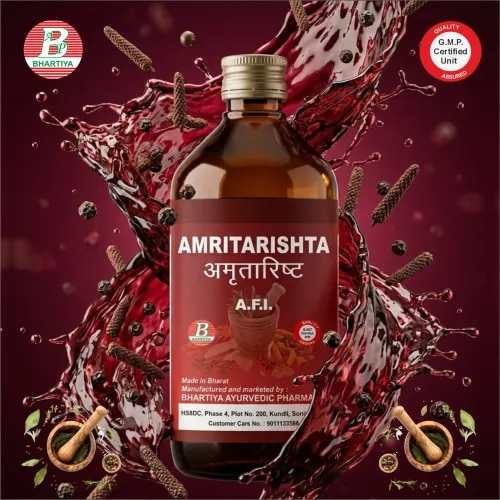
"name": "AMRITARISHTA",
"description": " \n AMRITARISHTA\n\n\nProduct Identification\nGeneric Name: Amritarishta\nType: Ayurvedic Polyherbal Fermented Formulation (Arishta)\nPrimary Indication Area:\nPrimarily used as a blood purifier, immunomodulator, and anti-inflammatory tonic, indicated in chronic fever, skin disorders, gout, and systemic inflammatory conditions.\n\nTherapeutic Indications:\n•\tChronic and recurrent fever (Jwara) \n•\tRheumatic disorders and inflammatory conditions \n•\tGout (Uric acid-related disorders) \n•\tSkin diseases (Kushta—eczema, itching, psoriasis-like conditions) \n•\tHepatomegaly and splenic disorders (supportive) \n•\tGeneral debility after chronic illness \n•\tLoss of immunity and recurrent infections \n•\tDetoxification and blood purification \n\nKey Benefits\n•\tImmunomodulatory action – strengthens body’s defense system \n•\tAnti-inflammatory support – reduces systemic inflammation and pain \n•\tBlood purification – helps eliminate metabolic toxins (Ama) \n•\tFever regulation – useful in chronic and recurrent fevers \n•\tSkin health improvement – reduces itching, eruptions, and inflammation \n•\tJoint health support – useful in gout and inflammatory joint pain \n•\tRestorative tonic action – improves strength after prolonged illness \n•\tBalances Pitta and Vata disorders\nFORMULA \nEach part contains:\nMain Decoction Drugs (Kwatha Dravyas):\n•\tGuduchi (Tinospora cordifolia) -4.800 kg\n•\tBilva (Aegle marmelos) -480 g\n•\tShyonaka (Oroxylum indicum) -480 g\n•\tGambhari (Gmelina arborea) -480 g\n•\tPatala (Stereospermum suaveolens) -480 g\n•\tAgnimantha (Clerodendrum phlomidis) -480 g\n•\tShalaparni (Desmodium gangeticum) -480 g\n•\tPrishniparni (Uraria picta) -480 g\n•\tBrihati (Solanum indicum) -480 g\n•\tKantakari (Solanum xanthocarpum) -480 g\n•\tGokshura (Tribulus terrestris) -480 g\n\nPrakshepa Dravyas (Added after decoction):\n•\tShweta Jeera (Cuminum cyminum) -48 g\n•\tParpata (Fumaria indica) -48 g\n•\tSaptaparna (Alstonia scholaris) -48 g\n•\tSunthi (Zingiber officinale) -48 g\n•\tMaricha (Piper nigrum) -48 g\n•\tPippali (Piper longum) -48 g\n•\tNagkesar (Mesua ferrea) -48 g\n•\tMusta (Cyperus rotundus) -48 g\n•\tKutaki (Picrorhiza kurroa) -48 g\n•\tAtivisha (Aconitum heterophyllum) -48 g\n•\tIndrayava (Holarrhena antidysenterica) -48 g \n\nFermentation Base:\n•\tGuda (Jaggery)-14.400 kg \n•\tWater (for decoction & fermentation)-49152 L reduced to 12.288 L\n1. Guduchi (Tinospora cordifolia)\n•\tRasa: Tikta, Kashaya \n•\tGuna: Laghu, Snigdha \n•\tVirya: Ushna \n•\tVipaka: Madhura \n•\tPrabhava: Rasayana, Jwaraghna \nMechanism of Action:\n•\tEnhances immune cell activity (macrophage stimulation) \n•\tReduces systemic inflammation and fever tendency \n•\tDetoxifies Ama from blood and tissues \n•\tSupports liver detoxification and metabolic clearance \n•\tImproves resistance against recurrent infections \n\n2. Bilva (Aegle marmelos)\n•\tRasa: Kashaya, Tikta \n•\tGuna: Laghu, Ruksha \n•\tVirya: Ushna \n•\tVipaka: Katu \n•\tPrabhava: Grahi, Deepana \nMechanism of Action:\n•\tImproves intestinal tone and controls abnormal bowel movements \n•\tReduces intestinal inflammation and abdominal discomfort \n•\tRegulates Vata in gastrointestinal tract \n•\tSupports digestion and absorption balance \n•\tPrevents toxin accumulation from improper digestion \n\n3. Shyonaka (Oroxylum indicum)\n•\tRasa: Tikta, Kashaya \n•\tGuna: Laghu, Ruksha \n•\tVirya: Ushna \n•\tVipaka: Katu \n•\tPrabhava: Shothahara \nMechanism of Action:\n•\tReduces systemic inflammation and tissue swelling \n•\tSupports joint and musculoskeletal health \n•\tImproves microcirculation and tissue repair \n•\tBalances Vata-Pitta inflammatory pathways \n•\tHelps in chronic pain and stiffness conditions \n\n4. Gambhari (Gmelina arborea)\n•\tRasa: Madhura, Tikta \n•\tGuna: Guru, Snigdha \n•\tVirya: Sheeta \n•\tVipaka: Madhura \n•\tPrabhava: Balya, Rasayana \nMechanism of Action:\n•\tProvides nourishment to depleted tissues \n•\tEnhances strength and recovery after illness \n•\tReduces fatigue and systemic weakness \n•\tSupports muscle and tissue regeneration \n•\tBalances Vata-induced debility \n\n5. Patala (Stereospermum suaveolens)\n•\tRasa: Tikta, Kashaya \n•\tGuna: Laghu \n•\tVirya: Ushna \n•\tVipaka: Katu \n•\tPrabhava: Vatahara \nMechanism of Action:\n•\tReduces Vata-related pain and stiffness \n•\tImproves circulation and tissue oxygenation \n•\tSupports anti-inflammatory activity in joints \n•\tHelps detoxify metabolic waste \n•\tRelieves systemic heaviness \n\n6. Agnimantha (Clerodendrum phlomidis)\n•\tRasa: Katu, Tikta \n•\tGuna: Laghu, Ruksha \n•\tVirya: Ushna \n•\tVipaka: Katu \n•\tPrabhava: Deepana, Pachana \nMechanism of Action:\n•\tStimulates digestive fire (Agni) \n•\tEnhances breakdown and metabolism of Ama \n•\tImproves nutrient assimilation \n•\tReduces bloating and sluggish digestion \n•\tBalances gut-related Vata disorders \n\n7. Shalaparni (Desmodium gangeticum)\n•\tRasa: Madhura \n•\tGuna: Guru, Snigdha \n•\tVirya: Sheeta \n•\tVipaka: Madhura \n•\tPrabhava: Balya, Vatahara \nMechanism of Action:\n•\tStrengthens neuromuscular system \n•\tReduces fatigue and physical weakness \n•\tImproves tissue repair and regeneration \n•\tSupports anti-inflammatory response \n•\tEnhances vitality in chronic illness \n\n8. Prishniparni (Uraria picta)\n•\tRasa: Madhura \n•\tGuna: Guru, Snigdha \n•\tVirya: Sheeta \n•\tVipaka: Madhura \n•\tPrabhava: Rasayana \nMechanism of Action:\n•\tImproves tissue nourishment and strength \n•\tEnhances recovery from systemic illness \n•\tReduces inflammatory fatigue \n•\tSupports immune modulation \n•\tStrengthens musculoskeletal system \n\n9. Brihati (Solanum indicum)\n•\tRasa: Tikta, Katu \n•\tGuna: Laghu, Ruksha \n•\tVirya: Ushna \n•\tVipaka: Katu \n•\tPrabhava: Vata-Kapha hara \nMechanism of Action:\n•\tReduces respiratory and systemic congestion \n•\tEnhances metabolic activity \n•\tImproves digestion and toxin clearance \n•\tRelieves inflammatory pain \n•\tSupports systemic detoxification \n\n10. Kantakari (Solanum xanthocarpum)\n•\tRasa: Tikta, Katu \n•\tGuna: Laghu, Ruksha \n•\tVirya: Ushna \n•\tVipaka: Katu \n•\tPrabhava: Shwasahara \nMechanism of Action:\n•\tClears respiratory and systemic mucus \n•\tReduces inflammatory congestion \n•\tEnhances metabolic detox pathways \n•\tSupports anti-inflammatory activity \n•\tImproves tissue clearance \n\n11. Gokshura (Tribulus terrestris)\n•\tRasa: Madhura, Tikta \n•\tGuna: Guru, Snigdha \n•\tVirya: Sheeta \n•\tVipaka: Madhura \n•\tPrabhava: Mutrala \nMechanism of Action:\n•\tSupports urinary detoxification system \n•\tReduces systemic toxin load \n•\tImproves tissue strength and nourishment \n•\tMaintains fluid-electrolyte balance \n•\tSupports recovery in chronic weakness \n\n12. Shweta Jeera (Cuminum cyminum)\n•\tRasa: Katu, Tikta \n•\tGuna: Laghu, Ruksha \n•\tVirya: Ushna \n•\tVipaka: Katu \n•\tPrabhava: Deepana, Pachana \nMechanism of Action:\n•\tStimulates digestive enzymes and Agni \n•\tReduces gas formation and bloating \n•\tEnhances gut motility \n•\tImproves nutrient absorption \n•\tSupports metabolic digestion \n\n13. Parpata (Fumaria indica)\n•\tRasa: Tikta \n•\tGuna: Laghu, Ruksha \n•\tVirya: Sheeta \n•\tVipaka: Katu \n•\tPrabhava: Raktashodhaka \nMechanism of Action:\n•\tPurifies blood and reduces toxins \n•\tSupports liver detoxification \n•\tReduces skin and inflammatory disorders \n•\tHelps clear metabolic waste \n•\tBalances Pitta-related conditions \n\n14. Saptaparna (Alstonia scholaris)\n•\tRasa: Tikta \n•\tGuna: Laghu, Ruksha \n•\tVirya: Ushna \n•\tVipaka: Katu \n•\tPrabhava: Jwaraghna \nMechanism of Action:\n•\tReduces chronic fever conditions \n•\tSupports immune regulation \n•\tActs against microbial imbalance \n•\tImproves systemic detoxification \n•\tStabilizes inflammatory response \n\n15. Sunthi (Zingiber officinale)\n•\tRasa: Katu \n•\tGuna: Laghu, Ruksha \n•\tVirya: Ushna \n•\tVipaka: Madhura \n•\tPrabhava: Ama Pachana \nMechanism of Action:\n•\tActivates digestive fire (Agni) \n•\tBreaks down Ama (metabolic toxins) \n•\tImproves circulation and metabolism \n•\tReduces gas and heaviness \n•\tEnhances nutrient absorption \n\n16. Maricha (Piper nigrum)\n•\tRasa: Katu \n•\tGuna: Laghu, Ruksha \n•\tVirya: Ushna \n•\tVipaka: Katu \n•\tPrabhava: Yogavahi \nMechanism of Action:\n•\tEnhances bioavailability of herbs \n•\tStimulates digestive enzymes \n•\tImproves metabolic rate \n•\tReduces Ama accumulation \n•\tSupports respiratory and digestive cleansing \n\n17. Pippali (Piper longum)\n•\tRasa: Katu \n•\tGuna: Laghu, Snigdha \n•\tVirya: Ushna \n•\tVipaka: Madhura \n•\tPrabhava: Rasayana \nMechanism of Action:\n•\tEnhances Agni and digestion \n•\tImproves respiratory and metabolic function \n•\tReduces chronic inflammation \n•\tSupports tissue rejuvenation \n•\tEnhances absorption of nutrients \n\n18. Nagkesar (Mesua ferrea)\n•\tRasa: Kashaya, Tikta \n•\tGuna: Laghu, Ruksha \n•\tVirya: Sheeta \n•\tVipaka: Katu \n•\tPrabhava: Raktastambhana \nMechanism of Action:\n•\tControls bleeding and inflammatory conditions \n•\tSupports blood purification \n•\tReduces tissue inflammation \n•\tImproves wound healing \n•\tBalances Pitta disorders \n\n19. Musta (Cyperus rotundus)\n•\tRasa: Tikta, Katu \n•\tGuna: Laghu, Ruksha \n•\tVirya: Sheeta \n•\tVipaka: Katu \n•\tPrabhava: Deepana, Pachana \nMechanism of Action:\n•\tImproves digestion and enzyme activity \n•\tReduces diarrhea and gut irritation \n•\tControls Ama formation \n•\tSupports metabolic balance \n•\tCalms gastrointestinal inflammation \n\n20. Kutaki (Picrorhiza kurroa)\n•\tRasa: Tikta \n•\tGuna: Laghu, Ruksha \n•\tVirya: Sheeta \n•\tVipaka: Katu \n•\tPrabhava: Hepatoprotective \nMechanism of Action:\n•\tSupports liver detoxification and regeneration \n•\tEnhances bile secretion and metabolism \n•\tRemoves accumulated toxins from blood \n•\tReduces inflammatory liver conditions \n•\tImproves digestion via hepatic support \n\n21. Ativisha (Aconitum heterophyllum)\n•\tRasa: Tikta, Katu \n•\tGuna: Laghu, Ruksha \n•\tVirya: Ushna \n•\tVipaka: Katu \n•\tPrabhava: Deepana, Jwaraghna \nMechanism of Action:\n•\tReduces fever and infectious conditions \n•\tEnhances digestive strength \n•\tControls diarrhea and gut infections \n•\tSupports immune response \n•\tReduces Ama-related disorders \n\n22. Indrayava (Holarrhena antidysenterica)\n•\tRasa: Tikta, Kashaya \n•\tGuna: Laghu, Ruksha \n•\tVirya: Sheeta \n•\tVipaka: Katu \n•\tPrabhava: Grahi, Krimighna \nMechanism of Action:\n•\tControls diarrhea and intestinal infections \n•\tEliminates intestinal parasites \n•\tImproves gut absorption and stability \n•\tReduces inflammation in GI tract \n•\tRestores intestinal microbial balance \n\n23. Guda (Jaggery)\n•\tRasa: Madhura \n•\tGuna: Guru \n•\tVirya: Ushna \n•\tVipaka: Madhura \n•\tPrabhava: Yogavahi \nMechanism of Action:\n•\tActs as fermentation medium in Arishta preparation \n•\tEnhances absorption of herbal constituents \n•\tImproves bioavailability of active compounds \n•\tSupports mild nutritive energy supply \n•\tFacilitates proper fermentation process \n\nDosage\n•\tAdults: 15–30 ml \n•\tTwice daily after meals \n•\tWith equal quantity of water (1:1 dilution) \n\nCommon Usage Guidance\n•\tUseful in fever, inflammation, and weakness \n•\tSupports digestion and detoxification simultaneously \n•\tTypically used for 4–8 weeks \n•\tBest taken after meals for better tolerance \n\nImportant Notes\n•\tUse cautiously in diabetes (contains jaggery) \n•\tAvoid overdose due to strong herbal potency \n•\tNot for acute severe dehydration or extreme weakness \n•\tShould be taken under Ayurvedic supervision in chronic disease \n\n\namritarishta syrup, amritarishta syrup uses in hindi, amritarishta ke fayde\namritarishta syrup uses, amritarishta use in hindi, amritarishta ayurvedic medicine uses in hindi\namritarishta uses, amritarishta syrup uses in hindi price, amritarishta ayurvedic medicine\namritarishta ayurvedic syrup uses in hindi, amritarishta ayurvedic, amritarishta ayurvedic medicine uses\namritarishta ayurvedic syrup uses, amritarishta ayurvedic dawai kis kaam aati hai\namritarishta ayurvedic syrup, amritarishta amazon, amritarishta benefits, amritarishta benefits in hindi\namritarishta banane ki vidhi, amritarishta composition, amritarishta contents, amritarishta dosage\namritarishta dawa ke fayde, amritarishta dawai kis kaam aati hai, amritarishta dawai\namritarishta dose, amritarishta easy ayurveda, amritarishta expiry date, amritarishta how to take\namritarishta hindi use, amritarishta use, hamdard amritarishta, amritarishta syrup hindi\namritarishta kya hai, amritarishta benefits hindi, amritarishta is used for, amritarishta indication\namritarishta image, amritarishta immune support, amritarishta in kannada, amritarishta uses hindi\namritarishta ke fayde in hindi, amritarishta kis kaam mein aati hai, amritarishta kis chij ki dawai hai\namritarishta kis kaam aata hai, amritarishta kaise lena chahiye\namritarishta kis liye hoti hai, amritarishta kiske liye hai, amritarishta medicine uses in hindi\namritarishta medicine uses, amritarishta mrp, amritarishta near me, amritarishta syrup near me\namritarishta online, amritarishta syrup online, amritarishta buy online, amritarishta before or after food\nuses of amritarishta, use of amritarishta in hindi, use of amritarishta syrup, benefits of amritarishta syrup\namritarishta peene ke kya fayde hain, amritarishta price in india, amritarishta planet ayurveda\namritarishta review, amritarishta syrup kis kaam aata hai, amritarishta syrup benefits\namritarishta syrup ingredients, amritarishta ayurvedic tonic, amritarishta vati, amritarishta when to take\namritarishta ayurveda, amritarishtam use, amritarishta syrup uses in english, amritarishta uses in english\nhow to take amritarishta syrup, how to take amritarishta, health benefits of amritarishta",
"price": 189.0,
"discountamount": 94.0,
"currencycode": "INR",
"priority": 1000000,
"isfreeshipmentavailable": false,
"shipmentduration": 1,
"_keywords": null,
"isarchived": false,
"isavailable": true,
"applicationid": null,
"productindex": 155,
"imageuri": "https://productimages.withfloats.com/actual/6a56292a5a4a17074bc2c96f.jpg",
"tileimageuri": "https://productimages.withfloats.com/tile/6a56292a5a4a17074bc2c96f.jpg",
"images": null,
"totalqueries": 0,
"gpid": null,
"groupproductid": null,
"createdon": "2026-07-14T12:18:42.683Z",
"updatedon": "2026-07-14T12:26:25.617Z",
"buyonlinelink": null,
"producturl": "http://WWW.BHARTIYAAYURVEDICPHARMACY.COM//amritarishta/155",
"availableunits": -1.0,
"iscodavailable": true,
"isprepaidonlineavailable": true,
"maxcodorders": -1,
"maxprepaidonlineorders": -1,
"uniquepaymenturl": null,
"brandname": "Bakula Fort",
"category": "AMRITARISHTA 450 ML X 40",
"tags": [],
"variants": false,
"keyspecification": null,
"otherspecifications": null,
"pickupaddressreferenceid": null,
"paymenttype": "AssuredPurchase",
"producttype": "products",
"hsncode": null,
"gstslab": 0.0,
"isnotforsale": false
},
{
"_id": "6a476c3f52249d9470d412c3",
"fptag": "BHARTIYEAYURVEDICPHARMACY",
"merchantname": null,
"customwidgets": null,
"externalsourceid": null,
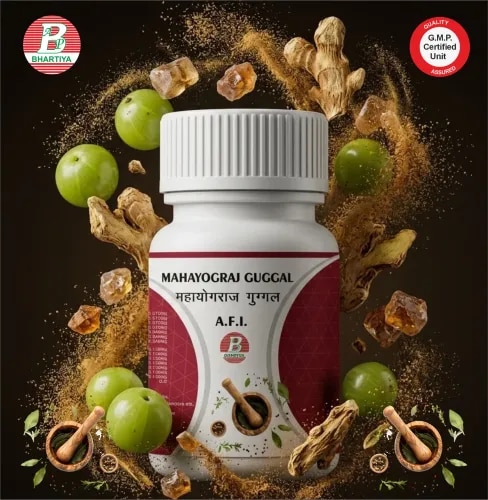
"name": "Mahayograj Guggal",
"description": "\n MHAYOGRAJ GUGGUL\n\nProduct Identification \n•\tGeneric Name: Mahayograj Guggul\n•\tType: Ayurvedic Polyherbal Formulation\n•\tPrimary Indication Area: Bones, Joints & Musculoskeletal Disorders\n•\t\nTherapeutic Indications: Traditionally used for:\nOsteoarthritis (joint pain, stiffness, swelling)\n• Rheumatoid arthritis-like conditions (Ama-Vata)\n• Back pain and cervical/lumbar spondylosis\n• Sciatica and nerve-related pain\n• Gout and inflammatory joint disorders\n• General weakness of bones, joints, and ligaments\nKey Benefits:\n•\tRelieves joint pain, stiffness, and swelling\n•\tHelps reduce inflammation in joints and muscles\n•\t Improves flexibility and mobility of joints\n•\t Supports nerve strength and reduces Vata imbalance\n•\tAids in improving chronic degenerative bone and joint conditions \nFORMULA\nEach Tablet contains: \nSunthi \t3 g\nPippali \t3 g\nChavya\t3 g\nPippali Mula\t3 g\nChitrak\t3 g\nHingu\t3 g\nAjmoda\t3 g\nSarsapa\t3 g\nSavet Jiraka\t3 g\nKrishan Jiraka\t3 g\nRenuka\t3 g\nKutaja\t3 g\nPatha\t3 g\nVidanga\t3 g\nGajpippali\t3 g\nKatuka\t3 g\nAtivisha\t3 g\nBharangi\t3 g\nVasa\t3 g\nMurva\t3 g\nHaritaki \t40g\nBibhitaki\t40g\nAmalaki\t40g\nShudh Guggul\t180g\nVang Bhasma\t48g\nRajat Bhasma\t48g\nNag Bhasma\t48g\nAbhrak Bhasma\t48g\nLoha Bhasma\t48g\nMandura Bhasma\t48g\nRas Sindura (Parada)\t48g\n\n \nIngredients:\n\n1. Haritaki (Terminalia chebula)\n• Botanical/Scientific Name: Terminalia chebula\n• Rasa–Guna–Vīrya–Vipāka:\no Rasa: Kaṣāya (Astringent), Amla (Sour), Madhura (Sweet), Tikta (Bitter), Kaṭu (Pungent)\no Guna: Laghu (Light), Rūkṣa (Dry)\no Vīrya: Uṣṇa (Hot)\no Vipāka: Madhura (Sweet)\n• Prabhāva: Virecana & Anulomana (Mild laxative and bowel regulator)\nMechanism of Action (Karma):\n• Anulomana Karma: Regulates Apana Vayu and improves bowel evacuation\n• Deepana-Pachana Karma: Enhances Agni and reduces Ama accumulation\n• Shothahara Karma: Reduces inflammatory swelling in tissues\n\n2. Bibhitaki (Terminalia bellirica)\n• Botanical/Scientific Name: Terminalia bellirica\n• Rasa–Guna–Vīrya–Vipāka:\no Rasa: Kaṣāya (Astringent)\no Guna: Laghu (Light), Rūkṣa (Dry)\no Vīrya: Uṣṇa (Hot)\no Vipāka: Madhura (Sweet)\n• Prabhāva: Kapha-Pitta Shamana\nMechanism of Action (Karma):\n• Detoxifies body and reduces Ama\n• Improves bowel regularity\n• Reduces inflammation in joints and tissues\n\n3. Amalaki (Emblica officinalis)\n• Botanical/Scientific Name: Emblica officinalis\n• Rasa–Guna–Vīrya–Vipāka:\no Rasa: Amla (Sour dominant, all Rasas except Lavana)\no Guna: Laghu (Light), Rūkṣa (Dry)\no Vīrya: Śīta (Cooling)\no Vipāka: Madhura (Sweet)\n• Prabhāva: Rasayana (Rejuvenator)\nMechanism of Action (Karma):\n• Strong antioxidant and tissue rejuvenation\n• Supports cartilage and bone health\n• Reduces oxidative inflammation in joints\n\n4. Sunthi (Zingiber officinale)\n• Botanical/Scientific Name: Zingiber officinale\n• Rasa–Guna–Vīrya–Vipāka:\no Rasa: Kaṭu (Pungent)\no Guna: Laghu (Light), Rūkṣa (Dry)\no Vīrya: Uṣṇa (Hot)\no Vipāka: Madhura (Sweet)\n• Prabhāva: Deepana & Shothahara\nMechanism of Action (Karma):\n• Improves digestion and removes Ama\n• Reduces joint inflammation and pain\n• Enhances circulation in Vata disorders\n\n5. Pippali (Piper longum)\n• Botanical/Scientific Name: Piper longum\n• Rasa–Guna–Vīrya–Vipāka:\no Rasa: Kaṭu\no Guna: Laghu, Snigdha\no Vīrya: Uṣṇa\no Vipāka: Madhura\n• Prabhāva: Yogavahi (bioenhancer)\nMechanism of Action (Karma):\n• Enhances absorption of other herbs\n• Reduces Ama and metabolic toxins\n• Strengthens joints and respiratory system\n\n6. Chavya (Piper chaba)\n• Botanical/Scientific Name: Piper chaba\n• Rasa–Guna–Vīrya–Vipāka:\no Rasa: Kaṭu\no Guna: Laghu, Rūkṣa\no Vīrya: Uṣṇa\no Vipāka: Kaṭu\n• Prabhāva: Deepana\nMechanism of Action (Karma):\n• Stimulates digestive fire\n• Reduces intestinal Ama\n• Helps Vata-Kapha imbalance in joints\n\n7. Pippali Mula (Piper longum root)\n• Botanical/Scientific Name: Piper longum (root)\n• Rasa–Guna–Vīrya–Vipāka:\no Rasa: Kaṭu\no Guna: Laghu, Rūkṣa\no Vīrya: Uṣṇa\no Vipāka: Kaṭu\n• Prabhāva: Vata-Kapha Shamana\nMechanism of Action (Karma):\n• Improves deep tissue metabolism\n• Reduces joint stiffness\n• Clears Ama from joints\n\n8. Chitrak (Plumbago zeylanica)\n• Botanical/Scientific Name: Plumbago zeylanica\n• Rasa–Guna–Vīrya–Vipāka:\no Rasa: Kaṭu\no Guna: Laghu, Rūkṣa, Tikṣṇa\no Vīrya: Uṣṇa\no Vipāka: Kaṭu\n• Prabhāva: Agni Deepana\nMechanism of Action (Karma):\n• Strong digestive stimulant\n• Breaks Ama in deep tissues\n• Reduces chronic inflammation in joints\n\n9. Hingu (Ferula foetida)\n• Botanical/Scientific Name: Ferula foetida\n• Rasa–Guna–Vīrya–Vipāka:\no Rasa: Kaṭu\no Guna: Laghu, Tikṣṇa, Snigdha\no Vīrya: Uṣṇa\no Vipāka: Kaṭu\n• Prabhāva: Vata Anulomana\nMechanism of Action (Karma):\n• Relieves gas and Vata obstruction\n• Reduces nerve and joint pain\n• Improves gut-joint connection balance\n\n10. Ajmoda (Apium leptophyllum)\n• Botanical/Scientific Name: Apium leptophyllum\n• Rasa–Guna–Vīrya–Vipāka:\no Rasa: Kaṭu, Tikta\no Guna: Laghu, Rūkṣa\no Vīrya: Uṣṇa\n• Prabhāva: Shoolahara\nMechanism of Action (Karma):\n• Reduces joint and muscular pain\n• Improves circulation\n• Relieves stiffness and cramps\n\n11. Sarsapa (Brassica juncea)\n• Botanical/Scientific Name: Brassica juncea\n• Rasa–Guna–Vīrya–Vipāka:\no Rasa: Kaṭu, Tikta\no Guna: Laghu, Rūkṣa, Tikṣṇa\no Vīrya: Uṣṇa\n• Prabhāva: Vedanasthapana\nMechanism of Action (Karma):\n• Improves blood flow in joints\n• Reduces cold-induced pain\n• Decreases stiffness\n\n12. Safed Jeeraka (Cuminum cyminum)\n• Botanical/Scientific Name: Cuminum cyminum\n• Rasa–Guna–Vīrya–Vipāka:\no Rasa: Kaṭu, Tikta\no Guna: Laghu, Rūkṣa\no Vīrya: Uṣṇa\n• Prabhāva: Deepana\nMechanism of Action (Karma):\n• Improves digestion and metabolism\n• Reduces Ama formation\n• Supports joint health indirectly\n\n13. Krishna Jeeraka (Carum carvi)\n• Botanical/Scientific Name: Carum carvi\n• Rasa–Guna–Vīrya–Vipāka:\no Rasa: Kaṭu, Tikta\no Guna: Laghu\no Vīrya: Uṣṇa\n• Prabhāva: Vata-Kapha Shamana\nMechanism of Action (Karma):\n• Relieves intestinal spasms\n• Reduces bloating and gas\n• Supports pain relief in Vata disorders\n\n14. Renuka\n• Botanical/Scientific Name: Vitex negundo (commonly associated)\n• Rasa–Guna–Vīrya–Vipāka:\no Rasa: Tikta, Kaṭu\no Guna: Laghu, Rūkṣa\no Vīrya: Uṣṇa\n• Prabhāva: Shothahara\nMechanism of Action (Karma):\n• Reduces inflammation in joints\n• Acts as mild analgesic\n• Helps in Vata-related swelling\n\n15. Kutaja (Holarrhena antidysenterica)\n• Botanical/Scientific Name: Holarrhena antidysenterica\n• Rasa–Guna–Vīrya–Vipāka:\no Rasa: Tikta, Kaṣāya\no Guna: Laghu, Rūkṣa\no Vīrya: Śīta\n• Prabhāva: Grahi (absorbent)\nMechanism of Action (Karma):\n• Controls excessive bowel discharge\n• Detoxifies gut\n• Supports chronic inflammatory conditions\n\n16. Patha (Cissampelos pareira)\n• Botanical/Scientific Name: Cissampelos pareira\n• Rasa–Guna–Vīrya–Vipāka:\no Rasa: Tikta, Kaṣāya\no Guna: Laghu, Rūkṣa\no Vīrya: Uṣṇa\n• Prabhāva: Shothahara\nMechanism of Action (Karma):\n• Reduces inflammation\n• Supports pain relief in joints\n• Helps Vata balance\n\n17. Vidanga (Embelia ribes)\n• Botanical/Scientific Name: Embelia ribes\n• Rasa–Guna–Vīrya–Vipāka:\no Rasa: Kaṭu, Tikta\no Guna: Laghu, Rūkṣa\no Vīrya: Uṣṇa\n• Prabhāva: Krimighna\nMechanism of Action (Karma):\n• Removes toxins and parasites\n• Improves gut health\n• Reduces Ama-related joint pain\n\n18. Gajpippali (Scindapsus officinalis)\n• Botanical/Scientific Name: Scindapsus officinalis\n• Rasa–Guna–Vīrya–Vipāka:\no Rasa: Kaṭu\no Guna: Laghu, Rūkṣa\no Vīrya: Uṣṇa\n• Prabhāva: Deepana\nMechanism of Action (Karma):\n• Improves digestion\n• Reduces Vata-Kapha imbalance\n• Supports joint metabolism\n\n19. Katuka (Picrorhiza kurroa)\n• Botanical/Scientific Name: Picrorhiza kurroa\n• Rasa–Guna–Vīrya–Vipāka:\no Rasa: Tikta\no Guna: Laghu, Rūkṣa\no Vīrya: Śīta\n• Prabhāva: Pitta Shamana\nMechanism of Action (Karma):\n• Detoxifies liver and blood\n• Reduces systemic inflammation\n• Supports chronic arthritis conditions\n\n20. Ativisha (Aconitum heterophyllum)\n• Botanical/Scientific Name: Aconitum heterophyllum\n• Rasa–Guna–Vīrya–Vipāka:\no Rasa: Tikta, Kaṭu\no Guna: Laghu, Rūkṣa\no Vīrya: Śīta\n• Prabhāva: Jwaraghna\nMechanism of Action (Karma):\n• Reduces systemic toxins\n• Supports immune regulation\n• Helps in chronic inflammatory disorders\n\n21. Bharangi (Clerodendrum serratum)\n• Botanical/Scientific Name: Clerodendrum serratum\n• Rasa–Guna–Vīrya–Vipāka:\no Rasa: Tikta, Kaṭu\no Guna: Laghu, Rūkṣa\no Vīrya: Uṣṇa\n• Prabhāva: Shothahara\nMechanism of Action (Karma):\n• Reduces swelling and inflammation\n• Supports respiratory and joint health\n• Helps in Vata-Kapha imbalance\n\n22. Vasa (Adhatoda vasica)\n• Botanical/Scientific Name: Adhatoda vasica\n• Rasa–Guna–Vīrya–Vipāka:\no Rasa: Tikta, Kaṣāya\no Guna: Laghu, Rūkṣa\no Vīrya: Śīta\n• Prabhāva: Kapha Shamana\nMechanism of Action (Karma):\n• Reduces Kapha and inflammation\n• Improves oxygenation and tissue repair\n• Supports chronic inflammatory conditions\n\n23. Murva (Marsdenia tenacissima)\n• Botanical/Scientific Name: Marsdenia tenacissima\n• Rasa–Guna–Vīrya–Vipāka:\no Rasa: Tikta\no Guna: Laghu, Rūkṣa\no Vīrya: Śīta\n• Prabhāva: Vata-Pitta Shamana\nMechanism of Action (Karma):\n• Reduces burning and inflammation\n• Supports joint and nerve health\n• Helps in chronic Vata disorders\n\n24. Shuddha Guggul (Commiphora mukul)\n• Botanical/Scientific Name: Commiphora mukul\n• Rasa–Guna–Vīrya–Vipāka:\no Rasa: Tikta, Kaṭu, Kaṣāya\no Guna: Laghu, Rūkṣa, Tikṣṇa\no Vīrya: Uṣṇa\n• Prabhāva: Yogavahi & Lekhana\nMechanism of Action (Karma):\n• Removes Ama and toxins from joints\n• Reduces inflammation and swelling\n• Restores joint mobility\n25. Vang Bhasma (Tin calx)\n• Botanical/Scientific Name: Tin processed calcined preparation (SnO₂ based Bhasma)\n• Rasa–Guna–Vīrya–Vipāka:\no Rasa: Kaṣāya, Tikta\no Guna: Laghu (Light), Rūkṣa (Dry)\no Vīrya: Śīta (Cooling)\no Vipāka: Kaṭu (Pungent)\n• Prabhāva: Balya & Shukra Dhatu Poshaka\nMechanism of Action (Karma):\n• Strengthens musculoskeletal tissues\n• Supports bone and joint mineral balance\n• Improves tissue regeneration in chronic degeneration\n\n26. Rajat Bhasma (Silver calx)\n• Botanical/Scientific Name: Purified calcined silver preparation\n• Rasa–Guna–Vīrya–Vipāka:\no Rasa: Madhura (Sweet), Kaṣāya\no Guna: Snigdha (Unctuous), Laghu\no Vīrya: Śīta (Cooling)\no Vipāka: Madhura (Sweet)\n• Prabhāva: Medhya & Rasayana\nMechanism of Action (Karma):\n• Supports nerve tissue regeneration\n• Reduces inflammation in chronic disorders\n• Enhances cellular repair and immunity\n\n27. Nag Bhasma (Lead calx – detoxified form in classical Ayurveda)\n• Botanical/Scientific Name: Purified calcined lead preparation\n• Rasa–Guna–Vīrya–Vipāka:\no Rasa: Kaṣāya, Tikta\no Guna: Laghu, Rūkṣa\no Vīrya: Uṣṇa\no Vipāka: Kaṭu\n• Prabhāva: Asthi-Sandhi Balya\nMechanism of Action (Karma):\n• Strengthens bone density and joints\n• Helps in chronic degenerative conditions\n• Supports Vata stabilization in musculoskeletal system\n\n28. Abhrak Bhasma (Mica calx)\n• Botanical/Scientific Name: Purified calcined mica (Silicate mineral complex)\n• Rasa–Guna–Vīrya–Vipāka:\no Rasa: Madhura, Tikta\no Guna: Laghu, Snigdha\no Vīrya: Śīta to Uṣṇa (balanced, Rasayana effect)\no Vipāka: Madhura\n• Prabhāva: Rasayana (Rejuvenator)\nMechanism of Action (Karma):\n• Promotes tissue regeneration and longevity\n• Strengthens nerves, bones, and muscles\n• Supports chronic degenerative disease recovery\n\n29. Loha Bhasma (Iron calx)\n• Botanical/Scientific Name: Purified calcined iron preparation\n• Rasa–Guna–Vīrya–Vipāka:\no Rasa: Kaṣāya, Tikta\no Guna: Laghu, Rūkṣa\no Vīrya: Uṣṇa\no Vipāka: Kaṭu\n• Prabhāva: Raktavardhaka & Balya\nMechanism of Action (Karma):\n• Improves blood formation and oxygen transport\n• Strengthens tissues and muscles\n• Supports recovery in chronic weakness\n\n30. Mandura Bhasma (Iron oxide calx)\nBotanical/Scientific Name: Ferric oxide-based calcined preparation\n Rasa–Guna–Vīrya–Vipāka:\no Rasa: Kaṣāya\no Guna: Laghu, Rūkṣa\no Vīrya: Uṣṇa\no Vipāka: Kaṭu\n• Prabhāva: Raktashodhaka\nMechanism of Action (Karma):\n• Purifies blood and removes metabolic toxins\n• Reduces inflammation in chronic disorders\n• Supports liver and tissue detox pathways\n\n31. Ras Sindura (Parada-based preparation)\n• Botanical/Scientific Name: Purified Mercury–Sulfur compound (HgS based Ayurvedic preparation)\n• Rasa–Guna–Vīrya–Vipāka:\no Rasa: Tikta, Kaṣāya\no Guna: Laghu, Tikṣṇa\no Vīrya: Uṣṇa\no Vipāka: Kaṭu\n• Prabhāva: Yogavahi & Rasayana (very potent catalyst)\nMechanism of Action (Karma):\n• Enhances potency of entire formulation\n• Supports deep tissue regeneration\n• Acts at microcellular level in chronic diseases\n• Helps in fast therapeutic action in Vata disorders\n\nDosage of Triphala Guggul\n•\tForm: Tablet / Capsule \n•\tDose: 1–2 tablets (250–500 mg each) \n•\tFrequency: Twice daily (BID) \n•\tTiming: After food \n•\tAnupana: Lukewarm water.\n\n\nmahayograj guggulu, mahayograj guggulu uses in hindi, mahayograj guggulu uses\nmahayograj guggulu benefits, mahayograj guggul, mahayograj guggulu ke fayde\nmahayograj guggulu price, mahayograj guggulu benefits in hindi, mahayograj guggulu ayurvedic medicine\nmahayograj guggulu amazon, mahayograj guggulu ayurveda, mahayograj guggulu ayurvedic\nmahayograj guggulu ayurvedic tablet, mahayograj guggul benefits in hindi\nmahayograj guggul benefits, mahayograj guggulu best brand, mahayograj guggulu buy online\nmahayograj guggul content, mahayograj guggul capsule, mahayograj guggul ingredients\nmahayograj guggul price, mahayograj guggul uses, mahayograj guggul dosage\nmahayograj guggulu fayde, mahayograj guggulu flipkart, mahayograj guggulu for arthritis\nmahayograj guggul ke fayde, mahayograj guggul ke fayde in hindi, mahayograj guggul gold\nmahayograj guggul ke ghatak, mahayograj guggul and yograj guggul, mahayograj guggul hindi\nmahayograj guggul uses hindi, swarna mahayograj guggul in hindi, mahayograj guggul kya hai\nmahayograj guggul benefits hindi, mahayograj guggul in hindi, mahayograj guggul ingredients in hindi\nmahayograj guggul in marathi, mahayograj guggul image, mahayograj guggulu ingredients\nmahayograj guggulu indicatio, mahayograj guggul khane ke fayde, mahayograj guggul ka kya kam hai\nmahayograj guggul ke bare mein bataiye, mahayograj guggul uses in hindi, mahayograj guggulu medicine\nmahayograj guggulu mrp, ayurvedic medicine mahayograj guggul, mahayograj guggul hindi mein\nmahayograj guggulu near me, mahayograj guggul botanical name, use of mahayograj guggul in hindi\nbenefits of mahayograj guggul, uses of mahayograj guggul, content of mahayograj guggul\ncomposition of mahayograj guggul, ingredients of mahayograj guggul, dose of mahayograj guggul\nmahayograj guggulu price in india, mahayograj guggul tablet, mahayograj guggulu tablet uses\nmahayograj guggul vati, mahayograj guggul vati uses in hindi, mahayograj guggulu vati\nmahayograj guggulu when to take, mahayograj guggul rate, mahayograj guggul fayde\nwhere mahayograj guggal tablets, where mahayograj guggal benefits, when mahayograj guggal how to use\nwhen mahayograj guggal tablets, when mahayograj guggal how to take, when mahayograj guggal benefits\nhow mahayograj guggal can be taken, how mahayograj guggal tablets, how mahayograj guggal mode of action\nhow mahayograj guggal benefits, how mahayograj guggal himalaya, why mahayograj guggal tablets\nwhy mahayograj guggal when to take, why mahayograj guggal mode of action, why mahayograj guggal in hindi\nwhy mahayograj guggal how to use, who mahayograj guggal tablets, who mahayograj gug, gal scientific name\nwho mahayograj guggal with gold, can mahayograj guggal how to use, can mahayograj guggal when to take\ncan mahayograj guggal side effects, can mahayograj guggal content, does mahayograj guggal dosage",
"price": 858.0,
"discountamount": 429.0,
"currencycode": "INR",
"priority": 1000000,
"isfreeshipmentavailable": false,
"shipmentduration": 1,
"_keywords": null,
"isarchived": false,
"isavailable": true,
"applicationid": null,
"productindex": 144,
"imageuri": "https://productimages.withfloats.com/actual/6a476c41ea2a7af079423105.jpg",
"tileimageuri": "https://productimages.withfloats.com/tile/6a476c41ea2a7af079423105.jpg",
"images": null,
"totalqueries": 0,
"gpid": null,
"groupproductid": null,
"createdon": "2026-07-03T08:01:03.912Z",
"updatedon": "2026-07-03T08:01:03.912Z",
"buyonlinelink": null,
"producturl": "http://WWW.BHARTIYAAYURVEDICPHARMACY.COM//mahayograj-guggal/144",
"availableunits": -1.0,
"iscodavailable": true,
"isprepaidonlineavailable": true,
"maxcodorders": -1,
"maxprepaidonlineorders": -1,
"uniquepaymenturl": null,
"brandname": "Bakula Fort",
"category": "Mahayograj Guggal 100 gm X 30",
"tags": [],
"variants": false,
"keyspecification": null,
"otherspecifications": null,
"pickupaddressreferenceid": null,
"paymenttype": "AssuredPurchase",
"producttype": "products",
"hsncode": null,
"gstslab": 0.0,
"isnotforsale": false
},
{
"_id": "6a293330031f91c411b6d96f",
"fptag": "BHARTIYEAYURVEDICPHARMACY",
"merchantname": null,
"customwidgets": null,
"externalsourceid": null,
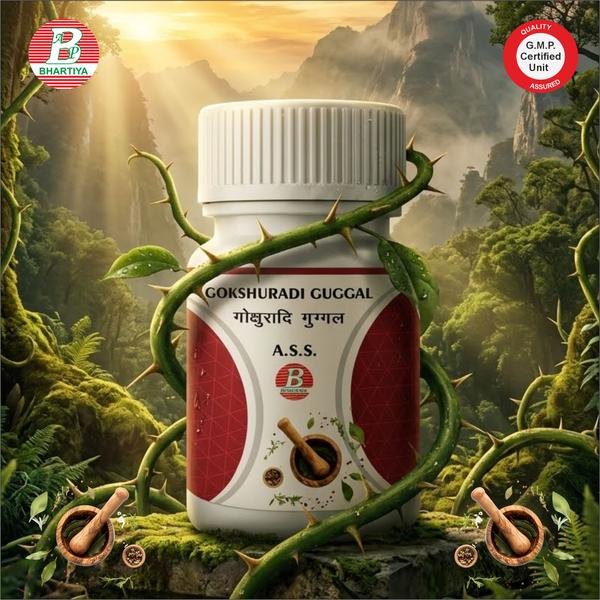
"name": "Gokshuradi Guggal",
"description": "\n GOKSHURADI GUGGUL\n\nProduct Identification \n•\tGeneric Name: Gokshuradi Guggul\n•\tType: Ayurvedic Polyherbal Formulation\n•\tPrimary Indication Area: Prameha (urinary disorders including diabetes mellitus support)\nTherapeutic Indications: Traditionally used for managing:\no\tPrameha (Madhumeha / diabetes-like conditions) – supports metabolic and urinary system balance \no\tMutravikara (urinary disorders) – helps in regulating urinary frequency and function \no\tMedo-dosha imbalance (lipid/metabolic disorders) – supports fat metabolism and weight-related metabolic issues \no\tKapha-vata disorders – helps in balancing doshas associated with metabolic syndrome \no\tGeneral metabolic weakness – used as a supportive formulation in chronic metabolic conditions\n\nKey Benefits:\n•\tSupports management of Prameha (diabetes-related metabolic imbalance)\nTraditionally used to help maintain balance in urinary and metabolic functions associated with Prameha.\nSrotas support)\nSupports healthy urinary frequency and flow, often affected in metabolic disorders.\n•\tPromotes healthy lipid and fat metabolism\nHelps manage “Medo-dosha” imbalance, which is linked with obesity and insulin resistance in Ayurveda.\n•\tSupports blood sugar balance (adjunct role)\nMay help in maintaining glucose metabolism as a supportive Ayurvedic formulation (not a standalone diabetes treatment).\n•\tReduces Kapha-related metabolic heaviness\nTraditionally used to address sluggish metabolism, heaviness, and water retention tendencies.\n•\tSupports detoxification and removal of metabolic wastes (Ama reduction)\nHelps improve digestion and metabolic processing, which is considered important in Prameha management.\n•\tSupports kidney and urinary tract health\nGokshura content traditionally supports renal and urinary system function\nFORMULA\nEach Tablet contains: \nGokshura \t1.344 kg\nShuddha Guggulu\t336g\nAmalaki \t48g\nHaritaki\t48g\nBibhitaki\t48g\nSunthi\t48g\nMarich\t48g\nPippali\t48g\nMusta\t48g\nWater\t8.0641 reduced to 4.0321\n\n 1. Gokshura (Tribulus terrestris)\n• Botanical/Scientific Name: Tribulus terrestris\n\nRasa–Guna–Vīrya–Vipāka:\n• Rasa: Madhura (Sweet), Kaṣāya (Astringent)\n• Guna: Guru (Heavy), Snigdha (Unctuous)\n• Vīrya: Śīta (Cooling)\n• Vipāka: Madhura (Sweet)\n\nPrabhāva:\n• Mutrala / Vrishya – Supports urinary system health and metabolic balance in Prameha\nMechanism of Action (Karma):\n• Mutravaha Srotas Shodhana Karma: Supports urinary tract function and regulates urinary frequency\n• Balya Karma: Improves strength and tissue nourishment\n• Kapha-Medo Hara Karma: Helps in reducing Kapha and fat-related metabolic imbalance\n\n2. Shuddha Guggulu (Commiphora mukul)\n• Botanical/Scientific Name: Commiphora mukul\n\nRasa–Guna–Vīrya–Vipāka:\n• Rasa: Tikta (Bitter), Kaṭu (Pungent)\n• Guna: Laghu (Light), Rūkṣa (Dry), Sara (Mobile)\n• Vīrya: Uṣṇa (Hot)\n• Vipāka: Kaṭu (Pungent)\n\nPrabhāva:\n• Yogavāhi / Lekhana – Enhances bioavailability and scrapes metabolic toxins (Medo-dosha)\n\nMechanism of Action (Karma):\n• Medo-Hara Karma: Reduces excess fat and supports lipid metabolism\n• Shothahara Karma: Reduces inflammation and swelling\n• Yogavāhi Karma: Enhances delivery and action of other herbs in the formulation\n\n3. Amalaki (Emblica officinalis)\n• Botanical/Scientific Name: Emblica officinalis\n\nRasa–Guna–Vīrya–Vipāka:\n• Rasa: Pancha Rasa (All tastes except Lavana), mainly Amla dominant\n• Guna: Laghu (Light), Ruksha (Dry)\n• Vīrya: Śīta (Cooling)\n• Vipāka: Madhura (Sweet)\n\nPrabhāva:\n• Rasayana – Potent rejuvenator and antioxidant support\n\nMechanism of Action (Karma):\n• Rasayana Karma: Supports tissue regeneration and immunity\n• Antioxidant Karma: Reduces oxidative stress in metabolic disorders\n• Pitta-Shamana Karma: Helps regulate heat and metabolic imbalance\n\n4. Haritaki (Terminalia chebula)\n• Botanical/Scientific Name: Terminalia chebula\n\nRasa–Guna–Vīrya–Vipāka:\n• Rasa: Pancha Rasa (all except Lavana)\n• Guna: Laghu (Light), Ruksha (Dry)\n• Vīrya: Uṣṇa (Hot)\n• Vipāka: Madhura (Sweet)\n\nPrabhāva:\n• Anulomana – Promotes proper bowel movement and detoxification\n\nMechanism of Action (Karma):\n• Deepana-Pachana Karma: Improves digestion and metabolic efficiency\n• Anulomana Karma: Supports proper elimination of waste\n• Ama-Pachana Karma: Reduces metabolic toxins linked with Prameha\n\n5. Bibhitaki (Terminalia bellirica)\n• Botanical/Scientific Name: Terminalia bellirica\n\nRasa–Guna–Vīrya–Vipāka:\n• Rasa: Kaṣāya (Astringent)\n• Guna: Laghu (Light), Ruksha (Dry)\n• Vīrya: Uṣṇa (Hot)\n• Vipāka: Madhura (Sweet)\n\nPrabhāva:\n• Kapha-Hara – Reduces excess mucus and metabolic congestion\n\nMechanism of Action (Karma):\n• Kapha-Medo Hara Karma: Helps in lipid and metabolic regulation\n• Detoxifying Karma: Supports removal of accumulated toxins\n• Metabolic Balancing Karma: Supports healthy digestion and metabolism\n\n6. Sunthi (Zingiber officinale)\n• Botanical/Scientific Name: Zingiber officinale\n\nRasa–Guna–Vīrya–Vipāka:\n• Rasa: Kaṭu (Pungent)\n• Guna: Laghu (Light), Snigdha (Slightly unctuous)\n• Vīrya: Uṣṇa (Hot)\n• Vipāka: Madhura (Sweet)\n\nPrabhāva:\n• Deepana-Pachana – Strong digestive and metabolic stimulant\n\nMechanism of Action (Karma):\n• Agni-Deepana Karma: Enhances digestive and metabolic fire\n• Shothahara Karma: Reduces inflammation\n• Bioavailability Enhancement Karma: Improves absorption of other herbs\n\n7. Marich (Piper nigrum)\n• Botanical/Scientific Name: Piper nigrum\n\nRasa–Guna–Vīrya–Vipāka:\n• Rasa: Kaṭu (Pungent)\n• Guna: Laghu (Light), Ruksha (Dry), Tikshna (Sharp)\n• Vīrya: Uṣṇa (Hot)\n• Vipāka: Kaṭu (Pungent)\n\nPrabhāva:\n• Yogavāhi – Enhances potency and absorption of other ingredients\n\nMechanism of Action (Karma):\n• Agni-Deepana Karma: Improves metabolism and digestion\n• Kapha-Hara Karma: Reduces excess Kapha and heaviness\n• Bioenhancer Karma: Increases bioavailability of active compounds\n\n8. Pippali (Piper longum)\n• Botanical/Scientific Name: Piper longum\n\nRasa–Guna–Vīrya–Vipāka:\n• Rasa: Kaṭu (Pungent)\n• Guna: Laghu (Light), Snigdha (Unctuous)\n• Vīrya: Uṣṇa (Hot)\n• Vipāka: Madhura (Sweet)\n\nPrabhāva:\n• Rasayana – Rejuvenative and bioenhancing herb\n\nMechanism of Action (Karma):\n• Agni-Deepana Karma: Enhances metabolic activity\n• Rasayana Karma: Supports tissue nourishment and strength\n• Vata-Kapha Shamana Karma: Balances doshas linked to metabolic disorders\n\n9. Musta (Cyperus rotundus)\n• Botanical/Scientific Name: Cyperus rotundus\n\nRasa–Guna–Vīrya–Vipāka:\n• Rasa: Tikta (Bitter), Kaṣāya (Astringent)\n• Guna: Laghu (Light), Ruksha (Dry)\n• Vīrya: Śīta (Cooling)\n• Vipāka: Kaṭu (Pungent)\n\nPrabhāva:\n• Tridosha Shamana – Balances all three doshas, especially Pitta and Kapha\n\nMechanism of Action (Karma):\n• Deepana-Pachana Karma: Improves digestion and metabolic regulation\n• Prameha Hara Karma: Supports management of urinary and metabolic disorders\n• Stambhana Karma: Helps regulate excessive secretions and fluid imbalance\n\nGeneral Ayurvedic dosage (adults):\nTablet/Capsule: 1–2 tablets (250–500 mg each)\n Frequency: 2 times a day\n Timing: After food (usually with lukewarm water)\n\n\n\ngokshuradi guggulu, gokshuradi guggulu benefits in hindi\ngokshuradi guggulu uses, gokshuradi guggulu uses in hindi\ngokshuradi guggulu ingredients, gokshuradi guggulu uses for male\ngokshuradi guggulu ingredients in hindi, gokshuradi guggulu benefits for male\ngokshuradi guggulu price, gokshuradi guggulu and chandraprabha vati\ngokshuradi guggulu ayurvedic medicine, gokshuradi guggulu amazon\ngokshuradi guggulu ayurvedic medicine uses, gokshuradi guggulu ayurvedic tablet\ngokshuradi guggulu benefits, gokshuradi guggulu benefits for female\ngokshuradi guggulu benefits for male in hindi, gokshuradi guggulu best brand\ngokshuradi guggulu before or after food, gokshuradi guggulu contents\ngokshuradi guggulu composition, gokshuradi guggulu dosage\ngokshuradi guggulu divya, gokshuradi guggulu ds tablet uses\ngokshuradi guggulu dose per day, gokshuradi guggulu easy ayurveda\ngokshuradi guggulu easy, gokshuradi guggulu uses easy ayurveda\ngokshuradi guggulu for weight loss, gokshuradi guggulu fayde in hindi\ngokshuradi guggulu goli, gokshuradi guggulu goli ke fayde\nwhat is gokshuradi guggulu good for, gokshuradi guggulu how to take\ngokshuradi guggulu hindi use, gokshuradi guggulu how long to take\ngokshuradi guggulu how to use, gokshuradi guggulu health benefits\ngokshuradi guggulu helps in weight loss, gokshuradi guggulu in hindi\ngokshuradi guggulu is used for, gokshuradi guggulu indication\nwhat is gokshuradi guggulu used for, what is gokshuradi guggulu\ngokshuradi guggulu ke fayde, gokshuradi guggulu ke fayde in hindi\ngokshuradi guggulu kis kaam aati hai, gokshuradi guggulu kaise khaye\ngokshuradi guggulu lene ka tarika, gokshuradi guggulu lene ke fayde\ngokshuradi guggulu kab lena chahiye, gokshuradi guggulu kis liye hota hai\ngokshuradi guggulu medicine, gokshuradi guggulu mrp, gokshuradi guggulu medicine uses\ngokshuradi guggulu near me, gokshuradi guggulu scientific name, gokshuradi guggulu botanical name\ngokshuradi guggulu online, benefits of gokshuradi guggulu, uses of gokshuradi guggulu\ningredients of gokshuradi guggulu, uses of gokshuradi guggulu in hindi, benefits of gokshuradi guggulu in hindi\ndosage of gokshuradi guggulu, gokshuradi guggulu plant, gokshuradi guggulu powder\ngokshuradi guggulu price in india, gokshuradi guggulu review, gokshuradi guggulu rate\ngokshuradi guggulu tablet, gokshuradi guggulu tablets benefits, gokshuradi guggulu tablet uses\ngokshuradi guggulu tablet uses in hindi, gokshuradi guggulu tablet ke fayde\ngokshuradi guggulu tablet price, gokshuradi guggulu tablets benefits in hindi\ngokshuradi guggulu tablet dosage, gokshuradi guggulu when to take\ngokshuradi guggul tablet, tablet gokshuradi guggulu, is gokshuradi guggulu good for kidney",
"price": 240.0,
"discountamount": 120.0,
"currencycode": "INR",
"priority": 1000000,
"isfreeshipmentavailable": false,
"shipmentduration": 1,
"_keywords": null,
"isarchived": false,
"isavailable": true,
"applicationid": null,
"productindex": 138,
"imageuri": "https://productimages.withfloats.com/actual/6a293335373107961f76938d.jpg",
"tileimageuri": "https://productimages.withfloats.com/tile/6a293335373107961f76938d.jpg",
"images": null,
"totalqueries": 0,
"gpid": null,
"groupproductid": null,
"createdon": "2026-06-10T09:49:36.351Z",
"updatedon": "2026-06-10T09:49:36.351Z",
"buyonlinelink": null,
"producturl": "http://WWW.BHARTIYAAYURVEDICPHARMACY.COM//gokshuradi-guggal/138",
"availableunits": -1.0,
"iscodavailable": true,
"isprepaidonlineavailable": true,
"maxcodorders": -1,
"maxprepaidonlineorders": -1,
"uniquepaymenturl": null,
"brandname": "Bakula Fort",
"category": "Gokshuradi Guggal 100 gm X 40",
"tags": [],
"variants": false,
"keyspecification": null,
"otherspecifications": null,
"pickupaddressreferenceid": null,
"paymenttype": "AssuredPurchase",
"producttype": "products",
"hsncode": null,
"gstslab": 0.0,
"isnotforsale": false
},
{
"_id": "6a191e69e5534ec887cb6d36",
"fptag": "BHARTIYEAYURVEDICPHARMACY",
"merchantname": null,
"customwidgets": null,
"externalsourceid": null,
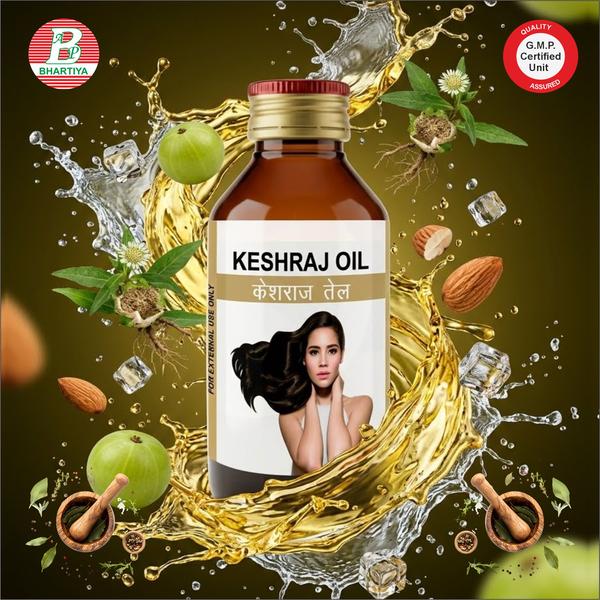
"name": "Keshraj Oil",
"description": " KESHRAJ OIL \n\nProduct Identification\n•\tGeneric Name: Keshraj Oil\n•\tType: Ayurvedic Patent Medicine\n•\tPrimary Indication Area: Promotes healthy scalp and hair, reduces hair fall, and prevents premature Graying.\n Therapeutic Indications\nUsed for strengthening hair roots, controlling hair fall, preventing premature graying, and nourishing the scalp to promote healthy hair growth.\nKey benefits:\n•\tStrengthens hair roots and prevents hair fall\n•\tReduces premature graying of hair\n•\tNourishes and moisturizes the scalp\n•\tPromotes healthy and long hair growth\n•\tImproves hair texture and shine\n\nIngredient: \n Bhringraj (Eclipta alba) \nBotanical Name: Eclipta alba\nKey Phytoconstituents:\n•\tWedelolactone\n•\tDemethylwedelolactone\n•\tCoumestans\n•\tFlavonoids\n•\tAlkaloids\n•\tTriterpenoids\nHair Health Benefits & Mechanism:\n1.\tPromotes Hair Growth: Stimulates hair follicles and improves scalp microcirculation, encouraging healthy hair growth.\n2.\tPrevents Hair Fall: Strengthens hair roots and reduces hair breakage.\n3.\tDelays Premature Graying: Nourishes hair follicles and helps maintain natural hair color.\n4.\tNourishes Scalp: Moisturizes dry scalp and reduces itchiness or dandruff.\n5.\tImproves Hair Texture & Shine: Enhances softness, smoothness, and natural luster of hair.\n6.\tCooling & Soothing: Reduces scalp inflammation and irritation.\n\n Amla (Indian Gooseberry) – Hair Health\nBotanical Name: Phyllanthus emblica\nKey Phytoconstituents:\n•\tVitamin C (Ascorbic acid)\n•\tTannins (e.g., Emblicanin A & B)\n•\tFlavonoids\n•\tPolyphenols\n•\tMinerals (Calcium, Iron, Phosphorus)\nHair Health Benefits & Mechanism:\n1.\tPromotes Hair Growth: Rich in antioxidants and nutrients that nourish hair follicles and stimulate growth.\n2.\tPrevents Hair Fall: Strengthens hair roots and reduces breakage.\n3.\tDelays Premature Graying: High vitamin C and tannin content help maintain natural hair colour.\n4.\tImproves Hair Texture & Shine: Conditions hair naturally, making it soft, smooth, and lustrous.\n5.\tScalp Health: Reduces dryness, dandruff, and scalp inflammation due to its cooling and rejuvenating properties.\n6.\tProtects Against Oxidative Damage: Antioxidants combat free radicals that weaken hair and follicles.\n\n\n Akarkara – Hair & Scalp Health\nBotanical Name: Anacyclus pyrethrum\nKey Phytoconstituents:\n•\tAlkylamides (e.g., Anacyclin)\n•\tPolyacetylenes\n•\tAlkaloids\n•\tEssential oils (volatile oils)\n•\tResin\nHair Health Benefits & Mechanism:\n1.\tStimulates Hair Growth: Improves blood circulation in the scalp, activating hair follicles.\n2.\tStrengthens Hair Roots: Alkaloids and essential oils nourish and fortify hair roots, reducing hair fall.\n3.\tScalp Rejuvenation: Antimicrobial and anti-inflammatory properties help soothe irritation and prevent scalp infections.\n4.\tImproves Hair Texture: Helps make hair stronger, thicker, and healthier in appearance.\n5.\tInvigorates Scalp: Traditionally considered “Vata-pacifying,” it provides warmth and promotes nourishment.\n\n Devdaru (Indian Cedar) \nBotanical Name: Cedrus deodara\nKey Phytoconstituents:\n•\tSesquiterpenes\n•\tFlavonoids\n•\tLignans\n•\tEssential oils (Cedrol, Cedrene)\n•\tResin acids\nHair Health Benefits & Mechanism:\n1.\tPromotes Hair Growth: Improves scalp circulation and stimulates hair follicles.\n2.\tReduces Hair Fall: Strengthens roots and prevents excessive shedding.\n3.\tNourishes Scalp: Provides moisture and soothes dry, itchy, or flaky scalp.\n4.\tImproves Hair Texture & Shine: Enhances hair strength, smoothness, and luster.\n5.\tAnti-inflammatory & Antimicrobial: Protects scalp from minor infections and irritation.\n\n Green Tea \nBotanical Name: Camellia sinensis\nKey Phytoconstituents:\n•\tPolyphenols (Epigallocatechin gallate – EGCG)\n•\tCatechins\n•\tFlavonoids\n•\tAmino acids (Theanine)\n•\tCaffeine\n•\tVitamins (B, C, E)\nHair Health Benefits & Mechanism:\n1.\tPromotes Hair Growth: EGCG and catechins stimulate hair follicle proliferation and prolong the anagen (growth) phase.\n2.\tReduces Hair Fall: Strengthens hair roots and prevents oxidative stress-induced shedding.\n3.\tDelays Premature Graying: Antioxidant activity protects hair follicle melanocytes from damage.\n4.\tImproves Scalp Health: Anti-inflammatory and antimicrobial properties soothe scalp irritation and reduce dandruff.\n5.\tEnhances Hair Strength & Shine: Nutrients nourish hair, improving texture, luster, and manageability.\n\n Jatamansi \nBotanical Name: Nardostachys jatamansi\nKey Phytoconstituents:\n•\tSesquiterpenes (Jatamansone / Nardostachone)\n•\tAlkaloids\n•\tLignans\n•\tEssential oils\n•\tCoumarins\nHair Health Benefits & Mechanism:\n1.\tPromotes Hair Growth: Stimulates hair follicles and improves scalp circulation.\n2.\tPrevents Hair Fall: Strengthens hair roots and reduces breakage.\n3.\tDelays Premature Graying: Nourishes hair follicles and maintains natural hair color.\n4.\tScalp Health: Anti-inflammatory and soothing effects reduce scalp irritation and dryness.\n5.\tImproves Hair Texture & Shine: Enhances softness, smoothness, and natural luster of hair.\n6.\tStress Relief (Ayurvedic Perspective): Helps calm Vata, which can indirectly reduce stress-related hair fall.\n\n Lemon Tea \nBotanical Name: Citrus limon (for lemon)\nKey Phytoconstituents:\n•\tVitamin C (Ascorbic acid)\n•\tFlavonoids (Hesperidin, Naringin)\n•\tCitric acid\n•\tEssential oils (Limonene, Linalool)\n•\tPolyphenols\nHair Health Benefits & Mechanism:\n1.\tPromotes Hair Growth: Improves scalp circulation and nourishes hair follicles.\n2.\tReduces Hair Fall: Strengthens hair roots and prevents breakage.\n3.\tPrevents Dandruff & Scalp Infections: Citric acid and flavonoids have mild antimicrobial and antifungal effects.\n4.\tImproves Hair Shine & Texture: Vitamin C and antioxidants protect hair from oxidative damage and enhance natural luster.\n5.\tBalances Scalp pH: Helps reduce oiliness and dryness, maintaining a healthy scalp environment.\n\n Brahmi – Hair Health\nBotanical Name: Bacopa monnieri\nKey Phytoconstituents:\n•\tBacosides (A & B)\n•\tAlkaloids (Brahmine, Nicotine)\n•\tFlavonoids\n•\tSaponins\n•\tSterols\nHair Health Benefits & Mechanism:\n1.\tPromotes Hair Growth: Nourishes hair follicles and improves scalp circulation.\n2.\tPrevents Hair Fall: Strengthens roots and reduces hair breakage.\n3.\tDelays Premature Graying: Rich in antioxidants that protect follicle melanocytes.\n4.\tScalp Health: Anti-inflammatory and soothing properties help reduce dryness, itching, and dandruff.\n5.\tImproves Hair Texture & Shine: Conditions hair naturally, enhancing softness, smoothness, and luster.\n6.\tCalms Nervous System (Ayurvedic Perspective): Reduces stress-related hair fall by pacifying Vata and supporting overall vitality.\n\n Til Taila (Sesame Oil) \nBotanical Name: Sesamum indicum\nKey Phytoconstituents:\n•\tUnsaturated fatty acids (Oleic acid, Linoleic acid)\n•\tVitamin E (Tocopherols)\n•\tSesamol & Sesamin (Lignans)\n•\tMinerals (Calcium, Magnesium, Phosphorus)\nHair Health Benefits & Mechanism:\n1.\tNourishes Hair & Scalp: Rich in essential fatty acids and vitamin E, it deeply moisturizes and strengthens hair.\n2.\tPrevents Hair Fall: Strengthens hair shafts and roots, reducing breakage and shedding.\n3.\tDelays Premature Graying: Antioxidants (sesamol, sesamin) protect hair follicles from oxidative damage.\n4.\tImproves Hair Texture & Shine: Conditions hair naturally, enhancing softness, smoothness, and luster.\n5.\tScalp Health: Anti-inflammatory properties soothe dry, itchy, or irritated scalp.\n6.\tEnhances Hair Growth: Improves blood circulation in the scalp, promoting healthy hair growth.\nHow to Use Keshraj Oil\n1.\tFor Hair Growth & Strengthening:\no\tTake 2–3 ml (about a teaspoon) of Keshraj Oil.\no\tGently massage it into the scalp using fingertips in circular motions for 5–10 minutes.\no\tEnsure even coverage of the scalp and hair roots.\n2.\tLeave-In Duration:\no\tLeave the oil on for at least 30 minutes.\no\tFor best results, leave it overnight and wash off in the morning.\n3.\tWashing:\no\tWash hair with a mild shampoo to remove excess oil.\no\tAvoid hot water; use lukewarm or cool water for washing.\n4.\tFrequency:\no\tUse 2–3 times a week or as advised by an Ayurvedic practitioner.\n5.\tAdditional Tip:\no\tRegular use improves hair strength, reduces hair fall, delays graying, and nourishes the scalp for healthier, shinier hair.\n\n\nkeshraj oil benefits, keshraj oil benefits in hindi, keshraj oil price\nkeshraj hair oil, keshraj hair oil review, keshraj hair oil benefits\nkeshraj hair oil price, keshraj bhringraj oil, keshraj oil agency\nkeshraj oil company, keshraj oil contact number, keshraj oil corporation\nkeshraj oil company contact number, keshraj oil creation, keshraj oil uses in hindi\nkeshraj oil in hindi, keshraj oil factory, keshraj oil filter price, keshraj oil gst number\nkeshraj oil gst rate, keshraj oil gst no, keshraj oil ke fayde, keshraj oil kg price\nkeshraj oil login, keshraj oil quantity, keshraj oil tonic, keshraj oil tree\nkeshraj oil uses, keshraj oil wash powder, what keshraj oil benefits\nwhat keshraj oil uses in hindi, what keshraj oil benefits in hindi\nwhat keshraj oil review, what keshraj oil price, where keshraj oil is manufactured\nwhere keshraj oil uses in hindi, where keshraj oil benefits, where keshraj oil price\nwhere keshraj oil in hindi, where keshraj oil benefits in hindi, where keshraj oil review\nwhen keshraj oil benefits, when keshraj oil uses in hindi, when keshraj oil benefits in hindi\nwhen keshraj oil price, when keshraj oil in hindi, when keshraj oil review\nhow keshraj oil is made, how keshraj oil works, how keshraj oil is used\nhow keshraj oil benefits, how keshraj oil uses in hindi, how keshraj oil benefits in hindi\nhow keshraj oil review, how keshraj oil price, why keshraj oil benefits\nwhy keshraj oil benefits in hindi, why keshraj oil uses in hindi, why keshraj oil review\nwhy keshraj oil price, who keshraj oil company, who keshraj oil benefits\nwho keshraj oil uses in hindi, who keshraj oil price, who keshraj oil in hindi\nis keshraj oil good, is keshraj oil benefits, is keshraj oil review\nis keshraj oil benefits in hindi, is keshraj oil uses in hindi, is keshraj oil price\ncan keshraj oil benefits, can keshraj oil uses in hindi, can keshraj oil review\ncan keshraj oil price, can keshraj oil in hindi, should keshraj oil benefits\nshould keshraj oil review, should keshraj oil benefits in hindi, should keshraj oil benefits in tamil\nshould keshraj oil uses in hindi, should keshraj oil price, will keshraj oil benefits\nwill keshraj oil review, will keshraj oil benefits in hindi, will keshraj oil price\nwill keshraj oil uses in hindi, will keshraj oil benefits in tamil, do keshraj oil uses in hindi\ndo keshraj oil price, do keshraj oil benefits, do keshraj oil benefits in hindi\ndo keshraj oil review, do keshraj oil in hindi, does keshraj oil benefits\ndoes keshraj oil benefits in hindi, does keshraj oil uses in hindi\ndoes keshraj oil review, was keshraj oil benefits, was keshraj oil uses in hindi\nwas keshraj oil benefits in hindi, was keshraj oil review, was keshraj oil price\nwas keshraj oil in hindi, was keshraj oil benefits in tamil, best keshraj oil in india\nbest keshraj oil benefits, best keshraj oil price, best keshraj oil uses in hindi\nbest keshraj oil review, best keshraj oil benefits in hindi, best keshraj oil in hindi\ntop keshraj oil company, top keshraj oil price, top keshraj oil pvt ltd\ntop keshraj oil uses in hindi, top keshraj oil review, top keshraj oil benefits\ntop keshraj oil in hindi, top keshraj oil benefits in hindi",
"price": 600.0,
"discountamount": 240.0,
"currencycode": "INR",
"priority": 1000000,
"isfreeshipmentavailable": false,
"shipmentduration": 1,
"_keywords": null,
"isarchived": false,
"isavailable": true,
"applicationid": null,
"productindex": 133,
"imageuri": "https://productimages.withfloats.com/actual/6a191e6d3b2a06da6b3bf919.jpg",
"tileimageuri": "https://productimages.withfloats.com/tile/6a191e6d3b2a06da6b3bf919.jpg",
"images": null,
"totalqueries": 0,
"gpid": null,
"groupproductid": null,
"createdon": "2026-05-29T05:04:41.942Z",
"updatedon": "2026-05-29T05:04:41.942Z",
"buyonlinelink": null,
"producturl": "http://WWW.BHARTIYAAYURVEDICPHARMACY.COM//keshraj-oil/133",
"availableunits": -1.0,
"iscodavailable": true,
"isprepaidonlineavailable": true,
"maxcodorders": -1,
"maxprepaidonlineorders": -1,
"uniquepaymenturl": null,
"brandname": "Bakula Fort",
"category": "Keshraj Oil 100 ML X 30",
"tags": [],
"variants": false,
"keyspecification": null,
"otherspecifications": null,
"pickupaddressreferenceid": null,
"paymenttype": "AssuredPurchase",
"producttype": "products",
"hsncode": null,
"gstslab": 0.0,
"isnotforsale": false
},
{
"_id": "6a0d871a8613ca78d7401948",
"fptag": "BHARTIYEAYURVEDICPHARMACY",
"merchantname": null,
"customwidgets": null,
"externalsourceid": null,
"name": "Anardana Goli",
"description": " ANARDANA GOLI \n\nProduct Identification\n•\tGeneric Name: Anardana Goli\n•\tType: Ayurvedic Patent Medicine\n•\tPrimary Indication Area: Improves digestion and stimulates appetite.\n•\tTherapeutic Indications: Helps improve digestion, increase appetite, boost vitality, and reduce weakness.\n\nKey benefits include:\n1. Digestive Support\n•\tAnardana Goli contains ingredients that are considered “Agnivardhaka” in Ayurveda, meaning they strengthen digestive fire (Agni).\n•\tStrong digestive fire ensures that food is properly broken down and nutrients are absorbed efficiently.\n•\tImproved digestion reduces issues like bloating, heaviness, or indigestion, which often suppress appetite.\n2. Appetite Stimulation\n•\tBy improving digestion, the body naturally signals hunger, leading to better appetite.\n•\tIt helps people who have poor appetite due to weakness, stress, or overexertion.\n•\tRegular use may lead to steady and healthy hunger cues, making it easier to eat balanced meals.\n3. Additional Benefits Linked to Digestion & Appetite\n•\tIncreased nutrient absorption → more energy and stamina\n•\tReduced digestive discomfort → enhanced overall well-being\n•\tSupports healthy metabolism, which can maintain proper body weight and vitality\n\nIngredients:\n Anardana \nBotanical Name: Punica granatum\nCommon Names: Anardana (India), Dried Pomegranate Seeds\n\nKey Nutrients / Phytochemicals\n•\tPolyphenols (punicalagins, ellagic acid) – potent antioxidants\n•\tVitamins: Vitamin C, some B-complex vitamins\n•\tMinerals: Potassium, iron, calcium, magnesium\n•\tFiber\n•\tStimulation of Digestive Enzymes\no\tOrganic acids in Anardana (like citric and malic acid) stimulate the secretion of saliva, gastric juices, and pancreatic enzymes.\no\tThis improves breakdown of food, especially proteins and fats.\n•\tEnhancement of Agni (Digestive Fire)\no\tIn Ayurvedic terms, Anardana strengthens Agni, helping proper digestion, nutrient absorption, and assimilation.\n•\tCarminative Effect\no\tReduces gas formation and bloating.\no\tThe mild aromatic compounds help relax intestinal muscles and aid smooth digestion.\n•\tMild Laxative & Stool Softening\no\tDietary fiber in Anardana adds bulk to stool.\no\tHelps in preventing constipation and promoting regular bowel movements.\n•\tReduction of Acidity & Indigestion\no\tOrganic acids balance stomach pH.\no\tHelps prevent fermentation of undigested food, reducing acidity, heartburn, and bloating.\n\n\n Kala Namak (Black Salt) \nBotanical/Source Name: Naturally occurring rock salt, mainly from the Himalayan region (mineral salt, not plant-based).\nCommon Names: Black Salt, Himalayan Black Salt, Kala Namak\n\nKey Constituents / Components\n•\tSodium chloride (NaCl) – main component\n•\tIron sulphide (gives the characteristic dark colour and sulphurous smell)\n•\tTrace minerals: potassium, magnesium, calcium, sulfur compounds\n\nDigestive Mechanism of Action\n1.\tStimulation of Digestive Enzymes & Saliva\no\tThe sulfur compounds and salts in Kala Namak stimulate salivary glands and gastric juices, improving breakdown of food.\no\tEnhances enzyme activity in the stomach, especially for protein digestion.\n2.\tEnhancement of Agni (Digestive Fire)\no\tIn Ayurveda, Kala Namak is considered Ushna (hot in potency) and Deepana (enhances Agni).\no\tPromotes proper digestion, assimilation of nutrients, and prevents Aama (undigested toxins) formation.\n3.\tCarminative & Gas-Relieving Effect\no\tHelps reduce flatulence, bloating, and heaviness in the stomach.\no\tMild action on intestinal muscles supports smooth movement of food.\n4.\tMild Laxative / Gut-Regulating Effect\no\tSupports bowel regularity in small doses.\no\tCan reduce constipation and improve stool consistency.\n5.\tAcidity & Heartburn Relief\no\tUnlike regular salt, Kala Namak neutralizes excess stomach acid due to its unique mineral composition.\no\tHelps maintain pH balance in the stomach, reducing acidity-related discomfort.\n\n Kali Mirch (Black Pepper) \nBotanical Name: Piper nigrum\nCommon Names: Black Pepper, Kali Mirch\n\nKey Phytochemicals\n•\tPiperine – main active compound, gives pungency\n•\tEssential oils (limonene, pinene) – contribute to digestive and carminative effects\n•\tAlkaloids and trace minerals\n\nDigestive Mechanism of Action\n1.\tStimulation of Digestive Enzymes\no\tPiperine in black pepper stimulates the secretion of saliva, gastric juices, bile, and pancreatic enzymes.\no\tEnhances breakdown and absorption of proteins, fats, and carbohydrates.\n2.\tEnhancement of Agni (Digestive Fire)\no\tIn Ayurveda, Kali Mirch is Ushna (hot) and Laghu (light), enhancing Agni.\no\tHelps in digestion of heavy or oily foods and prevents Aama (undigested toxins).\n3.\tCarminative Effect\no\tReduces gas formation, bloating, and flatulence.\no\tHelps relax intestinal muscles and improve bowel movement.\n4.\tImproved Nutrient Absorption\no\tPiperine enhances bioavailability of nutrients and other herbs.\no\tSupports efficient absorption of fat-soluble vitamins and minerals.\n5.\tGut Motility & Mild Laxative Action\no\tStimulates peristalsis, aiding smooth bowel movements.\no\tHelps prevent mild constipation.\n\n Amchur (Dried Mango Powder) \nBotanical Name: Mangifera indica (unripe mango)\nCommon Names: Amchur, Amchoor, Mango Powder\n\nKey Phytochemicals / Nutrients\n•\tOrganic acids: citric acid, malic acid, tartaric acid – provide sour taste\n•\tPolyphenols and flavonoids – antioxidant effect\n•\tVitamins: Vitamin C, small amounts of B-complex\n•\tMinerals: Potassium, magnesium\n\nDigestive Mechanism of Action\n1.\tStimulation of Digestive Enzymes\no\tOrganic acids in Amchur stimulate salivary and gastric secretions, enhancing breakdown of carbohydrates, proteins, and fats.\n2.\tEnhancement of Agni (Digestive Fire)\no\tIn Ayurveda, Amchur is Deepana (stimulates Agni) and Pachana (aids digestion).\no\tHelps digest heavy, oily, or kapha-aggravating foods.\n3.\tCarminative Effect\no\tReduces gas formation, bloating, and flatulence due to its sour and slightly astringent properties.\no\tSupports smooth movement of food in the intestines.\n4.\tAppetizer & Acid-Balancer\no\tImproves appetite by enhancing taste and stimulating digestive secretions.\no\tBalances mild acidity due to regulation of gastric pH.\n5.\tMild Laxative / Gut-Regulating Effect\no\tSlightly promotes bowel movements due to its fiber content and organic acids.\n Namak (Common Salt / Table Salt) \nChemical Composition: Mainly Sodium Chloride (NaCl)\nOther Components: Trace minerals (depending on source)\n\nDigestive Mechanism of Action\n1.\tStimulation of Digestive Secretions\no\tSalt stimulates salivary glands, promoting saliva production.\no\tIncreases secretion of gastric juices, which helps in breaking down food, especially proteins.\n2.\tEnhancement of Agni (Digestive Fire)\no\tIn Ayurveda, small amounts of salt are Deepana (stimulate Agni), aiding digestion and assimilation of nutrients.\n3.\tElectrolyte Balance\no\tMaintains osmotic balance in the gut, helping smooth movement of food through intestines.\n4.\tMild Appetite Stimulant\no\tImproves taste perception, which indirectly encourages better digestion by promoting chewing and salivation.\n5.\tGut Motility Support\no\tHelps maintain water balance in intestines, preventing constipation and aiding smooth bowel movements in normal amounts.\n\n Pippali (Long Pepper) \nBotanical Name: Piper longum\nCommon Names: Pippali, Long Pepper\n\nKey Phytochemicals\n•\tPiperine – main pungent compound\n•\tEssential oils – contribute to digestive and carminative effects\n•\tAlkaloids and volatile oils\n\nDigestive Mechanism of Action\n1.\tStimulation of Digestive Enzymes\no\tPiperine and essential oils stimulate secretion of saliva, gastric juices, and pancreatic enzymes.\no\tEnhances digestion of proteins, fats, and carbohydrates.\n2.\tEnhancement of Agni (Digestive Fire)\no\tIn Ayurveda, Pippali is Ushna (hot), Laghu (light), and Deepana (stimulates Agni).\no\tHelps digest heavy, kapha-aggravating foods and prevents formation of Aama (toxins from undigested food).\n3.\tCarminative Effect\no\tReduces bloating, gas formation, and flatulence.\no\tRelaxes intestinal muscles, aiding smooth movement of food.\n4.\tAppetite Stimulant\no\tImproves taste perception and digestive excitement, which indirectly enhances nutrient breakdown and assimilation.\n5.\tGut Motility & Mild Laxative Action\no\tStimulates peristalsis, supporting regular bowel movements.\no\tMildly laxative in nature, helps prevent constipation\n\n Gulkand (Rose Petal Preserve) \nBotanical Name: Rosa damascena (Damask Rose)\nCommon Names: Gulkand, Rose Petal Preserve\n\nKey Constituents / Phytochemicals\n•\tNatural sugars (from rose petals and sugar) – provide mild energy\n•\tFlavonoids and phenolic compounds – antioxidants\n•\tVolatile oils – aromatic and carminative properties\n•\tTrace minerals: iron, calcium\n\nDigestive Mechanism of Action\n1.\tEnhancement of Agni (Digestive Fire)\no\tGulkand is Deepana (stimulates digestion) and Pachana (aids digestion of heavy foods) in Ayurveda.\no\tHelps digest fatty or heavy meals and reduces formation of Aama (undigested toxins).\n2.\tCarminative Effect\no\tAromatic compounds and rose oils reduce gas, bloating, and flatulence.\no\tHelps smooth intestinal motility.\n3.\tCooling Digestive Tonic\no\tBalances Pitta and excess heat in the digestive tract while supporting digestion.\no\tMildly soothing for acidity and hyperacidity.\n4.\tAppetite Stimulant\no\tSweet taste and aroma improve appetite, increasing salivation and digestive enzyme secretion.\n5.\tGut-Regulating Effect\no\tSugar content provides mild bulk and energy for smooth bowel movement.\no\tMay prevent constipation in moderate use.\n\n Sugar (Sharkara / Saccharose / Table Sugar) \nChemical Composition: Mainly Sucrose (C12H22O11)\nSource: Sugarcane, sugar beet\n\nDigestive Mechanism of Action\n1.\tEnergy Source for Digestion\no\tSugar provides readily available glucose, which supplies quick energy for metabolic processes, including the digestive system.\n2.\tStimulation of Saliva & Taste\no\tSweet taste stimulates salivation, which begins pre-digestion of carbohydrates.\no\tEnhances the appetite indirectly by making food more palatable.\n3.\tMild Laxative / Gut-Regulating Effect (in moderate amounts)\no\tSugar can retain water in the intestines, softening stool slightly and supporting bowel movement.\n4.\tEnhancement of Digestive Enzyme Activity\no\tSimple sugars can activate carbohydrate-digesting enzymes (amylase) in saliva and pancreas.\n5.\tCooling Effect (in Ayurveda)\no\tSugar is considered Shita (cooling), which can soothe Pitta-related digestive irritation (like mild acidity).\n\n\n AMLA (Amalaki) \n1.\tDose:\no\t2–3 goli (tablets/lozenges) three times a day.\n2.\tTiming:\no\tTake after meals (breakfast, lunch, and dinner).\n3.\tMode of Intake:\no\tChew or slowly suck the goli for better digestive effect.\no\tCan be taken with lukewarm water if needed.\n4.\tPurpose:\no\tImproves digestion.\no\tReduces bloating, gas, and mild acidity.\n5.\tPrecautions:\no\tDo not take on an empty stomach.\no\tPeople with diabetes should monitor blood sugar.\no\tAvoid excessive intake to prevent loose stools or acidity.\n6.\tDuration:\no\tCan be used safely for 1–2 months or as advised by an Ayurvedic practitioner.\n\n\n\nanardana goli benefits, anardana goli benefits in hindi\nanardana goli khane ke fayde, anardana goli uses\nanardana goli ingredients, anardana goli recipe\nanardana goli amazon, anardana goli at home\nhow to make anardana goli at home, ayurvedic anardana goli\nwhat is anardana goli, is anardana goli good for health\nanardana goli buy online, anardana goli bottle\nanardana goli buy, anardana churan benefits\nanardana goli calories, anardana goli candy\nanardana goli contents, anardana chatpati goli\ncalories in anardana churan, anardana goli red colour\nanardana goli digestive, anardana goli dosage\nanardana goli in english, anardana goli for digestion\nanardana goli flipkart, anardana goli for kids\nanardana goli nutritional facts, anardana goli used for\nanardana goli gst rate, anardana churan goliyan\nanardana goli how to use, anardana goli health benefits\nanardana goli hindi, anardana churan hsn code\nis anardana goli healthy, anardana goli kya hota hai\nanardana goli in pregnancy, anardana goli india\nanardana goli indiamart, anardana goli in hindi\nanardana churan in pregnancy, anardana goli jiomart\nanardana goli jar, anardana goli kaise banti hai\nanardana goli kaise banate hain, anardana goli khatta meetha\nanardana ki goli, anardana churan ke fayde, anardana churan kaise banta hai\nanardana goli manufacturers, anardana goli making machine\nanardana goli manufacturers in india, anardana goli making\nanardana goli near me, anardana churan near me\nanardana goli shop near me, anardana churan online\nbuy anardana goli online, anardana goli pouch\nanardana goli powder, anardana goli price per kg\nanardana goli quantity, anardana goli qr code\nanardana goli q10, anardana goli qartulad\nanardana goli red, anardana churan recipe\njeera goli red, anardana churan recipe in hindi\nanardana churan goli recipe, anardana goli shadani\nanardana goli taste, anardana goli tablet\nanardana goli uses in hindi, anardana goli uses malayalam\nanardana churan uses, anardana goli kaise banaen\nanardana goli wholesale market, anardana goli wholesale\nanardana goli wholesale price, best anardana goli in india\nbenefits of eating anardana goli, why anardana goli healthy\nwhy anardana goli good for health, why anardana goli means\nwhy anardana goli good for digestion, who anardana goli price\nwho anardana goli in delhi, who anardana goli in a day\nwho anardana goli kaise banate hain, who anardana goli kaise banti hai\nwho anardana goli banane ka tarika, who anardana goli means\nwho anardana goli is made, who anardana goli good for health\nbest anardana goli brand, best anardana churan\nbest anardana brand",
"price": 108.0,
"discountamount": 54.0,
"currencycode": "INR",
"priority": 1000000,
"isfreeshipmentavailable": false,
"shipmentduration": 1,
"_keywords": null,
"isarchived": false,
"isavailable": true,
"applicationid": null,
"productindex": 125,
"imageuri": "https://productimages.withfloats.com/actual/6a0d871d881b69a5d83cfec8.jpg",
"tileimageuri": "https://productimages.withfloats.com/tile/6a0d871d881b69a5d83cfec8.jpg",
"images": null,
"totalqueries": 0,
"gpid": null,
"groupproductid": null,
"createdon": "2026-05-20T10:04:10.77Z",
"updatedon": "2026-05-20T10:04:10.77Z",
"buyonlinelink": null,
"producturl": "http://WWW.BHARTIYAAYURVEDICPHARMACY.COM//anardana-goli/125",
"availableunits": -1.0,
"iscodavailable": true,
"isprepaidonlineavailable": true,
"maxcodorders": -1,
"maxprepaidonlineorders": -1,
"uniquepaymenturl": null,
"brandname": "Bakula Fort",
"category": "Anardana Goli 100 GM X 40",
"tags": [],
"variants": false,
"keyspecification": null,
"otherspecifications": null,
"pickupaddressreferenceid": null,
"paymenttype": "AssuredPurchase",
"producttype": "products",
"hsncode": null,
"gstslab": 0.0,
"isnotforsale": false
},
{
"_id": "6a0d472f21349ee368625e5d",
"fptag": "BHARTIYEAYURVEDICPHARMACY",
"merchantname": null,
"customwidgets": null,
"externalsourceid": null,
"name": "Amritlata Pill",
"description": " ANARDANA GOLI \n\nProduct Identification\n•\tGeneric Name: Anardana Goli\n•\tType: Ayurvedic Patent Medicine\n•\tPrimary Indication Area: Improves digestion and stimulates appetite.\n•\tTherapeutic Indications: Helps improve digestion, increase appetite, boost vitality, and reduce weakness.\n\nKey benefits include:\n1. Digestive Support\n•\tAnardana Goli contains ingredients that are considered “Agnivardhaka” in Ayurveda, meaning they strengthen digestive fire (Agni).\n•\tStrong digestive fire ensures that food is properly broken down and nutrients are absorbed efficiently.\n•\tImproved digestion reduces issues like bloating, heaviness, or indigestion, which often suppress appetite.\n2. Appetite Stimulation\n•\tBy improving digestion, the body naturally signals hunger, leading to better appetite.\n•\tIt helps people who have poor appetite due to weakness, stress, or overexertion.\n•\tRegular use may lead to steady and healthy hunger cues, making it easier to eat balanced meals.\n3. Additional Benefits Linked to Digestion & Appetite\n•\tIncreased nutrient absorption → more energy and stamina\n•\tReduced digestive discomfort → enhanced overall well-being\n•\tSupports healthy metabolism, which can maintain proper body weight and vitality\n\nIngredients:\n Anardana \nBotanical Name: Punica granatum\nCommon Names: Anardana (India), Dried Pomegranate Seeds\n\nKey Nutrients / Phytochemicals\n•\tPolyphenols (punicalagins, ellagic acid) – potent antioxidants\n•\tVitamins: Vitamin C, some B-complex vitamins\n•\tMinerals: Potassium, iron, calcium, magnesium\n•\tFiber\n•\tStimulation of Digestive Enzymes\no\tOrganic acids in Anardana (like citric and malic acid) stimulate the secretion of saliva, gastric juices, and pancreatic enzymes.\no\tThis improves breakdown of food, especially proteins and fats.\n•\tEnhancement of Agni (Digestive Fire)\no\tIn Ayurvedic terms, Anardana strengthens Agni, helping proper digestion, nutrient absorption, and assimilation.\n•\tCarminative Effect\no\tReduces gas formation and bloating.\no\tThe mild aromatic compounds help relax intestinal muscles and aid smooth digestion.\n•\tMild Laxative & Stool Softening\no\tDietary fiber in Anardana adds bulk to stool.\no\tHelps in preventing constipation and promoting regular bowel movements.\n•\tReduction of Acidity & Indigestion\no\tOrganic acids balance stomach pH.\no\tHelps prevent fermentation of undigested food, reducing acidity, heartburn, and bloating.\n\n\n Kala Namak (Black Salt) \nBotanical/Source Name: Naturally occurring rock salt, mainly from the Himalayan region (mineral salt, not plant-based).\nCommon Names: Black Salt, Himalayan Black Salt, Kala Namak\n\nKey Constituents / Components\n•\tSodium chloride (NaCl) – main component\n•\tIron sulphide (gives the characteristic dark colour and sulphurous smell)\n•\tTrace minerals: potassium, magnesium, calcium, sulfur compounds\n\nDigestive Mechanism of Action\n1.\tStimulation of Digestive Enzymes & Saliva\no\tThe sulfur compounds and salts in Kala Namak stimulate salivary glands and gastric juices, improving breakdown of food.\no\tEnhances enzyme activity in the stomach, especially for protein digestion.\n2.\tEnhancement of Agni (Digestive Fire)\no\tIn Ayurveda, Kala Namak is considered Ushna (hot in potency) and Deepana (enhances Agni).\no\tPromotes proper digestion, assimilation of nutrients, and prevents Aama (undigested toxins) formation.\n3.\tCarminative & Gas-Relieving Effect\no\tHelps reduce flatulence, bloating, and heaviness in the stomach.\no\tMild action on intestinal muscles supports smooth movement of food.\n4.\tMild Laxative / Gut-Regulating Effect\no\tSupports bowel regularity in small doses.\no\tCan reduce constipation and improve stool consistency.\n5.\tAcidity & Heartburn Relief\no\tUnlike regular salt, Kala Namak neutralizes excess stomach acid due to its unique mineral composition.\no\tHelps maintain pH balance in the stomach, reducing acidity-related discomfort.\n\n Kali Mirch (Black Pepper) \nBotanical Name: Piper nigrum\nCommon Names: Black Pepper, Kali Mirch\n\nKey Phytochemicals\n•\tPiperine – main active compound, gives pungency\n•\tEssential oils (limonene, pinene) – contribute to digestive and carminative effects\n•\tAlkaloids and trace minerals\n\nDigestive Mechanism of Action\n1.\tStimulation of Digestive Enzymes\no\tPiperine in black pepper stimulates the secretion of saliva, gastric juices, bile, and pancreatic enzymes.\no\tEnhances breakdown and absorption of proteins, fats, and carbohydrates.\n2.\tEnhancement of Agni (Digestive Fire)\no\tIn Ayurveda, Kali Mirch is Ushna (hot) and Laghu (light), enhancing Agni.\no\tHelps in digestion of heavy or oily foods and prevents Aama (undigested toxins).\n3.\tCarminative Effect\no\tReduces gas formation, bloating, and flatulence.\no\tHelps relax intestinal muscles and improve bowel movement.\n4.\tImproved Nutrient Absorption\no\tPiperine enhances bioavailability of nutrients and other herbs.\no\tSupports efficient absorption of fat-soluble vitamins and minerals.\n5.\tGut Motility & Mild Laxative Action\no\tStimulates peristalsis, aiding smooth bowel movements.\no\tHelps prevent mild constipation.\n\n Amchur (Dried Mango Powder) \nBotanical Name: Mangifera indica (unripe mango)\nCommon Names: Amchur, Amchoor, Mango Powder\n\nKey Phytochemicals / Nutrients\n•\tOrganic acids: citric acid, malic acid, tartaric acid – provide sour taste\n•\tPolyphenols and flavonoids – antioxidant effect\n•\tVitamins: Vitamin C, small amounts of B-complex\n•\tMinerals: Potassium, magnesium\n\nDigestive Mechanism of Action\n1.\tStimulation of Digestive Enzymes\no\tOrganic acids in Amchur stimulate salivary and gastric secretions, enhancing breakdown of carbohydrates, proteins, and fats.\n2.\tEnhancement of Agni (Digestive Fire)\no\tIn Ayurveda, Amchur is Deepana (stimulates Agni) and Pachana (aids digestion).\no\tHelps digest heavy, oily, or kapha-aggravating foods.\n3.\tCarminative Effect\no\tReduces gas formation, bloating, and flatulence due to its sour and slightly astringent properties.\no\tSupports smooth movement of food in the intestines.\n4.\tAppetizer & Acid-Balancer\no\tImproves appetite by enhancing taste and stimulating digestive secretions.\no\tBalances mild acidity due to regulation of gastric pH.\n5.\tMild Laxative / Gut-Regulating Effect\no\tSlightly promotes bowel movements due to its fiber content and organic acids.\n Namak (Common Salt / Table Salt) \nChemical Composition: Mainly Sodium Chloride (NaCl)\nOther Components: Trace minerals (depending on source)\n\nDigestive Mechanism of Action\n1.\tStimulation of Digestive Secretions\no\tSalt stimulates salivary glands, promoting saliva production.\no\tIncreases secretion of gastric juices, which helps in breaking down food, especially proteins.\n2.\tEnhancement of Agni (Digestive Fire)\no\tIn Ayurveda, small amounts of salt are Deepana (stimulate Agni), aiding digestion and assimilation of nutrients.\n3.\tElectrolyte Balance\no\tMaintains osmotic balance in the gut, helping smooth movement of food through intestines.\n4.\tMild Appetite Stimulant\no\tImproves taste perception, which indirectly encourages better digestion by promoting chewing and salivation.\n5.\tGut Motility Support\no\tHelps maintain water balance in intestines, preventing constipation and aiding smooth bowel movements in normal amounts.\n\n Pippali (Long Pepper) \nBotanical Name: Piper longum\nCommon Names: Pippali, Long Pepper\n\nKey Phytochemicals\n•\tPiperine – main pungent compound\n•\tEssential oils – contribute to digestive and carminative effects\n•\tAlkaloids and volatile oils\n\nDigestive Mechanism of Action\n1.\tStimulation of Digestive Enzymes\no\tPiperine and essential oils stimulate secretion of saliva, gastric juices, and pancreatic enzymes.\no\tEnhances digestion of proteins, fats, and carbohydrates.\n2.\tEnhancement of Agni (Digestive Fire)\no\tIn Ayurveda, Pippali is Ushna (hot), Laghu (light), and Deepana (stimulates Agni).\no\tHelps digest heavy, kapha-aggravating foods and prevents formation of Aama (toxins from undigested food).\n3.\tCarminative Effect\no\tReduces bloating, gas formation, and flatulence.\no\tRelaxes intestinal muscles, aiding smooth movement of food.\n4.\tAppetite Stimulant\no\tImproves taste perception and digestive excitement, which indirectly enhances nutrient breakdown and assimilation.\n5.\tGut Motility & Mild Laxative Action\no\tStimulates peristalsis, supporting regular bowel movements.\no\tMildly laxative in nature, helps prevent constipation\n\n Gulkand (Rose Petal Preserve) \nBotanical Name: Rosa damascena (Damask Rose)\nCommon Names: Gulkand, Rose Petal Preserve\n\nKey Constituents / Phytochemicals\n•\tNatural sugars (from rose petals and sugar) – provide mild energy\n•\tFlavonoids and phenolic compounds – antioxidants\n•\tVolatile oils – aromatic and carminative properties\n•\tTrace minerals: iron, calcium\n\nDigestive Mechanism of Action\n1.\tEnhancement of Agni (Digestive Fire)\no\tGulkand is Deepana (stimulates digestion) and Pachana (aids digestion of heavy foods) in Ayurveda.\no\tHelps digest fatty or heavy meals and reduces formation of Aama (undigested toxins).\n2.\tCarminative Effect\no\tAromatic compounds and rose oils reduce gas, bloating, and flatulence.\no\tHelps smooth intestinal motility.\n3.\tCooling Digestive Tonic\no\tBalances Pitta and excess heat in the digestive tract while supporting digestion.\no\tMildly soothing for acidity and hyperacidity.\n4.\tAppetite Stimulant\no\tSweet taste and aroma improve appetite, increasing salivation and digestive enzyme secretion.\n5.\tGut-Regulating Effect\no\tSugar content provides mild bulk and energy for smooth bowel movement.\no\tMay prevent constipation in moderate use.\n\n Sugar (Sharkara / Saccharose / Table Sugar) \nChemical Composition: Mainly Sucrose (C12H22O11)\nSource: Sugarcane, sugar beet\n\nDigestive Mechanism of Action\n1.\tEnergy Source for Digestion\no\tSugar provides readily available glucose, which supplies quick energy for metabolic processes, including the digestive system.\n2.\tStimulation of Saliva & Taste\no\tSweet taste stimulates salivation, which begins pre-digestion of carbohydrates.\no\tEnhances the appetite indirectly by making food more palatable.\n3.\tMild Laxative / Gut-Regulating Effect (in moderate amounts)\no\tSugar can retain water in the intestines, softening stool slightly and supporting bowel movement.\n4.\tEnhancement of Digestive Enzyme Activity\no\tSimple sugars can activate carbohydrate-digesting enzymes (amylase) in saliva and pancreas.\n5.\tCooling Effect (in Ayurveda)\no\tSugar is considered Shita (cooling), which can soothe Pitta-related digestive irritation (like mild acidity).\n\n\n AMLA (Amalaki) \n1.\tDose:\no\t2–3 goli (tablets/lozenges) three times a day.\n2.\tTiming:\no\tTake after meals (breakfast, lunch, and dinner).\n3.\tMode of Intake:\no\tChew or slowly suck the goli for better digestive effect.\no\tCan be taken with lukewarm water if needed.\n4.\tPurpose:\no\tImproves digestion.\no\tReduces bloating, gas, and mild acidity.\n5.\tPrecautions:\no\tDo not take on an empty stomach.\no\tPeople with diabetes should monitor blood sugar.\no\tAvoid excessive intake to prevent loose stools or acidity.\n6.\tDuration:\no\tCan be used safely for 1–2 months or as advised by an Ayurvedic practitioner.\n\n\n\namritlata pills price, amritlata pills price in india, amritlata pills amazon\namritlata pills amazon india, amritlata pills amazon price, amritlata pills buy online\namritlata pills buy, amritlata pills bottle, amritlata pills buy online india\namritlata pills company, amritlata pills cost, amritlata pills cost in india\namritlata pills cost price, amritlata pills company details\namritlata pills delhi, amritlata pills english name, amritlata pills english\namritlata pills flipkart, amritlata pills for sale, amritlata pills gst number\namritlata pills gst rate, amritlata pills gst, amritlata pills hindi, amritlata pills himachal pradesh\namritlata pills in hindi, amritlata pills image, amritlata pills indiamart\namritlata pills journal, amritlata pills ke fayde, amritlata pills ke fayde in hindi\namritlata pills kya hai in hindi, amritlata pills linkedin, amritlata pills list\namritlata pills life, amritlata pills manufacturer, amritlata pills manufacturers in india\namritlata pills narela, amritlata pills online shopping, amritlata pills online\namritlata pills online order, amritlata pills quantity, amritlata pills q10\namritlata pills review, amritlata pills rate, amritlata pills supplier\namritlata pills supplier in delhi, amritlata pills tablet, amritlata pills uses\namritlata pills vs, amritlata pills wholesale, amritlata pills wholesale price\namritlata pills zepto, top amritlata pills price in india",
"price": 330.0,
"discountamount": 165.0,
"currencycode": "INR",
"priority": 1000000,
"isfreeshipmentavailable": false,
"shipmentduration": 1,
"_keywords": null,
"isarchived": false,
"isavailable": true,
"applicationid": null,
"productindex": 124,
"imageuri": "https://productimages.withfloats.com/actual/6a0d47311c6b4360d8faaff4.jpg",
"tileimageuri": "https://productimages.withfloats.com/tile/6a0d47311c6b4360d8faaff4.jpg",
"images": null,
"totalqueries": 0,
"gpid": null,
"groupproductid": null,
"createdon": "2026-05-20T05:31:27.893Z",
"updatedon": "2026-05-20T05:31:27.893Z",
"buyonlinelink": null,
"producturl": "http://WWW.BHARTIYAAYURVEDICPHARMACY.COM//amritlata-pill/124",
"availableunits": -1.0,
"iscodavailable": true,
"isprepaidonlineavailable": true,
"maxcodorders": -1,
"maxprepaidonlineorders": -1,
"uniquepaymenturl": null,
"brandname": "Bakula Fort",
"category": "Amritlata Pill 100 GM X 40",
"tags": [],
"variants": false,
"keyspecification": null,
"otherspecifications": null,
"pickupaddressreferenceid": null,
"paymenttype": "AssuredPurchase",
"producttype": "products",
"hsncode": null,
"gstslab": 0.0,
"isnotforsale": false
},
{
"_id": "6a0a9f6e361a58a92ee5cac8",
"fptag": "BHARTIYEAYURVEDICPHARMACY",
"merchantname": null,
"customwidgets": null,
"externalsourceid": null,
"name": "Dandelion Capsule",
"description": " DANDELION \n\n\n DANDELION (Taraxacum officinale Weber) \n\nThe Bitter Tonic Herb — “Taraxacum”\nDandelion, commonly known as “Taraxacum,” is a highly valued herb in traditional and modern herbal medicine. It is known for its liver-supportive, detoxifying, diuretic, and digestive-promoting properties. Rich in vitamins (A, C, K), minerals (potassium, iron), inulin, and antioxidants, Dandelion is considered beneficial for liver health, digestion, immunity, skin, and overall vitality.\n CLASSICAL AYURVEDIC REFERENCES\n1.\tCharaka Samhita\no\tMentioned in Kalpa Sthana as a bitter, Vata-Pitta pacifying herb.\no\tUsed in formulations to support liver function, digestion, and blood purification.\n2.\tSushruta Samhita\no\tListed in Kalpa Sthana for its detoxifying, digestive, and diuretic properties.\no\tRecommended for Jaundice, skin disorders, and Kapha-Pitta imbalance.\n3.\tBhavaprakasha Nighantu\no\tReferred to as Dundubhi / Dandelion, promoting rakta prasadana (blood purification), Medhya (intellect), and Hridya (heart health).\no\tOften used in Rasayana and liver-supportive formulations.\no\t\n CLASSICAL STORY / ANECDOTE\nThough not linked to divine legends, Dandelion has been traditionally referred to as the “liver’s friend” in Ayurvedic and folk medicine.\nAyurvedic texts highlight Dandelion’s bitter taste (Tikta Rasa) as symbolically “cutting through toxins” like a cleansing sword. Healers would recommend it to kings and sages for restoring vitality, liver strength, and clarity of mind during seasonal detoxification.\n\n BOTANICAL INFORMATION OF DANDELION\n•\tScientific Name: Taraxacum officinale Weber\n•\tFamily: Asteraceae\n•\tOrder: Asterales\n•\tGenus: Taraxacum\n•\tSpecies: officinale\n•\tCommon Names:\no\tSanskrit: Dundubhi, Dandelion\no\tHindi: Dandelion\no\tEnglish: Dandelion\no\tTamil: Kathalai Mullu\no\tTelugu: Pidugu Bellam\no\tMalayalam: Kattuchikku\no\tKannada: Katthalimullu\no\tBengali: Dandelion\n\n SYNONYMS IN CLASSICAL AYURVEDIC NIGHANTUS\n•\tCharaka Samhita: Dundubhi – Bitter, liver-supportive, Vata-Pitta balancing\n•\tSushruta Samhita: Dundubhi – Detoxifying, digestive, diuretic\n•\tBhavaprakasha Nighantu: Dundubhi, Taraxacum – Blood purifier, Rasayana, Medhya\n\n MORPHOLOGY OF DANDELION\n•\tPlant Type: Perennial herb\n•\tHeight: 10–40 cm\n•\tLeaves: Rosette, deeply lobed, basal\n•\tFlowers: Yellow, solitary, composite\n•\tFruit / Seed: Achene with pappus for wind dispersal\n•\tRoots: Thick, taproot, used medicinally\n\n ECOLOGICAL PREFERENCES\n•\tClimate: Temperate to subtropical, prefers cool, moist regions\n•\tSoil: Well-drained loamy soil; tolerates poor soils\n•\tHabitat: Meadows, lawns, fields, wastelands\n•\tAltitude: Sea level to 2,000 m\n\n GEOGRAPHICAL DISTRIBUTION\n•\tIndia: Himachal Pradesh, Uttarakhand, Jammu & Kashmir, Northeastern states\n•\tOutside India: Europe, North America, China, Russia, Japan\n\n CLASSICAL AYURVEDIC PROPERTIES (RASA–GUNA–VIRYA–VIPAKA)\n•\tRasa (Taste): Tikta (bitter), Katu (pungent)\n•\tGuna (Qualities): Laghu (light), Ruksha (dry)\n•\tVirya (Potency): Ushna (heating)\n•\tVipaka (post-digestive effect): Katu (pungent)\n•\tDosha Effects: Vata-Kapha hara, Pitta samana in moderation\n\n THERAPEUTIC ACTIONS (KARMA)\n1.\tRaktaprasadana: Blood purifier, detoxifies liver and kidneys\n2.\tKaphahara: Reduces excess Kapha, supports respiratory health\n3.\tHepatoprotective: Strengthens liver function, supports bile secretion\n4.\tMedhya: Supports memory, clarity, and intellect\n5.\tDipana-Pachana: Stimulates digestion and appetite\n6.\tMutravirechana: Mild diuretic, supports urinary health\n7.\tRasayana: Improves vitality and resilience\n\n INDICATIONS\n•\tDigestive System: Dyspepsia, constipation, loss of appetite\n•\tLiver & Metabolism: Jaundice, fatty liver, detoxification\n•\tUrinary System: Edema, kidney support\n•\tSkin & Hair: Acne, eczema, dull skin\n•\tImmune System: General debility, weakness\n•\tNervous System: Fatigue, mental sluggishness\n\n MODERN PHARMACOLOGY & PHYTOCHEMISTRY\n•\tMajor Constituents:\no\tTaraxacin, sesquiterpene lactones, inulin, flavonoids\no\tVitamins A, C, K\no\tMinerals: Potassium, iron, calcium, magnesium\n•\tPharmacological Actions:\no\tHepatoprotective\no\tAntioxidant\no\tAnti-inflammatory\no\tDiuretic\no\tDigestive stimulant\no\tImmunomodulatory\n\n CULTIVATION DETAILS\n•\tPropagation: Seeds, root division\n•\tSowing Time: Spring or autumn\n•\tSpacing: 20–30 cm between plants\n•\tIrrigation: Moderate; prefers moist soil\n•\tFertilization: Organic manure preferred\n•\tHarvesting: Leaves throughout growing season; roots in autumn\n\n CLASSICAL DOSAGE (According to Ayurvedic Granthas)\n•\tLeaf / Herb: 3–6 g/day (powder or decoction)\n•\tRoot: 5–10 g/day (powder, decoction, or infusion)\n•\tJuice / Extract: 10–30 ml/day\n•\tTopical Paste: As required for skin disorders\n\n DANDELION FORMULATIONS – BHARTIYA AYURVEDIC PHARMACY\n\nBhartiya Ayurvedic Pharmacy prepares a range of Dandelion-based formulations following classical Ayurvedic principles described in Charaka Samhita, Sushruta Samhita, and Bhavaprakasha Nighantu. Each product is designed to retain the full detoxifying, liver-supportive, digestive, and rejuvenative properties of Dandelion, supporting liver function, metabolic balance, skin and hair health, and overall vitality.\nKey Uses of Dandelion Formulations:\n•\tLiver and gallbladder support, bile secretion\n•\tDigestive aid and appetite stimulant\n•\tBlood purification and detoxification\n•\tSkin and hair nourishment\n•\tGeneral Rasayana for vitality and immunity\n\n DANDELION CAPSULE – BHARTIYA AYURVEDIC PHARMACY\nBhartiya Ayurvedic Pharmacy offers Dandelion Capsules, prepared according to classical Ayurvedic principles. Each capsule contains premium quality Dandelion leaf and root powder or extract, retaining its full therapeutic properties. Capsules provide a convenient way to support liver health, digestion, detoxification, metabolism, and overall vitality.\nKey Benefits:\n•\tSupports liver and kidney function\n•\tPromotes healthy digestion and bowel movements\n•\tActs as a blood purifier and mild diuretic\n•\tEnhances skin health and general vitality\n•\tFunctions as a Rasayana, promoting strength and endurance\nDosage:\n•\tAdults: 1–2 capsules twice daily with warm water or as directed by an Ayurvedic physician\n•\tCan be combined with milk or honey for enhanced rejuvenative effect\nSafety & Precautions:\n•\tSafe for long-term use when taken as per dosage\n•\tMild diuretic effect may occur; stay hydrated\n•\tMonitor if taking medications for liver or kidneys\nFormulation Highlights:\n•\t100% natural Dandelion leaf and root powder\n•\tFree from artificial colors, preservatives, and additives\n•\tPrepared using classical Ayurvedic methods to preserve therapeutic qualities\nSuggested Use:\n•\tIdeal for adults seeking liver support, digestive health, detoxification, and vitality\n•\tSuitable for those seeking Ayurvedic Rasayana support in a convenient capsule form\n\n\ndandelion capsules, dandelion capsules benefits, dandelion capsules uses\ndandelion capsules near me, dandelion capsules amazon\ndandelion root capsules amazon, , dandelion capsule benefits\ndandelion leaf capsules benefits, dandelion capsules health benefits\ndandelion root capsules benefits for women, dandelion capsules clicks\ndandelion capsule dosage, dandelion extract capsule\ndandelion capsules for sale, dandelion capsules good for\ndandelion herb capsules, dandelion herb india, dandelion tablets uses\ndandelion capsule ke fayde in hindi, dandelion capsule ke fayde\ndandelion root capsules nearby, benefits of dandelion capsules\ndandelion powder capsules, dandelion powder price, dandelion plant price per kg\ndandelion capsule quantity, dandelion capsule quality, dandelion tea capsule\ndandelion capsules walgreens, dandelion capsule zepto, what is dandelion capsules used for\nwhat is dandelion root capsules used for, can you buy dandelion capsules\ncan dandelion grow anywhere, is dandelion harmful, do dandelion grow in india\ntop dandelion supplement\n",
"price": 504.0,
"discountamount": 252.0,
"currencycode": "INR",
"priority": 1000000,
"isfreeshipmentavailable": false,
"shipmentduration": 1,
"_keywords": null,
"isarchived": false,
"isavailable": true,
"applicationid": null,
"productindex": 122,
"imageuri": "https://productimages.withfloats.com/actual/6a0a9f71f85bf4aace5311f9.jpg",
"tileimageuri": "https://productimages.withfloats.com/tile/6a0a9f71f85bf4aace5311f9.jpg",
"images": null,
"totalqueries": 0,
"gpid": null,
"groupproductid": null,
"createdon": "2026-05-18T05:11:10.262Z",
"updatedon": "2026-05-18T05:11:10.262Z",
"buyonlinelink": null,
"producturl": "http://WWW.BHARTIYAAYURVEDICPHARMACY.COM//dandelion-capsule/122",
"availableunits": -1.0,
"iscodavailable": true,
"isprepaidonlineavailable": true,
"maxcodorders": -1,
"maxprepaidonlineorders": -1,
"uniquepaymenturl": null,
"brandname": "Bakula Fort",
"category": "Dandelion Capsule 60 Cap X 40",
"tags": [],
"variants": false,
"keyspecification": null,
"otherspecifications": null,
"pickupaddressreferenceid": null,
"paymenttype": "AssuredPurchase",
"producttype": "products",
"hsncode": null,
"gstslab": 0.0,
"isnotforsale": false
}
],
"hasmoreitems": false,
"isapirequest": false,
"totalresults": 27,
"query": null,
"floatingpoint": null
}