BHARTIYEAYURVEDICPHARMACY
Products
08048126861
919711305254
Chat with us


Chat with us on WhatsApp
×
This is your website preview.
Currently it only shows your basic business info. Start adding relevant business details such as description, images and products or services to gain your customers attention by using Boost 360 android app / iOS App / web portal.
Home
 jatiphaladi vati found
 jatiphaladi vati found
Items tagged with 'jatiphaladi vati found'
{
"products": [
{
"_id": "69808eef911df6d4b0db3166",
"fptag": "BHARTIYEAYURVEDICPHARMACY",
"merchantname": null,
"customwidgets": null,
"externalsourceid": null,
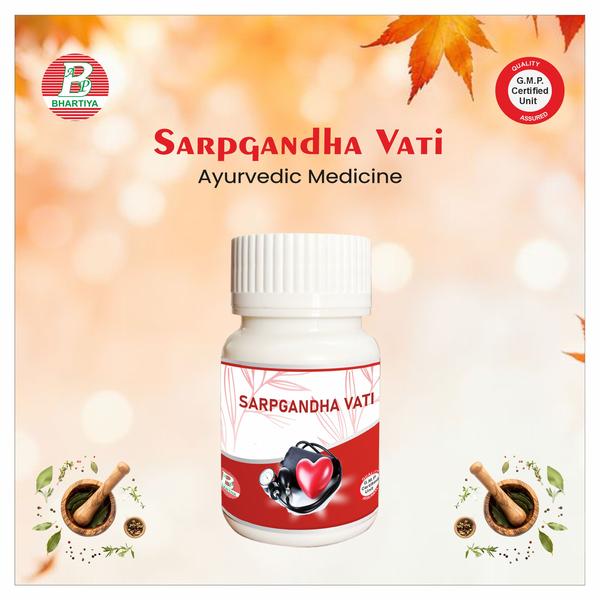
"name": "Sarpgandha vati / tablet",
"description": "Sarpagandha (Rauwolfia serpentina)\n The Serpent Root Herb with Profound Calming & Healing Power\nSarpagandha is one of the most potent and revered herbs in Ayurveda, known for its deep action on the nervous system, mind, blood pressure, and toxic conditions.\nThe name Sarpagandha literally means “the plant with a smell like a serpent” or “the herb that can subdue snake-like disorders”, symbolising its legendary power in calming, controlling, and neutralizing deep-rooted imbalances.\nAyurveda classifies Sarpagandha as:\n•\tStambhana (stabilizing, controlling)\n•\tNidrajanana (induces sleep)\n•\tVedanasthapana (analgesic)\n•\tSarpavisha hara (anti-venom / toxic disorders)\n•\tManas dosha hara (reduces mental disturbances)\n•\tHṛidya (supports the heart)\nIt is highly beneficial in managing high blood pressure, insomnia, anxiety, restlessness, mental agitation, certain psychotic disorders, and snake-bite toxic conditions (traditionally).\n Botanical Information of Sarpagandha\nScientific Name: Rauwolfia serpentina (Linn.) \nFamily: Apocynaceae\nOrder: Gentianales\nGenus: Rauwolfia\nSpecies: serpentina\nCommon Names\n•\tSanskrit: Sarpagandha, Chandrabhaga, Kundali, Sarpasandhi, Nakuli\n•\tHindi: Sarpagandha\n•\tEnglish: Indian Snakeroot, Serpent Root\n•\tTamil: Sivanar Vembu\n•\tTelugu: Patalagandhi\n•\tMalayalam: Paathalgaruda\n•\tKannada: Sarpagandhi\n•\tBengali: Sarpagandha\nSynonyms from Nighantus\n•\tBhavaprakasha: Sarpagandha, Chandrika, Kundali\n•\tDhanvantari Nighantu: Nakuli, Sarpasandhi\n•\tKaiyadeva Nighantu: Sarpagandha, Ganda Naga\n•\tRaja Nighantu: Sarpagandha, Patalagandhi\n Morphology of Sarpagandha (Rauwolfia serpentina)\nPlant Type\nPerennial, erect, smooth herb\nStem\n•\tSlender, erect, slightly woody at the base\n•\tDark green with smooth texture\nLeaves\n•\tSimple, opposite or whorled (3–4 in a circle)\n•\tLanceolate, smooth, shining\n•\tDark green above, light beneath\nFlowers\n•\tSmall, white or pinkish\n•\tArranged in terminal or axillary cymes\nRoots\n•\tLong, slender, cylindrical\n•\tDark brown externally, white inside\n•\tMedicinally most important part\n•\tCharacteristic serpentine smell (hence Sarpagandha)\nFruits\n•\tSmall, globose drupes\n•\tPurplish-black on ripening\nHabit\n•\tSlow-growing but hardy\n•\tDevelops best under semi-shade conditions\n Ecological Preferences\n•\tClimate: Tropical and subtropical\n•\tSoil: Moist, fertile, well-drained soil (prefers humus-rich loam)\n•\tSunlight: Partial shade preferred\n•\tMoisture: Requires consistent moisture\n•\tAltitude: Up to 1200 m\n•\tHabitat: Forest edges, moist slopes, shaded plantations\n Distribution\n•\tIndia: Common in the Himalayan foothills, Northeastern states, Bengal, Western Ghats, Odisha, and Central India\n•\tAsia: Nepal, Bhutan, Bangladesh, Myanmar, Sri Lanka, Thailand\n•\tOther Regions: Widely distributed in Southeast Asia\n Classical Ayurvedic Properties of Sarpagandha\n•\tRasa (Taste): Tikta (bitter), Kashaya (astringent), Madhura (slightly sweet)\n•\tGuna (Quality): Laghu (light), Ruksha (dry), Tikshna (penetrating)\n•\tVirya (Potency): Ushna (hot)\n•\tVipaka: Katu (pungent)\n•\tDosha Effect: Kapha-Vata hara, pacifies Raja & Tama (mental doshas)\nKarma (Therapeutic Actions)\n•\tNidrajanana – induces sleep\n•\tUnmadahara – reduces psychotic symptoms\n•\tSarpavisha hara – mitigates snake/poison effects (traditional use)\n•\tRaktachapa hara – reduces high blood pressure\n•\tStambhana – stabilizes nervous system\n•\tAnulomana – improves digestive and nervous coordination\n Historical & Grantha-Based Story/References of Sarpagandha\n 1. Mention in Ancient Texts\nSarpagandha is described in:\n•\tCharaka Samhita (Chikitsa Sthana) under Unmada (psychosis) treatment\n•\tSushruta Samhita under Sarpavisha Chikitsa (snake poisoning)\n•\tBhavaprakasha Nighantu elaborates its use for insomnia, hypertension-like symptoms, and mania\n•\tKaiyadeva Nighantu describes it as a herb that “calms the mind and controls the serpent-like movements of Vata in the nerves.”\n 2. Traditional Story: “The Serpent-Root Legend”\nAyurvedic folklore says:\n“A wandering sage noticed that snakes bitten by other snakes chewed the root of a certain plant and survived.”\nThis plant, believed to be Sarpagandha, was thus discovered in ancient times.\nThe sages concluded that if it could calm a deadly serpent’s venom, it could also calm the “inner serpent” — representing fear, agitation, and disordered nerves in humans.\nThis symbolic meaning led to its name Sarpagandha and its use for toxins, anxiety, agitation, hypertension, and insanity-like states.\n 3. Use by Ancient Physicians\n•\tAcharya Charaka used it in Unmada (psychiatric) conditions.\n•\tAcharya Sushruta prescribed it as a supportive herb for harmful bites and severe agitation.\n•\tVagbhata considered it “mind-stabilizing and nerve-controlling.”\n Modern Phytochemistry\nSarpagandha contains powerful alkaloids, especially:\n1. Alkaloids (main bioactive class)\n•\tReserpine – antihypertensive, sedative\n•\tAjmaline – antiarrhythmic\n•\tAjmalicine (raubasine) – circulatory and CNS modulator\n•\tSerpentine, Yohimbine (traces)\n2. Others\n•\tSterols\n•\tCarbohydrates\n•\tGlycosides\n•\tFlavonoids\n Species of Rauwolfia\n1.\tRauwolfia serpentina – true Sarpagandha, most potent\n2.\tRauwolfia tetraphylla – similar but less potent; used in some regions\n3.\tRauwolfia vomitoria – African species\n4.\tRauwolfia canescens – mild medicinal use\n Cultivation\n•\tPropagation: Seeds, root cuttings\n•\tPlanting Season: Monsoon (June–July)\n•\tSpacing: 30–45 cm\n•\tWatering: Regular moisture needed\n•\tManure: Best with organic compost\n•\tHarvesting: Roots collected after 2–3 years\n•\tNote: Overharvested in the wild → now commercially cultivated\n Classical Ayurvedic Dosage (from Granthas)\n(General, traditional; modern use must be supervised due to potency)\n•\tRoot Powder (Churna): 250–500 mg once or twice daily\n•\tRoot Decoction (Kwatha): 30–40 ml\n•\tSwarasa (Juice): 5–10 ml\nUsed in:\n•\tInsomnia\n•\tMental disorders\n•\tHypertension-like symptoms\n•\tAgitation\n•\tToxic disorders (traditional use)\n Safety & Precautions\nSarpagandha is highly potent.\n•\tAvoid overdose\n•\tNot suitable during pregnancy\n•\tNot to be combined with other sedatives or antihypertensive drugs without guidance\n•\tMust be used under qualified Ayurvedic supervision\n Sarpagandha Compound Formulations (Classical):\nSarpagandha with Arjuna, Ashwagandha, Brahmi, Shankhapushpi, or Jatamansi—used for hypertension, anxiety, insomnia, nervous disorders, and cardiovascular support, prepared according to classical Ayurvedic methods to retain Rasayana and Medhya properties.\n Sarpagandha Formulations by Bhartiya Ayurvedic Pharmacy\nAt Bhartiya Ayurvedic Pharmacy, we prepare a range of Sarpagandha formulations following classical Ayurvedic methods as described in Charaka Samhita, Sushruta Samhita, Bhavaprakasha Nighantu, and other Ayurvedic Granthas. Each product is crafted to retain the therapeutic potency, purity, and efficacy of the herb, ensuring benefits for stress relief, blood pressure management, nervous system support, and overall mental well-being.\n1.\tSarpagandha Vati/Tablet\nDose\n1 tablet (250–500 mg) twice daily\nOr 1 tablet at night for sleep disorders\nAdvanced cases: 1 tablet thrice daily (only under supervision)\n•\tFor hypertension-like symptoms, insomnia\n•\tSupports Calmness & Mental Stability\n•\tUseful in: Anxiety, Nervousness, Agitation, Irritability, Restlessness, Racing thoughts\n•\tHelps balance Rajas and Tamas (mental doshas) and calms Vata in the nervous system.\nSupports Brain & Nerve Health\nHelps in:\n•\tReducing excessive nerve excitability\n•\tSupporting healthy brain signaling\n•\tPromoting alert calmness\nUsed traditionally in unmada chikitsa (Ayurvedic mental health management)\n\n\nbenefits of sarpagandha tablet, benefits of sarpagandha tablets\nbest sarpagandha tablet, dosage of sarpagandha tablet\nhow to use sarpagandha, is sarpagandha effective for bp\nis sarpagandha safe, m sarpagandha mishran\nm sarpagandha mishran price, m sarpagandha mishran tablet\nm sarpagandha mishran tablet uses in hindi, m sarpagandha mishran uses\nm sarpagandha tablet, sarpagandha tablet benefits\nsarpagandha tablet benefits in hindi, sarpagandha tablet buy online\nsarpagandha tablet content, sarpagandha tablet dosage\nsarpagandha tablet dose, sarpagandha tablet fayde\nsarpagandha tablet flipkart, sarpagandha tablet for\nsarpagandha tablet hindi, sarpagandha tablet how to use\nsarpagandha tablet in hindim, sarpagandha tablet india\nsarpagandha tablet kaise khaye, msarpagandha tablet kaise le\nsarpagandha tablet ke fayde in hindi, sarpagandha tablet ke side effects\nsarpagandha tablet kis kaam aata hai, sarpagandha tablet kya kam karti hai\nsarpagandha tablet near me, sarpagandha tablet online\nsarpagandha tablet price, sarpagandha tablet price in india\nsarpagandha tablet review, sarpagandha tablet side effects\nsarpagandha tablet side effects in hindi, sarpagandha tablet use\nsarpagandha tablet used for, sarpagandha tablet uses\nsarpagandha tablet uses and side effects, sarpagandha tablet uses hindi\nsarpagandha tablet uses in english, sarpagandha tablet uses in hindi\nsarpagandha tablet when to take, sarpagandha tablets ayurvedic\nsarpagandha tablets benefits, sarpagandha tablets for blood pressure\nsarpagandha tablets for blood pressure in hindi, sarpagandha tablets uses\nsarpagandha use, sarpagandha vati tablet ke fayde\nsarpagandha vati tablet price, sarpagandha vati tablet side effects\nsarpagandha vati tablet uses, sarpagandha vati tablet uses in english\nsarpagandha vati tablet uses in hindi, sarpagandha vati tablet uses in tamil\nsarpagandha. tablet image, sarpagandhadi tablet uses\nsarpgandha tablet quality",
"price": 540.0,
"discountamount": 270.0,
"currencycode": "INR",
"priority": 1000000,
"isfreeshipmentavailable": false,
"shipmentduration": 1,
"_keywords": null,
"isarchived": false,
"isavailable": true,
"applicationid": null,
"productindex": 30,
"imageuri": "https://productimages.withfloats.com/actual/69808ef1cf660bbbdc554d46.jpg",
"tileimageuri": "https://productimages.withfloats.com/tile/69808ef1cf660bbbdc554d46.jpg",
"images": null,
"totalqueries": 0,
"gpid": null,
"groupproductid": null,
"createdon": "2026-02-02T11:47:59.198Z",
"updatedon": "2026-02-19T10:33:46.089Z",
"buyonlinelink": null,
"producturl": "http://WWW.BHARTIYAAYURVEDICPHARMACY.COM/products/sarpgandha-vati-tablet/30",
"availableunits": -1.0,
"iscodavailable": true,
"isprepaidonlineavailable": true,
"maxcodorders": 0,
"maxprepaidonlineorders": -1,
"uniquepaymenturl": null,
"brandname": "Bakula fort",
"category": "Sarpgandha vati / tablet 100 - GM X 24",
"tags": [],
"variants": false,
"keyspecification": null,
"otherspecifications": null,
"pickupaddressreferenceid": null,
"paymenttype": "AssuredPurchase",
"producttype": "products",
"hsncode": null,
"gstslab": 0.0,
"isnotforsale": false
},
{
"_id": "69e1c462654012fd93ca2eae",
"fptag": "BHARTIYEAYURVEDICPHARMACY",
"merchantname": null,
"customwidgets": null,
"externalsourceid": null,
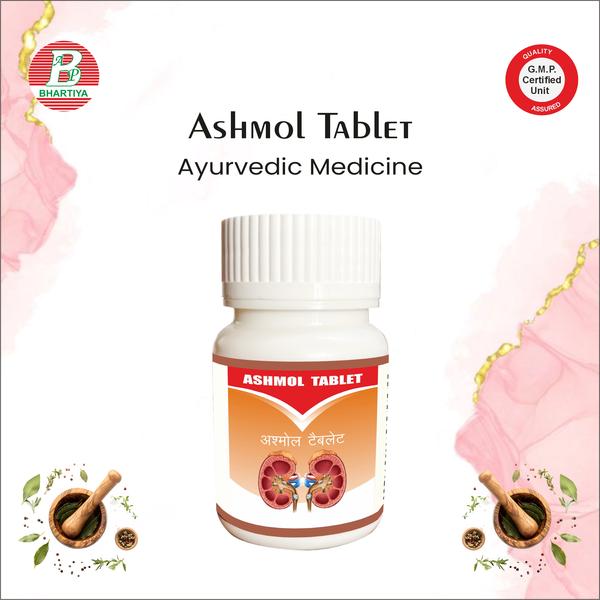
"name": "Ashmol Tablet",
"description": " ASHMOL TABLET \n\nProduct Identification\n•\tGeneric Name: Ashmol Tablet\n•\tType: Ayurvedic Patent Medicine\n•\tPrimary Indication Area: kidney stone treatment is to relieve pain and help pass or remove stones from the kidneys and urinary tract.\nTherapeutic Indications:\nPain relief, facilitation of stone passage, and prevention of stone recurrence. \nPrimary Benefit:\n•\tRelieves pain and helps pass or remove stones.\nOther Benefits:\n•\tPrevents recurrence of stones if proper medication or lifestyle changes are followed\n•\tReduces risk of urinary tract infections caused by stagnant stones\n•\tProtects kidney function by preventing obstruction and damage\n•\tMay improve urine flow and general urinary health\n HARAD \nBotanical / Common Name: Terminalia chebula\nKey Phytoconstituents:\n•\tTannins\n•\tFlavonoids\n•\tPolyphenols / Phenolic compounds\n•\tSugars / Mucilage\nMechanism of Action in Kidney Stones – Biochemistry / Pharmacology:\n1.\tInhibition of Stone Formation\no\tTannins and flavonoids bind calcium and oxalate ions, preventing calcium oxalate crystal aggregation.\no\tReduces formation of larger stones from small crystals.\n2.\tDiuretic Effect / Stone Flushing\no\tIncreases urine output, helping flush out small stones.\no\tReduces crystal retention in kidneys and ureters.\n3.\tAntioxidant / Renal Protective Effect\no\tPolyphenols and flavonoids scavenge reactive oxygen species (ROS).\no\tProtects renal tissue from oxidative damage that promotes stone formation.\n4.\tUrinary Alkalinization\no\tMildly increases urine pH, reducing uric acid stone formation.\n5.\tAnti-inflammatory Effect\no\tReduces inflammation in the urinary tract caused by stone irritation.\n\n BABOOL \nBotanical / Common Name: Acacia nilotica\nKey Phytoconstituents:\n•\tTannins\n•\tFlavonoids \n•\tSaponins\n•\tGlycosides\n•\tPolyphenolic compounds\nMechanism of Action – Biochemistry / Pharmacology:\n1.\tAntimicrobial / Oral Health Effect\no\tTannins and flavonoids exhibit antibacterial activity, reducing microbial growth in oral and gastrointestinal tract.\no\tHelps in prevention of infections and inflammation.\n2.\tAstringent Effect\no\tTannins precipitate proteins on mucosal surfaces, producing an astringent action.\no\tUseful in diarrhea, bleeding gums, and wound healing.\n3.\tAnti-inflammatory Effect\no\tPolyphenolic compounds reduce inflammation by inhibiting inflammatory mediators.\no\tProtects tissues from irritation and oxidative stress.\n4.\tAntioxidant Effect\no\tFlavonoids and polyphenols scavenge free radicals, protecting cells from oxidative damage.\n5.\tGastrointestinal Benefits\no\tSaponins and tannins strengthen gut mucosa, reduce diarrhea, and help maintain digestive health.\n\n\nSHUDH GUGGAL \nBotanical / Common Name: Commiphora mukul\nKey Phytoconstituents:\n•\tGuggulsterones (E- and Z- guggulsterone)\n•\tResinous compounds\n•\tEssential oils\n•\tSterols\nMechanism of Action – Biochemistry / Pharmacology:\n1.\tLipid-Lowering / Hypolipidemic Effect\no\tGuggulsterones modulate cholesterol metabolism by activating bile acid synthesis.\no\tReduces LDL cholesterol and triglycerides; increases HDL cholesterol.\n2.\tAnti-inflammatory Effect\no\tInhibits NF-κB pathway, reducing production of inflammatory mediators.\no\tUseful in arthritis, joint pain, and inflammatory conditions.\n3.\tAnti-oxidant Effect\no\tResin and phytosterols scavenge free radicals, protecting cells from oxidative stress.\n4.\tThyroid Stimulant / Metabolic Effect\no\tGuggulsterones may stimulate thyroid activity, enhancing metabolic rate and fat metabolism.\n5.\tCholagogue / Digestive Support\no\tPromotes bile secretion, aiding digestion and fat absorption.\n\n HAJRUL YAHOOD BHASMA \nBotanical / Common Name: mineral based Ayurvedic Bhasma (calcined stone)\nKey Phytoconstituents / Composition:\n•\tCalcium silicate / Lime silicate (from fossil stone)\n•\tMineral oxides (post calcination residues)\n(Hajrul Yahood is processed through purification and heating to form a fine, digestible powder) \nMechanism of Action in Kidney Stone / Urinary System – Biochemistry / Pharmacology:\n1.\tLithontriptic (Stone Dissolving) Action\no\tPromotes breakdown and dissolution of urinary calculi (stones), helping them reduce in size or pass through urine.\no\tUsed traditionally to manage kidney stones and assist expulsion along the urinary tract. \n2.\tDiuretic Effect / Urine Flow Promotion\no\tIncreases urine production and flow, facilitating the flushing out of small crystals or stones.\no\tHelps reduce urinary retention and complete bladder emptying. \n3.\tAnodyne / Pain Reducing Effect\no\tHas properties to alleviate renal colic (stone related pain) and discomfort during urination.\no\tMinimizes burning sensation and dysuria (painful urination). \n4.\tAntipruritic / Mucosal Protective Action\no\tTraditionally used externally for skin irritation (itching, ringworm) due to its calming effect on tissues.\no\tInternally, it supports mucosal health in the urinary tract. \n5.\tPitta & Kapha Pacification (Ayurvedic property)\no\tCooling (sheet) virya and astringent action help balance Pitta and Kapha doshas associated with excess heat and fluid imbalance in the GI and urinary systems. \n\n GHRIT KUMARI \nBotanical / Common Name: Aloe vera\nKey Phytoconstituents:\n•\tAnthraquinones (aloin, emodin)\n•\tPolysaccharides (acemannan)\n•\tSaponins\n•\tGlycoproteins\n•\tVitamins and minerals\nMechanism of Action – Biochemistry / Pharmacology:\n1.\tMild Laxative / Gastrointestinal Effect\no\tAnthraquinones stimulate intestinal peristalsis, easing bowel movements.\no\tPolysaccharides increase water content in stools, reducing constipation and straining.\n2.\tAnti-inflammatory Effect\no\tGlycoproteins and polysaccharides inhibit inflammatory mediators, soothing GI mucosa and reducing irritation.\n3.\tWound Healing / Tissue Regeneration\no\tPolysaccharides and glycoproteins promote cell proliferation, collagen synthesis, and tissue repair.\no\tHelps heal ulcers and minor GI lesions.\n4.\tAntioxidant Effect\no\tVitamins (A, C, E) and phenolic compounds scavenge free radicals, protecting tissues from oxidative damage.\n5.\tImmune Modulatory Effect\no\tPolysaccharides stimulate macrophages and cytokine activity, supporting immune defense in the GI tract.\nDosage\nDose: 2–3 tablets, twice a day (morning and evening)\n•\tAnupan: Water, preferably after food\n•\tPrecautions:\no\tOnly relieves pain, does not dissolve or remove stones\no\tMaintain hydration and follow dietary measures\no\tConsult a doctor if pain is severe, persistent, or with blood in urine/fever. \n\n\n\nashmol tablet amazon, ashmol tablet amazon india\nashmol tablet benefits, ashmol tablet buy online\nashmol tablet buy, ashmol tablet brand name\nashmol tablet composition, ashmol tablet company\nashmol tablet content, ashmol tablet composition pdf\nashmol tablet download, ashmol tablet dose\nashmol tablet dosage, ashmol tablet dose per day\nashmol tablet englis, ashmol tablet expiry date\nashmol tablet flipkart, ashmol tablet free download\nashmol tablet for hair, ashmol tablet for skin\nashmol tablet ghaziabad, ashmol tablet google\nashmol tablet ghaziabad uttar pradesh, ashmol tablet hindi\nashmol tablet holder, ashmol tablet how to use\nashmol tablet hsn code, ashmol tablet hd images\nashmol tablet indiamart, ashmol tablet india\nashmol tablet in hindi , ashmol tablet image\nashmol tablet jiomart, ashmol tablet jaipur\nashmol tablet ke fayde in hindi, ashmol tablet kya hai\nashmol tablet kis kaam aati hai, ashmol tablet ke fayde\nashmol tablet kya kam karta hai, ashmol tablet login\nashmol tablet list, ashmol tablet list pdf\nashmol tablet label, ashmolean museum tablets\nashmol tablet uses, ashmol tablet name\nashmol tablet new, ashmol tablet online shopping\nashmol tablet online, ashmol tablet order\nashmol tablet order online, ashmol tablet price\nashmol tablet price in india, ashmol tablet quality\nashmol tablet review, ashmol tablet rate\nashmol tablet review in hindi, ashmol tablet side effects\nashmol tablet supplier, ashmol tablet tablet\nasmol 500 uses in hindi, ashmol tablet video\nashmol tablet website, acimol+tablet+uses\nwhere ashmol tablet manufactured\nwhere ashmol tablet found, where ashmol tablet uses\nwhen ashmol tablet will start, when ashmol tablet launched\nwhen ashmol tablet uses, how ashmol tablet is used\nwhy ashmol tablet uses, who ashmol tablets\nwho ashmol tablet uses, is ashmol tablet good\ncan ashmol tablet uses, will ashmol tablet uses\ndo ashmol tablet uses, does ashmol tablets work\nwas ashmol tablet uses, best ashmol tablets\nbest ashmol tablet in india, top ashmol tablets\ntop ashmol tablet in india, top ashmol tablet uses",
"price": 105.0,
"discountamount": 50.0,
"currencycode": "INR",
"priority": 1000000,
"isfreeshipmentavailable": false,
"shipmentduration": 1,
"_keywords": null,
"isarchived": false,
"isavailable": true,
"applicationid": null,
"productindex": 91,
"imageuri": "https://productimages.withfloats.com/actual/69e1c46454763944d8952bf5.jpg",
"tileimageuri": "https://productimages.withfloats.com/tile/69e1c46454763944d8952bf5.jpg",
"images": null,
"totalqueries": 0,
"gpid": null,
"groupproductid": null,
"createdon": "2026-04-17T05:25:54.596Z",
"updatedon": "2026-04-17T05:25:54.596Z",
"buyonlinelink": null,
"producturl": "http://WWW.BHARTIYAAYURVEDICPHARMACY.COM//ashmol-tablet/91",
"availableunits": -1.0,
"iscodavailable": true,
"isprepaidonlineavailable": true,
"maxcodorders": -1,
"maxprepaidonlineorders": -1,
"uniquepaymenturl": null,
"brandname": "Bakula Fort",
"category": "Ashmol Tablet 100 Tab X 40",
"tags": [],
"variants": false,
"keyspecification": null,
"otherspecifications": null,
"pickupaddressreferenceid": null,
"paymenttype": "AssuredPurchase",
"producttype": "products",
"hsncode": null,
"gstslab": 0.0,
"isnotforsale": false
},
{
"_id": "69e0c1e2e465145e2f0b7c4e",
"fptag": "BHARTIYEAYURVEDICPHARMACY",
"merchantname": null,
"customwidgets": null,
"externalsourceid": null,
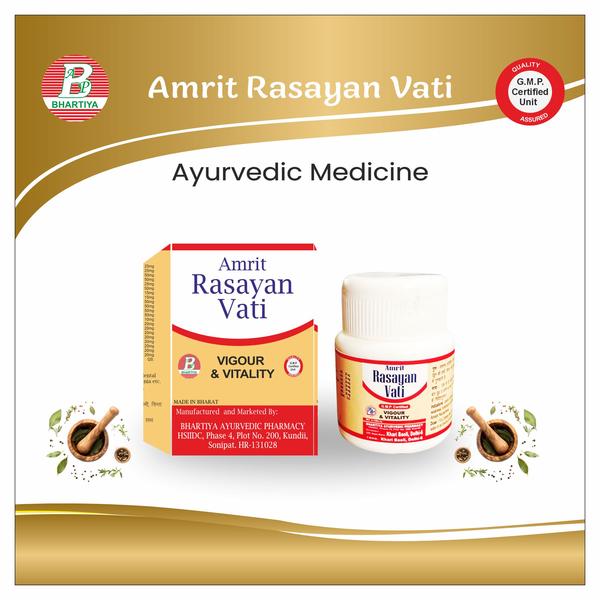
"name": "Amrit Rasayan Vati",
"description": " AMRIT RASAYAN VATI \n\nProduct Identification\n•\tGeneric Name: Amrit Rasayan Vati \n•\tType: Ayurvedic Patent Medicine\n•\tPrimary Indication Area: General physical and mental weakness, nervous debility (Nadi Daurbalya), anaemia/low vitality, stress and anxiety, and post-illness weakness.\nTherapeutic Indications:\n•\tUsed as a Rasayana for management of general physical and mental debility, nervous weakness, anxiety and stress, anaemia/low vitality, fatigue, and convalescence after illness.\n Primary Benefit:\n•\tEnhances overall physical strength and mental vitality by reducing weakness, nervous debility, stress, and fatigue.\nOther Benefits:\n•\tNervous system support: Helps strengthen nerves, improves nerve function, and reduces symptoms of nervous debility (Nadi Daurbalya).\n•\tStress and anxiety relief: Calms the mind, supports emotional balance, and helps reduce mental fatigue and worry.\n•\tImproved stamina and energy: Enhances physical endurance, reduces tiredness, and supports daily activity levels.\n•\tPost-illness recovery: Aids faster recovery by restoring strength and vitality after chronic disease or prolonged weakness.\n•\tImmunity and rejuvenation: Acts as a Rasayana to improve immunity, delay fatigue, and promote overall well-being and longevity.\n\n JAVITRI (Mace) \nBotanical Name: Myristica fragrans (Aril of nutmeg)\nKey Phytoconstituents\n•\tEssential oils (Myristicin, Elemicin, Safrole – in trace/regulated amounts)\n•\tLignans\n•\tFlavonoids\n•\tPhenolic compounds\n•\tFixed oils\n\nMechanism of Action in Mental & Physical Weakness (Biochemistry / Pharmacology)\n1. Central Nervous System Stimulant & Neuroprotective Action (Mental Weakness)\no\tMyristicin and elemicin modulate neurotransmitters such as dopamine and serotonin.\no\tEnhances neuronal signaling, improving alertness, concentration, and cognitive performance.\no\tFlavonoids provide neuroprotective antioxidant effects, reducing oxidative stress in brain tissue.\n\n2. Adaptogenic & Anti-Stress Effect\no\tRegulates the hypothalamic–pituitary–adrenal (HPA) axis, helping the body adapt to mental and physical stress.\no\tReduces cortisol-induced fatigue, thereby improving stress tolerance and mental endurance.\n\nJAIPHAL (Nutmeg) \nBotanical Name: Myristica fragrans (Seed)\nKey Phytoconstituents:\n•\tEssential oils: Myristicin, Elemicin, Safrole (in trace amounts)\n•\tLignans\n•\tFlavonoids\n•\tPhenolic compounds\n•\tFixed oils\nMechanism of Action in Mental & Physical Weakness (Biochemistry / Pharmacology)\n1. CNS Stimulant and Neuroprotective Action\n•\tMyristicin and elemicin modulate dopaminergic and serotonergic neurotransmission.\n•\tImproves cognition, alertness, memory, and focus.\n•\tFlavonoids and lignans act as antioxidants, protecting neurons from oxidative stress.\n2. Anti-Stress and Adaptogenic Effect\n•\tModulates HPA axis, reducing stress-induced cortisol elevation.\n•\tEnhances resilience to mental and physical fatigue.\n\nSAFED MUSLI \nBotanical Name: Chlorophytum borivilianum\nKey Phytoconstituents:\n•\tSaponins (Steroidal saponins)\n•\tAlkaloids\n•\tPolysaccharides\n•\tGlycosides\n•\tProteins and amino acids\nMechanism of Action in Mental & Physical Weakness (Biochemistry / Pharmacology)\n1. Adaptogenic & Anti-Fatigue Action\n•\tSteroidal saponins enhance stress tolerance by modulating the HPA axis.\n•\tReduces cortisol-induced fatigue, improving endurance and physical stamina.\n2. Energy Metabolism Support\n•\tImproves mitochondrial function and ATP production in muscle cells.\n•\tEnhances physical performance and reduces lethargy.\n\nSHATAVARI \nBotanical Name: Asparagus racemosus\nKey Phytoconstituents:\n•\tSteroidal saponins (Shatavarins I–IV)\n•\tFlavonoids\n•\tPolysaccharides\n•\tAlkaloids\n•\tVitamins and minerals\nMechanism of Action in Mental & Physical Weakness (Biochemistry / Pharmacology)\n1. Adaptogenic & Anti-Stress Action\n•\tSteroidal saponins modulate the hypothalamic–pituitary–adrenal (HPA) axis.\n•\tReduces stress-induced cortisol elevation, improving physical stamina and mental resilience.\n2. Rejuvenative / Rasayana Effect\n•\tActs as a general tonic, supporting vitality, energy, and immunity.\n•\tPromotes tissue regeneration and recovery from debility or chronic illness.\n\nBRAHMI \nBotanical Name: Bacopa monnieri\nKey Phytoconstituents:\n•\tBacosides A and B (saponins)\n•\tAlkaloids (brahmine, herpestine)\n•\tFlavonoids\n•\tPhenolic compounds\nMechanism of Action in Mental & Physical Weakness (Biochemistry / Pharmacology)\n1. Cognitive Enhancer & Neuroprotective Action\n•\tBacosides enhance synaptic transmission, nerve impulse conduction, and neuroplasticity.\n•\tProtect neurons from oxidative stress, reducing mental fatigue.\n•\tImproves memory, attention, learning, and mental clarity.\n2. Adaptogenic & Anti-Stress Effect\n•\tModulates HPA axis, reducing cortisol levels.\n•\tEnhances resistance to stress-induced mental and physical fatigue.\n\nSHILAJIT (Shudh / Purified) \nBotanical / Mineral Source: Exudate from rocks of the Himalayas (organic-mineral complex)\nKey Phytoconstituents:\n•\tFulvic acid\n•\tHumic acid\n•\tDibenzo-alpha-pyrones\n•\tTrace minerals (iron, zinc, magnesium, copper, selenium)\n•\tAmino acids\nMechanism of Action in Mental & Physical Weakness (Biochemistry / Pharmacology)\n1. Energy Metabolism & Anti-Fatigue Action\n•\tEnhances mitochondrial ATP production, increasing cellular energy.\n•\tImproves physical endurance and reduces fatigue, supporting muscle performance.\n2. Adaptogenic & Anti-Stress Effect\n•\tModulates the hypothalamic–pituitary–adrenal (HPA) axis.\n•\tReduces stress-induced cortisol elevation, improving mental alertness and physical stamina.\n\n KALI MIRCH (Black Pepper) \nBotanical Name: Piper nigrum\nKey Phytoconstituents:\n•\tPiperine (alkaloid)\n•\tEssential oils (pinene, limonene, sabinene)\n•\tFlavonoids\n•\tPolyphenols\nMechanism of Action in Mental & Physical Weakness (Biochemistry / Pharmacology)\n1. Digestive Stimulant / Bioavailability Enhancer\n•\tPiperine stimulates digestive enzyme secretion, improving digestion and nutrient absorption.\n•\tEnhances bioavailability of nutrients and other phytoconstituents, indirectly supporting physical and mental strength.\n2. Metabolic & Thermogenic Action\n•\tStimulates thermogenesis, improving energy metabolism.\n•\tSupports fatigue reduction and physical endurance.\n\n PIPALI (Long Pepper) \nBotanical Name: Piper longum\nKey Phytoconstituents:\n•\tPiperine (alkaloid)\n•\tVolatile oils (limonene, pinene, caryophyllene)\n•\tPolyphenols\n•\tFlavonoids\nMechanism of Action in Mental & Physical Weakness (Biochemistry / Pharmacology)\n1. Digestive Stimulant / Deepana-Pachana\n•\tPiperine and volatile oils stimulate digestive enzyme secretion, improving digestion and nutrient absorption.\n•\tHelps prevent accumulation of undigested food, which can cause lethargy and weakness.\n2. Bioavailability Enhancer\n•\tPiperine enhances absorption of nutrients and other herbal constituents.\n•\tIndirectly boosts physical strength, energy, and mental function when used in polyherbal formulations.\n\nSAUNTH (Dry Ginger) \nBotanical Name: Zingiber officinale (Dried Rhizome)\nKey Phytoconstituents:\n•\tGingerols and Shogaols (phenolic compounds)\n•\tEssential oils (zingiberene, bisabolene)\n•\tPolyphenols\n•\tFlavonoids\nMechanism of Action in Mental & Physical Weakness (Biochemistry / Pharmacology)\n1. Digestive Stimulant / Deepana-Pachana\n•\tGingerols and shogaols stimulate digestive enzymes, improving digestion and nutrient absorption.\n•\tPrevents accumulation of undigested food, which can cause lethargy and weakness.\n2. Thermogenic & Metabolic Enhancement\n•\tIncreases thermogenesis, enhancing energy metabolism.\n•\tSupports physical stamina and reduces fatigue.\n\nASHWAGANDHA \nBotanical Name: Withania somnifera\nKey Phytoconstituents:\n•\tWithanolides (steroidal lactones)\n•\tAlkaloids (somniferine, withanine)\n•\tSaponins\n•\tIron and amino acids\n\nMechanism of Action in Mental & Physical Weakness (Biochemistry / Pharmacology)\n1. Adaptogenic & Anti-Stress Action\n•\tWithanolides modulate the hypothalamic–pituitary–adrenal (HPA) axis, reducing cortisol levels.\n•\tEnhances stress resilience, improving both mental and physical endurance.\n2. Energy Metabolism & Anti-Fatigue\n•\tSupports mitochondrial function and ATP production, increasing cellular energy.\n•\tReduces physical fatigue and improves stamina.\n\nAKARKARA \nBotanical Name: Anacyclus pyrethrum\nKey Phytoconstituents:\n•\tAlkylamides (pyrethrins, anacyclin)\n•\tN-alkylamides\n•\tEssential oils\n•\tStarch and mucilage\n\nMechanism of Action in Mental & Physical Weakness (Biochemistry / Pharmacology)\n1. Nervine Tonic & Neuroprotective Action\n•\tAlkylamides stimulate central and peripheral nervous system, enhancing nerve conduction and mental alertness.\n•\tSupports cognitive function, focus, and memory, reducing mental fatigue.\n2. Adaptogenic & Anti-Fatigue Effects\n•\tEnhances stress resilience by modulating the HPA axis.\n•\tReduces physical and mental fatigue, improving endurance and stamina.\n\nAMLA (AMALAKI / Indian Gooseberry) \nBotanical Name: Emblica officinalis\nKey Phytoconstituents:\n•\tVitamin C (Ascorbic acid)\n•\tTannins\n•\tFlavonoids\n•\tPolyphenols\n•\tSaponins\nMechanism of Action in Mental & Physical Weakness (Biochemistry / Pharmacology)\n1. Antioxidant & Free Radical Scavenging\n•\tHigh vitamin C and polyphenol content neutralize free radicals.\n•\tProtects cells, muscles, and neurons from oxidative stress, supporting vitality and cognitive function.\n2. Adaptogenic & Stress-Modulating Effects\n•\tReduces oxidative and physiological stress, improving mental resilience.\n•\tSupports stress-induced fatigue reduction and overall endurance.\n\nKESAR (Saffron) \nBotanical Name: Crocus sativus\nKey Phytoconstituents:\n•\tCrocin (carotenoid)\n•\tCrocetin\n•\tSafranal\n•\tPicrocrocin\n•\tFlavonoids\nMechanism of Action in Mental & Physical Weakness (Biochemistry / Pharmacology)\n1. Cognitive Enhancer & Neuroprotective Action\n•\tCrocin and crocetin protect neurons from oxidative stress and apoptosis.\n•\tImproves memory, learning, attention, and overall cognitive function.\n2. Mood Modulation / Antidepressant Effect\n•\tSafranal and crocin modulate serotonin, dopamine, and norepinephrine pathways.\n•\tReduces anxiety, stress, and mental fatigue, supporting mental clarity.\n\nLOH BHASMA \nComposition / Source: Calcined iron (processed iron oxide, Ayurvedic metallic preparation)\nKey Constituents:\n•\tIron in bioavailable ferric/ferrihydrite forms\n•\tTrace minerals (depending on preparation and processing)\n\nMechanism of Action in Mental & Physical Weakness (Biochemistry / Pharmacology)\n1. Hematinic / Hemoglobin Enhancer\n•\tProvides bioavailable iron, supporting hemoglobin synthesis.\n•\tImproves oxygen transport to tissues, reducing fatigue, weakness, and lethargy.\n2. Energy Metabolism & Anti-Fatigue\n•\tIron is essential for mitochondrial electron transport chain and ATP production.\n•\tEnhances physical stamina and endurance in states of debility or anemia.\n\nABHRAK BHASMA \nComposition / Source: Calcined and purified mica (Biotite / Muscovite) processed with herbal juices and ghee (Ayurvedic metallic preparation)\nKey Constituents:\n•\tSilica and alumino-silicates\n•\tTrace minerals (iron, magnesium, potassium, calcium)\n•\tNano- or micro-particles of mica enriched with herbal bioactives during preparation\n\nMechanism of Action in Mental & Physical Weakness (Biochemistry / Pharmacology)\n1. Rasayana / Rejuvenative Action\n•\tActs as a general tonic, improving physical strength, stamina, and vitality.\n•\tSupports post-illness recovery and reduces chronic fatigue.\n2. Nervine & Cognitive Support\n•\tTrace minerals and bioactive particles support neurotransmitter synthesis, improving memory, focus, and mental clarity.\n•\tReduces stress-related mental fatigue.\n\n VANG BHASMA \nComposition / Source: Purified and calcined Tin (Vanga) metal, processed with herbal decoctions and ghee (Ayurvedic metallic preparation)\nKey Constituents:\n•\tTin in bioavailable form (as oxide / organometallic complex)\n•\tTrace minerals incorporated during classical Ayurvedic processing\nMechanism of Action in Mental & Physical Weakness (Biochemistry / Pharmacology)\n1. Rasayana / Rejuvenative Action\n•\tActs as a general tonic, enhancing physical strength, vitality, and endurance.\n•\tSupports recovery from chronic debility and weakness.\n2. Nervine & Cognitive Support\n•\tTrace elements and bioactive complexes support neurotransmitter synthesis, improving memory, focus, and mental clarity.\n•\tReduces mental fatigue and stress-induced cognitive decline.\n\nMUKTA SHUKTI PISHTI \nComposition / Source: Calcined and purified pearl oyster shells (Calcium carbonate-based) processed with herbal juices and milk)\nKey Constituents:\n•\tCalcium carbonate (CaCO₃) in bioavailable form\n•\tTrace minerals: Magnesium, Zinc, Iron\n•\tAmino acids (from herbal processing)\nMechanism of Action in Mental & Physical Weakness (Biochemistry / Pharmacology)\n1. Calcium & Bone-Muscle Support\n•\tProvides bioavailable calcium, supporting bone density, muscle function, and neuromuscular coordination.\n•\tImproves physical strength and endurance in cases of debility.\n2. Nervine & Cognitive Support\n•\tCalcium and trace minerals help neurotransmitter release and synaptic function, improving mental clarity, memory, and focus.\n•\tReduces mental fatigue and weakness.\n\nPRAVAL PISHTI \nComposition / Source: Calcined and purified red coral (calcium carbonate-based) processed with herbal juices and milk)\nKey Constituents:\n•\tCalcium carbonate (CaCO₃) in bioavailable form\n•\tTrace minerals: Magnesium, Iron, Zinc\n•\tAmino acids (from herbal processing)\nMechanism of Action in Mental & Physical Weakness (Biochemistry / Pharmacology)\n1. Calcium & Bone-Muscle Support\n•\tProvides bioavailable calcium, supporting bone strength, neuromuscular function, and muscle endurance.\n•\tImproves physical stamina and recovery from weakness.\n2. Nervine & Cognitive Support\n•\tCalcium and trace minerals support neurotransmitter synthesis and synaptic function, improving mental clarity, focus, and memory.\n•\tReduces mental fatigue and stress-related cognitive weakness.\n\n SWARN MAKSHIK BHASMA \nComposition / Source: Calcined Swarn Makshik (Auriferous Pyrite, FeS₂ with trace gold and iron) processed with herbal decoctions and ghee according to classical Ayurvedic methods.\nKey Constituents:\n•\tIron (Fe²⁺/Fe³⁺ forms)\n•\tSulfur\n•\tTrace gold and other minerals incorporated during processing\nMechanism of Action in Mental & Physical Weakness (Biochemistry / Pharmacology)\n1. Hematopoietic / Hematinic Effect\n•\tProvides bioavailable iron, supporting hemoglobin synthesis and oxygen transport to tissues.\n•\tImproves physical stamina, muscle function, and recovery from fatigue.\n2. Rasayana / Rejuvenative Action\n•\tActs as a general tonic, enhancing vitality, endurance, and resistance to chronic debility.\n•\tSupports recovery from post-illness weakness and physical exhaustion.\n\nRAS SINDOOR \nComposition / Source: Ayurvedic herbo-mineral preparation of mercury (Parada), sulfur (Gandhaka), and other processed minerals, often purified and triturated with herbal decoctions.\nKey Constituents:\n•\tMercury (processed, as mercuric sulfide, HgS)\n•\tSulfur (Gandhaka)\n•\tTrace minerals incorporated during classical Ayurvedic processing\nMechanism of Action in Mental & Physical Weakness (Biochemistry / Pharmacology)\n1. Rasayana / Rejuvenative Action\n•\tActs as a general tonic, enhancing physical strength, vitality, and endurance.\n•\tSupports recovery from chronic debility, post-illness weakness, and fatigue.\n2. Nervine & Cognitive Support\n•\tTraditionally believed to enhance neurocognitive functions, improving memory, focus, and mental clarity.\n•\tMay indirectly support neurotransmitter balance through trace mineral effects.\n\nSWARN BHASMA (Gold Bhasma) \nComposition / Source: Purified and incinerated gold particles processed with herbal decoctions (Rasayana preparation)\nKey Constituents:\n•\tMetallic gold (Au) in nano- or micro-particulate bioavailable form\n•\tTrace minerals absorbed during classical processing\nMechanism of Action in Mental & Physical Weakness (Biochemistry / Pharmacology)\n1. Rasayana / Rejuvenative Action\n•\tActs as a general tonic, enhancing vitality, stamina, and physical strength.\n•\tSupports recovery from chronic debility, post-illness weakness, and fatigue.\n2. Nervine & Cognitive Support\n•\tTraditionally believed to enhance brain function, improving memory, concentration, and mental clarity.\n•\tSupports neuroprotection, possibly through antioxidant and bioactive trace mineral effects.\n\nDosage\n•\tAdults: 1–2 tablets twice daily\n•\tTiming: After meals (dinner or lunch)\n•\tAdjuvant: Take with warm milk or water\nPrecautions\n•\tDo not exceed the prescribed dose.\n•\tConsult a doctor before use in children, elderly, or patients with chronic illnesses.\n•\tMaintain hydration and a nutritious diet for optimal results.\n•\tUse as part of a comprehensive Rasayana / rejuvenative regimen.\n\n\namrit rasayan vati ke fayde, amrit rasayan benefits\namrit rasayan ingredients, amrit rasayan uses\namrit rasayan vati amazon, amrit rasayan vati benefits\namrit rasayan vati benefits in hindi, amrit rasayan vati content\namrit rasayan vati composition, amrit rasayan vati capsule\namrit rasayan vati churna, amrit rasayan vati dosage\namrit rasayan vati dose, amrit rasayan vati dose per day\namrit rasayan vati easy ayurveda, amrit rasayan vati expiry date\namrit rasayan vati extra power, amrit rasayan vati extra\namrit rasayan vati gst rate, amrit rasayan vati generic name\namrit rasayan vati goli, amrit rasayan vati hindi\namrit rasayan vati how to use, amrit rasayan vati ingredients\namrit rasayan vati in hindi, amrit rasayan vati ingredients in hindi\nअमृत रसायन के फायदे, amrit rasayan ke fayde\namrit rasayan kya hai, amrit rasayan khane ke fayde\namrit rasayan vati lucknow, amrit rasayan vati lucknow uttar pradesh\namrit rasayan vati manufacturer, amrit rasayan vati mrp\namrit rasayan vati medicine, amrit rasayan vati near me\namrit rasayan vati online, amrit rasayan vati online shopping\namrit rasayan vati online purchase, amrit rasayan vati original\namrit rasayan price, amrit rasayan vati quantity\namrit rasayan vati quality, amrit rasayan vati review\namrit rasayan vati review in hindi, amrit rasayan side effects\namrit rasayan syrup, amrit rasayan vati tablet\namrit rasayan vati tablet uses in hindi\namrit rasayan vati tablet uses, amrit rasayan vati uses\namrit rasayan vati vati, amrit rasayan vati vyas\namrit rasayan vati website, amrit rasayan vati weight loss\namrit rasayan vati with ashwagandha, amrit rasayan vati works\namrit rasayan vati yantra, amrit rasayan vati yoga\namrit rasayan vati zepto, amrit rasayan vati zudio\namrit rasayan how to use, haridwar amrit vati\namrit rasayan benefits in hindi, rasayan amrit ke fayde\namrit rasayan, amrit rasayan review\nrasayan amrit price, what amrit rasayan vati used for\nwhere amrit rasayan vati available, where amrit rasayan vati manufactured\nwhere amrit rasayan vati found, where amrit rasayan vati made\nhow amrit rasayan vati works, who amrit rasayan vati uses in hindi\nwho amrit rasayan vati price, who amrit rasayan vati in hindi\nis amrit rasayan vati good, can amrit rasayan vati work\nwill amrit rasayan vati work, do amrit rasayan vati uses in hindi\ndoes amrit rasayan vati work, was amrit rasayan vati good\nbest amrit rasayan vati in india, best amrit rasayan vati uses in hindi\ntop amrit rasayan vati uses in hindi",
"price": 207.0,
"discountamount": 100.0,
"currencycode": "INR",
"priority": 1000000,
"isfreeshipmentavailable": false,
"shipmentduration": 1,
"_keywords": null,
"isarchived": false,
"isavailable": true,
"applicationid": null,
"productindex": 89,
"imageuri": "https://productimages.withfloats.com/actual/69e0c1e5ae12ae6a19635abf.jpg",
"tileimageuri": "https://productimages.withfloats.com/tile/69e0c1e5ae12ae6a19635abf.jpg",
"images": null,
"totalqueries": 0,
"gpid": null,
"groupproductid": null,
"createdon": "2026-04-16T11:02:58.799Z",
"updatedon": "2026-04-16T11:02:58.799Z",
"buyonlinelink": null,
"producturl": "http://WWW.BHARTIYAAYURVEDICPHARMACY.COM//amrit-rasayan-vati/89",
"availableunits": -1.0,
"iscodavailable": true,
"isprepaidonlineavailable": true,
"maxcodorders": -1,
"maxprepaidonlineorders": -1,
"uniquepaymenturl": null,
"brandname": "Bakula Fort",
"category": "Amrit Rasayan Vati 30tab X 207",
"tags": [],
"variants": false,
"keyspecification": null,
"otherspecifications": null,
"pickupaddressreferenceid": null,
"paymenttype": "AssuredPurchase",
"producttype": "products",
"hsncode": null,
"gstslab": 0.0,
"isnotforsale": false
},
{
"_id": "69aabe02090539877161e8f0",
"fptag": "BHARTIYEAYURVEDICPHARMACY",
"merchantname": null,
"customwidgets": null,
"externalsourceid": null,
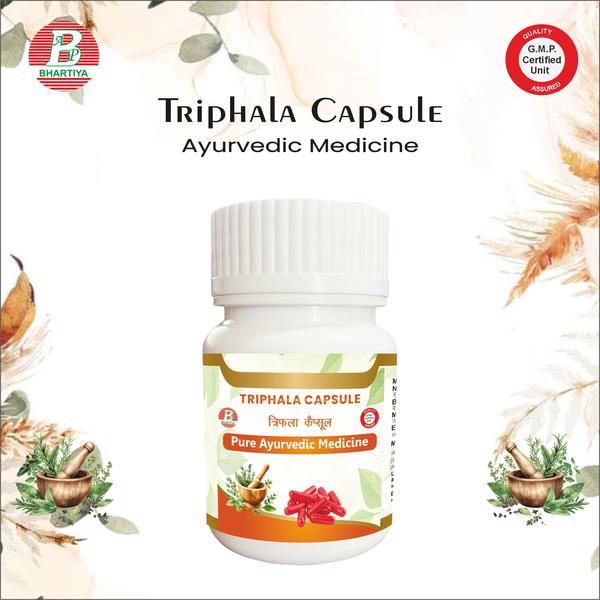
"name": "Triphala capsule",
"description": " TRIPHALA \n\n TRIPHALA \nThe Divine Rasayana of Ayurveda\nTriphala is one of the most revered classical formulations in Ayurveda, composed of three powerful fruits—Haritaki, Bibhitaki, and Amalaki. It is celebrated as a Rasayana (rejuvenator) that gently detoxifies the body while nourishing tissues, supporting digestion, immunity, eye health, and longevity. Unique among formulations, Triphala balances all three Doshas—Vata, Pitta, and Kapha.\n\n CLASSICAL AYURVEDIC REFERENCES\nCharaka Samhita\n•\tDescribed Triphala as a Tridoshahara Rasayana.\n•\tRegular use promotes longevity, strength, and digestive balance.\nSushruta Samhita\n•\tRecommends Triphala for eye health (Chakshushya) and internal cleansing.\n•\tUsed in wound healing, detoxification, and rejuvenation therapies.\nAshtanga Hridaya\n•\tMentions Triphala as a daily supportive Rasayana for maintaining Agni and Dhatu health.\nBhavaprakasha Nighantu\n•\tDescribes Triphala as Deepana, Pachana, Rasayana, and Chakshushya.\n\n CLASSICAL ANCIENT STORY / AACHARYA ANECDOTE\nAncient Ayurvedic tradition narrates that Acharya Charaka observed the declining vitality and digestive strength of people due to irregular lifestyle and improper food habits. The sages prayed for a formulation that could cleanse the body without weakening it.\nIt is said that Lord Dhanvantari, the divine physician, revealed Triphala—formed from three sacred fruits representing the three pillars of life:\n•\tHaritaki (Vata – movement & elimination)\n•\tBibhitaki (Kapha – stability & cleansing)\n•\tAmalaki (Pitta – nourishment & cooling)\nAcharyas proclaimed:\n“Nityaṃ Triphalā Sevanaṃ Jīvanaṃ Dīrgham Karoti”\n(Regular use of Triphala bestows long life.)\nThus, Triphala became known as the guardian Rasayana—safe for daily use, subtle yet profound in action.\n\n BOTANICAL COMPOSITION OF TRIPHALA\nIngredient\tBotanical Name\tPart Used\nHaritaki\tTerminalia chebula\tFruit\nBibhitaki\tTerminalia bellirica\tFruit\nAmalaki\tEmblica officinalis\tFruit\nFamily: Combretaceae & Phyllanthaceae\n\n SYNONYMS IN CLASSICAL TEXTS\n•\tTriphala – Three fruits\n•\tPhalatrikam\n•\tTridoshaghni\n•\tRasayana Yoga\n\n CLASSICAL AYURVEDIC PROPERTIES\n(RASA – GUNA – VIRYA – VIPAKA)\nRasa (Taste):\nPancharasa (All tastes except Lavana), predominantly Amla, Kashaya\nGuna (Qualities):\nLaghu (light), Ruksha (dry)\nVirya (Potency):\nUshna (Haritaki, Bibhitaki) & Sheeta (Amalaki) – balanced effect\nVipaka:\nMadhura\nDosha Effect:\n✔ Tridoshahara (Balances Vata, Pitta & Kapha)\n\n THERAPEUTIC ACTIONS (KARMA)\n• Rasayana – Rejuvenative\n• Anulomana – Regulates bowel movement\n• Deepana–Pachana – Improves digestion\n• Chakshushya – Promotes eye health\n• Raktashodhaka – Blood purifier\n• Medohara – Supports metabolism\n\n INDICATIONS\n• Chronic constipation & weak digestion\n• Detoxification and gut health\n• Eye disorders & vision support\n• Skin diseases & blood impurities\n• Metabolic imbalance & obesity\n• Immunity support & anti-aging care\n\n MODERN PHARMACOLOGY & PHYTOCHEMISTRY\nMajor Constituents:\n• Tannins\n• Gallic acid\n• Chebulinic acid\n• Vitamin C (from Amalaki)\nPharmacological Actions:\n• Mild laxative\n• Antioxidant\n• Anti-inflammatory\n• Gut microbiome supportive\n• Immunomodulatory\n\n\nTRIPHALA FORMULATIONS – Bhartiya Ayurvedic Pharmacy\nBhartiya Ayurvedic Pharmacy prepares authentic Triphala formulations—a classical blend of Haritaki (Terminalia chebula), Bibhitaki (Terminalia bellirica), and Amalaki (Emblica officinalis)—based on authoritative Ayurvedic texts, ensuring optimal digestive regulation, gentle detoxification, rejuvenation, and immune support.\n\n1. TRIPHALA CAPSULE \nDescription:\nTriphala Capsules are prepared using equal proportions of Haritaki, Bibhitaki, and Amalaki fruit powders, processed according to classical Ayurvedic principles to preserve Rasayana potency.\n\n KEY BENEFITS\n• Gently detoxifies without dependency\n• Improves digestion and bowel regularity\n• Enhances immunity and vitality\n• Supports eye and skin health\n• Promotes longevity and daily wellness\n\n DOSAGE\n• Adults: 1–2 capsules once or twice daily\n• Best taken at night with warm water\n• Or as directed by an Ayurvedic physician\n\n SAFETY & PRECAUTIONS\n• Safe for long-term use under guidance\n• Use cautiously in severe debility or dehydration\n• Adjust dose in high Vata conditions\n\n FORMULATION HIGHLIGHTS\n• Classical 1:1:1 Triphala formulation\n• 100% pure herbal ingredients\n• No chemicals, additives, or preservatives\n• Prepared as per authentic Ayurvedic texts\n\n Triphala is not merely a medicine—it is a daily companion for balanced living, as envisioned by the great Acharyas of Ayurveda.\n\n2. TRIPHALA CHURNA \n TRIPHALA \nThe Eternal Rasayana of the Great Acharyas\nTriphala Churna is one of the most time-honored classical formulations of Ayurveda, prepared from the powdered fruits of Haritaki, Bibhitaki, and Amalaki in equal proportion. Revered as a Rasayana (rejuvenator), Triphala Churna gently cleanses the body while nourishing all Dhatus, supporting digestion, vision, immunity, and longevity. It is uniquely praised for its ability to balance all three Doshas—Vata, Pitta, and Kapha.\n\n CLASSICAL AYURVEDIC REFERENCES\nCharaka Samhita\n•\tDescribes Triphala as Tridoshaghna and Rasayana.\n•\tRegular use promotes long life, strength, and clarity of senses.\nSushruta Samhita\n•\tRecommends Triphala Churna for Chakshushya (eye health) and internal purification.\n•\tWidely used in Vrana Shodhana (wound cleansing) and detoxifying therapies.\nAshtanga Hridaya\n•\tAdvises Triphala for daily use to maintain Agni, Koshtha, and Dhatu balance.\nBhavaprakasha Nighantu\n•\tDescribes Triphala as Deepana, Pachana, Rasayana, and Netrya.\n\n CLASSICAL ANCIENT STORY / AACHARYA ANECDOTE\nAyurvedic tradition narrates that the great sages observed how harsh purgatives weakened patients while untreated impurities shortened life. Seeking a remedy that could cleanse gently without depletion, they meditated upon nature’s wisdom.\nAcharya Charaka, guided by divine knowledge from Lord Dhanvantari, revealed Triphala—three sacred fruits representing harmony of the Tridosha:\n•\tHaritaki – Governs Vata, elimination, and vitality\n•\tBibhitaki – Regulates Kapha, cleansing and stability\n•\tAmalaki – Pacifies Pitta, nourishment and rejuvenation\nThe Acharyas proclaimed:\n“Triphala Nityasevanaṃ Sharīrasya Bala-Vardhanam”\n(Regular use of Triphala strengthens the body.)\n\n\n\nbenefits of triphala capsule, best brand of triphala capsules\nbest organic triphala capsules, best time to take triphala capsule\nbest triphala capsules, best triphala capsules brand in india\nbest triphala capsules in india, best triphala churna india\ncan i take triphala with other supplements\ncan triphala be taken daily, can triphala be taken everyday\ncan triphala cause weight gain, can triphala churna be taken daily\nhow to use triphala capsules, is it good to take triphala everyday\nis triphala capsules good, is triphala churna good for health\norganic triphala capsule, organic triphala capsules benefits\ntriphala 60 capsule organic india, triphala capsule ayurvedic\ntriphala capsule hsn code, triphala capsule in hindi\ntriphala capsule ke fayde, triphala capsule ke kya fayde hain\ntriphala capsule khane ke fayde, triphala capsule price\ntriphala capsule quantity, triphala capsule uses\ntriphala capsule uses in hindi, triphala capsules amazon\ntriphala capsules benefits, triphala capsules benefits in hindi\ntriphala capsules india, triphala capsules kottakkal\ntriphala capsules near me, triphala capsules nz\ntriphala capsules online, triphala capsules or powder\ntriphala capsules price, triphala capsules reviews\ntriphala capsules uk, triphala capsules uses, triphala capsules uses in hindi\ntriphala capsules when to take as, triphala churna capsule\ntriphala guggul capsule, triphala guggul tablets\ntriphala powder in capsule, triphala tablets india",
"price": 300.0,
"discountamount": 150.0,
"currencycode": "INR",
"priority": 1000000,
"isfreeshipmentavailable": false,
"shipmentduration": 1,
"_keywords": null,
"isarchived": false,
"isavailable": true,
"applicationid": null,
"productindex": 73,
"imageuri": "https://productimages.withfloats.com/actual/69aabe040d75f0106b3633a8.jpg",
"tileimageuri": "https://productimages.withfloats.com/tile/69aabe040d75f0106b3633a8.jpg",
"images": null,
"totalqueries": 0,
"gpid": null,
"groupproductid": null,
"createdon": "2026-03-06T11:44:02.388Z",
"updatedon": "2026-03-06T11:44:02.388Z",
"buyonlinelink": null,
"producturl": "http://WWW.BHARTIYAAYURVEDICPHARMACY.COM//triphala-capsule/73",
"availableunits": -1.0,
"iscodavailable": true,
"isprepaidonlineavailable": true,
"maxcodorders": -1,
"maxprepaidonlineorders": -1,
"uniquepaymenturl": null,
"brandname": "Bakula fort",
"category": "Triphala capsule 60-cap x 24",
"tags": [],
"variants": false,
"keyspecification": null,
"otherspecifications": null,
"pickupaddressreferenceid": null,
"paymenttype": "AssuredPurchase",
"producttype": "products",
"hsncode": null,
"gstslab": 0.0,
"isnotforsale": false
},
{
"_id": "69a27c1007634e1b29b4922c",
"fptag": "BHARTIYEAYURVEDICPHARMACY",
"merchantname": null,
"customwidgets": null,
"externalsourceid": null,
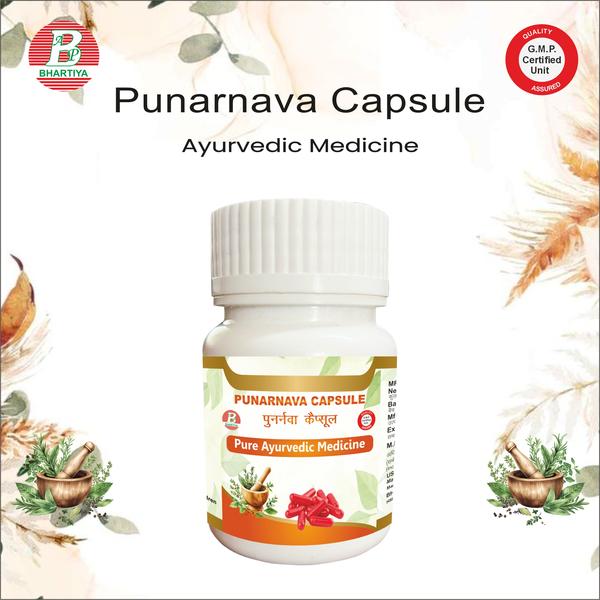
"name": "Punarnava Capsule",
"description": " Punarnava (Boerhavia diffusa) \n The Rejuvenating Herb with Healing Leaves\nPunarnava is one of the most important rejuvenating herbs in Ayurveda, widely valued for its unique ability to revive and renew the body.\nThe name Punarnava literally means “that which becomes new again”, indicating its powerful regenerative and restorative nature.\nIn Ayurveda, Punarnava is classified as a Mutrala (diuretic), Shothahara (anti-inflammatory), and Rasayana (rejuvenative) drug. It is highly beneficial in managing swelling (oedema), kidney disorders, liver weakness, urinary problems, digestive issues, anaemia, and general debility.\nBotanical Information of Punarnava\nScientific Name: Boerhavia diffusa Linn.\nFamily: Nyctaginaceae\nOrder: Caryophyllales\nGenus: Boerhavia\nSpecies: diffusa\nCommon Names:\n•\tSanskrit: Punarnavā, Shothaghanī, Raktapunarnavā, Śvetapunarnavā, Shreṇī, Shoṭikā\n•\tHindi: Punarnava\n•\tEnglish: Spreading Hogweed, Red Spiderling\n•\tTamil: Mookarattai\n•\tTelugu: Atika\n•\tMalayalam: Thazhuthama\n•\tKannada: Komme beru\n•\tBengali: Punarnava\nSynonyms of Punarnava (Boerhavia diffusa) in Ayurvedic Nighantus:\n Bhavaprakasha Nighantu – Shothaghni, Raktapunarnava, Shvetapunarnava, Shoṭikā\n Raja Nighantu & Kaiyadeva Nighantu – Panchanga, Jalapushpa, Mochana, Bhujanga\n Hrudaya Nighantu & Dhanvantari Nighantu – Utkalika, Shreni\n Morphology of Punarnava (Boerhavia diffusa)\nPlant Type: Perennial, creeping, and spreading herb\nStem:\n•\tProstrate or slightly ascending, creeping along the ground\n•\tPurplish-green, hairy, with swollen nodes\n•\tRoots develop at nodes where the stem touches the soil\nLeaves:\n•\tSimple, opposite arrangement\n•\tShape: Ovate, elliptic, or slightly rounded\n•\tTexture: Fleshy and soft\n•\tColor: Dark green on the upper surface, pale green below\n•\tPetiole: Short\nFlowers:\n•\tSmall, tubular, and bisexual\n•\tColor: Pink, reddish, or white\n•\tArranged in axillary clusters (cymes)\n•\tBloom mainly during summer and rainy seasons\nRoots:\n•\tThick, cylindrical, fleshy, and tapering\n•\tColor: White in Shveta Punarnava, reddish in Rakta Punarnava\n•\tMedicinal part, rich in active constituents\nFruits:\n•\tSmall, ovoid, glandular, and sticky when young\n•\tDark brown at maturity\n•\tOne-seeded\nHabit:\n•\tCreeping, spreading, fast-growing, regenerates easily\n•\tAdapted to drought and poor soil conditions\n Ecological Preferences of Punarnava\n•\tClimate: Thrives in tropical and subtropical climates; tolerates heat and moderate drought.\n•\tSoil: Prefers sandy, loamy, or well-drained soils; can grow in poor or degraded soils.\n•\tSunlight: Grows well in full sunlight to partial shade.\n•\tMoisture: Requires moderate moisture; can survive dry periods due to its hardy nature.\n•\tAltitude: Found at low to medium altitudes, commonly in plains and open areas.\n•\tHabitat: Common along roadsides, fields, gardens, wastelands, and riverbanks.\n•\tGrowth habit: Creeping, spreading, fast-growing, and regenerates easily after adverse conditions.\n Distribution of Punarnava\nGeographical Distribution:\nPunarnava is a widely distributed perennial herb found in tropical and subtropical regions across the world.\n•\tIndia: Found throughout the country in almost all states, particularly in plains, dry regions, roadsides, wastelands, and fields.\n•\tAsia: Occurs in Pakistan, Sri Lanka, Bangladesh, Nepal, and Myanmar.\n•\tAfrica: Common in tropical and subtropical Africa.\n•\tAmericas: Found in parts of South America and Central America.\n•\tOther Regions: Naturalized in various tropical areas worldwide due to its hardy and fast-growing nature\n Classical Ayurvedic Properties of Punarnava\n•\tRasa (Taste): Tikta (bitter), Kashaya (astringent)\n•\tGuna (Qualities): Laghu (light), Ruksha (dry)\n•\tVirya (Potency): Ushna (hot)\n•\tVipaka (post-digestive effect): Katu (pungent)\n•\tDosha Effect: Kapha-Vata shamaka (pacifies Kapha and Vata doshas)\n•\tKarma (Actions / Therapeutic Effects):\no\tMutrala: Promotes urination, useful in oedema and urinary disorders\no\tShothahara: Reduces swelling and inflammation\no\tYakrit-Pleeha Shodhaka: Supports liver and spleen health\no\tRasayana: Rejuvenative and revitalizing\no\tHridya: Supports heart function\nTherapeutic Actions of Punarnava According to Acharyas\n1.\tMutrala (Diuretic):\no\tPromotes urine formation, relieves Shotha (edema, ascites, anasarca)\no\tUseful in kidney and urinary disorders\n2.\tShothahara (Anti-inflammatory / Anti-edema):\no\tReduces Kapha and Vata-related swelling\no\tUseful in joint swelling, ascites, and edema\n3.\tYakrit-Pleeha Shodhaka (Hepato-splenic tonic / Detoxifier):\no\tSupports liver and spleen health\no\tClears stagnation in Rakta and Pitta\n4.\tRasayana (Rejuvenative / Revitalizing):\no\tImproves strength, vitality, and general health\no\tEnhances immunity and longevity\n5.\tHridya (Cardio-supportive):\no\tSupports heart function by reducing fluid overload\n6.\tMedohara / Vatashamaka:\no\tHelps in reducing excessive fat (Medo Dhatu) and pacifies Vata dosha in the body\n\nReferences from Acharyas:\n•\tCharaka Samhita: Punarnava is Shothaghni, Mutrala, Rasayana\n•\tSushruta Samhita: Shveta and Rakta Punarnava described for Shotha, Mutra, and Yakrit-Pleeha disorders\n•\tBhavaprakasha: Emphasizes anti-edema, diuretic, hepatoprotective, and rejuvenative actions\n Modern Phytochemistry of Punarnava\nPunarnava is rich in bioactive compounds responsible for its therapeutic properties. Key phytochemicals identified include:\n1. Alkaloids\n•\tPunarnavine – major alkaloid, responsible for diuretic and hepatoprotective activity\n•\tBoeravinones (A–F) – rotenoid compounds with antioxidant, hepatoprotective, and anti-inflammatory properties\n2. Flavonoids\n•\tQuercetin, Kaempferol – contribute to antioxidant and anti-inflammatory effects\n3. Glycosides\n•\tPunarnavoside – responsible for diuretic and anti-edema activity\nSpecies of Punarnava (Genus: Boerhavia)\nThe genus Boerhavia (family Nyctaginaceae) includes several species, but Boerhavia diffusa is the most commonly used in Ayurveda. Other species are also recognized botanically for various regional and medicinal uses:\n1. Boerhavia diffusa Linn.\n•\tMost widely used in Ayurveda\n•\tPerennial, creeping, and spreading herb\n•\tKnown for diuretic, anti-inflammatory, hepatoprotective, and rejuvenative properties\n2. Boerhavia erecta L.\n•\tErect or semi-erect habit, less creeping\n•\tFound in tropical regions\n•\tUsed in traditional medicine locally, but less common in classical Ayurveda\n3. Boerhavia repens L.\n•\tCreeping herb, often used as ground cover\n•\tOccasional medicinal use in folk medicine\n4. Boerhavia coccinea Mill.\n•\tRed-flowered species, creeping habit\n•\tSometimes used in ethnomedicine for fever and inflammation\n5. Boerhavia verticillata Willd.\n•\tFound in Africa and Asia\n•\tLimited medicinal use; occasionally cited in ethnobotanical surveys\nCultivation:\n•\tPropagation: Primarily by seeds; can also propagate via stem cuttings due to its creeping habit.\n•\tSowing Time: Best sown during the early monsoon or rainy season.\n•\tSpacing: Maintain 30–40 cm between plants to allow spreading.\n•\tWatering: Requires moderate moisture; drought-tolerant once established.\n•\tFertilization: Responds well to organic manure or compost, though hardy enough to grow in poor soils.\n•\tHarvesting: Roots, stems, and leaves are harvested after 3–4 months of growth, depending on medicinal use.\n•\tEcological Note: Acts as a pioneer plant, stabilizing soil and growing in degraded lands.\n Classical Dosage of Punarnava in Granthas\n1. Charaka Samhita\nForm: Root or whole plant powder (Churna), decoction (Kwatha)\nDose: 3–6 grams of powder; 40–60 ml of decoction, 2–3 times daily\nUses: Shotha (edema), Mutrakriccha (urinary disorders), Rasayana\n2. Sushruta Samhita\nForm: Root, whole plant, or paste\nDose: 3–6 grams powder; decoction 40–60 ml; external paste as required\nUses: Shotha, Mutra, Yakrit-Pleeha disorders\n3. Bhavaprakasha Nighantu\nForm: Churna, Kwatha, Swarasa (juice)\nDose: 3–6 grams Churna; 40–60 ml Kwatha; 20–30 ml Swarasa 1–2 times daily\nNotes: Shveta Punarnava for urinary issues; Rakta Punarnava for liver and blood disorders\n4. Raja Nighantu & Kaiyadeva Nighantu\nForm: Panchanga (whole plant), decoction, powder\nDose: Similar classical dose as above; 3–6 grams for powder, decoction 40–60 ml\nTherapeutic Use: Shothahara, Mutrala, Rasayana\n\n Safety and Precautions of Punarnava\n Safe in classical dosage.\n Avoid overdose -caution with strong diuretics.\n Pregnant Woman- use only under supervision.\n\n Classical Ayurvedic Formulations of Punarnava\nPunarnava is a key ingredient in many classical Ayurvedic preparations for edema, liver disorders, kidney ailments, and rejuvenation. Common formulations include:\n1. Punarnavadi Kwatha (Decoction)\n•\tIngredients: Punarnava, Trikatu (Pippali, Maricha, Shunthi), Musta, Haritaki, and other supporting herbs\n•\tAction: Diuretic, anti-edema, hepatoprotective, rejuvenative\n•\tIndication: Shotha (edema), Ascites, Mutrakriccha (urinary disorders)\n2. Punarnavadi Churna (Powder)\n•\tIngredients: Punarnava root, Haritaki, Musta, Chitrak, Shunthi\n•\tAction: Supports kidney and liver health, promotes detoxification, reduces swelling\n•\tDose: 3–6 g/day with water or honey\n3. Punarnava Swarasa (Juice)\n•\tForm: Fresh juice of Punarnava root or whole plant\n•\tAction: Diuretic, anti-inflammatory, mild laxative\n•\tDose: 20–30 ml, 1–2 times daily\n4. Punarnava Grita or Taila (Medicated Ghee/Oil)\n•\tUsage: External application for swelling, inflammation, and joint disorders\n•\tAction: Shothahara, soothing, and rejuvenative\n5. Compound Formulations\n•\tPunarnavadi Kashaya, Punarnavadi Gutika, Punarnavadi Avaleha – used in liver disorders, urinary diseases, edema, and general rejuvenation.\n Punarnava Formulations by Bhartiya Ayurvedic Pharmacy\nAt Bhartiya Ayurvedic Pharmacy, we prepare a range of Punarnava (Boerhavia diffusa) formulations following classical Ayurvedic methods as described in Charaka Samhita, Sushruta Samhita, Bhav Prakash Nighantu, and other Ayurvedic Granthas. Each product is crafted to retain the therapeutic potency, purity, and efficacy of the herb, ensuring benefits for fluid balance, kidney & liver support, detoxification, and rejuvenation.\n1. Punarnava Tablet\nDescription:\nPunarnava Tablets contain standardized powdered extract of Boerhavia diffusa, providing a convenient dosage form for daily use.\nKey Actions:\n•\tSupports normal urinary output and reduces mild water retention\n•\tPromotes liver and kidney health\n•\tReduces swelling (Edema)\n•\tBeneficial in cough or intestinal colic\n•\tIt can help lower the blood pressure\n•\tProvides general detox and rejuvenation\nDosage:\n•\t1–2 tablets twice daily after meals, or as advised by an Ayurvedic practitioner\nPrecautions:\n•\tUse under guidance in pregnancy, kidney disorders, or excessive fluid loss\n•\tMaintain recommended dosage\n2. Punarnava Capsule\nDescription:\nThese capsules offer a modern, easy-to-swallow format containing Punarnava extract, ideal for those who prefer capsules over tablets or decoctions.\nKey Actions:\n•\tSupports diuresis (mutrala) and reduces edema (shothahara)\n•\tHelps maintain healthy liver function\n•\tActs as a rejuvenative (rasayana)\nDosage:\n•\t1 capsule twice daily with warm water after meals\nPrecautions:\n•\tNot recommended for patients on strong diuretics without consulting a physician\n3. Punarnava Asava\nDescription:\nPunarnava Asava is a classical Ayurvedic fermented liquid formulation, prepared from fresh roots/whole plant to preserve bioactive constituents.\nKey Actions:\n•\tPromotes fluid balance and detoxification\n•\tSupports liver and kidney health\n•\tEasily digestible, suitable for patients with weak digestive fire\nDosage:\n•\t20–30 ml twice daily after meals, or as advised\n•\tCan be taken with warm water or honey as per taste and constitution\nPrecautions:\n•\tStore in a cool, dry place\n•\tUse under supervision during pregnancy or lactation\n4. Punarnavadi Mandura\nDescription:\nA classical Ayurvedic herbo-mineral formulation combining Punarnava with Mandura Bhasma (iron). Designed to support blood health, anemia, spleen function, along with Punarnava’s diuretic and rejuvenative actions.\nKey Actions:\n•\tHematinic: Replenishes iron and supports blood formation\n•\tDiuretic & Detox: Reduces edema and fluid retention\n•\tRejuvenative: Improves vitality and metabolic balance\nDosage:\n•\t1–2 tablets twice daily after meals with warm water or milk, as directed by an Ayurvedic practitioner\nPrecautions:\n•\tAvoid excessive intake; monitor iron levels if used long-term\n•\tNot recommended in cases of iron overload or severe gastric sensitivity\n\n\n\npunarnava capsule, punarnava capsule benefits, punarnava capsule company name\npunarnava capsule composition, punarnava capsule contains\npunarnava capsule cost, punarnava capsule gm\npunarnava capsule gst, punarnava capsule gst rate\npunarnava capsule ke fayde, punarnava capsule kis kaam aata hai\npunarnava capsule online, punarnava capsule online order\npunarnava capsule online shopping, punarnava capsule original\npunarnava capsule price, punarnava capsule quality\npunarnava capsule quantity, punarnava capsule review\npunarnava capsule root, punarnava capsule root powder\npunarnava capsule root powder benefits\npunarnava capsule side effects, punarnava capsule uses\npunarnava capsule uses in hindi, punarnava capsule video\npunarnava capsule video youtube, punarnava capsules benefits\npunarnava capsules benefits in hindi, punarnava capsules price in india\npunarnava capsules uses, punarnava capsules uses in hindi\npunarnava extract capsules, punarnava how to use\npunarnava ka juice, punarnava ke capsule\npunarnava nutritious capsule, punarnava tablet benefits\npunarnava tablet lene ke fayde, punarnava tablets benefits\nwhat is punarnava, when to take punarnava",
"price": 360.0,
"discountamount": 180.0,
"currencycode": "INR",
"priority": 1000000,
"isfreeshipmentavailable": false,
"shipmentduration": 1,
"_keywords": null,
"isarchived": false,
"isavailable": true,
"applicationid": null,
"productindex": 68,
"imageuri": "https://productimages.withfloats.com/actual/69a27c16871d453ad0f0d462.jpg",
"tileimageuri": "https://productimages.withfloats.com/tile/69a27c16871d453ad0f0d462.jpg",
"images": null,
"totalqueries": 0,
"gpid": null,
"groupproductid": null,
"createdon": "2026-02-28T05:24:32.91Z",
"updatedon": "2026-03-02T04:31:26.469Z",
"buyonlinelink": null,
"producturl": "http://WWW.BHARTIYAAYURVEDICPHARMACY.COM//punarnava-capsule/68",
"availableunits": -1.0,
"iscodavailable": true,
"isprepaidonlineavailable": true,
"maxcodorders": -1,
"maxprepaidonlineorders": -1,
"uniquepaymenturl": null,
"brandname": "Bakula Fort",
"category": "Punarnava Capsule 60 - cap X 24",
"tags": [],
"variants": false,
"keyspecification": null,
"otherspecifications": null,
"pickupaddressreferenceid": null,
"paymenttype": "AssuredPurchase",
"producttype": "products",
"hsncode": null,
"gstslab": 0.0,
"isnotforsale": false
},
{
"_id": "6993fdc30e3bcc31e5947ffe",
"fptag": "BHARTIYEAYURVEDICPHARMACY",
"merchantname": null,
"customwidgets": null,
"externalsourceid": null,
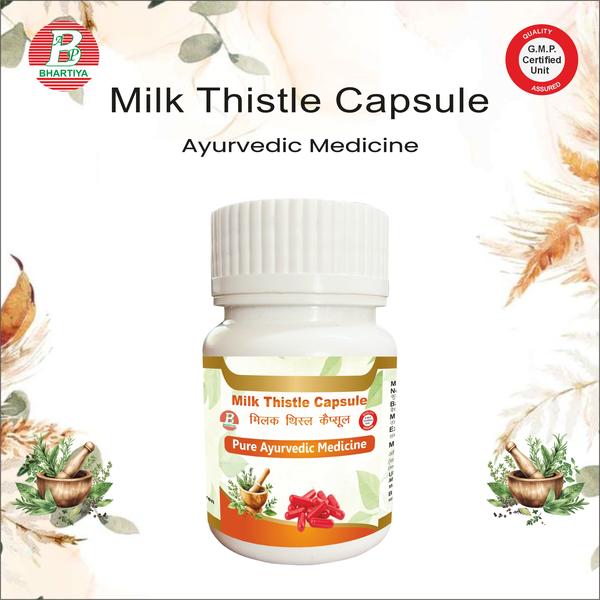
"name": "Milk Thistel Capsule",
"description": " MILK THISTLE \n\n MILK THISTLE (Silybum marianum L.) \nThe Liver-Protective Herb — “Marian Thistle”\nMilk Thistle, known scientifically as Silybum marianum, is a medicinal herb traditionally used for liver protection, detoxification, and rejuvenation. Rich in flavonolignans (silymarin), antioxidants, and phytonutrients, it is considered beneficial for liver health, digestion, metabolism, and overall vitality.\n\n CLASSICAL AYURVEDIC REFERENCES\nWhile Milk Thistle is not mentioned in classical Indian Ayurvedic granthas directly, modern Ayurvedic scholars equate its properties with “Yogavahi, Hridya, Yakrutya” (liver-protective, circulatory supportive, and rejuvenative herbs). Its actions are aligned with Rasayana therapy and digestive tonics described in:\n1.\tCharaka Samhita (Kalpa Sthana) – Herbs with Hepatoprotective and Pitta-hara properties are recommended for liver disorders, digestion, and detoxification.\n2.\tSushruta Samhita (Chikitsa Sthana) – Herbs with Tikta-Rasa (bitter taste) and Sheeta Virya (cooling potency) are advised to purify the blood and support liver function.\n3.\tBhavaprakasha Nighantu – Mentions Tikta-Medhya-Virechana herbs, comparable in modern research to Milk Thistle for detoxification, antioxidant, and rejuvenative effects.\nClassical Story / Analogy:\nAyurvedic scholars often compare Milk Thistle to a “guardian herb of the liver”, like a protector of vital channels. Its scientific name “marianum” comes from the legend of the Virgin Mary: the white veins on the leaves were said to represent milk spilled from her breast, symbolizing nourishment and protection. In Ayurveda, it is considered a Rasayana for the Yakrut (liver), Medhya (intellect), and Ojas (vitality).\n\n BOTANICAL INFORMATION OF MILK THISTLE\n•\tScientific Name: Silybum marianum (L.) Gaertn.\n•\tFamily: Asteraceae\n•\tOrder: Asterales\n•\tGenus: Silybum\n•\tSpecies: marianum\n•\tCommon Names:\no\tSanskrit: Kshirakakoli (in modern Ayurvedic texts)\no\tEnglish: Milk Thistle, Marian Thistle\no\tHindi: Kshirakakoli\no\tTamil: Pappal Thistle\no\tTelugu: Kshirakakoli\no\tMalayalam: Ksheerakakoli\no\tKannada: Ksheera Thistle\no\tBengali: Kshirakakoli\n\n SYNONYMS IN MODERN AYURVEDIC NIGHANTUS\n•\tBhavaprakasha Nighantu (modern Ayurvedic adaptations): Silybum marianum – Yakrutya, Rasayana, Medhya\n•\tCharaka & Sushruta adaptations: Herbs with Tikta Rasa, Sheeta Virya, and Yakrutya karma\n\n MORPHOLOGY OF MILK THISTLE\n•\tPlant Type: Biennial or annual herb\n•\tHeight: 1–2 m\n•\tLeaves: Large, spiny, green with white veins\n•\tFlowers: Purple, thistle-like, solitary or clustered\n•\tFruit / Seeds: Oval, brown to black, contain oil-rich seeds\n•\tSeeds: Rich in silymarin flavonolignans, hepatoprotective compounds\n\n ECOLOGICAL PREFERENCES\n•\tClimate: Temperate to Mediterranean\n•\tSoil: Well-drained, fertile, loamy soil\n•\tHabitat: Dry, sunny areas, wastelands, grasslands\n•\tAltitude: Sea level to 1,800 m\n\n GEOGRAPHICAL DISTRIBUTION\n•\tIndia: Himachal Pradesh, Uttarakhand, Jammu & Kashmir\n•\tOutside India: Mediterranean region, Europe, North America\n\n CLASSICAL AYURVEDIC PROPERTIES (RASA–GUNA–VIRYA–VIPAKA)\n•\tRasa (Taste): Tikta (bitter), Katu (pungent)\n•\tGuna (Qualities): Laghu (light), Ruksha (dry)\n•\tVirya (Potency): Sheeta (cooling)\n•\tVipaka (post-digestive effect): Katu (pungent)\n•\tDosha Effects: Pitta-Vata hara, supports Kapha balance in moderation\n\n THERAPEUTIC ACTIONS (KARMA)\n1.\tYakrutya / Hepatoprotective: Protects liver cells, supports detoxification\n2.\tRasayana / Rejuvenative: Supports vitality, Ojas, and metabolic health\n3.\tMedhya: Enhances memory and cognitive function\n4.\tHridya: Mild circulatory and heart support\n5.\tVirechana / Detoxifying: Promotes gentle bowel movement and purification\n6.\tKapha-Vata Samana: Reduces digestive sluggishness, supports metabolism\n\n INDICATIONS\n•\tLiver disorders, hepatitis, fatty liver, detoxification\n•\tDigestive sluggishness, mild constipation\n•\tMetabolic syndrome, obesity\n•\tCardiovascular support\n•\tFatigue, cognitive support\n\n MODERN PHARMACOLOGY & PHYTOCHEMISTRY\n•\tMajor Constituents: Silymarin (silybin, silychristin, silydianin), flavonoids, polyphenols, fatty acids, vitamins E & C\n•\tPharmacological Actions: Hepatoprotective, antioxidant, anti-inflammatory, mild hypoglycemic, lipid-lowering, neuroprotective\n\n CULTIVATION DETAILS\n•\tPropagation: Seeds\n•\tSowing Time: Spring (Feb–April)\n•\tSpacing: 30–50 cm between plants\n•\tIrrigation: Moderate; drought-tolerant once mature\n•\tFertilization: Organic manure preferred\n•\tHarvesting: Seeds harvested when brown and dry\n\n CLASSICAL DOSAGE (According to Ayurvedic Adaptation & Modern Herbal Use)\n•\tPowdered Seeds (Churna): 2–5 g/day\n•\tCapsule / Extract: 150–300 mg twice daily\n•\tDecoction / Tea: 1–2 cups/day for liver support\n\n MILK THISTLE FORMULATIONS – BHARTIYA AYURVEDIC PHARMACY\nBhartiya Ayurvedic Pharmacy prepares Milk Thistle Capsules and extracts following Ayurvedic principles adapted for modern use. Each product retains hepatoprotective, antioxidant, and rejuvenative properties, promoting liver health, metabolic balance, and overall vitality.\nKey Uses of Milk Thistle Formulations:\n•\tLiver support and detoxification\n•\tDigestive health and mild bowel regulation\n•\tMetabolic and cardiovascular support\n•\tRasayana for vitality, endurance, and rejuvenation\n\n MILK THISTLE CAPSULE\nBhartiya Ayurvedic Pharmacy offers Milk Thistle Capsules prepared from premium quality Silybum marianum seeds or extract, preserving full therapeutic properties.\nKey Benefits:\n•\tSupports liver detoxification and hepatoprotection\n•\tEnhances metabolism and digestive health\n•\tProvides antioxidant and rejuvenative effects\n•\tSupports cardiovascular and metabolic function\n•\tActs as a Rasayana for overall vitality\nDosage:\n•\tAdults: 1–2 capsules twice daily with warm water\n•\tCan be combined with warm water or milk for enhanced effect\nSafety & Precautions:\n•\tSafe for long-term use when taken as per dosage\n•\tMild laxative effect may occur in sensitive individuals\n•\tAvoid in cases of severe bile duct obstruction without consulting a physician\nFormulation Highlights:\n•\t100% natural Milk Thistle seed powder/extract\n•\tFree from artificial colours, preservatives, and additives\n•\tPrepared using modern Ayurvedic processing methods to preserve therapeutic qualities\nSuggested Use:\n•\tIdeal for adults seeking liver support, detoxification, and Rasayana effects\n•\tConvenient capsule form for daily Ayurvedic supplementation\n\nare milk thistle capsules good for you, are milk thistle capsules safe\nasthalin capsule\nasthalin capsule dose\nbest milk thistle capsule\nbest milk thistle capsules\nbest milk thistle capsules in india\nbest milk thistle supplement in india\nbest organic milk thistle capsules\ncan i open milk thistle capsules\ncan i take milk thistle with milk\ncan i take milk thistle with other supplements\ncan milk thistle capsules be opened\ncan we take milk thistle every day\ncan you open milk thistle capsules\ndo milk thistle capsules go bad\ndo milk thistle tablets go out of date\ndoes milk thistle capsules expire\ndoes milk thistle capsules work\ndoes milk thistle come in capsules\ndoes milk thistle help in weight loss\nhow long do milk thistle capsules last\nhow many milk thistle capsules per day\nhow much milk thistle capsules per day\nhow to take milk thistle capsules\nhow to take milk thistle seed powder\nhow to take milk thistle seeds\nhow to use milk thistle seeds for liver\nis milk thistle capsule good\nis milk thistle capsules good for you\nis milk thistle capsules good for your liver\nis milk thistle found in india\nkapiva milk thistle capsule review\nmilk thistle 500 mg capsule\nmilk thistle capsule\nmilk thistle capsule amazon\nmilk thistle capsule benefits\nmilk thistle capsule benefits for men\nmilk thistle capsule benefits in hindi\nmilk thistle capsule dosage\nmilk thistle capsule for liver\nmilk thistle capsule high strength\nmilk thistle capsule image\nmilk thistle capsule jan aushadhi kendra\nmilk thistle capsule jiomart\nmilk thistle capsule kab khana chahiye\nmilk thistle capsule ke fayde\nmilk thistle capsule or liquid\nmilk thistle capsule price\nmilk thistle capsule review\nmilk thistle capsule side effects\nmilk thistle capsule uses\nmilk thistle capsule uses in hindi\nmilk thistle capsule youtube\nmilk thistle capsule youtube video\nmilk thistle capsules\nmilk thistle capsules australia\nmilk thistle capsules benefits\nmilk thistle capsules best brand\nmilk thistle capsules boots\nmilk thistle capsules for sale\nmilk thistle capsules good for\nmilk thistle capsules how to use\nmilk thistle capsules in india\nmilk thistle capsules near me\nmilk thistle capsules now\nmilk thistle capsules organic\nmilk thistle capsules side effects\nmilk thistle capsules uk\nmilk thistle capsules usa\nmilk thistle capsules uses\nmilk thistle extract capsules benefits\nmilk thistle powder vs capsule\nmilk thistle tablets benefits for skin\nmilk thistle tablets benefits in hindi",
"price": 480.0,
"discountamount": 240.0,
"currencycode": "INR",
"priority": 1000000,
"isfreeshipmentavailable": false,
"shipmentduration": 1,
"_keywords": null,
"isarchived": false,
"isavailable": true,
"applicationid": null,
"productindex": 65,
"imageuri": "https://productimages.withfloats.com/actual/6993fdc6334724dfd78e0fbc.jpg",
"tileimageuri": "https://productimages.withfloats.com/tile/6993fdc6334724dfd78e0fbc.jpg",
"images": null,
"totalqueries": 0,
"gpid": null,
"groupproductid": null,
"createdon": "2026-02-17T05:33:55.94Z",
"updatedon": "2026-02-17T08:35:08.865Z",
"buyonlinelink": null,
"producturl": "http://WWW.BHARTIYAAYURVEDICPHARMACY.COM//milk-thistel-capsule/65",
"availableunits": -1.0,
"iscodavailable": true,
"isprepaidonlineavailable": true,
"maxcodorders": -1,
"maxprepaidonlineorders": -1,
"uniquepaymenturl": null,
"brandname": "Bakula Fort",
"category": "Milk Thistel Capsule 60 Cap X 12",
"tags": [],
"variants": false,
"keyspecification": null,
"otherspecifications": null,
"pickupaddressreferenceid": null,
"paymenttype": "AssuredPurchase",
"producttype": "products",
"hsncode": null,
"gstslab": 0.0,
"isnotforsale": false
},
{
"_id": "698c4c5cae6697176621053e",
"fptag": "BHARTIYEAYURVEDICPHARMACY",
"merchantname": null,
"customwidgets": null,
"externalsourceid": null,
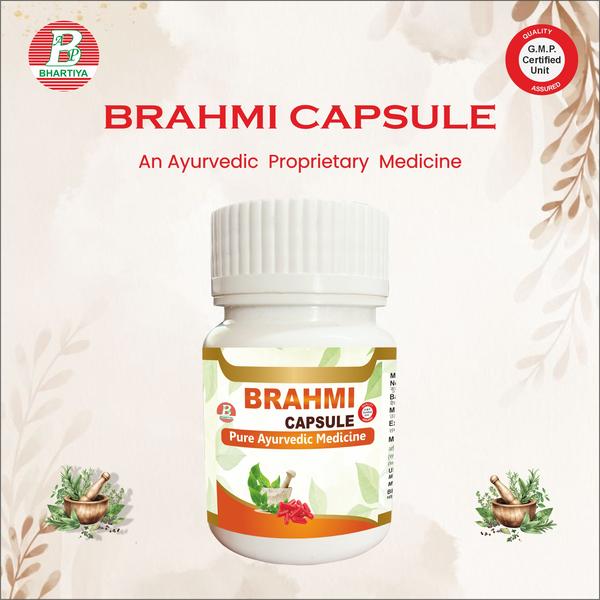
"name": "Brahmi Capsule",
"description": " Brahmi (Bacopa monnieri) \n The Ancient Rejuvenating Herb for Mind, Memory, and Nervous System\n\nBrahmi is one of the most revered herbs in Ayurveda, prized for its profound effects on cognition, memory, intellect, and mental resilience. The name Brahmi derives from Brahma, the creator, symbolizing its connection to higher mental faculties and spiritual insight.\nIn Ayurveda, Brahmi is classified as a Medhya Rasayana (intellect and memory enhancer), Shukra-Vardhaka (reproductive tissue supporter), and Rasayana (rejuvenative). It is highly valued for improving memory, concentration, calming the mind, reducing mental fatigue and anxiety, supporting the nervous system, and promoting longevity.\nThe herb has a rich historical background, documented in classical Ayurvedic texts for thousands of years, highlighting its role in enhancing mental faculties, cognition, and overall vitality.\n Historical Study and Classical References\n1. Charaka Samhita\n•\tAcharya Charaka describes Brahmi as a Medhya Rasayana that strengthens intellect, improves memory, and sharpens mental faculties.\n•\tRecommended for Manasika Vikara (mental disorders), nervous system weakness, and stress-related conditions.\n•\tClassical Dosage: 3–6 g of root/whole plant powder (Churna); decoction (Kwatha) 40–60 ml, 2–3 times daily.\n2. Sushruta Samhita\n•\tAcharya Sushruta emphasizes Brahmi in Manas-Roga Chikitsa (mental disorder treatment) and as a rejuvenative for the nervous system.\n•\tForms: root/whole plant paste, powder, decoction.\n•\tUses: Memory enhancement, calming overactive mind, improving mental clarity.\n3. Bhavaprakasha Nighantu\n•\tBrahmi listed under Medhya and Smritivardhini categories.\n•\tVariants: Wild vs. cultivated forms; leaf quality and flowering stage noted for potency.\n•\tSynonyms: Brahmaka, Medhya, Smritivardhini, Haritaki-brahmi.\n4. Raja Nighantu & Dhanvantari Nighantu\n•\tBrahmi described as Medhya and Jivaniya, improving intelligence, longevity, and mental function.\n•\tUsed in compound formulations for cognitive enhancement, stress reduction, and rejuvenation.\n5. Classical Ayurvedic Formulations\n•\tBrahmi Ghrita / Taila: Nourishes the brain, calms the mind, improves memory.\n•\tBrahmi Churna / Tablet / Capsule: For cognitive support, memory, and mental clarity.\n•\tMedhya Rasayana Compounds: Brahmi often combined with Shankhpushpi, Ashwagandha, and Vacha for brain tonics.\n Botanical Information of Brahmi\n•\tScientific Name: Bacopa monnieri (L.) Wettst.\n•\tFamily: Plantaginaceae\n•\tOrder: Lamiales\n•\tGenus: Bacopa\n•\tSpecies: monnieri\nCommon Names:\n•\tSanskrit: Brahmī, Medhya, Smritivardhini\n•\tHindi: Brahmi\n•\tEnglish: Water Hyssop, Herb of Grace\n•\tTamil: Brahmi, Neer Brahmi\n•\tTelugu: Brahmi\n•\tMalayalam: Brahmi\n•\tKannada: Brahmi\n•\tBengali: Brahmi\nSynonyms in Ayurvedic Nighantus:\n•\tBhavaprakasha Nighantu – Brahmi, Medhya, Smritivardhini\n•\tRaja Nighantu – Brahmaka, Jivaniya\n•\tDhanvantari Nighantu – Medhya, Smritivardhaka\n Morphology of Brahmi\n•\tPlant Type: Perennial, creeping, succulent herb\n•\tStem: Creeping, quadrangular, green, slightly succulent\n•\tLeaves: Opposite, small, oblong to spatulate, fleshy, light green\n•\tFlowers: Small, white to light purple, axillary cymes, bloom during warm seasons\n•\tRoots: Fibrous, white\n•\tFruits: Capsule, ovoid, containing tiny seeds\n•\tHabit: Creeping, spreading, fast-growing, regenerates easily\n Ecological Preferences\n•\tClimate: Tropical and subtropical; tolerates heat and moderate drought\n•\tSoil: Sandy, loamy, marshy, wet soils; thrives in marshes and near water bodies\n•\tSunlight: Full sun to partial shade\n•\tMoisture: Prefers moist conditions; hardy to dry periods\n•\tAltitude: Low to medium elevations\n•\tHabitat: Marshes, wetlands, riverbanks, paddy fields, gardens\n\n Distribution\n•\tIndia: Found across the country in wetlands, paddy fields, marshes\n•\tAsia: Sri Lanka, Nepal, Bangladesh, Myanmar\n•\tGlobal: Naturalized in tropical/subtropical regions worldwide due to hardy growth\n\n Classical Ayurvedic Properties\n•\tRasa (Taste): Tikta (bitter)\n•\tGuna (Qualities): Laghu (light), Snigdha (slightly oily)\n•\tVirya (Potency): Shita (cooling)\n•\tVipaka: Madhura (sweet)\n•\tDosha Effect: Kapha-Vata pacifying\n•\tKarma (Actions / Therapeutic Effects):\no\tMedhya – Enhances memory and intellect\no\tRasayana – Rejuvenative, anti-aging\no\tHridya – Supports heart function\no\tShukra-Vardhaka – Supports reproductive tissue\no\tVata-Kapha pacifying – Reduces neurological weakness\n\n Therapeutic Actions According to Acharyas\n1.\tMedhya (Nootropic): Improves memory, cognition, and focus\n2.\tRasayana (Rejuvenative): Enhances vitality, immunity, and longevity\n3.\tManah-Shamana: Reduces anxiety, stress, and mental fatigue\n4.\tHridya: Supports cardiovascular health\n5.\tShukra-Vardhaka: Improves reproductive tissue quality\n6.\tVata-Kapha Balancing: Useful in neurological weakness, tremors, fatigue\n\n Modern Phytochemistry\n•\tBacosides (A & B): Cognitive enhancement, neuroprotective\n•\tAlkaloids: Nervine tonic\n•\tFlavonoids (Apigenin, Luteolin): Antioxidant, anti-inflammatory, neuroprotective\n•\tSaponins: Brain rejuvenation, memory support\n\n Classical Dosage\n•\tPowder (Churna): 3–6 g/day\n•\tDecoction (Kwatha): 40–60 ml, 2–3 times daily\n•\tJuice (Swarasa): 10–20 ml, 1–2 times daily\n•\tTaila / Ghrita: External application or oral use as per formulation\nPrecautions: Safe in classical dosage; pregnant/lactating women under supervision; avoid overdose.\n\n Classical Ayurvedic Formulations of Brahmi\n1.\tBrahmi Ghrita / Taila: Brain nourishment, mental calmness, memory enhancement\n2.\tBrahmi Churna / Tablet / Capsule: Cognitive support, stress reduction\n3.\tBrahmi Kwatha: Nervous system support, memory enhancement\n4.\tMedhya Rasayana Compounds: With Shankhpushpi, Ashwagandha, Vacha for brain tonics\n5.\tCompound Formulations: Brahmi included in brain tonics, rejuvenative preparations, and nervous system revitalizers\n\n Brahmi Formulations by Bhartiya Ayurvedic Pharmacy\nAt Bhartiya Ayurvedic Pharmacy, we prepare a range of Brahmi (Bacopa monnieri) formulations following classical Ayurvedic methods as described in Charaka Samhita, Sushruta Samhita, Bhavaprakasha Nighantu, and other Ayurvedic Granthas. Each product is crafted to retain the therapeutic potency, purity, and efficacy of the herb, ensuring benefits for memory enhancement, cognitive support, nervous system health, stress relief, and overall mental rejuvenation.\n\n Brahmi Capsule\nDescription: Brahmi Capsule contains high-quality standardized extract of Bacopa monnieri in an easy-to-swallow form for optimal absorption.\nKey Actions: \n•\tEnhances learning ability, concentration, and memory retention.\n•\tReduces mental fatigue, brain fog, and overthinking\n•\tCalms the mind and supports balanced emotional health\n•\tSupports healthy sleep-wake cycles\n\nDosage:\n•\t1 capsule twice daily with warm water after meals\n•\tFor high stress or exam periods: 2 capsules daily\n•\tCan be taken for long-term brain rejuvenation\nPrecautions:\n•\tDo not exceed recommended dose\n•\tMay enhance sedation if used with sleeping medicines\n•\tConsult during pregnancy, lactation, or chronic neurological illness\n\n Brahmi Powder (Churna)\nDescription: Pure Brahmi powder for traditional Ayurvedic use, ideal for decoctions, smoothies, or milk-based preparations.\nKey Actions:\n•\tSupports memory, cognition, and overall nervous system health\n•\tActs as a Rasayana (rejuvenative) for the brain\n•\tReduces stress, anxiety, and mental fatigue\nDosage:\n•\t3–6 grams daily with water, milk, or honey\n•\tCan be used as decoction: 40–60 ml, 1–2 times daily\nPrecautions:\n•\tAvoid overdose\n•\tUse under supervision during pregnancy or neurological disorders\n Brahmi Amla Taila\n\nDescription: Medicated herbal oil prepared with Brahmi and Amla (Indian gooseberry) for external application or internal use as per classical Ayurvedic methods.\nKey Actions:\n•\tNourishes brain tissues and supports the nervous system\n•\tEnhances memory, mental clarity, and concentration\n•\tReduces stress and promotes calmness\n•\tSupports hair and scalp health when applied topically\nDosage:\n•\tApply externally as needed\n•\tFor internal use, take as directed by an Ayurvedic practitioner\nPrecautions:\n•\tAvoid excessive use\n•\tConsult a physician during pregnancy, lactation, or neurological conditions\n\n\nbenefits of brahmi capsule, best brahmi capsules, best brahmi supplement\nbest time to take brahmi capsule, brahmi amla capsules\nbrahmi ashwagandha capsule, brahmi capsule amazon\nbrahmi capsule awpl price, brahmi capsule ayurvedic\nbrahmi capsule benefits, brahmi capsule benefits in hindi\nbrahmi capsule dosage, brahmi capsule for kids\nbrahmi capsule ke fayde, brahmi capsule khane ke fayde\nbrahmi capsule kis kam aata hai, brahmi capsule price\nbrahmi capsule price in india, brahmi capsule side effects\nbrahmi capsule uses, brahmi capsule uses in hindi\nbrahmi capsules 500mg, brahmi capsules benefits\nbrahmi capsules benefits for hair, brahmi capsules benefits in hindi\nbrahmi capsules dosage, brahmi capsules india\nbrahmi capsules ingredients, brahmi capsules kerala ayurveda\nbrahmi capsules near me, brahmi capsules online\nbrahmi capsules organic, brahmi capsules organic india\nbrahmi capsules review, brahmi capsules side effects\nbrahmi capsules uk, brahmi capsules uses, brahmi capsules uses in hindi\nbrahmi extract capsule, brahmi extract capsule awpl\nbrahmi extract capsule awpl price, brahmi extract capsules\nbrahmi extract capsules uses in hindi, brahmi ghrita capsule\nbrahmi gold capsule, brahmi ke capsule, brahmi mind capsule\nbrahmi mind capsule benefits, brahmi mind capsule benefits in hindi\nbrahmi mind capsule herbal, brahmi mind capsule hindi\nbrahmi mind capsule in hindi, brahmi mind capsule ke fayde\nbrahmi mind capsule ke fayde in hindi, brahmi mind capsule price",
"price": 360.0,
"discountamount": 180.0,
"currencycode": "INR",
"priority": 1000000,
"isfreeshipmentavailable": false,
"shipmentduration": 1,
"_keywords": null,
"isarchived": false,
"isavailable": true,
"applicationid": null,
"productindex": 53,
"imageuri": "https://productimages.withfloats.com/actual/698c4c5e6a6c506fb8d6de8b.jpg",
"tileimageuri": "https://productimages.withfloats.com/tile/698c4c5e6a6c506fb8d6de8b.jpg",
"images": null,
"totalqueries": 0,
"gpid": null,
"groupproductid": null,
"createdon": "2026-02-11T09:31:08.072Z",
"updatedon": "2026-02-18T05:39:19.501Z",
"buyonlinelink": null,
"producturl": "http://WWW.BHARTIYAAYURVEDICPHARMACY.COM//brahmi-capsule/53",
"availableunits": -1.0,
"iscodavailable": true,
"isprepaidonlineavailable": true,
"maxcodorders": -1,
"maxprepaidonlineorders": -1,
"uniquepaymenturl": null,
"brandname": "Bakula Fort",
"category": "Brahmi Capsule 60 Cap X 24",
"tags": [],
"variants": false,
"keyspecification": null,
"otherspecifications": null,
"pickupaddressreferenceid": null,
"paymenttype": "AssuredPurchase",
"producttype": "products",
"hsncode": null,
"gstslab": 0.0,
"isnotforsale": false
},
{
"_id": "6982fd57fa5708ebdc6e87eb",
"fptag": "BHARTIYEAYURVEDICPHARMACY",
"merchantname": null,
"customwidgets": null,
"externalsourceid": null,
"name": "Ashoka Tone Syrup",
"description": " ASHOKATONE SYRUP \n\nProduct Identification\n•\tGeneric Name: Ashokatone Syrup\n•\tType: Ayurvedic Patent Medicine\n•\tPrimary Indication Area: Female reproductive health, menstrual disorders, uterine health\n Therapeutic Indications\nFor relief from menstrual disorders, uterine health support, and general female reproductive wellness.\nKey benefits:\n•\tRegulates menstrual cycle and reduces menstrual discomfort\n•\tControls excessive menstrual bleeding\n•\tSupports uterine health and reproductive wellness\n•\tHelps balance female hormones naturally\n•\tPromotes overall gynecological well-being\n \nIngredient: \n Ashok chhal \nBotanical Name: Terminalia arjuna \nKey Phytoconstituents: \n\n1.\tTriterpenoids / Triterpenoid Glycosides\no\tArjunolic acid\no\tArjunic acid\no\tArjunetin\n2.\tFlavonoids\no\tLuteolin\no\tQuercetin\no\tKaempferol\n3.\tTannins / Polyphenols\no\tPyrogallol-type tannins\no\tEllagic acid\n4.\tSaponins\n5.\tMinerals\no\tCalcium, magnesium, potassium\n\nMechanism of Action in Female Reproductive health\n•\tUterotonic / Menstrual Regulation\no\tHelps normalize menstrual cycles and reduce heavy menstrual bleeding (menorrhagia).\no\tMechanism: Tannins and flavonoids act on the uterine muscles, promoting tonicity and regulating contractions.\n•\tAnti-inflammatory / Antioxidant\no\tReduces inflammation in the endometrium, which helps with dysmenorrhea (painful menstruation).\no\tAntioxidants protect reproductive tissues from oxidative stress.\n•\tEndometrial Health\no\tPromotes healthy endometrial lining, supporting fertility and implantation.\n•\tHormonal Modulation (Indirect)\no\tHelps regulate estrogen and progesterone balance indirectly via uterine tissue support.\no\tMay support follicular maturation and ovarian function in traditional use.\n•\tManagement of Menorrhagia and Fibroids (Ayurvedic use)\no\tTraditionally used to control excessive bleeding due to its mild astringent (tannic) properties.\no\tHelps strengthen uterine walls and reduce bleeding.\n\n Babul Chhal\nBotanical Name: Acacia nilotica\n1. Key Phytoconstituents\n1.\tTannins / Polyphenols\no\tGallotannins\no\tCatechins\n2.\tFlavonoids\no\tKaempferol\no\tQuercetin\n3.\tAlkaloids\n4.\tSaponins\n5.\tVolatile oils\n6.\tMinerals\no\tCalcium, magnesium, potassium\n\nMechanism of Action in Female Reproductive Health\n•\tAstringent / Hemostatic\no\tReduces excessive uterine bleeding (menorrhagia) due to high tannin content.\no\tStrengthens uterine walls.\n•\tUterotonic / Menstrual Regulation\no\tSupports normalization of menstrual cycles by improving uterine tone.\n•\tAnti-inflammatory / Antioxidant\no\tReduces inflammation in reproductive tissues.\no\tProtects against oxidative stress.\n•\tManagement of Dysmenorrhea\no\tRelieves menstrual pain due to mild uterine muscle support and anti-inflammatory effects.\n•\tFertility Support (Traditional Use)\no\tPromotes reproductive tissue health and may support endometrial lining.\n\n Lodhra Chhal \nBotanical Name: Symplocos racemosa\n Key Phytoconstituents\n1.\tTannins / Polyphenols\no\tLodhretannin\no\tGallic acid\n2.\tFlavonoids\no\tQuercetin\no\tKaempferol\n3.\tAlkaloids\n4.\tSaponins\n5.\tGlycosides\n6.\tMinerals\no\tCalcium, magnesium, potassium\n\nMechanism of Action in Female Reproductive Health\n•\tAstringent / Hemostatic\no\tControls excessive uterine bleeding (menorrhagia) due to high tannin content.\no\tStrengthens uterine walls.\n•\tUterotonic / Menstrual Regulation\no\tHelps normalize menstrual cycles and regulate uterine contractions.\n•\tAnti-inflammatory / Antioxidant\no\tReduces inflammation in the endometrium.\no\tProtects reproductive tissues from oxidative stress.\n•\tManagement of Dysmenorrhea\no\tRelieves menstrual pain through uterine muscle support and anti-inflammatory effects.\n•\tEndometrial Health / Fertility Support\no\tPromotes healthy endometrial lining, supporting fertility and implantation.\n\n Marodphali Chhal \nBotanical Name: Helicteres isora\nKey Phytoconstituents\n•\tPolyphenols & Tannins: High levels of ellagitannins and condensed tannins (15–20% in fruit) provide astringent and antidiarrheal effects.\n•\tPhenolic Acids: Contains gallic acid, ellagic acid, caffeic acid, and p-coumaric acid, which act as powerful antioxidants.\n•\tFlavonoids: Primarily quercetin, kaempferol glycosides, and specialized compounds like isoscutellarein derivatives.\n•\tTriterpenoids & Sterols: Includes betulinic acid, oleanolic acid, and βbeta 𝛽-sitosterol, which support anti-inflammatory and liver health.\n•\tCucurbitacins: Notable compounds Cucurbitacin B and isocucurbitacin B are found in the roots, linked to potential anticancer activities.\n•\tGlycosides: Contains anthraquinone, cardiac, and rosmarinic acid glycosides.\n•\tNutrients: Rich in minerals (calcium, phosphorus, iron) and mucilage in seeds, which soothes the digestive tract. \nMechanism of Action in Female Reproductive Health\n•\tUterotonic / Menstrual Regulation\no\tSupports normalization of menstrual cycles and regulates uterine contractions.\n•\tAstringent / Hemostatic\no\tReduces excessive uterine bleeding (menorrhagia) due to tannins.\no\tStrengthens uterine walls.\n•\tAnti-inflammatory / Antioxidant\no\tProtects endometrial tissue and reduces inflammation in reproductive organs.\n•\tManagement of Dysmenorrhea\no\tRelieves menstrual pain through uterine muscle support and anti-inflammatory action.\n•\tEndometrial Health / Fertility Support\no\tPromotes healthy endometrial lining, supporting fertility and implantation.\n\n Shatavari Chhal \nBotanical Name: Asparagus racemosus\n Key Phytoconstituents\n1.\tSteroidal saponins (Shatavarins)\no\tShatavarin I, II, III\n2.\tFlavonoids\no\tQuercetin\no\tKaempferol\n3.\tAlkaloids\n4.\tTannins / Polyphenols\n5.\tGlycosides\n6.\tPolysaccharides\n7.\tMinerals\no\tCalcium, magnesium, potassium\n\nMechanism of Action in Female Reproductive Health\n•\tGalactagogue / Uterine Tonic\no\tSupports lactation and strengthens uterine tissues postpartum.\n•\tHormonal Modulation / Adaptogenic\no\tBalances estrogen and progesterone, supporting menstrual regularity and fertility.\n•\tUterotonic / Menstrual Regulation\no\tHelps normalize menstrual cycles and uterine contractions.\n•\tAnti-inflammatory / Antioxidant\no\tProtects reproductive tissues from oxidative stress and reduces endometrial inflammation.\n•\tEndometrial Health / Fertility Support\no\tPromotes healthy endometrial lining, follicular development, and implantation.\n•\tManagement of Dysmenorrhea & Menorrhagia\no\tReduces pain and controls excessive bleeding through saponins and uterine support.\n\n Nagkesar Chhal \nBotanical Name: Mesua ferrea\nKey Phytoconstituents\n1.\tXanthones\no\tMesuaxanthone\n2.\tCoumarins\no\tMesuol\no\tMesuagin\n3.\tFlavonoids\no\tQuercetin\no\tKaempferol\n4.\tTannins / Polyphenols\n5.\tEssential oils\n6.\tFatty acids\n7.\tMinerals\no\tCalcium, magnesium, potassium\n\nMechanism of Action in Female Reproductive Health\n•\tAstringent / Hemostatic\no\tControls excessive uterine bleeding (menorrhagia) due to tannins and polyphenols.\no\tStrengthens uterine walls.\n•\tUterotonic / Menstrual Regulation\no\tSupports normalization of menstrual cycles and regulates uterine contractions.\n•\tAnti-inflammatory / Antioxidant\no\tReduces endometrial inflammation and oxidative stress in reproductive tissues.\n•\tManagement of Dysmenorrhea\no\tRelieves menstrual pain via uterine support and anti-inflammatory action.\n•\tEndometrial Health / Fertility Support\no\tPromotes healthy endometrial lining, supporting implantation and fertility\n\n Chandan Chhal \nBotanical Name: Santalum album\n Key Phytoconstituents\n1.\tEssential oils / Volatile oils\no\tα-santalol\no\tβ-santalol\n2.\tFlavonoids\no\tQuercetin\no\tKaempferol\n3.\tTannins / Polyphenols\n4.\tSesquiterpenes\n5.\tResins\n6.\tMinerals\no\tCalcium, magnesium, potassium\n\nMechanism of Action in Female Reproductive Health\n•\tAnti-inflammatory / Cooling Effect\no\tReduces endometrial inflammation and soothes reproductive tissues.\n•\tAstringent / Mild Hemostatic\no\tHelps control mild excessive bleeding (menorrhagia).\n•\tUterine Tonic\no\tSupports uterine health and tonicity.\n•\tManagement of Dysmenorrhea\no\tRelieves menstrual pain through anti-inflammatory and smooth muscle calming effects.\n•\tEndometrial Health / Fertility Support\no\tPromotes healthy uterine lining, indirectly supporting fertility.\n\n Semal Chhal \nBotanical Name: Bombax ceiba\n1. Key Phytoconstituents\n1.\tFlavonoids\no\tQuercetin\no\tKaempferol\n2.\tTannins / Polyphenols\no\tGallic acid\no\tEllagic acid\n3.\tSaponins\n4.\tAlkaloids\n5.\tGum / Mucilage\n6.\tMinerals\no\tCalcium, magnesium, potassium\n\nMechanism of Action in Female Reproductive Health\n•\tAstringent / Hemostatic\no\tControls excessive uterine bleeding (menorrhagia) due to tannins.\no\tStrengthens uterine walls.\n•\tUterotonic / Menstrual Regulation\no\tHelps normalize menstrual cycles and regulates uterine contractions.\n•\tAnti-inflammatory / Antioxidant\no\tReduces inflammation in the endometrium and protects reproductive tissues from oxidative stress.\n•\tManagement of Dysmenorrhea\no\tRelieves menstrual pain through uterine support and anti-inflammatory action.\n•\tEndometrial Health / Fertility Support\no\tPromotes healthy endometrial lining, supporting implantation and fertility.\n\n Ashwagandha Chhal \nBotanical Name: Withania somnifera\n1. Key Phytoconstituents\n1.\tWithanolides (steroidal lactones)\no\tWithaferin A\no\tWithanolide D, E, and F\n2.\tAlkaloids\no\tSomniferine\no\tAnaferine\n3.\tSaponins\n4.\tFlavonoids\no\tQuercetin\no\tKaempferol\n5.\tTannins / Polyphenols\n6.\tIron, Calcium, Magnesium\n\nMechanism of Action in Female Reproductive Health\n•\tAdaptogenic / Hormonal Modulator\no\tHelps balance estrogen and progesterone, supporting menstrual regularity and ovarian function.\n•\tUterotonic / Reproductive Tonic\no\tSupports uterine health and promotes healthy uterine tone.\n•\tAnti-inflammatory / Antioxidant\no\tReduces endometrial inflammation and oxidative stress in reproductive tissues.\n•\tManagement of Dysmenorrhea\no\tAlleviates menstrual pain via anti-inflammatory and smooth muscle relaxant effects.\n•\tFertility Support\no\tPromotes healthy endometrial lining, supports follicular development, and improves reproductive tissue health.\n•\tStress & Ovulatory Support\no\tReduces stress-induced reproductive dysfunction due to adaptogenic effects.\n\n Sugar Base (Guda / Sugar Syrup)\n Key Phytoconstituents\n1.\tSucrose / Glucose / Fructose – main carbohydrate content\n2.\tMinerals\no\tCalcium, magnesium, potassium\no\tIron (in jaggery-based preparations)\n3.\tTrace Vitamins\no\tB-complex vitamins (in jaggery)\n4.\tPolyphenols\no\tAntioxidants (especially in unrefined jaggery)\nMechanism of Action in Female Reproductive Health\n•\tCarrier / Base for Herbal Formulations\no\tHelps deliver active phytoconstituents of herbal medicines effectively.\no\tImproves palatability and stability of formulations like Lehyas, Avalehas, and Churnas.\n•\tEnergy & Nutritional Support\no\tProvides immediate energy, important in postpartum care and anemia associated with menorrhagia.\n•\tMild Uterine Support (Indirect)\no\tWhen combined with herbs like Ashok, Shatavari, or Lodhra in Lehyas, it enhances absorption and supports reproductive tissue health.\n•\tHematopoietic Support\no\tJaggery-based sugar aids iron absorption, helpful in menstrual blood loss recovery.\nDose:\nDosage Instructions\n•\tAmount: 15–30 ml per dose\n•\tDilution: Mix with an equal amount of water (so if you take 15 ml of syrup, mix with 15 ml water)\n•\tFrequency: 3 times a day\n•\tTiming: After meals\nNotes / Precautions\n1.\tConsistency: Take it at the same times each day for best results.\n2.\tMonitor effects: If you experience any digestive discomfort, nausea, or allergic reactions, stop and consult a healthcare professional.\n3.\tMedical conditions: If you have chronic illnesses, are pregnant, or breastfeeding, check with a doctor before use.\n4.\tStorage: Keep in a cool, dry place and shake well before use.\n\n\nashoka cordial syrup uses, ashoka for tonic\nashoka rate syrup, ashoka syrup benefits\nashoka syrup in hindi, ashoka tone\nashoka tone syrup, ashoka tone syrup age limit\nashoka tone syrup amazon, ashoka tone syrup ayurvedic\nashoka tone syrup benefits, ashoka tone syrup benefits in hindi\nashoka tone syrup cold, ashoka tone syrup company name\nashoka tone syrup composition, ashoka tone syrup compound\nashoka tone syrup dosage, ashoka tone syrup dose\nashoka tone syrup expiry date, ashoka tone syrup flipkart\nashoka tone syrup generic name, ashoka tone syrup jpg\nashoka tone syrup ke fayde, ashoka tone syrup ke fayde in hindi\nashoka tone syrup kis kaam aata hai, ashoka tone syrup kis kaam aati hai\nashoka tone syrup login, ashoka tone syrup m\nashoka tone syrup meaning in hindi, ashoka tone syrup medicine\nashoka tone syrup mg, ashoka tone syrup mg road\nashoka tone syrup mrp, ashoka tone syrup name\nashoka tone syrup near me, ashoka tone syrup news\nashoka tone syrup news in hindi, ashoka tone syrup online\nashoka tone syrup online order, ashoka tone syrup online purchase\nashoka tone syrup online shopping, ashoka tone syrup plus tonic\nashoka tone syrup pm price, ashoka tone syrup price\nashoka tone syrup price in india, ashoka tone syrup qr code\nashoka tone syrup qr code scanner, ashoka tone syrup quantity\nashoka tone syrup rate, ashoka tone syrup recipe\nashoka tone syrup result, ashoka tone syrup review\nashoka tone syrup review in hindi, ashoka tone syrup right\nashoka tone syrup se kya hota hai, ashoka tone syrup side effects\nashoka tone syrup side effects in hindi, ashoka tone syrup sirup\nashoka tone syrup special, ashoka tone syrup sugar free\nashoka tone syrup super, ashoka tone syrup super tonic\nashoka tone syrup tonic uses, ashoka tone syrup tonlc\nashoka tone syrup uses in hindi, ashoka tone syrup zudio price\nashoka tonic in hindi, ashoka tonic syrup\nashoka tonic syrup uses in hindi, ashoka tonic uses",
"price": 180.0,
"discountamount": 90.0,
"currencycode": "INR",
"priority": 1000000,
"isfreeshipmentavailable": false,
"shipmentduration": 1,
"_keywords": null,
"isarchived": false,
"isavailable": true,
"applicationid": null,
"productindex": 33,
"imageuri": "https://productimages.withfloats.com/actual/6982fd59626b016e5e3a46a7.jpg",
"tileimageuri": "https://productimages.withfloats.com/tile/6982fd59626b016e5e3a46a7.jpg",
"images": null,
"totalqueries": 0,
"gpid": null,
"groupproductid": null,
"createdon": "2026-02-04T08:03:35.977Z",
"updatedon": "2026-02-19T06:38:12.323Z",
"buyonlinelink": null,
"producturl": "http://WWW.BHARTIYAAYURVEDICPHARMACY.COM//ashoka-tone-syrup/33",
"availableunits": -1.0,
"iscodavailable": true,
"isprepaidonlineavailable": true,
"maxcodorders": -1,
"maxprepaidonlineorders": -1,
"uniquepaymenturl": null,
"brandname": "Bakula Fort ",
"category": "Ashoka Tone Syrup 200 ML X 24",
"tags": [],
"variants": false,
"keyspecification": null,
"otherspecifications": null,
"pickupaddressreferenceid": null,
"paymenttype": "AssuredPurchase",
"producttype": "products",
"hsncode": null,
"gstslab": 0.0,
"isnotforsale": false
},
{
"_id": "698084369b2383ec7eecaa68",
"fptag": "BHARTIYEAYURVEDICPHARMACY",
"merchantname": null,
"customwidgets": null,
"externalsourceid": null,
"name": "Punarnava Tablet",
"description": "Punarnava (Boerhavia diffusa) \n The Rejuvenating Herb with Healing Leaves\nPunarnava is one of the most important rejuvenating herbs in Ayurveda, widely valued for its unique ability to revive and renew the body.\nThe name Punarnava literally means “that which becomes new again”, indicating its powerful regenerative and restorative nature.\nIn Ayurveda, Punarnava is classified as a Mutrala (diuretic), Shothahara (anti-inflammatory), and Rasayana (rejuvenative) drug. It is highly beneficial in managing swelling (oedema), kidney disorders, liver weakness, urinary problems, digestive issues, anaemia, and general debility.\nBotanical Information of Punarnava\nScientific Name: Boerhavia diffusa Linn.\nFamily: Nyctaginaceae\nOrder: Caryophyllales\nGenus: Boerhavia\nSpecies: diffusa\nCommon Names:\n•\tSanskrit: Punarnavā, Shothaghanī, Raktapunarnavā, Śvetapunarnavā, Shreṇī, Shoṭikā\n•\tHindi: Punarnava\n•\tEnglish: Spreading Hogweed, Red Spiderling\n•\tTamil: Mookarattai\n•\tTelugu: Atika\n•\tMalayalam: Thazhuthama\n•\tKannada: Komme beru\n•\tBengali: Punarnava\nSynonyms of Punarnava (Boerhavia diffusa) in Ayurvedic Nighantus:\n Bhavaprakasha Nighantu – Shothaghni, Raktapunarnava, Shvetapunarnava, Shoṭikā\n Raja Nighantu & Kaiyadeva Nighantu – Panchanga, Jalapushpa, Mochana, Bhujanga\n Hrudaya Nighantu & Dhanvantari Nighantu – Utkalika, Shreni\n Morphology of Punarnava (Boerhavia diffusa)\nPlant Type: Perennial, creeping, and spreading herb\nStem:\n•\tProstrate or slightly ascending, creeping along the ground\n•\tPurplish-green, hairy, with swollen nodes\n•\tRoots develop at nodes where the stem touches the soil\nLeaves:\n•\tSimple, opposite arrangement\n•\tShape: Ovate, elliptic, or slightly rounded\n•\tTexture: Fleshy and soft\n•\tColor: Dark green on the upper surface, pale green below\n•\tPetiole: Short\nFlowers:\n•\tSmall, tubular, and bisexual\n•\tColor: Pink, reddish, or white\n•\tArranged in axillary clusters (cymes)\n•\tBloom mainly during summer and rainy seasons\nRoots:\n•\tThick, cylindrical, fleshy, and tapering\n•\tColor: White in Shveta Punarnava, reddish in Rakta Punarnava\n•\tMedicinal part, rich in active constituents\nFruits:\n•\tSmall, ovoid, glandular, and sticky when young\n•\tDark brown at maturity\n•\tOne-seeded\nHabit:\n•\tCreeping, spreading, fast-growing, regenerates easily\n•\tAdapted to drought and poor soil conditions\n Ecological Preferences of Punarnava\n•\tClimate: Thrives in tropical and subtropical climates; tolerates heat and moderate drought.\n•\tSoil: Prefers sandy, loamy, or well-drained soils; can grow in poor or degraded soils.\n•\tSunlight: Grows well in full sunlight to partial shade.\n•\tMoisture: Requires moderate moisture; can survive dry periods due to its hardy nature.\n•\tAltitude: Found at low to medium altitudes, commonly in plains and open areas.\n•\tHabitat: Common along roadsides, fields, gardens, wastelands, and riverbanks.\n•\tGrowth habit: Creeping, spreading, fast-growing, and regenerates easily after adverse conditions.\n Distribution of Punarnava\nGeographical Distribution:\nPunarnava is a widely distributed perennial herb found in tropical and subtropical regions across the world.\n•\tIndia: Found throughout the country in almost all states, particularly in plains, dry regions, roadsides, wastelands, and fields.\n•\tAsia: Occurs in Pakistan, Sri Lanka, Bangladesh, Nepal, and Myanmar.\n•\tAfrica: Common in tropical and subtropical Africa.\n•\tAmericas: Found in parts of South America and Central America.\n•\tOther Regions: Naturalized in various tropical areas worldwide due to its hardy and fast-growing nature\n Classical Ayurvedic Properties of Punarnava\n•\tRasa (Taste): Tikta (bitter), Kashaya (astringent)\n•\tGuna (Qualities): Laghu (light), Ruksha (dry)\n•\tVirya (Potency): Ushna (hot)\n•\tVipaka (post-digestive effect): Katu (pungent)\n•\tDosha Effect: Kapha-Vata shamaka (pacifies Kapha and Vata doshas)\n•\tKarma (Actions / Therapeutic Effects):\no\tMutrala: Promotes urination, useful in oedema and urinary disorders\no\tShothahara: Reduces swelling and inflammation\no\tYakrit-Pleeha Shodhaka: Supports liver and spleen health\no\tRasayana: Rejuvenative and revitalizing\no\tHridya: Supports heart function\nTherapeutic Actions of Punarnava According to Acharyas\n1.\tMutrala (Diuretic):\no\tPromotes urine formation, relieves Shotha (edema, ascites, anasarca)\no\tUseful in kidney and urinary disorders\n2.\tShothahara (Anti-inflammatory / Anti-edema):\no\tReduces Kapha and Vata-related swelling\no\tUseful in joint swelling, ascites, and edema\n3.\tYakrit-Pleeha Shodhaka (Hepato-splenic tonic / Detoxifier):\no\tSupports liver and spleen health\no\tClears stagnation in Rakta and Pitta\n4.\tRasayana (Rejuvenative / Revitalizing):\no\tImproves strength, vitality, and general health\no\tEnhances immunity and longevity\n5.\tHridya (Cardio-supportive):\no\tSupports heart function by reducing fluid overload\n6.\tMedohara / Vatashamaka:\no\tHelps in reducing excessive fat (Medo Dhatu) and pacifies Vata dosha in the body\n\nReferences from Acharyas:\n•\tCharaka Samhita: Punarnava is Shothaghni, Mutrala, Rasayana\n•\tSushruta Samhita: Shveta and Rakta Punarnava described for Shotha, Mutra, and Yakrit-Pleeha disorders\n•\tBhavaprakasha: Emphasizes anti-edema, diuretic, hepatoprotective, and rejuvenative actions\n Modern Phytochemistry of Punarnava\nPunarnava is rich in bioactive compounds responsible for its therapeutic properties. Key phytochemicals identified include:\n1. Alkaloids\n•\tPunarnavine – major alkaloid, responsible for diuretic and hepatoprotective activity\n•\tBoeravinones (A–F) – rotenoid compounds with antioxidant, hepatoprotective, and anti-inflammatory properties\n2. Flavonoids\n•\tQuercetin, Kaempferol – contribute to antioxidant and anti-inflammatory effects\n3. Glycosides\n•\tPunarnavoside – responsible for diuretic and anti-edema activity\nSpecies of Punarnava (Genus: Boerhavia)\nThe genus Boerhavia (family Nyctaginaceae) includes several species, but Boerhavia diffusa is the most commonly used in Ayurveda. Other species are also recognized botanically for various regional and medicinal uses:\n1. Boerhavia diffusa Linn.\n•\tMost widely used in Ayurveda\n•\tPerennial, creeping, and spreading herb\n•\tKnown for diuretic, anti-inflammatory, hepatoprotective, and rejuvenative properties\n2. Boerhavia erecta L.\n•\tErect or semi-erect habit, less creeping\n•\tFound in tropical regions\n•\tUsed in traditional medicine locally, but less common in classical Ayurveda\n3. Boerhavia repens L.\n•\tCreeping herb, often used as ground cover\n•\tOccasional medicinal use in folk medicine\n4. Boerhavia coccinea Mill.\n•\tRed-flowered species, creeping habit\n•\tSometimes used in ethnomedicine for fever and inflammation\n5. Boerhavia verticillata Willd.\n•\tFound in Africa and Asia\n•\tLimited medicinal use; occasionally cited in ethnobotanical surveys\nCultivation:\n•\tPropagation: Primarily by seeds; can also propagate via stem cuttings due to its creeping habit.\n•\tSowing Time: Best sown during the early monsoon or rainy season.\n•\tSpacing: Maintain 30–40 cm between plants to allow spreading.\n•\tWatering: Requires moderate moisture; drought-tolerant once established.\n•\tFertilization: Responds well to organic manure or compost, though hardy enough to grow in poor soils.\n•\tHarvesting: Roots, stems, and leaves are harvested after 3–4 months of growth, depending on medicinal use.\n•\tEcological Note: Acts as a pioneer plant, stabilizing soil and growing in degraded lands.\n Classical Dosage of Punarnava in Granthas\n1. Charaka Samhita\nForm: Root or whole plant powder (Churna), decoction (Kwatha)\nDose: 3–6 grams of powder; 40–60 ml of decoction, 2–3 times daily\nUses: Shotha (edema), Mutrakriccha (urinary disorders), Rasayana\n2. Sushruta Samhita\nForm: Root, whole plant, or paste\nDose: 3–6 grams powder; decoction 40–60 ml; external paste as required\nUses: Shotha, Mutra, Yakrit-Pleeha disorders\n3. Bhavaprakasha Nighantu\nForm: Churna, Kwatha, Swarasa (juice)\nDose: 3–6 grams Churna; 40–60 ml Kwatha; 20–30 ml Swarasa 1–2 times daily\nNotes: Shveta Punarnava for urinary issues; Rakta Punarnava for liver and blood disorders\n4. Raja Nighantu & Kaiyadeva Nighantu\nForm: Panchanga (whole plant), decoction, powder\nDose: Similar classical dose as above; 3–6 grams for powder, decoction 40–60 ml\nTherapeutic Use: Shothahara, Mutrala, Rasayana\n\n Safety and Precautions of Punarnava\n Safe in classical dosage.\n Avoid overdose -caution with strong diuretics.\n Pregnant Woman- use only under supervision.\n\n Classical Ayurvedic Formulations of Punarnava\nPunarnava is a key ingredient in many classical Ayurvedic preparations for edema, liver disorders, kidney ailments, and rejuvenation. Common formulations include:\n1. Punarnavadi Kwatha (Decoction)\n•\tIngredients: Punarnava, Trikatu (Pippali, Maricha, Shunthi), Musta, Haritaki, and other supporting herbs\n•\tAction: Diuretic, anti-edema, hepatoprotective, rejuvenative\n•\tIndication: Shotha (edema), Ascites, Mutrakriccha (urinary disorders)\n2. Punarnavadi Churna (Powder)\n•\tIngredients: Punarnava root, Haritaki, Musta, Chitrak, Shunthi\n•\tAction: Supports kidney and liver health, promotes detoxification, reduces swelling\n•\tDose: 3–6 g/day with water or honey\n3. Punarnava Swarasa (Juice)\n•\tForm: Fresh juice of Punarnava root or whole plant\n•\tAction: Diuretic, anti-inflammatory, mild laxative\n•\tDose: 20–30 ml, 1–2 times daily\n4. Punarnava Grita or Taila (Medicated Ghee/Oil)\n•\tUsage: External application for swelling, inflammation, and joint disorders\n•\tAction: Shothahara, soothing, and rejuvenative\n5. Compound Formulations\n•\tPunarnavadi Kashaya, Punarnavadi Gutika, Punarnavadi Avaleha – used in liver disorders, urinary diseases, edema, and general rejuvenation.\n Punarnava Formulations by Bhartiya Ayurvedic Pharmacy\nAt Bhartiya Ayurvedic Pharmacy, we prepare a range of Punarnava (Boerhavia diffusa) formulations following classical Ayurvedic methods as described in Charaka Samhita, Sushruta Samhita, Bhav Prakash Nighantu, and other Ayurvedic Granthas. Each product is crafted to retain the therapeutic potency, purity, and efficacy of the herb, ensuring benefits for fluid balance, kidney & liver support, detoxification, and rejuvenation.\n1. Punarnava Tablet\nDescription:\nPunarnava Tablets contain standardized powdered extract of Boerhavia diffusa, providing a convenient dosage form for daily use.\nKey Actions:\n•\tSupports normal urinary output and reduces mild water retention\n•\tPromotes liver and kidney health\n•\tReduces swelling (Edema)\n•\tBeneficial in cough or intestinal colic\n•\tIt can help lower the blood pressure\n•\tProvides general detox and rejuvenation\nDosage:\n•\t1–2 tablets twice daily after meals, or as advised by an Ayurvedic practitioner\nPrecautions:\n•\tUse under guidance in pregnancy, kidney disorders, or excessive fluid loss\n•\tMaintain recommended dosage\n\n\n\nbest punarnava tablet, best punarnava tablets, best time to take punarnava tablets\ncan anyone take punarnava, can i take punarnava daily, how to drink punarnava\nhow to take punarnava tablet, how to take punarnava tablets, \nhow to use punarnava for weight loss, how to use punarnava tablet\npunarnava plant tablet, punarnava tablet, punarnava tablet ayurvedic\npunarnava tablet benefits, punarnava tablet benefits in hindi\npunarnava tablet composition, punarnava tablet dosage\npunarnava tablet flipkart, punarnava tablet hindi\npunarnava tablet how to use, punarnava tablet in hindi\npunarnava tablet ingredients, punarnava tablet kab lena chahiye\npunarnava tablet kaise khaye, punarnava tablet ke fayde\npunarnava tablet ke fayde in hindi, punarnava tablet ke labh\npunarnava tablet kya hai, punarnava tablet lene ke fayde\npunarnava tablet online, punarnava tablet price\npunarnava tablet quality, punarnava tablet quantity\npunarnava tablet uses, punarnava tablet uses hindi\npunarnava tablet uses in hindi, punarnava tablets amazon\npunarnava tablets benefits, punarnava tablets benefits in hindi\npunarnava tablets near me, punarnava tablets price in india\npunarnava tablets reviews, punarnava tablets uses\npunarnava tablets when to take, what is punarnava tablet",
"price": 180.0,
"discountamount": 90.0,
"currencycode": "INR",
"priority": 1000000,
"isfreeshipmentavailable": false,
"shipmentduration": 1,
"_keywords": null,
"isarchived": false,
"isavailable": true,
"applicationid": null,
"productindex": 29,
"imageuri": "https://productimages.withfloats.com/actual/69808437fc3cf1d183418882.jpg",
"tileimageuri": "https://productimages.withfloats.com/tile/69808437fc3cf1d183418882.jpg",
"images": null,
"totalqueries": 0,
"gpid": null,
"groupproductid": null,
"createdon": "2026-02-02T11:02:14.772Z",
"updatedon": "2026-02-19T11:12:54.092Z",
"buyonlinelink": null,
"producturl": "http://WWW.BHARTIYAAYURVEDICPHARMACY.COM//punarnava-tablet/29",
"availableunits": -1.0,
"iscodavailable": true,
"isprepaidonlineavailable": true,
"maxcodorders": 0,
"maxprepaidonlineorders": -1,
"uniquepaymenturl": null,
"brandname": "Bakula Fort",
"category": "Punarnava Tablet 100 - Tab X 24",
"tags": [],
"variants": false,
"keyspecification": null,
"otherspecifications": null,
"pickupaddressreferenceid": null,
"paymenttype": "AssuredPurchase",
"producttype": "products",
"hsncode": null,
"gstslab": 0.0,
"isnotforsale": false
}
],
"hasmoreitems": false,
"isapirequest": false,
"totalresults": 27,
"query": null,
"floatingpoint": null
}