BHARTIYEAYURVEDICPHARMACY
Products
08048128220
919711305254
Chat with us


Chat with us on WhatsApp
×
This is your website preview.
Currently it only shows your basic business info. Start adding relevant business details such as description, images and products or services to gain your customers attention by using Boost 360 android app / iOS App / web portal.
Home
 immunity boosters and wellness products
 immunity boosters and wellness products
Items tagged with 'immunity boosters and wellness products'
{
"products": [
{
"_id": "69902628ae41895d8787c4ff",
"fptag": "BHARTIYEAYURVEDICPHARMACY",
"merchantname": null,
"customwidgets": null,
"externalsourceid": null,
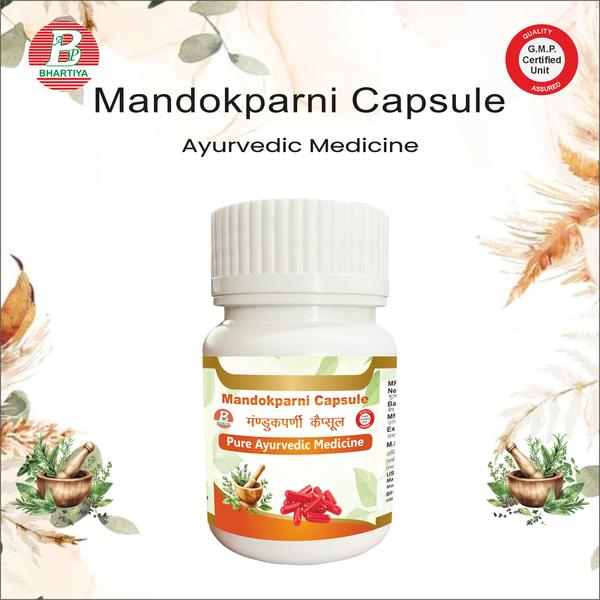
"name": "Mandokparni Capsule",
"description": " MANDUKPARNI \n\n MANDUKPARNI (Centella asiatica L.) \nThe Rejuvenative “Memory Herb” — Leaves and Whole Plant\nMandukparni, also known as Brahmi in Ayurveda, is a highly valued herb for its brain-boosting, rejuvenative, and adaptogenic properties. Rich in triterpenoids, flavonoids, and essential nutrients, Mandukparni is considered beneficial for cognitive function, nervous system health, skin health, wound healing, and overall vitality.\n\n CLASSICAL AYURVEDIC REFERENCES\n1.\tCharaka Samhita\no\tMentioned in Kalpa Sthana as a Medhya (intellect-promoting) and Rasayana (rejuvenative) herb.\no\tLeaves are used to strengthen memory, intellect, and Ojas.\n2.\tSushruta Samhita\no\tRecommended for Vata and Pitta disorders, nervous system weakness, and mental fatigue.\no\tDescribed as Snigdha (unctuous), Sheeta (cooling), and Balya (strength-giving).\n3.\tBhavaprakasha Nighantu\no\tCalled Mandukparni / Brahmi.\no\tPromotes longevity, memory, and cognitive function.\no\tUsed in Medhya, Hridya, and Rasayana formulations.\n\n CLASSICAL STORY / ANECDOTE\n\nMandukparni is often referred to as the “herb of intellect” in classical texts. It was traditionally consumed by scholars, students, and warriors to enhance memory, focus, and mental stamina. Ayurvedic legends describe it as a herb that balances the mind, improves clarity of thought, and nurtures longevity.\n\n BOTANICAL INFORMATION OF MANDUKPARNI\n•\tScientific Name: Centella asiatica L.\n•\tFamily: Apiaceae\n•\tOrder: Apiales\n•\tGenus: Centella\n•\tSpecies: asiatica\nCommon Names:\n•\tSanskrit: Mandukparni, Brahmi\n•\tHindi: Brahmi, Mandukparni\n•\tEnglish: Gotu Kola, Indian Pennywort\n•\tTamil: Vallarai\n•\tTelugu: Brahmi\n•\tMalayalam: Thankuni\n•\tKannada: Brahmi\n•\tBengali: Bhringraj (sometimes confused with Bacopa)\n\n SYNONYMS IN CLASSICAL AYURVEDIC NIGHANTUS\n•\tCharaka Samhita: Mandukparni – Medhya, Rasayana, Balya\n•\tSushruta Samhita: Mandukparni – Medhya, Sheeta, Balya\n•\tBhavaprakasha Nighantu: Mandukparni / Brahmi – Enhances memory, longevity, and vitality\n\n MORPHOLOGY OF MANDUKPARNI\n•\tPlant Type: Creeping perennial herb\n•\tHeight: 10–30 cm\n•\tLeaves: Small, fan-shaped, kidney-shaped, green\n•\tFlowers: Tiny, white to light purple, inconspicuous\n•\tRoots: Thin, fibrous, spreading\n•\tStem: Creeping, rooting at nodes\n\n ECOLOGICAL PREFERENCES\n•\tClimate: Tropical to subtropical; tolerates wet and humid conditions\n•\tSoil: Moist, loamy, or sandy soil, pH 6–7\n•\tHabitat: Marshy fields, near water bodies, gardens\n•\tAltitude: Sea level to 1,500 m\n\n GEOGRAPHICAL DISTRIBUTION\n•\tIndia: Kerala, Tamil Nadu, West Bengal, Maharashtra, Assam\n•\tOutside India: Sri Lanka, Southeast Asia, Africa, Australia, South America\n\n CLASSICAL AYURVEDIC PROPERTIES (RASA–GUNA–VIRYA–VIPAKA)\n•\tRasa (Taste): Tikta (bitter), Madhura (sweet), Katu (pungent)\n•\tGuna (Qualities): Laghu (light), Snigdha (unctuous)\n•\tVirya (Potency): Sheeta (cooling)\n•\tVipaka (post-digestive effect): Madhura (sweet)\n•\tDosha Effects: Vata-Pitta hara, Kapha samana in moderation\n\n THERAPEUTIC ACTIONS (KARMA)\n1.\tMedhya: Improves memory, concentration, and intellect\n2.\tHridya: Supports cardiovascular and nervous system health\n3.\tBalya: Enhances strength and immunity\n4.\tRasayana: Rejuvenates, promotes longevity, and vitality\n5.\tKeshya & Twachya: Nourishes hair and skin\n6.\tVatahara & Pittahara: Balances Vata and Pitta doshas\n7.\tVranaropana: Supports wound healing\n\n INDICATIONS\n•\tNervous System: Memory loss, mental fatigue, anxiety, stress\n•\tDigestive System: Poor digestion, liver disorders\n•\tSkin & Hair: Dry skin, eczema, premature greying, hair fall\n•\tCardiovascular System: Mild hypertension\n•\tGeneral Health: Fatigue, weakness, slow recovery\n\n MODERN PHARMACOLOGY & PHYTOCHEMISTRY\n•\tMajor Constituents:\no\tTriterpenoids: Asiaticoside, Madecassoside\no\tFlavonoids, Phenolics\no\tVitamins (A, C), Minerals (Ca, Mg, Fe)\no\tAlkaloids, Saponins\n•\tPharmacological Actions:\no\tNeuroprotective, Cognitive enhancer\no\tAntioxidant, Anti-inflammatory\no\tAdaptogenic, Anti-anxiety\no\tWound healing, Hepatoprotective\no\tCardioprotective\n\n CULTIVATION DETAILS\n•\tPropagation: Seeds, cuttings, or runners\n•\tSowing Time: Pre-monsoon or early monsoon\n•\tSpacing: 30–50 cm between plants\n•\tIrrigation: Regular, requires moist soil\n•\tFertilization: Organic manure preferred\n•\tHarvesting: Leaves – 3–4 times/year; Whole plant for formulations\n\n CLASSICAL DOSAGE (According to Ayurvedic Granthas)\n•\tLeaves / Whole Plant: 3–6 g/day (powdered or fresh juice)\n•\tDecoction / Juice: 30–60 ml/day\n•\tOil (Brahmi Taila): 5–10 ml/day for hair and scalp\n•\tPaste / Topical: As per therapeutic requirement for wounds, skin disorders\n\n MANDUKPARNI FORMULATIONS – BHARTIYA AYURVEDIC PHARMACY\nBhartiya Ayurvedic Pharmacy offers a range of Mandukparni-based products preserving its full rejuvenative and cognitive-supportive properties.\nKey Uses of Mandukparni Formulations:\n•\tEnhances memory, concentration, and mental clarity\n•\tReduces stress and nervous system fatigue\n•\tSupports skin and hair health\n•\tActs as Rasayana for overall vitality and longevity\n\n MANDUKPARNI CAPSULE\n•\tContains premium Mandukparni powder or extract\n•\tKey Benefits:\no\tImproves memory, intellect, and mental stamina\no\tSupports nervous system and cognitive function\no\tEnhances immunity and overall vitality\n•\tDosage: 1–2 capsules twice daily with warm water or as directed\n•\tSafety & Precautions:\no\tSafe for long-term use\no\tMay lower blood sugar or blood pressure; monitor if on medications\n•\tFormulation Highlights: 100% natural, no artificial additives\n\n MANDUKPARNI POWDER\n•\tMade from premium dried Mandukparni leaves and whole plant\n•\tKey Benefits:\no\tSupports memory, cognition, and mental alertness\no\tPromotes stress relief and nervous system health\no\tNourishes skin and hair\n•\tDosage: 3–6 g/day with warm water, milk, or ghee\n•\tSafety & Precautions:\no\tSafe for long-term use\no\tMild laxative effect may occur in sensitive individuals\n•\tSuggested Use: Ideal for daily Rasayana and cognitive support\n\ncan you eat centella asiatica, capsule centella asiatica, capsule di centella asiatica\ncentella asiatica ayurvedic medicine, centella asiatica benefits, centella asiatica benefits in hindi\ncentella asiatica best products, centella asiatica capsule benefits, centella asiatica capsule flipkart\ncentella asiatica capsule for skin, centella asiatica capsule hindi, centella asiatica capsule how to use\ncentella asiatica capsule hsn code, centella asiatica capsule jan aushadhi, centella asiatica capsule life cycle\ncentella asiatica capsule life pharmacy, centella asiatica capsule literature review, centella asiatica capsule name\ncentella asiatica capsule near me, centella asiatica capsule notes, centella asiatica capsule on amazon\ncentella asiatica capsule online, centella asiatica capsule online india, centella asiatica capsule online shopping\ncentella asiatica capsule original, centella asiatica capsule uses, centella asiatica capsule uses in hindi\ncentella asiatica capsule vial, centella asiatica capsule video, centella asiatica capsule water\ncentella asiatica capsule water benefits, centella asiatica capsule water for skin, centella asiatica capsule youtube\ncentella asiatica capsule zepto, centella asiatica capsules, centella asiatica dosage, centella asiatica extract capsules\ncentella asiatica growing conditions, centella asiatica health benefits, centella asiatica homeopathy medicine\ncentella asiatica how to use, centella asiatica in capsule, centella asiatica in hindi\ncentella asiatica in india, centella asiatica india, centella asiatica juice\ncentella asiatica medicinal properties, centella asiatica medicinal uses, centella asiatica pdf\ncentella asiatica powder, centella asiatica products, centella asiatica recipes\ncentella asiatica review,centella asiatica side effects",
"price": 300.0,
"discountamount": 150.0,
"currencycode": "INR",
"priority": 1000000,
"isfreeshipmentavailable": false,
"shipmentduration": 1,
"_keywords": null,
"isarchived": false,
"isavailable": true,
"applicationid": null,
"productindex": 64,
"imageuri": "https://productimages.withfloats.com/actual/6990262b7c77ed81bc469e18.jpg",
"tileimageuri": "https://productimages.withfloats.com/tile/6990262b7c77ed81bc469e18.jpg",
"images": null,
"totalqueries": 0,
"gpid": null,
"groupproductid": null,
"createdon": "2026-02-14T07:37:12.886Z",
"updatedon": "2026-02-17T09:15:23.872Z",
"buyonlinelink": null,
"producturl": "http://WWW.BHARTIYAAYURVEDICPHARMACY.COM/products/mandokparni-capsule/64",
"availableunits": -1.0,
"iscodavailable": true,
"isprepaidonlineavailable": true,
"maxcodorders": -1,
"maxprepaidonlineorders": -1,
"uniquepaymenturl": null,
"brandname": "Bakula Fort",
"category": "Mandokparni Capsule 60 Cap X 24",
"tags": [],
"variants": false,
"keyspecification": null,
"otherspecifications": null,
"pickupaddressreferenceid": null,
"paymenttype": "AssuredPurchase",
"producttype": "products",
"hsncode": null,
"gstslab": 0.0,
"isnotforsale": false
},
{
"_id": "69aabe02090539877161e8f0",
"fptag": "BHARTIYEAYURVEDICPHARMACY",
"merchantname": null,
"customwidgets": null,
"externalsourceid": null,
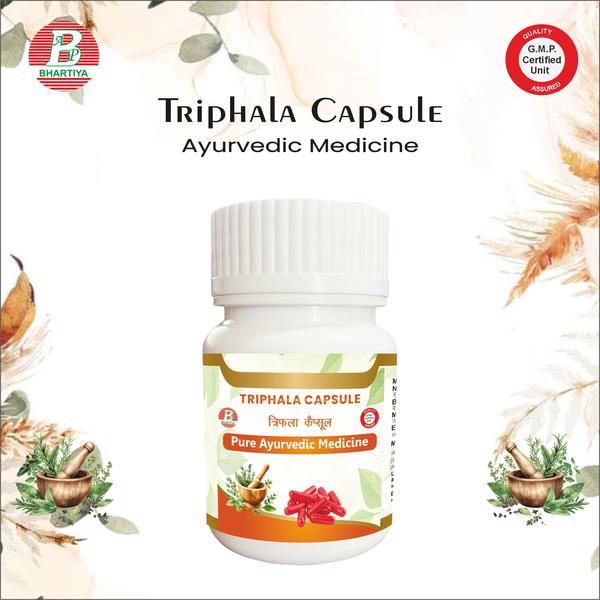
"name": "Triphala capsule",
"description": " TRIPHALA \n\n TRIPHALA \nThe Divine Rasayana of Ayurveda\nTriphala is one of the most revered classical formulations in Ayurveda, composed of three powerful fruits—Haritaki, Bibhitaki, and Amalaki. It is celebrated as a Rasayana (rejuvenator) that gently detoxifies the body while nourishing tissues, supporting digestion, immunity, eye health, and longevity. Unique among formulations, Triphala balances all three Doshas—Vata, Pitta, and Kapha.\n\n CLASSICAL AYURVEDIC REFERENCES\nCharaka Samhita\n•\tDescribed Triphala as a Tridoshahara Rasayana.\n•\tRegular use promotes longevity, strength, and digestive balance.\nSushruta Samhita\n•\tRecommends Triphala for eye health (Chakshushya) and internal cleansing.\n•\tUsed in wound healing, detoxification, and rejuvenation therapies.\nAshtanga Hridaya\n•\tMentions Triphala as a daily supportive Rasayana for maintaining Agni and Dhatu health.\nBhavaprakasha Nighantu\n•\tDescribes Triphala as Deepana, Pachana, Rasayana, and Chakshushya.\n\n CLASSICAL ANCIENT STORY / AACHARYA ANECDOTE\nAncient Ayurvedic tradition narrates that Acharya Charaka observed the declining vitality and digestive strength of people due to irregular lifestyle and improper food habits. The sages prayed for a formulation that could cleanse the body without weakening it.\nIt is said that Lord Dhanvantari, the divine physician, revealed Triphala—formed from three sacred fruits representing the three pillars of life:\n•\tHaritaki (Vata – movement & elimination)\n•\tBibhitaki (Kapha – stability & cleansing)\n•\tAmalaki (Pitta – nourishment & cooling)\nAcharyas proclaimed:\n“Nityaṃ Triphalā Sevanaṃ Jīvanaṃ Dīrgham Karoti”\n(Regular use of Triphala bestows long life.)\nThus, Triphala became known as the guardian Rasayana—safe for daily use, subtle yet profound in action.\n\n BOTANICAL COMPOSITION OF TRIPHALA\nIngredient\tBotanical Name\tPart Used\nHaritaki\tTerminalia chebula\tFruit\nBibhitaki\tTerminalia bellirica\tFruit\nAmalaki\tEmblica officinalis\tFruit\nFamily: Combretaceae & Phyllanthaceae\n\n SYNONYMS IN CLASSICAL TEXTS\n•\tTriphala – Three fruits\n•\tPhalatrikam\n•\tTridoshaghni\n•\tRasayana Yoga\n\n CLASSICAL AYURVEDIC PROPERTIES\n(RASA – GUNA – VIRYA – VIPAKA)\nRasa (Taste):\nPancharasa (All tastes except Lavana), predominantly Amla, Kashaya\nGuna (Qualities):\nLaghu (light), Ruksha (dry)\nVirya (Potency):\nUshna (Haritaki, Bibhitaki) & Sheeta (Amalaki) – balanced effect\nVipaka:\nMadhura\nDosha Effect:\n✔ Tridoshahara (Balances Vata, Pitta & Kapha)\n\n THERAPEUTIC ACTIONS (KARMA)\n• Rasayana – Rejuvenative\n• Anulomana – Regulates bowel movement\n• Deepana–Pachana – Improves digestion\n• Chakshushya – Promotes eye health\n• Raktashodhaka – Blood purifier\n• Medohara – Supports metabolism\n\n INDICATIONS\n• Chronic constipation & weak digestion\n• Detoxification and gut health\n• Eye disorders & vision support\n• Skin diseases & blood impurities\n• Metabolic imbalance & obesity\n• Immunity support & anti-aging care\n\n MODERN PHARMACOLOGY & PHYTOCHEMISTRY\nMajor Constituents:\n• Tannins\n• Gallic acid\n• Chebulinic acid\n• Vitamin C (from Amalaki)\nPharmacological Actions:\n• Mild laxative\n• Antioxidant\n• Anti-inflammatory\n• Gut microbiome supportive\n• Immunomodulatory\n\n\nTRIPHALA FORMULATIONS – Bhartiya Ayurvedic Pharmacy\nBhartiya Ayurvedic Pharmacy prepares authentic Triphala formulations—a classical blend of Haritaki (Terminalia chebula), Bibhitaki (Terminalia bellirica), and Amalaki (Emblica officinalis)—based on authoritative Ayurvedic texts, ensuring optimal digestive regulation, gentle detoxification, rejuvenation, and immune support.\n\n1. TRIPHALA CAPSULE \nDescription:\nTriphala Capsules are prepared using equal proportions of Haritaki, Bibhitaki, and Amalaki fruit powders, processed according to classical Ayurvedic principles to preserve Rasayana potency.\n\n KEY BENEFITS\n• Gently detoxifies without dependency\n• Improves digestion and bowel regularity\n• Enhances immunity and vitality\n• Supports eye and skin health\n• Promotes longevity and daily wellness\n\n DOSAGE\n• Adults: 1–2 capsules once or twice daily\n• Best taken at night with warm water\n• Or as directed by an Ayurvedic physician\n\n SAFETY & PRECAUTIONS\n• Safe for long-term use under guidance\n• Use cautiously in severe debility or dehydration\n• Adjust dose in high Vata conditions\n\n FORMULATION HIGHLIGHTS\n• Classical 1:1:1 Triphala formulation\n• 100% pure herbal ingredients\n• No chemicals, additives, or preservatives\n• Prepared as per authentic Ayurvedic texts\n\n Triphala is not merely a medicine—it is a daily companion for balanced living, as envisioned by the great Acharyas of Ayurveda.\n\n2. TRIPHALA CHURNA \n TRIPHALA \nThe Eternal Rasayana of the Great Acharyas\nTriphala Churna is one of the most time-honored classical formulations of Ayurveda, prepared from the powdered fruits of Haritaki, Bibhitaki, and Amalaki in equal proportion. Revered as a Rasayana (rejuvenator), Triphala Churna gently cleanses the body while nourishing all Dhatus, supporting digestion, vision, immunity, and longevity. It is uniquely praised for its ability to balance all three Doshas—Vata, Pitta, and Kapha.\n\n CLASSICAL AYURVEDIC REFERENCES\nCharaka Samhita\n•\tDescribes Triphala as Tridoshaghna and Rasayana.\n•\tRegular use promotes long life, strength, and clarity of senses.\nSushruta Samhita\n•\tRecommends Triphala Churna for Chakshushya (eye health) and internal purification.\n•\tWidely used in Vrana Shodhana (wound cleansing) and detoxifying therapies.\nAshtanga Hridaya\n•\tAdvises Triphala for daily use to maintain Agni, Koshtha, and Dhatu balance.\nBhavaprakasha Nighantu\n•\tDescribes Triphala as Deepana, Pachana, Rasayana, and Netrya.\n\n CLASSICAL ANCIENT STORY / AACHARYA ANECDOTE\nAyurvedic tradition narrates that the great sages observed how harsh purgatives weakened patients while untreated impurities shortened life. Seeking a remedy that could cleanse gently without depletion, they meditated upon nature’s wisdom.\nAcharya Charaka, guided by divine knowledge from Lord Dhanvantari, revealed Triphala—three sacred fruits representing harmony of the Tridosha:\n•\tHaritaki – Governs Vata, elimination, and vitality\n•\tBibhitaki – Regulates Kapha, cleansing and stability\n•\tAmalaki – Pacifies Pitta, nourishment and rejuvenation\nThe Acharyas proclaimed:\n“Triphala Nityasevanaṃ Sharīrasya Bala-Vardhanam”\n(Regular use of Triphala strengthens the body.)\n\n\n\nbenefits of triphala capsule, best brand of triphala capsules\nbest organic triphala capsules, best time to take triphala capsule\nbest triphala capsules, best triphala capsules brand in india\nbest triphala capsules in india, best triphala churna india\ncan i take triphala with other supplements\ncan triphala be taken daily, can triphala be taken everyday\ncan triphala cause weight gain, can triphala churna be taken daily\nhow to use triphala capsules, is it good to take triphala everyday\nis triphala capsules good, is triphala churna good for health\norganic triphala capsule, organic triphala capsules benefits\ntriphala 60 capsule organic india, triphala capsule ayurvedic\ntriphala capsule hsn code, triphala capsule in hindi\ntriphala capsule ke fayde, triphala capsule ke kya fayde hain\ntriphala capsule khane ke fayde, triphala capsule price\ntriphala capsule quantity, triphala capsule uses\ntriphala capsule uses in hindi, triphala capsules amazon\ntriphala capsules benefits, triphala capsules benefits in hindi\ntriphala capsules india, triphala capsules kottakkal\ntriphala capsules near me, triphala capsules nz\ntriphala capsules online, triphala capsules or powder\ntriphala capsules price, triphala capsules reviews\ntriphala capsules uk, triphala capsules uses, triphala capsules uses in hindi\ntriphala capsules when to take as, triphala churna capsule\ntriphala guggul capsule, triphala guggul tablets\ntriphala powder in capsule, triphala tablets india",
"price": 300.0,
"discountamount": 150.0,
"currencycode": "INR",
"priority": 1000000,
"isfreeshipmentavailable": false,
"shipmentduration": 1,
"_keywords": null,
"isarchived": false,
"isavailable": true,
"applicationid": null,
"productindex": 73,
"imageuri": "https://productimages.withfloats.com/actual/69aabe040d75f0106b3633a8.jpg",
"tileimageuri": "https://productimages.withfloats.com/tile/69aabe040d75f0106b3633a8.jpg",
"images": null,
"totalqueries": 0,
"gpid": null,
"groupproductid": null,
"createdon": "2026-03-06T11:44:02.388Z",
"updatedon": "2026-03-06T11:44:02.388Z",
"buyonlinelink": null,
"producturl": "http://WWW.BHARTIYAAYURVEDICPHARMACY.COM/products/triphala-capsule/73",
"availableunits": -1.0,
"iscodavailable": true,
"isprepaidonlineavailable": true,
"maxcodorders": -1,
"maxprepaidonlineorders": -1,
"uniquepaymenturl": null,
"brandname": "Bakula fort",
"category": "Triphala capsule 60-cap x 24",
"tags": [],
"variants": false,
"keyspecification": null,
"otherspecifications": null,
"pickupaddressreferenceid": null,
"paymenttype": "AssuredPurchase",
"producttype": "products",
"hsncode": null,
"gstslab": 0.0,
"isnotforsale": false
},
{
"_id": "69a55b8694180917ab8a5d30",
"fptag": "BHARTIYEAYURVEDICPHARMACY",
"merchantname": null,
"customwidgets": null,
"externalsourceid": null,
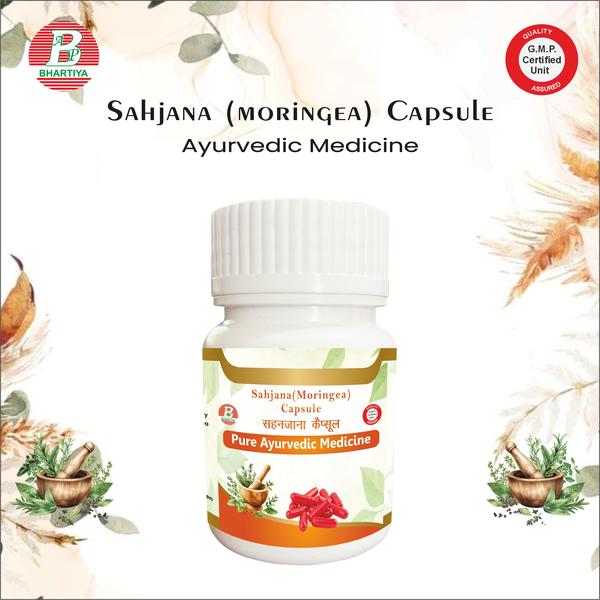
"name": "Sahjana capsule",
"description": " SAHJANA \n \n SAHJANA (Moringa oleifera Lam.) \nThe Nutrient-Rich “Drumstick Tree” — Leaves, Pods, Seeds, and Flowers\nSahjana, commonly known as Moringa, is a highly valued plant in Ayurveda and modern nutrition. Known for its nourishing, rejuvenating, and digestive-supporting properties, it is rich in vitamins, minerals, proteins, antioxidants, and phytochemicals. Sahjana is considered beneficial for immunity, metabolism, skin, hair, heart health, and overall vitality.\n CLASSICAL AYURVEDIC REFERENCES\n1.\tCharaka Samhita\no\tMentioned in Kalpa Sthana for strengthening Dhatus and improving Ojas.\no\tLeaves and pods are considered Medhya (brain nourishing) and Rasayana (rejuvenative).\n2.\tSushruta Samhita\no\tRecommended for Vata and Pitta disorders, digestive weakness, and anaemia.\no\tDescribed as Snigdha (unctuous), Ushna (warming), and Balya (strength-giving).\n3.\tBhavaprakasha Nighantu\no\tReferred to as Sahjana / Shobhanjana.\no\tPromotes longevity, immunity, and vitality.\no\tUsed in Vrishya (reproductive), Hridya (cardiac), and Medhya (intellectual) formulations.\n\n CLASSICAL STORY / ANECDOTE\nIn classical Ayurvedic texts, Sahjana is praised as a “miracle tree” because every part—leaves, pods, seeds, flowers, and bark—has medicinal or nutritional use. It is sometimes referred to as “Sanjeevani of common people”, symbolizing its life-supporting and rejuvenative qualities. Traditionally, Sahjana leaves and pods were included in the diet of warriors and laborers to enhance strength, stamina, and immunity during harsh seasons.\n\n BOTANICAL INFORMATION OF SAHJANA \n•\tScientific Name: Moringa oleifera Lam.\n•\tFamily: Moringaceae\n•\tOrder: Brassicales\n•\tGenus: Moringa\n•\tSpecies: oleifera\n\nCommon Names:\n\tSanskrit: Sahjana, Shobhanjana\n\tHindi: Sahjan, Munga\n\tEnglish: Drumstick Tree, Horseradish Tree\n\tTamil: Murungai\n\tTelugu: Munagaku\n\tMalayalam: Munagakaya\n\tKannada: Nuggekai\n\tBengali: Sajnana\n\n SYNONYMS IN CLASSICAL AYURVEDIC NIGHANTUS\n•\tCharaka Samhita: Sahjana – Rasayana, Balya\n•\tSushruta Samhita: Sahjana – Medhya, Hridya, Balya\n•\tBhavaprakasha Nighantu: Sahjana / Shobhanjana – Promotes longevity, immunity, and fertility\n\n MORPHOLOGY OF SAHJANA\n•\tPlant Type: Fast-growing perennial tree\n•\tHeight: 5–10 m\n•\tLeaves: Small, pinnate, feathery\n•\tFlowers: White to pale yellow, fragrant, 5-petaled\n•\tFruit / Pod: Long, slender drumstick-shaped pods containing seeds\n•\tSeeds: Round, brown, winged, nutrient-rich\n•\tRoots & Bark: Used in traditional medicines\n\n ECOLOGICAL PREFERENCES\n•\tClimate: Tropical to subtropical, tolerates dry conditions\n•\tSoil: Well-drained sandy or loamy soil, pH 6–7.5\n•\tHabitat: Cultivated in fields, gardens, roadsides; requires full sun\n•\tAltitude: Sea level to 1,000 m\n\n GEOGRAPHICAL DISTRIBUTION\n•\tIndia: Maharashtra, Tamil Nadu, Andhra Pradesh, West Bengal, Rajasthan\n•\tOutside India: Philippines, Africa, Caribbean, Southeast Asia, Middle East\n\n CLASSICAL AYURVEDIC PROPERTIES (RASA–GUNA–VIRYA–VIPAKA)\n•\tRasa (Taste): Madhura (sweet), Tikta (bitter), Katu (pungent)\n•\tGuna (Qualities): Laghu (light), Snigdha (unctuous)\n•\tVirya (Potency): Ushna (warming)\n•\tVipaka (post-digestive effect): Madhura (sweet)\n•\tDosha Effects: Vata-Pitta hara (reduces Vata & Pitta), Kapha samana in moderation\n THERAPEUTIC ACTIONS (KARMA)\n1.\tMedhya: Supports brain health, improves intellect and memory\n2.\tHridya: Supports cardiovascular system\n3.\tBalya: Enhances strength and immunity\n4.\tVatahara: Reduces Vata-related disorders like joint pain and weakness\n5.\tRasayana: Rejuvenates, promotes longevity, and overall vitality\n6.\tKeshya & Twachya: Nourishes hair and skin\n7.\tAnulomana: Supports digestion and regular bowel movements\n\n INDICATIONS\n•\tDigestive System: Constipation, poor digestion, loss of appetite\n•\tCardiovascular System: Hypertension, Hyperlipidemia\n•\tReproductive & Urinary System: Fertility support, reproductive wellness\n•\tSkin & Hair: Dry skin, hair loss, premature greying\n•\tMetabolism: Diabetes, obesity, metabolic imbalance\n•\tNervous System: Stress, fatigue, cognitive support\n\n MODERN PHARMACOLOGY & PHYTOCHEMISTRY\n•\tMajor Constituents:\no\tVitamins (A, C, E, B-complex), minerals (Ca, K, Fe, Mg)\no\tProteins, amino acids\no\tFlavonoids, phenolics, saponins, alkaloids\no\tOmega fatty acids (in seeds)\n•\tPharmacological Actions:\no\tAntioxidant\no\tAnti-inflammatory\no\tImmunomodulatory\no\tAnti-diabetic\no\tHepatoprotective\no\tCardioprotective\n\n CULTIVATION DETAILS\n•\tPropagation: Seeds or cuttings\n•\tSowing Time: February–May (summer) or monsoon planting\n•\tSpacing: 2–3 m between trees\n•\tIrrigation: Moderate; drought-tolerant\n•\tFertilization: Organic manure preferred\n•\tHarvesting: Leaves – year-round; Pods – 6–8 months after planting; Seeds – when pods mature\n\n CLASSICAL DOSAGE (According to Ayurvedic Granthas)\n•\tLeaves: 5–10 g/day (fresh or powdered)\n•\tPods / Drumsticks: 10–20 g/day cooked or in decoction\n•\tSeeds: 3–6 g/day powdered or soaked\n•\tOil (Sahjana Taila): 5–10 ml/day\n•\tDecoction / Paste: As per therapeutic requirement (skin, hair, or digestion)\n\n SAHJANA FORMULATIONS – BHARTIYA AYURVEDIC PHARMACY\nBhartiya Ayurvedic Pharmacy prepares a range of Sahjana formulations following classical Ayurvedic principles. Each product retains the full nutritive, rejuvenative, and digestive-supporting properties of Sahjana, promoting heart health, immunity, metabolism, and overall vitality.\nKey Uses of Sahjana Formulations:\n•\tDigestive Support: Improves digestion, relieves constipation, promotes gut health\n•\tCardiovascular Health: Supports healthy lipid levels and heart function\n•\tReproductive Health: Enhances fertility and nourishes reproductive tissues\n•\tSkin & Hair Care: Improves skin hydration, strengthens hair roots\n•\tRasayana: Rejuvenates, supports longevity, and overall vitality\n\n SAHJANA CAPSULE\nBhartiya Ayurvedic Pharmacy offers Sahjana Capsules prepared according to classical Ayurvedic methods. Each capsule contains premium quality Sahjana (Moringa) powder or extract, preserving its nutritive, rejuvenative, and balancing properties.\nKey Benefits:\n•\tSupports digestive health and regular bowel movements\n•\tPromotes cardiovascular health\n•\tEnhances reproductive health and immunity\n•\tNourishes skin and hair\n•\tActs as a Rasayana, promoting overall vitality and strength\n\nDosage:\n•\tAdults: 1–2 capsules twice daily with warm water or as directed by an Ayurvedic physician\n•\tCan be combined with milk or ghee for enhanced Rasayana effect\nSafety & Precautions:\n•\tSafe for long-term use when taken as per dosage\n•\tMild laxative effect may occur in sensitive individuals\n•\tMonitor blood pressure or blood sugar if taken with medications\nFormulation Highlights:\n•\t100% natural Sahjana (Moringa) powder\n•\tFree from artificial colours, preservatives, and additives\n•\tPrepared using classical Ayurvedic processing methods\nSuggested Use:\n•\tIdeal for adults looking to improve digestion, heart health, immunity, and vitality\n•\tSuitable for those seeking convenient Ayurvedic Rasayana support\n\n SAHJANA POWDER \nBhartiya Ayurvedic Pharmacy offers Sahjana (Moringa oleifera) Powder prepared according to classical Ayurvedic principles. Made from premium quality dried leaves, pods, and seeds, the powder retains full nutritive, rejuvenative, and balancing properties of Sahjana.\nKey Benefits:\n•\tSupports digestion and regular bowel movements\n•\tPromotes heart and cardiovascular health\n•\tEnhances immunity and overall vitality\n•\tNourishes skin and hair\n•\tActs as a Rasayana, promoting strength and stamina\nDosage:\n•\tAdults: 3–6 g/day (1–2 teaspoons) with warm water, milk, or ghee, or as directed by an Ayurvedic physician\n•\tCan be added to smoothies, soups, or food for daily nourishment\nSafety & Precautions:\n•\tSafe for long-term use when taken as per dosage\n•\tMild laxative effect may occur in sensitive individuals\n•\tMonitor blood sugar if taken with antidiabetic medications\nFormulation Highlights:\n•\t100% natural Sahjana (Moringa) powder\n•\tFree from artificial colours, preservatives, and additives\n•\tPrepared using classical Ayurvedic processing methods\nSuggested Use:\n•\tIdeal for adults looking to improve digestion, immunity, heart health, and overall vitality\n•\tSuitable for daily Rasayana and nutritional support\n\n\nsahjan capsule, sahjan capsule uses in hindi\nsahjan churna, sahjan ka churan, sahjan ka upyog\nsahjan ka upyog kaise karen, sahjan ke capsule\nsahjan ke capsule ke fayde, sahjan ke upyog\nsahjana capsule amazon, sahjana capsule ayurvedic\nsahjana capsule benefits, sahjana capsule benefits in hindi\nsahjana capsule buy online, sahjana capsule composition\nsahjana capsule contains, sahjana capsule content\nsahjana capsule cost, sahjana capsule dose\nsahjana capsule dose per day, sahjana capsule download\nsahjana capsule download pdf, sahjana capsule english\nsahjana capsule english name, sahjana capsule expiry date\nsahjana capsule extract, sahjana capsule gmp\nsahjana capsule green world, sahjana capsule hindi\nsahjana capsule how to use, sahjana capsule jan aushadhi\nsahjana capsule jiomart, sahjana capsule lagane ke fayde\nsahjana capsule life, sahjana capsule life care\nsahjana capsule login, sahjana capsule manufacturer\nsahjana capsule name, sahjana capsule near me\nsahjana capsule nutrition, sahjana capsule online\nsahjana capsule online order, sahjana capsule online purchase\nsahjana capsule online shopping, sahjana capsule price\nsahjana capsule quality, sahjana capsule quantity\nsahjana capsule question, sahjana capsule question paper\nsahjana capsule rate, sahjana capsule recipe\nsahjana capsule review, sahjana capsule review in hindi\nsahjana capsule side effects, sahjana capsule side effects in hindi",
"price": 360.0,
"discountamount": 180.0,
"currencycode": "INR",
"priority": 1000000,
"isfreeshipmentavailable": false,
"shipmentduration": 1,
"_keywords": null,
"isarchived": false,
"isavailable": true,
"applicationid": null,
"productindex": 70,
"imageuri": "https://productimages.withfloats.com/actual/69a55b888361c309c6520782.jpg",
"tileimageuri": "https://productimages.withfloats.com/tile/69a55b888361c309c6520782.jpg",
"images": null,
"totalqueries": 0,
"gpid": null,
"groupproductid": null,
"createdon": "2026-03-02T09:42:30.676Z",
"updatedon": "2026-03-02T09:42:30.676Z",
"buyonlinelink": null,
"producturl": "http://WWW.BHARTIYAAYURVEDICPHARMACY.COM/products/sahjana-capsule/70",
"availableunits": -1.0,
"iscodavailable": true,
"isprepaidonlineavailable": true,
"maxcodorders": -1,
"maxprepaidonlineorders": -1,
"uniquepaymenturl": null,
"brandname": "Bakula fort",
"category": "Sahjana capsule 60 - cap X 24",
"tags": [],
"variants": false,
"keyspecification": null,
"otherspecifications": null,
"pickupaddressreferenceid": null,
"paymenttype": "AssuredPurchase",
"producttype": "products",
"hsncode": null,
"gstslab": 0.0,
"isnotforsale": false
},
{
"_id": "69a16506696ba164ff83ed1b",
"fptag": "BHARTIYEAYURVEDICPHARMACY",
"merchantname": null,
"customwidgets": null,
"externalsourceid": null,
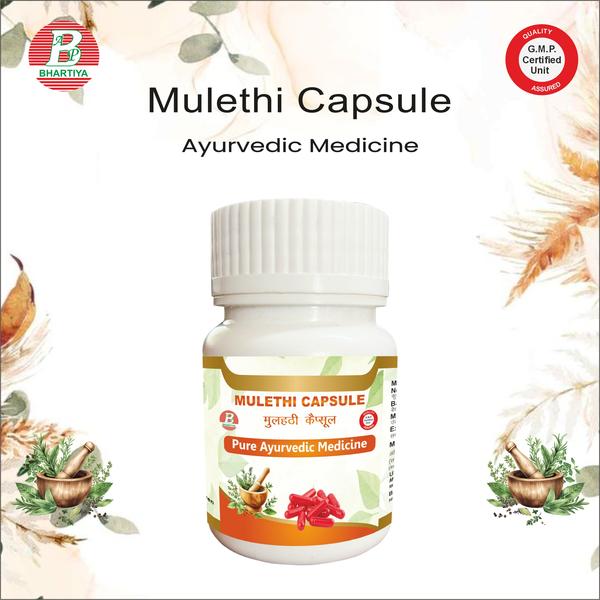
"name": "Mulethi Capsule",
"description": " MULETHI \n\n\n MULETHI (Glycyrrhiza glabra L.) \nThe Sweet Root — “Yashtimadhu” (The Compassionate Healer)\n\nMulethi, also known as Yashtimadhu, is a revered herb in Ayurveda, celebrated for its sweetness, cooling properties, and therapeutic versatility. Known as a demulcent, expectorant, and rejuvenative, it is used for respiratory, digestive, endocrine, liver, and skin health. It balances Vata and Pitta, while supporting immunity, vitality, and longevity.\n\n ANCIENT STORY & TRADITIONAL SIGNIFICANCE OF MULETHI (Yashtimadhu) \nSanskrit Name: Yashtimadhu – “Yashti” means root, “Madhu” means sweet; literally “Sweet Root.”\nSymbolism: Sweetness, nourishment, healing, and vitality.\n\nMythological & Historical References\n1.\tVedic References:\no\tMulethi finds mention in the Rigveda and Atharvaveda as a medicinal plant with restorative properties.\no\tIt was considered sacred and used in rituals to purify the body and maintain health.\no\tSweetness of Mulethi symbolizes Ahimsa (compassion) and Sattva (purity) in Ayurvedic philosophy.\n2.\tAyurvedic Classics:\no\tCharaka Samhita: Yashtimadhu is described as Madhura, Shita, Rasayana, suitable for balancing Vata and Pitta, nourishing Ojas, and promoting longevity.\no\tSushruta Samhita: Prescribes Mulethi for respiratory disorders, throat diseases, ulcers, and digestive issues.\no\tBhavaprakasha Nighantu: Calls it the “sweetest of roots,” a divine healer that restores strength, immunity, and vitality.\n3.\tLegendary Story (Folk & Mythological Tradition):\no\tOnce, during the cosmic churning of the ocean (Samudra Manthan), the gods were seeking nectar for immortality.\no\tAmongst the divine plants that emerged, Yashtimadhu (Mulethi) was gifted by the gods to humans as a herb of longevity and protection.\no\tIt is said that Sage Agastya, the revered Ayurvedic seer, first discovered its sweet root in the Vindhya forests and prescribed it as a remedy for throat, digestion, and vitality, making it a staple Rasayana in Ayurveda.\no\tBecause of its sweetness and healing power, Mulethi was also offered to deities and kings, symbolizing health, grace, and divine nourishment.\n\nAncient Uses & Cultural Significance\n•\tRoyal Medicine: Kings and warriors used Mulethi root as a daily tonic to enhance stamina, strength, and immunity.\n•\tSpiritual Practice: Used in Ayurvedic tonics during meditation and rituals to maintain balance of the doshas and clarity of mind.\n•\tSacred Offering: In temples, Mulethi was considered sacred and sometimes mixed in honey or ghee as prasadam for devotees.\n•\tThroat and Voice Care: Ancient singers and priests chewed Mulethi root to soothe the throat and strengthen the voice for chanting and recitations.\n\nSummary of Ancient Wisdom\n•\tNature: Sweet, cooling, nourishing, rejuvenative\n•\tPurpose: Promotes longevity, vitality, immunity, and respiratory wellness\n•\tSpiritual Symbolism: Sweetness of life, harmony, and divine health\n•\tCultural Legacy: From Vedic times to classical Ayurveda, Mulethi has been revered as a miraculous root that protects life and supports human well-being\n\n BOTANICAL INFORMATION OF MULETHI\nScientific Name: Glycyrrhiza glabra L.\nSynonyms: Glycyrrhiza glandulifera, Glycyrrhiza inflata\nFamily: Fabaceae (Leguminosae)\nOrder: Fabales\nGenus: Glycyrrhiza\nSpecies: glabra\nCommon Names\n•\tSanskrit: Yashtimadhu, Mula, Madhura\n•\tHindi: Mulethi\n•\tEnglish: Licorice\n•\tTamil: Athimadhuram\n•\tTelugu: Athimadhuram\n•\tMalayalam: Athimadhuram\n•\tKannada: Athimadhura\n•\tGujarati/Marathi: Mulethi\n•\tBengali: Mulethi\n SYNONYMS IN CLASSICAL AYURVEDIC NIGHANTUS\n•\tCharaka Samhita: Yashtimadhu – Balances Vata & Pitta, Rasayana for throat and digestion\n•\tSushruta Samhita: Mula, Madhura – Healing, demulcent, and rejuvenative\n•\tBhavaprakasha Nighantu: Madhura, Rasayana, Hrudya – Enhances strength and longevity\n•\tDhanvantari Nighantu: Yashtimadhu, Mula – Sweet root for vitality and respiratory wellness\n MORPHOLOGY OF MULETHI\n•\tPlant Type: Perennial herb or small shrub, Height: 1–2 m\n•\tStem: Erect, branched, woody at base\n•\tLeaves: Pinnate, 7–17 leaflets, oblong-elliptic\n•\tFlowers: Small, purple to pale violet, in racemes\n•\tFruit: Legume (pod), oblong, 1–2 cm, containing small seeds\n•\tRoot: Long, cylindrical, brown exterior, yellow interior, sweet taste, medicinal\n ECOLOGICAL PREFERENCES\n•\tClimate: Tropical and subtropical, tolerates semi-arid conditions\n•\tSoil: Well-drained loamy, sandy, or calcareous soils; prefers alkaline soils\n•\tHabitat: Cultivated fields, wastelands, gardens\n•\tAltitude: Sea level to 1,500 m\n GEOGRAPHICAL DISTRIBUTION\nIndia: Punjab, Haryana, Uttar Pradesh, Gujarat, Rajasthan\nOutside India: Afghanistan, Iran, Iraq, Turkey, China, Mediterranean region\nNaturalized: Worldwide in temperate and subtropical regions\n CLASSICAL AYURVEDIC PROPERTIES (RASA–GUNA–VIRYA–VIPAKA)\n•\tRasa (Taste): Madhura (sweet), Laghu tikta (slightly bitter)\n•\tGuna (Qualities): Snigdha (unctuous), Guru (heavy)\n•\tVirya (Potency): Śīta (cooling)\n•\tVipaka (post-digestive effect): Madhura (sweet)\n•\tDosha Effects: Balances Vata & Pitta; reduces dryness, supports Ojas\n THERAPEUTIC ACTIONS ACCORDING TO AYURVEDA (KARMA)\n1.\tRasayana (Rejuvenative): Strengthens body, restores vitality\n2.\tHridya (Cardioprotective): Supports heart and circulation\n3.\tKashaya / Pranahara (Respiratory Health): Reduces cough, throat irritation, asthma\n4.\tMedhya: Supports intellect and memory indirectly by nourishing tissues\n5.\tJvarahara: Reduces fever\n6.\tKledahara / Deepana: Promotes digestion, mucosa soothing\n7.\tTwachya (Skin Health): Anti-inflammatory, promotes healing\n8.\tMutravirechana (Diuretic): Mild diuretic effect\n9.\tShukra / Reproductive Health: Enhances vitality\n INDICATIONS\n•\tRespiratory System: Cough, cold, bronchitis, asthma, sore throat\n•\tDigestive System: Gastritis, heartburn, peptic ulcers, acidity\n•\tEndocrine / Metabolism: Supports adrenal and thyroid function\n•\tLiver & Kidney Health: Hepatoprotective, detoxifying\n•\tSkin & Hair: Anti-inflammatory, wound healing, anti-aging\n•\tImmunity & Vitality: Chronic fatigue, stress, weakness\n MODERN PHARMACOLOGY & PHYTOCHEMISTRY\nMajor Constituents:\n•\tGlycyrrhizin (sweet triterpene saponin)\n•\tFlavonoids: Liquiritin, Isoliquiritin\n•\tPolysaccharides, Sterols, Coumarins, Amino acids, Minerals\nPharmacological Actions:\n•\tAnti-inflammatory, Antioxidant, Immunomodulatory\n•\tDemulcent, Expectorant, Anti-ulcer, Hepatoprotective\n•\tAdaptogenic, Antiviral, Anti-allergic\n CULTIVATION DETAILS\n•\tPropagation: Seeds, stem cuttings\n•\tSowing Time: March–May\n•\tSpacing: 30–45 cm between plants\n•\tIrrigation: Moderate; drought-tolerant once established\n•\tFertilization: Organic manure preferred\n•\tHarvesting: Roots harvested 2–3 years after planting\n CLASSICAL DOSAGE (According to Ayurvedic Granthas)\n•\tChurna (Powder): 1–3 g twice daily\n•\tSwarasa (Juice): 5–10 ml\n•\tKwatha (Decoction): 20–40 ml\n•\tAvaleha / Lehyam: 10–15 g\n•\tOil / Thaila: External use for skin or hair\n CLASSICAL AYURVEDIC FORMULATIONS CONTAINING MULETHI\n1.\tYashtimadhu Churna: Respiratory and digestive tonic\n2.\tDashamoola Kashaya: Anti-inflammatory, stress reduction\n3.\tSitopaladi Churna: Cough, cold, respiratory wellness\n4.\tMulethi Avaleha / Lehyam: Rejuvenative, throat and digestive health\n5.\tHerbal Decoctions / Oils: Skin and hair applications\n SAFETY & PRECAUTIONS\n•\tGenerally safe in classical doses\n•\tExcessive consumption may cause water retention, hypertension, or hypokalemia\n•\tCaution in:\no\tHypertensive patients\no\tPregnant or lactating women (large doses)\no\tKidney disease\n\n MULETHI (Glycyrrhiza glabra) FORMULATIONS – BHARTIYA AYURVEDIC PHARMACY\nBhartiya Ayurvedic Pharmacy prepares a range of Mulethi formulations following classical Ayurvedic principles described in Charaka Samhita, Sushruta Samhita, Bhavaprakasha Nighantu, and other Ayurvedic texts. Each product is designed to retain the full therapeutic, rejuvenative, and demulcent properties of Mulethi, supporting respiratory, digestive, liver, and overall vitality.\n\n\n 1. Mulethi Capsule\nDescription:\nMulethi Capsule contains standardized extract in a convenient, easy-to-swallow form. Ideal for respiratory, digestive, and immune support.\nKey Actions:\n•\tDemulcent and expectorant\n•\tAntioxidant and anti-inflammatory\n•\tRejuvenative and immunity-enhancing\n•\tSupports liver, kidney, and digestive health\nDosage:\n•\t1–2 capsules twice daily with warm water after meals\nPrecautions:\n•\tAvoid overdose\n•\tMonitor blood pressure in hypertensive patients\n•\tUse under supervision if pregnant or lactating\n\n 2. Mulethi Powder (Churna)\nDescription:\nPure, finely powdered Mulethi root for traditional use. Can be consumed with honey, water, or ghee.\nKey Actions:\n•\tRasayana and demulcent\n•\tSupports respiratory and digestive health\n•\tEnhances liver and kidney detoxification\n•\tPromotes throat and skin health\nDosage:\n•\t1–3 g daily with warm water, honey, or as advised\nPrecautions:\n•\tAvoid excessive intake in hypertension or edema\n•\tDiabetics should consult before use\n\n\n\nbenefits mulethi, best mulethi powder, best mulethi powder for eating\nmulethi capsule amazon, mulethi capsule ayurvedic, mulethi capsule benefits\nmulethi capsule benefits in hindi, mulethi capsule composition\nmulethi capsule contains, mulethi capsule daily dose, mulethi capsule dosage\nmulethi capsule dose, mulethi capsule dose per day, mulethi capsule english\nmulethi capsule english name, mulethi capsule expiry date, mulethi capsule extract\nmulethi capsule ghar par kaise banaye, mulethi capsule good for skin\nmulethi capsule gst rate, mulethi capsule image, mulethi capsule in english\nmulethi capsule in hindi, mulethi capsule ingredients, mulethi capsule jan aushadhi\nmulethi capsule jan aushadhi kendra, mulethi capsule jiomart, mulethi capsule ke fayde\nmulethi capsule lagane ke fayde, mulethi capsule lagane se kya hota hai\nmulethi capsule lene ke fayde, mulethi capsule life, mulethi capsule life pharmacy\nmulethi capsule manufacturer, mulethi capsule manufacturers in india\nmulethi capsule mrp, mulethi capsule name, mulethi capsule near me\nmulethi capsule nutrition facts, mulethi capsule on amazon\nmulethi capsule on flipkart, mulethi capsule online\nmulethi capsule online order, mulethi capsule online shopping\nmulethi capsule qualification, mulethi capsule quality\nmulethi capsule quantity, mulethi capsule rate\nmulethi capsule result, mulethi capsule review\nmulethi capsule se kya hota hai, mulethi capsule side effects\nmulethi capsule side effects in hindi, mulethi capsule vs powder\nmulethi capsule water, mulethi capsule wholesale\nmulethi capsule with milk, mulethi capsule with milk benefits\nmulethi capsule youtube, mulethi consumption\nmulethi expiry date",
"price": 300.0,
"discountamount": 150.0,
"currencycode": "INR",
"priority": 1000000,
"isfreeshipmentavailable": false,
"shipmentduration": 1,
"_keywords": null,
"isarchived": false,
"isavailable": true,
"applicationid": null,
"productindex": 66,
"imageuri": "https://productimages.withfloats.com/actual/69a1650826088bebd41af280.jpg",
"tileimageuri": "https://productimages.withfloats.com/tile/69a1650826088bebd41af280.jpg",
"images": null,
"totalqueries": 0,
"gpid": null,
"groupproductid": null,
"createdon": "2026-02-27T09:33:58.793Z",
"updatedon": "2026-02-27T09:33:58.793Z",
"buyonlinelink": null,
"producturl": "http://WWW.BHARTIYAAYURVEDICPHARMACY.COM/products/mulethi-capsule/66",
"availableunits": -1.0,
"iscodavailable": true,
"isprepaidonlineavailable": true,
"maxcodorders": -1,
"maxprepaidonlineorders": -1,
"uniquepaymenturl": null,
"brandname": "Bakula Fort",
"category": "Mulethi capsule 60 - Cap X 24",
"tags": [],
"variants": false,
"keyspecification": null,
"otherspecifications": null,
"pickupaddressreferenceid": null,
"paymenttype": "AssuredPurchase",
"producttype": "products",
"hsncode": null,
"gstslab": 0.0,
"isnotforsale": false
},
{
"_id": "698dc74d9206f8f071919e73",
"fptag": "BHARTIYEAYURVEDICPHARMACY",
"merchantname": null,
"customwidgets": null,
"externalsourceid": null,
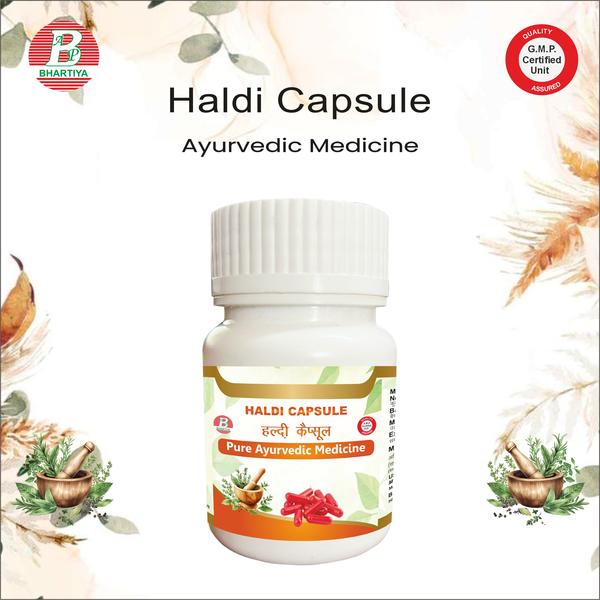
"name": "Haldi Capsule",
"description": " HALDI \n\n HALDI (Curcuma longa L.) \nThe Golden Healer — “Haridra”\n\nHaldi, commonly known as turmeric, is a revered herb in Ayurveda for its potent anti-inflammatory, antioxidant, and blood-purifying properties. It supports healthy digestion, immunity, skin health, and overall vitality. Traditionally used in inflammatory conditions, skin disorders, liver health, and general wellness.\n\n CLASSICAL AYURVEDIC REFERENCES\n \nCharaka Samhita\n\n•\tDescribed as Raktaprasadaka (blood purifier) and Pittashamaka (Pitta pacifier).\n\n•\tRecommended in skin diseases, fever, and digestive disorders.\n\nSushruta Samhita\n\n•\tUsed for wound healing, reducing inflammation, and promoting tissue regeneration.\n\n•\tRecognized for Kapha-Pitta balancing and detoxifying effects.\n\nBhavaprakasha Nighantu\n\n•\tCalled Haridra – Pittashamak, Rasayana (rejuvenator), Krimihara (anti-parasitic).\n•\tEnhances digestion, liver function, and immunity.\n\n\n CLASSICAL STORY / ANECDOTE\n\nAncient Ayurvedic lore tells that turmeric emerged from the churning of the cosmic ocean (Samudra Manthan) as a golden gift of the gods, symbolizing purity, protection, and vitality. It was used to heal wounds of warriors and maintain radiant health. Turmeric’s vibrant yellow color is associated with Agni (fire) and symbolizes its purifying and energizing qualities.\n\n\n BOTANICAL INFORMATION OF HALDI\n\nScientific Name: Curcuma longa L.\n\nFamily: Zingiberaceae\n\nOrder: Zingiberales\n\nGenus/Species: Curcuma longa\n\n\nCommon Names:\n\nSanskrit: Haridra\n\nHindi: Haldi\n\nEnglish: Turmeric\n\nTamil: Manjal\n\nTelugu: Pasupu\n\nMalayalam: Manjal\n\nKannada: Arisina\n\nBengali: Holud\n\n\n SYNONYMS IN CLASSICAL AYURVEDIC NIGHANTUS\n\n•\tCharaka Samhita: Haridra – Pittashamak, Raktaprasadaka\n•\tSushruta Samhita: Haridra – Vrana Ropaka (wound healing), Medohara\n•\tBhavaprakasha Nighantu: Haridra – Rasayana, Krimihara, Sheetapittahara\n\n\n MORPHOLOGY OF HALDI\n\nPlant Type: Perennial rhizomatous herb\nStem/Rhizome: Underground rhizomes, yellow-orange inside\nLeaves: Oblong-lanceolate, large, smooth\nFlowers: Pale yellow to light orange\nFruit: Small capsule\nTaste: Tikta (bitter), Kashaya (astringent), with slight Katu (pungent) aftertaste\n\n\n ECOLOGICAL PREFERENCES\n\nClimate: Tropical & subtropical\nSoil: Fertile, well-drained loamy soil\nHabitat: Moist, shaded fields, gardens\nSunlight: Partial shade to full sun\nAltitude: Up to 1500 m\n\n GEOGRAPHICAL DISTRIBUTION\n\nIndia: Kerala, Tamil Nadu, Karnataka, Odisha, West Bengal\nOutside India: Southeast Asia (Indonesia, Thailand), China\n\n CLASSICAL AYURVEDIC PROPERTIES (RASA–GUNA–VIRYA–VIPAKA)\n\nRasa (Taste): Tikta (bitter), Katu (pungent), Kashaya (astringent)\n\nGuna (Qualities): Laghu (light), Ruksha (dry)\n\nVirya (Potency): Ushna (heating)\n\nVipaka: Katu (pungent)\n\n\nDosha Effects:\n\nKapha-Pitta hara\n\nMay increase Vata if used excessively\n\n\nTherapeutic Actions (Karma):\n\n•\tRaktaprasadaka – purifies blood\n\n•\tPittashamak – balances Pitta\n\n•\tShothahara – reduces inflammation\n\n•\tKrimihara – anti-parasitic\n\n•\tRasayana – rejuvenator\n\n\nIndications:\n\n•\tSkin disorders (eczema, acne, wounds)\n\n•\tInflammatory conditions (arthritis, swelling)\n\n•\tLiver disorders and digestive weakness\n\n•\tFever and infections\n\n•\tImmune support and general wellness\n\n\n MODERN PHARMACOLOGY & PHYTOCHEMISTRY\n\nMajor Constituents:\n•\tCurcumin (active polyphenol)\n•\tVolatile oils (turmerone, zingiberene)\n•\tStarch, proteins, resins\n•\tPharmacological Actions:\n•\tAnti-inflammatory\n•\tAntioxidant\n\n•\tHepatoprotective (liver supportive)\n•\tAnti-microbial & wound healing\n•\tSupports immunity and metabolic health\n\n\n CULTIVATION DETAILS\n\n•\tPropagation: Rhizomes\n•\tPlanting Season: Early monsoon\n•\tSpacing: 30–45 cm\n•\tIrrigation: Moderate, keep soil moist\n•\tHarvesting: After 7–10 months\n\n\n CLASSICAL DOSAGE (According to Ayurvedic Practice)\n\nPowder (Churna): 1–3 g/day\nDecoction (Kwatha): 40–60 ml/day\nPaste (Lepa) for topical use: As required\nMilk with turmeric (Ksheerapaka): 100–200 ml/day\n\nSafety & Precautions:\n\ngenerally safe in recommended doses\nAvoid excess use in Pitta aggravation or acidity\n\n\n HALDI FORMULATIONS – Bhartiya Ayurvedic Pharmacy\n\nBhartiya Ayurvedic Pharmacy prepares authentic Haldi (Curcuma longa) formulations based on classical Ayurvedic texts, ensuring optimal anti-inflammatory, liver-supportive, and immunity-boosting benefits.\n\n\n HALDI CAPSULE \n\nDescription:\nHaldi Capsules are prepared using premium turmeric rhizome powder or standardized curcumin extract, following classical Ayurvedic methods.\nKey Benefits:\n•\tSupports liver and digestive health\n•\tReduces inflammation and swelling\n•\tEnhances immunity and overall vitality\n•\tSupports skin health and wound healing\nDosage:\n•\tAdults: 1–2 capsules twice daily with warm water or milk\n•\tOr as directed by an Ayurvedic physician\nSafety & Precautions:\n•\tSafe for long-term use under guidance\n•\tUse cautiously in cases of high Pitta, acidity, or bleeding disorders\nFormulation Highlights:\n•\t100% pure turmeric or standardized curcumin extract\n•\tNo artificial additives or preservatives\n•\tPrepared using classical Ayurvedic principles\n\n\n HALDI POWDER \n\nDescription:\nHaldi Powder is prepared from carefully dried and finely powdered turmeric rhizomes, preserving its natural therapeutic properties.\nKey Benefits:\n•\tAnti-inflammatory and antioxidant support\n•\tEnhances digestion and liver function\n•\tSupports immunity and metabolism\n•\tPromotes healthy skin and wound healing\nDosage:\n•\tAdults: 1–3 g daily\n•\tTake with warm water, milk, or honey\n•\tOr as advised by an Ayurvedic physician\nSafety & Precautions:\n•\tAvoid excessive use in high Pitta conditions\n•\tStore in a cool, dry place\nFormulation Highlights:\n•\t100% pure turmeric powder\n•\tNo chemicals, fillers, or preservatives\n•\tTraditionally processed following Ayurvedic methods\nSuggested Use:\n•\tIdeal for inflammatory conditions, liver support, immune health, skin care, and general wellness\n\namazon turmeric capsule, amba haldi capsule\nbenefits of haldi capsules, best haldi capsules in india\nbest haldi captions, best haldi drops in india\nblack haldi capsule, does haldi cause constipation\ndoes haldi remove acne, haldi capsule\nhaldi capsule benefits, haldi capsule ke fayde\nhaldi capsule khane ke fayde, haldi capsule price\nhaldi capsule quality, haldi capsule quantity\nhaldi capsules benefits, haldi capsules benefits in hindi\nhaldi kali mirch capsule, haldi ke capsule khane ke fayde\nhaldi neem capsule, haldi plus capsule\nhaldi plus capsule benefits, haldi plus capsule ke fayde\nhaldi plus capsule ke fayde in hindi, haldi wala capsule\nhaldi wale capsule, is haldi good for cough\nis haldi good for health\n",
"price": 300.0,
"discountamount": 150.0,
"currencycode": "INR",
"priority": 1000000,
"isfreeshipmentavailable": false,
"shipmentduration": 1,
"_keywords": null,
"isarchived": false,
"isavailable": true,
"applicationid": null,
"productindex": 59,
"imageuri": "https://productimages.withfloats.com/actual/698dc74f5901c42c245711b2.jpg",
"tileimageuri": "https://productimages.withfloats.com/tile/698dc74f5901c42c245711b2.jpg",
"images": null,
"totalqueries": 0,
"gpid": null,
"groupproductid": null,
"createdon": "2026-02-12T12:27:57.345Z",
"updatedon": "2026-02-17T10:43:27.002Z",
"buyonlinelink": null,
"producturl": "http://WWW.BHARTIYAAYURVEDICPHARMACY.COM/products/haldi-capsule/59",
"availableunits": -1.0,
"iscodavailable": true,
"isprepaidonlineavailable": true,
"maxcodorders": -1,
"maxprepaidonlineorders": -1,
"uniquepaymenturl": null,
"brandname": "Bakula Fort",
"category": "Haldi Capsule 60 Cap X 24",
"tags": [],
"variants": false,
"keyspecification": null,
"otherspecifications": null,
"pickupaddressreferenceid": null,
"paymenttype": "AssuredPurchase",
"producttype": "products",
"hsncode": null,
"gstslab": 0.0,
"isnotforsale": false
},
{
"_id": "698adcb79b2383ec7eecb3fe",
"fptag": "BHARTIYEAYURVEDICPHARMACY",
"merchantname": null,
"customwidgets": null,
"externalsourceid": null,
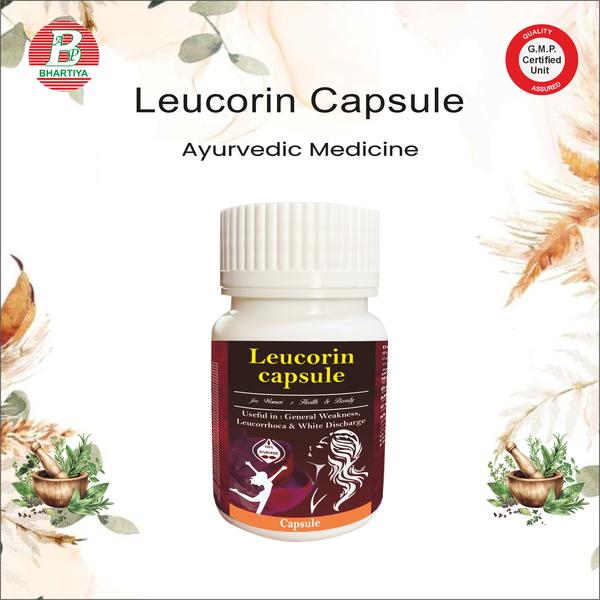
"name": "Leucorin Capsule",
"description": " LEUCORIN CAPSULE \n\n\nProduct Identification\n•\tGeneric Name: Leucorin Capsule\n•\tType: Ayurvedic Patent Medicine\n\nTherapeutic Indications \n•\tHelps manage excessive vaginal discharge, restores vaginal health, and balances hormonal and metabolic functions.\nPrimary Benefits\n•\tHelps reduce excessive vaginal discharge\n•\tRestores normal vaginal health and hygiene\n•\tSupports hormonal balance\n•\tStrengthens reproductive and urinary tract health\n•\tPromotes overall female reproductive wellness\n\nOther Benefits\n•\tImproves Immunity: Supports the body’s natural defense mechanisms, helping prevent recurrent infections.\n•\tSupports Digestive Health: Aids proper digestion and nutrient absorption, which can indirectly help maintain reproductive health.\n•\tEnhances Energy & Vitality: Helps reduce fatigue and general weakness often associated with prolonged leucorrhoea.\n•\tPromotes Hormonal Balance: Helps regulate the endocrine system, which can improve menstrual health and overall reproductive function.\n•\tMaintains Urinary Tract Health: Supports healthy urinary function, reducing the risk of associated irritation or infections.\n\nIngredients:\n Safed Musali (White Musli) \n•\tBotanical Name: Chlorophytum borivilianum\n•\tKey Constituents: Steroidal saponins, Alkaloids, Flavonoids, Polysaccharides, Proteins, Amino acids\nMechanism of Action in Women’s Health – Biochemistry / Pharmacology\n•\tActs as a reproductive tonic, nourishing uterus and vaginal tissues\n•\tRegulates hormonal balance (estrogen and progesterone), supporting menstrual and reproductive health\n•\tExhibits anti-inflammatory and antimicrobial effects, helping prevent infections\n•\tBoosts immunity to reduce recurrent reproductive tract infections\n•\tEnhances energy, vitality, and overall well-being, supporting systemic and reproductive health\n\n Shatavari \n•\tBotanical Name: Asparagus racemosus\n•\tKey Constituents: Steroidal saponins (Shatavarins), Flavonoids, Alkaloids, Polysaccharides, Proteins\nMechanism of Action in Women’s Health – Biochemistry / Pharmacology\n•\tActs as a female reproductive tonic, nourishing uterus and ovaries\n•\tRegulates hormonal balance (estrogen and progesterone), supporting menstrual and lactational health\n•\tExhibits anti-inflammatory and antioxidant effects, protecting reproductive tissues\n\nArjun Chhal (Arjuna Bark) \n•\tBotanical Name: Terminalia arjuna\n•\tKey Constituents: Tannins, Flavonoids, Glycosides, Saponins, Polyphenols, Minerals\nMechanism of Action in Women’s Health – Biochemistry / Pharmacology\n•\tSupports cardiovascular health, improving circulation and heart function\n•\tExhibits antioxidant and anti-inflammatory effects, protecting blood vessels and tissues\n•\tHelps maintain healthy blood pressure and lipid levels, indirectly supporting metabolic and reproductive health\n\n Mulethi (Licorice) \n•\tBotanical Name: Glycyrrhiza glabra\n•\tKey Constituents: Glycyrrhizin, Flavonoids, Saponins, Coumarins, Polysaccharides\nMechanism of Action in Women’s Health – Biochemistry / Pharmacology\n•\tExhibits anti-inflammatory and soothing effects, supporting reproductive tract health\n•\tHelps maintain hormonal balance, particularly estrogen, aiding menstrual and reproductive function\n\n Gokharu (Tribulus terrestris) \n Botanical Name: Tribulus terrestris\nKey Constituents: Saponins (Protodioscin, Tribulosides), Flavonoids, Alkaloids, Sterols\nMechanism of Action in Women’s Health – Biochemistry / Pharmacology\n•\tSupports hormonal balance by modulating luteinizing hormone (LH) and ovarian steroidogenesis, aiding menstrual and reproductive function\n•\tExhibits anti-inflammatory effects, reducing pelvic and systemic inflammation.\n•\tActs as a mild adaptogen, enhancing energy, stamina, and resilience to metabolic or hormonal stress\n\nAmla (Indian Gooseberry) \nBotanical Name: Phyllanthus emblica\n Key Constituents: Vitamin C, Tannins, Flavonoids, Polyphenols, Gallic Acid\nMechanism of Action in Women’s Health – Biochemistry / Pharmacology\n•\tPotent antioxidant, reducing oxidative stress and protecting reproductive and systemic tissue\n•\t Supports hormonal balance by enhancing adrenal and thyroid function, indirectly regulating menstrual cycles\n•\tExhibits anti-inflammatory effects, helping reduce menstrual and pelvic discomfort\n\nKaunch beej (Mucuna pruriens) \n Botanical Name: Mucuna pruriens\n Key Constituents: L-DOPA, Alkaloids, Flavonoids, Saponins, Proteins\nMechanism of Action in Women’s Health – Biochemistry / Pharmacology\n \n•\tSupports hormonal balance by modulating dopamine levels, which can influence prolactin and ovarian function, aiding menstrual and reproductive health\n•\t Exhibits mild adaptogenic and anti-stress effects, enhancing energy, vitality, and resilience to metabolic or hormonal stress\n•\t Acts as a reproductive tonic, promoting ovarian function and fertility\nVidhara (Shatavari, Asparagus racemosus) \n Botanical Name: Asparagus racemosus\nKey Constituents: Saponins (Shatavarins), Flavonoids, Alkaloids, Glycosides, Polysaccharides\nMechanism of Action in Women’s Health – Biochemistry / Pharmacology\n \n•\tSupports hormonal balance, particularly estrogen, aiding menstrual regulation, reproductive health, and fertility\n\n•\tExhibits galactagogue activity, enhancing lactation in postpartum women via prolactin modulation\n•\tActs as a mild adaptogen, improving energy, vitality, and resilience to hormonal or metabolic stress\n•\tShows anti-inflammatory and antioxidant effects, protecting reproductive tissues and reducing menstrual or pelvic discomfort\n\nBala (Sida cordifolia) \n Botanical Name: Sida cordifolia\nKey Constituents: Alkaloids (Ephedrine, Sidanol), Flavonoids, Sterols, Glycosides, Saponins\nMechanism of Action in Women’s Health – Biochemistry / Pharmacology\n• Supports reproductive health by strengthening uterine and ovarian function\n• Exhibits hormonal modulatory effects, aiding menstrual regulation and fertility\n• Acts as a mild adaptogen, enhancing energy, vitality, and resilience to hormonal or metabolic stress\n\nBombax malabaricum (Semal / Silk Cotton Tree) Botanical Name: Bombax malabaricum\n Key Constituents: Flavonoids, Tannins, Saponins, Polysaccharides, Sterols\nMechanism of Action in Women’s Health – Biochemistry / Pharmacology\n•\tSupports reproductive health by promoting uterine and ovarian function\n•\t Exhibits anti-inflammatory and soothing effects, reducing menstrual and pelvic discomfort\n•\t Acts as a hormonal modulator, aiding menstrual regulation and fertility\n\nLajwanti (Mimosa pudica)\nBotanical Name: Mimosa pudica\nKey Constituents: Alkaloids, Flavonoids, Tannins, Saponins, Polysaccharides\n\nMechanism of Action – Women’s Health (Biochemistry / Pharmacology)\n•\tUterine & Ovarian Support: Promotes reproductive organ function.\n•\tAnti-inflammatory: Reduces menstrual cramps and pelvic discomfort.\n•\tHormonal Modulation: Aids menstrual regulation and fertility.\n•\tAntioxidant: Protects reproductive tissues from oxidative stress.\n\nHygrophila spinosa (Talmakhana / Kokilaksha)\nBotanical Name: Hygrophila spinosa\nKey Constituents: Alkaloids, Flavonoids, Saponins, Sterols, Glycosides\n\nMechanism of Action – Women’s Health (Biochemistry / Pharmacology)\n•\tReproductive Support: Promotes uterine and ovarian function, supports fertility.\n•\tAnti-inflammatory: Reduces menstrual cramps and pelvic discomfort.\n•\tHormonal Modulation: Aids in menstrual cycle regulation.\n\n\n Daruhaldi (Berberis aristata)\nBotanical Name: Berberis aristata\nKey Constituents: Berberine, Alkaloids, Flavonoids, Tannins, Phenolic compounds\n\nMechanism of Action – Women’s Health (Biochemistry / Pharmacology)\n•\tReproductive Support: Promotes uterine and ovarian function.\n•\tAnti-inflammatory: Reduces menstrual cramps, pelvic discomfort, and inflammation.\n•\tHormonal Modulation: Aids in menstrual cycle regulation and fertility support.\n\nDevdaru (Cedrus deodara)\nBotanical Name: Cedrus deodara\nKey Constituents: α-Pinene, Limonene, Cedrol, Flavonoids, Tannins, Resinous compounds\n\nMechanism of Action – Women’s Health (Biochemistry / Pharmacology)\n•\tReproductive Support: Promotes uterine and ovarian function.\n•\tAnti-inflammatory: Reduces menstrual cramps and pelvic discomfort.\n•\tHormonal Modulation: Supports menstrual regulation and fertility.\n•\tAntioxidant: Protects reproductive tissues from oxidative stress.\n\nShudh Guggul (Commiphora mukul)\nBotanical Name: Commiphora mukul\nKey Constituents: Guggulsterones, Resin, Flavonoids, Tannins, Volatile oils\n\nMechanism of Action – Women’s Health (Biochemistry / Pharmacology)\n•\tReproductive Support: Promotes uterine and ovarian function.\n•\tAnti-inflammatory: Reduces menstrual cramps and pelvic discomfort.\n•\tHormonal Modulation: Aids menstrual regulation and supports fertility.\n•\tAntioxidant: Protects reproductive tissues from oxidative stress.\n\nKali Mirch (Black Pepper)\nBotanical Name: Piper nigrum\nKey Constituents: Piperine, Volatile oils, Alkaloids, Flavonoids\n\nMechanism of Action – Women’s Health (Biochemistry / Pharmacology)\n•\tReproductive Support: Promotes uterine and ovarian function.\n•\tAnti-inflammatory: Reduces menstrual cramps and pelvic discomfort.\n•\tHormonal Modulation: Supports menstrual regulation and fertility.\n\nAloe (Aloe vera)\nBotanical Name: Aloe vera\nKey Constituents: Anthraquinones, Polysaccharides, Saponins, Flavonoids, Vitamins\n\nMechanism of Action – Women’s Health (Biochemistry / Pharmacology)\n•\tReproductive Support: Promotes uterine and ovarian function.\n•\tAnti-inflammatory: Reduces menstrual cramps and pelvic discomfort.\n•\tHormonal Modulation: Supports menstrual regulation and fertility.\n\n Lodhra (Symplocos racemosa)\nBotanical Name: Symplocos racemosa\nKey Constituents: Tannins, Flavonoids, Glycosides, Alkaloids, Saponins\n\nMechanism of Action – Women’s Health (Biochemistry / Pharmacology)\n•\tReproductive Support: Glycosides and flavonoids modulate estrogen receptor activity → support uterine and ovarian function.\n•\tAnti-inflammatory: Tannins and flavonoids inhibit prostaglandin synthesis → reduce menstrual cramps and pelvic discomfort.\n•\tHormonal Modulation: Alkaloids and glycosides help regulate menstrual cycle and fertility.\n•\tAntioxidant: Flavonoids and tannins scavenge free radicals → protect ovarian and uterine tissues from oxidative stress\n\n Dhataki (Woodfordia fruticosa)\nBotanical Name: Woodfordia fruticosa\nKey Constituents: Flavonoids, Tannins, Glycosides, Anthocyanins, Volatile oils\n\nMechanism of Action – Women’s Health (Biochemistry / Pharmacology)\n•\tReproductive Support: Flavonoids and glycosides may modulate estrogen receptor activity → support uterine and ovarian function.\n•\tAnti-inflammatory: Tannins and flavonoids inhibit prostaglandin synthesis → reduce menstrual cramps and pelvic discomfort.\n•\tHormonal Modulation: Glycosides help in regulating menstrual cycle and fertility.\n\n\nBhringraj (Eclipta alba / Eclipta prostrata)\nBotanical Name: Eclipta alba\nKey Constituents: Alkaloids, Coumestans (Wedelolactone), Flavonoids, Tannins, Saponins\n\nMechanism of Action – Women’s Health (Biochemistry / Pharmacology)\n•\tReproductive Support: Modulates estrogen receptors → promotes uterine & ovarian function.\n•\tAnti-inflammatory: Inhibits COX-2 & prostaglandin synthesis → reduces menstrual cramps.\n•\tHormonal Modulation: Influences steroidogenesis → balances estrogen & progesterone\n\n Vacha (Acorus calamus)\nBotanical Name: Acorus calamus\nKey Constituents: β-Asarone, α-Asarone, Essential oils, Flavonoids, Tannins\n\nMechanism of Action – Women’s Health (Biochemistry / Pharmacology)\n•\tReproductive Support: β-Asarone may modulate estrogen receptor signaling → supports uterine and ovarian function.\n•\tAnti-inflammatory: Inhibits prostaglandin synthesis → reduces menstrual cramps and pelvic discomfort.\n•\tHormonal Modulation: Influences steroidogenesis → helps in menstrual regulation and fertility.\n•\tAntioxidant: Flavonoids and essential oils scavenge ROS → protect reproductive tissues.\n\nTejpatra (Cinnamomum tamala)\nBotanical Name: Cinnamomum tamala\nKey Constituents: Essential oils (Cinnamaldehyde, Eugenol), Tannins, Flavonoids\n\nMechanism of Action – Women’s Health (Biochemistry / Pharmacology)\n•\tReproductive Support: Cinnamaldehyde may modulate estrogen receptor activity → supports uterine and ovarian function.\n•\tAnti-inflammatory: Inhibits prostaglandin synthesis → reduces menstrual cramps and pelvic discomfort.\n•\tHormonal Modulation: Flavonoids influence steroidogenesis → aid in menstrual regulation and fertility.\n•\tAntioxidant: Essential oils and flavonoids scavenge ROS → protect reproductive tissues.\n\n Dalchini (Cinnamomum verum / Cinnamon)\nBotanical Name: Cinnamomum verum\nKey Constituents: Cinnamaldehyde, Eugenol, Tannins, Flavonoids, Volatile oils\n\nMechanism of Action – Women’s Health (Biochemistry / Pharmacology)\n•\tReproductive Support: Cinnamaldehyde and flavonoids modulate estrogen receptor signaling → support uterine and ovarian function.\n•\tAnti-inflammatory: Inhibits prostaglandin synthesis → reduces menstrual cramps and pelvic discomfort.\n•\tHormonal Modulation: Flavonoids influence steroidogenesis → aid menstrual regulation and fertility.\n\nMethi Dana (Fenugreek seeds)\nBotanical Name: Trigonella foenum-graecum\nKey Constituents: Saponins (Diosgenin), Alkaloids, Flavonoids, Fiber, Mucilage\n\nMechanism of Action – Leucorrhoea / Women’s Health (Biochemistry / Pharmacology)\n•\tHormonal Modulation: Diosgenin acts as a phytoestrogen → supports estrogen balance and strengthens vaginal mucosa.\n•\tAnti-inflammatory: Flavonoids inhibit prostaglandin synthesis → reduce inflammation in vaginal and uterine tissues.\n•\tAntioxidant: Saponins and flavonoids scavenge reactive oxygen species (ROS) → protect reproductive tissues from oxidative stress.\n\n Aamguthli (Mango seeds)\nBotanical Name: Mangifera indica\nKey Constituents: Tannins, Polyphenols, Flavonoids, Fatty acids, Mangiferin\n\nMechanism of Action – leucorrhoea / Women’s Health (Biochemistry / Pharmacology)\n•\tAstringent & Reproductive Support: Tannins and polyphenols → tighten vaginal mucosa and reduce excessive discharge.\n•\tAnti-inflammatory: Flavonoids inhibit prostaglandin synthesis → reduce inflammation in vaginal and uterine tissues.\n•\tAntioxidant: Mangiferin and polyphenols scavenge reactive oxygen species (ROS) → protect reproductive tissues from oxidative stress.\n\nSaunth (Dry Ginger)\nBotanical Name: Zingiber officinale\nKey Constituents: Gingerols, Shogaols, Zingerone, Volatile oils, Flavonoids\n\nMechanism of Action – Leucorrhea / Women’s Health (Biochemistry / Pharmacology)\n•\tAnti-inflammatory: Gingerols and shogaols inhibit prostaglandin and cytokine (TNF-α, IL-1β, IL-6) production → reduce vaginal and uterine inflammation.\n•\tAntioxidant: Gingerols and shogaols scavenge reactive oxygen species (ROS) → protect reproductive tissues from oxidative stress.\n•\tHormonal Modulation: Active compounds may support estrogen receptor activity → help normalize vaginal mucosa and secretions.\n\n Ashwagandha (Withania somnifera)\nBotanical Name: Withania somnifera\nKey Constituents: Withanolides, Alkaloids, Saponins, Flavonoids, Iron\n\nMechanism of Action – Women’s Health (Biochemistry / Pharmacology)\n•\tReproductive Support: Withanolides modulate estrogen and progesterone receptor signaling → support ovarian and uterine function.\n•\tAdaptogenic & Hormonal Modulation: Reduces stress-induced cortisol → indirectly normalizes menstrual cycles and improves fertility.\n•\tAnti-inflammatory: Inhibits pro-inflammatory cytokines (TNF-α, IL-1β) → reduces pelvic discomfort and uterine inflammation.\n\nPippali (Piper longum)\nBotanical Name: Piper longum\nKey Constituents: Piperine, Volatile oils, Alkaloids, Flavonoids\n\nMechanism of Action – Women’s Health (Biochemistry / Pharmacology)\n•\tReproductive Support: Piperine may modulate estrogen receptor activity → supports uterine and ovarian function.\n•\tAnti-inflammatory: Inhibits prostaglandin synthesis → reduces menstrual cramps and pelvic inflammation.\n•\tHormonal Modulation: Influences steroidogenesis → aids menstrual regulation and fertility.\n•\tAntioxidant: Flavonoids and piperine scavenge ROS → protect reproductive tissues.\n\n Vidhara (Acorus calamus)\nBotanical Name: Acorus calamus\nKey Constituents: α-Asarone, β-Asarone, Volatile oils, Flavonoids, Tannins\n\nMechanism of Action – Women’s Health (Biochemistry / Pharmacology)\n•\tReproductive Support: α- and β-Asarone modulate estrogen receptor activity → support uterine and ovarian function.\n•\tAnti-inflammatory: Inhibits prostaglandin synthesis → reduces menstrual cramps and pelvic inflammation.\n•\tHormonal Modulation: Influences steroidogenesis → aids menstrual regulation and fertility.\n•\tAntioxidant: Flavonoids and volatile oils scavenge ROS → protect reproductive tissues.\n\n Lahsun (Garlic)\nBotanical Name: Allium sativum\nKey Constituents: Allicin, Sulfur compounds, Flavonoids, Saponins\n\nMechanism of Action – Women’s Health (Biochemistry / Pharmacology)\n•\tReproductive Support: Sulfur compounds may improve uterine and ovarian microcirculation → support reproductive tissue function.\n•\tAnti-inflammatory: Inhibits prostaglandin synthesis and NF-κB pathway → reduces pelvic inflammation and menstrual cramps.\n•\tHormonal Modulation: Flavonoids and organosulfur compounds may influence steroidogenesis → aid menstrual regulation and fertility.\n\nBelgiri (Aegle marmelos)\nBotanical Name: Aegle marmelos\nKey Constituents: Alkaloids (e.g., Marmeline), Tannins, Flavonoids, Coumarins, Essential oils\n\nMechanism of Action – Women’s Health (Biochemistry / Pharmacology)\n•\tReproductive Support: Alkaloids and flavonoids modulate estrogen receptor activity → support uterine and ovarian function.\n•\tAnti-inflammatory: Tannins and coumarins inhibit prostaglandin synthesis → reduce menstrual cramps and pelvic inflammation.\n•\tHormonal Modulation: Flavonoids influence steroidogenesis → help regulate menstrual cycles and fertility.\n\nNaagkesar (Mesua ferrea)\nBotanical Name: Mesua ferrea\nKey Constituents: Xanthones, Coumarins, Flavonoids, Tannins, Essential oils\n\nMechanism of Action – Women’s Health (Biochemistry / Pharmacology)\n•\tReproductive Support: Xanthones and flavonoids modulate estrogen receptor activity → support uterine and ovarian function.\n•\tAnti-inflammatory: Inhibits prostaglandin synthesis and cytokine release → reduces menstrual cramps and pelvic inflammation.\n•\tHormonal Modulation: Coumarins influence steroidogenesis → aid menstrual regulation and fertility.\n\n Dhania (Coriandrum sativum)\nBotanical Name: Coriandrum sativum\nKey Constituents: Essential oils (Linalool, Geraniol), Flavonoids, Tannins, Alkaloids\n\nMechanism of Action – Women’s Health (Biochemistry / Pharmacology)\n•\tReproductive Support: Linalool and flavonoids may modulate estrogen receptor activity → support uterine and ovarian function.\n•\tAnti-inflammatory: Inhibits prostaglandin synthesis → reduces menstrual cramps and pelvic inflammation.\n•\tHormonal Modulation: Flavonoids influence steroidogenesis → help in menstrual regulation and fertility.\n\nCæsalpinia sappan (Sappan wood)\nBotanical Name: Cæsalpinia sappan\nKey Constituents: Brazilein, Flavonoids, Tannins, Phenolic compounds, Saponins\n\nMechanism of Action – Women’s Health (Biochemistry / Pharmacology)\n•\tReproductive Support: Brazilein and flavonoids may modulate estrogen receptor activity → support uterine and ovarian function.\n•\tAnti-inflammatory: Inhibits prostaglandin synthesis and NF-κB pathway → reduces menstrual cramps and pelvic inflammation.\n•\tHormonal Modulation: Phenolic compounds influence steroidogenesis → aid menstrual regulation and fertility.\n\n\n Ashoka (Saraca asoca)\nBotanical Name: Saraca asoca\nKey Constituents: Flavonoids, Tannins, Catechins, Glycosides, Saponins\n\nMechanism of Action – Women’s Health (Biochemistry / Pharmacology)\n•\tReproductive Support: Flavonoids and glycosides modulate estrogen receptor activity → support uterine and ovarian function.\n•\tAnti-inflammatory: Inhibits prostaglandin synthesis → reduces menstrual cramps and pelvic inflammation.\n•\tHormonal Modulation: Glycosides influence steroidogenesis → help regulate menstrual cycles and fertility.\n\nJeera (Cuminum cyminum)\nBotanical Name: Cuminum cyminum\nKey Constituents: Essential oils (Cumin aldehyde, Limonene), Flavonoids, Alkaloids, Tannins\nMechanism of Action – Women’s Health (Biochemistry / Pharmacology)\n•\tReproductive Support: Cumin aldehyde and flavonoids may modulate estrogen receptor activity → support uterine and ovarian function.\n•\tAnti-inflammatory: Inhibits prostaglandin synthesis → reduces menstrual cramps and pelvic inflammation.\n•\tHormonal Modulation: Flavonoids influence steroidogenesis → aid in menstrual regulation and fertility.\n\nAnantmool (Hemidesmus indicus)\nBotanical Name: Hemidesmus indicus\nKey Constituents: Saponins, Flavonoids, Tannins, Coumarins, Essential oils\n\nMechanism of Action – Women’s Health (Biochemistry / Pharmacology)\n•\tReproductive Support: Flavonoids and saponins may modulate estrogen receptor activity → support uterine and ovarian function.\n•\tAnti-inflammatory: Inhibits prostaglandin synthesis → reduces menstrual cramps and pelvic inflammation.\n•\tHormonal Modulation: Coumarins influence steroidogenesis → aid menstrual regulation and fertility.\n•\tAntioxidant: Flavonoids and essential oils scavenge ROS → protect reproductive tissues from oxidative stress.\n\nChavya (Piper chaba)\nBotanical Name: Piper chaba\nKey Constituents: Piperine, Essential oils, Alkaloids, Flavonoids\nMechanism of Action – Women’s Health (Biochemistry / Pharmacology)\n•\tReproductive Support: Piperine modulates estrogen receptor activity → supports uterine and ovarian function.\n•\tAnti-inflammatory: Inhibits prostaglandin synthesis → reduces menstrual cramps and pelvic inflammation.\n•\tHormonal Modulation: Influences steroidogenesis → helps in menstrual regulation and fertility.\n\n Artoon (Oraxylum indicum / Sonapatha)\nBotanical Name: Oroxylum indicum\nKey Constituents: Flavonoids (Baicalein, Chrysin), Tannins, Alkaloids, Phenolic compounds\nMechanism of Action – Women’s Health (Biochemistry / Pharmacology)\n•\tReproductive Support: Flavonoids modulate estrogen receptor activity → support uterine and ovarian function.\n•\tAnti-inflammatory: Inhibits prostaglandin synthesis → reduces menstrual cramps and pelvic inflammation.\n•\tHormonal Modulation: Flavonoids and phenolic compounds influence steroidogenesis → aid menstrual regulation and fertility.\n\nPatha (Cissampelos pareira)\nBotanical Name: Cissampelos pareira\nKey Constituents: Alkaloids (Bebeerine, Cissampeline), Flavonoids, Tannins, Saponins\nMechanism of Action – Women’s Health (Biochemistry / Pharmacology)\n•\tReproductive Support: Alkaloids modulate estrogen receptor activity → support uterine and ovarian function.\n•\tAnti-inflammatory: Inhibits prostaglandin synthesis → reduces menstrual cramps and pelvic inflammation.\n•\tHormonal Modulation: Alkaloids influence steroidogenesis → aid menstrual regulation and fertility.\n\n Piper cubeba (Cubeb)\nBotanical Name: Piper cubeba\nKey Constituents: Piperine, Cubebin, Essential oils, Flavonoids, Alkaloids\nMechanism of Action – Women’s Health (Biochemistry / Pharmacology)\n•\tReproductive Support: Piperine and cubebin modulate estrogen receptor activity → support uterine and ovarian function.\n•\tAnti-inflammatory: Inhibits prostaglandin synthesis → reduces menstrual cramps and pelvic inflammation.\n•\tHormonal Modulation: Influences steroidogenesis → aids menstrual regulation and fertility.\n•\tAntioxidant: Flavonoids and essential oils scavenge ROS → protect reproductive tissues from oxidative stress.\n\nNisoth (Ipomoea turpethum)\nBotanical Name: Ipomoea turpethum\nKey Constituents: Resin glycosides, Alkaloids, Flavonoids, Starch, Phenolic compounds\nMechanism of Action – Women’s Health (Biochemistry / Pharmacology)\n•\tReproductive Support: Resin glycosides and flavonoids modulate estrogen receptor activity → support uterine and ovarian function.\n•\tAnti-inflammatory: Inhibits prostaglandin synthesis → reduces menstrual cramps and pelvic inflammation.\n•\tHormonal Modulation: Alkaloids influence steroidogenesis → aid menstrual regulation and fertility.\n\n Sugar (Sugarcane)\nBotanical Name: Saccharum officinarum\nKey Constituents: Sucrose, Glucose, Fructose, Polyphenols, Flavonoids, Minerals\nMechanism of Action – Women’s Health (Biochemistry / Pharmacology)\n•\tEnergy & Vitality: Provides quick metabolic energy → reduces fatigue and supports systemic wellness.\n•\tReproductive Support: Polyphenols and flavonoids may modulate estrogen receptor activity → indirectly support uterine and ovarian function.\n•\tAntioxidant: Polyphenols and flavonoids scavenge ROS → protect reproductive tissues from oxidative stress.\n\n Lauha Bhasma (Incinerated Iron)\nComposition: Primarily Iron (Fe), along with trace minerals\nMechanism of Action – Women’s Health (Biochemistry / Pharmacology)\n•\tReproductive Support / Hematopoiesis: Supplies bioavailable iron → supports hemoglobin synthesis → improves oxygen delivery to reproductive tissues.\n•\tEnergy & Vitality: Corrects iron-deficiency anemia → reduces fatigue and boosts systemic energy.\n•\tHormonal Support: Adequate iron is essential for proper synthesis of steroid hormones → indirectly supports menstrual regulation and fertility.\n\n Shudh Shilajit (Purified Shilajit)\nComposition: Fulvic acid, Humic acid, Minerals (Iron, Zinc, Magnesium), Dibenzo-α-pyrones, Amino acids\nMechanism of Action – Women’s Health (Biochemistry / Pharmacology)\n•\tReproductive Support: Fulvic acid and minerals modulate estrogen receptor activity → support uterine and ovarian function.\n•\tHormonal Modulation: Enhances steroidogenesis → helps in menstrual regulation and fertility.\n•\tAnti-inflammatory: Inhibits prostaglandin synthesis and cytokine activity → reduces menstrual cramps and pelvic inflammation.\n\nUse : useful in general weakness,\nleucorrhoea & white discharge\n\nDosage \nForm: Capsule\n•\tDose: 1–2 capsules, twice daily\nAdministration Guidelines (Point-wise):\n1.\tTiming: Take after meals (commonly after breakfast and dinner) to aid digestion and absorption.\n2.\tWith Vehicle: Can be taken with warm water, milk, or honey as per preference or practitioner advice.\n3.\tCourse Duration: Usually recommended for 2–3 months, depending on individual health and response.\n4.\tPrecautions:\no\tConsult a qualified Ayurvedic practitioner before starting.\no\tMonitor blood sugar levels regularly, especially if on antidiabetic medications.\n5.\tMonitoring: Regular checkups for blood glucose and overall metabolic health are advised during prolonged use.\n\n\nleuco care capsule uses, leucoril capsules, leucorin capsule\nleucorin capsule amazon india, leucorin capsule available in india\nleucorin capsule available near me, leucorin capsule benefits\nleucorin capsule benefits in hindi, leucorin capsule blinkit\nleucorin capsule buy, leucorin capsule buy online\nleucorin capsule delhi, leucorin capsule excel sheet\nleucorin capsule flipkart, leucorin capsule gst rate\nleucorin capsule jan aushadhi kendra, leucorin capsule jiomart\nleucorin capsule kaisa hota hai, leucorin capsule ke fayde\nleucorin capsule ke fayde in hindi, leucorin capsule lagane ke fayde\nleucorin capsule latest price, leucorin capsule life\nleucorin capsule list, leucorin capsule manual\nleucorin capsule manufacturer, leucorin capsule name\nleucorin capsule name list, leucorin capsule near me\nleucorin capsule new, leucorin capsule number\nleucorin capsule on amazon, leucorin capsule online\nleucorin capsule online order, leucorin capsule online shopping\nleucorin capsule price, leucorin capsule price in india\nleucorin capsule quality, leucorin capsule quantity\nleucorin capsule rate, leucorin capsule review\nleucorin capsule review in hindi, leucorin capsule se kya hota hai\nleucorin capsule size, leucorin capsule size chart\nleucorin capsule spare parts, leucorin capsule test report\nleucorin capsule time period, leucorin capsule uses\nleucorin capsule uses in hindi, leucorine capsule uses in hindi",
"price": 480.0,
"discountamount": 240.0,
"currencycode": "INR",
"priority": 1000000,
"isfreeshipmentavailable": false,
"shipmentduration": 1,
"_keywords": null,
"isarchived": false,
"isavailable": true,
"applicationid": null,
"productindex": 47,
"imageuri": "https://productimages.withfloats.com/actual/698adcb96d55d349f7588826.jpg",
"tileimageuri": "https://productimages.withfloats.com/tile/698adcb96d55d349f7588826.jpg",
"images": null,
"totalqueries": 0,
"gpid": null,
"groupproductid": null,
"createdon": "2026-02-10T07:22:31.619Z",
"updatedon": "2026-02-18T08:48:29.382Z",
"buyonlinelink": null,
"producturl": "http://WWW.BHARTIYAAYURVEDICPHARMACY.COM/products/leucorin-capsule/47",
"availableunits": -1.0,
"iscodavailable": true,
"isprepaidonlineavailable": true,
"maxcodorders": -1,
"maxprepaidonlineorders": -1,
"uniquepaymenturl": null,
"brandname": "Bkula Fort",
"category": "lLeucorin Capsule 50 Cap X 12",
"tags": [],
"variants": false,
"keyspecification": null,
"otherspecifications": null,
"pickupaddressreferenceid": null,
"paymenttype": "AssuredPurchase",
"producttype": "products",
"hsncode": null,
"gstslab": 0.0,
"isnotforsale": false
},
{
"_id": "6989ad1742154005d20694ab",
"fptag": "BHARTIYEAYURVEDICPHARMACY",
"merchantname": null,
"customwidgets": null,
"externalsourceid": null,
"name": "Immune capsule",
"description": " IMMUNE CAPSULE \n\nProduct Identification\n•\tGeneric Name: Immune Capsule\n•\tType: Ayurvedic Patent Medicine\n•\tPrimary Indication Area: Supports Immunity\n Therapeutic Indications\n•\tUseful in the management of weak immunity and frequent infections.\nPrimary benefits:\n•\tStrengthens the body’s natural defense system\n•\tSupports resistance against common infections like cold, cough, and seasonal illnesses\n•\tBoosts energy and vitality\n•\tSupports respiratory and overall health\nOther benefits:\n•\tRich in Antioxidants: The herbal ingredients in Immune Capsule help neutralize free radicals, protecting cells from oxidative stress and supporting long-term health. This helps slow down cellular damage and boosts overall vitality.\n•\tSupports Digestive Health: A healthy gut is closely linked to strong immunity. The capsule’s herbs help improve digestion, nutrient absorption, and bowel regularity, which indirectly strengthens the immune system.\n•\tEnhances Overall Well-being: By improving energy levels and reducing fatigue, it promotes better physical and mental performance during daily activities.\n•\tSupports Respiratory Health: Certain herbs in the formulation help maintain healthy lungs and respiratory function, reducing susceptibility to infections of the respiratory tract.\n•\tBalances Body Systems: Ayurvedic herbs help maintain harmony in body systems, promoting general wellness and resilience against stress and illness.\n•\tNatural & Gentle: Being herbal and Ayurvedic, it is usually well-tolerated and can be taken regularly as a supportive immunity booster.\n•\tMay Reduce Frequency of Infections: Regular use may help lower the risk of recurrent minor infections, supporting long-term immune strength.\n\nIngredients: \n Arjun Chhal\n•\tBotanical Name: Terminalia arjuna \n•\tKey Constituents: \nKey Constituents:\n•\tTannins\n•\tFlavonoids\n•\tSaponins\n•\tPhenolic compounds\n\nMechanism of action in immunity \nThe antioxidants in Arjun bark fight harmful free radicals.\no\tThis keeps immune cells safe and healthy.\n2.\tBoosts immune cells\no\tSaponins and flavonoids help immune cells work better.\no\tThey increase antibody production and strengthen the body’s defense.\n\nHaldi (Turmeric)\nBotanical Name: Curcuma longa\nKey Constituents:\n•\tCurcumin\n•\tVolatile oils (like turmerone)\n•\tFlavonoids\n•\tPhenolic compounds\n\nMechanism of Action in Immunity\n1.\tProtects body cells\no\tCurcumin is a strong antioxidant that fights free radicals.\no\tKeeps immune cells healthy and prevents cellular damage.\n2.\tBoosts immune response\no\tStimulates activation of immune cells like T-cells, B-cells, and natural killer (NK) cells.\no\tEnhances antibody production.\n\nTulsi (Holy Basil) \nBotanical Name: Ocimum sanctum / Ocimum tenuiflorum\n Key Constituents: Flavonoids, Phenolic acids, Eugenol, Tannins, Vitamins (C, A)\nMechanism of Action as an Antioxidant – Biochemistry / Pharmacology\n1.\tStops Free Radicals:\n• Flavonoids and phenolic acids remove harmful molecules called free radicals, protecting cells from damage.\n2.\tProtects Cell Membranes:\n• Compounds like eugenol prevent damage to cell membranes caused by oxidation.\n\nAmla (Indian Gooseberry) \nBotanical Name: Phyllanthus emblica / Emblica officinalis\n Key Constituents: Vitamin C, Flavonoids, Tannins, Phenolic compounds, Gallic acid\nMechanism of Action as an Antioxidant – Biochemistry / Pharmacology\n1.\tFree Radical Scavenging:\n• Vitamin C and flavonoids remove harmful free radicals, protecting cells from oxidative damage.\n2.\tProtects Cell Membranes:\n• Phenolic compounds prevent damage to cell membranes and tissues caused by oxidation.\n\n Mulethi (Licorice) \n Botanical Name: Glycyrrhiza glabra\nKey Constituents: Glycyrrhizin, Flavonoids, Saponins, Tannins, Phenolic compounds\nMechanism of Action in Immunity – Biochemistry / Pharmacology\n1.\tImmune System Modulation:\n• Glycyrrhizin and flavonoids enhance activity of immune cells like macrophages, natural killer (NK) cells, and T-lymphocytes, helping the body fight infections.\n2.\tAnti-Inflammatory Effect:\n• Suppresses pro-inflammatory cytokines (TNF-α, IL-1β, IL-6) and inhibits NF-κB signaling, reducing inflammation during infections.\n\n Dalchini (Cinnamon) \nBotanical Name: Cinnamomum verum / Cinnamomum zeylanicum\nKey Constituents: Cinnamaldehyde, Eugenol, Flavonoids, Tannins, Phenolic acids\nMechanism of Action in Immunity – Biochemistry / Pharmacology\n1.\tImmune Modulation:\n• Flavonoids and cinnamaldehyde enhance activity of immune cells like macrophages and T-lymphocytes, improving the body’s defense against infections.\n2.\tAnti-Inflammatory Effect:\n• Suppresses pro-inflammatory cytokines (TNF-α, IL-1β, IL-6) and inhibits NF-κB signaling, reducing inflammation.\n\nGiloy (Tinospora cordifolia) \nBotanical Name: Tinospora cordifolia\nKey Constituents: Alkaloids (tinosporine), Glycosides, Steroids, Flavonoids, Polysaccharides\nMechanism of Action in Immunity – Biochemistry / Pharmacology\n1.\tImmune System Modulation:\n• Polysaccharides and glycosides enhance the activity of macrophages, T-lymphocytes, and natural killer (NK) cells, boosting the body’s defense against infections.\n2.\tAnti-Inflammatory Effect:\n• Suppresses pro-inflammatory cytokines (TNF-α, IL-1β, IL-6) and inhibits NF-κB signaling, reducing tissue inflammation.\n\nBhringraj (Eclipta alba) \nBotanical Name: Eclipta alba / Eclipta prostrata Key Constituents: Wedelolactone, Flavonoids, Alkaloids, Coumestans, Triterpenoids\nMechanism of Action in Immunity – Biochemistry / Pharmacology\n1.\tImmune System Modulation:\n• Flavonoids and wedelolactone enhance macrophage and lymphocyte activity, strengthening the body’s defense mechanisms.\n2.\tAnti-Inflammatory Effect:\n• Inhibits pro-inflammatory cytokines (TNF-α, IL-1β, IL-6) and NF-κB signaling, reducing tissue inflammation.\n\n Punarnava (Boerhavia diffusa) \n Botanical Name: Boerhavia diffusa\nKey Constituents: Alkaloids (boeravinone), Flavonoids, Glycosides, Sterols, Phenolic compounds\nMechanism of Action in Immunity – Biochemistry / Pharmacology\n1.\tImmune System Modulation:\n• Flavonoids and glycosides enhance activity of macrophages and T-lymphocytes, strengthening the body’s defense against infections.\n2.\tAnti-Inflammatory Effect:\n• Suppresses pro-inflammatory cytokines (TNF-α, IL-1β, IL-6) and inhibits NF-κB signaling, reducing tissue inflammation.\n\nGokharu (Tribulus terrestris) \n Botanical Name: Tribulus terrestris\n Key Constituents: Saponins (protodioscin), Flavonoids, Alkaloids, Glycosides, Sterols\nMechanism of Action in Immunity – Biochemistry / Pharmacology\n1.\tImmune System Modulation:\n• Saponins and flavonoids enhance macrophage and lymphocyte activity, improving the body’s defense against infections.\n2.\tAnti-Inflammatory Effect:\n• Suppresses pro-inflammatory cytokines (TNF-α, IL-1β, IL-6), reducing inflammation in tissues.\n\n Daruhaldi (Indian Barberry) \nBotanical Name: Berberis aristata\nKey Constituents: Berberine (alkaloid), Flavonoids, Tannins, Phenolic compounds\nMechanism of Action in Immunity – Biochemistry / Pharmacology\n1.\tImmune System Modulation:\n• Berberine and flavonoids enhance the activity of macrophages, natural killer (NK) cells, and lymphocytes, strengthening the body’s defense.\n2.\tAnti-Inflammatory Effect:\n• Suppresses pro-inflammatory cytokines (TNF-α, IL-1β, IL-6) and inhibits NF-κB signaling, reducing tissue inflammation.\n3.\tAntioxidant Support:\n• Flavonoids and phenolic compounds neutralize free radicals, protecting immune cells from oxidative stress.\n\nAshwagandha (Indian Ginseng) \n Botanical Name: Withania somnifera\n Key Constituents: Withanolides, Alkaloids, Saponins, Flavonoids, Sterols\nMechanism of Action in Immunity – Biochemistry / Pharmacology\n1.\tImmune System Modulation:\n• Withanolides and flavonoids enhance activity of macrophages, natural killer (NK) cells, and T-lymphocytes, boosting the body’s defense.\n2.\tAnti-Inflammatory Effect:\n• Suppresses pro-inflammatory cytokines (TNF-α, IL-1β, IL-6) and inhibits NF-κB signaling, reducing inflammation.\n\n Shatavari (Asparagus racemosus) \nBotanical Name: Asparagus racemosus\n Key Constituents: Shatavarins (steroidal saponins), Flavonoids, Alkaloids, Glycosides, Polysaccharides\nMechanism of Action in Immunity – Biochemistry / Pharmacology\n1.\tImmune System Modulation:\n• Shatavarins and polysaccharides enhance macrophage, T-lymphocyte, and natural killer (NK) cell activity, boosting the body’s defense against infections.\n2.\tAnti-Inflammatory Effect:\n• Suppresses pro-inflammatory cytokines (TNF-α, IL-1β, IL-6) and inhibits NF-κB signaling, reducing tissue inflammation.\n\n\n Brahmi (Bacopa monnieri) \n Botanical Name: Bacopa monnieri\nKey Constituents: Bacosides (A and B), Flavonoids, Alkaloids, Saponins, Phenolic compounds\nMechanism of Action in Immunity – Biochemistry / Pharmacology\n1.\tImmune System Modulation:\n• Bacosides and flavonoids enhance macrophage and lymphocyte activity, strengthening the body’s defense against infections.\n2.\tAnti-Inflammatory Effect:\n• Suppresses pro-inflammatory cytokines (TNF-α, IL-1β, IL-6) and inhibits NF-κB signaling, reducing tissue inflammation.\n\nSafed Musli (Chlorophytum borivilianum) \n Botanical Name: Chlorophytum borivilianum\n Key Constituents: Steroidal saponins, Flavonoids, Polysaccharides, Alkaloids, Glycosides\nMechanism of Action in Immunity – Biochemistry / Pharmacology\n1.\tImmune System Modulation:\n• Steroidal saponins and polysaccharides enhance activity of macrophages, T-lymphocytes, and natural killer (NK) cells, boosting the body’s defense.\n2.\tAnti-Inflammatory Effect:\n• Suppresses pro-inflammatory cytokines (TNF-α, IL-1β, IL-6) and inhibits NF-κB signaling, reducing inflammation.\n\nSaunth (Dry Ginger) \n Botanical Name: Zingiber officinale\n Key Constituents: Gingerols, Shogaols, Flavonoids, Phenolic compounds, Volatile oils\nMechanism of Action in Immunity – Biochemistry / Pharmacology\n1.\tImmune System Modulation:\n• Gingerols and flavonoids enhance macrophage, T-lymphocyte, and natural killer (NK) cell activity, supporting the body’s defense.\n2.\tAnti-Inflammatory Effect:\n• Inhibits pro-inflammatory cytokines (TNF-α, IL-1β, IL-6) and NF-κB signaling, reducing inflammation in tissues.\n\nKali Mirch (Black Pepper) \nBotanical Name: Piper nigrum\n Key Constituents: Piperine, Alkaloids, Flavonoids, Volatile oils, Phenolic compounds\nMechanism of Action in Immunity – Biochemistry / Pharmacology\n1.\tImmune System Modulation:\n• Piperine and flavonoids enhance macrophage and lymphocyte activity, improving the body’s defense against infections.\n2.\tAnti-Inflammatory Effect:\n• Inhibits pro-inflammatory cytokines (TNF-α, IL-1β, IL-6) and NF-κB signaling, reducing inflammation.\n\nPippali (Long Pepper) \n Botanical Name: Piper longum \nKey Constituents: Piperine, Alkaloids, Flavonoids, Volatile oils, Phenolic compounds\nMechanism of Action in Immunity – Biochemistry / Pharmacology\n1.\tImmune System Modulation:\n• Piperine and flavonoids enhance macrophage, T-lymphocyte, and natural killer (NK) cell activity, boosting the body’s defense.\n2.\tAnti-Inflammatory Effect:\n• Suppresses pro-inflammatory cytokines (TNF-α, IL-1β, IL-6) and inhibits NF-κB signaling, reducing inflammation.\n\nMitha Soda (Sodium Bicarbonate) \n Chemical Name: Sodium Bicarbonate (NaHCO₃)\nKey Properties: Alkalinizing agent, buffering agent\nMechanism of Action in Immunity / Body Defense – Biochemistry / Pharmacology\n1.\tAcid-Base Balance:\n• Neutralizes excess stomach acid or blood acidity, maintaining pH balance which indirectly supports cellular functions, including immune cells.\n2.\tAntioxidant Support (Indirect):\n• By maintaining pH, it helps prevent oxidative stress caused by acid-base imbalance in tissues.\n\nShudh Guggul (Indian Bdellium / Commiphora mukul) \n Botanical Name: Commiphora mukul\n Key Constituents: Guggulsterones, Flavonoids, Triterpenoids, Resin\nMechanism of Action in Immunity – Biochemistry / Pharmacology\n1.\tImmune System Modulation:\n• Guggulsterones and flavonoids enhance macrophage and lymphocyte activity, boosting the body’s defense against infections.\n2.\tAnti-Inflammatory Effect:\n• Suppresses pro-inflammatory cytokines (TNF-α, IL-1β, IL-6) and inhibits NF-κB signaling, reducing inflammation.\n\n Lahsun (Garlic) \nBotanical Name: Allium sativum\n Key Constituents: Allicin, Sulphur compounds, Flavonoids, Phenolic compounds, Saponins\nMechanism of Action in Immunity – Biochemistry / Pharmacology\n1.\tImmune System Modulation:\n• Allicin and sulfur compounds enhance activity of macrophages, natural killer (NK) cells, and lymphocytes, strengthening the body’s defense.\n2.\tAnti-Inflammatory Effect:\n• Inhibits pro-inflammatory cytokines (TNF-α, IL-1β, IL-6) and NF-κB signaling, reducing tissue inflammation.\n\nHing (Asafoetida) \n Botanical Name: Ferula asafoetida\n Key Constituents: Ferulic acid, Resin, Sulfur compounds, Flavonoids, Coumarins\nMechanism of Action in Immunity – Biochemistry / Pharmacology\n1.\tImmune System Modulation:\n• Sulfur compounds and flavonoids enhance activity of macrophages and lymphocytes, improving the body’s defense against infections.\n2.\tAnti-Inflammatory Effect:\n• Inhibits pro-inflammatory cytokines (TNF-α, IL-1β, IL-6) and NF-κB signaling, reducing inflammation in tissues.\n\nCalastrus paniculatus (Jyotishmati / Clammy Milkweed) \n Botanical Name: Calastrus paniculatus\nKey Constituents: Alkaloids, Flavonoids, Glycosides, Sterols, Phenolic compounds\nMechanism of Action in Immunity – Biochemistry / Pharmacology\n1.\tImmune System Modulation:\n• Alkaloids and flavonoids enhance macrophage and lymphocyte activity, improving the body’s defense against infections.\n2.\tAnti-Inflammatory Effect:\n• Suppresses pro-inflammatory cytokines (TNF-α, IL-1β, IL-6) and NF-κB signaling, reducing inflammation in tissues.\n\nindication :\nuseful in general disorder, cough, cold.\n\nDosage \n\n•\tAdults: 1–2 capsules twice daily\n•\tHow to take: With plain water after meals\n•\tDuration: As directed by a physician\n•\tPrecautions:\no\tConsult a doctor if pregnant, lactating, or having chronic illnesses\no\tAdjust dose based on age, severity, or individual health conditions\n\n\ncapsule immune, capsule immune booster\ncapsule immune evasion, capsule immune plus\ncapsule immune support supplements\ndeep immune capsule, emba immune capsule\ni immune capsule, i immune capsule uses\nimmune active capsules, immune advance capsule\nimmune all capsule, immune booster capsule\nimmune booster capsule price, immune capsule price\nimmune capsules, immune capsules uses\nimmune care capsule, immune plus capsule benefits in hindi\nimmune rich capsules, immune smart capsule uses\nimmune smart kee pharma, immune support capsule\nimmune support natural world capsule\nimmune system booster capsule, immune system capsule\nis immune plus good for you, what immune system\nwhen immune system is weak\nwhen immune system is weak what happens\nwhen immunity is low, where is immune system in body",
"price": 330.0,
"discountamount": 165.0,
"currencycode": "INR",
"priority": 1000000,
"isfreeshipmentavailable": false,
"shipmentduration": 1,
"_keywords": null,
"isarchived": false,
"isavailable": true,
"applicationid": null,
"productindex": 45,
"imageuri": "https://productimages.withfloats.com/actual/6989ad20f14bf2bc40a01a17.jpg",
"tileimageuri": "https://productimages.withfloats.com/tile/6989ad20f14bf2bc40a01a17.jpg",
"images": null,
"totalqueries": 0,
"gpid": null,
"groupproductid": null,
"createdon": "2026-02-09T09:47:03.327Z",
"updatedon": "2026-02-18T09:19:06.76Z",
"buyonlinelink": null,
"producturl": "http://WWW.BHARTIYAAYURVEDICPHARMACY.COM/products/immune-capsule/45",
"availableunits": -1.0,
"iscodavailable": true,
"isprepaidonlineavailable": true,
"maxcodorders": -1,
"maxprepaidonlineorders": -1,
"uniquepaymenturl": null,
"brandname": "Bakula Fort",
"category": "Immune capsule 50 cap X 24",
"tags": [],
"variants": false,
"keyspecification": null,
"otherspecifications": null,
"pickupaddressreferenceid": null,
"paymenttype": "AssuredPurchase",
"producttype": "products",
"hsncode": null,
"gstslab": 0.0,
"isnotforsale": false
},
{
"_id": "698705b4927481ba212bd210",
"fptag": "BHARTIYEAYURVEDICPHARMACY",
"merchantname": null,
"customwidgets": null,
"externalsourceid": null,
"name": "Asthonil Granules",
"description": " ASTHONIL GRANULES \n\nProduct Identification\n•\tGeneric Name: Asthonil Granule \n•\tType: Ayurvedic Patent Medicine\n•\tPrimary Indication Area: Supports respiratory health, particularly useful in bronchitis, cough, and asthma\n•\tTherapeutic Indications: support respiratory function, help in relieving cough, reducing congestion, and promoting lung health naturally\nKey benefits include:\n•\tRespiratory Support: Helps maintain healthy lung function and eases breathing.\n•\tBronchitis & Asthma Relief: Reduces symptoms like cough, congestion, and respiratory discomfort.\n•\tCough Management: Soothes the throat and reduces persistent coughing.\n•\tImmune Support: Strengthens the body’s natural defenses against infections.\n•\tAnti-inflammatory Action: Helps reduce mild inflammation in the respiratory tract.\n•\tOverall Vitality: Supports energy levels and general wellness.\n.\nIngredients:\n Gajwan (Onosma bracteatum) \nBotanical Name: Onosma bracteatum\nAyurvedic Name: Gojihva / Gaozaban\nKey Phytoconstituents:\n• Flavonoids & Phenolics – antioxidant, anti-inflammatory\n• Naphthoquinones (shikonins) – antimicrobial, anti-inflammatory\n• Coumarins & Glycosides – support fluid balance\n• Tannins & Mucilage – demulcent, soothe mucous membranes\n• Minerals & Alkaloids – tonic, diuretic\nMechanism / Actions:\n1.\tAnti-inflammatory & antioxidant → reduce airway inflammation\n2.\tDemulcent & expectorant → soothe throat, clear mucus\n3.\tSpasmolytic → relax airway smooth muscles → easier breathing\n\n Arjun Chhal (Terminalia arjuna Bark) \nBotanical Name: Terminalia arjuna\nAyurvedic Name: Arjuna Chhal / Arjuna Bark\nKey Phytoconstituents:\n• Triterpenoid saponins (Arjunic acid, Arjunolic acid) – mild anti-inflammatory\n• Flavonoids & Polyphenols – antioxidant, anti-inflammatory\n• Tannins – protect airway and lung tissue\n• Minerals (Calcium, Magnesium) – support tissue function\n• Glycosides – improve circulation\nMechanism / Actions:\n•\tAnti-inflammatory & antioxidant → reduce airway inflammation and oxidative damage\n•\tTissue protective → prevent chronic airway remodelling\n•\tMild bronchodilator support → relax airway smooth muscles\n•\tCirculation booster → support oxygen delivery to tissues\n•\tRespiratory support → may aid chronic bronchitis and cough\n Haldi (Curcuma longa Rhizome) \nBotanical Name: Curcuma longa\nAyurvedic Name: Haldi / Haridra\nKey Phytoconstituents:\n• Curcuminoids (Curcumin, Desmethoxycurcumin) – anti-inflammatory, antioxidant\n• Volatile oils (Turmerone, Zingiberene) – antimicrobial, anti-inflammatory\n• Polysaccharides – immune-modulatory\n• Minerals (Iron, Manganese) – support tissue repair\nMechanism / Actions:\n•\tAnti-inflammatory & antioxidant → reduces airway and tissue inflammation\n•\tImmunomodulatory → balances immune response in allergic conditions\n•\tAntimicrobial → protects against respiratory infections\n•\tTissue protective → prevents oxidative damage in lungs and other organs\n•\tMild bronchodilator → supports easier breathing\n Amla (Phyllanthus emblica Fruit) \nBotanical Name: Phyllanthus emblica\nAyurvedic Name: Amla / Amalaki\nKey Phytoconstituents:\n• Vitamin C (Ascorbic acid) – antioxidant, immune booster\n• Flavonoids & Polyphenols – anti-inflammatory, antioxidant\n• Tannins – astringent, protect tissues\n• Minerals (Calcium, Phosphorus) – support tissue function\n• Gallic acid & Ellagic acid – anti-inflammatory, antimicrobial\nMechanism / Actions:\n•\tAntioxidant → reduces oxidative stress in airways\n•\tAnti-inflammatory → decreases cytokine-driven airway inflammation\n•\tImmunomodulatory → strengthens immune response to infections\n•\tMucosa protective → soothes airway and respiratory tract\n•\tSupports tissue repair → aids recovery in bronchitis and cough\n Mulethi (Glycyrrhiza glabra Root) \nBotanical Name: Glycyrrhiza glabra\nAyurvedic Name: Mulethi / Yashtimadhu\nKey Phytoconstituents:\n• Glycyrrhizin – anti-inflammatory, demulcent\n• Flavonoids & Isoflavonoids – antioxidant, anti-inflammatory\n• Saponins – expectorant, mild bronchodilator\n• Polysaccharides – soothe mucous membranes\n• Minerals (Calcium, Potassium) – support tissue function\nMechanism / Actions:\n•\tDemulcent & expectorant → soothes throat, reduces mucus irritation\n•\tAnti-inflammatory → decreases airway inflammation in asthma/bronchitis\n•\tMild bronchodilator → relaxes smooth muscles of airways\n•\tAntioxidant → protects lung tissue from oxidative stress\n•\tTissue protective → supports recovery of irritated respiratory mucosa\n Bhringraj (Eclipta alba Whole Plant / Leaves) \nBotanical Name: Eclipta alba\nAyurvedic Name: Bhringraj / Bhringraja\nKey Phytoconstituents:\n• Coumestans (Wedelolactone) – anti-inflammatory, antioxidant\n• Flavonoids & Phenolics – antioxidant, tissue protective\n• Alkaloids & Glycosides – liver and tissue support\n• Essential oils – antimicrobial\n• Minerals (Iron, Calcium) – support tissue repair\nMechanism / Actions:\n•\tAnti-inflammatory & antioxidant → reduces airway and tissue inflammation\n•\tImmunomodulatory → supports body’s defense in respiratory infections\n•\tTissue protective → supports recovery of airway mucosa\n•\tMild antimicrobial → protects against secondary infections\n•\tDetoxifying → supports liver function and systemic wellness\n Sonth (Zingiber officinale Rhizome – Dry Ginger) \nBotanical Name: Zingiber officinale\nAyurvedic Name: Sonth / Sukshma Shunti\nKey Phytoconstituents:\n• Gingerols & Shogaols – anti-inflammatory, antioxidant, bronchodilator\n• Essential oils (Zingiberene, Bisabolene) – antimicrobial, spasmolytic\n• Polysaccharides – demulcent, soothe mucous membranes\n• Minerals (Magnesium, Potassium) – support tissue function\nMechanism / Actions:\n•\tAnti-inflammatory & antioxidant → reduces airway inflammation and oxidative stress\n•\tBronchodilator → relaxes smooth muscles of airways → easier breathing\n•\tExpectorant & demulcent → soothes throat, clears mucus\n•\tAntimicrobial → protects against respiratory infections\n•\tDigestive support → improves metabolism and systemic immunity\n Kali Mirch (Piper nigrum Fruit) \nBotanical Name: Piper nigrum\nAyurvedic Name: Kali Mirch / Maricha\nKey Phytoconstituents:\n• Piperine – bronchodilator, anti-inflammatory, bioavailability enhancer\n• Essential oils (Caryophyllene, Pinene) – antimicrobial, spasmolytic\n• Alkaloids – stimulate digestion and circulation\n• Minerals (Iron, Manganese) – support tissue and metabolic function\nMechanism / Actions:\n•\tBronchodilator → relaxes airway smooth muscles → easier breathing\n•\tAnti-inflammatory & antioxidant → reduces airway inflammation\n•\tExpectorant → clears mucus from respiratory tract\n•\tBioavailability enhancer → improves absorption of other herbs and nutrients\n•\tAntimicrobial → protects against respiratory infections\n Pippali (Piper longum Fruit) \nBotanical Name: Piper longum\nAyurvedic Name: Pippali / Pippalimula\nKey Phytoconstituents:\n• Piperine – bronchodilator, anti-inflammatory, enhances bioavailability\n• Essential oils (Caryophyllene, Pinene) – antimicrobial, spasmolytic\n• Alkaloids & Resins – support respiratory and digestive health\n• Minerals (Iron, Zinc) – tissue repair and immune support\nMechanism / Actions:\n•\tBronchodilator → relaxes airway smooth muscles → easier breathing\n•\tAnti-inflammatory & antioxidant → reduces airway inflammation\n•\tExpectorant → loosens and clears mucus from respiratory tract\n•\tBioavailability enhancer → improves absorption and efficacy of other herbs\n•\tAntimicrobial → protects against respiratory infections\n Myristica malabarica \nBotanical Name: Myrstica malabarica\nAyurvedic Name: Malabar Kaiphal\nKey Phytoconstituents:\n• Essential oils (Myristicin, Elemicin) – anti-inflammatory, spasmolytic\n• Lignans & Phenolics – antioxidant, antimicrobial\n• Alkaloids – support respiratory and digestive health\n• Minerals (Calcium, Iron) – tissue and metabolic suppor t\nMechanism / Actions:\n•\tBronchodilator → relaxes airway smooth muscles → easier breathing\n•\tAnti-inflammatory & antioxidant → reduces airway inflammation\n•\tExpectorant → clears mucus from respiratory tract\n•\tAntimicrobial → protects against respiratory infections\n•\tDigestive & systemic support → improves metabolism and wellness\n Vasa (Adhatoda vasica Leaves / Whole Plant) \nBotanical Name: Adhatoda vasica\nAyurvedic Name: Vasa / Vasaka\nKey Phytoconstituents:\n• Vasicine & Vasicinone – bronchodilator, expectorant, antitussive\n• Alkaloids – anti-inflammatory, antimicrobial\n• Flavonoids & Phenolics – antioxidant, reduce oxidative stress\n• Essential oils – antimicrobial\n• Minerals (Iron, Calcium) – tissue support\nMechanism / Actions:\n•\tBronchodilator → relaxes airway smooth muscles → eases breathing\n•\tExpectorant → loosens and clears mucus from respiratory tract\n•\tAnti-inflammatory & antioxidant → reduces airway inflammation and oxidative damage\n•\tAntitussive → suppresses excessive coughing\n•\tAntimicrobial → protects against respiratory infections\n Apamarg (Achyranthes aspera Whole Plant / Leaves) \nBotanical Name: Achyranthes aspera\nAyurvedic Name: Apamarg / Apamarg\nKey Phytoconstituents:\n• Saponins – anti-inflammatory, expectorant\n• Alkaloids – bronchodilator, antimicrobial\n• Flavonoids & Phenolics – antioxidant, reduce oxidative stress\n• Minerals (Calcium, Iron) – tissue support\nMechanism / Actions:\n•\tExpectorant → helps clear mucus from airways\n•\tAnti-inflammatory & antioxidant → reduces airway inflammation\n•\tMild bronchodilator → relaxes airway smooth muscles\n•\tAntimicrobial → protects against respiratory infections\n•\tTissue supportive → aids recovery of irritated respiratory mucosa\n Illicium verum (Star Anise Fruit) \nBotanical Name: Illicium verum\nAyurvedic / Common Name: Star Anise / Illicium\nKey Phytoconstituents:\n• Anethole – antimicrobial, spasmolytic, bronchodilator\n• Flavonoids & Phenolics – antioxidant, anti-inflammatory\n• Essential oils – digestive and respiratory support\n• Minerals (Calcium, Iron) – tissue and metabolic support\nMechanism / Actions:\n•\tBronchodilator → relaxes airway smooth muscles → easier breathing\n•\tExpectorant → helps clear mucus from respiratory tract\n•\tAnti-inflammatory & antioxidant → reduces airway inflammation and oxidative stress\n•\tAntimicrobial → protects against respiratory infections\n•\tDigestive & systemic support → improves metabolism and immunity\n Dalchini (Cinnamomum verum / Cinnamon Bark) \nBotanical Name: Cinnamomum verum\nAyurvedic Name: Dalchini / Twak\nKey Phytoconstituents:\n• Cinnamaldehyde – bronchodilator, anti-inflammatory, antimicrobial\n• Essential oils – spasmolytic, digestive support\n• Polyphenols – antioxidant, tissue protective\n• Minerals (Calcium, Manganese) – support tissue and metabolism\nMechanism / Actions:\n•\tBronchodilator → relaxes airway smooth muscles → easier breathing\n•\tAnti-inflammatory & antioxidant → reduces airway inflammation and oxidative stress\n•\tExpectorant → helps clear mucus from respiratory tract\n•\tAntimicrobial → protects against respiratory infections\n•\tDigestive support → improves metabolism and systemic immunity\n\n\nasthonil granules amazon, asthonil granules blinkit\nasthonil granules buy, asthonil granules buy online\nasthonil granules buyers, asthonil granules buyers in india\nasthonil granules composition, asthonil granules cost in india\nasthonil granules flipkart, asthonil granules gurgaon\nasthonil granules himachal pradesh, asthonil granules hsn code\nasthonil granules in hindi, asthonil granules in india price\nasthonil granules india, asthonil granules jiomart\nasthonil granules ke fayde, asthonil granules ke fayde in hindi\nasthonil granules kit price, asthonil granules label\nasthonil granules life, asthonil granules life pharmacy\nasthonil granules manufacturer\nasthonil granules manufacturers in india\nasthonil granules name, asthonil granules nature\nasthonil granules near me, asthonil granules on amazon\nasthonil granules online, asthonil granules online india\nasthonil granules online purchase\nasthonil granules online shopping, asthonil granules price\nasthonil granules price in india, asthonil granules quality\nasthonil granules quantity, asthonil granules rate\nasthonil granules review, asthonil granules share\nasthonil granules supplier, asthonil granules supplier in india\nasthonil granules uses, asthonil granules uses in hindi\nasthonil granules where to buy",
"price": 300.0,
"discountamount": 150.0,
"currencycode": "INR",
"priority": 1000000,
"isfreeshipmentavailable": false,
"shipmentduration": 1,
"_keywords": null,
"isarchived": false,
"isavailable": true,
"applicationid": null,
"productindex": 42,
"imageuri": "https://productimages.withfloats.com/actual/698705c0662d97438cc44a6c.jpg",
"tileimageuri": "https://productimages.withfloats.com/tile/698705c0662d97438cc44a6c.jpg",
"images": null,
"totalqueries": 0,
"gpid": null,
"groupproductid": null,
"createdon": "2026-02-07T09:28:20.814Z",
"updatedon": "2026-02-18T10:45:31.099Z",
"buyonlinelink": null,
"producturl": "http://WWW.BHARTIYAAYURVEDICPHARMACY.COM/products/asthonil-granules/42",
"availableunits": -1.0,
"iscodavailable": true,
"isprepaidonlineavailable": true,
"maxcodorders": -1,
"maxprepaidonlineorders": -1,
"uniquepaymenturl": null,
"brandname": "Bakula Fort",
"category": "Asthonil Granules 100 gm X 24",
"tags": [],
"variants": false,
"keyspecification": null,
"otherspecifications": null,
"pickupaddressreferenceid": null,
"paymenttype": "AssuredPurchase",
"producttype": "products",
"hsncode": null,
"gstslab": 0.0,
"isnotforsale": false
},
{
"_id": "69856fbf911df6d4b0db3616",
"fptag": "BHARTIYEAYURVEDICPHARMACY",
"merchantname": null,
"customwidgets": null,
"externalsourceid": null,
"name": "Musaffi Syrup",
"description": " MUSAFFI SYRUP \n\nProduct Identification\n•\tGeneric Name: Musaffi Syrup\n•\tType: Ayurvedic Patent Medicine\n•\tPrimary Indication Area: An Ayurvedic blood purifier that detoxifies the blood and promotes healthy, glowing skin.”\n Therapeutic Indications\n1.\tBlood purification – Helps detoxify the blood and remove impurities.\n2.\tSkin disorders – Supports treatment of acne, pimples, boils, eczema, and other eruptions caused by blood impurities.\n3.\tLiver and digestive support – Promotes healthy liver function and improves digestion to aid natural detoxification.\n4.\tGeneral wellness – Enhances overall vitality and boosts natural immunity.\nKey benefits:\n•\tPurifies the Blood: Removes toxins and impurities from the bloodstream.\n•\tPromotes Healthy Skin: Helps reduce acne, pimples, and skin eruptions for clearer, glowing skin.\n•\tSupports Liver Function: Aids natural detoxification and improves metabolism.\n•\tBoosts Immunity: Strengthens the body’s natural defense mechanisms.\n•\tEnhances Overall Wellness: Improves vitality and general health.\n \nIngredient: \n Daru Haldi (Berberis aristata)\nBotanical Name: Berberis aristata\nCommon Name: Daru Haldi, Indian Barberry\nKey phytoconstituents:\n•\tIsoquinoline alkaloids (major actives):\no\tBerberine (principal constituent)\no\tBerbamine\no\tPalmatine\no\tJatrorrhizine\no\tOxyacanthine\no\tMagnoflorine\n•\tOther constituents:\no\tTannins\no\tPhenolic compounds\no\tResins\no\tTraces of volatile oil\nTherapeutic Uses / Benefits:\n•\tBlood Purifier: Helps cleanse the blood and remove toxins.\n•\tSupports Liver Health: Promotes liver function and detoxification.\n•\tSkin Health: Aids in reducing acne, pimples, and other skin eruptions caused by impurities.\n•\tAnti-inflammatory & Antimicrobial: Useful in treating minor infections and inflammation.\n•\tDigestive Aid: Supports healthy digestion and metabolism.\n\n Haldi (Turmeric)\nBotanical Name: Curcuma longa\nCommon Name: Haldi, Turmeric\nKey phytoconstituents:\n1. Curcuminoids (major actives)\n•\tCurcumin (principal constituent)\n•\tDesmethoxycurcumin\n•\tBisdemethoxycurcumin\n2. Volatile (essential) oils\n•\tα-Turmerone\n•\tβ-Turmerone\n•\tAr-turmerone\n•\tZingiberene\n•\tCurlone\n\nAnantmool (Hemidesmus indicus)\nBotanical Name: Hemidesmus indicus\nCommon Names: Anantmool, Indian Sarsaparilla\nKey phytoconstituents:\n1. Glycosides\n•\tHemidesmin (major glycoside)\n•\tSaponin glycosides\n2. Coumarins\n•\tHemidesmol\n•\tUmbelliferone\n\n Lal Chandan (Red Sandalwood)\nBotanical Name: Pterocarpus santalinus\nCommon Names: Lal Chandan, Red Sandalwood\nKey phytoconstituents:\n1. Phenolic compounds\n•\tSantalin A\n•\tSantalin B (red coloring principles)\n2. Isoflavonoids\n•\tPterocarpin\n•\tSantal\n•\tIsopterocarpin\n\nTephrosia purpurea (Sharapunkha / Wild Indigo)\nBotanical Name: Tephrosia purpurea\nCommon Names: Sharapunkha, Wild Indigo, Sarapunkha\nKey phytoconstituents:\n1. Flavonoids (major actives)\n•\tTephrosia\n•\tRotenone\n•\tDeguelin\n•\tPurpurin\n2. Isoflavonoids\n•\tFormononetin\n•\tBiochanin A\n\nMimusops hexandra (Mahua / Bakul)\nBotanical Name: Mimusops hexandra\nCommon Names: Mahua, Bakul, Indian Mimusops\nKey phytoconstituents:\n1. Saponins (major constituents)\n•\tMadhucosides\n•\tSapogenins\n2. Sugars & carbohydrates\n•\tGlucose\n•\tFructose\n•\tSucrose\n\n Vidhara (Dryopteris filix-mas / Indian Fern)\nBotanical Name: Dryopteris filix-mas\nCommon Names: Vidhara, Indian Fern\nKey phytoconstituents:\n1. Alkaloids\n•\tErgoline alkaloids (trace amounts)\n•\tChanoclavine–type alkaloids\n2. Flavonoids\n•\tQuercetin\n•\tKaempferol\n•\tRutin\n\nRevandchini (Rheum emodi / Himalayan Rhubarb)\nBotanical Name: Rheum emodi\nCommon Names: Revandchini, Himalayan Rhubarb\nKey phytoconstituents:\n1. Anthraquinone derivatives (major actives)\n•\tEmodin\n•\tChrysophanol\n•\tAloe-emodin\n•\tRhein\n•\tPhyscion\n2. Glycosides\n•\tAnthraquinone glycosides\n•\tTannic glycosides\n\nSamunder Sokh\nBotanical Name: Argyreia nervosa \nCommon Names: Samunder Sokh\nKey phytoconstituents:\n1. Thiosugar compounds (major actives)\n•\tSalacinol\n•\tKotalanol\n•\tNeokotalanol\n2. Polyphenols & xanthones\n•\tMangiferin\n•\tCatechins\n•\tOther phenolic compounds\n\n Pitpapra (Fumaria indica / Indian Fumitory)\nBotanical Name: Fumaria indica\nCommon Names: Pitpapra, Fumitory\nKey phytoconstituents:\n1. Alkaloids (major actives)\n•\tFumarine\n•\tProtopine\n•\tCryptopine\n•\tStylopine\n2. Flavonoids\n•\tQuercetin\n•\tKaempferol\n\n\n Harad (Terminalia chebula / Black Myrobalan)\nBotanical Name: Terminalia chebula\nCommon Names: Harad, Haritaki, Black Myrobalan\nKey phytoconstituents:\n1. Tannins (major actives)\n•\tChebulinic acid\n•\tChebulagic acid\n•\tGallic acid\n•\tEllagic acid\n2. Glycosides\n•\tAnthraquinone glycosides (trace)\n\n Shatavari (Asparagus racemosus)\nBotanical Name: Asparagus racemosus\nCommon Names: Shatavari, Satavar, Wild Asparagus\nKey phytoconstituents:\n1. Steroidal saponins (major actives)\n•\tShatavarins (I, II, III) – primary bioactive saponins\n•\tAsparagosides\n2. Flavonoids\n•\tQuercetin\n•\tKaempferol\n\n Amla (Emblica officinalis / Indian Gooseberry)\nBotanical Name: Emblica officinalis\nCommon Names: Amla, Indian Gooseberry, Amalaki\nKey phytoconstituents:\n1. Vitamin C (major active)\n•\tAscorbic acid – high antioxidant content\n2. Tannins & phenolic compounds\n•\tEmblicanin A & B\n•\tPunigluconin\n•\tPedunculagin\n•\tGallic acid\n•\tEllagic acid\n\n\nayurvedic musaffi syrup, musaffi khas syrup, musaffi syrup benefits\nmusaffi syrup company, musaffi syrup company name\nmusaffi syrup composition, musaffi syrup content\nmusaffi syrup details, musaffi syrup dosage\nmusaffi syrup dose, musaffi syrup fayde in hindi\nmusaffi syrup flipkart, musaffi syrup generic name\nmusaffi syrup gst rate, musaffi syrup jan aushadhi kendra\nmusaffi syrup jiomart, musaffi syrup list\nmusaffi syrup login, musaffi syrup manufacturer\nmusaffi syrup manufacturers in india, musaffi syrup mrp\nmusaffi syrup online, musaffi syrup online order\nmusaffi syrup online shopping, musaffi syrup quantity\nmusaffi syrup side effects, musaffi syrup uses\nmusaffi syrup wholesale, musaffi syrup wholesale price\nmusafir syrup ayurvedic\n",
"price": 180.0,
"discountamount": 90.0,
"currencycode": "INR",
"priority": 1000000,
"isfreeshipmentavailable": false,
"shipmentduration": 1,
"_keywords": null,
"isarchived": false,
"isavailable": true,
"applicationid": null,
"productindex": 37,
"imageuri": "https://productimages.withfloats.com/actual/69856fc2294a773ab8402f51.jpg",
"tileimageuri": "https://productimages.withfloats.com/tile/69856fc2294a773ab8402f51.jpg",
"images": null,
"totalqueries": 0,
"gpid": null,
"groupproductid": null,
"createdon": "2026-02-06T04:36:15.708Z",
"updatedon": "2026-02-19T03:33:12.174Z",
"buyonlinelink": null,
"producturl": "http://WWW.BHARTIYAAYURVEDICPHARMACY.COM//musaffi-syrup/37",
"availableunits": -1.0,
"iscodavailable": true,
"isprepaidonlineavailable": true,
"maxcodorders": -1,
"maxprepaidonlineorders": -1,
"uniquepaymenturl": null,
"brandname": "Bakula Fort",
"category": "Musaffi Syrup 200 ML X 24",
"tags": [],
"variants": false,
"keyspecification": null,
"otherspecifications": null,
"pickupaddressreferenceid": null,
"paymenttype": "AssuredPurchase",
"producttype": "products",
"hsncode": null,
"gstslab": 0.0,
"isnotforsale": false
}
],
"hasmoreitems": false,
"isapirequest": false,
"totalresults": 27,
"query": null,
"floatingpoint": null
}