BHARTIYEAYURVEDICPHARMACY
Products
08048126861
919711305254
Chat with us


Chat with us on WhatsApp
×
This is your website preview.
Currently it only shows your basic business info. Start adding relevant business details such as description, images and products or services to gain your customers attention by using Boost 360 android app / iOS App / web portal.
Home
 immunity boosters and wellness products delhi
 immunity boosters and wellness products delhi
Items tagged with 'immunity boosters and wellness products delhi'
{
"products": [
{
"_id": "69f58edb071b2b9418e4b8de",
"fptag": "BHARTIYEAYURVEDICPHARMACY",
"merchantname": null,
"customwidgets": null,
"externalsourceid": null,
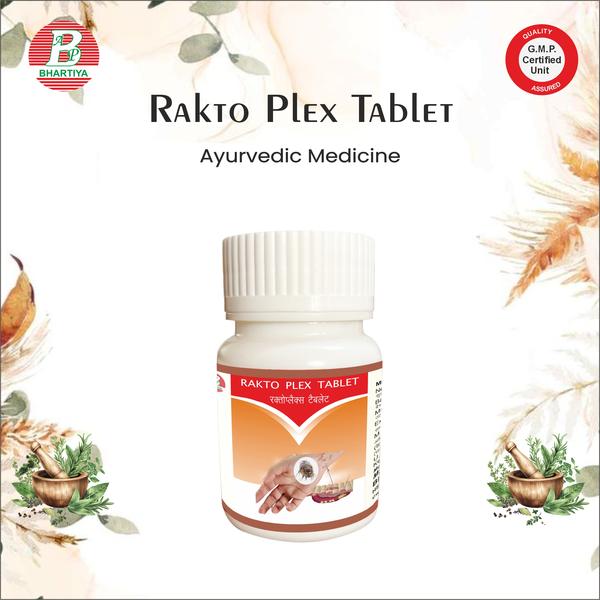
"name": "RAKTO PLEX TABLET",
"description": " RAKTO PLEX TABLET \n\nProduct Identification\n•\tGeneric Name: Rakto Plex Tablet\n•\tType: Ayurvedic Patent Medicine\n•\tPrimary Indication Area: Blood disorders (Rakt Vikar), Blood purification, Anaemia.\n\nTherapeutic Indications\nRakto Plex Tablet is used to support blood health by purifying blood, managing blood disorders (Rakt Vikar), and improving anaemia.\nKey benefits include:\nPrimary Benefit:\n•\tHelps in the management of blood disorders (Rakt Vikar) and anaemia by improving the quality and quantity of blood.\nOther Benefits:\no\tSupports overall energy and vitality\no\tMay help in skin health by improving blood quality\no\tSupports general well-being and immunity\nIngredients:\n CHOBCHINI \nBotanical / Common Name: Gymnema sylvestre\n•\tKey Phytoconstituents:\no\tGymnemic acids\no\tSaponins\no\tFlavonoids\no\tAlkaloids\nMechanism of Action in Rakt Vikar (Blood Disorders / Anaemia) – Biochemistry / Pharmacology:\n1.\tBlood Sugar Regulation & Metabolic Support\no\tGymnemic acids reduce glucose absorption in the intestine and enhance insulin secretion.\no\tImproved glycaemic control indirectly supports healthy blood composition.\n2.\tHematopoietic & Blood Purification Effects\no\tFlavonoids and saponins have antioxidant properties, reducing oxidative stress on red blood cells.\no\tSupports haemoglobin synthesis and improves RBC count, aiding in anaemia management.\n3.\tAnti-inflammatory & Immunomodulatory Activity\no\tReduces chronic inflammation in the blood and vascular tissues.\no\tEnhances immune regulation, contributing to overall blood health.\n4.\tLipid and Circulatory Support\no\tHelps normalize lipid levels, preventing blood thickening and improving circulation.\no\tProtects against free radical damage in blood vessels and plasma.\n\n KARANJUA \n•\tBotanical / Common Name: Pongamia pinnata\n•\tKey Phytoconstituents:\no\tFlavonoids (e.g., Pongamol, Karangin)\no\tAlkaloids\no\tTriterpenoids\no\tGlycosides\no\tFatty acids\nMechanism of Action in Rakt Vikar (Blood Disorders) – Biochemistry / Pharmacology:\n1.\tHematopoietic & Blood Purification Effects\no\tFlavonoids and triterpenoids act as antioxidants, protecting red blood cells from oxidative damage.\no\tPromotes purification of blood and supports normal haemoglobin levels.\n2.\tAnti-inflammatory & Detoxifying Action\no\tReduces chronic inflammation in blood vessels and tissues.\no\tDetoxifies the blood by neutralizing free radicals and harmful metabolites.\n3.\tCirculatory & Cardiovascular Support\no\tSupports healthy circulation by improving blood vessel function.\no\tMild vasodilatory effects help maintain normal blood flow.\n4.\tAntimicrobial Properties\no\tAlkaloids and flavonoids help protect blood from microbial infections, indirectly supporting blood health.\n REETHA \n•\tBotanical / Common Name: Sapindus mukorossi (Soapnut)\n•\tKey Phytoconstituents:\no\tSaponins\no\tFlavonoids\no\tTannins\no\tGlycosides\nMechanism of Action in Rakt Vikar (Blood Disorders) – Biochemistry / Pharmacology:\n1.\tBlood Purification & Detoxification\no\tSaponins and flavonoids have antioxidant properties that help detoxify the blood by neutralizing free radicals.\no\tSupports elimination of metabolic waste and toxins from the bloodstream.\n2.\tHematopoietic Support\no\tEnhances red blood cell health and may support haemoglobin levels, aiding in anaemia management.\n3.\tAnti-inflammatory & Immunomodulatory Effects\no\tReduces inflammation in blood and vascular tissues.\no\tModulates immune response, contributing to overall blood health.\n4.\tCirculatory & Cardiovascular Support\no\tImproves microcirculation and maintains healthy blood flow.\no\tProtects vascular endothelium from oxidative stress.\n\n SHUDH GANDHAK \n•\tBotanical / Common Name: Sulphur (Purified Form)\n•\tKey Phytoconstituents / Components:\no\tElemental Sulphur (S)\no\tTrace mineral impurities removed during purification\nMechanism of Action in Rakt Vikar (Blood Disorders) – Biochemistry / Pharmacology:\n1.\tBlood Purification & Detoxification\no\tActs as a natural detoxifier by removing toxins and impurities from the blood.\no\tEnhances metabolic processes that support purification of blood.\n2.\tAntimicrobial & Anti-inflammatory Effects\no\tExhibits mild antimicrobial activity, protecting blood from infections.\no\tReduces inflammation in tissues, indirectly supporting blood health.\n3.\tHematopoietic & Tissue Support\no\tSupports healthy red blood cell formation and tissue regeneration.\no\tPromotes skin and connective tissue health through sulphur-dependent enzymatic pathways.\n4.\tMetabolic & Enzymatic Role\no\tEssential for certain enzymes and amino acids (like cysteine and methionine) that are important for detoxification and maintaining blood health.\n\n RAS MANIKYA \n•\tBotanical / Common Name: Arsenic trisulfide (Purified Form)\n•\tType: Ayurvedic herbo-mineral preparation (Rasaushadhi)\nKey Components / Phytoconstituents:\n•\tArsenic trisulfide (As₂S₃) – purified\n•\tOther trace minerals from traditional purification (Shodhana) processes\nMechanism of Action in Rakt Vikar (Blood Disorders) – Biochemistry / Pharmacology:\n1.\tBlood Purification & Detoxification\no\tActs to detoxify and purify the blood, removing impurities and harmful metabolic by-products.\no\tEnhances liver and kidney function indirectly to support cleaner blood.\n2.\tHematopoietic & Tissue Support\no\tSupports formation and maintenance of healthy blood cells.\no\tAids in managing anaemia and improving overall vitality.\n3.\tAnti-inflammatory & Immunomodulatory Effects\no\tReduces inflammation in blood and tissue, supporting normal circulation.\no\tModulates immune response to protect blood and vascular health.\n4.\tMetabolic Activity\no\tInfluences enzymatic pathways involved in detoxification and tissue repair.\no\tSupports general metabolic balance, contributing to improved blood quality.\nDosage:\nDose per Intake: 1–2 tablets\nFrequency: Twice a day (morning and evening)\nTotal Daily Dose: 2–4 tablets per day\nAnupan (Vehicle / Medium):\n•\tPreferred: Take with water\n•\tOptional: Can be taken with milk for better absorption and nourishing effect\n•\tTiming: Preferably after meals to reduce gastric irritation\nPrecautions:\n•\tDo not exceed the prescribed dose\n•\tMonitor for any side effects\nConsult an Ayurvedic Practitioner Before Use in:\n•\tChildren\n•\tElderly\n•\tIndividuals with chronic illnesses\n\n\nraktoplex tablet price, raktoplex tablet uses in hindi\nraktoplex tablet uses, raktoplex tablet amazon\nraktoplex tablet amazon india, raktoplex tablet buy online\nraktoplex tablet buy, raktoplex tablet benefits\nraktoplex tablet box, raktoplex tablet benefits in hindi\nraktoplex tablet composition, raktoplex tablet company\nraktoplex tablet catalogue pdf, raktoplex tablet catalogue\nraktoplex tablet content, raktoplex tablet download\nraktoplex tablet english, raktoplex tablet export\nraktoplex tablet export data, raktoplex tablet flipkart\nraktoplex tablet faridabad, raktoplex tablet free download\nraktoplex tablet free, raktoplex tablet for\nraktoplex tablet gst rate, raktoplex tablet ghaziabad\nraktoplex tablet gst, raktoplex tablet ghaziabad uttar pradesh\nraktoplex tablet grade, raktoplex tablet hsn code\nraktoplex tablet hindi, raktoplex tablet holder\nraktoplex tablet indiamart, raktoplex tablet in hindi\nraktoplex tablet images, raktoplex tablet india\nraktoplex tablet joint, raktoplex tablet jalandhar\nraktoplex tablet kya kam karta hai, raktoplex tablet ke fayde in hindi\nraktoplex tablet login, raktoplex tablet list, raktoplex tablet manufacturer\nraktoplex tablet manufacturing company, raktoplex tablet manufacturers in india\nraktoplex tablet name, raktoplex tablet near me\nraktoplex tablet new, raktoplex tablet online shopping\nraktoplex tablet online, raktoplex tablet online order\nraktoplex tablet price in india, raktoplex tablet quality\nraktoplex tablet q10, raktoplex tablet review\nraktoplex tablet rate, raktoplex tablet review in hindi\nraktoplex tablet supplier, raktoplex tablet specification\nraktoplex tablet supplier in delhi, raktoplex tablet tds\nraktoplex tablet wholesale, raktoplex tablet weight in kg\nraktoplex tablet wholesale price, raktoplex tablet which company",
"price": 105.0,
"discountamount": 50.0,
"currencycode": "INR",
"priority": 1000000,
"isfreeshipmentavailable": false,
"shipmentduration": 1,
"_keywords": null,
"isarchived": false,
"isavailable": true,
"applicationid": null,
"productindex": 111,
"imageuri": "https://productimages.withfloats.com/actual/69f58edde35d63e511a95424.jpg",
"tileimageuri": "https://productimages.withfloats.com/tile/69f58edde35d63e511a95424.jpg",
"images": null,
"totalqueries": 0,
"gpid": null,
"groupproductid": null,
"createdon": "2026-05-02T05:42:51.125Z",
"updatedon": "2026-05-02T05:42:51.125Z",
"buyonlinelink": null,
"producturl": "http://WWW.BHARTIYAAYURVEDICPHARMACY.COM/products/rakto-plex-tablet/111",
"availableunits": -1.0,
"iscodavailable": true,
"isprepaidonlineavailable": true,
"maxcodorders": -1,
"maxprepaidonlineorders": -1,
"uniquepaymenturl": null,
"brandname": "Bakula Fort",
"category": "RAKTO PLEX TABLET 100 Tab X 50",
"tags": [],
"variants": false,
"keyspecification": null,
"otherspecifications": null,
"pickupaddressreferenceid": null,
"paymenttype": "AssuredPurchase",
"producttype": "products",
"hsncode": null,
"gstslab": 0.0,
"isnotforsale": false
},
{
"_id": "69e852155e0bb245ce3f18d9",
"fptag": "BHARTIYEAYURVEDICPHARMACY",
"merchantname": null,
"customwidgets": null,
"externalsourceid": null,
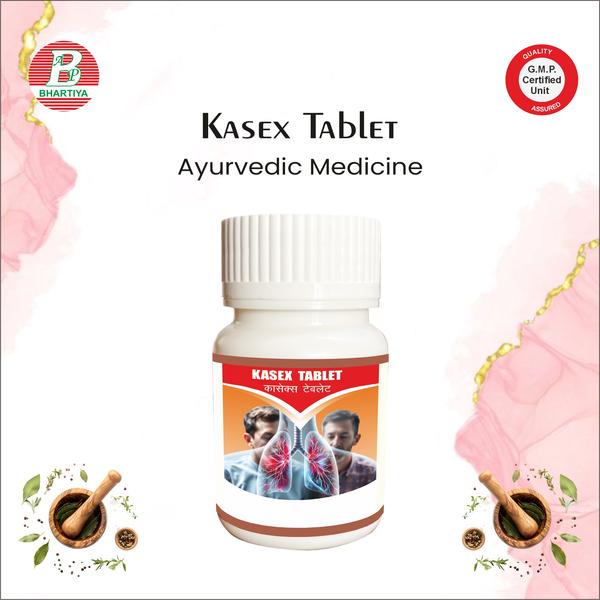
"name": "Kasex Tablet",
"description": " KASEX TABLET \n\nProduct Identification\n•\tGeneric Name: Kasex Tablet\n•\tType: Ayurvedic Patent Medicine\n•\tPrimary Indication Area: For the relief of coughs, colds, and chest congestion. \nTherapeutic Indications\n•\tIt is primarily an expectorant and mild respiratory remedy\n Primary Benefit:\n•\tIts main purpose is to ease respiratory discomfort and help clear mucus from the airways.\nOther Benefits:\n•\tSoothes throat irritation: The herbal components may have mild anti-inflammatory and cooling effects, providing relief from scratchy or sore throats often associated with colds.\n\n•\tSupports respiratory function: By helping to clear mucus from the respiratory tract, it may improve airflow and make breathing feel easier during a cold or mild respiratory infection.\n\n\n•\tReduces mild respiratory inflammation: Some ingredients could have anti-inflammatory properties, which may reduce swelling in the throat and bronchial passages, contributing to easier breathing.\n\n•\tGeneral relief from cold symptoms: It can help alleviate associated discomforts of common cold, such as mild chest tightness or irritation, supporting overall comfort while the body fights the infection\n\n•\tAdjunctive support for immunity (possible, depending on formulation): Certain herbal formulations sometimes contain ingredients believed to support the body’s natural defenses, though this is more supportive than a primary therapeutic effect.\n\n Sat Mulethi (Glycyrrhiza glabra) \nKey Phytoconstituents:\n•\tGlycyrrhizin (saponin)\n•\tFlavonoids\n•\tTriterpenoids\n•\tPolysaccharides\n\nMechanism of Action in Respiratory Health / Cough & Cold\n1.\tExpectorant Effect\n•\tGlycyrrhizin and saponins stimulate secretion in the respiratory tract.\n•\tThins mucus, making coughs more productive and relieving chest congestion.\n2.\tDemulcent / Soothing Action\n•\tPolysaccharides form a protective coating on throat and respiratory mucosa.\n•\tReduces irritation and soreness from coughs and colds.\n3.\tAnti-inflammatory Effects on Airways\n•\tFlavonoids and triterpenoids reduce inflammation in the bronchial passages.\n•\tHelps relieve throat inflammation, hoarseness, and mild bronchial irritation.\n4.\tMild Antimicrobial / Antiviral Support (supportive effect)\n•\tSome phytochemicals show activity against respiratory pathogens.\n•\tMay help support recovery from mild viral infections.\n\n\n Pippali (Piper longum) \nKey Phytoconstituents:\n•\tPiperine\n•\tVolatile oils\n•\tAlkaloids\n•\tFlavonoids\n\nMechanism of Action in Respiratory / Digestive Health\n1.\tRespiratory Stimulant / Expectorant\n•\tPiperine and volatile oils stimulate bronchial secretions.\n•\tHelps loosen mucus, making coughs more productive and relieving chest congestion.\n2.\tBronchodilator / Anti-inflammatory Effects\n•\tReduces inflammation in the respiratory tract.\n•\tSupports easier breathing in conditions like mild bronchitis or cold.\n3.\tDigestive Stimulant / Carminative Action\n•\tEnhances secretion of digestive enzymes.\n•\tImproves digestion, appetite, and absorption, preventing accumulation of undigested food that can worsen constipation or bloating.\n4.\tImmune Support / Antimicrobial Effects (supportive)\n•\tSome phytochemicals exhibit mild antimicrobial and immune-modulating activity.\n•\tSupports resistance against minor respiratory infections.\n\n Saunf (Foeniculum vulgare) \nKey Phytoconstituents:\n•\tAnethole (essential oil)\n•\tFenchone\n•\tFlavonoids\n•\tPhenolic compounds\n•\tFiber\nMechanism of Action in Digestive / Respiratory Health\n1.\tCarminative / Digestive Stimulant\n•\tAnethole and fenchone stimulate digestive enzyme secretion.\n•\tHelps relieve bloating, indigestion, and flatulence.\n2.\tMild Laxative Effect\n•\tDietary fiber and phytochemicals promote bowel movement, easing mild constipation.\n3.\tAntispasmodic / Gut Relaxant\n•\tRelaxes smooth muscles of the gastrointestinal tract.\n•\tReduces cramping, abdominal discomfort, and colic.\n4.\tExpectorant / Mild Respiratory Support\n•\tEssential oils loosen mucus and soothe the throat, aiding mild cough relief.\n•\tCan help in cold-related congestion.\n5.\tAntioxidant and Anti-inflammatory Effects\n•\tFlavonoids and phenolic compounds reduce gut inflammation.\n•\tProtect gut mucosa and support overall digestive health.\n\n\n Cydonia oblonga (Quince) \nKey Phytoconstituents:\n•\tPectin (soluble fiber)\n•\tTannins\n•\tFlavonoids\n•\tVitamins (Vitamin C)\n•\tOrganic acids\nMechanism of Action in Digestive / Respiratory Health\n1.\tMild Laxative / Digestive Support\n•\tPectin and fiber absorb water, softening stools.\n•\tHelps relieve mild constipation and improve bowel regularity.\n2.\tDemulcent / Soothing Effect on Gut\n•\tTannins and mucilage coat the intestinal lining.\n•\tReduces irritation, bloating, and discomfort associated with digestive issues.\n3.\tAnti-inflammatory Effects\n•\tFlavonoids and tannins reduce gut inflammation.\n•\tSupports healing of minor gut irritation or ulcers.\n4.\tAntioxidant Protection\n•\tVitamins and flavonoids scavenge free radicals, protecting gut mucosa.\n5.\tMild Respiratory Support (optional)\n•\tTraditionally used to soothe throat irritation and mild coughs.\n•\tMucilage content helps coat and calm irritated mucous membranes.\n\n Banfsha (Viola odorata) \nKey Phytoconstituents:\n•\tMucilage\n•\tFlavonoids\n•\tSaponins\n•\tAlkaloids (e.g., viroten)\n•\tEssential oils\nMechanism of Action in Respiratory / Cough & Cold\n1.\tDemulcent / Soothing Action\nMucilage coats the throat and respiratory mucosa.\n•\tSoothes irritation and dryness, reducing cough reflex.\n2.\tExpectorant Effect\n•\tSaponins and mucilage help loosen and thin mucus.\n•\tAids productive cough and mucus clearance from chest.\n3.\tAnti inflammatory Effects\n•\tFlavonoids reduce inflammation in the airways.\n•\tHelps relieve throat inflammation, congestion, and bronchial irritation.\n4.\tMild Antitussive (Cough Suppressing) Action\n•\tSoothing mucilage and constituents calm cough spasms.\n•\tUseful for dry, irritating coughs.\n5.\tAntioxidant Support\n•\tFlavonoids and other phytochemicals scavenge free radicals.\n•\tSupports tissue protection during respiratory irritation.\n\n Sugar (Saccharum officinarum / refined sugar) \nKey Phytoconstituents:\n•\tSucrose (main component)\n•\tMinor minerals (potassium, calcium, magnesium in unrefined forms)\nMechanism of Action in Traditional / Supportive Health Uses\n1.\tDemulcent / Soothing Effect\n•\tSugar is often used in syrups to soothe the throat and reduce irritation during coughs or colds.\n•\tProvides a coating effect, making cough medicines more palatable and milder on throat mucosa.\n2.\tEnergy Source / Quick Calorie Supply\n•\tProvides rapid energy for the body during illness or weakness.\n•\tHelps support stamina during recovery from minor ailments.\n3.\tSynergistic / Formulation Role in Herbal Preparations\n•\tActs as a sweetening agent in herbal syrups or tablets, improving taste and compliance.\n•\tCan enhance absorption and palatability of active phytochemicals in formulations.\n\n Sat Pudina (Mentha spicata / Spearmint) \nKey Phytoconstituents:\n•\tMenthol\n•\tMenthone\n•\tFlavonoids\n•\tEssential oils\n•\tPhenolic compounds\nMechanism of Action in Digestive / Respiratory Health\n1.\tDigestive Stimulant / Carminative\n•\tMenthol and essential oils stimulate digestive secretions.\n•\tHelps relieve indigestion, bloating, and flatulence.\n2.\tAntispasmodic / Gut Relaxant\n•\tRelaxes smooth muscles of the gastrointestinal tract.\n•\tReduces abdominal cramps, colic, and discomfort.\n3.\tMild Expectorant / Respiratory Support\n•\tMenthol loosens mucus in airways.\n•\tProvides relief in mild cough, cold, and chest congestion.\n4.\tCooling & Soothing Effect\n•\tMenthol provides a cooling sensation, calming irritation in throat and stomach.\n5.\tAntimicrobial & Antioxidant Effects\n•\tFlavonoids and essential oils exhibit mild antimicrobial activity.\n•\tHelps support gut and respiratory health.\n Saunf Oil (Foeniculum vulgare Seed Oil / Fennel Oil) \nKey Phytoconstituents:\n•\tAnethole (major essential oil)\n•\tFenchone\n•\tEstragole\n•\tLimonene\n•\tFlavonoids\nMechanism of Action in Digestive / Respiratory Health\n1.\tCarminative / Digestive Stimulant\n•\tAnethole and fenchone stimulate digestive secretions.\n•\tHelps relieve bloating, indigestion, and flatulence.\n2.\tAntispasmodic / Smooth Muscle Relaxant\n•\tRelaxes gastrointestinal smooth muscles.\n•\tReduces colic, cramps, and abdominal discomfort.\n3.\tExpectorant / Respiratory Support\n•\tVolatile oils loosen mucus and soothe throat irritation.\n•\tProvides relief in mild coughs and chest congestion.\n4.\tAntimicrobial Effects\n•\tEssential oils exhibit antibacterial and antifungal activity.\n•\tHelps protect gut and respiratory tract from minor infections.\n5.\tAntioxidant / Anti-inflammatory Action\n•\tFlavonoids and phenolic compounds reduce inflammation and oxidative stress.\n•\tSupports healthy gut and respiratory mucosa.\n\n Nilgiri Oil (Eucalyptus globulus Oil / Eucalyptus Oil) \nKey Phytoconstituents:\n•\tEucalyptol (1,8-cineole)\n•\tα-Pinene\n•\tLimonene\n•\tFlavonoids (minor)\n•\tTannins (minor)\nMechanism of Action in Respiratory Health\n1.\tExpectorant / Mucolytic\n•\tEucalyptol stimulates bronchial secretions.\n•\tLoosens and thins mucus, aiding productive cough and relieving chest congestion.\n2.\tAnti-inflammatory Effects\n•\tReduces inflammation in the respiratory tract.\n•\tHelps relieve throat irritation, mild bronchial inflammation, and congestion.\n3.\tAntimicrobial / Antiseptic\n•\tExhibits antibacterial, antiviral, and antifungal activity.\n•\tSupports respiratory tract hygiene and reduces infection risk.\n4.\tCooling & Soothing Effect\n•\tProvides a refreshing sensation, calming irritation in the nose and throat.\n•\tSupports ease of breathing during colds or congestion.\n5.\tMild Analgesic / Decongestant Action\n•\tHelps reduce mild chest discomfort and nasal congestion.\n\n\nDosage\n•\t1–2 tablets, 2–3 times a day after food.\n•\tFollow label instructions or healthcare provider’s advice for exact dosing.\nPrecautions:\n•\tCheck for allergies to herbal ingredients (licorice, mulethi, peppermint, etc.).\n•\tPregnant or lactating women, children, or patients with chronic illness should consult a physician.\n•\tDo not exceed recommended dose; herbal products can vary in strength.\nAdministration Tip:\n•\tTake with warm water.\n\nkasex tablet amazon, kasex tablet amazon india\nkasex cough syrup, kasex cough syrup uses\nkasex herbal cough syrup, kasex cough syrup in hindi\nkasex tablet company, kasex tablet composition\nkasex tablet catalogue pdf, kasex tablet content\nkasex tablet catalogue, kasex tablet download\nkasex tablet dose, kasex tablet export\nkasex tablet export data, kasex tablet free download\nkasex tablet gst rate, kasex tablet good\nkasex tablet good or bad, kasex tablet hindi\nkasex tablet holder, kasex tablet how to use\nkasex tablet hsn code, kasex tablet in hindi\nkasex tablet in india, kasex tablet indiamart\nkasex tablet images, kasex tablet japan\nkasex tablet jiomart, kasex tablet jio\nkasex tablet list, kasex tablet login\nkasex tablet list pdf, kasex tablet label\nkasex tablet manufacturer, kasex tablet manufacturers in india\nkasex tablet mrp, kasex tablet online shopping\nkasex tablet online, kasex tablet order online\nkasex tablet order, kasex tablet price\nkasex tablet price in india, kasex tablet quality\nkasex tablet quantity, kasex tablet review\nkasex tablet rate, kasex tablet review in hindi\nkasex tablet seller, kasex tablet supplier in delhi\nkasex tablet syrup uses, kasex tablet syrup\nkasex tablet syrup in hindi, kasex tablet tablet\nkasex tablet type, kasex tablet tata\nkasex tablet uses in hindi, kasex tablet uses\nkasex tablet weight, kasex tablet with price\nkasex tablet which company, kasex tablet weight loss",
"price": 63.0,
"discountamount": 25.0,
"currencycode": "INR",
"priority": 1000000,
"isfreeshipmentavailable": false,
"shipmentduration": 1,
"_keywords": null,
"isarchived": false,
"isavailable": true,
"applicationid": null,
"productindex": 101,
"imageuri": "https://productimages.withfloats.com/actual/69e8521762692449e1e0a4dd.jpg",
"tileimageuri": "https://productimages.withfloats.com/tile/69e8521762692449e1e0a4dd.jpg",
"images": null,
"totalqueries": 0,
"gpid": null,
"groupproductid": null,
"createdon": "2026-04-22T04:44:05.593Z",
"updatedon": "2026-04-22T05:20:19.686Z",
"buyonlinelink": null,
"producturl": "http://WWW.BHARTIYAAYURVEDICPHARMACY.COM//kasex-tablet/101",
"availableunits": -1.0,
"iscodavailable": true,
"isprepaidonlineavailable": true,
"maxcodorders": -1,
"maxprepaidonlineorders": -1,
"uniquepaymenturl": null,
"brandname": "Bakula Fort",
"category": "Kasex Tablet 100 Tab X 50",
"tags": [],
"variants": false,
"keyspecification": null,
"otherspecifications": null,
"pickupaddressreferenceid": null,
"paymenttype": "AssuredPurchase",
"producttype": "products",
"hsncode": null,
"gstslab": 0.0,
"isnotforsale": false
},
{
"_id": "69e1b3d6e60a4779a1bf63aa",
"fptag": "BHARTIYEAYURVEDICPHARMACY",
"merchantname": null,
"customwidgets": null,
"externalsourceid": null,
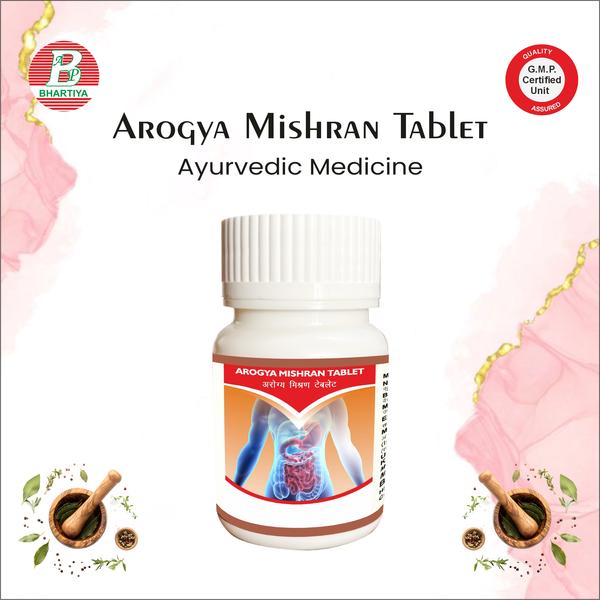
"name": "Arogya Mishran Tablet",
"description": " AROGYA MISHRAN TABLET \n\nProduct Identification\n•\tGeneric Name: Arogya Mishran Tablet\n•\tType: Ayurvedic Patent Medicine\n•\tPrimary Indication Area: Liver disorders and digestive/metabolic support.\n\nTherapeutic Indications:\nSupports liver function, improves digestion, and provides hepatoprotective effects.\n Primary Benefit:\n•\tPromotes liver health, supports detoxification, and enhances digestion and metabolism.\nOther Benefits:\n1.\tAppetite Stimulation: Enhances natural appetite, which helps patients with liver disorders who often experience loss of appetite.\n2.\tMetabolic Regulation: Supports healthy metabolism by improving the efficiency of digestive enzymes and nutrient assimilation, which is often compromised in liver dysfunction.\n3.\tHepatocyte Protection & Regeneration: Provides antioxidants and bioactive compounds that protect liver cells from oxidative stress, toxins, and inflammation, while supporting tissue repair.\n4.\tImproved Energy & Vitality: By optimizing liver function and digestion, it contributes to better energy levels, reducing fatigue associated with liver disorders.\n5.\tMild Detoxification: Assists the liver in eliminating metabolic toxins and waste products, supporting overall detoxification pathways.\n6.\tSupport for Digestive Health: Helps maintain optimal bile flow and digestive function, which can be impaired in liver disorders.\n7.\tImmune Support: Indirectly strengthens immunity by supporting liver detoxification and metabolic balance, which are critical for overall health.\n\nAROGYA VARDHINI VATI \nBotanical / Common Name: Classical Ayurvedic polyherbal-mineral formulation\nKey Phytoconstituents / Components:\n1.\tTriphala: Emblica officinalis, Terminalia chebula, Terminalia bellirica – tannins, polyphenols, vitamin C\n2.\tKatuki (Picrorhiza kurroa) – iridoid glycosides (Picroside I & II)\n3.\tShuddha Parada (Purified Mercury) & Shuddha Gandhak (Purified Sulphur) – bioactive minerals\n4.\tOther supportive herbs – flavonoids, glycosides, saponins\nMechanism of Action in Liver Disorders – Biochemistry / Pharmacology:\n1.Hepatoprotective Effect\n•\tBioactive compounds protect hepatocytes from oxidative stress and toxins.\n•\tPromotes liver tissue regeneration and function.\n2. Digestive & Choleretic Support\n•\tEnhances bile secretion and supports fat metabolism.\n•\tStimulates digestive enzymes, improving nutrient absorption.\n3.Anti-inflammatory & Antioxidant Activity\n•\tReduces hepatic inflammation and oxidative damage.\n•\tPolyphenols and flavonoids neutralize free radicals.\n4.\tDetoxification & Metabolic Regulation\n•\tEnhances phase I & II liver detoxification enzymes.\n•\tSupports amino acid and lipid metabolism, stabilizing liver function.\n5.\tRejuvenation / Rasayana Effect\n•\tImproves overall vitality, energy, and immunity.\n•\tActs as a rejuvenator for liver and digestive tissues.\n\n PUNARNAVADI MANDOOR \nBotanical / Common Name: Classical Ayurvedic polyherbal-mineral formulation\nKey Phytoconstituents / Components:\n•\tPunarnava (Boerhavia diffusa) – flavonoids, alkaloids, glycosides\n•\tMandur Bhasma (Iron oxide) – bioavailable iron\n•\tTrikatu (Zingiber officinale, Piper longum, Piper nigrum) – alkaloids, volatile oils\n•\tOther supporting herbs – tannins, saponins, phenolic compounds\nMechanism of Action in Liver / Digestive Disorders – Biochemistry / Pharmacology:\n1.\tHepatoprotective & Rejuvenative Effect\no\tPunarnava and iron support hepatocyte regeneration and improve liver function.\no\tProvides Rasayana (rejuvenation) effect on liver and digestive tissues.\n2.\tDigestive & Metabolic Support\no\tTrikatu enhances digestive enzyme activity and stimulates metabolism.\no\tSupports proper bile flow and fat digestion.\n3.\tHematinic & Detoxification Effect\no\tMandur Bhasma supplies bioavailable iron, improving anaemia associated with liver dysfunction.\no\tPromotes mild detoxification, aiding in toxin clearance.\n4.\tAnti-inflammatory & Diuretic Action\no\tPunarnava reduces hepatic and systemic inflammation.\no\tMild diuretic effect supports fluid balance and reduces tissue congestion.\n LAGHU SUTSHEKHAR RAS \nBotanical / Common Name: Classical Ayurvedic herbo-mineral formulation\nKey Phytoconstituents / Components:\n•\tShuddha Parada (Purified Mercury) – bioactive mineral\n•\tShuddha Gandhak (Purified Sulphur) – bioactive mineral\n•\tLoha Bhasma (Iron oxide) – hematinic mineral\n•\tSwarna Makshik Bhasma (Copper sulphide) – trace mineral\n•\tSupporting herbs: Pippali (Piper longum), Maricha (Piper nigrum), other carminative and digestive herbs\nMechanism of Action in Digestive / Liver Disorders – Biochemistry / Pharmacology:\n1.\tDigestive & Carminative Support\no\tEnhances digestive fire (Agni) and enzyme activity.\no\tReduces bloating, gas, and indigestion.\n2.\tHepatoprotective Effect\no\tSupports liver function and protects hepatocytes from oxidative stress.\no\tPromotes metabolism and bile secretion.\n3.\tDetoxification & Rejuvenation (Rasayana Effect)\no\tBioactive minerals and herbs stimulate detoxification pathways in the liver.\no\tEnhances overall vitality, stamina, and digestive health.\n4.\tAnti-inflammatory & Mild Antimicrobial Activity\no\tReduces inflammation in digestive tract.\no\tSome components provide mild antimicrobial support, improving gut health.\n\nDosage\n•\t2–3 tablets\n•\tThrice a day\n•\tWith lukewarm water or milk\nPrecautions\n•\tDo not exceed the prescribed dose.\n•\tTake under medical supervision, especially in children, elderly, or patients with chronic illnesses.\n•\tMonitor for any adverse reaction\n\n\n\narogya mishran tablet uses, arogya vati uses, arogya mishran\narogya mishran tablet amazon, arogya mishran tablet ayurvedic\narogya mishran tablet benefits, arogya mishran tablet benefits in hindi\narogya mishran tablet buy online, arogya mishran tablet buy\narogya mishran tablet book, arogya mishran tablet composition\narogya mishran tablet company, arogya mishran tablet content\narogya mishran tablet cost, arogya mishran tablet composition pdf\narogya mishran tablet dose, arogya mishran tablet dose per day\narogya mishran tablet download, arogya mishran tablet details\narogya mishran tablet english, arogya mishran tablet excel\narogya mishran tablet flipkart, arogya mishran tablet form\narogya mishran tablet ghaziabad, arogya mishran tablet google\narogya mishran tablet ghaziabad uttar pradesh, arogya mishran tablet government\narogya mishran tablet uses in hindi, arogya mishran tablet ji\narogya mishran tablet jiomart, arogya mishran tablet ke fayde\narogya mishran tablet ke fayde in hindi, arogya mishran tablet list\narogya mishran tablet login, arogya mishran tablet list pdf\narogya mishran tablet manufacturer, arogya mishran tablet manufacturers in india\narogya mishran tablet name, arogya mishran tablet name list\narogya mishran tablet ni, arogya mishran tablet online\narogya mishran tablet online shopping, arogya mishran tablet online purchase\narogya mishran tablet online order, arogya mishran tablet price\narogya mishran tablet price in india, arogya mishran tablet price in delhi\narogya mishran tablet qualification, arogya mishran tablet quality\narogya mishran tablet rajasthan, arogya mishran tablet review in hindi\narogya mishran tablet tata 1mg, arogya mishran tablet tablet\narogya mishran tablet time, arogya mishran tablet veterinary\narogya mishran tablet vet, arogya mishran tablet website\narogya mishran tablet work, arogya mishran tablet yojana haryana\narogya mishran tablet zinc, what arogya mishran tablet uses in hindi\nwhat arogya mishran tablet uses, where arogya mishran tablets\nwhere arogya mishran tablets available, where arogya mishran tablet uses\nwhere arogya mishran tablet uses in hindi, when arogya mishran tablets\nwhen arogya mishran tablet uses, how arogya mishran tablets\nhow arogya mishran tablet works, how arogya mishran tablet uses\nwhy arogya mishran tablets, why arogya mishran tablet uses\nwhy arogya mishran tablet uses in hindi, who arogya mishran tablets\nwho arogya mishran tablet price, who arogya mishran tablet uses in hindi\nwho arogya mishran tablet uses, is arogya mishran tablet uses\nis arogya mishran tablet uses in hindi, can arogya mishran tablets be patient\ncan arogya mishran tablet uses, can arogya mishran tablet uses in hindi\nwill arogya mishran tablets, will arogya mishran tablet uses\ndo arogya mishran tablet uses in hindi, do arogya mishran tablet uses\ndoes arogya mishran tablets work, does arogya mishran tablet uses\ndoes arogya mishran tablet uses in hindi, was arogya mishran tablets\nwas arogya mishran tablet uses, was arogya mishran tablet uses in hindi\nbest arogya mishran tablets, best arogya mishran tablet price\nbest arogya mishran tablet uses, best arogya mishran tablet uses in hindi\ntop arogya mishran tablets, top arogya mishran tablet price\ntop arogya mishran tablet uses, top arogya mishran tablet uses in hindi",
"price": 135.0,
"discountamount": 65.0,
"currencycode": "INR",
"priority": 1000000,
"isfreeshipmentavailable": false,
"shipmentduration": 1,
"_keywords": null,
"isarchived": false,
"isavailable": true,
"applicationid": null,
"productindex": 90,
"imageuri": "https://productimages.withfloats.com/actual/69e1b3d954763944d8952ac7.jpg",
"tileimageuri": "https://productimages.withfloats.com/tile/69e1b3d954763944d8952ac7.jpg",
"images": null,
"totalqueries": 0,
"gpid": null,
"groupproductid": null,
"createdon": "2026-04-17T04:15:18.143Z",
"updatedon": "2026-04-17T04:15:18.143Z",
"buyonlinelink": null,
"producturl": "http://WWW.BHARTIYAAYURVEDICPHARMACY.COM//arogya-mishran-tablet/90",
"availableunits": -1.0,
"iscodavailable": true,
"isprepaidonlineavailable": true,
"maxcodorders": -1,
"maxprepaidonlineorders": -1,
"uniquepaymenturl": null,
"brandname": "Bakula Fort",
"category": "Arogya Mishran Tablet 100 tab X 30",
"tags": [],
"variants": false,
"keyspecification": null,
"otherspecifications": null,
"pickupaddressreferenceid": null,
"paymenttype": "AssuredPurchase",
"producttype": "products",
"hsncode": null,
"gstslab": 0.0,
"isnotforsale": false
},
{
"_id": "69df2b0b3c7591238aeaf23e",
"fptag": "BHARTIYEAYURVEDICPHARMACY",
"merchantname": null,
"customwidgets": null,
"externalsourceid": null,
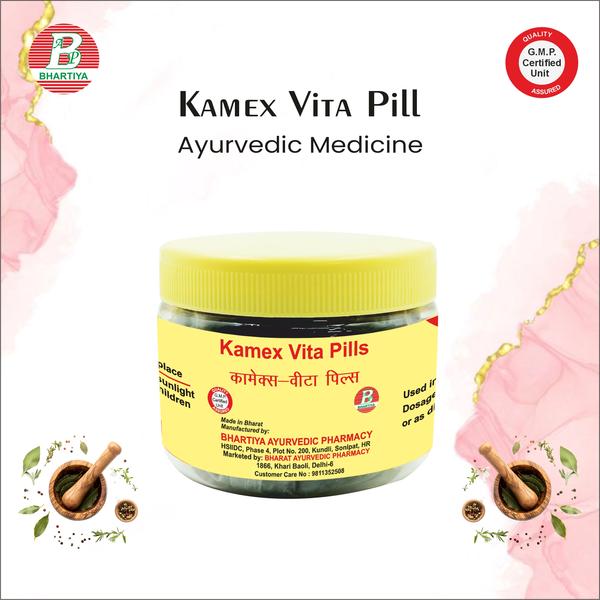
"name": "Kamex Vita Pills",
"description": " KAMEX FORT PILLS \n\nProduct Identification\n•\tGeneric Name: Kamex Vita Pills\n•\tType: Ayurvedic Patent Medicine\nPrimary Indication Area: General Health and Nutritional Supplement / Immunity Support\nTherapeutic Indications: \n•\tActs as a general health tonic\n•\tSupports immunity and helps enhance vitality\n•\tReplenishes essential vitamins and minerals\n•\tMay help reduce fatigue and improve overall well-being\nKey benefits include:\n•\tBoosts Energy & Vitality – Helps reduce fatigue and supports an active lifestyle.\n•\tEnhances Immunity – Strengthens the body’s natural defense mechanisms.\n•\tSupports Overall Health – Provides essential vitamins and minerals for general wellness.\n•\tImproves Nutritional Balance – Helps replenish nutrients that may be lacking in daily diet.\n•\tPromotes Well-being – Supports physical and mental wellness, contributing to better health.\n\nIngredients:\n Arjun Chhal \nBotanical Name: Terminalia arjuna\nPrimary Use:\n•\tTraditionally used in Ayurveda as a rejuvenating tonic to combat general weakness, fatigue, and low vitality.\nKey Phytochemicals & Actions:\n•\tTriterpenoid Saponins: Enhance energy metabolism → reduce fatigue and improve stamina.\n•\tFlavonoids (Quercetin, Kaempferol): Antioxidant → protect cells from oxidative stress that contributes to weakness.\n•\tTannins: Anti-inflammatory → support muscle and tissue recovery.\n•\tPolyphenols & Glycosides: Nutritional support → improve nutrient absorption and overall strength.\nMechanism of Action in General Weakness:\n1.\tEnergy & Stamina Support: Boosts cellular metabolism → reduces tiredness and improves endurance.\n2.\tCardio-supportive: Strengthens heart function → improves blood circulation → more oxygen and nutrients reach tissues.\n3.\tAntioxidant Protection: Scavenges free radicals → prevents oxidative damage that causes fatigue.\n4.\tNutritional & Tonic Effect: Replenishes essential nutrients → aids recovery from prolonged weakness or post-illness fatigue.\n5.\tAdaptogenic Effect: Enhances resilience to physical and mental stress → promotes overall vitality.\n\n Bhringraj \nBotanical Name: Eclipta alba\nPrimary Use:\n•\tTraditionally used in Ayurveda for hair health, liver support, and rejuvenation (Rasayana).\nKey Phytochemicals & Actions:\n•\tWedelolactone & Ecliptin: Hepatoprotective → support liver detoxification and regeneration.\n•\tFlavonoids (Luteolin, Apigenin): Antioxidant → protect cells from oxidative stress.\n•\tAlkaloids & Coumestans: Anti-inflammatory → reduce tissue inflammation.\n•\tTriterpenoids: Support hair growth → nourish hair follicles and scalp.\nMechanism of Action:\n1.\tHepatoprotective: Enhances antioxidant enzymes (SOD, catalase, glutathione peroxidase) → protects hepatocytes from toxins.\n2.\tHair Health Support: Stimulates hair follicle growth → reduces hair fall and premature greying.\n3.\tAnti-inflammatory: Reduces inflammation → protects liver and other tissues.\n4.\tAntioxidant: Scavenges free radicals → prevents oxidative damage to liver cells and hair follicles.\n5.\tRejuvenation (Rasayana): Supports overall vitality, stamina, and tissue regeneration.\n\n Daru Haldi \nBotanical Name: Berberis aristata\nPrimary Use:\n•\tTraditionally used in Ayurveda for liver support, digestive health, and blood purification.\nKey Phytochemicals & Actions:\n•\tBerberine (Alkaloid): Hepatoprotective and antimicrobial → supports liver function and fights infections.\n•\tTannins: Anti-inflammatory → reduce tissue inflammation.\n•\tPhenolic Compounds: Antioxidant → protect liver and other organs from oxidative stress.\n•\tBerberrubine & Oxyacanthine: Support detoxification → aid in metabolic balance and toxin clearance.\nMechanism of Action:\n1.\tHepatoprotective: Enhances antioxidant enzymes (SOD, catalase, glutathione peroxidase) → protects liver cells.\n2.\tAnti-inflammatory: Reduces pro-inflammatory markers → prevents liver and tissue inflammation.\n3.\tDigestive Support: Stimulates bile secretion → improves digestion and nutrient absorption.\n4.\tAntioxidant Action: Neutralizes free radicals → prevents oxidative damage in liver and other tissues.\n5.\tDetoxification Support: Enhances liver detox enzymes → aids in toxin metabolism and elimination.\n Alsi (Flaxseed) \nBotanical Name: Linum usitatissimum\nPrimary Use:\n•\tTraditionally used in Ayurveda for digestion, heart health, and general vitality.\nKey Phytochemicals & Actions:\n•\tAlpha-linolenic acid (ALA): Omega-3 fatty acid → supports cardiovascular health and reduces inflammation.\n•\tLignans: Antioxidant → neutralize free radicals and support hormonal balance.\n•\tDietary Fiber: Improves digestion → supports bowel regularity and nutrient absorption.\n•\tProteins & Minerals: Nutritional support → strengthens tissues and improves stamina.\nMechanism of Action:\n1.\tCardiovascular Support: Omega-3 fatty acids → help maintain healthy blood circulation and heart function.\n2.\tDigestive Support: High fiber content → promotes healthy digestion and prevents constipation.\n3.\tAntioxidant Action: Lignans → reduce oxidative stress in cells and tissues.\n4.\tNutritional Tonic: Proteins, minerals, and healthy fats → replenish energy and combat weakness.\n5.\tAnti-inflammatory: Reduces tissue inflammation → supports overall wellness and vitality.\n\n Haldi \nBotanical Name: Curcuma longa\nPrimary Use:\n•\tTraditionally used in Ayurveda for anti-inflammatory, antioxidant, liver support, and immunity enhancement.\nKey Phytochemicals & Actions:\n•\tCurcumin: Antioxidant and anti-inflammatory → protect cells from oxidative stress and reduces inflammation.\n•\tVolatile Oils (Turmerone, Atlantone): Support digestive health → improve metabolism and nutrient absorption.\n•\tPolysaccharides: Immunomodulatory → enhance body’s natural defense mechanisms.\n•\tProteins & Minerals: Nutritional support → aid tissue repair and overall vitality.\nMechanism of Action:\n1.\tAnti-inflammatory: Inhibits pro-inflammatory cytokines (TNF-α, IL-6) → reduces tissue inflammation.\n2.\tAntioxidant: Scavenges free radicals → protects liver, heart, and other cells from oxidative damage.\n3.\tHepatoprotective: Enhances liver detox enzymes → supports liver function and detoxification.\n4.\tImmune Support: Modulates immune responses → strengthens resistance against infections and stress.\n5.\tDigestive Support: Improves bile secretion and nutrient absorption → promotes digestive wellness.\n\n Harad \nBotanical Name: Terminalia chebula\nPrimary Use:\n•\tTraditionally used in Ayurveda for digestive health, detoxification, and overall vitality.\nKey Phytochemicals & Actions:\n•\tTannins & Chebulagic Acid: Antioxidant and anti-inflammatory → protect cells from oxidative stress and tissue inflammation.\n•\tGallic Acid & Ellagic Acid: Hepatoprotective → support liver function and detoxification.\n•\tPolysaccharides & Glycosides: Nutritional support → aid in tissue repair and general strength.\n•\tFlavonoids: Antioxidant → reduce free radical damage and support immunity.\nMechanism of Action:\n1.\tDigestive Support: Stimulates digestion → improves nutrient absorption and relieves constipation.\n2.\tHepatoprotective: Enhances liver detox enzymes → supports toxin metabolism and liver health.\n3.\tAntioxidant: Neutralizes free radicals → protects tissues and organs from oxidative damage.\n4.\tAnti-inflammatory: Reduces tissue inflammation → promotes healing and overall wellness.\n5.\tDetoxification Support: Supports body’s natural cleansing → maintains metabolic balance and vitality.\n\n Baheda \nBotanical Name: Terminalia bellirica\nPrimary Use:\n•\tTraditionally used in Ayurveda for respiratory health, digestion, detoxification, and overall vitality.\nKey Phytochemicals & Actions:\n•\tTannins & Gallic Acid: Antioxidant → protect cells from oxidative stress and tissue damage.\n•\tEllagic Acid & Chebulagic Acid: Anti-inflammatory → reduce inflammation in tissues and organs.\n•\tPolysaccharides & Glycosides: Nutritional support → aid tissue repair and general strength.\n•\tFlavonoids: Antioxidant → help in detoxification and immune support.\nMechanism of Action:\n1.\tDigestive Support: Enhances digestion → improves nutrient absorption and gut health.\n2.\tHepatoprotective: Supports liver detox enzymes → aids toxin metabolism and liver function.\n3.\tRespiratory Support: Reduces inflammation in respiratory tract → promotes healthy breathing.\n4.\tAntioxidant & Anti-inflammatory: Protects tissues from oxidative stress and inflammation.\n5.\tDetoxification & Rejuvenation: Supports natural cleansing processes → improves overall vitality and wellness.\n Tulsi \nBotanical Name: Ocimum sanctum\nPrimary Use:\n•\tTraditionally used in Ayurveda for immunity support, respiratory health, stress management, and overall vitality.\nKey Phytochemicals & Actions:\n•\tEugenol: Anti-inflammatory and antimicrobial → protects against infections and reduces tissue inflammation.\n•\tUrsolic Acid: Antioxidant → neutralizes free radicals and protects cells from oxidative stress.\n•\tOleanolic Acid & Flavonoids: Adaptogenic → helps the body cope with stress and supports overall resilience.\n•\tPolysaccharides & Volatile Oils: Immunomodulatory → enhance natural defense mechanisms.\nMechanism of Action:\n1.\tImmunity Support: Enhances activity of immune cells → strengthens the body’s natural defenses.\n2.\tRespiratory Support: Reduces inflammation and clears mucus → promotes healthy breathing.\n3.\tAntioxidant Action: Scavenges free radicals → protects organs and tissues from oxidative damage.\n4.\tAdaptogenic Effect: Reduces stress-induced fatigue → improves energy, stamina, and mental well-being.\n5.\tDetoxification Support: Supports liver and kidney function → aids in toxin clearance and overall vitality.\n\n Swarn Geru \nBotanical/Traditional Name: Swarn Geru (Red Ochre)\nPrimary Use:\n•\tTraditionally used in Ayurveda for strengthening bones, improving vitality, and supporting overall health.\nKey Phytochemicals & Actions:\n•\tIron Oxide (Fe₂O₃): Nutritional mineral → supports haemoglobin formation and red blood cell health.\n•\tCalcium Compounds: Bone tonic → strengthens bones and teeth.\n•\tTrace Minerals (Mg, Zn, Mn): Support metabolic functions and tissue repair.\n•\tAnti-inflammatory Properties: Helps reduce minor tissue inflammation and support healing.\nMechanism of Action:\n1.\tHematopoietic Support: Provides iron → boosts haemoglobin and prevents anaemia → reduces fatigue and weakness.\n2.\tBone Health: Calcium and minerals → strengthen bones and joints → enhance physical vitality.\n3.\tNutritional Tonic: Replenishes essential minerals → improves energy and stamina.\n4.\tDetoxification & Tissue Support: Trace minerals → aid tissue repair and overall wellness.\n5.\tRejuvenation: Acts as a Rasayana → improves vitality, endurance, and general strength.\n\nDosage:\n•\tDose per intake: 1–2 pills\n•\tFrequency: Twice daily\n•\tTotal daily dose: 2–4 pills, preferably after meals\n•\tHow to take: With lukewarm water, preferably after breakfast and dinner\n\nPrecautions:\n•\tDo not exceed the prescribed dose.\n•\tTake with meals to reduce digestive discomfort.\n•\tConsult an Ayurvedic practitioner before use in:\no\tChildren\no\tElderly\no\tPatients with chronic illness.\n\n\n\nkamex vita pills price\nkamex vita pills amazon\nkamex vita pills amazon india\nkamex vita pills available in india\nkamex vita pills amazon price\nkamex vita pills buy online\nkamex vita pills buy\nkamex vita pills benefits\nkamex vita pills bottle\nkamex vita pills box\nkamex vita pills content\nkamex vita pills composition\nkamex vita pills capsule\nkamex vita pills cap\nkamex vita pills company\nkamex vita pills delhi\nkamex vita pills dose\nkamex vita pills details\nkamex vita pills dose per day\nkamex vita pills email id\nkamex vita pills for dogs\nkamex vita pills for cats\nkamex vita pills for sale\nkamex vita pills gst number\nkamex vita pills gmp\nkamex vita pills hindi\nkamex vita pills hsn code\nkamex vita pills how to use\nkamex vita pills healthcare\nkamex vita pills in hindi\nkamex vita pills indiamart\nkamex vita pills ingredients\nkamex vita pills in india\nkamex vita pills ke fayde in hindi\nkamex vita pills manufacturer\nkamex vita pills mrp\nkamex vita pills manufacturing company\nkamex vita pills manufacturers in india\nkamex vita pills name\nkamex vita pills noida\nkamex vita pills new\nkamex vita pills new packaging\nkamex vita pills online\nkamex vita pills online shopping\nkamex vita pills online order\nkamex vita pills online purchase\nkamex vita pills price in india\nkamex vita pills pvt ltd\nkamex vita pills quantity\nkamex vita pills qatar\nkamex vita pills review\nkamex vita pills rate\nkamex vita pills syrup\nkamex vita pills supplier in delhi\nkamex vita pills supplier in india\nkamex vita pills tablet\nkamex vita pills tab\nkamex vita pills uses in hindi\nkamex vita pills uses\nkamex vita pills uk\nkamex vita pills veterinary\nkamex vita pills vs\nkamex vita pills website\nkamex vita pills which country brand\nkamex vita pills where to buy\nkamex vita pills zepto",
"price": 180.0,
"discountamount": 90.0,
"currencycode": "INR",
"priority": 1000000,
"isfreeshipmentavailable": false,
"shipmentduration": 1,
"_keywords": null,
"isarchived": false,
"isavailable": true,
"applicationid": null,
"productindex": 84,
"imageuri": "https://productimages.withfloats.com/actual/69df2b110043897b758c140d.jpg",
"tileimageuri": "https://productimages.withfloats.com/tile/69df2b110043897b758c140d.jpg",
"images": null,
"totalqueries": 0,
"gpid": null,
"groupproductid": null,
"createdon": "2026-04-15T06:07:07.471Z",
"updatedon": "2026-04-15T06:07:07.471Z",
"buyonlinelink": null,
"producturl": "http://WWW.BHARTIYAAYURVEDICPHARMACY.COM//kamex-vita-pills/84",
"availableunits": -1.0,
"iscodavailable": true,
"isprepaidonlineavailable": true,
"maxcodorders": -1,
"maxprepaidonlineorders": -1,
"uniquepaymenturl": null,
"brandname": "Bakula Fort",
"category": "Kamex Vita Pills 100gm X 30",
"tags": [],
"variants": false,
"keyspecification": null,
"otherspecifications": null,
"pickupaddressreferenceid": null,
"paymenttype": "AssuredPurchase",
"producttype": "products",
"hsncode": null,
"gstslab": 0.0,
"isnotforsale": false
},
{
"_id": "69902628ae41895d8787c4ff",
"fptag": "BHARTIYEAYURVEDICPHARMACY",
"merchantname": null,
"customwidgets": null,
"externalsourceid": null,
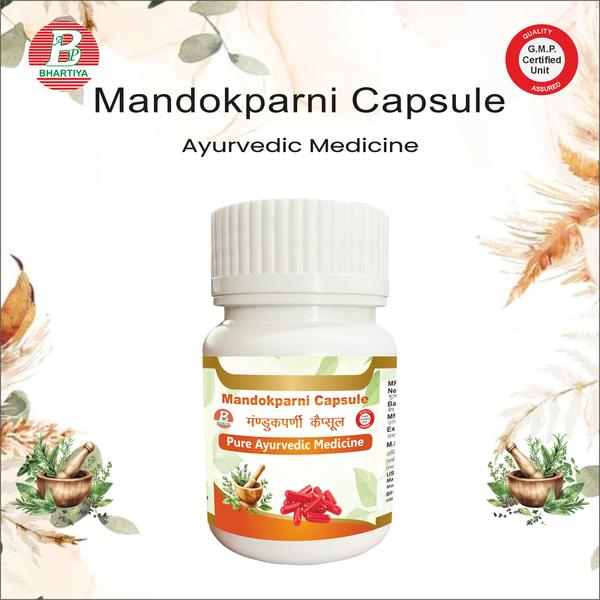
"name": "Mandokparni Capsule",
"description": " MANDUKPARNI \n\n MANDUKPARNI (Centella asiatica L.) \nThe Rejuvenative “Memory Herb” — Leaves and Whole Plant\nMandukparni, also known as Brahmi in Ayurveda, is a highly valued herb for its brain-boosting, rejuvenative, and adaptogenic properties. Rich in triterpenoids, flavonoids, and essential nutrients, Mandukparni is considered beneficial for cognitive function, nervous system health, skin health, wound healing, and overall vitality.\n\n CLASSICAL AYURVEDIC REFERENCES\n1.\tCharaka Samhita\no\tMentioned in Kalpa Sthana as a Medhya (intellect-promoting) and Rasayana (rejuvenative) herb.\no\tLeaves are used to strengthen memory, intellect, and Ojas.\n2.\tSushruta Samhita\no\tRecommended for Vata and Pitta disorders, nervous system weakness, and mental fatigue.\no\tDescribed as Snigdha (unctuous), Sheeta (cooling), and Balya (strength-giving).\n3.\tBhavaprakasha Nighantu\no\tCalled Mandukparni / Brahmi.\no\tPromotes longevity, memory, and cognitive function.\no\tUsed in Medhya, Hridya, and Rasayana formulations.\n\n CLASSICAL STORY / ANECDOTE\n\nMandukparni is often referred to as the “herb of intellect” in classical texts. It was traditionally consumed by scholars, students, and warriors to enhance memory, focus, and mental stamina. Ayurvedic legends describe it as a herb that balances the mind, improves clarity of thought, and nurtures longevity.\n\n BOTANICAL INFORMATION OF MANDUKPARNI\n•\tScientific Name: Centella asiatica L.\n•\tFamily: Apiaceae\n•\tOrder: Apiales\n•\tGenus: Centella\n•\tSpecies: asiatica\nCommon Names:\n•\tSanskrit: Mandukparni, Brahmi\n•\tHindi: Brahmi, Mandukparni\n•\tEnglish: Gotu Kola, Indian Pennywort\n•\tTamil: Vallarai\n•\tTelugu: Brahmi\n•\tMalayalam: Thankuni\n•\tKannada: Brahmi\n•\tBengali: Bhringraj (sometimes confused with Bacopa)\n\n SYNONYMS IN CLASSICAL AYURVEDIC NIGHANTUS\n•\tCharaka Samhita: Mandukparni – Medhya, Rasayana, Balya\n•\tSushruta Samhita: Mandukparni – Medhya, Sheeta, Balya\n•\tBhavaprakasha Nighantu: Mandukparni / Brahmi – Enhances memory, longevity, and vitality\n\n MORPHOLOGY OF MANDUKPARNI\n•\tPlant Type: Creeping perennial herb\n•\tHeight: 10–30 cm\n•\tLeaves: Small, fan-shaped, kidney-shaped, green\n•\tFlowers: Tiny, white to light purple, inconspicuous\n•\tRoots: Thin, fibrous, spreading\n•\tStem: Creeping, rooting at nodes\n\n ECOLOGICAL PREFERENCES\n•\tClimate: Tropical to subtropical; tolerates wet and humid conditions\n•\tSoil: Moist, loamy, or sandy soil, pH 6–7\n•\tHabitat: Marshy fields, near water bodies, gardens\n•\tAltitude: Sea level to 1,500 m\n\n GEOGRAPHICAL DISTRIBUTION\n•\tIndia: Kerala, Tamil Nadu, West Bengal, Maharashtra, Assam\n•\tOutside India: Sri Lanka, Southeast Asia, Africa, Australia, South America\n\n CLASSICAL AYURVEDIC PROPERTIES (RASA–GUNA–VIRYA–VIPAKA)\n•\tRasa (Taste): Tikta (bitter), Madhura (sweet), Katu (pungent)\n•\tGuna (Qualities): Laghu (light), Snigdha (unctuous)\n•\tVirya (Potency): Sheeta (cooling)\n•\tVipaka (post-digestive effect): Madhura (sweet)\n•\tDosha Effects: Vata-Pitta hara, Kapha samana in moderation\n\n THERAPEUTIC ACTIONS (KARMA)\n1.\tMedhya: Improves memory, concentration, and intellect\n2.\tHridya: Supports cardiovascular and nervous system health\n3.\tBalya: Enhances strength and immunity\n4.\tRasayana: Rejuvenates, promotes longevity, and vitality\n5.\tKeshya & Twachya: Nourishes hair and skin\n6.\tVatahara & Pittahara: Balances Vata and Pitta doshas\n7.\tVranaropana: Supports wound healing\n\n INDICATIONS\n•\tNervous System: Memory loss, mental fatigue, anxiety, stress\n•\tDigestive System: Poor digestion, liver disorders\n•\tSkin & Hair: Dry skin, eczema, premature greying, hair fall\n•\tCardiovascular System: Mild hypertension\n•\tGeneral Health: Fatigue, weakness, slow recovery\n\n MODERN PHARMACOLOGY & PHYTOCHEMISTRY\n•\tMajor Constituents:\no\tTriterpenoids: Asiaticoside, Madecassoside\no\tFlavonoids, Phenolics\no\tVitamins (A, C), Minerals (Ca, Mg, Fe)\no\tAlkaloids, Saponins\n•\tPharmacological Actions:\no\tNeuroprotective, Cognitive enhancer\no\tAntioxidant, Anti-inflammatory\no\tAdaptogenic, Anti-anxiety\no\tWound healing, Hepatoprotective\no\tCardioprotective\n\n CULTIVATION DETAILS\n•\tPropagation: Seeds, cuttings, or runners\n•\tSowing Time: Pre-monsoon or early monsoon\n•\tSpacing: 30–50 cm between plants\n•\tIrrigation: Regular, requires moist soil\n•\tFertilization: Organic manure preferred\n•\tHarvesting: Leaves – 3–4 times/year; Whole plant for formulations\n\n CLASSICAL DOSAGE (According to Ayurvedic Granthas)\n•\tLeaves / Whole Plant: 3–6 g/day (powdered or fresh juice)\n•\tDecoction / Juice: 30–60 ml/day\n•\tOil (Brahmi Taila): 5–10 ml/day for hair and scalp\n•\tPaste / Topical: As per therapeutic requirement for wounds, skin disorders\n\n MANDUKPARNI FORMULATIONS – BHARTIYA AYURVEDIC PHARMACY\nBhartiya Ayurvedic Pharmacy offers a range of Mandukparni-based products preserving its full rejuvenative and cognitive-supportive properties.\nKey Uses of Mandukparni Formulations:\n•\tEnhances memory, concentration, and mental clarity\n•\tReduces stress and nervous system fatigue\n•\tSupports skin and hair health\n•\tActs as Rasayana for overall vitality and longevity\n\n MANDUKPARNI CAPSULE\n•\tContains premium Mandukparni powder or extract\n•\tKey Benefits:\no\tImproves memory, intellect, and mental stamina\no\tSupports nervous system and cognitive function\no\tEnhances immunity and overall vitality\n•\tDosage: 1–2 capsules twice daily with warm water or as directed\n•\tSafety & Precautions:\no\tSafe for long-term use\no\tMay lower blood sugar or blood pressure; monitor if on medications\n•\tFormulation Highlights: 100% natural, no artificial additives\n\n MANDUKPARNI POWDER\n•\tMade from premium dried Mandukparni leaves and whole plant\n•\tKey Benefits:\no\tSupports memory, cognition, and mental alertness\no\tPromotes stress relief and nervous system health\no\tNourishes skin and hair\n•\tDosage: 3–6 g/day with warm water, milk, or ghee\n•\tSafety & Precautions:\no\tSafe for long-term use\no\tMild laxative effect may occur in sensitive individuals\n•\tSuggested Use: Ideal for daily Rasayana and cognitive support\n\ncan you eat centella asiatica, capsule centella asiatica, capsule di centella asiatica\ncentella asiatica ayurvedic medicine, centella asiatica benefits, centella asiatica benefits in hindi\ncentella asiatica best products, centella asiatica capsule benefits, centella asiatica capsule flipkart\ncentella asiatica capsule for skin, centella asiatica capsule hindi, centella asiatica capsule how to use\ncentella asiatica capsule hsn code, centella asiatica capsule jan aushadhi, centella asiatica capsule life cycle\ncentella asiatica capsule life pharmacy, centella asiatica capsule literature review, centella asiatica capsule name\ncentella asiatica capsule near me, centella asiatica capsule notes, centella asiatica capsule on amazon\ncentella asiatica capsule online, centella asiatica capsule online india, centella asiatica capsule online shopping\ncentella asiatica capsule original, centella asiatica capsule uses, centella asiatica capsule uses in hindi\ncentella asiatica capsule vial, centella asiatica capsule video, centella asiatica capsule water\ncentella asiatica capsule water benefits, centella asiatica capsule water for skin, centella asiatica capsule youtube\ncentella asiatica capsule zepto, centella asiatica capsules, centella asiatica dosage, centella asiatica extract capsules\ncentella asiatica growing conditions, centella asiatica health benefits, centella asiatica homeopathy medicine\ncentella asiatica how to use, centella asiatica in capsule, centella asiatica in hindi\ncentella asiatica in india, centella asiatica india, centella asiatica juice\ncentella asiatica medicinal properties, centella asiatica medicinal uses, centella asiatica pdf\ncentella asiatica powder, centella asiatica products, centella asiatica recipes\ncentella asiatica review,centella asiatica side effects",
"price": 300.0,
"discountamount": 150.0,
"currencycode": "INR",
"priority": 1000000,
"isfreeshipmentavailable": false,
"shipmentduration": 1,
"_keywords": null,
"isarchived": false,
"isavailable": true,
"applicationid": null,
"productindex": 64,
"imageuri": "https://productimages.withfloats.com/actual/6990262b7c77ed81bc469e18.jpg",
"tileimageuri": "https://productimages.withfloats.com/tile/6990262b7c77ed81bc469e18.jpg",
"images": null,
"totalqueries": 0,
"gpid": null,
"groupproductid": null,
"createdon": "2026-02-14T07:37:12.886Z",
"updatedon": "2026-02-17T09:15:23.872Z",
"buyonlinelink": null,
"producturl": "http://WWW.BHARTIYAAYURVEDICPHARMACY.COM//mandokparni-capsule/64",
"availableunits": -1.0,
"iscodavailable": true,
"isprepaidonlineavailable": true,
"maxcodorders": -1,
"maxprepaidonlineorders": -1,
"uniquepaymenturl": null,
"brandname": "Bakula Fort",
"category": "Mandokparni Capsule 60 Cap X 24",
"tags": [],
"variants": false,
"keyspecification": null,
"otherspecifications": null,
"pickupaddressreferenceid": null,
"paymenttype": "AssuredPurchase",
"producttype": "products",
"hsncode": null,
"gstslab": 0.0,
"isnotforsale": false
},
{
"_id": "698adcb79b2383ec7eecb3fe",
"fptag": "BHARTIYEAYURVEDICPHARMACY",
"merchantname": null,
"customwidgets": null,
"externalsourceid": null,
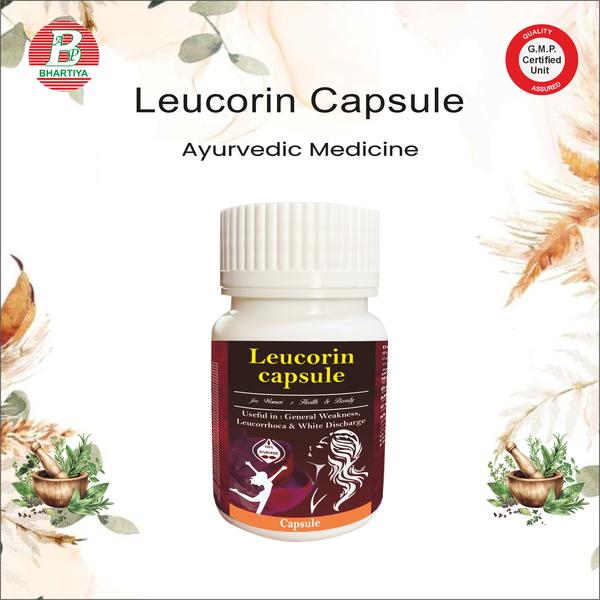
"name": "Leucorin Capsule",
"description": " LEUCORIN CAPSULE \n\n\nProduct Identification\n•\tGeneric Name: Leucorin Capsule\n•\tType: Ayurvedic Patent Medicine\n\nTherapeutic Indications \n•\tHelps manage excessive vaginal discharge, restores vaginal health, and balances hormonal and metabolic functions.\nPrimary Benefits\n•\tHelps reduce excessive vaginal discharge\n•\tRestores normal vaginal health and hygiene\n•\tSupports hormonal balance\n•\tStrengthens reproductive and urinary tract health\n•\tPromotes overall female reproductive wellness\n\nOther Benefits\n•\tImproves Immunity: Supports the body’s natural defense mechanisms, helping prevent recurrent infections.\n•\tSupports Digestive Health: Aids proper digestion and nutrient absorption, which can indirectly help maintain reproductive health.\n•\tEnhances Energy & Vitality: Helps reduce fatigue and general weakness often associated with prolonged leucorrhoea.\n•\tPromotes Hormonal Balance: Helps regulate the endocrine system, which can improve menstrual health and overall reproductive function.\n•\tMaintains Urinary Tract Health: Supports healthy urinary function, reducing the risk of associated irritation or infections.\n\nIngredients:\n Safed Musali (White Musli) \n•\tBotanical Name: Chlorophytum borivilianum\n•\tKey Constituents: Steroidal saponins, Alkaloids, Flavonoids, Polysaccharides, Proteins, Amino acids\nMechanism of Action in Women’s Health – Biochemistry / Pharmacology\n•\tActs as a reproductive tonic, nourishing uterus and vaginal tissues\n•\tRegulates hormonal balance (estrogen and progesterone), supporting menstrual and reproductive health\n•\tExhibits anti-inflammatory and antimicrobial effects, helping prevent infections\n•\tBoosts immunity to reduce recurrent reproductive tract infections\n•\tEnhances energy, vitality, and overall well-being, supporting systemic and reproductive health\n\n Shatavari \n•\tBotanical Name: Asparagus racemosus\n•\tKey Constituents: Steroidal saponins (Shatavarins), Flavonoids, Alkaloids, Polysaccharides, Proteins\nMechanism of Action in Women’s Health – Biochemistry / Pharmacology\n•\tActs as a female reproductive tonic, nourishing uterus and ovaries\n•\tRegulates hormonal balance (estrogen and progesterone), supporting menstrual and lactational health\n•\tExhibits anti-inflammatory and antioxidant effects, protecting reproductive tissues\n\nArjun Chhal (Arjuna Bark) \n•\tBotanical Name: Terminalia arjuna\n•\tKey Constituents: Tannins, Flavonoids, Glycosides, Saponins, Polyphenols, Minerals\nMechanism of Action in Women’s Health – Biochemistry / Pharmacology\n•\tSupports cardiovascular health, improving circulation and heart function\n•\tExhibits antioxidant and anti-inflammatory effects, protecting blood vessels and tissues\n•\tHelps maintain healthy blood pressure and lipid levels, indirectly supporting metabolic and reproductive health\n\n Mulethi (Licorice) \n•\tBotanical Name: Glycyrrhiza glabra\n•\tKey Constituents: Glycyrrhizin, Flavonoids, Saponins, Coumarins, Polysaccharides\nMechanism of Action in Women’s Health – Biochemistry / Pharmacology\n•\tExhibits anti-inflammatory and soothing effects, supporting reproductive tract health\n•\tHelps maintain hormonal balance, particularly estrogen, aiding menstrual and reproductive function\n\n Gokharu (Tribulus terrestris) \n Botanical Name: Tribulus terrestris\nKey Constituents: Saponins (Protodioscin, Tribulosides), Flavonoids, Alkaloids, Sterols\nMechanism of Action in Women’s Health – Biochemistry / Pharmacology\n•\tSupports hormonal balance by modulating luteinizing hormone (LH) and ovarian steroidogenesis, aiding menstrual and reproductive function\n•\tExhibits anti-inflammatory effects, reducing pelvic and systemic inflammation.\n•\tActs as a mild adaptogen, enhancing energy, stamina, and resilience to metabolic or hormonal stress\n\nAmla (Indian Gooseberry) \nBotanical Name: Phyllanthus emblica\n Key Constituents: Vitamin C, Tannins, Flavonoids, Polyphenols, Gallic Acid\nMechanism of Action in Women’s Health – Biochemistry / Pharmacology\n•\tPotent antioxidant, reducing oxidative stress and protecting reproductive and systemic tissue\n•\t Supports hormonal balance by enhancing adrenal and thyroid function, indirectly regulating menstrual cycles\n•\tExhibits anti-inflammatory effects, helping reduce menstrual and pelvic discomfort\n\nKaunch beej (Mucuna pruriens) \n Botanical Name: Mucuna pruriens\n Key Constituents: L-DOPA, Alkaloids, Flavonoids, Saponins, Proteins\nMechanism of Action in Women’s Health – Biochemistry / Pharmacology\n \n•\tSupports hormonal balance by modulating dopamine levels, which can influence prolactin and ovarian function, aiding menstrual and reproductive health\n•\t Exhibits mild adaptogenic and anti-stress effects, enhancing energy, vitality, and resilience to metabolic or hormonal stress\n•\t Acts as a reproductive tonic, promoting ovarian function and fertility\nVidhara (Shatavari, Asparagus racemosus) \n Botanical Name: Asparagus racemosus\nKey Constituents: Saponins (Shatavarins), Flavonoids, Alkaloids, Glycosides, Polysaccharides\nMechanism of Action in Women’s Health – Biochemistry / Pharmacology\n \n•\tSupports hormonal balance, particularly estrogen, aiding menstrual regulation, reproductive health, and fertility\n\n•\tExhibits galactagogue activity, enhancing lactation in postpartum women via prolactin modulation\n•\tActs as a mild adaptogen, improving energy, vitality, and resilience to hormonal or metabolic stress\n•\tShows anti-inflammatory and antioxidant effects, protecting reproductive tissues and reducing menstrual or pelvic discomfort\n\nBala (Sida cordifolia) \n Botanical Name: Sida cordifolia\nKey Constituents: Alkaloids (Ephedrine, Sidanol), Flavonoids, Sterols, Glycosides, Saponins\nMechanism of Action in Women’s Health – Biochemistry / Pharmacology\n• Supports reproductive health by strengthening uterine and ovarian function\n• Exhibits hormonal modulatory effects, aiding menstrual regulation and fertility\n• Acts as a mild adaptogen, enhancing energy, vitality, and resilience to hormonal or metabolic stress\n\nBombax malabaricum (Semal / Silk Cotton Tree) Botanical Name: Bombax malabaricum\n Key Constituents: Flavonoids, Tannins, Saponins, Polysaccharides, Sterols\nMechanism of Action in Women’s Health – Biochemistry / Pharmacology\n•\tSupports reproductive health by promoting uterine and ovarian function\n•\t Exhibits anti-inflammatory and soothing effects, reducing menstrual and pelvic discomfort\n•\t Acts as a hormonal modulator, aiding menstrual regulation and fertility\n\nLajwanti (Mimosa pudica)\nBotanical Name: Mimosa pudica\nKey Constituents: Alkaloids, Flavonoids, Tannins, Saponins, Polysaccharides\n\nMechanism of Action – Women’s Health (Biochemistry / Pharmacology)\n•\tUterine & Ovarian Support: Promotes reproductive organ function.\n•\tAnti-inflammatory: Reduces menstrual cramps and pelvic discomfort.\n•\tHormonal Modulation: Aids menstrual regulation and fertility.\n•\tAntioxidant: Protects reproductive tissues from oxidative stress.\n\nHygrophila spinosa (Talmakhana / Kokilaksha)\nBotanical Name: Hygrophila spinosa\nKey Constituents: Alkaloids, Flavonoids, Saponins, Sterols, Glycosides\n\nMechanism of Action – Women’s Health (Biochemistry / Pharmacology)\n•\tReproductive Support: Promotes uterine and ovarian function, supports fertility.\n•\tAnti-inflammatory: Reduces menstrual cramps and pelvic discomfort.\n•\tHormonal Modulation: Aids in menstrual cycle regulation.\n\n\n Daruhaldi (Berberis aristata)\nBotanical Name: Berberis aristata\nKey Constituents: Berberine, Alkaloids, Flavonoids, Tannins, Phenolic compounds\n\nMechanism of Action – Women’s Health (Biochemistry / Pharmacology)\n•\tReproductive Support: Promotes uterine and ovarian function.\n•\tAnti-inflammatory: Reduces menstrual cramps, pelvic discomfort, and inflammation.\n•\tHormonal Modulation: Aids in menstrual cycle regulation and fertility support.\n\nDevdaru (Cedrus deodara)\nBotanical Name: Cedrus deodara\nKey Constituents: α-Pinene, Limonene, Cedrol, Flavonoids, Tannins, Resinous compounds\n\nMechanism of Action – Women’s Health (Biochemistry / Pharmacology)\n•\tReproductive Support: Promotes uterine and ovarian function.\n•\tAnti-inflammatory: Reduces menstrual cramps and pelvic discomfort.\n•\tHormonal Modulation: Supports menstrual regulation and fertility.\n•\tAntioxidant: Protects reproductive tissues from oxidative stress.\n\nShudh Guggul (Commiphora mukul)\nBotanical Name: Commiphora mukul\nKey Constituents: Guggulsterones, Resin, Flavonoids, Tannins, Volatile oils\n\nMechanism of Action – Women’s Health (Biochemistry / Pharmacology)\n•\tReproductive Support: Promotes uterine and ovarian function.\n•\tAnti-inflammatory: Reduces menstrual cramps and pelvic discomfort.\n•\tHormonal Modulation: Aids menstrual regulation and supports fertility.\n•\tAntioxidant: Protects reproductive tissues from oxidative stress.\n\nKali Mirch (Black Pepper)\nBotanical Name: Piper nigrum\nKey Constituents: Piperine, Volatile oils, Alkaloids, Flavonoids\n\nMechanism of Action – Women’s Health (Biochemistry / Pharmacology)\n•\tReproductive Support: Promotes uterine and ovarian function.\n•\tAnti-inflammatory: Reduces menstrual cramps and pelvic discomfort.\n•\tHormonal Modulation: Supports menstrual regulation and fertility.\n\nAloe (Aloe vera)\nBotanical Name: Aloe vera\nKey Constituents: Anthraquinones, Polysaccharides, Saponins, Flavonoids, Vitamins\n\nMechanism of Action – Women’s Health (Biochemistry / Pharmacology)\n•\tReproductive Support: Promotes uterine and ovarian function.\n•\tAnti-inflammatory: Reduces menstrual cramps and pelvic discomfort.\n•\tHormonal Modulation: Supports menstrual regulation and fertility.\n\n Lodhra (Symplocos racemosa)\nBotanical Name: Symplocos racemosa\nKey Constituents: Tannins, Flavonoids, Glycosides, Alkaloids, Saponins\n\nMechanism of Action – Women’s Health (Biochemistry / Pharmacology)\n•\tReproductive Support: Glycosides and flavonoids modulate estrogen receptor activity → support uterine and ovarian function.\n•\tAnti-inflammatory: Tannins and flavonoids inhibit prostaglandin synthesis → reduce menstrual cramps and pelvic discomfort.\n•\tHormonal Modulation: Alkaloids and glycosides help regulate menstrual cycle and fertility.\n•\tAntioxidant: Flavonoids and tannins scavenge free radicals → protect ovarian and uterine tissues from oxidative stress\n\n Dhataki (Woodfordia fruticosa)\nBotanical Name: Woodfordia fruticosa\nKey Constituents: Flavonoids, Tannins, Glycosides, Anthocyanins, Volatile oils\n\nMechanism of Action – Women’s Health (Biochemistry / Pharmacology)\n•\tReproductive Support: Flavonoids and glycosides may modulate estrogen receptor activity → support uterine and ovarian function.\n•\tAnti-inflammatory: Tannins and flavonoids inhibit prostaglandin synthesis → reduce menstrual cramps and pelvic discomfort.\n•\tHormonal Modulation: Glycosides help in regulating menstrual cycle and fertility.\n\n\nBhringraj (Eclipta alba / Eclipta prostrata)\nBotanical Name: Eclipta alba\nKey Constituents: Alkaloids, Coumestans (Wedelolactone), Flavonoids, Tannins, Saponins\n\nMechanism of Action – Women’s Health (Biochemistry / Pharmacology)\n•\tReproductive Support: Modulates estrogen receptors → promotes uterine & ovarian function.\n•\tAnti-inflammatory: Inhibits COX-2 & prostaglandin synthesis → reduces menstrual cramps.\n•\tHormonal Modulation: Influences steroidogenesis → balances estrogen & progesterone\n\n Vacha (Acorus calamus)\nBotanical Name: Acorus calamus\nKey Constituents: β-Asarone, α-Asarone, Essential oils, Flavonoids, Tannins\n\nMechanism of Action – Women’s Health (Biochemistry / Pharmacology)\n•\tReproductive Support: β-Asarone may modulate estrogen receptor signaling → supports uterine and ovarian function.\n•\tAnti-inflammatory: Inhibits prostaglandin synthesis → reduces menstrual cramps and pelvic discomfort.\n•\tHormonal Modulation: Influences steroidogenesis → helps in menstrual regulation and fertility.\n•\tAntioxidant: Flavonoids and essential oils scavenge ROS → protect reproductive tissues.\n\nTejpatra (Cinnamomum tamala)\nBotanical Name: Cinnamomum tamala\nKey Constituents: Essential oils (Cinnamaldehyde, Eugenol), Tannins, Flavonoids\n\nMechanism of Action – Women’s Health (Biochemistry / Pharmacology)\n•\tReproductive Support: Cinnamaldehyde may modulate estrogen receptor activity → supports uterine and ovarian function.\n•\tAnti-inflammatory: Inhibits prostaglandin synthesis → reduces menstrual cramps and pelvic discomfort.\n•\tHormonal Modulation: Flavonoids influence steroidogenesis → aid in menstrual regulation and fertility.\n•\tAntioxidant: Essential oils and flavonoids scavenge ROS → protect reproductive tissues.\n\n Dalchini (Cinnamomum verum / Cinnamon)\nBotanical Name: Cinnamomum verum\nKey Constituents: Cinnamaldehyde, Eugenol, Tannins, Flavonoids, Volatile oils\n\nMechanism of Action – Women’s Health (Biochemistry / Pharmacology)\n•\tReproductive Support: Cinnamaldehyde and flavonoids modulate estrogen receptor signaling → support uterine and ovarian function.\n•\tAnti-inflammatory: Inhibits prostaglandin synthesis → reduces menstrual cramps and pelvic discomfort.\n•\tHormonal Modulation: Flavonoids influence steroidogenesis → aid menstrual regulation and fertility.\n\nMethi Dana (Fenugreek seeds)\nBotanical Name: Trigonella foenum-graecum\nKey Constituents: Saponins (Diosgenin), Alkaloids, Flavonoids, Fiber, Mucilage\n\nMechanism of Action – Leucorrhoea / Women’s Health (Biochemistry / Pharmacology)\n•\tHormonal Modulation: Diosgenin acts as a phytoestrogen → supports estrogen balance and strengthens vaginal mucosa.\n•\tAnti-inflammatory: Flavonoids inhibit prostaglandin synthesis → reduce inflammation in vaginal and uterine tissues.\n•\tAntioxidant: Saponins and flavonoids scavenge reactive oxygen species (ROS) → protect reproductive tissues from oxidative stress.\n\n Aamguthli (Mango seeds)\nBotanical Name: Mangifera indica\nKey Constituents: Tannins, Polyphenols, Flavonoids, Fatty acids, Mangiferin\n\nMechanism of Action – leucorrhoea / Women’s Health (Biochemistry / Pharmacology)\n•\tAstringent & Reproductive Support: Tannins and polyphenols → tighten vaginal mucosa and reduce excessive discharge.\n•\tAnti-inflammatory: Flavonoids inhibit prostaglandin synthesis → reduce inflammation in vaginal and uterine tissues.\n•\tAntioxidant: Mangiferin and polyphenols scavenge reactive oxygen species (ROS) → protect reproductive tissues from oxidative stress.\n\nSaunth (Dry Ginger)\nBotanical Name: Zingiber officinale\nKey Constituents: Gingerols, Shogaols, Zingerone, Volatile oils, Flavonoids\n\nMechanism of Action – Leucorrhea / Women’s Health (Biochemistry / Pharmacology)\n•\tAnti-inflammatory: Gingerols and shogaols inhibit prostaglandin and cytokine (TNF-α, IL-1β, IL-6) production → reduce vaginal and uterine inflammation.\n•\tAntioxidant: Gingerols and shogaols scavenge reactive oxygen species (ROS) → protect reproductive tissues from oxidative stress.\n•\tHormonal Modulation: Active compounds may support estrogen receptor activity → help normalize vaginal mucosa and secretions.\n\n Ashwagandha (Withania somnifera)\nBotanical Name: Withania somnifera\nKey Constituents: Withanolides, Alkaloids, Saponins, Flavonoids, Iron\n\nMechanism of Action – Women’s Health (Biochemistry / Pharmacology)\n•\tReproductive Support: Withanolides modulate estrogen and progesterone receptor signaling → support ovarian and uterine function.\n•\tAdaptogenic & Hormonal Modulation: Reduces stress-induced cortisol → indirectly normalizes menstrual cycles and improves fertility.\n•\tAnti-inflammatory: Inhibits pro-inflammatory cytokines (TNF-α, IL-1β) → reduces pelvic discomfort and uterine inflammation.\n\nPippali (Piper longum)\nBotanical Name: Piper longum\nKey Constituents: Piperine, Volatile oils, Alkaloids, Flavonoids\n\nMechanism of Action – Women’s Health (Biochemistry / Pharmacology)\n•\tReproductive Support: Piperine may modulate estrogen receptor activity → supports uterine and ovarian function.\n•\tAnti-inflammatory: Inhibits prostaglandin synthesis → reduces menstrual cramps and pelvic inflammation.\n•\tHormonal Modulation: Influences steroidogenesis → aids menstrual regulation and fertility.\n•\tAntioxidant: Flavonoids and piperine scavenge ROS → protect reproductive tissues.\n\n Vidhara (Acorus calamus)\nBotanical Name: Acorus calamus\nKey Constituents: α-Asarone, β-Asarone, Volatile oils, Flavonoids, Tannins\n\nMechanism of Action – Women’s Health (Biochemistry / Pharmacology)\n•\tReproductive Support: α- and β-Asarone modulate estrogen receptor activity → support uterine and ovarian function.\n•\tAnti-inflammatory: Inhibits prostaglandin synthesis → reduces menstrual cramps and pelvic inflammation.\n•\tHormonal Modulation: Influences steroidogenesis → aids menstrual regulation and fertility.\n•\tAntioxidant: Flavonoids and volatile oils scavenge ROS → protect reproductive tissues.\n\n Lahsun (Garlic)\nBotanical Name: Allium sativum\nKey Constituents: Allicin, Sulfur compounds, Flavonoids, Saponins\n\nMechanism of Action – Women’s Health (Biochemistry / Pharmacology)\n•\tReproductive Support: Sulfur compounds may improve uterine and ovarian microcirculation → support reproductive tissue function.\n•\tAnti-inflammatory: Inhibits prostaglandin synthesis and NF-κB pathway → reduces pelvic inflammation and menstrual cramps.\n•\tHormonal Modulation: Flavonoids and organosulfur compounds may influence steroidogenesis → aid menstrual regulation and fertility.\n\nBelgiri (Aegle marmelos)\nBotanical Name: Aegle marmelos\nKey Constituents: Alkaloids (e.g., Marmeline), Tannins, Flavonoids, Coumarins, Essential oils\n\nMechanism of Action – Women’s Health (Biochemistry / Pharmacology)\n•\tReproductive Support: Alkaloids and flavonoids modulate estrogen receptor activity → support uterine and ovarian function.\n•\tAnti-inflammatory: Tannins and coumarins inhibit prostaglandin synthesis → reduce menstrual cramps and pelvic inflammation.\n•\tHormonal Modulation: Flavonoids influence steroidogenesis → help regulate menstrual cycles and fertility.\n\nNaagkesar (Mesua ferrea)\nBotanical Name: Mesua ferrea\nKey Constituents: Xanthones, Coumarins, Flavonoids, Tannins, Essential oils\n\nMechanism of Action – Women’s Health (Biochemistry / Pharmacology)\n•\tReproductive Support: Xanthones and flavonoids modulate estrogen receptor activity → support uterine and ovarian function.\n•\tAnti-inflammatory: Inhibits prostaglandin synthesis and cytokine release → reduces menstrual cramps and pelvic inflammation.\n•\tHormonal Modulation: Coumarins influence steroidogenesis → aid menstrual regulation and fertility.\n\n Dhania (Coriandrum sativum)\nBotanical Name: Coriandrum sativum\nKey Constituents: Essential oils (Linalool, Geraniol), Flavonoids, Tannins, Alkaloids\n\nMechanism of Action – Women’s Health (Biochemistry / Pharmacology)\n•\tReproductive Support: Linalool and flavonoids may modulate estrogen receptor activity → support uterine and ovarian function.\n•\tAnti-inflammatory: Inhibits prostaglandin synthesis → reduces menstrual cramps and pelvic inflammation.\n•\tHormonal Modulation: Flavonoids influence steroidogenesis → help in menstrual regulation and fertility.\n\nCæsalpinia sappan (Sappan wood)\nBotanical Name: Cæsalpinia sappan\nKey Constituents: Brazilein, Flavonoids, Tannins, Phenolic compounds, Saponins\n\nMechanism of Action – Women’s Health (Biochemistry / Pharmacology)\n•\tReproductive Support: Brazilein and flavonoids may modulate estrogen receptor activity → support uterine and ovarian function.\n•\tAnti-inflammatory: Inhibits prostaglandin synthesis and NF-κB pathway → reduces menstrual cramps and pelvic inflammation.\n•\tHormonal Modulation: Phenolic compounds influence steroidogenesis → aid menstrual regulation and fertility.\n\n\n Ashoka (Saraca asoca)\nBotanical Name: Saraca asoca\nKey Constituents: Flavonoids, Tannins, Catechins, Glycosides, Saponins\n\nMechanism of Action – Women’s Health (Biochemistry / Pharmacology)\n•\tReproductive Support: Flavonoids and glycosides modulate estrogen receptor activity → support uterine and ovarian function.\n•\tAnti-inflammatory: Inhibits prostaglandin synthesis → reduces menstrual cramps and pelvic inflammation.\n•\tHormonal Modulation: Glycosides influence steroidogenesis → help regulate menstrual cycles and fertility.\n\nJeera (Cuminum cyminum)\nBotanical Name: Cuminum cyminum\nKey Constituents: Essential oils (Cumin aldehyde, Limonene), Flavonoids, Alkaloids, Tannins\nMechanism of Action – Women’s Health (Biochemistry / Pharmacology)\n•\tReproductive Support: Cumin aldehyde and flavonoids may modulate estrogen receptor activity → support uterine and ovarian function.\n•\tAnti-inflammatory: Inhibits prostaglandin synthesis → reduces menstrual cramps and pelvic inflammation.\n•\tHormonal Modulation: Flavonoids influence steroidogenesis → aid in menstrual regulation and fertility.\n\nAnantmool (Hemidesmus indicus)\nBotanical Name: Hemidesmus indicus\nKey Constituents: Saponins, Flavonoids, Tannins, Coumarins, Essential oils\n\nMechanism of Action – Women’s Health (Biochemistry / Pharmacology)\n•\tReproductive Support: Flavonoids and saponins may modulate estrogen receptor activity → support uterine and ovarian function.\n•\tAnti-inflammatory: Inhibits prostaglandin synthesis → reduces menstrual cramps and pelvic inflammation.\n•\tHormonal Modulation: Coumarins influence steroidogenesis → aid menstrual regulation and fertility.\n•\tAntioxidant: Flavonoids and essential oils scavenge ROS → protect reproductive tissues from oxidative stress.\n\nChavya (Piper chaba)\nBotanical Name: Piper chaba\nKey Constituents: Piperine, Essential oils, Alkaloids, Flavonoids\nMechanism of Action – Women’s Health (Biochemistry / Pharmacology)\n•\tReproductive Support: Piperine modulates estrogen receptor activity → supports uterine and ovarian function.\n•\tAnti-inflammatory: Inhibits prostaglandin synthesis → reduces menstrual cramps and pelvic inflammation.\n•\tHormonal Modulation: Influences steroidogenesis → helps in menstrual regulation and fertility.\n\n Artoon (Oraxylum indicum / Sonapatha)\nBotanical Name: Oroxylum indicum\nKey Constituents: Flavonoids (Baicalein, Chrysin), Tannins, Alkaloids, Phenolic compounds\nMechanism of Action – Women’s Health (Biochemistry / Pharmacology)\n•\tReproductive Support: Flavonoids modulate estrogen receptor activity → support uterine and ovarian function.\n•\tAnti-inflammatory: Inhibits prostaglandin synthesis → reduces menstrual cramps and pelvic inflammation.\n•\tHormonal Modulation: Flavonoids and phenolic compounds influence steroidogenesis → aid menstrual regulation and fertility.\n\nPatha (Cissampelos pareira)\nBotanical Name: Cissampelos pareira\nKey Constituents: Alkaloids (Bebeerine, Cissampeline), Flavonoids, Tannins, Saponins\nMechanism of Action – Women’s Health (Biochemistry / Pharmacology)\n•\tReproductive Support: Alkaloids modulate estrogen receptor activity → support uterine and ovarian function.\n•\tAnti-inflammatory: Inhibits prostaglandin synthesis → reduces menstrual cramps and pelvic inflammation.\n•\tHormonal Modulation: Alkaloids influence steroidogenesis → aid menstrual regulation and fertility.\n\n Piper cubeba (Cubeb)\nBotanical Name: Piper cubeba\nKey Constituents: Piperine, Cubebin, Essential oils, Flavonoids, Alkaloids\nMechanism of Action – Women’s Health (Biochemistry / Pharmacology)\n•\tReproductive Support: Piperine and cubebin modulate estrogen receptor activity → support uterine and ovarian function.\n•\tAnti-inflammatory: Inhibits prostaglandin synthesis → reduces menstrual cramps and pelvic inflammation.\n•\tHormonal Modulation: Influences steroidogenesis → aids menstrual regulation and fertility.\n•\tAntioxidant: Flavonoids and essential oils scavenge ROS → protect reproductive tissues from oxidative stress.\n\nNisoth (Ipomoea turpethum)\nBotanical Name: Ipomoea turpethum\nKey Constituents: Resin glycosides, Alkaloids, Flavonoids, Starch, Phenolic compounds\nMechanism of Action – Women’s Health (Biochemistry / Pharmacology)\n•\tReproductive Support: Resin glycosides and flavonoids modulate estrogen receptor activity → support uterine and ovarian function.\n•\tAnti-inflammatory: Inhibits prostaglandin synthesis → reduces menstrual cramps and pelvic inflammation.\n•\tHormonal Modulation: Alkaloids influence steroidogenesis → aid menstrual regulation and fertility.\n\n Sugar (Sugarcane)\nBotanical Name: Saccharum officinarum\nKey Constituents: Sucrose, Glucose, Fructose, Polyphenols, Flavonoids, Minerals\nMechanism of Action – Women’s Health (Biochemistry / Pharmacology)\n•\tEnergy & Vitality: Provides quick metabolic energy → reduces fatigue and supports systemic wellness.\n•\tReproductive Support: Polyphenols and flavonoids may modulate estrogen receptor activity → indirectly support uterine and ovarian function.\n•\tAntioxidant: Polyphenols and flavonoids scavenge ROS → protect reproductive tissues from oxidative stress.\n\n Lauha Bhasma (Incinerated Iron)\nComposition: Primarily Iron (Fe), along with trace minerals\nMechanism of Action – Women’s Health (Biochemistry / Pharmacology)\n•\tReproductive Support / Hematopoiesis: Supplies bioavailable iron → supports hemoglobin synthesis → improves oxygen delivery to reproductive tissues.\n•\tEnergy & Vitality: Corrects iron-deficiency anemia → reduces fatigue and boosts systemic energy.\n•\tHormonal Support: Adequate iron is essential for proper synthesis of steroid hormones → indirectly supports menstrual regulation and fertility.\n\n Shudh Shilajit (Purified Shilajit)\nComposition: Fulvic acid, Humic acid, Minerals (Iron, Zinc, Magnesium), Dibenzo-α-pyrones, Amino acids\nMechanism of Action – Women’s Health (Biochemistry / Pharmacology)\n•\tReproductive Support: Fulvic acid and minerals modulate estrogen receptor activity → support uterine and ovarian function.\n•\tHormonal Modulation: Enhances steroidogenesis → helps in menstrual regulation and fertility.\n•\tAnti-inflammatory: Inhibits prostaglandin synthesis and cytokine activity → reduces menstrual cramps and pelvic inflammation.\n\nUse : useful in general weakness,\nleucorrhoea & white discharge\n\nDosage \nForm: Capsule\n•\tDose: 1–2 capsules, twice daily\nAdministration Guidelines (Point-wise):\n1.\tTiming: Take after meals (commonly after breakfast and dinner) to aid digestion and absorption.\n2.\tWith Vehicle: Can be taken with warm water, milk, or honey as per preference or practitioner advice.\n3.\tCourse Duration: Usually recommended for 2–3 months, depending on individual health and response.\n4.\tPrecautions:\no\tConsult a qualified Ayurvedic practitioner before starting.\no\tMonitor blood sugar levels regularly, especially if on antidiabetic medications.\n5.\tMonitoring: Regular checkups for blood glucose and overall metabolic health are advised during prolonged use.\n\n\nleuco care capsule uses, leucoril capsules, leucorin capsule\nleucorin capsule amazon india, leucorin capsule available in india\nleucorin capsule available near me, leucorin capsule benefits\nleucorin capsule benefits in hindi, leucorin capsule blinkit\nleucorin capsule buy, leucorin capsule buy online\nleucorin capsule delhi, leucorin capsule excel sheet\nleucorin capsule flipkart, leucorin capsule gst rate\nleucorin capsule jan aushadhi kendra, leucorin capsule jiomart\nleucorin capsule kaisa hota hai, leucorin capsule ke fayde\nleucorin capsule ke fayde in hindi, leucorin capsule lagane ke fayde\nleucorin capsule latest price, leucorin capsule life\nleucorin capsule list, leucorin capsule manual\nleucorin capsule manufacturer, leucorin capsule name\nleucorin capsule name list, leucorin capsule near me\nleucorin capsule new, leucorin capsule number\nleucorin capsule on amazon, leucorin capsule online\nleucorin capsule online order, leucorin capsule online shopping\nleucorin capsule price, leucorin capsule price in india\nleucorin capsule quality, leucorin capsule quantity\nleucorin capsule rate, leucorin capsule review\nleucorin capsule review in hindi, leucorin capsule se kya hota hai\nleucorin capsule size, leucorin capsule size chart\nleucorin capsule spare parts, leucorin capsule test report\nleucorin capsule time period, leucorin capsule uses\nleucorin capsule uses in hindi, leucorine capsule uses in hindi",
"price": 480.0,
"discountamount": 240.0,
"currencycode": "INR",
"priority": 1000000,
"isfreeshipmentavailable": false,
"shipmentduration": 1,
"_keywords": null,
"isarchived": false,
"isavailable": true,
"applicationid": null,
"productindex": 47,
"imageuri": "https://productimages.withfloats.com/actual/698adcb96d55d349f7588826.jpg",
"tileimageuri": "https://productimages.withfloats.com/tile/698adcb96d55d349f7588826.jpg",
"images": null,
"totalqueries": 0,
"gpid": null,
"groupproductid": null,
"createdon": "2026-02-10T07:22:31.619Z",
"updatedon": "2026-02-18T08:48:29.382Z",
"buyonlinelink": null,
"producturl": "http://WWW.BHARTIYAAYURVEDICPHARMACY.COM//leucorin-capsule/47",
"availableunits": -1.0,
"iscodavailable": true,
"isprepaidonlineavailable": true,
"maxcodorders": -1,
"maxprepaidonlineorders": -1,
"uniquepaymenturl": null,
"brandname": "Bkula Fort",
"category": "lLeucorin Capsule 50 Cap X 12",
"tags": [],
"variants": false,
"keyspecification": null,
"otherspecifications": null,
"pickupaddressreferenceid": null,
"paymenttype": "AssuredPurchase",
"producttype": "products",
"hsncode": null,
"gstslab": 0.0,
"isnotforsale": false
},
{
"_id": "6a58bbe06552478ea1d9eb13",
"fptag": "BHARTIYEAYURVEDICPHARMACY",
"merchantname": null,
"customwidgets": null,
"externalsourceid": null,
"name": "ASHWAGANDHARISHTA",
"description": " ASHWAGANDHARISHTA\n\n\nProduct Identification\nGeneric Name: Ashwagandharishta\nType: Ayurvedic Polyherbal Fermented Formulation (Arishta)\nPrimary Indication Area: Primarily used as a rejuvenative (Rasayana) and adaptogenic tonic for improving physical strength, mental well-being, nervous system health, vitality, and recovery from chronic weakness. It is commonly indicated in fatigue, stress, anxiety, debility, insomnia, convalescence, reduced immunity, sexual weakness, and age-related decline in strength and stamina.\n\nTherapeutic Indications\n•\tGeneral debility (Daurbalya) \n•\tChronic fatigue and physical exhaustion \n•\tStress and anxiety (Chittodvega) \n•\tNervous exhaustion \n•\tInsomnia and disturbed sleep \n•\tMuscle weakness and reduced stamina \n•\tAge-related decline in vitality \n•\tConvalescence following prolonged illness \n•\tReduced immunity \n•\tSexual weakness and reproductive debility (supportive therapy) \n•\tMild cognitive impairment associated with stress \n•\tLoss of appetite associated with chronic weakness \n\nKey Benefits\n•\tSupports healthy nervous system function and stress adaptation \n•\tPromotes physical strength, stamina, and endurance \n•\tHelps reduce fatigue and improves energy levels \n•\tSupports restful sleep and relaxation \n•\tEnhances mental clarity, memory, and concentration \n•\tSupports healthy immune function \n•\tActs as a rejuvenative (Rasayana) for overall vitality and longevity \n•\tSupports healthy reproductive function and vitality \n•\tHelps improve recovery following chronic illness and prolonged weakness \n•\tProvides antioxidant protection against oxidative stress \n\nFORMULA\nEach part contains:\n•\tAshwagandha (Withania somnifera) Root – 2.400 kg \n•\tMusali (Chlorophytum borivilianum) – 960 g \n•\tManjistha (Rubia cordifolia) – 480 g \n•\tHaritaki (Terminalia chebula) – 480 g \n•\tHaridra (Curcuma longa) – 480 g \n•\tDaruharidra (Berberis aristata) – 480 g \n•\tRasna (Pluchea lanceolata) – 480 g \n•\tVidari (Pueraria tuberosa) – 480 g \n•\tArjuna (Terminalia arjuna) – 480 g \n•\tMusta (Cyperus rotundus) – 480 g \n•\tChitraka (Plumbago zeylanica) – 384 g \n•\tTrivrit (Operculina turpethum) – 480 g \n•\tSveta Sariva (Hemidesmus indicus)-384 g\n•\tKrsna Sariva (Cyrptolepis buchanani)-384 g \n•\tShweta Chandana (Santalum album) – 384 g \n•\tRakta Chandana (Pterocarpus santalinus) – 384 g \n•\tVacha (Acorus calamus) – 384 g \n•\tWater – 98.304 L, reduced to 12.288 L \nPrakshepa Dravyas\n•\tMadhu (Honey) – 14.400 K g \n•\tDhataki Pushpa (Woodfordia fruticosa) – 768 g \n•\tShunthi (Zingiber officinale) – 96 g \n•\tMaricha (Piper nigrum) – 96 g\n•\tPippali (Piper longum) – 96 g\n•\tTvak (Cinnamomum verum) – 96 g\n•\tEla (Elettaria cardamomum) – 96 g\n•\tTejapatra (Cinnamomum tamala) – 96 g\n•\tPriyangu (Callicarpa macrophylla) – 96 g\n•\tNagakesara (Mesua ferrea) – 96 g\n\nIngredients\n1. Ashwagandha\nBotanical Name: Withania somnifera\n•\tRasa: Tikta, Kashaya, Madhura \n•\tGuna: Laghu, Snigdha \n•\tVirya: Ushna \n•\tVipaka: Madhura \n•\tPrabhava: Balya, Rasayana \nMechanism of Action\n•\tSupports adaptation to physical and mental stress. \n•\tEnhances muscle strength and endurance. \n•\tSupports healthy nervous system function. \n•\tPromotes restful sleep and relaxation. \n•\tProvides antioxidant and immunomodulatory activity. \n\n2. Musali\nBotanical Name: Chlorophytum borivilianum\n•\tRasa: Madhura \n•\tGuna: Guru, Snigdha \n•\tVirya: Sheeta \n•\tVipaka: Madhura \n•\tPrabhava: Vrishya, Balya \nMechanism of Action\n•\tImproves physical strength and stamina. \n•\tSupports reproductive health. \n•\tNourishes body tissues (Dhatus). \n•\tHelps reduce fatigue and debility. \n•\tActs as a rejuvenative tonic. \n\n3. Manjistha\nBotanical Name: Rubia cordifolia\n•\tRasa: Tikta, Kashaya, Madhura \n•\tGuna: Guru, Ruksha \n•\tVirya: Ushna \n•\tVipaka: Katu \n•\tPrabhava: Raktashodhaka \nMechanism of Action\n•\tSupports healthy blood purification. \n•\tPromotes healthy circulation. \n•\tProvides antioxidant protection. \n•\tHelps maintain normal inflammatory responses. \n•\tSupports skin and tissue health. \n\n4. Haritaki\nBotanical Name: Terminalia chebula\n•\tRasa: Pancharasa (except Lavana), predominantly Kashaya \n•\tGuna: Laghu, Ruksha \n•\tVirya: Ushna \n•\tVipaka: Madhura \n•\tPrabhava: Rasayana \nMechanism of Action\n•\tSupports digestion and metabolism. \n•\tPromotes bowel regularity. \n•\tEnhances nutrient absorption. \n•\tHelps eliminate metabolic waste. \n•\tActs as a rejuvenative. \n\n5. Haridra\nBotanical Name: Curcuma longa\n•\tRasa: Tikta, Katu \n•\tGuna: Laghu, Ruksha \n•\tVirya: Ushna \n•\tVipaka: Katu \n•\tPrabhava: Vishaghna \nMechanism of Action\n•\tSupports healthy inflammatory balance. \n•\tProvides antioxidant activity. \n•\tSupports liver function. \n•\tEnhances immune response. \n•\tProtects tissues from oxidative stress. \n\n6. Daruharidra\nBotanical Name: Berberis aristata\n•\tRasa: Tikta, Kashaya \n•\tGuna: Laghu, Ruksha \n•\tVirya: Ushna \n•\tVipaka: Katu \n•\tPrabhava: Krimighna \nMechanism of Action\n•\tSupports liver and metabolic health. \n•\tHelps maintain healthy blood glucose metabolism. \n•\tProvides antimicrobial activity. \n•\tSupports immune function. \n•\tPromotes healthy inflammatory balance. \n\n7. Rasna\nBotanical Name: Pluchea lanceolata\n•\tRasa: Tikta, Katu \n•\tGuna: Laghu, Snigdha \n•\tVirya: Ushna \n•\tVipaka: Katu \n•\tPrabhava: Vatahara \nMechanism of Action\n•\tSupports joint and muscle health. \n•\tHelps reduce stiffness. \n•\tPromotes mobility. \n•\tSupports recovery from muscular fatigue. \n•\tHelps maintain healthy inflammatory response. \n\n8. Vidari\nBotanical Name: Pueraria tuberosa\n•\tRasa: Madhura \n•\tGuna: Guru, Snigdha \n•\tVirya: Sheeta \n•\tVipaka: Madhura \n•\tPrabhava: Balya, Rasayana \nMechanism of Action\n•\tNourishes body tissues. \n•\tImproves stamina and vitality. \n•\tSupports reproductive health. \n•\tHelps recovery from chronic weakness. \n•\tPromotes overall rejuvenation. \n\n9. Arjuna\nBotanical Name: Terminalia arjuna\n•\tRasa: Kashaya \n•\tGuna: Laghu, Ruksha \n•\tVirya: Sheeta \n•\tVipaka: Katu \n•\tPrabhava: Hridya \nMechanism of Action\n•\tSupports healthy cardiac muscle function. \n•\tPromotes efficient circulation. \n•\tMaintains vascular integrity. \n•\tProvides antioxidant protection. \n•\tSupports cardiovascular wellness. \n\n10. Musta\nBotanical Name: Cyperus rotundus\n•\tRasa: Tikta, Katu, Kashaya \n•\tGuna: Laghu, Ruksha \n•\tVirya: Sheeta \n•\tVipaka: Katu \n•\tPrabhava: Deepana, Pachana \nMechanism of Action\n•\tSupports digestion and appetite. \n•\tPromotes healthy metabolism. \n•\tHelps relieve digestive discomfort. \n•\tMaintains gastrointestinal balance. \n•\tSupports nutrient assimilation. \n\n11. Chitraka\nBotanical Name: Plumbago zeylanica\n•\tRasa: Katu \n•\tGuna: Laghu, Tikshna, Ruksha \n•\tVirya: Ushna \n•\tVipaka: Katu \n•\tPrabhava: Deepana, Pachana \nMechanism of Action\n•\tStimulates digestive fire (Agni). \n•\tImproves digestion and nutrient absorption. \n•\tReduces Ama (metabolic toxins). \n•\tSupports healthy metabolism. \n•\tEnhances bioavailability of herbal constituents. \n\n12. Trivrit\nBotanical Name: Operculina turpethum\n•\tRasa: Tikta, Katu \n•\tGuna: Laghu, Snigdha, Tikshna \n•\tVirya: Ushna \n•\tVipaka: Katu \n•\tPrabhava: Rechana \nMechanism of Action\n•\tSupports natural detoxification. \n•\tPromotes bowel regularity. \n•\tHelps eliminate metabolic waste. \n•\tSupports digestive health. \n•\tMaintains healthy metabolism. \n\n13. Sveta Sariva\nBotanical Name: Hemidesmus indicus\n•\tRasa: Madhura, Tikta \n•\tGuna: Guru, Snigdha \n•\tVirya: Sheeta \n•\tVipaka: Madhura \n•\tPrabhava: Raktaprasadana \nMechanism of Action\n•\tSupports blood purification. \n•\tProvides cooling and rejuvenating effects. \n•\tHelps maintain healthy skin. \n•\tSupports immune function. \n•\tPromotes overall vitality. \n\n14. Krishna Sariva\nBotanical Name: Cryptolepis buchanani\n•\tRasa: Tikta, Kashaya \n•\tGuna: Guru, Snigdha \n•\tVirya: Sheeta \n•\tVipaka: Madhura \n•\tPrabhava: Balya \nMechanism of Action\n•\tSupports healthy joints and muscles. \n•\tHelps maintain normal inflammatory responses. \n•\tPromotes tissue nourishment. \n•\tSupports musculoskeletal health. \n•\tProvides antioxidant protection. \n\n15. Shweta Chandana\nBotanical Name: Santalum album\n•\tRasa: Tikta, Madhura \n•\tGuna: Laghu, Ruksha \n•\tVirya: Sheeta \n•\tVipaka: Katu \n•\tPrabhava: Pittashamaka \nMechanism of Action\n•\tProvides cooling effects. \n•\tSupports urinary health. \n•\tPromotes mental calmness. \n•\tHelps balance Pitta. \n•\tProvides antioxidant activity. \n\n16. Rakta Chandana\nBotanical Name: Pterocarpus santalinus\n•\tRasa: Tikta, Kashaya \n•\tGuna: Laghu, Ruksha \n•\tVirya: Sheeta \n•\tVipaka: Katu \n•\tPrabhava: Raktaprasadana \nMechanism of Action\n•\tSupports healthy circulation. \n•\tProvides antioxidant protection. \n•\tHelps maintain skin health. \n•\tSupports tissue healing. \n•\tHelps maintain normal inflammatory balance. \n\n17. Vacha\nBotanical Name: Acorus calamus\n•\tRasa: Katu, Tikta \n•\tGuna: Laghu, Tikshna \n•\tVirya: Ushna \n•\tVipaka: Katu \n•\tPrabhava: Medhya \nMechanism of Action\n•\tSupports cognitive function. \n•\tEnhances memory and concentration. \n•\tSupports nervous system health. \n•\tHelps reduce mental fatigue. \n•\tPromotes mental clarity. \n Prakshepa Dravyas\n1. Madhu (Honey)\nSource: Honey \n•\tRasa: Madhura, Kashaya Anurasa \n•\tGuna: Laghu, Ruksha \n•\tVirya: Sheeta \n•\tVipaka: Madhura \n•\tPrabhava: Yogavahi \nMechanism of Action\n•\tActs as a Yogavahi, enhancing the delivery and absorption of herbal constituents. \n•\tSupports tissue nourishment and rejuvenation. \n•\tProvides antioxidant and antimicrobial properties. \n•\tImproves the palatability of the formulation. \n•\tHelps preserve the fermented preparation. \n\n2. Dhataki Pushpa\nBotanical Name: Woodfordia fruticosa\n•\tRasa: Kashaya \n•\tGuna: Laghu, Ruksha \n•\tVirya: Sheeta \n•\tVipaka: Katu \n•\tPrabhava: Sandhaniya, Yogavahi \nMechanism of Action\n•\tActs as the natural fermenting agent in Arishta preparation. \n•\tFacilitates the formation of self-generated alcohol for efficient extraction of phytoconstituents. \n•\tImproves bioavailability of herbal constituents. \n•\tSupports preservation and stability of the formulation. \n•\tEnhances overall therapeutic efficacy through improved absorption. \n\n3. Shunthi\nBotanical Name: Zingiber officinale (Dry Rhizome)\n•\tRasa: Katu \n•\tGuna: Laghu, Snigdha \n•\tVirya: Ushna \n•\tVipaka: Madhura \n•\tPrabhava: Deepana, Pachana \nMechanism of Action\n•\tStimulates digestive fire (Agni). \n•\tImproves digestion and nutrient absorption. \n•\tHelps reduce Ama (metabolic toxins). \n•\tSupports healthy circulation and metabolism. \n•\tEnhances bioavailability of herbal constituents. \n\n4. Maricha\nBotanical Name: Piper nigrum\n•\tRasa: Katu \n•\tGuna: Laghu, Tikshna \n•\tVirya: Ushna \n•\tVipaka: Katu \n•\tPrabhava: Deepana, Lekhana \nMechanism of Action\n•\tStimulates digestion and metabolism. \n•\tEnhances intestinal absorption of phytoconstituents. \n•\tSupports respiratory health. \n•\tPromotes healthy circulation. \n•\tProvides antioxidant activity. \n\n5. Pippali\nBotanical Name: Piper longum\n•\tRasa: Katu \n•\tGuna: Laghu, Snigdha, Tikshna \n•\tVirya: Anushna (Mildly Ushna) \n•\tVipaka: Madhura \n•\tPrabhava: Rasayana \nMechanism of Action\n•\tSupports respiratory and digestive health. \n•\tEnhances absorption and bioavailability of herbal compounds. \n•\tPromotes rejuvenation and vitality. \n•\tSupports immune function. \n•\tHelps improve endurance and recovery. \n\n6. Tvak\nBotanical Name: Cinnamomum verum (Syn. Cinnamomum zeylanicum)\n•\tRasa: Katu, Tikta, Madhura \n•\tGuna: Laghu, Ruksha, Tikshna \n•\tVirya: Ushna \n•\tVipaka: Katu \n•\tPrabhava: Hridya \nMechanism of Action\n•\tSupports healthy digestion and metabolism. \n•\tPromotes healthy blood circulation. \n•\tProvides antioxidant activity. \n•\tHelps maintain healthy blood glucose metabolism. \n•\tImproves aroma and taste of the formulation. \n\n7. Ela\nBotanical Name: Elettaria cardamomum\n•\tRasa: Katu, Madhura \n•\tGuna: Laghu, Ruksha \n•\tVirya: Sheeta \n•\tVipaka: Madhura \n•\tPrabhava: Hridya \nMechanism of Action\n•\tSupports healthy digestion. \n•\tHelps reduce bloating and indigestion. \n•\tSupports respiratory health. \n•\tProvides antioxidant activity. \n•\tImproves aroma and palatability. \n\n8. Tejapatra\nBotanical Name: Cinnamomum tamala\n•\tRasa: Katu, Tikta, Kashaya \n•\tGuna: Laghu, Ruksha \n•\tVirya: Ushna \n•\tVipaka: Katu \n•\tPrabhava: Deepana \nMechanism of Action\n•\tStimulates appetite and digestion. \n•\tSupports healthy metabolism. \n•\tPromotes circulation. \n•\tProvides antioxidant protection. \n•\tEnhances the aromatic quality of the formulation. \n\n9. Priyangu\nBotanical Name: Callicarpa macrophylla\n•\tRasa: Kashaya, Madhura \n•\tGuna: Laghu, Ruksha \n•\tVirya: Sheeta \n•\tVipaka: Katu \n•\tPrabhava: Pittashamaka \nMechanism of Action\n•\tSupports healthy skin and blood. \n•\tHelps maintain normal inflammatory responses. \n•\tProvides antioxidant activity. \n•\tPromotes tissue healing. \n•\tContributes to the rejuvenative effects of the formulation. \n\n10. Nagakesara\nBotanical Name: Mesua ferrea\n•\tRasa: Kashaya, Tikta \n•\tGuna: Laghu, Ruksha \n•\tVirya: Sheeta \n•\tVipaka: Katu \n•\tPrabhava: Grahi, Raktastambhaka \nMechanism of Action\n•\tSupports healthy circulation and vascular integrity. \n•\tHelps maintain normal inflammatory responses. \n•\tProvides antioxidant protection. \n•\tSupports digestive health. \n•\tContributes to tissue repair and rejuvenation.\n Dosage\n•\tAdults: 15–30 ml \n•\tTwice daily after meals \n•\tDilute with an equal quantity of water (1:1 dilution is commonly recommended) \nCommon Usage Guidance\n•\tTake after meals to improve digestion and absorption. \n•\tShake well before use. \n•\tCan be used regularly as a Rasayana (rejuvenative) and adaptogenic tonic under the supervision of a qualified Ayurvedic physician. \n•\tThe duration of therapy generally ranges from 4–12 weeks, depending on the individual's condition and the physician's advice. \nImportant Notes\n•\tNot recommended during pregnancy or lactation unless advised by a qualified healthcare professional. \n•\tUse cautiously in individuals taking sedatives, antidiabetic medications, antihypertensive drugs, thyroid medications, or immunosuppressants, as Ashwagandha may influence their effects. \n•\tPatients with chronic medical conditions should use this formulation under the supervision of a qualified Ayurvedic physician or healthcare professional. \n•\tThis is a naturally fermented preparation and contains a small amount of self-generated alcohol, which enhances the extraction and absorption of herbal constituents. \n•\tDo not exceed the recommended dosage. \n•\tStore in a cool, dry place away from direct sunlight and keep the container tightly closed after use.\n\n\nashwagandharishta ke fayde\nashwagandharishta syrup benefits in hindi\nashwagandharishta syrup\nashwagandharishta kis kaam aati hai\nashwagandharishta benefits in hindi\nashwagandharishta uses in hindi\nashwagandharishta ayurvedic medicine uses\nashwagandharishta ayurveda\nashwagandharishta ayurvedic medicine uses in hindi\nashwagandharishta ayurvedic syrup uses in hindi\nashwagandharishta composition\nashwagandharishta expiry date\nashwagandharishta empty stomach\nashwagandharishta uses easy ayurveda\nashwagandharishta syrup expiry date\nashwagandharishta for women\nashwagandharishta fayde\nashwagandharishta flipkart\nashwagandharishta for weight gain\nashwagandharishta for heart\nashwagandharishta fayde in hindi\nashwagandharishta ke gun\nashwagandharishta hindi use\nashwagandharishta hindi mein\nashwagandharishta how to take\nashwagandharishta hai\nashwagandharishta how long to take\nashwagandharishta how to use\nashwagandharishta hamdard\nashwagandharishta in hindi\nashwagandharishta ingredients\nashwagandharishta ingredients in hindi\nashwagandharishta image\nashwagandharishta india\nashwagandharishta kaise piya jata hai\nashwagandharishta ke fayde hindi mein\nashwagandharishta kis kaam mein aata hai\nashwagandharishta mein kya-kya hota hai\nashwagandharishta mein kya-kya hai\nashwagandharishta meaning in hindi\nashwagandharishta me kya hota hai\nashwagandharishta near me\nashwagandharishta online\nashwagandharishta online buy\nashwagandharishta online price\nashwagandharishta peene ke fayde\nashwagandharishta price\nashwagandharishta peene se kya hota hai\nashwagandharishta powder\nashwagandharishta peene se kya-kya fayda hai\nashwagandharishta rate\nashwagandharishta ras\nashwagandharishta syrup kis kaam aata hai\nashwagandharishta special\nashwagandharishta syrup uses in hindi\nashwagandharishta syrup benefits\nashwagandharishta syrup uses\nashwagandharishta special benefits\nashwagandharishta syrup price",
"price": 192.0,
"discountamount": 96.0,
"currencycode": "INR",
"priority": 1000000,
"isfreeshipmentavailable": false,
"shipmentduration": 1,
"_keywords": null,
"isarchived": false,
"isavailable": true,
"applicationid": null,
"productindex": 158,
"imageuri": "https://productimages.withfloats.com/actual/6a58bbe4096fa165252ea2c3.jpg",
"tileimageuri": "https://productimages.withfloats.com/tile/6a58bbe4096fa165252ea2c3.jpg",
"images": null,
"totalqueries": 0,
"gpid": null,
"groupproductid": null,
"createdon": "2026-07-16T11:09:20.636Z",
"updatedon": "2026-07-16T11:09:20.636Z",
"buyonlinelink": null,
"producturl": "http://WWW.BHARTIYAAYURVEDICPHARMACY.COM//ashwagandharishta/158",
"availableunits": -1.0,
"iscodavailable": true,
"isprepaidonlineavailable": true,
"maxcodorders": -1,
"maxprepaidonlineorders": -1,
"uniquepaymenturl": null,
"brandname": "Bakula Fort",
"category": "ASHWAGANDHARISHTA 450 Ml X 40",
"tags": [],
"variants": false,
"keyspecification": null,
"otherspecifications": null,
"pickupaddressreferenceid": null,
"paymenttype": "AssuredPurchase",
"producttype": "products",
"hsncode": null,
"gstslab": 0.0,
"isnotforsale": false
},
{
"_id": "6a28ff79cc5f347db82c1ba4",
"fptag": "BHARTIYEAYURVEDICPHARMACY",
"merchantname": null,
"customwidgets": null,
"externalsourceid": null,
"name": "Amritadi Guggal",
"description": " AMRITADI GUGGUL\n\nProduct Identification\nGeneric Name: Amritadi Guggul\nType: Ayurvedic Polyherbal Formulation\nPrimary Indication Area: Gathiya (arthritis) – traditional Ayurvedic support for joint pain, stiffness, and inflammatory joint disorders.\nTherapeutic Indications: Traditionally used for managing gout (Vatarakta), skin diseases, chronic inflammation, ulcers, and metabolic toxin accumulation in the body.\nKey Benefits\n•\tHelps support joint health and mobility. \n•\tAssists in reducing joint pain and stiffness. \n•\tSupports management of arthritis-related symptoms. \n•\tHelps reduce Ama (metabolic toxins) according to Ayurvedic principles. \n•\tPromotes healthy digestion and metabolism. \n•\tSupports reduction of inflammation associated with joint disorders. \n•\tHelps maintain flexibility and comfort in joints. \n•\tSupports overall musculoskeletal health. Assists in maintaining healthy body weight and fat metabolism. \n•\tContributes to general wellness and physical comfort.\nFORMULA \nEach Tablet contains: \nGuduchi\t768 g\nShudha Guggul\t2.304 kg \nHaritaki\t768 g\nBibhitaki\t768 g\nAmalaki\t768 g\nVarsabhu\t768 g\nDanti\t24g \nChitraka mula\t24 g\nPippali\t24 g\nSunthi\t24 g\nHaritaki\t8 g\nBibhitaki\t8 g\nAmalaki \t8 g\nGuduchi\t24g\nDalchini\t24g\nVidanga\t24 g\nTrivrit \t12g\nWater\t12.288 l reduced 3.0721 L\n\nIngredients:\n1. Guduchi\nBotanical Name: Guduchi (Tinospora cordifolia)\n\n•\tRasa: Tikta, Kashaya \n•\tGuna: Laghu, Snigdha \n•\tVirya: Ushna \n•\tVipaka: Madhura \n•\tPrabhava: Rasayana, Tridosha Shamana \nMechanism in Arthritis (Gathiya):\n\n•\tReduces inflammatory mediators (Ayurvedic: Shothahara action) \n•\tHelps digest Ama (metabolic toxins linked to Amavata) \n•\tSupports immune modulation and joint tissue repair \n\n2. Shuddha Guggulu\nBotanical Name: Shuddha Guggulu (Commiphora mukul)\n\n•\tRasa: Tikta, Katu, Kashaya \n•\tGuna: Laghu, Ruksha, Tikshna \n•\tVirya: Ushna \n•\tVipaka: Katu \n•\tPrabhava: Lekhana, Yogavahi \nMechanism in Arthritis: \n\n•\tReduces joint swelling and stiffness (Shothahara) \n•\tHelps remove Ama from joints (Ama Pachana) \n•\tImproves mobility by clearing obstructed Srotas \n•\tSupports lipid and inflammatory balance in chronic arthritis \n\n3. Haritaki\nBotanical Name: Haritaki (Terminalia chebula)\n\n•\tRasa: Pancharasa (except Lavana) \n•\tGuna: Laghu, Ruksha \n•\tVirya: Ushna \n•\tVipaka: Madhura \n•\tPrabhava: Anulomana \nMechanism in Arthritis:\n\n•\tPromotes elimination of Ama via bowel cleansing \n•\tReduces systemic inflammatory load \n•\tSupports detoxification pathways linked to joint disease \n\n4. Bibhitaki\nBotanical Name: Bibhitaki (Terminalia bellirica)\n\n•\tRasa: Kashaya \n•\tGuna: Laghu, Ruksha \n•\tVirya: Ushna \n•\tVipaka: Madhura \n•\tPrabhava: Kapha-Pitta Shamaka \nMechanism in Arthritis:\n\n•\tReduces Kapha-related joint heaviness and stiffness \n•\tSupports reduction of inflammation and mucus-like accumulation in joints \n•\tHelps metabolic cleansing in chronic arthritis \n\n5. Amalaki\nBotanical Name: Amalaki (Emblica officinalis)\n\n•\tRasa: Pancharasa (dominant Amla) \n•\tGuna: Laghu, Ruksha \n•\tVirya: Shita \n•\tVipaka: Madhura \n•\tPrabhava: Rasayana \nMechanism in Arthritis:\n\n•\tAntioxidant support for joint tissues \n•\tReduces degenerative changes in joints \n•\tSupports tissue regeneration and immunity \n6.Varṣābhū\n Botanical Name: Trianthema portulacastrum\n\n• Rasa: Tikta, Kashaya\n• Guna: Laghu, Snigdha (sometimes described as Ruksha in some texts)\n• Virya: Ushna\n• Vipaka: Katu\n• Prabhava: Shothahara \nMechanism in Arthritis:\n\n•\tReduces swelling and fluid retention in joints\n•\tActs as anti-inflammatory and mild diuretic support\n•\tHelps in inflammatory and Kapha-Ama related joint stiffness\n•\t Improves joint comfort by reducing heaviness and edema\n\n7. Danti\n\nBotanical Name: Danti (Baliospermum montanum)\n\n•\tRasa: Tikta, Katu \n•\tGuna: Tikshna, Ruksha \n•\tVirya: Ushna \n•\tVipaka: Katu \n•\tPrabhava: Virechana (Purgative) \nMechanism in Arthritis:\n\n•\tEliminates deep-seated Ama through purgation \n•\tReduces chronic inflammatory load \n•\tUsed in cleansing therapy for Amavata \n\n8. Chitraka Mula\nBotanical Name: Chitraka Mula (Plumbago zeylanica)\n\n•\tRasa: Katu \n•\tGuna: Laghu, Ruksha, Tikshna \n•\tVirya: Ushna \n•\tVipaka: Katu \n•\tPrabhava: Deepana-Pachana \nMechanism in Arthritis:\n\n•\tImproves digestion of Ama (key in Amavata) \n•\tEnhances metabolic fire (Agni) \n•\tReduces stiffness by clearing metabolic toxins \n \n9. Pippali\nBotanical Name : Pippali (Piper longum)\n\n•\tRasa: Katu \n•\tGuna: Snigdha, Laghu \n•\tVirya: Ushna \n•\tVipaka: Madhura \n•\tPrabhava: Rasayana \nMechanism in Arthritis:\n\n•\tEnhances bioavailability of other herbs (Yogavahi support) \n•\tReduces inflammation and pain \n•\tSupports respiratory and systemic detox pathways \n\n10. Sunthi\nBotanical Name : Sunthi (Zingiber officinale)\n\n•\tRasa: Katu \n•\tGuna: Laghu, Ruksha \n•\tVirya: Ushna \n•\tVipaka: Madhura \n•\tPrabhava: Deepana, Shothahara \nMechanism in Arthritis :\n\n•\tStrong anti-inflammatory and analgesic support \n•\tImproves circulation in joints \n•\tReduces stiffness and Ama accumulation \n\n11. Dalchini\nBotanical Name : Dalchini (Cinnamomum verum)\n\n•\tRasa : Katu, Tikta, Madhura \n•\tGuna : Laghu, Tikshna \n•\tVirya : Ushna \n•\tVipaka : Katu \n•\tPrabhava : Shothahara \nMechanism in Arthritis :\n\n•\tReduces inflammation and oxidative stress \n•\tImproves blood circulation in joints \n•\tHelps reduce stiffness and pain \n\n12. Vidanga\nBotanical Name: Vidanga (Embelia ribes)\n\n•\tRasa: Katu, Kashaya \n•\tGuna: Ruksha, Tikshna \n•\tVirya: Ushna \n•\tVipaka: Katu \n•\tPrabhava: Krimighna \nMechanism in Arthritis:\n\n•\tRemoves Ama-related microbial/toxic burden \n•\tSupports detoxification in chronic joint disease \n•\tReduces inflammatory load indirectly \n\n13. Trivrit\nBotanical Name: Trivrit (Operculina turpethum)\n•\tRasa: Katu, Tikta \n•\tGuna: Laghu, Ruksha \n•\tVirya: Ushna \n•\tVipaka: Katu \n•\tPrabhava: Virechana \nMechanism in Arthritis:\n•\tEliminates deep Ama through purgation \n•\tUsed in classical Panchakarma support for Amavata \n•\tReduces chronic inflammatory accumulation \n \nStandard Adult Dosage\n•\t1–2 tablets (or 250–500 mg each) \n•\t2 times a day \n•\tBest taken after food \nAnupana (vehicle)\n\n•\tWarm water, or \n•\tDecoction like Nirgundi / Dashmool water (commonly used in joint disorders) \nDuration (general practice)\n\n•\tUsually 4–8 weeks, depending on condition severity \n•\tCan be continued longer under Ayurvedic supervision\n\namritadi guggulu, amritadi guggulu in hindi, amritadi guggulu uses\namritadi guggulu uses hindi, amritadi guggulu tablet uses in hindi\namritadi guggulu ingredients, amritadi guggulu ke fayde\namritadi guggulu benefits, amritadi guggulu price, amritadi guggulu tablet uses\namritadi guggulu ayurvedic medicine, amritadi guggulu benefits in hindi\namritadi guggulu contents, amritadi guggulu composition, amrita guggulu contents\namritadi guggulu dhootapapeshwar, amritadi guggulu dabur, amritadi guggulu dosage\namritadi guggulu dose, amrita guggulu easy ayurveda, amrutadi guggulu easy ayurveda\namritadi guggulu ke fayde in hindi, amritadi guggulu hindi, amritadi guggul hindi\namritadi guggulu indication, amritadi guggulu uses in hindi, amritadi guggulu kis kaam aati hai\namritadi guggal lucknow, amritadi guggal location, amritadi guggal lab, amritadi guggal last\namritadi guggulu medicine, uses of amritadi guggulu, use of amritadi guggulu in hindi\nbenefits of amritadi guggulu, ingredients of amritadi guggulu, amritadi guggulu preparation\namritadi guggal quality, amritadi guggal questions, amritadi guggulu reference\namritadi guggulu research paper, amritadi guggulu tablet, amrutadi guggul benefits\namrutadi guggul tablet, amrutadi guggul, tab amrita guggulu uses, tab amrutadi guggulu\ntab amrutadi guggulu uses, uses of amrutadi guggul, uses of amrutadi guggulu\namritadi guggulu use, uses of amrita guggulu, what is amrita in ayurveda\nwhat is the use of amritadi guggulu, amrita guggulu uses, amrita guggulu tablets\nwhere amritadi guggulu found, where amritadi guggulu, when amritadi guggulu\nwhen amritadi guggulu started, how amritadi guggulu works, how amritadi guggulu\nhow amritadi guggulu uses in hindi, how amritadi guggulu uses, why amritadi guggulu\nwhy amritadi guggulu is used, is amritadi guggulu, should amritadi guggulu increase, do amritadi guggulu",
"price": 240.0,
"discountamount": 120.0,
"currencycode": "INR",
"priority": 1000000,
"isfreeshipmentavailable": false,
"shipmentduration": 1,
"_keywords": null,
"isarchived": false,
"isavailable": true,
"applicationid": null,
"productindex": 137,
"imageuri": "https://productimages.withfloats.com/actual/6a28ff7b0966a060d35e4a26.jpg",
"tileimageuri": "https://productimages.withfloats.com/tile/6a28ff7b0966a060d35e4a26.jpg",
"images": null,
"totalqueries": 0,
"gpid": null,
"groupproductid": null,
"createdon": "2026-06-10T06:08:57.494Z",
"updatedon": "2026-06-10T12:22:21.21Z",
"buyonlinelink": null,
"producturl": "http://WWW.BHARTIYAAYURVEDICPHARMACY.COM//amritadi-guggal/137",
"availableunits": -1.0,
"iscodavailable": true,
"isprepaidonlineavailable": true,
"maxcodorders": -1,
"maxprepaidonlineorders": -1,
"uniquepaymenturl": null,
"brandname": "Bakula Fort",
"category": "Amritadi Guggal 100 GM X 40",
"tags": [],
"variants": false,
"keyspecification": null,
"otherspecifications": null,
"pickupaddressreferenceid": null,
"paymenttype": "AssuredPurchase",
"producttype": "products",
"hsncode": null,
"gstslab": 0.0,
"isnotforsale": false
},
{
"_id": "6a214222982541594abe07f6",
"fptag": "BHARTIYEAYURVEDICPHARMACY",
"merchantname": null,
"customwidgets": null,
"externalsourceid": null,
"name": "Suntex Tail",
"description": "Dose : 10 - 15 drops trough massaging by \nright hand at morning & bed time \nas directed by the phiysician. \nUse : useful in general weakness, debility, stress buster, energy\nenhancer, seminal weakness, erectile dysfunction,\nimprove immunity system, improve sleep duration etc.\n\n\nSuntex tail axpress, suntex tail box, suntex tail bangalore\nsuntex tail board, suntex tail bengaluru, suntex tail business\nsuntex tail branches, suntex tail business pte ltd\nsuntex tail cooler, suntex tail contact number, suntex tail contact\nsuntex tail cooler price, suntex tail design, suntex tail door\nsuntex tail delhi, suntex tail enterprises reviews\nsuntex tail enterprises mumbai, suntex tail faridabad\nsuntex tail heater, suntex tail india pvt ltd\nsuntex tail insulation, suntex tail industries\nsuntex tail india, suntex tail in hindi, suntex tail jaipur\nsuntex tail joint, suntex tail katar, suntex tail light\nsuntex tail light price, suntex tail logistics, suntex tail ludhiana\nsuntex tail limited, suntex tail machine, suntex tail mill\nsuntex tail milling machine, suntex tail marker, suntex tail mumbai\nsuntex tail number, suntex tail no, suntex tail oil, suntex tail office\nsuntex tail office address, suntex tail price, suntex tail plate\nsuntex tail product, suntex tail plastic, suntex tail pvt ltd\nsuntex tail private limited, suntex tail quality, suntex tail quartz\nsuntex tail que, suntex tail quick, suntex tail surat, suntex tail steel\nsuntex tail stove, suntex tail temperature, suntex tail up\nsuntex tail unit, suntex tail usa, suntex tail usa inc, suntex tail valve\nsuntex tail valve price",
"price": 240.0,
"discountamount": 120.0,
"currencycode": "INR",
"priority": 1000000,
"isfreeshipmentavailable": false,
"shipmentduration": 1,
"_keywords": null,
"isarchived": false,
"isavailable": true,
"applicationid": null,
"productindex": 135,
"imageuri": "https://productimages.withfloats.com/actual/6a214224f5265dc73117a4c9.jpg",
"tileimageuri": "https://productimages.withfloats.com/tile/6a214224f5265dc73117a4c9.jpg",
"images": null,
"totalqueries": 0,
"gpid": null,
"groupproductid": null,
"createdon": "2026-06-04T09:15:14.821Z",
"updatedon": "2026-06-04T09:15:14.821Z",
"buyonlinelink": null,
"producturl": "http://WWW.BHARTIYAAYURVEDICPHARMACY.COM//suntex-tail/135",
"availableunits": -1.0,
"iscodavailable": true,
"isprepaidonlineavailable": true,
"maxcodorders": -1,
"maxprepaidonlineorders": -1,
"uniquepaymenturl": null,
"brandname": "Bakula Fort",
"category": "Suntex Tail 15 Ml X 30",
"tags": [],
"variants": false,
"keyspecification": null,
"otherspecifications": null,
"pickupaddressreferenceid": null,
"paymenttype": "AssuredPurchase",
"producttype": "products",
"hsncode": null,
"gstslab": 0.0,
"isnotforsale": false
}
],
"hasmoreitems": false,
"isapirequest": false,
"totalresults": 27,
"query": null,
"floatingpoint": null
}