Currently it only shows your basic business info. Start adding relevant business details such as description, images and products or services to gain your customers attention by using Boost 360
android app
/
iOS App/ web portal.
{
"products": [
{
"_id": "678f3267c45d77df54cd64e8",
"fptag": "BHARTIYEAYURVEDICPHARMACY",
"merchantname": null,
"customwidgets": null,
"externalsourceid": null,
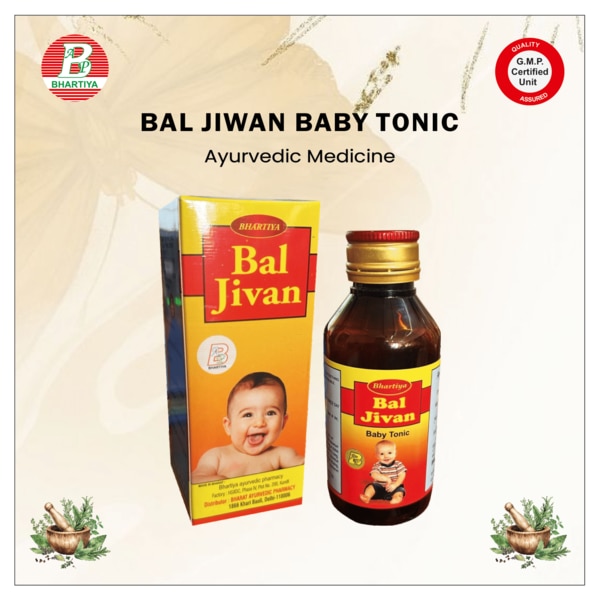
"name": "Bal Jivan Baby Tonic - 100 ml",
"description": "Bal Jivan Baby Tonic is a natural, Ayurvedic formulation designed to boost immunity, improve digestion, and promote overall growth in babies and toddlers. Enriched with essential herbs, it helps enhance appetite, supports physical development, and ensures sound sleep. Trusted by parents, Bal Jivan Baby Tonic is gentle, effective, and free from harmful chemicals, ensuring your baby’s healthy and happy journey.",
"price": 96.0,
"discountamount": 48.0,
"currencycode": "INR",
"priority": 1000000,
"isfreeshipmentavailable": false,
"shipmentduration": 1,
"_keywords": [
"happy journey",
"babys healthy",
"gentle effective",
"essential herbs",
"toddlers enriched",
"harmful chemicals ensuring"
],
"isarchived": false,
"isavailable": true,
"applicationid": null,
"productindex": 16,
"imageuri": "https://productimages.withfloats.com/actual/678f326ab17e29a717e23b80.png",
"tileimageuri": "https://productimages.withfloats.com/tile/678f326ab17e29a717e23b80.png",
"images": null,
"totalqueries": 0,
"gpid": null,
"groupproductid": null,
"createdon": "2025-01-21T05:36:39.487Z",
"updatedon": "2026-02-03T05:25:14.382Z",
"buyonlinelink": null,
"producturl": "http://WWW.BHARTIYAAYURVEDICPHARMACY.COM/products/bal-jivan-baby-tonic-100-ml/16",
"availableunits": -1.0,
"iscodavailable": true,
"isprepaidonlineavailable": true,
"maxcodorders": 0,
"maxprepaidonlineorders": 0,
"uniquepaymenturl": null,
"brandname": "Bakula Fort ",
"category": "Bal Jivan Baby Tonic - 100 ml X 48",
"tags": [],
"variants": false,
"keyspecification": null,
"otherspecifications": null,
"pickupaddressreferenceid": null,
"paymenttype": "AssuredPurchase",
"producttype": "products",
"hsncode": null,
"gstslab": 0.001,
"isnotforsale": false
},
{
"_id": "698dc74d9206f8f071919e73",
"fptag": "BHARTIYEAYURVEDICPHARMACY",
"merchantname": null,
"customwidgets": null,
"externalsourceid": null,
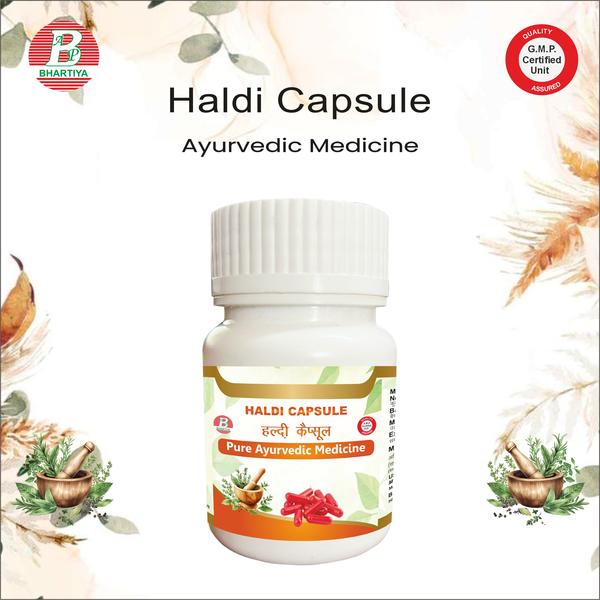
"name": "Haldi Capsule",
"description": " HALDI \n\n HALDI (Curcuma longa L.) \nThe Golden Healer — “Haridra”\n\nHaldi, commonly known as turmeric, is a revered herb in Ayurveda for its potent anti-inflammatory, antioxidant, and blood-purifying properties. It supports healthy digestion, immunity, skin health, and overall vitality. Traditionally used in inflammatory conditions, skin disorders, liver health, and general wellness.\n\n CLASSICAL AYURVEDIC REFERENCES\n \nCharaka Samhita\n\n•\tDescribed as Raktaprasadaka (blood purifier) and Pittashamaka (Pitta pacifier).\n\n•\tRecommended in skin diseases, fever, and digestive disorders.\n\nSushruta Samhita\n\n•\tUsed for wound healing, reducing inflammation, and promoting tissue regeneration.\n\n•\tRecognized for Kapha-Pitta balancing and detoxifying effects.\n\nBhavaprakasha Nighantu\n\n•\tCalled Haridra – Pittashamak, Rasayana (rejuvenator), Krimihara (anti-parasitic).\n•\tEnhances digestion, liver function, and immunity.\n\n\n CLASSICAL STORY / ANECDOTE\n\nAncient Ayurvedic lore tells that turmeric emerged from the churning of the cosmic ocean (Samudra Manthan) as a golden gift of the gods, symbolizing purity, protection, and vitality. It was used to heal wounds of warriors and maintain radiant health. Turmeric’s vibrant yellow color is associated with Agni (fire) and symbolizes its purifying and energizing qualities.\n\n\n BOTANICAL INFORMATION OF HALDI\n\nScientific Name: Curcuma longa L.\n\nFamily: Zingiberaceae\n\nOrder: Zingiberales\n\nGenus/Species: Curcuma longa\n\n\nCommon Names:\n\nSanskrit: Haridra\n\nHindi: Haldi\n\nEnglish: Turmeric\n\nTamil: Manjal\n\nTelugu: Pasupu\n\nMalayalam: Manjal\n\nKannada: Arisina\n\nBengali: Holud\n\n\n SYNONYMS IN CLASSICAL AYURVEDIC NIGHANTUS\n\n•\tCharaka Samhita: Haridra – Pittashamak, Raktaprasadaka\n•\tSushruta Samhita: Haridra – Vrana Ropaka (wound healing), Medohara\n•\tBhavaprakasha Nighantu: Haridra – Rasayana, Krimihara, Sheetapittahara\n\n\n MORPHOLOGY OF HALDI\n\nPlant Type: Perennial rhizomatous herb\nStem/Rhizome: Underground rhizomes, yellow-orange inside\nLeaves: Oblong-lanceolate, large, smooth\nFlowers: Pale yellow to light orange\nFruit: Small capsule\nTaste: Tikta (bitter), Kashaya (astringent), with slight Katu (pungent) aftertaste\n\n\n ECOLOGICAL PREFERENCES\n\nClimate: Tropical & subtropical\nSoil: Fertile, well-drained loamy soil\nHabitat: Moist, shaded fields, gardens\nSunlight: Partial shade to full sun\nAltitude: Up to 1500 m\n\n GEOGRAPHICAL DISTRIBUTION\n\nIndia: Kerala, Tamil Nadu, Karnataka, Odisha, West Bengal\nOutside India: Southeast Asia (Indonesia, Thailand), China\n\n CLASSICAL AYURVEDIC PROPERTIES (RASA–GUNA–VIRYA–VIPAKA)\n\nRasa (Taste): Tikta (bitter), Katu (pungent), Kashaya (astringent)\n\nGuna (Qualities): Laghu (light), Ruksha (dry)\n\nVirya (Potency): Ushna (heating)\n\nVipaka: Katu (pungent)\n\n\nDosha Effects:\n\nKapha-Pitta hara\n\nMay increase Vata if used excessively\n\n\nTherapeutic Actions (Karma):\n\n•\tRaktaprasadaka – purifies blood\n\n•\tPittashamak – balances Pitta\n\n•\tShothahara – reduces inflammation\n\n•\tKrimihara – anti-parasitic\n\n•\tRasayana – rejuvenator\n\n\nIndications:\n\n•\tSkin disorders (eczema, acne, wounds)\n\n•\tInflammatory conditions (arthritis, swelling)\n\n•\tLiver disorders and digestive weakness\n\n•\tFever and infections\n\n•\tImmune support and general wellness\n\n\n MODERN PHARMACOLOGY & PHYTOCHEMISTRY\n\nMajor Constituents:\n•\tCurcumin (active polyphenol)\n•\tVolatile oils (turmerone, zingiberene)\n•\tStarch, proteins, resins\n•\tPharmacological Actions:\n•\tAnti-inflammatory\n•\tAntioxidant\n\n•\tHepatoprotective (liver supportive)\n•\tAnti-microbial & wound healing\n•\tSupports immunity and metabolic health\n\n\n CULTIVATION DETAILS\n\n•\tPropagation: Rhizomes\n•\tPlanting Season: Early monsoon\n•\tSpacing: 30–45 cm\n•\tIrrigation: Moderate, keep soil moist\n•\tHarvesting: After 7–10 months\n\n\n CLASSICAL DOSAGE (According to Ayurvedic Practice)\n\nPowder (Churna): 1–3 g/day\nDecoction (Kwatha): 40–60 ml/day\nPaste (Lepa) for topical use: As required\nMilk with turmeric (Ksheerapaka): 100–200 ml/day\n\nSafety & Precautions:\n\ngenerally safe in recommended doses\nAvoid excess use in Pitta aggravation or acidity\n\n\n HALDI FORMULATIONS – Bhartiya Ayurvedic Pharmacy\n\nBhartiya Ayurvedic Pharmacy prepares authentic Haldi (Curcuma longa) formulations based on classical Ayurvedic texts, ensuring optimal anti-inflammatory, liver-supportive, and immunity-boosting benefits.\n\n\n HALDI CAPSULE \n\nDescription:\nHaldi Capsules are prepared using premium turmeric rhizome powder or standardized curcumin extract, following classical Ayurvedic methods.\nKey Benefits:\n•\tSupports liver and digestive health\n•\tReduces inflammation and swelling\n•\tEnhances immunity and overall vitality\n•\tSupports skin health and wound healing\nDosage:\n•\tAdults: 1–2 capsules twice daily with warm water or milk\n•\tOr as directed by an Ayurvedic physician\nSafety & Precautions:\n•\tSafe for long-term use under guidance\n•\tUse cautiously in cases of high Pitta, acidity, or bleeding disorders\nFormulation Highlights:\n•\t100% pure turmeric or standardized curcumin extract\n•\tNo artificial additives or preservatives\n•\tPrepared using classical Ayurvedic principles\n\n\n HALDI POWDER \n\nDescription:\nHaldi Powder is prepared from carefully dried and finely powdered turmeric rhizomes, preserving its natural therapeutic properties.\nKey Benefits:\n•\tAnti-inflammatory and antioxidant support\n•\tEnhances digestion and liver function\n•\tSupports immunity and metabolism\n•\tPromotes healthy skin and wound healing\nDosage:\n•\tAdults: 1–3 g daily\n•\tTake with warm water, milk, or honey\n•\tOr as advised by an Ayurvedic physician\nSafety & Precautions:\n•\tAvoid excessive use in high Pitta conditions\n•\tStore in a cool, dry place\nFormulation Highlights:\n•\t100% pure turmeric powder\n•\tNo chemicals, fillers, or preservatives\n•\tTraditionally processed following Ayurvedic methods\nSuggested Use:\n•\tIdeal for inflammatory conditions, liver support, immune health, skin care, and general wellness",
"price": 300.0,
"discountamount": 150.0,
"currencycode": "INR",
"priority": 1000000,
"isfreeshipmentavailable": false,
"shipmentduration": 1,
"_keywords": null,
"isarchived": false,
"isavailable": true,
"applicationid": null,
"productindex": 59,
"imageuri": "https://productimages.withfloats.com/actual/698dc74f5901c42c245711b2.jpg",
"tileimageuri": "https://productimages.withfloats.com/tile/698dc74f5901c42c245711b2.jpg",
"images": null,
"totalqueries": 0,
"gpid": null,
"groupproductid": null,
"createdon": "2026-02-12T12:27:57.345Z",
"updatedon": "2026-02-12T12:27:57.345Z",
"buyonlinelink": null,
"producturl": "http://WWW.BHARTIYAAYURVEDICPHARMACY.COM/products/haldi-capsule/59",
"availableunits": -1.0,
"iscodavailable": true,
"isprepaidonlineavailable": true,
"maxcodorders": -1,
"maxprepaidonlineorders": -1,
"uniquepaymenturl": null,
"brandname": "Bakula Fort",
"category": "Haldi Capsule 60 Cap X 24",
"tags": [],
"variants": false,
"keyspecification": null,
"otherspecifications": null,
"pickupaddressreferenceid": null,
"paymenttype": "AssuredPurchase",
"producttype": "products",
"hsncode": null,
"gstslab": 0.0,
"isnotforsale": false
},
{
"_id": "698dad3d301c5faebac8e965",
"fptag": "BHARTIYEAYURVEDICPHARMACY",
"merchantname": null,
"customwidgets": null,
"externalsourceid": null,
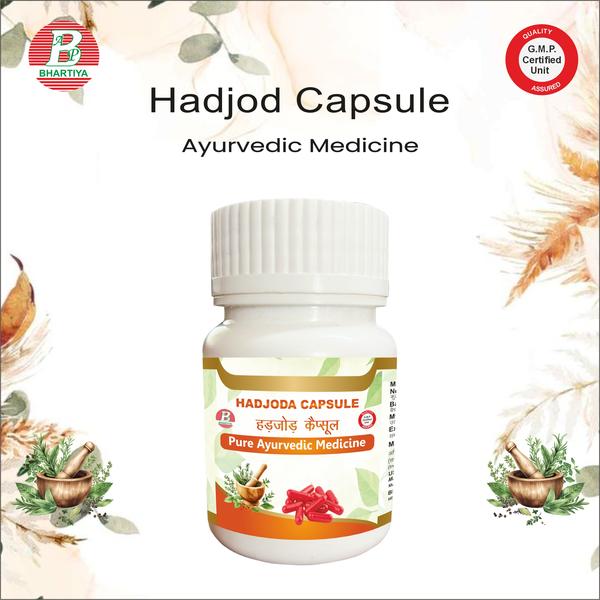
"name": "Hadjod capsule",
"description": " HADJOD \n\n HADJOD (Cissus quadrangularis L.) \nThe Bone-Healer & Fracture-Repair Herb — “Asthisamhara / Vajravalli”\nHadjod is one of the most renowned bone-strengthening and fracture-healing herbs in Ayurveda. Revered for its powerful Asthi-poshaka (bone-nourishing) and Sandhaniya (tissue-joining) properties, Hadjod accelerates fracture healing, strengthens bones and joints, and supports musculoskeletal integrity. It is widely used in fractures, osteoporosis, ligament injuries, and joint disorders.\n\n CLASSICAL AYURVEDIC REFERENCES\n\nCharaka Samhita\n•\tMentioned under Sandhaniya Dravyas for healing fractures and tissue injuries.\n•\tDescribed as Balya, Bhagna-sandhanakara (fracture uniting), and Vata-shamaka.\n\nSushruta Samhita\n•\tExtensively used in Bhagna Chikitsa (fracture management).\n•\tRecommended in fractures, dislocations, ligament tears, and post-surgical bone healing.\n\nBhavaprakasha Nighantu\n•\tDescribed as Asthisandhani, Balya, Vatahara, and Shothahara.\n•\tPromoted for strengthening bones, tendons, and muscles.\n\n CLASSICAL STORY / ANECDOTE\n\nAyurvedic lore describes Hadjod as a plant that “rejoins what is broken.”\nTraditional Vaidyas observed that even broken stems of Hadjod reattach and grow vigorously, inspiring its name Asthisamhara— “that which unites bones.”\nForest healers applied Hadjod paste externally on fractures while administering decoctions internally for rapid healing.\n\n BOTANICAL INFORMATION OF HADJOD\n\n• Scientific Name: Cissus quadrangularis L.\n• Family: Vitaceae\n• Order: Vitales\n• Genus: Cissus\n• Species: quadrangularis\n\nCommon Names:\n• Sanskrit: Asthisamhara, Vajravalli\n• Hindi: Hadjod\n• English: Bone Setter, Devil’s Backbone\n• Tamil: Pirandai\n• Telugu: Nalleru\n• Malayalam: Changalamparanda\n• Kannada: Mangarahalli\n• Bengali: Harjora\n\n SYNONYMS IN CLASSICAL AYURVEDIC NIGHANTUS\n\n• Charaka Samhita: Asthisamhara – Sandhaniya, Balya\n• Sushruta Samhita: Vajravalli – Bhagna-sandhanakara\n• Bhavaprakasha Nighantu: Hadjod – Vatahara, Shothahara\n\n MORPHOLOGY OF HADJOD\n\n• Plant Type: Perennial climber\n• Stem: Fleshy, quadrangular, jointed\n• Leaves: Simple, ovate, fleshy\n• Flowers: Small, greenish-white\n• Fruit: Small, red berry\n• Taste: Astringent, slightly sour\n\n ECOLOGICAL PREFERENCES\n\n• Climate: Tropical and subtropical\n• Soil: Well-drained sandy or loamy soil\n• Habitat: Hedges, dry forests, wastelands\n• Sunlight: Full sun to partial shade\n• Altitude: Up to 900 m\n\n GEOGRAPHICAL DISTRIBUTION\n\n• India: Tamil Nadu, Kerala, Andhra Pradesh, Maharashtra, Rajasthan, Madhya Pradesh\n• Outside India: Sri Lanka, Africa, Southeast Asia\n\n CLASSICAL AYURVEDIC PROPERTIES (RASA–GUNA–VIRYA–VIPAKA)\n\n• Rasa (Taste): Kashaya (astringent), Amla (sour)\n• Guna (Qualities): Laghu (light), Ruksha (dry)\n• Virya (Potency): Ushna (heating)\n• Vipaka (post-digestive effect): Katu (pungent)\n\nDosha Effects:\n• Vata–Kapha hara\n• May increase Pitta if used excessively\n\n THERAPEUTIC ACTIONS (KARMA)\n\n• Sandhaniya – Promotes fracture and tissue healing\n• Asthi-poshaka – Nourishes bones\n• Shothahara – Reduces inflammation\n• Vedanasthapana – Relieves pain\n• Balya – Strengthens muscles and joints\n• Vranaropana – Supports wound healing\n\n INDICATIONS\n\n• Bone fractures and hairline cracks\n• Osteoporosis and osteopenia\n• Joint pain, arthritis, and ligament injuries\n• Post-surgical bone recovery\n• Back pain and cervical/lumbar spondylosis\n• Sports injuries\n\n MODERN PHARMACOLOGY & PHYTOCHEMISTRY\n\nMajor Constituents:\nCalcium, phosphorus\n Ketosteroidso Flavonoids\n Triterpenoids\nAscorbic acid\n\nPharmacological Actions:\n Accelerates fracture healing\n Enhances bone mineralization\n Anti-inflammatory\n Analgesic\n Anti-osteoporotic\n\n CULTIVATION DETAILS\n\n• Propagation: Stem cuttings\n• Planting Season: Monsoon\n• Spacing: 1.5–2 m\n• Irrigation: Low to moderate\n• Harvesting: After 6–8 months\n\n CLASSICAL DOSAGE (According to Ayurvedic Practice)\n\n• Powder (Churna): 3–6 g/day\n• Decoction (Kwatha): 40–80 ml/day\n• Fresh Stem Juice: 10–20 ml/day\n• External Paste: As required\n\n\nHadjod (Cissus quadrangularis) Formulations – Bhartiya Ayurvedic Pharmacy\nBhartiya Ayurvedic Pharmacy prepares authentic Hadjod formulations based on classical Ayurvedic texts, ensuring optimal bone-healing, Vata-balancing, and musculoskeletal support.\n\n HADJOD CAPSULE 🌿\n\nHadjod Capsules are prepared using premium quality Cissus quadrangularis stem powder / standardized extract following classical Ayurvedic processing methods.\n\nKey Benefits:\n• Accelerates fracture healing\n• Strengthens bones and joints\n• Reduces pain and inflammation\n• Supports osteoporosis management\n• Improves mobility and recovery\n\nDosage:\n• Adults: 1–2 capsules twice daily with warm water or milk\n• Or as directed by an Ayurvedic physician\n\nSafety & Precautions:\n• Safe for long-term use under guidance\n• Use cautiously in high Pitta conditions\n• Suitable during fracture recovery\n\nFormulation Highlights:\n• 100% pure Hadjod stem extract\n• No artificial additives or preservatives\n• Prepared using classical Ayurvedic principles\n\nSuggested Use:\n• Ideal for fractures, weak bones, joint disorders, and post-injury rehabilitation\n\n HADJOD POWDER \n\nHadjod Powder is prepared from shade-dried, finely powdered stems of Cissus quadrangularis, preserving its natural bone-healing potency.\n\nKey Benefits:\n• Promotes rapid bone union\n• Strengthens ligaments and tendons\n• Reduces swelling and pain\n• Supports bone density\n\nDosage:\n• Adults: 3–6 g daily\n• Take with warm milk, ghee, or water\n• Or as advised by an Ayurvedic physician\n\nSafety & Precautions:\n• Excess use may increase Pitta\n• Store in a cool, dry place\n\nFormulation Highlights:\n• 100% pure Hadjod stem powder\n• No chemicals, fillers, or preservatives\n• Traditionally processed\n\nSuggested Use:\n• Ideal for fractures, osteoporosis, joint pain, and musculoskeletal strength\n",
"price": 300.0,
"discountamount": 150.0,
"currencycode": "INR",
"priority": 1000000,
"isfreeshipmentavailable": false,
"shipmentduration": 1,
"_keywords": null,
"isarchived": false,
"isavailable": true,
"applicationid": null,
"productindex": 58,
"imageuri": "https://productimages.withfloats.com/actual/698dad3fde2355c59a2f7b0a.jpg",
"tileimageuri": "https://productimages.withfloats.com/tile/698dad3fde2355c59a2f7b0a.jpg",
"images": null,
"totalqueries": 0,
"gpid": null,
"groupproductid": null,
"createdon": "2026-02-12T10:36:45.622Z",
"updatedon": "2026-02-12T10:36:45.622Z",
"buyonlinelink": null,
"producturl": "http://WWW.BHARTIYAAYURVEDICPHARMACY.COM/products/hadjod-capsule/58",
"availableunits": -1.0,
"iscodavailable": true,
"isprepaidonlineavailable": true,
"maxcodorders": -1,
"maxprepaidonlineorders": -1,
"uniquepaymenturl": null,
"brandname": "Bakula Fort",
"category": "Hadjod capsule 60 cap X 24",
"tags": [],
"variants": false,
"keyspecification": null,
"otherspecifications": null,
"pickupaddressreferenceid": null,
"paymenttype": "AssuredPurchase",
"producttype": "products",
"hsncode": null,
"gstslab": 0.0,
"isnotforsale": false
},
{
"_id": "698d91b0ae21e6001288f1de",
"fptag": "BHARTIYEAYURVEDICPHARMACY",
"merchantname": null,
"customwidgets": null,
"externalsourceid": null,
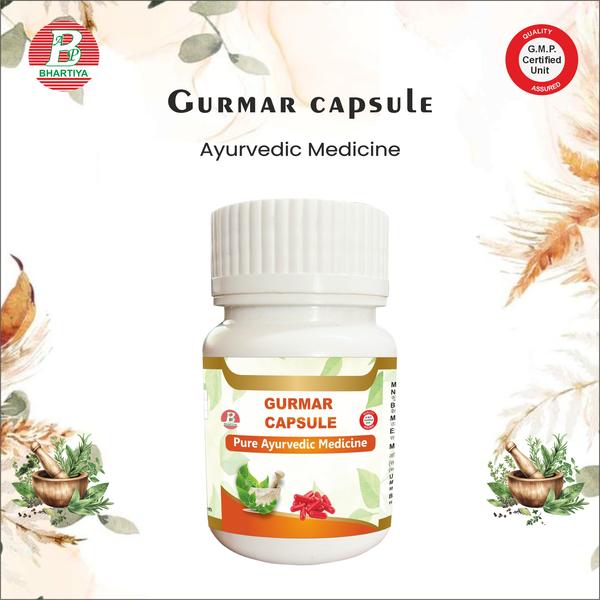
"name": "Gurmar Capsule",
"description": " GUDMAR \n\n\n GUDMAR (Gymnema sylvestre R.Br.) \nThe Sugar-Destroyer & Blood Sugar Regulator — “Madhunashini”\nGudmar is a revered herb in Ayurveda known for its potent Madhumeha-hara (anti-diabetic) and Rasa-hara (sweetness-reducing) properties. It supports healthy blood sugar levels, improves pancreatic function, reduces sugar cravings, and aids in weight management. Traditionally used in diabetes, metabolic syndrome, obesity, and sweet cravings.\n\n CLASSICAL AYURVEDIC REFERENCES\n\nCharaka Samhita\n•\tMentioned under Madhumeha Chikitsa for managing diabetes.\n•\tDescribed as Raktaprasadaka, Madhumeha-hara, and Kapha-Pitta balancing.\n\nSushruta Samhita\n•\tRecommended in Madhumeha, obesity, and metabolic disorders.\n•\tSupports insulin regulation and pancreatic health.\n\nBhavaprakasha Nighantu\n•\tDescribed as Madhunashini, Sheetapittahara, and Medohara.\n•\tPromotes healthy digestion, metabolism, and sugar control.\n\n CLASSICAL STORY / ANECDOTE\n\nAyurvedic lore describes Gudmar as the herb that “destroys sugar.”\nTraditional Vaidyas observed that chewing its leaves temporarily removes the taste of sweetness from the tongue, inspiring its name Madhunashini— “the destroyer of sugar.”\n\n BOTANICAL INFORMATION OF GUDMAR\n\n• Scientific Name: Gymnema sylvestre R.Br.\n• Family: Apocynaceae\n• Order: Gentianales\n• Genus: Gymnema\n• Species: sylvestre\n\nCommon Names:\n• Sanskrit: Madhunashini\n• Hindi: Gudmar\n• English: Gymnema, Sugar Destroyer\n• Tamil: Periploca of India\n• Telugu: Chinna Chinta\n• Malayalam: Pullaari\n• Kannada: Meshasringi\n• Bengali: Gudmar\n\n SYNONYMS IN CLASSICAL AYURVEDIC NIGHANTUS\n\n• Charaka Samhita: Madhumeha-hara – Raktaprasadaka, Kapha-Pitta balancing\n• Sushruta Samhita: Gudmar – Madhumeha-hara, Medohara\n• Bhavaprakasha Nighantu: Madhunashini – Sheetapittahara, Rasa-hara\n\n MORPHOLOGY OF GUDMAR\n\n• Plant Type: Perennial climber\n• Stem: Woody, climbing\n• Leaves: Opposite, ovate, smooth\n• Flowers: Small, greenish-white\n• Fruit: Follicle containing seeds\n• Taste: Bitter, slightly astringent\n\n ECOLOGICAL PREFERENCES\n\n• Climate: Tropical and subtropical\n• Soil: Well-drained sandy or loamy soil\n• Habitat: Forests, dry hills, wastelands\n• Sunlight: Full sun to partial shade\n• Altitude: Up to 800 m\n\n GEOGRAPHICAL DISTRIBUTION\n\n• India: Madhya Pradesh, Maharashtra, Karnataka, Tamil Nadu, Kerala\n• Outside India: Sri Lanka, Southeast Asia, Africa\n\n CLASSICAL AYURVEDIC PROPERTIES (RASA–GUNA–VIRYA–VIPAKA)\n\n• Rasa (Taste): Tikta (bitter), Kashaya (astringent)\n• Guna (Qualities): Laghu (light), Ruksha (dry)\n• Virya (Potency): Ushna (heating)\n• Vipaka (post-digestive effect): Katu (pungent)\n\nDosha Effects:\n• Kapha–Pitta hara\n• May increase Vata if used excessively\n\n THERAPEUTIC ACTIONS (KARMA)\n\n• Madhumeha-hara – Manages blood sugar\n• Medohara – Reduces excess fat\n• Rasa-hara – Reduces sweetness perception\n• Sheetapittahara – Balances Pitta\n• Agnivardhana – Improves digestion and metabolism\n\n INDICATIONS\n\no\tDiabetes (Madhumeha)\no\tObesity and metabolic syndrome\no\tSweet cravings and sugar dependency\no\tHigh cholesterol and triglycerides\no\tDigestive weakness\n\n MODERN PHARMACOLOGY & PHYTOCHEMISTRY\n\nMajor Constituents:\n• Gymnemic acids\n• Saponins\n• Flavonoids\n• Tannins\n\nPharmacological Actions:\n• Anti-diabetic (reduces blood sugar)\n• Anti-obesity\n• Reduces sugar absorption in the intestine\n• Improves insulin function\n• Hypolipidemic\n\n CULTIVATION DETAILS\n\n• Propagation: Stem cuttings or seeds\n• Planting Season: Monsoon\n• Spacing: 1–1.5 m\n• Irrigation: Low to moderate\n• Harvesting: After 12–18 months\n\n CLASSICAL DOSAGE (According to Ayurvedic Practice)\n\n• Powder (Churna): 1–3 g/day\n• Decoction (Kwatha): 40–60 ml/day\n• Fresh Leaf Juice: 10–20 ml/day\n• Chewing Fresh Leaves: As required\n\n\nGudmar (Gymnema sylvestre) Formulations – Bhartiya Ayurvedic Pharmacy\nBhartiya Ayurvedic Pharmacy prepares authentic Gudmar (Gymnema sylvestre) formulations based on classical Ayurvedic texts, ensuring optimal blood sugar support, metabolic balance, and digestive wellness.\n\n GUDMAR CAPSULE \n\nGudmar Capsules are prepared using premium Gymnema sylvestre leaf powder or standardized extract following classical Ayurvedic methods.\n\nKey Benefits:\n• Supports healthy blood sugar levels\n• Reduces sugar cravings\n• Promotes weight management\n• Improves metabolism and insulin function\n\nDosage:\n• Adults: 1–2 capsules twice daily with warm water or milk\n• Or as directed by an Ayurvedic physician\n\nSafety & Precautions:\n• Safe for long-term use under guidance\n• Use cautiously in low blood sugar conditions\n• Suitable for metabolic support\n\nFormulation Highlights:\n• 100% pure Gudmar leaf extract\n• No artificial additives or preservatives\n• Prepared using classical Ayurvedic principles\n\n GUDMAR POWDER \n\nGudmar Powder is prepared from shade-dried, finely powdered leaves of Gymnema sylvestre, preserving its natural anti-diabetic potency.\n\nKey Benefits:\n• Supports blood sugar regulation\n• Reduces sugar cravings\n• Supports weight management\n• Improves digestive and metabolic health\n\nDosage:\n• Adults: 1–3 g daily\n• Take with warm water, milk, or honey\n• Or as advised by an Ayurvedic physician\n\nSafety & Precautions:\n• Avoid excess use to prevent hypoglycemia\n• Store in a cool, dry place\n\nFormulation Highlights:\n• 100% pure Gudmar leaf powder\n• No chemicals, fillers, or preservatives\n• Traditionally processed\n\nSuggested Use:\n• Ideal for diabetes management, sweet cravings, weight control, and metabolic support\n",
"price": 360.0,
"discountamount": 180.0,
"currencycode": "INR",
"priority": 1000000,
"isfreeshipmentavailable": false,
"shipmentduration": 1,
"_keywords": null,
"isarchived": false,
"isavailable": true,
"applicationid": null,
"productindex": 56,
"imageuri": "https://productimages.withfloats.com/actual/698d91b2fa1c09f4b913a8f0.jpg",
"tileimageuri": "https://productimages.withfloats.com/tile/698d91b2fa1c09f4b913a8f0.jpg",
"images": null,
"totalqueries": 0,
"gpid": null,
"groupproductid": null,
"createdon": "2026-02-12T08:39:12.704Z",
"updatedon": "2026-02-12T08:39:12.704Z",
"buyonlinelink": null,
"producturl": "http://WWW.BHARTIYAAYURVEDICPHARMACY.COM/products/gurmar-capsule/56",
"availableunits": -1.0,
"iscodavailable": true,
"isprepaidonlineavailable": true,
"maxcodorders": -1,
"maxprepaidonlineorders": -1,
"uniquepaymenturl": null,
"brandname": "Bakula Fort",
"category": "Gurmar Capsule 60 cap X 16",
"tags": [],
"variants": false,
"keyspecification": null,
"otherspecifications": null,
"pickupaddressreferenceid": null,
"paymenttype": "AssuredPurchase",
"producttype": "products",
"hsncode": null,
"gstslab": 0.0,
"isnotforsale": false
},
{
"_id": "69808eef911df6d4b0db3166",
"fptag": "BHARTIYEAYURVEDICPHARMACY",
"merchantname": null,
"customwidgets": null,
"externalsourceid": null,
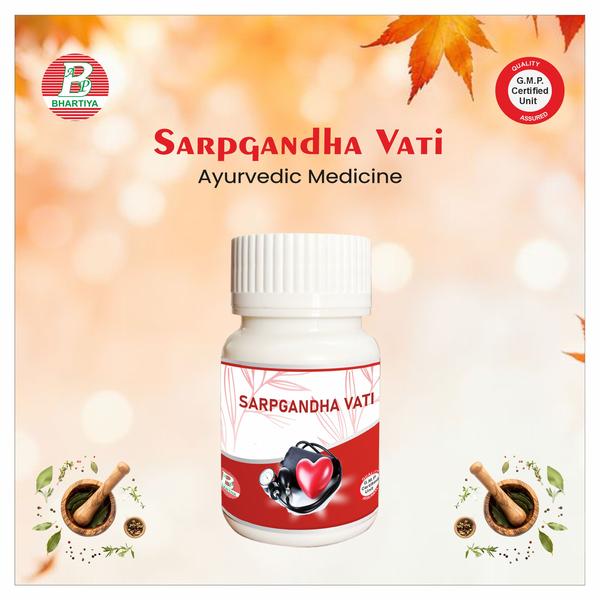
"name": "Sarpgandha vati / tablet",
"description": " Sarpagandha (Rauwolfia serpentina)\n The Serpent Root Herb with Profound Calming & Healing Power\nSarpagandha is one of the most potent and revered herbs in Ayurveda, known for its deep action on the nervous system, mind, blood pressure, and toxic conditions.\nThe name Sarpagandha literally means “the plant with a smell like a serpent” or “the herb that can subdue snake-like disorders”, symbolising its legendary power in calming, controlling, and neutralizing deep-rooted imbalances.\nAyurveda classifies Sarpagandha as:\n•\tStambhana (stabilizing, controlling)\n•\tNidrajanana (induces sleep)\n•\tVedanasthapana (analgesic)\n•\tSarpavisha hara (anti-venom / toxic disorders)\n•\tManas dosha hara (reduces mental disturbances)\n•\tHṛidya (supports the heart)\nIt is highly beneficial in managing high blood pressure, insomnia, anxiety, restlessness, mental agitation, certain psychotic disorders, and snake-bite toxic conditions (traditionally).\n Botanical Information of Sarpagandha\nScientific Name: Rauwolfia serpentina (Linn.) \nFamily: Apocynaceae\nOrder: Gentianales\nGenus: Rauwolfia\nSpecies: serpentina\nCommon Names\n•\tSanskrit: Sarpagandha, Chandrabhaga, Kundali, Sarpasandhi, Nakuli\n•\tHindi: Sarpagandha\n•\tEnglish: Indian Snakeroot, Serpent Root\n•\tTamil: Sivanar Vembu\n•\tTelugu: Patalagandhi\n•\tMalayalam: Paathalgaruda\n•\tKannada: Sarpagandhi\n•\tBengali: Sarpagandha\nSynonyms from Nighantus\n•\tBhavaprakasha: Sarpagandha, Chandrika, Kundali\n•\tDhanvantari Nighantu: Nakuli, Sarpasandhi\n•\tKaiyadeva Nighantu: Sarpagandha, Ganda Naga\n•\tRaja Nighantu: Sarpagandha, Patalagandhi\n Morphology of Sarpagandha (Rauwolfia serpentina)\nPlant Type\nPerennial, erect, smooth herb\nStem\n•\tSlender, erect, slightly woody at the base\n•\tDark green with smooth texture\nLeaves\n•\tSimple, opposite or whorled (3–4 in a circle)\n•\tLanceolate, smooth, shining\n•\tDark green above, light beneath\nFlowers\n•\tSmall, white or pinkish\n•\tArranged in terminal or axillary cymes\nRoots\n•\tLong, slender, cylindrical\n•\tDark brown externally, white inside\n•\tMedicinally most important part\n•\tCharacteristic serpentine smell (hence Sarpagandha)\nFruits\n•\tSmall, globose drupes\n•\tPurplish-black on ripening\nHabit\n•\tSlow-growing but hardy\n•\tDevelops best under semi-shade conditions\n Ecological Preferences\n•\tClimate: Tropical and subtropical\n•\tSoil: Moist, fertile, well-drained soil (prefers humus-rich loam)\n•\tSunlight: Partial shade preferred\n•\tMoisture: Requires consistent moisture\n•\tAltitude: Up to 1200 m\n•\tHabitat: Forest edges, moist slopes, shaded plantations\n Distribution\n•\tIndia: Common in the Himalayan foothills, Northeastern states, Bengal, Western Ghats, Odisha, and Central India\n•\tAsia: Nepal, Bhutan, Bangladesh, Myanmar, Sri Lanka, Thailand\n•\tOther Regions: Widely distributed in Southeast Asia\n Classical Ayurvedic Properties of Sarpagandha\n•\tRasa (Taste): Tikta (bitter), Kashaya (astringent), Madhura (slightly sweet)\n•\tGuna (Quality): Laghu (light), Ruksha (dry), Tikshna (penetrating)\n•\tVirya (Potency): Ushna (hot)\n•\tVipaka: Katu (pungent)\n•\tDosha Effect: Kapha-Vata hara, pacifies Raja & Tama (mental doshas)\nKarma (Therapeutic Actions)\n•\tNidrajanana – induces sleep\n•\tUnmadahara – reduces psychotic symptoms\n•\tSarpavisha hara – mitigates snake/poison effects (traditional use)\n•\tRaktachapa hara – reduces high blood pressure\n•\tStambhana – stabilizes nervous system\n•\tAnulomana – improves digestive and nervous coordination\n Historical & Grantha-Based Story/References of Sarpagandha\n 1. Mention in Ancient Texts\nSarpagandha is described in:\n•\tCharaka Samhita (Chikitsa Sthana) under Unmada (psychosis) treatment\n•\tSushruta Samhita under Sarpavisha Chikitsa (snake poisoning)\n•\tBhavaprakasha Nighantu elaborates its use for insomnia, hypertension-like symptoms, and mania\n•\tKaiyadeva Nighantu describes it as a herb that “calms the mind and controls the serpent-like movements of Vata in the nerves.”\n 2. Traditional Story: “The Serpent-Root Legend”\nAyurvedic folklore says:\n“A wandering sage noticed that snakes bitten by other snakes chewed the root of a certain plant and survived.”\nThis plant, believed to be Sarpagandha, was thus discovered in ancient times.\nThe sages concluded that if it could calm a deadly serpent’s venom, it could also calm the “inner serpent” — representing fear, agitation, and disordered nerves in humans.\nThis symbolic meaning led to its name Sarpagandha and its use for toxins, anxiety, agitation, hypertension, and insanity-like states.\n 3. Use by Ancient Physicians\n•\tAcharya Charaka used it in Unmada (psychiatric) conditions.\n•\tAcharya Sushruta prescribed it as a supportive herb for harmful bites and severe agitation.\n•\tVagbhata considered it “mind-stabilizing and nerve-controlling.”\n Modern Phytochemistry\nSarpagandha contains powerful alkaloids, especially:\n1. Alkaloids (main bioactive class)\n•\tReserpine – antihypertensive, sedative\n•\tAjmaline – antiarrhythmic\n•\tAjmalicine (raubasine) – circulatory and CNS modulator\n•\tSerpentine, Yohimbine (traces)\n2. Others\n•\tSterols\n•\tCarbohydrates\n•\tGlycosides\n•\tFlavonoids\n Species of Rauwolfia\n1.\tRauwolfia serpentina – true Sarpagandha, most potent\n2.\tRauwolfia tetraphylla – similar but less potent; used in some regions\n3.\tRauwolfia vomitoria – African species\n4.\tRauwolfia canescens – mild medicinal use\n Cultivation\n•\tPropagation: Seeds, root cuttings\n•\tPlanting Season: Monsoon (June–July)\n•\tSpacing: 30–45 cm\n•\tWatering: Regular moisture needed\n•\tManure: Best with organic compost\n•\tHarvesting: Roots collected after 2–3 years\n•\tNote: Overharvested in the wild → now commercially cultivated\n Classical Ayurvedic Dosage (from Granthas)\n(General, traditional; modern use must be supervised due to potency)\n•\tRoot Powder (Churna): 250–500 mg once or twice daily\n•\tRoot Decoction (Kwatha): 30–40 ml\n•\tSwarasa (Juice): 5–10 ml\nUsed in:\n•\tInsomnia\n•\tMental disorders\n•\tHypertension-like symptoms\n•\tAgitation\n•\tToxic disorders (traditional use)\n Safety & Precautions\nSarpagandha is highly potent.\n•\tAvoid overdose\n•\tNot suitable during pregnancy\n•\tNot to be combined with other sedatives or antihypertensive drugs without guidance\n•\tMust be used under qualified Ayurvedic supervision\n Sarpagandha Compound Formulations (Classical):\nSarpagandha with Arjuna, Ashwagandha, Brahmi, Shankhapushpi, or Jatamansi—used for hypertension, anxiety, insomnia, nervous disorders, and cardiovascular support, prepared according to classical Ayurvedic methods to retain Rasayana and Medhya properties.\n Sarpagandha Formulations by Bhartiya Ayurvedic Pharmacy\nAt Bhartiya Ayurvedic Pharmacy, we prepare a range of Sarpagandha formulations following classical Ayurvedic methods as described in Charaka Samhita, Sushruta Samhita, Bhavaprakasha Nighantu, and other Ayurvedic Granthas. Each product is crafted to retain the therapeutic potency, purity, and efficacy of the herb, ensuring benefits for stress relief, blood pressure management, nervous system support, and overall mental well-being.\n1.\tSarpagandha Vati/Tablet\nDose\n1 tablet (250–500 mg) twice daily\nOr 1 tablet at night for sleep disorders\nAdvanced cases: 1 tablet thrice daily (only under supervision)\n•\tFor hypertension-like symptoms, insomnia\n•\tSupports Calmness & Mental Stability\n•\tUseful in: Anxiety, Nervousness, Agitation, Irritability, Restlessness, Racing thoughts\n•\tHelps balance Rajas and Tamas (mental doshas) and calms Vata in the nervous system.\nSupports Brain & Nerve Health\nHelps in:\n•\tReducing excessive nerve excitability\n•\tSupporting healthy brain signaling\n•\tPromoting alert calmness\nUsed traditionally in unmada chikitsa (Ayurvedic mental health management)",
"price": 540.0,
"discountamount": 270.0,
"currencycode": "INR",
"priority": 1000000,
"isfreeshipmentavailable": false,
"shipmentduration": 1,
"_keywords": null,
"isarchived": false,
"isavailable": true,
"applicationid": null,
"productindex": 30,
"imageuri": "https://productimages.withfloats.com/actual/69808ef1cf660bbbdc554d46.jpg",
"tileimageuri": "https://productimages.withfloats.com/tile/69808ef1cf660bbbdc554d46.jpg",
"images": null,
"totalqueries": 0,
"gpid": null,
"groupproductid": null,
"createdon": "2026-02-02T11:47:59.198Z",
"updatedon": "2026-02-04T05:50:18.477Z",
"buyonlinelink": null,
"producturl": "http://WWW.BHARTIYAAYURVEDICPHARMACY.COM//sarpgandha-vati-tablet/30",
"availableunits": -1.0,
"iscodavailable": true,
"isprepaidonlineavailable": true,
"maxcodorders": 0,
"maxprepaidonlineorders": -1,
"uniquepaymenturl": null,
"brandname": "Bakula fort",
"category": "Sarpgandha vati / tablet 100 - GM X 24",
"tags": [],
"variants": false,
"keyspecification": null,
"otherspecifications": null,
"pickupaddressreferenceid": null,
"paymenttype": "AssuredPurchase",
"producttype": "products",
"hsncode": null,
"gstslab": 0.0,
"isnotforsale": false
},
{
"_id": "698084369b2383ec7eecaa68",
"fptag": "BHARTIYEAYURVEDICPHARMACY",
"merchantname": null,
"customwidgets": null,
"externalsourceid": null,
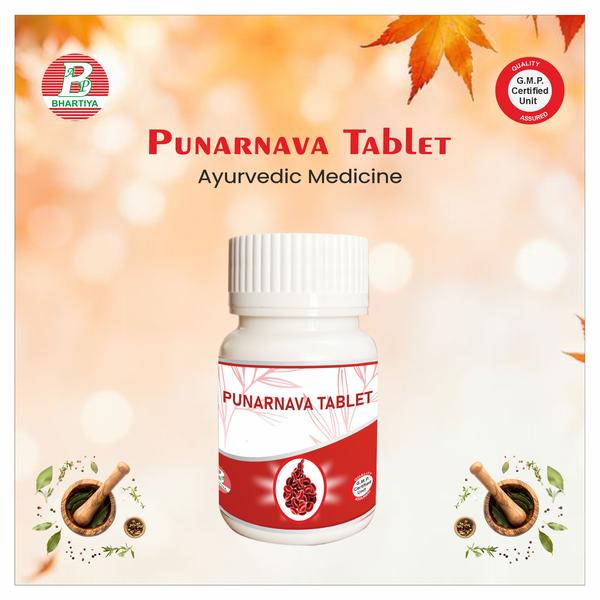
"name": "Punarnava Tablet",
"description": " Punarnava (Boerhavia diffusa) \n The Rejuvenating Herb with Healing Leaves\nPunarnava is one of the most important rejuvenating herbs in Ayurveda, widely valued for its unique ability to revive and renew the body.\nThe name Punarnava literally means “that which becomes new again”, indicating its powerful regenerative and restorative nature.\nIn Ayurveda, Punarnava is classified as a Mutrala (diuretic), Shothahara (anti-inflammatory), and Rasayana (rejuvenative) drug. It is highly beneficial in managing swelling (oedema), kidney disorders, liver weakness, urinary problems, digestive issues, anaemia, and general debility.\nBotanical Information of Punarnava\nScientific Name: Boerhavia diffusa Linn.\nFamily: Nyctaginaceae\nOrder: Caryophyllales\nGenus: Boerhavia\nSpecies: diffusa\nCommon Names:\n•\tSanskrit: Punarnavā, Shothaghanī, Raktapunarnavā, Śvetapunarnavā, Shreṇī, Shoṭikā\n•\tHindi: Punarnava\n•\tEnglish: Spreading Hogweed, Red Spiderling\n•\tTamil: Mookarattai\n•\tTelugu: Atika\n•\tMalayalam: Thazhuthama\n•\tKannada: Komme beru\n•\tBengali: Punarnava\nSynonyms of Punarnava (Boerhavia diffusa) in Ayurvedic Nighantus:\n Bhavaprakasha Nighantu – Shothaghni, Raktapunarnava, Shvetapunarnava, Shoṭikā\n Raja Nighantu & Kaiyadeva Nighantu – Panchanga, Jalapushpa, Mochana, Bhujanga\n Hrudaya Nighantu & Dhanvantari Nighantu – Utkalika, Shreni\n Morphology of Punarnava (Boerhavia diffusa)\nPlant Type: Perennial, creeping, and spreading herb\nStem:\n•\tProstrate or slightly ascending, creeping along the ground\n•\tPurplish-green, hairy, with swollen nodes\n•\tRoots develop at nodes where the stem touches the soil\nLeaves:\n•\tSimple, opposite arrangement\n•\tShape: Ovate, elliptic, or slightly rounded\n•\tTexture: Fleshy and soft\n•\tColor: Dark green on the upper surface, pale green below\n•\tPetiole: Short\nFlowers:\n•\tSmall, tubular, and bisexual\n•\tColor: Pink, reddish, or white\n•\tArranged in axillary clusters (cymes)\n•\tBloom mainly during summer and rainy seasons\nRoots:\n•\tThick, cylindrical, fleshy, and tapering\n•\tColor: White in Shveta Punarnava, reddish in Rakta Punarnava\n•\tMedicinal part, rich in active constituents\nFruits:\n•\tSmall, ovoid, glandular, and sticky when young\n•\tDark brown at maturity\n•\tOne-seeded\nHabit:\n•\tCreeping, spreading, fast-growing, regenerates easily\n•\tAdapted to drought and poor soil conditions\n Ecological Preferences of Punarnava\n•\tClimate: Thrives in tropical and subtropical climates; tolerates heat and moderate drought.\n•\tSoil: Prefers sandy, loamy, or well-drained soils; can grow in poor or degraded soils.\n•\tSunlight: Grows well in full sunlight to partial shade.\n•\tMoisture: Requires moderate moisture; can survive dry periods due to its hardy nature.\n•\tAltitude: Found at low to medium altitudes, commonly in plains and open areas.\n•\tHabitat: Common along roadsides, fields, gardens, wastelands, and riverbanks.\n•\tGrowth habit: Creeping, spreading, fast-growing, and regenerates easily after adverse conditions.\n Distribution of Punarnava\nGeographical Distribution:\nPunarnava is a widely distributed perennial herb found in tropical and subtropical regions across the world.\n•\tIndia: Found throughout the country in almost all states, particularly in plains, dry regions, roadsides, wastelands, and fields.\n•\tAsia: Occurs in Pakistan, Sri Lanka, Bangladesh, Nepal, and Myanmar.\n•\tAfrica: Common in tropical and subtropical Africa.\n•\tAmericas: Found in parts of South America and Central America.\n•\tOther Regions: Naturalized in various tropical areas worldwide due to its hardy and fast-growing nature\n Classical Ayurvedic Properties of Punarnava\n•\tRasa (Taste): Tikta (bitter), Kashaya (astringent)\n•\tGuna (Qualities): Laghu (light), Ruksha (dry)\n•\tVirya (Potency): Ushna (hot)\n•\tVipaka (post-digestive effect): Katu (pungent)\n•\tDosha Effect: Kapha-Vata shamaka (pacifies Kapha and Vata doshas)\n•\tKarma (Actions / Therapeutic Effects):\no\tMutrala: Promotes urination, useful in oedema and urinary disorders\no\tShothahara: Reduces swelling and inflammation\no\tYakrit-Pleeha Shodhaka: Supports liver and spleen health\no\tRasayana: Rejuvenative and revitalizing\no\tHridya: Supports heart function\nTherapeutic Actions of Punarnava According to Acharyas\n1.\tMutrala (Diuretic):\no\tPromotes urine formation, relieves Shotha (edema, ascites, anasarca)\no\tUseful in kidney and urinary disorders\n2.\tShothahara (Anti-inflammatory / Anti-edema):\no\tReduces Kapha and Vata-related swelling\no\tUseful in joint swelling, ascites, and edema\n3.\tYakrit-Pleeha Shodhaka (Hepato-splenic tonic / Detoxifier):\no\tSupports liver and spleen health\no\tClears stagnation in Rakta and Pitta\n4.\tRasayana (Rejuvenative / Revitalizing):\no\tImproves strength, vitality, and general health\no\tEnhances immunity and longevity\n5.\tHridya (Cardio-supportive):\no\tSupports heart function by reducing fluid overload\n6.\tMedohara / Vatashamaka:\no\tHelps in reducing excessive fat (Medo Dhatu) and pacifies Vata dosha in the body\n\nReferences from Acharyas:\n•\tCharaka Samhita: Punarnava is Shothaghni, Mutrala, Rasayana\n•\tSushruta Samhita: Shveta and Rakta Punarnava described for Shotha, Mutra, and Yakrit-Pleeha disorders\n•\tBhavaprakasha: Emphasizes anti-edema, diuretic, hepatoprotective, and rejuvenative actions\n Modern Phytochemistry of Punarnava\nPunarnava is rich in bioactive compounds responsible for its therapeutic properties. Key phytochemicals identified include:\n1. Alkaloids\n•\tPunarnavine – major alkaloid, responsible for diuretic and hepatoprotective activity\n•\tBoeravinones (A–F) – rotenoid compounds with antioxidant, hepatoprotective, and anti-inflammatory properties\n2. Flavonoids\n•\tQuercetin, Kaempferol – contribute to antioxidant and anti-inflammatory effects\n3. Glycosides\n•\tPunarnavoside – responsible for diuretic and anti-edema activity\nSpecies of Punarnava (Genus: Boerhavia)\nThe genus Boerhavia (family Nyctaginaceae) includes several species, but Boerhavia diffusa is the most commonly used in Ayurveda. Other species are also recognized botanically for various regional and medicinal uses:\n1. Boerhavia diffusa Linn.\n•\tMost widely used in Ayurveda\n•\tPerennial, creeping, and spreading herb\n•\tKnown for diuretic, anti-inflammatory, hepatoprotective, and rejuvenative properties\n2. Boerhavia erecta L.\n•\tErect or semi-erect habit, less creeping\n•\tFound in tropical regions\n•\tUsed in traditional medicine locally, but less common in classical Ayurveda\n3. Boerhavia repens L.\n•\tCreeping herb, often used as ground cover\n•\tOccasional medicinal use in folk medicine\n4. Boerhavia coccinea Mill.\n•\tRed-flowered species, creeping habit\n•\tSometimes used in ethnomedicine for fever and inflammation\n5. Boerhavia verticillata Willd.\n•\tFound in Africa and Asia\n•\tLimited medicinal use; occasionally cited in ethnobotanical surveys\nCultivation:\n•\tPropagation: Primarily by seeds; can also propagate via stem cuttings due to its creeping habit.\n•\tSowing Time: Best sown during the early monsoon or rainy season.\n•\tSpacing: Maintain 30–40 cm between plants to allow spreading.\n•\tWatering: Requires moderate moisture; drought-tolerant once established.\n•\tFertilization: Responds well to organic manure or compost, though hardy enough to grow in poor soils.\n•\tHarvesting: Roots, stems, and leaves are harvested after 3–4 months of growth, depending on medicinal use.\n•\tEcological Note: Acts as a pioneer plant, stabilizing soil and growing in degraded lands.\n Classical Dosage of Punarnava in Granthas\n1. Charaka Samhita\nForm: Root or whole plant powder (Churna), decoction (Kwatha)\nDose: 3–6 grams of powder; 40–60 ml of decoction, 2–3 times daily\nUses: Shotha (edema), Mutrakriccha (urinary disorders), Rasayana\n2. Sushruta Samhita\nForm: Root, whole plant, or paste\nDose: 3–6 grams powder; decoction 40–60 ml; external paste as required\nUses: Shotha, Mutra, Yakrit-Pleeha disorders\n3. Bhavaprakasha Nighantu\nForm: Churna, Kwatha, Swarasa (juice)\nDose: 3–6 grams Churna; 40–60 ml Kwatha; 20–30 ml Swarasa 1–2 times daily\nNotes: Shveta Punarnava for urinary issues; Rakta Punarnava for liver and blood disorders\n4. Raja Nighantu & Kaiyadeva Nighantu\nForm: Panchanga (whole plant), decoction, powder\nDose: Similar classical dose as above; 3–6 grams for powder, decoction 40–60 ml\nTherapeutic Use: Shothahara, Mutrala, Rasayana\n\n Safety and Precautions of Punarnava\n Safe in classical dosage.\n Avoid overdose -caution with strong diuretics.\n Pregnant Woman- use only under supervision.\n\n Classical Ayurvedic Formulations of Punarnava\nPunarnava is a key ingredient in many classical Ayurvedic preparations for edema, liver disorders, kidney ailments, and rejuvenation. Common formulations include:\n1. Punarnavadi Kwatha (Decoction)\n•\tIngredients: Punarnava, Trikatu (Pippali, Maricha, Shunthi), Musta, Haritaki, and other supporting herbs\n•\tAction: Diuretic, anti-edema, hepatoprotective, rejuvenative\n•\tIndication: Shotha (edema), Ascites, Mutrakriccha (urinary disorders)\n2. Punarnavadi Churna (Powder)\n•\tIngredients: Punarnava root, Haritaki, Musta, Chitrak, Shunthi\n•\tAction: Supports kidney and liver health, promotes detoxification, reduces swelling\n•\tDose: 3–6 g/day with water or honey\n3. Punarnava Swarasa (Juice)\n•\tForm: Fresh juice of Punarnava root or whole plant\n•\tAction: Diuretic, anti-inflammatory, mild laxative\n•\tDose: 20–30 ml, 1–2 times daily\n4. Punarnava Grita or Taila (Medicated Ghee/Oil)\n•\tUsage: External application for swelling, inflammation, and joint disorders\n•\tAction: Shothahara, soothing, and rejuvenative\n5. Compound Formulations\n•\tPunarnavadi Kashaya, Punarnavadi Gutika, Punarnavadi Avaleha – used in liver disorders, urinary diseases, edema, and general rejuvenation.\n Punarnava Formulations by Bhartiya Ayurvedic Pharmacy\nAt Bhartiya Ayurvedic Pharmacy, we prepare a range of Punarnava (Boerhavia diffusa) formulations following classical Ayurvedic methods as described in Charaka Samhita, Sushruta Samhita, Bhav Prakash Nighantu, and other Ayurvedic Granthas. Each product is crafted to retain the therapeutic potency, purity, and efficacy of the herb, ensuring benefits for fluid balance, kidney & liver support, detoxification, and rejuvenation.\n1. Punarnava Tablet\nDescription:\nPunarnava Tablets contain standardized powdered extract of Boerhavia diffusa, providing a convenient dosage form for daily use.\nKey Actions:\n•\tSupports normal urinary output and reduces mild water retention\n•\tPromotes liver and kidney health\n•\tReduces swelling (Edema)\n•\tBeneficial in cough or intestinal colic\n•\tIt can help lower the blood pressure\n•\tProvides general detox and rejuvenation\nDosage:\n•\t1–2 tablets twice daily after meals, or as advised by an Ayurvedic practitioner\nPrecautions:\n•\tUse under guidance in pregnancy, kidney disorders, or excessive fluid loss\n•\tMaintain recommended dosage",
"price": 180.0,
"discountamount": 90.0,
"currencycode": "INR",
"priority": 1000000,
"isfreeshipmentavailable": false,
"shipmentduration": 1,
"_keywords": null,
"isarchived": false,
"isavailable": true,
"applicationid": null,
"productindex": 29,
"imageuri": "https://productimages.withfloats.com/actual/69808437fc3cf1d183418882.jpg",
"tileimageuri": "https://productimages.withfloats.com/tile/69808437fc3cf1d183418882.jpg",
"images": null,
"totalqueries": 0,
"gpid": null,
"groupproductid": null,
"createdon": "2026-02-02T11:02:14.772Z",
"updatedon": "2026-02-04T05:52:19.889Z",
"buyonlinelink": null,
"producturl": "http://WWW.BHARTIYAAYURVEDICPHARMACY.COM/products/punarnava-tablet/29",
"availableunits": -1.0,
"iscodavailable": true,
"isprepaidonlineavailable": true,
"maxcodorders": 0,
"maxprepaidonlineorders": -1,
"uniquepaymenturl": null,
"brandname": "Bakula Fort",
"category": "Punarnava Tablet 100 - Tab X 24",
"tags": [],
"variants": false,
"keyspecification": null,
"otherspecifications": null,
"pickupaddressreferenceid": null,
"paymenttype": "AssuredPurchase",
"producttype": "products",
"hsncode": null,
"gstslab": 0.0,
"isnotforsale": false
},
{
"_id": "698ec4911456f45dc237c744",
"fptag": "BHARTIYEAYURVEDICPHARMACY",
"merchantname": null,
"customwidgets": null,
"externalsourceid": null,
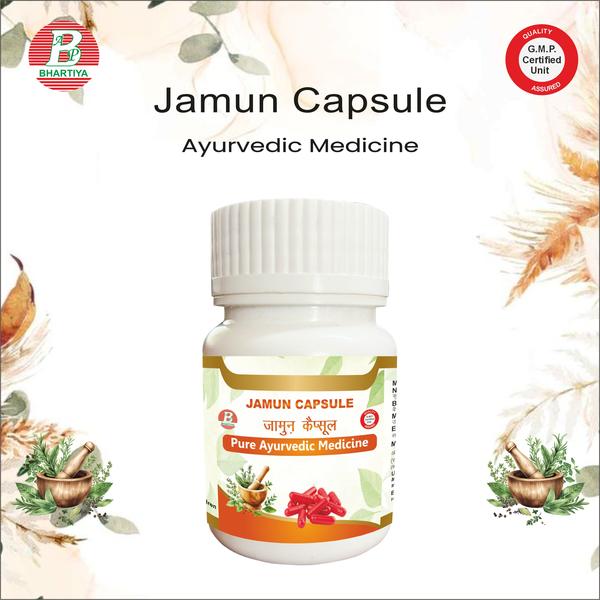
"name": "Jamun capsule",
"description": " JAMUN \n\n The Dark Jewel of Ayurveda — “Jamun / Syzygium cumini”\n\nJamun is a revered fruit in Ayurveda, known for its Raktashodhaka (blood-purifying), Madhumehahara (anti-diabetic), Deepana–Pachana (digestive), Rasayana (rejuvenative), and Vata-Kapha balancing properties. It is highly valued for maintaining healthy blood sugar, supporting digestion, improving immunity, and revitalizing the body. Traditionally, Jamun is considered especially effective in Madhumeha (diabetes), Pitta disorders, and digestive imbalances.\n\n CLASSICAL AYURVEDIC REFERENCES\nCharaka Samhita\n•\tRecommended in Madhumeha, Pitta disorders, and digestive disturbances\n•\tActs as a Rasayana to improve overall vitality\n•\tSupports blood purification and metabolic balance\nSushruta Samhita\n•\tUsed for digestive disorders, Pitta imbalances, and urinary issues\n•\tPromotes tissue rejuvenation and detoxification\nBhavaprakasha Nighantu\n•\tHighlights Jamun for Raktashodhaka, Madhumehahara, Rasayana, and Vata-Kapha balancing\n•\tParticularly emphasized for blood sugar management, anaemia, and general debility\nUnani & Folk Medicine\n•\tKnown as “Indian Blackberry”\n•\tTraditionally used to control diabetes, reduce inflammation, improve digestion, and detoxify the body\n\n CLASSICAL STORY / TRADITIONAL ANALOGY\nAncient Ayurvedic texts narrate:\n“Jamun is the dark-hued gem of the forest, whose seeds, fruit, and bark hold the power to sweeten the imbalance of blood, calm the fire of Pitta, and strengthen the weakened tissues. As the fruit ripens under the summer sun, so does the body regain strength and metabolic balance when nourished by Jamun.”\nRishis and Acharyas prescribed Jamun to:\n•\tControl Madhumeha (diabetes) and high blood sugar\n•\tSupport digestion and liver function\n•\tPurify blood and enhance tissue metabolism\n•\tRejuvenate the body and support immunity\n\n BOTANICAL INFORMATION OF JAMUN\nScientific Name: Syzygium cumini (L.) Skeels\nFamily: Myrtaceae\nOrder: Myrtales\nGenus: Syzygium\nSpecies: cumini\nCommon Names:\n•\tSanskrit: Jambū, Jambu, Krishnaphala\n•\tHindi: Jamun\n•\tEnglish: Indian Blackberry\n•\tTamil: Neredu\n•\tTelugu: Jambhulamu\n•\tKannada: Neredu\n•\tBengali: Jam\n•\tMalayalam: Neredu\nSynonyms in Traditional Texts:\n•\tMadhumehahara – Anti-diabetic\n•\tRaktashodhaka – Blood-purifying\n•\tRasayana – Rejuvenative\n•\tDeepana–Pachana – Improves digestion\n\n MORPHOLOGY OF JAMUN\nPlant Type: Large evergreen tree\nHeight: 10–30 m\nLeaves: Simple, opposite, oblong-elliptic, dark green\nFlowers: Small, white to pinkish, fragrant\nFruit: Dark purple to black berry, fleshy, sweet-sour taste\nSeeds: Oval, hard, light brown\nBark: Thick, dark brown, astringent taste\n\n ECOLOGICAL PREFERENCES\n•\tClimate: Tropical and subtropical\n•\tSoil: Well-drained loamy, alluvial soil\n•\tSunlight: Full sun to partial shade\n•\tWater Requirement: Moderate; tolerates drought once established\n•\tAltitude: 0–1500 m\n•\tDistribution: India (all over, especially Madhya Pradesh, Maharashtra, Tamil Nadu, West Bengal), Pakistan, Sri Lanka, Southeast Asia\n\n AYURVEDIC PROPERTIES (RASA–GUNA–VIRYA–VIPAKA)\n•\tRasa: Tikta (bitter), Madhura (sweet), Kashaya (astringent)\n•\tGuna: Laghu (light), Ruksha (dry)\n•\tVirya: Sheeta (cooling)\n•\tVipaka: Madhura (sweet)\n•\tDosha Effect: Pitta-Vata pacifying, Kapha balancing\n\n THERAPEUTIC ACTIONS (KARMA)\n•\tMadhumehahara: Helps control blood sugar levels\n•\tRaktashodhaka: Purifies blood and detoxifies\n•\tRasayana: Rejuvenative, strengthens immunity\n•\tDeepana–Pachana: Improves digestion and nutrient assimilation\n•\tVata-Kapha balancing: Reduces inflammation and metabolic disorders\n\n INDICATIONS\n•\tDiabetes / high blood sugar\n•\tDigestive disorders and Pitta imbalances\n•\tUrinary and kidney issues\n•\tBlood impurities / anaemia\n•\tChronic inflammation\n•\tGeneral debility and weakness\n\n MODERN PHYTOCHEMISTRY & PHARMACOLOGY\nMajor Constituents:\n•\tAnthocyanins (jamunins) – responsible for hypoglycemic effect\n•\tEllagic acid, Gallic acid – antioxidant\n•\tFlavonoids and Tannins – digestive, anti-inflammatory\n•\tEssential oils and resins\nPharmacological Actions:\n•\tAnti-diabetic / hypoglycemic\n•\tAntioxidant and anti-inflammatory\n•\tHepatoprotective\n•\tAntimicrobial\n•\tDigestive support\n•\tImmunomodulatory\n\n CULTIVATION DETAILS\n•\tPropagation: Seeds, grafting, and air-layering\n•\tSowing Time: Early monsoon\n•\tHarvesting: Fruits harvested in summer; seeds and bark processed for medicinal use\n•\tIrrigation: Moderate; drought-tolerant once established\n•\tSoil Preference: Well-drained loamy soil\n\n CLASSICAL DOSAGE\n•\tPowder (Churna): 3–6 grams/day\n•\tSeed Powder: 1–2 grams/day\n•\tDecoction / Extract: As prescribed by Ayurvedic practitioner\n•\tFruit: 10–20 berries/day for mild metabolic support\n\n\n JAMUN FORMULATIONS BY BHARTIYA AYURVEDIC PHARMACY\nAt Bhartiya Ayurvedic Pharmacy, we prepare a range of Jamun (Syzygium cumini) formulations following classical Ayurvedic methods as described in Charaka Samhita, Sushruta Samhita, Bhavaprakasha Nighantu, and other Ayurvedic Granthas. Each product is crafted to retain the therapeutic potency, purity, and efficacy of Jamun for blood sugar management, digestive support, detoxification, and rejuvenation.\n\n 1. Jamun Capsule\nDescription:\nBhartiya Ayurvedic Pharmacy Jamun Capsules are prepared using standardized Jamun seed and pulp extract, ensuring convenient daily use while preserving the full therapeutic potential of the herb.\nKey Actions:\n•\tSupports healthy blood sugar levels\n•\tPromotes digestion and liver function\n•\tActs as a blood purifier and rejuvenative\n•\tReduces inflammation and metabolic imbalances\n•\tEnhances immunity and general vitality\nDosage:\n•\t1–2 capsules twice daily with warm water after meals, or as advised by an Ayurvedic practitioner\nPrecautions:\n•\tMonitor blood sugar if taking antidiabetic medications\n•\tAvoid overdose\n•\tUse under supervision in pregnancy and lactation\n\n 2. Jamun Powder (Churna)\nDescription:\nPowdered form of dried Jamun seeds, suitable for internal use or preparation of decoctions. Maintains blood sugar balance, digestive health, and tissue rejuvenation.\nKey Actions:\n•\tHelps control blood sugar levels (Madhumehahara)\n•\tPurifies blood (Raktashodhaka)\n•\tSupports digestion and metabolic balance\n•\tActs as a general rejuvenative (Rasayana)\n•\tBalances Pitta and Vata doshas\nDosage:\n•\t2–4 grams once or twice daily with warm water, honey, or ghee\n•\tCan be taken before or after meals depending on constitution\nPrecautions:\n•\tAvoid in cases of low blood sugar without monitoring\n•\tNot recommended for individuals with known hypersensitivity to Jamun\n\n CLASSICAL INSIGHT\n•\tPrescribed in Charaka Samhita, Sushruta Samhita, and Bhavaprakasha Nighantu for:\no\tDiabetes / high blood sugar\no\tBlood purification and anaemia\no\tDigestive disorders\no\tRejuvenation (Rasayana)\nTraditional Analogy:\n“As the dark-hued Jamun ripens under the sun and nourishes all, so does the body regain strength, balance, and vitality when nourished by Jamun.”",
"price": 270.0,
"discountamount": 135.0,
"currencycode": "INR",
"priority": 1000000,
"isfreeshipmentavailable": false,
"shipmentduration": 1,
"_keywords": null,
"isarchived": false,
"isavailable": true,
"applicationid": null,
"productindex": 61,
"imageuri": "https://productimages.withfloats.com/actual/698ec49b3d2f9770ce0bdc4e.jpg",
"tileimageuri": "https://productimages.withfloats.com/tile/698ec49b3d2f9770ce0bdc4e.jpg",
"images": null,
"totalqueries": 0,
"gpid": null,
"groupproductid": null,
"createdon": "2026-02-13T06:28:33.524Z",
"updatedon": "2026-02-13T06:28:33.524Z",
"buyonlinelink": null,
"producturl": "http://WWW.BHARTIYAAYURVEDICPHARMACY.COM/products/jamun-capsule/61",
"availableunits": -1.0,
"iscodavailable": true,
"isprepaidonlineavailable": true,
"maxcodorders": -1,
"maxprepaidonlineorders": -1,
"uniquepaymenturl": null,
"brandname": "Bakula Fort",
"category": "Jamun capsule 60 Cap X 24",
"tags": [],
"variants": false,
"keyspecification": null,
"otherspecifications": null,
"pickupaddressreferenceid": null,
"paymenttype": "AssuredPurchase",
"producttype": "products",
"hsncode": null,
"gstslab": 0.0,
"isnotforsale": false
},
{
"_id": "698c4c5cae6697176621053e",
"fptag": "BHARTIYEAYURVEDICPHARMACY",
"merchantname": null,
"customwidgets": null,
"externalsourceid": null,
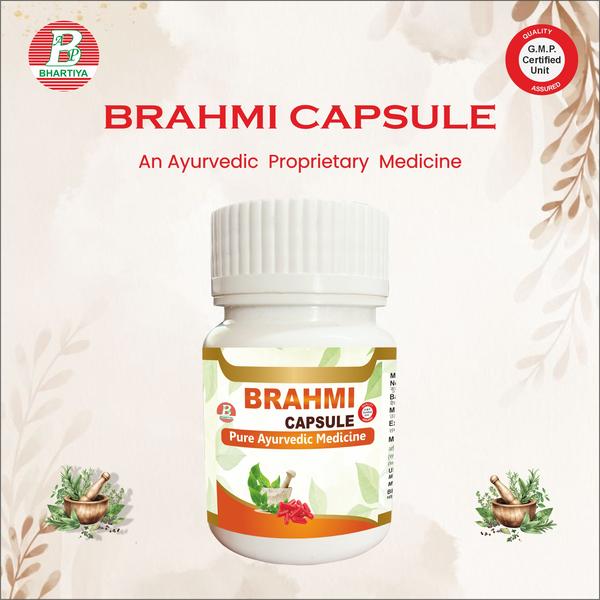
"name": "Brahmi Capsule",
"description": " Brahmi (Bacopa monnieri) \n The Ancient Rejuvenating Herb for Mind, Memory, and Nervous System\n\nBrahmi is one of the most revered herbs in Ayurveda, prized for its profound effects on cognition, memory, intellect, and mental resilience. The name Brahmi derives from Brahma, the creator, symbolizing its connection to higher mental faculties and spiritual insight.\nIn Ayurveda, Brahmi is classified as a Medhya Rasayana (intellect and memory enhancer), Shukra-Vardhaka (reproductive tissue supporter), and Rasayana (rejuvenative). It is highly valued for improving memory, concentration, calming the mind, reducing mental fatigue and anxiety, supporting the nervous system, and promoting longevity.\nThe herb has a rich historical background, documented in classical Ayurvedic texts for thousands of years, highlighting its role in enhancing mental faculties, cognition, and overall vitality.\n Historical Study and Classical References\n1. Charaka Samhita\n•\tAcharya Charaka describes Brahmi as a Medhya Rasayana that strengthens intellect, improves memory, and sharpens mental faculties.\n•\tRecommended for Manasika Vikara (mental disorders), nervous system weakness, and stress-related conditions.\n•\tClassical Dosage: 3–6 g of root/whole plant powder (Churna); decoction (Kwatha) 40–60 ml, 2–3 times daily.\n2. Sushruta Samhita\n•\tAcharya Sushruta emphasizes Brahmi in Manas-Roga Chikitsa (mental disorder treatment) and as a rejuvenative for the nervous system.\n•\tForms: root/whole plant paste, powder, decoction.\n•\tUses: Memory enhancement, calming overactive mind, improving mental clarity.\n3. Bhavaprakasha Nighantu\n•\tBrahmi listed under Medhya and Smritivardhini categories.\n•\tVariants: Wild vs. cultivated forms; leaf quality and flowering stage noted for potency.\n•\tSynonyms: Brahmaka, Medhya, Smritivardhini, Haritaki-brahmi.\n4. Raja Nighantu & Dhanvantari Nighantu\n•\tBrahmi described as Medhya and Jivaniya, improving intelligence, longevity, and mental function.\n•\tUsed in compound formulations for cognitive enhancement, stress reduction, and rejuvenation.\n5. Classical Ayurvedic Formulations\n•\tBrahmi Ghrita / Taila: Nourishes the brain, calms the mind, improves memory.\n•\tBrahmi Churna / Tablet / Capsule: For cognitive support, memory, and mental clarity.\n•\tMedhya Rasayana Compounds: Brahmi often combined with Shankhpushpi, Ashwagandha, and Vacha for brain tonics.\n Botanical Information of Brahmi\n•\tScientific Name: Bacopa monnieri (L.) Wettst.\n•\tFamily: Plantaginaceae\n•\tOrder: Lamiales\n•\tGenus: Bacopa\n•\tSpecies: monnieri\nCommon Names:\n•\tSanskrit: Brahmī, Medhya, Smritivardhini\n•\tHindi: Brahmi\n•\tEnglish: Water Hyssop, Herb of Grace\n•\tTamil: Brahmi, Neer Brahmi\n•\tTelugu: Brahmi\n•\tMalayalam: Brahmi\n•\tKannada: Brahmi\n•\tBengali: Brahmi\nSynonyms in Ayurvedic Nighantus:\n•\tBhavaprakasha Nighantu – Brahmi, Medhya, Smritivardhini\n•\tRaja Nighantu – Brahmaka, Jivaniya\n•\tDhanvantari Nighantu – Medhya, Smritivardhaka\n Morphology of Brahmi\n•\tPlant Type: Perennial, creeping, succulent herb\n•\tStem: Creeping, quadrangular, green, slightly succulent\n•\tLeaves: Opposite, small, oblong to spatulate, fleshy, light green\n•\tFlowers: Small, white to light purple, axillary cymes, bloom during warm seasons\n•\tRoots: Fibrous, white\n•\tFruits: Capsule, ovoid, containing tiny seeds\n•\tHabit: Creeping, spreading, fast-growing, regenerates easily\n Ecological Preferences\n•\tClimate: Tropical and subtropical; tolerates heat and moderate drought\n•\tSoil: Sandy, loamy, marshy, wet soils; thrives in marshes and near water bodies\n•\tSunlight: Full sun to partial shade\n•\tMoisture: Prefers moist conditions; hardy to dry periods\n•\tAltitude: Low to medium elevations\n•\tHabitat: Marshes, wetlands, riverbanks, paddy fields, gardens\n\n Distribution\n•\tIndia: Found across the country in wetlands, paddy fields, marshes\n•\tAsia: Sri Lanka, Nepal, Bangladesh, Myanmar\n•\tGlobal: Naturalized in tropical/subtropical regions worldwide due to hardy growth\n\n Classical Ayurvedic Properties\n•\tRasa (Taste): Tikta (bitter)\n•\tGuna (Qualities): Laghu (light), Snigdha (slightly oily)\n•\tVirya (Potency): Shita (cooling)\n•\tVipaka: Madhura (sweet)\n•\tDosha Effect: Kapha-Vata pacifying\n•\tKarma (Actions / Therapeutic Effects):\no\tMedhya – Enhances memory and intellect\no\tRasayana – Rejuvenative, anti-aging\no\tHridya – Supports heart function\no\tShukra-Vardhaka – Supports reproductive tissue\no\tVata-Kapha pacifying – Reduces neurological weakness\n\n Therapeutic Actions According to Acharyas\n1.\tMedhya (Nootropic): Improves memory, cognition, and focus\n2.\tRasayana (Rejuvenative): Enhances vitality, immunity, and longevity\n3.\tManah-Shamana: Reduces anxiety, stress, and mental fatigue\n4.\tHridya: Supports cardiovascular health\n5.\tShukra-Vardhaka: Improves reproductive tissue quality\n6.\tVata-Kapha Balancing: Useful in neurological weakness, tremors, fatigue\n\n Modern Phytochemistry\n•\tBacosides (A & B): Cognitive enhancement, neuroprotective\n•\tAlkaloids: Nervine tonic\n•\tFlavonoids (Apigenin, Luteolin): Antioxidant, anti-inflammatory, neuroprotective\n•\tSaponins: Brain rejuvenation, memory support\n\n Classical Dosage\n•\tPowder (Churna): 3–6 g/day\n•\tDecoction (Kwatha): 40–60 ml, 2–3 times daily\n•\tJuice (Swarasa): 10–20 ml, 1–2 times daily\n•\tTaila / Ghrita: External application or oral use as per formulation\nPrecautions: Safe in classical dosage; pregnant/lactating women under supervision; avoid overdose.\n\n Classical Ayurvedic Formulations of Brahmi\n1.\tBrahmi Ghrita / Taila: Brain nourishment, mental calmness, memory enhancement\n2.\tBrahmi Churna / Tablet / Capsule: Cognitive support, stress reduction\n3.\tBrahmi Kwatha: Nervous system support, memory enhancement\n4.\tMedhya Rasayana Compounds: With Shankhpushpi, Ashwagandha, Vacha for brain tonics\n5.\tCompound Formulations: Brahmi included in brain tonics, rejuvenative preparations, and nervous system revitalizers\n\n Brahmi Formulations by Bhartiya Ayurvedic Pharmacy\nAt Bhartiya Ayurvedic Pharmacy, we prepare a range of Brahmi (Bacopa monnieri) formulations following classical Ayurvedic methods as described in Charaka Samhita, Sushruta Samhita, Bhavaprakasha Nighantu, and other Ayurvedic Granthas. Each product is crafted to retain the therapeutic potency, purity, and efficacy of the herb, ensuring benefits for memory enhancement, cognitive support, nervous system health, stress relief, and overall mental rejuvenation.\n\n Brahmi Capsule\nDescription: Brahmi Capsule contains high-quality standardized extract of Bacopa monnieri in an easy-to-swallow form for optimal absorption.\nKey Actions: \n•\tEnhances learning ability, concentration, and memory retention.\n•\tReduces mental fatigue, brain fog, and overthinking\n•\tCalms the mind and supports balanced emotional health\n•\tSupports healthy sleep-wake cycles\n\nDosage:\n•\t1 capsule twice daily with warm water after meals\n•\tFor high stress or exam periods: 2 capsules daily\n•\tCan be taken for long-term brain rejuvenation\nPrecautions:\n•\tDo not exceed recommended dose\n•\tMay enhance sedation if used with sleeping medicines\n•\tConsult during pregnancy, lactation, or chronic neurological illness\n\n Brahmi Powder (Churna)\nDescription: Pure Brahmi powder for traditional Ayurvedic use, ideal for decoctions, smoothies, or milk-based preparations.\nKey Actions:\n•\tSupports memory, cognition, and overall nervous system health\n•\tActs as a Rasayana (rejuvenative) for the brain\n•\tReduces stress, anxiety, and mental fatigue\nDosage:\n•\t3–6 grams daily with water, milk, or honey\n•\tCan be used as decoction: 40–60 ml, 1–2 times daily\nPrecautions:\n•\tAvoid overdose\n•\tUse under supervision during pregnancy or neurological disorders\n Brahmi Amla Taila\n\nDescription: Medicated herbal oil prepared with Brahmi and Amla (Indian gooseberry) for external application or internal use as per classical Ayurvedic methods.\nKey Actions:\n•\tNourishes brain tissues and supports the nervous system\n•\tEnhances memory, mental clarity, and concentration\n•\tReduces stress and promotes calmness\n•\tSupports hair and scalp health when applied topically\nDosage:\n•\tApply externally as needed\n•\tFor internal use, take as directed by an Ayurvedic practitioner\nPrecautions:\n•\tAvoid excessive use\n•\tConsult a physician during pregnancy, lactation, or neurological conditions",
"price": 360.0,
"discountamount": 180.0,
"currencycode": "INR",
"priority": 1000000,
"isfreeshipmentavailable": false,
"shipmentduration": 1,
"_keywords": null,
"isarchived": false,
"isavailable": true,
"applicationid": null,
"productindex": 53,
"imageuri": "https://productimages.withfloats.com/actual/698c4c5e6a6c506fb8d6de8b.jpg",
"tileimageuri": "https://productimages.withfloats.com/tile/698c4c5e6a6c506fb8d6de8b.jpg",
"images": null,
"totalqueries": 0,
"gpid": null,
"groupproductid": null,
"createdon": "2026-02-11T09:31:08.072Z",
"updatedon": "2026-02-11T09:56:43.369Z",
"buyonlinelink": null,
"producturl": "http://WWW.BHARTIYAAYURVEDICPHARMACY.COM/products/brahmi-capsule/53",
"availableunits": -1.0,
"iscodavailable": true,
"isprepaidonlineavailable": true,
"maxcodorders": -1,
"maxprepaidonlineorders": -1,
"uniquepaymenturl": null,
"brandname": "Bakula Fort",
"category": "Brahmi Capsule 60 Cap X 24",
"tags": [],
"variants": false,
"keyspecification": null,
"otherspecifications": null,
"pickupaddressreferenceid": null,
"paymenttype": "AssuredPurchase",
"producttype": "products",
"hsncode": null,
"gstslab": 0.0,
"isnotforsale": false
},
{
"_id": "698c4005e628254e7adcd257",
"fptag": "BHARTIYEAYURVEDICPHARMACY",
"merchantname": null,
"customwidgets": null,
"externalsourceid": null,
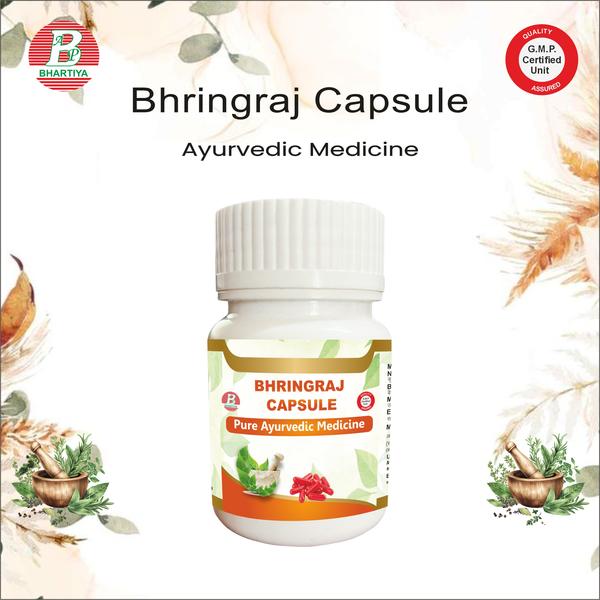
"name": "Bhringraj Capsule",
"description": " BHRINGRAJ \n\n BHRINGRAJ (Eclipta alba / Eclipta prostrata) \nThe King of Hair & Supreme Liver Rejuvenator\nBhringraj is one of the most important Rasayana herbs in Ayurveda, especially renowned for hair regeneration, liver rejuvenation, blood purification, and nervous system support.\nIt is called “Kesharaja” – King of Hair, and “Yakrit Uttama” – Best herb for liver health.\n\n Meaning of Bhringraj\nBhringa = Black bee\nRaja = King\n The herb that gives hair the black, glossy shine of a bee\n\nHistorical Story According to Acharyas\nAccording to Charaka Samhita and Bhavaprakasha, Bhringraj was first described as a divine herb gifted to humanity for promoting longevity and vitality. It is said that Lord Dhanvantari, during the churning of the ocean (Samudra Manthan), gave this herb to rejuvenate the sages and heal ailments, particularly those affecting hair, liver, and blood.\nBhavaprakasha Nighantu highlights:\n“Keshya, Rasayana, Hridya, Yakrit Pleeha Shodhaka” – Bhringraj nourishes hair, rejuvenates the body, supports heart health, and purifies liver and spleen.\nIt has been traditionally used as a Rasayana (rejuvenative), Keshya (hair tonic), and Yakrit-Pleeha Shodhaka (hepato-splenic tonic) in Ayurveda for centuries.\n\n Botanical Information of Bhringraj\n•\tScientific Name: Eclipta alba (L.) Hassk.\n•\tFamily: Asteraceae\n•\tOrder: Asterales\n•\tGenus: Eclipta\n•\tSpecies: alba\n\nCommon Names:\no\tSanskrit: Bhringraj, Kesharaja, Bhringraj\no\tHindi: Bhringraj\no\tEnglish: False Daisy\no\tTamil: Karisalankanni\no\tTelugu: Bhringrajam\no\tMalayalam: Bhringarajam\no\tKannada: Bhringaraja\no\tBengali: Bhringraj\nSynonyms in Ayurvedic Nighantus:\n•\tBhavaprakasha Nighantu: Keshya, Rasayana, Hridya\n•\tRaja Nighantu & Kaiyadeva Nighantu: Bhringraj, Karisalankanni\n•\tDhanvantari Nighantu: Keshya, Shreshtha Rasayana\n\n Morphology of Bhringraj (Eclipta alba)\n•\tPlant Type: Annual, erect or semi-prostrate herb\n•\tStem:\no\tErect, glabrous or slightly hairy\no\tGreen, branching, 30–100 cm height\n•\tLeaves:\no\tOpposite arrangement, simple, lanceolate or ovate\no\tSmooth, dark green, slightly hairy\no\tShort petiole\n•\tFlowers:\no\tSmall, white, tubular, bisexual\no\tBloom throughout monsoon\n•\tRoots:\no\tSlender, fibrous, white\no\tMedicinal part for Rasayana and Keshya use\n•\tFruits:\no\tSmall, one-seeded achenes\n•\tHabit:\no\tFast-growing, creeping or erect\no\tTolerates dry and degraded soils\n\n Ecological Preferences\n•\tClimate: Tropical and subtropical\n•\tSoil: Sandy, loamy, well-drained; grows in poor soils\n•\tSunlight: Full sun to partial shade\n•\tMoisture: Moderate, drought-tolerant\n•\tAltitude: Plains to medium elevation\n•\tHabitat: Roadsides, fields, gardens, wastelands\n\n Distribution\n•\tIndia: Widely throughout the country\n•\tAsia: Sri Lanka, Bangladesh, Myanmar, Nepal\n•\tAfrica: Tropical Africa\n•\tAmericas: Naturalized in South and Central America\n•\tOther regions: Common in tropical areas worldwide\n\n Classical Ayurvedic Properties of Bhringraj\n•\tRasa (Taste): Tikta (bitter), Kashaya (astringent)\n•\tGuna (Qualities): Laghu (light), Snigdha (slightly oily)\n•\tVirya (Potency): Ushna (hot)\n•\tVipaka (post-digestive effect): Katu (pungent)\n•\tDosha Effect: Kapha-Vata Shamaka\n\nKarma (Actions):\no\tKeshya: Promotes hair growth, delays greying\no\tRasayana: Rejuvenative, increases vitality\no\tYakrit-Pleeha Shodhaka: Supports liver and spleen\no\tHridya: Supports heart function\no\tMedohara: Reduces excess fat, balances metabolism\n\n Therapeutic Actions According to Acharyas\n1.\tKeshya (Hair tonic):\no\tPrevents hair fall, premature greying\no\tStrengthens hair roots\n2.\tRasayana (Rejuvenative):\no\tEnhances strength, vitality, longevity\no\tImproves immunity\n3.\tYakrit-Pleeha Shodhaka:\no\tSupports liver and spleen health\no\tDetoxifies blood\n4.\tHridya (Cardio-supportive):\no\tImproves circulation and heart health\n5.\tMedohara / Vata Shamak:\no\tReduces fat deposition\no\tBalances Vata dosha\nReferences:\n•\tCharaka Samhita: Bhringraj as Keshya and Rasayana\n•\tSushruta Samhita: Describes hair growth and liver-protective properties\n•\tBhavaprakasha Nighantu: Emphasizes rejuvenation, hair care, and liver support\n\n Modern Phytochemistry of Bhringraj\n•\tAlkaloids: Wedelolactone, Demethylwedelolactone – hepatoprotective\n•\tFlavonoids: Luteolin, Apigenin – antioxidant, anti-inflammatory\n•\tCoumestans: Antioxidant, anti-hepatotoxic\n•\tTriterpenoids: Support liver and kidney health\n•\tPhenolic compounds: Anti-aging and detoxifying effects\n\n Species of Bhringraj (Genus: Eclipta)\n1.\tEclipta alba (L.) Hassk. – Most widely used in Ayurveda\n2.\tEclipta prostrata (L.) L. – Similar properties, sometimes used interchangeably in folk medicine\n\n Cultivation\n•\tPropagation: Seeds or stem cuttings\n•\tSowing time: Early monsoon\n•\tSpacing: 25–30 cm between plants\n•\tWatering: Moderate; drought-tolerant\n•\tFertilization: Organic manure; hardy herb\n•\tHarvesting: Leaves and whole plant after 3–4 months\n•\tEcological note: Pioneer plant, stabilizes degraded soils\n\n Classical Dosage (According to Granthas)\n1.\tCharaka Samhita:\no\tPowder (Churna) 3–6 g/day\no\tDecoction (Kwatha) 40–60 ml, 2–3 times/day\n2.\tSushruta Samhita:\no\tFresh juice (Swarasa) 20–30 ml/day\no\tExternal paste for hair 2–3 times/week\n3.\tBhavaprakasha Nighantu:\no\tChurna 3–6 g\no\tKwatha 40–60 ml\no\tSwarasa 20–30 ml\n\n Bhringraj Formulations\n1.\tBhringraj Churna (Powder) – Hair growth, liver tonic, Rasayana\n2.\tBhringraj Swarasa (Juice) – Internal detox, Rasayana, hair health\n3.\tBhringraj Taila (Oil) – Hair tonic, prevents greying, strengthens scalp\n4.\tBhringraj Capsule / Tablet – Convenient, standardized for internal use\n5.\tBhringraj Asava – Fermented preparation for liver and general rejuvenation\n\n Bhringraj Formulations by Ayurvedic Pharmacy\n1.\tBhringraj Tablet – 1–2 tablets twice daily, supports hair, liver, and Rasayana effect\n2.\tBhringraj Capsule – 1 capsule twice daily, detoxifies and rejuvenates\n3.\tBhringraj Oil – Apply to scalp 2–3 times/week for hair fall, greying\n4.\tBhringraj Swarasa / Asava – 20–30 ml twice daily, improves liver, blood, and immunity\n\n Safety and Precautions\n•\tSafe in classical doses\n•\tAvoid overdose; may cause mild digestive upset if excessive\n•\tPregnant women: Use only under supervision\n•\tPatients with liver disease: Consult physician before long-term use\n\n BHRINGRAJ FORMULATIONS – BHARTIYA AYURVEDIC PHARMACY\nBhartiya Ayurvedic Pharmacy prepares Bhringraj (Eclipta alba) formulations using purified plant material, processed according to classical Ayurvedic principles, preserving its rejuvenating, hair-nourishing, liver-supporting, and Rasayana qualities.\nKey Uses\n• Promotes healthy hair growth and prevents premature greying\n• Supports liver and spleen function\n• Enhances vitality, stamina, and immunity\n• Blood purification and detoxification\n• Acts as a Rasayana for longevity and rejuvenation\n\n BHRINGRAJ CAPSULE\nBhartiya Ayurvedic Pharmacy Bhringraj Capsules are prepared using standardized Bhringraj extract/powder, following classical Ayurvedic processing methods.\nKey Benefits\n• Supports healthy hair growth and strengthens roots\n• Promotes liver and spleen health\n• Enhances energy, stamina, and general vitality\n• Acts as a rejuvenative (Rasayana) tonic\nDosage\n• Adults: 1 capsule twice daily with warm water after meals\n• Or as advised by an Ayurvedic physician\nSafety & Precautions\n• Safe for long-term use in recommended dose\n• Suitable for both men and women\n• Pregnant or lactating women: Use only under supervision\nFormulation Highlights\n• 100% pure Bhringraj extract/powder\n• No preservatives or additives\n• Classical Ayurvedic processing to retain therapeutic potency\n\n BHRINGRAJ POWDER (CHURNA)\nBhringraj Powder is prepared from dried and finely powdered Bhringraj whole plant/root.\nKey Benefits\n• Promotes hair growth and delays greying\n• Supports liver function and detoxification\n• Improves general vitality and immunity\n• Acts as a Rasayana for longevity\nDosage\n• 3–6 grams (1 tsp) once or twice daily with lukewarm water, honey, or milk\n• Or as advised by an Ayurvedic physician\nSafety & Precautions\n• Safe in classical doses\n• Avoid overdose\n• Pregnant women: Use only under guidance\nFormulation Highlights\n• Pure, dried Bhringraj powder\n• No artificial additives\n• Preserves natural bioactive compounds\n\n BHRINGRAJ ASAVA / SWARASA\nBhringraj Asava is a classical fermented liquid preparation from fresh roots/whole plant.\nKey Benefits\n• Supports liver and spleen health\n• Detoxifies blood and enhances vitality\n• Improves hair health from within\n• Acts as a mild Rasayana tonic\nDosage\n• 20–30 ml twice daily after meals with water or honey\n• Or as advised by an Ayurvedic physician\nSafety & Precautions\n• Contains naturally occurring alcohol (fermentation)\n• Use cautiously in children and pregnancy\nFormulation Highlights\n• Prepared from fresh plant material for maximum efficacy\n• Classical Ayurvedic fermentation process\n• Preserves bioactive constituents\n\n BHRINGRAJ OIL (TAILA)\nBhringraj Oil is a classical medicated oil prepared with Bhringraj Swarasa/Kwatha and carrier oils like sesame or coconut oil.\nKey Benefits\n• Strengthens scalp and hair roots\n• Promotes hair growth, prevents hair fall and premature greying\n• Nourishes hair and improves shine\n• Soothes scalp irritation and dryness\nMethod of Use\n• Apply to scalp 2–3 times weekly\n• Massage gently, leave 30–60 minutes or overnight\n• Wash with mild herbal shampoo\nFormulation Highlights\n• Made from Bhringraj Swarasa/Kwatha in herbal oils\n• Preserves hair-nourishing bioactive compounds\n• No artificial chemicals or additives",
"price": 300.0,
"discountamount": 150.0,
"currencycode": "INR",
"priority": 1000000,
"isfreeshipmentavailable": false,
"shipmentduration": 1,
"_keywords": null,
"isarchived": false,
"isavailable": true,
"applicationid": null,
"productindex": 52,
"imageuri": "https://productimages.withfloats.com/actual/698c400712379120adacf0ef.jpg",
"tileimageuri": "https://productimages.withfloats.com/tile/698c400712379120adacf0ef.jpg",
"images": null,
"totalqueries": 0,
"gpid": null,
"groupproductid": null,
"createdon": "2026-02-11T08:38:29.295Z",
"updatedon": "2026-02-11T08:38:29.295Z",
"buyonlinelink": null,
"producturl": "http://WWW.BHARTIYAAYURVEDICPHARMACY.COM/products/bhringraj-capsule/52",
"availableunits": -1.0,
"iscodavailable": true,
"isprepaidonlineavailable": true,
"maxcodorders": -1,
"maxprepaidonlineorders": -1,
"uniquepaymenturl": null,
"brandname": "Bakula Fort",
"category": "Bhringraj Capsule 60 Cap X 24",
"tags": [],
"variants": false,
"keyspecification": null,
"otherspecifications": null,
"pickupaddressreferenceid": null,
"paymenttype": "AssuredPurchase",
"producttype": "products",
"hsncode": null,
"gstslab": 0.0,
"isnotforsale": false
}
],
"hasmoreitems": false,
"isapirequest": false,
"totalresults": 27,
"query": null,
"floatingpoint": null
}