BHARTIYEAYURVEDICPHARMACY
Products
08048128220
919711305254
Chat with us


Chat with us on WhatsApp
×
This is your website preview.
Currently it only shows your basic business info. Start adding relevant business details such as description, images and products or services to gain your customers attention by using Boost 360 android app / iOS App / web portal.
Home
 enhances nutrient absorption
 enhances nutrient absorption
Items tagged with 'enhances nutrient absorption'
{
"products": [
{
"_id": "69898b6b1456f45dc237c022",
"fptag": "BHARTIYEAYURVEDICPHARMACY",
"merchantname": null,
"customwidgets": null,
"externalsourceid": null,
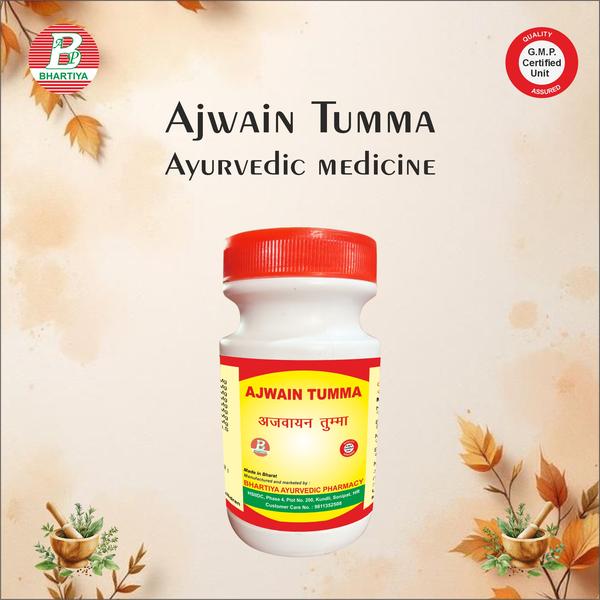
"name": "Ajwain Tumma",
"description": " AJWAIN TUMMA \n\nProduct Identification\n•\tGeneric Name: Ajwain Tumma\n•\tType: Ayurvedic Patent Medicine\n•\tPrimary Indication Area: Disorders of the digestive system, including indigestion, flatulence, abdominal discomfort, colic, and related gastrointestinal disturbances.\n•\tTherapeutic Indications: Ajwain Tumma is indicated for the management of digestive disorders such as indigestion (Ajeerna), flatulence (Adhmana), abdominal pain (Shoola), colic, bloating, and loss of appetite. It helps in improving digestion, relieving gas, and soothing gastrointestinal discomfort.\n\n Key benefits include:\n•\tSupports healthy digestion and helps relieve indigestion\n•\tReduces gas formation, bloating, and flatulence\n•\tHelps alleviate abdominal pain and colic\n•\tImproves appetite and digestive fire (Agni)\n•\tAssists in easing stomach discomfort and heaviness\n•\tTraditionally used to maintain overall gastrointestinal comfort.\nIngredients:\n\n Kali Mirch (Black Pepper) \nBotanical Name: Piper nigrum\nAyurvedic Name: Maricha / Kali Mirch\nKey Phytoconstituents\nPiperine – enhances bioavailability, digestive stimulant, metabolic booster\nVolatile oils (β-caryophyllene, limonene) – carminative, anti-inflammatory\nFlavonoids – antioxidant support\nAlkaloids – thermogenic, digestive tonic\nMechanism of Action (Ayurvedic & Physiological)\nAgni Deepana (Digestive Fire Stimulation):\n•\tEnhances secretion of digestive enzymes, improving digestion and nutrient absorption.\nBioavailability Enhancer:\n•\tPiperine increases absorption and efficacy of co-administered nutrients and herbs.\nMetabolic Activation:\n•\tThermogenic action supports metabolism and helps reduce Ama (toxins).\nVata–Kapha Shamana:\n•\tHelps relieve gas, bloating, cough, and congestion.\nAnti-inflammatory & Antioxidant:\n•\tReduces oxidative stress and supports overall tissue health.\n\n Sonth (Dry Ginger) – Role in Gas, Acidity & Stomach Pain \nBotanical Name: Zingiber officinale (Rhizome, dried)\nAyurvedic Name: Shunthi / Sonth\nKey Active Constituents (Biochemistry)\n•\tGingerols & Shogaols – digestive stimulant, anti-inflammatory, analgesic\n•\tZingerone – carminative, anti-spasmodic\n•\tVolatile oils – improve gut motility, reduce gas\n•\tPhenolic compounds – antioxidant, mucosal protective\nMechanism of Action in Gas, Acidity & Stomach Pain\n1. Agni Deepana & Pachana (Improves Digestion)\n•\tStimulates gastric enzymes and bile secretion\n•\tEnhances digestion of food, preventing Ama formation\n2. Carminative & Anti-flatulent Action\n•\tRelaxes intestinal smooth muscles\n•\tHelps expel trapped gas and reduces fermentation\n3. Anti-spasmodic Effect (Pain Relief)\n•\tShogaols reduce intestinal spasms\n•\tDecreases gut hypersensitivity\n4. Acid Regulation & Mucosal Protection\n•\tImproves gastric emptying, preventing acid backflow\n•\tEnhances protective mucus layer of stomach lining\n5. Anti-inflammatory & Antioxidant\n•\tInhibits inflammatory mediators (COX, prostaglandins)\n•\tProtects gastric mucosa from irritation\n\n Pippali (Long Pepper) – Biochemistry in Gas, Flatulence & Colic Pain \nBotanical Name: Piper longum\nKey Bioactive Compounds: Piperine, Piperlongumine, Essential oils, Alkaloids\nBiochemical Actions in GI Disorders\n1. Digestive Enzyme Activation (Anti-gas effect)\n•\tPiperine stimulates gastric juice, pancreatic enzymes, and bile secretion\n•\tImproves digestion of carbohydrates, fats, and proteins\n•\tPrevents intestinal fermentation (major cause of gas & flatulence)\n2. Carminative Action\n•\tEssential oils relax intestinal smooth muscles\n•\tFacilitates expulsion of trapped gas\n3. Gut Motility Regulation\n•\tPiperine modulates enteric nervous system signaling\n•\tNormalizes peristalsis (prevents stasis and spasms)\n4. Anti-spasmodic Action (Colic Pain Relief)\n•\tPiperlongumine inhibits calcium channel–mediated smooth muscle contraction\n•\tReduces intestinal spasms\n5. Anti-inflammatory & Analgesic Effect\n•\tInhibits inflammatory mediators (COX-2, TNF-α)\n•\tReduces gut wall inflammation and hypersensitivity\n6. Acid Balance & Mucosal Safety\n•\tMild stimulant of gastric secretion (gentler than black pepper)\n•\tSupports protective mucus layer at therapeutic doses\n\n Namak (Rock Salt / Saindhava Lavana) \nBotanical Name: Sodium Chloride (NaCl)\nAyurvedic Name: Saindhava Lavana / Samudra Lavana\nKey Phytoconstituents\n•\tSodium chloride (NaCl) – stimulates gastric secretions, bile, and digestive enzymes\n•\tTrace Minerals (Magnesium, Potassium, Calcium, Iron) – support enzymatic functions, gut motility, and neuromuscular balance\n•\tLavana Rasa (Salty Taste) – liquefies Ama (undigested toxins) and enhances Agni (digestive fire)\nMechanism of Action in Gas, Acidity & Stomach Pain\n•\tDigestive Secretion Stimulation: Sodium ions enhance salivary, gastric, and pancreatic enzymes, improving breakdown of food and preventing gas formation.\n•\tCarminative & Anti-flatulent Effect: Facilitates smooth passage of food and helps expel trapped gas from the intestines.\n•\tGut Motility & Nerve Function: Electrolytes support enteric nervous system signaling, reducing intestinal spasms and colicky pain.\n•\tAcidity Regulation: Saindhava rock salt buffers excessive gastric acid without irritating the stomach lining.\n•\tAma Pachana (Ayurvedic Detoxification): Liquefies and mobilizes undigested food/toxins, enhancing absorption and efficacy of co-administered digestive herbs.\n\n Amchur (Dried Mango Powder) \nBotanical Name: Mangifera indica (unripe fruit)\nAyurvedic Name: Amchur / Amra Phala Churna\nKey Phytoconstituents\n•\tOrganic Acids (Tartaric, Malic, Citric Acid) – digestive stimulant, carminative, mild laxative\n•\tPolyphenols & Flavonoids – antioxidant, anti-inflammatory\n•\tVitamin C (Ascorbic Acid) – supports tissue health, immunity, and digestion\n•\tPectin & Fiber – improves gut motility and prevents constipation\n•\tSugars (Glucose, Fructose) – nutritive, support energy\nMechanism of Action in Gas, Acidity & Stomach Pain\n•\tDigestive Stimulation: Organic acids stimulate gastric juice and digestive enzymes, improving breakdown of food and preventing stagnation.\n•\tCarminative Action: Helps expel trapped gas and reduces bloating.\n•\tAcidity Regulation: Mildly sour nature helps balance stomach pH and improves appetite.\n•\tAnti-spasmodic Effect: Polyphenols reduce intestinal spasms, alleviating colicky pain.\n•\tGut Motility Support: Fiber and pectin improve peristalsis, preventing constipation-related gas and discomfort.\n\n Sudh Hing (Asafoetida) \nBotanical Name: Ferula asafoetida\nAyurvedic Name: Hing / Sudh Hing\n\nKey Phytoconstituents\n•\tResins (Asafoetidin, Ferulic Acid, Umbelliferone) – digestive stimulant, anti-spasmodic, anti-flatulent\n•\tVolatile Oils (Sulfur-containing compounds, Terpenes) – carminative, antimicrobial, smooth muscle relaxant\n•\tGum & Polysaccharides – demulcent, gut-soothing\n•\tPhenolic Compounds – antioxidant, anti-inflammatory\nMechanism of Action in Gas, Acidity & Stomach Pain\n•\tCarminative Action: Relaxes intestinal smooth muscles, helping expel trapped gas and reduce bloating.\n•\tAnti-spasmodic Effect: Volatile oils reduce intestinal spasms and colicky pain.\n•\tDigestive Stimulation: Enhances secretion of gastric juices and digestive enzymes, improving digestion and preventing fermentation.\n•\tAnti-flatulent & Vata-pacifying: Balances Vata in the gut, reducing excessive gas and discomfort.\n•\tAnti-inflammatory & Antioxidant: Protects gut lining from oxidative stress and inflammation, soothing stomach irritation.\n\n Ajwain (Carom Seeds) \nBotanical Name: Trachyspermum ammi\nAyurvedic Name: Ajwain / Ajmoda\nKey Phytoconstituents\n•\tThymol – carminative, antimicrobial, digestive stimulant\n•\tVolatile Oils (γ-Terpinene, Para-Cymene) – anti-flatulent, spasmolytic\n•\tFlavonoids – antioxidant, anti-inflammatory\n•\tSaponins & Alkaloids – metabolic support, gut tonic\nMechanism of Action in Gas, Acidity & Stomach Pain\n•\tCarminative & Anti-flatulent: Relaxes intestinal smooth muscles, expelling trapped gas and reducing bloating.\n•\tDigestive Stimulation: Stimulates gastric juices, bile, and digestive enzymes, improving breakdown of food and preventing fermentation.\n•\tAnti-spasmodic: Reduces intestinal spasms and colicky abdominal pain.\n•\tAntimicrobial: Helps prevent dysbiosis or gas caused by gut microbes.\n•\tVata-Pacifying: Balances Vata in the gut, aiding digestion and reducing heaviness or discomfort.\n\n Geru (Red Ochre / Red Earth) \nBotanical Name: Iron Oxide (Fe₂O₃)\nAyurvedic Name: Geru / Raktapitta Shamak\nKey Phytoconstituents\n•\tIron Oxide (Fe₂O₃) – supports haemoglobin synthesis and tissue health\n•\tTrace Minerals (Calcium, Magnesium, Silica) – aid enzymatic and metabolic processes\n•\tNatural Clay Minerals – absorbent, gut-soothing\nMechanism of Action in Gas, Acidity & Stomach Pain\n•\tDigestive Support: Mildly stimulates digestive enzymes and balances digestive fire (Agni).\n•\tAnti-flatulent & Absorbent Action: Clay minerals help absorb excess gas and toxins from the gut.\n•\tGut Lining Protection: Forms a protective layer over irritated mucosa, reducing burning sensation from acidity.\n•\tVata-Kapha Balancing: Reduces colic, heaviness, and bloating.\n•\tTrace Mineral Support: Contributes to enzymatic and metabolic functions important in digestion.\n\nDosage:\n1.\tDose per intake: 5-10 gm \n2.\tFrequency: 2 times daily\n3.\tHow to take: With water\nPrecautions\n•\tDo not exceed the prescribed dose\n•\tConsult an Ayurvedic practitioner before use in:\no\tChildren\no\tElderly\no\tPatients with chronic illness\n•\tMonitor for any side effects (e.g., digestive discomfort)\n•\tMaintain proper diet and hydration to support bowel health\n",
"price": 114.0,
"discountamount": 57.0,
"currencycode": "INR",
"priority": 1000000,
"isfreeshipmentavailable": false,
"shipmentduration": 1,
"_keywords": null,
"isarchived": false,
"isavailable": true,
"applicationid": null,
"productindex": 44,
"imageuri": "https://productimages.withfloats.com/actual/69898b6da536acc867720360.jpg",
"tileimageuri": "https://productimages.withfloats.com/tile/69898b6da536acc867720360.jpg",
"images": null,
"totalqueries": 0,
"gpid": null,
"groupproductid": null,
"createdon": "2026-02-09T07:23:23.583Z",
"updatedon": "2026-02-09T08:24:35.411Z",
"buyonlinelink": null,
"producturl": "http://WWW.BHARTIYAAYURVEDICPHARMACY.COM/products/ajwain-tumma/44",
"availableunits": -1.0,
"iscodavailable": true,
"isprepaidonlineavailable": true,
"maxcodorders": -1,
"maxprepaidonlineorders": -1,
"uniquepaymenturl": null,
"brandname": "Bakula Fort",
"category": "Ajwain Tumma 100 GM X 48",
"tags": [],
"variants": false,
"keyspecification": null,
"otherspecifications": null,
"pickupaddressreferenceid": null,
"paymenttype": "AssuredPurchase",
"producttype": "products",
"hsncode": null,
"gstslab": 0.0,
"isnotforsale": false
},
{
"_id": "698705b4927481ba212bd210",
"fptag": "BHARTIYEAYURVEDICPHARMACY",
"merchantname": null,
"customwidgets": null,
"externalsourceid": null,
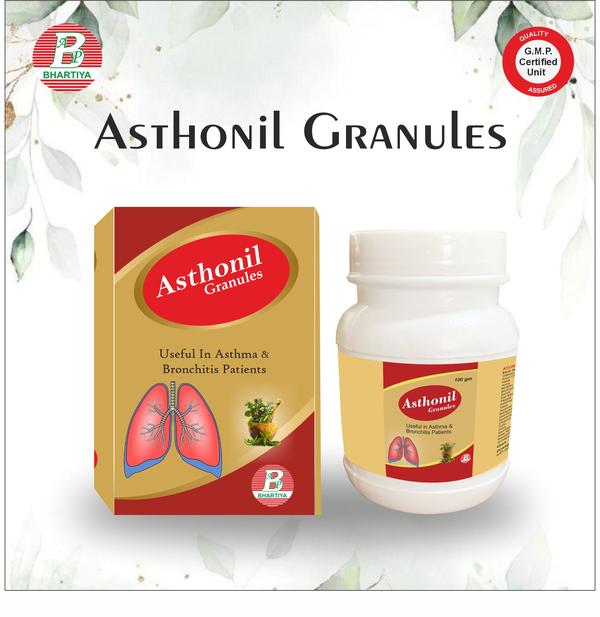
"name": "Asthonil Granules",
"description": " ASTHONIL GRANULES \n\nProduct Identification\n•\tGeneric Name: Asthonil Granule \n•\tType: Ayurvedic Patent Medicine\n•\tPrimary Indication Area: Supports respiratory health, particularly useful in bronchitis, cough, and asthma\n•\tTherapeutic Indications: support respiratory function, help in relieving cough, reducing congestion, and promoting lung health naturally\nKey benefits include:\n•\tRespiratory Support: Helps maintain healthy lung function and eases breathing.\n•\tBronchitis & Asthma Relief: Reduces symptoms like cough, congestion, and respiratory discomfort.\n•\tCough Management: Soothes the throat and reduces persistent coughing.\n•\tImmune Support: Strengthens the body’s natural defenses against infections.\n•\tAnti-inflammatory Action: Helps reduce mild inflammation in the respiratory tract.\n•\tOverall Vitality: Supports energy levels and general wellness.\n.\nIngredients:\n Gajwan (Onosma bracteatum) \nBotanical Name: Onosma bracteatum\nAyurvedic Name: Gojihva / Gaozaban\nKey Phytoconstituents:\n• Flavonoids & Phenolics – antioxidant, anti-inflammatory\n• Naphthoquinones (shikonins) – antimicrobial, anti-inflammatory\n• Coumarins & Glycosides – support fluid balance\n• Tannins & Mucilage – demulcent, soothe mucous membranes\n• Minerals & Alkaloids – tonic, diuretic\nMechanism / Actions:\n1.\tAnti-inflammatory & antioxidant → reduce airway inflammation\n2.\tDemulcent & expectorant → soothe throat, clear mucus\n3.\tSpasmolytic → relax airway smooth muscles → easier breathing\n\n Arjun Chhal (Terminalia arjuna Bark) \nBotanical Name: Terminalia arjuna\nAyurvedic Name: Arjuna Chhal / Arjuna Bark\nKey Phytoconstituents:\n• Triterpenoid saponins (Arjunic acid, Arjunolic acid) – mild anti-inflammatory\n• Flavonoids & Polyphenols – antioxidant, anti-inflammatory\n• Tannins – protect airway and lung tissue\n• Minerals (Calcium, Magnesium) – support tissue function\n• Glycosides – improve circulation\nMechanism / Actions:\n•\tAnti-inflammatory & antioxidant → reduce airway inflammation and oxidative damage\n•\tTissue protective → prevent chronic airway remodelling\n•\tMild bronchodilator support → relax airway smooth muscles\n•\tCirculation booster → support oxygen delivery to tissues\n•\tRespiratory support → may aid chronic bronchitis and cough\n Haldi (Curcuma longa Rhizome) \nBotanical Name: Curcuma longa\nAyurvedic Name: Haldi / Haridra\nKey Phytoconstituents:\n• Curcuminoids (Curcumin, Desmethoxycurcumin) – anti-inflammatory, antioxidant\n• Volatile oils (Turmerone, Zingiberene) – antimicrobial, anti-inflammatory\n• Polysaccharides – immune-modulatory\n• Minerals (Iron, Manganese) – support tissue repair\nMechanism / Actions:\n•\tAnti-inflammatory & antioxidant → reduces airway and tissue inflammation\n•\tImmunomodulatory → balances immune response in allergic conditions\n•\tAntimicrobial → protects against respiratory infections\n•\tTissue protective → prevents oxidative damage in lungs and other organs\n•\tMild bronchodilator → supports easier breathing\n Amla (Phyllanthus emblica Fruit) \nBotanical Name: Phyllanthus emblica\nAyurvedic Name: Amla / Amalaki\nKey Phytoconstituents:\n• Vitamin C (Ascorbic acid) – antioxidant, immune booster\n• Flavonoids & Polyphenols – anti-inflammatory, antioxidant\n• Tannins – astringent, protect tissues\n• Minerals (Calcium, Phosphorus) – support tissue function\n• Gallic acid & Ellagic acid – anti-inflammatory, antimicrobial\nMechanism / Actions:\n•\tAntioxidant → reduces oxidative stress in airways\n•\tAnti-inflammatory → decreases cytokine-driven airway inflammation\n•\tImmunomodulatory → strengthens immune response to infections\n•\tMucosa protective → soothes airway and respiratory tract\n•\tSupports tissue repair → aids recovery in bronchitis and cough\n Mulethi (Glycyrrhiza glabra Root) \nBotanical Name: Glycyrrhiza glabra\nAyurvedic Name: Mulethi / Yashtimadhu\nKey Phytoconstituents:\n• Glycyrrhizin – anti-inflammatory, demulcent\n• Flavonoids & Isoflavonoids – antioxidant, anti-inflammatory\n• Saponins – expectorant, mild bronchodilator\n• Polysaccharides – soothe mucous membranes\n• Minerals (Calcium, Potassium) – support tissue function\nMechanism / Actions:\n•\tDemulcent & expectorant → soothes throat, reduces mucus irritation\n•\tAnti-inflammatory → decreases airway inflammation in asthma/bronchitis\n•\tMild bronchodilator → relaxes smooth muscles of airways\n•\tAntioxidant → protects lung tissue from oxidative stress\n•\tTissue protective → supports recovery of irritated respiratory mucosa\n Bhringraj (Eclipta alba Whole Plant / Leaves) \nBotanical Name: Eclipta alba\nAyurvedic Name: Bhringraj / Bhringraja\nKey Phytoconstituents:\n• Coumestans (Wedelolactone) – anti-inflammatory, antioxidant\n• Flavonoids & Phenolics – antioxidant, tissue protective\n• Alkaloids & Glycosides – liver and tissue support\n• Essential oils – antimicrobial\n• Minerals (Iron, Calcium) – support tissue repair\nMechanism / Actions:\n•\tAnti-inflammatory & antioxidant → reduces airway and tissue inflammation\n•\tImmunomodulatory → supports body’s defense in respiratory infections\n•\tTissue protective → supports recovery of airway mucosa\n•\tMild antimicrobial → protects against secondary infections\n•\tDetoxifying → supports liver function and systemic wellness\n Sonth (Zingiber officinale Rhizome – Dry Ginger) \nBotanical Name: Zingiber officinale\nAyurvedic Name: Sonth / Sukshma Shunti\nKey Phytoconstituents:\n• Gingerols & Shogaols – anti-inflammatory, antioxidant, bronchodilator\n• Essential oils (Zingiberene, Bisabolene) – antimicrobial, spasmolytic\n• Polysaccharides – demulcent, soothe mucous membranes\n• Minerals (Magnesium, Potassium) – support tissue function\nMechanism / Actions:\n•\tAnti-inflammatory & antioxidant → reduces airway inflammation and oxidative stress\n•\tBronchodilator → relaxes smooth muscles of airways → easier breathing\n•\tExpectorant & demulcent → soothes throat, clears mucus\n•\tAntimicrobial → protects against respiratory infections\n•\tDigestive support → improves metabolism and systemic immunity\n Kali Mirch (Piper nigrum Fruit) \nBotanical Name: Piper nigrum\nAyurvedic Name: Kali Mirch / Maricha\nKey Phytoconstituents:\n• Piperine – bronchodilator, anti-inflammatory, bioavailability enhancer\n• Essential oils (Caryophyllene, Pinene) – antimicrobial, spasmolytic\n• Alkaloids – stimulate digestion and circulation\n• Minerals (Iron, Manganese) – support tissue and metabolic function\nMechanism / Actions:\n•\tBronchodilator → relaxes airway smooth muscles → easier breathing\n•\tAnti-inflammatory & antioxidant → reduces airway inflammation\n•\tExpectorant → clears mucus from respiratory tract\n•\tBioavailability enhancer → improves absorption of other herbs and nutrients\n•\tAntimicrobial → protects against respiratory infections\n Pippali (Piper longum Fruit) \nBotanical Name: Piper longum\nAyurvedic Name: Pippali / Pippalimula\nKey Phytoconstituents:\n• Piperine – bronchodilator, anti-inflammatory, enhances bioavailability\n• Essential oils (Caryophyllene, Pinene) – antimicrobial, spasmolytic\n• Alkaloids & Resins – support respiratory and digestive health\n• Minerals (Iron, Zinc) – tissue repair and immune support\nMechanism / Actions:\n•\tBronchodilator → relaxes airway smooth muscles → easier breathing\n•\tAnti-inflammatory & antioxidant → reduces airway inflammation\n•\tExpectorant → loosens and clears mucus from respiratory tract\n•\tBioavailability enhancer → improves absorption and efficacy of other herbs\n•\tAntimicrobial → protects against respiratory infections\n Myristica malabarica \nBotanical Name: Myrstica malabarica\nAyurvedic Name: Malabar Kaiphal\nKey Phytoconstituents:\n• Essential oils (Myristicin, Elemicin) – anti-inflammatory, spasmolytic\n• Lignans & Phenolics – antioxidant, antimicrobial\n• Alkaloids – support respiratory and digestive health\n• Minerals (Calcium, Iron) – tissue and metabolic suppor t\nMechanism / Actions:\n•\tBronchodilator → relaxes airway smooth muscles → easier breathing\n•\tAnti-inflammatory & antioxidant → reduces airway inflammation\n•\tExpectorant → clears mucus from respiratory tract\n•\tAntimicrobial → protects against respiratory infections\n•\tDigestive & systemic support → improves metabolism and wellness\n Vasa (Adhatoda vasica Leaves / Whole Plant) \nBotanical Name: Adhatoda vasica\nAyurvedic Name: Vasa / Vasaka\nKey Phytoconstituents:\n• Vasicine & Vasicinone – bronchodilator, expectorant, antitussive\n• Alkaloids – anti-inflammatory, antimicrobial\n• Flavonoids & Phenolics – antioxidant, reduce oxidative stress\n• Essential oils – antimicrobial\n• Minerals (Iron, Calcium) – tissue support\nMechanism / Actions:\n•\tBronchodilator → relaxes airway smooth muscles → eases breathing\n•\tExpectorant → loosens and clears mucus from respiratory tract\n•\tAnti-inflammatory & antioxidant → reduces airway inflammation and oxidative damage\n•\tAntitussive → suppresses excessive coughing\n•\tAntimicrobial → protects against respiratory infections\n Apamarg (Achyranthes aspera Whole Plant / Leaves) \nBotanical Name: Achyranthes aspera\nAyurvedic Name: Apamarg / Apamarg\nKey Phytoconstituents:\n• Saponins – anti-inflammatory, expectorant\n• Alkaloids – bronchodilator, antimicrobial\n• Flavonoids & Phenolics – antioxidant, reduce oxidative stress\n• Minerals (Calcium, Iron) – tissue support\nMechanism / Actions:\n•\tExpectorant → helps clear mucus from airways\n•\tAnti-inflammatory & antioxidant → reduces airway inflammation\n•\tMild bronchodilator → relaxes airway smooth muscles\n•\tAntimicrobial → protects against respiratory infections\n•\tTissue supportive → aids recovery of irritated respiratory mucosa\n Illicium verum (Star Anise Fruit) \nBotanical Name: Illicium verum\nAyurvedic / Common Name: Star Anise / Illicium\nKey Phytoconstituents:\n• Anethole – antimicrobial, spasmolytic, bronchodilator\n• Flavonoids & Phenolics – antioxidant, anti-inflammatory\n• Essential oils – digestive and respiratory support\n• Minerals (Calcium, Iron) – tissue and metabolic support\nMechanism / Actions:\n•\tBronchodilator → relaxes airway smooth muscles → easier breathing\n•\tExpectorant → helps clear mucus from respiratory tract\n•\tAnti-inflammatory & antioxidant → reduces airway inflammation and oxidative stress\n•\tAntimicrobial → protects against respiratory infections\n•\tDigestive & systemic support → improves metabolism and immunity\n Dalchini (Cinnamomum verum / Cinnamon Bark) \nBotanical Name: Cinnamomum verum\nAyurvedic Name: Dalchini / Twak\nKey Phytoconstituents:\n• Cinnamaldehyde – bronchodilator, anti-inflammatory, antimicrobial\n• Essential oils – spasmolytic, digestive support\n• Polyphenols – antioxidant, tissue protective\n• Minerals (Calcium, Manganese) – support tissue and metabolism\nMechanism / Actions:\n•\tBronchodilator → relaxes airway smooth muscles → easier breathing\n•\tAnti-inflammatory & antioxidant → reduces airway inflammation and oxidative stress\n•\tExpectorant → helps clear mucus from respiratory tract\n•\tAntimicrobial → protects against respiratory infections\n•\tDigestive support → improves metabolism and systemic immunity\n",
"price": 300.0,
"discountamount": 150.0,
"currencycode": "INR",
"priority": 1000000,
"isfreeshipmentavailable": false,
"shipmentduration": 1,
"_keywords": null,
"isarchived": false,
"isavailable": true,
"applicationid": null,
"productindex": 42,
"imageuri": "https://productimages.withfloats.com/actual/698705c0662d97438cc44a6c.jpg",
"tileimageuri": "https://productimages.withfloats.com/tile/698705c0662d97438cc44a6c.jpg",
"images": null,
"totalqueries": 0,
"gpid": null,
"groupproductid": null,
"createdon": "2026-02-07T09:28:20.814Z",
"updatedon": "2026-02-07T09:28:20.814Z",
"buyonlinelink": null,
"producturl": "http://WWW.BHARTIYAAYURVEDICPHARMACY.COM/products/asthonil-granules/42",
"availableunits": -1.0,
"iscodavailable": true,
"isprepaidonlineavailable": true,
"maxcodorders": -1,
"maxprepaidonlineorders": -1,
"uniquepaymenturl": null,
"brandname": "Bakula Fort",
"category": "Asthonil Granules 100 gm X 24",
"tags": [],
"variants": false,
"keyspecification": null,
"otherspecifications": null,
"pickupaddressreferenceid": null,
"paymenttype": "AssuredPurchase",
"producttype": "products",
"hsncode": null,
"gstslab": 0.0,
"isnotforsale": false
},
{
"_id": "678a4b205b36a837b67fde99",
"fptag": "BHARTIYEAYURVEDICPHARMACY",
"merchantname": null,
"customwidgets": null,
"externalsourceid": null,
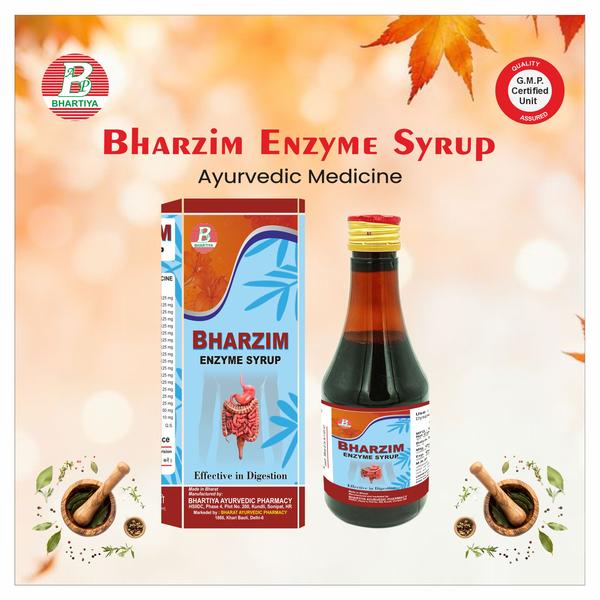
"name": "Bharzim Enzyme Syrup 200 ml",
"description": "Bharzim Enzyme Syrup 200 ml is a trusted digestive aid formulated to support healthy digestion and alleviate bloating, indigestion, and gastric discomfort. Enriched with essential enzymes, it enhances nutrient absorption and promotes gut health. Ideal for daily use, Bharzim Syrup provides natural relief, ensuring optimal digestive well-being. Suitable for all age groups, it’s your partner for a healthier stomach.",
"price": 180.0,
"discountamount": 90.0,
"currencycode": "INR",
"priority": 1000000,
"isfreeshipmentavailable": false,
"shipmentduration": 1,
"_keywords": [
"healthier stomach",
"age groups",
"bharzim syrup",
"essential enzymes",
"enhances nutrient absorption",
"gastric discomfort enriched",
"alleviate bloating indigestion",
"support healthy digestion"
],
"isarchived": false,
"isavailable": true,
"applicationid": null,
"productindex": 12,
"imageuri": "https://productimages.withfloats.com/actual/69843284d14b677c68c7fc29.jpg",
"tileimageuri": "https://productimages.withfloats.com/tile/69843284d14b677c68c7fc29.jpg",
"images": null,
"totalqueries": 0,
"gpid": null,
"groupproductid": null,
"createdon": "2025-01-17T12:20:48.262Z",
"updatedon": "2026-02-05T06:02:43.307Z",
"buyonlinelink": null,
"producturl": "http://WWW.BHARTIYAAYURVEDICPHARMACY.COM//bharzim-enzyme-syrup-200-ml/12",
"availableunits": -1.0,
"iscodavailable": true,
"isprepaidonlineavailable": true,
"maxcodorders": 0,
"maxprepaidonlineorders": 0,
"uniquepaymenturl": null,
"brandname": "Bakula Fort ",
"category": "Bharzim Enzyme Syrup 200 ml X 24",
"tags": [],
"variants": false,
"keyspecification": null,
"otherspecifications": null,
"pickupaddressreferenceid": null,
"paymenttype": "AssuredPurchase",
"producttype": "products",
"hsncode": null,
"gstslab": 0.001,
"isnotforsale": false
},
{
"_id": "698d97f5814d89cb6a299bc4",
"fptag": "BHARTIYEAYURVEDICPHARMACY",
"merchantname": null,
"customwidgets": null,
"externalsourceid": null,
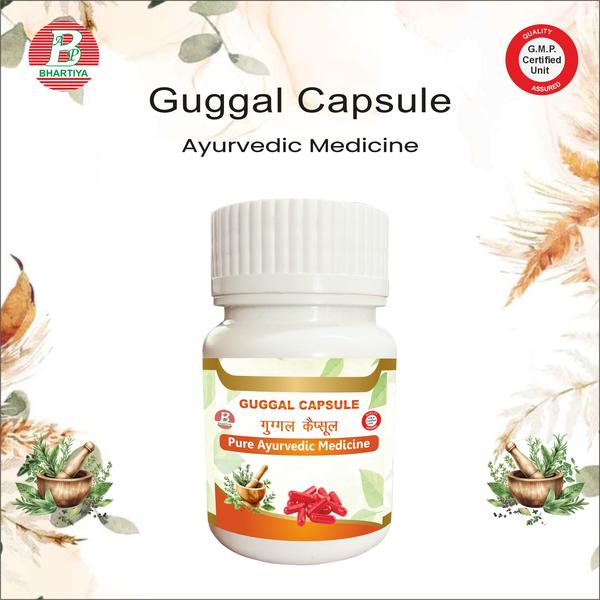
"name": "Guggal capsule",
"description": " GUGGUL \n\n The Golden Resin — “Guggul / Commiphora mukul”\nGuggul is a revered resin in Ayurveda known for its Shothahara (anti-inflammatory), Medohara (fat-reducing), Deepana–Pachana (digestive), Rasayana (rejuvenative), and Rakta-shodhaka (blood-purifying) properties. It is highly valued for promoting joint health, balancing lipid metabolism, supporting detoxification, and enhancing vitality. Traditionally, it is considered especially effective in Kapha–Vata disorders and metabolic imbalance.\n\n CLASSICAL AYURVEDIC REFERENCES\n\nCharaka Samhita\n•\tDescribed under Shothahara (anti-inflammatory) and Rasayana dravyas.\n•\tIndicated for Medoroga (obesity), Asthi-Majja Kshaya, Sandhigata Vata (arthritis), and Kaphaja disorders.\n•\tSupports digestion and metabolism without aggravating Pitta.\nSushruta Samhita\n•\tRecommended in Kshaya (tissue depletion), Vrana (wound healing), and Medoroga.\n•\tUsed for deep tissue purification and detoxification.\nBhavaprakasha Nighantu\n•\tHighlights Guggul’s use in Balya, Brimhana, and Rasayana therapy.\n•\tConsidered Kaphahara and Vatahara, especially for joint and lipid disorders.\n\nUnani & Folk Medicine\nCalled “Indian Myrrh” or “Mirra Indica.”\nTraditionally used to improve vitality, cleanse toxins, reduce swelling, and support weight management.\n\n CLASSICAL STORY / TRADITIONAL ANALOGY\nAncient Ayurvedic texts narrate:\n“Guggul is the sweat of the sacred Kalpavriksha of the desert; as the tree yields resin under harsh conditions, so Guggul strengthens and purifies the human body in the face of chronic imbalances.”\n\nRishis and Acharyas prescribed Guggul to:\n•\tReduce joint stiffness and Vata disorders\n•\tNormalize lipid metabolism and obesity\n•\tDetoxify and rejuvenate tissues\n•\tSupport overall longevity and vitality\n\n BOTANICAL INFORMATION OF GUGGUL\nScientific Name: Commiphora wightii (Arn.) Bhandari\nFamily: Burseraceae\nOrder: Sapindales\nGenus: Commiphora\nSpecies: wightii\n\nCommon Names\nSanskrit: Guggulu\nHindi: Guggul\nEnglish: Indian Myrrh\nTamil: Seethaphal Guggul\nTelugu: Guggula\nKannada: Guggula\nBengali: Guggal\n\n SYNONYMS IN TRADITIONAL TEXTS\n•\tAsthipushtika – Bone-nourishing\n•\tMedohara – Reduces excess fat\n•\tShothahara – Anti-inflammatory\n•\tRasayana – Rejuvenative\n\n MORPHOLOGY OF GUGGUL\nPlant Type: Thorny, deciduous shrub \nHeight: 1–3 m\nLeaves: Small, ovate, light green\nFlowers: Greenish-yellow, inconspicuous\nResin: Golden-yellow, aromatic\nRoots: Deep taproot system\nSeeds: Small, oblong\n\n ECOLOGICAL PREFERENCES\nClimate: Arid to semi-arid\nSoil: Sandy, well-drained\nSunlight: Full sun\nWater Requirement: Low\nAltitude: Up to 1,500 m\n\n GEOGRAPHICAL DISTRIBUTION\nIndia: Rajasthan, Gujarat, Madhya Pradesh, Maharashtra\nWorldwide: Pakistan, Middle East, Africa\n\n AYURVEDIC PROPERTIES (RASA–GUNA–VIRYA–VIPAKA)\n•\tRasa: Tikta (bitter), Katu (pungent)\n•\tGuna: Laghu (light), Ruksha (dry)\n•\tVirya: Ushna (heating)\n•\tVipaka: Katu (pungent)\nDosha Effect:\nVata-Pitta hara\nKapha reducing\n\n THERAPEUTIC ACTIONS (KARMA)\nMedohara – Reduces excess fat, supports lipid metabolism\nShothahara – Anti-inflammatory, relieves joint swelling\nAsthipushtika – Strengthens bones and muscles\nRasayana – Rejuvenative, anti-aging\nDeepana–Pachana – Improves digestion and metabolism\nKaphahara – Reduces Kapha-related disorders\n\n INDICATIONS\n•\tObesity and lipid disorders\n•\tArthritis, joint stiffness, gout\n•\tTissue depletion and weakness\n•\tChronic inflammation\n•\tMetabolic disorders\n•\tDetoxification therapy \n\n MODERN PHYTOCHEMISTRY & PHARMACOLOGY\nMajor Constituents:\n•\tGuggulsterones (E & Z)\n•\tFlavonoids, Tannins, Terpenoids\n•\tEssential oils\n•\tResinous compounds\nPharmacological Actions:\n•\tLipid-lowering (hypolipidemic)\n•\tAnti-inflammatory & analgesic\n•\tAntioxidant\n•\tBone-protective\n•\tImmunomodulatory\n•\tDetoxifying \n\n CULTIVATION DETAILS\nPropagation: Seeds and stem cuttings\nSowing Time: March–May\nHarvesting: Resin tapped from 4–5-year-old shrubs\nIrrigation: Minimal; drought-tolerant\n\n CLASSICAL DOSAGE\nPowder (Churna): 500 mg – 1 g twice daily\nResin (Shuddha Guggul): 250–500 mg twice daily\nDecoction/Extract: As prescribed\n\n GUGGUL CAPSULE \nBhartiya Ayurvedic Pharmacy Guggul Capsules are prepared using purified, standardized Guggul resin (Shuddha Guggulu) according to classical Ayurvedic principles. These capsules preserve the full therapeutic potential of Guggul for metabolism, joint health, tissue nourishment, and rejuvenation.\n\n KEY BENEFITS\n\n•\tSupports healthy lipid metabolism and weight management\n\n•\tReduces joint stiffness, inflammation, and Vata-Kapha imbalances\n•\tPromotes bone and tissue strength\n\n•\tActs as a Rasayana for rejuvenation and vitality\n\n•\tEnhances digestion and metabolism naturally\n\n•\tBalances Kapha and Vata doshas\n\n THERAPEUTIC ACTIONS (KARMA\nMedohara – Supports healthy fat metabolism\n\nShothahara – Anti-inflammatory for joints and muscles\n\nAsthipushtika – Strengthens bones and connective tissue\n\nRasayana – Rejuvenation and longevity support\n\nDeepana–Pachana – Improves digestion and nutrient absorption\n\n INDICATIONS\n•\tHigh cholesterol and lipid imbalance\n\n•\tObesity and metabolic disorders\n\n•\tOsteoarthritis, gout, joint inflammation \n\n•\tChronic Vata-Kapha imbalances\n\n•\tTissue depletion and general weakness\n\n•\tDetoxification and rejuvenation therapy\n\n DOSAGE\n•\tAdults: 1–2 capsules twice daily\n\n•\tRecommended with lukewarm water or milk\n\n•\tBest taken after meals or as advised by physician\n\n SAFETY & PRECAUTIONS\n•\tSafe for long-term use under medical guidance\n\n•\tAvoid in pregnancy and lactation unless prescribed\n\n•\tCaution in Pitta-dominant individuals if taken in high doses\n\n•\tNot for use in individuals with known hypersensitivity to Guggul\n\n FORMULATION HIGHLIGHTS\n•\t100% pure Shuddha Guggul resin\n\n•\tClassical Ayurvedic purification and processing\n\n•\tNo preservatives, additives, or artificial fillers\n\n•\tStandardized for consistent therapeutic efficacy\n\n MODERN PHARMACOLOGICAL SUPPORT\n•\tHypolipidemic – Supports healthy cholesterol and triglyceride levels\n\n•\tAnti-inflammatory & Analgesic – Reduces joint pain and swelling\n\n•\tAntioxidant – Protects tissues from oxidative stress\n\n•\tImmunomodulatory – Enhances overall immunity\n\n•\tBone & Tissue Protective – Strengthens musculoskeletal system \n\n CLASSICAL AYURVEDIC INSIGHT\n•\tGuggul has been prescribed in Charaka Samhita, Sushruta Samhita, and Bhavaprakasha Nighantu for:\n\n•\tMetabolic disorders (Medoroga)\n\n•\tJoint and bone disorders (Sandhigata Vata, Asthi Kshaya)\n\n•\tDetoxification and rejuvenation (Rasayana & Shothahara therapies) \n\n•\t“As the golden resin strengthens the tree against desert harshness, Shuddha Guggul strengthens the body against chronic imbalances.”\n",
"price": 600.0,
"discountamount": 300.0,
"currencycode": "INR",
"priority": 1000000,
"isfreeshipmentavailable": false,
"shipmentduration": 1,
"_keywords": null,
"isarchived": false,
"isavailable": true,
"applicationid": null,
"productindex": 57,
"imageuri": "https://productimages.withfloats.com/actual/698da467de2355c59a2f79e5.jpg",
"tileimageuri": "https://productimages.withfloats.com/tile/698da467de2355c59a2f79e5.jpg",
"images": null,
"totalqueries": 0,
"gpid": null,
"groupproductid": null,
"createdon": "2026-02-12T09:05:57.872Z",
"updatedon": "2026-02-12T09:59:02.412Z",
"buyonlinelink": null,
"producturl": "http://WWW.BHARTIYAAYURVEDICPHARMACY.COM//guggal-capsule/57",
"availableunits": -1.0,
"iscodavailable": true,
"isprepaidonlineavailable": true,
"maxcodorders": -1,
"maxprepaidonlineorders": -1,
"uniquepaymenturl": null,
"brandname": "Bakula Fort",
"category": "Guggal capsule 60 Cap X 12",
"tags": [],
"variants": false,
"keyspecification": null,
"otherspecifications": null,
"pickupaddressreferenceid": null,
"paymenttype": "AssuredPurchase",
"producttype": "products",
"hsncode": null,
"gstslab": 0.0,
"isnotforsale": false
},
{
"_id": "698b1826061c704326857527",
"fptag": "BHARTIYEAYURVEDICPHARMACY",
"merchantname": null,
"customwidgets": null,
"externalsourceid": null,
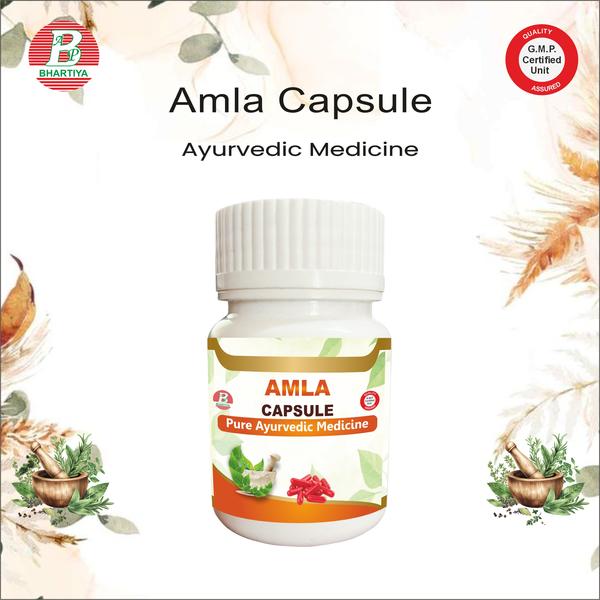
"name": "Amla Capsule",
"description": " (AMLA (Emblica officinalis Gaertn.) \n The Supreme Rasayana — “Dhatri Phala” (The Nourishing Mother Fruit)\nĀmla, also known as Āmalakī, is one of the most celebrated herbs in Ayurveda, recognized as a prime Rasayana (rejuvenative) and Pittashamaka. Considered sacred and synonymous with longevity, it is used for rejuvenation, metabolism, immunity, skin, hair, digestion, eyesight, and vitality.\nIt is among the richest natural sources of Vitamin C, in a unique heat-stable and bioavailable form preserved by tannins such as Emblicanin A & B.\nAyurvedic texts describe Amla as a divine herb, equal to nectar, and capable of restoring youth, strength, and Ojas.\n\n BOTANICAL INFORMATION OF AMLA\nScientific Name: Emblica officinalis Gaertn.\nSynonyms: Phyllanthus emblica Linn.\nFamily: Phyllanthaceae (formerly Euphorbiaceae)\nOrder: Malpighiales\nGenus: Phyllanthus\nSpecies: emblica\nCommon Names\n•\tSanskrit: Āmalakī, Dhatri, Shiva, Amrutaphala, Vayasya\n•\tHindi: Amla\n•\tEnglish: Indian Gooseberry\n•\tTamil: Nellikai\n•\tTelugu: Usirikaya\n•\tMalayalam: Nellikka\n•\tKannada: Nellikayi\n•\tGujarati/Marathi: Amla\n•\tBengali: Amloki\n\n SYNONYMS IN CLASSICAL AYURVEDIC NIGHANTUS\nCharaka Samhita\n•\tDhatri, Amalaki – Supreme Rasayana for long life\nSushruta Samhita\n•\tVayasya, Shreyasi, Kshaya Apaha\nBhavaprakasha Nighantu\n•\tAmruta, Shiva, Shreyasi, Amalaki\nDhanvantari Nighantu\n•\tTishya, Vayasya, Dhatri Phala\n•\tThese synonyms emphasize longevity, nourishment, rejuvenation, and divine purity.\n\n MORPHOLOGY OF AMLA\nTree-Medium-sized deciduous tree, Height: 8–20 crooked trunk, spreading crown\nBark-Thin, greyish or reddish-brown, Exfoliating in irregular flakes\nLeaves-Simple, subsessile, linear-oblong, closely arranged along branchlets, resembling compound leaves\nFlowers-Greenish-yellow, Unisexual, axillary clusters\nFruit-Nearly spherical, smooth, light green,6 vertical stripes, extremely sour and astringent, highly nutritious and medicinal.\nSeed -Hard, six-triangular\n ECOLOGICAL PREFERENCES\nClimate: Tropical and subtropical, highly drought-resistant, Tolerates high temperatures\nSoil: Grows in poor, alkaline, calcareous, or sandy soils, Thrives in well-drained loamy soil\nHabitat: Dry deciduous forests, Fields, gardens, village premises, Native to Indian subcontinent\nAltitude-Sea level to 1,500 m\n\n GEOGRAPHICAL DISTRIBUTION\n India\n•\tWidely distributed throughout\n•\tMajor states: UP, MP, Rajasthan, Gujarat, Maharashtra, Tamil Nadu, Kerala\nOutside India\n•\tSri Lanka, Nepal, Bangladesh, Pakistan\n•\tChina, Myanmar, Thailand\n•\tNaturalized in Southeast Asia and tropical regions worldwide\n\n CLASSICAL AYURVEDIC PROPERTIES (RASA–GUNA–VIRYA–VIPAKA)\nRasa (Taste): Pancharasa (five tastes): Amla (sour) predominates Madhura (sweet), Kashaya (astringent), Tikta (bitter), Katu (pungent)No Lavana (salty)\nGuna (Qualities): Laghu (light), Ruksha (dry)\nVirya (Potency): Śīta (cooling)\nVipaka (post-digestive effect): Madhura (sweet)\nDosha Effects: Tridoshaghna (balances all three) Especially Pittashamaka Balances Vata & Kapha too\n THERAPEUTIC ACTIONS ACCORDING TO AYURVEDA (KARMA)\n1. Rasayana (Rejuvenative)-Restores youth, vitality, Ojas, Promotes longevity\n2. ChakshushyaImproves eyesight, Used in Tripahala for eye therapies\n3. Dipana & Pachana-Enhances digestive fire gently, Prevents acidity despite sour taste\n4. Medhya-Enhances memory, intellect, Nourishes brain tissues\n5. Hridya-Strengthens heart, Improves circulation\n6. Vrishya / Reproductive Health-Promotes fertility, Nourishes Shukra dhatu\n7. Keshya-Strengthens hair roots, Prevents greying & hair fall\n8. Raktaprasadana-Purifies blood, Detoxifying\n9. Lekhana & Kapha-pittahara-Reduces excessive Pitta, Clears Kapha from channels\n INDICATIONS\nDigestive System-Acidity, Indigestion, Constipation, Hyperacidity, IBS, Loss of appetite\nRespiratory System-Cough, Cold, Allergies, Asthma (as part of formulations)\nReproductive & Urinary System-Semen quality improvement, Strengthens bladder\nSkin & Hair-Brightens complexion, Anti-aging, reduces pigmentation, Promotes hair growth\nMetabolism-Diabetes, Obesity, High cholesterol\nNervous System-Memory loss, Fatigue, Stress\n MODERN PHARMACOLOGY & PHYTOCHEMISTRY\nMajor Constituents\n•\tVitamin C (highly stable)\n•\tTannins: Emblicanin A &, Gallotannins, Ellagitannins\n•\tPhenolics: Gallic acid, Ellagic acid, Chebulinic acid\n•\tFlavonoids: Quercetin, Kaempferol, Amino acids, minerals\nPharmacological Actions\n•\tAdaptogenic\n•\tAntioxidant\n•\tAnti-inflammatory\n•\tImmunomodulatory\n•\tHepatoprotective\n•\tAnti-ulcer\n•\tAntidiabetic\n•\tAnti-aging\n\n CULTIVATION DETAILS\nPropagation-Seeds (most common), Vegetative cuttings\nSowing Time-June–July (monsoon)\nSpacing-8–10 m between plants\nIrrigation-Moderate, tolerates drought once mature\nFertilization-Organic manure preferred\nHarvesting-Fruits harvested November–March, Leaves and bark collected as required\n CLASSICAL DOSAGE (According to Ayurvedic Granthas)\nChurna (Powder): 2–5 g twice daily\nSwarasa (Fresh juice): 10–20 ml\nKwatha (Decoction): 40–60 ml\nAvaleha (paste/lehyam): 10–15 g\nCapsules / Tablets: As per preparation\nOil (Thaila): External use\nGhrita: Internal rejuvenation\n CLASSICAL AYURVEDIC FORMULATIONS CONTAINING AMLA\n1. Chyawanprash-Primary Rasayana formulation, Rejuvenation, immunity\n2. Tripahala Churna-Digestive, detoxifying, eye tonic\n3. Amalaki Rasayana-Anti-aging, brain tonic, immunity\n4. Dhatri Rasayana-Pitta balance, digestion\n5. Brahma Rasayana-Brain and nerve rejuvenative\n6. Dhatryarishta-Digestive and hepatoprotective\n7. Amla Oil (Thaila)\n•\tUsed for hair growth, cooling\n Amla (Phyllanthus emblica/Emblica officinalis) Formulations – Bhartiya Ayurvedic Pharmacy\nBhartiya Ayurvedic Pharmacy prepares a range of Amla formulations following classical Ayurvedic principles described in Charaka Samhita, Sushruta Samhita, Bhav Prakash Nighantu, and other Ayurvedic texts. Each product is designed to retain the full rejuvenative, antioxidant, and digestive properties of Amla, supporting immunity, digestion, liver health, and overall vitality.\n 1. Amla Tablet\nDescription:\nAmla Tablet is a modern, convenient dosage form containing standardized Amla (Phyllanthus emblica) extract. Ideal for daily use, it retains Amla’s rejuvenative, antioxidant, and digestive properties.\nKey Actions:\n•\tTridoshic Rasayana: Balances Vata, Pitta, Kapha\n•\tSupports immunity and vitality\n•\tEnhances digestion and bowel regularity\n•\tImproves liver and kidney health\n•\tPromotes skin and hair health\nDosage:\n•\t1–2 tablets twice daily after meals with warm water, or as directed\nPrecautions:\n•\tAvoid excessive use in diarrhea or loose stools\n•\tDiabetics should monitor blood sugar\n 2. Amla Capsule\nDescription:\nAmla Capsule is a convenient, easy-to-swallow form containing Amla extract. Suitable for those who prefer capsules over tablets or powders.\nKey Actions:\n•\tRejuvenative and immunity-boosting\n•\tAntioxidant properties reduce oxidative stress\n•\tSupports digestive health\n•\tPromotes liver and kidney function\nDosage:\n•\t1–2 capsules twice daily with warm water after meals\nPrecautions:\n•\tAvoid overdose\n•\tUse under supervision if pregnant or lactating\n 3. Amlakyadi Loh (Amlakyadi Loh Bhasma)\nDescription:\nA herbo-mineral Ayurvedic formulation combining Amla and metallic/mineral preparations (Loh Bhasma – iron ash). Traditionally used for blood disorders, anaemia, and general debility.\nKey Actions:\n•\tHematinic: Supports red blood cell formation\n•\tRejuvenative: Enhances strength, vitality, and metabolism\n•\tImproves immunity\n•\tSupports liver function\nDosage:\n•\t1–2 tablets once or twice daily after meals with warm water or milk, as directed by an Ayurvedic practitioner\nPrecautions:\n•\tMonitor iron levels during prolonged use\n•\tAvoid in cases of iron overload or gastric sensitivity\n 4. Amla Powder (Amla Churna)\nDescription:\nPure, finely powdered Amla for traditional use. Can be consumed with honey, ghee, or water.\nKey Actions:\n•\tRasayana and rejuvenative\n•\tSupports digestion and bowel movements\n•\tEnhances liver and kidney detoxification\n•\tImproves immunity, skin, and hair health\nDosage:\n•\t1–3 g daily with water, honey, or as advised\nPrecautions:\n•\tAvoid excess intake in diarrhea\n•\tDiabetics should consult before use\n Amlaki Rasayana (Semi-Solid / Avaleha Form)\nDescription:\nClassical semi-solid Rasayana prepared from Amla (Phyllanthus emblica), sometimes with other rejuvenative herbs, preserving full potency and bioactive constituents.\nKey Actions:\n•\tRejuvenative (Rasayana) and immunity booster\n•\tEnhances digestion and nutrient absorption\n•\tDetoxifies liver and kidneys\n•\tPromotes healthy skin and hair\n•\tSupports respiratory health and longevity\nDosage:\n•\t5–10 g (1 teaspoon) twice daily with warm milk, water, or honey\nPrecautions:\n•\tAvoid in diarrhea or loose stools\n•\tDiabetics should monitor sugar if sweetened\n•\tUse under supervision during pregnancy or chronic illness\nBenefits:\n•\tVitality and strength\n•\tDigestive, liver, and kidney support\n•\tAntioxidant and anti-aging effects\n•\tOverall rejuvenation and longevity\n 6. Tripahala Churna\nDescription:\nA classical Ayurvedic powder containing Haritaki, Bibhitaki, and Amla, used for digestion, detoxification, and bowel regulation.\nKey Actions:\n•\tMild laxative: Supports regular bowel movements\n•\tRejuvenative: Improves immunity and vitality\n•\tDetoxifying: Cleanses liver, kidneys, and digestive tract\n•\tBalances Vata and Pitta doshas\nDosage:\n•\t1–3 g daily with warm water, honey, or ghee, preferably at bedtime or as advised\nPrecautions:\n•\tAvoid excessive use leading to loose stools\n•\tConsult practitioner for prolonged use in elderly or weak patients\n SAFETY & PRECAUTIONS\nSafe for long-term use when taken in classical doses\nHighly safe fruit for children, elderly, and pregnant women (dietary form)\nPrecautions:\n•\tExcess consumption may increase dryness (Vata)\n•\tUse cautiously in:\n• Severe hypoglycemia\n• Chronic diarrhea\n•\tAvoid cold Amla juice in Kapha prakriti people during heavy winter",
"price": 210.0,
"discountamount": 105.0,
"currencycode": "INR",
"priority": 1000000,
"isfreeshipmentavailable": false,
"shipmentduration": 1,
"_keywords": null,
"isarchived": false,
"isavailable": true,
"applicationid": null,
"productindex": 50,
"imageuri": "https://productimages.withfloats.com/actual/698b18283d7b82b108fcb293.jpg",
"tileimageuri": "https://productimages.withfloats.com/tile/698b18283d7b82b108fcb293.jpg",
"images": null,
"totalqueries": 0,
"gpid": null,
"groupproductid": null,
"createdon": "2026-02-10T11:36:06.219Z",
"updatedon": "2026-02-10T12:15:22.966Z",
"buyonlinelink": null,
"producturl": "http://WWW.BHARTIYAAYURVEDICPHARMACY.COM/products/amla-capsule/50",
"availableunits": -1.0,
"iscodavailable": true,
"isprepaidonlineavailable": true,
"maxcodorders": -1,
"maxprepaidonlineorders": -1,
"uniquepaymenturl": null,
"brandname": "",
"category": "Amla Capsule 60 Cap X 24",
"tags": [],
"variants": false,
"keyspecification": null,
"otherspecifications": null,
"pickupaddressreferenceid": null,
"paymenttype": "AssuredPurchase",
"producttype": "products",
"hsncode": null,
"gstslab": 0.0,
"isnotforsale": false
},
{
"_id": "698adcb79b2383ec7eecb3fe",
"fptag": "BHARTIYEAYURVEDICPHARMACY",
"merchantname": null,
"customwidgets": null,
"externalsourceid": null,
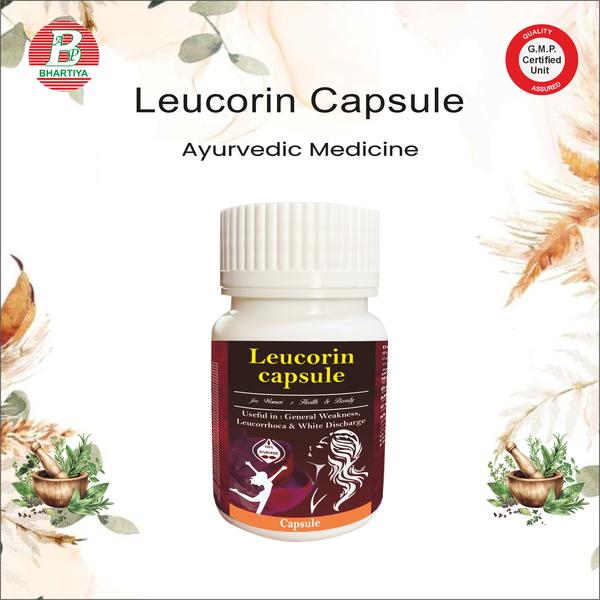
"name": "Leucorin Capsule",
"description": " LEUCORIN CAPSULE \n\n\nProduct Identification\n•\tGeneric Name: Leucorin Capsule\n•\tType: Ayurvedic Patent Medicine\n\nTherapeutic Indications \n•\tHelps manage excessive vaginal discharge, restores vaginal health, and balances hormonal and metabolic functions.\nPrimary Benefits\n•\tHelps reduce excessive vaginal discharge\n•\tRestores normal vaginal health and hygiene\n•\tSupports hormonal balance\n•\tStrengthens reproductive and urinary tract health\n•\tPromotes overall female reproductive wellness\n\nOther Benefits\n•\tImproves Immunity: Supports the body’s natural defense mechanisms, helping prevent recurrent infections.\n•\tSupports Digestive Health: Aids proper digestion and nutrient absorption, which can indirectly help maintain reproductive health.\n•\tEnhances Energy & Vitality: Helps reduce fatigue and general weakness often associated with prolonged leucorrhoea.\n•\tPromotes Hormonal Balance: Helps regulate the endocrine system, which can improve menstrual health and overall reproductive function.\n•\tMaintains Urinary Tract Health: Supports healthy urinary function, reducing the risk of associated irritation or infections.\n\nIngredients:\n Safed Musali (White Musli) \n•\tBotanical Name: Chlorophytum borivilianum\n•\tKey Constituents: Steroidal saponins, Alkaloids, Flavonoids, Polysaccharides, Proteins, Amino acids\nMechanism of Action in Women’s Health – Biochemistry / Pharmacology\n•\tActs as a reproductive tonic, nourishing uterus and vaginal tissues\n•\tRegulates hormonal balance (estrogen and progesterone), supporting menstrual and reproductive health\n•\tExhibits anti-inflammatory and antimicrobial effects, helping prevent infections\n•\tBoosts immunity to reduce recurrent reproductive tract infections\n•\tEnhances energy, vitality, and overall well-being, supporting systemic and reproductive health\n\n Shatavari \n•\tBotanical Name: Asparagus racemosus\n•\tKey Constituents: Steroidal saponins (Shatavarins), Flavonoids, Alkaloids, Polysaccharides, Proteins\nMechanism of Action in Women’s Health – Biochemistry / Pharmacology\n•\tActs as a female reproductive tonic, nourishing uterus and ovaries\n•\tRegulates hormonal balance (estrogen and progesterone), supporting menstrual and lactational health\n•\tExhibits anti-inflammatory and antioxidant effects, protecting reproductive tissues\n\nArjun Chhal (Arjuna Bark) \n•\tBotanical Name: Terminalia arjuna\n•\tKey Constituents: Tannins, Flavonoids, Glycosides, Saponins, Polyphenols, Minerals\nMechanism of Action in Women’s Health – Biochemistry / Pharmacology\n•\tSupports cardiovascular health, improving circulation and heart function\n•\tExhibits antioxidant and anti-inflammatory effects, protecting blood vessels and tissues\n•\tHelps maintain healthy blood pressure and lipid levels, indirectly supporting metabolic and reproductive health\n\n Mulethi (Licorice) \n•\tBotanical Name: Glycyrrhiza glabra\n•\tKey Constituents: Glycyrrhizin, Flavonoids, Saponins, Coumarins, Polysaccharides\nMechanism of Action in Women’s Health – Biochemistry / Pharmacology\n•\tExhibits anti-inflammatory and soothing effects, supporting reproductive tract health\n•\tHelps maintain hormonal balance, particularly estrogen, aiding menstrual and reproductive function\n\n Gokharu (Tribulus terrestris) \n Botanical Name: Tribulus terrestris\nKey Constituents: Saponins (Protodioscin, Tribulosides), Flavonoids, Alkaloids, Sterols\nMechanism of Action in Women’s Health – Biochemistry / Pharmacology\n•\tSupports hormonal balance by modulating luteinizing hormone (LH) and ovarian steroidogenesis, aiding menstrual and reproductive function\n•\tExhibits anti-inflammatory effects, reducing pelvic and systemic inflammation.\n•\tActs as a mild adaptogen, enhancing energy, stamina, and resilience to metabolic or hormonal stress\n\nAmla (Indian Gooseberry) \nBotanical Name: Phyllanthus emblica\n Key Constituents: Vitamin C, Tannins, Flavonoids, Polyphenols, Gallic Acid\nMechanism of Action in Women’s Health – Biochemistry / Pharmacology\n•\tPotent antioxidant, reducing oxidative stress and protecting reproductive and systemic tissue\n•\t Supports hormonal balance by enhancing adrenal and thyroid function, indirectly regulating menstrual cycles\n•\tExhibits anti-inflammatory effects, helping reduce menstrual and pelvic discomfort\n\nKaunch beej (Mucuna pruriens) \n Botanical Name: Mucuna pruriens\n Key Constituents: L-DOPA, Alkaloids, Flavonoids, Saponins, Proteins\nMechanism of Action in Women’s Health – Biochemistry / Pharmacology\n \n•\tSupports hormonal balance by modulating dopamine levels, which can influence prolactin and ovarian function, aiding menstrual and reproductive health\n•\t Exhibits mild adaptogenic and anti-stress effects, enhancing energy, vitality, and resilience to metabolic or hormonal stress\n•\t Acts as a reproductive tonic, promoting ovarian function and fertility\nVidhara (Shatavari, Asparagus racemosus) \n Botanical Name: Asparagus racemosus\nKey Constituents: Saponins (Shatavarins), Flavonoids, Alkaloids, Glycosides, Polysaccharides\nMechanism of Action in Women’s Health – Biochemistry / Pharmacology\n \n•\tSupports hormonal balance, particularly estrogen, aiding menstrual regulation, reproductive health, and fertility\n\n•\tExhibits galactagogue activity, enhancing lactation in postpartum women via prolactin modulation\n•\tActs as a mild adaptogen, improving energy, vitality, and resilience to hormonal or metabolic stress\n•\tShows anti-inflammatory and antioxidant effects, protecting reproductive tissues and reducing menstrual or pelvic discomfort\n\nBala (Sida cordifolia) \n Botanical Name: Sida cordifolia\nKey Constituents: Alkaloids (Ephedrine, Sidanol), Flavonoids, Sterols, Glycosides, Saponins\nMechanism of Action in Women’s Health – Biochemistry / Pharmacology\n• Supports reproductive health by strengthening uterine and ovarian function\n• Exhibits hormonal modulatory effects, aiding menstrual regulation and fertility\n• Acts as a mild adaptogen, enhancing energy, vitality, and resilience to hormonal or metabolic stress\n\nBombax malabaricum (Semal / Silk Cotton Tree) Botanical Name: Bombax malabaricum\n Key Constituents: Flavonoids, Tannins, Saponins, Polysaccharides, Sterols\nMechanism of Action in Women’s Health – Biochemistry / Pharmacology\n•\tSupports reproductive health by promoting uterine and ovarian function\n•\t Exhibits anti-inflammatory and soothing effects, reducing menstrual and pelvic discomfort\n•\t Acts as a hormonal modulator, aiding menstrual regulation and fertility\n\nLajwanti (Mimosa pudica)\nBotanical Name: Mimosa pudica\nKey Constituents: Alkaloids, Flavonoids, Tannins, Saponins, Polysaccharides\n\nMechanism of Action – Women’s Health (Biochemistry / Pharmacology)\n•\tUterine & Ovarian Support: Promotes reproductive organ function.\n•\tAnti-inflammatory: Reduces menstrual cramps and pelvic discomfort.\n•\tHormonal Modulation: Aids menstrual regulation and fertility.\n•\tAntioxidant: Protects reproductive tissues from oxidative stress.\n\nHygrophila spinosa (Talmakhana / Kokilaksha)\nBotanical Name: Hygrophila spinosa\nKey Constituents: Alkaloids, Flavonoids, Saponins, Sterols, Glycosides\n\nMechanism of Action – Women’s Health (Biochemistry / Pharmacology)\n•\tReproductive Support: Promotes uterine and ovarian function, supports fertility.\n•\tAnti-inflammatory: Reduces menstrual cramps and pelvic discomfort.\n•\tHormonal Modulation: Aids in menstrual cycle regulation.\n\n\n Daruhaldi (Berberis aristata)\nBotanical Name: Berberis aristata\nKey Constituents: Berberine, Alkaloids, Flavonoids, Tannins, Phenolic compounds\n\nMechanism of Action – Women’s Health (Biochemistry / Pharmacology)\n•\tReproductive Support: Promotes uterine and ovarian function.\n•\tAnti-inflammatory: Reduces menstrual cramps, pelvic discomfort, and inflammation.\n•\tHormonal Modulation: Aids in menstrual cycle regulation and fertility support.\n\nDevdaru (Cedrus deodara)\nBotanical Name: Cedrus deodara\nKey Constituents: α-Pinene, Limonene, Cedrol, Flavonoids, Tannins, Resinous compounds\n\nMechanism of Action – Women’s Health (Biochemistry / Pharmacology)\n•\tReproductive Support: Promotes uterine and ovarian function.\n•\tAnti-inflammatory: Reduces menstrual cramps and pelvic discomfort.\n•\tHormonal Modulation: Supports menstrual regulation and fertility.\n•\tAntioxidant: Protects reproductive tissues from oxidative stress.\n\nShudh Guggul (Commiphora mukul)\nBotanical Name: Commiphora mukul\nKey Constituents: Guggulsterones, Resin, Flavonoids, Tannins, Volatile oils\n\nMechanism of Action – Women’s Health (Biochemistry / Pharmacology)\n•\tReproductive Support: Promotes uterine and ovarian function.\n•\tAnti-inflammatory: Reduces menstrual cramps and pelvic discomfort.\n•\tHormonal Modulation: Aids menstrual regulation and supports fertility.\n•\tAntioxidant: Protects reproductive tissues from oxidative stress.\n\nKali Mirch (Black Pepper)\nBotanical Name: Piper nigrum\nKey Constituents: Piperine, Volatile oils, Alkaloids, Flavonoids\n\nMechanism of Action – Women’s Health (Biochemistry / Pharmacology)\n•\tReproductive Support: Promotes uterine and ovarian function.\n•\tAnti-inflammatory: Reduces menstrual cramps and pelvic discomfort.\n•\tHormonal Modulation: Supports menstrual regulation and fertility.\n\nAloe (Aloe vera)\nBotanical Name: Aloe vera\nKey Constituents: Anthraquinones, Polysaccharides, Saponins, Flavonoids, Vitamins\n\nMechanism of Action – Women’s Health (Biochemistry / Pharmacology)\n•\tReproductive Support: Promotes uterine and ovarian function.\n•\tAnti-inflammatory: Reduces menstrual cramps and pelvic discomfort.\n•\tHormonal Modulation: Supports menstrual regulation and fertility.\n\n Lodhra (Symplocos racemosa)\nBotanical Name: Symplocos racemosa\nKey Constituents: Tannins, Flavonoids, Glycosides, Alkaloids, Saponins\n\nMechanism of Action – Women’s Health (Biochemistry / Pharmacology)\n•\tReproductive Support: Glycosides and flavonoids modulate estrogen receptor activity → support uterine and ovarian function.\n•\tAnti-inflammatory: Tannins and flavonoids inhibit prostaglandin synthesis → reduce menstrual cramps and pelvic discomfort.\n•\tHormonal Modulation: Alkaloids and glycosides help regulate menstrual cycle and fertility.\n•\tAntioxidant: Flavonoids and tannins scavenge free radicals → protect ovarian and uterine tissues from oxidative stress\n\n Dhataki (Woodfordia fruticosa)\nBotanical Name: Woodfordia fruticosa\nKey Constituents: Flavonoids, Tannins, Glycosides, Anthocyanins, Volatile oils\n\nMechanism of Action – Women’s Health (Biochemistry / Pharmacology)\n•\tReproductive Support: Flavonoids and glycosides may modulate estrogen receptor activity → support uterine and ovarian function.\n•\tAnti-inflammatory: Tannins and flavonoids inhibit prostaglandin synthesis → reduce menstrual cramps and pelvic discomfort.\n•\tHormonal Modulation: Glycosides help in regulating menstrual cycle and fertility.\n\n\nBhringraj (Eclipta alba / Eclipta prostrata)\nBotanical Name: Eclipta alba\nKey Constituents: Alkaloids, Coumestans (Wedelolactone), Flavonoids, Tannins, Saponins\n\nMechanism of Action – Women’s Health (Biochemistry / Pharmacology)\n•\tReproductive Support: Modulates estrogen receptors → promotes uterine & ovarian function.\n•\tAnti-inflammatory: Inhibits COX-2 & prostaglandin synthesis → reduces menstrual cramps.\n•\tHormonal Modulation: Influences steroidogenesis → balances estrogen & progesterone\n\n Vacha (Acorus calamus)\nBotanical Name: Acorus calamus\nKey Constituents: β-Asarone, α-Asarone, Essential oils, Flavonoids, Tannins\n\nMechanism of Action – Women’s Health (Biochemistry / Pharmacology)\n•\tReproductive Support: β-Asarone may modulate estrogen receptor signaling → supports uterine and ovarian function.\n•\tAnti-inflammatory: Inhibits prostaglandin synthesis → reduces menstrual cramps and pelvic discomfort.\n•\tHormonal Modulation: Influences steroidogenesis → helps in menstrual regulation and fertility.\n•\tAntioxidant: Flavonoids and essential oils scavenge ROS → protect reproductive tissues.\n\nTejpatra (Cinnamomum tamala)\nBotanical Name: Cinnamomum tamala\nKey Constituents: Essential oils (Cinnamaldehyde, Eugenol), Tannins, Flavonoids\n\nMechanism of Action – Women’s Health (Biochemistry / Pharmacology)\n•\tReproductive Support: Cinnamaldehyde may modulate estrogen receptor activity → supports uterine and ovarian function.\n•\tAnti-inflammatory: Inhibits prostaglandin synthesis → reduces menstrual cramps and pelvic discomfort.\n•\tHormonal Modulation: Flavonoids influence steroidogenesis → aid in menstrual regulation and fertility.\n•\tAntioxidant: Essential oils and flavonoids scavenge ROS → protect reproductive tissues.\n\n Dalchini (Cinnamomum verum / Cinnamon)\nBotanical Name: Cinnamomum verum\nKey Constituents: Cinnamaldehyde, Eugenol, Tannins, Flavonoids, Volatile oils\n\nMechanism of Action – Women’s Health (Biochemistry / Pharmacology)\n•\tReproductive Support: Cinnamaldehyde and flavonoids modulate estrogen receptor signaling → support uterine and ovarian function.\n•\tAnti-inflammatory: Inhibits prostaglandin synthesis → reduces menstrual cramps and pelvic discomfort.\n•\tHormonal Modulation: Flavonoids influence steroidogenesis → aid menstrual regulation and fertility.\n\nMethi Dana (Fenugreek seeds)\nBotanical Name: Trigonella foenum-graecum\nKey Constituents: Saponins (Diosgenin), Alkaloids, Flavonoids, Fiber, Mucilage\n\nMechanism of Action – Leucorrhoea / Women’s Health (Biochemistry / Pharmacology)\n•\tHormonal Modulation: Diosgenin acts as a phytoestrogen → supports estrogen balance and strengthens vaginal mucosa.\n•\tAnti-inflammatory: Flavonoids inhibit prostaglandin synthesis → reduce inflammation in vaginal and uterine tissues.\n•\tAntioxidant: Saponins and flavonoids scavenge reactive oxygen species (ROS) → protect reproductive tissues from oxidative stress.\n\n Aamguthli (Mango seeds)\nBotanical Name: Mangifera indica\nKey Constituents: Tannins, Polyphenols, Flavonoids, Fatty acids, Mangiferin\n\nMechanism of Action – leucorrhoea / Women’s Health (Biochemistry / Pharmacology)\n•\tAstringent & Reproductive Support: Tannins and polyphenols → tighten vaginal mucosa and reduce excessive discharge.\n•\tAnti-inflammatory: Flavonoids inhibit prostaglandin synthesis → reduce inflammation in vaginal and uterine tissues.\n•\tAntioxidant: Mangiferin and polyphenols scavenge reactive oxygen species (ROS) → protect reproductive tissues from oxidative stress.\n\nSaunth (Dry Ginger)\nBotanical Name: Zingiber officinale\nKey Constituents: Gingerols, Shogaols, Zingerone, Volatile oils, Flavonoids\n\nMechanism of Action – Leucorrhea / Women’s Health (Biochemistry / Pharmacology)\n•\tAnti-inflammatory: Gingerols and shogaols inhibit prostaglandin and cytokine (TNF-α, IL-1β, IL-6) production → reduce vaginal and uterine inflammation.\n•\tAntioxidant: Gingerols and shogaols scavenge reactive oxygen species (ROS) → protect reproductive tissues from oxidative stress.\n•\tHormonal Modulation: Active compounds may support estrogen receptor activity → help normalize vaginal mucosa and secretions.\n\n Ashwagandha (Withania somnifera)\nBotanical Name: Withania somnifera\nKey Constituents: Withanolides, Alkaloids, Saponins, Flavonoids, Iron\n\nMechanism of Action – Women’s Health (Biochemistry / Pharmacology)\n•\tReproductive Support: Withanolides modulate estrogen and progesterone receptor signaling → support ovarian and uterine function.\n•\tAdaptogenic & Hormonal Modulation: Reduces stress-induced cortisol → indirectly normalizes menstrual cycles and improves fertility.\n•\tAnti-inflammatory: Inhibits pro-inflammatory cytokines (TNF-α, IL-1β) → reduces pelvic discomfort and uterine inflammation.\n\nPippali (Piper longum)\nBotanical Name: Piper longum\nKey Constituents: Piperine, Volatile oils, Alkaloids, Flavonoids\n\nMechanism of Action – Women’s Health (Biochemistry / Pharmacology)\n•\tReproductive Support: Piperine may modulate estrogen receptor activity → supports uterine and ovarian function.\n•\tAnti-inflammatory: Inhibits prostaglandin synthesis → reduces menstrual cramps and pelvic inflammation.\n•\tHormonal Modulation: Influences steroidogenesis → aids menstrual regulation and fertility.\n•\tAntioxidant: Flavonoids and piperine scavenge ROS → protect reproductive tissues.\n\n Vidhara (Acorus calamus)\nBotanical Name: Acorus calamus\nKey Constituents: α-Asarone, β-Asarone, Volatile oils, Flavonoids, Tannins\n\nMechanism of Action – Women’s Health (Biochemistry / Pharmacology)\n•\tReproductive Support: α- and β-Asarone modulate estrogen receptor activity → support uterine and ovarian function.\n•\tAnti-inflammatory: Inhibits prostaglandin synthesis → reduces menstrual cramps and pelvic inflammation.\n•\tHormonal Modulation: Influences steroidogenesis → aids menstrual regulation and fertility.\n•\tAntioxidant: Flavonoids and volatile oils scavenge ROS → protect reproductive tissues.\n\n Lahsun (Garlic)\nBotanical Name: Allium sativum\nKey Constituents: Allicin, Sulfur compounds, Flavonoids, Saponins\n\nMechanism of Action – Women’s Health (Biochemistry / Pharmacology)\n•\tReproductive Support: Sulfur compounds may improve uterine and ovarian microcirculation → support reproductive tissue function.\n•\tAnti-inflammatory: Inhibits prostaglandin synthesis and NF-κB pathway → reduces pelvic inflammation and menstrual cramps.\n•\tHormonal Modulation: Flavonoids and organosulfur compounds may influence steroidogenesis → aid menstrual regulation and fertility.\n\nBelgiri (Aegle marmelos)\nBotanical Name: Aegle marmelos\nKey Constituents: Alkaloids (e.g., Marmeline), Tannins, Flavonoids, Coumarins, Essential oils\n\nMechanism of Action – Women’s Health (Biochemistry / Pharmacology)\n•\tReproductive Support: Alkaloids and flavonoids modulate estrogen receptor activity → support uterine and ovarian function.\n•\tAnti-inflammatory: Tannins and coumarins inhibit prostaglandin synthesis → reduce menstrual cramps and pelvic inflammation.\n•\tHormonal Modulation: Flavonoids influence steroidogenesis → help regulate menstrual cycles and fertility.\n\nNaagkesar (Mesua ferrea)\nBotanical Name: Mesua ferrea\nKey Constituents: Xanthones, Coumarins, Flavonoids, Tannins, Essential oils\n\nMechanism of Action – Women’s Health (Biochemistry / Pharmacology)\n•\tReproductive Support: Xanthones and flavonoids modulate estrogen receptor activity → support uterine and ovarian function.\n•\tAnti-inflammatory: Inhibits prostaglandin synthesis and cytokine release → reduces menstrual cramps and pelvic inflammation.\n•\tHormonal Modulation: Coumarins influence steroidogenesis → aid menstrual regulation and fertility.\n\n Dhania (Coriandrum sativum)\nBotanical Name: Coriandrum sativum\nKey Constituents: Essential oils (Linalool, Geraniol), Flavonoids, Tannins, Alkaloids\n\nMechanism of Action – Women’s Health (Biochemistry / Pharmacology)\n•\tReproductive Support: Linalool and flavonoids may modulate estrogen receptor activity → support uterine and ovarian function.\n•\tAnti-inflammatory: Inhibits prostaglandin synthesis → reduces menstrual cramps and pelvic inflammation.\n•\tHormonal Modulation: Flavonoids influence steroidogenesis → help in menstrual regulation and fertility.\n\nCæsalpinia sappan (Sappan wood)\nBotanical Name: Cæsalpinia sappan\nKey Constituents: Brazilein, Flavonoids, Tannins, Phenolic compounds, Saponins\n\nMechanism of Action – Women’s Health (Biochemistry / Pharmacology)\n•\tReproductive Support: Brazilein and flavonoids may modulate estrogen receptor activity → support uterine and ovarian function.\n•\tAnti-inflammatory: Inhibits prostaglandin synthesis and NF-κB pathway → reduces menstrual cramps and pelvic inflammation.\n•\tHormonal Modulation: Phenolic compounds influence steroidogenesis → aid menstrual regulation and fertility.\n\n\n Ashoka (Saraca asoca)\nBotanical Name: Saraca asoca\nKey Constituents: Flavonoids, Tannins, Catechins, Glycosides, Saponins\n\nMechanism of Action – Women’s Health (Biochemistry / Pharmacology)\n•\tReproductive Support: Flavonoids and glycosides modulate estrogen receptor activity → support uterine and ovarian function.\n•\tAnti-inflammatory: Inhibits prostaglandin synthesis → reduces menstrual cramps and pelvic inflammation.\n•\tHormonal Modulation: Glycosides influence steroidogenesis → help regulate menstrual cycles and fertility.\n\nJeera (Cuminum cyminum)\nBotanical Name: Cuminum cyminum\nKey Constituents: Essential oils (Cumin aldehyde, Limonene), Flavonoids, Alkaloids, Tannins\nMechanism of Action – Women’s Health (Biochemistry / Pharmacology)\n•\tReproductive Support: Cumin aldehyde and flavonoids may modulate estrogen receptor activity → support uterine and ovarian function.\n•\tAnti-inflammatory: Inhibits prostaglandin synthesis → reduces menstrual cramps and pelvic inflammation.\n•\tHormonal Modulation: Flavonoids influence steroidogenesis → aid in menstrual regulation and fertility.\n\nAnantmool (Hemidesmus indicus)\nBotanical Name: Hemidesmus indicus\nKey Constituents: Saponins, Flavonoids, Tannins, Coumarins, Essential oils\n\nMechanism of Action – Women’s Health (Biochemistry / Pharmacology)\n•\tReproductive Support: Flavonoids and saponins may modulate estrogen receptor activity → support uterine and ovarian function.\n•\tAnti-inflammatory: Inhibits prostaglandin synthesis → reduces menstrual cramps and pelvic inflammation.\n•\tHormonal Modulation: Coumarins influence steroidogenesis → aid menstrual regulation and fertility.\n•\tAntioxidant: Flavonoids and essential oils scavenge ROS → protect reproductive tissues from oxidative stress.\n\nChavya (Piper chaba)\nBotanical Name: Piper chaba\nKey Constituents: Piperine, Essential oils, Alkaloids, Flavonoids\nMechanism of Action – Women’s Health (Biochemistry / Pharmacology)\n•\tReproductive Support: Piperine modulates estrogen receptor activity → supports uterine and ovarian function.\n•\tAnti-inflammatory: Inhibits prostaglandin synthesis → reduces menstrual cramps and pelvic inflammation.\n•\tHormonal Modulation: Influences steroidogenesis → helps in menstrual regulation and fertility.\n\n Artoon (Oraxylum indicum / Sonapatha)\nBotanical Name: Oroxylum indicum\nKey Constituents: Flavonoids (Baicalein, Chrysin), Tannins, Alkaloids, Phenolic compounds\nMechanism of Action – Women’s Health (Biochemistry / Pharmacology)\n•\tReproductive Support: Flavonoids modulate estrogen receptor activity → support uterine and ovarian function.\n•\tAnti-inflammatory: Inhibits prostaglandin synthesis → reduces menstrual cramps and pelvic inflammation.\n•\tHormonal Modulation: Flavonoids and phenolic compounds influence steroidogenesis → aid menstrual regulation and fertility.\n\nPatha (Cissampelos pareira)\nBotanical Name: Cissampelos pareira\nKey Constituents: Alkaloids (Bebeerine, Cissampeline), Flavonoids, Tannins, Saponins\nMechanism of Action – Women’s Health (Biochemistry / Pharmacology)\n•\tReproductive Support: Alkaloids modulate estrogen receptor activity → support uterine and ovarian function.\n•\tAnti-inflammatory: Inhibits prostaglandin synthesis → reduces menstrual cramps and pelvic inflammation.\n•\tHormonal Modulation: Alkaloids influence steroidogenesis → aid menstrual regulation and fertility.\n\n Piper cubeba (Cubeb)\nBotanical Name: Piper cubeba\nKey Constituents: Piperine, Cubebin, Essential oils, Flavonoids, Alkaloids\nMechanism of Action – Women’s Health (Biochemistry / Pharmacology)\n•\tReproductive Support: Piperine and cubebin modulate estrogen receptor activity → support uterine and ovarian function.\n•\tAnti-inflammatory: Inhibits prostaglandin synthesis → reduces menstrual cramps and pelvic inflammation.\n•\tHormonal Modulation: Influences steroidogenesis → aids menstrual regulation and fertility.\n•\tAntioxidant: Flavonoids and essential oils scavenge ROS → protect reproductive tissues from oxidative stress.\n\nNisoth (Ipomoea turpethum)\nBotanical Name: Ipomoea turpethum\nKey Constituents: Resin glycosides, Alkaloids, Flavonoids, Starch, Phenolic compounds\nMechanism of Action – Women’s Health (Biochemistry / Pharmacology)\n•\tReproductive Support: Resin glycosides and flavonoids modulate estrogen receptor activity → support uterine and ovarian function.\n•\tAnti-inflammatory: Inhibits prostaglandin synthesis → reduces menstrual cramps and pelvic inflammation.\n•\tHormonal Modulation: Alkaloids influence steroidogenesis → aid menstrual regulation and fertility.\n\n Sugar (Sugarcane)\nBotanical Name: Saccharum officinarum\nKey Constituents: Sucrose, Glucose, Fructose, Polyphenols, Flavonoids, Minerals\nMechanism of Action – Women’s Health (Biochemistry / Pharmacology)\n•\tEnergy & Vitality: Provides quick metabolic energy → reduces fatigue and supports systemic wellness.\n•\tReproductive Support: Polyphenols and flavonoids may modulate estrogen receptor activity → indirectly support uterine and ovarian function.\n•\tAntioxidant: Polyphenols and flavonoids scavenge ROS → protect reproductive tissues from oxidative stress.\n\n Lauha Bhasma (Incinerated Iron)\nComposition: Primarily Iron (Fe), along with trace minerals\nMechanism of Action – Women’s Health (Biochemistry / Pharmacology)\n•\tReproductive Support / Hematopoiesis: Supplies bioavailable iron → supports hemoglobin synthesis → improves oxygen delivery to reproductive tissues.\n•\tEnergy & Vitality: Corrects iron-deficiency anemia → reduces fatigue and boosts systemic energy.\n•\tHormonal Support: Adequate iron is essential for proper synthesis of steroid hormones → indirectly supports menstrual regulation and fertility.\n\n Shudh Shilajit (Purified Shilajit)\nComposition: Fulvic acid, Humic acid, Minerals (Iron, Zinc, Magnesium), Dibenzo-α-pyrones, Amino acids\nMechanism of Action – Women’s Health (Biochemistry / Pharmacology)\n•\tReproductive Support: Fulvic acid and minerals modulate estrogen receptor activity → support uterine and ovarian function.\n•\tHormonal Modulation: Enhances steroidogenesis → helps in menstrual regulation and fertility.\n•\tAnti-inflammatory: Inhibits prostaglandin synthesis and cytokine activity → reduces menstrual cramps and pelvic inflammation.\n\nUse : useful in general weakness,\nleucorrhoea & white discharge\n\nDosage \nForm: Capsule\n•\tDose: 1–2 capsules, twice daily\nAdministration Guidelines (Point-wise):\n1.\tTiming: Take after meals (commonly after breakfast and dinner) to aid digestion and absorption.\n2.\tWith Vehicle: Can be taken with warm water, milk, or honey as per preference or practitioner advice.\n3.\tCourse Duration: Usually recommended for 2–3 months, depending on individual health and response.\n4.\tPrecautions:\no\tConsult a qualified Ayurvedic practitioner before starting.\no\tMonitor blood sugar levels regularly, especially if on antidiabetic medications.\n5.\tMonitoring: Regular checkups for blood glucose and overall metabolic health are advised during prolonged use.\n",
"price": 480.0,
"discountamount": 240.0,
"currencycode": "INR",
"priority": 1000000,
"isfreeshipmentavailable": false,
"shipmentduration": 1,
"_keywords": null,
"isarchived": false,
"isavailable": true,
"applicationid": null,
"productindex": 47,
"imageuri": "https://productimages.withfloats.com/actual/698adcb96d55d349f7588826.jpg",
"tileimageuri": "https://productimages.withfloats.com/tile/698adcb96d55d349f7588826.jpg",
"images": null,
"totalqueries": 0,
"gpid": null,
"groupproductid": null,
"createdon": "2026-02-10T07:22:31.619Z",
"updatedon": "2026-02-10T07:22:31.619Z",
"buyonlinelink": null,
"producturl": "http://WWW.BHARTIYAAYURVEDICPHARMACY.COM/products/leucorin-capsule/47",
"availableunits": -1.0,
"iscodavailable": true,
"isprepaidonlineavailable": true,
"maxcodorders": -1,
"maxprepaidonlineorders": -1,
"uniquepaymenturl": null,
"brandname": "Bkula Fort",
"category": "lLeucorin Capsule 50 Cap X 12",
"tags": [],
"variants": false,
"keyspecification": null,
"otherspecifications": null,
"pickupaddressreferenceid": null,
"paymenttype": "AssuredPurchase",
"producttype": "products",
"hsncode": null,
"gstslab": 0.0,
"isnotforsale": false
},
{
"_id": "6989ad1742154005d20694ab",
"fptag": "BHARTIYEAYURVEDICPHARMACY",
"merchantname": null,
"customwidgets": null,
"externalsourceid": null,
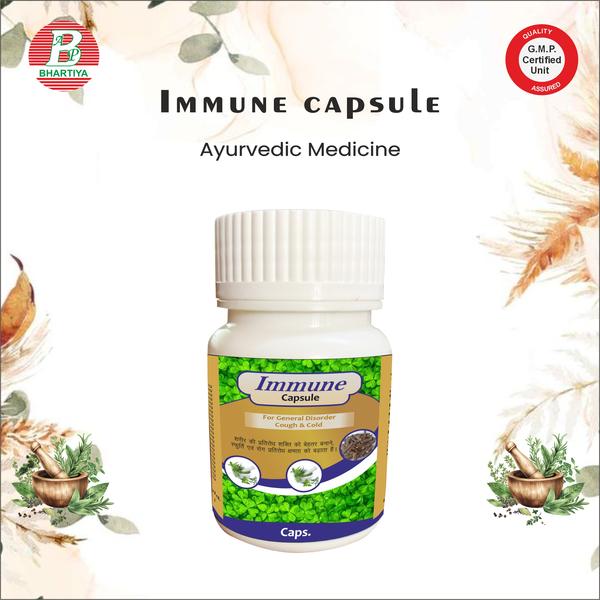
"name": "Immune capsule",
"description": " IMMUNE CAPSULE \n\nProduct Identification\n•\tGeneric Name: Immune Capsule\n•\tType: Ayurvedic Patent Medicine\n•\tPrimary Indication Area: Supports Immunity\n Therapeutic Indications\n•\tUseful in the management of weak immunity and frequent infections.\nPrimary benefits:\n•\tStrengthens the body’s natural defense system\n•\tSupports resistance against common infections like cold, cough, and seasonal illnesses\n•\tBoosts energy and vitality\n•\tSupports respiratory and overall health\nOther benefits:\n•\tRich in Antioxidants: The herbal ingredients in Immune Capsule help neutralize free radicals, protecting cells from oxidative stress and supporting long-term health. This helps slow down cellular damage and boosts overall vitality.\n•\tSupports Digestive Health: A healthy gut is closely linked to strong immunity. The capsule’s herbs help improve digestion, nutrient absorption, and bowel regularity, which indirectly strengthens the immune system.\n•\tEnhances Overall Well-being: By improving energy levels and reducing fatigue, it promotes better physical and mental performance during daily activities.\n•\tSupports Respiratory Health: Certain herbs in the formulation help maintain healthy lungs and respiratory function, reducing susceptibility to infections of the respiratory tract.\n•\tBalances Body Systems: Ayurvedic herbs help maintain harmony in body systems, promoting general wellness and resilience against stress and illness.\n•\tNatural & Gentle: Being herbal and Ayurvedic, it is usually well-tolerated and can be taken regularly as a supportive immunity booster.\n•\tMay Reduce Frequency of Infections: Regular use may help lower the risk of recurrent minor infections, supporting long-term immune strength.\n\nIngredients: \n Arjun Chhal\n•\tBotanical Name: Terminalia arjuna \n•\tKey Constituents: \nKey Constituents:\n•\tTannins\n•\tFlavonoids\n•\tSaponins\n•\tPhenolic compounds\n\nMechanism of action in immunity \nThe antioxidants in Arjun bark fight harmful free radicals.\no\tThis keeps immune cells safe and healthy.\n2.\tBoosts immune cells\no\tSaponins and flavonoids help immune cells work better.\no\tThey increase antibody production and strengthen the body’s defense.\n\nHaldi (Turmeric)\nBotanical Name: Curcuma longa\nKey Constituents:\n•\tCurcumin\n•\tVolatile oils (like turmerone)\n•\tFlavonoids\n•\tPhenolic compounds\n\nMechanism of Action in Immunity\n1.\tProtects body cells\no\tCurcumin is a strong antioxidant that fights free radicals.\no\tKeeps immune cells healthy and prevents cellular damage.\n2.\tBoosts immune response\no\tStimulates activation of immune cells like T-cells, B-cells, and natural killer (NK) cells.\no\tEnhances antibody production.\n\nTulsi (Holy Basil) \nBotanical Name: Ocimum sanctum / Ocimum tenuiflorum\n Key Constituents: Flavonoids, Phenolic acids, Eugenol, Tannins, Vitamins (C, A)\nMechanism of Action as an Antioxidant – Biochemistry / Pharmacology\n1.\tStops Free Radicals:\n• Flavonoids and phenolic acids remove harmful molecules called free radicals, protecting cells from damage.\n2.\tProtects Cell Membranes:\n• Compounds like eugenol prevent damage to cell membranes caused by oxidation.\n\nAmla (Indian Gooseberry) \nBotanical Name: Phyllanthus emblica / Emblica officinalis\n Key Constituents: Vitamin C, Flavonoids, Tannins, Phenolic compounds, Gallic acid\nMechanism of Action as an Antioxidant – Biochemistry / Pharmacology\n1.\tFree Radical Scavenging:\n• Vitamin C and flavonoids remove harmful free radicals, protecting cells from oxidative damage.\n2.\tProtects Cell Membranes:\n• Phenolic compounds prevent damage to cell membranes and tissues caused by oxidation.\n\n Mulethi (Licorice) \n Botanical Name: Glycyrrhiza glabra\nKey Constituents: Glycyrrhizin, Flavonoids, Saponins, Tannins, Phenolic compounds\nMechanism of Action in Immunity – Biochemistry / Pharmacology\n1.\tImmune System Modulation:\n• Glycyrrhizin and flavonoids enhance activity of immune cells like macrophages, natural killer (NK) cells, and T-lymphocytes, helping the body fight infections.\n2.\tAnti-Inflammatory Effect:\n• Suppresses pro-inflammatory cytokines (TNF-α, IL-1β, IL-6) and inhibits NF-κB signaling, reducing inflammation during infections.\n\n Dalchini (Cinnamon) \nBotanical Name: Cinnamomum verum / Cinnamomum zeylanicum\nKey Constituents: Cinnamaldehyde, Eugenol, Flavonoids, Tannins, Phenolic acids\nMechanism of Action in Immunity – Biochemistry / Pharmacology\n1.\tImmune Modulation:\n• Flavonoids and cinnamaldehyde enhance activity of immune cells like macrophages and T-lymphocytes, improving the body’s defense against infections.\n2.\tAnti-Inflammatory Effect:\n• Suppresses pro-inflammatory cytokines (TNF-α, IL-1β, IL-6) and inhibits NF-κB signaling, reducing inflammation.\n\nGiloy (Tinospora cordifolia) \nBotanical Name: Tinospora cordifolia\nKey Constituents: Alkaloids (tinosporine), Glycosides, Steroids, Flavonoids, Polysaccharides\nMechanism of Action in Immunity – Biochemistry / Pharmacology\n1.\tImmune System Modulation:\n• Polysaccharides and glycosides enhance the activity of macrophages, T-lymphocytes, and natural killer (NK) cells, boosting the body’s defense against infections.\n2.\tAnti-Inflammatory Effect:\n• Suppresses pro-inflammatory cytokines (TNF-α, IL-1β, IL-6) and inhibits NF-κB signaling, reducing tissue inflammation.\n\nBhringraj (Eclipta alba) \nBotanical Name: Eclipta alba / Eclipta prostrata Key Constituents: Wedelolactone, Flavonoids, Alkaloids, Coumestans, Triterpenoids\nMechanism of Action in Immunity – Biochemistry / Pharmacology\n1.\tImmune System Modulation:\n• Flavonoids and wedelolactone enhance macrophage and lymphocyte activity, strengthening the body’s defense mechanisms.\n2.\tAnti-Inflammatory Effect:\n• Inhibits pro-inflammatory cytokines (TNF-α, IL-1β, IL-6) and NF-κB signaling, reducing tissue inflammation.\n\n Punarnava (Boerhavia diffusa) \n Botanical Name: Boerhavia diffusa\nKey Constituents: Alkaloids (boeravinone), Flavonoids, Glycosides, Sterols, Phenolic compounds\nMechanism of Action in Immunity – Biochemistry / Pharmacology\n1.\tImmune System Modulation:\n• Flavonoids and glycosides enhance activity of macrophages and T-lymphocytes, strengthening the body’s defense against infections.\n2.\tAnti-Inflammatory Effect:\n• Suppresses pro-inflammatory cytokines (TNF-α, IL-1β, IL-6) and inhibits NF-κB signaling, reducing tissue inflammation.\n\nGokharu (Tribulus terrestris) \n Botanical Name: Tribulus terrestris\n Key Constituents: Saponins (protodioscin), Flavonoids, Alkaloids, Glycosides, Sterols\nMechanism of Action in Immunity – Biochemistry / Pharmacology\n1.\tImmune System Modulation:\n• Saponins and flavonoids enhance macrophage and lymphocyte activity, improving the body’s defense against infections.\n2.\tAnti-Inflammatory Effect:\n• Suppresses pro-inflammatory cytokines (TNF-α, IL-1β, IL-6), reducing inflammation in tissues.\n\n Daruhaldi (Indian Barberry) \nBotanical Name: Berberis aristata\nKey Constituents: Berberine (alkaloid), Flavonoids, Tannins, Phenolic compounds\nMechanism of Action in Immunity – Biochemistry / Pharmacology\n1.\tImmune System Modulation:\n• Berberine and flavonoids enhance the activity of macrophages, natural killer (NK) cells, and lymphocytes, strengthening the body’s defense.\n2.\tAnti-Inflammatory Effect:\n• Suppresses pro-inflammatory cytokines (TNF-α, IL-1β, IL-6) and inhibits NF-κB signaling, reducing tissue inflammation.\n3.\tAntioxidant Support:\n• Flavonoids and phenolic compounds neutralize free radicals, protecting immune cells from oxidative stress.\n\nAshwagandha (Indian Ginseng) \n Botanical Name: Withania somnifera\n Key Constituents: Withanolides, Alkaloids, Saponins, Flavonoids, Sterols\nMechanism of Action in Immunity – Biochemistry / Pharmacology\n1.\tImmune System Modulation:\n• Withanolides and flavonoids enhance activity of macrophages, natural killer (NK) cells, and T-lymphocytes, boosting the body’s defense.\n2.\tAnti-Inflammatory Effect:\n• Suppresses pro-inflammatory cytokines (TNF-α, IL-1β, IL-6) and inhibits NF-κB signaling, reducing inflammation.\n\n Shatavari (Asparagus racemosus) \nBotanical Name: Asparagus racemosus\n Key Constituents: Shatavarins (steroidal saponins), Flavonoids, Alkaloids, Glycosides, Polysaccharides\nMechanism of Action in Immunity – Biochemistry / Pharmacology\n1.\tImmune System Modulation:\n• Shatavarins and polysaccharides enhance macrophage, T-lymphocyte, and natural killer (NK) cell activity, boosting the body’s defense against infections.\n2.\tAnti-Inflammatory Effect:\n• Suppresses pro-inflammatory cytokines (TNF-α, IL-1β, IL-6) and inhibits NF-κB signaling, reducing tissue inflammation.\n\n\n Brahmi (Bacopa monnieri) \n Botanical Name: Bacopa monnieri\nKey Constituents: Bacosides (A and B), Flavonoids, Alkaloids, Saponins, Phenolic compounds\nMechanism of Action in Immunity – Biochemistry / Pharmacology\n1.\tImmune System Modulation:\n• Bacosides and flavonoids enhance macrophage and lymphocyte activity, strengthening the body’s defense against infections.\n2.\tAnti-Inflammatory Effect:\n• Suppresses pro-inflammatory cytokines (TNF-α, IL-1β, IL-6) and inhibits NF-κB signaling, reducing tissue inflammation.\n\nSafed Musli (Chlorophytum borivilianum) \n Botanical Name: Chlorophytum borivilianum\n Key Constituents: Steroidal saponins, Flavonoids, Polysaccharides, Alkaloids, Glycosides\nMechanism of Action in Immunity – Biochemistry / Pharmacology\n1.\tImmune System Modulation:\n• Steroidal saponins and polysaccharides enhance activity of macrophages, T-lymphocytes, and natural killer (NK) cells, boosting the body’s defense.\n2.\tAnti-Inflammatory Effect:\n• Suppresses pro-inflammatory cytokines (TNF-α, IL-1β, IL-6) and inhibits NF-κB signaling, reducing inflammation.\n\nSaunth (Dry Ginger) \n Botanical Name: Zingiber officinale\n Key Constituents: Gingerols, Shogaols, Flavonoids, Phenolic compounds, Volatile oils\nMechanism of Action in Immunity – Biochemistry / Pharmacology\n1.\tImmune System Modulation:\n• Gingerols and flavonoids enhance macrophage, T-lymphocyte, and natural killer (NK) cell activity, supporting the body’s defense.\n2.\tAnti-Inflammatory Effect:\n• Inhibits pro-inflammatory cytokines (TNF-α, IL-1β, IL-6) and NF-κB signaling, reducing inflammation in tissues.\n\nKali Mirch (Black Pepper) \nBotanical Name: Piper nigrum\n Key Constituents: Piperine, Alkaloids, Flavonoids, Volatile oils, Phenolic compounds\nMechanism of Action in Immunity – Biochemistry / Pharmacology\n1.\tImmune System Modulation:\n• Piperine and flavonoids enhance macrophage and lymphocyte activity, improving the body’s defense against infections.\n2.\tAnti-Inflammatory Effect:\n• Inhibits pro-inflammatory cytokines (TNF-α, IL-1β, IL-6) and NF-κB signaling, reducing inflammation.\n\nPippali (Long Pepper) \n Botanical Name: Piper longum \nKey Constituents: Piperine, Alkaloids, Flavonoids, Volatile oils, Phenolic compounds\nMechanism of Action in Immunity – Biochemistry / Pharmacology\n1.\tImmune System Modulation:\n• Piperine and flavonoids enhance macrophage, T-lymphocyte, and natural killer (NK) cell activity, boosting the body’s defense.\n2.\tAnti-Inflammatory Effect:\n• Suppresses pro-inflammatory cytokines (TNF-α, IL-1β, IL-6) and inhibits NF-κB signaling, reducing inflammation.\n\nMitha Soda (Sodium Bicarbonate) \n Chemical Name: Sodium Bicarbonate (NaHCO₃)\nKey Properties: Alkalinizing agent, buffering agent\nMechanism of Action in Immunity / Body Defense – Biochemistry / Pharmacology\n1.\tAcid-Base Balance:\n• Neutralizes excess stomach acid or blood acidity, maintaining pH balance which indirectly supports cellular functions, including immune cells.\n2.\tAntioxidant Support (Indirect):\n• By maintaining pH, it helps prevent oxidative stress caused by acid-base imbalance in tissues.\n\nShudh Guggul (Indian Bdellium / Commiphora mukul) \n Botanical Name: Commiphora mukul\n Key Constituents: Guggulsterones, Flavonoids, Triterpenoids, Resin\nMechanism of Action in Immunity – Biochemistry / Pharmacology\n1.\tImmune System Modulation:\n• Guggulsterones and flavonoids enhance macrophage and lymphocyte activity, boosting the body’s defense against infections.\n2.\tAnti-Inflammatory Effect:\n• Suppresses pro-inflammatory cytokines (TNF-α, IL-1β, IL-6) and inhibits NF-κB signaling, reducing inflammation.\n\n Lahsun (Garlic) \nBotanical Name: Allium sativum\n Key Constituents: Allicin, Sulphur compounds, Flavonoids, Phenolic compounds, Saponins\nMechanism of Action in Immunity – Biochemistry / Pharmacology\n1.\tImmune System Modulation:\n• Allicin and sulfur compounds enhance activity of macrophages, natural killer (NK) cells, and lymphocytes, strengthening the body’s defense.\n2.\tAnti-Inflammatory Effect:\n• Inhibits pro-inflammatory cytokines (TNF-α, IL-1β, IL-6) and NF-κB signaling, reducing tissue inflammation.\n\nHing (Asafoetida) \n Botanical Name: Ferula asafoetida\n Key Constituents: Ferulic acid, Resin, Sulfur compounds, Flavonoids, Coumarins\nMechanism of Action in Immunity – Biochemistry / Pharmacology\n1.\tImmune System Modulation:\n• Sulfur compounds and flavonoids enhance activity of macrophages and lymphocytes, improving the body’s defense against infections.\n2.\tAnti-Inflammatory Effect:\n• Inhibits pro-inflammatory cytokines (TNF-α, IL-1β, IL-6) and NF-κB signaling, reducing inflammation in tissues.\n\nCalastrus paniculatus (Jyotishmati / Clammy Milkweed) \n Botanical Name: Calastrus paniculatus\nKey Constituents: Alkaloids, Flavonoids, Glycosides, Sterols, Phenolic compounds\nMechanism of Action in Immunity – Biochemistry / Pharmacology\n1.\tImmune System Modulation:\n• Alkaloids and flavonoids enhance macrophage and lymphocyte activity, improving the body’s defense against infections.\n2.\tAnti-Inflammatory Effect:\n• Suppresses pro-inflammatory cytokines (TNF-α, IL-1β, IL-6) and NF-κB signaling, reducing inflammation in tissues.\n\nindication :\nuseful in general disorder, cough, cold.\n\nDosage \n\n•\tAdults: 1–2 capsules twice daily\n•\tHow to take: With plain water after meals\n•\tDuration: As directed by a physician\n•\tPrecautions:\no\tConsult a doctor if pregnant, lactating, or having chronic illnesses\no\tAdjust dose based on age, severity, or individual health conditions\n",
"price": 330.0,
"discountamount": 165.0,
"currencycode": "INR",
"priority": 1000000,
"isfreeshipmentavailable": false,
"shipmentduration": 1,
"_keywords": null,
"isarchived": false,
"isavailable": true,
"applicationid": null,
"productindex": 45,
"imageuri": "https://productimages.withfloats.com/actual/6989ad20f14bf2bc40a01a17.jpg",
"tileimageuri": "https://productimages.withfloats.com/tile/6989ad20f14bf2bc40a01a17.jpg",
"images": null,
"totalqueries": 0,
"gpid": null,
"groupproductid": null,
"createdon": "2026-02-09T09:47:03.327Z",
"updatedon": "2026-02-09T09:51:21.248Z",
"buyonlinelink": null,
"producturl": "http://WWW.BHARTIYAAYURVEDICPHARMACY.COM/products/immune-capsule/45",
"availableunits": -1.0,
"iscodavailable": true,
"isprepaidonlineavailable": true,
"maxcodorders": -1,
"maxprepaidonlineorders": -1,
"uniquepaymenturl": null,
"brandname": "Bakula Fort",
"category": "Immune capsule 50 cap X 24",
"tags": [],
"variants": false,
"keyspecification": null,
"otherspecifications": null,
"pickupaddressreferenceid": null,
"paymenttype": "AssuredPurchase",
"producttype": "products",
"hsncode": null,
"gstslab": 0.0,
"isnotforsale": false
},
{
"_id": "6986feccb9095165358beab7",
"fptag": "BHARTIYEAYURVEDICPHARMACY",
"merchantname": null,
"customwidgets": null,
"externalsourceid": null,
"name": "Zelitone syrup",
"description": " ZELITON SYRUP \n\nProduct Identification\n•\tGeneric Name: Zeliton Syrup\n•\tType: Ayurvedic Patent Medicine\n•\tPrimary Indication Area: Helps relieve indigestion, acidity, gas, and loss of appetite while promoting healthy digestion.\nTherapeutic Indications\nZeliton Syrup is an Ayurvedic medicine that helps relieve indigestion, acidity, gas, and loss of appetite while promoting healthy digestion.\nKey benefits:\n•\tRelieves indigestion and acidity\n•\tReduces gas and bloating\n•\tStimulates appetite\n•\tSupports healthy digestion\n\n\nIngredient: \n Saunth (Dry Ginger)\nBotanical Name: Zingiber officinale (Dry Ginger)\nKey Phytoconstituents:\n•\tGingerols\n•\tShogaols\n•\tVolatile oils\n•\tFlavonoids\nMechanism of Action and Benefits:\n1.\tDigestive Aid\no\tHelps relieve indigestion, bloating, and gas.\no\tStimulates digestive enzymes, improving overall digestion.\n2.\tReduces Acidity & Heartburn\no\tSoothes the stomach lining and balances gastric acid levels.\no\tProvides relief from acid reflux and heartburn.\n\n Mirch \nBotanical Name: Piper nigrum (Black Pepper) / Piper longum (Long Pepper)\nKey Phytoconstituents:\n•\tPiperine – primary active compound\n•\tEssential oils\n•\tAlkaloids\n•\tFlavonoids\nMechanism of Action and Benefits:\n1.\tDigestive Stimulant\no\tEnhances digestive enzyme secretion, aiding digestion.\no\tHelps relieve indigestion, bloating, and gas.\n2.\tReduces Acidity\no\tBalances gastric acid production to relieve heartburn and acidity.\n\nPippali (Long Pepper)\nBotanical Name: Piper longum\nKey Phytoconstituents:\n•\tPiperine – main active compound\n•\tEssential oils\n•\tAlkaloids\n•\tResins\nMechanism of Action and Benefits:\n1.\tDigestive Aid\no\tStimulates digestive enzymes, improving digestion and nutrient absorption.\no\tHelps relieve indigestion, bloating, and gas.\n2.\tReduces Acidity\no\tBalances gastric acid secretion to alleviate heartburn and acidity.\n\nMulethi (Licorice)\nBotanical Name: Glycyrrhiza glabra\nKey Phytoconstituents:\n•\tGlycyrrhizin – main active compound\n•\tFlavonoids\n•\tCoumarins\n•\tSaponins\nMechanism of Action and Benefits:\n1.\tDigestive Aid\no\tSoothes the gastrointestinal tract and helps relieve indigestion.\no\tPromotes healthy digestion and reduces gastric irritation.\n2.\tReduces Acidity & Heartburn\no\tProtects the stomach lining and balances gastric acid, alleviating acidity and heartburn.\n\n Lahsun (Garlic)\nBotanical Name: Allium sativum\nKey Phytoconstituents:\n•\tAllicin – primary active compound\n•\tSulfur compounds\n•\tFlavonoids\n•\tVitamins (C, B6)\nMechanism of Action and Benefits:\n1.\tDigestive Aid\no\tStimulates digestive enzymes, improving digestion and nutrient absorption.\no\tHelps reduce indigestion and bloating.\n2.\tCarminative Effect\no\tPromotes the expulsion of intestinal gas, relieving discomfort.\n\n\n Amla (Indian Gooseberry)\nBotanical Name: Phyllanthus emblica (Emblica officinalis)\nKey Phytoconstituents:\n•\tVitamin C – primary active compound\n•\tTannins\n•\tFlavonoids\n•\tPolyphenols\nMechanism of Action and Benefits:\n1.\tDigestive Aid\no\tStimulates digestion and improves nutrient absorption.\no\tHelps relieve indigestion and bloating.\n2.\tReduces Acidity\no\tBalances gastric acid levels, providing relief from acid reflux and heartburn\n\n Haldi (Turmeric)\nBotanical Name: Curcuma longa\nKey Phytoconstituents:\n•\tCurcumin – primary active compound\n•\tVolatile oils\n•\tTannins\n•\tFlavonoids\nMechanism of Action and Benefits:\n1.\tDigestive Aid\no\tStimulates bile production, improving digestion.\no\tHelps relieve indigestion, bloating, and gas.\n2.\tReduces Acidity & Heartburn\no\tBalances gastric acid levels and soothes the stomach lining.\n\nDalchini (Cinnamon)\nBotanical Name: Cinnamomum verum / Cinnamomum zeylanicum\nKey Phytoconstituents:\n•\tCinnamaldehyde – primary active compound\n•\tEssential oils\n•\tPolyphenols\n•\tTannins\nMechanism of Action and Benefits:\n1.\tDigestive Aid\no\tStimulates digestive enzymes, improving digestion.\no\tHelps relieve indigestion, bloating, and gas.\n2.\tReduces Acidity & Heartburn\no\tSoothes the stomach lining and balances gastric acid levels.\n\nGiloy (Tinospora cordifolia)\nBotanical Name: Tinospora cordifolia\nKey Phytoconstituents:\n•\tAlkaloids (e.g., Berberine, Palmatine)\n•\tDiterpenoid lactones\n•\tGlycosides\n•\tPolysaccharides\nMechanism of Action and Benefits:\n1.\tDigestive Support\no\tHelps in maintaining healthy digestion and improves nutrient absorption.\no\tReduces indigestion and bloating.\n2.\tReduces Acidity\no\tBalances gastric acid levels, relieving acid reflux and heartburn.\n\n Punarnava (Boerhavia diffusa)\nBotanical Name: Boerhavia diffusa\nKey Phytoconstituents:\n•\tAlkaloids\n•\tFlavonoids\n•\tLignans\n•\tSaponins\nMechanism of Action and Benefits:\n1.\tDigestive Support\no\tHelps maintain healthy digestion and reduces bloating.\no\tMildly supports stomach comfort and intestinal health.\n2.\tReduces Acidity & Gas\no\tBalances gastric acid levels, relieving acid reflux and heartburn.\no\tExhibits carminative properties, aiding in the expulsion of intestinal gas.\n\n",
"price": 210.0,
"discountamount": 105.0,
"currencycode": "INR",
"priority": 1000000,
"isfreeshipmentavailable": false,
"shipmentduration": 1,
"_keywords": null,
"isarchived": false,
"isavailable": true,
"applicationid": null,
"productindex": 41,
"imageuri": "https://productimages.withfloats.com/actual/6986fed3ae09baa6820feee8.jpg",
"tileimageuri": "https://productimages.withfloats.com/tile/6986fed3ae09baa6820feee8.jpg",
"images": null,
"totalqueries": 0,
"gpid": null,
"groupproductid": null,
"createdon": "2026-02-07T08:58:52.786Z",
"updatedon": "2026-02-07T08:59:24.695Z",
"buyonlinelink": null,
"producturl": "http://WWW.BHARTIYAAYURVEDICPHARMACY.COM/products/zelitone-syrup/41",
"availableunits": -1.0,
"iscodavailable": true,
"isprepaidonlineavailable": true,
"maxcodorders": -1,
"maxprepaidonlineorders": -1,
"uniquepaymenturl": null,
"brandname": "Bakula Fort",
"category": "Zelitone syrup 200 X ML",
"tags": [],
"variants": false,
"keyspecification": null,
"otherspecifications": null,
"pickupaddressreferenceid": null,
"paymenttype": "AssuredPurchase",
"producttype": "products",
"hsncode": null,
"gstslab": 0.0,
"isnotforsale": false
},
{
"_id": "6985de16061c70432685704f",
"fptag": "BHARTIYEAYURVEDICPHARMACY",
"merchantname": null,
"customwidgets": null,
"externalsourceid": null,
"name": "Sharbat Faulad",
"description": " SARBAT - FAULAD\n\nProduct Identification\n•\tGeneric Name: Sarbat Faulad \n•\tType: Ayurvedic Patent Medicine\n•\tPrimary Indication Area: An Ayurvedic medicine used for blood disorders (Rakt Nunta) and liver disorders (Yakrit Vikar).\nTherapeutic Indications\nUsed to treat blood disorders (anaemia, blood purification) and liver disorders (hepatitis, jaundice, liver dysfunction).\nKey benefits:\n•\tSupports Blood Health – Helps in improving haemoglobin levels, purifying blood, and managing conditions like anaemia or general weakness.\n•\tPromotes Liver Function – Assists in detoxifying the liver, supporting its normal metabolic and regenerative functions, and managing liver disorders like jaundice or hepatitis. Enhances Vitality & Energy – By improving blood and liver health, it contributes to better stamina, reduced fatigue, and overall vitality.\n•\tDetoxification & Body Rejuvenation – Helps eliminate toxins from the body, supporting overall wellness and rejuvenation.\n•\tHolistic Ayurvedic Support – Combines herbal and mineral ingredients that work synergistically to strengthen the body’s natural healing mechanisms.\n\n\nIngredient: \n Safed Chandan (White Sandalwood)\nBotanical Name: Santalum album\nKey Phytoconstituents:\n•\tSantalols (α-santalol, β-santalol)\n•\tFlavonoids\n•\tPhenolic compounds\n•\tEssential oils\nTherapeutic Action for Blood & Liver Health:\n1.\tLiver Support (Yakrit Vikar):\no\tActs as a mild hepatoprotective agent.\no\tSupports liver detoxification and healthy metabolic function.\n2.\tBlood Purification (Rakt Nunta):\no\tHelps in purifying blood and reducing inflammatory conditions.\no\tSupports overall vitality and detoxification.\n3.\tAnti-inflammatory & Antioxidant Effects:\no\tReduces oxidative stress in the liver and blood.\no\tHelps protect cells from damage caused by toxins.\n\n Kashni (Chicory)\nBotanical Name: Cichorium intybus\nKey Phytoconstituents:\n•\tInulin\n•\tPhenolic compounds\n•\tFlavonoids\n•\tTannins\n•\tCoumarins\nMechanism of Action and Benefits for Blood & Liver:\n1.\tLiver Health (Yakrit Vikar)\no\tHepatoprotective: Supports liver detoxification and regeneration.\no\tPromotes Bile Flow: Improves digestion and metabolism of fats.\no\tReduces Liver Inflammation: Helps in conditions like fatty liver or hepatitis.\n2.\tBlood Purification (Rakt Nunta)\no\tDetoxifies Blood: Removes toxins and supports healthy circulation.\no\tAnti-inflammatory & Antioxidant: Protects blood cells from oxidative stress.\n\nGajwan\nBotanical Name: Cissus quadrangularis (commonly called Gajwan in some Ayurvedic texts)\nKey Phytoconstituents:\n•\tFlavonoids\n•\tTriterpenoids\n•\tStilbenes\n•\tAscorbic acid (Vitamin C)\n•\tCalcium and other minerals\nMechanism of Action and Benefits for Blood & Liver:\n1.\tLiver Health (Yakrit Vikar)\no\tHepatoprotective: Supports liver detoxification and regeneration.\no\tReduces Inflammation: Protects liver cells from oxidative stress and toxins.\n2.\tBlood Purification (Rakt Nunta)\no\tDetoxifying Effect: Helps purify blood and maintain healthy circulation.\no\tSupports Haematopoiesis: May aid in improving blood quality.\n\n Saunf (Fennel Seeds)\nBotanical Name: Foeniculum vulgare\nKey Phytoconstituents:\n•\tVolatile oils (Anethole, Fenchone, Estragole)\n•\tFlavonoids\n•\tPhenolic compounds\n•\tFiber\n•\tVitamins (A, C) and minerals (Calcium, Iron)\nMechanism of Action and Benefits for Blood & Liver:\n1.\tLiver Health (Yakrit Vikar)\no\tHepatoprotective: Supports liver detoxification and regeneration.\no\tDigestive Support: Improves bile flow, aiding metabolism and fat digestion.\no\tReduces Liver Inflammation: Antioxidant properties protect liver cells.\n2.\tBlood Purification (Rakt Nunta)\no\tDetoxifying Effect: Helps eliminate toxins from the blood.\no\tSupports Circulation: Mildly enhances blood quality and vitality.\n\nNilotpala (Blue Lotus / Water Lily)\nBotanical Name: Nymphaea nouchali (also Nymphaea caerulea in some references)\nKey Phytoconstituents:\n•\tAlkaloids\n•\tFlavonoids\n•\tTannins\n•\tGlycosides\n•\tPhenolic compounds\nMechanism of Action and Benefits (General & Related to Blood & Liver):\n1.\tLiver Support (Yakrit Vikar)\no\tHepatoprotective: Traditionally valued for supporting liver health and assisting detoxification.\no\tAntioxidant Properties: Helps protect liver cells from oxidative stress.\n2.\tBlood Purification (Rakt Nunta)\no\tDetoxifying & Cooling: Aids in cleansing the bloodstream and reducing inflammatory conditions.\no\tSupports overall circulation and vitality.\n\nArjun Chhal (Arjuna Bark)\nBotanical Name: Terminalia arjuna\nKey Phytoconstituents:\n•\tTannins (Arjunic acid, Arjungenin)\n•\tFlavonoids\n•\tGlycosides\n•\tSaponins\n•\tMinerals (Calcium, Magnesium, Potassium)\nMechanism of Action and Benefits for Blood & Liver:\n1.\tLiver Health (Yakrit Vikar)\no\tHepatoprotective: Supports liver detoxification and protects liver cells from oxidative stress.\no\tReduces Inflammation: Helps manage liver inflammation and improves metabolic function.\n2.\tBlood & Circulatory Support (Rakt Nunta)\no\tBlood Purification: Promotes healthy circulation and detoxification of the blood.\no\tCardioprotective Effects: Supports heart and vascular health, indirectly benefiting overall blood health.\n\nLoh Bhasma (Ash of Iron)\nType: Ayurvedic Mineral Preparation (Bhasma)\nComposition:\n•\tCalcined Iron (Fe₂O₃, Fe₃O₄ depending on preparation)\n•\tTrace minerals from the Ayurvedic preparation process\nMechanism of Action and Benefits for Blood & Liver:\n1.\tBlood Health (Rakt Nunta / Anemia)\no\tHematopoietic Activity: Provides bioavailable iron to support hemoglobin formation and red blood cell production.\no\tBlood Purification: Traditionally used to improve overall blood quality and vitality.\n2.\tLiver Support (Yakrit Vikar)\no\tDetoxification: Helps in rejuvenation and metabolic support of the liver.\no\tSupports Enzyme Function: Improves nutrient assimilation and liver-related metabolic processes.\n\nFitkari (Alum / Potash Alum)\nBotanical / Mineral Name: Potash Alum – KAl (SO₄) ₂·12H₂O\nType: Ayurvedic Mineral Preparation\nMechanism of Action and Benefits for Blood & Liver:\n1.\tBlood Purification (Rakt Nunta)\no\tAstringent & Antiseptic: Helps purify blood and reduce minor bleeding or inflammation.\no\tDetoxifying Effect: Traditionally used to cleanse blood and maintain healthy circulation.\n2.\tLiver Support (Yakrit Vikar)\no\tMild Hepatoprotective Action: Supports liver detoxification indirectly by reducing toxins in the bloodstream.\n3.\tAdditional Benefits\no\tDigestive Support: Aids in controlling excessive acidity and gut inflammation.\no\tAnti-inflammatory: Reduces mild internal inflammation, indirectly supporting metabolic organs.\n\n Sugar Base (Mishri / Sucrose / Sugar Syrup)\nComposition:\n•\tSucrose (Refined or Unrefined Sugar)\n•\tSometimes combined with water or honey to make a syrup (Sarbat)\nMechanism of Action and Benefits:\n1.\tPalatability & Acceptability\no\tMakes the formulation easy to consume, especially for children and elderly patients.\n2.\tVehicle for Drug Delivery\no\tActs as a medium to carry herbal/mineral ingredients effectively into the body.\no\tHelps in stabilizing the active ingredients in syrup form.\n3.\tEnergy Source\no\tProvides instant energy due to simple carbohydrates.\no\tCan help improve general vitality, especially in weak or anaemic patients.\n\nDose: \n•\tDosage: 10–25 ml per dose.\n•\tFrequency: Twice a day.\n•\tHow to take: Mix the syrup with a little water or fruit juice to make it easier to take.\n•\tTiming: Usually, morning and evening or as prescribed by a doctor.\n•\tImportant: Make sure to follow the exact dose recommended by a doctor or on the label; do not exceed it.\n\nFitkari (Alum / Potash Alum)\nBotanical / Mineral Name: Potash Alum – KAl (SO₄) ₂·12H₂O\nType: Ayurvedic Mineral Preparation\nMechanism of Action and Benefits for Blood & Liver:\n1.\tBlood Purification (Rakt Nunta)\no\tAstringent & Antiseptic: Helps purify blood and reduce minor bleeding or inflammation.\no\tDetoxifying Effect: Traditionally used to cleanse blood and maintain healthy circulation.\n2.\tLiver Support (Yakrit Vikar)\no\tMild Hepatoprotective Action: Supports liver detoxification indirectly by reducing toxins in the bloodstream.\n3.\tAdditional Benefits\no\tDigestive Support: Aids in controlling excessive acidity and gut inflammation.\no\tAnti-inflammatory: Reduces mild internal inflammation, indirectly supporting metabolic organs.\n\n Sugar Base (Mishri / Sucrose / Sugar Syrup)\nComposition:\n•\tSucrose (Refined or Unrefined Sugar)\n•\tSometimes combined with water or honey to make a syrup (Sarbat)\nMechanism of Action and Benefits:\n1.\tPalatability & Acceptability\no\tMakes the formulation easy to consume, especially for children and elderly patients.\n2.\tVehicle for Drug Delivery\no\tActs as a medium to carry herbal/mineral ingredients effectively into the body.\no\tHelps in stabilizing the active ingredients in syrup form.\n3.\tEnergy Source\no\tProvides instant energy due to simple carbohydrates.\no\tCan help improve general vitality, especially in weak or anaemic patients.\n\nDose: \n•\tDosage: 10–25 ml per dose.\n•\tFrequency: Twice a day.\n•\tHow to take: Mix the syrup with a little water or fruit juice to make it easier to take.\n•\tTiming: Usually, morning and evening or as prescribed by a doctor.\n•\tImportant: Make sure to follow the exact dose recommended by a doctor or on the label; do not exceed it.\n\n",
"price": 180.0,
"discountamount": 90.0,
"currencycode": "INR",
"priority": 1000000,
"isfreeshipmentavailable": false,
"shipmentduration": 1,
"_keywords": null,
"isarchived": false,
"isavailable": true,
"applicationid": null,
"productindex": 40,
"imageuri": "https://productimages.withfloats.com/actual/6985de1cc124fdbd89543866.jpg",
"tileimageuri": "https://productimages.withfloats.com/tile/6985de1cc124fdbd89543866.jpg",
"images": null,
"totalqueries": 0,
"gpid": null,
"groupproductid": null,
"createdon": "2026-02-06T12:27:02.043Z",
"updatedon": "2026-02-06T12:27:02.043Z",
"buyonlinelink": null,
"producturl": "http://WWW.BHARTIYAAYURVEDICPHARMACY.COM/products/sharbat-faulad/40",
"availableunits": -1.0,
"iscodavailable": true,
"isprepaidonlineavailable": true,
"maxcodorders": -1,
"maxprepaidonlineorders": -1,
"uniquepaymenturl": null,
"brandname": "Bakula Fort",
"category": "Sharbat Faulad 200 ML X 24",
"tags": [],
"variants": false,
"keyspecification": null,
"otherspecifications": null,
"pickupaddressreferenceid": null,
"paymenttype": "AssuredPurchase",
"producttype": "products",
"hsncode": null,
"gstslab": 0.0,
"isnotforsale": false
}
],
"hasmoreitems": false,
"isapirequest": false,
"totalresults": 27,
"query": null,
"floatingpoint": null
}