BHARTIYEAYURVEDICPHARMACY
Products
08048038922
919711305254
Chat with us


Chat with us on WhatsApp
×
This is your website preview.
Currently it only shows your basic business info. Start adding relevant business details such as description, images and products or services to gain your customers attention by using Boost 360 android app / iOS App / web portal.
Home
 ayurvedic medicine manufacturer delhi
 ayurvedic medicine manufacturer delhi
Items tagged with 'ayurvedic medicine manufacturer delhi'
{
"products": [
{
"_id": "69f041bb3d0dd66733f9e574",
"fptag": "BHARTIYEAYURVEDICPHARMACY",
"merchantname": null,
"customwidgets": null,
"externalsourceid": null,
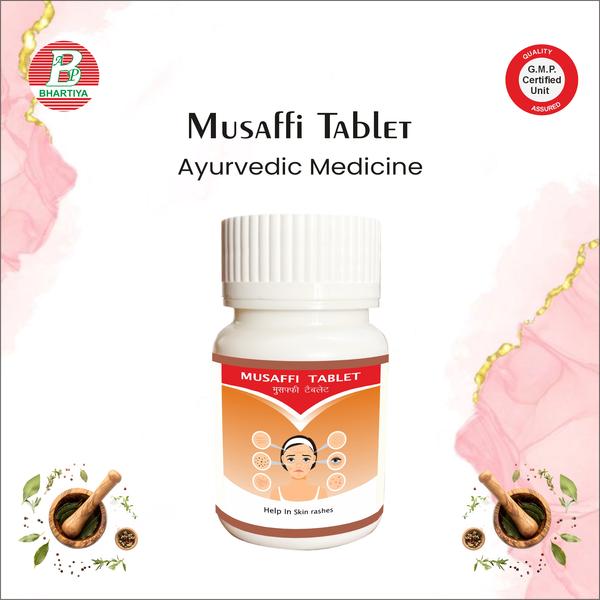
"name": "Musaffi Tablet",
"description": " \n MUSAFFI TABLET \n\n\nProduct Identification\n• Generic Name: Musaffi Tablet\n• Type: Ayurvedic Patent Medicine\n• Primary Indication Area: Blood purification, detoxification, and support in blood-related disorders (Rakt Vikar).\nTherapeutic Indications\nMusaffi Tablet is used to support blood health by purifying the blood, managing blood disorders (Rakt Vikar), and promoting overall vitality.\nKey Benefits:\nPrimary Benefit:\n• Supports blood purification and helps in the management of blood-related disorders by improving the quality of blood.\nOther Benefits:\n• Enhances energy and overall vitality.\n• Supports skin health by improving blood quality.\n• Promotes general well-being and immunity.\n\n CHOBCHINI \nBotanical / Common Name: Gymnema sylvestre\nKey Phytoconstituents:\n•\tGymnemic acids\n•\tSaponins\n•\tFlavonoids\n•\tAlkaloids\nMechanism of Action in Rakt Vikar (Blood Disorders / Anaemia) – Biochemistry / Pharmacology:\n1.\tBlood Purification & Detoxification\no\tGymnemic acids and flavonoids exhibit antioxidant properties, reducing oxidative stress on blood cells.\no\tHelps in cleansing the blood by neutralizing free radicals, which supports overall blood health.\n2.\tHematopoietic Support\no\tSaponins and flavonoids support haemoglobin synthesis and improve red blood cell (RBC) count.\no\tEnhances the quality and quantity of blood, aiding in the management of anaemia and other blood disorders.\n\nKUTAKI \nBotanical / Common Name: Picrorhiza kurroa\nKey Phytoconstituents:\n•\tPicrosides (Picrosides I & II)\n•\tKutkoside\n•\tIridoid glycosides\n•\tFlavonoids\nMechanism of Action in Rakt Vikar (Blood Disorders / Anaemia) – Biochemistry / Pharmacology:\n1.\tHepatoprotective & Blood Purification Effects\no\tPicrosides and iridoid glycosides support liver function, enhancing detoxification.\no\tImproved liver function aids in purifying the blood and removing metabolic toxins.\n2.\tHematopoietic Support\no\tFlavonoids and kutakoside promote RBC production and haemoglobin synthesis.\no\tHelps improve blood quality and manage anaemia associated with blood disorders.\n\nHARAD \nBotanical / Common Name: Terminalia chebula\nKey Phytoconstituents:\n•\tTannins (chebulinic acid, chebulagic acid)\n•\tFlavonoids\n•\tPhenolic compounds\n•\tGlycosides\nMechanism of Action in Rakt Vikar (Blood Disorders / Anaemia) – Biochemistry / Pharmacology:\n1.\tBlood Purification & Detoxification\no\tTannins and phenolic compounds exhibit antioxidant activity, helping neutralize free radicals in blood.\no\tSupports detoxification and improves overall blood quality.\n2.\tHematopoietic Support\no\tPromotes RBC formation and haemoglobin synthesis.\no\tSupports management of anaemia and other blood-related disorders.\n\nBAHEDA \nBotanical / Common Name: Terminalia belerica\nKey Phytoconstituents:\n•\tTannins (gallic acid, ellagic acid)\n•\tFlavonoids\n•\tGlycosides\n•\tPhenolic compounds\nMechanism of Action in Rakt Vikar (Blood Disorders / Anaemia) – Biochemistry / Pharmacology:\n1.\tBlood Purification & Detoxification\no\tTannins and phenolic compounds act as antioxidants, reducing oxidative stress on blood cells.\no\tSupports cleansing of blood and removal of toxins, improving blood quality.\n2.\tHematopoietic Support\no\tPromotes red blood cell formation and haemoglobin synthesis.\no\tHelps manage anaemia and strengthens overall blood health.\n\nAMLA \nBotanical / Common Name: Phyllanthus emblica\nKey Phytoconstituents:\n•\tVitamin C (ascorbic acid)\n•\tTannins (gallic acid, ellagic acid)\n•\tFlavonoids\n•\tPolyphenols\nMechanism of Action in Rakt Vikar (Blood Disorders / Anaemia) – Biochemistry / Pharmacology:\n1.\tAntioxidant & Blood Purification\no\tVitamin C, tannins, and polyphenols reduce oxidative stress on blood cells.\no\tSupports detoxification and improves the quality of blood.\n2.\tHematopoietic Support\no\tEnhances iron absorption and supports haemoglobin synthesis, aiding in anaemia management.\no\tImproves red blood cell count and overall blood health.\n\nDARUHALDI \nBotanical / Common Name: Berberis aristata\nKey Phytoconstituents:\n•\tBerberine (alkaloid)\n•\tTannins\n•\tFlavonoids\n•\tPhenolic compounds\nMechanism of Action in Rakt Vikar (Blood Disorders / Anaemia) – Biochemistry / Pharmacology:\n1.\tBlood Purification & Detoxification\no\tBerberine and flavonoids act as antioxidants, reducing oxidative stress on blood cells.\no\tSupports liver function and detoxification, indirectly improving blood quality.\n2.\tHematopoietic Support\no\tStimulates red blood cell formation and haemoglobin synthesis.\no\tAids in managing anaemia and other blood disorders.\n\nGORAKHMUNDI \nBotanical / Common Name: Sphaeranthus indicus\nKey Phytoconstituents:\n•\tSesquiterpene lactones (sphaerantholide)\n•\tFlavonoids\n•\tEssential oils\n•\tAlkaloids\nMechanism of Action in Rakt Vikar (Blood Disorders / Anaemia) – Biochemistry / Pharmacology:\n1.\tBlood Purification & Detoxification\no\tFlavonoids and sesquiterpene lactones reduce oxidative stress and help cleanse the blood.\no\tSupports liver and metabolic function, indirectly improving blood quality.\n2.\tHematopoietic Support\no\tStimulates red blood cell production and improves haemoglobin levels.\no\tAids in managing anaemia and related blood disorders.\n\nAFSTEEN \nBotanical / Common Name: Clerodendrum serratum (or related species)\nKey Phytoconstituents:\n•\tFlavonoids\n•\tAlkaloids\n•\tPhenolic compounds\n•\tTriterpenoids\nMechanism of Action in Rakt Vikar (Blood Disorders / Anaemia) – Biochemistry / Pharmacology:\n1.\tBlood Purification & Detoxification\no\tFlavonoids and phenolic compounds act as antioxidants, reducing oxidative stress in blood.\no\tSupports liver function and detoxification, enhancing overall blood quality.\n2.\tHematopoietic Support\no\tAlkaloids and triterpenoids aid in RBC formation and haemoglobin synthesis.\no\tHelps improve blood quality and manage anaemia.\n\nPITPAPDA \nBotanical / Common Name: Fumaria indica\nKey Phytoconstituents:\n•\tAlkaloids (fumarin, protopine)\n•\tFlavonoids\n•\tTannins\n•\tPhenolic compounds\nMechanism of Action in Rakt Vikar (Blood Disorders / Anaemia) – Biochemistry / Pharmacology:\n1.\tBlood Purification & Detoxification\no\tAlkaloids and flavonoids exhibit antioxidant activity, helping to cleanse the blood and reduce oxidative stress on blood cells.\no\tSupports liver function and metabolic detoxification, improving overall blood quality.\n2.\tHematopoietic Support\no\tPromotes RBC formation and hemoglobin synthesis.\no\tSupports management of anemia and enhances overall blood health.\n\nNILOPHER \nBotanical / Common Name: Nymphaea alba (White Water Lily)\nKey Phytoconstituents:\n•\tFlavonoids\n•\tAlkaloids\n•\tTannins\n•\tPhenolic compounds\nMechanism of Action in Rakt Vikar (Blood Disorders / Anaemia) – Biochemistry / Pharmacology:\n1.\tBlood Purification & Detoxification\no\tFlavonoids and tannins act as antioxidants, reducing oxidative stress on blood cells.\no\tSupports detoxification pathways, enhancing blood quality and overall vitality.\n2.\tHematopoietic Support\no\tAlkaloids and phenolic compounds promote RBC formation and hemoglobin synthesis.\no\tHelps in managing anemia and improving overall blood health.\n\nMANJEETH \nBotanical / Common Name: Rubia cordifolia\nKey Phytoconstituents:\n•\tAnthraquinones (alizarin, purpurin)\n•\tIridoid glycosides\n•\tFlavonoids\n•\tTannins\nMechanism of Action in Rakt Vikar (Blood Disorders / Anaemia) – Biochemistry / Pharmacology:\n1.\tBlood Purification & Detoxification\no\tAnthraquinones and flavonoids act as antioxidants, neutralizing free radicals and cleansing the blood.\no\tSupports liver and kidney function, indirectly improving blood quality.\n2.\tHematopoietic Support\no\tPromotes RBC formation and enhances hemoglobin synthesis.\no\tHelps in managing anemia and other blood-related disorders.\n\nGULAB PHOOL \nBotanical / Common Name: Rosa indica\nKey Phytoconstituents:\n•\tFlavonoids (quercetin, kaempferol)\n•\tTannins\n•\tVolatile oils (rose oil)\n•\tPhenolic compounds\nMechanism of Action in Rakt Vikar (Blood Disorders / Anaemia) – Biochemistry / Pharmacology:\n1.\tBlood Purification & Detoxification\no\tFlavonoids and phenolic compounds act as antioxidants, reducing oxidative stress on blood cells.\no\tSupports detoxification and improves blood quality.\n2.\tHematopoietic Support\no\tPromotes RBC formation and supports hemoglobin synthesis.\no\tHelps in managing anemia and enhancing overall blood health.\n\nREVAND CHINI \nBotanical / Common Name: Rheum emodi (Himalayan Rhubarb)\nKey Phytoconstituents:\n•\tAnthraquinones (emodin, chrysophanol)\n•\tTannins\n•\tFlavonoids\n•\tStilbenes\nMechanism of Action in Rakt Vikar (Blood Disorders / Anaemia) – Biochemistry / Pharmacology:\n1.\tBlood Purification & Detoxification\no\tAnthraquinones and flavonoids exhibit antioxidant activity, reducing oxidative stress on blood cells.\no\tSupports detoxification and cleansing of blood, improving overall blood quality.\n2.\tHematopoietic Support\no\tPromotes RBC formation and hemoglobin synthesis.\no\tHelps manage anemia and supports healthy blood composition.\n\nANANTMOOL \nBotanical Name: Hemidesmus indicus\nCommon Name: Indian Sarsaparilla\n\nKey Phytoconstituents\n•\tSaponins\n•\tFlavonoids\n•\tTannins\n•\tEssential oils\nMechanism of Action in Rakt Vikar (Blood Disorders / Anaemia)\n1. Blood Purification & Detoxification\n•\tSaponins and flavonoids act as powerful antioxidants, reducing oxidative stress and supporting the removal of circulating toxins.\n•\tEnhances liver and kidney function, promoting efficient detoxification and improved blood quality.\n2. Hematopoietic Support\n•\tSupports erythropoiesis (RBC formation) and hemoglobin synthesis.\n•\tHelps in managing anemia and contributes to improved overall blood composition.\n\nGILOY (Guduchi) \nBotanical Name: Tinospora cordifolia\nFamily: Menispermaceae\n\nKey Phytoconstituents\n•\tAlkaloids (berberine, tinosporin, magnoflorine)\n•\tDiterpenoid lactones (tinosporide, cordifolide)\n•\tGlycosides\n•\tPolysaccharides\n•\tPhenolics & Flavonoids\n\nMechanism of Action in Rakt Vikar (Blood Disorders / Anaemia)\n1. Blood Purification & Detoxification\n•\tPotent antioxidant and free-radical scavenging action from phenolics and flavonoids.\n•\tEnhances hepatic detoxification enzymes, supporting liver-based blood purification.\n•\tReduces circulating toxins (ama) and improves blood quality.\n\n2. Hematopoietic Support\n•\tStimulates bone marrow activity, increasing RBC and WBC production.\n•\tImproves hemoglobin synthesis and overall blood profile.\n•\tBeneficial in mild to moderate anemia due to its Rasayana (rejuvenative) effect.\n\nDosage:\nDose per Intake: 1–2 tablets\nFrequency: Twice a day (morning and evening)\nTotal Daily Dose: 2–4 tablets per day\nAnupan (Vehicle / Medium):\n•\tPreferred: Take with water\n•\tTiming: Preferably after meals to reduce gastric irritation\nPrecautions:\n•\tDo not exceed the prescribed dose\n•\tMonitor for any side effects\nConsult an Ayurvedic Practitioner Before Use in:\n•\tChildren\n•\tElderly\n•\tIndividuals with chronic illnesses\n\n\nmusaffi tablets, musaffi khoon tablet, musaffi khoon tablet uses\nmusaffi tablet amazon, musaffi tablet amazon india\nmusaffi tablet available in delhi, musaffi tablet available in india\nmusaffi tablet ajeeb uses in hindi, musaffi tablet benefits\nmusaffi tablet benefits in hindi, musaffi tablet buy online\nmusaffi tablet buy, musaffi tablet composition, musaffi tablet company\nmusaffi tablet content, musaffi tablet cost, musaffi tablet company name\nmusaffi tablet download, musaffi tablet dosage, musaffi tablet dose\nmusaffi tablet english, musaffi tablet expiry date, musaffi tablet export\nmusaffi tablet flipkart, musaffi tablet free download, musaffi tablet fayde in hindi\nmusaffi tablet gold, musaffi tablet good, musaffi tablet google, musaffi tablet in india\nmusaffi tablet in hindi, musaffi tablet in english, musaffi tablet jiomart\nmusaffi tablet login, musaffi tablet list pdf, musaffi tablet life science\nmusaffi tablet manufacturer, musaffi tablet meaning, musaffi tablet manufacturers in india\nmusaffi tablet manufacturing company, musaffi tablet medicine\nmusaffi tablet name, musaffi tablet near me, musaffi tablet nutrition\nmusaffi tablet name in india, musaffi tablet online, musaffi tablet online shopping\nmusaffi tablet online order, musaffi tablet price, musaffi tablet price in india\nmusaffi tablet qatar, musaffi tablet q10, musaffi tablet quality\nmusaffi tablet review, musaffi tablet review in hindi, musaffi tablet rate\nmusaffi tablet recipe, musaffi tablet tablet, musaffi tablet tab\nmusaffi tablet weight loss, musaffi tablet zamzam, ayurvedic musaffi syrup",
"price": 102.0,
"discountamount": 51.0,
"currencycode": "INR",
"priority": 1000000,
"isfreeshipmentavailable": false,
"shipmentduration": 1,
"_keywords": null,
"isarchived": false,
"isavailable": true,
"applicationid": null,
"productindex": 108,
"imageuri": "https://productimages.withfloats.com/actual/69f041bd7824e0f41855c98a.jpg",
"tileimageuri": "https://productimages.withfloats.com/tile/69f041bd7824e0f41855c98a.jpg",
"images": null,
"totalqueries": 0,
"gpid": null,
"groupproductid": null,
"createdon": "2026-04-28T05:12:27.341Z",
"updatedon": "2026-04-28T05:12:27.341Z",
"buyonlinelink": null,
"producturl": "http://WWW.BHARTIYAAYURVEDICPHARMACY.COM/products/musaffi-tablet/108",
"availableunits": -1.0,
"iscodavailable": true,
"isprepaidonlineavailable": true,
"maxcodorders": -1,
"maxprepaidonlineorders": -1,
"uniquepaymenturl": null,
"brandname": "Bakula Fort",
"category": "Musaffi Tablet 100 Tab X 102",
"tags": [],
"variants": false,
"keyspecification": null,
"otherspecifications": null,
"pickupaddressreferenceid": null,
"paymenttype": "AssuredPurchase",
"producttype": "products",
"hsncode": null,
"gstslab": 0.0,
"isnotforsale": false
},
{
"_id": "69e08903ef2bb462c498463f",
"fptag": "BHARTIYEAYURVEDICPHARMACY",
"merchantname": null,
"customwidgets": null,
"externalsourceid": null,
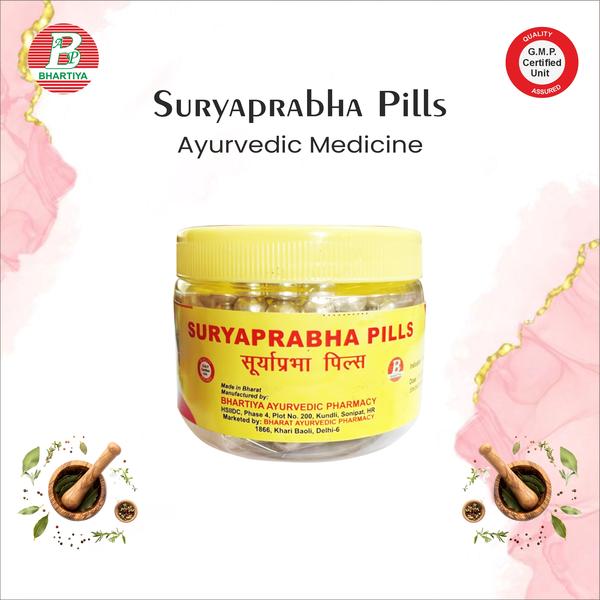
"name": "SURYAPRABHA PILLS",
"description": " SURYAPRABHA PILLS (SILVER COATED) \n\nProduct Identification\n•\tGeneric Name: Suryaprabha Pills\n•\tType: Ayurvedic Patent Medicine\n•\tPrimary Indication Area: Diabetes (Prameha / Blood Sugar Imbalance)\nTherapeutic Indications: The management of diabetes (Prameha / high blood sugar) and to support metabolic health, digestive strength, and overall vitality.\n\nKey benefits include:\n•\tBlood Sugar Support: Helps maintain healthy glucose levels.\n•\tDigestive & Metabolic Support: Enhances digestion, nutrient absorption, and metabolism.\n•\tPancreatic & Liver Health: Supports proper insulin function and detoxification.\n•\tStamina & Vitality: Helps combat fatigue and weakness associated with diabetes.\n•\tRasayana (Rejuvenation): Supports overall tissue nourishment and long-term health.\n\nIngredients:\n Giloy (Tinospora cordifolia) \nAyurvedic Name: Giloy / Guduchi\nPrimary Uses in Diabetes: Helps regulate blood glucose, improves insulin sensitivity, and protects organs from diabetic complications.\nKey Phytoconstituents\n•\tAlkaloids (e.g., berberine, magnoflorine)\n•\tDiterpenoid lactones (e.g., Tinosporide)\n•\tGlycosides\n•\tFlavonoids\n•\tSteroids\n•\tPolysaccharides\nThese compounds contribute to its antidiabetic, antioxidant, and immunomodulatory effects.\nMechanism of Action in Diabetes\n1. Insulin Sensitization & Secretion\n•\tGiloy stimulates pancreatic beta cells → increases insulin secretion.\n•\tImproves insulin receptor sensitivity on target tissues (muscle and adipose), enhancing glucose uptake.\n•\tAlkaloids like berberine mimic insulin action by activating AMPK pathway, which helps lower blood glucose.\n2. Carbohydrate Metabolism Regulation\n•\tModulates key enzymes:\no\tIncreases glucokinase activity → promotes glucose utilization in the liver.\no\tInhibits glucose-6-phosphatase & fructose-1,6-bisphosphatase → reduces hepatic gluconeogenesis.\n•\tThis leads to lower fasting and postprandial blood glucose.\n\nHaldi / Turmeric (Curcuma longa) \nAyurvedic Name: Haridra / Haldi\nPrimary Uses: Anti-inflammatory, antioxidant, digestive support, liver protection, and metabolic health (including blood sugar support).\nKey Phytoconstituents\n•\tCurcuminoids: Curcumin (major active compound), desmethoxycurcumin, bisdemethoxycurcumin\n•\tVolatile oils: Turmerone, zingiberene, atlantone\n•\tProteins & sugars\n•\tMinerals: Iron, calcium\nBiochemical & Pharmacological Actions\n1. Anti-inflammatory\n•\tCurcumin inhibits NF-κB pathway, reducing pro-inflammatory cytokines: TNF-α, IL-1β, IL-6.\n•\tSuppresses COX-2 and LOX enzymes, reducing prostaglandin and leukotriene production.\n•\tHelps in arthritis, inflammation, and chronic metabolic inflammation.\n2. Antioxidant\n•\tCurcumin neutralizes free radicals (ROS and RNS).\n•\tUpregulates endogenous antioxidant enzymes: SOD, catalase, glutathione peroxidase.\n•\tProtects tissues (liver, pancreas, kidneys, and heart) from oxidative stress.\n\nAtis (Aconitum heterophyllum) \nPrimary Role in Diabetes (Ayurvedic / Biochemical Basis):\nAtis is considered a mild hypoglycaemic and metabolism-supportive herb in traditional use, mainly through digestive and metabolic regulation. Modern research is limited, but biochemical mechanisms can be inferred.\nKey Phytochemicals Relevant to Diabetes\n•\tNon-toxic alkaloids (stimulatory to metabolism)\n•\tPhenolic compounds (antioxidant effects)\n•\tCarbohydrates and starch (support energy metabolism)\n•\tTannins (reduce oxidative gut stress)\nMechanisms of Action – Biochemical Basis\n1. Digestive & Metabolic Support\n•\tEnhances Agni (digestive fire) → indirectly supports carbohydrate digestion and absorption.\n•\tBetter digestion → improved glucose homeostasis because nutrients are metabolized efficiently.\n2. Antioxidant Action\n•\tPhenolic compounds neutralize free radicals generated by high blood sugar.\n•\tProtects pancreatic β-cells from oxidative damage → maintains insulin production.\n\nDaru Haldi (Berberis aristata) \nAyurvedic Name: Daruharidra / Daruhaldi\nPrimary Uses: Diabetes (Madhumeha), metabolic disorders, liver protection, antioxidant support\nKey Phytochemicals\n•\tAlkaloids: Berberine (major active compound), palmatine, jatrorrhizine\n•\tPolyphenols and flavonoids\n•\tTannins\n•\tOrganic acids\nBerberine is the primary active compound responsible for most antidiabetic effects.\nBiochemical Mechanisms in Diabetes\n1. Insulin Sensitization\n•\tBerberine activates AMPK (AMP-activated protein kinase) → acts like an “energy sensor” in cells.\n•\tIncreases glucose uptake in muscle and adipose tissue → lowers blood sugar.\n•\tImproves insulin receptor expression and sensitivity.\n2. Inhibition of Gluconeogenesis\n•\tReduces hepatic glucose production by inhibiting gluconeogenic enzymes:\no\tGlucose-6-phosphatase\no\tPhosphoenolpyruvate carboxykinase (PEPCK)\n•\tLeads to lower fasting blood glucose.\n\nPippali (Piper longum) \nAyurvedic Name: Pippali\nPrimary Uses: Diabetes (Madhumeha), digestive support, respiratory support, metabolism booster\nKey Phytochemicals\n•\tAlkaloids: Piperine (main active compound)\n•\tEssential oils: Caryophyllene, Pinene\n•\tFlavonoids, phenolic compounds\n•\tLignans\nPiperine is the primary bioactive compound responsible for most pharmacological effects.\nBiochemical Mechanisms in Diabetes\n1. Improves Insulin Sensitivity\n•\tPiperine enhances insulin receptor activity → increases glucose uptake in muscles and adipose tissue.\n•\tActs as a cellular sensitizer, making tissues respond better to insulin.\n2. Enhances Glucose Metabolism\n•\tStimulates glycolytic enzymes → promotes breakdown of glucose for energy.\n•\tReduces hepatic gluconeogenesis → less glucose is released into blood by the liver.\n\nChitrak (Plumbago zeylanica) \nAyurvedic Name: Chitraka\nPrimary Uses in Diabetes (Madhumeha): Digestive and metabolic support, improving glucose utilization, stimulating pancreatic function, and enhancing fat metabolism.\nKey Phytochemicals\n•\tPlumbagin (primary bioactive naphthoquinone)\n•\tAlkaloids\n•\tFlavonoids and phenolic compounds\n•\tEssential oils\nPlumbagin is the main compound responsible for antidiabetic effects.\nBiochemical Mechanisms in Diabetes\n1. Enhances Glucose Uptake\n•\tPlumbagin stimulates glucose transporter (GLUT4) translocation in muscle and adipose tissue.\n•\tImproves peripheral glucose utilization, lowering blood sugar.\n2. Stimulates Pancreatic Function\n•\tMildly supports pancreatic β-cell activity → helps maintain insulin secretion.\n•\tProtects β-cells from oxidative stress-induced damage.\n\nHarad (Terminalia chebula) \nAyurvedic Name: Haritaki / Harad\nPrimary Uses in Diabetes (Madhumeha): Blood sugar regulation, antioxidant support, lipid metabolism improvement, and digestive/metabolic balance.\nKey Phytochemicals\n•\tTannins: Chebulinic acid, chebulagic acid, gallic acid\n•\tFlavonoids and phenolic compounds\n•\tOrganic acids\n•\tPolysaccharides\nMost antidiabetic effects are attributed to tannins and polyphenols.\nBiochemical Mechanisms in Diabetes\n1. Improves Insulin Sensitivity\n•\tPolyphenols and tannins enhance insulin receptor activity on muscle and adipose tissues.\n•\tPromotes glucose uptake by cells → lowers blood sugar.\n2. Reduces Hepatic Glucose Production\n•\tInhibits gluconeogenic enzymes (glucose-6-phosphatase, PEPCK) → reduces fasting blood glucose.\n•\tHelps regulate hepatic glucose output.\n\nAmla (Phyllanthus emblica) \nAyurvedic Name: Amla / Amalaki\nPrimary Uses in Diabetes (Madhumeha): Blood sugar regulation, antioxidant protection, lipid metabolism improvement, and pancreatic β-cell protection.\nKey Phytochemicals\n•\tVitamin C (Ascorbic acid) – very high content\n•\tTannins: Emblicanin A & B, punigluconin, pedunculagin\n•\tFlavonoids and polyphenols\n•\tGallic acid and ellagic acid\nThe antioxidant compounds and tannins are responsible for most antidiabetic effects.\nBiochemical Mechanisms in Diabetes\n1. Enhances Insulin Secretion & β-Cell Protection\n•\tAntioxidants in Amla protect pancreatic β-cells from oxidative stress.\n•\tSupports insulin secretion in mild diabetes.\n2. Improves Insulin Sensitivity\n•\tPolyphenols improve insulin receptor activity on muscle and adipose tissues.\n•\tEnhances peripheral glucose uptake → lowers blood sugar.\n\nChavya (Piper chaba) \nAyurvedic Name: Chavya\nPrimary Uses in Diabetes (Madhumeha): Blood sugar regulation, digestive/metabolic support, and insulin sensitization.\nKey Phytochemicals\n•\tAlkaloids: Piperine (main active compound)\n•\tEssential oils: Caryophyllene, pinene\n•\tFlavonoids and polyphenols\n•\tLignans\nPiperine is the main bioactive compound responsible for most antidiabetic effects\nBiochemical Mechanisms in Diabetes\n1. Enhances Insulin Sensitivity\n•\tPiperine improves insulin receptor activity in muscle and adipose tissue.\n•\tIncreases glucose uptake → lowers blood sugar.\n2. Stimulates Glucose Metabolism\n•\tEnhances glycolytic enzyme activity → better glucose utilization by cells.\n•\tReduces hepatic gluconeogenesis → less glucose released into blood.\n\nVaividang (Embelia ribes) \nAyurvedic Name: Vaividang / Vidanga\nPrimary Uses in Diabetes (Madhumeha): Blood sugar regulation, antioxidant protection, lipid metabolism improvement, and digestive/metabolic support.\nKey Phytochemicals\n•\tAlkaloids: Embelin (main active compound)\n•\tFlavonoids and phenolic compounds\n•\tTannins and glycosides\n•\tEssential oils\nEmbelin is the major bioactive molecule responsible for antidiabetic effects.\nBiochemical Mechanisms in Diabetes\n1. Enhances Insulin Sensitivity\n•\tEmbelin improves insulin receptor activity in peripheral tissues (muscle and adipose).\n•\tIncreases glucose uptake, lowering blood sugar.\n2. Stimulates Glucose Metabolism\n•\tPromotes glycolytic enzyme activity → better glucose utilization in tissues.\n•\tReduces hepatic gluconeogenesis → decreases blood glucose release from liver.\n\nSaunth / Shunthi (Zingiber officinale, dry ginger) \nAyurvedic Name: Saunth / Shunthi\nPrimary Uses in Diabetes (Madhumeha): Blood sugar regulation, insulin sensitization, antioxidant protection, and metabolic support.\nKey Phytochemicals\n•\tGingerols and Shogaols (major bioactive compounds)\n•\tPolyphenols and flavonoids\n•\tEssential oils (zingiberene, bisabolene)\n•\tDiarylheptanoids\nGingerols and Shogaols are mainly responsible for antidiabetic effects.\nBiochemical Mechanisms in Diabetes\n1. Enhances Insulin Sensitivity\n•\tGingerol and shogaol improve insulin receptor signaling in muscle and adipose tissue.\n•\tEnhances glucose uptake by cells, reducing blood sugar.\n2. Reduces Hepatic Glucose Production\n•\tInhibits gluconeogenic enzymes like glucose-6-phosphatase and PEPCK.\n•\tLeads to lower fasting blood glucose.\n\nSajji kshar (Alkaline Salt / Kshara) \nAyurvedic Name: Sajji kshar / Kshara\nPrimary Uses in Diabetes (Madhumeha):\n•\tDigestive support and enhancing metabolism\n•\tBlood sugar balance\n•\tAcid-base regulation in the body\nKey Biochemical Properties\n•\tAlkaline nature (basic pH)\n•\tSodium ions and carbonate ions\n•\tNo direct organic phytochemicals (inorganic compound)\nSajji kshar is not a herb but an alkaline mineral-based therapeutic agent used in Ayurveda to correct metabolic imbalances.\nBiochemical Mechanisms Relevant to Diabetes\n1. Supports Digestive Enzymes & Metabolism\n•\tAlkaline environment improves digestive enzyme activity → better breakdown and absorption of nutrients.\n•\tHelps regulate glucose metabolism indirectly by improving digestion (Agni).\n2. Neutralizes Excess Acidity\n•\tIn diabetes, acid-base imbalance and metabolic acidosis may occur in uncontrolled cases.\n•\tSajji kshar helps maintain systemic pH balance, which supports enzymatic reactions for carbohydrate metabolism.\n\nSaindha Namak (Rock Salt / Himalayan Salt) \nAyurvedic Name: Saindha Namak / Lavana\nPrimary Uses in Diabetes (Madhumeha):\n•\tSupports digestion and metabolism\n•\tEnhances nutrient absorption\n•\tElectrolyte and mineral balance\nKey Biochemical Properties\n•\tSodium chloride – primary component\n•\tTrace minerals: potassium, magnesium, calcium, iron\n•\tAlkaline-forming salts (helps balance pH in tissues)\nSaindha Namak is not an organic herb, but a mineral salt used in Ayurveda to improve digestion and metabolic balance, which is important in diabetes management.\n\nBiochemical Mechanisms Relevant to Diabetes\n1. Digestive & Metabolic Support\n•\tEnhances Agni (digestive fire) → improves enzymatic breakdown of carbohydrates.\n•\tBetter digestion → improved glucose absorption and utilization.\n2. Electrolyte & Mineral Balance\n•\tProvides sodium, potassium, and trace minerals → helps maintain cellular osmolarity and enzyme function.\n•\tProper electrolyte balance supports insulin signaling and glucose transport in tissues.\n\nKala Namak (Black Salt) \nAyurvedic Name: Kala Namak / Black Salt\nPrimary Uses in Diabetes (Madhumeha):\n•\tDigestive and metabolic support\n•\tElectrolyte and mineral balance\n•\tMild alkalizing effect → helps in metabolic homeostasis\nKey Biochemical Properties\n•\tMain components: Sodium chloride, sodium sulphate, trace minerals (iron, magnesium, potassium)\n•\tContains sulfur compounds → gives characteristic taste and mild therapeutic action\n•\tMildly alkaline → supports acid-base balance\nKala Namak is a mineral-based adjunct in Ayurveda, not a direct herb, but plays an important role in metabolic regulation and diabetes support.\n\nBiochemical Mechanisms Relevant to Diabetes\n1. Digestive & Metabolic Support\n•\tImproves Agni (digestive fire) → enhances carbohydrate breakdown and absorption.\n•\tProper digestion → more stable blood glucose levels.\n2. Electrolyte & Mineral Balance\n•\tProvides sodium, potassium, and magnesium → supports cellular osmolarity, insulin signaling, and enzyme activity.\n\nDantimool (Baliospermum montanum) \nAyurvedic Name: Dantimool / Danti\nPrimary Uses in Diabetes (Madhumeha):\n•\tBlood sugar regulation\n•\tDigestive and metabolic support\n•\tLipid metabolism improvement\n•\tMild detoxification of blood\nKey Phytochemicals\n•\tAlkaloids: Baliospermin, solanifolamine\n•\tFlavonoids and phenolic compounds\n•\tGlycosides\n•\tFatty acids\nThe alkaloids and flavonoids are mainly responsible for metabolic and antidiabetic effects.\nBiochemical Mechanisms in Diabetes\n1. Digestive & Metabolic Support\n•\tImproves Agni (digestive fire) → enhances carbohydrate breakdown and nutrient absorption.\n•\tBetter digestion → improves glucose metabolism and stabilizes blood sugar levels.\n2. Enhances Glucose Utilization\n•\tStimulates glycolytic enzymes → promotes cellular glucose utilization.\n•\tReduces hepatic gluconeogenesis, lowering fasting blood sugar.\n\nTejpatra (Cinnamomum tamala) \nAyurvedic Name: Tejpatra / Indian Bay Leaf\nPrimary Uses in Diabetes (Madhumeha):\n•\tBlood sugar regulation\n•\tInsulin sensitization\n•\tAntioxidant protection\n•\tLipid metabolism support\nKey Phytochemicals\n•\tEssential oils: Eugenol, cinnamaldehyde, linalool\n•\tPolyphenols\n•\tFlavonoids\n•\tTannins\nThe cinnamaldehyde and polyphenols are mainly responsible for antidiabetic effects.\nBiochemical Mechanisms in Diabetes\n1. Enhances Insulin Sensitivity\n•\tPolyphenols and cinnamaldehyde improve insulin receptor activity in muscle and adipose tissue.\n•\tEnhances glucose uptake by cells, reducing postprandial blood sugar.\n2. Reduces Hepatic Glucose Production\n•\tInhibits gluconeogenic enzymes (glucose-6-phosphatase, PEPCK) → lowers fasting blood glucose.\n\nNagarmotha (Cyperus rotundus) \nAyurvedic Name: Nagarmotha / Musta-moola\nPrimary Uses in Diabetes (Madhumeha):\n•\tBlood sugar regulation\n•\tInsulin sensitization\n•\tDigestive and metabolic support\n•\tLipid metabolism improvement\nKey Phytochemicals\n•\tEssential oils: Cyperene, α-cyperone, β-selinene\n•\tFlavonoids and phenolic compounds\n•\tTannins\n•\tAlkaloids and glycosides\nThe α-cyperone, flavonoids, and phenolic compounds are mainly responsible for antidiabetic effects.\nBiochemical Mechanisms in Diabetes\n1. Enhances Insulin Sensitivity\n•\tFlavonoids and α-cyperone improve insulin receptor activity in muscle and adipose tissue.\n•\tEnhances glucose uptake by peripheral tissues, reducing postprandial blood sugar.\n2. Reduces Hepatic Glucose Production\n•\tInhibits gluconeogenic enzymes (glucose-6-phosphatase, PEPCK) → lowers fasting blood glucose.\n\nShudh Guggul (Commiphora mukul) \nAyurvedic Name: Guggul / Shudh Guggul\nPrimary Uses in Diabetes (Madhumeha):\n•\tBlood sugar regulation\n•\tLipid metabolism improvement\n•\tInsulin sensitization\n•\tAnti-inflammatory and antioxidant effects\n\nKey Phytochemicals\n•\tGuggulsterones (E & Z) – primary active compounds\n•\tFlavonoids and polyphenols\n•\tTerpenoids and volatile oils\n•\tResin compounds\nGuggulsterones are mainly responsible for antidiabetic and lipid-lowering effects.\nBiochemical Mechanisms in Diabetes\n1. Enhances Insulin Sensitivity\n•\tGuggulsterones improve insulin receptor signaling in peripheral tissues (muscle and adipose).\n•\tEnhances glucose uptake, lowering postprandial blood sugar.\n2. Regulates Hepatic Glucose Metabolism\n•\tModulates gluconeogenic enzymes in the liver → reduces fasting blood glucose.\n•\tSupports glycolysis, promoting cellular glucose utilization.\n\nShudh Shilajeet (Purified Shilajit) \nAyurvedic Name: Shilajeet / Shilajit\nPrimary Uses in Diabetes (Madhumeha):\n•\tBlood sugar regulation\n•\tInsulin sensitization\n•\tAntioxidant and anti-inflammatory support\n•\tEnergy metabolism enhancement\nKey Biochemical Constituents\n•\tFulvic acid – major bioactive compound\n•\tHumic acids\n•\tTrace minerals: zinc, iron, magnesium, copper\n•\tDibenzo-α-pyrones (antioxidant compounds)\n•\tAmino acids and phenolic compounds\nFulvic acid and dibenzo-α-pyrones are mainly responsible for antidiabetic effects.\nBiochemical Mechanisms in Diabetes\n1. Enhances Insulin Sensitivity\n•\tFulvic acid improves insulin receptor activity in muscle and adipose tissue.\n•\tEnhances glucose uptake, lowering blood sugar.\n2. Regulates Hepatic Glucose Metabolism\n•\tInhibits gluconeogenic enzymes (glucose-6-phosphatase, PEPCK) → reduces fasting blood glucose.\n•\tStimulates glycolysis → improves cellular glucose utilization.\n\nLoh Bhasma (Iron Ash) \nAyurvedic Name: Loh Bhasma\nPrimary Uses in Diabetes (Madhumeha):\n•\tSupports Hemoglobin and iron metabolism\n•\tEnhances energy and stamina\n•\tImproves glucose metabolism indirectly\n•\tAntioxidant and tissue-protective effects\n\nKey Biochemical Properties\n•\tInorganic Iron (Fe³⁺/Fe²⁺) – main active component\n•\tTrace minerals retained during preparation\n•\tHighly bioavailable form after Ayurvedic calcination (Bhasmikarana)\nLoh Bhasma is a mineral-based Ayurvedic preparation that primarily improves haematological and metabolic functions, indirectly supporting glucose homeostasis.\nBiochemical Mechanisms Relevant to Diabetes\n1. Supports Red Blood Cells & Oxygen Transport\n•\tIncreases Hemoglobin synthesis → better oxygen delivery to tissues.\n•\tEnhanced tissue oxygenation improves glucose utilization in muscles and organs.\n2. Energy & Metabolic Support\n•\tIron is a cofactor for enzymes in the electron transport chain and oxidative phosphorylation.\n•\tImproves ATP production, which enhances glucose metabolism and cellular energy.\n\nDosage & Administration\n•\tDose per intake: 1–2 pills\n•\tFrequency: 2–3 times daily\n•\tTotal daily dose: 2–6 pills (as per physician advice)\n•\tHow to take: With warm water, preferably after meals\n\nPrecautions\n•\tDo not exceed prescribed dose\n•\tConsult Ayurvedic practitioner before use in:\no\tChildren\no\tElderly\no\tChronic illness patients\n•\tMonitor for digestive discomfort\n•\tMaintain proper diet, hydration, and lifestyle for diabetes management\n\n\nsuryaprabha tablet, suryaprabha tablet uses, suryaprabha pills amazon\nsuryaprabha pills buy, suryaprabha pills buy online, suryaprabha pills benefits\nsuryaprabha pills brand, suryaprabha pills benefits in hindi\nsuryaprabha pills bibwewadi pune, suryaprabha pills company\nsuryaprabha pills contact number, suryaprabha pills content\nsuryaprabha pills chemist, suryaprabha pills contact details\nsuryaprabha pills contact no, suryaprabha pills channel\nsuryaprabha pills delhi, suryaprabha pills details\nsuryaprabha pills distributor, suryaprabha pills email id\nsuryaprabha pills energy, suryaprabha pills enterprises\nsuryaprabha pills education, suryaprabha pills energy private limited\nsuryaprabha pills effects, suryaprabha pills edit\nsuryaprabha pills for hair, suryaprabha pills for skin\nsuryaprabha pills for weight loss, suryaprabha pills group\nsuryaprabha pills gst number, suryaprabha pills granules\nsuryaprabha pills gulika uses, suryaprabha pills gulika\nsuryaprabha pills gulika benefits, suryaprabha pills gulika side effects\nsuryaprabha pills hyderabad, suryaprabha pills hindi\nsuryaprabha pills himachal pradesh, suryaprabha pills hospital\nsuryaprabha pills holidays, suryaprabha pills home\nsuryaprabha pills hospital pune, suryaprabha pills hot latest\nsuryaprabha pills in hindi, suryaprabha pills industries\nsuryaprabha pills indiamart, suryaprabha pills ingredients\nsuryaprabha pills in malayalam, suryaprabha pills instagram\nsuryaprabha pills in tamil, suryaprabha pills in perambalur\nsuryaprabha pills jee advanced, suryaprabha pills ke fayde\nsuryaprabha pills ke fayde in hindi, suryaprabha pills khanna\nsuryaprabha pills limited, suryaprabha pills linkedin\nsuryaprabha pills login, suryaprabha pills latest\nsuryaprabha pills manufacturer, suryaprabha pills manufacturing company\nsuryaprabha pills malayalam, suryaprabha pills matrimony\nsuryaprabha pills model, suryaprabha pills news\nsuryaprabha pills name, suryaprabha pills net worth\nsuryaprabha pills network, suryaprabha pills new delhi\nsuryaprabha pills nursing home, suryaprabha pills owner\nsuryaprabha pills online, suryaprabha pills online shopping\nsuryaprabha pills owner name, suryaprabha pills online order\nsuryaprabha pills oil, suryaprabha pills official\nsuryaprabha pills photography, suryaprabha pills photoshoot\nsuryaprabha pills pune, suryaprabha pills review\nsuryaprabha pills research, suryaprabha pills reels\nsuryaprabha pills supplier, suryaprabha pills share price\nsuryaprabha pills today, suryaprabha vati uses\nsuryaprabha pills veterinary, suryaprabha pills vs\nsuryaprabha pills vati uses, suryaprabha pills vati\nsuryaprabha pills vlogs, suryaprabha pills vahanam\nsuryaprabha pills vahanam images, suryaprabha pills website\nsuryaprabha pills wholesale, suryaprabha pills zepto\nayurvedic medicine suryaprabha, sooryaprabha tablet\ndoes suryaprabha pills work, does suryaprabha pills uses\nwas suryaprabha pills good, was suryaprabha pills uses\nwas suryaprabha pills uses in malayalam\nbest suryaprabha pills in india, best suryaprabha pills uses\nbest suryaprabha pills uses in malayalam",
"price": 450.0,
"discountamount": 225.0,
"currencycode": "INR",
"priority": 1000000,
"isfreeshipmentavailable": false,
"shipmentduration": 1,
"_keywords": null,
"isarchived": false,
"isavailable": true,
"applicationid": null,
"productindex": 87,
"imageuri": "https://productimages.withfloats.com/actual/69e08924c32735ec39db6c8e.jpg",
"tileimageuri": "https://productimages.withfloats.com/tile/69e08924c32735ec39db6c8e.jpg",
"images": null,
"totalqueries": 0,
"gpid": null,
"groupproductid": null,
"createdon": "2026-04-16T07:00:19.771Z",
"updatedon": "2026-04-16T07:00:19.771Z",
"buyonlinelink": null,
"producturl": "http://WWW.BHARTIYAAYURVEDICPHARMACY.COM//suryaprabha-pills/87",
"availableunits": -1.0,
"iscodavailable": true,
"isprepaidonlineavailable": true,
"maxcodorders": -1,
"maxprepaidonlineorders": -1,
"uniquepaymenturl": null,
"brandname": "Bakula Fort",
"category": "SURYAPRABHA PILLS 100gm X 30",
"tags": [],
"variants": false,
"keyspecification": null,
"otherspecifications": null,
"pickupaddressreferenceid": null,
"paymenttype": "AssuredPurchase",
"producttype": "products",
"hsncode": null,
"gstslab": 0.0,
"isnotforsale": false
},
{
"_id": "698ea823ae21e6001288f3ef",
"fptag": "BHARTIYEAYURVEDICPHARMACY",
"merchantname": null,
"customwidgets": null,
"externalsourceid": null,
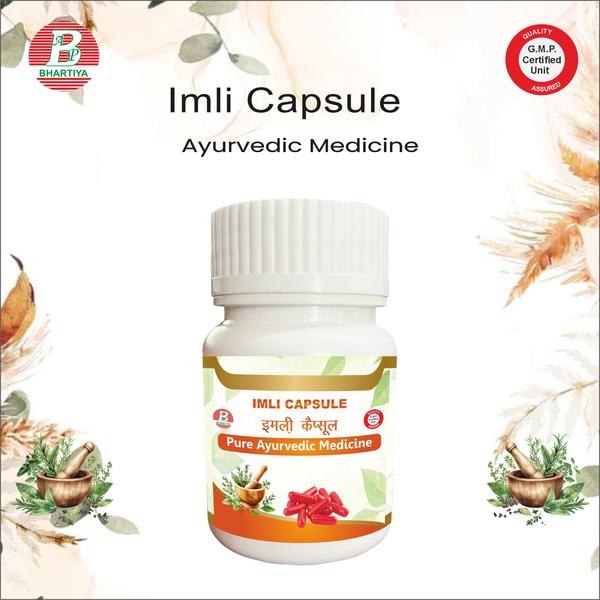
"name": "Imali Capsule",
"description": " IMLI \n\n\n IMLI (Tamarindus indica L.) \nThe Digestive & Metabolic Fruit — “Tamarind”\nImli, commonly known as Tamarind, is a widely used fruit in Ayurveda and traditional medicine. It is valued for its digestive, cooling, detoxifying, and rejuvenative properties. Rich in organic acids, polyphenols, and dietary fiber, Imli supports digestion, metabolism, liver function, cardiovascular health, and overall vitality.\n\n CLASSICAL AYURVEDIC REFERENCES\n1.\tCharaka Samhita\n•\tMentioned in Sutra Sthana and Kalpa Sthana as a digestive and metabolism-supporting fruit.\n•\tDescribed as Madhura-Amla-Kashaya in taste, pacifying Vata and Pitta.\n2.\tSushruta Samhita\n•\tEmphasized in Kalpa Sthana as a natural laxative and liver-supporting herb.\n•\tUsed in formulations for Vata-Pitta disorders, constipation, and digestive sluggishness.\n3.\tBhavaprakasha Nighantu\n•\tReferred to as Imli / Tamarind, supporting Agni (digestive fire), Medha (intellect), and Ojas (vitality).\n•\tRecommended in Rasayana and Hrudya formulations, often combined with honey or ghee.\n\n CLASSICAL STORY / ANECDOTE\nImli is often praised in Ayurvedic texts as the “King of Digestive Fruits” for its ability to restore Agni (digestive fire) and eliminate Ama (toxins).\nTraditionally, sages recommended Imli to strengthen digestion and metabolism, particularly during hot seasons, by consuming the pulp with water or in churna form to rejuvenate the body and maintain vitality.\n\n BOTANICAL INFORMATION OF IMLI\n•\tScientific Name: Tamarindus indica L.\n•\tFamily: Fabaceae\n•\tOrder: Fabales\n•\tGenus: Tamarindus\n•\tSpecies: indica\n•\tCommon Names:\no\tSanskrit: Imli, Amli, Chinta\no\tHindi: Imli\no\tEnglish: Tamarind\no\tTamil: Puli\no\tTelugu: Chintapandu\no\tMalayalam: Puliyam\no\tKannada: Hunase Hannu\no\tBengali: Tentul\n\n SYNONYMS IN CLASSICAL AYURVEDIC NIGHANTUS\n•\tCharaka Samhita: Imli – Digestive, Vata-Pitta pacifying\n•\tSushruta Samhita: Imli – Hrudya, Medhya, Vata-Pitta balancing\n•\tBhavaprakasha Nighantu: Imli, Chinta – Rasayana, Agni vardhaka, Detoxifier\n\n MORPHOLOGY OF IMLI\n•\tPlant Type: Large evergreen tree\n•\tHeight: 12–18 m\n•\tLeaves: Pinnate, 6–12 pairs of leaflets, small and oblong\n•\tFlowers: Small, yellowish-brown, clustered, fragrant\n•\tFruit: Leguminous pod, brown, elongated, pulpy, tangy-sweet\n•\tSeeds: Hard, shiny brown, 1–2 cm, embedded in pulp\n\n ECOLOGICAL PREFERENCES\n•\tClimate: Tropical and subtropical; tolerates heat and drought\n•\tSoil: Well-drained sandy, loamy, or red soils\n•\tHabitat: Fields, gardens, village premises; native to Indian subcontinent\n•\tAltitude: Sea level to 1,200 m\n\n GEOGRAPHICAL DISTRIBUTION\n•\tIndia: Tamil Nadu, Kerala, Karnataka, Maharashtra, Andhra Pradesh\n•\tOutside India: Sri Lanka, Africa, Southeast Asia, Caribbean, Latin America\n\n CLASSICAL AYURVEDIC PROPERTIES (RASA–GUNA–VIRYA–VIPAKA)\n•\tRasa (Taste): Madhura (sweet), Amla (sour), Kashaya (astringent)\n•\tGuna (Qualities): Snigdha (unctuous), Laghu (light)\n•\tVirya (Potency): Śīta (cooling)\n•\tVipaka (post-digestive effect): Madhura (sweet)\n•\tDosha Effects: Vata-Pitta hara, Kapha samana in moderation\n\n THERAPEUTIC ACTIONS (KARMA)\n1.\tDipana & Pachana: Enhances digestive fire, prevents constipation\n2.\tMedhya: Supports memory and intellect\n3.\tHrudya: Strengthens heart and circulation\n4.\tRasayana: Promotes overall vitality and rejuvenation\n5.\tVata-Pittahara: Balances Vata and Pitta disorders\n6.\tKeshya: Supports hair health\n7.\tLekhana & Raktaprasadana: Detoxifies blood, reduces toxins\n\n INDICATIONS\nWITH AACHARYA AND GRANTHS\nHere’s a detailed Imli (Tamarindus indica) monograph in the same format as Alsi, including classical Ayurvedic references and acharya/granth citations:\n IMLI (Tamarindus indica L.) \nThe Digestive and Metabolic Fruit — “Tamarind”\nImli, commonly known as Tamarind, is a widely used fruit in Ayurveda and traditional medicine. It is valued for its digestive, metabolism-supporting, cooling, and rejuvenative properties. Rich in organic acids, vitamins (A, C, B), minerals, and antioxidants, Imli supports digestion, liver function, heart health, metabolism, and overall vitality.\n\n CLASSICAL AYURVEDIC REFERENCES\n1.\tCharaka Samhita\no\tMentioned in Kalpa Sthana (Charaka Kalpa 6/28–30) as a sweet, sour, and nourishing fruit beneficial for digestive fire (Agni) and metabolism.\no\tUsed in formulations for Medhya (intellect) and Rasayana (rejuvenation).\n2.\tSushruta Samhita\no\tListed in Kalpa Sthana (Sushruta 52/18–20) for constipation, digestive sluggishness, and liver support.\no\tEmphasized as Snigdha (unctuous), Madhura (sweet), and Tikta (bitter) — suitable for Rasayana and mild laxative therapies.\n3.\tBhavaprakasha Nighantu\no\tReferred to as Imli / Amli, promoting Ojas, digestion, and rejuvenation.\no\tMentioned in Hrudya, Medhya, and Virechana formulations — often used with ghee, honey, or warm water.\n4.\tOther Classical Anecdotes\no\tAyurvedic texts describe Imli as a “pachana phala” — the fruit that digests and metabolizes food efficiently.\no\tTraditionally, sages recommended Imli to warriors and kings as a digestive and metabolism-supporting Rasayana, often combined with other herbs for enhanced rejuvenation.\n\n BOTANICAL INFORMATION OF IMLI\n•\tScientific Name: Tamarindus indica L.\n•\tFamily: Fabaceae (Leguminosae)\n•\tOrder: Fabales\n•\tGenus: Tamarindus\n•\tSpecies: indica\n•\tCommon Names:\no\tSanskrit: Imli, Amli, Chinta Phala\no\tHindi: Imli\no\tEnglish: Tamarind\no\tTamil: Puli\no\tTelugu: Chintapandu\no\tMalayalam: Puli\no\tKannada: Hunase Hannu\no\tBengali: Tentul\n\n SYNONYMS IN CLASSICAL AYURVEDIC NIGHANTUS\n•\tCharaka Samhita: Imli – Pachana, Medhya\n•\tSushruta Samhita: Imli – Virechana, Hrudya, Medhya\n•\tBhavaprakasha Nighantu: Amli, Imli – Rasayana, Pachana, Ojasvardhaka\n\n MORPHOLOGY OF IMLI\n•\tTree Type: Medium to large deciduous tree, 12–18 m height\n•\tBark: Brown, rough, fibrous\n•\tLeaves: Pinnate, alternate, leaflets small and oblong\n•\tFlowers: Yellowish, small, in clusters\n•\tFruit: Long, curved pods containing sticky, brown pulp\n•\tSeeds: Hard, glossy, dark brown\n\n ECOLOGICAL PREFERENCES\n•\tClimate: Tropical and subtropical, tolerates dry conditions\n•\tSoil: Well-drained loamy, clay, or sandy soils\n•\tHabitat: Fields, gardens, village premises; native to Indian subcontinent\n•\tAltitude: Sea level to 1,200 m\n\n GEOGRAPHICAL DISTRIBUTION\n•\tIndia: Maharashtra, Tamil Nadu, Karnataka, Andhra Pradesh, Gujarat\n•\tOutside India: Sri Lanka, Africa, Southeast Asia, Caribbean\n\n CLASSICAL AYURVEDIC PROPERTIES (RASA–GUNA–VIRYA–VIPAKA)\n•\tRasa (Taste): Madhura (sweet), Amla (sour), Tikta (bitter)\n•\tGuna (Qualities): Snigdha (unctuous), Laghu (light)\n•\tVirya (Potency): Śīta (cooling)\n•\tVipaka (post-digestive effect): Madhura (sweet)\n•\tDosha Effects: Tridoshaghna (balances all three); especially Vata-Pitta hara\n\n THERAPEUTIC ACTIONS (KARMA)\n1.\tPachana & Dipana: Enhances digestive fire, prevents acidity\n2.\tMedhya: Supports memory, intellect, and brain tissue\n3.\tHrudya: Supports heart and circulation\n4.\tRasayana: Promotes rejuvenation, Ojas, and vitality\n5.\tVatahara: Relieves constipation, joint stiffness\n6.\tLekhana: Mild lipid-lowering effect\n7.\tVrishya: Supports reproductive health and Shukra dhatu\n\n INDICATIONS\n•\tDigestive System: Constipation, sluggish digestion, hyperacidity\n•\tMetabolism: Obesity, mild dyslipidemia\n•\tNervous System: Fatigue, stress\n•\tReproductive & Urinary System: Supports fertility\n•\tSkin & Hair: Nourishes skin, mild detoxification\n MODERN PHARMACOLOGY & PHYTOCHEMISTRY\n•\tMajor Constituents:\no\tOrganic acids: tartaric, citric, malic\no\tPolyphenols: flavonoids, phenolic acids\no\tVitamins: A, C, B-complex\no\tMinerals: K, Mg, Ca, Fe\n•\tPharmacological Actions:\no\tDigestive tonic, mild laxative\no\tAntioxidant\no\tHepatoprotective\no\tAnti-inflammatory\no\tAnti-obesity and metabolic modulator\n\n CULTIVATION DETAILS\n•\tPropagation: Seeds (most common), grafting\n•\tSowing Time: May–June (monsoon)\n•\tSpacing: 10–12 m between plants\n•\tIrrigation: Moderate, drought-tolerant once mature\n•\tFertilization: Organic manure preferred\n•\tHarvesting: Fruits harvested November–March\n\n CLASSICAL DOSAGE (According to Ayurvedic Granthas)\n•\tPulp / Fresh Fruit: 10–20 g/day, chewed or in decoction\n•\tPowdered Fruit / Churna: 3–6 g/day\n•\tJuice / Paste: As per therapeutic need, especially for digestive support\n•\tSeed / Oil: 1–5 g/day, used in formulations for digestion and skin\n\n IMLI FORMULATIONS – BHARTIYA AYURVEDIC PHARMACY\nBhartiya Ayurvedic Pharmacy prepares Imli formulations following classical Ayurvedic principles described in Charaka Samhita, Sushruta Samhita, Bhavaprakasha Nighantu, and other texts. Each product retains digestive, metabolism-supporting, and rejuvenative properties, promoting overall vitality.\nKey Uses of Imli Formulations:\n•\tDigestive support: Relieves constipation, enhances Agni\n•\tMetabolic balance: Supports healthy weight and lipid profile\n•\tLiver support: Detoxification and mild hepatoprotection\n•\tRasayana: Promotes vitality and rejuvenation\n•\tSkin & Hair: Mild detoxification and nourishment\n\n IMLI CAPSULE\nBhartiya Ayurvedic Pharmacy offers Imli Capsules prepared according to classical Ayurvedic principles. Each capsule contains premium quality Tamarind pulp or extract, retaining full digestive, metabolism-supporting, and rejuvenative properties.\nKey Benefits:\n•\tSupports digestion and bowel regularity\n•\tPromotes metabolic balance and weight management\n•\tMild liver support and detoxification\n•\tActs as a Rasayana, enhancing vitality\n•\tSupports healthy skin and hair\nDosage:\n•\tAdults: 1–2 capsules twice daily with warm water\n•\tCan be combined with warm water or milk for enhanced effect\nSafety & Precautions:\n•\tSafe for long-term use when taken as per dosage\n•\tMay cause mild laxative effect in sensitive individuals\n•\tMonitor if taking antidiabetic or laxative medications\nFormulation Highlights:\n•\t100% natural Imli (Tamarindus indica) pulp/extract\n•\tFree from artificial colors, preservatives, and additives\n•\tPrepared using Ayurvedic-inspired processing methods\nSuggested Use:\n•\tIdeal for adults seeking digestive, metabolic, and Rasayana support\n•\tConvenient capsule form for daily use\n\n\nbest imli, best imli candy, best imli in india, capsule c care, capsule image\ndoes imli cause acidity, does imli cause gas, does imli expire, does imli have vitamin c\ndoes imli help in digestion, does imli help lose weight, does imli increase weight, e imli\nhow imli is made, i am capsule, i imli, imali capsule at home, imali capsule ayurvedic\nimali capsule company name, imali capsule contains, imali capsule daily use\nimali capsule daily use in hindi, imali capsule dainik bhaskar, imali capsule delhi\nimali capsule english name, imali capsule expiry date, imali capsule hindi\nimali capsule how to use, imali capsule in english, imali capsule in hindi\nimali capsule jiomart, imali capsule ke fayde, imali capsule ke fayde in hindi\nimali capsule khane ke fayde, imali capsule manufacturer, imali capsule manufacturers in india\nimali capsule meesho, imali capsule name, imali capsule near me, imali capsule online\nimali capsule online order, imali capsule online shopping, imali capsule online shopping india\nimali capsule price, imali capsule rate, imali capsule recipe, imali capsule se kya hota hai\nimali capsule side effects, imali capsule side effects in hindi, imali capsule uses\nimali capsule uses in hindi\nimli capsule\nimli capsules\nimli cause cough\nwhat is imli",
"price": 300.0,
"discountamount": 150.0,
"currencycode": "INR",
"priority": 1000000,
"isfreeshipmentavailable": false,
"shipmentduration": 1,
"_keywords": null,
"isarchived": false,
"isavailable": true,
"applicationid": null,
"productindex": 60,
"imageuri": "https://productimages.withfloats.com/actual/698ea825e8395ed6920a532a.jpg",
"tileimageuri": "https://productimages.withfloats.com/tile/698ea825e8395ed6920a532a.jpg",
"images": null,
"totalqueries": 0,
"gpid": null,
"groupproductid": null,
"createdon": "2026-02-13T04:27:15.232Z",
"updatedon": "2026-02-17T10:23:47.696Z",
"buyonlinelink": null,
"producturl": "http://WWW.BHARTIYAAYURVEDICPHARMACY.COM//imali-capsule/60",
"availableunits": -1.0,
"iscodavailable": true,
"isprepaidonlineavailable": true,
"maxcodorders": -1,
"maxprepaidonlineorders": -1,
"uniquepaymenturl": null,
"brandname": "Bakula Fort",
"category": "Imali Capsule 60 Cap X 24",
"tags": [],
"variants": false,
"keyspecification": null,
"otherspecifications": null,
"pickupaddressreferenceid": null,
"paymenttype": "AssuredPurchase",
"producttype": "products",
"hsncode": null,
"gstslab": 0.0,
"isnotforsale": false
},
{
"_id": "6a0efae7f0187bd56f2cf310",
"fptag": "BHARTIYEAYURVEDICPHARMACY",
"merchantname": null,
"customwidgets": null,
"externalsourceid": null,
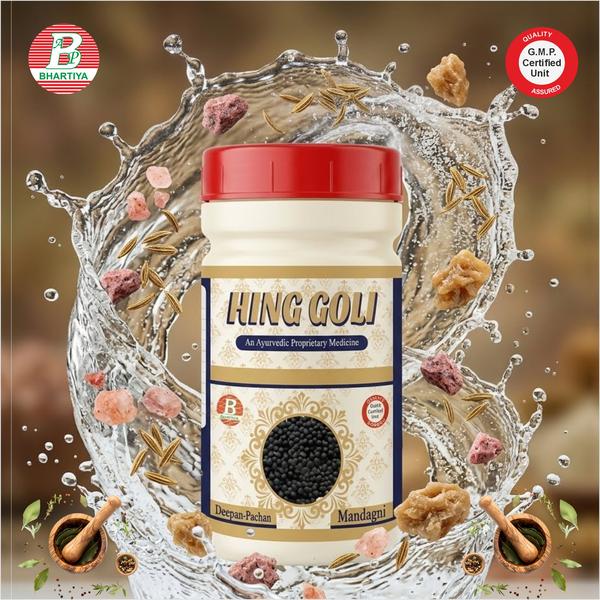
"name": "Hing Goli",
"description": " HING GOLI \n\nProduct Identification\n•\tGeneric Name: Hing Goli\n•\tType: Ayurvedic Patent Medicine\n•\tPrimary Indication Area: Indicated for apachan (indigestion) and badhajmi; helps improve digestion and stimulate appetite.\n•\tTherapeutic Indications: Helps improve digestion, increase appetite, enhance vitality, and reduce general weakness.\nKey benefits include:\n1.\t Relieves Apachan and Badhajmi: Helps in the management of apachan (indigestion) and badhajmi by supporting proper digestion and reducing digestive discomfort such as heaviness and bloating.\n\n2.\tImproves Digestive Function: Enhances digestive capacity by promoting efficient breakdown and absorption of food.\n\n\n3.\tStimulates Appetite: Encourages healthy appetite, especially in individuals experiencing loss of appetite due to weak digestion.\n\n4.\tEnhances Vitality: By improving digestion and nutrient absorption, it helps support overall strength and vitality.\n\n\n5.\t Reduces General Weakness: Aids in reducing weakness associated with poor digestion and inadequate nutrient assimilation.\n\nIngredients:\n Dry Ginger)\nBotanical name: Zingiber officinale (rhizome, dried)\n\n Key Biochemical Constituents\n•\tGingerols (reduced in drying)\n•\tShogaols (increase after drying – more potent)\n•\tZingerone\n•\tVolatile oils (zingiberene, bisabolene)\n Shogaols are mainly responsible for strong digestive action.\n\n Biochemistry of Action in Indigestion (Apāchan)\n1. Stimulation of Digestive Enzymes\n•\tShogaols stimulate secretion of:\no\tSalivary amylase\no\tGastric acid (HCl)\no\tPancreatic enzymes (proteases, lipase)\n•\tImproves breakdown of carbohydrates, proteins, and fats\n\n2. Enhancement of Gastrointestinal Motility\n•\tActivates cholinergic receptors in the gut\n•\tImproves gastric emptying\n•\tReduces food stagnation → prevents heaviness and bloating\n\n3. Carminative Action\n•\tVolatile oils reduce intestinal gas formation\n•\tDecreases fermentation by gut microbes\n•\tRelieves abdominal distension and discomfort\n\n4. Anti-inflammatory & Antioxidant Effect\n•\tInhibits COX and LOX pathways\n•\tReduces mild gastric inflammation\n•\tProtects gastric mucosa during indigestion\n\n Kali Mirch (Black Pepper) \nBotanical name: Piper nigrum (fruit, dried)\nIndication: Indigestion, loss of appetite, bloating\n Key Biochemical Constituents\n•\tPiperine – main active alkaloid\n•\tVolatile oils – e.g., limonene, pinene, caryophyllene\n•\tResins and minor alkaloids\n Biochemistry of Action in Indigestion (Apachan / Ajīrṇa)\n1.\tStimulation of Digestive Secretions\n\n•\tPiperine enhances secretion of:\no\tSalivary amylase\no\tGastric acid (HCl)\no\tPancreatic enzymes (proteases, lipase)\n• Improves breakdown of carbohydrates, proteins, and fats\n2.\tEnhancement of Gastrointestinal Motility\n\n•\tStimulates gut smooth muscles via cholinergic pathways\n•\t Improves gastric emptying → reduces heaviness and bloating\n3.\tCarminative Action\n\n•\tVolatile oils reduce gas formation in intestines\n•\t Decreases fermentation by gut microbes → relieves flatulence\n4.\tThermogenic & Bioavailability Effect\n \n•\tPiperine increases absorption of other nutrients and herbal compounds\n•\t Mildly increases metabolic heat, aiding digestion\n5.\tAnti-inflammatory & Antioxidant Effect•\n•\tInhibits oxidative stress in gut tissues\n•\tHelps reduce mild inflammation of the digestive tract\n\n Dhaniya (Coriander seeds)\nBotanical name: Coriandrum sativum (dried seeds)\nIndication: Indigestion, bloating, loss of appetite, nausea\n Key Biochemical Constituents\n•\tEssential oils – linalool, geraniol, borneol\n•\tFlavonoids – quercetin, kaempferol\n•\tFatty acids – petroselinic acid\n•\tResins and tannins\n Biochemistry of Action in Indigestion (Apāchan / Ajīrṇa)\n1. Stimulation of Digestive Secretions\n\n•\tEnhances secretion of:\no\tSalivary amylase\no\tGastric acid (HCl)\no\tPancreatic enzymes\n• Improves breakdown of food, especially fats\n2.Carminative & Anti-flatulent Action\n\n•\tReduces gas formation in intestines\n•\tRelieves bloating and abdominal discomfort\n•\tVolatile oils help in smooth expulsion of intestinal gas\n3.Gastroprotective & Anti-inflammatory Effect\n\n•\tProtects gastric mucosa\n•\tReduces mild inflammation in the gut\n4.Appetizer & Mild Spasmolytic\n\n•\tStimulates appetite\n•\tRelaxes gut muscles mildly → helps with cramps and colic\n5.Antioxidant Effect\n\n•\tFlavonoids and essential oils reduce oxidative stress in the digestive tract\n\n Jeera (Cumin seeds)\nBotanical name: Cuminum cyminum (dried seeds)\nIndication: Indigestion, bloating, loss of appetite, nausea\n Key Biochemical Constituents\n•\tEssential oils – cuminaldehyde, cymene, terpenes\n•\tFlavonoids – apigenin, luteolin\n•\tFatty acids – linoleic acid, oleic acid\n•\tResins and tannins\n Biochemistry of Action in Indigestion (Apāchan / Ajīrṇa)\n1.\tStimulation of Digestive Secretions\n\n•\tIncreases:\no\tSalivary amylase\no\tGastric acid (HCl)\no\tPancreatic enzymes\n• Improves digestion of carbohydrates, proteins, and fats\n2.\tCarminative & Anti-flatulent Action\n\n•\tReduces gas formation in intestines \n•\tRelieves bloating and abdominal discomfort\n•\t Volatile oils facilitate smooth expulsion of intestinal gas\n3.\tGastrointestinal Motility Enhancement\n\n•\tMildly stimulates gut smooth muscles → aids gastric emptying\n•\t Helps prevent food stagnation\n4.\tAppetizer & Mild Spasmolytic\n\n•\tStimulates appetite\n\n•\t Relaxes gut muscles → helps with cramps\n5.\tAntioxidant & Anti-inflammatory Effect\n\n•\tProtects gastric mucosa\n•\t Reduces oxidative stress in digestive tract\n\n Namak (Common Salt / Rock Salt)\nBotanical/chemical name: Sodium chloride (NaCl)\nIndication: Indigestion, loss of appetite, bloating, nausea\n Key Biochemical Constituents\n•\tSodium (Na⁺)\n•\tChloride (Cl⁻)\n•\tTrace minerals in natural rock salts (iodine, potassium, magnesium)\n Biochemistry of Action in Indigestion (Apāchan / Ajīrṇa)\n1.\tStimulation of Digestive Secretions\n•\tEnhances secretion of:\no\tSalivary amylase → aids carbohydrate digestion\no\tGastric acid (HCl) → improves protein digestion\n• Helps maintain proper pH in the stomach for enzymatic activity\n2.\tAppetizer Effect\n\n•\tMildly stimulates taste receptors → improves appetite\n3.\tElectrolyte & Fluid Balance\n\n•\tMaintains osmotic balance in the gut\n•\tSupports smooth muscle contraction → aids peristalsis\n4.\tCarminative Support (with other herbs)\n• Often combined with cumin, black pepper, or ginger to relieve bloating and gas\n5.\tCautions\n• Excess salt can cause water retention and high blood pressure\n• Best used in moderation, especially in digestive formulations\n\n Nausāra / Nausadar\nType: Mineral preparation (Rasayana / Ayurvedic digestive mineral)\nIndication: Indigestion (Apāchan), loss of appetite, bloating\n Key Biochemical/Active Components\n•\tPrimarily contains Sodium carbonate / Sodium bicarbonate\n•\tSometimes processed with herbs to enhance digestion\n•\tClassically prepared to reduce toxicity of raw minerals\n Mechanism of Action in Digestion (Apāchan / Ajīrṇa)\n1.\tAntacid Effect\n \n•\tNeutralizes excess stomach acid (HCl)\n\n•\tProvides quick relief from acidity, heartburn, and heaviness\n2.\tAppetizer & Digestive Enhancer\n\n•\tMildly stimulates digestive enzymes\n•\tImproves breakdown of carbohydrates, proteins, and fats\n3.\tCarminative Support\n\n•\tOften combined with Jeera, Dhaniya, or Dry Ginger\n•\t Reduces bloating, gas, and fermentation\n4.\tGastroprotective Effect\n\n•\tProtects stomach lining from mild acid irritation\n•\tSupports overall gut health\n\n Nimbusar / Nimbu-Sara (sometimes “Lemon Juice” in formulations)\nType: Herbal/mineral digestive aid (acidic preparation)\nIndication: Indigestion (apachan), heaviness, bloating, loss of appetite\n Key Biochemical/Active Components\n•\tCitric acid (from lemon juice or citrus component)\n•\tOrganic acids and flavonoids\n•\tSometimes combined with rock salt or other digestive minerals\n Mechanism of Action in Digestion\n1.\tMild Acidic Stimulation\n \n•\tStimulates salivary and gastric secretions\n•\t Improves breakdown of food → supports digestion\n2.\tAppetizer Effect\n\n•\tEnhances appetite\n•\t Reduces nausea\n3.\tCarminative Support\n\n•\tReduces bloating and gas\n•\t Often combined with cumin, dry ginger, or coriander\n4.\tDigestive Balancing\n\n•\tHelps restore proper stomach pH (mildly acidic)\n•\tAids in proper enzyme activity\n\n Aam Churan (Amchur / Dried Unripe Mango Powder)\nBotanical name: Mangifera indica (unripe fruit, dried and powdered)\nIndication: Indigestion (Apāchan), loss of appetite, heaviness, nausea\n Key Biochemical Constituents\n•\tOrganic acids – citric acid, malic acid, tartaric acid\n•\tVitamin C (ascorbic acid)\n•\tTannins – mild astringent effect\n•\tFlavonoids – antioxidant activity\n Mechanism of Action in Digestion (Apāchan / Ajīrṇa)\n1.\tAppetizer & Digestive Stimulant\n\n•\tOrganic acids stimulate salivary and gastric secretions\n•\t Enhances breakdown of carbohydrates and proteins\n•\t Improves appetite\n2.\tCarminative & Anti-fermentation\n\n•\tReduces gas formation and bloating\n•\t Mildly astringent tannins help control intestinal fermentation\n3.\tGastroprotective & Antioxidant\n•\tProtects stomach lining\n•\t Reduces oxidative stress in gut tissues\n4.\tBalancing Digestive Pitta (Ayurvedic perspective)\n\n•\tReduces acidity-related discomfort\n•\t Supports healthy digestion\n\n Hing (Asafoetida)\nBotanical name: Ferula asafoetida (resin from rhizome/stem)\nIndication: Indigestion (Apāchan), bloating, flatulence, colic\n Key Biochemical Constituents\n•\tVolatile oils – e.g., ferulic acid, asaresinotannols\n•\tResins – asaresinotannol\n•\tSulfur compounds – responsible for pungent smell and digestive action\n Mechanism of Action in Digestion (Apāchan / Ajīrṇa)\n1.\tCarminative Action\n\n•\tReduces gas formation in intestines\n•\t Relieves bloating, heaviness, and abdominal discomfort\n2.\tStimulation of Digestive Secretions\n\n•\tIncreases salivary, gastric, and pancreatic enzymes\n•\t Improves digestion of carbohydrates, proteins, and fats\n3.\tGut Motility Enhancement\n•\tMild spasmolytic → relaxes gut muscles\n•\tReduces colic and smoothens bowel movements\n4.\tAnti-inflammatory & Antioxidant\n•\tReduces mild inflammation in the gut\n•\t Protects gastric mucosa during digestion\n5.\tAppetizer Effect\n\n•\tEnhances taste and stimulates appetite\n•\tOften used in very small amounts due to pungent taste\n\n Kala Namak (Black Salt / Himalayan Black Salt)\nChemical/Traditional name: Sodium chloride with trace minerals (NaCl + iron sulphide)\nIndication: Indigestion (Apāchan), bloating, loss of appetite, heartburn\n Key Biochemical/Active Components\n•\tSodium chloride (main component)\n•\tTrace minerals: iron, sulfur compounds\n•\tMildly acidic sulphide compounds → give its characteristic smell\n Mechanism of Action in Digestion (Apāchan / Ajīrṇa)\n1.\tStimulation of Digestive Secretions\n\n•\tEnhances salivary, gastric, and pancreatic enzymes\n•\tImproves breakdown of food → aids digestion\n2.\tAppetizer Effect\n\n•\tStimulates appetite by acting on taste receptors\n•\tMild digestive stimulant\n3.\tCarminative / Gas Reliever\n\n•\tSulfur compounds reduce intestinal gas formation\n•\tRelieves bloating and heaviness\n4.\tAlkaline & Electrolyte Balance\n\n•\tSupports proper gut pH\n•\t Maintains electrolyte balance in digestive tract\n\n1.\tDose:\no\t1–2goli (tablets/lozenges) two times a day.\n2.\tTiming:\no\tTake after meals (breakfast, lunch, and dinner).\n3.\tMode of Intake:\no\tChew or slowly suck the goli for better digestive effect.\no\tCan be taken with lukewarm water if needed.\n4.\tPurpose:\no\tImproves digestion.\no\tReduces bloating, gas, and mild acidity.\n5.\tPrecautions:\no\tDo not take on an empty stomach.\no\tPeople with diabetes should monitor blood sugar.\no\tAvoid excessive intake to prevent loose stools or acidity.\n6.\tDuration:\no\tCan be used safely for 1–2 months or as advised by an Ayurvedic practitioner.\n\n\nhing goli packet, hing goli benefits, hing goli khane ke fayde\nhing goli ke fayde in hindi, hing goli ingredients\nhing goli old packet, hing goli kaise banti hai\nhing goli ayurvedic, hing goli amazon, hing goli after meal\nhing goli advantage, hing ajwain goli, hing goli for acidity\nhing goli kis kaam aati hai, hing goli benefits in hindi\nhing goli badal, hing goli blue packet, hing goli bottle\nhing goli buy online, hing goli churan, hing goli chocolate\nhing goli dosage, hing goli digestive, hing goli dabbi\nhing goli extra strong, hing goli empty stomach\nhing goli in english, does hing goli expire\nhing goli side effects in hindi, hing goli meaning in english\nhing goli for digestion, hing goli for gas, hing goli for weight loss\nhing goli for constipation, hing goli fayde, hing goli flipkart\nhing goli for stomach, hing goli green, hing goli hajmola\nhing goli hindi, hing goli how to make, hing goli hathras\nhing goli hsn, does hing goli help in digestion\nhing goli in pregnancy in hindi, hing goli india\nhing goli in hindi, hing jeera goli, benefits of hing goli\nhing goli price, hing goli uses, side effects of hing goli\nhing goli ke fayde, hing goli khane ke nuksan\nhing goli kab khana chahiye, hing goli khane ke fayde or nuksan\nhing goli khatti meethi, hing goli kaise khaye\nhing goli in loose motion, what is hing goli\nhing goli uses in hindi, hing goli manufacturer in delhi\nhing goli means, hing goli making machine\nhing goli making, hing goli meesho\nhing goli manufacturer in india, hing goli near me\nhing goli nepal, hing goli nepali\npoddar hing goli near me\nhing goli ke nuksan\nhing goli online\nhing goli old packaging\nhing goli original\nhing goli quantity\n\n",
"price": 90.0,
"discountamount": 45.0,
"currencycode": "INR",
"priority": 1000000,
"isfreeshipmentavailable": false,
"shipmentduration": 1,
"_keywords": null,
"isarchived": false,
"isavailable": true,
"applicationid": null,
"productindex": 127,
"imageuri": "https://productimages.withfloats.com/actual/6a0efaeb991284cd7485ac96.jpg",
"tileimageuri": "https://productimages.withfloats.com/tile/6a0efaeb991284cd7485ac96.jpg",
"images": null,
"totalqueries": 0,
"gpid": null,
"groupproductid": null,
"createdon": "2026-05-21T12:30:31.771Z",
"updatedon": "2026-05-21T12:30:31.771Z",
"buyonlinelink": null,
"producturl": "http://WWW.BHARTIYAAYURVEDICPHARMACY.COM//hing-goli/127",
"availableunits": -1.0,
"iscodavailable": true,
"isprepaidonlineavailable": true,
"maxcodorders": -1,
"maxprepaidonlineorders": -1,
"uniquepaymenturl": null,
"brandname": "Bakula Fort",
"category": "Hing Goli 100 gm X 40",
"tags": [],
"variants": false,
"keyspecification": null,
"otherspecifications": null,
"pickupaddressreferenceid": null,
"paymenttype": "AssuredPurchase",
"producttype": "products",
"hsncode": null,
"gstslab": 0.0,
"isnotforsale": false
},
{
"_id": "6a0d871a8613ca78d7401948",
"fptag": "BHARTIYEAYURVEDICPHARMACY",
"merchantname": null,
"customwidgets": null,
"externalsourceid": null,
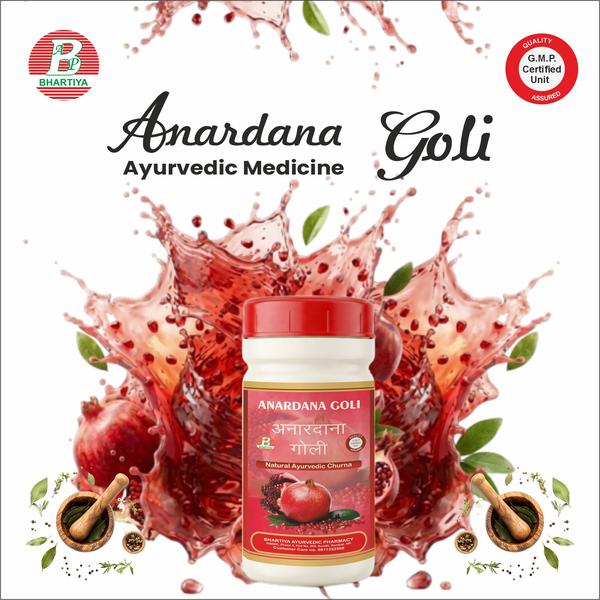
"name": "Anardana Goli",
"description": " ANARDANA GOLI \n\nProduct Identification\n•\tGeneric Name: Anardana Goli\n•\tType: Ayurvedic Patent Medicine\n•\tPrimary Indication Area: Improves digestion and stimulates appetite.\n•\tTherapeutic Indications: Helps improve digestion, increase appetite, boost vitality, and reduce weakness.\n\nKey benefits include:\n1. Digestive Support\n•\tAnardana Goli contains ingredients that are considered “Agnivardhaka” in Ayurveda, meaning they strengthen digestive fire (Agni).\n•\tStrong digestive fire ensures that food is properly broken down and nutrients are absorbed efficiently.\n•\tImproved digestion reduces issues like bloating, heaviness, or indigestion, which often suppress appetite.\n2. Appetite Stimulation\n•\tBy improving digestion, the body naturally signals hunger, leading to better appetite.\n•\tIt helps people who have poor appetite due to weakness, stress, or overexertion.\n•\tRegular use may lead to steady and healthy hunger cues, making it easier to eat balanced meals.\n3. Additional Benefits Linked to Digestion & Appetite\n•\tIncreased nutrient absorption → more energy and stamina\n•\tReduced digestive discomfort → enhanced overall well-being\n•\tSupports healthy metabolism, which can maintain proper body weight and vitality\n\nIngredients:\n Anardana \nBotanical Name: Punica granatum\nCommon Names: Anardana (India), Dried Pomegranate Seeds\n\nKey Nutrients / Phytochemicals\n•\tPolyphenols (punicalagins, ellagic acid) – potent antioxidants\n•\tVitamins: Vitamin C, some B-complex vitamins\n•\tMinerals: Potassium, iron, calcium, magnesium\n•\tFiber\n•\tStimulation of Digestive Enzymes\no\tOrganic acids in Anardana (like citric and malic acid) stimulate the secretion of saliva, gastric juices, and pancreatic enzymes.\no\tThis improves breakdown of food, especially proteins and fats.\n•\tEnhancement of Agni (Digestive Fire)\no\tIn Ayurvedic terms, Anardana strengthens Agni, helping proper digestion, nutrient absorption, and assimilation.\n•\tCarminative Effect\no\tReduces gas formation and bloating.\no\tThe mild aromatic compounds help relax intestinal muscles and aid smooth digestion.\n•\tMild Laxative & Stool Softening\no\tDietary fiber in Anardana adds bulk to stool.\no\tHelps in preventing constipation and promoting regular bowel movements.\n•\tReduction of Acidity & Indigestion\no\tOrganic acids balance stomach pH.\no\tHelps prevent fermentation of undigested food, reducing acidity, heartburn, and bloating.\n\n\n Kala Namak (Black Salt) \nBotanical/Source Name: Naturally occurring rock salt, mainly from the Himalayan region (mineral salt, not plant-based).\nCommon Names: Black Salt, Himalayan Black Salt, Kala Namak\n\nKey Constituents / Components\n•\tSodium chloride (NaCl) – main component\n•\tIron sulphide (gives the characteristic dark colour and sulphurous smell)\n•\tTrace minerals: potassium, magnesium, calcium, sulfur compounds\n\nDigestive Mechanism of Action\n1.\tStimulation of Digestive Enzymes & Saliva\no\tThe sulfur compounds and salts in Kala Namak stimulate salivary glands and gastric juices, improving breakdown of food.\no\tEnhances enzyme activity in the stomach, especially for protein digestion.\n2.\tEnhancement of Agni (Digestive Fire)\no\tIn Ayurveda, Kala Namak is considered Ushna (hot in potency) and Deepana (enhances Agni).\no\tPromotes proper digestion, assimilation of nutrients, and prevents Aama (undigested toxins) formation.\n3.\tCarminative & Gas-Relieving Effect\no\tHelps reduce flatulence, bloating, and heaviness in the stomach.\no\tMild action on intestinal muscles supports smooth movement of food.\n4.\tMild Laxative / Gut-Regulating Effect\no\tSupports bowel regularity in small doses.\no\tCan reduce constipation and improve stool consistency.\n5.\tAcidity & Heartburn Relief\no\tUnlike regular salt, Kala Namak neutralizes excess stomach acid due to its unique mineral composition.\no\tHelps maintain pH balance in the stomach, reducing acidity-related discomfort.\n\n Kali Mirch (Black Pepper) \nBotanical Name: Piper nigrum\nCommon Names: Black Pepper, Kali Mirch\n\nKey Phytochemicals\n•\tPiperine – main active compound, gives pungency\n•\tEssential oils (limonene, pinene) – contribute to digestive and carminative effects\n•\tAlkaloids and trace minerals\n\nDigestive Mechanism of Action\n1.\tStimulation of Digestive Enzymes\no\tPiperine in black pepper stimulates the secretion of saliva, gastric juices, bile, and pancreatic enzymes.\no\tEnhances breakdown and absorption of proteins, fats, and carbohydrates.\n2.\tEnhancement of Agni (Digestive Fire)\no\tIn Ayurveda, Kali Mirch is Ushna (hot) and Laghu (light), enhancing Agni.\no\tHelps in digestion of heavy or oily foods and prevents Aama (undigested toxins).\n3.\tCarminative Effect\no\tReduces gas formation, bloating, and flatulence.\no\tHelps relax intestinal muscles and improve bowel movement.\n4.\tImproved Nutrient Absorption\no\tPiperine enhances bioavailability of nutrients and other herbs.\no\tSupports efficient absorption of fat-soluble vitamins and minerals.\n5.\tGut Motility & Mild Laxative Action\no\tStimulates peristalsis, aiding smooth bowel movements.\no\tHelps prevent mild constipation.\n\n Amchur (Dried Mango Powder) \nBotanical Name: Mangifera indica (unripe mango)\nCommon Names: Amchur, Amchoor, Mango Powder\n\nKey Phytochemicals / Nutrients\n•\tOrganic acids: citric acid, malic acid, tartaric acid – provide sour taste\n•\tPolyphenols and flavonoids – antioxidant effect\n•\tVitamins: Vitamin C, small amounts of B-complex\n•\tMinerals: Potassium, magnesium\n\nDigestive Mechanism of Action\n1.\tStimulation of Digestive Enzymes\no\tOrganic acids in Amchur stimulate salivary and gastric secretions, enhancing breakdown of carbohydrates, proteins, and fats.\n2.\tEnhancement of Agni (Digestive Fire)\no\tIn Ayurveda, Amchur is Deepana (stimulates Agni) and Pachana (aids digestion).\no\tHelps digest heavy, oily, or kapha-aggravating foods.\n3.\tCarminative Effect\no\tReduces gas formation, bloating, and flatulence due to its sour and slightly astringent properties.\no\tSupports smooth movement of food in the intestines.\n4.\tAppetizer & Acid-Balancer\no\tImproves appetite by enhancing taste and stimulating digestive secretions.\no\tBalances mild acidity due to regulation of gastric pH.\n5.\tMild Laxative / Gut-Regulating Effect\no\tSlightly promotes bowel movements due to its fiber content and organic acids.\n Namak (Common Salt / Table Salt) \nChemical Composition: Mainly Sodium Chloride (NaCl)\nOther Components: Trace minerals (depending on source)\n\nDigestive Mechanism of Action\n1.\tStimulation of Digestive Secretions\no\tSalt stimulates salivary glands, promoting saliva production.\no\tIncreases secretion of gastric juices, which helps in breaking down food, especially proteins.\n2.\tEnhancement of Agni (Digestive Fire)\no\tIn Ayurveda, small amounts of salt are Deepana (stimulate Agni), aiding digestion and assimilation of nutrients.\n3.\tElectrolyte Balance\no\tMaintains osmotic balance in the gut, helping smooth movement of food through intestines.\n4.\tMild Appetite Stimulant\no\tImproves taste perception, which indirectly encourages better digestion by promoting chewing and salivation.\n5.\tGut Motility Support\no\tHelps maintain water balance in intestines, preventing constipation and aiding smooth bowel movements in normal amounts.\n\n Pippali (Long Pepper) \nBotanical Name: Piper longum\nCommon Names: Pippali, Long Pepper\n\nKey Phytochemicals\n•\tPiperine – main pungent compound\n•\tEssential oils – contribute to digestive and carminative effects\n•\tAlkaloids and volatile oils\n\nDigestive Mechanism of Action\n1.\tStimulation of Digestive Enzymes\no\tPiperine and essential oils stimulate secretion of saliva, gastric juices, and pancreatic enzymes.\no\tEnhances digestion of proteins, fats, and carbohydrates.\n2.\tEnhancement of Agni (Digestive Fire)\no\tIn Ayurveda, Pippali is Ushna (hot), Laghu (light), and Deepana (stimulates Agni).\no\tHelps digest heavy, kapha-aggravating foods and prevents formation of Aama (toxins from undigested food).\n3.\tCarminative Effect\no\tReduces bloating, gas formation, and flatulence.\no\tRelaxes intestinal muscles, aiding smooth movement of food.\n4.\tAppetite Stimulant\no\tImproves taste perception and digestive excitement, which indirectly enhances nutrient breakdown and assimilation.\n5.\tGut Motility & Mild Laxative Action\no\tStimulates peristalsis, supporting regular bowel movements.\no\tMildly laxative in nature, helps prevent constipation\n\n Gulkand (Rose Petal Preserve) \nBotanical Name: Rosa damascena (Damask Rose)\nCommon Names: Gulkand, Rose Petal Preserve\n\nKey Constituents / Phytochemicals\n•\tNatural sugars (from rose petals and sugar) – provide mild energy\n•\tFlavonoids and phenolic compounds – antioxidants\n•\tVolatile oils – aromatic and carminative properties\n•\tTrace minerals: iron, calcium\n\nDigestive Mechanism of Action\n1.\tEnhancement of Agni (Digestive Fire)\no\tGulkand is Deepana (stimulates digestion) and Pachana (aids digestion of heavy foods) in Ayurveda.\no\tHelps digest fatty or heavy meals and reduces formation of Aama (undigested toxins).\n2.\tCarminative Effect\no\tAromatic compounds and rose oils reduce gas, bloating, and flatulence.\no\tHelps smooth intestinal motility.\n3.\tCooling Digestive Tonic\no\tBalances Pitta and excess heat in the digestive tract while supporting digestion.\no\tMildly soothing for acidity and hyperacidity.\n4.\tAppetite Stimulant\no\tSweet taste and aroma improve appetite, increasing salivation and digestive enzyme secretion.\n5.\tGut-Regulating Effect\no\tSugar content provides mild bulk and energy for smooth bowel movement.\no\tMay prevent constipation in moderate use.\n\n Sugar (Sharkara / Saccharose / Table Sugar) \nChemical Composition: Mainly Sucrose (C12H22O11)\nSource: Sugarcane, sugar beet\n\nDigestive Mechanism of Action\n1.\tEnergy Source for Digestion\no\tSugar provides readily available glucose, which supplies quick energy for metabolic processes, including the digestive system.\n2.\tStimulation of Saliva & Taste\no\tSweet taste stimulates salivation, which begins pre-digestion of carbohydrates.\no\tEnhances the appetite indirectly by making food more palatable.\n3.\tMild Laxative / Gut-Regulating Effect (in moderate amounts)\no\tSugar can retain water in the intestines, softening stool slightly and supporting bowel movement.\n4.\tEnhancement of Digestive Enzyme Activity\no\tSimple sugars can activate carbohydrate-digesting enzymes (amylase) in saliva and pancreas.\n5.\tCooling Effect (in Ayurveda)\no\tSugar is considered Shita (cooling), which can soothe Pitta-related digestive irritation (like mild acidity).\n\n\n AMLA (Amalaki) \n1.\tDose:\no\t2–3 goli (tablets/lozenges) three times a day.\n2.\tTiming:\no\tTake after meals (breakfast, lunch, and dinner).\n3.\tMode of Intake:\no\tChew or slowly suck the goli for better digestive effect.\no\tCan be taken with lukewarm water if needed.\n4.\tPurpose:\no\tImproves digestion.\no\tReduces bloating, gas, and mild acidity.\n5.\tPrecautions:\no\tDo not take on an empty stomach.\no\tPeople with diabetes should monitor blood sugar.\no\tAvoid excessive intake to prevent loose stools or acidity.\n6.\tDuration:\no\tCan be used safely for 1–2 months or as advised by an Ayurvedic practitioner.\n\n\n\nanardana goli benefits, anardana goli benefits in hindi\nanardana goli khane ke fayde, anardana goli uses\nanardana goli ingredients, anardana goli recipe\nanardana goli amazon, anardana goli at home\nhow to make anardana goli at home, ayurvedic anardana goli\nwhat is anardana goli, is anardana goli good for health\nanardana goli buy online, anardana goli bottle\nanardana goli buy, anardana churan benefits\nanardana goli calories, anardana goli candy\nanardana goli contents, anardana chatpati goli\ncalories in anardana churan, anardana goli red colour\nanardana goli digestive, anardana goli dosage\nanardana goli in english, anardana goli for digestion\nanardana goli flipkart, anardana goli for kids\nanardana goli nutritional facts, anardana goli used for\nanardana goli gst rate, anardana churan goliyan\nanardana goli how to use, anardana goli health benefits\nanardana goli hindi, anardana churan hsn code\nis anardana goli healthy, anardana goli kya hota hai\nanardana goli in pregnancy, anardana goli india\nanardana goli indiamart, anardana goli in hindi\nanardana churan in pregnancy, anardana goli jiomart\nanardana goli jar, anardana goli kaise banti hai\nanardana goli kaise banate hain, anardana goli khatta meetha\nanardana ki goli, anardana churan ke fayde, anardana churan kaise banta hai\nanardana goli manufacturers, anardana goli making machine\nanardana goli manufacturers in india, anardana goli making\nanardana goli near me, anardana churan near me\nanardana goli shop near me, anardana churan online\nbuy anardana goli online, anardana goli pouch\nanardana goli powder, anardana goli price per kg\nanardana goli quantity, anardana goli qr code\nanardana goli q10, anardana goli qartulad\nanardana goli red, anardana churan recipe\njeera goli red, anardana churan recipe in hindi\nanardana churan goli recipe, anardana goli shadani\nanardana goli taste, anardana goli tablet\nanardana goli uses in hindi, anardana goli uses malayalam\nanardana churan uses, anardana goli kaise banaen\nanardana goli wholesale market, anardana goli wholesale\nanardana goli wholesale price, best anardana goli in india\nbenefits of eating anardana goli, why anardana goli healthy\nwhy anardana goli good for health, why anardana goli means\nwhy anardana goli good for digestion, who anardana goli price\nwho anardana goli in delhi, who anardana goli in a day\nwho anardana goli kaise banate hain, who anardana goli kaise banti hai\nwho anardana goli banane ka tarika, who anardana goli means\nwho anardana goli is made, who anardana goli good for health\nbest anardana goli brand, best anardana churan\nbest anardana brand",
"price": 108.0,
"discountamount": 54.0,
"currencycode": "INR",
"priority": 1000000,
"isfreeshipmentavailable": false,
"shipmentduration": 1,
"_keywords": null,
"isarchived": false,
"isavailable": true,
"applicationid": null,
"productindex": 125,
"imageuri": "https://productimages.withfloats.com/actual/6a0d871d881b69a5d83cfec8.jpg",
"tileimageuri": "https://productimages.withfloats.com/tile/6a0d871d881b69a5d83cfec8.jpg",
"images": null,
"totalqueries": 0,
"gpid": null,
"groupproductid": null,
"createdon": "2026-05-20T10:04:10.77Z",
"updatedon": "2026-05-20T10:04:10.77Z",
"buyonlinelink": null,
"producturl": "http://WWW.BHARTIYAAYURVEDICPHARMACY.COM//anardana-goli/125",
"availableunits": -1.0,
"iscodavailable": true,
"isprepaidonlineavailable": true,
"maxcodorders": -1,
"maxprepaidonlineorders": -1,
"uniquepaymenturl": null,
"brandname": "Bakula Fort",
"category": "Anardana Goli 100 GM X 40",
"tags": [],
"variants": false,
"keyspecification": null,
"otherspecifications": null,
"pickupaddressreferenceid": null,
"paymenttype": "AssuredPurchase",
"producttype": "products",
"hsncode": null,
"gstslab": 0.0,
"isnotforsale": false
},
{
"_id": "6a081086f07b0c299fde3d2b",
"fptag": "BHARTIYEAYURVEDICPHARMACY",
"merchantname": null,
"customwidgets": null,
"externalsourceid": null,
"name": "Mulbarry Capsule",
"description": " MULBERRY \n\n MULBERRY (Morus alba L., Morus nigra L.) \nThe Nutritive, Rejuvenative Herb — “Sangri / Shahtoot”\nMulberry is a widely valued medicinal and nutritive plant in Ayurveda for its rejuvenative, blood-purifying, and metabolism-supporting properties. Traditionally used to support digestion, improve immunity, maintain blood sugar levels, and enhance overall vitality, Mulberry is rich in flavonoids, anthocyanins, vitamins, and minerals. It is considered beneficial for managing diabetes, improving haemoglobin, supporting liver and kidney health, and promoting longevity.\n CLASSICAL AYURVEDIC REFERENCES\n1.\tCharaka Samhita\n•\tMentioned in Chikitsa Sthana for strengthening blood, improving digestion, and enhancing Ojas.\n•\tUsed as Rasayana and for diabetes management (Prameha).\n2.\tSushruta Samhita\n•\tRecommended for skin disorders, bleeding disorders, and general debility.\n•\tDescribed as Snigdha (unctuous), Sheeta (cooling), and Madhura (sweet), supporting metabolism and rejuvenation.\n3.\tBhavaprakasha Nighantu\n•\tReferred to as Shahtoot / Shukrala (Morus).\n•\tPromotes longevity, Ojas, and blood health.\n•\tUsed in Rasayana and Medhya formulations.\n\n CLASSICAL STORY / ANECDOTE\nIn Ayurvedic texts, Mulberry is praised for its nutritive and rejuvenating effect on the body and mind. Acharyas describe Mulberry as “Rasayana, Ojasvardhaka, and Balya,” emphasizing its role in restoring vitality and stamina. Traditionally, Mulberry leaves and fruits were recommended to improve haemoglobin levels, support digestion, and maintain balanced blood sugar. Bhavaprakasha Nighantu likens Mulberry to a “nourishing tree,” symbolizing its life-sustaining and rejuvenative qualities.\n BOTANICAL INFORMATION OF MULBERRY\n•\tScientific Name: Morus alba L. / Morus nigra L.\n•\tFamily: Moraceae\n•\tOrder: Rosales\n•\tGenus: Morus\n•\tSpecies: alba / nigra\n\nCommon Names:\n•\tSanskrit: Shahtoot\n•\tHindi: Shahtoot / Tut\n•\tEnglish: Mulberry\n•\tTamil: Tutti\n•\tTelugu: Tooti\n•\tMalayalam: Tutti\n•\tKannada: Tooti\n•\tBengali: Tut\n\n SYNONYMS IN CLASSICAL AYURVEDIC NIGHANTUS\n•\tCharaka Samhita: Shahtoot – Rasayana, Ojasvardhaka, Balya\n•\tSushruta Samhita: Shahtoot – Medhya, Rasayana, Shukrala\n•\tBhavaprakasha Nighantu: Shahtoot – Promotes longevity, blood health, and vitality\n MORPHOLOGY OF MULBERRY\n•\tPlant Type: Deciduous, perennial tree\n•\tHeight: 5–15 m\n•\tLeaves: Simple, heart-shaped, serrated edges\n•\tFlowers: Small, greenish-white, dioecious\n•\tFruits: Sweet or slightly tart, multiple small drupes clustered (white, red, black)\n•\tSeeds: Tiny, embedded in the fruit\n ECOLOGICAL PREFERENCES\n•\tClimate: Temperate to subtropical, tolerates drought\n•\tSoil: Well-drained loamy soil, pH 6–7.5\n•\tHabitat: Cultivated widely; wild in riverbanks and open forests\n•\tAltitude: 0–2,000 m\n GEOGRAPHICAL DISTRIBUTION\n•\tIndia: Uttar Pradesh, Punjab, Madhya Pradesh, Himachal Pradesh, Maharashtra\n•\tOutside India: China, Europe, North America, Middle East\n CLASSICAL AYURVEDIC PROPERTIES (RASA–GUNA–VIRYA–VIPAKA)\n•\tRasa (Taste): Madhura (sweet), Kashaya (astringent)\n•\tGuna (Qualities): Snigdha (unctuous), Laghu (light)\n•\tVirya (Potency): Sheeta (cooling)\n•\tVipaka (post-digestive effect): Madhura (sweet)\n•\tDosha Effects: Pitta-Vata hara (reduces Pitta & Vata), Kapha balancing\n THERAPEUTIC ACTIONS (KARMA)\n1.\tRasayana: Enhances longevity, immunity, and vitality\n2.\tRaktaprasadaka: Supports blood health and hemoglobin\n3.\tMedhya: Supports mental clarity and cognitive function\n4.\tPramehahara: Helps regulate blood sugar\n5.\tHridya: Supports heart and circulation\n6.\tBalya: Improves strength and stamina\n INDICATIONS\n•\tNervous System: Weakness, fatigue\n•\tDigestive System: Indigestion, constipation\n•\tMetabolic / Endocrine: Diabetes, low vitality\n•\tCardiovascular System: Mild hypertension, palpitations\n•\tHaematological: Anaemia, low haemoglobin\n•\tImmunity & Rejuvenation: General debility, aging-related weakness\n MODERN PHARMACOLOGY & PHYTOCHEMISTRY\n•\tMajor Constituents:\no\tFlavonoids, anthocyanins, vitamins (C, K), minerals (iron, calcium, magnesium), alkaloids, phenolics\n•\tPharmacological Actions:\no\tAntioxidant & anti-inflammatory\no\tHypoglycaemic & metabolic regulator\no\tCardioprotective\no\tImmunomodulatory\no\tHepatoprotective\n CULTIVATION DETAILS\n•\tPropagation: Seeds, cutting, grafting\n•\tSowing Time: Spring (March–May)\n•\tSpacing: 3–5 m between trees\n•\tIrrigation: Moderate; tolerates drought\n•\tFertilization: Organic manure preferred\n•\tHarvesting: Fruits harvested seasonally; leaves harvested multiple times per year\n CLASSICAL DOSAGE (According to Ayurvedic Granthas)\n•\tFruits (fresh or dried): 10–30 g/day\n•\tLeaves (decoction / juice): 20–50 ml twice daily\n•\tRoot / Bark (powder / decoction): 2–5 g/day\n•\tOil / Taila (external): 5–10 ml/day for massages\n MULBERRY FORMULATIONS – BHARTIYA AYURVEDIC PHARMACY\nBhartiya Ayurvedic Pharmacy prepares Mulberry formulations following classical Ayurvedic principles. Each product retains the nutritive, rejuvenative, and metabolism-supporting properties of Mulberry, promoting blood health, immunity, cognitive function, and overall vitality.\nKey Uses of Mulberry Formulations:\n•\tBlood and metabolic system support\n•\tImmunity enhancement\n•\tCognitive and mental health support\n•\tRasayana: longevity, vitality, and balanced energy\n\n MULBERRY CAPSULE \n•\tKey Benefits:\no\tSupports blood, metabolism, and immunity\no\tEnhances energy, stamina, and vitality\no\tPromotes mental clarity and cognitive function\n•\tDosage:\no\tAdults: 1–2 capsules twice daily with warm water or as directed\no\tCan be combined with milk or ghee for enhanced Rasayana effect\n•\tSafety & Precautions:\no\tSafe for long-term use as per dosage\no\tMild hypoglycaemic effect may occur; monitor if on diabetes medications\n•\tFormulation Highlights:\no\t100% natural Mulberry (Morus) powder\no\tFree from artificial colours, preservatives, and additives\no\tPrepared using classical Ayurvedic methods\n\n•\tSuggested Use:\no\tIdeal for adults seeking rejuvenation, immunity, blood support, and metabolic balance\no\tSuitable for daily Rasayana and revitalization\n\n\nmulberry capsules, mulberry capsules benefits, mulberry leaf capsules\nwhite mulberry capsules, mulberry extract capsules, mulberry fruit capsules\nmulberry leaf extract capsules, mulberry capsule amazon, mulberry capsule ayurvedic\nmulberry capsule ayurveda, mulberry capsule ayurvedic medicine\nmultiberry capsule, mulberine capsules uses\nmulberry capsule download, mulberry capsule dosage\nmulberry capsule dose, mulberry capsule dose per day\nmulberry capsule daily dose, mulberry capsule dark chocolate\nmulberry leaf extract capsule, mulberry extract tablet\nmulberry capsule gold, mulberry capsule gst rate\nmulberry capsule hindi, mulberry capsule how to use\nmulberry capsule hsn code, mulberry capsule hoti hai\nindian mulberry capsule, mulberry capsule japan\nmulberry capsule juice, mulberry capsule joy\nmulberry capsule juice price, mulberry capsule juice benefits\nmulberry capsule jiomart, mulberry capsule juice amazon\nmulberry capsule juice online, mulberry capsule khane ke fayde\nmulberry capsule ke fayde in hindi, mulberry leaf capsule\n mulberry capsule manufacturer, mulberry capsule manufacturers in india\nmulberry capsule name, mulberry capsule near me, mulberry capsule nutrition\nmulberry capsule nutrition facts, mulberry capsule new packaging\nmulberry capsule na, mulberry capsule night, mulberry capsule note\nmulberry capsule online, mulberry capsule online shopping\nmulberry capsule original, mulberry capsule online order\nmulberry capsule on amazon, mulberry capsule on face\nmulberry capsule price, mulberry capsule pdf, mulberry capsule price in india\nmulberry capsule pharma, mulberry capsule pillow price, mulberry capsule quality\nmulberry capsule quantity, mulberry capsule quotes short, mulberry capsule review\nmulberry capsule rate, mulberry capsule research paper, mulberry capsule red\nmulberry capsule red benefits, mulberry capsule release, mulberry capsule rose\nmulberry capsule tablet, mulberry capsule types, mulberry capsule test\nmulberry capsule tata, mulberry capsule tab, mulberry capsule tonic\nmulberry capsule topic, mulberry capsule tshirt, mulberry capsule tonic benefits\nmulberry capsule uses in hindi, mulberry capsule uses, mulberry capsule wholesale\nwhere mulberry capsule manufactured, where mulberry capsules are made\nwhere mulberry capsules, when does mulberry grow, when is mulberry season in india\nhow mulberry capsule works, why mulberry face wash, does mulberry increase weight\nwho mulberry capsules, is mulberry capsule good, is mulberry good for cholesterol\n",
"price": 480.0,
"discountamount": 240.0,
"currencycode": "INR",
"priority": 1000000,
"isfreeshipmentavailable": false,
"shipmentduration": 1,
"_keywords": null,
"isarchived": false,
"isavailable": true,
"applicationid": null,
"productindex": 120,
"imageuri": "https://productimages.withfloats.com/actual/6a081088f72a9a60137a7547.jpg",
"tileimageuri": "https://productimages.withfloats.com/tile/6a081088f72a9a60137a7547.jpg",
"images": null,
"totalqueries": 0,
"gpid": null,
"groupproductid": null,
"createdon": "2026-05-16T06:36:54.248Z",
"updatedon": "2026-05-16T06:36:54.248Z",
"buyonlinelink": null,
"producturl": "http://WWW.BHARTIYAAYURVEDICPHARMACY.COM//mulbarry-capsule/120",
"availableunits": -1.0,
"iscodavailable": true,
"isprepaidonlineavailable": true,
"maxcodorders": -1,
"maxprepaidonlineorders": -1,
"uniquepaymenturl": null,
"brandname": "Bakula Fort",
"category": "Mulbarry Capsule 60 Cap X 30",
"tags": [],
"variants": false,
"keyspecification": null,
"otherspecifications": null,
"pickupaddressreferenceid": null,
"paymenttype": "AssuredPurchase",
"producttype": "products",
"hsncode": null,
"gstslab": 0.0,
"isnotforsale": false
},
{
"_id": "69e9bdf02c0925e46b696de0",
"fptag": "BHARTIYEAYURVEDICPHARMACY",
"merchantname": null,
"customwidgets": null,
"externalsourceid": null,
"name": "Krimihar Tabler",
"description": " KRIMIHAR TABLET \n\nProduct Identification\n•\tGeneric Name: KrimiharTablet\n•\tType: Ayurvedic Patent Medicine\n•\tPrimary Indication Area: Treatment and prevention of intestinal worm infestations (helminthiasis).\n\nTherapeutic Indications:\n•\tUsed for: Treatment of intestinal worm (helminth) infections\n•\tEffective against: Roundworms, threadworms, tapeworms, and hookworms\n•\tPurpose: Helps expel worms from the gastrointestinal tract and relieve symptoms like abdominal discomfort, weakness, and nutritional deficiency caused by worms.\n.\n Primary Benefit:\n•\tEliminates intestinal worms and relieves symptoms caused by worm infections, such as abdominal discomfort, weakness, and nutritional deficiencies.\nOther Benefits:\n1.Eliminates Intestinal Worms (Primary Benefit)\n•\tKrimihar tablet targets common gastrointestinal parasites such as roundworms, threadworms, tapeworms, and hookworms.\n•\tBy killing or expelling these worms, it directly addresses the root cause of infection.\n•\tThis reduces symptoms like abdominal pain, bloating, diarrhea, and itching around the anus (common in threadworm infections).\n2. Improves Digestion and Nutrient Absorption\n•\tWorm infestations often interfere with nutrient absorption, leading to deficiencies in proteins, vitamins, and minerals.\n•\tRemoving worms allows the digestive system to function normally, improving appetite, digestion, and overall nutrient uptake.\n3. Reduces Fatigue and Weakness\n•\tWorm infections can cause anemia or general weakness due to blood loss (hookworms) or malabsorption of nutrients.\n•\tBy eliminating the parasites, Krimihar helps restore energy levels, stamina, and vitality.\n4. Supports Overall Gut Health\n•\tA healthy intestine free of parasites can maintain a balanced gut microbiome, reducing the risk of recurring infections and gastrointestinal disturbances.\n5. Prevents Complications\n•\tUntreated worm infestations in children or adults can lead to stunted growth, delayed development, or chronic nutritional deficiencies.\n•\tRegular treatment with anthelmintics like Krimihar can prevent these long-term complications.\n\n Vaividang \nBotanical Name: (Embelia ribes) \nKey Phytoconstituents:\n•\tEmbelin (primary active compound)\n•\tTannins\n•\tFlavonoids\n•\tPhenolic compounds\nMechanism of Action Against Intestinal Worms – Biochemistry / Pharmacology:\n1.\tNeuromuscular Paralysis of Worms\no\tEmbelin interferes with neurotransmission in worm muscles.\no\tCauses paralysis → worms detach from intestinal wall and are expelled.\n2.\tDisruption of Worm Energy Metabolism\no\tInhibits mitochondrial respiratory enzymes in worms.\no\tReduces ATP production → energy depletion → worm death.\n3.\tTegument / Membrane Damage\no\tPhenolic compounds damage the worm’s outer surface (tegument).\no\tLoss of structural integrity makes worms vulnerable to digestive enzymes.\n4.\tOxidative Stress Induction\no\tEmbelin generates reactive oxygen species (ROS) in worm tissues.\no\tDamages proteins, lipids, and DNA → contributes to worm death.\n\n Pitpapda\nBotanical Name:(Fumaria indica / Fumaria parviflora)\nKey Phytoconstituents:\n•\tAlkaloids (Fumarine, Protopine)\n•\tFlavonoids\n•\tTannins\n•\tOrganic acids\nMechanism of Action in GIT / Constipation / Liver Support – Biochemistry / Pharmacology:\n1.\tMild Laxative / Stool Softening Effect\no\tAlkaloids stimulate bowel motility.\no\tHelps ease passage of stools and relieves constipation.\n2.\tDigestive Stimulant / Carminative\no\tFlavonoids and organic acids enhance digestive enzyme secretion.\no\tReduces bloating and improves digestion.\n3.\tHepatoprotective / Liver Support\no\tAlkaloids and flavonoids support liver function.\no\tPromotes bile secretion → improves fat digestion and prevents indigestion.\n4.\tAnti-inflammatory Effects\no\tReduces inflammation in gut lining.\no\tRelieves discomfort and irritation in gastrointestinal tract.\n5.\tAntioxidant Protection\no\tFlavonoids and phenolic compounds scavenge free radicals.\no\tProtects gut and liver tissues from oxidative damage.\n\n Kamala \n Botanical Name:(Mallotus philippensis / Red Kamala)\nKey Phytoconstituents:\n•\tRottlerin (primary active compound)\n•\tTannins\n•\tFlavonoids\n•\tPhenolic compounds\n•\tResin\nMechanism of Action in GIT / Anti-helminthic – Biochemistry / Pharmacology:\n1.\tAnti-helminthic / Vermifuge Effect\no\tRottlerin and tannins paralyze intestinal worms.\no\tParalyzed worms are expelled via bowel movements.\n2.\tMild Laxative Effect\no\tStimulates intestinal motility.\no\tSoftens stools and relieves mild constipation.\n3.\tDigestive Stimulant\no\tFlavonoids enhance secretion of digestive enzymes.\no\tImproves digestion and nutrient absorption.\n4.\tAnti-inflammatory Action\no\tPhenolic compounds reduce gut mucosal inflammation.\no\tRelieves abdominal discomfort, bloating, and irritation.\n5.\tAntioxidant Protection\no\tFlavonoids and phenolics scavenge free radicals.\no\tSupports gut mucosa health and healing of minor lesions.\n\n Shudh Kuchla \nBotanical Name: (Strychnos nux-vomica, Purified Nux Vomica Seeds) \nKey Phytoconstituents:\n•\tStrychnine (alkaloid, detoxified in Shudh form)\n•\tBrucine\n•\tOther minor alkaloids\nMechanism of Action in GIT / Constipation / Digestive Health – Biochemistry / Pharmacology:\n1.\tDigestive Stimulant / Carminative Effect\no\tDetoxified strychnine enhances secretion of digestive enzymes.\no\tImproves digestion and absorption, reducing accumulation of undigested food.\n2.\tMild Laxative Effect\no\tStimulates bowel motility in small doses.\no\tEases passage of stools and helps relieve mild constipation.\n3.\tAppetizer / Metabolic Stimulant\no\tEnhances appetite and gastrointestinal function.\no\tSupports overall digestive efficiency.\n4.\tAnti-flatulent / Carminative Action\no\tReduces bloating and gas formation in the gut.\n5.\tCaution / Safety\no\tRaw Kuchla seeds are highly toxic; only Shudh (purified) form is safe.\no\tUse under medical supervision to avoid toxicity.\n\n Afsanteen / Afsteen (Artemisia absinthium) \nBotanical Name / Common Name: Artemisia absinthium — commonly known as Wormwood in English and Afsanteen in Unani medicine. \nKey Phytoconstituents:\n•\tSesquiterpene lactones (e.g., absinthin, anabsin)\n•\tEssential oils\n•\tFlavonoids\n•\tBitter compounds\n•\tPhenolics \nMechanism of Action in GIT / Worms / Digestion – Biochemistry / Pharmacology:\n1.\tAnthelmintic / Anti parasite Action\no\tBitter sesquiterpene lactones have vermifuge properties, traditionally used to expel intestinal worms.\no\tImproves defence against parasites in the gut. \n2.\tDigestive Stimulant / Bitter Tonic Effect\no\tBitter compounds stimulate secretion of digestive juices (stomach acid and bile).\no\tEnhances digestion, appetite and nutrient absorption. \n3.\tCarminative & Mild Stomachic Effect\no\tEssential oils and flavonoids help reduce bloating, gas and indigestion.\no\tEases discomfort and supports regular bowel function. \n4.\tHepatoprotective / Liver Support\no\tTraditional use includes supporting liver and gallbladder function.\no\tMay aid detoxification and improve metabolic processing. \n5.\tAnti inflammatory & Antimicrobial Properties\no\tPhenolics and essential oils exhibit anti inflammatory and antimicrobial effects in the gut.\no\tHelps maintain gut mucosa health and reduce irritation. \n\n\n Khursani Ajwain (Trachyspermum ammi / Carom seeds) \n\nKey Phytoconstituents:\n•\tThymol (primary active compound)\n•\tTerpenes\n•\tFlavonoids\n•\tSaponins\n•\tVolatile oils\nMechanism of Action in GIT / Digestion / Anti-parasitic – Biochemistry / Pharmacology:\n1.\tCarminative / Anti-flatulence Effect\no\tThymol and volatile oils relax gut smooth muscles.\no\tReduces bloating, gas, and abdominal discomfort.\n2.\tDigestive Stimulant\no\tStimulates secretion of gastric juices and digestive enzymes.\no\tEnhances digestion and nutrient absorption.\n3.\tMild Laxative / Bowel Regulation\no\tTerpenes and saponins stimulate mild intestinal motility.\no\tAids smooth passage of stools, relieving mild constipation.\n4.\tAntimicrobial / Anti-parasitic Action\no\tThymol exhibits antimicrobial and vermifuge properties.\no\tHelps control intestinal pathogens and mild worm infestations.\n5.\tAnti-inflammatory & Spasmolytic Action\no\tFlavonoids and volatile oils reduce gut inflammation and smooth muscle spasm.\no\tRelieves abdominal cramps and gut irritation.\n\n\nDosage\nAdult:2–3 tablets thrice a day\nChildren: 1-2 tablets\nCommon Anupan for Krimihar:\n1.\tHoney (Madhu)\no\tSoothes GI tract.\no\tImproves palatability, especially for children.\n2.\tWarm Water / Lukewarm Water\no\tFacilitates swallowing and absorption.\no\tHelps expel worms through natural bowel movement.\n\n Precautions\n•\tChildren & Age: Use cautiously in young children; follow age-appropriate dose.\n•\tPregnancy/Lactation: Consult doctor before use.\n•\tGI Sensitivity: Take with warm water, milk, or honey to avoid stomach upset.\n•\tAllergies: Avoid if allergic to any ingredient.\n•\tChronic Illness: Caution in liver, kidney, or gut disorders.\n•\tDrug Interactions: Maintain 1–2-hour gap with other medicines.\n•\tOverdose: Stick to recommended dose; avoid self-increasing.\n\nkrimihar tablet uses, krimi tablet name, krimihar tablet amazon\nkrimihar tablet ayurvedic, krimihar tablet amazon india\nkrimihar tablet brands in india, krimihar tablet benefits\nkrimihar tablet brand name, krimihar tablet benefits in hindi\nkrimihar tablet buy online, krimihar tablet capsule\nkrimihar tablet company, krimihar tablet composition\nkrimihar tablet content, krimihar tablet cost\nkrimihar tablet download, krimihar tablet english\nkrimihar tablet english name, krimihar tablet flipkart\nkrimihar tablet free download, krimihar tablet gst rate\nkrimihar tablet google, krimihar tablet government of india\nkrimihar tablet hindi, krimihar tablet hd images\nkrimihar tablet in hindi, krimihar tablet image\nkrimihar tablet jain, krimihar tablet ke fayde\nkrimihar tablet ke fayde in hindi, krimihar tablet list\nkrimihar tablet manufacturer, krimihar tablet manufacturers in india\nkrimihar tablet mrp, krimihar tablet name, krimihar tablet name in hindi\nkrimihar tablet news in hindi, krimihar tablet name list\nkrimihar tablet online shopping, krimihar tablet online\nkrimihar tablet online order, krimihar tablet price\nkrimihar tablet price in india, krimihar tablet quality\nkrimihar tablet question, krimihar tablet review\nkrimihar tablet rate, krimihar tablet review in hindi\nkrimihar tablet time",
"price": 96.0,
"discountamount": 40.0,
"currencycode": "INR",
"priority": 1000000,
"isfreeshipmentavailable": false,
"shipmentduration": 1,
"_keywords": null,
"isarchived": false,
"isavailable": true,
"applicationid": null,
"productindex": 104,
"imageuri": "https://productimages.withfloats.com/actual/69e9bdf36b4fa44895043fca.jpg",
"tileimageuri": "https://productimages.withfloats.com/tile/69e9bdf36b4fa44895043fca.jpg",
"images": null,
"totalqueries": 0,
"gpid": null,
"groupproductid": null,
"createdon": "2026-04-23T06:36:32.114Z",
"updatedon": "2026-04-23T07:29:03.263Z",
"buyonlinelink": null,
"producturl": "http://WWW.BHARTIYAAYURVEDICPHARMACY.COM//krimihar-tabler/104",
"availableunits": -1.0,
"iscodavailable": true,
"isprepaidonlineavailable": true,
"maxcodorders": -1,
"maxprepaidonlineorders": -1,
"uniquepaymenturl": null,
"brandname": "Bakula Fort",
"category": "Krimihar Tabler 100 Tab X 40",
"tags": [],
"variants": false,
"keyspecification": null,
"otherspecifications": null,
"pickupaddressreferenceid": null,
"paymenttype": "AssuredPurchase",
"producttype": "products",
"hsncode": null,
"gstslab": 0.0,
"isnotforsale": false
},
{
"_id": "69e8891bfe3f5514f1dc5681",
"fptag": "BHARTIYEAYURVEDICPHARMACY",
"merchantname": null,
"customwidgets": null,
"externalsourceid": null,
"name": "Kasleen Tablet",
"description": " KASLEEN TABLET \n\nProduct Identification\n•\tGeneric Name: Kasleen Tablet\n•\tType: Ayurvedic Patent Medicine\n•\tPrimary Indication Area: Relief of cough and common cold symptoms — including runny nose, nasal congestion, and throat irritation\nTherapeutic Indications:\n•\tUsed for relief of cough and cold symptoms, including runny nose, nasal congestion (nazla/jukam), and throat irritation associated with upper respiratory infections\n Primary Benefit:\n•\tProvides relief from cough and common cold symptoms, including easing cough, throat irritation, nasal congestion, and runny or blocked nose associated with upper respiratory discomfort.\nOther Benefits:\n• Soothes throat irritation and soreness, making talking and swallowing more comfortable. \n• Helps reduce mucus and congestion, supporting clearer breathing. \n• May assist in easing respiratory discomfort, such as chest heaviness and irritation. \n• Supports overall respiratory comfort in both dry and productive cough conditions\n MULETHI \nBotanical / Scientific Name: Glycyrrhiza glabra L. (Licorice) \nKey Bioactive Constituents:\n• Glycyrrhizin & glycyrrhetinic acid\n• Liquiritin / flavonoids\n• Saponins / phenolic compounds\n• Mucilage / polysaccharides \nMechanism of Action – Cough, Cold & Congestion\n1.\tDemulcent / Soothing Action\no\tRoot mucilage and glycyrrhizin form a protective coating on irritated mucous membranes.\no\tHelps soothe sore throat and reduce cough reflex irritation. \n2.\tExpectorant & Mucus Clearing Effect\no\tLiquiritin and saponins stimulate secretion of thinner mucus in airways.\no\tEncourages loosening and expulsion of phlegm, improving congestion. \n\nPIPPALI \nBotanical / Scientific Name: Piper longum L. (Long Pepper) \nKey Bioactive Constituents:\n• Piperine (major alkaloid)\n• Volatile oils (pinene, limonene)\n• Alkaloids (pellitorine, piperlongumine)\n• Flavonoids & polyphenols \n\nMechanism of Action – Cough, Cold & Congestion\n1.\tAntitussive / Cough Suppression\no\tPippali exhibits a cough suppressing action, reducing irritation in the respiratory tract that triggers coughing.\no\tThis is attributed to its alkaloid and volatile oil actions on mucosal tissues. \n2.\tExpectorant / Mucus Clearing Effect\no\tThe volatile oils and piperine help loosen and expel mucus from the airways, aiding removal of phlegm and relieving chest congestion.\no\tThis facilitates easier breathing. \n\n SAUNF \nBotanical / Scientific Name: Foeniculum vulgare Mill. (Fennel) \nKey Phytoconstituents:\n• Essential oils (anethole, fenchone, pinene, limonene) \nMechanism of Action – Cough, Cold & Congestion\n1.\tExpectorant / Mucus Clearing Action\no\tVolatile oils (e.g., anethole) help loosen and thin mucus in the respiratory tract.\no\tMakes phlegm easier to expel, easing congestion and productive coughs. \n2.\tAnti Inflammatory Effect\no\tCompounds in Saunf exhibit anti inflammatory properties that help reduce airway and throat inflammation.\no\tSupports relief from sore throat and cough irritation. \n\n SOMLATA \nBotanical / Scientific Name: Ephedra gerardiana (also Ephedra vulgaris) — a medicinal herb traditionally used in Ayurveda and folk medicine for respiratory support. \nKey Bioactive Constituents:\n• Alkaloids (ephedrine, pseudoephedrine, nor ephedrine)\n• Flavonoids\n• Tannins\n• Phenolic compounds\n• Volatile constituents \nMechanism of Action – Cough, Cold & Congestion\n1.\tBronchodilator Action\no\tEphedrine and related alkaloids stimulate sympathetic receptors, leading to relaxation of bronchial smooth muscles.\no\tResults in easier airflow and relief from bronchospasm / tight chest associated with cough and cold. \n2.\tDecongestant Effect\no\tEphedrine type compounds cause mild vasoconstriction (shrinking of swollen mucous membranes), helping reduce nasal and airway congestion.\no\tThis improves nasal drainage and breathing comfort. \n\nBANFSA \nBotanical / Scientific Name: Viola odorata L. (Sweet Violet / Wood Violet) \nFamily: Violaceae \nKey Phytoconstituents:\n• Flavonoids\n• Glycosides (e.g., methyl salicylate glycoside)\n• Alkaloids\n• Saponins\n• Tannins\n• Volatile oils \nMechanism of Action – Cough, Cold & Congestion\n1.\tExpectorant / Phlegm Clearance\n• Promotes loosening and expulsion of mucus from the respiratory tract.\n• Aids in relieving congestion and productive cough. \n2.\tDemulcent / Soothing Effect\n• Soothes irritated mucous membranes of throat and chest.\n• Helps reduce cough reflex irritation. \n\nSUGAR \nBotanical / Scientific Reference: Sucrose (a common dietary sugar, carbohydrate source) \nKey Constituents:\n• Sucrose (disaccharide of glucose + fructose) \n• Glucose (monosaccharide) \n• Fructose (monosaccharide) \nMechanism of Action – Biochemistry / Physiological Effects\n1.\tRapid Energy Source\n• Broken down into glucose and fructose → absorbed into bloodstream; glucose fuels cells and is used in ATP production. \n2.\tBlood Sugar Regulation & Insulin Response\n• Glucose stimulates insulin release from pancreatic β cells to help transport sugar into cells for energy. \n\nSAUNF TAIL \nBotanical / Scientific Name: Foeniculum vulgare Mill. (Fennel) — oil extracted from seeds (“Saunf”) by steam distillation. \nKey Bioactive Constituents:\n• Volatile Oil: Anethole (major), Fenchone, Estragole, α pinenes, limonene, terpenes \n• Phenolic compounds and antioxidants (in fixed and volatile oil) \nMechanism of Action – Cough, Cold & Congestion\n1.\tExpectorant / Mucus Clearance\no\tThe volatile oil components (like anethole) exhibit expectorant action by thinning and mobilizing mucus in the respiratory tract.\no\tHelps reduce phlegm congestion and supports easier cough clearance. \n2.\tAnti inflammatory & Soothing Effect\no\tActive constituents reduce inflammation of the airway mucosa and soothe irritated throat and bronchial tissues.\no\tEases sore throat discomfort and cough irritation. \n\nNEELGIRI TAIL \nBotanical / Scientific Name: Eucalyptus globulus Labill. (Eucalyptus Oil) — essential oil obtained from leaves of the tree. \nKey Phytoconstituents:\n• 1,8 Cineole (Eucalyptol) – dominant volatile monoterpene. \n• α Pinene – anti inflammatory & bronchodilator. \n• Limonene, α terpineol & other minor terpenes – support respiratory effects. \nMechanism of Action – Cough, Cold & Congestion\n1.\tDecongestant / Mucus Clearing Action\no\tVolatile oil components like 1,8 cineole help loosen and mobilize mucus, making it easier to expel and reducing nasal and chest congestion.\no\tSupports clearer breathing when inhaled (steam) or diffused. \n2.\tExpectorant Effect\no\tEucalyptus oil promotes phlegm loosening and ejection from the respiratory passages — calming productive coughs.\no\tThis also helps clear sinus and bronchial congestion. \n\n SATPUDINA \nBotanical / Scientific Reference: Satpudina — a traditional herbal ingredient often identified with medicinal mint/fennel mixtures used in Ayurvedic cough remedies such as Multani Kuka syrup (exact botanical classification varies in traditional sources). \nKey Phytoconstituents (Reported / Traditional):\n• Volatile oils (menthol, menthone, limonene) — aromatic compounds\n• Other anti inflammatory and soothing components found in mint like herbs \nMechanism of Action – Cough, Cold & Congestion\n1.\tExpectorant / Mucus Mobilization\n• Helps loosen and facilitate expulsion of mucus from the respiratory tract.\n• Aids in phlegm clearance and congestion relief. \n2.\tAnti inflammatory Action\n• Compounds may reduce throat and airway inflammation, easing irritation and cough triggers.\n• Contributes to reduced sore throat discomfort. \n\nDALCHINI \nBotanical / Scientific Name: Cinnamomum zeylanicum (also Cinnamomum verum) — Cinnamon bark. \nKey Phytoconstituents:\n• Volatile oils (cinnamaldehyde, eugenol, pinene, phellandrene, cymene) \n• Tannins and mucilage \n\nMechanism of Action – Cough, Cold & Congestion\n1.\tAntimicrobial / Antiseptic Action\n• Cinnamaldehyde and eugenol exhibit antibacterial and mild antiviral action, helping reduce microbial irritation in the respiratory tract. \n2.\tAnti inflammatory Effect\n• Volatile oils and tannins help reduce inflammation of throat and bronchial mucosa, soothing sore throat and respiratory irritation. \n\nTULSI \nBotanical / Scientific Name: Ocimum sanctum L. (Holy Basil) \nKey Phytoconstituents:\n• Eugenol, camphor, linalool (volatile oils)\n• Rosmarinic acid, ursolic acid (anti inflammatory compounds)\n• Flavonoids & phenolic acids (antioxidants) \nMechanism of Action – Cough, Cold & Congestion\n1.\tAntitussive / Cough Soothing Effect\no\tTulsi helps suppress the cough reflex and soothe irritated throat tissues, reducing cough severity. \n2.\tExpectorant / Mucus Clearance\no\tPromotes loosening and mobilization of mucus from the airways, aiding expectoration and relieving chest congestion. \n\nDosage \n Dose: 2 tablets twice a day (usually morning and evening).\n Method: Swallow the tablets with warm water to help them dissolve and work better.\n Purpose: Helps relieve cold, cough, and congestion in the chest and nose.\n Timing Tips:\n•\tTake the tablets about 12 hours apart.\n•\tBest taken after meals to avoid stomach upset.\n Additional Advice:\n•\tDrink plenty of warm fluids like water, tea, or soup to help loosen mucus.\n•\tRest well to aid recovery.\n•\tDo not exceed the prescribed dose.\n•\tStop and consult a doctor if you notice side effects like rash, excessive drowsiness, or difficulty breathing.\n\nkasleen tablet download, kasleen tablet display\nkasleen tablet doctor, kasleen tablet delhi\nkasleen tablet delhi case, kasleen tablet free download\nkasleen tablet font free download, kasleen tablet free\nkasleen tablet font download, kasleen tablet facebook\nkasleen tablet fight, kasleen tablet facebook post\nkasleen tablet holder, kasleen tablet haryana\nkasleen tablet hindi, kasleen tablet happiness\nkasleen tablet images, kasleen tablet indiamart\nkasleen tablet in english, kasleen tablet in hindi\nkasleen tablet in india, kasleen tablet interview\nkasleen tablet keyboard, kasleen tablet ke fayde\nkasleen tablet ke fayde in hindi, kasleen tablet ka matlab\nkasleen tablet kaun hai, kasleen tablet khan ki video\nkasleen tablet login, kasleen tablet logo\nkasleen tablet list, kasleen tablet lab\nkasleen tablet latest new, kasleen tablet lifestyle\nkasleen tablet model, kasleen tablet manufacturer\nkasleen tablet meaning, kasleen tablet music\nkasleen tablet meaning in urdu, kasleen tablet mishra\nkasleen tablet name, kasleen tablet new\nkasleen tablet new delhi, kasleen tablet now\nkasleen tablet news, kasleen tablet name meaning\nkasleen tablet online shopping, kasleen tablet online\nkasleen tablet owner, kasleen tablet order\nkasleen tablet on instagram, kasleen tablet price\nkasleen tablet price in india, kasleen tablet prints\nkasleen tablet punjabi, kasleen tablet pic\nkasleen tablet quality, kasleen tablet review\nkasleen tablet rs, kasleen tablet store\nkasleen tablet shop, kasleen tablet stand price\nkasleen tablet store narela, kasleen tablet suri\nkasleen tablet tablet, kasleen tablet to\nkasleen tablet tablet uses in hindi\nkasleen tablet tablet uses\nkasleen tablet to english\nkasleen tablet times now\nkasleen tablet uses in hindi\nkasleen tablet uses\nkasleen tablet writing\nkasleen tablet word\n",
"price": 63.0,
"discountamount": 25.0,
"currencycode": "INR",
"priority": 1000000,
"isfreeshipmentavailable": false,
"shipmentduration": 1,
"_keywords": null,
"isarchived": false,
"isavailable": true,
"applicationid": null,
"productindex": 102,
"imageuri": "https://productimages.withfloats.com/actual/69e88920a7406eae06b4c2e8.jpg",
"tileimageuri": "https://productimages.withfloats.com/tile/69e88920a7406eae06b4c2e8.jpg",
"images": null,
"totalqueries": 0,
"gpid": null,
"groupproductid": null,
"createdon": "2026-04-22T08:38:51.48Z",
"updatedon": "2026-04-22T08:38:51.48Z",
"buyonlinelink": null,
"producturl": "http://WWW.BHARTIYAAYURVEDICPHARMACY.COM//kasleen-tablet/102",
"availableunits": -1.0,
"iscodavailable": true,
"isprepaidonlineavailable": true,
"maxcodorders": -1,
"maxprepaidonlineorders": -1,
"uniquepaymenturl": null,
"brandname": "Bakula Fort",
"category": "Kasleen Tablet 100 Tab X 50",
"tags": [],
"variants": false,
"keyspecification": null,
"otherspecifications": null,
"pickupaddressreferenceid": null,
"paymenttype": "AssuredPurchase",
"producttype": "products",
"hsncode": null,
"gstslab": 0.0,
"isnotforsale": false
},
{
"_id": "69e852155e0bb245ce3f18d9",
"fptag": "BHARTIYEAYURVEDICPHARMACY",
"merchantname": null,
"customwidgets": null,
"externalsourceid": null,
"name": "Kasex Tablet",
"description": " KASEX TABLET \n\nProduct Identification\n•\tGeneric Name: Kasex Tablet\n•\tType: Ayurvedic Patent Medicine\n•\tPrimary Indication Area: For the relief of coughs, colds, and chest congestion. \nTherapeutic Indications\n•\tIt is primarily an expectorant and mild respiratory remedy\n Primary Benefit:\n•\tIts main purpose is to ease respiratory discomfort and help clear mucus from the airways.\nOther Benefits:\n•\tSoothes throat irritation: The herbal components may have mild anti-inflammatory and cooling effects, providing relief from scratchy or sore throats often associated with colds.\n\n•\tSupports respiratory function: By helping to clear mucus from the respiratory tract, it may improve airflow and make breathing feel easier during a cold or mild respiratory infection.\n\n\n•\tReduces mild respiratory inflammation: Some ingredients could have anti-inflammatory properties, which may reduce swelling in the throat and bronchial passages, contributing to easier breathing.\n\n•\tGeneral relief from cold symptoms: It can help alleviate associated discomforts of common cold, such as mild chest tightness or irritation, supporting overall comfort while the body fights the infection\n\n•\tAdjunctive support for immunity (possible, depending on formulation): Certain herbal formulations sometimes contain ingredients believed to support the body’s natural defenses, though this is more supportive than a primary therapeutic effect.\n\n Sat Mulethi (Glycyrrhiza glabra) \nKey Phytoconstituents:\n•\tGlycyrrhizin (saponin)\n•\tFlavonoids\n•\tTriterpenoids\n•\tPolysaccharides\n\nMechanism of Action in Respiratory Health / Cough & Cold\n1.\tExpectorant Effect\n•\tGlycyrrhizin and saponins stimulate secretion in the respiratory tract.\n•\tThins mucus, making coughs more productive and relieving chest congestion.\n2.\tDemulcent / Soothing Action\n•\tPolysaccharides form a protective coating on throat and respiratory mucosa.\n•\tReduces irritation and soreness from coughs and colds.\n3.\tAnti-inflammatory Effects on Airways\n•\tFlavonoids and triterpenoids reduce inflammation in the bronchial passages.\n•\tHelps relieve throat inflammation, hoarseness, and mild bronchial irritation.\n4.\tMild Antimicrobial / Antiviral Support (supportive effect)\n•\tSome phytochemicals show activity against respiratory pathogens.\n•\tMay help support recovery from mild viral infections.\n\n\n Pippali (Piper longum) \nKey Phytoconstituents:\n•\tPiperine\n•\tVolatile oils\n•\tAlkaloids\n•\tFlavonoids\n\nMechanism of Action in Respiratory / Digestive Health\n1.\tRespiratory Stimulant / Expectorant\n•\tPiperine and volatile oils stimulate bronchial secretions.\n•\tHelps loosen mucus, making coughs more productive and relieving chest congestion.\n2.\tBronchodilator / Anti-inflammatory Effects\n•\tReduces inflammation in the respiratory tract.\n•\tSupports easier breathing in conditions like mild bronchitis or cold.\n3.\tDigestive Stimulant / Carminative Action\n•\tEnhances secretion of digestive enzymes.\n•\tImproves digestion, appetite, and absorption, preventing accumulation of undigested food that can worsen constipation or bloating.\n4.\tImmune Support / Antimicrobial Effects (supportive)\n•\tSome phytochemicals exhibit mild antimicrobial and immune-modulating activity.\n•\tSupports resistance against minor respiratory infections.\n\n Saunf (Foeniculum vulgare) \nKey Phytoconstituents:\n•\tAnethole (essential oil)\n•\tFenchone\n•\tFlavonoids\n•\tPhenolic compounds\n•\tFiber\nMechanism of Action in Digestive / Respiratory Health\n1.\tCarminative / Digestive Stimulant\n•\tAnethole and fenchone stimulate digestive enzyme secretion.\n•\tHelps relieve bloating, indigestion, and flatulence.\n2.\tMild Laxative Effect\n•\tDietary fiber and phytochemicals promote bowel movement, easing mild constipation.\n3.\tAntispasmodic / Gut Relaxant\n•\tRelaxes smooth muscles of the gastrointestinal tract.\n•\tReduces cramping, abdominal discomfort, and colic.\n4.\tExpectorant / Mild Respiratory Support\n•\tEssential oils loosen mucus and soothe the throat, aiding mild cough relief.\n•\tCan help in cold-related congestion.\n5.\tAntioxidant and Anti-inflammatory Effects\n•\tFlavonoids and phenolic compounds reduce gut inflammation.\n•\tProtect gut mucosa and support overall digestive health.\n\n\n Cydonia oblonga (Quince) \nKey Phytoconstituents:\n•\tPectin (soluble fiber)\n•\tTannins\n•\tFlavonoids\n•\tVitamins (Vitamin C)\n•\tOrganic acids\nMechanism of Action in Digestive / Respiratory Health\n1.\tMild Laxative / Digestive Support\n•\tPectin and fiber absorb water, softening stools.\n•\tHelps relieve mild constipation and improve bowel regularity.\n2.\tDemulcent / Soothing Effect on Gut\n•\tTannins and mucilage coat the intestinal lining.\n•\tReduces irritation, bloating, and discomfort associated with digestive issues.\n3.\tAnti-inflammatory Effects\n•\tFlavonoids and tannins reduce gut inflammation.\n•\tSupports healing of minor gut irritation or ulcers.\n4.\tAntioxidant Protection\n•\tVitamins and flavonoids scavenge free radicals, protecting gut mucosa.\n5.\tMild Respiratory Support (optional)\n•\tTraditionally used to soothe throat irritation and mild coughs.\n•\tMucilage content helps coat and calm irritated mucous membranes.\n\n Banfsha (Viola odorata) \nKey Phytoconstituents:\n•\tMucilage\n•\tFlavonoids\n•\tSaponins\n•\tAlkaloids (e.g., viroten)\n•\tEssential oils\nMechanism of Action in Respiratory / Cough & Cold\n1.\tDemulcent / Soothing Action\nMucilage coats the throat and respiratory mucosa.\n•\tSoothes irritation and dryness, reducing cough reflex.\n2.\tExpectorant Effect\n•\tSaponins and mucilage help loosen and thin mucus.\n•\tAids productive cough and mucus clearance from chest.\n3.\tAnti inflammatory Effects\n•\tFlavonoids reduce inflammation in the airways.\n•\tHelps relieve throat inflammation, congestion, and bronchial irritation.\n4.\tMild Antitussive (Cough Suppressing) Action\n•\tSoothing mucilage and constituents calm cough spasms.\n•\tUseful for dry, irritating coughs.\n5.\tAntioxidant Support\n•\tFlavonoids and other phytochemicals scavenge free radicals.\n•\tSupports tissue protection during respiratory irritation.\n\n Sugar (Saccharum officinarum / refined sugar) \nKey Phytoconstituents:\n•\tSucrose (main component)\n•\tMinor minerals (potassium, calcium, magnesium in unrefined forms)\nMechanism of Action in Traditional / Supportive Health Uses\n1.\tDemulcent / Soothing Effect\n•\tSugar is often used in syrups to soothe the throat and reduce irritation during coughs or colds.\n•\tProvides a coating effect, making cough medicines more palatable and milder on throat mucosa.\n2.\tEnergy Source / Quick Calorie Supply\n•\tProvides rapid energy for the body during illness or weakness.\n•\tHelps support stamina during recovery from minor ailments.\n3.\tSynergistic / Formulation Role in Herbal Preparations\n•\tActs as a sweetening agent in herbal syrups or tablets, improving taste and compliance.\n•\tCan enhance absorption and palatability of active phytochemicals in formulations.\n\n Sat Pudina (Mentha spicata / Spearmint) \nKey Phytoconstituents:\n•\tMenthol\n•\tMenthone\n•\tFlavonoids\n•\tEssential oils\n•\tPhenolic compounds\nMechanism of Action in Digestive / Respiratory Health\n1.\tDigestive Stimulant / Carminative\n•\tMenthol and essential oils stimulate digestive secretions.\n•\tHelps relieve indigestion, bloating, and flatulence.\n2.\tAntispasmodic / Gut Relaxant\n•\tRelaxes smooth muscles of the gastrointestinal tract.\n•\tReduces abdominal cramps, colic, and discomfort.\n3.\tMild Expectorant / Respiratory Support\n•\tMenthol loosens mucus in airways.\n•\tProvides relief in mild cough, cold, and chest congestion.\n4.\tCooling & Soothing Effect\n•\tMenthol provides a cooling sensation, calming irritation in throat and stomach.\n5.\tAntimicrobial & Antioxidant Effects\n•\tFlavonoids and essential oils exhibit mild antimicrobial activity.\n•\tHelps support gut and respiratory health.\n Saunf Oil (Foeniculum vulgare Seed Oil / Fennel Oil) \nKey Phytoconstituents:\n•\tAnethole (major essential oil)\n•\tFenchone\n•\tEstragole\n•\tLimonene\n•\tFlavonoids\nMechanism of Action in Digestive / Respiratory Health\n1.\tCarminative / Digestive Stimulant\n•\tAnethole and fenchone stimulate digestive secretions.\n•\tHelps relieve bloating, indigestion, and flatulence.\n2.\tAntispasmodic / Smooth Muscle Relaxant\n•\tRelaxes gastrointestinal smooth muscles.\n•\tReduces colic, cramps, and abdominal discomfort.\n3.\tExpectorant / Respiratory Support\n•\tVolatile oils loosen mucus and soothe throat irritation.\n•\tProvides relief in mild coughs and chest congestion.\n4.\tAntimicrobial Effects\n•\tEssential oils exhibit antibacterial and antifungal activity.\n•\tHelps protect gut and respiratory tract from minor infections.\n5.\tAntioxidant / Anti-inflammatory Action\n•\tFlavonoids and phenolic compounds reduce inflammation and oxidative stress.\n•\tSupports healthy gut and respiratory mucosa.\n\n Nilgiri Oil (Eucalyptus globulus Oil / Eucalyptus Oil) \nKey Phytoconstituents:\n•\tEucalyptol (1,8-cineole)\n•\tα-Pinene\n•\tLimonene\n•\tFlavonoids (minor)\n•\tTannins (minor)\nMechanism of Action in Respiratory Health\n1.\tExpectorant / Mucolytic\n•\tEucalyptol stimulates bronchial secretions.\n•\tLoosens and thins mucus, aiding productive cough and relieving chest congestion.\n2.\tAnti-inflammatory Effects\n•\tReduces inflammation in the respiratory tract.\n•\tHelps relieve throat irritation, mild bronchial inflammation, and congestion.\n3.\tAntimicrobial / Antiseptic\n•\tExhibits antibacterial, antiviral, and antifungal activity.\n•\tSupports respiratory tract hygiene and reduces infection risk.\n4.\tCooling & Soothing Effect\n•\tProvides a refreshing sensation, calming irritation in the nose and throat.\n•\tSupports ease of breathing during colds or congestion.\n5.\tMild Analgesic / Decongestant Action\n•\tHelps reduce mild chest discomfort and nasal congestion.\n\n\nDosage\n•\t1–2 tablets, 2–3 times a day after food.\n•\tFollow label instructions or healthcare provider’s advice for exact dosing.\nPrecautions:\n•\tCheck for allergies to herbal ingredients (licorice, mulethi, peppermint, etc.).\n•\tPregnant or lactating women, children, or patients with chronic illness should consult a physician.\n•\tDo not exceed recommended dose; herbal products can vary in strength.\nAdministration Tip:\n•\tTake with warm water.\n\nkasex tablet amazon, kasex tablet amazon india\nkasex cough syrup, kasex cough syrup uses\nkasex herbal cough syrup, kasex cough syrup in hindi\nkasex tablet company, kasex tablet composition\nkasex tablet catalogue pdf, kasex tablet content\nkasex tablet catalogue, kasex tablet download\nkasex tablet dose, kasex tablet export\nkasex tablet export data, kasex tablet free download\nkasex tablet gst rate, kasex tablet good\nkasex tablet good or bad, kasex tablet hindi\nkasex tablet holder, kasex tablet how to use\nkasex tablet hsn code, kasex tablet in hindi\nkasex tablet in india, kasex tablet indiamart\nkasex tablet images, kasex tablet japan\nkasex tablet jiomart, kasex tablet jio\nkasex tablet list, kasex tablet login\nkasex tablet list pdf, kasex tablet label\nkasex tablet manufacturer, kasex tablet manufacturers in india\nkasex tablet mrp, kasex tablet online shopping\nkasex tablet online, kasex tablet order online\nkasex tablet order, kasex tablet price\nkasex tablet price in india, kasex tablet quality\nkasex tablet quantity, kasex tablet review\nkasex tablet rate, kasex tablet review in hindi\nkasex tablet seller, kasex tablet supplier in delhi\nkasex tablet syrup uses, kasex tablet syrup\nkasex tablet syrup in hindi, kasex tablet tablet\nkasex tablet type, kasex tablet tata\nkasex tablet uses in hindi, kasex tablet uses\nkasex tablet weight, kasex tablet with price\nkasex tablet which company, kasex tablet weight loss",
"price": 63.0,
"discountamount": 25.0,
"currencycode": "INR",
"priority": 1000000,
"isfreeshipmentavailable": false,
"shipmentduration": 1,
"_keywords": null,
"isarchived": false,
"isavailable": true,
"applicationid": null,
"productindex": 101,
"imageuri": "https://productimages.withfloats.com/actual/69e8521762692449e1e0a4dd.jpg",
"tileimageuri": "https://productimages.withfloats.com/tile/69e8521762692449e1e0a4dd.jpg",
"images": null,
"totalqueries": 0,
"gpid": null,
"groupproductid": null,
"createdon": "2026-04-22T04:44:05.593Z",
"updatedon": "2026-04-22T05:20:19.686Z",
"buyonlinelink": null,
"producturl": "http://WWW.BHARTIYAAYURVEDICPHARMACY.COM//kasex-tablet/101",
"availableunits": -1.0,
"iscodavailable": true,
"isprepaidonlineavailable": true,
"maxcodorders": -1,
"maxprepaidonlineorders": -1,
"uniquepaymenturl": null,
"brandname": "Bakula Fort",
"category": "Kasex Tablet 100 Tab X 50",
"tags": [],
"variants": false,
"keyspecification": null,
"otherspecifications": null,
"pickupaddressreferenceid": null,
"paymenttype": "AssuredPurchase",
"producttype": "products",
"hsncode": null,
"gstslab": 0.0,
"isnotforsale": false
}
],
"hasmoreitems": false,
"isapirequest": false,
"totalresults": 27,
"query": null,
"floatingpoint": null
}