BHARTIYEAYURVEDICPHARMACY
Products
08048126861
919711305254
Chat with us


Chat with us on WhatsApp
×
This is your website preview.
Currently it only shows your basic business info. Start adding relevant business details such as description, images and products or services to gain your customers attention by using Boost 360 android app / iOS App / web portal.
Home
 60 years
 60 years
Items tagged with '60 years'
{
"products": [
{
"_id": "69a91c672e7f81807148337b",
"fptag": "BHARTIYEAYURVEDICPHARMACY",
"merchantname": null,
"customwidgets": null,
"externalsourceid": null,
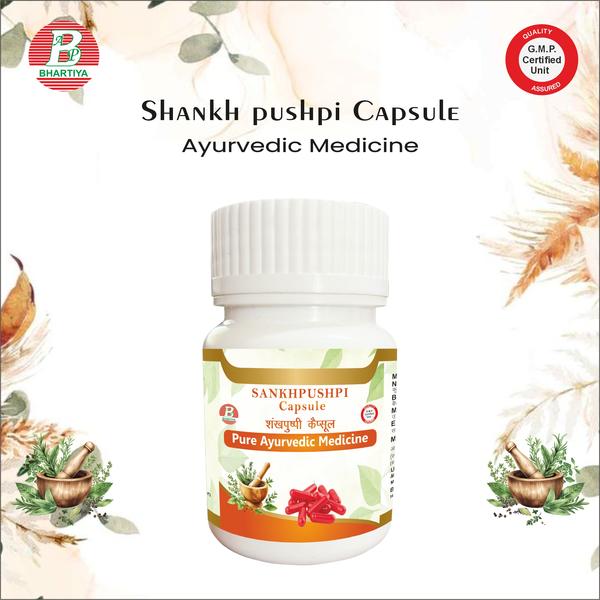
"name": "Shankh pushpi capsule",
"description": " ŚAṄKHAPUṢPI (Convolvulus pluricaulis Choisy)\n The Supreme Medhya Rasayana — Herb of Divine Wisdom, Memory & Mental Peace\n\n AN ANCIENT STORY OF ŚAṄKHAPUṢPĪ — THE HERB OF SARASWATI\nIn ancient times, during the era of the Rishis, it is said that Sage Medhavi, son of the great Rishi Chyavana, undertook intense penance to attain supreme knowledge, clarity of mind, and divine memory (Dhi, Dhriti, Smriti).\nDespite his efforts, the young sage struggled with distraction and mental exhaustion. Seeing his difficulty, Goddess Saraswati appeared before him holding a white conch (Śaṅkha) glowing with celestial light.\nShe touched the earth with the conch, and from that spot emerged a delicate blue-white flower shaped like a tiny conch shell — Sankhpushpi.\nThe Goddess said:\n“This is the herb of my blessing.\nIt calms the mind, sharpens intellect, lengthens memory,\nremoves fear, and fills the heart with peace.\nWhoever consumes Sankhpushpi with sincerity shall attain\nsteady Mind (Manas), deep Memory (Smriti), and pure Knowledge (Medha).”\nSage Medhavi consumed the herb daily, preparing its juice and ghee, and soon became renowned as one of the wisest sages, with unparalleled memory and intellect.\nThus, Sankhpushpi became celebrated in Ayurveda as the Medhya Rasayana gifted by Saraswati herself.\n BOTANICAL INFORMATION OF ŚAṄKHAPUṢPĪ\nScientific Name: Convolvulus pluricaulis \nSynonyms: Convolvulus microphyllus, Evolvulus alsinoides (commonly confused but traditionally distinct)\nFamily: Convolvulaceae\nOrder: Solanales\nGenus: Convolvulus\nSpecies: pluricaulis\n COMMON NAMES\n•\tSanskrit: Sankhpushpi, Saraswati, Mangalyakusuma, Medhya, Sumedha, Shankhini\n•\tHindi: Sankhpushpi\n•\tEnglish: Convolvulus / Aloe Weed\n•\tTamil: Vishnukranthi\n•\tTelugu: Sankhpushpi\n•\tMalayalam: Sankhupushpam\n•\tKannada: Shankhini\n•\tGujarati/Marathi: Sankhpushpi\n•\tBengali: Shankhapuli\n CLASSICAL AYURVEDIC SYNONYMS (FROM NIGHANTUS)\nCharaka Samhita\n•\tMedhya Rasayana (Superb brain tonic)\n•\tSmritivardhini (enhances memory)\nSushruta Samhita\n•\tBalya, Nidrajanaka, Mano-Anulomana\nBhavaprakasha Nighantu\n•\tSaraswati, Mangalyakusuma, Pragya-Vardhini\nDhanvantari Nighantu\n•\tŚaṅkhinī, Sumedha, Medhya\nAll synonyms emphasize intellect, calmness, happiness, purity of mind, and memory.\n MORPHOLOGY OF ŚAṄKHAPUṢPĪ\nHabit:\nSmall, perennial herb growing close to the ground, spreading extensively.\nStem:\nSlender, soft, hairy, branching, often forming mats.\nLeaves:\nSmall, narrow, linear-lanceolate, 1–2 cm long; green-grey.\nFlowers:\n•\tFunnel-shaped\n•\tBluish-violet or white\n•\tResemble a conch shell (Shankha), hence the name\nFruit:\nTiny ovoid capsule containing 2–4 seeds.\nRoot:\nThin, woody; used medicinally with the whole plant.\n ECOLOGICAL PREFERENCES\nClimate: Tropical & subtropical; thrives in heat\nSoil: Sandy, loamy, slightly alkaline soil\nIrrigation: Moderate; drought-tolerant\nHabitat: Dry open grasslands, Rocky plains, Roadsides, Cultivated areas\nAltitude: Sea level to 1,500 m\n\n GEOGRAPHICAL DISTRIBUTION\nIndia\nWidely distributed throughout: Uttar Pradesh, Rajasthan, Madhya Pradesh, Gujarat, Maharashtra, Tamil Nadu, Karnataka, Kerala.\nOutside India: -Nepal, Bangladesh, Sri Lanka, Myanmar, Thailand, Pakistan.\n CLASSICAL AYURVEDIC PROPERTIES\n(Rasa–Guna–Virya–Vipaka–Dosha Karma)\nRasa (Taste): Tikta (bitter), Kashaya (astringent)\nGuna (Quality): Laghu (light), Snigdha (unctuous)\nVirya (Potency): Śīta (cooling)\nVipaka (post-digestive effect): Madhura (sweet)\nEffect on Doshas:\n•\tPittashamaka\n•\tVata balancing\n•\tMildly reduces Kapha\n THERAPEUTIC ACTIONS (KARMA)\n1.\tMedhya Rasayana – Rejuvenates brain, enhances memory\n2.\tSmriti Vardhini – Improves retention & recall\n3.\tNidrajanana – Promotes healthy sleep\n4.\tManasa-Anulomana – Calms the nervous system\n5.\tAnxiolytic – Relieves anxiety, stress\n6.\tBalya – Strengthens mind & nerves\n7.\tHridaya – Calming cardiac tonic\n8.\tDipana-Pachana – Enhances digestion\n9.\tVedana Sthapana – Mild analgesic\n10.\tMedhya Rasayana – Anti-aging for the mind\n INDICATIONS\nNervous System: -Memory loss, Poor concentration, Learning disabilities, ADHD, Alzheimer’s support therapy, Epilepsy (adjunct), Anxiety, panic, stress, Mental fatigue, Depression (mild), Chronic insomnia, Irritability, anger.\nDigestive System: -Loss of appetite, Hyperacidity, IBS (stress-related)\nCardiac: -Stress-induced hypertension, Palpitations\nChildren’s Health: -Low grasping power, Exam stress, Forgetfulness\nReproductive: -System Enhances Shukra Dhatu, Supports hormonal balance in stress-induced menstrual issues\n MODERN PHYTOCHEMISTRY & PHARMACOLOGY\nMajor Constituents: -Flavonoids, Alkaloids: Convolvine, Convolamine, Convolidine, Ceryl alcohol, Scopoletin, β-sitosterol, Glycosides, Glucose, sucrose.\nPharmacological Actions\n•\tNootropic (brain-protective)\n•\tNeurodegenerative\n•\tAnxiolytic (anti-anxiety)\n•\tAntidepressant (mild)\n•\tSedative (natural, non-habit forming)\n•\tAnticonvulsant\n•\tAntioxidant\n•\tAnti-stress (adaptogenic)\n•\tImmunomodulatory\n CULTIVATION DETAILS\nPropagation: Seeds or cuttings\nSowing Time: February–April or June–August\nSoil: Well-drained sandy loam\nIrrigation: Light but regular\nFertilization: Organic manures preferred\nHarvesting:\n•\tWhole plant harvested during flowering\n•\tRoots collected separately\n CLASSICAL DOSAGE (According to Ayurvedic Granthas)\n•\tChurna (Powder): 2–6 g twice daily\n•\tSwarasa (Fresh juice): 10–20 ml\n•\tKwatha (Decoction): 40–60 ml\n•\tGhrita (Medicated ghee): 5–10 g\n•\tSyrup: 10–20 ml\n CLASSICAL AYURVEDIC FORMULATIONS CONTAINING ŚAṄKHAPUṢPĪ\n1.\tSaraswata Churna – For intellect & speech\n2.\tSankhpushpi Ghrita – Supreme brain tonic\n3.\tMedhya Rasayana – Memory rejuvenator\n4.\tBrahmi Sankhpushpi Syrup – Mental nourishment\n5.\tSmriti Sagar Ras – Chronic memory disorders\n6.\tPrashnashankhadi Yoga – Mental calmness\n7.\tBrahma Rasayana – Nerve rejuvenator\n Sankhpushpi (Convolvulus pluricaulis) Formulations – Bhartiya Ayurvedic Pharmacy \nBhartiya Ayurvedic Pharmacy prepares authentic Sankhpushpi-based formulations following classical Ayurvedic principles from Charaka Samhita, Sushruta Samhita, Bhavaprakasha, and Dhanvantari Nighantu. These products preserve Sankhpushpi full potency as a Medhya Rasayana, supporting memory, cognition, calmness, sleep, and nervous system strength.\n 1. SHANKHPUSHPI TABLET\nDescription\nSankhpushpi Tablet is a convenient and standardized formulation containing pure extract/powder of Sankhpushpi (Convolvulus pluricaulis).\nIt is specially designed for daily use to support memory, concentration, focus, stress relief, and restful sleep.\nKey Actions\n•\tMedhya Rasayana: Enhances intelligence, memory & learning\n•\tReduces stress, anxiety & restlessness\n•\tSupports healthy sleep\n•\tPromotes calmness of mind and mental clarity\n•\tStrengthens the nervous system\n•\tBeneficial for students, professionals & elderly\n•\tSupports cardiovascular calmness (reduces palpitation due to stress)\nDosage\n•\t1–2 tablets twice daily\n•\tBest taken after meals with warm water or milk\n•\tFor children (above 7 years): 1 tablet daily under supervision\n•\tFor insomnia/anxiety: 1 tablet at bedtime is beneficial\nPrecautions\n•\tAvoid overdose (may cause excess drowsiness)\n•\tMonitor if taking sedatives or BP-lowering medicines\n•\tPregnant & lactating women should use under guidance\n\n 2. SHANKHPUSHPI CAPSULE\nDescription\nSankhpushpi Capsule contains high-quality extract of Sankhpushpi in an easy-to-swallow form.\nIdeal for individuals seeking a standardized potency and improved absorption for brain health.\nKey Actions\n•\tPowerful nootropic: Boosts learning ability & concentration\n•\tSmritivardhini – Improves memory retention\n•\tReduces mental fatigue, brain fog & overthinking\n•\tCalms the mind and supports balanced emotional health\n•\tHelps maintain healthy blood pressure during stress\n•\tGood for students during exams and adults with high mental workload\n•\tSupports healthy sleep-wake cycles\nDosage\n•\t1 capsule twice daily with warm water\n•\tFor high stress or exam periods: 2 capsules daily\n•\tCan be taken for long-term rejuvenation\nPrecautions\n•\tDo not exceed recommended dose\n•\tMay enhance sedation if used with sleeping medicines\n•\tUse carefully in low blood pressure\n•\tConsult during pregnancy or chronic neurological illness\n 3. SHANKHPUSHPI POWDER (Sankhpushpi Churna)\nDescription\nPure, finely powdered whole plant of Sankhpushpi prepared traditionally.\nThis is the most classical way of consuming Sankhpushpi.\nKey Actions\n•\tSuperior Medhya Rasayana – rejuvenates brain cells\n•\tImproves memory, concentration & decision-making\n•\tPromotes deep relaxation & mental peace\n•\tBeneficial for insomnia, anxiety, excessive thinking\n•\tStrengthens nerves and mind\n•\tUseful in hyperacidity & stress-induced digestive issues\n•\tCalms Pitta & Vata doshas\nDosage: -1–3 g (½–1 teaspoon) twice daily\n•\tTake with:\no\tWarm milk for memory & brain health\no\tWarm water for stress/anxiety\no\tGhee for students and elderly\no\tHoney for speech & learning enhancement\nPrecautions\n•\tDo not take more than prescribed (may cause drowsiness)\n•\tAvoid during very low blood pressure\n•\tChildren should take under guidance\n•\tAvoid mixing with alcohol or sedative drugs\n4. Sankhpushpi Tail\nDescription\nSankhpushpi Tail is a traditional Ayurvedic herbal oil prepared using Sankhpushpi (Convolvulus pluricaulis) as the primary ingredient.\nIt is valued for its mind-calming, memory-enhancing, and nervine-strengthening properties.\nApplied externally, it supports relaxation, scalp nourishment, and mental clarity.\n Key Actions\n•\tMedhya Rasayana – promotes intelligence, memory & retention\n•\tHelps reduce stress, anxiety, and mental fatigue\n•\tCalms the mind and supports a balanced nervous system\n•\tNourishes the scalp and strengthens hair roots\n•\tHelps reduce scalp heat, restlessness, and disturbed sleep\n•\tSupports mental freshness and emotional well-being\n•\tUseful during high mental workload and long study hours\n Directions for Use\n•\tApply 2–3 teaspoonfuls of the oil to the scalp\n•\tMassage gently for 5–10 minutes\n•\tLeave for 1–2 hours or overnight; wash if needed\n•\tCan be used daily or 3–4 times per week\n Precautions\n•\tFor external use only unless otherwise advised by an Ayurvedic practitioner\n•\tAvoid use on infected or wounded scalp areas\n•\tStore in a cool, dry place away from direct sunlight\n•\tConsult a physician if you have chronic neurological illness or are pregnant\n\n BENEFITS OF BHARTIYA AYURVEDIC SANKHPUSHPĪ PRODUCTS\n•\t100% pure, authentic, and traditionally processed\n•\tFree from artificial flavors or preservatives\n•\tStandardized for potency\n•\tSuitable for long-term use\n•\tSafe for students, adults & elderly\n•\tNon-habit-forming natural brain tonic\t\n\n\nbest shankhpushpi, best shankhpushpi syrup, brahmi and shankhpushpi capsules\ndosage of shankhpushpi, health benefits of shankhpushpi\nhow does shankhpushpi work, how shankhpushpi works\nhow to take shankhpushpi powder, shankh pushpi capsule amazon\nshankh pushpi capsule ayurvedic, shankh pushpi capsule company name\nshankh pushpi capsule composition, shankh pushpi capsule contains\nshankh pushpi capsule cost, shankh pushpi capsule easy ayurveda\nshankh pushpi capsule effect, shankh pushpi capsule english\nshankh pushpi capsule english name, shankh pushpi capsule extract\nshankh pushpi capsule generic name, shankh pushpi capsule image\nshankh pushpi capsule in hindi, shankh pushpi capsule ingredients\nshankh pushpi capsule jankari, shankh pushpi capsule jankari in hindi\nshankh pushpi capsule manufacturer, shankh pushpi capsule manufacturers in india\nshankh pushpi capsule name, shankh pushpi capsule near me\nshankh pushpi capsule online, shankh pushpi capsule online order\nshankh pushpi capsule online purchase, shankh pushpi capsule online shopping\nshankh pushpi capsule original, shankh pushpi capsule qualification\nshankh pushpi capsule quantity, shankh pushpi capsule recipe\nshankh pushpi capsule recipe in hindi, shankh pushpi capsule review\nshankh pushpi capsule use, shankh pushpi capsule uses in hindi\nshankh pushpi capsule which company, shankh pushpi capsule which company is best\nshankhpushpi capsules",
"price": 300.0,
"discountamount": 150.0,
"currencycode": "INR",
"priority": 1000000,
"isfreeshipmentavailable": false,
"shipmentduration": 1,
"_keywords": null,
"isarchived": false,
"isavailable": true,
"applicationid": null,
"productindex": 71,
"imageuri": "https://productimages.withfloats.com/actual/69a91c696a06377ef522c4dd.jpg",
"tileimageuri": "https://productimages.withfloats.com/tile/69a91c696a06377ef522c4dd.jpg",
"images": null,
"totalqueries": 0,
"gpid": null,
"groupproductid": null,
"createdon": "2026-03-05T06:02:15.179Z",
"updatedon": "2026-03-05T06:02:15.179Z",
"buyonlinelink": null,
"producturl": "http://WWW.BHARTIYAAYURVEDICPHARMACY.COM/products/shankh-pushpi-capsule/71",
"availableunits": -1.0,
"iscodavailable": true,
"isprepaidonlineavailable": true,
"maxcodorders": -1,
"maxprepaidonlineorders": -1,
"uniquepaymenturl": null,
"brandname": "Bakula fort",
"category": "Shankh pushpi capsule 60 - cap X 24",
"tags": [],
"variants": false,
"keyspecification": null,
"otherspecifications": null,
"pickupaddressreferenceid": null,
"paymenttype": "AssuredPurchase",
"producttype": "products",
"hsncode": null,
"gstslab": 0.0,
"isnotforsale": false
},
{
"_id": "698c4c5cae6697176621053e",
"fptag": "BHARTIYEAYURVEDICPHARMACY",
"merchantname": null,
"customwidgets": null,
"externalsourceid": null,
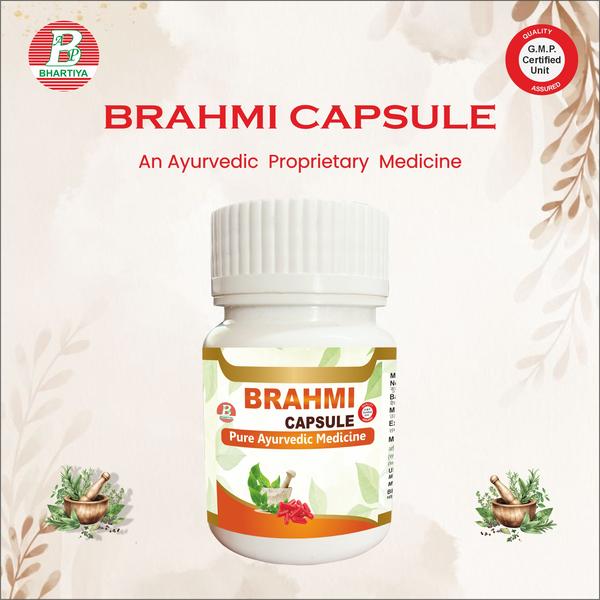
"name": "Brahmi Capsule",
"description": " Brahmi (Bacopa monnieri) \n The Ancient Rejuvenating Herb for Mind, Memory, and Nervous System\n\nBrahmi is one of the most revered herbs in Ayurveda, prized for its profound effects on cognition, memory, intellect, and mental resilience. The name Brahmi derives from Brahma, the creator, symbolizing its connection to higher mental faculties and spiritual insight.\nIn Ayurveda, Brahmi is classified as a Medhya Rasayana (intellect and memory enhancer), Shukra-Vardhaka (reproductive tissue supporter), and Rasayana (rejuvenative). It is highly valued for improving memory, concentration, calming the mind, reducing mental fatigue and anxiety, supporting the nervous system, and promoting longevity.\nThe herb has a rich historical background, documented in classical Ayurvedic texts for thousands of years, highlighting its role in enhancing mental faculties, cognition, and overall vitality.\n Historical Study and Classical References\n1. Charaka Samhita\n•\tAcharya Charaka describes Brahmi as a Medhya Rasayana that strengthens intellect, improves memory, and sharpens mental faculties.\n•\tRecommended for Manasika Vikara (mental disorders), nervous system weakness, and stress-related conditions.\n•\tClassical Dosage: 3–6 g of root/whole plant powder (Churna); decoction (Kwatha) 40–60 ml, 2–3 times daily.\n2. Sushruta Samhita\n•\tAcharya Sushruta emphasizes Brahmi in Manas-Roga Chikitsa (mental disorder treatment) and as a rejuvenative for the nervous system.\n•\tForms: root/whole plant paste, powder, decoction.\n•\tUses: Memory enhancement, calming overactive mind, improving mental clarity.\n3. Bhavaprakasha Nighantu\n•\tBrahmi listed under Medhya and Smritivardhini categories.\n•\tVariants: Wild vs. cultivated forms; leaf quality and flowering stage noted for potency.\n•\tSynonyms: Brahmaka, Medhya, Smritivardhini, Haritaki-brahmi.\n4. Raja Nighantu & Dhanvantari Nighantu\n•\tBrahmi described as Medhya and Jivaniya, improving intelligence, longevity, and mental function.\n•\tUsed in compound formulations for cognitive enhancement, stress reduction, and rejuvenation.\n5. Classical Ayurvedic Formulations\n•\tBrahmi Ghrita / Taila: Nourishes the brain, calms the mind, improves memory.\n•\tBrahmi Churna / Tablet / Capsule: For cognitive support, memory, and mental clarity.\n•\tMedhya Rasayana Compounds: Brahmi often combined with Shankhpushpi, Ashwagandha, and Vacha for brain tonics.\n Botanical Information of Brahmi\n•\tScientific Name: Bacopa monnieri (L.) Wettst.\n•\tFamily: Plantaginaceae\n•\tOrder: Lamiales\n•\tGenus: Bacopa\n•\tSpecies: monnieri\nCommon Names:\n•\tSanskrit: Brahmī, Medhya, Smritivardhini\n•\tHindi: Brahmi\n•\tEnglish: Water Hyssop, Herb of Grace\n•\tTamil: Brahmi, Neer Brahmi\n•\tTelugu: Brahmi\n•\tMalayalam: Brahmi\n•\tKannada: Brahmi\n•\tBengali: Brahmi\nSynonyms in Ayurvedic Nighantus:\n•\tBhavaprakasha Nighantu – Brahmi, Medhya, Smritivardhini\n•\tRaja Nighantu – Brahmaka, Jivaniya\n•\tDhanvantari Nighantu – Medhya, Smritivardhaka\n Morphology of Brahmi\n•\tPlant Type: Perennial, creeping, succulent herb\n•\tStem: Creeping, quadrangular, green, slightly succulent\n•\tLeaves: Opposite, small, oblong to spatulate, fleshy, light green\n•\tFlowers: Small, white to light purple, axillary cymes, bloom during warm seasons\n•\tRoots: Fibrous, white\n•\tFruits: Capsule, ovoid, containing tiny seeds\n•\tHabit: Creeping, spreading, fast-growing, regenerates easily\n Ecological Preferences\n•\tClimate: Tropical and subtropical; tolerates heat and moderate drought\n•\tSoil: Sandy, loamy, marshy, wet soils; thrives in marshes and near water bodies\n•\tSunlight: Full sun to partial shade\n•\tMoisture: Prefers moist conditions; hardy to dry periods\n•\tAltitude: Low to medium elevations\n•\tHabitat: Marshes, wetlands, riverbanks, paddy fields, gardens\n\n Distribution\n•\tIndia: Found across the country in wetlands, paddy fields, marshes\n•\tAsia: Sri Lanka, Nepal, Bangladesh, Myanmar\n•\tGlobal: Naturalized in tropical/subtropical regions worldwide due to hardy growth\n\n Classical Ayurvedic Properties\n•\tRasa (Taste): Tikta (bitter)\n•\tGuna (Qualities): Laghu (light), Snigdha (slightly oily)\n•\tVirya (Potency): Shita (cooling)\n•\tVipaka: Madhura (sweet)\n•\tDosha Effect: Kapha-Vata pacifying\n•\tKarma (Actions / Therapeutic Effects):\no\tMedhya – Enhances memory and intellect\no\tRasayana – Rejuvenative, anti-aging\no\tHridya – Supports heart function\no\tShukra-Vardhaka – Supports reproductive tissue\no\tVata-Kapha pacifying – Reduces neurological weakness\n\n Therapeutic Actions According to Acharyas\n1.\tMedhya (Nootropic): Improves memory, cognition, and focus\n2.\tRasayana (Rejuvenative): Enhances vitality, immunity, and longevity\n3.\tManah-Shamana: Reduces anxiety, stress, and mental fatigue\n4.\tHridya: Supports cardiovascular health\n5.\tShukra-Vardhaka: Improves reproductive tissue quality\n6.\tVata-Kapha Balancing: Useful in neurological weakness, tremors, fatigue\n\n Modern Phytochemistry\n•\tBacosides (A & B): Cognitive enhancement, neuroprotective\n•\tAlkaloids: Nervine tonic\n•\tFlavonoids (Apigenin, Luteolin): Antioxidant, anti-inflammatory, neuroprotective\n•\tSaponins: Brain rejuvenation, memory support\n\n Classical Dosage\n•\tPowder (Churna): 3–6 g/day\n•\tDecoction (Kwatha): 40–60 ml, 2–3 times daily\n•\tJuice (Swarasa): 10–20 ml, 1–2 times daily\n•\tTaila / Ghrita: External application or oral use as per formulation\nPrecautions: Safe in classical dosage; pregnant/lactating women under supervision; avoid overdose.\n\n Classical Ayurvedic Formulations of Brahmi\n1.\tBrahmi Ghrita / Taila: Brain nourishment, mental calmness, memory enhancement\n2.\tBrahmi Churna / Tablet / Capsule: Cognitive support, stress reduction\n3.\tBrahmi Kwatha: Nervous system support, memory enhancement\n4.\tMedhya Rasayana Compounds: With Shankhpushpi, Ashwagandha, Vacha for brain tonics\n5.\tCompound Formulations: Brahmi included in brain tonics, rejuvenative preparations, and nervous system revitalizers\n\n Brahmi Formulations by Bhartiya Ayurvedic Pharmacy\nAt Bhartiya Ayurvedic Pharmacy, we prepare a range of Brahmi (Bacopa monnieri) formulations following classical Ayurvedic methods as described in Charaka Samhita, Sushruta Samhita, Bhavaprakasha Nighantu, and other Ayurvedic Granthas. Each product is crafted to retain the therapeutic potency, purity, and efficacy of the herb, ensuring benefits for memory enhancement, cognitive support, nervous system health, stress relief, and overall mental rejuvenation.\n\n Brahmi Capsule\nDescription: Brahmi Capsule contains high-quality standardized extract of Bacopa monnieri in an easy-to-swallow form for optimal absorption.\nKey Actions: \n•\tEnhances learning ability, concentration, and memory retention.\n•\tReduces mental fatigue, brain fog, and overthinking\n•\tCalms the mind and supports balanced emotional health\n•\tSupports healthy sleep-wake cycles\n\nDosage:\n•\t1 capsule twice daily with warm water after meals\n•\tFor high stress or exam periods: 2 capsules daily\n•\tCan be taken for long-term brain rejuvenation\nPrecautions:\n•\tDo not exceed recommended dose\n•\tMay enhance sedation if used with sleeping medicines\n•\tConsult during pregnancy, lactation, or chronic neurological illness\n\n Brahmi Powder (Churna)\nDescription: Pure Brahmi powder for traditional Ayurvedic use, ideal for decoctions, smoothies, or milk-based preparations.\nKey Actions:\n•\tSupports memory, cognition, and overall nervous system health\n•\tActs as a Rasayana (rejuvenative) for the brain\n•\tReduces stress, anxiety, and mental fatigue\nDosage:\n•\t3–6 grams daily with water, milk, or honey\n•\tCan be used as decoction: 40–60 ml, 1–2 times daily\nPrecautions:\n•\tAvoid overdose\n•\tUse under supervision during pregnancy or neurological disorders\n Brahmi Amla Taila\n\nDescription: Medicated herbal oil prepared with Brahmi and Amla (Indian gooseberry) for external application or internal use as per classical Ayurvedic methods.\nKey Actions:\n•\tNourishes brain tissues and supports the nervous system\n•\tEnhances memory, mental clarity, and concentration\n•\tReduces stress and promotes calmness\n•\tSupports hair and scalp health when applied topically\nDosage:\n•\tApply externally as needed\n•\tFor internal use, take as directed by an Ayurvedic practitioner\nPrecautions:\n•\tAvoid excessive use\n•\tConsult a physician during pregnancy, lactation, or neurological conditions\n\n\nbenefits of brahmi capsule, best brahmi capsules, best brahmi supplement\nbest time to take brahmi capsule, brahmi amla capsules\nbrahmi ashwagandha capsule, brahmi capsule amazon\nbrahmi capsule awpl price, brahmi capsule ayurvedic\nbrahmi capsule benefits, brahmi capsule benefits in hindi\nbrahmi capsule dosage, brahmi capsule for kids\nbrahmi capsule ke fayde, brahmi capsule khane ke fayde\nbrahmi capsule kis kam aata hai, brahmi capsule price\nbrahmi capsule price in india, brahmi capsule side effects\nbrahmi capsule uses, brahmi capsule uses in hindi\nbrahmi capsules 500mg, brahmi capsules benefits\nbrahmi capsules benefits for hair, brahmi capsules benefits in hindi\nbrahmi capsules dosage, brahmi capsules india\nbrahmi capsules ingredients, brahmi capsules kerala ayurveda\nbrahmi capsules near me, brahmi capsules online\nbrahmi capsules organic, brahmi capsules organic india\nbrahmi capsules review, brahmi capsules side effects\nbrahmi capsules uk, brahmi capsules uses, brahmi capsules uses in hindi\nbrahmi extract capsule, brahmi extract capsule awpl\nbrahmi extract capsule awpl price, brahmi extract capsules\nbrahmi extract capsules uses in hindi, brahmi ghrita capsule\nbrahmi gold capsule, brahmi ke capsule, brahmi mind capsule\nbrahmi mind capsule benefits, brahmi mind capsule benefits in hindi\nbrahmi mind capsule herbal, brahmi mind capsule hindi\nbrahmi mind capsule in hindi, brahmi mind capsule ke fayde\nbrahmi mind capsule ke fayde in hindi, brahmi mind capsule price",
"price": 360.0,
"discountamount": 180.0,
"currencycode": "INR",
"priority": 1000000,
"isfreeshipmentavailable": false,
"shipmentduration": 1,
"_keywords": null,
"isarchived": false,
"isavailable": true,
"applicationid": null,
"productindex": 53,
"imageuri": "https://productimages.withfloats.com/actual/698c4c5e6a6c506fb8d6de8b.jpg",
"tileimageuri": "https://productimages.withfloats.com/tile/698c4c5e6a6c506fb8d6de8b.jpg",
"images": null,
"totalqueries": 0,
"gpid": null,
"groupproductid": null,
"createdon": "2026-02-11T09:31:08.072Z",
"updatedon": "2026-02-18T05:39:19.501Z",
"buyonlinelink": null,
"producturl": "http://WWW.BHARTIYAAYURVEDICPHARMACY.COM//brahmi-capsule/53",
"availableunits": -1.0,
"iscodavailable": true,
"isprepaidonlineavailable": true,
"maxcodorders": -1,
"maxprepaidonlineorders": -1,
"uniquepaymenturl": null,
"brandname": "Bakula Fort",
"category": "Brahmi Capsule 60 Cap X 24",
"tags": [],
"variants": false,
"keyspecification": null,
"otherspecifications": null,
"pickupaddressreferenceid": null,
"paymenttype": "AssuredPurchase",
"producttype": "products",
"hsncode": null,
"gstslab": 0.0,
"isnotforsale": false
},
{
"_id": "6abb61db513312a8b8627ec3",
"fptag": "BHARTIYEAYURVEDICPHARMACY",
"merchantname": null,
"customwidgets": null,
"externalsourceid": null,
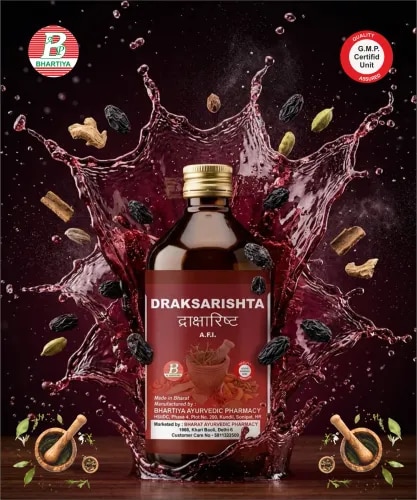
"name": "DRAKSHARISHTA",
"description": "\n DRAKSHARISHTA\n\n\nProduct Identification\nGeneric Name: Draksharishta\nType: Ayurvedic Polyherbal Fermented Formulation (Arishta)\nPrimary Indication Area: Digestive tonic, restorative tonic, mild cardiotonic, and respiratory support formulation.\n\nTherapeutic Indications\n• General debility and fatigue\n• Loss of appetite (Aruchi)\n• Chronic indigestion and weak digestion (Agnimandya)\n• Anaemia and weakness associated with chronic illness\n• Respiratory weakness and chronic cough (supportive)\n• Convalescence after fever and infection\n• Constipation associated with debility\n• Cardiac weakness (supportive use)\n• Low energy and poor nutritional status\n• Elderly weakness and recovery support\n\nKey Benefits\n• Acts as a nourishing and restorative tonic\n• Improves digestion and appetite\n• Supports healthy bowel function\n• Enhances strength and vitality\n• Helps reduce fatigue and exhaustion\n• Supports respiratory health\n• Mild cardiotonic and rejuvenative action\n• Promotes recovery after illness\n\nFORMULA\nMain Decoction Drugs (Kwatha Dravyas)\n• Draksha (Vitis vinifera – Raisins) – 4.800 kg\n• Water – 49.152 L reduced to approximately 12.288 L\n\nPrakshepa Dravyas\n• Tvak (Cinnamomum verum) – 48 g\n• Ela (Elettaria cardamomum) – 48 g\n• Patra (Cinnamomum tamala) – 48 g\n• Nagakesara (Mesua ferrea) – 48 g\n• Maricha (Piper nigrum) – 48 g\n• Pippali (Piper longum) – 48 g\n• Shunthi (Zingiber officinale) – 48 g\n• Dhataki Pushpa (Woodfordia fruticosa) – 768 g (or as per classical reference)\n\nFermentation Base\n• Guda (Jaggery) – 9.600–14.400 kg (varies by reference)\n• Dhataki Pushpa – natural fermentation starter\n• Decoction of Draksha\n\nKey Ingredient Actions\n\n1. Draksha (Vitis vinifera)\nRasa: Madhura\nGuna: Guru, Snigdha\n Virya: Sheeta\nVipaka: Madhura\n Prabhava: Brimhana, Raktavardhaka\nMechanism of Action:\nProvides nourishment and energy\nSupports hemoglobin and blood health\n Reduces fatigue and weakness\nMild laxative effect helps bowel regularity\n Supports respiratory and cardiovascular health\n\n2. Shunthi (Zingiber officinale)\nRasa: Katu\nGuna: Laghu, Ruksha\nVirya: Ushna\n\n Vipaka: Madhura\nMechanism of Action:\nImproves digestion and appetite\nEnhances circulation\n Reduces bloating and indigestion\n Supports respiratory function\n Improves absorption of nutrients\n\n3. Pippali (Piper longum)\nRasa: Katu\nGuna: Laghu, Snigdha\nVirya: Anushna-Ushna\nVipaka: Madhura\nMechanism of Action:\nImproves bioavailability of herbal constituents\nEnhances digestive strength\n Supports respiratory health\nHelps reduce chronic weakness\n Acts as rejuvenative support\n\n4. Maricha (Piper nigrum)\nRasa: Katu\nGuna: Laghu, Tikshna\nVirya: Ushna\n Vipaka: Katu\nMechanism of Action:\nStimulates digestion and metabolism\nImproves nutrient absorption\nReduces Ama (metabolic toxins)\nSupports respiratory clearance\nEnhances circulation\n\n5. Tvak (Cinnamomum verum)\nRasa: Katu, Tikta, Madhura\nGuna: Laghu, Tikshna\nVirya: Ushna\nVipaka: Katu\nMechanism of Action:\nImproves digestion and appetite\n Supports circulation\n Provides antioxidant activity\n Reduces abdominal discomfort\nEnhances flavor and palatability\n\n6. Ela (Elettaria cardamomum)\nRasa: Madhura, Katu\nGuna: Laghu\nVirya: Sheeta\nVipaka: Madhura\nMechanism of Action:\nReduces bloating and nausea\n Improves digestion\nSupports respiratory comfort\nEnhances aroma and taste\nPromotes appetite\n\n7. Nagakesara (Mesua ferrea)\nRasa: Kashaya, Tikta\nGuna: Laghu, Ruksha\nVirya: Sheeta\nVipaka: Katu\nMechanism of Action:\nSupports blood health\nReduces inflammation\nHelps maintain tissue integrity\nMild hemostatic action\nSupports overall vitality\n8. Dhataki (Woodfordia fruticosa)\nRasa: Kashaya\nGuna: Laghu, Ruksh\nVirya: Ushna\nVipaka: Katu\nPrabhava: Sandhana Karaka\nMechanism of Action:\nNatural fermentation catalyst\nSupports formation of self-generated alcohol\nImproves extraction of active constituents\nEnhances stability and shelf life\nIncreases bioavailability\n \nDosage\nAdults: 15–30 ml\nTwice daily after meals\nDilute with equal quantity of water\n\nCommon Usage Guidance\nUsed as a restorative tonic after illness\nBeneficial in weakness, fatigue, and poor digestion\nSupports respiratory and cardiovascular function\n Commonly prescribed for 4–12 weeks depending on condition\nBest taken after food\n\nImportant Notes \nContains jaggery and naturally generated alcohol due to fermentation\n Use cautiously in diabetes\n Not recommended during pregnancy unless prescribed by a qualified practitioner\nShould be used under Ayurvedic supervision in chronic illnesses\nStore in a cool, dry place and keep tightly closed\n\n",
"price": 170.0,
"discountamount": 85.0,
"currencycode": "INR",
"priority": 1000000,
"isfreeshipmentavailable": false,
"shipmentduration": 1,
"_keywords": null,
"isarchived": false,
"isavailable": true,
"applicationid": null,
"productindex": 181,
"imageuri": "https://productimages.withfloats.com/actual/6abb62182d637d02c37b43ac.jpg",
"tileimageuri": "https://productimages.withfloats.com/tile/6abb62182d637d02c37b43ac.jpg",
"images": null,
"totalqueries": 0,
"gpid": null,
"groupproductid": null,
"createdon": "2026-09-29T06:59:39.1Z",
"updatedon": "2026-09-29T06:59:39.1Z",
"buyonlinelink": null,
"producturl": "http://WWW.BHARTIYAAYURVEDICPHARMACY.COM//draksharishta/181",
"availableunits": -1.0,
"iscodavailable": true,
"isprepaidonlineavailable": true,
"maxcodorders": -1,
"maxprepaidonlineorders": -1,
"uniquepaymenturl": null,
"brandname": "Bakula Fort",
"category": "DRAKSHARISHTA 450 ML X 40",
"tags": [],
"variants": false,
"keyspecification": null,
"otherspecifications": null,
"pickupaddressreferenceid": null,
"paymenttype": "AssuredPurchase",
"producttype": "products",
"hsncode": null,
"gstslab": 0.0,
"isnotforsale": false
},
{
"_id": "6a7af152dc4cc98142dd8d64",
"fptag": "BHARTIYEAYURVEDICPHARMACY",
"merchantname": null,
"customwidgets": null,
"externalsourceid": null,
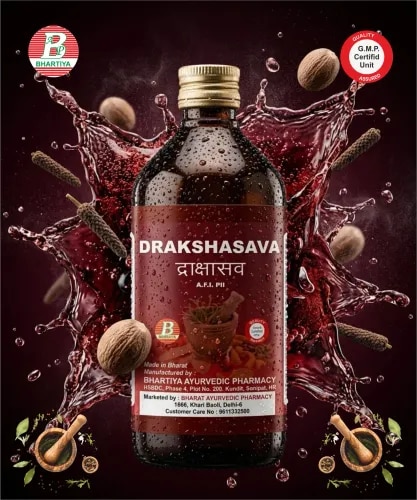
"name": "DRAKSHAASAVA",
"description": " DRAKSHAASAVA\n \n\nProduct Identification\nGeneric Name: Drakshaasava (Drakshasava)\nType: Ayurvedic Polyherbal Fermented Formulation (Asava)\nPrimary Indication Area: Digestive tonic, restorative tonic, blood-supportive tonic, and rejuvenative formulation.\n\nTherapeutic Indications\n• General debility and fatigue\n• Loss of appetite (Aruchi)\n• Chronic indigestion and weak digestion (Agnimandya)\n• Anaemia and weakness associated with chronic illness\n• Convalescence after fever and infection\n• Mild constipation associated with debility\n• Nutritional deficiency and poor strength\n• Respiratory weakness and chronic cough (supportive use)\n• Elderly weakness and recovery support\n• Low body weight and poor vitality\n\nKey Benefits\n• Acts as a nourishing and restorative tonic\n• Improves digestion and appetite\n• Supports healthy blood formation\n• Enhances strength and vitality\n• Helps reduce fatigue and exhaustion\n• Supports healthy bowel function\n• Promotes recovery after illness\n• Supports respiratory health\n• Improves overall nutritional status\n\nFORMULA\nMain Ingredients\n• Draksha (Vitis vinifera – Raisins) – 4.800 kg\n• Water – sufficient quantity for extraction\nSweetening and Fermentation Base\n• Guda (Jaggery) – 9.600–14.400 kg (as per reference)\n• Madhu (Honey) – quantity as per classical reference (where applicable)\n• Dhataki Pushpa (Woodfordia fruticosa) – 768 g\nPrakshepa Dravyas\n• Tvak (Cinnamomum verum) – 48 g\n• Ela (Elettaria cardamomum) – 48 g\n• Patra (Cinnamomum tamala) – 48 g\n• Nagakesara (Mesua ferrea) – 48 g\n• Maricha (Piper nigrum) – 48 g\n• Pippali (Piper longum) – 48 g\n• Shunthi (Zingiber officinale) – 48 g\n\nKey Ingredient Actions\n1.Draksha (Vitis vinifera)\n\nRasa: Madhura\nGuna: Guru, Snigdha\nVirya: Sheeta\n Vipaka: Madhura\n Prabhava: Brimhana, Raktavardhaka\nMechanism of Action:\n• Provides nourishment and energy\n• Supports blood health and vitality\n• Helps reduce fatigue and weakness\n• Mild laxative action supports bowel regularity\n• Supports respiratory and cardiovascular health\n\n2. Shunthi (Zingiber officinale)\nRasa: Katu\n Guna: Laghu, Ruksha\nVirya: Ushna\nVipaka: Madhura\nMechanism of Action:\n• Improves digestion and appetite\n• Enhances circulation\n• Reduces bloating and indigestion\n• Supports respiratory function\n• Improves nutrient assimilation\n\n3. Pippali (Piper longum)\nRasa: Katu\n Guna: Laghu, Snigdha\n Virya: Anushna-Ushna\n Vipaka: Madhura\nMechanism of Action:\n• Enhances digestive strength\n• Improves bioavailability of herbal constituents\n• Supports respiratory health\n• Helps reduce chronic weakness\n• Acts as rejuvenative support\n\n4. Maricha (Piper nigrum)\nRasa: Katu\nGuna: Laghu, Tikshna\nVirya: Ushna\n Vipaka: Katu\nMechanism of Action:\n• Stimulates digestion and metabolism\n• Improves nutrient absorption\n• Reduces Ama (metabolic toxins)\n• Supports respiratory clearance\n• Enhances circulation\n\n5. Tvak (Cinnamomum verum)\nRasa: Katu, Tikta, Madhura\n Guna: Laghu, Tikshna\n Virya: Ushna\nVipaka: Katu\nMechanism of Action:\n• Improves digestion and appetite\n• Supports circulation\n• Provides antioxidant activity\n• Reduces abdominal discomfort\n• Enhances flavor and palatability\n\n6. Ela (Elettaria cardamomum)\nRasa: Madhura, Katu\nGuna: Laghu\nVirya: Sheeta\nVipaka: Madhura\nMechanism of Action:\n• Reduces bloating and nausea\n• Improves digestion\n• Supports respiratory comfort\n• Enhances aroma and taste\n• Promotes appetite\n\n7. Nagakesara (Mesua ferrea)\nRasa: Kashaya, Tikta\n Guna: Laghu, Ruksha\nVirya: Sheeta\nVipaka: Katu\nMechanism of Action:\n• Supports blood health\n• Helps maintain tissue integrity\n• Reduces inflammation\n• Supports overall vitality\n• Provides restorative support\n\n8. Dhataki (Woodfordia fruticosa)\nRasa: Kashaya\nGuna: Laghu, Ruksha\n Virya: Ushna\n Vipaka: Katu\n Prabhava: Sandhana Karaka\nMechanism of Action:\n• Natural fermentation catalyst\n• Supports self-generated alcohol formation\n• Improves extraction of active constituents\n• Enhances stability and shelf life\n• Increases bioavailability\n\nDosage\n• Adults: 15–30 ml\n• Twice daily after meals\n• Dilute with equal quantity of water\n\nCommon Usage Guidance\n• Used as a restorative tonic after illness\n• Beneficial in weakness, fatigue, and poor digestion\n• Supports healthy blood formation and vitality\n• Commonly prescribed for 4–12 weeks depending on condition\n• Best taken after food\n\nImportant Notes\n• Contains jaggery, honey, and naturally generated alcohol due to fermentation\n• Use cautiously in diabetes\n• Not recommended during pregnancy unless prescribed by a qualified practitioner\n• Should be used under Ayurvedic supervision in chronic illnesses\n• Store in a cool, dry place and keep tightly closed\n• Keep out of reach of children\n• Shake well before use if recommended by the manufacturer\n\n\n\ndrakshasava, drakshasava uses in hindi, drakshasava benefits in hindi\ndrakshasava uses, drakshasava syrup, drakshasava price\ndrakshasava syrup uses, drakshasava benefits, drakshasava ayurvedic medicine\ndrakshasava ayurvedic medicine uses in hindi, drakshasava ayurvedic\ndrakshasava ayurvedic syrup, drakshasava ayurvedic medicine hindi\ndrakshasava amazon, drakshasava ayurvedic medicine uses\ndrakshasava buy online, drakshasava best brand, drakshasava benefits in english\ndrakshasava contains alcohol, drakshasava churna, drakshasava che fayde\ndrakshasava for child, drakshasava dabur syrup uses in hindi, drakshasava dose\ndrakshasava in english, when to take drakshasava, drakshasava for liver\ndrakshasava for skin, drakshasava for weight gain, drakshasava for kids\ndrakshasava for weight loss, drakshasava fayde, drakshasava for acidity\n drakshasava for cough, drakshasava glass bottle, drakshasava how to take,\ndrakshasava hindi use, drakshasava use, benefits of drakshasava in hindi\ndrakshasava kya hai, drakshasava ingredients, drakshasava in hindi\ndrakshasava ingredients in hindi, drakshasava indication, drakshasava images\ndrakshasava in cough, drakshasava juice, drakshasava ke fayde, drakshasava ke upyog\ndrakshasava ke labh, drakshasava ke fayde in hindi, drakshasava kis kaam aata hai\ndrakshasava kya kam karta hai, drakshasava lohasava syrup, drakshasava lene ke fayde\ndrakshasava meaning in hindi, drakshasava medicine uses in hindi, drakshasava marathi\ndrakshasava medicine, drakshasava meaning, drakshasava medicine uses, drakshasava mrp\ndrakshasava near me, drakshasava syrup near me, drakshasava online, benefits of drakshasava\nuses of drakshasava, benefits of drakshasava syrup, drakshasava price in india\ndrakshasava rate, drakshasava syrup benefits, drakshasava syrup in hindi\ndrakshasava syrup price, what does drakshasava do, where drakshasava\nwhen drakshasava, how to take drakshasava, why drakshasava\nwho drakshasava, is drakshasava good for sleep, is drakshasava good for liver\nis drakshasava good for diabetes, is drakshasava alcohol\nis drakshasava and draksharishta same, is drakshasava wine\nis drakshasava good for cough, is drakshasava good for acidity\nis drakshasava good for health, can we take drakshasava daily\nshould drakshasava, will drakshasava, was drakshasava\nbest drakshasava syrup, best drakshasava, top drakshasava",
"price": 170.0,
"discountamount": 135.0,
"currencycode": "INR",
"priority": 1000000,
"isfreeshipmentavailable": false,
"shipmentduration": 1,
"_keywords": null,
"isarchived": false,
"isavailable": true,
"applicationid": null,
"productindex": 166,
"imageuri": "https://productimages.withfloats.com/actual/6a7af1547d36c41d87d8e5de.jpg",
"tileimageuri": "https://productimages.withfloats.com/tile/6a7af1547d36c41d87d8e5de.jpg",
"images": null,
"totalqueries": 0,
"gpid": null,
"groupproductid": null,
"createdon": "2026-08-11T09:54:26.703Z",
"updatedon": "2026-08-11T12:11:05.313Z",
"buyonlinelink": null,
"producturl": "http://WWW.BHARTIYAAYURVEDICPHARMACY.COM//drakshaasava/166",
"availableunits": -1.0,
"iscodavailable": true,
"isprepaidonlineavailable": true,
"maxcodorders": -1,
"maxprepaidonlineorders": -1,
"uniquepaymenturl": null,
"brandname": "BAKULA FORT",
"category": "DRAKSHAASAVA 450 ML X 170",
"tags": [],
"variants": false,
"keyspecification": null,
"otherspecifications": null,
"pickupaddressreferenceid": null,
"paymenttype": "AssuredPurchase",
"producttype": "products",
"hsncode": null,
"gstslab": 0.0,
"isnotforsale": false
},
{
"_id": "6a6069dca338caae77fcc9a0",
"fptag": "BHARTIYEAYURVEDICPHARMACY",
"merchantname": null,
"customwidgets": null,
"externalsourceid": null,
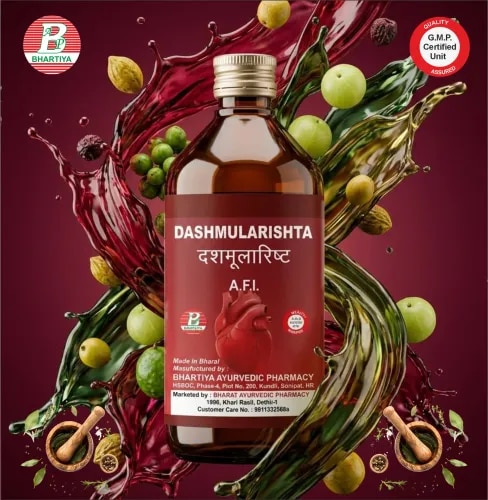
"name": "DASHMULARISHTA",
"description": " DASHMULARISHTA\n\n\nProduct Identification\nGeneric Name: Dashmularishta\nType: Ayurvedic Polyherbal Fermented Formulation (Arishta)\nPrimary Indication Area: Primarily used as a rejuvenative and restorative tonic for postpartum care, Vata disorders, inflammatory conditions, musculoskeletal weakness, nervous system disorders, and recovery following chronic illness. It is widely indicated for general debility, fever recovery, respiratory weakness, digestive impairment, and gynecological disorders associated with Vata imbalance.\n\nTherapeutic Indications\n•\tGeneral debility (Daurbalya) \n•\tPostpartum care (Sutika Paricharya) \n•\tVata disorders (Vatavyadhi) \n•\tChronic inflammatory conditions \n•\tMusculoskeletal weakness \n•\tJoint pain and stiffness \n•\tLow back pain \n•\tNeuralgia and neuropathic discomfort \n•\tConvalescence following prolonged illness \n•\tRespiratory weakness and chronic cough \n•\tFever recovery \n•\tDigestive weakness and poor appetite \n•\tGynecological disorders associated with Vata imbalance \n•\tFatigue and reduced stamina \n•\tAge-related decline in strength and vitality \n\nKey Benefits\n•\tSupports healthy musculoskeletal and nervous system function. \n•\tPromotes recovery following childbirth and prolonged illness. \n•\tHelps reduce inflammation and joint discomfort. \n•\tImproves physical strength and endurance. \n•\tSupports healthy respiratory function. \n•\tEnhances digestion and metabolism. \n•\tPromotes healthy immune function. \n•\tSupports uterine health during the postpartum period. \n•\tActs as a Rasayana for restoring vitality. \n•\tProvides antioxidant protection against oxidative stress. \n\nFORMULA\nEach part contains:\n•\tBilva (Aegle marmelos) \n•\tShyonaka (Oroxylum indicum) \n•\tGambhari (Gmelina arborea) \n•\tPatala (Stereospermum suaveolens) \n•\tAgnimantha (Clerodendrum phlomidis) \n•\tShalaparni (Desmodium gangeticum) \n•\tPrishniparni (Uraria picta) \n•\tBrihati (Solanum indicum) \n•\tKantakari (Solanum xanthocarpum)\n•\tGokshura (Tribulus terrestris) \n•\tChitraka (Plumbago zeylanica) \n•\tPushkara (Inula racemosa) \n•\tLodhra (Symplocos racemosa) \n•\tGuduchi (Tinospora cordifolia) \n•\tAmalaki (Phyllanthus emblica) \n•\tDhanvayasa (Fagonia cretica) \n•\tKhadira (Acacia catechu) \n•\tKustha (Saussurea lappa) \n•\tManjistha (Rubia cordifolia) \n•\tDevadaru (Cedrus deodara) \n•\tVidanga (Embelia ribes) \n•\tMadhuka (Glycyrrhiza glabra) \n•\tBharangi (Clerodendrum serratum) \n•\tKapitha (Limonia acidissima / Feronia limonia) \n•\tBibhitaki (Terminalia bellirica) \n•\tPunarnava (Boerhavia diffusa) \n•\tChavya (Piper retrofractum) \n•\tJatamansi (Nardostachys jatamansi) \n•\tPriyangu (Callicarpa macrophylla) \n•\tSariva (Hemidesmus indicus) \n•\tKala Jeera (Carum carvi / Nigella sativa (regional use)) \n•\tTrivrit (Operculina turpethum) \n•\tNirgundi (Vitex negundo) \n•\tRasna (Pluchea lanceolata) \n•\tHaridra (Curcuma longa) \n•\tSatpushpa (Anethum sowa / Anethum graveolens) \n•\tPadmaka (Prunus cerasoides) \n•\tNagakesara (Mesua ferrea) \n•\tMusta (Cyperus rotundus) \n•\tIndrayava (Holarrhena antidysenterica) \n•\tKarkatashringi (Pistacia integerrima) \n•\tJivaka (Microstylis wallichii) \n•\tRishabhaka (Microstylis muscifera) \n•\tMeda (Polygonatum cirrhifolium) \n•\tKakoli (Fritillaria roylei) \n•\tKshirakakoli (Roscoea purpurea) \n•\tRiddhi (Habenaria intermedia) \n•\tVriddhi (Habenaria edgeworthii) \n•\tDraksha (Vitis vinifera) \n•\tKatphala (Myrica nagi) \n•\tPuga (Areca catechu) \n•\tGuda (Jaggery) \n•\tMadhu (Honey) \n•\tDhataki (Woodfordia fruticosa) \n•\tLavanga (Syzygium aromaticum) \n•\tTvak (Cinnamomum verum) \n•\tEla (Elettaria cardamomum) \n•\tTejapatra (Cinnamomum tamala) \n•\tPippali (Piper longum) \n•\tHaridra (Curcuma longa) \n•\tSveta Chandana (Santalum album) \n•\tPippali root\n\n\n1. Bilva\nBotanical Name: Aegle marmelos\n•\tRasa: Kashaya, Tikta \n•\tGuna: Laghu, Ruksha \n•\tVirya: Ushna \n•\tVipaka: Katu \n•\tPrabhava: Vata-Kapha Shamaka \nMechanism of Action\n•\tReduces inflammatory mediators in gut and joints \n•\tRegulates Vata in neuromuscular system \n•\tSupports digestive motility and Agni \n•\tAnti-inflammatory and mild analgesic activity \n•\tHelps in post-illness weakness recovery \n\n2. Shyonaka\nBotanical Name: Oroxylum indicum\n•\tRasa: Tikta, Kashaya \n•\tGuna: Laghu, Ruksha \n•\tVirya: Ushna \n•\tVipaka: Katu \nMechanism of Action\n•\tReduces cytokine-mediated inflammation \n•\tSupports respiratory and musculoskeletal recovery \n•\tAntioxidant and tissue-protective action \n•\tHelps in Vata-induced pain conditions \n\n3. Gambhari\nBotanical Name: Gmelina arborea\n•\tRasa: Madhura, Kashaya \n•\tGuna: Guru, Snigdha \n•\tVirya: Sheeta \n•\tVipaka: Madhura \n•\tPrabhava: Rasayana \nMechanism of Action\n•\tPromotes tissue regeneration and strength \n•\tSupports post-partum recovery \n•\tImmunomodulatory and restorative effect \n•\tAnti-inflammatory and nutritive action \n\n4. Patala\nBotanical Name: Stereospermum suaveolens\n•\tRasa: Tikta, Kashaya \n•\tGuna: Laghu, Ruksha \n•\tVirya: Ushna \n•\tVipaka: Katu \nMechanism of Action\n•\tReduces neuromuscular inflammation \n•\tSupports respiratory function \n•\tAnalgesic activity in Vata disorders \n•\tImproves tissue repair mechanisms \n\n5. Agnimantha\nBotanical Name: Clerodendrum phlomidis\n•\tRasa: Katu, Tikta \n•\tGuna: Laghu, Ruksha \n•\tVirya: Ushna \n•\tVipaka: Katu \nMechanism of Action\n•\tStimulates digestive enzymes and Agni \n•\tReduces Ama accumulation \n•\tAnti-inflammatory in joints and muscles \n•\tEnhances metabolic clearance \n\n6. Shalaparni\nBotanical Name: Desmodium gangeticum\n•\tRasa: Madhura, Tikta \n•\tGuna: Snigdha, Laghu \n•\tVirya: Ushna \n•\tVipaka: Madhura \nMechanism of Action\n•\tNeuroprotective and muscle-strengthening \n•\tReduces fatigue and weakness \n•\tSupports immune modulation \n•\tEnhances recovery from chronic illness \n\n7. Prishniparni\nBotanical Name: Uraria picta\n•\tRasa: Madhura, Tikta \n•\tGuna: Snigdha, Laghu \n•\tVirya: Ushna \n•\tVipaka: Madhura \nMechanism of Action\n•\tImproves neuromuscular strength \n•\tSupports postpartum tissue repair \n•\tAnti-inflammatory and rejuvenative \n•\tEnhances stamina and vitality \n\n8. Brihati\nBotanical Name: Solanum indicum\n•\tRasa: Tikta, Katu \n•\tGuna: Laghu, Ruksha \n•\tVirya: Ushna \n•\tVipaka: Katu \nMechanism of Action\n•\tReduces inflammatory pain \n•\tSupports respiratory health \n•\tHelps in Vata-Kapha imbalance disorders \n•\tImproves metabolic function \n\n9. Kantakari\nBotanical Name: Solanum xanthocarpum\n•\tRasa: Tikta, Katu \n•\tGuna: Laghu, Ruksha \n•\tVirya: Ushna \n•\tVipaka: Katu \nMechanism of Action\n•\tBronchodilator and expectorant action \n•\tReduces respiratory inflammation \n•\tSupports Vata-Kapha balance \n•\tImproves oxygenation and vitality \n\n10. Gokshura\nBotanical Name: Tribulus terrestris\n•\tRasa: Madhura \n•\tGuna: Snigdha, Guru \n•\tVirya: Sheeta \n•\tVipaka: Madhura \nMechanism of Action\n•\tDiuretic and urinary system support \n•\tEnhances muscle strength and stamina \n•\tImproves reproductive function \n•\tAnti-fatigue and anabolic support \n\n11. Chitraka\nBotanical Name: Plumbago zeylanica\n•\tRasa: Katu \n•\tGuna: Laghu, Tikshna \n•\tVirya: Ushna \n•\tVipaka: Katu \nMechanism of Action\n•\tPotent digestive stimulant (Agni deepana) \n•\tReduces Ama accumulation \n•\tImproves nutrient absorption \n•\tEnhances metabolic rate \n\n12. Pushkara\nBotanical Name: Inula racemosa\n•\tRasa: Tikta, Katu \n•\tGuna: Laghu, Ruksha \n•\tVirya: Ushna \n•\tVipaka: Katu \nMechanism of Action\n•\tCardiorespiratory stimulant \n•\tImproves oxygen utilization \n•\tAnti-inflammatory and bronchodilator \n•\tSupports endurance \n\n13. Lodhra\nBotanical Name: Symplocos racemosa\n•\tRasa: Kashaya \n•\tGuna: Laghu, Ruksha \n•\tVirya: Sheeta \n•\tVipaka: Katu \nMechanism of Action\n•\tUterine tonic and anti-inflammatory \n•\tSupports tissue tightening and healing \n•\tReduces excessive secretions \n•\tImproves reproductive health \n\n14. Guduchi\nBotanical Name: Tinospora cordifolia\n•\tRasa: Tikta, Kashaya \n•\tGuna: Laghu, Snigdha \n•\tVirya: Ushna \n•\tVipaka: Madhura \nMechanism of Action\n•\tStrong immunomodulator \n•\tAnti-inflammatory and antipyretic \n•\tEnhances detoxification pathways \n•\tSupports chronic disease recovery \n\n15. Amalaki\nBotanical Name: Phyllanthus emblica\n•\tRasa: Amla Pradhana Pancharasa \n•\tGuna: Laghu, Ruksha \n•\tVirya: Sheeta \n•\tVipaka: Madhura \nMechanism of Action\n•\tPotent antioxidant (vitamin C rich) \n•\tAnti-aging and Rasayana effect \n•\tSupports immunity and tissue repair \n•\tEnhances digestion and metabolism\n16. Dhanvayasa\nBotanical Name: Fagonia cretica / Alhagi pseudalhagi\n•\tRasa: Tikta, Kashaya \n•\tGuna: Laghu, Ruksha \n•\tVirya: Sheeta \n•\tVipaka: Katu \nMechanism\n•\tAnti-inflammatory and blood-purifying activity \n•\tSupports detoxification and tissue repair \n•\tHelps reduce chronic inflammatory states \n\n17. Khadira\nBotanical Name: Acacia catechu\n•\tRasa: Kashaya \n•\tGuna: Ruksha, Laghu \n•\tVirya: Sheeta \n•\tVipaka: Katu \nMechanism\n•\tStrong antioxidant and antimicrobial action \n•\tSupports skin, blood and metabolic health \n•\tReduces chronic inflammation \n\n18. Kustha\nBotanical Name: Saussurea lappa\n•\tRasa: Tikta, Katu \n•\tGuna: Laghu, Tikshna \n•\tVirya: Ushna \n•\tVipaka: Katu \nMechanism\n•\tAnti-inflammatory and analgesic \n•\tSupports Vata disorders (pain, stiffness) \n•\tImproves neuromuscular function \n\n19. Manjistha\nBotanical Name: Rubia cordifolia\n•\tRasa: Tikta, Kashaya \n•\tGuna: Guru, Ruksha \n•\tVirya: Ushna \n•\tVipaka: Katu \nMechanism\n•\tBlood purification and lymphatic drainage \n•\tAnti-inflammatory and antioxidant \n•\tSupports skin and tissue repair \n\n20. Devadaru\nBotanical Name: Cedrus deodara\n•\tRasa: Tikta, Katu \n•\tGuna: Laghu, Ruksha \n•\tVirya: Ushna \n•\tVipaka: Katu \nMechanism\n•\tPotent anti-inflammatory action \n•\tRelieves joint and muscle pain \n•\tSupports respiratory clearance \n\n21. Vidanga\nBotanical Name: Embelia ribes\n•\tRasa: Katu \n•\tGuna: Laghu, Ruksha \n•\tVirya: Ushna \n•\tVipaka: Katu \nMechanism\n•\tAnthelmintic and antimicrobial \n•\tImproves gut health and metabolism \n•\tReduces Ama accumulation \n\n22. Madhuka\nBotanical Name: Glycyrrhiza glabra\n•\tRasa: Madhura \n•\tGuna: Guru, Snigdha \n•\tVirya: Sheeta \n•\tVipaka: Madhura \nMechanism\n•\tAnti-inflammatory and demulcent \n•\tSupports respiratory and gastric mucosa \n•\tImmunomodulatory and rejuvenative \n\n23. Bharangi\nBotanical Name: Clerodendrum serratum\n•\tRasa: Tikta, Katu \n•\tGuna: Laghu, Ruksha \n•\tVirya: Ushna \n•\tVipaka: Katu \nMechanism\n•\tRespiratory anti-inflammatory \n•\tBronchodilator effect \n•\tSupports cough and asthma conditions \n\n24. Kapitha\nBotanical Name: Limonia acidissima\n•\tRasa: Kashaya \n•\tGuna: Guru, Ruksha \n•\tVirya: Sheeta \n•\tVipaka: Katu \nMechanism\n•\tDigestive and gut stabilizing \n•\tAntimicrobial and anti-diarrheal \n•\tSupports intestinal health \n\n25. Bibhitaki\nBotanical Name: Terminalia bellirica\n•\tRasa: Kashaya \n•\tGuna: Ruksha, Laghu \n•\tVirya: Ushna \n•\tVipaka: Madhura \nMechanism\n•\tDetoxification and bowel regulation \n•\tAntioxidant and anti-inflammatory \n•\tSupports respiratory health \n\n26. Punarnava\nBotanical Name: Boerhavia diffusa\n•\tRasa: Tikta, Kashaya \n•\tGuna: Laghu, Ruksha \n•\tVirya: Ushna \n•\tVipaka: Katu \nMechanism\n•\tDiuretic and anti-edema action \n•\tKidney and fluid balance support \n•\tAnti-inflammatory activity \n\n27. Chavya\nBotanical Name: Piper retrofractum\n•\tRasa: Katu \n•\tGuna: Laghu, Tikshna \n•\tVirya: Ushna \n•\tVipaka: Katu \nMechanism\n•\tDigestive stimulant (Deepana) \n•\tImproves metabolism and Agni \n•\tReduces Ama formation \n\n28. Jatamansi\nBotanical Name: Nardostachys jatamansi\n•\tRasa: Tikta, Kashaya \n•\tGuna: Laghu, Snigdha \n•\tVirya: Sheeta \n•\tVipaka: Katu \nMechanism\n•\tNervine sedative and neuroprotective \n•\tReduces stress and anxiety \n•\tSupports sleep and mental balance \n\n29. Priyangu\nBotanical Name: Callicarpa macrophylla\n•\tRasa: Kashaya, Madhura \n•\tGuna: Laghu, Ruksha \n•\tVirya: Sheeta \n•\tVipaka: Katu \nMechanism\n•\tBlood purification and wound healing \n•\tAnti-inflammatory and cooling \n•\tSupports tissue repair \n\n30. Sariva\nBotanical Name: Hemidesmus indicus\n•\tRasa: Madhura, Tikta \n•\tGuna: Guru, Snigdha \n•\tVirya: Sheeta \n•\tVipaka: Madhura \nMechanism\n•\tBlood detoxification \n•\tCooling and anti-inflammatory \n•\tSupports skin and immune health \n\n31. Kala Jeera\nBotanical Name: Nigella sativa / Carum carvi (variant usage)\n•\tRasa: Katu, Tikta \n•\tGuna: Laghu, Ruksha \n•\tVirya: Ushna \n•\tVipaka: Katu \nMechanism\n•\tAnti-inflammatory and antioxidant \n•\tImproves digestion and immunity \n•\tSupports metabolic balance \n\n32. Trivrit\nBotanical Name: Operculina turpethum\n•\tRasa: Katu, Tikta \n•\tGuna: Ruksha, Laghu \n•\tVirya: Ushna \n•\tVipaka: Katu \nMechanism\n•\tStrong purgative (Rechana) \n•\tDetoxification and bowel cleansing \n•\tRemoves accumulated toxins \n\n33. Nirgundi\nBotanical Name: Vitex negundo\n•\tRasa: Katu, Tikta \n•\tGuna: Laghu, Ruksha \n•\tVirya: Ushna \n•\tVipaka: Katu \nMechanism\n•\tAnti-inflammatory and analgesic \n•\tUseful in joint pain and Vata disorders \n•\tMuscle relaxant activity \n\n34. Rasna\nBotanical Name: Pluchea lanceolata\n•\tRasa: Tikta, Katu \n•\tGuna: Snigdha, Laghu \n•\tVirya: Ushna \n•\tVipaka: Katu \nMechanism\n•\tStrong anti-arthritic action \n•\tReduces stiffness and pain \n•\tSupports neuromuscular health \n\n35. Haridra\nBotanical Name: Curcuma longa\n•\tRasa: Tikta, Katu \n•\tGuna: Laghu, Ruksha \n•\tVirya: Ushna \n•\tVipaka: Katu \nMechanism\n•\tAnti-inflammatory and antioxidant \n•\tImmunomodulatory activity \n•\tTissue healing and detox support \n\n36. Satpushpa\nBotanical Name: Anethum sowa / Anethum graveolens\n•\tRasa: Katu \n•\tGuna: Laghu \n•\tVirya: Ushna \n•\tVipaka: Katu \nMechanism\n•\tDigestive stimulant \n•\tReduces bloating and gas \n•\tSupports metabolism \n\n37. Padmaka\nBotanical Name: Prunus cerasoides\n•\tRasa: Kashaya \n•\tGuna: Laghu \n•\tVirya: Sheeta \n•\tVipaka: Katu \nMechanism\n•\tAnti-inflammatory and cooling \n•\tSupports blood purification \n•\tTissue soothing action \n\n38. Nagakesara\nBotanical Name: Mesua ferrea\n•\tRasa: Kashaya, Tikta \n•\tGuna: Laghu, Ruksha \n•\tVirya: Sheeta \n•\tVipaka: Katu \nMechanism\n•\tHemostatic and anti-inflammatory \n•\tSupports uterine and vascular health \n•\tAntioxidant activity \n\n39. Musta\nBotanical Name: Cyperus rotundus\n•\tRasa: Tikta, Katu \n•\tGuna: Laghu, Ruksha \n•\tVirya: Sheeta \n•\tVipaka: Katu \nMechanism\n•\tDigestive regulator \n•\tAnti-diarrheal and metabolic balance \n•\tReduces Ama \n\n40. Indrayava\nBotanical Name: Holarrhena antidysenterica\n•\tRasa: Tikta, Kashaya \n•\tGuna: Laghu, Ruksha \n•\tVirya: Sheeta \n•\tVipaka: Katu \nMechanism\n•\tStrong anti-diarrheal action \n•\tGut antimicrobial activity \n•\tRestores intestinal balance \n\n41. Karkatashringi\nBotanical Name: Pistacia integerrima\n•\tRasa: Kashaya \n•\tGuna: Laghu, Ruksha \n•\tVirya: Sheeta \n•\tVipaka: Katu \nMechanism\n•\tRespiratory anti-inflammatory \n•\tReduces cough and bronchial irritation \n•\tSupports lung function \n42. Jivaka\nBotanical Name: Microstylis wallichii\n•\tRasa: Madhura \n•\tGuna: Guru, Snigdha \n•\tVirya: Sheeta \n•\tVipaka: Madhura \nMechanism\n•\tRasayana and tissue-building action \n•\tImproves strength and vitality \n•\tSupports reproductive and neuromuscular health \n\n43. Rishabhaka\nBotanical Name: Microstylis muscifera\n•\tRasa: Madhura \n•\tGuna: Guru, Snigdha \n•\tVirya: Sheeta \n•\tVipaka: Madhura \nMechanism\n•\tRejuvenative and anabolic support \n•\tEnhances stamina and recovery \n•\tSupports muscle and nerve repair \n\n44. Meda\nBotanical Name: Polygonatum cirrhifolium\n•\tRasa: Madhura \n•\tGuna: Guru, Snigdha \n•\tVirya: Sheeta \n•\tVipaka: Madhura \nMechanism\n•\tNourishing and restorative \n•\tImproves tissue regeneration \n•\tSupports energy metabolism \n\n45. Kakoli\nBotanical Name: Fritillaria roylei\n•\tRasa: Madhura \n•\tGuna: Guru, Snigdha \n•\tVirya: Sheeta \n•\tVipaka: Madhura \nMechanism\n•\tPotent Rasayana herb \n•\tImproves strength and immunity \n•\tSupports nervous system recovery \n\n46. Kshirakakoli\nBotanical Name: Roscoea purpurea\n•\tRasa: Madhura \n•\tGuna: Guru, Snigdha \n•\tVirya: Sheeta \n•\tVipaka: Madhura \nMechanism\n•\tDeep tissue nourishment \n•\tEnhances vitality and stamina \n•\tSupports postpartum recovery \n\n47. Riddhi\nBotanical Name: Habenaria intermedia\n•\tRasa: Madhura \n•\tGuna: Guru, Snigdha \n•\tVirya: Sheeta \n•\tVipaka: Madhura \nMechanism\n•\tStrength promoter (Balya) \n•\tEnhances tissue growth and recovery \n•\tSupports immunity and endurance \n\n48. Vriddhi\nBotanical Name: Habenaria edgeworthii\n•\tRasa: Madhura \n•\tGuna: Guru, Snigdha \n•\tVirya: Sheeta \n•\tVipaka: Madhura \nMechanism\n•\tGrowth and regenerative support \n•\tImproves physical strength \n•\tRasayana for chronic weakness \n\n49. Draksha\nBotanical Name: Vitis vinifera\n•\tRasa: Madhura \n•\tGuna: Guru, Snigdha \n•\tVirya: Sheeta \n•\tVipaka: Madhura \nMechanism\n•\tAntioxidant and cardiotonic support \n•\tImproves energy and hydration \n•\tSupports liver and digestion \n\n50. Katphala\nBotanical Name: Myrica nagi\n•\tRasa: Kashaya \n•\tGuna: Laghu, Ruksha \n•\tVirya: Ushna \n•\tVipaka: Katu \nMechanism\n•\tAntimicrobial and digestive stimulant \n•\tSupports respiratory clearance \n•\tReduces Ama formation \n\n51. Puga\nBotanical Name: Areca catechu\n•\tRasa: Kashaya, Madhura \n•\tGuna: Laghu \n•\tVirya: Ushna \n•\tVipaka: Katu \nMechanism\n•\tAstringent and digestive support \n•\tImproves oral and gut health \n•\tMild stimulant action \n\n52. Guda\nBotanical Name: Saccharum officinarum (Jaggery)\n•\tRasa: Madhura \n•\tGuna: Guru, Snigdha \n•\tVirya: Ushna \n•\tVipaka: Madhura \nMechanism\n•\tFermentation substrate \n•\tEnergy provider \n•\tEnhances bioavailability of herbs \n\n53. Madhu\nBotanical Name: Honey (Apis mellifera product)\n•\tRasa: Madhura, Kashaya \n•\tGuna: Laghu, Ruksha \n•\tVirya: Sheeta \n•\tVipaka: Madhura \nMechanism\n•\tBioavailability enhancer (Yogavahi) \n•\tAntimicrobial and antioxidant \n•\tSupports fermentation stability \n\n54. Dhataki\nBotanical Name: Woodfordia fruticosa\n•\tRasa: Kashaya \n•\tGuna: Laghu, Ruksha \n•\tVirya: Sheeta \n•\tVipaka: Katu \nMechanism\n•\tNatural fermentation catalyst \n•\tEnhances alcohol formation \n•\tImproves extraction of phytochemicals \n\n55. Lavanga\nBotanical Name: Syzygium aromaticum\n•\tRasa: Katu, Tikta \n•\tGuna: Laghu, Tikshna \n•\tVirya: Ushna \n•\tVipaka: Katu \nMechanism\n•\tStrong antimicrobial action \n•\tDigestive stimulant \n•\tAnalgesic and carminative \n\n56. Tvak\nBotanical Name: Cinnamomum verum\n•\tRasa: Katu, Tikta \n•\tGuna: Laghu \n•\tVirya: Ushna \n•\tVipaka: Katu \nMechanism\n•\tImproves circulation and metabolism \n•\tAnti-inflammatory and antioxidant \n•\tSupports digestive fire \n\n57. Ela\nBotanical Name: Elettaria cardamomum\n•\tRasa: Madhura, Katu \n•\tGuna: Laghu \n•\tVirya: Sheeta \n•\tVipaka: Madhura \nMechanism\n•\tDigestive carminative \n•\tReduces bloating and gas \n•\tAromatic bioenhancer \n\n58. Tejapatra\nBotanical Name: Cinnamomum tamala\n•\tRasa: Katu, Tikta \n•\tGuna: Laghu \n•\tVirya: Ushna \n•\tVipaka: Katu \nMechanism\n•\tMetabolic stimulant \n•\tAnti-inflammatory activity \n•\tImproves digestion \n\n59. Pippali\nBotanical Name: Piper longum\n•\tRasa: Katu \n•\tGuna: Laghu, Tikshna \n•\tVirya: Ushna \n•\tVipaka: Madhura \nMechanism\n•\tBioavailability enhancer (Yogavahi) \n•\tRespiratory stimulant \n•\tImproves digestion and absorption\n42. Jivaka\nBotanical Name: Microstylis wallichii\n•\tRasa: Madhura \n•\tGuna: Guru, Snigdha \n•\tVirya: Sheeta \n•\tVipaka: Madhura \nMechanism\n•\tRasayana and tissue-building action \n•\tImproves strength and vitality \n•\tSupports reproductive and neuromuscular health \n\n43. Rishabhaka\nBotanical Name: Microstylis muscifera\n•\tRasa: Madhura \n•\tGuna: Guru, Snigdha \n•\tVirya: Sheeta \n•\tVipaka: Madhura \nMechanism\n•\tRejuvenative and anabolic support \n•\tEnhances stamina and recovery \n•\tSupports muscle and nerve repair \n\n44. Meda\nBotanical Name: Polygonatum cirrhifolium\n•\tRasa: Madhura \n•\tGuna: Guru, Snigdha \n•\tVirya: Sheeta \n•\tVipaka: Madhura \nMechanism\n•\tNourishing and restorative \n•\tImproves tissue regeneration \n•\tSupports energy metabolism \n\n45. Kakoli\nBotanical Name: Fritillaria roylei\n•\tRasa: Madhura \n•\tGuna: Guru, Snigdha \n•\tVirya: Sheeta \n•\tVipaka: Madhura \nMechanism\n•\tPotent Rasayana herb \n•\tImproves strength and immunity \n•\tSupports nervous system recovery \n\n46. Kshirakakoli\nBotanical Name: Roscoea purpurea\n•\tRasa: Madhura \n•\tGuna: Guru, Snigdha \n•\tVirya: Sheeta \n•\tVipaka: Madhura \nMechanism\n•\tDeep tissue nourishment \n•\tEnhances vitality and stamina \n•\tSupports postpartum recovery \n\n47. Riddhi\nBotanical Name: Habenaria intermedia\n•\tRasa: Madhura \n•\tGuna: Guru, Snigdha \n•\tVirya: Sheeta \n•\tVipaka: Madhura \nMechanism\n•\tStrength promoter (Balya) \n•\tEnhances tissue growth and recovery \n•\tSupports immunity and endurance \n\n48. Vriddhi\nBotanical Name: Habenaria edgeworthii\n•\tRasa: Madhura \n•\tGuna: Guru, Snigdha \n•\tVirya: Sheeta \n•\tVipaka: Madhura \nMechanism\n•\tGrowth and regenerative support \n•\tImproves physical strength \n•\tRasayana for chronic weakness \n\n49. Draksha\nBotanical Name: Vitis vinifera\n•\tRasa: Madhura \n•\tGuna: Guru, Snigdha \n•\tVirya: Sheeta \n•\tVipaka: Madhura \nMechanism\n•\tAntioxidant and cardiotonic support \n•\tImproves energy and hydration \n•\tSupports liver and digestion \n\n50. Katphala\nBotanical Name: Myrica nagi\n•\tRasa: Kashaya \n•\tGuna: Laghu, Ruksha \n•\tVirya: Ushna \n•\tVipaka: Katu \nMechanism\n•\tAntimicrobial and digestive stimulant \n•\tSupports respiratory clearance \n•\tReduces Ama formation \n\n51. Puga\nBotanical Name: Areca catechu\n•\tRasa: Kashaya, Madhura \n•\tGuna: Laghu \n•\tVirya: Ushna \n•\tVipaka: Katu \nMechanism\n•\tAstringent and digestive support \n•\tImproves oral and gut health \n•\tMild stimulant action \n\n52. Guda\nBotanical Name: Saccharum officinarum (Jaggery)\n•\tRasa: Madhura \n•\tGuna: Guru, Snigdha \n•\tVirya: Ushna \n•\tVipaka: Madhura \nMechanism\n•\tFermentation substrate \n•\tEnergy provider \n•\tEnhances bioavailability of herbs \n\n53. Madhu\nBotanical Name: Honey (Apis mellifera product)\n•\tRasa: Madhura, Kashaya \n•\tGuna: Laghu, Ruksha \n•\tVirya: Sheeta \n•\tVipaka: Madhura \nMechanism\n•\tBioavailability enhancer (Yogavahi) \n•\tAntimicrobial and antioxidant \n•\tSupports fermentation stability \n\n54. Dhataki\nBotanical Name: Woodfordia fruticosa\n•\tRasa: Kashaya \n•\tGuna: Laghu, Ruksha \n•\tVirya: Sheeta \n•\tVipaka: Katu \nMechanism\n•\tNatural fermentation catalyst \n•\tEnhances alcohol formation \n•\tImproves extraction of phytochemicals \n\n55. Lavanga\nBotanical Name: Syzygium aromaticum\n•\tRasa: Katu, Tikta \n•\tGuna: Laghu, Tikshna \n•\tVirya: Ushna \n•\tVipaka: Katu \nMechanism\n•\tStrong antimicrobial action \n•\tDigestive stimulant \n•\tAnalgesic and carminative \n\n56. Tvak\nBotanical Name: Cinnamomum verum\n•\tRasa: Katu, Tikta \n•\tGuna: Laghu \n•\tVirya: Ushna \n•\tVipaka: Katu \nMechanism\n•\tImproves circulation and metabolism \n•\tAnti-inflammatory and antioxidant \n•\tSupports digestive fire \n\n57. Ela\nBotanical Name: Elettaria cardamomum\n•\tRasa: Madhura, Katu \n•\tGuna: Laghu \n•\tVirya: Sheeta \n•\tVipaka: Madhura \nMechanism\n•\tDigestive carminative \n•\tReduces bloating and gas \n•\tAromatic bioenhancer \n\n58. Tejapatra\nBotanical Name: Cinnamomum tamala\n•\tRasa: Katu, Tikta \n•\tGuna: Laghu \n•\tVirya: Ushna \n•\tVipaka: Katu \nMechanism\n•\tMetabolic stimulant \n•\tAnti-inflammatory activity \n•\tImproves digestion \n\n59. Pippali\nBotanical Name: Piper longum\n•\tRasa: Katu \n•\tGuna: Laghu, Tikshna \n•\tVirya: Ushna \n•\tVipaka: Madhura \nMechanism\n•\tBioavailability enhancer (Yogavahi) \n•\tRespiratory stimulant \n•\tImproves digestion and absorption\n60. Karkatashringi\nBotanical Name: Pistacia integerrima\n•\tRasa: Kashaya \n•\tGuna: Laghu, Ruksha \n•\tVirya: Sheeta \n•\tVipaka: Katu \nMechanism\n•\tStrong respiratory anti-inflammatory action \n•\tReduces cough, bronchial irritation and asthma symptoms \n•\tSupports lung tissue healing \n\n61. Satpushpa\nBotanical Name: Anethum sowa\n•\tRasa: Katu \n•\tGuna: Laghu \n•\tVirya: Ushna \n•\tVipaka: Katu \nMechanism\n•\tCarminative and digestive stimulant \n•\tReduces gas, bloating and indigestion \n•\tSupports Agni and metabolism \n\n62. Padmaka\nBotanical Name: Prunus cerasoides\n•\tRasa: Kashaya \n•\tGuna: Laghu \n•\tVirya: Sheeta \n•\tVipaka: Katu \nMechanism\n•\tAnti-inflammatory and cooling effect \n•\tBlood purifier and tissue soothing action \n•\tSupports Pitta balance \n\n63. Nagakesara\nBotanical Name: Mesua ferrea\n•\tRasa: Kashaya, Tikta \n•\tGuna: Laghu, Ruksha \n•\tVirya: Sheeta \n•\tVipaka: Katu \nMechanism\n•\tHemostatic and anti-inflammatory \n•\tSupports uterine and vascular health \n•\tAntioxidant and wound healing activity \n\n64. Musta\nBotanical Name: Cyperus rotundus\n•\tRasa: Tikta, Katu \n•\tGuna: Laghu, Ruksha \n•\tVirya: Sheeta \n•\tVipaka: Katu \nMechanism\n•\tDigestive regulator and anti-diarrheal \n•\tReduces Ama formation \n•\tSupports gut microbial balance \n\n65. Indrayava\nBotanical Name: Holarrhena antidysenterica\n•\tRasa: Tikta, Kashaya \n•\tGuna: Laghu, Ruksha \n•\tVirya: Sheeta \n•\tVipaka: Katu \nMechanism\n•\tStrong anti-diarrheal and antimicrobial action \n•\tRestores intestinal mucosa integrity \n•\tSupports gut infection control \n\n66. Nirgundi\nBotanical Name: Vitex negundo\n•\tRasa: Katu, Tikta \n•\tGuna: Laghu, Ruksha \n•\tVirya: Ushna \n•\tVipaka: Katu \nMechanism\n•\tPowerful anti-inflammatory and analgesic \n•\tRelieves joint pain, swelling and stiffness \n•\tVata pacifying action \n\n67. Rasna\nBotanical Name: Pluchea lanceolata\n•\tRasa: Tikta, Katu \n•\tGuna: Snigdha, Laghu \n•\tVirya: Ushna \n•\tVipaka: Katu \nMechanism\n•\tAnti-arthritic and neuromuscular relaxant \n•\tReduces inflammation and stiffness \n•\tSupports Vata disorders \n\n68. Jivaka\nBotanical Name: Microstylis wallichii\n•\tRasa: Madhura \n•\tGuna: Guru, Snigdha \n•\tVirya: Sheeta \n•\tVipaka: Madhura \nMechanism\n•\tPotent Rasayana (rejuvenator) \n•\tImproves strength, stamina and tissue repair \n•\tSupports reproductive and nerve health \n\n69. Rishabhaka\nBotanical Name: Microstylis muscifera\n•\tRasa: Madhura \n•\tGuna: Guru, Snigdha \n•\tVirya: Sheeta \n•\tVipaka: Madhura \nMechanism\n•\tAnabolic and restorative action \n•\tEnhances muscle and nerve regeneration \n•\tImproves vitality and endurance \n\n70. Meda\nBotanical Name: Polygonatum cirrhifolium\n•\tRasa: Madhura \n•\tGuna: Guru, Snigdha \n•\tVirya: Sheeta \n•\tVipaka: Madhura \nMechanism\n•\tDeep nutritive and rejuvenative herb \n•\tImproves tissue building and energy metabolism \n•\tSupports chronic weakness recovery \n\n71. Kakoli / Kshirakakoli \nBotanical Name: Fritillaria roylei / Roscoea purpurea (group substitute in practice)\n•\tRasa: Madhura \n•\tGuna: Guru, Snigdha \n•\tVirya: Sheeta \n•\tVipaka: Madhura \nMechanism\n•\tStrong Rasayana and immunomodulator \n•\tEnhances strength, stamina and recovery \n•\tSupports neuromuscular and reproductive systems \n•\tDeep tissue nourishment and anti-aging effect\n\n1. Adult Dose\n•\t15–30 mL \n•\tTwice daily \n\n2. How to Take\n•\tDilute with equal quantity of water (1:1) \n•\tBest taken after meals \n•\tCommonly taken in morning and evening \n\n3. Therapeutic Duration\n•\tUsually 4–12 weeks \n•\tMay be extended in chronic conditions under physician supervision \n\n4. Special Situations\n•\tPostpartum care: 15–30 mL twice daily for 2–6 weeks (as advised) \n•\tGeneral debility: 15–20 mL twice daily \n•\tChronic Vata disorders: 20–30 mL twice daily \n\n5. Caution\n•\tUse under supervision in: \no\tPregnancy (generally avoided unless prescribed) \no\tDiabetes (contains jaggery fermentation) \no\tHypertension / cardiac patients on medication \n•\tAvoid self-medication in chronic diseases\n\n",
"price": 192.0,
"discountamount": 96.0,
"currencycode": "INR",
"priority": 1000000,
"isfreeshipmentavailable": false,
"shipmentduration": 1,
"_keywords": null,
"isarchived": false,
"isavailable": true,
"applicationid": null,
"productindex": 164,
"imageuri": "https://productimages.withfloats.com/actual/6a6069de406ff2e16e248d2f.jpg",
"tileimageuri": "https://productimages.withfloats.com/tile/6a6069de406ff2e16e248d2f.jpg",
"images": null,
"totalqueries": 0,
"gpid": null,
"groupproductid": null,
"createdon": "2026-07-22T06:57:32.507Z",
"updatedon": "2026-07-22T06:57:32.507Z",
"buyonlinelink": null,
"producturl": "http://WWW.BHARTIYAAYURVEDICPHARMACY.COM//dashmularishta/164",
"availableunits": -1.0,
"iscodavailable": true,
"isprepaidonlineavailable": true,
"maxcodorders": -1,
"maxprepaidonlineorders": -1,
"uniquepaymenturl": null,
"brandname": "Bakula Fort",
"category": "DASHMULARISHTA 450 ML X 40",
"tags": [],
"variants": false,
"keyspecification": null,
"otherspecifications": null,
"pickupaddressreferenceid": null,
"paymenttype": "AssuredPurchase",
"producttype": "products",
"hsncode": null,
"gstslab": 0.0,
"isnotforsale": false
},
{
"_id": "6a58bbe06552478ea1d9eb13",
"fptag": "BHARTIYEAYURVEDICPHARMACY",
"merchantname": null,
"customwidgets": null,
"externalsourceid": null,
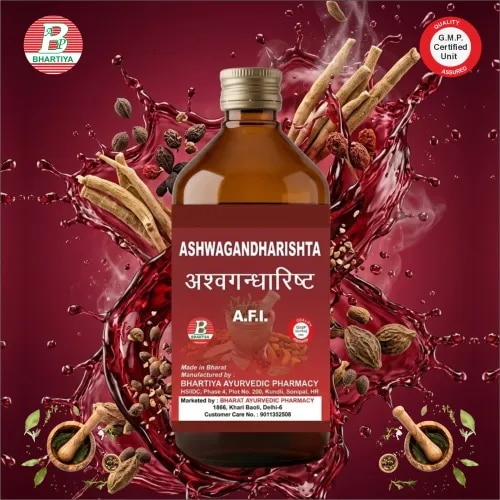
"name": "ASHWAGANDHARISHTA",
"description": " ASHWAGANDHARISHTA\n\n\nProduct Identification\nGeneric Name: Ashwagandharishta\nType: Ayurvedic Polyherbal Fermented Formulation (Arishta)\nPrimary Indication Area: Primarily used as a rejuvenative (Rasayana) and adaptogenic tonic for improving physical strength, mental well-being, nervous system health, vitality, and recovery from chronic weakness. It is commonly indicated in fatigue, stress, anxiety, debility, insomnia, convalescence, reduced immunity, sexual weakness, and age-related decline in strength and stamina.\n\nTherapeutic Indications\n•\tGeneral debility (Daurbalya) \n•\tChronic fatigue and physical exhaustion \n•\tStress and anxiety (Chittodvega) \n•\tNervous exhaustion \n•\tInsomnia and disturbed sleep \n•\tMuscle weakness and reduced stamina \n•\tAge-related decline in vitality \n•\tConvalescence following prolonged illness \n•\tReduced immunity \n•\tSexual weakness and reproductive debility (supportive therapy) \n•\tMild cognitive impairment associated with stress \n•\tLoss of appetite associated with chronic weakness \n\nKey Benefits\n•\tSupports healthy nervous system function and stress adaptation \n•\tPromotes physical strength, stamina, and endurance \n•\tHelps reduce fatigue and improves energy levels \n•\tSupports restful sleep and relaxation \n•\tEnhances mental clarity, memory, and concentration \n•\tSupports healthy immune function \n•\tActs as a rejuvenative (Rasayana) for overall vitality and longevity \n•\tSupports healthy reproductive function and vitality \n•\tHelps improve recovery following chronic illness and prolonged weakness \n•\tProvides antioxidant protection against oxidative stress \n\nFORMULA\nEach part contains:\n•\tAshwagandha (Withania somnifera) Root – 2.400 kg \n•\tMusali (Chlorophytum borivilianum) – 960 g \n•\tManjistha (Rubia cordifolia) – 480 g \n•\tHaritaki (Terminalia chebula) – 480 g \n•\tHaridra (Curcuma longa) – 480 g \n•\tDaruharidra (Berberis aristata) – 480 g \n•\tRasna (Pluchea lanceolata) – 480 g \n•\tVidari (Pueraria tuberosa) – 480 g \n•\tArjuna (Terminalia arjuna) – 480 g \n•\tMusta (Cyperus rotundus) – 480 g \n•\tChitraka (Plumbago zeylanica) – 384 g \n•\tTrivrit (Operculina turpethum) – 480 g \n•\tSveta Sariva (Hemidesmus indicus)-384 g\n•\tKrsna Sariva (Cyrptolepis buchanani)-384 g \n•\tShweta Chandana (Santalum album) – 384 g \n•\tRakta Chandana (Pterocarpus santalinus) – 384 g \n•\tVacha (Acorus calamus) – 384 g \n•\tWater – 98.304 L, reduced to 12.288 L \nPrakshepa Dravyas\n•\tMadhu (Honey) – 14.400 K g \n•\tDhataki Pushpa (Woodfordia fruticosa) – 768 g \n•\tShunthi (Zingiber officinale) – 96 g \n•\tMaricha (Piper nigrum) – 96 g\n•\tPippali (Piper longum) – 96 g\n•\tTvak (Cinnamomum verum) – 96 g\n•\tEla (Elettaria cardamomum) – 96 g\n•\tTejapatra (Cinnamomum tamala) – 96 g\n•\tPriyangu (Callicarpa macrophylla) – 96 g\n•\tNagakesara (Mesua ferrea) – 96 g\n\nIngredients\n1. Ashwagandha\nBotanical Name: Withania somnifera\n•\tRasa: Tikta, Kashaya, Madhura \n•\tGuna: Laghu, Snigdha \n•\tVirya: Ushna \n•\tVipaka: Madhura \n•\tPrabhava: Balya, Rasayana \nMechanism of Action\n•\tSupports adaptation to physical and mental stress. \n•\tEnhances muscle strength and endurance. \n•\tSupports healthy nervous system function. \n•\tPromotes restful sleep and relaxation. \n•\tProvides antioxidant and immunomodulatory activity. \n\n2. Musali\nBotanical Name: Chlorophytum borivilianum\n•\tRasa: Madhura \n•\tGuna: Guru, Snigdha \n•\tVirya: Sheeta \n•\tVipaka: Madhura \n•\tPrabhava: Vrishya, Balya \nMechanism of Action\n•\tImproves physical strength and stamina. \n•\tSupports reproductive health. \n•\tNourishes body tissues (Dhatus). \n•\tHelps reduce fatigue and debility. \n•\tActs as a rejuvenative tonic. \n\n3. Manjistha\nBotanical Name: Rubia cordifolia\n•\tRasa: Tikta, Kashaya, Madhura \n•\tGuna: Guru, Ruksha \n•\tVirya: Ushna \n•\tVipaka: Katu \n•\tPrabhava: Raktashodhaka \nMechanism of Action\n•\tSupports healthy blood purification. \n•\tPromotes healthy circulation. \n•\tProvides antioxidant protection. \n•\tHelps maintain normal inflammatory responses. \n•\tSupports skin and tissue health. \n\n4. Haritaki\nBotanical Name: Terminalia chebula\n•\tRasa: Pancharasa (except Lavana), predominantly Kashaya \n•\tGuna: Laghu, Ruksha \n•\tVirya: Ushna \n•\tVipaka: Madhura \n•\tPrabhava: Rasayana \nMechanism of Action\n•\tSupports digestion and metabolism. \n•\tPromotes bowel regularity. \n•\tEnhances nutrient absorption. \n•\tHelps eliminate metabolic waste. \n•\tActs as a rejuvenative. \n\n5. Haridra\nBotanical Name: Curcuma longa\n•\tRasa: Tikta, Katu \n•\tGuna: Laghu, Ruksha \n•\tVirya: Ushna \n•\tVipaka: Katu \n•\tPrabhava: Vishaghna \nMechanism of Action\n•\tSupports healthy inflammatory balance. \n•\tProvides antioxidant activity. \n•\tSupports liver function. \n•\tEnhances immune response. \n•\tProtects tissues from oxidative stress. \n\n6. Daruharidra\nBotanical Name: Berberis aristata\n•\tRasa: Tikta, Kashaya \n•\tGuna: Laghu, Ruksha \n•\tVirya: Ushna \n•\tVipaka: Katu \n•\tPrabhava: Krimighna \nMechanism of Action\n•\tSupports liver and metabolic health. \n•\tHelps maintain healthy blood glucose metabolism. \n•\tProvides antimicrobial activity. \n•\tSupports immune function. \n•\tPromotes healthy inflammatory balance. \n\n7. Rasna\nBotanical Name: Pluchea lanceolata\n•\tRasa: Tikta, Katu \n•\tGuna: Laghu, Snigdha \n•\tVirya: Ushna \n•\tVipaka: Katu \n•\tPrabhava: Vatahara \nMechanism of Action\n•\tSupports joint and muscle health. \n•\tHelps reduce stiffness. \n•\tPromotes mobility. \n•\tSupports recovery from muscular fatigue. \n•\tHelps maintain healthy inflammatory response. \n\n8. Vidari\nBotanical Name: Pueraria tuberosa\n•\tRasa: Madhura \n•\tGuna: Guru, Snigdha \n•\tVirya: Sheeta \n•\tVipaka: Madhura \n•\tPrabhava: Balya, Rasayana \nMechanism of Action\n•\tNourishes body tissues. \n•\tImproves stamina and vitality. \n•\tSupports reproductive health. \n•\tHelps recovery from chronic weakness. \n•\tPromotes overall rejuvenation. \n\n9. Arjuna\nBotanical Name: Terminalia arjuna\n•\tRasa: Kashaya \n•\tGuna: Laghu, Ruksha \n•\tVirya: Sheeta \n•\tVipaka: Katu \n•\tPrabhava: Hridya \nMechanism of Action\n•\tSupports healthy cardiac muscle function. \n•\tPromotes efficient circulation. \n•\tMaintains vascular integrity. \n•\tProvides antioxidant protection. \n•\tSupports cardiovascular wellness. \n\n10. Musta\nBotanical Name: Cyperus rotundus\n•\tRasa: Tikta, Katu, Kashaya \n•\tGuna: Laghu, Ruksha \n•\tVirya: Sheeta \n•\tVipaka: Katu \n•\tPrabhava: Deepana, Pachana \nMechanism of Action\n•\tSupports digestion and appetite. \n•\tPromotes healthy metabolism. \n•\tHelps relieve digestive discomfort. \n•\tMaintains gastrointestinal balance. \n•\tSupports nutrient assimilation. \n\n11. Chitraka\nBotanical Name: Plumbago zeylanica\n•\tRasa: Katu \n•\tGuna: Laghu, Tikshna, Ruksha \n•\tVirya: Ushna \n•\tVipaka: Katu \n•\tPrabhava: Deepana, Pachana \nMechanism of Action\n•\tStimulates digestive fire (Agni). \n•\tImproves digestion and nutrient absorption. \n•\tReduces Ama (metabolic toxins). \n•\tSupports healthy metabolism. \n•\tEnhances bioavailability of herbal constituents. \n\n12. Trivrit\nBotanical Name: Operculina turpethum\n•\tRasa: Tikta, Katu \n•\tGuna: Laghu, Snigdha, Tikshna \n•\tVirya: Ushna \n•\tVipaka: Katu \n•\tPrabhava: Rechana \nMechanism of Action\n•\tSupports natural detoxification. \n•\tPromotes bowel regularity. \n•\tHelps eliminate metabolic waste. \n•\tSupports digestive health. \n•\tMaintains healthy metabolism. \n\n13. Sveta Sariva\nBotanical Name: Hemidesmus indicus\n•\tRasa: Madhura, Tikta \n•\tGuna: Guru, Snigdha \n•\tVirya: Sheeta \n•\tVipaka: Madhura \n•\tPrabhava: Raktaprasadana \nMechanism of Action\n•\tSupports blood purification. \n•\tProvides cooling and rejuvenating effects. \n•\tHelps maintain healthy skin. \n•\tSupports immune function. \n•\tPromotes overall vitality. \n\n14. Krishna Sariva\nBotanical Name: Cryptolepis buchanani\n•\tRasa: Tikta, Kashaya \n•\tGuna: Guru, Snigdha \n•\tVirya: Sheeta \n•\tVipaka: Madhura \n•\tPrabhava: Balya \nMechanism of Action\n•\tSupports healthy joints and muscles. \n•\tHelps maintain normal inflammatory responses. \n•\tPromotes tissue nourishment. \n•\tSupports musculoskeletal health. \n•\tProvides antioxidant protection. \n\n15. Shweta Chandana\nBotanical Name: Santalum album\n•\tRasa: Tikta, Madhura \n•\tGuna: Laghu, Ruksha \n•\tVirya: Sheeta \n•\tVipaka: Katu \n•\tPrabhava: Pittashamaka \nMechanism of Action\n•\tProvides cooling effects. \n•\tSupports urinary health. \n•\tPromotes mental calmness. \n•\tHelps balance Pitta. \n•\tProvides antioxidant activity. \n\n16. Rakta Chandana\nBotanical Name: Pterocarpus santalinus\n•\tRasa: Tikta, Kashaya \n•\tGuna: Laghu, Ruksha \n•\tVirya: Sheeta \n•\tVipaka: Katu \n•\tPrabhava: Raktaprasadana \nMechanism of Action\n•\tSupports healthy circulation. \n•\tProvides antioxidant protection. \n•\tHelps maintain skin health. \n•\tSupports tissue healing. \n•\tHelps maintain normal inflammatory balance. \n\n17. Vacha\nBotanical Name: Acorus calamus\n•\tRasa: Katu, Tikta \n•\tGuna: Laghu, Tikshna \n•\tVirya: Ushna \n•\tVipaka: Katu \n•\tPrabhava: Medhya \nMechanism of Action\n•\tSupports cognitive function. \n•\tEnhances memory and concentration. \n•\tSupports nervous system health. \n•\tHelps reduce mental fatigue. \n•\tPromotes mental clarity. \n Prakshepa Dravyas\n1. Madhu (Honey)\nSource: Honey \n•\tRasa: Madhura, Kashaya Anurasa \n•\tGuna: Laghu, Ruksha \n•\tVirya: Sheeta \n•\tVipaka: Madhura \n•\tPrabhava: Yogavahi \nMechanism of Action\n•\tActs as a Yogavahi, enhancing the delivery and absorption of herbal constituents. \n•\tSupports tissue nourishment and rejuvenation. \n•\tProvides antioxidant and antimicrobial properties. \n•\tImproves the palatability of the formulation. \n•\tHelps preserve the fermented preparation. \n\n2. Dhataki Pushpa\nBotanical Name: Woodfordia fruticosa\n•\tRasa: Kashaya \n•\tGuna: Laghu, Ruksha \n•\tVirya: Sheeta \n•\tVipaka: Katu \n•\tPrabhava: Sandhaniya, Yogavahi \nMechanism of Action\n•\tActs as the natural fermenting agent in Arishta preparation. \n•\tFacilitates the formation of self-generated alcohol for efficient extraction of phytoconstituents. \n•\tImproves bioavailability of herbal constituents. \n•\tSupports preservation and stability of the formulation. \n•\tEnhances overall therapeutic efficacy through improved absorption. \n\n3. Shunthi\nBotanical Name: Zingiber officinale (Dry Rhizome)\n•\tRasa: Katu \n•\tGuna: Laghu, Snigdha \n•\tVirya: Ushna \n•\tVipaka: Madhura \n•\tPrabhava: Deepana, Pachana \nMechanism of Action\n•\tStimulates digestive fire (Agni). \n•\tImproves digestion and nutrient absorption. \n•\tHelps reduce Ama (metabolic toxins). \n•\tSupports healthy circulation and metabolism. \n•\tEnhances bioavailability of herbal constituents. \n\n4. Maricha\nBotanical Name: Piper nigrum\n•\tRasa: Katu \n•\tGuna: Laghu, Tikshna \n•\tVirya: Ushna \n•\tVipaka: Katu \n•\tPrabhava: Deepana, Lekhana \nMechanism of Action\n•\tStimulates digestion and metabolism. \n•\tEnhances intestinal absorption of phytoconstituents. \n•\tSupports respiratory health. \n•\tPromotes healthy circulation. \n•\tProvides antioxidant activity. \n\n5. Pippali\nBotanical Name: Piper longum\n•\tRasa: Katu \n•\tGuna: Laghu, Snigdha, Tikshna \n•\tVirya: Anushna (Mildly Ushna) \n•\tVipaka: Madhura \n•\tPrabhava: Rasayana \nMechanism of Action\n•\tSupports respiratory and digestive health. \n•\tEnhances absorption and bioavailability of herbal compounds. \n•\tPromotes rejuvenation and vitality. \n•\tSupports immune function. \n•\tHelps improve endurance and recovery. \n\n6. Tvak\nBotanical Name: Cinnamomum verum (Syn. Cinnamomum zeylanicum)\n•\tRasa: Katu, Tikta, Madhura \n•\tGuna: Laghu, Ruksha, Tikshna \n•\tVirya: Ushna \n•\tVipaka: Katu \n•\tPrabhava: Hridya \nMechanism of Action\n•\tSupports healthy digestion and metabolism. \n•\tPromotes healthy blood circulation. \n•\tProvides antioxidant activity. \n•\tHelps maintain healthy blood glucose metabolism. \n•\tImproves aroma and taste of the formulation. \n\n7. Ela\nBotanical Name: Elettaria cardamomum\n•\tRasa: Katu, Madhura \n•\tGuna: Laghu, Ruksha \n•\tVirya: Sheeta \n•\tVipaka: Madhura \n•\tPrabhava: Hridya \nMechanism of Action\n•\tSupports healthy digestion. \n•\tHelps reduce bloating and indigestion. \n•\tSupports respiratory health. \n•\tProvides antioxidant activity. \n•\tImproves aroma and palatability. \n\n8. Tejapatra\nBotanical Name: Cinnamomum tamala\n•\tRasa: Katu, Tikta, Kashaya \n•\tGuna: Laghu, Ruksha \n•\tVirya: Ushna \n•\tVipaka: Katu \n•\tPrabhava: Deepana \nMechanism of Action\n•\tStimulates appetite and digestion. \n•\tSupports healthy metabolism. \n•\tPromotes circulation. \n•\tProvides antioxidant protection. \n•\tEnhances the aromatic quality of the formulation. \n\n9. Priyangu\nBotanical Name: Callicarpa macrophylla\n•\tRasa: Kashaya, Madhura \n•\tGuna: Laghu, Ruksha \n•\tVirya: Sheeta \n•\tVipaka: Katu \n•\tPrabhava: Pittashamaka \nMechanism of Action\n•\tSupports healthy skin and blood. \n•\tHelps maintain normal inflammatory responses. \n•\tProvides antioxidant activity. \n•\tPromotes tissue healing. \n•\tContributes to the rejuvenative effects of the formulation. \n\n10. Nagakesara\nBotanical Name: Mesua ferrea\n•\tRasa: Kashaya, Tikta \n•\tGuna: Laghu, Ruksha \n•\tVirya: Sheeta \n•\tVipaka: Katu \n•\tPrabhava: Grahi, Raktastambhaka \nMechanism of Action\n•\tSupports healthy circulation and vascular integrity. \n•\tHelps maintain normal inflammatory responses. \n•\tProvides antioxidant protection. \n•\tSupports digestive health. \n•\tContributes to tissue repair and rejuvenation.\n Dosage\n•\tAdults: 15–30 ml \n•\tTwice daily after meals \n•\tDilute with an equal quantity of water (1:1 dilution is commonly recommended) \nCommon Usage Guidance\n•\tTake after meals to improve digestion and absorption. \n•\tShake well before use. \n•\tCan be used regularly as a Rasayana (rejuvenative) and adaptogenic tonic under the supervision of a qualified Ayurvedic physician. \n•\tThe duration of therapy generally ranges from 4–12 weeks, depending on the individual's condition and the physician's advice. \nImportant Notes\n•\tNot recommended during pregnancy or lactation unless advised by a qualified healthcare professional. \n•\tUse cautiously in individuals taking sedatives, antidiabetic medications, antihypertensive drugs, thyroid medications, or immunosuppressants, as Ashwagandha may influence their effects. \n•\tPatients with chronic medical conditions should use this formulation under the supervision of a qualified Ayurvedic physician or healthcare professional. \n•\tThis is a naturally fermented preparation and contains a small amount of self-generated alcohol, which enhances the extraction and absorption of herbal constituents. \n•\tDo not exceed the recommended dosage. \n•\tStore in a cool, dry place away from direct sunlight and keep the container tightly closed after use.\n\n\nashwagandharishta ke fayde\nashwagandharishta syrup benefits in hindi\nashwagandharishta syrup\nashwagandharishta kis kaam aati hai\nashwagandharishta benefits in hindi\nashwagandharishta uses in hindi\nashwagandharishta ayurvedic medicine uses\nashwagandharishta ayurveda\nashwagandharishta ayurvedic medicine uses in hindi\nashwagandharishta ayurvedic syrup uses in hindi\nashwagandharishta composition\nashwagandharishta expiry date\nashwagandharishta empty stomach\nashwagandharishta uses easy ayurveda\nashwagandharishta syrup expiry date\nashwagandharishta for women\nashwagandharishta fayde\nashwagandharishta flipkart\nashwagandharishta for weight gain\nashwagandharishta for heart\nashwagandharishta fayde in hindi\nashwagandharishta ke gun\nashwagandharishta hindi use\nashwagandharishta hindi mein\nashwagandharishta how to take\nashwagandharishta hai\nashwagandharishta how long to take\nashwagandharishta how to use\nashwagandharishta hamdard\nashwagandharishta in hindi\nashwagandharishta ingredients\nashwagandharishta ingredients in hindi\nashwagandharishta image\nashwagandharishta india\nashwagandharishta kaise piya jata hai\nashwagandharishta ke fayde hindi mein\nashwagandharishta kis kaam mein aata hai\nashwagandharishta mein kya-kya hota hai\nashwagandharishta mein kya-kya hai\nashwagandharishta meaning in hindi\nashwagandharishta me kya hota hai\nashwagandharishta near me\nashwagandharishta online\nashwagandharishta online buy\nashwagandharishta online price\nashwagandharishta peene ke fayde\nashwagandharishta price\nashwagandharishta peene se kya hota hai\nashwagandharishta powder\nashwagandharishta peene se kya-kya fayda hai\nashwagandharishta rate\nashwagandharishta ras\nashwagandharishta syrup kis kaam aata hai\nashwagandharishta special\nashwagandharishta syrup uses in hindi\nashwagandharishta syrup benefits\nashwagandharishta syrup uses\nashwagandharishta special benefits\nashwagandharishta syrup price",
"price": 192.0,
"discountamount": 96.0,
"currencycode": "INR",
"priority": 1000000,
"isfreeshipmentavailable": false,
"shipmentduration": 1,
"_keywords": null,
"isarchived": false,
"isavailable": true,
"applicationid": null,
"productindex": 158,
"imageuri": "https://productimages.withfloats.com/actual/6a58bbe4096fa165252ea2c3.jpg",
"tileimageuri": "https://productimages.withfloats.com/tile/6a58bbe4096fa165252ea2c3.jpg",
"images": null,
"totalqueries": 0,
"gpid": null,
"groupproductid": null,
"createdon": "2026-07-16T11:09:20.636Z",
"updatedon": "2026-07-16T11:09:20.636Z",
"buyonlinelink": null,
"producturl": "http://WWW.BHARTIYAAYURVEDICPHARMACY.COM//ashwagandharishta/158",
"availableunits": -1.0,
"iscodavailable": true,
"isprepaidonlineavailable": true,
"maxcodorders": -1,
"maxprepaidonlineorders": -1,
"uniquepaymenturl": null,
"brandname": "Bakula Fort",
"category": "ASHWAGANDHARISHTA 450 Ml X 40",
"tags": [],
"variants": false,
"keyspecification": null,
"otherspecifications": null,
"pickupaddressreferenceid": null,
"paymenttype": "AssuredPurchase",
"producttype": "products",
"hsncode": null,
"gstslab": 0.0,
"isnotforsale": false
},
{
"_id": "6a5869bc5a2a63b638185da4",
"fptag": "BHARTIYEAYURVEDICPHARMACY",
"merchantname": null,
"customwidgets": null,
"externalsourceid": null,
"name": "ARVINDASAVA",
"description": " \n ARVINDASAVA \n\n\nProduct Identification\nGeneric Name: Arvindasava\nType: Ayurvedic Polyherbal Formulation\nPrimary Indication Area: Primarily used as a pediatric growth-promoting and digestive tonic, indicated in children’s debility, poor appetite, delayed growth, recurrent digestive disturbances, and developmental weakness.\nTherapeutic Indications: \n•\tChronic constipation (mild to moderate laxative action) \n•\tHemorrhoids (Arsha / piles)—especially when associated with constipation and straining \n•\tIndigestion (Agnimandya) \n•\tAbdominal bloating and gas (flatulence) \n•\tGastrointestinal sluggishness / irregular bowel movements \n•\tGrahani (IBS-like conditions)—support in malabsorption and unstable digestion \n•\tLoss of appetite related to poor digestion \n•\tMild abdominal discomfort due to digestive imbalance\nKey Benefits\n•\tImproves appetite (Deepana effect) – enhances digestive fire in children and supports regular eating habits \n•\tPromotes healthy growth and development – supports physical weight gain and tissue nourishment \n•\tEnhances digestion and absorption – improves breakdown and utilization of nutrients \n•\tBoosts immunity – strengthens natural resistance against frequent infections \n•\tReduces general weakness and fatigue – improves energy levels in debilitated children \n•\tSupports healthy bowel function – helps regulate digestion and relieve mild constipation or indigestion \n•\tImproves overall vitality (Balya action) – acts as a general tonic for pediatric health \n•\tSupports recovery after illness – helps restore strength and appetite after infections or weakness \n•\tMild hematinic support – may help improve mild nutritional deficiency states \n•\tEnhances overall pediatric well-being – supports balanced growth and development patterns\nFORMULA \nEach part contains:\nArvinda (kamala)\t48 g\nUsira \t48 g\nGambhari \t48 g\nNilotpala (Utpala)\t48 g\nManjistha\t48 g\nEla \t48 g\nBala \t48 g\nJatamansi \t48 g\nMusta \t48 g\nSveta Sariva \t48 g\nHaritaki \t48 g\nBibhitaki \t48 g\nVach\t48 g\nAmalaki \t48 g\nSati \t48 g\nTrivrit \t48 g\nNili \t48 g\nPatala \t48 g\nParpata \t48 g\nArjuna \t48 g\nMadhuka\t48 g\nYasti\t48 g\nMurva \t48 g\nDraksha \t960 g\nDhataki \t768 g\nWater \t24.576 L\nSarkara \t4.800 kg \nMadhu \t2.400 kg \n\n\n\n\n\n\n\n\n\nIngredients:\n1. Arvinda (Nelumbo nucifera / Kamala)\n\n•\tRasa: Madhura, Kashaya\n•\tGuna: Guru, Snigdha\n•\t Virya: Sheeta\n•\t Vipaka: Madhura\n•\tPrabhava: Balya, Rasayana\nMechanism of Action:\n\n•\tPromotes growth and nourishment in children\n•\tEnhances tissue strength and vitality\n•\t Supports mental calmness and emotional balance\n•\tActs as primary rejuvenative herb in formulation\n•\tImproves immunity and resistance\n\n2. Usira (Vetiveria zizanioides)\n•\tRasa: Tikta, Madhura\n•\t Guna: Laghu, Ruksha\n•\tVirya: Sheeta\n•\t Vipaka: Madhura\n•\t Prabhava: Pitta shamaka, Stambhana\nMechanism of Action:\n\n•\tCools excessive body heat and inflammation\n•\t Reduces irritability and Pitta disorders\n•\t Supports skin and blood purification\n•\t Calms nervous system and improves stability\n•\t Helps detoxification via sweat and urine\n\n3. Gambhari (Gmelina arborea)\n•\tRasa: Madhura, Tikta\n•\t Guna: Guru, Snigdha\n•\tVirya: Sheeta\n•\tVipaka: Madhura\n•\t Prabhava: Balya, Rasayana\nMechanism of Action:\n\n•\tStrengthens tissues and muscle growth\n•\tReduces fatigue and weakness\n•\t Supports recovery after illness\n•\tEnhances nourishment in children\n•\t Balances Vata-induced debility\n\n4. Nilotpala (Nymphaea nouchali)\n\n•\tRasa: Madhura, Kashaya\n•\t Guna: Laghu, Snigdha\n•\tVirya: Sheeta\n•\t Vipaka: Madhura\n•\tPrabhava: Hridya, Medhya\nMechanism of Action:\n\n•\tCalms mind and reduces stress\n•\t Improves emotional balance\n•\t Supports cardiac and nervous system health\n•\t Enhances cognitive stability in children\n•\t Reduces Pitta-related irritation\n\n5. Manjistha (Rubia cordifolia)\n\n•\tRasa: Tikta, Kashaya\n•\tGuna: Guru, Ruksha\n•\t Virya: Ushna\n•\t Vipaka: Katu\n•\t Prabhava: Raktashodhaka\nMechanism of Action:\n\n•\tPurifies blood and lymphatic system\n•\t Improves skin health and complexion\n•\t Reduces chronic inflammation\n•\t Supports detoxification pathways\n•\tEnhances metabolic clearance\n\n6. Ela (Elettaria cardamomum)\n•\tRasa: Katu, Madhura\n•\t Guna: Laghu, Snigdha\n•\tVirya: Sheeta\n•\tVipaka: Madhura\n•\t Prabhava: Deepana, Hridya\nMechanism of Action:\n\n•\tImproves digestion and appetite\n•\t Reduces gas and bloating\n•\tSupports respiratory clarity\n•\t Enhances palatability of formulation\n•\t Calms digestive tract\n\n7. Bala (Sida cordifolia)\n•\tRasa: Madhura\n•\tGuna: Guru, Snigdha\n•\tVirya: Sheeta\n•\t Vipaka: Madhura\n•\tPrabhava: Balya, Vatahara\nMechanism of Action:\n•\tIncreases strength and muscle tone\n•\t Supports neuromuscular development\n•\t Reduces fatigue and weakness\n•\tEnhances growth in children\n•\t Balances Vata disorders\n\n8. Jatamansi (Nardostachys jatamansi)\n•\tRasa: Tikta, Kashaya\n•\t Guna: Laghu, Snigdha\n•\tVirya: Sheeta\n•\tVipaka: Katu\n•\tPrabhava: Medhya, Nidra janana\nMechanism of Action:\n\n•\tCalms nervous system and anxiety\n•\tImproves sleep quality\n•\t Enhances cognitive stability\n•\t Reduces stress-related imbalance\n•\t Supports brain function\n\n9. Musta (Cyperus rotundus)\n•\tRasa: Tikta, Katu\n•\t Guna: Laghu, Ruksha\n•\t Virya: Sheet\n•\t Vipaka: Katu\n•\t Prabhava: Deepana, Pachana\nMechanism of Action:\n\n•\tImproves digestion and metabolism\n•\t Reduces diarrhea and bloating\n•\t Controls gut inflammation\n•\t Prevents Ama formation\n•\t Supports digestive balance\n10. Sveta Sariva (Hemidesmus indicus)\n\n•\tRasa: Madhura, Tikta\n•\t Guna: Guru, Snigdha\n•\t Virya: Sheeta\n•\tVipaka: Madhura\n•\tPrabhava: Raktashodhaka, Pitta shamaka\nMechanism of Action:\n\n•\tPurifies blood and lymph\n•\t Reduces skin disorders and itching\n•\t Cools internal inflammation\n•\tSupports detoxification pathways\n•\tImproves complexion and skin health\n\n11. Haritaki (Terminalia chebula)\n\n•\tRasa: Pancha rasa (except Lavana)\n•\tGuna: Laghu, Ruksha\n•\tVirya: Ushna\n•\tVipaka: Madhura\n•\t Prabhava: Anulomana, Rasayana\nMechanism of Action:\n\n•\tRegulates bowel movement\n•\tRemoves accumulated toxins (Ama)\n•\t Improves digestion and absorption\n•\tSupports long-term gut health\n•\tEnhances immunity and resilience\n\n12. Bibhitaki (Terminalia bellirica)\n•\tRasa: Kashaya\n•\tGuna: Laghu, Ruksha\n•\tVirya: Ushna\n•\tVipaka: Madhura\n•\t Prabhava: Kapha-Pitta shamaka\nMechanism of Action:\n\n•\tCleanses respiratory and digestive channels\n•\t Reduces mucus and congestion\n•\tSupports detoxification of body fluids\n•\tImproves metabolic clearance\n•\t Enhances gut and respiratory health\n\n13. Vacha (Acorus calamus)\n•\tRasa: Katu, Tikta\n•\tGuna: Laghu, Tikshna\n•\tVirya: Ushna\n•\tVipaka: Katu\n•\t Prabhava: Medhya, Lekhana\nMechanism of Action:\n\n•\tEnhances cognitive function and speech\n•\t Improves digestion and appetite\n•\t Clears mental dullness\n•\tSupports nervous system stimulation\n•\t Helps in toxin removal\n\n14. Amalaki (Emblica officinalis)\n•\tRasa: Amla pradhana\n•\t Guna: Laghu, Ruksha\n•\tVirya: Sheeta\n•\tVipaka: Madhura\n•\tPrabhava: Rasayana\nMechanism of Action:\n\n•\tStrong antioxidant and rejuvenator\n•\t Improves immunity and tissue repair\n•\t Supports digestion and metabolism\n•\tEnhances growth and vitality\n•\t Protects liver and systemic health\n\n15. Sati (Hedychium spicatum)\n•\tRasa: Katu, Tikta\n•\t Guna: Laghu, Ruksha\n•\t Virya: Ushna\n•\tVipaka: Katu\n•\t Prabhava: Deepana, Shwasahara\nMechanism of Action:\n\n•\tImproves digestion and metabolism\n•\tSupports respiratory clearance\n•\t Reduces congestion and mucus\n•\t Enhances appetite\n•\t Helps in toxin metabolism\n\n16. Trivrit (Operculina turpethum)\n\n•\tRasa: Katu, Tikta\n•\tGuna: Laghu, Ruksha\n•\t Virya: Ushna\n•\t Vipaka: Katu\n•\tPrabhava: Rechana (purgative)\nMechanism of Action:\n\n•\tSupports bowel cleansing\n•\t Removes deep-seated toxins\n•\t Improves gut detoxification\n•\t Helps in metabolic clearance\n•\t Balances Pitta disorders\n\n17. Nili (Indigofera tinctoria)\n•\tRasa: Tikta\n•\t Guna: Laghu, Ruksha\n•\tVirya: Sheeta\n•\tVipaka: Katu\n•\t Prabhava: Raktashodhaka\nMechanism of Action:\n\n•\tPurifies blood and skin\n•\t Reduces inflammatory conditions\n•\t Supports liver detoxification\n•\tImproves complexion\n•\t Helps in chronic skin disorders\n18. Patala (Stereospermum suaveolens)\n\n•\tRasa: Tikta, Kashaya\n•\tGuna: Laghu\n•\t Virya: Ushna\n•\t Vipaka: Katu\n•\tPrabhava: Vata-Kapha shamaka\nMechanism of Action:\n\n•\tReduces body pain and stiffness\n•\tSupports anti-inflammatory activity\n•\t Improves circulation and tissue flow\n•\tHelps in detoxification of metabolic waste\n•\t Balances Vata-related discomfort\n\n19. Parpata (Fumaria indica)\n•\tRasa: Tikta\n•\t Guna: Laghu, Ruksha\n•\tVirya: Sheeta\n•\t Vipaka: Katu\n•\tPrabhava: Raktashodhaka\nMechanism of Action:\n\n•\tPurifies blood and liver detox pathways\n•\t Reduces skin inflammation and eruptions\n•\t Supports bile regulation and metabolism\n•\t Helps in chronic fever-like conditions\n•\t Clears internal heat (Pitta balance)\n\n20. Arjuna (Terminalia arjuna)\n•\tRasa: Kashaya\n•\t Guna: Laghu, Ruksha\n•\tVirya: Sheeta\n•\tVipaka: Katu\n•\tPrabhava: Hridya, Balya\nMechanism of Action:\n\n•\tStrengthens heart and muscle tissue\n•\t Improves endurance and vitality\n•\t Supports circulation and oxygenation\n•\t Enhances recovery from weakness\n•\tActs as systemic tonic\n\n21. Madhuka (Glycyrrhiza glabra / Yashtimadhu variant in some texts)\n\n•\tRasa: Madhura\n•\t Guna: Guru, Snigdha\n•\tVirya: Sheeta\n•\t Vipaka: Madhura\n•\tPrabhava: Varnya, Balya\nMechanism of Action:\n\n•\tSoothes mucosal and digestive lining\n•\t Reduces inflammation and irritation\n•\t Supports respiratory and throat health\n•\t Enhances tissue nourishment\n•\tImproves immunity and vitality\n\n22. Yashti (Glycyrrhiza glabra)\n•\tRasa: Madhura\n•\tGuna: Guru, Snigdha\n•\tVirya: Sheeta\n•\t Vipaka: Madhura\n•\t Prabhava: Rasayana, Varnya\nMechanism of Action:\n\n•\tSupports hormonal and metabolic balance\n•\t Improves digestion and gut healing\n•\tReduces inflammation in tissues\n•\tEnhances immunity and strength\n•\tPromotes recovery and rejuvenation\n\n23. Murva (Marsdenia tenacissima)\n•\tRasa: Tikta, Kashaya\n•\t Guna: Laghu, Ruksha\n•\tVirya: Ushna\n•\t Vipaka: Katu\n•\t Prabhava: Krimighna, Raktashodhaka\nMechanism of Action:\n\n•\tSupports detoxification of blood\n•\t Helps in microbial and parasitic balance\n•\tImproves liver and metabolic function\n•\tReduces inflammatory load\n•\tSupports skin and tissue cleansing\n\n24. Draksha (Vitis vinifera)\n•\tRasa: Madhura\n•\tGuna: Snigdha, Guru\n•\t Virya: Sheeta\n•\tVipaka: Madhura\n•\tPrabhava: Balya, Hridya\nMechanism of Action:\n•\tProvides natural energy and nourishment\n•\t Improves digestion and strength\n•\tSupports blood formation\n•\tEnhances recovery from weakness\n•\tActs as mild rejuvenator\n\n25. Dhataki (Woodfordia fruticosa)\n•\tRasa: Kashaya\n•\t Guna: Laghu, Ruksha\n•\tVirya: Ushna\n•\tVipaka: Katu\n•\t Prabhava: Sandhana karaka\nMechanism of Action:\n\n•\tInitiates fermentation process\n•\t Enhances extraction of herbal actives\n•\t Improves potency and stability\n•\tActs as natural fermenting agent\nSupports formation of therapeutic alcohol base\n\n26. Water (Jala)\n\n•\tRasa: Madhura (natural quality)\n•\t Guna: Laghu, Snigdha\n•\tVirya: Sheeta\n•\tVipaka: Madhura\n•\t Prabhava: Anupana, Yogavahi\nMechanism of Action:\n\n•\tActs as extraction medium\n•\t Supports decoction and fermentation\n•\t Enhances bioavailability of herbs\n•\t Maintains formulation consistency\n•\t Helps in proper herbal infusion\n\n27. Sarkara (Sugar)\n\n•\tRasa: Madhura\n•\tGuna: Guru\n•\t Virya: Sheeta\n•\t Vipaka: Madhura\n•\t Prabhava: Yogavahi, Sandhana karaka\nMechanism of Action:\n•\tProvides fermentation substrate\n•\tEnhances palatability of formulation\n•\t Supports energy and nourishment\n•\t Improves extraction of herbal actives\n•\t Stabilizes fermentation process\n\n28. Madhu (Honey)\n\n•\tRasa: Madhura, Kashaya\n•\t Guna: Laghu, Ruksha\n•\tVirya: Sheeta\n•\t Vipaka: Madhura\n•\t Prabhava: Yogavahi, Lekhana\nMechanism of Action:\n\n•\tEnhances delivery of herbal compounds\n•\t Supports immune modulation\n•\tImproves digestion and absorption\n•\t Acts as natural preservative\n•\t Aids detoxification and channel cleansing\n\nDosage of Arvindasava\nAdults\n• 15–30 ml\n• Twice daily (BID)\nChildren\n• 3–6 ml\n• Twice daily\nInfants (special case only)\n• 10–20 drops\n• 2–3 times daily (only under strict Ayurvedic supervision)\n\nHow to Take\n• Always after food (post-meal)\n• Mix with equal quantity of water (1:1 dilution)\n• Shake well before use\n\nDuration\n• Commonly 4–12 weeks depending on condition\n• Can be continued longer in children for growth support under supervision\n\nImportant Precautions\n•\tAvoid taking on an empty stomach (may cause gastric irritation)\n•\tUse caution in diabetes (contains sugar/jaggery base\n•\tDo not exceed recommended dose\n•\t Prefer physician supervision for infants and chronic illness\n\n",
"price": 192.0,
"discountamount": 96.0,
"currencycode": "INR",
"priority": 1000000,
"isfreeshipmentavailable": false,
"shipmentduration": 1,
"_keywords": null,
"isarchived": false,
"isavailable": true,
"applicationid": null,
"productindex": 156,
"imageuri": "https://productimages.withfloats.com/actual/6a5869be1b18f4defa166f50.jpg",
"tileimageuri": "https://productimages.withfloats.com/tile/6a5869be1b18f4defa166f50.jpg",
"images": null,
"totalqueries": 0,
"gpid": null,
"groupproductid": null,
"createdon": "2026-07-16T05:18:52.273Z",
"updatedon": "2026-07-16T05:18:52.273Z",
"buyonlinelink": null,
"producturl": "http://WWW.BHARTIYAAYURVEDICPHARMACY.COM//arvindasava/156",
"availableunits": -1.0,
"iscodavailable": true,
"isprepaidonlineavailable": true,
"maxcodorders": -1,
"maxprepaidonlineorders": -1,
"uniquepaymenturl": null,
"brandname": "Bakula Fort",
"category": "ARVINDASAVA 450 ML X 40",
"tags": [],
"variants": false,
"keyspecification": null,
"otherspecifications": null,
"pickupaddressreferenceid": null,
"paymenttype": "AssuredPurchase",
"producttype": "products",
"hsncode": null,
"gstslab": 0.0,
"isnotforsale": false
},
{
"_id": "69afa519bf4e24909aec2e8e",
"fptag": "BHARTIYEAYURVEDICPHARMACY",
"merchantname": null,
"customwidgets": null,
"externalsourceid": null,
"name": "Salai guggal capsule",
"description": " SALAI GUGGUL \n\n SALAI GUGGUL (Boswellia serrata Roxb.) \nThe Natural Anti-Inflammatory & Joint Protector\n“Shallaki / Indian Frankincense”\nSalai Guggul is one of Ayurveda’s most powerful Shothahara (anti-inflammatory) and Vedanasthapana (pain-relieving) herbs. Revered for its exceptional ability to reduce joint inflammation, improve mobility, and protect cartilage, it is widely used in arthritis, joint degeneration, musculoskeletal pain, and inflammatory disorders.\n\n CLASSICAL AYURVEDIC REFERENCES\nCharaka Samhita\n• Mentioned among Shothahara Dravya’s for inflammatory conditions\n• Described as Vata-Kapha shamaka and Sandhishoolahara\nSushruta Samhita\n• Recommended in Sandhigata Vata, joint swelling, and pain disorders\n• Used in Vatavyadhi and traumatic inflammation\nBhavaprakasha Nighantu\n• Described as Shallaki – Shothahara, Vedanasthapana, Balya\n• Especially beneficial in joint and musculoskeletal disorders\n CLASSICAL STORY / ANECDOTE\nTraditional Ayurvedic physicians observed that the resin of the Salai tree exudes naturally to heal wounds and protect the tree from injury.\nThis self-protective and healing nature inspired its use in joint inflammation and tissue degeneration, where it “protects and restores” internal structures just as it does externally.\n\n BOTANICAL INFORMATION OF SALAI GUGGUL\nScientific Name: Boswellia serrata Roxb.\nFamily: Burseraceae\nOrder: Sapindales\nGenus: Boswellia\nSpecies: serrata\n\nCommon Names\nSanskrit: Shallaki\nHindi: Salai Guggul \nEnglish: Indian Frankincense\nTamil: Parangisambirani\nTelugu: Anduguggilam\nKannada: Chandra Dhoopa\nBengali: Salai Guggal\n\n SYNONYMS IN CLASSICAL AYURVEDIC NIGHANTUS\n Charaka Samhita: Shallaki – Shothahara\n Sushruta Samhita: Salai – Vatashamaka\n• Bhavaprakasha: Shallaki – Vedanasthapana, Balya\n MORPHOLOGY OF SALAI GUGGUL\n• Plant Type: Medium-sized deciduous tree\n• Bark: Thin, papery, exfoliating\n• Resin: Aromatic oleo-gum-resin (Salai Guggul)\n• Leaves: Pinnate, serrated\n• Flowers: Small, white\n• Taste: Bitter, astringent\n\n ECOLOGICAL PREFERENCES\n• Climate: Dry tropical\n• Soil: Rocky, well-drained soil\n• Habitat: Dry forests, hills\n• Sunlight: Full sun\n• Altitude: Up to 1200 m\n\n GEOGRAPHICAL DISTRIBUTION\n• India: Rajasthan, Madhya Pradesh, Gujarat, Maharashtra, Andhra Pradesh\n• Outside India: Africa, Middle East\n\n CLASSICAL AYURVEDIC PROPERTIES\n(RASA–GUNA–VIRYA–VIPAKA)\n• Rasa (Taste): Tikta (bitter), Kashaya (astringent)\n• Guna (Qualities): Laghu (light), Ruksha (dry)\n• Virya (Potency): Ushna (heating)\n• Vipaka: Katu (pungent)\nDosha Effect\n• Vata–Kapha hara\n• Excess use may aggravate Pitta\n\n THERAPEUTIC ACTIONS (KARMA)\n Shothahara – Reduces inflammation\n Vedanasthapana – Relieves pain\n Sandhishoolahara – Alleviates joint pain\n Balya – Strengthens joints and muscles\n Amapachana – Digests metabolic toxins\n Vranaropana – Supports healing\n INDICATIONS\n• Osteoarthritis\n• Rheumatoid arthritis\n• Joint pain and stiffness\n• Cervical & lumbar spondylosis\n• Sports injuries\n• Tendinitis and bursitis\n• Inflammatory musculoskeletal disorders\n\n MODERN PHARMACOLOGY & PHYTOCHEMISTRY\nMajor Constituents\n• Boswellic acids (AKBA)\n• Triterpenoids\n• Essential oils\n• Resin acids\nPharmacological Actions\n• Potent anti-inflammatory\n• Anti-arthritic\n• Analgesic\n• Cartilage protective\n• Anti-degenerative\n\n CULTIVATION DETAILS\n• Propagation: Seeds\n• Harvesting: Resin tapping after tree maturity\n• Collection Season: Summer\n• Processing: Purification and drying\n\n CLASSICAL DOSAGE (Ayurvedic Practice)\n• Powder (Churna): 1–3 g/day\n• Decoction (Kwatha): 30–60 ml/day\n• Capsules/Tablets: As prescribed\n• External Application: Oil or paste as required\n\n SALAI GUGGUL FORMULATIONS\nBhartiya Ayurvedic Pharmacy\nBhartiya Ayurvedic Pharmacy prepares authentic Salai Guggul formulations following classical Ayurvedic principles to support joint health, inflammation control, and musculoskeletal strength.\n\n SALAI GUGGUL CAPSULE \nPrepared using premium quality Boswellia serrata resin extract, standardized for optimal boswellic acid content.\nKey Benefits\n• Reduces joint inflammation\n• Relieves pain and stiffness\n• Improves mobility\n• Protects cartilage\n• Supports arthritis management\nDosage\n• Adults: 1–2 capsules twice daily with warm water\n• Or as directed by an Ayurvedic physician\nSafety & Precautions\n• Safe for long-term use under guidance\n• Use cautiously in high Pitta conditions\nFormulation Highlights\n• 100% pure Salai Guggul extract\n• No artificial additives or preservatives\n• Classical Ayurvedic processing\n\n SALAI GUGGUL POWDER \nPrepared from purified, shade-dried Salai Guggul resin, retaining its natural anti-inflammatory potency.\nKey Benefits\n• Reduces swelling and pain\n• Strengthens joints\n• Improves flexibility\n• Supports inflammatory balance\nDosage\n• Adults: 1–3 g daily\n• Take with warm water or honey\n• Or as advised by an Ayurvedic physician\nSafety & Precautions\n• Excess use may increase Pitta\n• Store in a cool, dry place\nFormulation Highlights\n• 100% pure Salai Guggul resin\n• No fillers or chemicals\n• Traditionally processed\n\n\n\nguggul capsules benefits, guggul how to use\nguggul is used for, guggul medicine uses\nguggul weight loss, guggul weight loss reviews\nguggulu capsules, salai guggal capsule amazon\nsalai guggal capsule ayurvedic, salai guggal capsule benefits\nsalai guggal capsule benefits in hindi, salai guggal capsule buy online\nsalai guggal capsule company, salai guggal capsule company name\nsalai guggal capsule composition, salai guggal capsule content\nsalai guggal capsule cost, salai guggal capsule details\nsalai guggal capsule details in hindi, salai guggal capsule dose\nsalai guggal capsule dose per day, salai guggal capsule download\nsalai guggal capsule easy ayurveda, salai guggal capsule english\nsalai guggal capsule english name, salai guggal capsule extract\nsalai guggal capsule for hair, salai guggal capsule for hair growth\nsalai guggal capsule for skin, salai guggal capsule for weight loss\nsalai guggal capsule goli, salai guggal capsule green world\nsalai guggal capsule gst number, salai guggal capsule gst rate\nsalai guggal capsule gujarati, salai guggal capsule hindi\nsalai guggal capsule hindi name, salai guggal capsule how to use\nsalai guggal capsule image, salai guggal capsule in english\nsalai guggal capsule in hindi, salai guggal capsule in india\nsalai guggal capsule indiamart, salai guggal capsule ke fayde\nsalai guggal capsule ke fayde in hindi, salai guggal capsule life\nsalai guggal capsule manufacturer, salai guggal capsule manufacturers in india\nsalai guggal capsule manufacturing company, salai guggal capsule name\nsalai guggal capsule name in hindi, salai guggal capsule near me\nsalai guggal capsule online, salai guggal capsule online order\nsalai guggal capsule online purchase, salai guggal capsule online shopping\nsalai guggal capsule original, salai guggal capsule price\nsalai guggal capsule price in india, salai guggal capsule rate\nsalai guggal capsule review, salai guggal capsule review in hindi\nsalai guggal capsule side effects, salai guggal capsule side effects in hindi\nsalai guggal capsule uses, salai guggal capsule uses in hindi",
"price": 450.0,
"discountamount": 225.0,
"currencycode": "INR",
"priority": 1000000,
"isfreeshipmentavailable": false,
"shipmentduration": 1,
"_keywords": null,
"isarchived": false,
"isavailable": true,
"applicationid": null,
"productindex": 77,
"imageuri": "https://productimages.withfloats.com/actual/69afa520f73acb380293150b.jpg",
"tileimageuri": "https://productimages.withfloats.com/tile/69afa520f73acb380293150b.jpg",
"images": null,
"totalqueries": 0,
"gpid": null,
"groupproductid": null,
"createdon": "2026-03-10T04:59:05.318Z",
"updatedon": "2026-03-10T04:59:05.318Z",
"buyonlinelink": null,
"producturl": "http://WWW.BHARTIYAAYURVEDICPHARMACY.COM//salai-guggal-capsule/77",
"availableunits": -1.0,
"iscodavailable": true,
"isprepaidonlineavailable": true,
"maxcodorders": -1,
"maxprepaidonlineorders": -1,
"uniquepaymenturl": null,
"brandname": "Bakula fort",
"category": "Salai guggal capsule 60-cap x 24",
"tags": [],
"variants": false,
"keyspecification": null,
"otherspecifications": null,
"pickupaddressreferenceid": null,
"paymenttype": "AssuredPurchase",
"producttype": "products",
"hsncode": null,
"gstslab": 0.0,
"isnotforsale": false
},
{
"_id": "69abe347e762637e8ffc6f29",
"fptag": "BHARTIYEAYURVEDICPHARMACY",
"merchantname": null,
"customwidgets": null,
"externalsourceid": null,
"name": "Tulsi capsule",
"description": " TULSI (Ocimum sanctum / Ocimum tenuiflorum)\n The Sacred, Divine & Healing Herb of Ayurveda\nTulsi, also known as Holy Basil, is one of the most revered Ayurvedic herbs, worshipped for thousands of years for its spiritual purity, healing power, and protective energy. The name Tulsi means “the incomparable one,” signifying its unmatched medicinal and spiritual importance. In Ayurveda, Tulsi is described as Kaphahara, Vatahara, Hridya, Kasa-Shwasahara, Krimighna, Jwaraghna, and Rasayana. It is highly beneficial in respiratory infections, fever, cough, cold, asthma, immune weakness, digestive problems, skin disorders, stress, and mental imbalance.\n BOTANICAL INFORMATION\nScientific Name : Ocimum sanctum / Ocimum tenuiflorum\nFamily : Lamiaceae\nOrder : Lamiales\nGenus : Ocimum\nSpecies : sanctum / tenuiflorum\nCommon Names :\nSanskrit – Tulsi, Surasa, Parnasa, Gramya-jiraka\nHindi – Tulsi\nEnglish – Holy Basil, Sacred Basil\nTamil – Thulasi\nTelugu – Tulasi\nMalayalam – Tulasi\nKannada – Tulasi\nBengali – Tulshi\nTypes of Tulsi:\n1.\tShri (Green) Tulsi\n2.\tKrishna (Purple) Tulsi\n3.\tVan Tulsi (Wild)\n4.\tKapoor Tulsi (Aromatic)\n5.\tRama Tulsi\n SYNONYMS FROM AYURVEDIC NIGHANTUS\nBhavaprakasha – Tulasi, Surasa, Parnasa\nDhanvantari Nighantu – Tulasi, Mahoshadhi\nKaiyadeva Nighantu – Surasa, Vishaghni\nRaja Nighantu – Tulsi, Krishna Tulsi, Shyamala\n MORPHOLOGY\nPlant Type: Aromatic, erect, highly branched perennial herb\nStem: Quadrangular, purplish or green, soft and slightly hairy\nLeaves: Simple, opposite, ovate or elliptical, highly aromatic, serrated edges\nFlowers: Small, purplish or white, in elongated spikes\nRoots: Fibrous, branched, aromatic\nFruits: Tiny nutlets containing small seeds\n ECOLOGICAL PREFERENCES\nClimate – Tropical & subtropical\nSoil – Well-drained, loamy\nSunlight – Full sun exposure\nMoisture – Moderate watering\nAltitude – Up to 1800 m\nHabitat – Courtyards, temples, gardens, wild areas\n DISTRIBUTION\nWidely found throughout India; also present in Nepal, Sri Lanka, Bangladesh, Indonesia; naturalized worldwide due to religious and medicinal importance.\n CLASSICAL AYURVEDIC PROPERTIES\nRasa : Katu (pungent), Tikta (bitter)\nGuna : Laghu (light), Ruksha (dry), Tikshna (sharp)\nVirya : Ushna (hot)\nVipaka : Katu (pungent)\nDosha Effect : Kapha-Vata shamaka\nKarma (Therapeutic Actions):\nKasa-Shwasahara, Jwaraghna, Krimighna, Hridya, Vishaghna, Rasayana, Balya\n HISTORICAL REFERENCES & STORIES\nVedic Era: Mentioned in Rigveda and Atharva Veda as a herb of purity, protection, and healing.\nCharaka Samhita: Used for Kasa (cough), Shwasa (asthma), Jwara (fever), Krimi (infection), Hridroga (heart disorders).\nSushruta Samhita: Used for skin diseases, poisoning, Kapha disorders, and wound cleansing.\nAshtanga Hridaya: Praised for balancing Kapha, enhancing digestion, boosting intelligence and longevity.\nStory : In ancient texts, a kingdom was protected from epidemic by planting and worshipping Tulsi; it became known as “Vishnu Priya” – beloved of Lord Vishnu, symbolizing purification and protection.\nBhavaprakasha Nighantu: Describes Tulsi as Tikshna, Ushna, Vishaghni, Swasahara, Jwarahara, Rasayana.\n MODERN PHYTOCHEMISTRY\nContains Eugenol, Ursolic acid, Rosmarinic acid, Caryophyllene, Ocimarin, Flavonoids (apigenin, luteolin), essential oils (methyl chavicol, linalool).\n CULTIVATION\nPropagated by seeds, sown in spring or monsoon. Requires sunlight, organic manure; leaves harvested after 2–3 months.\n CLASSICAL DOSAGE (ACCORDING TO GRANATHAS)\n•\tTulsi Churna (Powder) : 1–3 g, twice daily\n•\tTulsi Swarasa (Juice) : 10–15 ml, 1–2 times daily\n•\tTulsi Kwatha (Decoction) : 30–50 ml, twice daily\n•\tTulsi Patra (Leaves) : 5–10 fresh leaves daily\n•\tTulsi Ark : 10–20 ml daily\n•\tTulsi Tablet : 1–2 tablets, twice daily after meals\n•\tTulsi Capsule : 1 capsule, twice daily with warm water after meals\n THERAPEUTIC INDICATIONS\nCough, cold, asthma, fever, viral/bacterial infections, respiratory congestion, stress, anxiety, digestion issues, skin diseases, heart support, immunity enhancement, insect bites, poisoning.\n SAFETY & PRECAUTIONS\nSafe in recommended doses. \nUse cautiously during pregnancy (high doses). \nAvoid with strong anticoagulant drugs. \nSuitable for long-term daily use in small doses.\nTulsi Compound Formulations (Classical): Tulsi with Sitopaladi, Trikatu, Chyawanprash, Ginger & Black Pepper, or Honey/Jaggery—used for cough, asthma, digestion, immunity, and rejuvenation, prepared as per classical Ayurvedic methods.\n Tulsi Formulations by Bhartiya Ayurvedic Pharmacy\nAt Bhartiya Ayurvedic Pharmacy, we prepare a range of Tulsi formulations following classical Ayurvedic methods as described in Charaka Samhita, Sushruta Samhita, Bhavaprakasha Nighantu, and other Ayurvedic Granthas. Each product is crafted to retain the therapeutic potency, purity, and efficacy of the herb, ensuring benefits for immunity, respiratory health, stress relief, and overall vitality\n TULSI TABLET\nDosage :\n1–2 tablets twice daily after meals.\nIndications:\nCough, cold, throat congestion, asthma, fever, low immunity, stress, digestive weakness, skin infections, Kapha disorders, seasonal allergies.\nKey Actions (According to Acharya) :\nKasa-Shwasahara, Jwaraghna, Krimighna, Vishaghna, Rasayana, Kapha-Vata Hara.\n TULSI CAPSULE\nDosage :\n1 capsule twice daily with warm water after meals.\nIndications :\nChronic cough, respiratory infections, viral fevers, allergic rhinitis, immunity booster, stress, indigestion, heart support, detoxification.\nKey Ayurvedic Benefits :\nStrengthens lungs, clears Kapha, improves digestion, supports heart, enhances natural immunity (Ojas).\n TULSI (PATRA) POWDER (CHURNA)\nDosage (Classical):\n1–3 grams twice daily with warm water or honey.\nIndications:\nCold, cough, asthma, fever, indigestion, parasites, skin disorders, stress, mental fatigue, oral infections.\nClassical References:\nCharaka – Kasa, Shwasa, Jwara, Hridroga\nSushruta – Krimighna, Vrana Shodhana\nBhavaprakasha – Vishaghna, Rasayana, Swasa-Kasa Hara\n\n\nbenefits of tulsi capsules, best tulsi capsules\nbest tulsi cough syrup, can tulsi cure dry cough\ncan tulsi cure fever, does tulsi cause constipation\ndoes tulsi contains caffeine, tulasi capsule\ntulsi capsule benefits, tulsi capsule jan aushadhi kendra\ntulsi capsule jind haryana, tulsi capsule jyoti\ntulsi capsule ke fayde, tulsi capsule manufacturer\ntulsi capsule manufacturers in india\ntulsi capsule organic india, tulsi capsule price\ntulsi capsule quality, tulsi capsule quantity\ntulsi capsule weight loss, tulsi capsule wholesale\ntulsi capsule with benefits, tulsi capsule with price\ntulsi capsule with warm water, tulsi capsule work\ntulsi capsules benefits, tulsi capsules benefits in hindi\ntulsi capsules organic india, tulsi capsules planet ayurveda\ntulsi extract capsules, tulsi forte capsule, tulsi ke capsule\ntulsi plus capsule ke fayde, tulsi plus capsule price\ntulsi plus capsule uses, tulsi plus capsule uses in hindi",
"price": 300.0,
"discountamount": 150.0,
"currencycode": "INR",
"priority": 1000000,
"isfreeshipmentavailable": false,
"shipmentduration": 1,
"_keywords": null,
"isarchived": false,
"isavailable": true,
"applicationid": null,
"productindex": 74,
"imageuri": "https://productimages.withfloats.com/actual/69abe349ce30eb0364cd92f8.jpg",
"tileimageuri": "https://productimages.withfloats.com/tile/69abe349ce30eb0364cd92f8.jpg",
"images": null,
"totalqueries": 0,
"gpid": null,
"groupproductid": null,
"createdon": "2026-03-07T08:35:19.132Z",
"updatedon": "2026-03-07T08:35:19.132Z",
"buyonlinelink": null,
"producturl": "http://WWW.BHARTIYAAYURVEDICPHARMACY.COM//tulsi-capsule/74",
"availableunits": -1.0,
"iscodavailable": true,
"isprepaidonlineavailable": true,
"maxcodorders": -1,
"maxprepaidonlineorders": -1,
"uniquepaymenturl": null,
"brandname": "Bakula Fort",
"category": "Tulsi capsule 60-cap x 24",
"tags": [],
"variants": false,
"keyspecification": null,
"otherspecifications": null,
"pickupaddressreferenceid": null,
"paymenttype": "AssuredPurchase",
"producttype": "products",
"hsncode": null,
"gstslab": 0.0,
"isnotforsale": false
}
],
"hasmoreitems": false,
"isapirequest": false,
"totalresults": 27,
"query": null,
"floatingpoint": null
}